
Abstract
Since November 2019, each country in the world has been affected by COVID-19, which has claimed more than four million lives. As an infectious disease, COVID-19 has a stronger transmission power and faster propagation speed. In fact, environmental noise is an inevitable important factor in the real world. This paper mainly gives a new random infectious disease system under infection rate environmental noise. We give the existence and uniqueness of the solution of the system and discuss the ergodic stationary distribution and the extinction conditions of the system. The probability density function of the stochastic system is studied. Some digital simulations are used to demonstrate the probability density function and the extinction of the system.
1. Introduction
So far, infectious diseases have become one of the important factors endangering human health. Medical research shows that there are three outcomes of any infectious disease: the first is that the infectious virus is eliminated by human drugs; the second is that the virus exists only in a small area, such as Ebola, SARS (severe acute respiratory syndrome), and so on; the third is the long-term coexistence of viruses and humans, such as influenza, AIDS (acquired immunodeficiency syndrome), and so on [1].
In order to describe the dynamic behavior of the epidemic, mathematical modeling is considered to be an important tool [2]. According to the occurrence, transmission, and development law of infectious disease in the population, Mathematicians and ecologists have established several epidemic models to study and control various epidemics [3,4,5]. The authors gave the dynamics and stationary distribution of the hepatitis E model. Meanwhile, the authors obtained the optimal control analysis and the Atangana–Baleanu derivative for the dynamical analysis of the hepatitis E model in [6]. Through the qualitative analysis and numerical simulation of the dynamic behavior of the infectious disease model [7], the authors gave an exact expression of the probability density function of the stochastic model SVI (susceptible, vaccinated, infectious) around the unique endemic equilibrium of the deterministic system by solving the corresponding Fokker–Planck equation, which is guaranteed by a new critical value in [8], and other models, such as SIR (susceptible, infectious, recovered), SIRS (susceptible, infectious, recovered, susceptible), SEIR (susceptible, exposed, infectious, recovered), etc. [9,10].
Since November 2019, the world has been enveloped in COVID-19 (coronavirus disease 2019). As a contagious virus, COVID-19 is highly infectious [11]. Since April 2021, only half a year, the number of newly confirmed cases in the world has increased by 100 million [12]. At the same time, Griffin B.D., etc. [13], found that the new coronavirus could infect and spread among North American deer rats, which has increased the difficulty in controlling COVID-19. Many countries are working hard to prevent the spread of COVID-19. Mathematicians use simulated mathematical models to predict the future behavior of coronavirus disease transmission in 2019. So far, several typical 2019 coronavirus disease transmission models have been proposed and are being used in some decisions. Recently, people have grasped valuable inferences through mathematical modeling and obtained in-depth understanding of the novel coronavirus (COVID-19) [14]. A. Atangana confirmed the effect of lockdown as a possible adequate measure to help flatten the curve of deaths and infections with the epidemic model as follows: [15]:
where the parameters are in Table 1.
Table 1.
The definitions of the parameters.
However, in the real world, due to the influence of various factors, such as the environment, a random model is constructed by random components with some distribution. Through the addition of some white noise, these distributions may reflect the uncertainty of the input content or random process [16]. Meanwhile, the quarantined measures play a very important role in fighting and preventing the increase in COVID-19. The authors found that the dynamic system with the external source was more reliable than the suspected people travelling, and that the rate of isolation is extremely important for controlling the increase in the cumulative confirmed people of COVID-2019 [17]. The authors in [18] put forward the stochastic coronavirus epidemic model with the parameter disturbance by the natural mortality rate by translating the quarantined factor as follows:
where the definitions of the parameters are in Table 2 and .
Table 2.
The definitions of the parameters.
In the system (2), the important role of isolation in COVID-19 is pointed out, and the stable distribution of the model under extinction conditions is obtained. However, in the real world, according to the COVID-19 data in Pakistan [19], the disturbance of the infection rate coefficient plays a very important role in the spread of COVID-19. Meanwhile, vaccination and isolation measures can also affect the infection rate. In the present paper, we give the stochastic coronavirus epidemic model with the stochastic disturbance of the infection rate coefficient. The system is the following:
The main composition of the present paper is as follows. The second section gives the basic lemma and basic concepts of this paper. The existence and uniqueness of the global positive solution of the system (3) are obtained in the third section, and the fourth section gives the ergodic stationary distribution of the system (3). In order to better understand the degree of control of the virus, we consider the extinction condition of the system (3) in the fifth section. Meanwhile, in the sixth section, the probability density function of the system (3) is given to understand the trend of the coronavirus viruses in the system (3). In the last section, by numerical simulation, two examples give the extinction, long-term persistence, and the probability density function with the corresponding conditions.
2. Preliminaries
We give some basic conceptions as in [3,5,16,20]. Suppose is a complete probability space with a filtration ; we define and . In addition, if is an integral function on , we define . In the following, we give the Its formula.
Lemma 1
([3]). Let be an It process with the stochastic differential
where and . Let . Then, is again an It process with the stochastic differential given by
Firstly, we consider the general three-dimensional stochastic differential equation
with initial value , where denotes three-dimensional standard Brownian motion defined on the above probability space . Define the differential operator L by Mao [3] as
If L acts on a function , where , then
where and .
By Lemma 1, we obtain
The diffusion matrix is defined as follows:
3. Existence and Uniqueness of the Global Positive Solution
The problem where the solution is global and positive is important in studying the dynamical behavior of the system (3). The coefficients of the system (3) are not the linear growth, and the solutions of the system (3) may explode at a fixed time. The main theorem is as follows.
Theorem 2.
There is a unique positive solution of system (3) on by the initial value , and the solution for all almost surely (a.s.).
Proof.
Based on [5], we obtain the fact that there is a unique solution on for the reason that the coefficients of the system (3) are the locally Lipschitz continuous, where is an explosion time. We can obtain the fact that the local solution is global when a.s. By the definitions in [3], we define a fundamental -function , which is
where are positive constants, which will be determined in the following text. The non-negativity of the function U can be seen from for any .
Applying Its formula [3], we obtain
where
Then, we can obtain
where K is a positive constant. The remainder of the proof is similar to Theorem 3.1 in Mao [5]. Hence, we omit it here. □
7. Examples and Numerical Simulations
In this section, we give the numerical simulation of system (3) by using the discrete equation with the same method as [10]. The equations are as follows:
where the time increment , and is a the Gaussian random variable
Example 1.
Here, in system (3), we use the environmental noise parameter as . In addition, following the biological feasibility result, the values of the parameters are as shown in Table 3.
Table 3.
Parameters value.
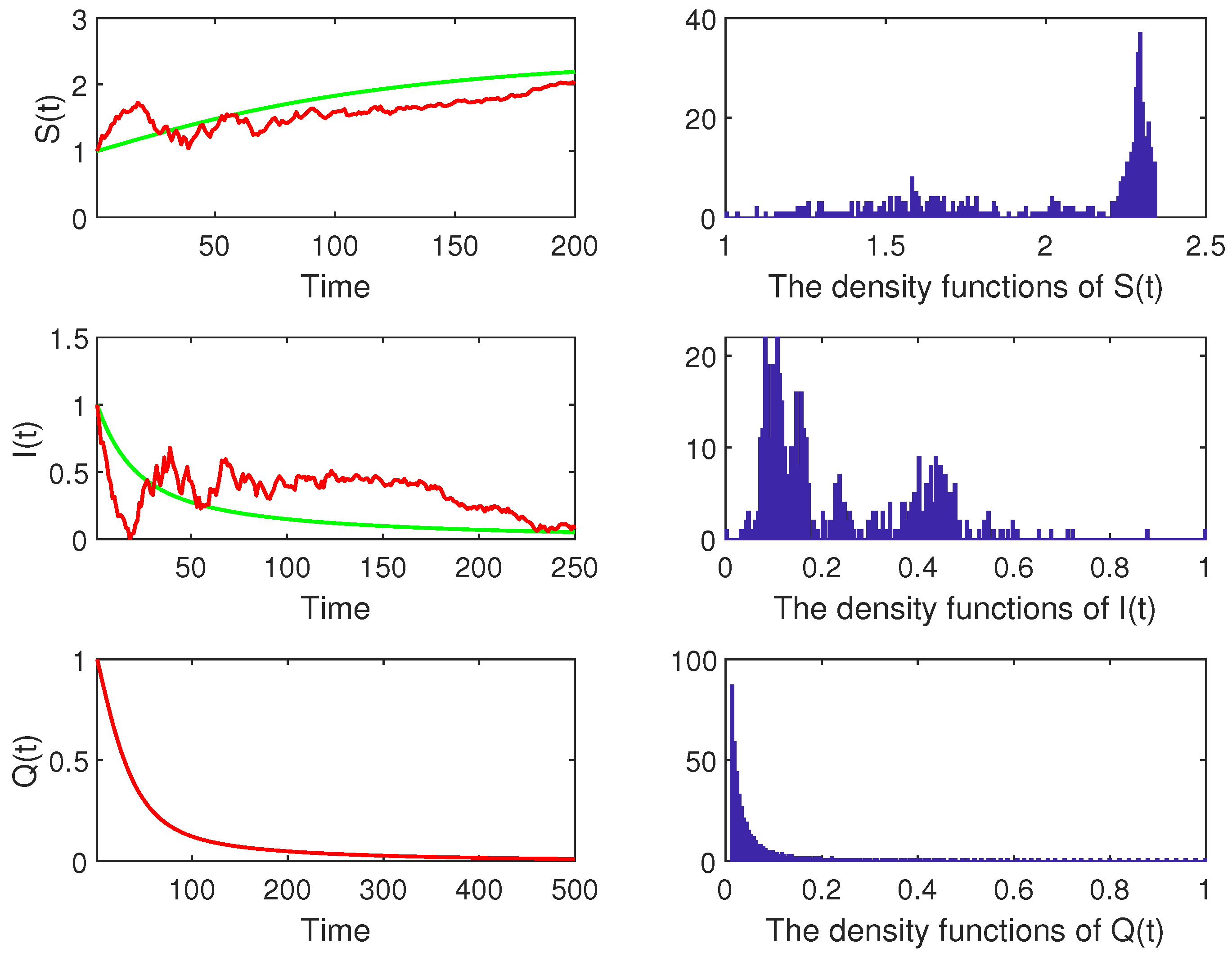
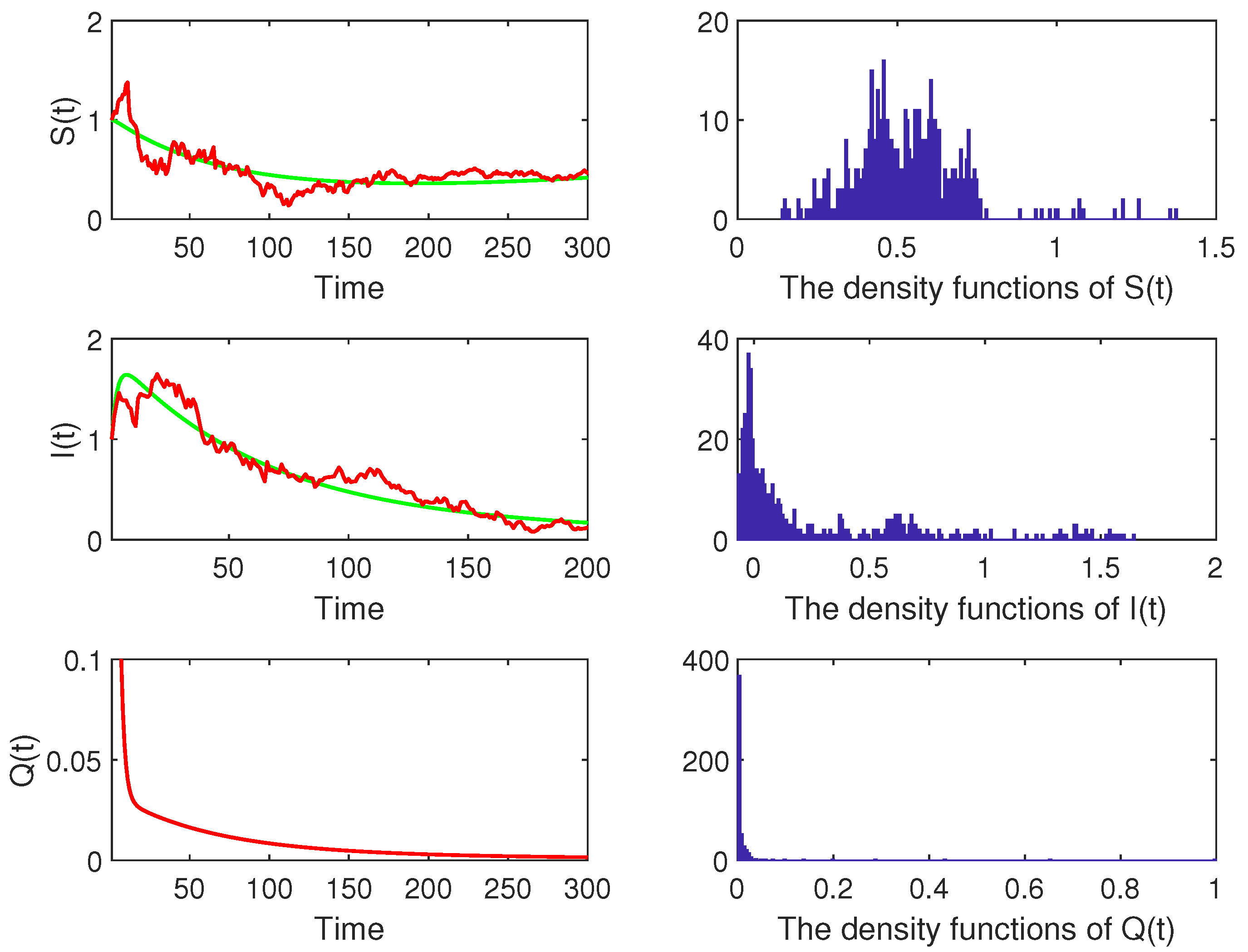
In addition, we can choose the following real data in Pakistan on 7 October 2021 [19]. Then, where is defined in Section 4. By the results of Theorem 4, we can find that system (3) will persist for a long time by a distribution . The numerical simulations (Figure 1) confirm this.
Figure 1.
The red lines describe the solution of system (3) and the green lines stand for the solution of the corresponding system (2). The right pictures are the histogram of the density function for , and Q populations.
Example 2.
Here, in system (3), we use the environmental noise parameter . In addition, following the biological feasibility result, the values of the parameters are as shown in Table 4.
Table 4.
Parameters value.
In addition, we can choose the following real data in Pakistan on 7 October 2021 [19]. Then, where is defined in Section 4. We can find that system (3) will be extinct in a long time. The numerical simulations (Figure 2) confirm this.
Figure 2.
The red lines discribe the solution of system (3) and the green lines stand for the solution of the corresponding system (2). The right pictures are the histogram of the density function for , and Q populations.
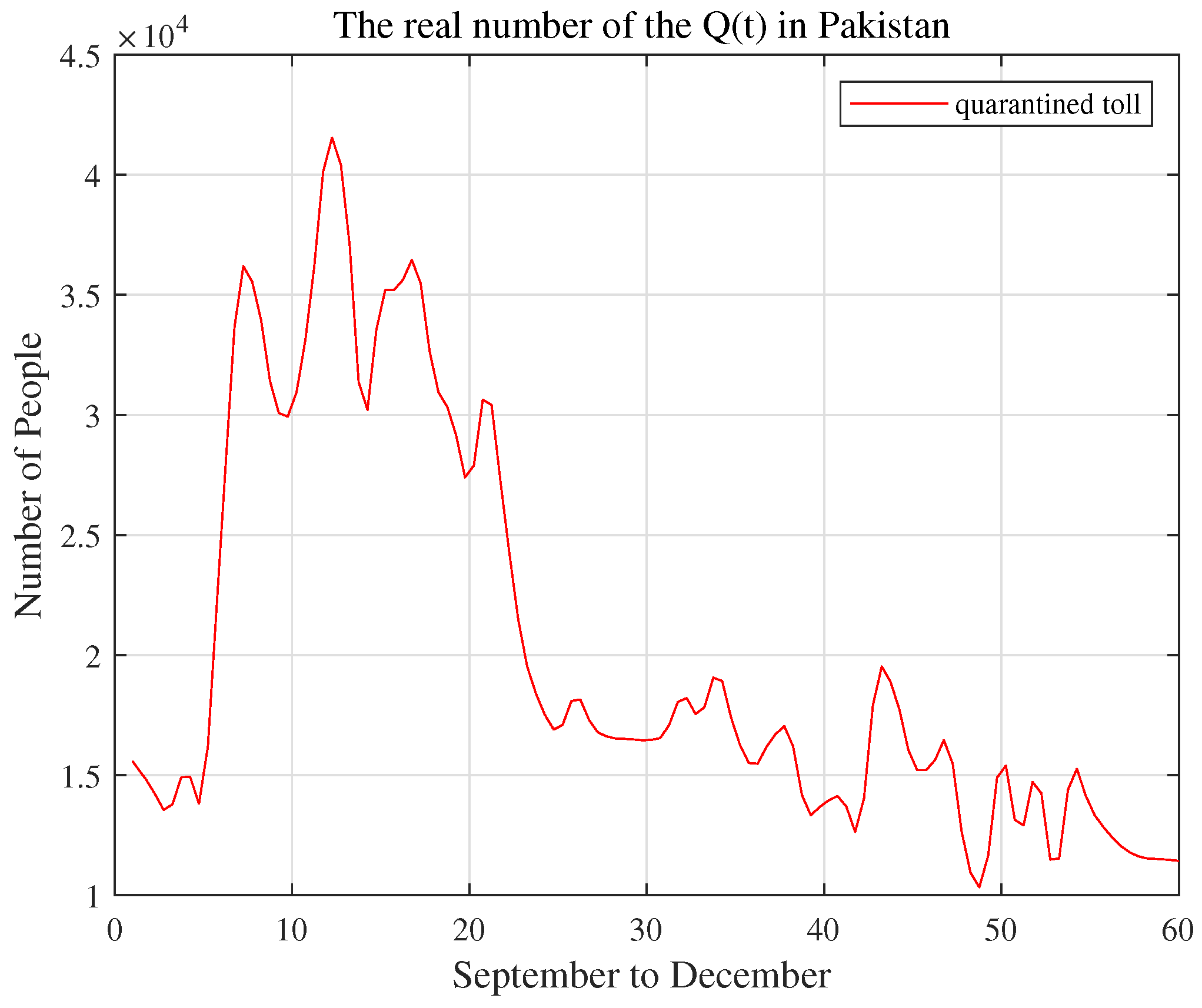
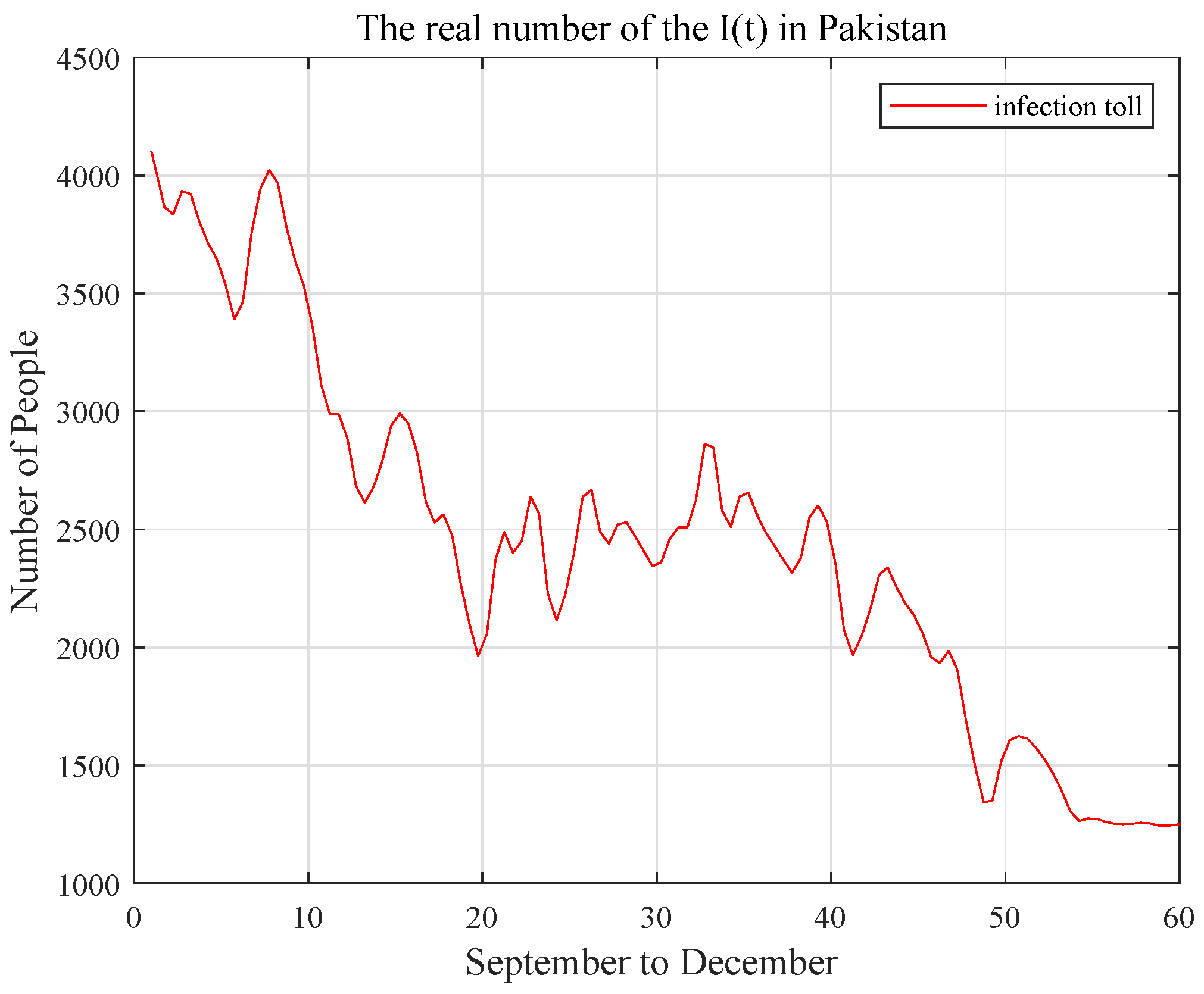
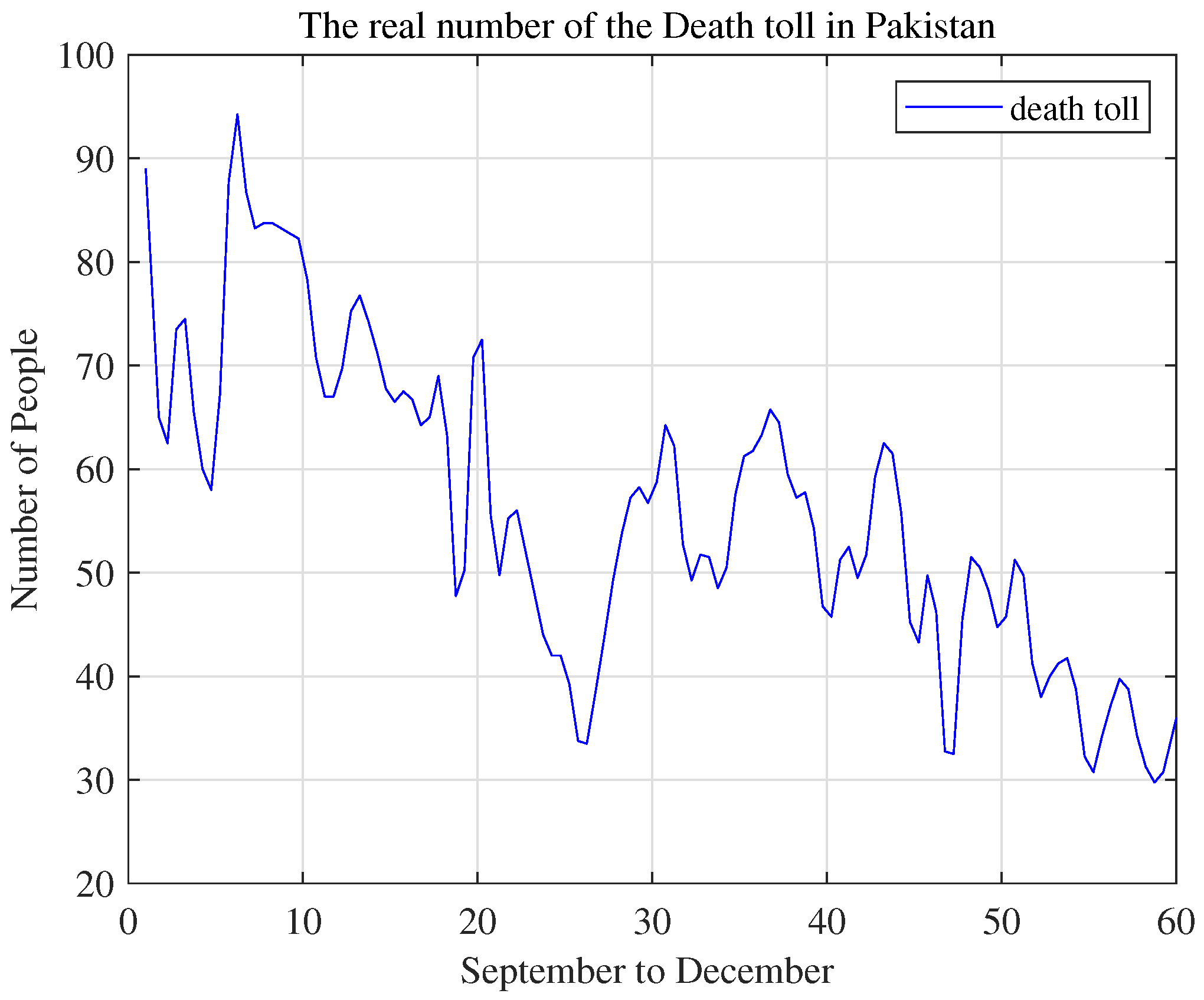
In fact, using the statistical data of Pakistan for September to December 2021, it can be seen from the figure (Figure 3, Figure 4 and Figure 5) that the control of the isolation number will affect the disturbance of the infection rate and control the increase in the infection number. At the same time, when the infection rate is disturbed by other factors, such as vaccine injection, the number of deaths decreases with the decrease in the number of infections. This is basically consistent with the research results of system (3) in this paper.
Figure 3.
The number of the daily statistics of quarantined people in Pakistan from September to December 2021.
Figure 4.
The red curve represents the daily statistics number of infections in Pakistan from September to December 2021.
Figure 5.
The blue curve represents the daily statistics death toll in Pakistan from September to December 2021.
8. Discussion
So far, the COVID-19 coronavirus disease is still one of the most serious diseases in the world. Until today, there is no appropriate treatment. At the same time, due to the strong transmission of the virus, with the existence of many uncertain factors (human activities, animal activities, express delivery, etc.), it also contains a lot of randomness. With the help of stochastic theory, we developed a model for the new 2019 coronavirus disease, and considered studying the transmission characteristics of the disease and understanding its transmission dynamics in the change in population and environment. The important role of isolation measures in controlling transmission is introduced. By disturbing the infection coefficient, the existence and positivity of Lyapunov function theory are studied. In this paper, in order to further discuss the extinction and stable distribution, we gave a new random infectious disease system under infection rate environmental noise. We give the existence and uniqueness of the solution of the system and discuss the ergodic stationary distribution and the extinction conditions of the system. The probability density function of the stochastic system is studied. Some digital simulations are used to demonstrate the probability density function and the extinction of system (3). Through numerical simulation, we analyzed the above results and drew a conclusion with the support of graphics. This work shows that random analysis is a better method used to study the dynamics of infectious diseases, especially the new 2019 coronavirus disease.
We know that the control of infectious diseases needs to consider a variety of random disturbance factors, and we will consider system (3) in more general random phenomena and their persistence and extinction properties in our future research.
Author Contributions
Writing—original draft preparation, J.S.; writing—review and editing, J.S. and M.G.; funding acquisition, J.S. and D.J. All authors have read and agreed to the published version of this manuscript.
Funding
The authors were supported by Shandong Provincial Natural Science Foundation (No. ZR2021MA052) and the National Natural Science Foundation of China (No. 11601520).
Institutional Review Board Statement
Not applicable.
Informed Consent Statement
Not applicable.
Data Availability Statement
Not applicable.
Conflicts of Interest
The authors declare no conflict of interest.
References
- Lai, C.C.; Shih, T.P.; Ko, W.C.; Tang, H.J.; Hsueh, P.R. Severe acute respiratory syndrome coronavirus 2 (SARS-CoV-2) and corona virus disease-2019 (COVID-19): The epidemic and the challenges. Int. J. Antimicrob. Agents 2020, 53, 105924. [Google Scholar] [CrossRef] [PubMed]
- Wu, Z.; Mcgoogan, J.M. Characteristics of and important lessons from the coronavirus disease 2019 (COVID-19) outbreak in china: Summary of a report of 72 314 cases from the chinese center for disease control and prevention. JAMA 2020, 323, 1239–1242. [Google Scholar] [CrossRef] [PubMed]
- Mao, X. Stochastic Differential Equations and Applications; Horwood: Chichester, UK, 1997. [Google Scholar]
- Has’miniskii, R. Stochastic Stability of Differential Equations; Horwood: Chichester, UK, 1997. [Google Scholar]
- Mao, X.; Marion, G.; Renshaw, E. Environmental Brownian noise suppresses explosions in population dynamics. Stoch. Process. Appl. 2002, 97, 95–110. [Google Scholar] [CrossRef]
- Alzahrani, E.O.; Khan, M.A. Modeling the dynamics of hepatitis E with optimal control. Chaos Solit. Fract. 2018, 116, 287–301. [Google Scholar] [CrossRef]
- Wilder-Smith, A.; Freedman, D.O. Isolation, quarantine, social distancing and community containment: Pivotal role for old-style public health measures in the novel coronavirus (2019-nCoV) outbreak. J. Travel Med. 2020, 27, taaa020. [Google Scholar] [CrossRef] [PubMed]
- Han, B.; Zhou, B.; Jiang, D.; Hayat, T.; Alsaedi, A. Stationary solution, extinction and density function for a high-dimensional stochastic SEI epidemic model with general distributed delay. Appl. Math. Comput. 2021, 405, 126236. [Google Scholar] [CrossRef]
- Thomas, C.G. Introduction to Stochastic Differential Equations; Dekker: New York, NY, USA, 1988. [Google Scholar]
- Gao, M.M.; Jiang, D.; Hayat, T.; Alsaedi, A. Threshold behavior of a stochastic Lotka-Volterra food chain chemostat model with jumps. Phys. A 2019, 523, 191–203. [Google Scholar] [CrossRef]
- Siqueira, J.D.; Goes, L.R.; Alves, B.M.; da Silva, A.C.P.; de Carvalho, P.S.; Cicala, C.; Arthos, J.; Viola, J.P.; Soares, M.A. Distinguishing SARS-CoV-2 bonafide re-infection from pre-existing minor variant reactivation, Infection. Genet. Evol. 2021, 90, 104772. [Google Scholar] [CrossRef] [PubMed]
- Lipster, R. A strong law of large numbers for local martingales. Stochastics 1980, 3, 217–218. [Google Scholar]
- Griffin, B.D.; Chan, M.; Tailor, N.; Mendoza, E.J.; Leung, A.; Warner, B.M.; Duggan, A.T.; Moffat, E.; He, S.; Garnett, L.; et al. SARS-CoV-2 infection and transmission in the North American deer mouse. Nat. Commun. 2021, 12, 3612. [Google Scholar] [CrossRef]
- Khan, M.A.; Abdon, A. Modeling the dynamics of novel coronavirus (2019-nCoV) with fractional derivative. Alex. Eng. J. 2020, 59, 2379–2389. [Google Scholar] [CrossRef]
- Abdon, A. Modelling the spread of COVID-19 with new fractal-fractional operators: Can the lockdown save mankind before vaccination. Chaos Solitons Fractals 2020, 136, 109860. [Google Scholar]
- Zhou, B.; Zhang, X.; Jiang, D. Dynamics and density function analysis of a stochastic SVI epidemic model with half saturated incidence rate. Chaos Solitons Fractals 2020, 137, 109865. [Google Scholar] [CrossRef]
- Chen, Y.; Cheng, J.; Jiang, Y.; Liu, K. A time delay dynamic system with external source for the local outbreak of 2019-nCoV. Appl. Anal. 2020, 12, 1–12. [Google Scholar] [CrossRef]
- Din, A.; Khan, A.; Baleanu, D. Stationary distribution and extinction of stochastic coronavirus (COVID-19) epidemic model. Chaos Solitons Fractals 2020, 139, 110036. [Google Scholar] [CrossRef] [PubMed]
- Available online: http://covid.gov.pk/ (accessed on 10 January 2022).
- Herwaarden, O.A.; Grasman, J. Stochastic epidemics: Major outbreaks and the duration of the endemic period. J. Math. Biol. 1995, 33, 581–601. [Google Scholar] [CrossRef] [PubMed]
- Roozen, H. An asymptotic solution to a two dimensional exit problem arising in population dynamics. SIAM J. Appl. Math. 1989, 49, 1973. [Google Scholar] [CrossRef] [Green Version]
- Hethcote, H.W. Qualitative analyses of communicable disease models. Math. Biosci. 1976, 28, 335–356. [Google Scholar] [CrossRef]
Publisher’s Note: MDPI stays neutral with regard to jurisdictional claims in published maps and institutional affiliations. |
© 2022 by the authors. Licensee MDPI, Basel, Switzerland. This article is an open access article distributed under the terms and conditions of the Creative Commons Attribution (CC BY) license (https://creativecommons.org/licenses/by/4.0/).