

Dynamical Behaviors of an SIR Epidemic Model with Discrete Time


Abstract
1. Introduction
2. Stability of Fixed Points
- 1.
- If and ,
- 2.
- If and ,
3. Bifurcation Analysis of the Boundary FIXED Point
4. Bifurcation Analysis of the Positive Fixed Point
4.1. One Parameter Bifurcations
4.2. Two-Parameter Bifurcations
5. Continuation Method
5.1. Numerical Continuation of
5.2. Numerical Continuation of
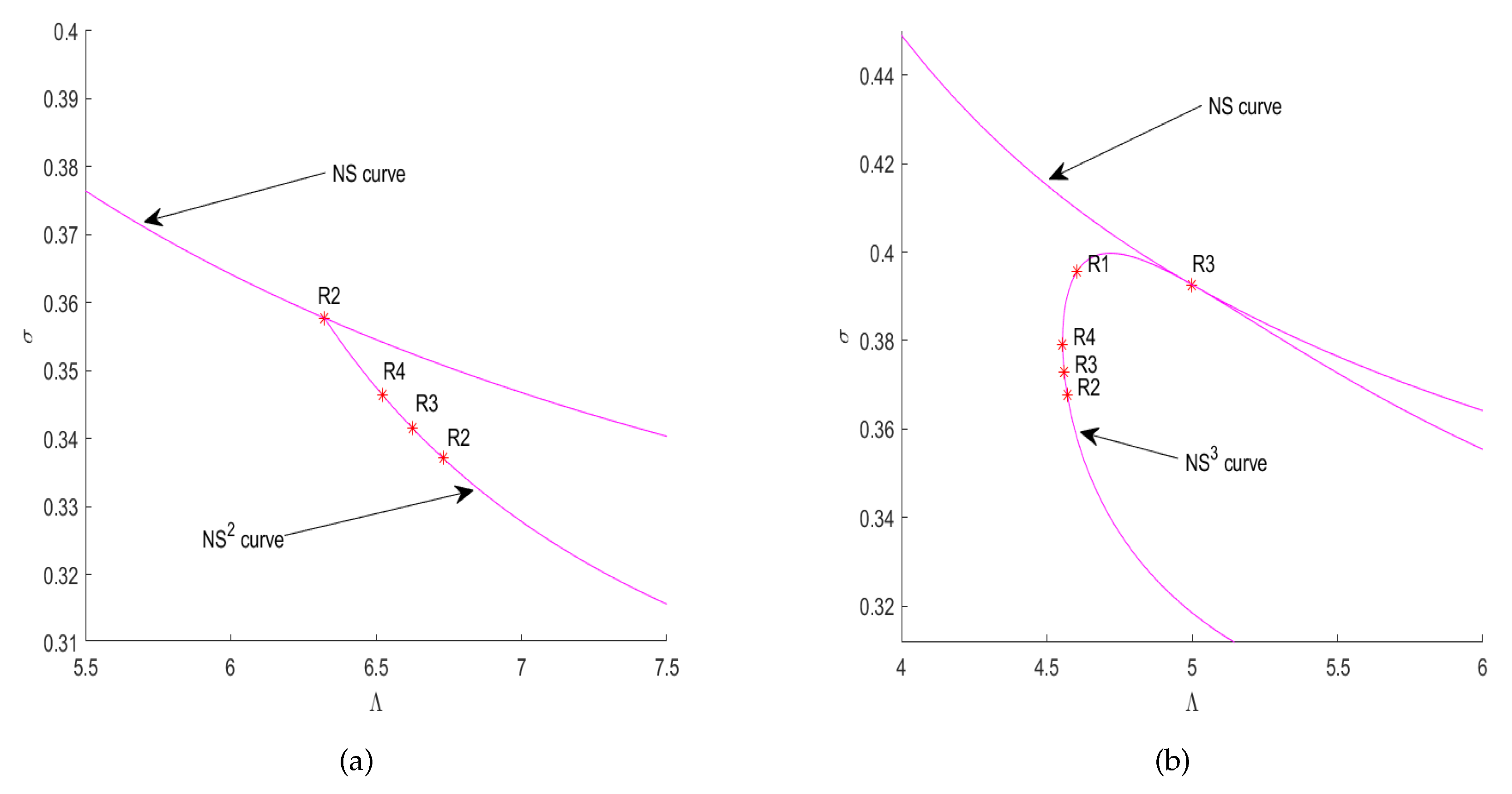
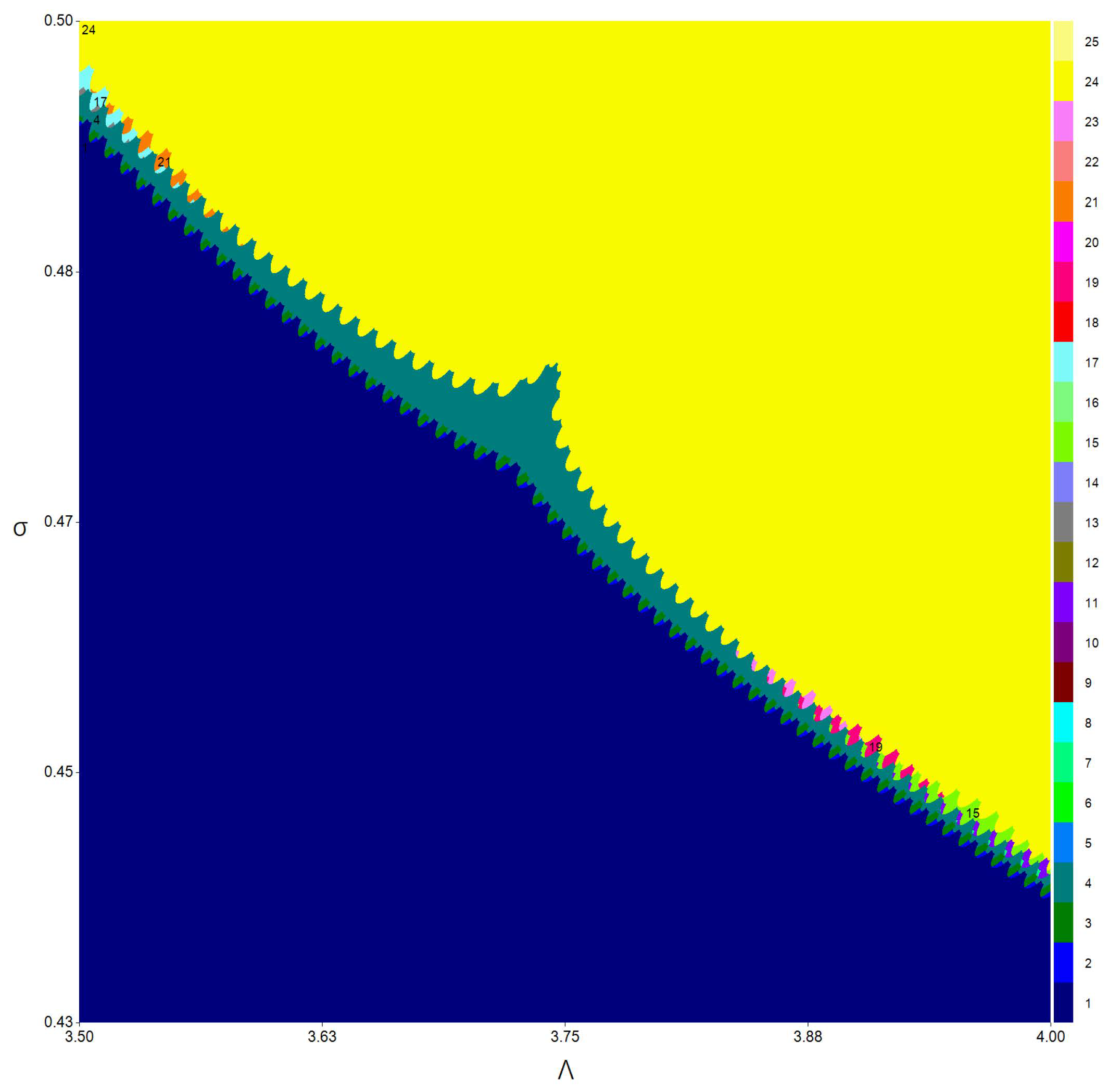
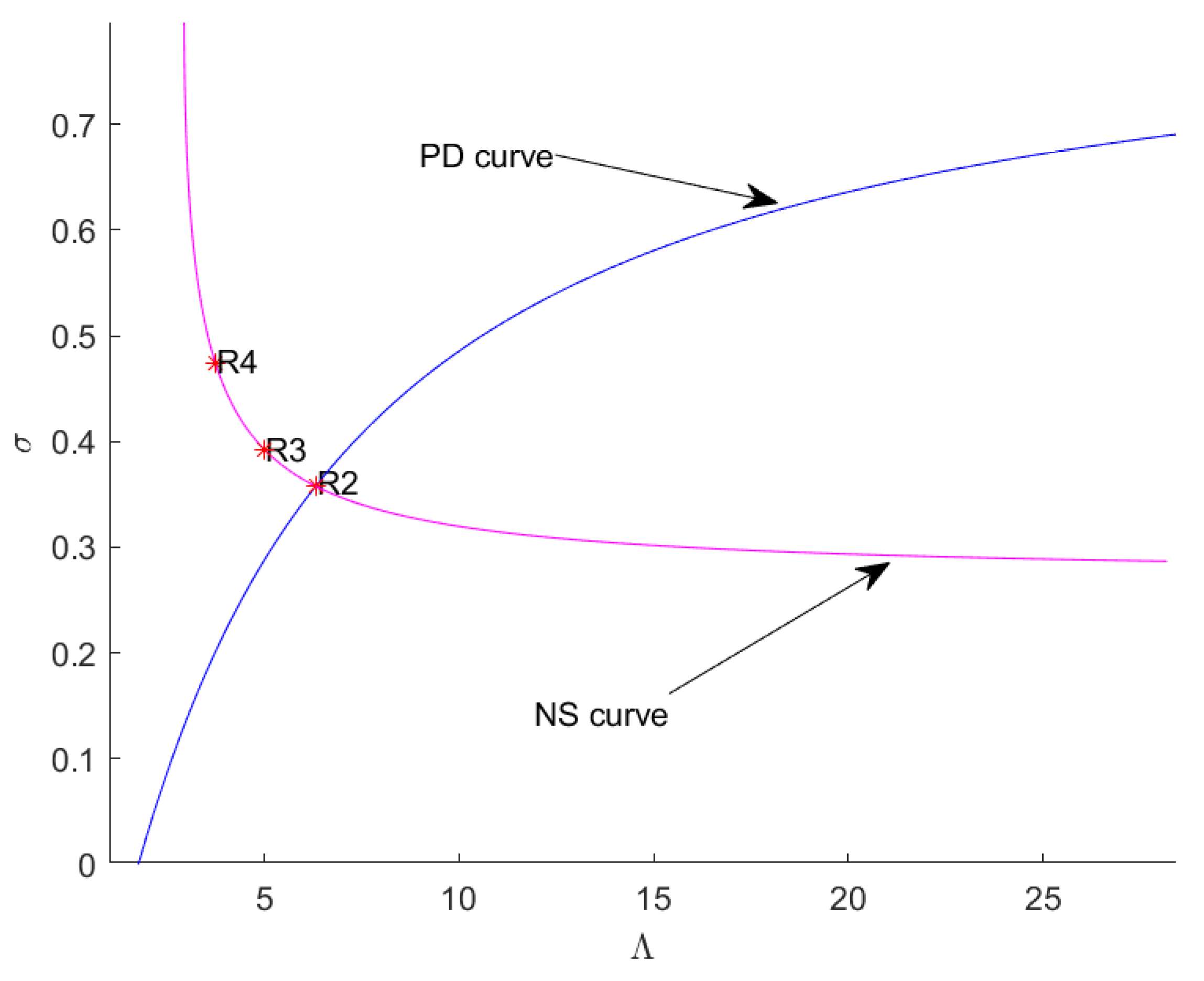
- The resonance 1:4 bifurcation occurs at for and where . If we compute the convergent orbits from initial point with respect to and a two-dimensional bifurcation diagram in the neighborhood of the R4 point can be displayed with the period number of the corresponding orbits [28,29]; see Figure 4. In addition to the parameter region with a period-4 cycle, there also exist regions with fixed points—period-2, -11, -15, -17, -19 and -21 cycles—to show complex periodic dynamics. Here, a stable period-4 cycle occurs when and one of a period-4 cycle is (3.092783505154633,3.762886597938157).
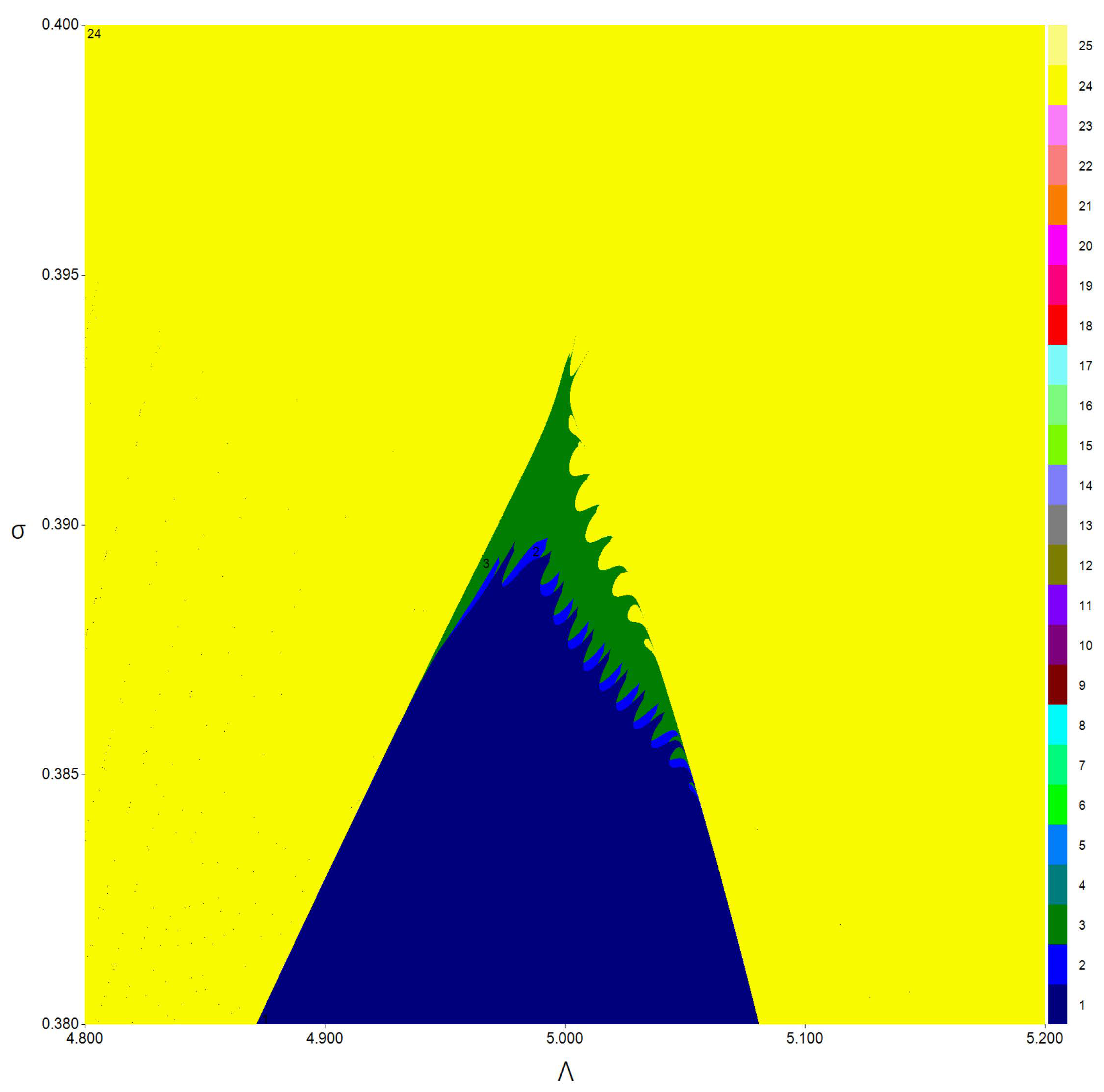
- The resonance 1:3 bifurcation occurs at for and where . If we compute the convergent orbits from initial point with respect to and a two-dimensional bifurcation diagram in the neighborhood of the R3 point can be displayed with the period number of the corresponding orbits; see Figure 5. In addition to the parameter region with a period-3 cycle, there only exist regions with fixed points and a period-2 cycle. Here, a stable period-3 cycle occurs when and one of the period-3 cycle is (2.796052631578960,5.972329721362207).
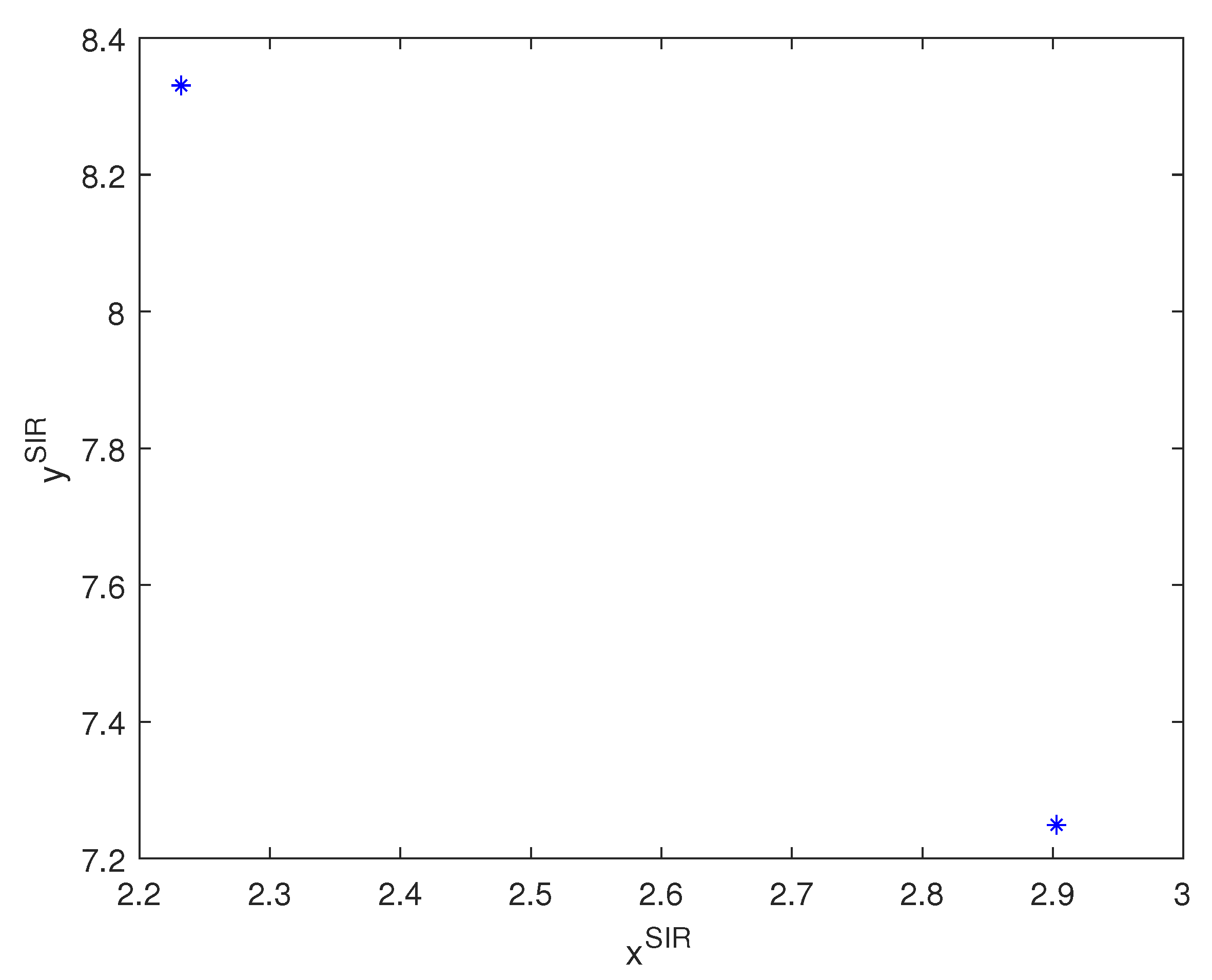
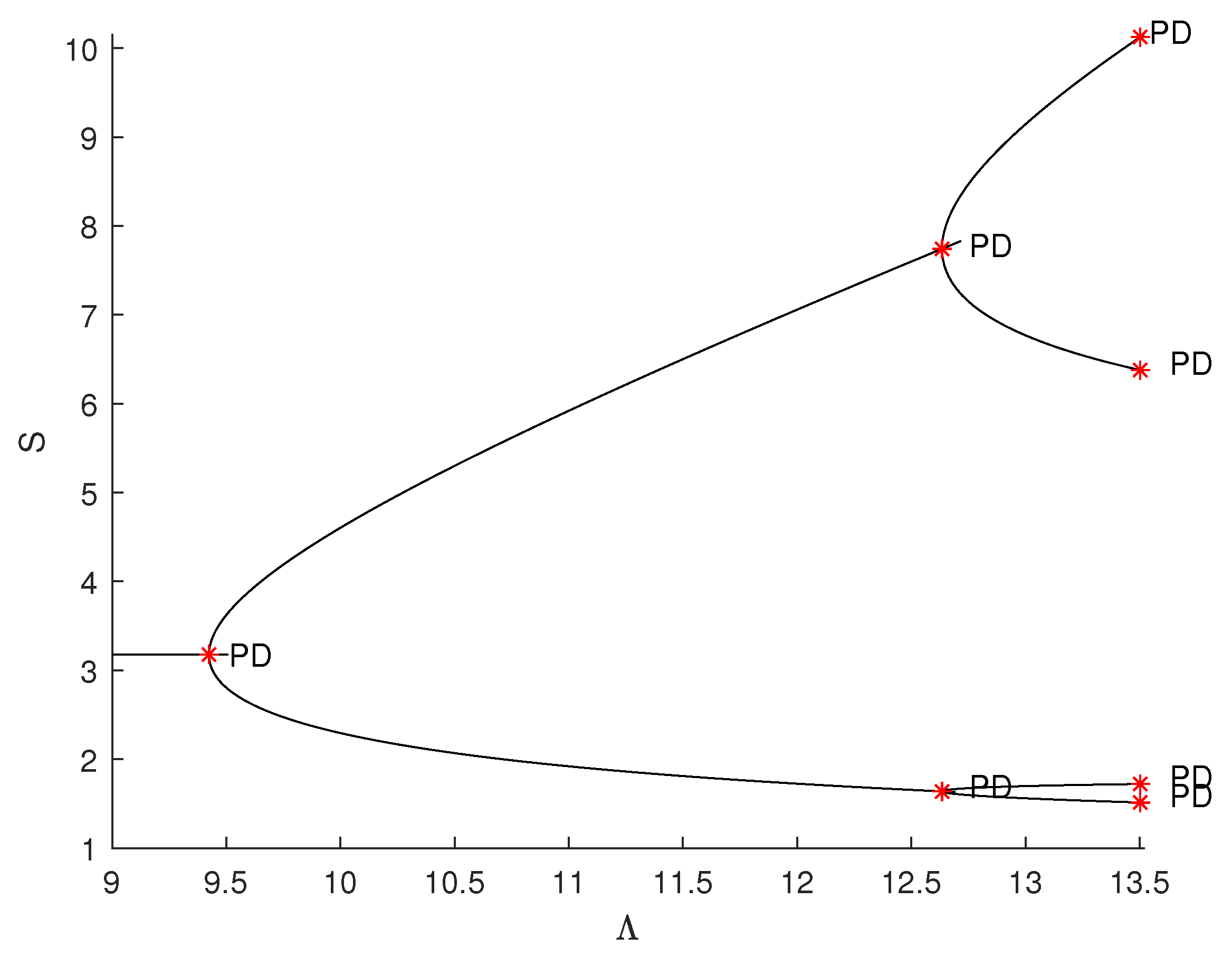
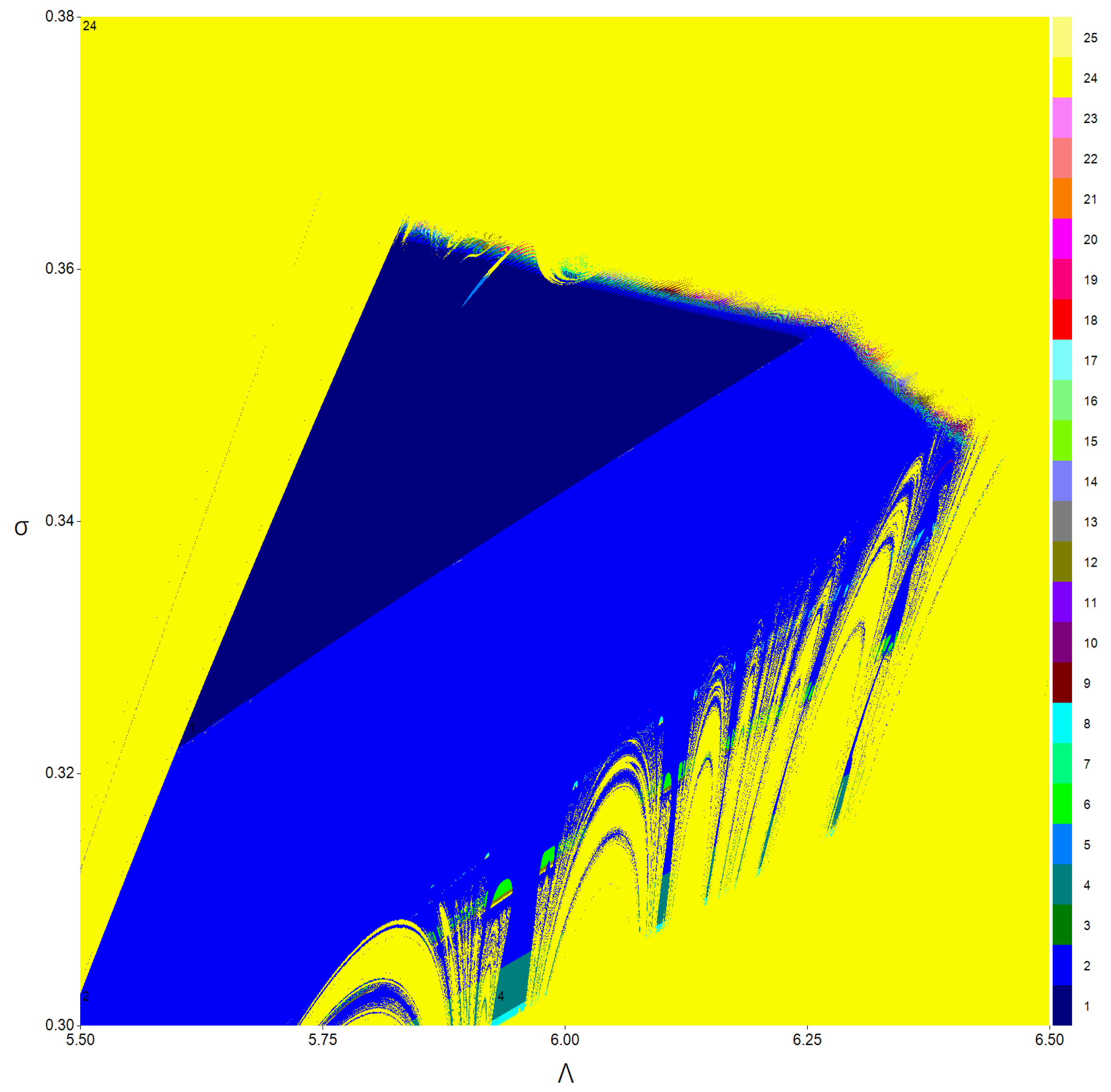
- The resonance 1:2 bifurcation occurs at for and where and . If we compute the convergent orbits from initial point with respect to and a two-dimensional bifurcation diagram in the neighborhood of the R2 point can be displayed with the period number of the corresponding orbits; see Figure 6. In addition to the parameter region with a period-2 cycle, there only exist regions with fixed points and period-4, -6, and -8 cycles. Here, a stable period-2 cycle occurs when and one of the period-2 cycles is (2.232027014018290,8.330641606985276); see Figure 7.
6. Discussion
7. Conclusions
Author Contributions
Funding
Informed Consent Statement
Data Availability Statement
Acknowledgments
Conflicts of Interest
Appendix A
References
- Barrientos, P.G.; Rodríguez, J.Á.; Ruiz-Herrera, A. Chaotic dynamics in the seasonally forced SIR epidemic model. J. Math. Biol. 2017, 75, 1655–1668. [Google Scholar] [CrossRef] [PubMed]
- Diedrichs, D.R.; Isihara, P.A.; Buursma, D.D. The schedule effect:can recurrent peak infections be reduced without vaccines, quarantines or school closings? Math. Biosci. 2014, 248, 46–53. [Google Scholar] [CrossRef]
- Axelsen, J.B.; Yaari, R.; Grenfell, B.T.; Stone, L. Multiannual forecasting of seasonal influenza dynamics reveals climatic and evolutionary drivers. Proc. Natl. Acad. Sci. USA 2014, 111, 9538–9542. [Google Scholar] [CrossRef] [PubMed]
- Dietz, K. The incidence of infectious diseases under the influence of seasonal fluctuations. In Mathematical Models in Medicine; Springer: Berlin/Heidelberg, Germany, 1976; pp. 1–15. [Google Scholar]
- Aron, J.L.; Schwartz, I.B. Seasonality and period-doubling bifurcations in an epidemic model. J. Theor. Biol. 1984, 110, 665–679. [Google Scholar] [CrossRef]
- Eskandari, Z.; Alidousti, J. Stability and codimension 2 bifurcations of a discrete time SIR model. J. Frankl. Inst. 2020, 357, 10937–10959. [Google Scholar] [CrossRef]
- Li, X.; Wang, W. A discrete epidemic model with stage structure. Chaos Solitons Fractals 2005, 26, 947–958. [Google Scholar] [CrossRef]
- Naik, P.A.; Zu, J.; Ghoreishi, M. Stability analysis and approximate solution of SIR epidemic model with Crowley-Martin type functional response and Holling type-II treatment rate by using homotopy analysis method. J. Appl. Anal. Comput. 2020, 10, 1482–1515. [Google Scholar]
- Stone, L.; Olinky, R.; Huppert, A. Seasonal dynamics of recurrent epidemics. Nature 2007, 446, 533–536. [Google Scholar] [CrossRef]
- Ghori, M.B.; Naik, P.A.; Zu, J.; Eskari, Z.; Naik, M. Global dynamics and bifurcation analysis of a fractional-order SEIR epidemic model with saturation incidence rate. Math. Methods Appl. Sci. 2022, 45, 1–33. [Google Scholar] [CrossRef]
- Karaji, P.T.; Nyamoradi, N. Analysis of a fractional SIR model with general incidence function. Appl. Math. Lett. 2020, 108, 106499. [Google Scholar] [CrossRef]
- Naik, P.A. Global dynamics of a fractional-order SIR epidemic model with memory. Int. J. Biomath. 2020, 13, 2050071. [Google Scholar] [CrossRef]
- Zhang, Q.; Tang, B.; Tang, S. Vaccination threshold size and backward bifurcation of SIR model with state-dependent pulse control. J. Theor. Biol. 2018, 455, 75–85. [Google Scholar] [CrossRef] [PubMed]
- BjØrnstad, O.N.; Finkenstädt, B.F.; Grenfell, B.T. Dynamics of measles epidemics: Estimating scaling of transmission rates using a time series SIR model. Ecol. Monogr. 2002, 72, 169–184. [Google Scholar]
- Olsen, L.F.; Schaffer, W.M. Chaos versus noisy periodicity: Alternative hypotheses for childhood epidemics. Science 1990, 249, 499–504. [Google Scholar] [CrossRef]
- Augeraud-Véron, E.; Sari, N. Seasonal dynamics in an SIR epidemic system. J. Math. Biol. 2014, 68, 701–725. [Google Scholar]
- Duarte, J.; Januário, C.; Martins, N.; Rogovchenko, S.; Rogovchenko, Y. Chaos analysis and explicit series solutions to the seasonally forced SIR epidemic model. J. Math. Biol. 2019, 78, 2235–2258. [Google Scholar] [CrossRef]
- Kermack, W.O.; McKendrick, A.G. A contribution to the mathematical theory of epidemics. Proc. R. Soc. Lond. Ser. Contain. Pap. Math. Phys. Character 1927, 115, 700–721. [Google Scholar]
- Hethcote, H.W. The mathematics of infectious diseases. SIAM Rev. 2000, 42, 599–653. [Google Scholar] [CrossRef]
- Akrami, M.H.; Atabaigi, A. Hopf and forward bifurcation of an integer and fractional-order SIR epidemic model with logistic growth of the susceptible individuals. J. Appl. Math. Comput. 2020, 64, 615–633. [Google Scholar] [CrossRef]
- Hu, Z.; Teng, Z.; Zhang, L. Stability and bifurcation analysis in a discrete SIR epidemic model. Math. Comput. Simul. 2014, 97, 80–93. [Google Scholar] [CrossRef]
- Liu, X.; Xiao, D. Complex dynamic behaviors of a discrete-time predator-prey system. Chaos Solitons Fractals 2007, 32, 80–94. [Google Scholar] [CrossRef]
- He, Z.; Lai, X. Bifurcation and chaotic behavior of a discrete-time predator-prey system. Nonlinear Anal. Real World Appl. 2011, 12, 403–417. [Google Scholar] [CrossRef]
- Kuznetsov, Y.A. Elements of Applied Bifurcation Theory; Springer Science & Business Media: Berlin/Heidelberg, Germany, 2013; Volume 112. [Google Scholar]
- Kuznetsov, Y.A.; Meijer, H.G. Numerical normal forms for codim 2 bifurcations of fixed points with at most two critical eigenvalues. Siam J. Sci. Comput. 2005, 26, 1932–1954. [Google Scholar] [CrossRef]
- Kuznetsov, Y.A.; Meijer, H.G. Numerical Bifurcation Analysis of Maps: From Theory to Software; Cambridge University Press: Cambridge, UK, 2019. [Google Scholar]
- Govaerts, W.; Ghaziani, R.K.; Kuznetsov, Y.A.; Meijer, H.G. Numerical methods for two-parameter local bifurcation analysis of maps. Siam J. Sci. Comput. 2007, 29, 2644–2667. [Google Scholar] [CrossRef]
- Li, B.; Liang, H.J.; He, Q.Z. Multiple and generic bifurcation analysis of a discrete Hindmarsh-Rose model. Chaos Solitons Fractals 2021, 146, 110856. [Google Scholar] [CrossRef]
- Li, B.; Liang, H.J.; Shi, L.; He, Q.Z. Complex dynamics of Kopel model with nonsymmetric response between oligopolists. Chaos Solitons Fractals 2022, 156, 111860. [Google Scholar] [CrossRef]
- Li, X.L.; Su, L. A heterogeneous duopoly game under an isoelastic demand and diseconomies of scale. Fractal Fract. 2022, 6, 459. [Google Scholar] [CrossRef]
- Jiang, X.W.; Chen, C.; Zhang, X.H.; Chi, M.; Yan, H. Bifurcation and chaos analysis for a discrete ecological developmental systems. Nonlinear Dyn. 2021, 104, 4671–4680. [Google Scholar] [CrossRef]
- Rahmi, E.; Darti, I.; Suryanto, A.; Trisilowati. A Modified Leslie–Gower Model Incorporating Beddington–DeAngelis Functional Response, Double Allee Effect and Memory Effect. Fractal Fract. 2021, 5, 84. [Google Scholar] [CrossRef]
- Li, P.; Yan, J.; Xu, C.; Gao, R.; Li, Y. Understanding Dynamics and Bifurcation Control Mechanism for a Fractional-Order Delayed Duopoly Game Model in Insurance Market. Fractal Fract. 2022, 6, 270. [Google Scholar] [CrossRef]
- Wang, H.; Ke, G.; Pan, J.; Hu, F.; Fan, H. Multitudinous potential hidden Lorenz-like attractors coined. Eur. Phys. J.-Spec. Top. 2022, 231, 359–368. [Google Scholar] [CrossRef]
- Wang, N.; Zhang, G.S.; Kuznetsov, N.V.; Bao, H. Hidden attractors and multistability in a modified Chua’s circuit. Commun. Nonlinear Sci. Numer. Simul. 2021, 92, 105494. [Google Scholar] [CrossRef]
- Ali, M.S.; Narayanan, G.; Shekher, V.; Alsulami, H.; Saeed, T. Dynamic stability analysis of stochastic fractional-order memristor fuzzy BAM neural networks with delay and leakage terms. Appl. Math. Comput. 2020, 369, 124896. [Google Scholar]
- Eskandari, Z.; Alidousti, J.; Avazzadeh, Z.; Ghaziani, R.K. Dynamics and bifurcations of a discrete time neural network with self connection. Eur. J. Control 2022, 66, 100642. [Google Scholar] [CrossRef]
- Eskandari, Z.; Alidousti, J.; Avazzadeh, Z.; Machado, J.T. Dynamics and bifurcations of a discrete-time prey-predator model with Allee effect on the prey population. Ecol. Complex. 2021, 48, 100962. [Google Scholar] [CrossRef]
- Eskandari, Z.; Avazzadeh, Z.; Ghaziani, R.K. Complex dynamics of a Kaldor model of business cycle with discrete-time. Chaos, Solitons Fractals 2022, 157, 111863. [Google Scholar] [CrossRef]
- Eskandari, Z.; Avazzadeh, Z.; Khoshsiar Ghaziani, R.; Li, B. Dynamics and bifurcations of a discrete-time Lotka-Volterra model using non-standard finite difference discretization method. Math. Methods Appl. Sci. 2022. [Google Scholar] [CrossRef]
- Xiao, Y.; Zhang, S.G.; Peng, Y. Dynamic investigations in a Stackelberg model with differentiated products and bounded rationality. J. Comput. Appl. Math. 2022, 414, 114409. [Google Scholar] [CrossRef]
- Barge, H.; Sanjurjo, J.M.R. Higher dimensional topology and generalized Hopf bifurcations for discrete dynamical systems. Discret. Contin. Dyn. Syst. 2021, 42, 2585–2601. [Google Scholar] [CrossRef]
- Tassaddiq, A.; Shabbir, M.S.; Din, Q.; Naaz, H. Discretization, Bifurcation, and Control for a Class of Predator-Prey Interactions. Fractal Fract. 2020, 6, 31. [Google Scholar] [CrossRef]



| Parameter | Description |
|---|---|
| Incidence of natural death in the population | |
| Rate of incident bilinearity | |
| Population recruitment rate | |
| Infection rate of infected individuals | |
| Disease-induced death rate |
Publisher’s Note: MDPI stays neutral with regard to jurisdictional claims in published maps and institutional affiliations. |
© 2022 by the authors. Licensee MDPI, Basel, Switzerland. This article is an open access article distributed under the terms and conditions of the Creative Commons Attribution (CC BY) license (https://creativecommons.org/licenses/by/4.0/).
Share and Cite
Li, B.; Eskandari, Z.; Avazzadeh, Z. Dynamical Behaviors of an SIR Epidemic Model with Discrete Time. Fractal Fract. 2022, 6, 659. https://doi.org/10.3390/fractalfract6110659
Li B, Eskandari Z, Avazzadeh Z. Dynamical Behaviors of an SIR Epidemic Model with Discrete Time. Fractal and Fractional. 2022; 6(11):659. https://doi.org/10.3390/fractalfract6110659
Chicago/Turabian StyleLi, Bo, Zohreh Eskandari, and Zakieh Avazzadeh. 2022. "Dynamical Behaviors of an SIR Epidemic Model with Discrete Time" Fractal and Fractional 6, no. 11: 659. https://doi.org/10.3390/fractalfract6110659
APA StyleLi, B., Eskandari, Z., & Avazzadeh, Z. (2022). Dynamical Behaviors of an SIR Epidemic Model with Discrete Time. Fractal and Fractional, 6(11), 659. https://doi.org/10.3390/fractalfract6110659