

Abstract
The advection–dispersion equations have gotten a lot of theoretical attention. The difficulty in dealing with these problems stems from the fact that there is no perfect answer and that tackling them using local numerical methods is tough. The Riesz fractional advection–dispersion equations are quantitatively studied in this research. The numerical methodology is based on the collocation approach and a simple numerical algorithm. To show the technique’s performance and competency, a comprehensive theoretical formulation is provided, along with numerical examples.
1. Introduction
As approximated strategies for addressing differential equations, many numerical techniques, global or local, were listed. Local techniques provide numerical answers for specific places, whereas global methods provide solutions for the whole domain. Using finite difference techniques, the numerical approximations for differential equations [1,2,3,4] are provided at certain places. While finite element approaches [5,6,7] split the whole interval into sub-intervals and provide an approximate solution in them. Because of their ability to solve problems with infinite or finite domains [8,9], spectral techniques have recently received the most attention for dealing with various forms of differential and integral equations [10,11,12]. The major benefits of spectral approaches are their fast convergence (exponential rate) and excellent accuracy level [13,14,15,16].
Fractional calculus is a branch of calculus in which differential equations are used to represent a wide range of phenomena in mechanics, biology, engineering, economics, and physics. Fractional models can be used to closely depict a variety of phenomena. Because it is hard to provide explicit analytical solutions to space and/or time-fractional differential equations in most circumstances, developing effective numerical techniques is a critical necessity. Riesz fractional may be used to closely reflect a variety of occurrences, as shown in [17,18,19]. Only a few numerical approaches are capable of approximating such situations. The authors of [20,21,22,23] provide a number of finite difference approaches for solving the one-dimensional Riesz space-fractional issue. To address the one-dimensional Riesz space-fractional issue, finite element techniques [24,25,26,27] were applied. For both the temporal and spatial discretizations of the Riesz space fractional partial differential, Lai and Liu employed the Galerkin finite element scheme [28]. Yang et al. solved the semilinear Riesz space-fractional diffusion equations with time delay using the implicit alternating direction approach [29]. Numerous numerical approaches are utilized for the two-dimensional Riesz space-fractional issue, such as compact alternating direction implicit [30], finite volume [31], semi-alternating direction [32], Crank–Nicolson Galerkin finite element [33] and finite element [34].
In contrast to the effort put into studying finite difference and finite elements schemes for solving fractional-order differential equations in the literature, only a small amount of academic work has been invested into constructing and analyzing global spectral schemes. The spectral collocation approach is very useful, as it can estimate a broad variety of equations, including linear and nonlinear differential equations, integral, integro-differential equations, fractional differential equations, optimal control, and variational problems. For its obvious advantages, the collocation technique has been successfully used in a wide range of scientific and technical domains. The collocation approach is highly beneficial in providing very accurate result owing to its exponential rate of convergence. In contrast, for dealing with fractional problems, the collocation strategy has risen in popularity in recent decades. The truncated solutions for advection–dispersion equations with the Riesz fractional (RF-ADEs) are derived using the Legendre collocation technique based on Gauss-Lobatto and Gauss-Radau nodes. We employed the spectral collocation technique for the x and t-discretizations. For x-discretization, the SL-GL-C scheme with proper boundary management is used. While the SL-GR-C technique was used for t-discretization. This adjustment considerably improves accuracy. After that, the residuals at the SL-GR and SL-GL quadrature nodes are calculated. As a consequence, we have an algebraic system that can be solved using a suitable method. A variety of numerical problems are used to illustrate the accuracy of the new technique.
2. Riemann–Liouville Fractional Derivative
Different formulations exist for fractional derivative of order , [35]. The most frequent and commonly used expression is the Riemann–Liouville formula, which is defined as
The left- and right-sided of RL-FD on infinite domain are defined as
The Riesz fractional derivative is written as
where . The fractional Laplacian operator in (3) can formulated as
If , then the Riesz fractional derivative can be written as, see [36]
For Legendre polynomial , get
3. Fully Spectral Collocation Treatment
In this paper, we established a numerical approach for dealing with RF-ADEs
where , and . With
The SL-GL-C and SL-GR-C techniques are used here to convert the RF-ADEs into linear algebraic systems. The abbreviated solution is written as,
where and is performed to shifted Legendre polynomials on .
The Riesz fractional derivative is computed as
where , see [37]. While, is
where .
At certain points, the preceding derivatives are
The Equation (7) is constrained to be zero at the points. Alternatively, the initial-boundary may be found by
Additionally,
4. Numerical Results
In this part, we demonstrate the resilience and efficiency of the spectral collocation strategy by applying it to two test cases.
Example 1.
Taking the RF-ADEs [38]
is given where
Table 1 shows a comparison of our outcomes with those in [38]. Thus, the suggested technique outperforms the numerical results provided in [38]. It is often discovered that good estimates with a small number of nodes. The numerical solution and absolute errors of the problem (17) are shown in Figure 1 and Figure 2, respectively. We presented the -direction graphs of numerical and exact solutions in Figure 3, where , . The - and -graphs relating to absolute errors are depicted in Figure 4 and Figure 5, respectively. Additionally, we can see the error degradation in Figure 6.

Table 1.
MAEs for problem (17).
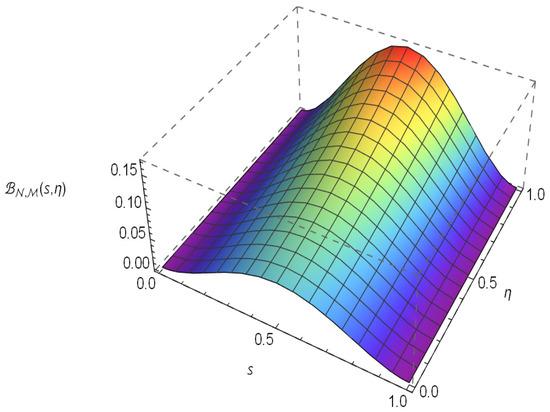
Figure 1.
Numerical solution of the problem (17), where , and .
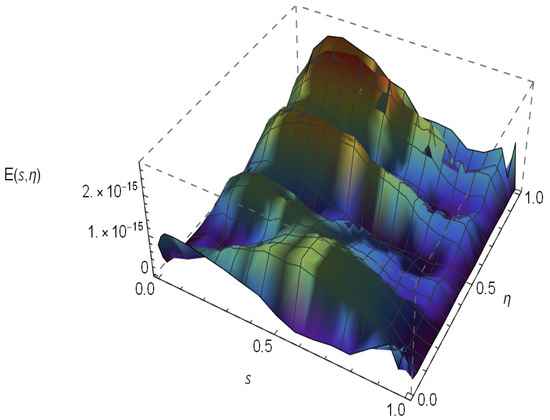
Figure 2.
Absolute errors of problem (17), where , .
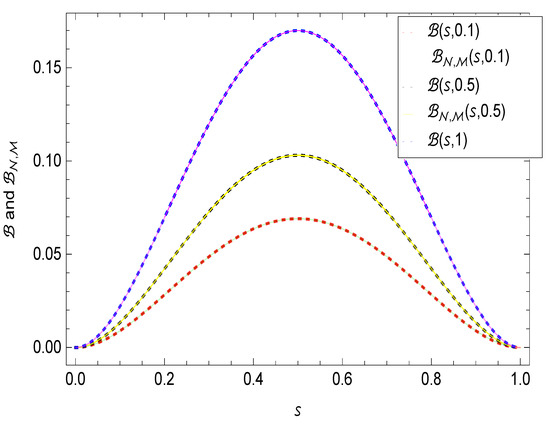
Figure 3.
-direction graphs of numerical and exact solutions of problem (17), where , .
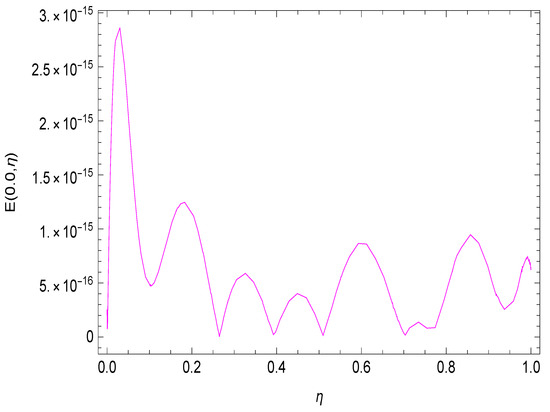
Figure 4.
-absolute errors of the problem (17), where , and .
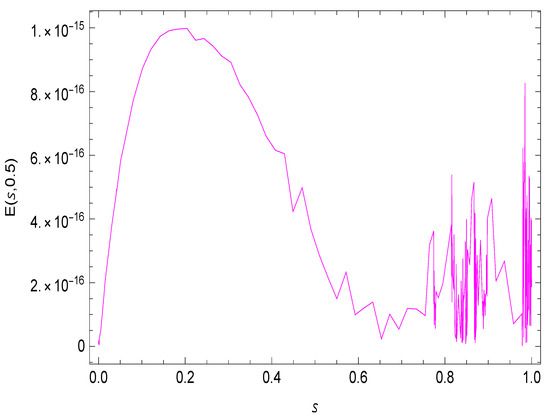
Figure 5.
-absolute errors of the problem (17), where , and .
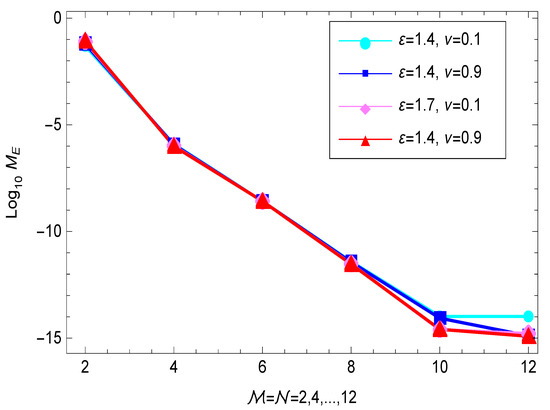
Figure 6.
convergence of problem (17), for different values of and .
Example 2.
Taking the RF-ADEs [38]
is supplied where
Table 2 shows a comparison of our outcomes with those in [38]. Thus, the suggested technique outperforms the numerical results provided in [38]. It is often discovered that good estimates with a small number of nodes. The numerical solution and absolute errors of the problem (18) are shown in Figure 7 and Figure 8, respectively. The - and -graphs relating to absolute errors are depicted in Figure 9 and Figure 10, respectively. Additionally, we can see the error degradation in Figure 11.
Table 2.
MAEs for problem (18).
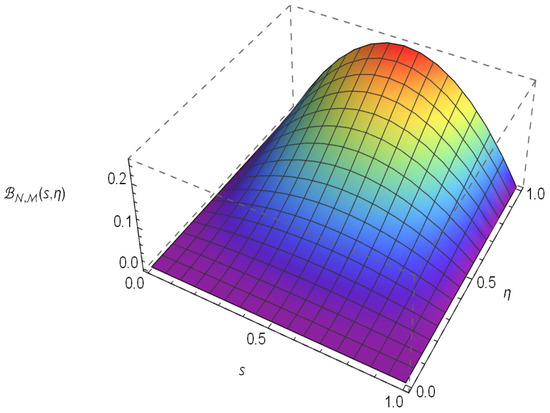
Figure 7.
Numerical solution of the problem (18), where , and .
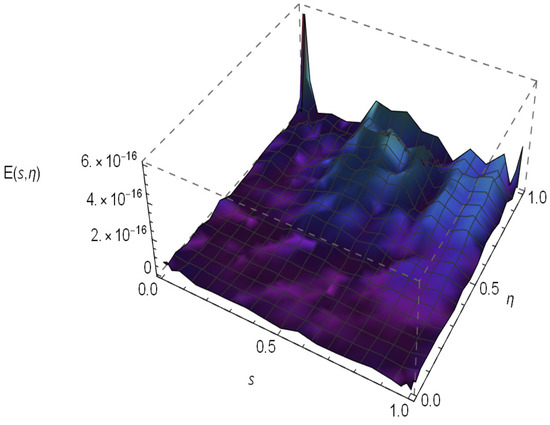
Figure 8.
Absolute errors of problem (18), where , .
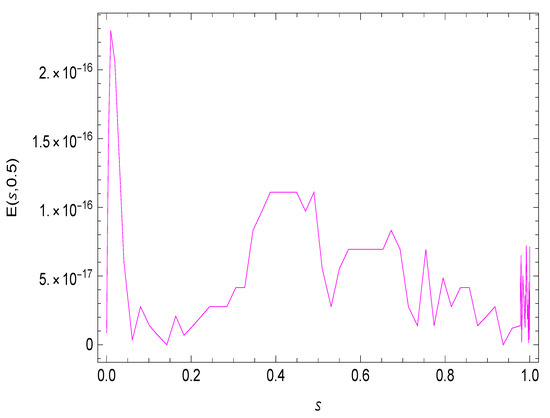
Figure 9.
-absolute errors of the problem (18), where , and .
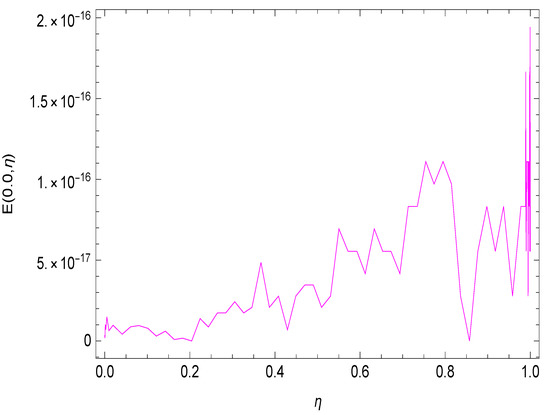
Figure 10.
-absolute errors of the problem (18), where , and .
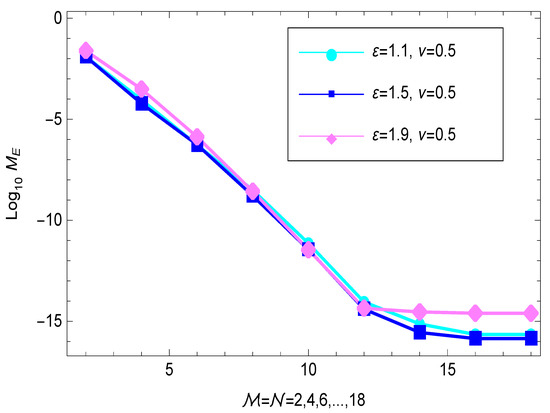
Figure 11.
convergence of problem (18), for different values of and .
5. Conclusions
To get numerical solutions for RF-ADEs in one dimensional space, we offer an accurate and economical numerical methodology linked to the SL-GL-C and SL-GR-C methods. The approach is efficient, adaptable to a wide range of operators, and easily extendable to multi-dimensions. Based on the obtained findings, we can observe that our approach has a high degree of accuracy.
Author Contributions
Data curation, M.M.A.-S. and M.A.A.; Formal analysis, M.A.A.; Funding acquisition, M.M.A.-S.; Methodology, M.A.A.; Writing–original draft, M.M.A.-S. and M.A.A.; Writing–review & editing, M.M.A.-S.and M.A.A. All authors prepared, applied the numerical method, made the algorithm, read and approved the final manuscript. All authors have read and agreed to the published version of the manuscript.
Funding
This Project was funded by the Deanship of Scientific Research (DSR) at King Abdulaziz University, Jeddah, under grant no. (G:188-130-14422). The authors, therefore, acknowledge with thanks DSR for technical and financial support.
Institutional Review Board Statement
Not applicable.
Informed Consent Statement
Not applicable.
Data Availability Statement
Not applicable.
Conflicts of Interest
The authors declare that they have no competing interests.
References
- Sousa, F.S.; Lages, C.; Ansoni, J.L.; Castelo, A.; Simao, A. A finite difference method with meshless interpolation for incompressible flows in non-graded tree-based grids. J. Comput. Phys. 2019, 396, 848–866. [Google Scholar] [CrossRef]
- Mbroh, N.A.; Munyakazi, J.B. A fitted operator finite difference method of lines for singularly perturbed parabolic convection–diffusion problems. Math. Comput. Simul. 2019, 165, 156–171. [Google Scholar] [CrossRef]
- Patil, H.M.; Maniyeri, R. Finite difference method based analysis of bio-heat transfer in human breast cyst. Therm. Sci. Eng. Prog. 2019, 10, 42–47. [Google Scholar] [CrossRef]
- Li, P.W.; Fu, Z.J.; Gu, Y.; Song, L. The generalized finite difference method for the inverse Cauchy problem in two-dimensional isotropic linear elasticity. Int. J. Solids Struct. 2019, 174, 69–84. [Google Scholar] [CrossRef]
- Shu, Y.; Li, J.; Zhang, C. A local and parallel Uzawa finite element method for the generalized Navier–Stokes equations. Appl. Math. Comput. 2020, 387, 124671. [Google Scholar] [CrossRef]
- Wang, C.; Wang, J. Primal–dual weak Galerkin finite element methods for elliptic Cauchy problems. Comput. Math. Appl. 2020, 79, 746–763. [Google Scholar] [CrossRef] [Green Version]
- Xiao, X.; Dai, Z.; Feng, X. A positivity preserving characteristic finite element method for solving the transport and convection–diffusion–reaction equations on general surfaces. Comput. Phys. Commun. 2020, 247, 106941. [Google Scholar] [CrossRef]
- Bhrawy, A.H.; Taha, T.M.; Machado, J.A.T. A review of operational matrices and spectral techniques for fractional calculus. Nonlinear Dyn. 2015, 81, 1023–1052. [Google Scholar] [CrossRef]
- Bhrawy, A.H.; Zaky, M.A. A method based on the Jacobi tau approximation for solving multi-term time–space fractional partial differential equations. J. Comput. Phys. 2015, 281, 876–895. [Google Scholar] [CrossRef]
- Doha, E.; Abdelkawy, M.; Amin, A.; Lopes, A.M. Shifted Jacobi–Gauss-collocation with convergence analysis for fractional integro-differential equations. Commun. Nonlinear Sci. Numer. Simul. 2019, 72, 342–359. [Google Scholar] [CrossRef]
- Doha, E.H.; Bhrawy, A.H.; Ezz-Eldien, S.S. A Chebyshev spectral method based on operational matrix for initial and boundary value problems of fractional order. Comput. Math. Appl. 2011, 62, 2364–2373. [Google Scholar] [CrossRef] [Green Version]
- Doha, E.H.; Abdelkawy, M.A.; Amin, A.; Baleanu, D. Shifted Jacobi spectral collocation method with convergence analysis for solving integro-differential equations and system of integro-differential equations. Nonlinear Anal. Model. Control 2019, 24, 332–352. [Google Scholar] [CrossRef]
- Bhrawy, A.H.; Abdelkawy, M.A. A fully spectral collocation approximation for multi-dimensional fractional Schrödinger equations. J. Comput. Phys. 2015, 294, 462–483. [Google Scholar] [CrossRef]
- Bhrawy, A.H.; Doha, E.H.; Baleanu, D.; Ezz-Eldien, S.S. A spectral tau algorithm based on Jacobi operational matrix for numerical solution of time fractional diffusion-wave equations. J. Comput. Phys. 2015, 293, 142–156. [Google Scholar] [CrossRef]
- Hafez, R.M.; Zaky, M.A.; Abdelkawy, M.A. Jacobi Spectral Galerkin method for Distributed-Order Fractional Rayleigh-Stokes problem for a Generalized Second Grade Fluid. Front. Phys. 2020, 7, 240. [Google Scholar] [CrossRef]
- Doha, E.H.; Abd-Elhameed, W.M. Efficient spectral ultraspherical-dual-Petrov–Galerkin algorithms for the direct solution of (2n+ 1) th-order linear differential equations. Math. Comput. Simul. 2009, 79, 3221–3242. [Google Scholar] [CrossRef]
- Bologna, M.; Tsallis, C.; Grigolini, P. Anomalous diffusion associated with nonlinear fractional derivative Fokker-Planck-like equation: Exact time-dependent solutions. Phys. Rev. E 2000, 62, 2213. [Google Scholar] [CrossRef] [Green Version]
- Tsallis, C.; Lenzi, E. Anomalous diffusion: Nonlinear fractional Fokker–Planck equation. Chem. Phys. 2002, 284, 341–347. [Google Scholar] [CrossRef]
- Saichev, A.I.; Zaslavsky, G.M. Fractional kinetic equations: Solutions and applications. Chaos Interdiscip. J. Nonlinear Sci. 1997, 7, 753–764. [Google Scholar] [CrossRef] [Green Version]
- Wang, D.; Xiao, A.; Yang, W. Crank–Nicolson difference scheme for the coupled nonlinear Schrödinger equations with the Riesz space fractional derivative. J. Comput. Phys. 2013, 242, 670–681. [Google Scholar] [CrossRef]
- Wang, P.; Huang, C. An efficient fourth-order in space difference scheme for the nonlinear fractional Ginzburg–Landau equation. BIT Numer. Math. 2018, 58, 783–805. [Google Scholar] [CrossRef]
- Liao, H.l.; Lyu, P.; Vong, S. Second-order BDF time approximation for Riesz space-fractional diffusion equations. Int. J. Comput. Math. 2018, 95, 144–158. [Google Scholar] [CrossRef]
- Cheng, X.; Duan, J.; Li, D. A novel compact ADI scheme for two-dimensional Riesz space fractional nonlinear reaction–diffusion equations. Appl. Math. Comput. 2019, 346, 452–464. [Google Scholar] [CrossRef]
- Liu, F.; Zhuang, P.; Turner, I.; Burrage, K.; Anh, V. A new fractional finite volume method for solving the fractional diffusion equation. Appl. Math. Model. 2014, 38, 3871–3878. [Google Scholar] [CrossRef]
- Ervin, V.J.; Heuer, N.; Roop, J.P. Numerical approximation of a time dependent, nonlinear, space-fractional diffusion equation. SIAM J. Numer. Anal. 2007, 45, 572–591. [Google Scholar] [CrossRef] [Green Version]
- Zhao, Z.; Li, C. A numerical approach to the generalized nonlinear fractional Fokker–Planck equation. Comput. Math. Appl. 2012, 64, 3075–3089. [Google Scholar] [CrossRef] [Green Version]
- Li, M.; Huang, C.; Wang, P. Galerkin finite element method for nonlinear fractional Schrödinger equations. Numer. Algorithms 2017, 74, 499–525. [Google Scholar] [CrossRef]
- Lai, J.; Liu, H. On a novel numerical scheme for Riesz fractional partial differential equations. Mathematics 2021, 9, 2014. [Google Scholar] [CrossRef]
- Yang, S.; Liu, Y.; Liu, H.; Wang, C. Numerical Methods for Semilinear Fractional Diffusion Equations with Time Delay. Adv. Appl. Math. Mech. 2022, 14, 56–78. [Google Scholar]
- Zhao, X.; Sun, Z.z.; Hao, Z.p. A fourth-order compact ADI scheme for two-dimensional nonlinear space fractional Schrodinger equation. SIAM J. Sci. Comput. 2014, 36, A2865–A2886. [Google Scholar] [CrossRef]
- Yang, Q.; Turner, I.; Moroney, T.; Liu, F. A finite volume scheme with preconditioned Lanczos method for two-dimensional space-fractional reaction–diffusion equations. Appl. Math. Model. 2014, 38, 3755–3762. [Google Scholar] [CrossRef] [Green Version]
- Liu, F.; Zhuang, P.; Turner, I.; Anh, V.; Burrage, K. A semi-alternating direction method for a 2-D fractional FitzHugh–Nagumo monodomain model on an approximate irregular domain. J. Comput. Phys. 2015, 293, 252–263. [Google Scholar] [CrossRef] [Green Version]
- Bu, W.; Tang, Y.; Wu, Y.; Yang, J. Crank–Nicolson ADI Galerkin finite element method for two-dimensional fractional FitzHugh–Nagumo monodomain model. Appl. Math. Comput. 2015, 257, 355–364. [Google Scholar] [CrossRef]
- Yang, Z.; Yuan, Z.; Nie, Y.; Wang, J.; Zhu, X.; Liu, F. Finite element method for nonlinear Riesz space fractional diffusion equations on irregular domains. J. Comput. Phys. 2017, 330, 863–883. [Google Scholar] [CrossRef] [Green Version]
- Miller, K.S.; Ross, B. An Introduction to the Fractional Calculus and Fractional Differential Equations; Wiley: Hoboken, NJ, USA, 1993. [Google Scholar]
- Zhuang, P.; Liu, F.; Anh, V.; Turner, I. Numerical methods for the variable-order fractional advection-diffusion equation with a nonlinear source term. SIAM J. Numer. Anal. 2009, 47, 1760–1781. [Google Scholar] [CrossRef] [Green Version]
- Bhrawy, A.; Abdelkawy, M.; Ezz-Eldien, S. Efficient spectral collocation algorithm for a two-sided space fractional Boussinesq equation with non-local conditions. Mediterr. J. Math. 2016, 13, 2483–2506. [Google Scholar] [CrossRef]
- Zhang, J. A stable explicitly solvable numerical method for the Riesz fractional advection–dispersion equations. Appl. Math. Comput. 2018, 332, 209–227. [Google Scholar] [CrossRef]
Publisher’s Note: MDPI stays neutral with regard to jurisdictional claims in published maps and institutional affiliations. |
© 2021 by the authors. Licensee MDPI, Basel, Switzerland. This article is an open access article distributed under the terms and conditions of the Creative Commons Attribution (CC BY) license (https://creativecommons.org/licenses/by/4.0/).