


Abstract
In this research, obtaining of approximate solution for fractional-order Burgers’ equation will be presented in reproducing kernel Hilbert space (RKHS). Some special reproducing kernel spaces are identified according to inner products and norms. Then an iterative approach is constructed by using kernel functions. The convergence of this approach and its error estimates are given. The numerical algorithm of the method is presented. Furthermore, numerical outcomes are shown with tables and graphics for some examples. These outcomes demonstrate that the proposed method is convenient and effective.
1. Introduction
In this article, produced from a part of PhD thesis number 519846 from the Council of Higher Education, an iterative approach of reproducing kernel method (RKM) is considered for obtaining an approximate solution of the Burgers’ equation with fractional order as follows:
Here, is fractional differential operator in Caputo sense with respect to time variable and also , , , , are continuous functions. For this model problem, initial-Neumann boundary conditions:
and initial-Dirichlet boundary conditions:
will be taken as above.
The Burgers’ equation is a simplified version of the Navier–Stokes equation. It was obtained by use of removing the pressure term from the Navier–Stokes equation by Burgers [1] in 1939. In other words, the Burgers’ equation can be expressed as a result of combining nonlinear wave motion with linear diffusion. Lately, many scientists have focused on Burgers’ equation by using several methods and different approaches. For instance, existence and uniqueness of local and global solution for Burgers’ equation was presented in [2] by Guesmia and Daili. Lombard and Matignon used a diffusive approximation for fractional-order Burgers’ equation in [3]. The averaging principle was proposed by Dong et al. for stochastic Burgers’ equation in [4]. Nojavan et al. obtained a numerical solution of Burgers’ equation by using discretization in reproducing kernel Hilbert space [5]. The Chebyshev wavelet method was developed by Oruc et al. for the numerical solution of time-fractional Burgers’ equation [6]. Pei et al. presented the local discontinuous Galerkin method for modified Burgers’ equation in [7]. The Petrov–Galerkin method was used by Roshan and Bhamra for modified Burgers’ equation in [8]. The collocation method was presented by Ramadan and Danaf for modified Burgers’ equation in [9]. Bahadir and Saglam constructed a mixed method for one dimensional Burgers’ equation [10]. Dag et al. used the cubic B-splines method [11]. Caldwell et al. proposed a finite element approximation for Burgers’ equation [12]. A finite difference method was used by Kutluay et al. for one-dimensional Burgers’ equation [13]. An approximate solution obtained by using the reproducing kernel method for Burgers’ equation [14]. A hybrid technique for the unsteady flow of a Burgers’ fluid is given by Raza et al. [15]. Laplace and finite Hankel transformations were proposed by Safdar et al. for generalized Burgers’ fluid with fractional derivative [16]. Time-fractional coupled Burgers’ equations were solved with generalized differential transform method by Liu and Hou [17]. Zhang et al proposed an analytical and numerical approach for multi-term time-fractional Burgers’ fluid model [18]. The Adomian decomposition method was applied to space-and time-fractional Burgers’ equation by Momani [19]. A generalized Taylor series technique was proposed by Ajou et al. for fractional nonlinear KdV-Burgers’ equation [20]. Mittal and Arora presented a numerical approach by using cubic B-spline functions for coupled viscous Burgers’ equation [21]. Jiwari used a hybrid numerical scheme for Burgers’ equation [22]. Kutluay et al. proposed a B-spline finite element method for Burgers’ equation [23].
Reproducing kernel concept is introduced by Zaremba [24]. In his study, Zaremba focused on the boundary value problem, which includes the Dirichlet boundary condition. Furthermore, the theoretical concept of reproducing kernel is developed in [25,26]. Reproducing kernel spaces of polynomial and trigonometric functions are constructed in [27]. Many studies have been conducted by using reproducing kernel method. For instance, eighth order boundary value problems [28], fractional advection-dispersion equation [29], fractional order systems of Dirichlet function types [30], fractional order Bagley–Torvik equation [31], time fractional telegraph equation [32], a local reproducing kernel method for Burgers’ equation [33], time-fractional partial integro differential equations [34], Riccati differential equations [35], nonlinear hyperbolic telegraph equation [36], time-fractional Tricomi and Keldysh equations [37], one-dimensional sine–Gordon equation [38], reaction-diffusion equations [39], integro differential equations of Fredholm operator type [40], fredholm integro-differential equations [41], nonlinear system of PDEs [42], class of fractional partial differential equation [43], Bagley–Torvik and Painlevé equations [44], nonlinear coupled Burgers equations [45] and so on [46,47,48,49,50,51,52,53,54,55,56,57,58,59].
This research is organized as: Specific definitions and Hilbert spaces are demonstrated in Section 2. Reproducing kernel solution is identified by RKM in Section 3. Convergence analysis of the approximate solution is proved in Section 4. Error estimation of the method is presented in Section 5. Two examples of fractional order Burgers’ equation are examined by the RKM and the algorithm of the process is given in Section 6. Finally, a short conclusion is given in Section 7.
The notation table Table 1 is given as follow:

Table 1.
Notation table.
2. Some Specific Definitions and Hilbert Spaces
In this section, some basic definitions and significant reproducing kernel spaces will be given.
Definition 1.
([58,59]) Fractional α order Caputo derivative is defined as:
Definition 2.
Let H be Hilbert space and an abstract set. If following conditions are provide, then is is called as reproducing kernel function:
2.1. Reproducing Kernel Spaces with One Variable
In this subsection, reproducing kernel functions will be presented for some special Hilbert spaces. Definitions and kernel functions of these spaces will be given for z and variables. shows the general reproducing kernel space for one variable. Equations (1) and (2a,b) has second order derivative for z and first order derivative for . Therefore, the kernel function of will be given for and the kernel function of will be given for . Furthermore, space will be given for general function (without derivative). For the obtaining procedure of reproducing kernel functions, please see [47].
Hilbert space
- The inner product of can be taken as follows:
- The norm of can be taken as follows:
- The kernel function of is as follows:
Hilbert Space
Here, .
- The inner product of can be taken as follows:
- The norm of can be taken as follows:
- The kernel function of is as follows:
Hilbert Space
space with Dirichlet boundary condition:
- The inner product of can be taken as follows:
- The norm of can be taken as follows:
- The kernel function of is as follows:
space with Neumann boundary condition:
- The inner product of can be taken as follows:
- The norm of can be taken as follows:
- The kernel function of is as follows:For , the kernel function:and for the kernel function:
2.2. Reproducing Kernel Spaces for Two Variable
The problem (1) and (2a,b) has two variables z and . For this reason, we should give the spaces, inner products, and kernel functions according to these variables. Because the highest order derivatives z and to be considered, reproducing kernel spaces will be given for both z and variables. The region which we consider is . In this part, space is given for Dirichlet boundary conditions. These reproducing kernel spaces are also determined in the same way for Neumann boundary conditions.
Hilbert Space
- The inner product of can be taken as follows:
- The norm of can be taken as follows:
Theorem 1.
is the kernel function of and also it is obtained by multiplying kernel functions of and , respectively. So, it can be written that
For any
and
Proof.
Inner product of space (Equation (13)) will be used to prove the theorem.
So, , and
Therefore, the proof is completed. □
Hilbert Space
- The inner product of can be taken as follows:
- The norm of can be taken as follows:
- The kernel function of is as follows:
Remark 1.
In the next sections all analysis will be given for the Dirichlet boundary conditions. A similar analysis can be made for Neumann boundary conditions.
3. Obtaining of Reproducing Kernel Solution for Equations (1) and (2a,b) in
In the reproducing kernel method, an approximate solution will be obtained with the help of kernel function and linear operator L. The choosing of L is arbitrary. One can choose the whole linear part of the model problem or any linear part of it. Here, the whole linear part of the model problem is chosen as follow:
The new statement of Equations (1)-(2a-2b) can be expressed as:
and .
Let be a countable dense subset in . Now, basis function will be defined by applying the kernel function to the operator L.
Now, it will be shown that basis function belong to space and satisfies the initial-boundary condition of space. For this purpose, the following theorem will be given.
Theorem 2.
The basis function is belong to reproducing space for .
Proof.
To prove the theorem, we must show that the following conditions are provided.
- It should be shown that .
- is completely continuous function.
- basis function satisfies the initial and boundary conditions.
One can see that any elements of satisfy the above conditions. Now, the following equation can be written using the property of the kernel function
Here, both and are continuous in . These functions are bounded because they are continuous in . So, it can be written
In the same way, one can write that
Here, and are positive constants. From (17),
Therefore, . Furthermore, is completely continuous in since is closed region. Finally, basis function satisfies initial-boundary conditions such that and . Therefore, . □
Theorem 3.
is a complete system in .
Proof.
It is known that
Clearly, for each fixed , if then , . Therefore,
is dense in . Hence, . By using of inverse operator , it can be seen that . So, theorem is proven. □
The orthonormal basis system of can be obtained by the way of Gram–Schmidt orthogonalization process of as follow:
In Equation (20), and are orthogonalization coefficients.
Theorem 4.
If is dense in Θ, then the solution (16) is
Proof.
It is known that system is complete in from the previous theorem. So, it can be written
So, theorem is proven. □
In Equation (21), is described as infinite term sum. In the next equation, finitely n-terms solution will be given as :
4. Convergence of Reproducing Kernel Solution
In this section, it will be shown that
If we take
then (21) can be described as
Now, is found by taking from the initial conditions of problem. Furthermore, by choosing , the n-term approximation to is expressed as follows:
here
Now, some theoretical results will be given for convergence of and , respectively.
Lemma 1.
If is continuous and for , then
Proof.
Since
Using reproducing kernel feature, it can be written that
It follows that
It can be said that there exists from the convergence of such that
In a similar way it can be shown that
Therefore,
So, lemma is proven. □
Theorem 5.
Assume that (16) has a unique solution, is a bounded and is dense in Θ. Then, converges to and
Proof.
Firstly, we aim to show that is convergence. Following equality can be written
from the Equation (27). Using the orthonormality of , we have
Therefore, satisfies from (40). Here, it seems that is bounded. So, one can know that is convergent. Therefore, there exists a constant b so that
So, above equation shows that . If , then
The following equation is obtained
and consequently
The completeness of shows that for . Next, it will be shown that is the representation solution of (16). If the limit is taken both sides of Equation (27), the following equation can be written:
Note that
Therefore,
From (28), the following equation can be expressed
For each , is dense in . Therefore, there exists a subsequence such that , . It is known that
By using Lemma 1 and continuity of F, it can be seen that
Theorem 6.
uniformly converges to for and .
Proof.
The convergence of is given in the previous theorem. Now,
So,
□
5. Error Estimation of Method
In this section, error analysis for the presented method will be given. In this analysis, one can understand that the error estimation varies depending on the selected step size. Now, the step size, chosen of points, and norm will be taken as follow:
Furthermore, can be written in two ways for each variable as follow:
and
The following two theorems will be given for error estimation considering the two equations above.
Theorem 7.
Let be error in . Therefore, there exist a so that
Proof.
For , the following equality can be written:
Here, Taylor expansion will be used to show error estimate for the function around the point . This equality will be analyzed in three cases. It is known that
Firstly, the continuity of and on is considered. So, one can write that
Secondly, one know that
The next equation can be stated by using of maximum norm
Finally, for sufficiently large n, any and using Theorem 6 such that
From Equation (54), it is known that is arbitrary constant and the chosen of n, the following equality can be expressed
In light of the information given above, error estimation will be given as follows:
□
So far, error estimation analysis is done for z variable. The error estimation analysis for variable will be given by the next theorem.
Theorem 8.
Assume that and are continuous and also, and are bounded. So, there exist a such that the error estimate can be expressed as:
Proof.
For , it can be written
Taylor series expansion for function around the point as follow:
Firstly, the following expression can be written by considering the continuation of and on ,
Secondly, one knows that
The follow equality can be written by using of maximum norm:
The following statement can be written using Theorem 6 and for any arbitrary , and sufficiently large n:
The following equation can be written from Equation (55) by choosing of n and using arbitrary constant . So, we have
One can know that the following equations can be written from the integral property for differentiable functions:
The following inequality can be written from Equations (56)–(59) and Theorem 6:
□
6. Numerical Applications and Algorithm of Method
In this section, two fractional Burgers’ problems with variable and constant coefficient are considered. Exact solutions of problems include the fractional parameter . Reproducing kernel method will be applied for these problems and outcomes will be presented with tables and graphics.
6.1. Algorithm Process of RKM
The algorithm process of RKM is given as follow:
Case 1. Choosing of iteration number as .
Case 2. Start .
Case 3. Obtaining of coefficients.
Case 4. Set for .
Case 5. Start initial approximation .
Case 6. Calculate for .
Case 7. Calculate for .
6.2. Numerical Applications
Example 1.
It will be examined that the following fractional-order Burgers’ problem with Dirichlet boundary condition:
The exact solution of problem:
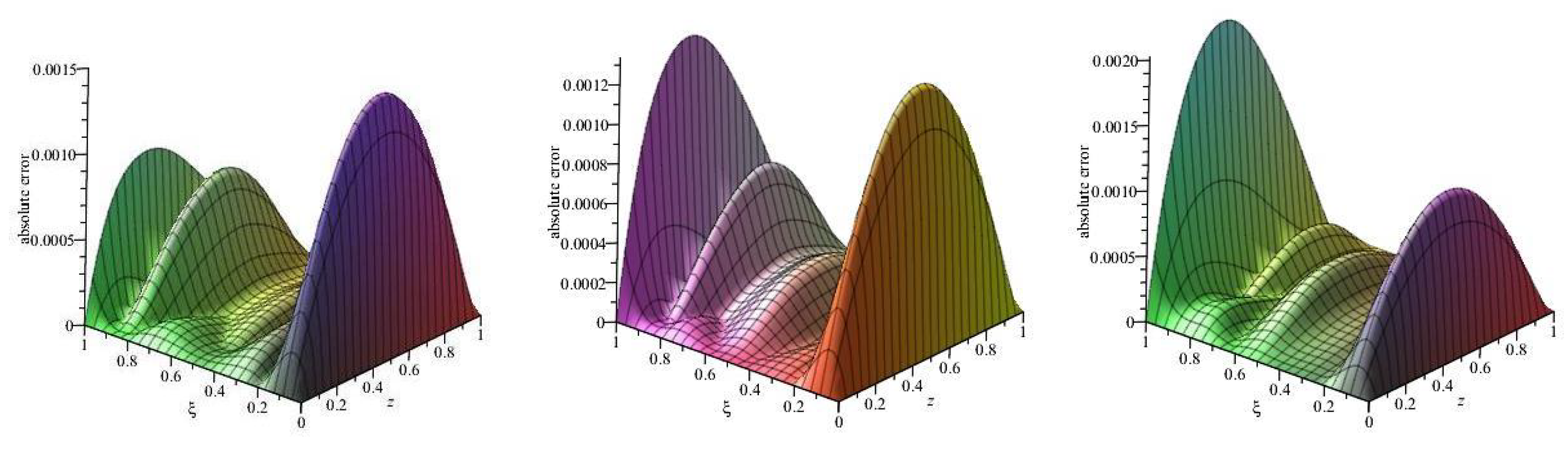
and is the function that provides the Equation (62). Taking , and n-th term of approximate solution is selected as . Absolute error values for Example 1 is computed for , , and . Error values are given in Table 2, Table 3 and Table 4 in order to observe of applicability and influence of method. The graphics of absolute errors are given for , , and in Figure 1.
Table 2.
Absolute error values of Example 1 for Burgers’ equation with .
Table 3.
Absolute error values of Example 1 for Burgers’ equation with .
Table 4.
Absolute error values of Example 1 for Burgers’ equation with .
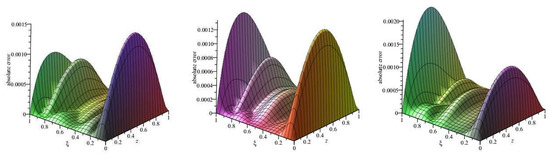
Figure 1.
The surfaces show the absolute error of Example 1 with and for , , respectively on region .
Example 2.
It will be examined that the fractional-order Burgers’ equation with Neumann boundary condition as follow:
The exact solution of problem is:
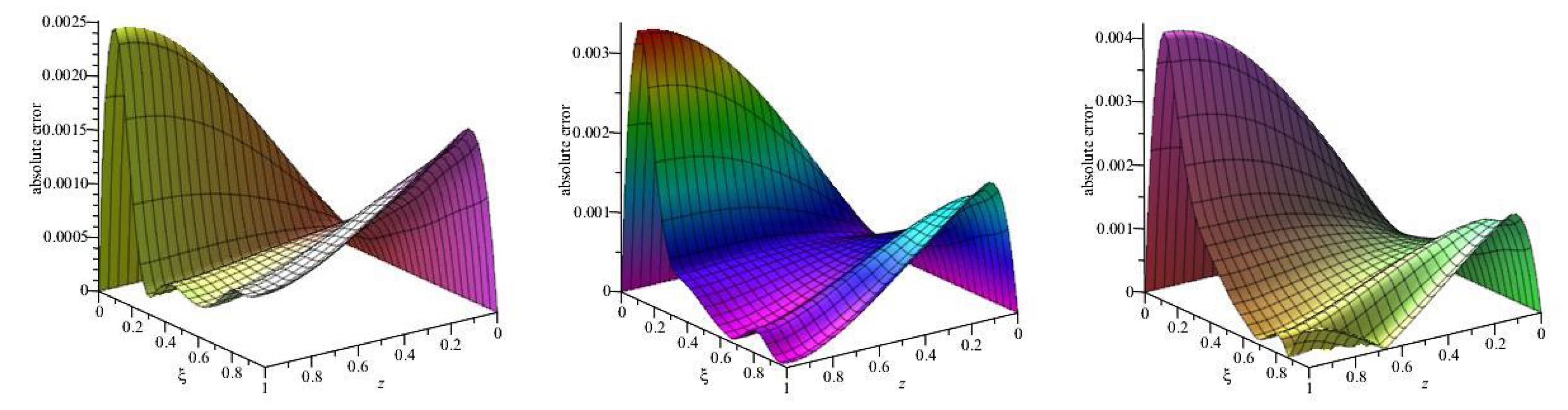
and is the function that provides the Equations (65). Taking , and . Absolute error of Example 2 is computed for , , and . Error values are given in Table 5, Table 6 and Table 7 in order to observe of applicability and influence of method. The graphics of absolute errors are given for , , and in Figure 2.
Table 5.
Absolute error values of Example 2 for Burgers’ equation with .
Table 6.
Absolute error values of Example 2 for Burgers’ equation with .
Table 7.
Absolute error values of Example 2 for Burgers’ equation with .
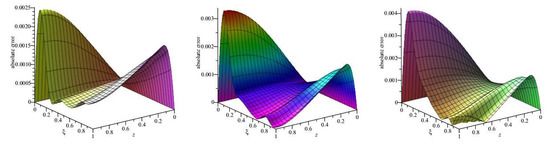
Figure 2.
The surfaces show the absolute error of Example 2 with and for , , respectively on region .
7. Conclusions
In this research, some special Hilbert spaces with inner products and the kernel function of these spaces are introduced. Then the iterative solution is obtained by reproducing kernel theory. Error estimation of the approximate solution and convergence analysis are verified with lemma and theorems. Numerical outcomes demonstrate that the iterative approximation is applicable, convenient, and powerful for fractional-order Burgers’ equation with Dirichlet and Neumann conditions. Therefore, iterative RKM is successfully implemented for fractional-order Burgers’ equation and so this study will contribute to the science.
Author Contributions
Resources, F.E.; Software, M.G.S.; Writing-original draft, O.S.; Writing-review & editing, O.S. and M.G.S. All authors have read and agreed to the published version of the manuscript.
Funding
This research received no funding.
Acknowledgments
We thank the reviewers for their positive remarks on our work.
Conflicts of Interest
The authors declare no conflict of interest.
Abbreviations
The following abbreviations are used in this manuscript:
| RKM | Reproducing Kernel Method |
| RKHS | Reproducing Kernel Hilbert Space |
References
- Burgers, J.M. Mathematical examples illustrating relations occurring in the theory of turbulent fluid motion. In Selected Papers of JM Burgers; Verhandelingen Der Koninklijke Nederlandsche Akademle V An Wetenschappen, Afdeeling Natuurkunde; Springer: Dordrecht, The Netherlands, 1939; Volume 17, pp. 1–53. [Google Scholar]
- Guesmia, A.; Daili, N. About the existence and uniqueness of solution to fractional Burgers Equation. Acta Univ. Apulensis 2010, 21, 161–170. [Google Scholar]
- Lombard, B.; Matignon, D. Diffusive approximation of a time-fractional Burger’s equation in nonlinear acoustics. Siam J. Appl. Math. 2016, 76, 1765–1791. [Google Scholar] [CrossRef]
- Dong, Z.; Sun, X.; Xiao, H.; Zhai, J. Averaging principle for one dimensional stochastic Burgers equation. J. Differ. Equ. 2018, 265, 4749–4797. [Google Scholar] [CrossRef]
- Nojavan, H.; Abbasbandy, S.; Mohammadi, M. Local variably scaled Newton basis functions collocation method for solving Burgers’ equation. Appl. Math. Comput. 2018, 330, 23–41. [Google Scholar] [CrossRef]
- Oruc, O.; Esen, A.; Bulut, F. A unified finite difference Chebyshev wavelet method for numerically solving time fractional Burgers’ equation. Discret. Contin. Dyn. Syst. Ser. S 2019, 12, 533–542. [Google Scholar]
- Rong-Pei, Z.; Xi-Jun, Y.; Guo-Zhong, Z. Modified Burgers’ equation by the local discontinuous Galerkin method. Chin. Phys. B 2013, 22, 1–5. [Google Scholar]
- Roshan, T.; Bhamra, K.S. Numerical solutions of the modified Burgers’ equation by Petrov-Galerkin method. Appl. Math. Comput. 2011, 218, 3673–3679. [Google Scholar] [CrossRef]
- Ramadan, M.A.; Danaf, T.S.E. Numerical treatment for the modified Burgers equation. Math. Comput. Simul. 2005, 70, 90–98. [Google Scholar] [CrossRef]
- Bahadir, A.R.; Saglam, M. A mixed finite difference and boundary element approach to one-dimensional Burgers’ equation. Appl. Math. Comput. 2005, 160, 663–673. [Google Scholar] [CrossRef]
- Dag, I.; Irk, D.; Saka, B. A numerical solution of the Burgers equation using cubic B-splines. Appl. Math. Comput. 2005, 163, 199–211. [Google Scholar]
- Caldwell, J.; Wanless, P.; Cook, E. A finite element approach to Burgers’ equation. Appl. Math. Model. 1981, 5, 189–193. [Google Scholar] [CrossRef]
- Kutluay, S.; Bahadir, A.R.; Ozdes, A. Numerical solution of one-dimensional Burgers’ equation: Explicit and exact-explicit finite-difference methods. J. Comput. Appl. 1999, 103, 251–261. [Google Scholar] [CrossRef]
- Li, F.; Cui, M. A best approximation for the solution of one-dimensional variable-coefficient Burgers equation. Numer. Methods Partial Differ. Equ. 2009, 25, 1353–1365. [Google Scholar] [CrossRef]
- Raza, N.; Awan, A.U.; Haque, E.U.; Abdullah, M.; Rashidi, M.M. Unsteady flow of a Burgers’ fluid with Caputo fractional derivatives: A hybrid technique. Ain Shams Eng. J. 2019, 10, 319–325. [Google Scholar] [CrossRef]
- Safdar, R.; Imran, M.; Khalique, C.M. Time-dependent flow model of a generalized Burgers’ fluid with fractional derivatives through a cylindrical domain: An exact and numerical approach. Results Phys. 2018, 9, 237–245. [Google Scholar] [CrossRef]
- Liu, J.; Hou, G. Numerical solutions of the space-and time-fractional coupled Burgers equations by generalized differential transform method. Appl. Math. Comput. 2011, 217, 7001–7008. [Google Scholar] [CrossRef]
- Zhang, J.; Liu, F.; Lin, Z.; Anh, V. Analytical and numerical solutions of a multi-term time-fractional Burgers’ fluid model. Appl. Math. Comput. 2019, 356, 1–12. [Google Scholar] [CrossRef]
- Momani, S. Non-perturbative analytical solutions of the space-and time-fractional Burgers equations. Chaos Solitons Fractals 2006, 28, 930–937. [Google Scholar] [CrossRef]
- Ajou, A.E.; Arqub, O.A.; Momani, S. Approximate analytical solution of the nonlinear fractional KdV-Burgers equation: A new iterative algorithm. J. Comput. Phys. 2015, 293, 81–95. [Google Scholar] [CrossRef]
- Mittal, R.C.; Arora, G. Numerical solution of the coupled viscous Burgers’ equation. Commun. Nonlinear. Sci. Numer. Simulat. 2011, 16, 1304–1313. [Google Scholar] [CrossRef]
- Jiwari, R. A hybrid numerical scheme for the numerical solution of the Burgers’ equation. Comput. Phys. Commun. 2015, 188, 59–67. [Google Scholar] [CrossRef]
- Kutluay, S.; Esen, A.; Dag, I. Numerical solutions of the Burgers’ equation by the least-squares quadratic B-spline finite element method. J. Comput. Appl. Math. 2004, 167, 21–33. [Google Scholar] [CrossRef]
- Zaremba, S. Sur le calcul numérique des fonctions demandées dans le probléme de Dirichlet et le problème hydrodynamique. Bull. Int. de l’Académie Sci. Cracovie 1908, 1908, 125–195. [Google Scholar]
- Aronszajn, N. Theory of reproducing kernels. Trans. Am. Math. Soc. 1950, 68, 337–404. [Google Scholar] [CrossRef]
- Schwartz, L. Sous-espaces hilbertiens d’espaces vectoriels topologiques et noyaux associés (noyaux reproduisants). J. Anal. Math. 1964, 13, 115–256. [Google Scholar] [CrossRef]
- Saitoh, S.; Sawano, Y. Theory of Reproducing Kernels and Applications. Developments in Mathematics; Springer: Singapore, 2016. [Google Scholar]
- Akram, G.; Rehman, H. Numerical solution of eighth order boundary value problems in reproducing Kernel space. Numer. Algor. 2013, 62, 527–540. [Google Scholar] [CrossRef]
- Jiang, W.; Lin, Y. Approximate solution of the fractional advection-dispersion equation. Comput. Phys. Commun. 2010, 181, 557–561. [Google Scholar] [CrossRef]
- Arqub, O.A. Numerical algorithm for the solutions of fractional order systems of Dirichlet function types with comparative analysis. Fundam. Inform. 2019, 166, 111–137. [Google Scholar] [CrossRef]
- Sakar, M.G.; Saldır, O.; Akgül, A. A novel technique for fractional Bagley–Torvik equation. Proc. Natl. Acad. Sci. India Sect. A Phys. Sci. 2019, 89, 539–545. [Google Scholar] [CrossRef]
- Jiang, W.; Lin, Y. Representation of exact solution for the time-fractional telegraph equation in the reproducing kernel space. Commun. Nonlinear Sci. Numer. Simulat. 2011, 16, 3639–3645. [Google Scholar] [CrossRef]
- Mohammadi, M.; Zafarghandi, F.S.; Babolian, E.; Jvadi, S. A local reproducing kernel method accompanied by some different edge improvement techniques: Application to the Burgers’ equation. Iran. J. Sci. Technol. Trans. Sci. 2018, 42, 857–871. [Google Scholar] [CrossRef]
- Arqub, O.A.; Al-Smadi, M. Numerical algorithm for solving time-fractional partial integrodifferential equations subject to initial and Dirichlet boundary conditions. Numer. Methods Partial Differ. Equ. 2018, 34, 1577–1597. [Google Scholar] [CrossRef]
- Sakar, M.G. Iterative reproducing kernel Hilbert spaces method for Riccati differential equations. J. Comput. Appl. Math. 2017, 309, 163–174. [Google Scholar] [CrossRef]
- Yao, H. Reproducing Kernel method for the solution of nonlinear hyperbolic telegraph equation with an integral condition. Numer. Methods Partial Differ. Equ. 2011, 27, 867–886. [Google Scholar] [CrossRef]
- Arqub, O.A. Solutions of time-fractional Tricomi and Keldysh equations of Dirichlet functions types in Hilbert space. Numer. Methods Partial Differ. Equ. 2018, 34, 1759–1780. [Google Scholar] [CrossRef]
- Akgül, A.; Inc, M.; Kilicman, A.; Baleanu, D. A new approach for one-dimensional sine-Gordon equation. Adv. Differ. Equ. 2010, 8, 1–20. [Google Scholar] [CrossRef]
- Lin, Y.; Zhou, Y. Solving the reaction-diffusion equations with nonlocal boundary conditions based on reproducing kernel space. Numer. Methods Partial Differ. Equ. 2009, 25, 1468–1481. [Google Scholar] [CrossRef]
- Arqub, O.A.; Maayah, B. Numerical solutions of integro differential equations of Fredholm operator type in the sense of the Atangana-Baleanu fractional operator. Chaos Solitons Fractals 2018, 117, 117–124. [Google Scholar] [CrossRef]
- Arqub, O.A.; Al-Smadi, M.; Shawagfeh, N. Solving Fredholm integro-differentialequations using reproducing kernel Hilbert space method. Appl. Math. Comput. 2013, 219, 8938–8948. [Google Scholar]
- Mohammadi, M.; Mokhtari, R. A reproducing kernel method for solving a class of nonlinear systems of PDEs. Math. Model. Anal. 2014, 19, 180–198. [Google Scholar] [CrossRef]
- Wang, Y.; Du, M.; Tan, F.; Li, Z.; Nie, T. Using reproducing kernel for solving a class of fractional partial differential equation with non-classical conditions. Appl. Math. Comput. 2013, 219, 5918–5925. [Google Scholar] [CrossRef]
- Arqub, O.A.; Al-Smadi, M. Atangana-Baleanu fractional approach to the solutions of Bagley–Torvik and Painlevéequations in Hilbert space. Chaos Solitons Fractals 2018, 117, 161–167. [Google Scholar] [CrossRef]
- Mohammadi, M.; Mokhtari, R.; Panahipour, H. A Galerkin-reproducing kernel method: Application to the 2D nonlinear coupled Burgers equations. Eng. Anal. Bound. Elem. 2013, 37, 1642–1652. [Google Scholar] [CrossRef]
- Sakar, M.G.; Saldır, O. Improving variational iteration method with auxiliary parameter for nonlinear time-fractional partial differential equations. J. Optim. Theory Appl. 2017, 174, 530–549. [Google Scholar] [CrossRef]
- Cui, M.G.; Lin, Y.Z. Nonlinear Numercal Analysis in the Reproducing Kernel Space; Nova Science Publisher: New York, NY, USA, 2009. [Google Scholar]
- Tanaka, K. Generation of point sets by convex optimization for interpolation in reproducing kernel Hilbert spaces. Numer. Algor. 2019, 84, 1049–1079. [Google Scholar] [CrossRef]
- Sakar, M.G.; Saldır, O.; Erdogan, F. An iterative approximation for time-fractional Cahn-Allen equation with reproducing kernel method. Comput. Appl. Math. 2018, 37, 5951–5964. [Google Scholar] [CrossRef]
- Lotfi, T.; Rashidi, M.; Mahdiani, K. A posteriori analysis: Error estimation for the eighth order boundary value problems in reproducing Kernel space. Numer. Algor. 2016, 73, 391–406. [Google Scholar] [CrossRef]
- Saldır, O.; Sakar, M.G.; Erdogan, F. Numerical solution of time-fractional Kawahara equation using reproducing kernel method with error estimate. Comp. Appl. Math. 2019, 38, 198. [Google Scholar] [CrossRef]
- Bakhtiari, P.; Abbasbandy, S.; Van Gorder, R.A. Solving the Dym initial value problem in reproducing kernel space. Numer. Algor. 2018, 78, 405–421. [Google Scholar] [CrossRef]
- Sakar, M.G.; Saldır, O.; Erdogan, F. A hybrid method for singularly perturbed convection–diffusion equation. Int. J. Appl. Comput. Math. 2019, 5, 135. [Google Scholar] [CrossRef]
- Sakar, M.G.; Saldır, O. A novel iterative solution for time-fractional Boussinesq equation by reproducing kernel method. J. Appl. Math. Comput. 2020, in press. [Google Scholar] [CrossRef]
- Gao, W.; Veeresha, P.; Prakasha, D.G.; Baskonus, H.M. Novel Dynamic Structures of 2019-nCoV with Nonlocal Operator via Powerful Computational Technique. Biology 2020, 9, 107. [Google Scholar] [CrossRef] [PubMed]
- Goufo, E.F.D.; Toudjeo, I.T. Around chaotic disturbance and irregularity for higher order traveling waves. J. Math. 2018, 2018, 2391697. [Google Scholar]
- Goufo, E.F.D. Application of the Caputo-Fabrizio fractional derivative without singular kernel to Korteweg-de Vries-Burgers equation. Math. Model. Anal. 2016, 21, 188–198. [Google Scholar] [CrossRef]
- Podlubny, I. Fractional Differential Equations; Academic Press: New York, NY, USA, 1999. [Google Scholar]
- Diethelm, K. The Analysis of Fractional Differential Equations; Lecture Notes in Mathematics; Springer: Berlin/Heidelberg, Germany, 2010. [Google Scholar]
© 2020 by the authors. Licensee MDPI, Basel, Switzerland. This article is an open access article distributed under the terms and conditions of the Creative Commons Attribution (CC BY) license (http://creativecommons.org/licenses/by/4.0/).