1. Introduction
Urban drainage systems are increasingly exposed to the combined pressures of climate and land-use change. Intensified rainfall and soil sealing have altered the hydrological cycle, resulting in the exceedance of drainage network capacity and a consequent rise in the frequency and severity of sewer flooding in urban areas [
1]. In many European cities, including several in Italy, combined sewer systems remain predominant. These networks are designed to convey both wastewater and stormwater toward treatment facilities through a single drainage infrastructure [
2]. Generally, when rainfall intensity exceeds the system’s conveyance or storage capacity, combined sewer overflows (CSOs) are activated as hydraulic relief structures that discharge excess mixed flow into adjacent receiving waters [
3,
4]. Although originally conceived as essential safety mechanisms to prevent network surcharge and surface flooding, CSOs have progressively become critical points of interaction between urban drainage and the receiving water bodies [
5]. Their increasing frequency and pollutant loads, driven by infrastructure ageing, urban densification and changing rainfall regimes, now represent one of the main challenges for urban water management, affecting compliance with water-quality standards and the ecological status of receiving water bodies [
6].
The European Water Framework Directive [
7] established an integrated vision of water management, recognizing water as a shared resource and promoting the simultaneous achievement of chemical, physical and ecological quality objectives. This regulatory framework has encouraged the development of approaches that combine engineering reliability with environmental sustainability. Within this perspective, Nature-Based Solutions (NBS) have gained increasing attention as strategies that employ natural processes to manage water resources and enhance resilience [
8,
9]. Among these, Sustainable Drainage Systems (SuDS) represent the practical implementation of NBS in urban contexts, aiming to reproduce natural hydrological processes through retention, infiltration and evapotranspiration [
10]. Typical SuDS elements, such as bioretention cells, rain gardens, and permeable pavements, help control stormwater, reduce runoff peaks and improve the ecological quality of cities [
11].
Scientific research has progressively examined the hydrologic and environmental performance of SuDS, although results remain context-dependent and influenced by several factors. The review by Jazayeri Moghanlo and Raimondi [
12] synthesizes extensive evidence showing that SuDS can substantially reduce overflow volumes, peak discharges, and pollutant loads, while enhancing hydraulic stability and downstream water quality. Their findings also emphasize that performance strongly depends on local hydroclimatic conditions and on the spatial configuration and combination of measures, as synergistic effects often arise from integrated implementations. Recent modelling analyses [
13,
14] reveal that the interaction among multiple SuDS components is not linear and that overall performance depends on spatial configuration, hydraulic routing and implementation extent. The resilience-oriented framework proposed by Rodriguez et al. [
14] highlights that SuDS can improve the adaptive capacity of combined sewer systems under variable rainfall regimes, although performance varies spatially and temporally. At the catchment scale, Kwak et al. [
15] confirmed that distributed green stormwater infrastructure can attenuate overflow volumes and peaks, even if its efficiency tends to decrease under rainfall characterized by higher cumulative depths or intensities. Although substantial research has been conducted, the majority of studies have focused on examining SuDS performance under synthetic design storms. In contrast, their effectiveness under ordinary precipitation conditions, which dominate long-term system operation, remains underexplored. This gap limits the understanding of SuDS behaviour under real operating conditions, where rainfall variability, catchment hydrology, and drainage network configuration jointly influence system performance [
16]. Differences between ordinary real rainfall conditions and design extreme scenarios arise from distinct hydrological and hydraulic responses, yet empirical evidence capturing these differences remains scarce, particularly for industrial and densely urbanized areas in Southern Europe [
17]. This study aims at advancing existing knowledge by providing event-scale evidence under ordinary rainfall conditions and by explicitly comparing these results with a synthetic design storm used as a benchmark. The work represents a first step within a broader research framework and is conceived as a scenario-based analysis relying on uncalibrated drainage network models. Within this framework, the work addresses the following research questions:
How do SuDS influence CSO discharge volumes, peak flows, and activation frequency under ordinary rainfall conditions?
To what extent does SuDS effectiveness depend on rainfall characteristics and on the spatial configuration of CSOs within the catchment?
How does SuDS performance under ordinary rainfall conditions compare with that obtained under a synthetic 10-years return period design storm?
These questions are addressed through the analysis of SuDS effects on the quantitative control of CSOs in the industrial district of Sesto Ulteriano, within the municipality of San Giuliano Milanese (Metropolitan City of Milan). The area represents a typical example of an undersized combined drainage network hydraulically connected to artificial channels, where spatially and temporally frequent overflow events lead to both hydraulic and water-quality issues [
18,
19]. Using the Storm Water Management Model (SWMM 5.2) [
20,
21,
22], two hydrologic–hydraulic configurations were investigated: a baseline representing current conditions and a design scenario incorporating SuDS interventions distributed across 24 hectares [
23]. Simulations were performed for four rainfall events representative of ordinary local precipitation conditions, extracted from a one-year continuous rainfall record (2014). In addition, synthetic design storm was designed using local depth-duration-frequency relationships, with a 9 h duration and a 10-year return period, and was adopted exclusively as a benchmark to compare SuDS performance under ordinary observed precipitation conditions and under synthetic design storm. Beyond conventional indicators, such as the reduction in total overflow volumes from all CSOs in the network, the analysis also considers the decrease in CSO activation frequency across the system and examines the response of three specific CSOs located at different points of the urban catchment, each characterized by distinct contributing areas. These aspects collectively provide an updated perspective on the potential contribution of SuDS to CSO reduction under real operating conditions. Beyond the local case, the results are expected to inform similar contexts where combined sewer systems remain widespread and where hybrid strategies combining natural and engineered measures are needed to enhance system resilience.
2. Materials and Methods
2.1. The Case Study
Sesto Ulteriano (45°23′45″ N, 9°15′13″ E) is a district of approximately 1100 ha and 3500 inhabitants within the municipality of San Giuliano Milanese, in the Metropolitan City of Milan, Northern Italy. The area combines urban and agricultural land uses and drains toward the Lambro River through a network of artificial and semi-natural irrigation channels originally designed for irrigation but now hydraulically connected to the urban drainage system. In particular, the study area covers about 290 ha and represents the most urbanized sector of the district, characterized by a predominance of industrial activities and limited residential development [
18].
Over the past decades, urban expansion in the Lombardy region has led to a substantial increase in impervious surfaces, with significant implications for runoff generation, infiltration processes and flood susceptibility. In Sesto Ulteriano, this process has resulted in a highly impermeable landscape dominated by industrial and commercial areas. The combined sewer network conveys both wastewater and stormwater southward to the San Giuliano Milanese Ovest wastewater treatment plant. When rainfall intensity exceeds the system capacity, 27 combined sewer overflows (CSOs) discharge excess mixed water into the adjacent irrigation and drainage channels that serve as receiving bodies. These channels perform multiple hydraulic functions but remain sensitive to stormwater inputs from urban areas. Although water quality has improved following the modernization of regional wastewater treatment systems, occasional pollution associated with overflow events still occurs, particularly during heavy rainfall. The strong hydraulic interconnection between the combined sewer system and the surface water network amplifies both hydraulic and qualitative criticalities. Limited conveyance capacity further constrains the resilience of the receiving system. This condition exemplifies the structural fragility of many peri-urban drainage networks in Northern Italy and underscores the need for sustainable stormwater management approaches capable of enhancing both hydraulic efficiency and environmental performance.
2.2. Climatic Context and Rainfall Event Selection
According to the Köppen classification [
24,
25], the study area belongs to the humid subtropical (Cfa) climate group, corresponding to a warm temperate regime with hot summers and no dry season. Precipitation occurs throughout the year, with marked interannual variability due to the alternation of convective and stratiform events.
Rainfall data were obtained from the Lodi weather station (45°19′ N, 9°30′ E), managed by the Italian Environmental Agency (ARPA) of the Lombardia Region and located about 25 km southeast of the study area. The station provides one of the most complete sub-hourly rainfall datasets available for the region [
19]. The year 2014 was selected because it offers a complete and continuous dataset with no significant gaps and includes several rainfall events representatives of the typical intensity–duration spectrum observed locally.
Table 1 summarizes the main characteristics of the four rainfall events selected from the 2014 dataset, together with those of a design rainfall event introduced for comparative purposes. The convective event of 24 June 2014 exhibited the highest mean intensity (16.6 mm h
−1) and the shortest duration (1.7 h), typical of short, high-intensity summer storms. The mixed event of 7 July 2014 lasted 9.8 h with an intensity of 4.6 mm h
−1 but presented a brief intensity peak (16.4 mm/10 min), reflecting the transitional nature between convective and stratiform rainfall. The stratiform event of 12 November 2014 was the longest (27.5 h) and produced the highest cumulative depth (112.2 mm), characteristic of persistent autumn precipitation. Conversely, the ordinary event of 9 December 2014 had a limited rainfall depth (15.6 mm) and low intensity (3.5 mm h
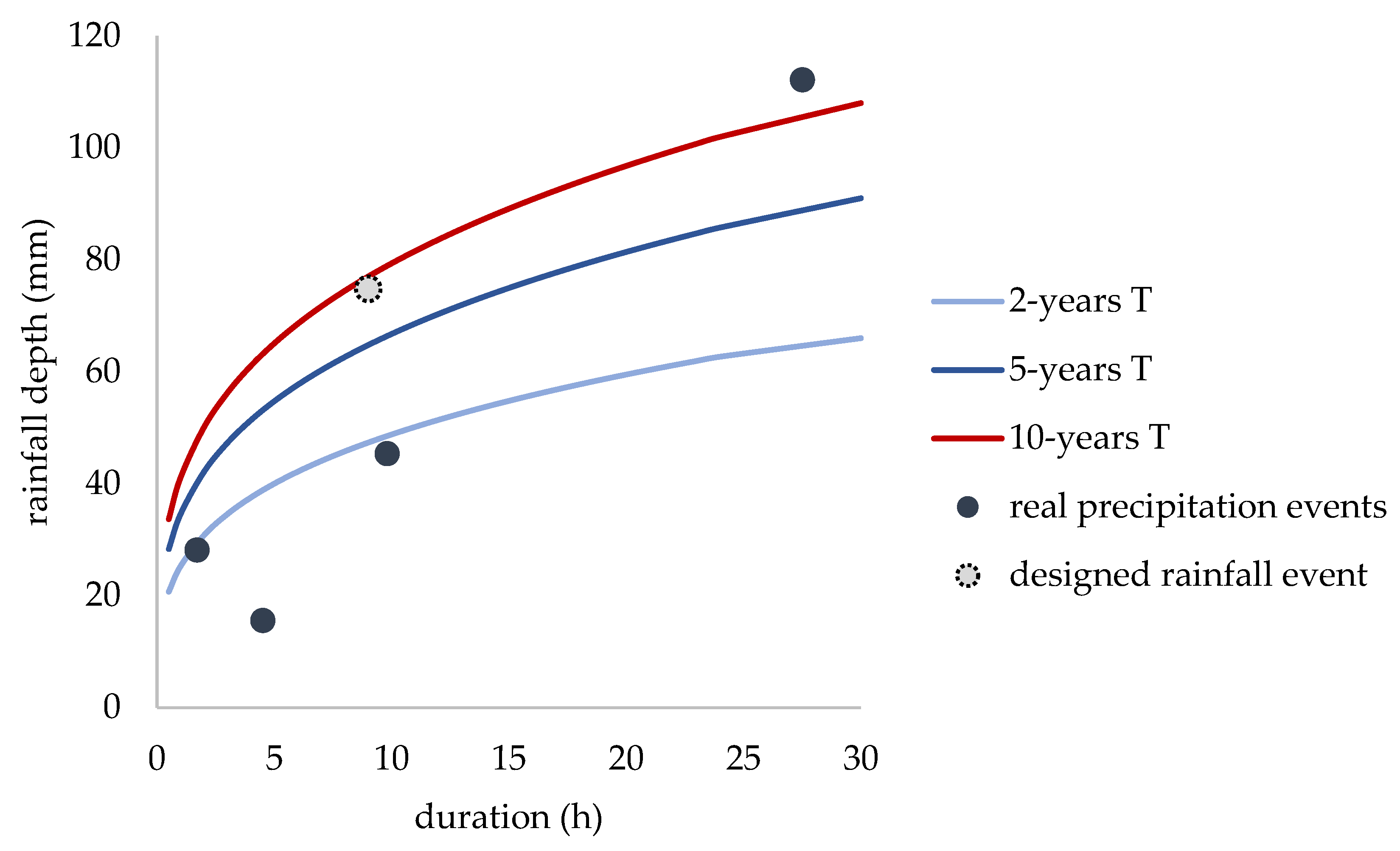
−1), return period of 2 years of ordinary, low-impact rainfall that occurs frequently during the cold season. All selected events, with the exception of the November event, which exceeds a 10-year return period, are characterized by very high frequency and are associated with a return period of approximately 2 years, as shown in
Figure 1. In addition to the observed rainfall events, a synthetic design storm was included in the analysis. The event was characterized by a 10-year return period (T = 10 years) and a duration of 9 h, corresponding to the rainfall duration that maximizes peak discharge. This duration is also comparable to that of one of the observed events considered in the analysis, allowing for a more consistent comparison between synthetic and real rainfall conditions. The storm was designed using depth–duration–frequency relationships derived from the Lodi rain gauge, with its temporal structure defined according to a Chicago hyetograph (
Figure 1 and
Table 1).
Selecting rainfall events with different characteristics was essential to explore the response of the combined sewer system and the SuDS configuration under different hydrological conditions. Short, high-intensity storms test the network’s ability to mitigate peak discharges, whereas long-duration events emphasize storage and infiltration processes. Including low-intensity, frequent rainfall allows assessment of system performance under ordinary operating conditions, which are the most ordinary within the annual rainfall regime and play a critical role in long-term CSO control.
2.3. The SWMM 5.2 Drainage Network Models
Two SWMM 5.2 hydraulic-hydrological models of the Sesto Ulteriano drainage system, previously developed for different research objectives, were used in this study [
23].
The Business-as-Usual (BAU) scenario reproduces the current configuration of the combined drainage network. The model includes the existing layout of conduits and manholes, land-use characteristics and boundary conditions, which were derived from data provided by the local water utility (CAP Group) and, where necessary, supplemented by simplified assumptions. Further details on the model setup can be found in a previous study [
18]. The BAU configuration represents the traditional approach to stormwater management and serves as the reference for evaluating the hydraulic performance of the existing network.
The Green Drainage Scenario (GDS) represents an improvement of the baseline BAU configuration through the retrofitting of selected impervious areas with SuDS, designed to improve on-site retention and reduce the hydraulic load entering the combined network. The implemented measures include infiltration trenches, rain gardens and permeable parking areas, for an overall retrofitted surface of approximately 24 hectares, corresponding to about 8% of the total study area (≈290 ha). SuDS typologies were selected based on a preliminary screening of their suitability for the local context, with particular attention to operational and maintenance feasibility, and were located in specific areas of the catchment identified as suitable for hosting each selected infrastructure [
18,
23].
The definition of the SuDS design project, including infrastructure typology, extent, spatial distribution, and technological configuration, represents a primary element in shaping overall system behaviour. Nevertheless, key hydraulic parameters of SuDS substrates, such as hydraulic conductivity and porosity, may also influence their hydrological response by affecting processes related to runoff capture, conveyance, and storage capacity [
26]. Technological and design choices were established at an early project stage, while hydraulic parameters were defined during the modelling set-up based on literature evidence and recommendations provided in the SWMM 5.2 technical manual. The resulting SuDS parameterization adopted in this study is detailed in D’Ambrosio et al. [
18].
2.4. Simulations and Output Analysis
Two continuous simulations were performed using SWMM 5.2, adopting as rainfall input the 10 min time-step series recorded in Lodi during 2014, which includes the four selected rainfall events described above. These simulations were run for both drainage configurations, BAU and GDS. In addition, two event-scale simulations were conducted for the same configurations using the synthetic design rainfall event with a 10-year return period as input.
Model outputs were analyzed in terms of total overflow rates (L s−1) at the 27 main CSOs, to provide both an overall assessment of system performance (e.g., total overflow volume within the catchment and number of active CSOs) and detailed evaluations at selected sites.
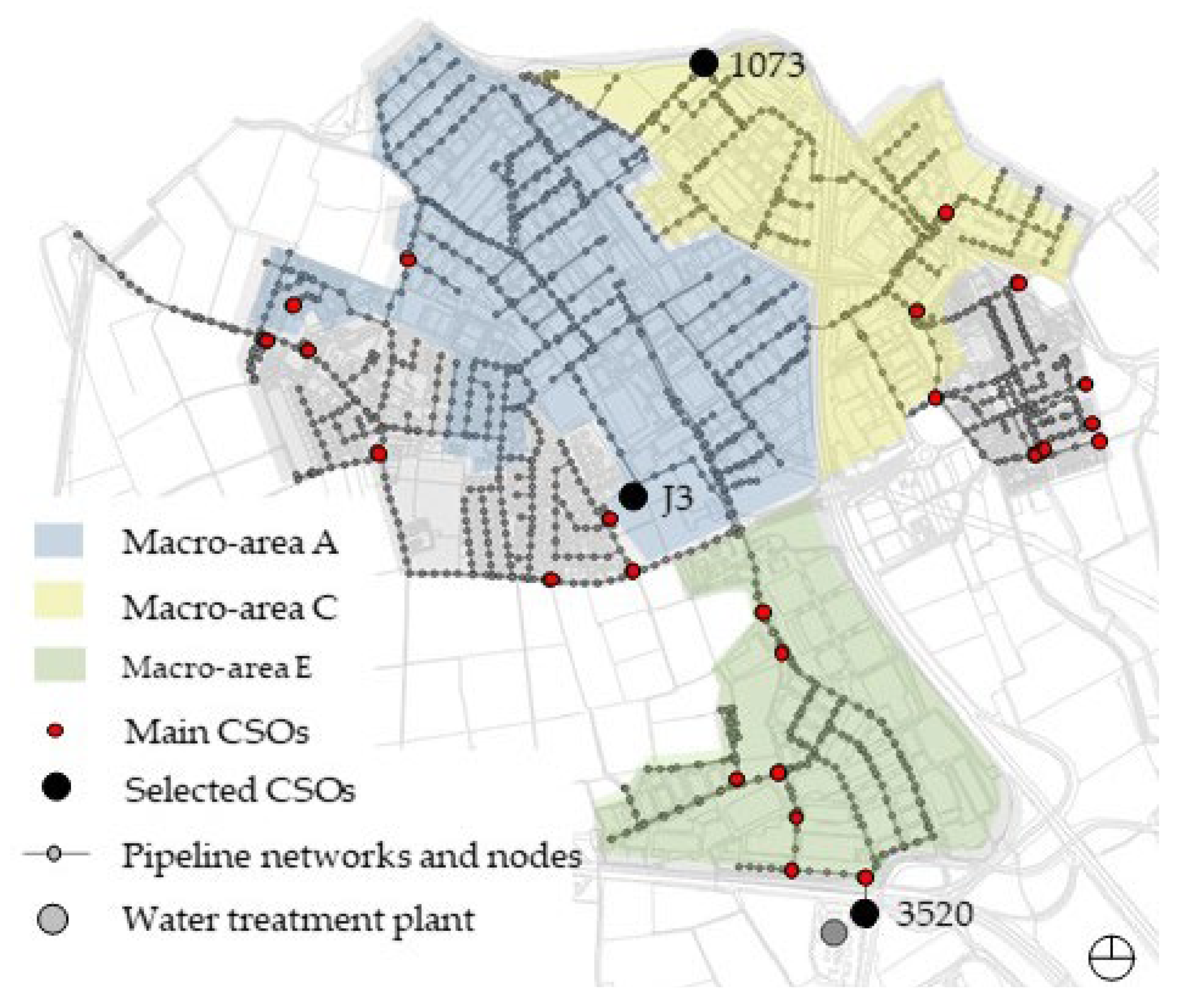
Particular attention was given to three CSOs, 1073, J3, and 3520, located along the network from upstream to downstream and identified as critical points based on their distinct characteristics (
Figure 2).
Table 2 summarizes the main characteristics of each CSO, including the contributing area (A), the length of the main sewer conduit (L), and the contributing impervious area (A
IMP) together with its corresponding discharge coefficient (C
IMP).
CSO 1073, located in the upper section of the system, drains runoff from a small industrial area of approximately 9 ha. CSO J3 collects flows from a major industrialized subcatchment of about 161 ha and represents one of the most hydraulically stressed nodes in the network. CSO 3520, positioned at the downstream end, lies immediately upstream of the San Giuliano Milanese Ovest wastewater treatment plant and drains an area of 84 ha. The three contributing catchments differ not only in extent but also in surface characteristics, with imperviousness values of 56% for CSO 1073, 32% for J3, and 18% for CSO 3520. Regarding surface transformation through SuDS implementation, the three CSOs fall within distinct industrial macro-areas characterized by similar retrofitting rates, approximately 12% in macro-areas C and E, and 9% in macro-area A [
18]. However, the main differences arise from the hydraulic configuration of the sewer system. At CSO J3, inflows are conveyed through a longer upstream main conduit (1400 m), resulting in greater hydraulic attenuation and longer travel times before overflow occurs. Conversely, at CSOs 3520 and 1073, the contributing networks are hydraulically more direct, with shorter main conduits (800 and 900 m, respectively), leading to shorter concentration times and faster hydrograph responses at the overflow structures. From the continuous dataset, the inflow time series corresponding to each of the four rainfall events were extracted. Based on these series, the following metrics were computed:
total overflow volume from all 27 CSOs (VTOT CSOs);
number of active CSOs during each event (N CSOs);
total overflow volume from 1073, J3, 3520 (VTOT 1073, VTOT J3, VTOT 3520);
peak overflow from 1073, J3, 3520 (QMAX 1073, QMAX J3, QMAX 3520).
2.5. SuDS Performance Assessment
Based on the synthetic metrics previously described and obtained for each modelled drainage configuration (BAU and GDS), a comparative analysis was performed between the current network condition (BAU), used as a benchmark, and the corresponding values from the GDS scenario. The comparison was carried out for each investigated rainfall event to highlight, by difference, the capacity of SuDS, the only varying component between the two configurations, to mitigate overflow volumes and peaks, as well as overflow frequency in the whole catchment.
Accordingly, the following SuDS performance indicators were defined for each selected event:
reduction of the total overflow volume from all 27 CSOs (RVTOT CSOs);
reduction of the number of active CSOs during each event (RN CSOs);
reduction of the total overflow volume from 1073, J3, 3520 (RVTOT 1073, RVTOT J3, RVTOT 3520);
reduction of the peak overflow from 1073, J3, 3520 (RQMAX 1073, RQMAX J3, RQMAX 3520).
An example of the calculation for one of the indicators is reported below.
To gain a more detailed view of the system behaviour, the analysis additionally focused on hydrographs, useful for capturing the temporal dynamics of each CSO, and on the corresponding overflow cumulative distributions. These outputs were generated for the selected CSOs (1073, J3, and 3520) across all simulated rainfall events. For a direct comparison between configurations, the results were presented in 12 figures, each representing a specific CSO/rainfall event pair and including two curves, one for BAU and one for GDS. The synthetic design precipitation event was not considered in this analysis, in order to maintain a specific focus on system responses under real-world rainfall conditions.
3. Results
The main quantitative performance metrics defined in
Section 2.4 are reported in
Table 3 and
Table 4 for the BAU and GDS scenarios, respectively. In the BAU condition (
Table 3), the magnitude and spatial extent of overflow clearly reflect the severity of the rainfall events. The short and intense 24 June event produces relatively small system-wide overflow volumes and peak discharges at the three reference CSOs. The 7 July event, with longer duration and higher cumulative rainfall, generates substantially larger volumes while activating a similar number of CSOs. The November event (highest cumulative depth) yields the highest total overflow volume and triggers almost all CSOs in the network, with all three reference structures showing pronounced increases in both volume and peak discharge. Conversely, the low-intensity December event results in very limited overflow and the lowest level of network activation. Across all events, the three CSOs maintain consistent relative differences: J3 systematically exhibits the largest overflow volumes, whereas 1073 and 3520 produce smaller volumes but display higher peak values in several cases.
The 10-years T design event produces system responses that are consistent with its role as an extreme synthetic design storm benchmark. In terms of total overflow volume, the design event generates values substantially higher than those associated with ordinary observed events, while remaining lower than the most severe recorded event of November. A similar behaviour is observed at the reference CSOs, where overflow volumes fall between those of moderate events and the November storm. Conversely, peak discharges under the design event are among the highest recorded at the local scale, particularly at CSOs J3 and 3520, reflecting the more concentrated temporal structure of the synthetic hyetograph. This confirms that, while the design storm does not necessarily represent the most severe condition in terms of cumulative overflow volumes, it induces critical peak responses that are useful for benchmarking system performance under extreme loading conditions.
In the GDS scenario (
Table 4), overflow responses show consistently lower magnitudes across all rainfall events. The 24 June event results in modest overflow volumes and comparatively small peak discharges at the three reference CSOs, while the 7 July event, despite its longer duration, produces reduced system-wide overflow levels and engages nearly the same number of CSOs. The November event is still the one with the highest total overflow, although absolute values at the reference CSOs are substantially smaller and the number of activated nodes is slightly reduced. The December event generates minimal overflow and involves only a limited portion of the network, confirming the low activation threshold observed under the least intense conditions. Across all events, the three reference CSOs display consistent differences in magnitude, with J3 producing the largest overflow volumes and 1073 and 3520 showing smaller contributions and distinct peak-flow responses.
Under the GDS scenario, the response to the synthetic T10 design event further illustrates the effect of SuDS retrofitting on system behaviour. While the design event still generates larger overflow volumes than ordinary observed rainfall, total discharges remain substantially lower than those associated with the most severe recorded event, confirming the attenuation of cumulative loads achieved through SuDS implementation. At the reference CSOs, peak discharges remain relatively pronounced, particularly at J3 and 3520, indicating that, even under retrofitted conditions, short-term hydraulic stress persists under extreme loading. Overall, the design event highlights that SuDS primarily enhance volumetric control, whereas peak-flow responses remain the critical factor for performance assessment under extreme design scenarios.
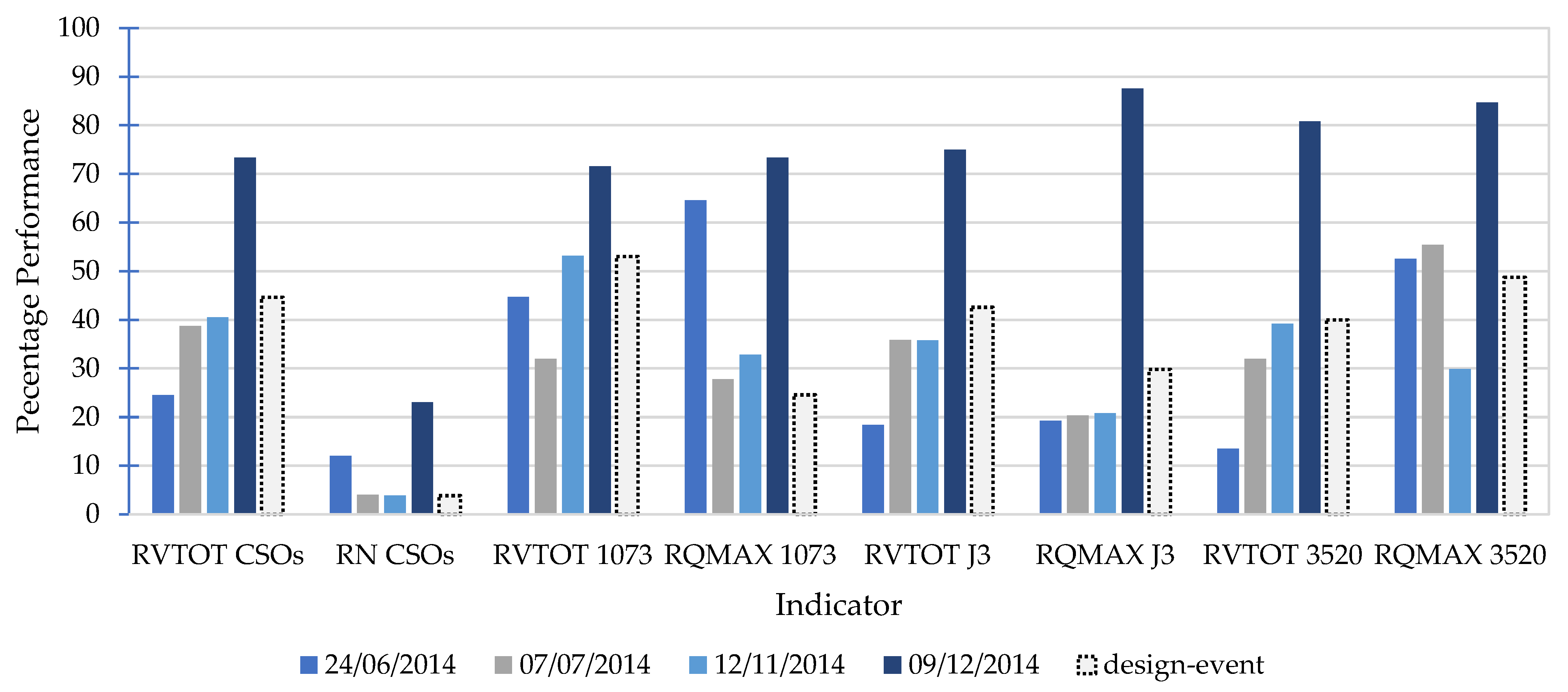
The SuDS performance indicators (
Table 5) show a structured and event-dependent pattern, with clear distinctions between volumetric and peak-flow performance and evident differences among the three reference CSOs. A colour scale ranging from blue to red is used to support the visual interpretation of the reduction indicators, with blue representing the highest reductions (i.e., the most effective SuDS performance) and red indicating the lowest. Intermediate shades allow a rapid visual comparison of performance across events and CSOs. At the system scale, reductions in total overflow volume (RV
TOT CSOs) are limited for the events of June, July and November (24–41%) and markedly higher in the December event (73%). The reduction in the number of active CSOs (RN CSOs) follows a similar trend, confirming that mitigation becomes more effective as rainfall severity decreases. The synthetic design event shows an intermediate system response, with reduction levels comparable to those observed during the most demanding real event occurred in November. At the individual CSOs, volumetric reductions (RV
TOT 1073, RV
TOT J3, RV
TOT 3520) reveal heterogeneous behaviour across events. In the events of June, July and November, CSOs 1073 and 3520 show consistently stronger volume reductions (32–53% and 13–39%, respectively), whereas J3 exhibits more limited reductions (18–36%), indicating that the three locations do not respond uniformly under more challenging conditions. Only the December event yields uniformly high volumetric reductions for all CSOs (72–81%), aligning local behaviour with the system-wide result. The design event follows the same relative ranking among CSOs, with reduction levels that remain consistent with the heterogeneous patterns observed during the most severe recorded events. Peak-flow reductions (RQ
MAX) introduce an additional layer of differentiation. CSOs 1073 and 3520 display substantial reductions in several events (28–65% and 30–55%, respectively), whereas J3 consistently shows the lowest peak-flow reductions in the precipitation events characterized by the highest intensity or cumulative depth (19–21%). This indicates that, for J3, SuDS interventions tend to affect volumes more than peak discharges under demanding rainfall conditions, while impulsive CSOs such as 1073 and 3520 show a more balanced or even stronger mitigation on peak flows. As with volumetric reductions, the December event produces the highest and most uniform peak reductions across all CSOs (73–88%). Under the synthetic design event, peak-flow reductions remain limited and heterogeneous across CSOs (25–49%), indicating that peak attenuation represents a critical aspect under extreme design scenarios. Overall, the table highlights a multi-dimensional response:
mitigation effectiveness increases as rainfall severity decreases;
the balance between volumetric and peak-flow reductions varies across CSOs, with some locations showing stronger effects on volumes and others on peak discharges;
convergence between system-wide and individual-CSO behaviour occurs only under mild rainfall conditions, while more severe events, characterized by higher cumulative depths or intensities, trigger distinct and site-specific behaviours;
The explicit comparison between real rainfall events and the synthetic design scenario demonstrates that SuDS performance under ordinary operating conditions cannot be fully inferred from extreme design-event analyses alone.
To complement the information reported in the table, the same results are also presented as a histogram in
Figure 3.
Figures S1 and S2, respectively, show the hydrographs and the overflow cumulative distributions for each selected CSO (1073, J3, and 3520) across all simulated real rainfall events. Each panel corresponds to a specific precipitation/CSO pair and displays two curves, one for each drainage configuration (BAU and GDS), allowing a direct visual comparison within the matrix of results.
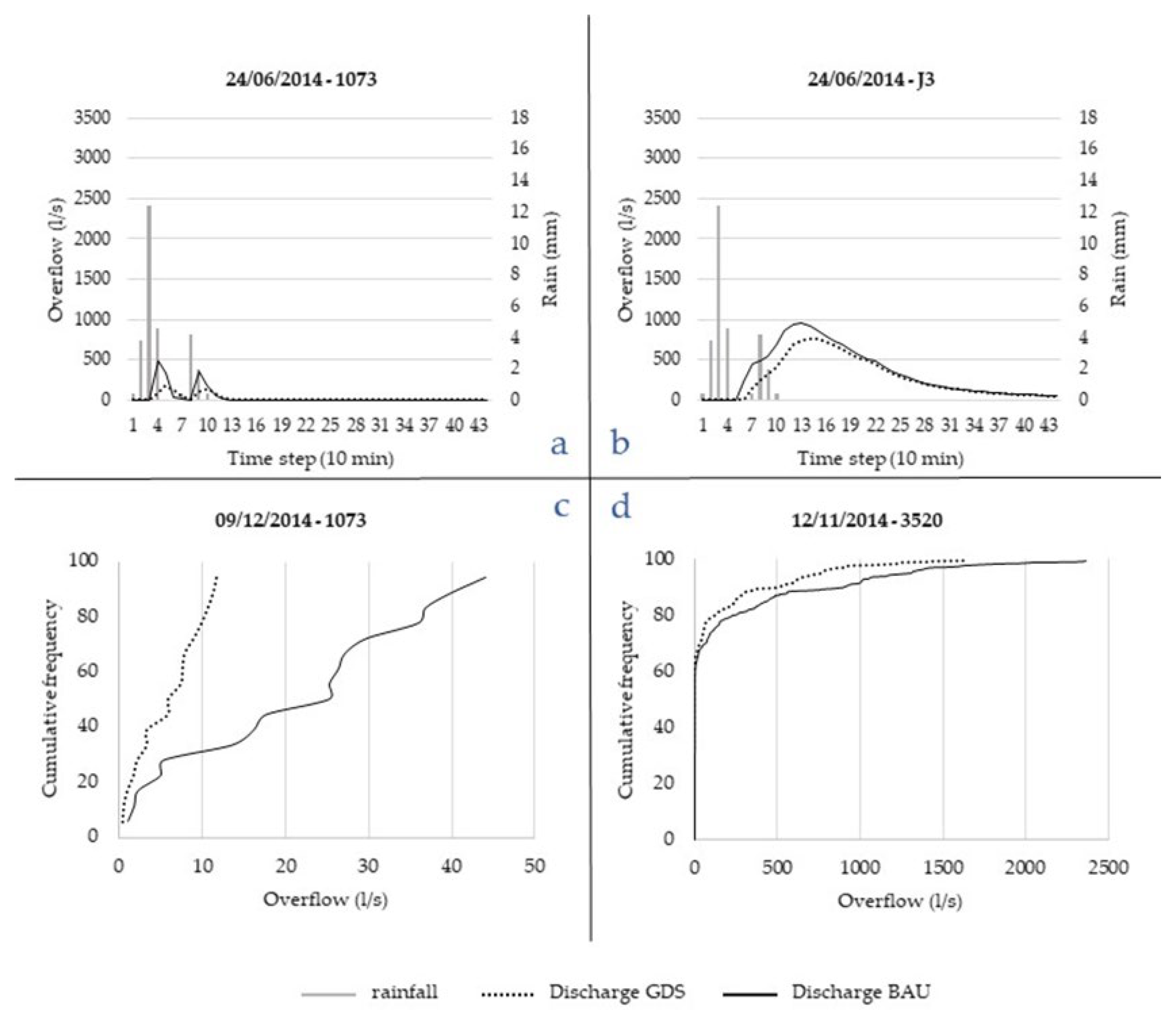
The hydrographs (
Figure S1, representative examples in
Figure 4) reveal a markedly heterogeneous hydraulic response across the three CSOs and clearly show that the effectiveness of the SuDS interventions depends both on event severity and on the local flow dynamics. In CSOs 1073 and 3520, which display rapid responses and sharp hydrograph peaks, SuDS provide clear peak attenuation under the rainfall events characterized by lower intensity. Under the highest-cumulative event occurred in November, however, the reduction in maximum flows is limited and the temporal structure of the hydrograph remains essentially unchanged from the baseline, indicating an absence of meaningful flow attenuation. CSO J3 displays a very different behaviour. Its response is slower, with broader hydrographs and more extended recessions, but the SuDS do not produce, except in the lowest-intensity event, a substantial reduction in peak flows. In the three more demanding cases, the overall hydrograph shape remains similar between BAU and GDS; the most noticeable effect is on the central region and the upper tail of the distribution, which tend to flatten and lose some of the irregularities observed under BAU. This indicates that, in J3, the benefit of the SuDS intervention manifests primarily in the reduction of volumes and in the modulation of secondary rises, rather than in a consistent attenuation of maximum flows. Overall, the hydrographs show that mitigation is not spatially uniform: the two impulsive CSOs (1073 and 3520) exhibit clear reductions in peak flows, whereas the slower CSO (J3) benefits from a more distributed reduction of runoff rather than from systematic peak attenuation.
The cumulative distributions in
Figure S2, partially shown also in
Figure 4, complement the interpretation provided by the hydrographs. Regardless of the rainfall event, the GDS curves diverge from the BAU ones mainly in the mid-to-upper part of the distribution while remaining close in the lower range: smaller overflows occur with similar frequency in both scenarios, whereas more substantial overflows become less frequent after retrofitting, with BAU distributions extending more noticeably toward higher values. In the more intense events, distinctive features emerge across the CSOs. In 1073 the distribution retains a relatively steep slope, indicating that the response is dominated by a narrower and more characteristic interval of flows. In contrast, J3 and 3520 exhibit flatter distributions, with a broad range of flows occurring with similar frequency. This flattening reflects a more dispersed response and greater variability in overflow conditions, consistent with longer sequences of exceedance and with the more complex hydrograph structures observed in these CSOs. Under such demanding conditions, the differences between BAU and GDS are most apparent in the central portion of the curves, while toward the upper end the two distributions tend to converge, delineating an asymptotic behaviour associated with the progressive approach of the system to its capacity limits.
4. Discussion
The results from the four rainfall events show that SuDS systematically reduce overflow volumes, peak discharges and the number of active CSOs, although the magnitude of these improvements is far from uniform. The variability reflects both the characteristics of the rainfall events and the hydraulic and hydrological properties of the drainage network. These results are consistent with findings from earlier studies [
12,
14].
A first controlling factor is the combined effect of network configuration, catchment size and land-cover characteristics. The three CSOs drain areas that differ greatly in extent, imperviousness, retrofitting coverage and hydrological connectivity, and these structural contrasts strongly shape SuDS performance. J3 drains by far the largest and most hydraulically connected basin (161 ha), with low imperviousness (C
IMP = 0.32) and the lowest retrofitting percentage (8.8%). The long drainage paths and the aggregation of multiple upstream contributions produce smoother but persistent overflows. In this configuration, SuDS reduce overflow volumes to a certain extent but have limited influence on peak attenuation, as they intercept only a small fraction of the fast-responding runoff and their effect is progressively dissipated along the network. This configuration explains why J3 consistently shows the smallest peak-flow reductions, particularly under severe rainfall conditions. In contrast, CSO 1073 drains a very small and highly impervious catchment (9 ha, C
IMP = 0.56) with one of the highest retrofitting percentages (11.9%). The response is impulsive and dominated by rapid runoff generation. Under these conditions, SuDS achieve clear reductions in both peak overflow and total volume, although the balance between the two varies across events, reflecting the sensitivity of this compact catchment to rainfall variability. CSO 3520 represents a mid-range condition but with a defining feature: although the basin is larger (84 ha), imperviousness is lower (C
IMP = 0.18). Only a small fraction of the catchment generates rapid runoff, and SuDS primarily act on this component. As a result, peak-flow reductions are generally more evident than volumetric reductions, whereas the slower contributions that govern total overflow are less influenced. This pattern is consistent with observations for the same macro-area under events of comparable return period [
18].
A second important factor is the combination of the initial imperviousness and the relative extent of SuDS retrofitting. Catchments with higher imperviousness and lower SuDS coverage tend to maintain larger overflow volumes and higher peaks, even under the GDS scenario, whereas those with more extensive retrofitting surface exhibit stronger volumetric reductions and, in many cases, more effective peak damping [
13,
18]. The variability observed in RV
TOT and RQ
MAX across the three CSOs can therefore be interpreted as the combined effect of local runoff production and the extent to which this runoff is intercepted or delayed by SuDS. The systematically lower reductions at J3 confirm that SuDS influence weakens when applied to large and highly connected contributing areas.
Rainfall severity provides a third key to interpreting the results. The December event, characterized by low cumulative depth and limited short-term intensity, yields the highest reductions in both volume and peak discharge, at both system and CSO scales. In this case, SuDS operate fully within their design capacity and are able to substantially reduce both the frequency and the magnitude of overflow. As event severity increases, either through higher cumulative rainfall in long-duration events or through stronger short-term intensities in impulsive events, the relative performance of SuDS declines. This observation aligns with existing literature on NBS performance at both the urban scale [
15] and the single-infrastructure scale. The long-duration November event exhibits the lowest percentage reductions, particularly at J3, where both volume and peak reductions remain modest. This behaviour is consistent with progressive storage filling and reduced infiltration capacity of SuDS. At the system scale, both the activation of outfalls (RN CSOs) and the total overflow volume (RV
TOT CSOs) are primarily governed by rainfall severity. The mildest event produces the largest reductions, as SuDS, covering approximately 8% of the total impervious area, operate well within their functional capacity and can prevent many outfalls from activating while substantially limiting total overflow. In contrast, during more demanding rainfall conditions, the higher and more persistent runoff load progressively reduces available storage and infiltration, leading to widespread outfall activation and markedly smaller volumetric reductions.
Taken together, the results indicate that SuDS effectiveness arises from the interaction between rainfall regime, catchment structure and the spatial deployment of SuDS interventions [
27]. While system-wide benefits are evident in all events, the detailed indicators show that these benefits are unevenly distributed across the network and differ substantially in their volumetric and peak-flow components. These findings imply that performance targets cannot be defined solely at the aggregate scale, but must explicitly consider local catchment properties and network configuration, especially in critical CSO locations.
From an urban drainage planning perspective, these findings highlight the need to move beyond exclusive reliance on conventional drainage infrastructure. Even relatively limited and targeted SuDS retrofitting, implemented alongside existing drainage systems, can deliver substantial benefits under ordinary operating conditions, supporting incremental and spatially differentiated strategies. Under climate variability, which affects not only extreme events but also ordinary rainfall patterns, such adaptive designs can enhance system resilience without requiring large-scale structural upgrades.
5. Conclusions
The analysis conducted on the four rainfall events demonstrates that SuDS represent an effective strategy for mitigating combined sewer overflows in complex urban drainage systems. Across all events, SuDS consistently reduce overflow volumes and the number of CSO activations, thereby limiting the hydraulic and environmental pressure on receiving water bodies. Event-scale analyses based on observed rainfall events, including both ordinary conditions and a severe recorded storm, show that a relatively limited but targeted SuDS retrofitting, covering 8.4% of the study area, achieves average reductions of about 44% in total CSO discharge volumes and approximately 47% in peak flows across the three monitored CSOs, while decreasing overflow frequency by around 11%.
When tested against the synthetic 10-years T design event used as a benchmark, SuDS performance remains comparable in terms of total overflow volume reduction, while lower effectiveness is observed for peak-flow attenuation (35%) and overflow frequency reduction (4%). Notably, this difference emerges despite the set of observed events including a severe recorded storm, suggesting that the observed differences cannot be attributed to event magnitude alone but are also influenced by variations in rainfall intensity patterns and temporal structure between observed and design precipitation inputs. This contrast highlights the markedly different system responses obtained under real ordinary rainfall conditions compared with those derived from design-storm–based analyses, confirming the importance of evaluating SuDS performance under realistic operating regimes in addition to design scenarios. This result is particularly relevant for contexts such as Sesto Ulteriano, where the high density of overflow structures and the strong hydraulic connectivity with surrounding surface waters make the system especially vulnerable to pollutant discharges. Reductions in overflow volumes translate directly into reductions in contaminant loads, providing a tangible benefit for water quality preservation.
The study also highlights that SuDS performance is not uniform and depends on both rainfall characteristics and catchment structure. More specifically, SuDS performance is jointly controlled by rainfall characteristics and catchment structure, as SuDS can substantially attenuate the most critical components of the hydrograph in small and responsive basins, while their influence becomes progressively limited in large, highly connected catchments or under severe rainfall conditions, when storage and infiltration capacities are rapidly saturated. These findings are consistent with previous evidence showing that SuDS effectiveness decreases as event severity increases [
19] and may further decline as systems age or lose efficiency over time [
26,
28].
Overall, the results suggest that SuDS can contribute to reducing CSO occurrence and associated pollutant loads even when implemented over a limited portion of the catchment. However, the results should be interpreted as a first step of the analysis, acknowledging the inherent limitations of the study. The assessment is based on a limited number of rainfall events selected from a single year of observation and on a site-specific SuDS configuration, and it is therefore not intended to provide statistically exhaustive performance metrics. Rather, the study aims to offer event-scale insight into SuDS behaviour under ordinary real-world rainfall conditions, using a synthetic design storm design event solely as a comparative benchmark. This distinction is critical for avoiding an underestimation of SuDS benefits that may arise when performance assessments are based exclusively on design storms. Further work will therefore focus on extending the analysis to longer observation periods, exploring alternative SuDS configurations, and calibrating the Business-as-Usual (BAU) drainage network model using measured flow data provided by the local water utility. In addition, future developments will consider the inclusion of climate-change rainfall scenarios and the integration of water-quality modelling to better quantify CSO-related pollutant loads and receiving-water impacts. These aspects will be essential to consolidate the preliminary results presented here and for supporting future planning strategies aimed at improving the resilience and environmental sustainability of urban drainage networks.