


Abstract
The implementation of the Variable Energy (VE) feature in the previously fixed-energy IBA Cyclone® Kiube cyclotron is presented as an upgrade enabling the production of novel radioisotopes with improved radionuclidic purity and production yields. The possibility of easily decreasing the energy of the extracted proton beam, from 18 down to 13 MeV, allows us to avoid the use of degraders and/or thick target windows, thus preventing related beam current limitations. The immediate application of the Variable Energy feature is proven by presenting the improved results obtained for the production of 68Ga from the irradiation of liquid targets simultaneously in terms of radionuclidic purity and activity produced.
1. Introduction
Several works from distinct authors in recent years have demonstrated the potential of cyclotron production of radiometals through the irradiation of liquid targets [1,2,3,4], with the technique presenting numerous advantages over the more conventionally spread production techniques (cyclotron solid targets and/or generators). In many cases, such as the clinically relevant 68Ga and 89Zr, it is mandatory to reduce the fixed beam energy available from biomedical cyclotrons—historically established for the production of 18F—in order to maintain the radionuclidic purity of the labelled biomarker within established parameters long after End-Of-Bombardment (EOB) [5,6,7,8,9,10] and for patient protection. The proton energy at the target can be defined by the extracted energy from the cyclotron or by adding a degrader foil in front of the target to reduce the initial energy down to the acceptable energy directed at the target. However, a degrader foil has known drawbacks as it limits the current of the target, independently of the type of target considered (either solid, liquid or gaseous), dissipates heat, requires a complex engineering system and modifies the beam shape and size directed at the target. For liquid and gaseous targets, the necessary decrease in the beam energy directed at the target is also commonly achieved by increasing the thickness of the target window foil, which therefore also acts as a degrader, but such a decision also comes at the expense of increased technical difficulty due to the larger amount of heat deposited by the beam on the target window [11,12]. As a result, such thick target windows are also synonymous with limited target current to prevent production failure by window rupture. The beam current limitation due to the extra heat load on the degrader and the limited heat removal capacity of such foils are a practical limitation for the development of compact high current targets, for both solid- and liquid targets.
In order to avoid such a technical limitation, Ion Beam Applications (IBA, Belgium) recently introduced a key feature in their latest fixed-energy biomedical cyclotron Cyclone® Kiube by making variable energy possible. The implementation of the Variable Energy (VE) feature enables the selection of the initial beam energy in discrete steps according to the production route chosen for the intended radioisotope, ensuring the desired radionuclidic purity. The first prototype was developed and installed at the Institute of Nuclear Sciences Applied to Heath (ICNAS) of the University of Coimbra, in Coimbra, Portugal. While some exit ports maintain a fixed 18 MeV proton energy, the proton beam can also be extracted in some ports with variable initial energy from 18 down to 13 MeV. This work presents the implementation of the Variable Energy (VE) feature in the IBA cyclotron Kiube and exemplifies the obtained benefits in the practical case of the production of the clinically relevant 68Ga through the patented purification process following the irradiation of liquid targets.
2. The Variable Energy Upgrade: The Cyclone® Kiube VE
Cyclone® KIUBE is a fixed-energy compact isochronous cyclotron that accelerates negative hydrogen ions up to 18 MeV and hosts up to two proton (internal) sources. The maximum proton energy of the machine was chosen to 18 MeV to obtain the highest yield of the main PET isotope 18F. The machine, schematically represented in Figure 1, is reasonably simple, with an extraction system using stripping foils that are fixed into position (at the 18 MeV radius) and up to height targets fixed in position around the vacuum chamber. The stripping foils are actuated from outside when the beam is needed for a particular target and retracted when not needed. Each extractor (‘a carrousel’) can hold multiple foils to offer redundancy in operation.
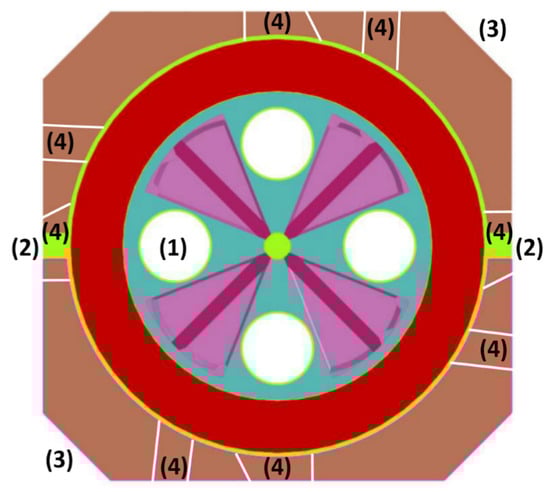
Figure 1.
Top view of Cyclone KIUBE representing (1) the four vacuum pumps holes in the valleys, (2) the radial insertion of the ion sources, (3) the magnetic structure (yoke) and (4) the radial extraction ports.
With eight independent exit ports, Cyclone KIUBE allows eight independent targets; each exit port has its own extractor and gate valve to isolate the target or beam line from the main cyclotron vacuum. Each target is directly affixed to the vacuum chamber and gate valve and aligned with the beam trajectory without moving parts to ease operation. An example of two targets is depicted in Figure 2 with stripper and proton energy of 18 MeV.
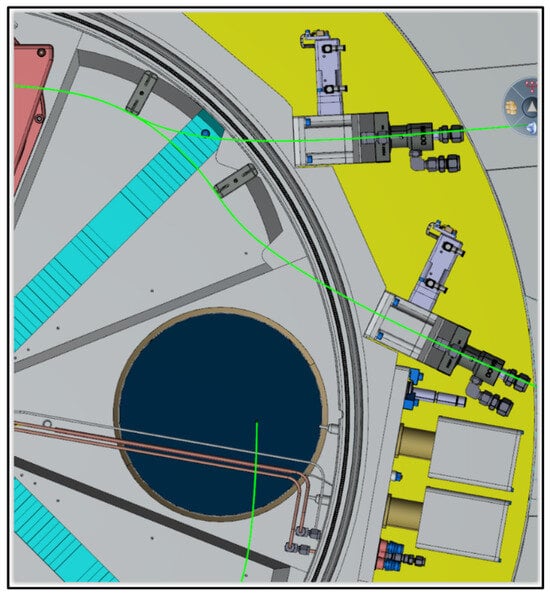
Figure 2.
Representation of the 18 MeV proton beam directed in two distinct locations by stripping foils.
Varying energy during extraction from the cyclotron is a more elegant way of obtaining the right bombardment energy onto the target. Some cyclotrons have an extraction system mounted on a long shaft that can be radially inserted in the machine; the beam energy is lower at a lower radius, but since the radius of curvature of a proton beam in a magnetic field changes with the projectile energy, the target position must always be adapted to the extracted energy, leading to a complex mechanical system. Usually, such a radially variable extraction system has a limited number of exits and a switching/recombination dipole to cope with all the energies extracted from the machine and direct the beam to the beam lines/targets (for example, the IBA Cyclone 30 and 70 cyclotrons). Alternatively, targets are directly mounted onto a complex mechanical ‘targets changer system’ that need to be aligned with the beam trajectories and are prone to damage, misalignment or advanced operator’s skills to operate.
The Variable Energy patented feature optimizes the production of radioisotopes on Cyclone Kiube. It is based on a simple fixed-position stripper system and targets attached to the machine at the best position to align with the beam trajectories. During the development of the possible solution to extract beams at lower energy, IBA has tested each of the eight exit ports with the computed proton beam trajectories inside and outside the cyclotron isochronous field, as shown in Figure 3 for the 18 and 13 MeV energy trajectories. The beam is extracted at lower energies for the eight exit ports by a ‘long shaft’ stripper fork. However, for some of the exit ports, this feature cannot be used due to the vacuum beam port position or magnetic yoke collision, as shown in Figure 3.
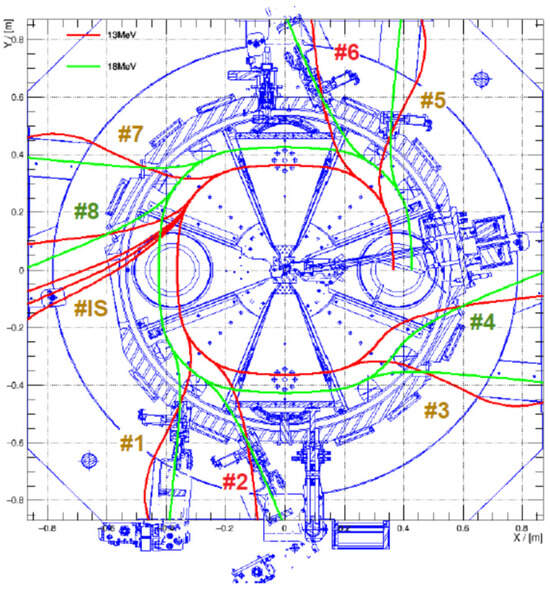
Figure 3.
Simulated proton beam trajectories at 13 (red line) and 18 (green line).
The solution ‘Variable Energy’ was developed by IBA and it is offered on only two exit ports to limit the modification to the cyclotron structure. The user can then define multiple and fixed proton energies at the two extraction ports automatically and without complex moving parts, as only the following two adaptations are required (Figure 3):
- A stripper system of the appropriate length (long shaft) extracts the beam anywhere in discrete steps between 13 and 18 MeV (Figure 4 and Figure 5);
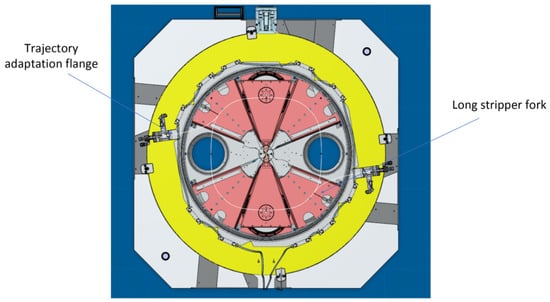 Figure 4. Representation of the 13 MeV proton beam extracted, using the long stripper fork and the adaptive flange to align to the target system.
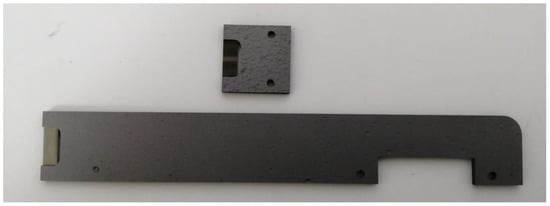 Figure 5. Stripper forks used to extract the proton beam with 13 (long fork) and 18 (short fork) MeV.
 - A wedge flange added to the fixed exit port aligns the target to the beam path according to the chosen energy (Figure 4 and Figure 6).
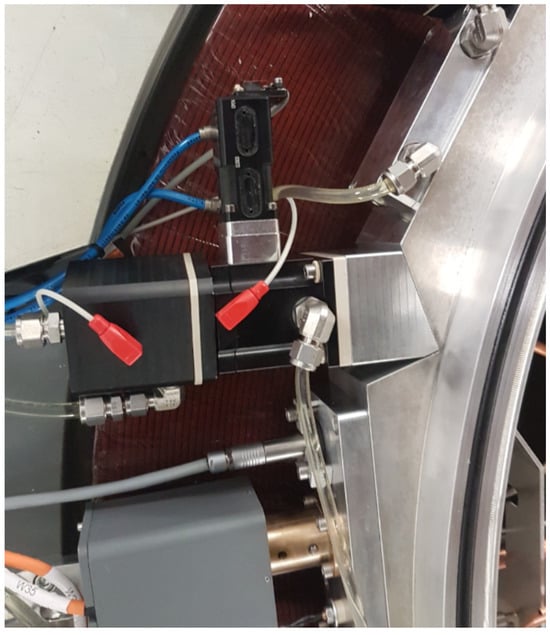 Figure 6. Photograph of the adapting flange used to align the target system when proton beam energies lower than 18 MeV are extracted.
The wedge is 0° for 18 MeV, which is the default energy for Cyclone KIUBE, while other wedges are defined for 13, 14 and 15 MeV, which seems to be the set of energies needed for other PET radioisotopes. This wedge is a simple adaptation tool to align the existing target system to the beam trajectory and is seamlessly integrated into the exit port interface.
3. Experimental Results
The first Variable Energy Cyclone® KIUBE was installed at ICNAS (Institute for Nuclear Sciences Applied to Health) in Coimbra, Portugal, within the framework of research project collaboration between IBA and the University of Coimbra.
Besides the immediate advantageous reduction in the heat deposited on the target window, the use of reduced initial beam energies also translates into less power deposited in the liquid target system, therefore resulting in larger target currents before reaching a given limiting pressure, representing a major improvement (Table 1). It is relevant at this point to mention that this improvement is not observed when reducing the beam energy directed at the liquid target by increasing the thickness of the target window because the overall heat (defined by the initial beam energy) remains unchanged in the target system. The larger heat generated in thicker targets window results in more heat diffused into the liquid target in such a way that the pressure–current dependence remains almost unchanged, i.e., nearly independent of the target window thickness.
Such an improvement is achieved despite an increment in the stopping power at lower energies. Indeed, since the stopping power increases with decreasing particle energies, reducing the impinging beam energy is also synonymous of more heat deposited on a window per impinging particle. For instance, the stopping power of protons in niobium is 26% larger at 13 MeV than at 18 MeV. This is particularly relevant as larger target currents are now possible. For these reasons, systematic irradiations were conducted at the lowest energy possible, 13 MeV, as it represents the most critical energy scenario in terms of stopping power, with a 75 µm thick niobium window. Also, it is worth mentioning that the extraction of the beam at only 13 MeV instead of 18 MeV resulted in no significant changes in the beam’s size and shape at the target position nor in its transmission from the ion source to the target.
Long-term stability of the target system was achieved after repeated irradiations under the same conditions. A target current of 90 µA was now achievable (Table 1), which was particularly relevant as the present Kiube VE configuration enables an overall maximum current of 180 µA in the dual-beam mode. Even under these particular conditions, the target system was successfully used for several cycles of tens of irradiations with 13 MeV protons, with accumulated integrated currents larger than 2000 µAh without any incident.
As referred to earlier, the ability to decrease the energy of protons in the Kiube VE feature finds immediate application in the production of 68Ga in liquid targets. Up to now, the initial 18 MeV proton beam energy available was reduced down to 14.2 MeV by using a 250 µm thick niobium target window to significantly reduce the co-production of 67Ga through the 68Zn(p,2n)67Ga nuclear reaction in order to achieve acceptable radionuclidic purity. The introduction of the Kiube VE feature provides the following two immediate improvements:
- As already explained, the reduction in the heat dissipated in the liquid target system at lower energy resulted in a significant increase in the beam current, compensating for the lower production yield due to the reduction in the initial energy;
- The lower bombarding energy resulted in an improvement of the radionuclidic purity, as shown in Table 1. Furthermore, while great care has to be taken with the purity of enriched 68Zn used when working with 18 MeV to achieve acceptable radionuclidic purity (for instance, the content in 66Zn has to be minimized in order to avoid efficient production of 66Ga through the 66Zn(p,n)66Ga reaction [5]), less demanding purity requirements of enriched 68Zn are necessary when using less energetic protons.
Table 1 presents the experimental results obtained for irradiations performed with 13 MeV protons delivered by the Kiube VE. As expected, even if the production rate is lower than in the previous configuration with 18 MeV and a thicker target window, the much larger beam current possible compensates for this, resulting in even larger activities of 68Ga produced at End-Of-Bombardment (EOB). In addition, the radionuclidic purity is improved despite the use of a less pure enriched 68Zn. Table 1 and Table 2 also present the activities of purified 68GaCl3 produced at End-Of-Purification (EOP), with two distinct concentrations of enriched 68Zn in the liquid target, in a process lasting only about 35 min after EOB by using a Synthera Extension module under GMP conditions [13].
Table 2 presents the results of the routine production of 68Ga peptides from over 300 runs, using both 13 or 18 MeV and with identical target pressure. It demonstrates that the Kiube VE feature enables improved production of 68Ga from the irradiation of liquid targets. In other words, the Kiube VE upgrade allows for larger production yields and therefore activities, while simultaneously improving the radionuclidic purity. The experimental data presented in Table 2 were obtained by using a target solution with a 68Zn concentration of 66 mg/mL provided by Fluidomica Lda. (Fluidomica, Portugal). This specific concentration was chosen to match our particular production needs but one should also stress at this point that larger quantities of 68Ga can be produced by simply scaling the concentration of 68Zn in the target solution independently of the impinging energy on the target. Table 3 presents experimental data obtained with several concentrations of 68Zn in the liquid target and shows that up to 20 GBq of 68Ga can be produced, even at low energy.

Table 1.
Comparison of the average production yields and radionuclidic purity of 68Ga experimentally obtained at 13 MeV and 18 MeV using solutions of 68Zn(NO3)2 with a concentration of 68Zn of 33 mg/mL. The shelf-life was calculated according to the specification defined in [14].
Table 1.
Comparison of the average production yields and radionuclidic purity of 68Ga experimentally obtained at 13 MeV and 18 MeV using solutions of 68Zn(NO3)2 with a concentration of 68Zn of 33 mg/mL. The shelf-life was calculated according to the specification defined in [14].
| 13 MeV + 75 µm Nb Target Window | 18 MeV + 250 µm Nb Target Window | ||
|---|---|---|---|
| Number of Runs | 3 | 45 | |
| Enriched 68Zn Used | %64Zn | 0.41 | 0.01 |
| %66Zn | 0.35 | 0.01 | |
| %67Zn | 0.22 | 0.30 | |
| %68Zn | 99.0 | 99.5 | |
| %70Zn | 0.02 | 0.18 | |
| Irradiation Time | (min) | 68.0 ± 0.1 | 62.3 ± 9.2 |
| Target Current | (µA) | 88.3 ± 1.5 | 53.5 ± 3.3 |
| Target Pressure | (bar) | 32 | 32 |
| Integrated Current | (µAh) | 100.0 ± 1.7 | 55.6 ± 8.7 |
| 68Ga Produced @EOB | (mCi) | 160.9 ± 11.9 | 128.0 ± 19.3 |
| Production Rates | (mCi/µAh) | 1.61 ± 0.09 | 2.33 ± 0.30 |
| (mCi/µAsat) | 3.64 ± 0.21 | 5.12 ± 0.58 | |
| ((mCi·cm3)/(µA·g)sat) | 109.2 ± 6.4 | 154.18 ± 18.11 | |
| Purified 68GaCl3 @EOP | (mCi) | 78.9 ± 6.7 | n.a. |
| Radionuclidic | %68Ga | 99.945 ± 0.015 | 99.732 ± 0.074 |
| Purity | %67Ga | 0.005 ± 0.001 | 0.261 ± 0.074 |
| @EOB | %66Ga | 0.050 ± 0.014 | 0.006 ± 0.002 |
| Shelf-Life after EOB | (h) | 6.6 | 3.3 |
Table 2.
Comparison of the conditions for the routine production of 68Ga-labelled peptides obtained at 13 MeV and 18 MeV with equivalent target pressure and using solutions of 68Zn(NO3)2 with a 68Zn concentration of 66 mg/mL.
Table 2.
Comparison of the conditions for the routine production of 68Ga-labelled peptides obtained at 13 MeV and 18 MeV with equivalent target pressure and using solutions of 68Zn(NO3)2 with a 68Zn concentration of 66 mg/mL.
| Cyclotron | #Runs | Irradiation Time | Target Current | Target Pressure | Integrated Current | 68Ga Activity @EOB | 68Ga Production Yield | Activity of 68GaCl3 @EOP | Purification Yield | Activity of Labelled 68Ga-Peptides @EOS | Labelling Yield | ||
|---|---|---|---|---|---|---|---|---|---|---|---|---|---|
| (min) | (µA) | (bar) | (µAh) | (GBq) | ((GBq·cm3)/(µA·g)) | (GBq) | (Decay Corrected) | (Non-Decay Corrected) | (mCi) | (Decay Corrected) | (Non-Decay Corrected) | ||
| 13 MeV Kiube | 159 | 72.26 ± 7.03 | 52.67 ± 6.48 | 20.10 ± 1.93 | 62.77 ± 7.97 | 7.80 ± 1.22 | 4.40 ± 0.96 | 3.82 ± 0.76 | 0.73 ± 0.11 | 0.49 ± 0.08 | 60.94 ± 16.27 | 0.67 ± 0.32 | 0.59 ± 0.10 |
| 18 MeV 18/9 | 216 | 71.4 ± 7.6 | 44.16 ± 5.68 | 21.45 ± 3.51 | 52.21 ± 8.76 | 7.68 ± 1.55 | 5.15 ± 0.92 | 3.98 ± 1.06 | 0.76 ± 0.10 | 0.52 ± 0.09 | 66.16 ± 15.28 | 0.72 ± 0.25 | 0.61 ± 0.12 |
Table 3.
Comparison of the conditions for routine production of 68Ga-labelled peptides obtained at 13 MeV and 18 MeV by using solutions of 68Zn(NO3)2 with distinct concentrations of 68Zn.
Table 3.
Comparison of the conditions for routine production of 68Ga-labelled peptides obtained at 13 MeV and 18 MeV by using solutions of 68Zn(NO3)2 with distinct concentrations of 68Zn.
| Cyclotron | Thickness of the Niobium Target Window | Concentration of 68Zn | #Runs | Irradiation Time | Target Current | Target Pressure | Integrated Target Current | Activity Ga-68 @EOB | Production Yield | Activity 68GaCl3 @EOP | Radionuclidic Purity @EOP | ||
|---|---|---|---|---|---|---|---|---|---|---|---|---|---|
| (µm) | (mg/mL) | (min) | (µA) | (bar) | (µAh) | (GBq) | ((GBq·cm3)/(µA·g))sat | (GBq) | (68Ga) | (67Ga) | (66Ga) | ||
| 18/9 @18 MeV | 250 | 33 | 21 | 68.0 | 66.6 | 32 | 75.3 | 7.37 | 6.72 | 3.85 | 0.9961 | 0.0029 | 0.0010 |
| 66 | 21 | 70.3 | 51.2 | 32 | 58.6 | 8.9 | 5.18 | 4.73 | 0.9980 | 0.0017 | 0.0002 | ||
| 100 | 5 | 68.0 | 52.2 | 32 | 59.2 | 13.07 | 5.01 | 5.61 | 0.9980 | 0.0018 | 0.0003 | ||
| 133 | 3 | 68.0 | 48.3 | 32 | 54.7 | 15.37 | 4.78 | 5.66 | 0.9980 | 0.0017 | 0.0003 | ||
| Kiube @13 MeV | 75 | 33 | 23 | 68.6 | 87.8 | 27 | 100.5 | 6.21 | 4.27 | 3.03 | 0.9994 | 0.0001 | 0.0005 |
| 66 | 17 | 67.2 | 62.6 | 23 | 69.4 | 6.67 | 3.30 | 3.16 | 0.9995 | 0.0003 | 0.0002 | ||
| 100 | 5 | 68.0 | 60.4 | 27 | 68.4 | 10.32 | 3.42 | 3.76 | 0.9996 | 0.0002 | 0.0002 | ||
| 115 | 5 | 68.2 | 59.4 | 26 | 69.2 | 12.18 | 3.55 | 4.16 | 0.9995 | 0.0003 | 0.0003 | ||
| 133 | 8 | 68.3 | 53.4 | 27 | 60.3 | 10.73 | 3.02 | 2.67 | 0.9996 | 0.0002 | 0.0002 | ||
| 250 | 3 | 68.0 | 51.3 | 27 | 58.2 | 18.71 | 2.91 | 6.62 | 0.9992 | 0.0004 | 0.0003 | ||
4. Conclusions
This works presents the implementation of the Variable Energy (VE) upgrade in the previously fixed-energy IBA Cyclone Kiube, a feature fundamental for the production of novel radioisotopes with improved radionuclidic purity and production yields. The possibility of decreasing the initial beam energy, from 18 MeV down to 13 MeV, avoids the use of degraders and/or thick target windows, thus also avoiding related beam current limitations due to the extra heat load, for all kind of targets, either solid, liquid or gaseous. This characteristic was achieved by intercepting and extracting the beam sooner in its acceleration with the use of a longer stripper fork and by using a tilted adapting flange to correct the alignment of the target system to the beam, depending on the extracted beam energy, while simultaneously keeping its high performance for the production of 18F in the remaining exit ports. Finally, the immediate application of the added value of the Variable Energy upgrade was demonstrated by presenting the improved results for the production of the clinically relevant 68Ga from the irradiation of liquid targets simultaneously in terms of radionuclidic purity and activity produced.
5. Patents
EP3503693B1; EP3101660A1.
Author Contributions
Conceptualization, E.K., B.N., J.-M.G. and F.A.; Investigation, S.J.C.d.C. and Â.C.B.N.; Data Curation, S.J.C.d.C. and Â.C.B.N.; writing—original draft preparation, S.J.C.d.C.; writing—review and editing, J.-M.G. and F.A.; supervision, F.A.; project administration, A.J.A., F.A., B.N. and J.-M.G. All authors have read and agreed to the published version of the manuscript.
Funding
This research received no external funding.
Data Availability Statement
The original contributions presented in the study are included in the article, further inquiries can be directed to the corresponding author.
Conflicts of Interest
Authors Eric Kral, Jean-Michel Geets and Benoit Nactergal were employed by the company Ion Beam Applications. The remaining authors declare that the research was conducted in the absence of any commercial or financial relationships that could be construed as a potential conflict of interest.
References
- do Carmo, S.J.C.; Scott, P.J.H.; Alves, F. The production of radiometals in liquid targets. EJNMMI Radiopharm. Chem. 2020, 5, 2. [Google Scholar]
- Alternative Radionuclide Production with a Cyclotron; Series: IAEA radioisotopes and radiopharmaceuticals reports; International Atomic Energy Agency: Vienna, Austria, 2021; ISSN 2413–2955.
- Sharma, S.; Pandey, M.K. Radiometals in Imaging and Therapy: Highlighting Two Decades of Research. Pharmaceuticals 2023, 16, 1460. [Google Scholar] [CrossRef] [PubMed]
- Production of Emerging Radionuclides towards Theranostic Applications: Copper-61, Scandium-43 and -44, and Yttrium-86; International Atomic Energy Agency: Vienna, Austria, 2021; IAEA-TECDOC-1955.
- Alves, F.; Alves, V.H.; Neves, A.C.B.; do Carmo, S.J.C.; Natergal, B.; Hellas, V.; Kral, E.; Gonçalves-Gameiro, C.; Abrunhosa, A.J. Cyclotron production of Ga-68 for human use from liquid targets: From theory to practice. AIP Conf. Proc. 2017, 1845, 020001. [Google Scholar]
- Oehlke, E.; Hoehr, C.; Hou, X.; Hanemaayer, V.; Zeisler, S.; Adam, M.J.; Ruth, T.J.; Celler, A.; Buckley, K.; Benard, F.; et al. Production of Y-86 and other radiometals for research purposes using a solution target system. Nucl. Med. Biol. 2015, 42, 842–849. [Google Scholar]
- Synowiecki, M.A.; Perk, L.R.; Nijsen, J.F.W. Production of novel diagnostic radionuclides in small medical cyclotrons. EJNMMI Radiopharm. Chem. 2018, 3, 3. [Google Scholar] [CrossRef] [PubMed]
- Carzaniga, T.S.; Auger, M.; Braccini, S.; Bunka, M.; Ereditato, A.; Nesteruk, K.P.; Sacmpoli, P.; Turler, A.; van der Meulen, N. Measurement of 43Sc and 44Sc production cross-section with an 18 MeV medical PET cyclotron. Appl. Radiat. Isot. 2017, 129, 96–102. [Google Scholar] [CrossRef] [PubMed]
- Hoehr, C.; Morley, T.; Buckley, K.; Trinczek, M.; Hanemaayer, V.; Schaffer, P.; Ruth, T.; Bénard, F. Radiometals from liquid targets: 94mTc production using a standard water target on a 13MeV cyclotron. Appl. Radiat. Isot. 2012, 70, 2308–2312. [Google Scholar] [CrossRef] [PubMed]
- Dabkowski, A.d.; Paisey, S.J.; Talboys, M.; Marshall, C. Optimization of cyclotron production for radiometal of zirconium 89. Acta Phys. Pol. A 2015, 127, 5. [Google Scholar] [CrossRef]
- do Carmo, S.J.C.; de Oliveira, P.M.; Alves, F. Thermal Simulation Studies for the Characterization of a Cyclotron Liquid Target with Thick Niobium Target Windows. Appl. Sci. 2021, 11, 10922. [Google Scholar] [CrossRef]
- Pandey, M.K.; De Grado, T.R. Cyclotron Production of PET Radiometals in Liquid Targets: Aspects and Prospects. Curr. Radiopharm. 2021, 14, 325–339. [Google Scholar] [CrossRef] [PubMed] [PubMed Central]
- Alves, V.H.; do Carmo, S.J.C.; Alves, F.; Abrunhosa, A.J. Automated Purification of Radiometals Produced by Liquid Targets. Instruments 2018, 2, 17. [Google Scholar] [CrossRef]
- Gallium (68Ga) Chloride (accelerator produced) solution for radiolabelling. Eur. Pharmacopoeia 2020, 10 (Suppl. S10), 4864–4865.
Disclaimer/Publisher’s Note: The statements, opinions and data contained in all publications are solely those of the individual author(s) and contributor(s) and not of MDPI and/or the editor(s). MDPI and/or the editor(s) disclaim responsibility for any injury to people or property resulting from any ideas, methods, instructions or products referred to in the content. |
© 2024 by the authors. Licensee MDPI, Basel, Switzerland. This article is an open access article distributed under the terms and conditions of the Creative Commons Attribution (CC BY) license (https://creativecommons.org/licenses/by/4.0/).