Abstract
A partial substitution such as Ce in SmCo could be a brilliant way to improve the magnetic performance, because it will introduce strain in the structure and breaks the lattice symmetry in a way that enhances the contribution of the Co atoms to magnetocrystalline anisotropy. However, Ce substitutions, which are benefit to improve the magnetocrystalline anisotropy, are detrimental to enhance the Curie temperature (). With the requirements of wide operating temperature range of magnetic devices, it is important to quantitatively explore the relationship between the and ferromagnetic exchange energy. In this paper we show, based on mean-field approximation, artificial tensile strain in SmCo induced by substitution leads to enhanced effective ferromagnetic exchange energy and , even though Ce atom itself reduces .
1. Introduction
Owing to the large magnetocrystalline anisotropy, high Curie temperature () and saturation magnetization (), Sm–Co compounds have drawn attention for the high-performance magnet [1,2,3,4,5,6,7,8,9,10,11,12]. The net performance of the magnet crucially depends on the inter-atomic interactions, which in turn depend on the local atomic arrangements. In order to improve the intrinsic magnetic properties of Sm–Co system, further approaches [5,7,9,12,13,14,15,16,17,18,19] have been attempted in the past few decades.
A promising scheme is the partial substitution of Co with other transition metals (TM), such as Cu, Ni, Fe, or Zr in Sm(Co, TM) [15,19,20,21,22]. The partial TM substitution enhances magnetic anisotropy energy (MAE) due to slight modifications of the atomic structure and the breaking of the lattice symmetry. Substitution of the Co in the system might make it more economically viable, however, due to the reduced exchange coupling parameters, both and the of the Sm(Co, TM) compounds decrease with increasing TM content [15,19,20].
Importantly, any substitution of Co with another TM reduces the effective ferromagnetic exchange coupling and consequently reduces . This is highly undesirable because the most important application field of Sm-Co-based magnets is that of high temperature. Hence, it is vital that we find a way to enhance the magnetic performance in Sm-Co magnets without substituting away the Co, but by carefully modifying the local atomic arrangements, by introducing strain. Strain is a particularly important issue for permanent magnets, because their synthesis typically involves sintering, and thermal processes inevitably introduce strain on fine-grained materials [23,24]. Strain effects are also associated directly to partial element substitution, such as e.g., of Sm with another RE metal.
Ce is a particularly promising candidate because it is the most abundant and second lightest among all RE metals, and CeCo is isomorhpous with SmCo [25,26]. It is well-known that the magnetic material parameters of CeCo are substantially weaker than those of SmCo [27], i.e., reduced of 660 K instead of 1000 K, reduced MAE of 5.3 MJ/m instead of 17.2 MJ/m, and reduced of 0.95 T instead of 1.15 T. Therefore, most researches focused on 3d transtion metal substitution instead of Ce substitution, at least so far. Nevertheless, our recent simulation work indicates that a partial substitution of Sm by Ce can have drastic effects on the magnetic performance, because it will introduce strain in the structure and breaks the lattice symmetry in a way that enhances the contribution of the Co atoms to magnetocrystalline anisotropy (MCA) [28]. Furthermore, we have also experimentally confirmed that a partial Ce substitution can enhance the magnetic performance of the system [29]. However, Ce substitutions, which are benefit to improve the MCA with slight modifications of the local atomic arrangements, are detrimental to enhance the Curie temperature. With the requirements of wide operating temperature range of magnetic devices, it is very important to quantitatively explore the relationship between the Curie temperature and ferromagnetic exchange energy.
In this paper we will report, based on mean-field approximation (MFA), that Ce substitution-induced tensile strain in SmCo leads to enhanced effective ferromagnetic exchange energy and . However, the Ce atom itself reduces .
2. Results and Discussion
2.1. Crystal Structure
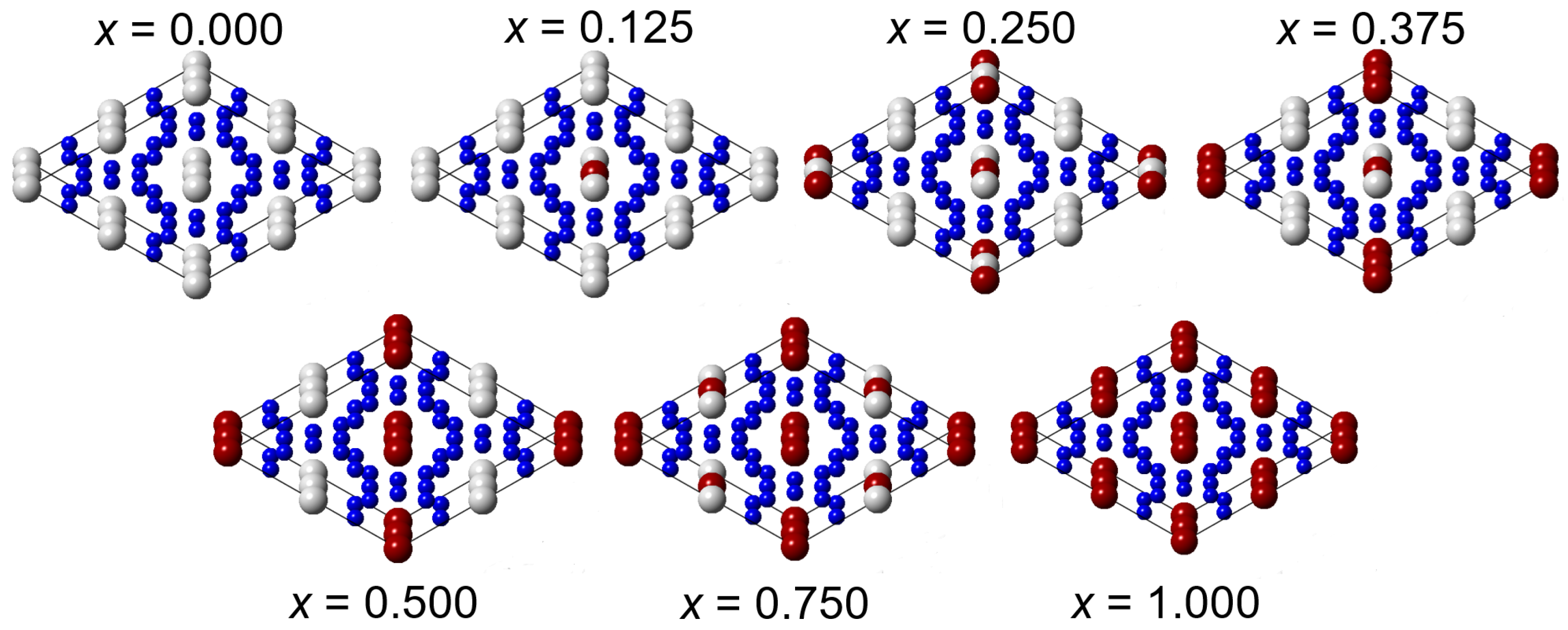
The intermetallic magnetic compounds SmCo and CeCo crystallize into the hexagonal CaCu structure, where each Sm (Ce) occupies a 1a site and Co occupies 2c and 3g sites in the lattice that Co and SmCo sub-layers are alternatively along the c-axis [30]. To understand the Ce substitution effect on crystal structure and magnetic properties, we performed calculations of the SmCeCo system, where we considered seven different compositions: x = 0, 0.125, 0.25, 0.375, 0.5, 0.75, and 1. Configurations shown in Figure 1 are the most stable structures obtained by total energy minimization in the density functional theory calculations [28].
Figure 1.
Illustration of the crystal structure of SmCeCo for x = 0, 0.125, 0.25, 0.375, 0.5, 0.75, and 1. Gray, red, and blue spheres correspond to Sm, Ce, and Co atoms, respectively.
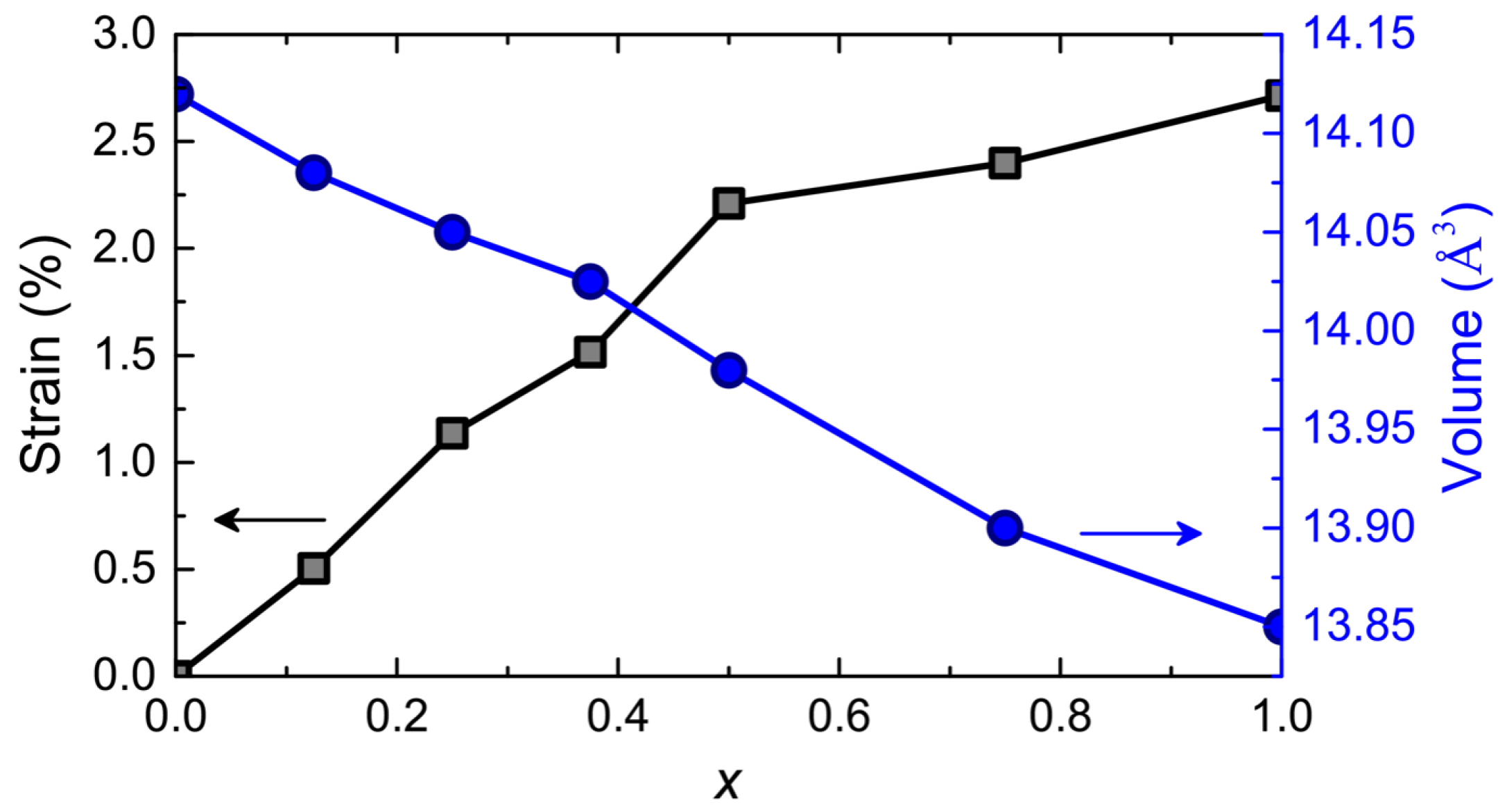
The atomic volume decreases linearly from 14.12 Å in SmCo to 13.84 Å in CeCo with increasing x, whereas the strain increases correspondingly monotonically with increasing x (see Figure 2). Result that decreased volume by Ce concentration well corresponds with ref. [31] which presented that CeCo compound stands out as a anomalous in the lattice constants. Due to lanthanide contraction, smooth decrease in atomic volume can be expected through the series from lanthanum to terbium in the periodic table, however, there is a pronounced deviation for CeCo. In our related research [28], we found substitution-induced tensile strain on SmCeCo has drastic effects on the magnetic state. While the decreased magnetic moment for CeCo have been interpreted as evidence for a mixed-valence behavior of the Ce ion [32,33], the effective occupation number of the 4f orbitals can be determined by induced strain rate.
Figure 2.
Modification of the effective strain (square) compared to the SmCo cell, and the atomic volume (circle) in SmCeCo, as a function of Ce substitution x.
2.2. Exchange Interactions
Mean-field Hamiltonian for the 3-sublattice system could be written as
where , , and are exchange coupling between sites i and j, magnetization, and classical spin vector at crystal site i, respectively. Labels of c and g correspond to 2c and 3g sites of Co atom, while a represents 1a site of Sm.
Sublattice magnetization is
where is the number of neighboring sites in j-th sublattice to i-th sublattice.
While the inter-atomic ferromagnetic exchange interactions can be obtained as the difference between ferromagnetic and antiferromagnetic spin configuration, i.e., by using density functional theory calculations [28], the effective exchange energies of Co and Sm are calculated as
respectively.
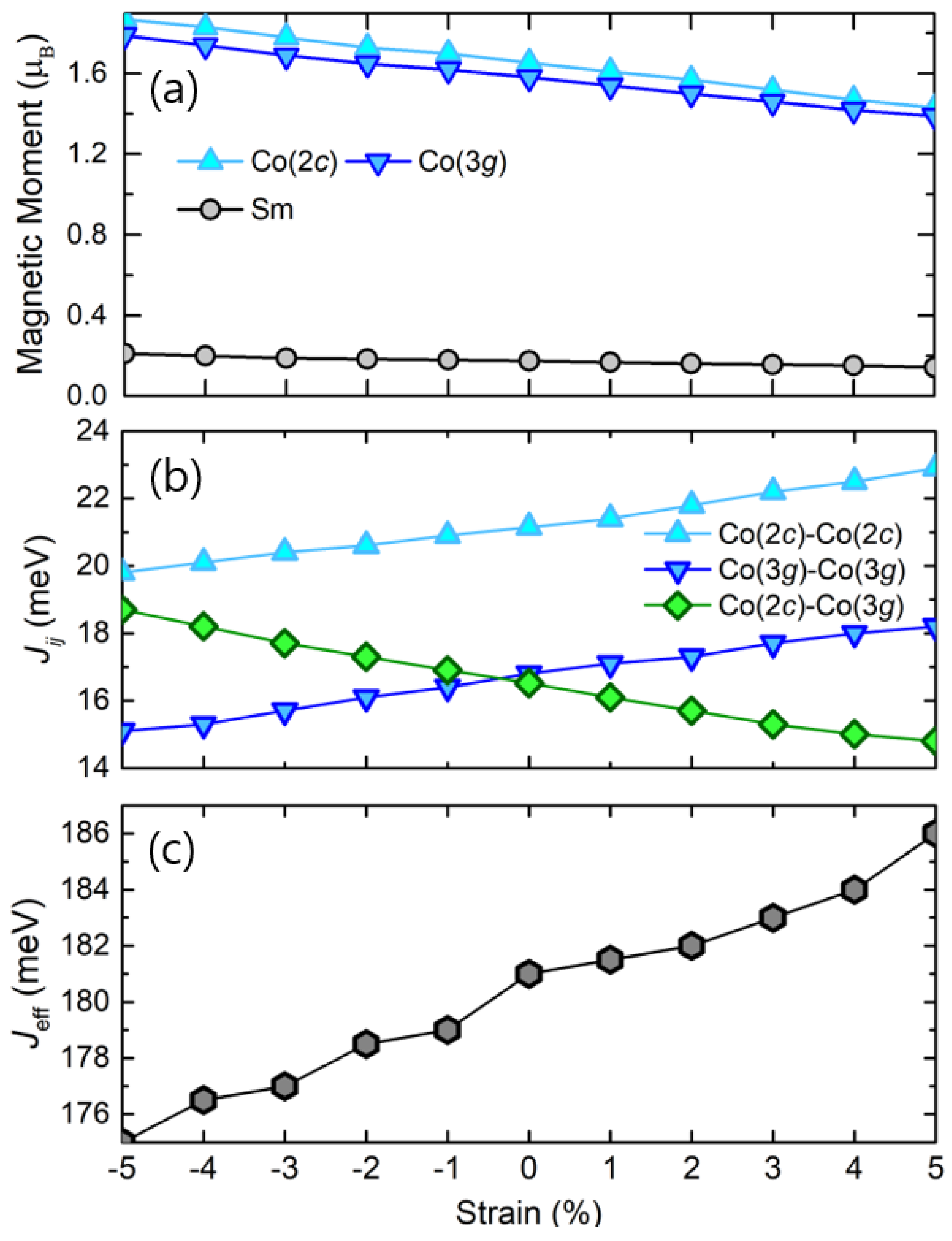
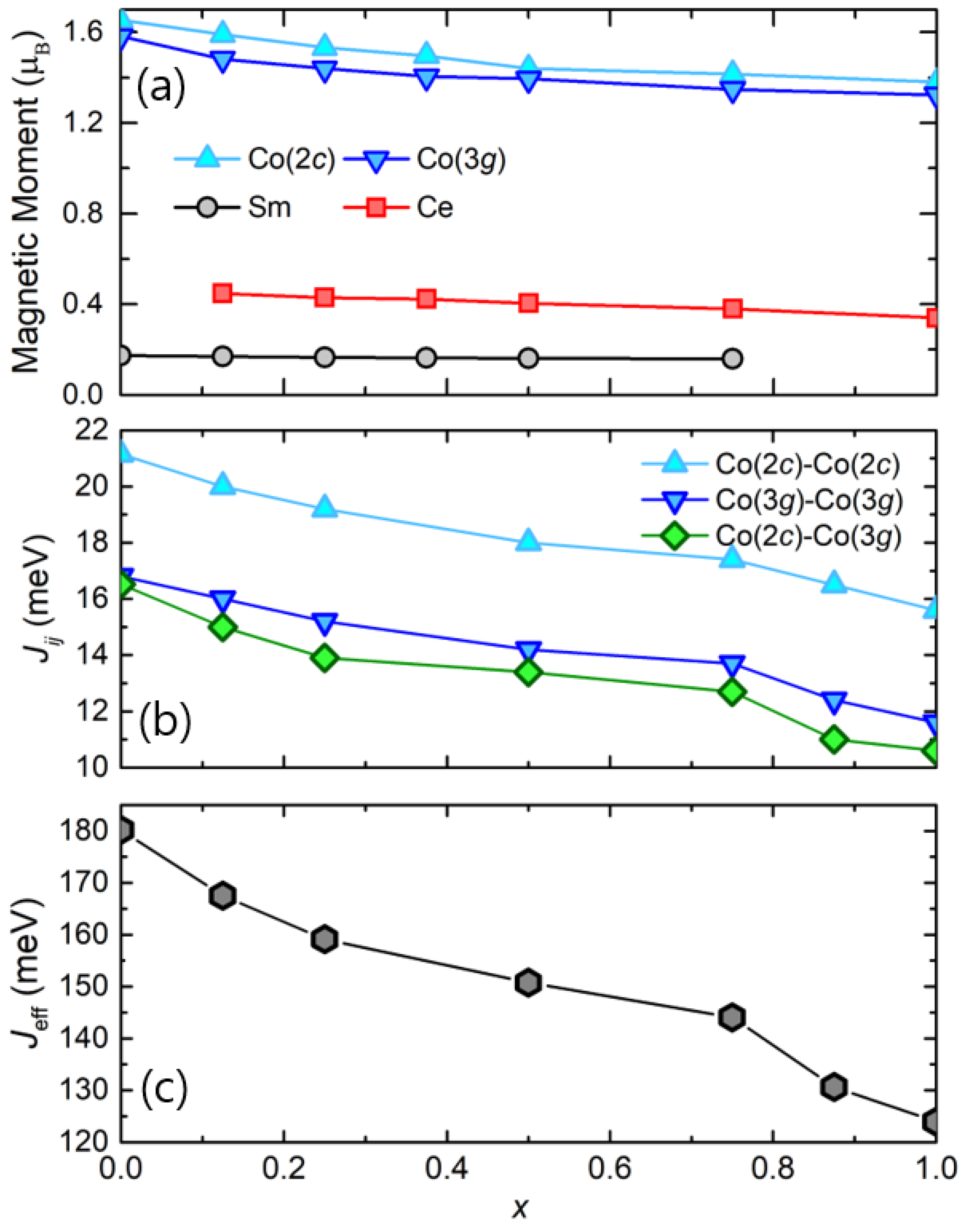
Due to the smallness of the de Gennes factor of Sm, the Curie temperature is dominantly determined by the interatomic exchange interaction of the Co atoms [9,34]. Therefore the calculations on the exchange interaction are focused on the Co-Co couplings. To understand the role of Ce substitution-induced strain and Ce substitution itself, magnetic moment, inter-site exchange coupling () and effective exchange energy () are calculated as a function of the strain in SmCo (Figure 3) and Ce concentration in SmCeCo (Figure 4).
Figure 3.
Intrinsic magnetic properties as a function of strain in SmCo: (a) atomic magnetic moments of Co atoms at sites 2c (triangles) and 3g (inverse-triangles) and Sm atoms (circles); (b) exchange coupling between Co sites i and j; and (c) effective total ferromagnetic exchange energy.
Figure 4.
Magnetic properties as a function of Ce-substitution of Sm: (a) atomic magnetic moments of Co atoms at sites 2c (triangles) and 3g (inverse-triangles) and Sm atoms (circles); (b) exchange coupling between Co sites i and j; and (c) effective total ferromagnetic exchange energy.
In Figure 3a, the magnetic moments at each crystallographic site decrease nearly linearly with increasing tensile strain. The reason for the decrease of the magnetic moments is the decreasing overlap of the d-orbitals as the c-axis grows with strain. Further, we calculate the inter-site exchange coupling and overall effective exchange coupling parameters. The intra-plane interaction strengths and increase while the inter-plane interaction strength decreases with increasing tensile strain (Figure 3b). This illustrates the dependence of the ferromagnetic exchange on the inter-atomic distance: as the c–c and g–g distances decrease the corresponding exchange interaction increases, whereas as the c–g distance increases with increasing tensile strain the exchange interaction decreases. Then we obtain effective exchange interactions , which are the sum of the exchange coupling constants within a sphere of radius . From these calculations we observe that the total ferromagnetic exchange interaction increases monotonically with increasing strain (see Figure 3c), in contrast to the magnetic moments.
For Ce substituted SmCeCo without strain, the calculated magnetic moments of the Co, Ce, and Sm atoms decrease monotonically with increasing Ce-substitution x, which correlates to the decreasing atomic volume, following Vergard’s law [35] (see Figure 4a). Also, the calculated and decrease strongly with increasing x, as seen in Figure 4b,c.
2.3. Calculations of Curie Temperature
The corresponding Curie temperatures are also derived from the calculated exchange parameters based on the MFA.
The MFA is based on the notion of single-spin excitations, and the Hamiltonian is
where g and are the Lande factor and Bohr magneton, respectively. The molecular field could be thus defined as
with
where is the Brillouin function, is the Boltzmann constant, and T is the temperature in K. When T is very high, such as , the and are rewritten as
By using the exchange integral previously obtained, we get
which has nonzero solution only if the determinant
Among solutions in Equation (9), the highest positive T is the desired Curie temperature .
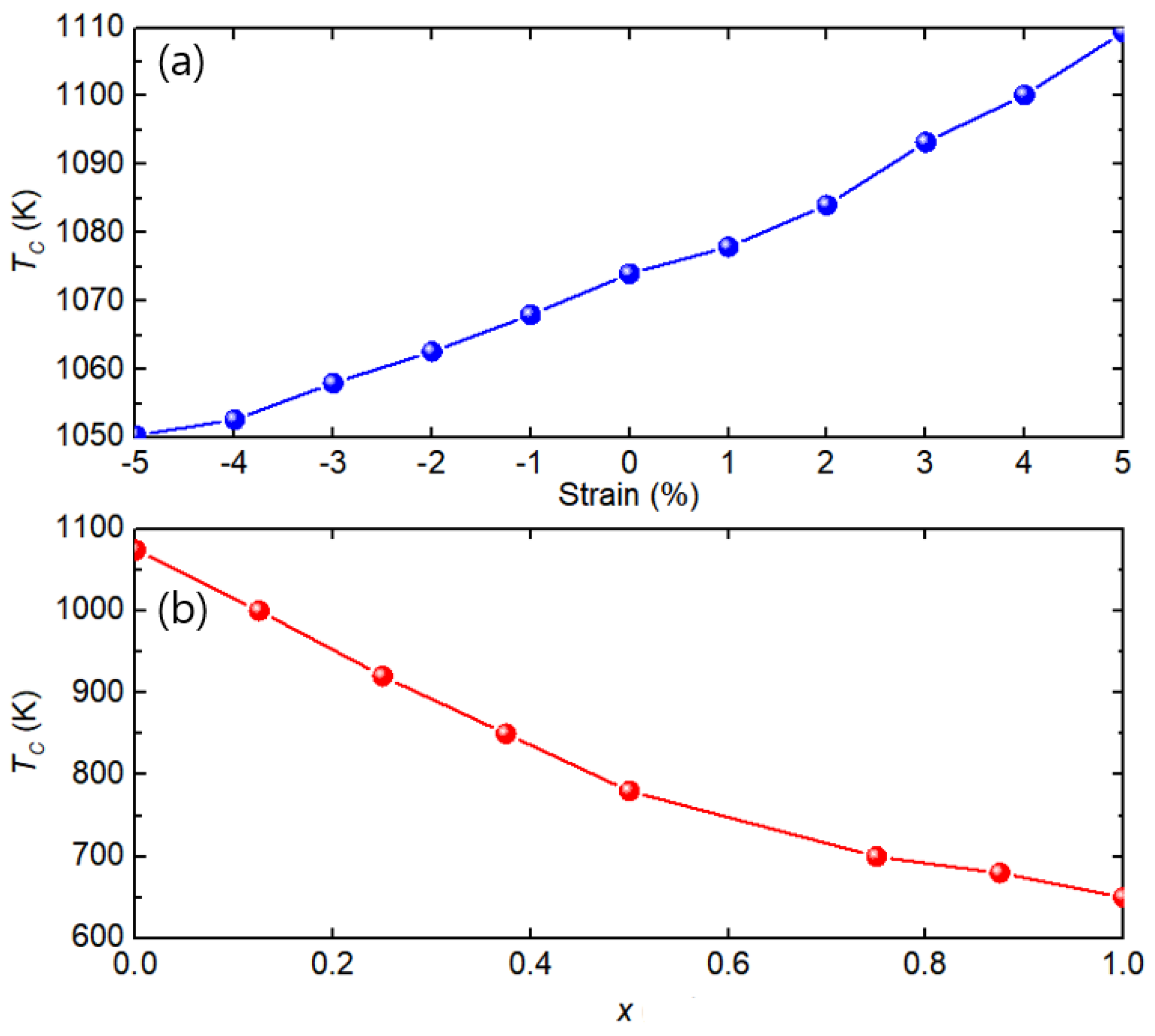
As shown in Figure 5a, increases from 1085 K to 1110 K with increasing tensile strain along c-axis from 0% to 5%. For non-strained SmCo (0%), the calculated (1085 K) is comparable with the experimental values ( = 1020 K) [8], considering the MFA Curie temperature is generally overestimated by about 10–20% [36]. On the other hand, rapidly reduces with increasing concentration of Ce substitutions, and eventually CeCo exhibit only = 660 K. Because for SmCeCo without strain the decrease of the effective ferromagnetic exchange is reinforced by the decrease of the magnetic moments. The appearance of the value of results from the strain dependence of the effective exchange parameters .
Figure 5.
Variation of the Curie temperature with respect to (a) strain and (b) Ce concentration x.
3. Conclusions
Using mean-field theory approximation, we investigated the Ce substitution and strain effect on ferromagnetic exchange energy and corresponding Curie temperature of SmCo compounds. It is found that tensile strain along c-direction improves which is key property for hard magnets. In comparison with an equilibrium state of SmCo, about 40 K higher is observed when 5% tensile strain is applied. The enhancement of can be explained by responses of exchange energy parameters to the lattice strain. Even though the artificial strain due to Ce substitution improves the , Ce itself rather reduces . Therefore, it is necessary to find a substance which can produce a similar strain on SmCo but does not cause a decrease in by substitution. In addition, our work can propose a guideline since the interest on the role of strain as a tool to control novel quantum functionalities is rapidly growing in related condensed matter systems like ultrathin strongly correlated magnetic ultra thin films [37], cuprates [38] and iron-based high superconductors [39] and charge density wave materials [40].
Funding
This research was funded by ETH Zürich central funding.
Acknowledgments
Author thanks to Michalis Charilaou for fruitful discussion.
Conflicts of Interest
The author declares no conflict of interest.
References
- Buschow, K. Intermetallic compounds of rare-earth and 3d transition metals. Rep. Prog. Phys. 1977, 40, 1179. [Google Scholar] [CrossRef]
- Strnat, K.; Hoffer, G.; Olson, J.; Ostertag, W. A Family of New Cobalt-base Permanent Magnet Materials. J. Appl. Phys. 1967, 38, 1001. [Google Scholar] [CrossRef]
- Fingers, R.T.; Rubertus, C.S. Application of high temperature magnetic materials. IEEE Trans. Magn. 2000, 36, 3373–3375. [Google Scholar] [CrossRef]
- Liu, J.F.; Zhang, Y.; Dimitrov, D.; Hadjipanayis, G.C. Microstructure and high temperature magnetic properties of Sm (Co, Cu, Fe, Zr)z (z = 6.7–9.1) permanent magnets. J. Appl. Phys. 1999, 85, 2800–2804. [Google Scholar] [CrossRef]
- Lv, L.; Wang, F.Q.; Zheng, Q.; Du, J.; Dong, X.L.; Cui, P.; Liu, J.P. Preparation and Magnetic Properties of Anisotropic SmCo5/Co Composite Particles. Acta Metall. Sin. (Engl. Lett.) 2017, 31, 143–147. [Google Scholar] [CrossRef]
- Ji, W.; Fu, C.B.; Gao, H. Searching for new spin-dependent interactions with SmCo5 spin sources and a spin-exchange-relaxation-free comagnetometer. Phys. Rev. D 2017, 95, 075014. [Google Scholar] [CrossRef]
- Suzuki, A.; Hotta, Y.; Yamada, M.; Ohtake, M.; Futamoto, M.; Kirino, F.; Inaba, N. Structure and magnetic properties of SmCo5/X (X = Fe, Fe-Co, Co) magnetic bilayer films on MgO (110) substrate. J. Magn. Magn. Mater. 2017, 440, 74–78. [Google Scholar] [CrossRef]
- Buschow, K.H.J.; Van Diepen, A.M.; De Wijn, H.W. Crystal-field anisotropy of Sm3+ in SmCo5. Solid State Commun. 1974, 15, 903–906. [Google Scholar] [CrossRef]
- Sabiryanov, R.F.; Jaswal, S.S. Magnetic properties of hard/soft composites: SmCo5/Co1−xFex. Phys. Rev. B 1998, 58, 12071. [Google Scholar] [CrossRef]
- Larson, P.; Mazin, I.; Papaconstantopoulos, D.A. Calculation of magnetic anisotropy energy in SmCo5. Phys. Rev. B 2003, 67, 214405. [Google Scholar] [CrossRef]
- Richter, M.; Oppeneer, P.M.; Eschrig, H.; Johansson, B. Calculated crystal-field parameters of SmCo5. Phys. Rev. B 1992, 42, 13919. [Google Scholar] [CrossRef]
- Sayama, J.; Asahi, T.; Mizutani, K.; Osaka, T. Newly developed SmCo5 thin film with perpendicular magnetic anisotropy. J. Phys. D Appl. Phys. 2003, 37, L1. [Google Scholar] [CrossRef]
- Sayama, J.; Mizutani, K.; Asahi, T.; Osaka, T. Thin films of SmCo5 with very high perpendicular magnetic anisotropy. Appl. Phys. Lett. 2004, 85, 5640–5642. [Google Scholar] [CrossRef]
- Rong, C.; Poudyal, N.; Liu, X.B.; Zhang, Y.; Kramer, M.J.; Ping Liu, J. High temperature magnetic properties of SmCo5/α-Fe (Co) bulk nanocomposite magnets. Appl. Phys. Lett. 2012, 101, 152401. [Google Scholar] [CrossRef]
- Hao, S.Q.; Chen, N.X.; Shen, J. Atomistic study of rare-earth compounds R2Fe17 (R = Y, Ce, Pr, Nd, Sm, Gd, Tb, Dy, Ho, Er, Tm, Lu) and Nd2Fe17Nx. Model. Simul. Mater. Sci. Eng. 2002, 10, 425. [Google Scholar] [CrossRef]
- Kneller, E.F.; Hawig, R. The exchange-spring magnet: A new material principle for permanent magnets. IEEE Trans. Magn. 1991, 27, 3560–3588. [Google Scholar] [CrossRef]
- Al-Omari, I.A.; Sellmyer, D.J. Magnetic properties of nanostructured CoSm/FeCo films. Phys. Rev. B 1995, 52, 3441. [Google Scholar] [CrossRef]
- Jiang, J.S.; Pearson, E.; Liu, Z.Y.; Kabius, B.; Trasobares, S.; Miller, D.J.; Bader, S.D. A new approach for improving exchange-spring magnets. J. Appl. Phys. 2005, 97, 10K311. [Google Scholar] [CrossRef]
- Cheng, W.; Dai, Y.; Hu, H.; Cheng, X.; Miao, X. Effect of Cu Substitution on the Magnetic Properties of SmCo5 Film with Perpendicular Magnetic Anisotropy. J. Electron. Mater. 2012, 41, 2178–2183. [Google Scholar] [CrossRef]
- Liu, X.B.; Altounian, Z. The mixing of Fe/Co and its effect on the exchange interaction in SmCo5/α-Fe nanocomposites: A first-principles study. J. Appl. Phys. 2012, 111, 07B526. [Google Scholar] [CrossRef]
- Fukuzaki, T.; Iwane, H.; Abe, K.; Doi, T.; Tamura, R.; Oikawa, T. Effect of Zr, V, Nb, Mo, and Ta substitutions on magnetic properties and microstructure of melt-spun SmCo5 magnets. J. Appl. Phys. 2014, 115, 17A760. [Google Scholar] [CrossRef]
- Söderlind, P.; Landa, A.; Locht, I.L.M.; Åberg, D.; Kvashnin, Y.; Pereiro, M.; Däne, M.; Turchi, P.E.A.; Antropov, V.P.; Eriksson, O. Prediction of the new efficient permanent magnet SmCoNiFe3. Phys. Rev. B 2017, 96, 100404(R). [Google Scholar] [CrossRef]
- Sagawa, M.; Fujimura, S.; Yamamoto, H.; Matsuura, Y.; Hiraga, K. Permanent magnet materials based on the rare earth-iron-boron tetragonal compounds. IEEE Trans. Magn. 1984, 20, 1584–1589. [Google Scholar] [CrossRef]
- Vial, F.; Joly, F.; Nevalainen, E.; Sagawa, M.; Hiraga, K.; Park, K.T. Improvement of coercivity of sintered NdFeB permanent magnets by heat treatment. J. Magn. Magn. Mater. 2002, 242, 1329–1334. [Google Scholar] [CrossRef]
- Zhang, J.J.; Gao, H.M.; Yan, Y.; Bai, X.; Su, F.; Wang, W.Q.; Du, X.B. Morphology and magnetic properties of CeCo5 submicron flakes prepared by surfactant-assisted high-energy ball milling. J. Magn. Magn. Mater. 2012, 324, 3272–3275. [Google Scholar] [CrossRef]
- Narita, K.; Yamamoto, H. Crystal structure and magnetic properties in CeCo5-PrCo5 alloy system. IEEE Trans. Mag. 1981, 17, 2466–2470. [Google Scholar] [CrossRef]
- Nagel, H. Hard magnetic materials: Rare earth-transition metal and Fe-Nd-B. In Powder Metallurgy Data; Landolt-Börnstein—Group VIII Advanced Materials and Technologies; Springer: New York, NY, USA, 2003; Volume 2A1. [Google Scholar]
- Jekal, S.; Loeffler, J.; Charilaou, M. Pushing the limits of magnetic anisotropy in the Sm-Co system. arXiv, 2018; arXiv:1807.09257. [Google Scholar]
- Charilaou, M.; Hagmann, A.; Jekal, S.; Koch, L.; Telford, S.; Stoica, M.; Schaublin, R.; Simon, R.; Löffler, J. Enhanced magnetocrystalline anisotropy in melt-spun Ce-substituted SmCo5 magnets. Unpublished work.
- Zhang, Z.D.; Liu, W.; Liu, J.P.; Sellmyer, D.J. Metastable phases in rare-earth permanent-magnet materials. J. Phys. D Appl. Phys. 2000, 33, R217. [Google Scholar] [CrossRef]
- Nordström, L.; Eriksson, O.; Brooks, M.; Johansson, B. Theory of ferromagnetism in CeCo5. Phys. Rev. B 1990, 41, 9111. [Google Scholar] [CrossRef]
- Gignoux, D.; Givord, F.; Lemaire, R.; Launois, H.; Sayetat, F. Valence state of cerium in the hexagonal CeM5 compounds with the transition metals. J. Phys. 1982, 43, 173–180. [Google Scholar] [CrossRef]
- Givord, D.; Laforest, J.; Lemaire, R.; Lu, Q. Cobalt magnetism in RCo5-Intermetallics: Onset of 3d magnetism and magnetocrystalline anisotropy (R = Rare earth or Th). J. Magn. Magn. Mater. 1983, 31, 191–196. [Google Scholar] [CrossRef]
- Kashyap, A.; Skomski, R.; Sabiryanov, R.F.; Jaswal, S.S.; Sellmyer, D.J. Exchange interactions and Curie temperature of Y-Co compounds. IEEE Trans. Magn. 2003, 39, 2908–2910. [Google Scholar] [CrossRef]
- Denton, A.R.; Ashcroft, N.W. Vegard’s law. Phys. Rev. A 1991, 43, 3161. [Google Scholar] [CrossRef]
- Van Schilfgaarde, M.; Antropov, V. First-principles exchange interactions in Fe, Ni, and Co. J. Appl. Phys. 1999, 85, 4827–4829. [Google Scholar] [CrossRef]
- Stewart, M.; Yee, C.H.; Liu, J.; Kareev, M.; Smith, R.; Chapler, B.; Varela, M.; Ryan, P.; Haule, K.; Chakhalian, J.; et al. Optical study of strained ultrathin films of strongly correlated LaNiO3. Phys. Rev. B 2011, 83, 075125. [Google Scholar] [CrossRef]
- Yim, C.M.; Trainer, C.; Aluru, R.; Chi, S.; Hardy, W.N.; Liang, R.; Bonn, D.; Wahl, P. Discovery of a strain-stabilised smectic electronic order in LiFeAs. Nat. Commun. 2018, 9, 2602. [Google Scholar] [CrossRef]
- Agrestini, S.; Saini, N.; Bianconi, G.; Bianconi, A. The strain of CuO2 lattice: The second variable for the phase diagram of cuprate perovskites. J. Phys. A Math. Gen. 2003, 36, 9133. [Google Scholar] [CrossRef]
- Gao, S.; Flicker, F.; Sankar, R.; Zhao, H.; Ren, Z.; Rachmilowitz, B.; Balachandar, S.; Chou, F.; Burch, K.S.; Wang, Z.; et al. Atomic-scale strain manipulation of a charge density wave. Proc. Natl. Acad. Sci. USA 2018, 115, 6986–6990. [Google Scholar] [CrossRef]
© 2019 by the author. Licensee MDPI, Basel, Switzerland. This article is an open access article distributed under the terms and conditions of the Creative Commons Attribution (CC BY) license (http://creativecommons.org/licenses/by/4.0/).