
You are currently on the new version of our website. Access the old version .
FishesFishes
  • Article
  • Open Access

12 January 2026

From Biofouling to Crop Resource: Novel Opportunities as Extractive Species in a Mediterranean IMTA Pilot

,
,
,
,
and
1
Department of Biological and Environmental Sciences and Technologies (DiSTEBA), University of Salento, 73100 Lecce, Italy
2
National Interuniversity Consortium for Marine Sciences (CoNISMa), 00196 Rome, Italy
3
Institute of Marine Sciences (LABOMAR), Federal University of Ceará (UFC), Fortaleza 60165-121, Brazil
*
Author to whom correspondence should be addressed.
This article belongs to the Special Issue Integrated Multi-Trophic Aquaculture (IMTA)

Abstract

Biofouling communities are usually managed as pests in aquaculture, yet their natural proliferation in fish farms makes them also promising IMTA extractive components. The growth and biomass production of four dominant macrofoulers, Mytilus galloprovincialis (mussels), Sabella spallanzanii (polychaete worms), Phallusia mammillata and Styela plicata (ascidians), were evaluated under a novel IMTA system in the Ionian Sea (southern Italy). Coconut-fiber ropes (10 m) were deployed around fish cages in October 2022 and monitored over a 1-year cycle. Monthly density, length-frequency and cohort analyses combined with species-specific length-weight relationships were used to estimate target species’ growth and biomass. Mytilus and Sabella showed single-cohort dynamics, with densities steadily declining over time, whereas ascidians displayed continuous recruitment allowing for additional rope-deployment windows. Specific growth rates in length were significantly higher in Phallusia and Sabella (≈25% month−1) than in Mytilus and Styela (≈17 and 22% month−1). Total macrofouling biomass (live weight) increased from ≈350 kg in May to a peak of ≈2500 kg in August, remaining as high in October. Mytilus and Sabella accounted for 60–80% of total biomass while ascidians contributed 20–40%. Beyond environmental restoration, this multispecies biomass offers several potential commercial opportunities and could be further valorized through biorefinery-based cascading extraction, including final conversion into bioenergy. Overall, IMTA could leverage traditionally undesired fouling organisms as multifunctional crops, enhancing bioremediation while supporting circular blue-bioeconomy principles. Future research should focus on optimizing rope deployment timing, harvesting strategies, and biomass valorization pathways to fully exploit the emerging potential of integrating multispecies fouling biomass within IMTA systems.
Key Contribution:
This study shows that fouling organisms can be transformed from pests into valuable IMTA crops, providing both bioremediation services and potentially marketable biomass for multiple supply chains, in line with sustainability and circular bioeconomy principles.

1. Introduction

Biofouling, defined as accumulation of marine organisms on submerged structures, represents a pervasive issue in aquaculture worldwide [1]. The assemblages colonizing artificial structures associated with fish farms are typically dominated by sessile suspension-feeding macroinvertebrates and, when light is not limiting, also by algae [1,2]. These organisms reduce water flow, increase maintenance costs, and can have detrimental effects on farmed organisms, including reduced growth and health impairment, and the economic impact is far from negligible: in some cases, fouling may account for up to 30% of aquaculture operating costs [3,4,5]. However, several studies have also highlighted the functional role played by these fouling species in fish farms, where they can feed on the excess organic matter released by farming activities, thereby limiting its accumulation in the surrounding environment [6,7,8,9].
Over the past two decades, IMTA (Integrated Multi-Trophic Aquaculture) has emerged as a model of sustainable aquaculture, where extractive organisms such as filter-feeders and seaweed recycle excess organic matter and nutrients derived from fed species such as fish [10,11]. IMTA is increasingly regarded in Europe as a potential pathway to mitigate the environmental footprint of intensive fish monoculture [12,13,14]. However, its commercial development has so far focused on a restricted set of species with established markets (e.g., particularly mussels and seaweed), which may not be sufficient to fully compensate for organic loading in fish farms [15,16]. Expanding the range of extractive species could instead enhance both ecological resilience and resource efficiency [17,18,19]. In this regard, the much-disliked fouling organisms may represent untapped extractive resources [20].
Their natural settlement on aquaculture structures leads to the accumulation of non-negligible amounts of biomass, which reflects their ability to exploit available food resources and convert them into living tissue [7,21]. However, fouling assemblages are rarely studied from a production-oriented perspective. Studies largely focused on their negative impacts and on short-term studies aimed at control and mitigation [1,4] and typically, aquaculture operators periodically remove fouling from nets, cages, and boat hulls, thus limiting long-term observations. As a result, little is known about the potential biomass yield of fouling assemblages over extended cultivation periods [22], since these organisms have never been considered a production resource. Moreover, in conventional aquaculture, economic priority is usually placed on monospecific crops such as mussels, and other fouling species are regarded as competitors for space and food rather than as potential co-cultured extractive components. Exploring this biomass under an IMTA framework not only takes advantage of the bioremediation services by fouling communities [9] but also opens opportunities for its potential economic valorization.
A novel multi-species IMTA pilot was developed in the Mar Grande of Taranto (Ionian Sea, Southern Italy), co-culturing several benthic invertebrates (e.g., polychaetes and sponges) and seaweed in long-lines around the cages of an existing fish farm [23]. Among fouling taxa, the polychaete worm Sabella spallanzanii (Gmelin, 1791), the mussel Mytilus galloprovincialis (Lamarck, 1819), and the ascidians Phallusia mammillata (Cuvier, 1815) and Styela plicata (Lesueur, 1823) were particularly abundant in the farming area [21]. Mytilus galloprovincialis is already known to be an extractive component of IMTA systems [24], while S. spallanzanii has recently attracted attention for its high clearance rates and potential role in microplastic and particulate organic matter removal [22,25,26]. Ascidians, although not currently exploited commercially in Europe, are efficient filter feeders and fast-growing organisms, making them strong candidates for IMTA systems [20].
This study aims to evaluate the potential of the dominant fouling species as extractive components within a novel IMTA pilot system through the analysis of the growth performance and biomass production of S. spallanzanii, M. galloprovincialis, S. plicata, and P. mammillata. By adopting a cultivation approach based on natural recruitment, the study specifically focuses on (i) describing the population size structure and density of these target species, (ii) evaluating the growth dynamics of their dominant cohorts, (iii) estimating biomass production over an annual cultivation cycle under the IMTA pilot system, (iv) interpreting species-specific growth and biomass patterns in relation to their extractive function and management potential within the IMTA pilot and (iv) discussing their potential for commercial exploitation.

2. Materials and Methods

2.1. Study Area

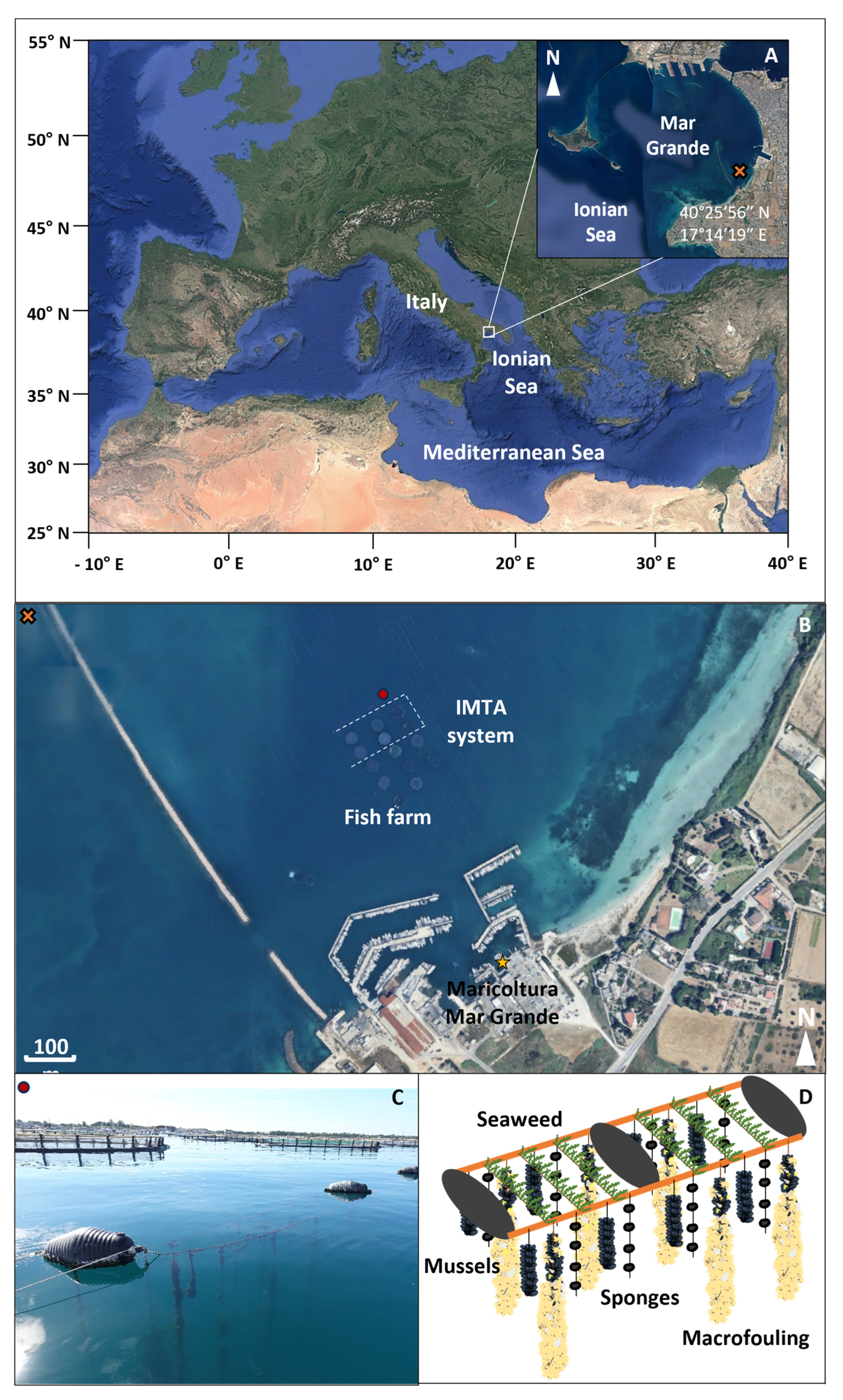
The study was carried out at the cooperative fish farm Maricoltura Mar Grande Scarl (40°25′56″ N; 17°14′19″ E), located in the southeastern sector of the Mar Grande of Taranto (Ionian Sea, southern Italy, Figure 1A). The facility, located approximately 600 m from the coastline, was partially converted into an innovative IMTA system integrating novel extractive species such as sponges and polychaetes [23]. The farm consists of 15 circular floating cages (22 m diameter) occupying an area of about 0.006 km2, operating at depths ranging between 7 and 12 m (Figure 1B). Annual production is approximately 100 t of European sea bass Dicentrarchus labrax (Linnaeus, 1758) and gilthead sea bream Sparus aurata (Linnaeus, 1758). The Mar Grande of Taranto is a semi-enclosed basin bordered by the city of Taranto and connected to the Gulf of Taranto by two openings to the north and south of the Cheradi Islands, which are connected by a breakwater. Water temperature follows the typical seasonal pattern of the Ionian Sea, ranging from 14 °C in winter to 28 °C in summer, while salinity remains relatively stable between 35 and 36 [27]. The area also hosts extensive mussel farming, primarily for depuration before marketing [28].
Figure 1. (A) Position of Italy within the Mediterranean Sea, with an inset showing the Mar Grande (Ionian Sea, southern Italy) and the geographic coordinates of the study area (orange cross). (B) Map of the study area showing the location of the cooperative fish farm “Maricoltura Mar Grande” (white square). (C) Photograph and (D) schematic diagram of the IMTA longline system (red dot) showing the arrangement of bioremediating species within culture chambers surrounding the fish cages.

2.2. Description of the IMTA System and Sampling

The IMTA pilot system was established at the fish farm by installing three long lines around the fish cages to support the cultivation of extractive organisms. Each long line consisted of a series of buoys forming approximately 6 m culture chambers (Figure 1C), where grow-out units for invertebrates were suspended vertically, while seaweed units were arranged horizontally (Figure 1D). The configuration has been designed to ensure optimal growth conditions for all organisms (e.g., light exposure to seaweed) while improving particle interception and nutrient uptake in the water column [21,22,23]. A detailed description of the IMTA design can be found in [23].
Within these structures, a total of 196 natural fiber ropes (each 10 m long, made of coconut fiber) were deployed in October 2022 as larval macrofouling collectors, allowing natural colonization by benthic invertebrates. Macrofouling colonization was monitored in the following months to assess the settlement of target species, and growth monitoring activities were carried out from May, when the species were all clearly visible and measurable, until October 2023, one year after rope deployment.
At each monthly sampling event, six ropes were randomly selected from a single culture chamber that changed each month to avoid pseudo-replication. Three of them were used to estimate the density of target species (numbers of individuals per rope, ind. rope−1) by counting all individuals within three random 1-m sections per rope and scaling up the resulting values to the total 10-m rope length. The remaining three ropes were dedicated to size measurements (total body length, cm). For each target species, 40 random individuals per month were measured in situ using a ruler (resolution ±1 mm) to describe population size structure and growth trends: shell length for M. galloprovincialis, tube length for S. spallanzanii, and tunic length for the ascidians P. mammillata and S. plicata (Tables S1–S4). Any individuals showing visible damage and/or partial loss of anatomical structures (e.g., incomplete tubes) were excluded from length measurements. Specifically, post-sampling inspections indicated no evident signs of organism stress or detachment attributable to rope or specimen manipulation. Although a sample size of 40 individuals per month may appear limited for highly variable species such as ascidians, sample size was considered adequate based on the low standard error monthly length estimates (0.05–0.30 cm), indicating sufficient precision to resolve temporal growth patterns.

2.3. Fouling Target Species

Sabella spallanzanii is a large, filter-feeding polychaete worm widely distributed in the Mediterranean Sea, characterized by high clearance rates [24,25] and a single, synchronous annual recruitment event following late autumn-winter spawning [29,30]. Its capacity to efficiently remove suspended particles and organic matter makes it an ideal candidate for bioremediation in IMTA systems.
Mytilus galloprovincialis is a key commercial bivalve species and a dominant fouler in Mediterranean areas. It exhibits a well-defined annual spawning event during winter [31,32], producing dense juvenile settlements (spat) that can rapidly colonize submerged substrates. Besides its economic value, its filtration capacity significantly contributes to the removal of particulate organic matter in coastal systems [22,31].
Styela plicata is an introduced solitary ascidian species, likely of Indo-Pacific origin, that is now cosmopolitan and commonly found in harbors and aquaculture facilities across temperate and warm seas [33]. It exhibits a continuous recruitment pattern throughout the year with observed seasonal peaks [34]. Phallusia mammillata, by contrast, is a native Mediterranean solitary ascidian typical of local fouling communities. It attains larger sizes than S. plicata and likely displays a similarly continuous reproductive pattern, although its full life cycle is not yet clearly defined [35,36].
For improved readability, in the following sections, the target species will be referred to by their genus name only, without risk of misunderstanding.

2.4. Cohort and Growth Analysis

In contrast to Sabella and Mytilus, which exhibit well-defined massive spawning events in late autumn-winter, enabling predictable demographic dynamics and smooth growth monitoring, ascidians are characterized by a continuous recruitment pattern throughout the year. This continuous recruitment complicates growth monitoring, as the overlapping occurrence of new settlers can bias the estimation of individual growth trajectories over time.
To address this issue, size-frequency data were analyzed to identify the dominant cohort, assumed to represent individuals that settled relatively shortly after the deployment of the ropes in October 2022. Length-frequency distributions were constructed monthly for each species based on the 40 individuals measured. Size-class intervals were defined on a biological basis, corresponding to the typical size of individuals approximately one month after recruitment for each species, as observed in situ and supported by literature [22,34,37]: 1 cm for Mytilus, 3 cm for Sabella, 2.5 cm for Phallusia, and 1.5 cm for Styela. The use of size-at-1-month of the target species as a class step enabled accurate detection of any new recruits and improved main cohort resolution during the monitoring period. Moreover, main cohort identification was supported by the known timing of rope deployment, which imposed a clear temporal directionality on recruitment and settlement since rope deployment.
The identification of the main cohort was based on modal progression analysis, a method typically employed in fish stock assessments to distinguish cohorts from polymodal size distributions [38,39,40]. The dominant cohorts of target species were visually identified as the modal size class and, where appropriate, their adjacent class. An adjacent class was included when its relative abundance was within 10 percentage points of the modal class (Δpp < 10) and when it showed a coherent temporal progression between consecutive months [38,39,40]. To test the robustness of cohort identification, class width was varied by ±25%, and cohorts were considered stable when the dominant class remained the same (or adjacent) and its relative frequency varied by less than 10 percentage points (Δpp < 10) [41,42,43]. Across all species, mean Δpp values for both reduced and increased class widths remained below 10 percentage points and no dominant class shifted beyond one adjacent size class under these scenarios, indicating a consistently high level of robustness. Slightly higher deviations (up to 15–17.5 pp) occurred during biologically transitional phases at the beginning or end of the growth cycle, when size distributions can be naturally more heterogeneous [42]. These results confirm that the adopted class widths, based on species-specific size at one-month post-recruitment, were robust for cohort and growth analysis. However, modal progression analysis was based on visual inspection to identify dominant cohorts rather than formal cohort decomposition methods [38], and some uncertainty in cohort assignment cannot be entirely excluded, particularly under continuous recruitment and overlapping cohorts.
In this approach, the displacement of modal peaks toward larger size classes over time is interpreted as an indicator of growth [39,40]. Monthly changes in the average length of the dominant cohort were used to estimate individual growth of the target species. To allow for interspecific comparison of growth performance, specific growth rates (SGR) were calculated according to [44] as (1) and reported as percentage increase in length per month (% month−1):
S G R = ( e I G R 1 ) × 100 ,
where the instantaneous growth rate (IGR) was defined as (2):
I G R = ln L f ln L i Δ t ,
with Lf and Li being the species’ final and initial mean length and Δt the interval between final and initial sampling times (months). SGR expresses the percentage rate of increase in body length per unit time and provides a standardized measure of growth independent of initial size, allowing for comparison between different species. As data exhibited heteroscedasticity even after log-transformation log (x + 1) to meet the assumption of normality, Welch’s t-test was used to evaluate differences in SGR among species. Statistical significance was set at 95% (p = 0.05). All data analyses were performed using Microsoft® Excel® for Microsoft 365 MSO (version 2510), including the add-in Data Analysis ToolPak for regression and statistical analyses.

2.5. Biomass Estimation Analysis

Biomass estimation for each target species was based on the integration of size-frequency data and length-weight relationships (Tables S1–S4). To obtain robust biomass estimates, the population size structure was taken into account. For each sampling month, a weighted mean length was calculated, where the mean length of each size class was weighted by its relative abundance within the monthly sample. Monthly weighted mean lengths were converted into estimated wet weights using species-specific allometric equations of the form (3):
W = a L w b
where W is the wet weight (g), Lw is the weighted mean length (cm), and a and b are allometric parameters (Table 1). These parameters were obtained from linear regressions based on log-transformed size values of subsamples collected during monitoring (n = 20). Confidence intervals (95%) for parameters a and b were calculated on the log scale using the t-distribution and back-transformed for parameter a. Residuals were checked for normality and homoscedasticity and any violations of these assumptions were appropriately addressed. The coefficient of determination (r2) was used to assess the goodness of fit of the length-weight relationships.
Table 1. Allometric parameters and coefficients of determination for the four target species.
The biomass per rope for each target species was then obtained by multiplying the species-specific weighted mean biomass by its observed rope density. Finally, total biomass for the entire IMTA system was extrapolated by scaling up to the total number of ropes deployed (196), providing an estimate of the overall relative and cumulative biomass of the target species at the farm scale.

3. Results

3.1. Density Trends

The overall density of Mytilus and Sabella largely exceeded that of both ascidians throughout the cultivation cycle (Figure 2).
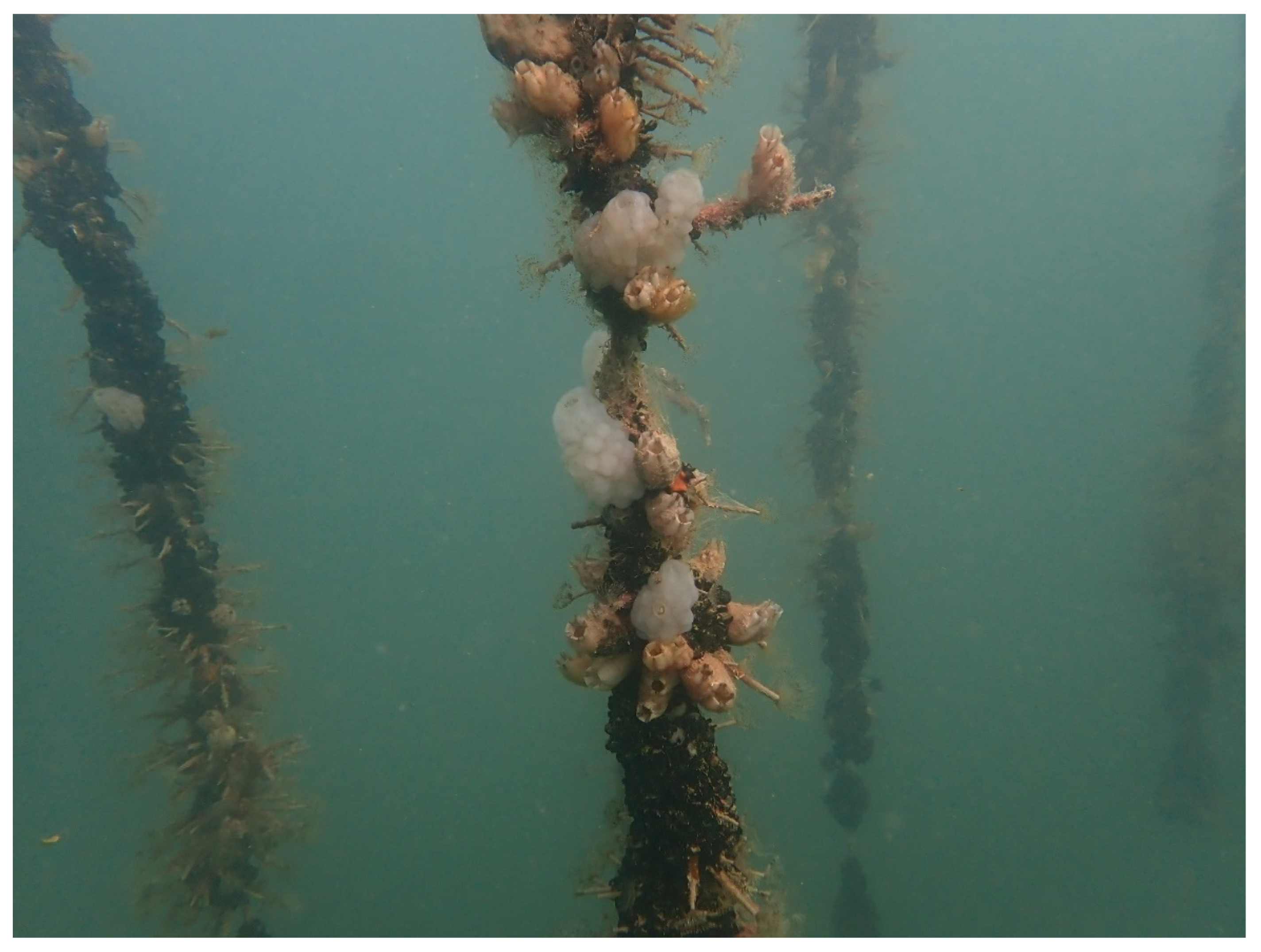
Figure 2. Underwater view of the target species co-cultured on the experimental ropes in July 2023.
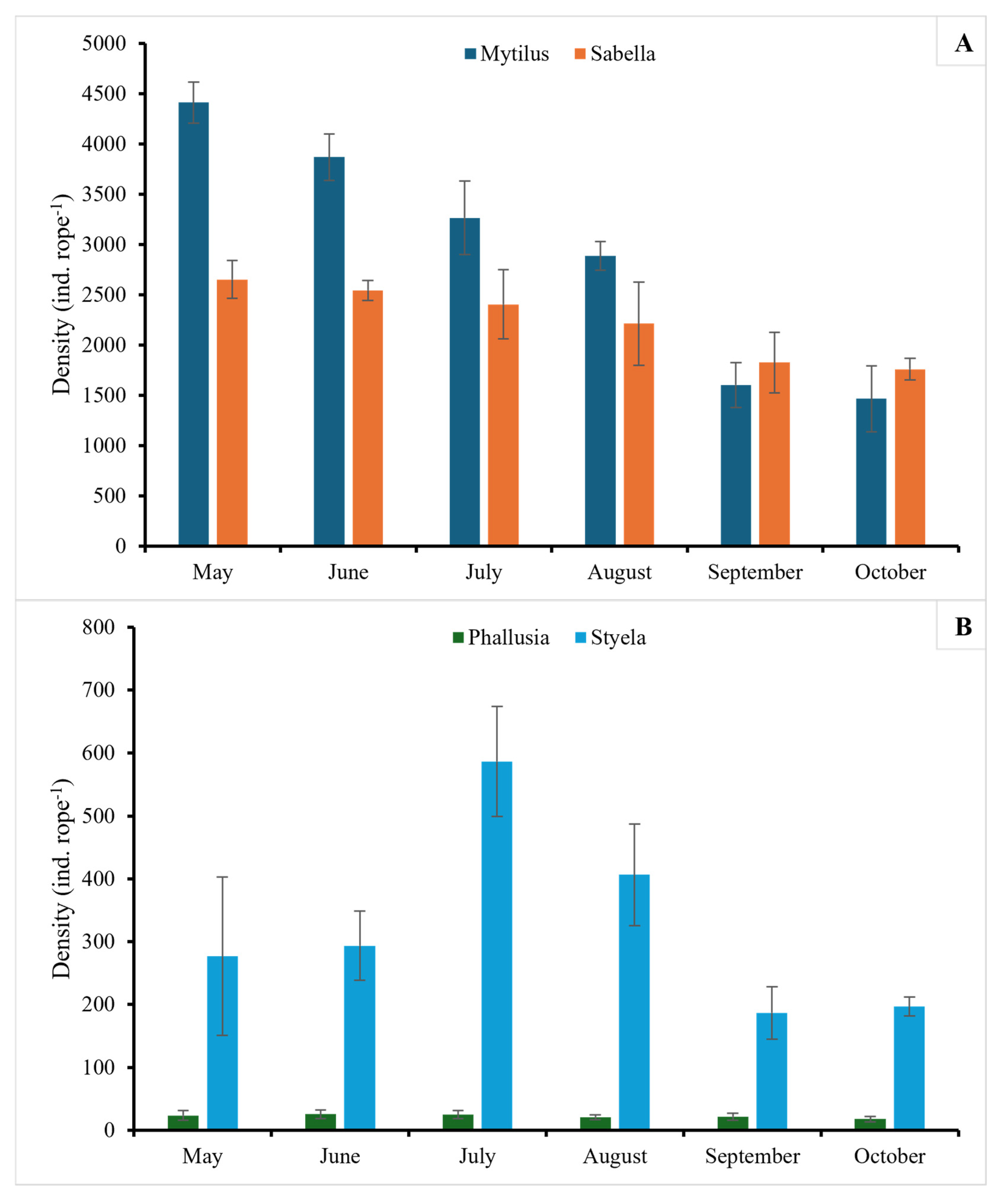
Mean densities of Mytilus ranged between 4410 ± 204 ind. rope−1 in May and 1463 ± 326 ind. rope−1 in October, while Sabella varied from 2650 ± 187 to 1757 ± 107 ind. rope−1 over the same period (Figure 3A). In contrast, Phallusia and Styela showed much lower densities between 18–25 ind. rope−1 and 180–590 ind. rope−1, respectively (Figure 3B).
Figure 3. Monthly density (ind. rope−1) of Mytilus galloprovincialis and Sabella spallanzanii (A), and Phallusia mammillata and Styela plicata (B) over the cultivation cycle under the IMTA pilot system.
Both Mytilus and Sabella showed a steady decline in density from May to October, consistent with a single recruitment event followed by cohort growth and partial mortality. In particular, Mytilus experienced a sharp decrease in abundance between August and September, becoming less abundant than Sabella at the end of the cultivation cycle. Conversely, Phallusia and Styela maintained relatively stable or fluctuating densities across months, indicating continuous recruitment with overlapping cohorts within the population.

3.2. Cohort Structure and Growth

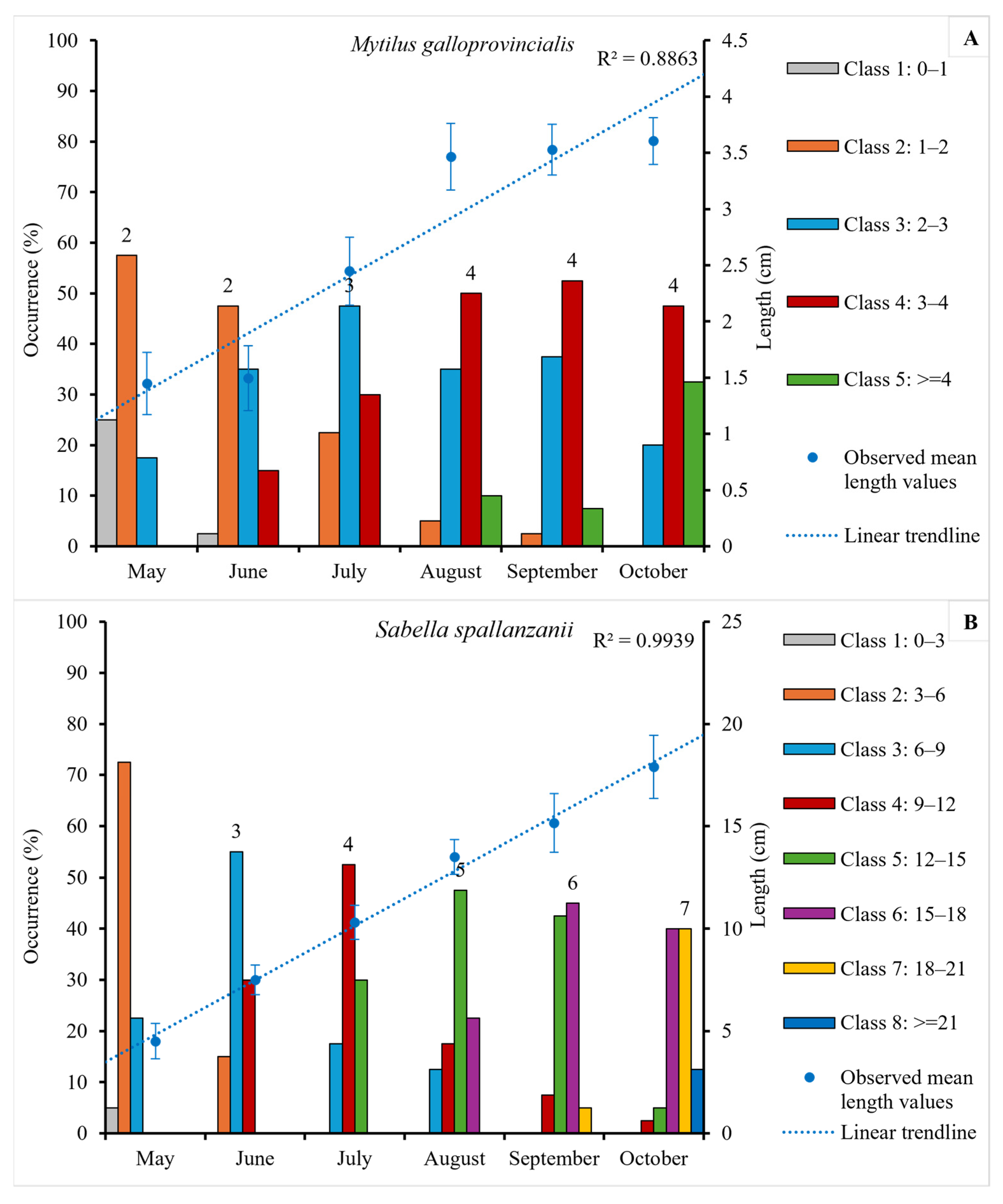
Modal size-class analysis revealed different recruitment and growth patterns among species. In Mytilus, individuals progressively shifted from smaller to larger size classes reaching class 4 as modal class in August, after which growth rate slowed markedly and the modal class remained unchanged until the end of the cultivation cycle (Figure 4A). Mean shell length increased from 1.45 ± 0.28 cm in May to 3.61 ± 0.21 cm in October, corresponding to an average growth rate of about 0.36 cm month−1 (Figure 4A). Similarly, Sabella showed a clear shift from smaller to larger size classes, with a sharp increase in length from 4.50 ± 0.86 cm in May to 17.89 ± 1.55 cm in October, yielding a high mean growth rate of about 2.2 cm month−1 (Figure 4B). The lack of new recruits over time, as highlighted by the month-by-month disappearance of individuals from smaller size classes (e.g., class 1 starting in June, classes 1 and 2 starting in July, etc.), indicates a single recruitment event, as in Mytilus.
Figure 4. Monthly variation in the occurrence (%) of individuals within size classes (stacked bars, left axis) and mean length (blue dots ± SD, right axis) of Mytilus galloprovincialis (A) and Sabella spallanzanii (B) from May to October. Numbers above the bars indicate the modal size class(es) for each month. The dotted blue line represents the linear increase in length throughout the sampling period.
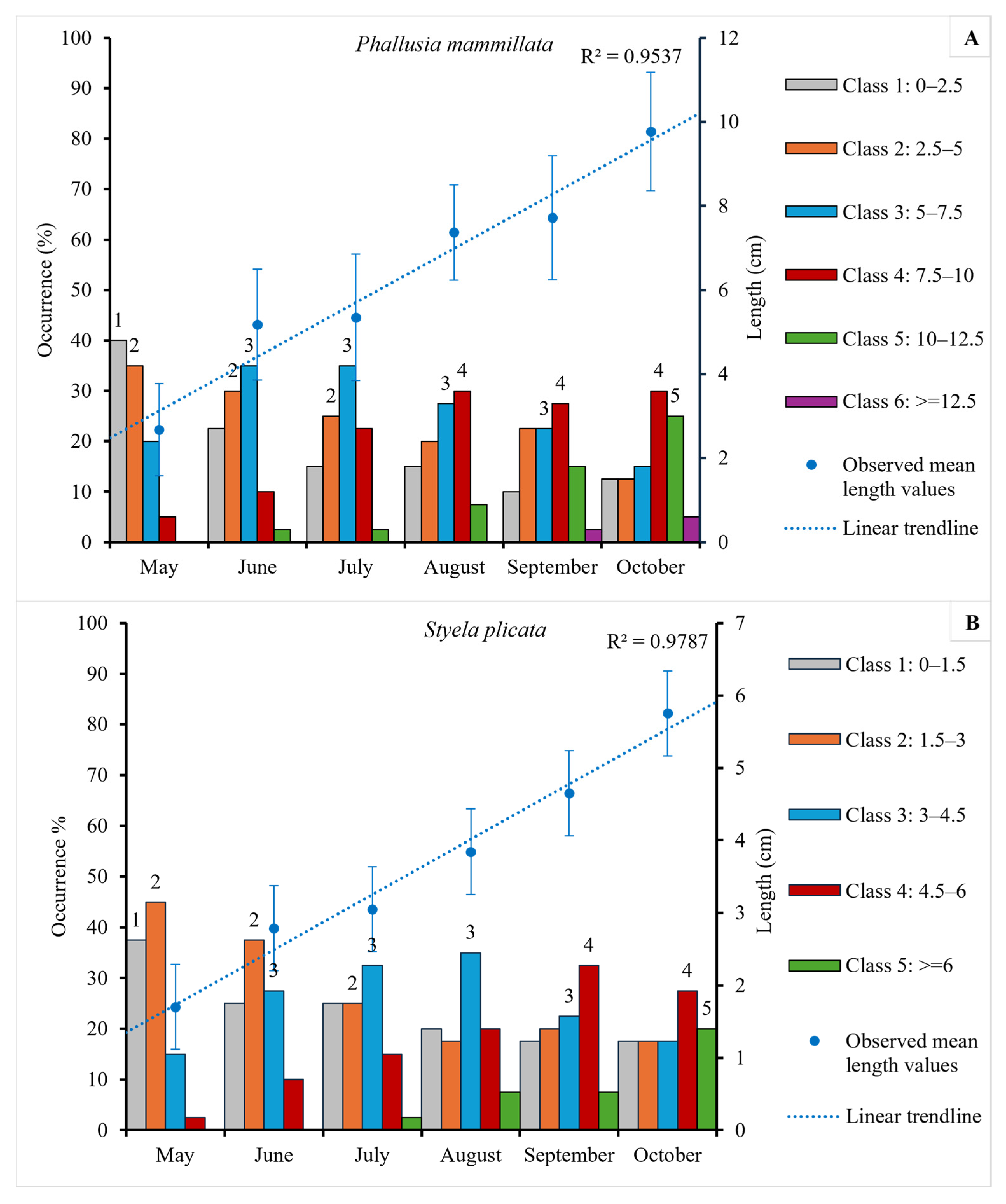
In contrast, Phallusia and Styela displayed the simultaneous presence of multiple size classes at all sampling times, consistent with continuous recruitment (Figure 5A,B).
Figure 5. Monthly variation in the occurrence (%) of individuals within size classes (stacked bars, left axis) and mean length (blue dots ± SD, right axis) of Phallusia mammillata (A) and Styela plicata (B) from May to October. Numbers above the bars indicate the modal size class(es) for each month. The dotted blue line represents the linear increase in length throughout the sampling period.
Nevertheless, modal progression analysis enabled the detection of a main cohort for both species settled in early spring showing a gradual but continuous increase in mean length. Phallusia grew from 2.68 ± 1.10 cm in May to 9.77 ± 1.41 cm in October, at an average rate of about 1.18 cm month−1 (Figure 5A).
The ascidian Styela increased from 1.70 ± 0.63 cm to 5.75 ± 0.56 cm, equivalent to about 0.8 cm month−1 (Figure 5B). These patterns, coupled with the continued occurrence of individuals in size class 1, suggest prolonged and overlapping recruitment for both ascidian species throughout the sampling period.
The mean SGR was lowest in Mytilus (17.02 ± 3.19% month−1) and higher in Phallusia (25.89 ± 5.92% month−1) and Sabella (25.03 ± 1.97% month−1), followed by Styela (21.68 ± 6.97% month−1). Welch’s t-tests revealed significant differences between Mytilus and all other species, with t(22) = 8.25, p < 0.001 vs. Sabella; t(39) = 6.01, p < 0.001 vs. Phallusia; and t(31) = 2.70, p = 0.011 vs. Styela. Conversely, no significant difference was detected between Sabella and Phallusia (t(24) = 0.23, p = 0.82), whereas both differed significantly from Styela (t(19) = 2.64, p = 0.016 and t(33) = 2.30, p = 0.028, respectively).
Overall, Mytilus exhibited the lowest significant growth rate, consistent with its subsequent stabilization in modal size class 4. In contrast, Sabella and Phallusia displayed higher and comparable SGR values, reflecting steady growth throughout the cultivation cycle, while Styela showed a more variable pattern with intermediate performance.

3.3. Biomass Estimation

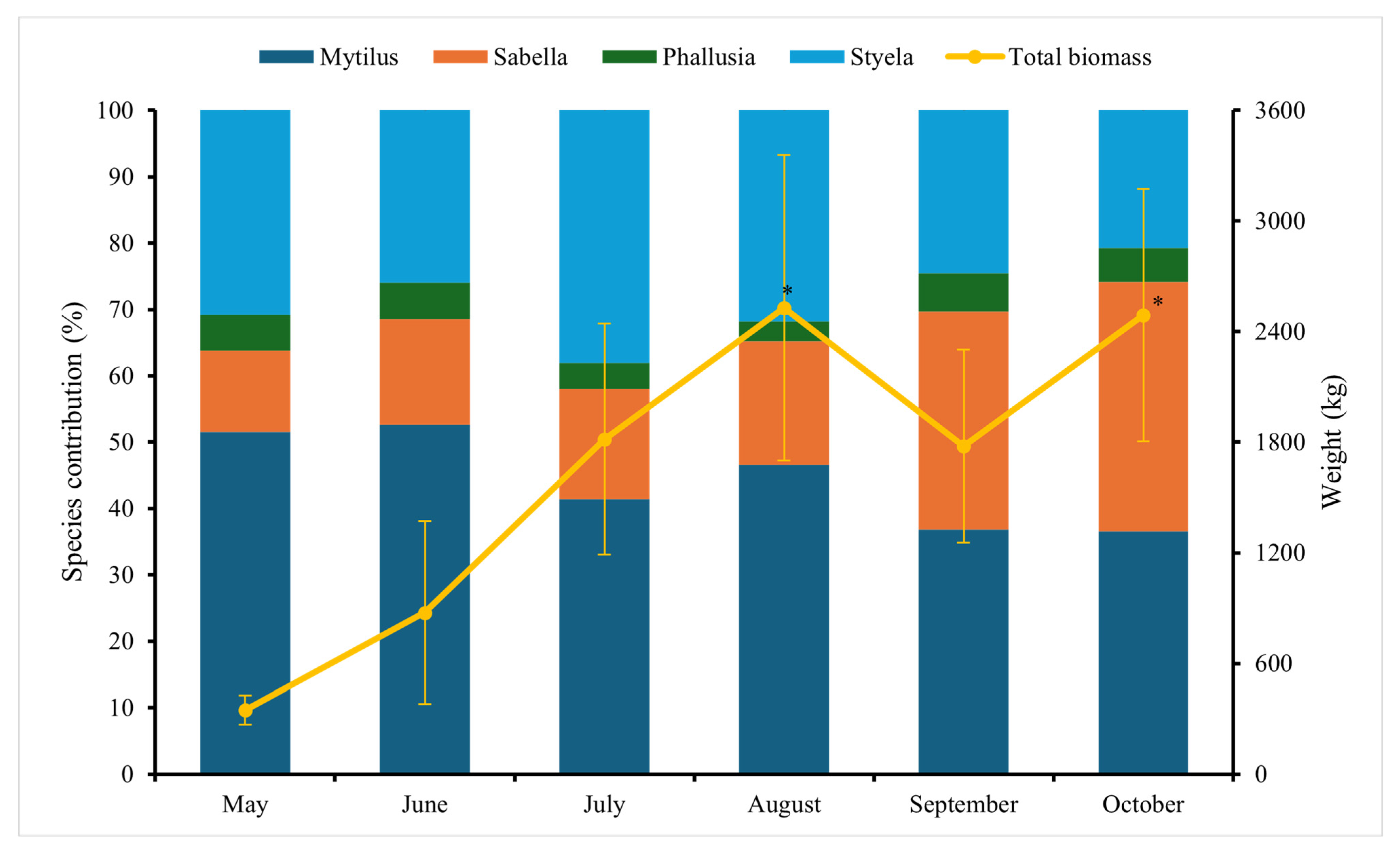
Total biomass within the IMTA system showed a marked increase from May to August, followed by a moderate decline in September and a subsequent recovery toward October (Figure 6). At the IMTA farm scale, overall biomass increased from 347 ± 79 kg in May to a peak of 2528 ± 829 kg in August, remaining as high in October (2489 ± 684 kg).
Figure 6. Temporal variation of total biomass within the IMTA system (yellow line, right axis, kg) and relative contribution of the target species Mytilus galloprovincialis, Sabella spallanzanii, Phallusia mammillata and Styela plicata (stacked bars, left axis, %). The asterisks (*) indicate peaks in total biomass.
Mytilus contributed most to total biomass throughout the study, accounting for 47–53% of the standing stock in the first months and stabilizing around 37% in autumn. Mean biomass per rope increased from 0.91 ± 0.26 kg in May to 6.01 ± 3.88 kg in August, corresponding to 178.7 ± 50.6 kg and 1177.8 ± 761.0 kg at the IMTA farm scale, respectively, before decreasing to 4.64 ± 3.00 kg rope−1 (908.9 ± 587.1 kg) in October. This decrease in biomass was largely driven by the decline in mussel abundance between August and September, combined with reduced growth. Sabella followed a similar but delayed trend, showing a steady biomass increase from 0.22 ± 0.15 kg rope−1 in May to 4.78 ± 1.74 kg rope−1 in October (936.3 ± 340.8 kg at IMTA scale). Its relative contribution to total biomass increased progressively from 12% in early spring to 38% in autumn, surpassing Mytilus by the end of the monitoring period and becoming the major contributor to macrofouling biomass. The ascidians Phallusia and Styela exhibited lower but more stable biomass values, consistent with their continuous recruitment strategy. Phallusia’s biomass increased from 0.10 ± 0.09 kg rope−1 in May (18.7 ± 17.5 kg) to 0.65 ± 0.38 kg rope−1 in October (128.1 ± 74.6 kg), representing 4–6% of the total. Styela displayed higher and more variable values, rising from 0.54 ± 0.26 kg rope−1 in May (106.7 ± 51.2 kg) to a peak of 4.10 ± 0.84 kg rope−1 in August (803.6 ± 165.1 kg), before decreasing to 2.63 ± 0.21 kg rope−1 (515.7 ± 41.1 kg) in October. Overall, Mytilus and Sabella together accounted for 60–80% of total IMTA biomass throughout the experimental period, driving most of the system’s production capacity. The ascidians contributed the remaining 20–40%, with Styela generally dominating among them.

4. Discussion

The present study provides new insights into the density dynamics, growth performance, and biomass production of the dominant fouling species within an IMTA pilot system in the Mediterranean Sea, with the aim of assessing their potential as IMTA crops. In IMTA systems, extractive species must be capable of generating sufficient biomass to effectively assimilate surplus organic matter, while also enhancing overall production [10,11]. The conversion of the traditional fish farm into an IMTA system [23] promoted measurable restorative effects on the local environment, as recently documented for this area [45,46,47]. The establishment of a structured fouling community dominated by the target species, capable of co-filtering excess organic matter across different particle size ranges, resulted in high bioremediation efficiency [6,48]. The three-dimensional structure formed by these sessile organisms recalls an underwater “animal forest” [49], enhancing organic matter retention and carbon immobilization [50], providing habitat for numerous detritivorous species [21,22] that further contributed to organic matter processing [51,52,53] and to the overall environmental restoration observed in the IMTA-converted area [45,46,47]. In addition, this community showed a strong capacity to remove and bioaccumulate hazardous pollutants from the water column, including heavy metals [22] and microplastics [54,55], thereby further improving environmental quality in the area.
The dominance of Mytilus and Sabella in the macrofouling community was mainly due to the timing of rope placement in October, which allowed interception of their annual spawning in late autumn-winter. This gave them an advantage in colonizing the ropes over ascidians, which tend to have peak recruitment in spring-early summer [34,56]. The progressive disappearance of individuals from the smallest size class in both species indicated a clear single-cohort pattern, characterized by massive initial settlement followed by steady growth and partial mortality. This dynamic may be consistent with self-thinning processes [57,58], describing density-dependent mortality resulting from intra- and interspecific competition for limited resources and previously documented in farmed mussel [59,60] and other multispecies sessile assemblages [61,62]. Although self-thinning was inferred from density decline coupled with growth, no formal log-log regression was applied, and this interpretation should therefore be considered indicative. Furthermore, the marked decline in density of Mytilus between August and September may probably reflect mortality associated with summer heat waves [63,64], a phenomenon increasingly reported for Mediterranean mussel populations over the past two decades [65,66,67], and particularly evident in the Taranto area [28,32]. These recurrent mortality events, coupled with elevated summer temperatures, also appear to favor the expansion of the introduced thermophilic pearl oyster Pinctada radiata (Leach, 1814) in the study area, which, despite potential ecological and economic implications for mussel farming, may represent a promising crop resource for future IMTA development under ongoing climate change [68]. In contrast, the ascidians Styela and Phallusia exhibited continuous recruitment, as shown by the coexistence of multiple size classes throughout the cultivation cycle, likely reflecting overlapping generations [34,36]. Such a reproductive strategy is typical of fouling ascidians, which sustain population stability through continuous larval supply under fluctuating environmental conditions, exploiting favorable temporal windows across seasons [34,36,56,69].
Mytilus displayed the lowest specific growth rate, consistent with its typically long cultivation cycles. In the Mediterranean Sea, and particularly in the Mar Grande of Taranto, mussel farming generally lasts 18–20 months, with the second grafting occurring in November of the second year and harvesting taking place between May and July [32,70,71]. Although several authors have reported enhanced mussel growth performance near fish farms in the Mediterranean Sea [28,72,73,74,75], those studies mainly focused on the second growth phase, limiting direct comparison with the present data. Nevertheless, the mean shell length reached by Mytilus in the present study (approximately 40 mm in October) aligns both with the initial mussel size considered by those studies [28,72,73,74,75] and with that of mussels typically used for the second grafting stage in the same area and period [32,70,71]. In contrast, Sabella and Phallusia showed the highest SGRs (>25% month−1), with an average length increase of 2.20 and 1.18 cm month−1, respectively. These values are consistent with previous findings for Sabella cultivated in the same area [22,23], and largely exceed those reported for wild populations, in which tube elongation averages about 14 cm per year [76,77]. The high growth rate and density observed in this study highlighted the ability of Sabella to efficiently exploit suspended organic resources in farming areas [6,48], confirming its suitability as an extractive species under IMTA [22].
The growth pattern of Styela likely reflected the overlap between continuous recruitment and the attainment of sexual maturity. The occurrence already in May-June of specimens larger than 40 mm corresponding to the reported size at first maturity [69], suggests that early settlers may have reproduced during the same season, potentially contributing to the observed density peak in summer. Styela can reach this size within two months in summer and five months in winter [69]. In this study, the average growth rate of Styela (0.8 cm per month) fully matched this winter growth pattern, despite sampling occurring mainly in summer. This observed discrepancy is likely due to the coexistence of several overlapping cohorts, which may have led to underestimating average growth, whereas Yamaguchi’s findings [69] probably represent maximum individual performance. In Phallusia, the lower reproductive output, as indicated by its low density on the ropes, allowed for a clearer identification of the main cohort, revealing the highest SGR among the target species, comparable to that of Sabella. Although size at maturity and detailed growth parameters for Phallusia are not yet reported in the literature, limiting direct comparisons with previous studies, the sizes observed in this study (mostly 6–10 cm, size classes 3–4) are consistent with previous reports from the study area [35]. Overall, ascidians demonstrated a high potential for rapid biomass accumulation, reaching substantial sizes within only 3–4 months from settlement. This rapid turnover suggests that, unlike mussels and worms, which require 18–20 months to complete their cultivation cycle [22,32], ascidians may represent a valuable short-term extractive and productive resource within IMTA systems.
Biomass production mirrored species demographic patterns, with Mytilus and Sabella together accounting for 60–80% of total macrofouling biomass throughout the study period, while ascidians contributed a smaller but stable fraction (20–40%), with large individuals persisting year-round. Total biomass peaked in August at approximately 2.5 t at IMTA scale, driven mainly by Mytilus and Styela, followed by decline in September and a subsequent recovery by the end of the cultivation cycle, mainly due to the increasing contribution of Sabella. Mytilus dominated biomass during most of the experiment (47–53%) but was surpassed by Sabella in October due to the combined effect of mussel mortality and continued worm growth. The biomass of Sabella increased steadily to 4.78 ± 1.74 kg rope−1 in October, which is equivalent to roughly 1 t at IMTA scale, making it the dominant extractive species in the late phase of the cycle. Styela showed intermediate values, peaking in August, while Phallusia maintained a stable biomass production, contributing about 5–6% throughout the cultivation cycle.
Despite the robust temporal coverage of the cultivation cycle under operational IMTA conditions, some limitations should be acknowledged, particularly for ascidians characterized by continuous recruitment. Growth estimates for ascidians may be underestimated due to continuous recruitment and overlapping cohorts, which complicate individual growth tracking. Future research would benefit from increasing the number of replicate ropes sampled per month across multiple culture chambers, as well as from increasing the number of individuals sampled. The use of tagged or individually tracked specimens and mixed-effects models could further improve the resolution of growth trajectories in ascidians. Increasing the number of replicated units would also allow improved spatial replication, with more accurate extrapolation of scaling biomass estimates to the IMTA farm level. Additionally, rope manipulation during monthly sampling may represent a potential source of bias, as handling could affect organism density or size. Although qualitative observations conducted in the subsequent sampling period did not indicate evident stress or damage to the target species, this effect was not quantitatively assessed and therefore cannot be fully excluded. Moreover, self-thinning-based mortality was inferred indirectly from density declines coupled with individual growth, without formal log-log regression validation, and only for single-cohort species. This interpretation therefore relies on an ecological assumption that density reductions primarily reflect competition for resources, rather than other processes such as handling effects or unquantified disturbance. Direct estimates of species-specific mortality would further strengthen population dynamic analyses.
Given the contrasting growth dynamics and life spans of the target species, different harvest and deployment strategies could be adopted to optimize overall productivity and biomass valorization. Results showed that ascidians, characterized by continuous recruitment and high specific growth rates, rapidly contributed to a stable biomass fraction within a few months after settlement, whereas mussels and worms followed a single-cohort trajectory with slower but sustained biomass accumulation over longer time scales. Under the present autumn configuration, these dynamics suggest that fast-growing ascidians could be harvested earlier, after 6–8 months in summer, either through complete or selective removal of large, marketable individuals, while leaving smaller recruits, mussels, and worms to continue growing. This approach would enable shorter cultivation cycles and allow for multiple harvests within a single year. In addition, the observed dominance of Mytilus and Sabella following autumn rope deployment highlights the importance of early substrate occupation in structuring fouling communities [21,22]. Deploying ropes in early spring, or immediately after the spawning peaks of these strong space competitors in Taranto waters [21,78], could favor ascidian settlement by reducing early substrate exclusion. In the Mediterranean Sea, Styela exhibits continuous recruitment with seasonal peaks in spring/summer [34], while Phallusia is reported to produce eggs throughout the year [79], but its complete life cycle is still unknown. Consistently, new recruits of both species were observed each month in the present study. Nevertheless, an improved knowledge of their local reproductive timing would be essential to refine these strategies. Overall, combining autumn and spring deployment windows could therefore sustain more continuous production while maximizing species-specific performance. Logistical constraints associated with these strategies are mainly related to increased labor, biomass sorting, and harvest scheduling rather than additional infrastructure requirements, as cultivation relies on natural recruitment and existing farm structures. Accordingly, increasing the number of ropes or deployment windows could enhance biomass yields and economic returns, supporting the scalability of the proposed IMTA management strategies.
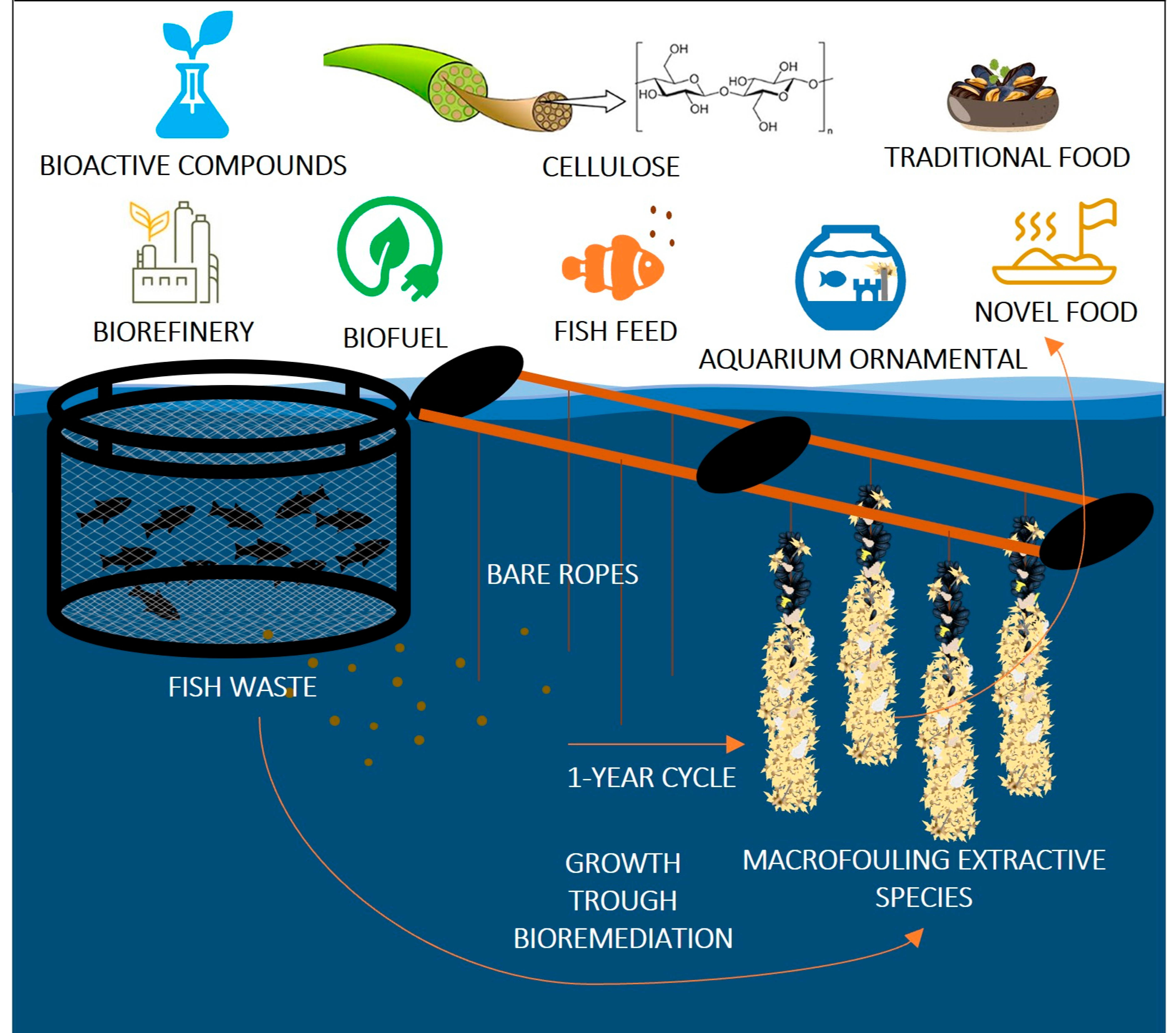
Although the ecological benefits of IMTA are substantial, they often remain less evident to farmers compared with direct economic gains, making adoption more likely when the biomass generated by extractive species can be effectively valorized and into marketable products. In this regard, the target species examined in this study offer complementary and promising opportunities for commercial exploitation, supporting crop diversification and potential additional revenue streams [80,81]. Mytilus remains a cornerstone of Mediterranean aquaculture, providing both marketable seafood and ecosystem services [24]. Sabella may be used as a high-protein alternative to fishmeal in fish feed [82,83], provided that contaminant levels comply with European feed regulations [84] also holds value as an ornamental species for aquaria due to its distinctive aesthetic features [85,86,87]. Moreover, the antibacterial properties of Sabella’s mucus suggest potential pharmaceutical applications [88]. Ascidians appear particularly promising for bioprospecting and biotechnological exploitation, as they produce a wide range of bioactive compounds, with antimicrobial, antitumoral, antioxidant, and anti-inflammatory properties [20,88,89,90], with many more likely yet to be discovered [91]. Their tunic contains tunicin, a cellulose-based biopolymer suitable for nanocellulose extraction processing for biomedical and industrial applications [92]. Styela is already consumed and farmed in several Asian countries, including Korea and Japan [93,94,95], indicating a potential food market pathway, while in Europe it could represent a novel seafood product, pending adequate monitoring of contaminant levels and food safety standards [96]. In contrast, Phallusia, due to its basal chordate position and transparent eggs, holds considerable value as a research model organism for developmental biology and ecotoxicology [79,97,98,99,100,101,102] potentially supporting stable niche market within the scientific research supply chain [103].
Overall, our results highlight the potential for integrating naturally recruited fouling communities as multifunctional IMTA crops rather than incidental by-products of fish farming. The magnitude of biomass produced (exceeding 2.5 t at peak), combined with the contrasting life-history strategies of the target species, supports the feasibility of diversified and flexible IMTA configurations. Short-cycle species such as ascidians, characterized by rapid growth and continuous recruitment, can provide fast-turnover biomass and allow multiple deployment or harvesting windows within a year, whereas longer-cycle species such as mussels and worms ensure sustained biomass accumulation and long-term extractive capacity. This functional complementarity enables adaptive management strategies, including staggered rope deployment and selective or partial harvesting, aimed at reducing interspecific competition while maximizing overall biomass yield. Importantly, the potential uses of the biomass produced under this IMTA system are not mutually exclusive but rather complementary, enabling cascading valorization processes, fully in line with a marine biorefinery approach [104,105]. High-value biomass or compounds can be recovered first and directed toward appropriate market outlets; the residual biomass can then be processed for energy generation, such as biogas via anaerobic digestion [106,107], with the resulting digestate further usable as a soil fertilizer [108,109]. Although access to existing markets and regulatory frameworks still limits immediate commercialization of some products [84,110,111], the integration of biomass production, ecosystem service provision, and cascading valorization demonstrates that IMTA systems can realistically support future value chains. In this perspective, emerging mechanisms such as blue carbon and nutrient credit schemes may help internalize the environmental services provided by IMTA [112,113], reinforcing its role as a scalable model that integrates environmental remediation, sustainable production, and circular blue-bioeconomy principles [114]. Future IMTA development should therefore consider the intentional integration of naturally recruited fouling assemblages as low-trophic extractive crops and further research on ascidian life cycles and other promising extractive species, on the optimization of rope deployment, on biorefinery-based processing, and on the development of suitable market outlets will be crucial to fully unlocking the potential of fouling species within future IMTA systems.

5. Conclusions

This study showed that a self-regulating fouling community dominated by Mytilus, Sabella, Phallusia, and Styela can effectively couple environmental remediation with valuable biomass production under IMTA. Moreover, cultivation based on natural macrofouling recruitment provides a simple, sustainable, cost-effective, and scalable method for generating high biomass yields, requiring minimal management after rope deployment. Based on the current set-up of about 200 ropes, total biomass slightly exceeded 2.5 t at peak, with mussels and worms accounting for most of the standing stock, while ascidians provided a stable and rapidly renewable fraction thanks to their rapid growth and continuous recruitment. The contrasting life-history traits of the target species support complementary ecological functions and flexible management options, including staggered rope deployment and selective or seasonal harvesting. Moreover, integrating fouling-derived biomass into biorefinery-based cascading valorization pathways can enhance economic feasibility while minimizing waste and expanding the range of sustainable marine products. Overall, these results highlight the potential of IMTA to transform fouling assemblages into multifunctional crops, fully aligned with circular and sustainable blue-bioeconomy frameworks.

Supplementary Materials

The following supporting information can be downloaded at: https://www.mdpi.com/article/10.3390/fishes11010047/s1. Table S1: Monthly length data (n = 40) and length-weight measurements (n = 20) of the target species Mytilus galloprovincialis; Table S2: Sabella spallanzanii; Table S3: Phallusia mammillata; Table S4: Styela plicata during the cultivation cycle.

Author Contributions

Conceptualization, D.A. and A.G.; methodology, D.A. and S.R.; validation, D.A.; formal analysis, D.A.; investigation, D.A., S.F., C.C. and L.D.; resources, S.R. and A.G.; data curation, D.A.; writing—original draft preparation, D.A.; writing—review and editing, D.A., S.R., S.F. and A.G.; visualization, D.A. and S.F.; supervision, A.G. and S.R.; project administration, A.G. and S.R.; funding acquisition, A.G. and S.R. All authors have read and agreed to the published version of the manuscript.

Funding

This research was funded by the European Union through the REMEDIA Life Project (LIFE16 ENV/IT/000343). Additional support was provided by the EU Horizon Europe project no. 101036515 “OCEAN CITIZEN-Marine Forest coastal restoration: an underwater gardening socio-ecological plan”.

Data Availability Statement

The data presented in this study are included in the article and Supplementary Materials.

Acknowledgments

The authors would like to thank Graziana Basile and the staff of “Maricoltura Mar Grande” for their support during sampling activities. They also thank the anonymous reviewers for their thorough evaluations and constructive comments, which contributed to improving the quality of this manuscript.

Conflicts of Interest

The authors declare no conflicts of interest.

References

  1. Fitridge, I.; Dempster, T.; Guenther, J.; De Nys, R. The impact and control of biofouling in marine aquaculture: A review. Biofouling 2012, 28, 649–669. [Google Scholar] [CrossRef]
  2. Cook, E.J.; Black, K.D.; Sayer, M.D.J.; Cromey, C.J.; Angel, D.L.; Spanier, E.; Tsemel, A.; Katz, T.; Eden, N.; Karakassis, I.; et al. The influence of caged mariculture on the early development of sublittoral fouling communities: A pan-European study. ICES J. Mar. Sci. 2006, 63, 637–649. [Google Scholar] [CrossRef]
  3. Bannister, J.; Sievers, M.; Bush, F.; Bloecher, N. Biofouling in marine aquaculture: A review of recent research and developments. Biofouling 2019, 35, 631–648. [Google Scholar] [CrossRef] [PubMed]
  4. Dürr, S.; Watson, D.I. Biofouling and antifouling in aquaculture. Biofouling 2010, 12, 267–287. [Google Scholar]
  5. Sievers, M.; Dempster, T.; Keough, M.J.; Fitridge, I. Methods to prevent and treat biofouling in shellfish aquaculture. Aquaculture 2019, 505, 263–270. [Google Scholar] [CrossRef]
  6. Borghese, J.; Giangrande, A.; Arduini, D.; Trani, R.; Doria, L.; Anglano, M.; Rizzo, L.; Rossi, S. Influence of an innovative IMTA system (Mediterranean Sea, Italy) on environmental and biological parameters: Seasonal analysis. Aquaculture 2025, 596, 741726. [Google Scholar] [CrossRef]
  7. Gonzalez-Silvera, D.; Izquierdo-Gomez, D.; Fernandez-Gonzalez, V.; Martínez-López, F.J.; López-Jiménez, J.A.; Sanchez-Jerez, P. Mediterranean fouling communities assimilate the organic matter derived from coastal fish farms as a new trophic resource. Mar. Pollut. Bull. 2015, 91, 45–53. [Google Scholar] [CrossRef]
  8. Hughes, D.J.; Cook, E.J.; Sayer, M.D. Biofiltration and biofouling on artificial structures in Europe: The potential for mitigating organic impacts. In Oceanography and Marine Biology; CRC Press: Boca Raton, FA, USA, 2005; pp. 133–182. [Google Scholar]
  9. Montalto, V.; Rinaldi, A.; Ape, F.; Mangano, M.C.; Gristina, M.; Sarà, G.; Mirto, S. Functional role of biofouling linked to aquaculture facilities in Mediterranean enclosed locations. Aquac. Environ. Interact. 2020, 12, 11–22. [Google Scholar] [CrossRef]
  10. Chopin, T.; Buschmann, A.H.; Halling, C.; Troell, M.; Kautsky, N.; Neori, A.; Neefus, C. Integrating seaweeds into marine aquaculture systems: A key toward sustainability. J. Phycol. 2001, 37, 975–986. [Google Scholar] [CrossRef]
  11. Chopin, T.; Cooper, J.A.; Reid, G.; Cross, S.; Moore, C. Open-water integrated multi-trophic aquaculture: Environmental biomitigation and economic diversification of fed aquaculture by extractive aquaculture. Rev. Aquac. 2012, 4, 209–220. [Google Scholar] [CrossRef]
  12. Buck, B.H.; Troell, M.; Krause, G.; Angel, D.; Grote, B.; Chopin, T. State of the art and challenges for multi-trophic offshore aquaculture. Front. Mar. Sci. 2018, 5, 1–21. [Google Scholar] [CrossRef]
  13. Hughes, A.D.; Black, K.D. Going beyond the search for solutions: Understanding trade-offs in European integrated multi-trophic aquaculture development. Aquac. Environ. Interact. 2016, 8, 191–199. [Google Scholar] [CrossRef]
  14. Kleitou, P.; Kletou, D.; David, J. Is Europe ready for integrated multi-trophic aquaculture? A survey on the perspectives of European farmers and scientists with IMTA experience. Aquaculture 2018, 490, 136–148. [Google Scholar] [CrossRef]
  15. Navarrete-Mier, F.; Sanz-Lázaro, C.; Marín, A. Does bivalve mollusc polyculture reduce marine fin fish farming environmental impact? Aquaculture 2010, 306, 101–107. [Google Scholar] [CrossRef]
  16. Reid, G.K.; Chopin, T.; Robinson, S.M.C.; Azevedo, P.; Quinton, M.; Belyea, E. Weight ratios of the kelps, Alaria esculenta and Saccharina latissima, required to sequester dissolved inorganic nutrients and supply oxygen for Atlantic salmon, Salmo salar, in integrated multi-trophic aquaculture systems. Aquaculture 2013, 408, 34–46. [Google Scholar] [CrossRef]
  17. Thomas, M.; Pasquet, A.; Aubin, J.; Nahon, S.; Lecocq, T. When more is more: Taking advantage of species diversity to move towards sustainable aquaculture. Biol. Rev. 2021, 96, 767–784. [Google Scholar] [CrossRef]
  18. Troell, M.; Naylor, R.L.; Metian, M.; Beveridge, M.; Tyedmers, P.H.; Folke, C.; Arrow, K.J.; Barrett, S.; Crépin, A.-S.; Ehrlich, P.R.; et al. Does aquaculture add resilience to the global food system? Proc. Natl. Acad. Sci. USA 2014, 111, 13257–13263. [Google Scholar] [CrossRef] [PubMed]
  19. Verdegem, M.; Buschmann, A.H.; Latt, U.W.; Dalsgaard, A.J.; Lovatelli, A. The contribution of aquaculture systems to global aquaculture production. J. World Aquac. Soc. 2023, 54, 206–250. [Google Scholar] [CrossRef]
  20. Marques, L.; Calado, R.; Lillebø, A.I. Potential of ascidians as extractive species and their added value in marine integrated multitrophic aquaculture systems-From pests to valuable blue bioresources. Front. Mar. Sci. 2022, 9, 849870. [Google Scholar] [CrossRef]
  21. Arduini, D.; Borghese, J.; Gravina, M.F.; Trani, R.; Longo, C.; Pierri, C.; Giangrande, A. Biofouling role in mariculture environment restoration: An example in the Mar Grande of Taranto (Mediterranean Sea). Front. Mar. Sci. 2022, 9, 842616. [Google Scholar] [CrossRef]
  22. Arduini, D.; Rossi, S.; Migoni, D.; Giangrande, A. Cultivation of the polychaete worm Sabella spallanzanii (Gmelin, 1791) in a novel multi-species IMTA (integrated multi-trophic aquaculture) system in the Mediterranean Sea. Aquaculture 2025, 612, 743248. [Google Scholar] [CrossRef]
  23. Giangrande, A.; Pierri, C.; Arduini, D.; Borghese, J.; Licciano, M.; Trani, R.; Corriero, G.; Basile, G.; Cecere, E.; Petrocelli, A.; et al. An innovative IMTA system: Polychaetes, sponges and macroalgae co-cultured in a Southern Italian in-shore mariculture plant (Ionian Sea). J. Mar. Sci. Eng. 2020, 8, 733. [Google Scholar] [CrossRef]
  24. Batır, E.; Aydın, İ.; Theodorou, J.A.; Rakaj, A. Mytilus galloprovincialis’s role in Integrated Multi-Trophic Aquaculture (IMTA): A comprehensive review. J. World Aquac. Soc. 2025, 56, e70013. [Google Scholar] [CrossRef]
  25. Fraissinet, S.; Arduini, D.; Vidal, O.; Pennetta, A.; De Benedetto, G.E.; Malitesta, C.; Giangrande, A.; Rossi, S. Particle uptake by filter-feeding macrofoulers from the Mar Grande of Taranto (Mediterranean Sea, Italy): Potential as microplastic pollution bioremediators. Mar. Pollut. Bull. 2023, 188, 114613. [Google Scholar] [CrossRef]
  26. Licciano, M.; Stabili, L.; Giangrande, A. Clearance rates of Sabella spallanzanii and Branchiomma luctuosum (Annelida: Polychaeta) on a pure culture of Vibrio alginolyticus. Water Res. 2005, 39, 4375–4384. [Google Scholar] [CrossRef] [PubMed]
  27. De Serio, F.; Mossa, M. Environmental monitoring in the Mar Grande basin (Ionian Sea, Southern Italy). Environ. Sci. Pollut. Res. 2016, 23, 12662–12674. [Google Scholar] [CrossRef] [PubMed]
  28. Arduini, D.; Portacci, G.; Giangrande, A.; Acquaviva, M.I.; Borghese, J.; Calabrese, C.; Giandomenico, S.; Quarta, E.; Stabili, L. Growth Performance of Mytilus galloprovincialis Lamarck, 1819 under an Innovative Integrated Multi-Trophic Aquaculture System (IMTA) in the Mar Grande of Taranto (Mediterranean Sea, Italy). Water 2023, 15, 1922. [Google Scholar] [CrossRef]
  29. Giangrande, A.; Licciano, M.; Pagliara, P.; Gambi, M.C. Gametogenesis and larval development in Sabella spallanzanii (Polychaeta: Sabellidae) from the Mediterranean Sea. Mar. Biol. 2000, 136, 847–861. [Google Scholar] [CrossRef]
  30. Giangrande, A.; Licciano, M.; Musco, L.; Stabili, L. Shift in Sabella spallanzanii (Polychaeta, Sabellidae) spawning period in the Central Mediterranean Sea: A consequence of climate change? Mediterr. Mar. Sci. 2010, 11, 373–380. [Google Scholar] [CrossRef]
  31. Cáceres-Martínez, J.; Figueras, A. Long-term survey on wild and cultured mussels (Mytilus galloprovincialis Lmk) reproductive cycles in the Ria de Vigo (NW Spain). Aquaculture 1998, 162, 141–156. [Google Scholar] [CrossRef]
  32. Giordano, L.; Portacci, G.; Caroppo, C. Multidisciplinary tools for sustainable management of an ecosystem service: The case study of mussel farming in the Mar Piccolo of Taranto (Mediterranean, Ionian Sea). Ocean Coast. Manag. 2019, 176, 11–23. [Google Scholar] [CrossRef]
  33. Pineda, M.C.; Lopez-Legentil, S.; Turon, X. The whereabouts of an ancient wanderer: Global phylogeography of the solitary ascidian Styela plicata. PLoS ONE 2011, 6, e25495. [Google Scholar] [CrossRef]
  34. Pineda, M.C.; López-Legentil, S.; Turon, X. Year-round reproduction in a seasonal sea: Biological cycle of the introduced ascidian Styela plicata in the Western Mediterranean. Mar. Biol. 2013, 160, 221–230. [Google Scholar] [CrossRef]
  35. Arduini, D.; Doria, L.; Borghese, J.; Gravina, M.F.; Giangrande, A. The ascidian-amphipod association between Phallusia mammillata (Cuvier, 1815) and Leucothoe richiardii (Lessona, 1865) in the mar grande of taranto (Mediterranean Sea, Italy). J. Mar. Sci. Eng. 2023, 11, 1694. [Google Scholar] [CrossRef]
  36. Brunetti, R.; Mastrototaro, F. Ascidiacea of the European Waters; Fauna d’Italia, 51; Calderini/Edagricole: Milano, Italy, 2017; 447p, ISBN 9788850655298. [Google Scholar]
  37. Sarà, G.; Manganaro, A.; Cortese, G.; Pusceddu, A.; Mazzola, A. The relationship between food availability and growth in Mytilus galloprovincialis in the open sea (southern Mediterranean). Aquaculture 1998, 167, 1–15. [Google Scholar] [CrossRef]
  38. Bhattacharya, C.G. A simple method of resolution of a distribution into Gaussian components. Biometrics 1967, 23, 115–135. [Google Scholar] [CrossRef]
  39. Gulland, J.A.; Rosenberg, A.A. A Review of Length-Based Approaches to Assessing Fish Stocks; FAO Fisheries Technical Paper. No. 323; FAO: Rome, Italy, 1992. [Google Scholar]
  40. Sparre, P.; Venema, S.C. Introduction to Tropical Fish Stock Assessment-Part 1: Manual; FAO Fisheries Technical Paper. No. 306.1, Rev. 2; FAO: Rome, Italy, 1998. [Google Scholar]
  41. Haddon, M. Modelling and Quantitative Methods in Fisheries; Chapman and Hall/CRC: New York, NY, USA, 2011. [Google Scholar] [CrossRef]
  42. Pauly, D.; Morgan, G.R. (Eds.) Length-Based Methods in Fisheries Research; ICLARM Conference Proceedings 13; ICLARM: Manila, Philippines; Kuwait Institute for Scientific Research: Safat, Kuwait, 1987; 468p. [Google Scholar]
  43. Sparre, R. What is the optimum interval class size for length-frequency analysis? Fishbyte 1989, 7, 1–23. [Google Scholar]
  44. Crane, D.P.; Ogle, D.H.; Shoup, D.E. Use and misuse of a common growth metric: Guidance for appropriately calculating and reporting specific growth rate. Rev. Aquac. 2020, 12, 1542–1547. [Google Scholar] [CrossRef]
  45. Borghese, J.; Musco, L.; Arduini, D.; Tamburello, L.; Del Pasqua, M.; Giangrande, A. A comparative approach to detect macrobenthic response to the conversion of an inshore mariculture plant into an IMTA system in the Mar Grande of Taranto (Mediterranean Sea, Italy). Water 2022, 15, 68. [Google Scholar] [CrossRef]
  46. Stabili, L.; Giangrande, A.; Arduini, D.; Borghese, J.; Petrocelli, A.; Alabiso, G.; Ricci, P.; Cavallo, R.A.; Acquaviva, M.I.; Narracci, M.; et al. Environmental quality improvement of a mariculture plant after its conversion into a multi-trophic system. Sci. Total Environ. 2023, 884, 163846. [Google Scholar] [CrossRef]
  47. Trani, R.; Pierri, C.; Schiavo, A.; Lazic, T.; Mercurio, M.; Coccia, I.; Giangrande, A.; Longo, C. Response of hard-bottom macro-zoobenthos to the transition of a Mediterranean mariculture fish plant (Mar Grande of Taranto, Ionian Sea) into an Integrated Multi-Trophic Aquaculture (IMTA) system. J. Mar. Sci. Eng. 2025, 13, 143. [Google Scholar] [CrossRef]
  48. Borghese, J.; Giangrande, A.; Arduini, D.; Doria, L.; Longo, C.; Rizzo, L.; Pennetta, A.; De Benedetto, G.E.; Rossi, S. Stable Isotopes Analysis of Bioremediating Organisms in an Innovative Integrated Multi-Trophic Aquaculture System. J. Mar. Sci. Eng. 2024, 12, 2286. [Google Scholar] [CrossRef]
  49. Orejas, C.; Carreiro-Silva, M.; Mohn, C.; Reimer, J.; Samaai, T.; Allcock, A.L.; Rossi, S. Marine animal forests of the world: Definition and characteristics. Res. Ideas Outcomes 2022, 8, e96274. [Google Scholar] [CrossRef]
  50. Rossi, S.; Bramanti, L.; Gori, A.; Orejas, C. Marine Animal Forests: The Ecology of Benthic Biodiversity Hotspots; Springer International Publishing: Cham, Switzerland, 2017. [Google Scholar]
  51. Guerra-García, J.M.; Hachero-Cruzado, I.; González-Romero, P.; Jiménez-Prada, P.; Cassell, C.; Ros, M. Towards integrated multi-trophic aquaculture: Lessons from caprellids (Crustacea: Amphipoda). PLoS ONE 2016, 11, e0154776. [Google Scholar] [CrossRef]
  52. Jiménez-Prada, P.; Hachero-Cruzado, I.; Guerra-García, J.M. Aquaculture waste as food for amphipods: The case of Gammarus insensibilis in marsh ponds from southern Spain. Aquac. Int. 2021, 29, 139–153. [Google Scholar] [CrossRef]
  53. Woodcock, S.H.; Strohmeier, T.; Strand, Ø.; Olsen, S.A.; Bannister, R.J. Mobile epibenthic fauna consume organic waste from coastal fin-fish aquaculture. Mar. Environ. Res. 2018, 137, 16–23. [Google Scholar] [CrossRef] [PubMed]
  54. Fraissinet, S.; Arduini, D.; Martines, A.; De Benedetto, G.E.; Malitesta, C.; Giangrande, A.; Rossi, S. Seasonal occurrence and distribution of microplastics in four different benthic suspension feeders from an Integrated Multi-Trophic Aquaculture (IMTA) facility: A bioremediation perspective. Mar. Pollut. Bull. 2024, 207, 116811. [Google Scholar] [CrossRef]
  55. Fraissinet, S.; Arduini, D.; Martines, A.; De Benedetto, G.E.; Malitesta, C.; Giangrande, A.; Rossi, S. Microplastics uptake by four filter feeders. J. Mar. Sci. Eng. 2024, 12, 1000. [Google Scholar] [CrossRef]
  56. Millar, R.H. The biology of ascidians. In Advances in Marine Biology; Academic Press: Cambridge, MA, USA, 1971; Volume 6, pp. 1–100. [Google Scholar]
  57. Yoda, K. Self-thinning in overcrowded pure stands under cultivated and natural conditions (Intraspecific competition among higher plants XI). J. Biol. (Osaka City Univ. Jpn.) D 1963, 14, 107–129. [Google Scholar]
  58. Westoby, M. The self-thinning rule. In Advances in Ecological Research; Academic Press: Cambridge, MA, USA, 1984; Volume 14, pp. 167–225. [Google Scholar]
  59. Cubillo, A.M.; Peteiro, L.G.; Fernández-Reiriz, M.J.; Labarta, U. Influence of stocking density on growth of mussels (Mytilus galloprovincialis) in suspended culture. Aquaculture 2012, 342, 103–111. [Google Scholar] [CrossRef]
  60. Frechette, M.; Lefaivre, D. Discriminating between food and space imitation in benthic suspension feeders using self-thinning relationships. Mar. Ecol. Prog. Ser. 1990, 65, 15–23. [Google Scholar] [CrossRef]
  61. Rossi, S.; Bramanti, L.; Broglio, E.; Gili, J.M. Trophic impact of long-lived species indicated by population dynamics in the short-lived hydrozoan Eudendrium racemosum. Mar. Ecol. Prog. Ser. 2012, 467, 97–111. [Google Scholar] [CrossRef]
  62. Nelson, H.; Bramanti, L. From trees to octocorals: The role of self-thinning and shading in underwater animal forests. In Perspectives on the Marine Animal Forests of the World; Springer International Publishing: Cham, Switzerland, 2021; pp. 401–417. [Google Scholar]
  63. Anestis, A.; Lazou, A.; Pörtner, H.O.; Michaelidis, B. Behavioral, metabolic, and molecular stress responses of marine bivalve Mytilus galloprovincialis during long-term acclimation at increasing ambient temperature. Am. J. Physiol.-Regul. Integr. Comp. Physiol. 2007, 293, R911–R921. [Google Scholar] [CrossRef]
  64. Galli, G.; Solidoro, C.; Lovato, T. Marine heat waves hazard 3D maps and the risk for low motility organisms in a warming Mediterranean Sea. Front. Mar. Sci. 2017, 4, 136. [Google Scholar] [CrossRef]
  65. Bracchetti, L.; Capriotti, M.; Fazzini, M.; Cocci, P.; Palermo, F.A. Mass mortality event of Mediterranean mussels (Mytilus galloprovincialis) in the middle Adriatic: Potential implications of the climate crisis for marine ecosystems. Diversity 2024, 16, 130. [Google Scholar] [CrossRef]
  66. Garrabou, J.; Gómez-Gras, D.; Medrano, A.; Cerrano, C.; Ponti, M.; Schlegel, R.; Bensoussan, N.; Turicchia, E.; Sini, M.; Gerovasileiou, V.; et al. Marine heatwaves drive recurrent mass mortalities in the Mediterranean Sea. Glob. Change Biol. 2022, 28, 5708–5725. [Google Scholar] [CrossRef]
  67. Lattos, A.; Papadopoulos, D.K.; Feidantsis, K.; Karagiannis, D.; Giantsis, I.A.; Michaelidis, B. Are marine heatwaves responsible for mortalities of farmed Mytilus galloprovincialis? A pathophysiological analysis of Marteilia infected mussels from Thermaikos Gulf, Greece. Animals 2022, 12, 2805. [Google Scholar] [CrossRef] [PubMed]
  68. Calabrese, C.; Giangrande, A.; Quarta, E.; Arduini, D.; Acquaviva, M.I.; Biandolino, F.; Giandomenico, S.; Pitarra, G.; Prato, E.; Stabili, L. The Mediterranean introduced pearl oyster Pinctada radiata: Can an invasion be changed into a gain in a climate change scenario? Mar. Pollut. Bull. 2026, 222, 118736. [Google Scholar] [CrossRef] [PubMed]
  69. Yamaguchi, M. Growth and reproductive cycles of the marine fouling ascidians Ciona intestinalis, Styela plicata, Botrylloides violaceus, and Leptoclinum mitsukurii at Aburatsubo-Moroiso Inlet (Central Japan). Mar. Biol. 1975, 29, 253–259. [Google Scholar] [CrossRef]
  70. Matarrese, A.; Tursi, A.; Costantino, G.; Pollicoro, R. The reproductive cycle of Mytilus galloprovincialis Lam. in the Mar Piccolo and in the Mar Grande of Taranto (Ionian Sea). Oebalia 1993, 19, 1–11. [Google Scholar]
  71. Pastore, M.; Panetta, P.; Andreoli, C.; Dell’Angelo, B. Accrescimento di Mytilus galloprovincialis Lamark nei mari di Taranto. Oebalia 1976, 2, 20–61. [Google Scholar]
  72. Gvozdenović, S.; Mandić, M.; Pešić, V.; Nikolić, M.; Pešić, A.; Ikica, Z. Comparison between IMTA and monoculture farming of mussels (Mytilus galloprovincialis L.) in the Boka Kotorska Bay. Acta Adriat. 2017, 58, 271–284. [Google Scholar] [CrossRef]
  73. Irisarri, J.; Cubillo, A.M.; Fernández-Reiriz, M.J.; Labarta, U. Growth variations within a farm of mussel (Mytilus galloprovincialis) held near fish cages: Importance for the implementation of integrated aquaculture. Aquac. Res. 2015, 46, 1988–2002. [Google Scholar] [CrossRef]
  74. Peharda, M.; Župan, I.; Bavčević, L.; Frankić, A.; Klanjšček, T. Growth and condition index of mussel Mytilus galloprovincialis in experimental integrated aquaculture. Aquac. Res. 2007, 38, 1714–1720. [Google Scholar] [CrossRef]
  75. Sarà, G.; Zenone, A.; Tomasello, A. Growth of Mytilus galloprovincialis (mollusca, bivalvia) close to fish farms: A case of integrated multi-trophic aquaculture within the Tyrrhenian Sea. Hydrobiologia 2009, 636, 129–136. [Google Scholar] [CrossRef]
  76. Giangrande, A.; Petraroli, A. Observations on reproduction and growth of Sabella spallanzanii (Polychaeta, Sabellidae) in the Mediterranean Sea. In Actes de la 4ème Conference Internationale Des Polychètes; Muséum National d’Histoire Naturelle: Paris, France, 1994; Volume 162, pp. 51–56. [Google Scholar]
  77. Giangrande, A.; Pierri, C.; Fanelli, G.; Schirosi, R.; Licciano, M.; Stabili, L. Rearing experiences of the polychaete Sabella spallanzanii in the Gulf of Taranto (Mediterranean Sea, Italy). Aquac. Int. 2014, 22, 1677–1688. [Google Scholar] [CrossRef]
  78. Pierri, C.; Longo, C.; Giangrande, A. Variability of fouling communities in the Mar Piccolo of Taranto (Northern Ionian Sea, Mediterranean Sea). J. Mar. Biol. Assoc. U. K. 2010, 90, 159–167. [Google Scholar] [CrossRef]
  79. Pennati, R.; Groppelli, S.; Zega, G.; Biggiogero, M.; De Bernardi, F.; Sotgia, C. Toxic effects of two pesticides, Imazalil and Triadimefon, on the early development of the ascidian Phallusia mammillata (Chordata, Ascidiacea). Aquat. Toxicol. 2006, 79, 205–212. [Google Scholar] [CrossRef] [PubMed]
  80. Knowler, D.; Chopin, T.; Martínez-Espiñeira, R.; Neori, A.; Nobre, A.; Noce, A.; Reid, G. The economics of Integrated Multi-Trophic Aquaculture: Where are we now and where do we need to go? Rev. Aquac. 2020, 12, 1579–1594. [Google Scholar] [CrossRef]
  81. Piper, L.; Arduini, D. Business Model and Sustainability-Led Innovations: A Case Study on the Integrated Multitrophic Aquaculture; Tangram Edizioni Scientifiche: Trento, Italy, 2025. [Google Scholar]
  82. Arduini, D.; Calabrese, C.; Borghese, J.; De Domenico, S.; Putignano, M.; Toso, A.; Gravili, C.; Giangrande, A. Perspectives for exploitation of Sabella spallanzanii’s biomass as a new Integrated Multi-Trophic Aquaculture (IMTA) by-product: Feeding trial on Amphiprion ocellaris using Sabella meal. J. Mar. Sci. Eng. 2023, 11, 123. [Google Scholar] [CrossRef]
  83. Stabili, L.; Cecere, E.; Licciano, M.; Petrocelli, A.; Sicuro, B.; Giangrande, A. Integrated multitrophic aquaculture by-products with added value: The polychaete Sabella spallanzanii and the seaweed Chaetomorpha linum as potential dietary ingredients. Mar. Drugs 2019, 17, 677. [Google Scholar] [CrossRef]
  84. European Commission. Commission Regulation (EU) 2019/1869 of 7 November 2019 amending and correcting Annex I to Directive 2002/32/EC of the European Parliament and of the Council as regards maximum levels for certain undesirable substances in animal feed. Off. J. Eur. Union 2019, L289, 32–44. [Google Scholar]
  85. Mileti, A.; Arduini, D.; Watson, G.; Giangrande, A. Blockchain traceability in trading biomasses obtained with an Integrated Multi-Trophic Aquaculture. Sustainability 2022, 15, 767. [Google Scholar] [CrossRef]
  86. Murray, J.M.; Watson, G.J.; Giangrande, A.; Licciano, M.; Bentley, M.G. Managing the marine aquarium trade: Revealing the data gaps using ornamental polychaetes. PLoS ONE 2012, 7, e29543. [Google Scholar] [CrossRef] [PubMed]
  87. Watson, G.J.; Kohler, S.; Collins, J.J.; Richir, J.; Arduini, D.; Calabrese, C.; Schaefer, M. Can the global marine aquarium trade (MAT) be a model for sustainable coral reef fisheries? Sci. Adv. 2023, 9, eadh4942. [Google Scholar] [CrossRef] [PubMed]
  88. Stabili, L.; Schirosi, R.; Di Benedetto, A.; Merendino, A.; Villanova, L.; Giangrande, A. First insights into the biochemistry of Sabella spallanzanii (Annelida: Polychaeta) mucus: A potentially unexplored resource for applicative purposes. J. Mar. Biol. Assoc. UK 2011, 91, 199–208. [Google Scholar] [CrossRef]
  89. Gao, P.; Khong, H.Y.; Mao, W.; Chen, X.; Bao, L.; Wen, X.; Xu, Y. Tunicates as sources of high-quality nutrients and bioactive compounds for food/feed and pharmaceutical applications: A review. Foods 2023, 12, 3684. [Google Scholar] [CrossRef]
  90. Palanisamy, S.K.; Rajendran, N.M.; Marino, A. Natural products diversity of marine ascidians (Tunicates; Ascidiacea) and successful drugs in clinical development. Nat. Prod. Bioprospect. 2017, 7, 1–111. [Google Scholar] [CrossRef]
  91. Jayachandran, K.V.; Divya, L.; Oommen, O.V. Marine Bioprospecting a Promising Future Venture and Precautionary Measures to Maintain Its Sustainability. In Biodiversity and Business: Bio Prospecting and Benefit Sharing; Springer Nature: Cham, Switzerland, 2024; pp. 83–131. [Google Scholar]
  92. Riccioni, A.; Famengo, A.; El Habra, N.; Ballarin, L.; Manni, L.; Zamuner, A.; Schievano, E. Nanocrystalline Cellulose from the Solitary Tunicate Phallusia Mammillata, a Valuable Nanocellulose Precursor. Adv. Sustain. Syst. 2025, 9, 2500139. [Google Scholar] [CrossRef]
  93. Lambert, G.; Karney, R.C.; Rhee, W.Y.; Carman, M.R. Wild and cultured edible tunicates: A review. Manag. Biol. Invasions 2016, 7, 59–66. [Google Scholar] [CrossRef]
  94. Lee, E.H.; Jung, S.K.; Cha, Y.J. A study on the taste compounds of an ascidian, Styela plicata. Korean J. Food Sci. Technol. 1983, 15, 1–5. [Google Scholar]
  95. Lee, H.J.; Oh, K.S. Processing and Quality of Seasoned Low-salt Fermented Styela plicata Supplemented with Fermentation Alcohol. Korean J. Fish. Aquat. Sci. 2021, 54, 841–848. [Google Scholar]
  96. European Parliament; Council of the European Union. Regulation (EU) 2015/2283 of 25 November 2015 on novel foods, amending Regulation (EU) No 1169/2011 of the European Parliament and of the Council and repealing Regulation (EC) No 258/97 of the European Parliament and of the Council and Commission Regulation (EC) No 1852/2001. Off. J. Eur. Union 2015, L327, 1–22. [Google Scholar]
  97. Glardon, S.; Callaerts, P.; Halder, G.; Gehring, W.J. Conservation of Pax-6 in a lower chordate, the ascidian Phallusia mammillata. Development 1997, 124, 817–825. [Google Scholar] [CrossRef] [PubMed]
  98. Honegger, T.G. Fertilization in ascidians: Studies on the egg envelope, sperm and gamete interactions in Phallusia mammillata. Dev. Biol. 1986, 118, 118–128. [Google Scholar] [CrossRef]
  99. Yasuo, H.; McDougall, A. Practical guide for ascidian microinjection: Phallusia mammillata. In Transgenic Ascidians; Springer: Singapore, 2018; pp. 15–24. [Google Scholar]
  100. Dumollard, R.; Gazo, I.; DLGomes, I.; Besnardeau, L.; McDougall, A. Ascidians: An emerging marine model for drug discovery and screening. Curr. Top. Med. Chem. 2017, 17, 2056–2066. [Google Scholar] [CrossRef]
  101. Eliso, M.C.; Corsi, I.; Spagnuolo, A.; Dumollard, R. Nanoplastic-Induced Developmental Toxicity in Ascidians: Comparative Analysis of Chorionated and Dechorionated Phallusia mammillata Embryos. J. Xenobiotics 2025, 15, 10. [Google Scholar] [CrossRef] [PubMed]
  102. Groppelli, S.; Zega, G.; Biggiogero, M.; De Bernardi, F.; Sotgia, C.; Pennati, R. Fluconazole induces teratogenic effects in the tunicate Phallusia mammillata. Environ. Toxicol. Pharmacol. 2007, 23, 265–271. [Google Scholar] [CrossRef] [PubMed]
  103. Lee, S.S.C.; Unger, A.; Teo, S.L.M.; Shenkar, N. Culturing the solitary ascidian Phallusia nigra in closed and open water systems for tropical environmental research. Limnol. Oceanogr. Methods 2025, 23, 700–714. [Google Scholar] [CrossRef]
  104. Cherubini, F. The biorefinery concept: Using biomass instead of oil for producing energy and chemicals. Energy Convers. Manag. 2010, 51, 1412–1421. [Google Scholar] [CrossRef]
  105. Nguyen, T.; Sperou, N.; Su, P.; Zhang, W. Marine biorefinery: An environmentally sustainable solution to turn marine biomass and processing wastes into value-added products and profits. Biochemist 2022, 44, 22–27. [Google Scholar] [CrossRef]
  106. Bello, O.S.; Agboola, S.O.; Alagbada, T.C.; Ojo, A.O.; Oguntola, P.A.; Ajayi, O.S.; Bello, O.O.; Olagunju, E.O. Marine bioresources for sustainable energy production and cleaner environment. In Marine Bioresources; Elsevier: Amsterdam, The Netherlands, 2026; pp. 55–74. [Google Scholar]
  107. Vaishnavi, J.; Arulprakash, A.; Selvi, A.; Rajasekar, A. Marine biomass toward biofuel production. In Refining Biomass Residues for Sustainable Energy and Bioproducts; Academic Press: Cambridge, MA, USA, 2020; pp. 451–462. [Google Scholar]
  108. Akila, V.; Manikandan, A.; Sukeetha, D.S.; Balakrishnan, S.; Ayyasamy, P.M.; Rajakumar, S. Biogas and biofertilizer production of marine macroalgae: An effective anaerobic digestion of Ulva sp. Biocatal. Agric. Biotechnol. 2019, 18, 101035. [Google Scholar] [CrossRef]
  109. Hackl, R.; Hansson, J.; Norén, F.; Stenberg, O.; Olshammar, M. Cultivating Ciona intestinalis to counteract marine eutrophication: Environmental assessment of a marine biomass based bioenergy and biofertilizer production system. Renew. Energy 2018, 124, 103–113. [Google Scholar] [CrossRef]
  110. Calado, R.; Leal, M.C.; Gaspar, H.; Santos, S.; Marques, A.; Nunes, M.L.; Vieira, H. How to succeed in marketing marine natural products for nutraceutical, pharmaceutical and cosmeceutical markets. In Grand Challenges in Marine Biotechnology; Springer International Publishing: Cham, Switzerland, 2018. [Google Scholar]
  111. Longo, C.; Pierri, C.; Trani, R.; Mercurio, M.; Nonnis Marzano, C.; Corriero, G.; Aguilo-Arce, J.; Sini, V.; Massari, F.; Zambonin, C.; et al. Toward a green strategy of sponge mariculture and bioactive compounds recovery. Sci. Rep. 2025, 15, 5999. [Google Scholar] [CrossRef] [PubMed]
  112. Alleway, H.K.; Gentry, R.R.; Smart, L.; Jones, A.R.; Mackay, J. Managing Bivalve Aquaculture to Enhance Blue Carbon Ecosystems and Carbon Sequestration. Aquat. Conserv. Mar. Freshw. Ecosyst. 2025, 35, e70160. [Google Scholar] [CrossRef]
  113. Van den Burg, S.W.K.; Termeer, E.E.W.; Skirtun, M.; Poelman, M.; Veraart, J.A.; Selnes, T. Exploring mechanisms to pay for ecosystem services provided by mussels, oysters and seaweeds. Ecosyst. Serv. 2022, 54, 101407. [Google Scholar] [CrossRef]
  114. Stegmann, P.; Londo, M.; Junginger, M. The circular bioeconomy: Its elements and role in European bioeconomy clusters. Resour. Conserv. Recycl. X 2020, 6, 100029. [Google Scholar] [CrossRef]
Disclaimer/Publisher’s Note: The statements, opinions and data contained in all publications are solely those of the individual author(s) and contributor(s) and not of MDPI and/or the editor(s). MDPI and/or the editor(s) disclaim responsibility for any injury to people or property resulting from any ideas, methods, instructions or products referred to in the content.

Article Metrics

Citations

Article Access Statistics

Article metric data becomes available approximately 24 hours after publication online.