Article

Genome-Wide Identification and Expression Analysis of TTC39 Genes Associated with Red Skin Coloration in Plectropomus leopardus


1
Sanya Nanfan Research Institute of Hainan University, Hainan Aquaculture Breeding Engineering Research Center, Hainan Academician Team Innovation Center, Hainan University, Haikou 570228, China
2
Key Laboratory of Tropical Biological Resources of Ministry of Education, Yazhou Bay Innovation Institute, Hainan Academy of Ocean and Fisheries Sciences, Haikou 570000, China
*
Authors to whom correspondence should be addressed.
Fishes 2026, 11(1), 48; https://doi.org/10.3390/fishes11010048
Submission received: 20 November 2025 / Revised: 29 December 2025 / Accepted: 10 January 2026 / Published: 12 January 2026
(This article belongs to the Section Genetics and Biotechnology)

Abstract

Despite the recognized involvement of TTC39 family genes in metabolism related to pigment deposition, their evolutionary features and potential roles in body coloration in teleost fish remain largely unexplored. We identified three TTC39 genes in Plectropomus leopardus, conserved domains, and evolutionary relationships. The three genes (TTC39A, TTC39B, and TTC39C) were mapped to different chromosomes, yet they shared similar conserved protein domains. Phylogenetic and collinearity analyses indicated that TTC39 genes are evolutionarily conserved among Danio rerio. Gene structure and motif analyses further highlighted the homology and distributional diversity within the TTC39 family. Quantitative expression assays comparing red and black skin revealed significant upregulation of TTC39A and TTC39B in red skin, suggesting that these genes play a role in regulating skin color. These findings provide a foundation for future studies examining how TTC39 genes regulate red skin coloration in P. leopardus.
Key Contribution: This study found the key factors involved in skin color variation in Plectropomus leopardus, suggesting that TTC39A and TTC39B play important roles in regulating skin pigmentation. This study is expected to provide a theoretical basis for subsequent functional research on the TTC39 gene.

1. Introduction

The TTC (tetratricopeptide repeat domain-containing) gene family is widely distributed among eukaryotes [1]. TTC genes are characterized by the presence of tetratricopeptide repeat (TPR) domains [2]. Each TPR comprises approximately 34 amino acid residues that form a typical α-helical structure [3]. When arranged in tandem, these repeats generate a “helix–turn–helix” super-secondary structure [4]. The TPR domain primarily mediates protein–protein interactions [5]. Its widespread and conserved presence from bacteria to mammals demonstrates its high structural conservation and functional diversity [6,7].
TTC39 genes, a subfamily within the TTC family, encode scaffold proteins widely found in animals [8], including humans [9], mice [10] and medaka [11]. The core members, TTC39A, TTC39B, and TTC39C, are evolutionarily conserved; however, their structural characteristics and functions in aquatic animals remain poorly understood. Previous studies have shown that TTC39B negatively regulates the transcriptional activity of liver X receptor (LXR) by promoting its ubiquitination and degradation, thereby affecting pathways such as high-density lipoprotein (HDL) metabolism and bile acid synthesis [12,13]. Carotenoids are natural pigments widely distributed in plants, animals, and microorganisms [14]. They impart yellow, orange, and red coloration and participate in physiological processes such as photoprotection, immune regulation, and signal transduction [15]. In vertebrates, carotenoid absorption, transport, and metabolism are closely linked to lipid metabolism, which is mediated by apolipoproteins and lipid transport proteins for cellular uptake [16]. TTC39B, together with pigment-related metabolic enzymes [17], participates in carotenoid oxidation and tissue-specific deposition [18]. Therefore, TTC39 family genes not only play conserved roles in lipid metabolism but may also influence skin color formation and diversity by modulating carotenoid metabolic pathways [19]. Previous studies in salmonids have demonstrated a significant interaction between dietary lipid levels and carotenoid deposition, where elevated lipid content enhanced carotenoid retention in skin and flesh, thereby affecting the intensity of red pigmentation in fish flesh and skin [20]. These findings indicate that TTC39 family members play important roles in lipid metabolism and metabolic homeostasis [21]. In most cases, TTC39 proteins regulate nuclear receptor activity by forming specific protein complexes, thereby influencing downstream gene expression networks. Functional loss of these proteins has been shown to alleviate metabolic disease phenotypes such as atherosclerosis and nonalcoholic steatohepatitis in animal models [10].
In aquatic organisms, studies on the TTC39 gene family remain limited. However, available evidence suggests that TTC39C may contribute to adaptation to complex aquatic environments and resistance to pathogenic bacterial infection by participating in proteostasis regulation [22]. Comparative analyses of red and yellow skin in cichlids have revealed higher expression of TTC39B in red skin [23], indicating its potential role in carotenoid metabolism and red coloration in vertebrates. In birds, yellow carotenoids (such as lutein and zeaxanthin) are oxidized into red ketocarotenoids (e.g., astaxanthin), a key process in red feather formation [24]. In house finches, the primary red pigment is 3-hydroxy-echinenone rather than astaxanthin synthesized through the CYP2J19/BDH1L pathway, yet TTC39B expression remains closely correlated with carotenoid metabolism, suggesting that it plays a role in alternative regulatory routes [25]. These findings have enhanced our understanding of TTC39B’s functional diversity across avian species.
Plectropomus leopardus is a marine fish species of high economic value [26]. Renowned for its delicate flesh and distinctive skin patterns, P. leopardus is extensively farmed in Southeast Asia and southern China and is popular among consumers [27]. Its skin color and pattern directly affect both its esthetic quality and market value [28]. However, under aquaculture conditions, its coloration is sensitive to environmental factors, feed composition, and stress, often resulting in abnormal darkening or loss of red hue that reduces its commercial value [29]. The red skin color of P. leopardus mainly depends on carotenoid uptake and deposition, yet how TTC39 genes involved in carotenoid metabolism affect the red coloration of P. leopardus remains unclear. Here, we evaluated the role of TTC39 genes in carotenoid metabolism by identifying TTC39 members involved in carotenoid metabolism in P. leopardus and analyzed their classification, conserved domains, and evolutionary relationships to provide a foundation for subsequent functional investigations.

2. Materials and Methods

2.1. Experimental Animals

Fish were purchased from Hainan Haiwangxing Technology Co., Ltd. (Wenchang, Hainan, China) and reared indoors in a recirculating seawater aquaculture system under controlled temperature and humidity. Seawater temperature was maintained at 25.8–28.8 °C under a natural light–dark cycle. The feed we use is from Hayashikane Sangyo Co., Ltd.(Shimonoseki, Japan) Number: 2020-026. Based on skin coloration, which was determined through meticulous visual inspection [30]. Fish were classified into two groups: black phenotype (B) and red phenotype (R). For qPCR analysis, skin tissues from three individuals with the same phenotype were pooled to generate one sample. Each pooled sample was considered as one biological replicate, with a total of three biological replicates per group, and three technical replicates were performed for each biological replicate. Before sampling, all fish were anesthetized with eugenol (Macklin, Shanghai, China). Dorsal skin tissues (B—black phenotype; R—red phenotype) were collected and placed in nuclease-free cryotubes, immediately snap-frozen in liquid nitrogen, and then transferred to a −80 °C freezer for long-term storage. All experimental procedures, including sample collection, were approved by the Institutional Animal Care and Use Committee of the College of Ocean of Hainan University, Hainan, China. No. HNUAUCC-2022-00038.

2.2. Genome-Wide Identification of TTC39 Genes in P. leopardus

To identify TTC39 gene family members in P. leopardus, TTC39 protein sequences from D. rerio and Epinephelus moara were downloaded from the ZFIN (https://zfin.org/, accessed on 18 June 2025) and National Center for Biotechnology Information (https://www.ncbi.nlm.nih.gov/, accessed on 18 June 2025) databases, together with the whole-genome sequence of P. leopardus (GCF_008729295.1). D. rerio and Epinephelus moara TTC39 proteins were used as queries to search the P. leopardus genome using TBtools_v2.222 (E-value < 1 × 10⁻⁶). The theoretical isoelectric points (pI) and molecular weights (MW) of the P. leopardus TTC39 proteins were then predicted with the TBtools Protein Parameter Calc (ProtParam-based) function.

2.3. Sequence and Phylogenetic Analysis

Using the Gene Location Visualize module in TBtools, we generated a chromosomal map of TTC39 genes in P. leopardus. A phylogenetic tree was constructed in MEGA12 from 27 full-length TTC39 protein sequences (The method for obtaining the TTC39 protein sequence in this part is the same as that for obtaining the TTC39 protein sequence of the P. leopardus in Section 2.2) spanning D. rerio, Oryzias latipes (GCF_002234675.1), Epinephelus lanceolatus (GCF_041903045.1), Epinephelus fuscoguttatus (GCF_011397635.1), P. leopardus, Amphiprion ocellaris (GCF_022539595.1), Larimichthys crocea (GCF_000972845.2), Trachinotus anak (GCF_046630095.1), and Epinephelus coioides (GCA_051314025.1). The neighbor-joining method with 1000 bootstrap replicates was used for tree inference [31].

2.4. Gene Structure, Motif, and Synteny Analyses

Using TBtools, D. rerio TTC39 genes were aligned to the P. leopardus genome assembly to predict TTC39 gene structures in P. leopardus. Conserved protein motifs were identified with MEME, and results were visualized in TBtools. To further infer evolutionary relationships between D. rerio and P. leopardus TTC39 family members, collinearity was assessed with MCScanX_v2.222.

2.5. Total RNA Extraction and Quantitative Real-Time Reverse Transcription PCR Analysis

Total RNA was extracted with TRIzol reagent (Invitrogen, Carlsbad, CA, USA) following the manufacturer’s instructions. RNA concentration and purity were measured using a NanoDrop 2000C spectrophotometer (Therom, Waltham, MA, USA), and RNA integrity was assessed by agarose gel electrophoresis. Reverse transcription was performed on 1 μg of total RNA per sample using HiScript II Q RT SuperMix (Vazyme, Nanjing, China). The resulting cDNA served as a template for qPCR with ChamQ Universal SYBR qPCR Master Mix (Vazyme, Nanjing, China). Primers for TTC39A, TTC39B, and TTC39C were designed using NCBI Primer-BLAST (Bethesda, MD, USA)(Table 1). qPCR was conducted on a LightCycler 480 II real-time system. All procedures were carried out on ice and protected from light. Each 10 μL reaction contained 0.8 μL of cDNA, 5 μL of 2× ChamQ Universal SYBR qPCR Master Mix, 0.2 μL of forward primer, 0.2 μL of reverse primer, and 3.8 μL of ddH2O. The thermal cycling conditions were as follows: initial denaturation at 95 °C for 30 s, followed by 40 cycles of 95 °C for 10 s and 60 °C for 30 s. Amplification specificity was verified by melt-curve analysis, and relative gene expression was calculated using the 2−ΔΔCt method [31]. Differences between control and experimental groups were evaluated with an independent-samples t-test. All results were processed in SPSS 26.0 (IBM Corp., Armonk, NY, USA), with statistical significance set at p < 0.05.

3. Results

3.1. Identification and Chromosomal Distribution of TTC39 Genes

Table 2 summarizes the characteristics of the predicted P. leopardus TTC39 proteins. The predicted pI ranged from 6.19 to 7.82, and the predicted MWs ranged from 64,784.62 to 66,609.92 Da (≈64.8–66.6 kDa), with protein lengths of 564–592 aa amino acids.
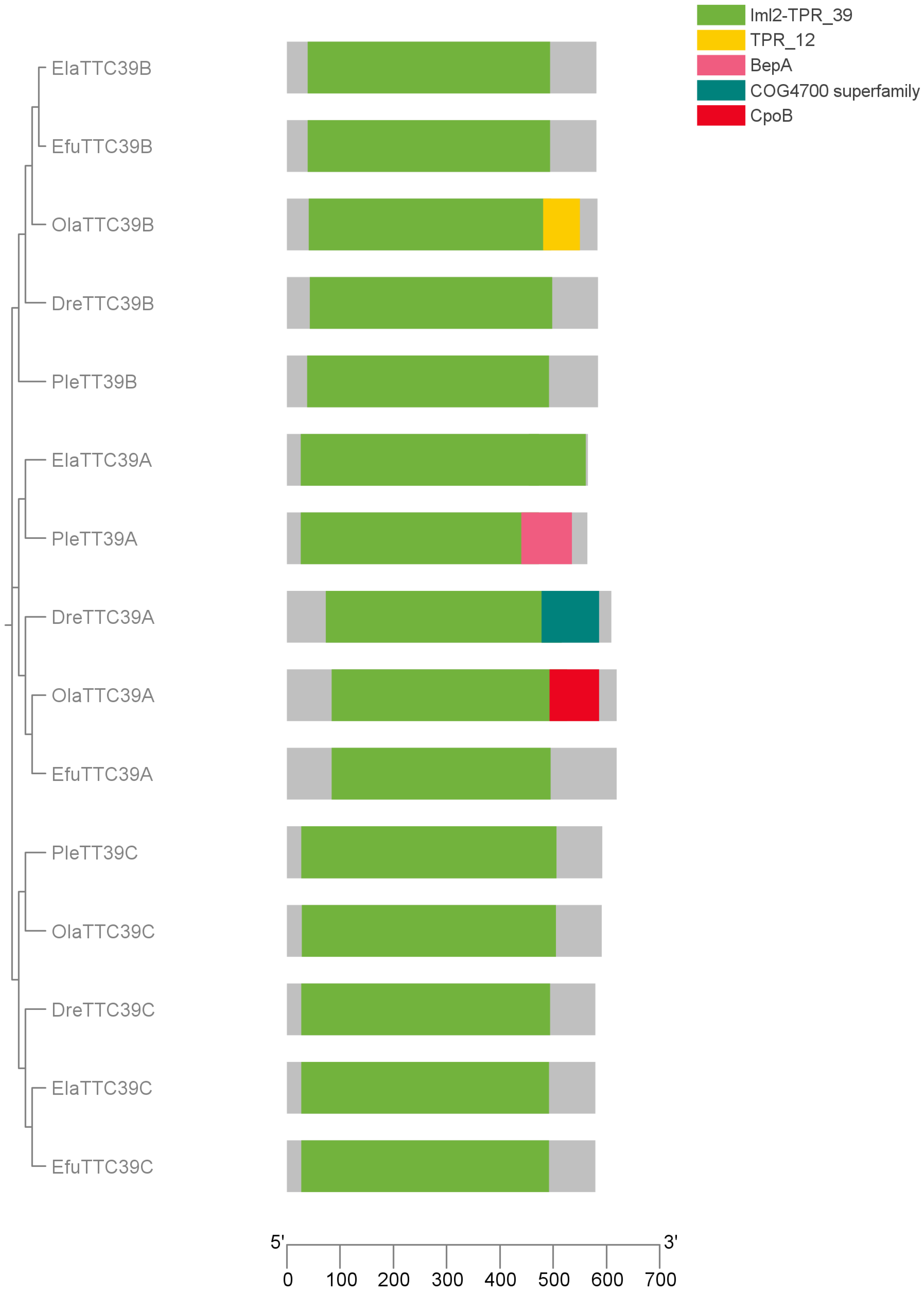
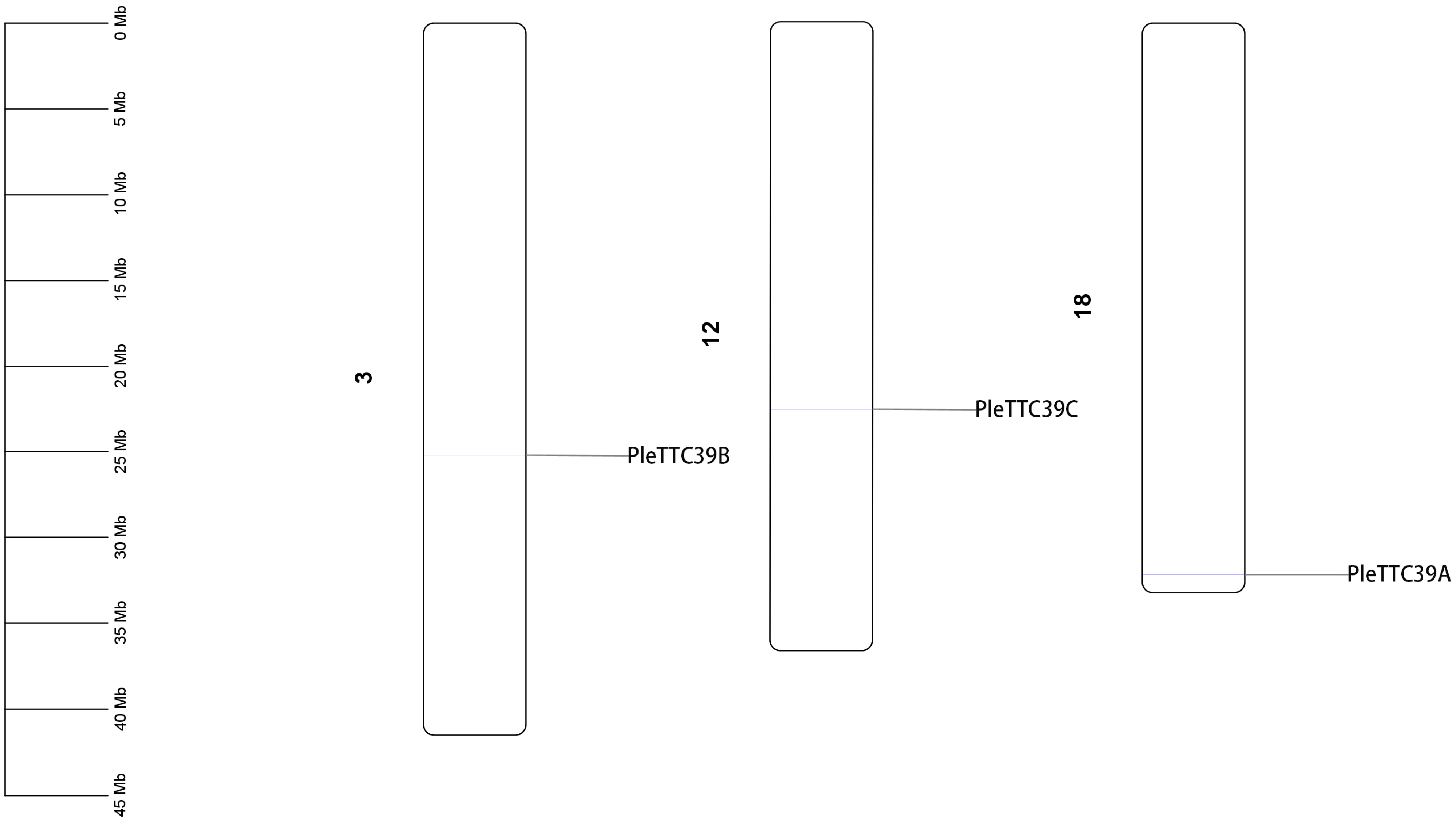
All three TTC39 proteins contained evolutionarily conserved domains (Figure 1). CD-Search analysis showed that each TTC39 sequence harbored the characteristic core TPR domain (Phylogeny in Figure 1 were also constructed in MEGA12). Nevertheless, the types and combinations of additional domains differed among genes. Additional domains both differ among genes and species. This domain diversity suggests that, while retaining fundamental functions, the family may have undergone functional differentiation via domain gain or loss, providing a structural basis for their putative roles in processes such as skin color formation. Genomic mapping indicated that the P. leopardus TTC39 genes are located on chromosomes 3, 12, and 18 (Figure 2).

3.2. Phylogenetic and Synteny Analyses

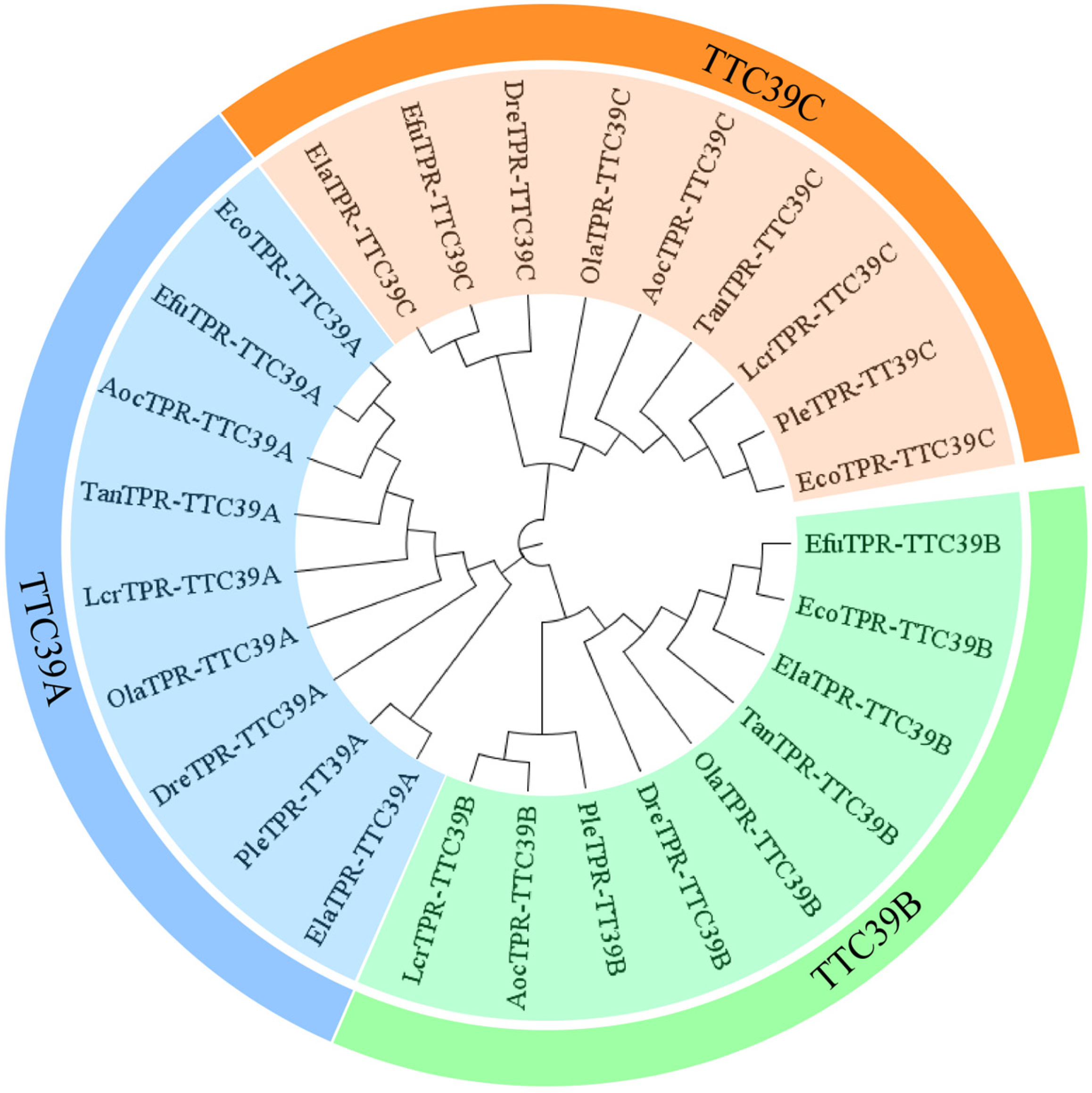
A phylogenetic analysis of 27 TTC39 proteins from nine fish species classified these proteins into three distinct clades (Figure 3), providing strong phylogenetic support for the identification of P. leopardus TTC39 genes. To further resolve their relationships, we constructed a synteny plot comparing P. leopardus and D. rerio (Figure 4). Among the three P. leopardus TTC39 genes, TTC39B on chromosome 3 showed conserved homology with a D. rerio ortholog.

3.3. Conserved Motif and Structural Analysis of TTC39 Genes

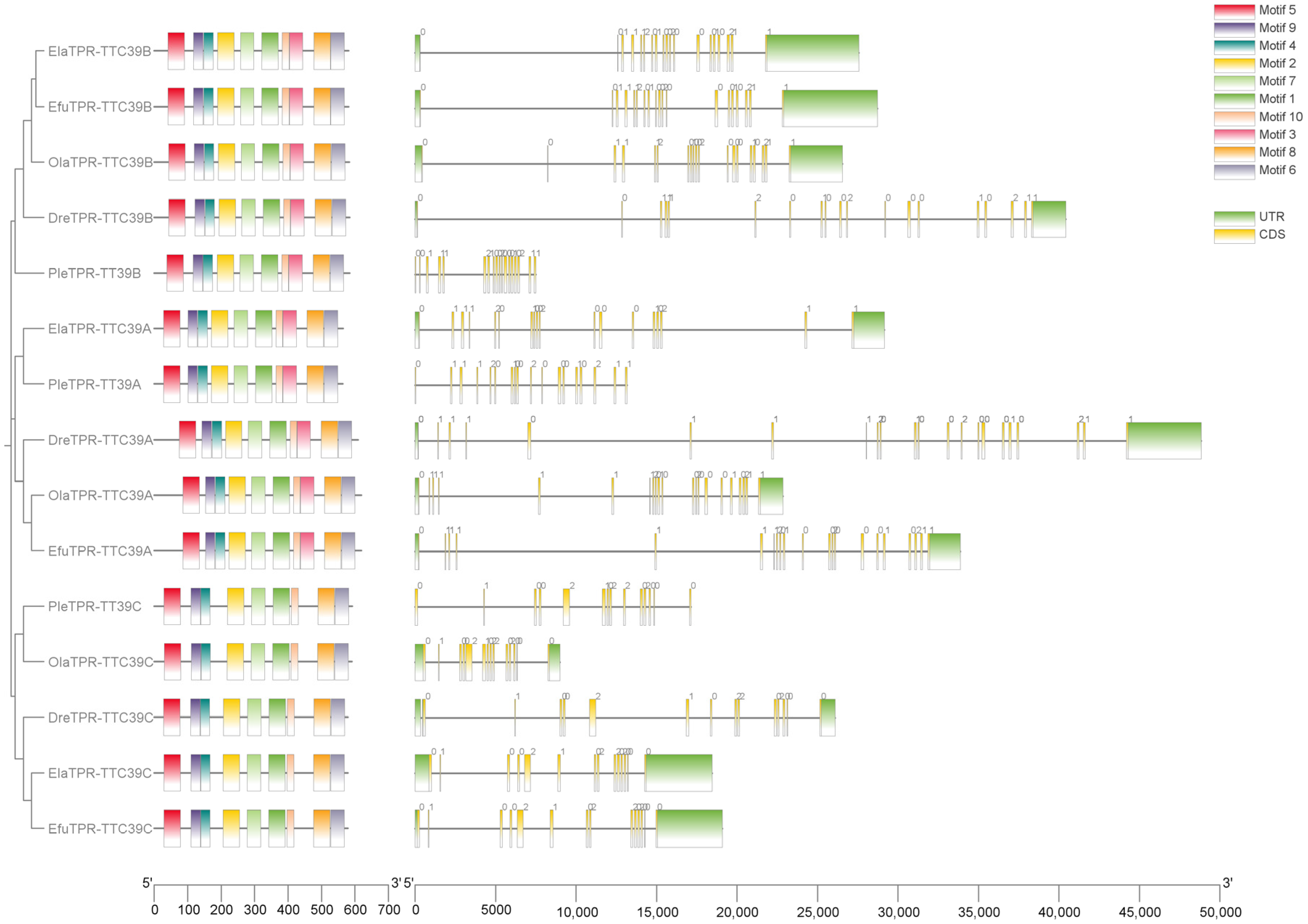
To characterize the structural features of the P. leopardus TTC39 gene family, we analyzed exon–intron organization and coding sequences. The TTC39 genes contained 14–18 exons (TTC39A: 18; TTC39B: 18; TTC39C: 14). Genes within the same clade exhibited similar exon–intron architectures. Across the family, intron phases 0, 1, and 2 were observed. Overall, P. leopardus TTC39 gene structures were highly similar to those in the four other fish species examined.
Conserved motifs in TTC39 proteins were identified using the MEME Suite, revealing 10 distinct motifs. Proteins within the same subclass showed similar motif numbers and distributions (Figure 5). Among all P. leopardus TTC39 proteins, motif 3 was absent from TTC39C, whereas the remaining nine motifs were present in each protein, indicating that these are the most conserved within the TTC39 family. A comparison of 5′-end MEME results (Figure 5) with 5′-end CD-Search annotations (Figure 1) showed that motifs 1, 2, 4, 5, 7, 9, and 10 correspond to conserved TPR-domain regions whereas motifs 6 and 8 are positioned outside the TPR domain. Consistent with the exon–intron analysis, TTC39A and TTC39B share several structural features; their nucleotide sequences also display comparable motif distributions and counts, suggesting potential functional similarity between these two genes.

3.4. Analysis of TTC39 Family Gene Expression

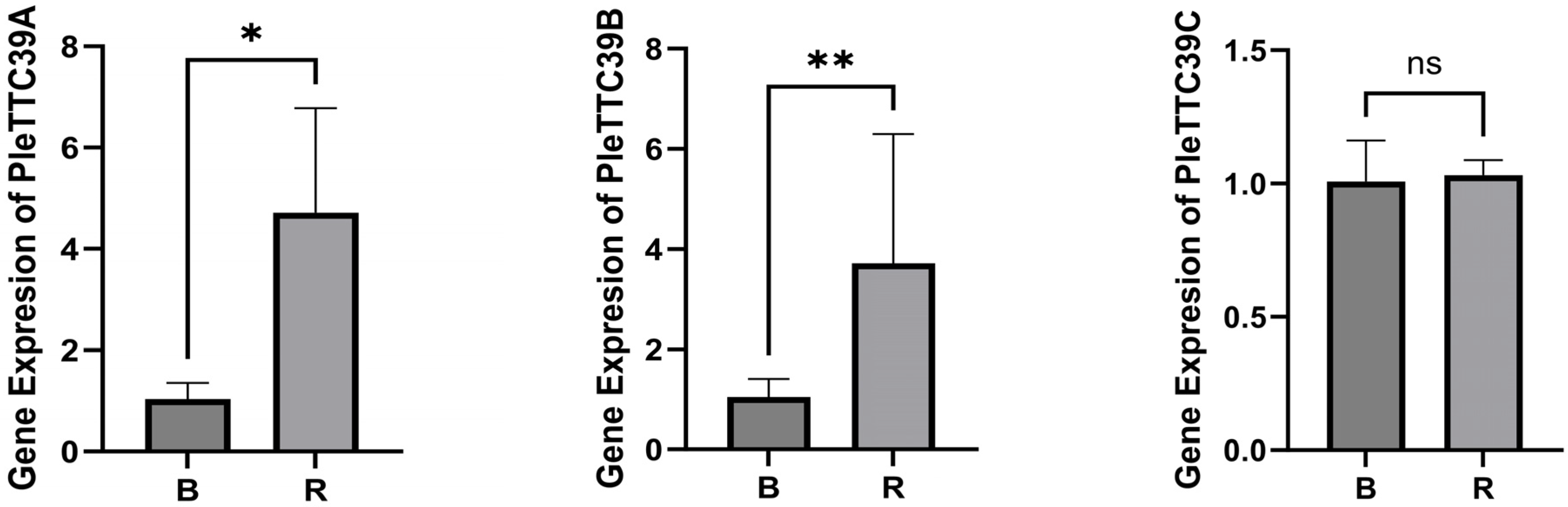
The qPCR results showed that TTC39A and TTC39B were significantly up-regulated in red skin (*: p < 0.05; **: p < 0.01, and ns indicates no significant difference), and the expression change in TTC39C was not statistically significant. These expression patterns suggested that these genes may be involved in regulating related processes under these conditions.

4. Discussion

4.1. Identification and Evolution of TTC39 Genes

This study provides the first systematic identification and analysis of the TTC39 gene family in P. leopardus and explores the potential roles of TTC39 genes in skin color formation via analysis of expression profiles. All three TTC39 genes possess the canonical TPR domain, confirming its conservation within the TTC39 family. In P. leopardus, TTC39A contains a BpeA domain, whereas TTC39B and TTC39C lack this domain. Although these three genes belong to the same family, no tandem duplication events were detected. This suggests that the TTC39 family in P. leopardus is evolutionarily conserved and may have undergone independent duplication and/or translocation events, potentially leading to functional divergence. Although no tandem duplication events were detected among the three TTC39 family members, the absence of locally clustered paralogs does not exclude the involvement of other duplication mechanisms. Genes can arise through multiple processes, including whole-genome duplications, dispersed duplications, and transposed duplications. Different modes of gene duplication have been shown to make distinct contributions to gene family evolution and may promote functional diversification or subfunctionalization over evolutionary time [32].
Synteny analysis shows that TTC39B is conserved between D. rerio and P. leopardus, indicating the significance of this gene in the evolution of the TTC39 family. All TTC39 proteins contained 10 identified motifs, except for TTC39C, which lacked motif 3 Of these 10 motifs, the remaining nine (excluding motif 3) appear to be highly conserved and functionally important in TTC39 evolution (Figure 5). TTC39B gene has been retained throughout the evolution of teleost fishes. In many vertebrate gene families, such as the relaxin and AMH signaling genes, the conservation of gene order and flanking genomic regions across species reflects selective pressures to preserve essential gene functions following whole-genome duplication and subsequent rediploidization events, as well as the maintenance of core regulatory contexts [33]. In addition, nine highly conserved motifs were identified among TTC39 proteins, with only motif 3 being uniquely absent in TTC39C, suggesting that shared structural and potentially functional elements have been subject to purifying selection [34]. These conserved motifs likely represent structural domains that are essential for the stability of TTC39 proteins [35].

4.2. Expression of TTC39 Gene Family Members

In the present study, we did detect significant expression differences in TTC39 genes between red skin phenotypes and black skin phenotypes based on qPCR analysis. However no direct evidence (e.g., gene manipulation or metabolic assays) was obtained for a link between TTC39 gene family members and skin color formation in fish. While expression differences were observed, functional evidence linking TTC39 genes to skin color regulation remains to be established. Previous studies indicate that TTC39B, a protein involved in lipid metabolism, may contribute to the pathway from carotenoid intake to cutaneous deposition [17].
Skin color strongly influences the market value of P. leopardus. In skin tissue, TTC39A and TTC39B were upregulated in red skin relative to black skin. In stickleback, TTC39B lies within a known QTL for red coloration, indicating an association with red pigmentation [36]. Similarly, a study on cichlids reported, TTC39B was consistently more highly expressed in red skin compared with yellow skin across multiple taxon pairs, and this expression pattern covaried with total carotenoid concentration, suggesting a role in integumentary carotenoid deposition rather than pigment biosynthesis per se. significantly higher TTC39B expression in red skin than in yellow skin [17]. These findings indicate that TTC39B might be a particularly relevant candidate for pigmentation research. In our analysis of red-skin versus black-skin groups, TTC39B showed the highest expression among the three genes, while TTC39C was upregulated but not significantly (Figure 6). The expression of TTC39B was significantly higher than that of the other two genes. The limited differential expression across the family may reflect underlying structural differences and warrants further investigation. TTC39 family members may reflect underlying structural and sequence divergences among paralogs. Studies in other systems have demonstrated that expression divergence of paralogous genes often correlates with sequence and structural divergence following duplication events, such that paralogs with greater divergence tend to exhibit more distinct expression profiles. For example, analyses of plant gene families revealed a positive relationship between sequence divergence and expression divergence among paralogs, suggesting that structural differentiation can underlie changes in transcription patterns [37]. Similarly, structural divergence measures—including exon–intron organization—have shown positive correlations with expression divergence across duplicated genes. These findings support the view that structural differences among TTC39 genes lead to differences in their regulation [38].
In summary, this work provides a comprehensive overview of the TTC39 gene family in P. leopardus. Using bioinformatics approaches, we analyzed the characteristics of these genes and elucidated their evolutionary relationships. Expression profiling in red skin offers preliminary functional insights into the functions of TTC39 proteins: two genes exhibited statistically significant differences in expression between color groups (p < 0.05), suggesting that they play important roles in regulating skin pigmentation. Notably, TTC39A and TTC39B contain motif 3, whereas TTC39C lacks this motif, which may explain the nonsignificant change in the expression of TTC39C in red skin. Overall, our results implicate the TTC39 family in skin-color regulation and reveal functional divergence among its members. These hypotheses require validation with larger sample sizes and targeted functional assays. The expression profiles of the TTC39 gene family in the skin provide preliminary functional insights into TTC39 proteins. These discoveries enhance our understanding of the role of TTC39 proteins in skin color regulation.

5. Conclusions

In this study, genome-wide identification and analysis were performed on the TTC39 gene family in Pletropomus leopardus, and the expression levels of its members in individuals with red and black skin phenotypes were quantitatively analyzed. The results revealed that TTC39A, TTC39B, and TTC39C were identified in the P. leopardus genome, each containing the conserved TPR_39 domain characteristic of the TTC39 gene family. Phylogenetic and collinearity analyses further demonstrated that TTC39 genes are evolutionarily conserved, with members of the same subfamily exhibiting highly similar exon–intron structures. Motif analysis showed that TTC39A and TTC39B possess the complete set of 10 motifs, whereas TTC39C lacks motif 3. Notably, quantitative expression analysis indicated that TTC39A and TTC39B were significantly upregulated in red skin compared with black skin, while TTC39C displayed no significant difference in expression. The absence of motif 3 in TTC39C may contribute to this divergent expression pattern. Overall, these findings advance our understanding of the potential roles of TTC39 family members in skin color regulation and provide foundation for future functional investigations.

Author Contributions

X.W. (Xin Wen), J.G. and J.L. co-conceived this study, and supervised the experiments; Y.L., X.Z., X.W. (Xiaojing Wu), Y.T., N.L. and Z.J. performed the experiments and conducted the data analysis, and created figures and tables. Y.L. wrote the manuscript. All authors have read and agreed to the published version of the manuscript.

Funding

The author(s) declare financial support was received for the research, authorship, and/or publication of this article. This work was supported by the Key R&D Project in Hainan (ZDYF2023XDNY046). Major Science and Technology Plan of Hainan Province (ZDKJ2021003).

Institutional Review Board Statement

All experimental procedures, including sample collection, were approved by the Institutional Animal Care and Use Committee of the College of Ocean of Hainan University, Hainan, China. No. HNUAUCC-2022-00038 (Approval date: 1 March 2022).

Data Availability Statement

The original contributions presented in this study are included in the article. Further inquiries can be directed to the corresponding authors.

Conflicts of Interest

The authors declare no conflicts of interest.

References

  1. Main, E.R.G.; Xiong, Y.; Cocco, M.J.; D’Andrea, L.; Regan, L. Design of stable α-helical arrays from an idealized TPR motif. Structure 2003, 11, 497–508. [Google Scholar] [CrossRef] [PubMed]
  2. Blatch, G.L.; Lässle, M. The tetratricopeptide repeat: A structural motif mediating protein-protein interactions. Bioessays 1999, 21, 932–939. [Google Scholar] [CrossRef]
  3. Llabrés, S.; Tsenkov, M.I.; MacGowan, S.A.; Barton, G.J.; Zachariae, U. Disease related single point mutations alter the global dynamics of a tetratricopeptide (TPR) α-solenoid domain. J. Struct. Biol. 2020, 209, 107405. [Google Scholar] [CrossRef] [PubMed]
  4. Roberts, J.D.; Thapaliya, A.; Martínez-Lumbreras, S.; Krysztofinska, E.M.; Isaacson, R.L. Structural and functional insights into small, glutamine-rich, tetratricopeptide repeat protein alpha. Front. Mol. Biosci. 2015, 2, 71. [Google Scholar] [CrossRef]
  5. Barik, S. An analytical review of the structural features of pentatricopeptide repeats: Strategic amino acids, repeat arrangements and superhelical architecture. Int. J. Mol. Sci. 2021, 22, 5407. [Google Scholar] [CrossRef]
  6. Cerveny, L.; Straskova, A.; Dankova, V.; Hartlova, A.; Ceckova, M.; Staud, F.; Stulik, J. Tetratricopeptide repeat motifs in the world of bacterial pathogens: Role in virulence mechanisms. Infect. Immun. 2013, 81, 629–635. [Google Scholar] [CrossRef]
  7. D’Andrea, L.D.; Regan, L. TPR proteins: The versatile helix. Trends Biochem. Sci. 2003, 28, 655–662. [Google Scholar] [CrossRef]
  8. Allan, R.K.; Ratajczak, T. Versatile TPR domains accommodate different modes of target protein recognition and function. Cell Stress Chaperones 2011, 16, 353–367. [Google Scholar] [CrossRef]
  9. Khare, S.; Zhang, Q. P102 Role Of Endogenous Mapk Pathway Suppressor On Ibd. Inflamm. Bowel Dis. 2018, 24, S36. [Google Scholar] [CrossRef]
  10. Langsted, A.; Nordestgaard, B.G. Lipoprotein (a): Is it more, less or equal to LDL as a causal factor for cardiovascular disease and mortality? Curr. Opin. Lipidol. 2020, 31, 125–131. [Google Scholar] [CrossRef]
  11. Kimura, T.; Inoue, I. Ttc39bl, one of the two duplicated paralogs of the tetratricopeptide repeat domain 39B gene, is essential for carotenoid coloration in medaka (Oryzias latipes) and is the gene responsible for the r locus. bioRxiv 2025. [Google Scholar]
  12. Hsieh, J.; Koseki, M.; Molusky, M.M.; Yakushiji, E.; Ichi, I.; Westerterp, M.; Iqbal, J.; Chan, R.B.; Abramowicz, S.; Tascau, L.; et al. TTC39B deficiency stabilizes LXR reducing both atherosclerosis and steatohepatitis. Nature 2016, 535, 303–307. [Google Scholar] [CrossRef] [PubMed]
  13. Hsieh, J.; Molusky, M.M.; McCabe, K.M.; Fotakis, P.; Xiao, T.; Tascau, L.; Zeana-Schliep, L.; DaSilva-Jardine, P.; Tall, A.R. TTC39B destabilizes retinoblastoma protein promoting hepatic lipogenesis in a sex-specific fashion. J. Hepatol. 2022, 76, 383–393. [Google Scholar] [CrossRef] [PubMed]
  14. Gupta, P.; Hirschberg, J. The genetic components of a natural color palette: A comprehensive list of carotenoid pathway mutations in plants. Front. Plant Sci. 2022, 12, 806184. [Google Scholar] [CrossRef] [PubMed]
  15. Lopes, R.J.; Johnson, J.D.; Toomey, M.B.; Ferreira, M.S.; Araujo, P.M.; Melo-Ferreira, J.; Andersson, L.; Hill, G.E.; Corbo, J.C.; Carneiro, M. Genetic basis for red coloration in birds. Curr. Biol. 2016, 26, 1427–1434. [Google Scholar] [CrossRef]
  16. Hooper, D.M.; McDiarmid, C.S.; Powers, M.J.; Justyn, N.M.; Kučka, M.; Hart, N.S.; Hill, G.E.; Andolfatto, P.; Chan, Y.F.; Griffith, S.C. Spread of yellow-bill-color alleles favored by selection in the long-tailed finch hybrid system. Curr. Biol. 2024, 34, 5444–5456.e8. [Google Scholar] [CrossRef]
  17. Twyman, H.; Andersson, S.; Mundy, N.I. Evolution of CYP2J19, a gene involved in colour vision and red coloration in birds: Positive selection in the face of conservation and pleiotropy. BMC Evol. Biol. 2018, 18, 22. [Google Scholar] [CrossRef]
  18. Alonso-Alvarez, C.; Andrade, P.; Cantarero, A.; Morales, J.; Carneiro, M. Relocation to avoid costs: A hypothesis on red carotenoid-based signals based on recent CYP2J19 gene expression data. BioEssays 2022, 44, 2200037. [Google Scholar] [CrossRef]
  19. Pratchett, M.S.; Cameron, D.S.; Donelson, J.; Evans, L.; Frisch, A.J.; Hobday, A.J.; Hoey, A.S.; Marshall, N.A.; Messmer, V.; Munday, P.L.; et al. Effects of climate change on coral grouper (Plectropomus spp.) and possible adaptation options. Rev. Fish Biol. Fish. 2017, 27, 297–316. [Google Scholar] [CrossRef]
  20. Lin, S.; Hossain, A.; Shahidi, F. Dietary lipid and astaxanthin contents affect the pigmentation of Arctic charr (Salvelinus alpinus). Food Prod. Process. Nutr. 2024, 6, 77. [Google Scholar] [CrossRef]
  21. Hayes, C.S.; Labuzan, S.A.; Menke, J.A.; Haddock, A.N.; Waddell, D.S. Ttc39c is upregulated during skeletal muscle atrophy and modulates ERK1/2 MAP kinase and hedgehog signaling. J. Cell. Physiol. 2019, 234, 23807–23824. [Google Scholar] [CrossRef]
  22. Ahi, E.P.; Lecaudey, L.A.; Ziegelbecker, A.; Steiner, O.; Goessler, W.; Sefc, K.M. Expression levels of the tetratricopeptide repeat protein gene ttc39b covary with carotenoid-based skin colour in cichlid fish. Biol. Lett. 2020, 16, 20200629. [Google Scholar] [CrossRef]
  23. Toomey, M.B.; Marques, C.I.; Araújo, P.M.; Huang, D.; Zhong, S.; Liu, Y.; Schreiner, G.D.; Myers, C.A.; Pereira, P.; Afonso, S.; et al. A mechanism for red coloration in vertebrates. Curr. Biol. 2022, 32, 4201–4214.e12. [Google Scholar] [CrossRef] [PubMed]
  24. Koch, R.E.; Truong, C.N.; Reeb, H.R.; Joski, B.H.; Hill, G.E.; Zhang, Y.; Toomey, M.B. Multiple pathways to red carotenoid coloration: House finches (Haemorhous mexicanus) do not use CYP2J19 to produce red plumage. Mol. Ecol. 2025, 34, e17744. [Google Scholar] [CrossRef] [PubMed]
  25. Toews, D.P.L.; Hofmeister, N.R.; Taylor, S.A. The evolution and genetics of carotenoid processing in animals. Trends Genet. 2017, 33, 171–182. [Google Scholar] [CrossRef] [PubMed]
  26. Lin, X.; Cao, Y.; Wang, X.; Meng, X.; Deng, J.; Tan, B. Optimal dietary phospholipid requirement for juvenile leopard coral grouper (Plectropomus leopardus). J. Anim. Sci. 2025, 103, skaf096. [Google Scholar] [CrossRef]
  27. Shimose, T.; Kanaiwa, M. Influence of the body color and size on the market value of wild captured coralgroupers (Serranidae, Plectropomus): Implications for fisheries management. Fish. Res. 2022, 248, 106223. [Google Scholar] [CrossRef]
  28. Yang, Y.; Wu, L.N.; Chen, J.F.; Wu, X.; Xia, J.H.; Meng, Z.N.; Liu, X.C.; Lin, H.R. Whole-genome sequencing of leopard coral grouper (Plectropomus leopardus) and exploration of regulation mechanism of skin color and adaptive evolution. Zool. Res. 2020, 41, 328. [Google Scholar] [CrossRef]
  29. Li, R.; Shu, M.; Liu, X.; Nei, Z.; Ye, B.; Wang, H.; Gong, Y. Genome-wide identification of mitogen-activated protein kinase (MAPK) gene family in yellow catfish (Pelteobagrus fulviadraco) and their expression profiling under the challenge of Aeromonas hydrophila. J. Fish Biol. 2022, 101, 699–710. [Google Scholar] [CrossRef]
  30. Wen, X.; Tang, H.; Zhou, M.; Yang, M.; Huang, J.; Liu, J.; Zhou, K.; Fan, X.; Zhang, W.; Luo, J. Genome-wide association study of red skin color in leopard coral grouper (Plectropomus leopardus) based on genome resequencing. Aquaculture 2023, 563, 739014. [Google Scholar] [CrossRef]
  31. Nie, Z.; Wang, B.; Zhang, Z.; Jia, Z.; Xu, R.; Wang, H.; Zhou, W.; Gong, Y. Genome-wide identification of the traf gene family in yellow catfish (Pelteobagrus fulvidraco) and analysis of their expression in response to bacterial challenge. J. Fish Biol. 2022, 101, 573–583. [Google Scholar] [CrossRef]
  32. Qiao, X.; Yin, H.; Li, L.; Wang, R.; Wu, J.; Wu, J.; Zhang, S. Different modes of gene duplication show divergent evolutionary patterns and contribute differently to the expansion of gene families involved in important fruit traits in pear (Pyrus bretschneideri). Front. Plant Sci. 2018, 9, 161. [Google Scholar] [CrossRef] [PubMed]
  33. Good-Avila, S.V.; Yegorov, S.; Harron, S.; Bogerd, J.; Glen, P.; Ozon, J.; Wilson, B.C. Relaxin gene family in teleosts: Phylogeny, syntenic mapping, selective constraint, andexpression analysis. BMC Evol. Biol. 2009, 9, 293. [Google Scholar] [CrossRef] [PubMed]
  34. Zheng, K.; Feng, Y.; Liu, R.; Zhang, Y.; Fan, D.; Zhong, K.; Tang, X.; Zhang, Q.; Cao, S. Bioinformatics Analysis Reveals the Evolutionary Characteristics of the Phoebe bournei ARF Gene Family and Its Expression Patterns in Stress Adaptation. Int. J. Mol. Sci. 2025, 26, 3701. [Google Scholar] [CrossRef] [PubMed]
  35. Zhang, L.; Zhang, Q.; Hu, K.; Lu, W.; Li, W.; Wang, F.; Cheng, J. Evolutionary Dynamics and Functional Conservation of amh Signaling in Teleost Lineages. Fishes 2025, 10, 327. [Google Scholar] [CrossRef]
  36. McKinnon, J.S.; Newsome, W.B.; Balakrishnan, C.N. Gene expression in male and female stickleback from populations with convergent and divergent throat coloration. Ecol. Evol. 2022, 12, e8860. [Google Scholar] [CrossRef]
  37. Lian, S.; Zhou, Y.; Liu, Z.; Gong, A.; Cheng, L. The differential expression patterns of paralogs in response to stresses indicate expression and sequence divergences. BMC Plant Biol. 2020, 20, 277. [Google Scholar] [CrossRef]
  38. Wang, Y.; Tan, X.; Paterson, A.H. Different patterns of gene structure divergence following gene duplication in Arabidopsis. BMC Genom. 2013, 14, 652. [Google Scholar] [CrossRef]
Figure 1. Conserved regions of TTC39 proteins. Amino acid sequences lacking predicted functional domains are represented by gray segments, while regions with reliably predicted domains are indicated by colored segments. The protein domains are shown in proportion to the total protein length, reflecting their relative positions within the amino acid sequence. Ela, Epinephelus lanceolatus; Efu, Epinephelus fuscoguttatus; Ola, Oryzias latipes; Dre, Danio rerio; Ple, Plectropomus leopardus.
Fishes 11 00048 g001
Figure 2. Chromosomal map of TTC39 genes in the Plectropomus leopardus genome. The black horizontal lines on the bars indicate the positions of each TTC39 gene.
Fishes 11 00048 g002
Figure 3. Phylogenetic tree constructed using TTC39 proteins from nine species. Species abbreviations: Dre, Danio rerio; Ple, Plectropomus leopardus; Ela, Epinephelus lanceolatus; Efu, Epinephelus fuscoguttatus; Ola, Oryzias latipes; Aoc, Amphiprion ocellaris; Lcr, Larimichthys crocea; Tan, Trachinotus anak; and Eco, Epinephelus coioides. Each of the three clades is represented by a distinct color.
Fishes 11 00048 g003
Figure 4. Analysis of syntenic TTC39 genes between Plectropomus leopardus and Danio rerio Syntenic blocks between the Danio rerio and Plectropomus leopardus genomes are indicated by gray lines in the background, while syntenic TTC genes are highlighted in red.
Fishes 11 00048 g004
Figure 5. Exon–intron pattern analysis of TTC39 genes based on phylogenetic relationships. The phylogenetic tree was constructed using the same method described for Figure 3. In the schematic, yellow boxes, green boxes and black lines represent coding sequences (CDS), untranslated regions (UTR), and introns, respectively. The splice phases of the introns are labeled as 0, 1, and 2. Analysis of conserved motifs in TTC39 proteins based on phylogenetic relationships. The phylogenetic tree was constructed using the same method described for Figure 3. Conserved motifs were identified using the MEME Suite software_v5.5.9. The settings were as follows: maximum number of distinct motifs, 10; minimum width of motifs, 6; and maximum width of motifs, 100. The length of each motif is shown in proportion to its actual size.
Fishes 11 00048 g005
Figure 6. Expression analysis of TTC39 genes (TTC39A, TTC39B, TTC39C). (*: p < 0.05; **: p < 0.01, and ns indicates no significant difference) B (black phenotype), R (red phenotype). Results are presented as mean ± standard deviation (n = 3 biological replicates).
Fishes 11 00048 g006
Table 1. Primers used for quantitative real-time reverse transcription PCR in this study.
GeneForward Primer Sequence (5′-3′)Reverse Primer Sequence (5′-3′)
β-ActinCACCACAGCCGAGAGGGATCTGGGCAACGGAACCTCT
PleTPR-TTC39AAGGGAAGTCTCCCCCGACTGCACAGCGGTCATCCACCGAA
PleTPR-TTC39BTTTGGGGCATCTGGTGCAGGAGAGCCCATGGTGTTGAGCG
PleTPR-TTC39CTCCAACGCCTTGAGTGCCAGTGTGGCTCCTTGGCACACTC
Table 2. Features of Plectropomus leopardus TTC39 genes.
NameGene IDChrGene LocationAAMW (Da)pI
PleTPR-TTC39APle111160.11832,146,100–32,159,26356464,748.626.46
PleTPR-TTC39BPle183220.1325,195,153–25,202,65758466,609.926.19
PleTPR-TTC39CPle039890.11222,604,719–22,621,85059266,493.357.82
Note: Chr, chromosome; AA: amino acid; MW: protein molecular weight; pI: isoelectric point.
Disclaimer/Publisher’s Note: The statements, opinions and data contained in all publications are solely those of the individual author(s) and contributor(s) and not of MDPI and/or the editor(s). MDPI and/or the editor(s) disclaim responsibility for any injury to people or property resulting from any ideas, methods, instructions or products referred to in the content.