


Dietary Analysis of Commercial Fish (Families Mullidae and Sparidae) from Bay of Cádiz, Southern Spain: An Integrative Approach

 , and
, and
Abstract
1. Introduction
2. Materials and Methods
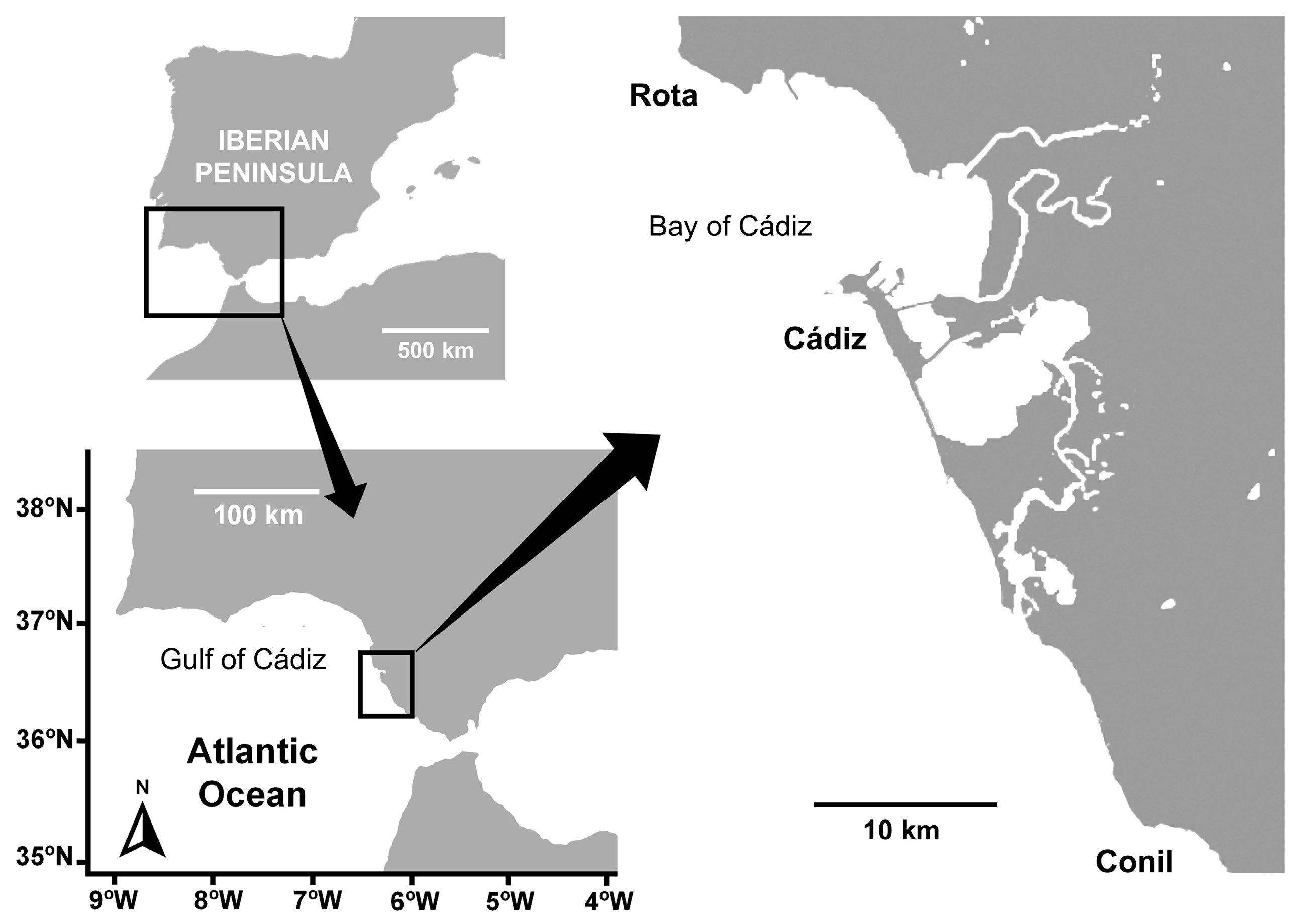
2.1. Study Area and Fish Sampling
2.2. Stomach Contents Procedure
2.3. Analytical Methods for Stable Isotope Measurements
2.4. Data Analyses
3. Results
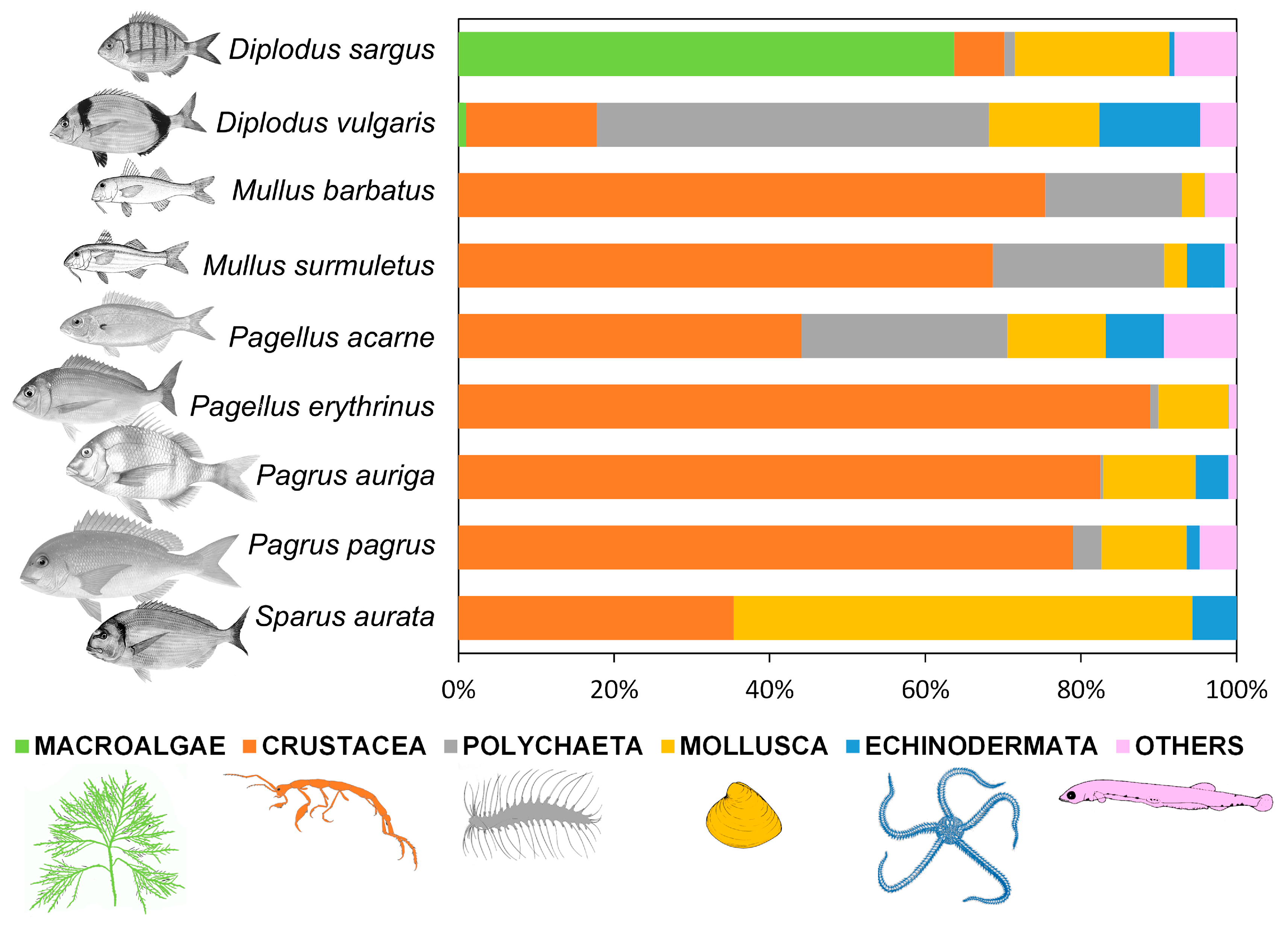
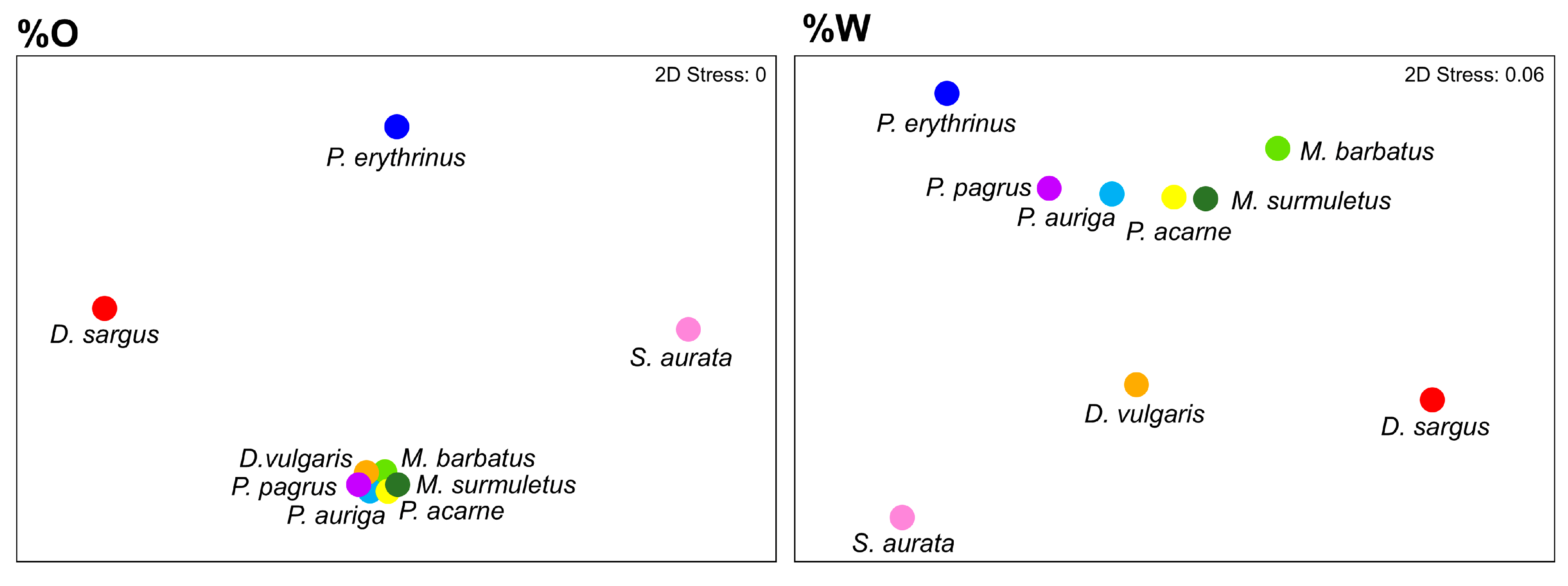
3.1. Food Items
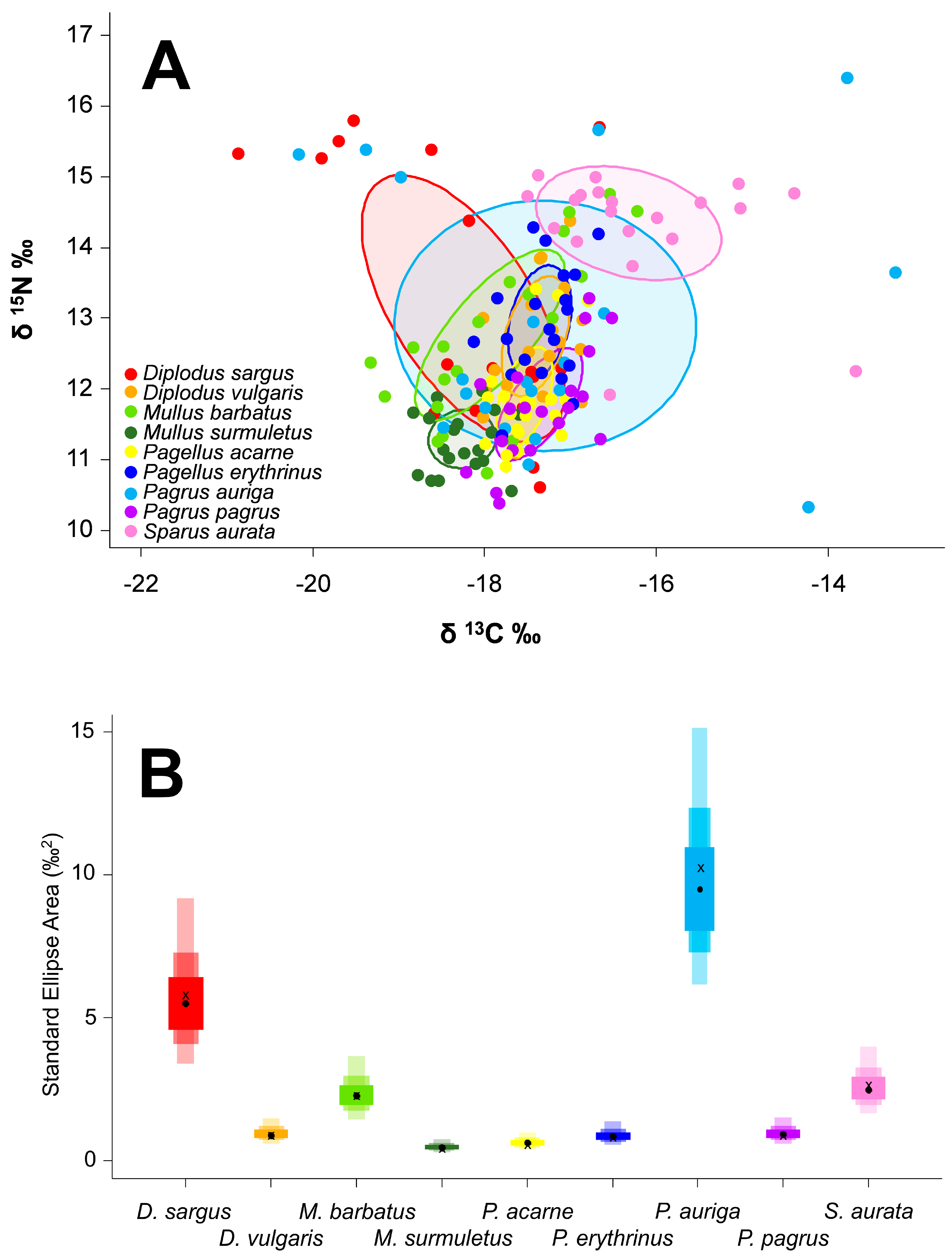
3.2. Stable Isotopes
4. Discussion
4.1. Diet Characterization and Resource Partitioning
4.2. Discrepancies Between the Two Methods
5. Conclusions
Supplementary Materials
Author Contributions
Funding
Institutional Review Board Statement
Informed Consent Statement
Data Availability Statement
Acknowledgments
Conflicts of Interest
References
- Thomas, M.; Pasquet, A.; Aubin, J.; Nahon, S.; Lecocq, T. When more is more: Taking advantage of species diversity to move towards sustainable aquaculture. Biol. Rev. 2021, 96, 767–784. [Google Scholar] [CrossRef]
- Coll, M.; Carreras, M.; Ciércoles, C.; Cornax, M.J.; Gorelli, G.; Morote, E.; Sáez, R. Assessing fishing and marine biodiversity changes using fishers’ perceptions: The Spanish Mediterranean and Gulf of Cadiz case study. PLoS ONE 2014, 9, e85670. [Google Scholar] [CrossRef]
- Sobrino, I.; Baldó, F.; García-González, D.; Cuesta, J.A.; Silva-García, A.; Fernández-Delgado, C.; Arias, A.M.; Rodríguez, A.; Drake, P. The effect of estuarine fisheries on juvenile fish observed within the Guadalquivir Estuary (SW Spain). Fish. Res. 2005, 76, 229–242. [Google Scholar] [CrossRef]
- Miró, J.; Megina, C.; Donázar-Aramendía, I.; Reyes-Martínez, M.; Sánchez-Moyano, J.; García-Gómez, J. Environmental factors affecting the nursery function for fish in the main estuaries of the Gulf of Cadiz (south-west Iberian Peninsula). Sci. Total. Environ. 2020, 737, 139614. [Google Scholar] [CrossRef] [PubMed]
- Torres, M.Á.; Coll, M.; Heymans, J.J.; Christensen, V.; Sobrino, I. Food-web structure of and fishing impacts on the Gulf of Cadiz ecosystem (South-western Spain). Ecol. Model. 2013, 265, 26–44. [Google Scholar] [CrossRef]
- Ramos, F.; Gil, J.; Torres, M.A.; Silva, L.; Vila, Y.; Sánchez, R.; Jiménez, M.P.; Baldó, F.; Fernández-Salas, F.; Rueda, L.M.; et al. Estrategias Marinas. In Demarcación Marina Sudatlántica. Parte I. Marco General: Características de la Demarcación Marina. Ministerio de Agricultura, Alimentación y Medio Ambiente (MAGRAMA), Instituto Español de Oceanografía (IEO); Centro de Estudios de Puertos y Costas-Centrode Estudios y Experimentación de Obras Públicas (CEPYC-CEDEX): Madrid, Spain, 2012; p. 127. [Google Scholar]
- Winemiller, K.O.; Layman, C.A. Food web science: Moving on the path from abstraction to prediction. In Dynamic Food Webs: Multispecies Assemblages, Ecosystem Development and Environmental Change; Ruiter, P.C., Wolters, V., Moore, J.C., Eds.; Elsevier: Amsterdam, The Netherlands, 2005; pp. 10–23. [Google Scholar]
- García, A.F.S.; Santos, M.L.; Garcia, A.M.; Vieira, J.P. Changes in food web structure of fish assemblages along a river-to-ocean transect of a coastal subtropical system. Mar. Freshw. Res. 2018, 70, 402–416. [Google Scholar] [CrossRef]
- Hyslop, E.J. Stomach contents analysis, a review of methods and their application. J. Fish Biol. 1980, 17, 411–429. [Google Scholar] [CrossRef]
- Nielsen, J.M.; Clare, E.L.; Hayden, B.; Brett, M.T.; Kratina, P. Diet tracing in ecology: Method comparison and selection. Methods Ecol. Evol. 2017, 9, 278–291. [Google Scholar] [CrossRef]
- Zorica, B.; Ezgeta-Balić, D.; Vidjak, O.; Vuletin, V.; Šestanović, M.; Isajlović, I.; Čikeš-Keč, V.; Vrgoč, N.; Harrod, C. Diet composition and isotopic analysis of nine important fisheries resources in the Eastern Adriatic Sea (Mediterranean). Front. Mar. Sci. 2021, 8, 609432. [Google Scholar] [CrossRef]
- Ferry, L.A.; Caillict, G.M. Sample size and data analysis: Are we characterizing and comparing diet properly? In Feeding Ecology and Nutrition in Fish: Proceedings of the Symposium on the Biology of Fishes; MacKinlay, D., Shearer, K., Eds.; American Fisheries Society: San Francisco, CA, USA, 1996; pp. 71–80. [Google Scholar]
- Baker, R.; Buckland, A.; Sheaves, M. Fish gut content analysis: Robust measures of diet composition. Fish Fish. 2014, 15, 170–177. [Google Scholar] [CrossRef]
- Vinson, M.R.; Angradi, T.R. Stomach emptiness in fishes: Sources of variation and study design implications. Rev. Fish. Sci. 2011, 19, 63–73. [Google Scholar] [CrossRef]
- Cresson, P.; Ruitton, S.; Ourgaud, M.; Harmelin-Vivien, M. Contrasting perception of fish trophic level from stomach content and stable isotope analyses: A Mediterranean artificial reef experience. J. Exp. Mar. Biol. Ecol. 2014, 452, 54–62. [Google Scholar] [CrossRef]
- da Silveira, E.L.; Semmar, N.; Cartes, J.E.; Tuset, V.M.; Lombarte, A.; Ballester, E.L.C.; Vaz-dos-Santos, A.M. Methods for trophic ecology assessment in fishes: A critical review of stomach analyses. Rev. Fish. Sci. Aquac. 2020, 28, 71–106. [Google Scholar] [CrossRef]
- Bautista-Vega, A.A.; Letourneur, Y.; Harmelin-Vivien, M.; Salen-Picard, C. Difference in diet and size—Related trophic level in two sympatric fish species, the red mullets Mullus barbatus and Mullus surmuletus, in the Gulf of Lions (north—West Mediterranean Sea). J. Fish Biol. 2008, 73, 2402–2420. [Google Scholar] [CrossRef]
- Pethybridge, H.; Choy, C.A.; Logan, J.M.; Allain, V.; Lorrain, A.; Bodin, N.; Somes, C.J.; Young, J.; Ménard, F.; Langlais, C.; et al. A global meta-analysis of marine predator nitrogen stable isotopes: Relationships between trophic structure and environmental conditions. Glob. Ecol. Biogeogr. 2018, 27, 1043–1055. [Google Scholar] [CrossRef]
- Deudero, S.; Pinnegar, J.K.; Polunin, N.V.C.; Morey, G.; Morales-Nin, B. Spatial variation and ontogenic shifts in the isotopic composition of Mediterranean littoral fishes. Mar. Biol. 2004, 145, 971–981. [Google Scholar] [CrossRef]
- Jennings, S.; Reñones, O.; Morales-Nin, B.; Polunin, N.V.; Moranta, J.; Coll, J. Spatial variation in the 15N and 13C stable isotope composition of plants, invertebrates and fishes on Mediterranean reefs: Implications for the study of trophic pathways. Mar. Ecol. Prog. Ser. 1997, 146, 109–116. [Google Scholar] [CrossRef]
- Pinnegar, J.K.; Polunin, N.V. Contributions of stable-isotope data to elucidating food webs of Mediterranean rocky littoral fishes. Oecologia 2000, 122, 399–409. [Google Scholar] [CrossRef] [PubMed]
- Varela, J.L.; Carrera, I.; Medina, A. Seasonal feeding patterns of Atlantic bluefin tuna (Thunnus thynnus) in the Strait of Gibraltar. Mar. Environ. Res. 2020, 153, 104811. [Google Scholar] [CrossRef] [PubMed]
- Bearhop, S.; Adams, C.E.; Waldron, S.; Fuller, R.A.; Macleod, H. Determining trophic niche width: A novel approach using stable isotope analysis. J. Anim. Ecol. 2004, 73, 1007–1012. [Google Scholar] [CrossRef]
- Docmac, F.; Araya, M.; Hinojosa, I.A.; Dorador, C.; Harrod, C. Habitat coupling writ large: Pelagic—Derived materials fuel benthivorous macroalgal reef fishes in an upwelling zone. Ecology 2017, 98, 2267–2272. [Google Scholar] [CrossRef] [PubMed]
- Cabana, G.; Rasmussen, J.B. Comparison of aquatic food chains using nitrogen isotopes. Proc. Natl. Acad. Sci. USA 1996, 93, 10844–10847. [Google Scholar] [CrossRef]
- Peterson, B.J.; Fry, B. Stable isotopes in ecosystem studies. Annu. Rev. Ecol. Evol. Syst. 1987, 18, 293–320. [Google Scholar] [CrossRef]
- Post, D.M. Using stable isotopes to estimate trophic position: Models, methods, and assumptions. Ecology 2002, 83, 703–718. [Google Scholar] [CrossRef]
- Schmidt, K.; McClelland, J.W.; Mente, E.; Montoya, J.P.; Atkinson, A.; Voss, M. Trophic-level interpretation based on δ15N values: Implication of tissue specific fractionation and amino-acid composition. Mar. Ecol. Prog. Ser. 2004, 266, 43–58. [Google Scholar] [CrossRef]
- Mill, A.C.; Pinnegar, J.K.; Polunin, N.V.C. Explaining isotope trophic-step fractionation: Why herbivorous fish are different. Funct. Ecol. 2007, 21, 1137–1145. [Google Scholar] [CrossRef]
- Sweeting, C.J.; Barry, J.; Barnes, C.; Polunin, N.V.C.; Jennings, S. Effects of body size and environment on diet-tissue δ15N fractionation in fishes. J. Exp. Mar. Biol. Ecol. 2007, 340, 1–10. [Google Scholar] [CrossRef]
- Perga, M.; Grey, J. Laboratory measures of isotope discrimination factors: Comments on Caut, Angulo & Courchamp (2008, 2009). J. Appl. Ecol. 2010, 47, 942–947. [Google Scholar] [CrossRef]
- Mancinelli, G.; Vizzini, S.; Mazzola, A.; Maci, S.; Basset, A. Cross-validation of δ15N and FishBase estimates of fish trophic position in a Mediterranean lagoon: The importance of isotopic baseline. Estuar. Coast. Shelf Sci. 2013, 135, 77–85. [Google Scholar] [CrossRef]
- Fanelli, E.; Cartes, J.E. Temporal variations in the feeding habits and trophic levels of three deep-sea demersal fishes from the western Mediterranean Sea, based on stomach contents and stable isotope analyses. Mar. Ecol. Prog. Ser. 2010, 402, 213–232. [Google Scholar] [CrossRef][Green Version]
- Condini, M.V.; Hoeinghaus, D.J.; Garcia, A.M. Trophic ecology of dusky grouper Epinephelus marginatus (Actinopterygii, Epinephelidae) in littoral and neritic habitats of southern Brazil as elucidated by stomach contents and stable isotope analyses. Hydrobiologia 2015, 743, 109–125. [Google Scholar] [CrossRef]
- Majdi, N.; Hette-Tronquart, N.; Auclair, E.; Bec, A.; Chouvelon, T.; Cognie, B.; Danger, M.; Decottignies, P.; Desser, A.; Desvilettes, C.; et al. There’s no harm in having too much: A comprehensive toolbox of methods in trophic ecology. Food Webs 2018, 17, e00100. [Google Scholar] [CrossRef][Green Version]
- Young, T.; Pincin, J.; Neubauer, P.; Ortega-García, S.; Jensen, O.P. Investigating diet patterns of highly mobile marine predators using stomach contents, stable isotope, and fatty acid analyses. ICES J. Mar. Sci. 2018, 75, 1583–1590. [Google Scholar] [CrossRef]
- Wei, X.; Wang, Y.; Tweedley, J.R.; Loneragan, N.R.; Tian, T.; Wang, Z.; Zhang, Y.; An, W.; Xu, L.; Wu, Z. Diet and trophic niches of sympatric Seriola species revealed by stomach content and multi-tissue stable isotope analyses. Fish. Res. 2025, 282, 107272. [Google Scholar] [CrossRef]
- Tripp-Valdez, A.; Arreguín-Sánchez, F. The use of stable isotopes and stomach. J. Fish. Aquat. Sci. 2009, 4, 274–284. [Google Scholar]
- Matich, P.; Kiszka, J.J.; Gastrich, K.R.; Heithaus, M.R. Trophic redundancy among fishes in an East African nearshore seagrass community inferred from stable-isotope analysis. J. Fish Biol. 2017, 91, 490–509. [Google Scholar] [CrossRef]
- Hadwen, W.L.; Russell, G.L.; Arthington, A.H. Gut content-and stable isotope-derived diets of four commercially and recreationally important fish species in two intermittently open estuaries. Mar. Fresh. Res. 2007, 58, 363–375. [Google Scholar] [CrossRef]
- Vargas, J.M.; García-Lafuente, J.; Delgado, J.; Criado, F. Seasonal and wind-induced variability of sea surface temperature patterns in the Gulf of Cádiz. J. Mar. Syst. 2003, 38, 205–219. [Google Scholar] [CrossRef]
- Castro-Gutiérrez, J.; Cabrera-Castro, R.; Czerwinski, I.A.; Báez, J.C. Effect of climatic oscillations on small pelagic fisheries and its economic profit in the Gulf of Cadiz. Int. J. Biometeorol. 2022, 66, 613–626. [Google Scholar] [CrossRef] [PubMed]
- Silva, L.; Gil, J.; Sobrino, I. Definition of fleet components in the Spanish artisanal fishery of the Gulf of Cádiz (SW Spain ICES division IXa). Fish. Res. 2002, 59, 117–128. [Google Scholar] [CrossRef]
- Carrasco, M.; Lopez-Ramírez, J.A.; Benavente, J.; López-Aguayo, F.; Sales, D. Assessment of urban and industrial contamination levels in the bay of Cádiz, SW Spain. Mar. Pollut. Bull. 2003, 46, 335–345. [Google Scholar] [CrossRef]
- de Andrés, M.; Barragán, J.M.; Sanabria, J.G. Ecosystem services and urban development in coastal Social-Ecological Systems: The Bay of Cádiz case study. Ocean Coast. Manag. 2018, 154, 155–167. [Google Scholar] [CrossRef]
- Jiménez, M.P.; Sobrino, I.; Ramos, F. Distribution pattern, reproductive biology, and fishery of the wedge sole Dicologlossa cuneata in the Gulf of Cadiz, southwest Spain. Marine Biology 1998, 131, 173–187. [Google Scholar]
- Millán, M. Reproductive characteristics and condition status of anchovy Engraulis encrasicolus L. from the Bay of Cadiz (SW Spain). Fish. Res. 1999, 41, 73–86. [Google Scholar] [CrossRef]
- Sánchez-Lamadrid, A. Effectiveness of releasing gilthead sea bream (Sparus aurata, L.) for stock enhancement in the bay of Cádiz. Aquaculture 2004, 231, 135–148. [Google Scholar] [CrossRef]
- Yúfera, M.; Arias, A.M. Traditional polyculture in “Esteros” in the Bay of Cádiz (Spain). Hopes and expectancies for the prevalence of a unique activity in Europe. Aquac. Eur. 2010, 35, 22–25. [Google Scholar]
- Machias, A.; Labropoulou, M. Intra-specific variation in resource use by red mullet, Mullus barbatus. Est. Coast. Shelf Sci. 2002, 55, 565–578. [Google Scholar] [CrossRef]
- Aguirre, H.; Sánchez, P. Repartición del recurso trófico entre Mullus barbatus y M. surmuletus en el Mar Catalán (Mediterráneo Noroccidental). Cienc. Mar. 2005, 31, 429–439. [Google Scholar] [CrossRef][Green Version]
- Esposito, V.; Andaloro, F.; Bianca, D.; Natalotto, A.; Romeo, T.; Scotti, G.; Castriota, L. Diet and prey selectivity of the red mullet, Mullus barbatus (Pisces: Mullidae), from the southern Tyrrhenian Sea: The role of the surf zone as a feeding ground. Mar. Biol. Res. 2014, 10, 167–178. [Google Scholar] [CrossRef]
- Tüzün, S.; Dalyan, C.; Eryılmaz, L. Feeding biology and resource partitioning of the Mullidae family members off the northeastern Levantine coast of Turkey. Environ. Biol. Fish. 2021, 104, 1629–1642. [Google Scholar] [CrossRef]
- Chaouch, H.; Hamida, O.B.A.B.H.; Ghorbel, M.; Jarboui, O. Diet composition and food habits of Diplodus puntazzo (Sparidae) from the Gulf of Gabès (Central Mediterranean). J. Mar. Biol. Assoc. 2013, 93, 2257–2264. [Google Scholar] [CrossRef]
- Basurco, B.; Lovatelli, A.; García, B. Current status of Sparidae aquaculture. In Sparidae: Biology and Aquaculture of Gilthead Sea Bream and Other Species; Pavlidis, M.A., Mylonas, C.C., Eds.; Blackwell Publishing: Oxford, UK, 2011; pp. 1–50. [Google Scholar]
- Teles, A.O.; Lupatsch, I.; Nengas, I. Nutrition and feeding of Sparidae. Sparidae 2011, 7, 199–232. [Google Scholar] [CrossRef]
- Guerra-García, J.M.; Calero-Cano, S.; Donázar-Aramendía, Í.; Giráldez, I.; Morales, E.; Arechavala-Lopez, P.; Cervera-Currado, J.L. Assessment of elemental composition in commercial fish of the Bay of Cádiz, Southern Iberian Peninsula. Mar. Pollut. Bull. 2023, 187, 114504. [Google Scholar] [CrossRef]
- Arechavala-Lopez, P.; Uglem, I.; Fernandez-Jover, D.; Bayle-Sempere, J.T.; Sanchez-Jerez, P. Post-escape dispersion of farmed seabream (Sparus aurata L.) and recaptures by local fisheries in the Western Mediterranean Sea. Fish. Res. 2012, 121, 126–135. [Google Scholar] [CrossRef]
- Guerra-García, J.M.; Calero-Cano, S.; Donázar-Aramendía, Í.; Giráldez, I.; Morales, E.; Arechavala-Lopez, P.; Cervera-Currado, J.L. Farming Sparus aurata (Teleostei: Sparidae) in marsh ponds: Trophic characterization and trace metal accumulation. Mar. Environ. Res. 2023, 188, 106007. [Google Scholar] [CrossRef]
- Arawomo, G.A.O. Food and fecding of three Cithariniis species in Lake Kainji, Nigeria. J. Fish Biol. 1976, 9, 3–10. [Google Scholar] [CrossRef]
- Pita, C.; Gamito, S.; Erzini, K. Feeding habits of the gilthead seabream (Sparus aurata) from the Ria Formosa (southern Portugal) as compared to the black seabream (Spondyliosoma cantharus) and the annular seabream (Diplodus annularis). J. Appl. Ichthyol. 2002, 18, 81–86. [Google Scholar] [CrossRef]
- Pinnegar, J.K.; Polunin, N.V. Differential fractionation of d13C and d15N among fish tissue: Implications for the study of trophic interactions. Funct. Ecol. 1999, 13, 225–231. [Google Scholar] [CrossRef]
- Rodríguez-García, C.; Toro-Podadera, A.; Sarmiento-Carbajal, J.; Cabrera-Castro, R. Coexisting in the Surf Zone: Age and Feeding Habits of the Spotted Seabass (Dicentrarchus punctatus) and European Seabass (Dicentrarchus labrax) on the Gulf of Cádiz Beaches (Southwest Iberian Peninsula). Fishes 2024, 9, 173. [Google Scholar] [CrossRef]
- Shannon, C.; Weaver, W. The Mathematical Theory of Communication; University of Illinois Press: Urbana, IL, USA, 1964. [Google Scholar]
- Colwell, R.K.; Futuyama, D.J. On the measurement of niche breadth and overlap. Ecology 1971, 52, 567–576. [Google Scholar] [CrossRef]
- Carrasson, M.; Matallanas, J. Feeding ecology of the Mediterranean spiderfish, Bathypterois mediterraneus (Pisces: Chlorophthalmidae), on the western Mediterranean slope. Fish. Bull. 2001, 99, 266. [Google Scholar]
- Pielou, E.C. The measurement of diversity in different types of biological collections. J. Theor. Biol. 1966, 13, 131–144. [Google Scholar] [CrossRef]
- Krebs, C.J. Ecological Methodology; Longman: London, UK, 1989. [Google Scholar]
- Gibson, R.N.; Ezzi, I.A. Feeding relationships of a demersal fish assemblage on the west coast of Scotland. J. Fish Biol. 1987, 31, 55–69. [Google Scholar] [CrossRef]
- Quirino, B.A.; Carniatto, N.; Guglielmetti, R.; Fugi, R. Changes in diet and niche breadth of a small fish species in response to the flood pulse in a Neotropical floodplain lake. Limnologica 2017, 62, 126–131. [Google Scholar] [CrossRef]
- Schoener, T.W. Nonsynchronous spatial overlap of lizards in patchy habitats. Ecology 1970, 51, 408–418. [Google Scholar] [CrossRef]
- Schoener, T.W. Resource partitioning in ecological communities. Science 1974, 185, 27–39. [Google Scholar] [CrossRef]
- Wallace, R.K. An assessment of diet overlap indexes. Trans. Am. Fish. Soc. 1981, 110, 72–76. [Google Scholar] [CrossRef]
- Madurell, T.; Cartes, J.E. Trophic relationships and food consumption of slope dwelling macrourids from the bathyal Ionian Sea (eastern Mediterranean). Mar. Biol. 2006, 148, 1325–1338. [Google Scholar] [CrossRef]
- Sánchez-Hernández, J.; Cobo, F. Summer food resource partitioning between four sympatric fish species in Central Spain (River Tormes). Folia Zool. 2011, 60, 189–202. [Google Scholar] [CrossRef]
- Daban, İ.B. Comparative study on the feeding ecology of the White Seabream, Diplodus sargus, and the Black Seabream, Spondyliosoma cantharus (Osteichthyes: Sparidae) in the North Aegean Sea. Zool. Middle East. 2022, 68, 126–134. [Google Scholar] [CrossRef]
- Sturrock, K.; Rocha, J. A multidimensional scaling stress evaluation table. Field Methods 2000, 12, 49–60. [Google Scholar] [CrossRef]
- Anderson, M.J. PERMANOVA: A Fortran Computer Program for Permutational Multivariate Analyses of Variance; Department of Statistics, University of Auckland: Auckland, New Zealand, 2005. [Google Scholar]
- Jackson, A.L.; Inger, R.; Parnell, A.C.; Bearhop, S. Comparing isotopic niche widths among and within communities: SIBER—Stable Isotope Bayesian Ellipses in R. J. Anim. Ecol. 2011, 80, 595–602. [Google Scholar] [CrossRef]
- Eckrich, C.A.; Albeke, S.E.; Flaherty, E.A.; Bowyer, R.T.; Ben-David, M. rKIN: Kernel-based method for estimating isotopic niche size and overlap. J. Anim. Ecol. 2020, 89, 757–771. [Google Scholar] [CrossRef]
- Layman, C.A.; Arrington, D.A.; Montaña, C.G.; Post, D.M. Can Stable Isotope Ratios Provide for Community-Wide Measures of Trophic Structure? Ecology 2007, 88, 42–48. [Google Scholar] [CrossRef]
- Clarke, K.R.; Gorley, R.N. PRIMER v5: User Manual/Tutorial; PRIMER-E: Plymouth, UK, 2001. [Google Scholar]
- Anderson, M.; Gorley, R.N.; Clarke, R.K. Permanova+ for Primer: Guide to Software and Statistical Methods; PRIMER-E: Plymouth, UK, 2008. [Google Scholar]
- Pianka, E.R. The structure of lizard communities. Annu. Rev. Ecol. Syst. 1973, 4, 53–74. [Google Scholar] [CrossRef]
- Love, M.S.; Ebeling, A.W. Food and habitat of three switch-feeding fishes in the kelp forests off Santa Barbara, California. Fish. Bullet. 1978, 76, 257–271. [Google Scholar]
- Larson, R.J. Competition, habitat selection, and the bathymetric segregation of two rockfish (Sebastes) species. Ecol. Monogr. 1980, 50, 221–239. [Google Scholar] [CrossRef]
- Hallacher, L.E.; Roberts, D.A. Differential utilization of space and food by the inshore rockfishes (Scorpaenidae: Sebastes) of Carmel Bay, California. Environ. Biol. Fishes 1985, 12, 91–110. [Google Scholar] [CrossRef]
- Holbrook, S.J.; Schmitt, R.J. Food acquisition by competing surfperch on a patchy environmental gradient. Environ. Biol. Fishes 1986, 16, 135–146. [Google Scholar] [CrossRef]
- Ross, S.T. Resource partitioning in fish assemblages: A review of field studies. Copeia 1986, 2, 352–388. [Google Scholar] [CrossRef]
- Sala, E.; Ballesteros, E. Partitioning of space and food resources by three fish of the genus Diplodus (Sparidae) in a Mediterranean rocky infralittoral ecosystem. Mar. Ecol. Prog. Ser. 1997, 152, 273–283. [Google Scholar] [CrossRef]
- Torres, M.A. Modelización Ecológica del Golfo de Cádiz: Relaciones Tróficas, Análisis de la Estructura de la Comunidad e Impacto de la Pesca en el Ecosistema. Ph.D. Thesis, Universidad de Cádiz, Cádiz, Spain, 2013. [Google Scholar]
- Labropoulou, M.; Eleftheriou, A. The foraging ecology of two pairs of congeneric demersal fish species: Importance of morphological characteristics in prey selection. J. Fish Biol. 1997, 50, 324–340. [Google Scholar] [CrossRef]
- Labropoulou, M.; Machias, A.; Tsimenides, N.; Eleftheriou, A. Feeding habits and ontogenetic diet shift of the striped red mullet, Mullus surmuletus Linnaeus, 1758. Fish. Res. 1997, 31, 257–267. [Google Scholar] [CrossRef]
- Mazzola, B.A.; Lopiano, L.; La Rosa, T.; Sara, G. Diel feeding habits of juveniles of Mullus surmuletus (Linneo 1758) in the lagoon of the Stagnone di Marsala (Western Sicily, Italy). J. Appl. Ichthyol. 1999, 15, 143–148. [Google Scholar] [CrossRef]
- Vassilopoulou, V.; Papaconstantinou, C.; Christides, G. Food segregation of sympatric Mullus barbatus and Mullus surmuletus in the Aegean Sea. Isr. J. Zool. 2001, 47, 201–211. [Google Scholar] [CrossRef]
- Chérif, M.; Amor, M.B.; Selmi, S.; Gharbi, H.; Missaoui, H.; Capapé, C. Food and feeding habits of the red mullet, Mullus barbatus (Actinopterygii: Perciformes: Mullidae), off the northern Tunisian coast (central Mediterranean). Acta Ichthyol. Piscat. 2011, 1, 109–116. [Google Scholar] [CrossRef]
- Nadon, M.-O.; Himmelman, J.H. Stable isotopes in subtidal food webs: Have enriched carbon ratios in benthic consumers been misinterpreted? Limnol. Oceanogr. 2006, 51, 2828–2836. [Google Scholar] [CrossRef]
- Joubert, C.S.W.; Hanekon, P.B. A study of feeding in some inshore reef fish of the Natal Coast, South Africa. S. Afr. J. Zool. 1980, 15, 262–274. Available online: https://hdl.handle.net/10520/AJA00445096_1175. [CrossRef]
- Coetzee, P.S. Diet composition and breeding cycle of blacktail, Diplodus sargus capensis (Piscis: Sparidae), caugh off St. Croix Island, Algoa Bay, South Africa. Afr. Zool. 1986, 21, 237–243. [Google Scholar]
- Figueiredo, M.; Morato, T.; Barreiros, J.P.; Afonso, P.; Santos, R.S. Feeding ecology of the white seabream, Diplodus sargus, and the ballan wrasse, Labrus bergylta, in the Azores. Fish. Res. 2005, 75, 107–119. [Google Scholar] [CrossRef]
- Mann, B.Q.; Buxton, C.D. Diets of Diplodus sargus capensis and D. cervinus hottentotus (Pisces: Sparidae) on the Tsitsikamma coast, South Africa. Koedoe 1992, 35, 27–36. [Google Scholar] [CrossRef]
- Lobel, P.S. Trophic biology of herbivorous reef fishes: Alimentary pH and digestive capabilities. J. Fish. Biol. 1981, 19, 365–397. [Google Scholar] [CrossRef]
- Gonçalves, J.M.S.; Erzini, K. Feeding habits of the two-banded sea bream (Diplodus vulgaris) and the black sea bream (Spondyliosoma gantharus) (Sparidae) from the south-west coast of Portugal. Cybium 1998, 22, 245–254. [Google Scholar]
- Mattson, S. Food and feed ing habits of fish species over a soft sublittoral bottom in the Northeast Atlantic. 3. Haddock (Melanogrammus aeglefinus L.) (Gadidae). Sarsia 1992, 77, 33–45. [Google Scholar] [CrossRef]
- Bertolino, M.; Reboa, A.; Armenio, C.; Castellano, M.; Felline, S.; Terlizzi, A.; Bavestrello, G. Sponges as feeding resource for the white seabream Diplodus sargus (Linnaeus, 1758) from the Mediterranean Sea. Eur. Zool. J. 2024, 91, 1192–1198. [Google Scholar] [CrossRef]
- Arias, A. Growth, food and reproductive habits of sea bream (Sparus aurata L.) and sea bass (Dicentrarchus labrax L.) in the esteros (fish ponds) of Cadiz. Invest. Pesq. 1980, 44, 59–83. [Google Scholar]
- Rosecchi, E. L’alimentation de Diplodus annularis, Diplodus sargus, Diplodus vulgaris et Sparus aurata (Pisces, Sparidae) dans le Golfe du Lion et les lagunes littorales. Rev. Trav. Inst. Pêches Marit. 1985, 49, 125–141. [Google Scholar]
- Tancioni, L.; Mariani, S.; Maccaroni, A.; Mariani, A.; Massac, F.; Scardia, M.; Cataudella, S. Locality-specific variation in the feeding of Sparus aurata L.: Evidence from two Mediterranean lagoon systems. Estuar. Coast. Shelf Sci. 2003, 57, 469–474. [Google Scholar] [CrossRef]
- Chaoui, L.; Derbal, F.; Kara, M.H.; Quignard, J.P. Alimentation et condition de la dorade Sparus aurata (Teleostei Sparidae) dan la lagune du Mellah (Algérie Nord-Est). Cah. Biol. Mar. 2005, 46, 221–225. [Google Scholar]
- Taieb, A.H.; Sley, A.; Ghorbel, M.; Jarboui, O. Feeding habits of Sparus aurata (Sparidae) from the Gulf of Gabes (central Mediterranean). Cah. Biol. Mar. 2013, 54, 263–270. [Google Scholar]
- Fanelli, E.; Badalamenti, F.; D’Anna, G.; Pipitone, C.; Riginella, E.; Azzurro, E. Food partitioning and diet temporal variation in two coexisting sparids, Pagellus erythrinus and Pagellus acarne. J. Fish Biol. 2011, 78, 869–900. [Google Scholar] [CrossRef]
- Šantić, M.; Paladin, A.; Rađa, B. Feeding habits of common pandora Pagellus erythrinus (Sparidae) from eastern central Adriatic Sea. Cybium 2011, 35, 83–90. [Google Scholar]
- Fehri-Bedoui, R.; Mokrani, E.; Hassine, O.K.B. Feeding habits of Pagellus acarne (Sparidae) in the Gulf of Tunis, central Mediterranean. Sci. Mar. 2009, 73, 667–678. [Google Scholar] [CrossRef]
- Papaconstantinou, C.; Caragitsou, E. Feeding interaction between two sympatric species Pagrus pagrus and Phycis phycis around Kastellorizo Island (Dodecanese, Greece). Fish. Res. 1989, 7, 329–342. [Google Scholar] [CrossRef]
- Vinson, M.R.; Budy, P. Sources of variability and comparability between salmonid stomach contents and isotopic analyses: Study design lessons and recommendations. Can. J. Fish. Aquat. Sci. 2011, 68, 137–151. [Google Scholar] [CrossRef]
- Malek, A.J.; Collie, J.S.; Taylor, D.L. Trophic structure of a coastal fish community determined with diet and stable isotope analyses. J. Fish. Biol. 2016, 89, 1513–1536. [Google Scholar] [CrossRef] [PubMed]
- Beaudoin, C.P.; Tonn, W.M.; Prepas, E.E.; Wassenaar, L.I. Individual specialization and trophic adaptability of northern pike (Esox lucius): An isotope and dietary analysis. Oecologia 1999, 120, 386–396. [Google Scholar] [CrossRef] [PubMed]
- McIntyre, J.K.; Beauchamp, D.A.; Mazur, M.M.; Overman, N.C. Ontogenetic trophic interactions and benthopelagic coupling in Lake Washington: Evidence from stable isotopes and diet analysis. Trans. Am. Fish. Soc. 2006, 135, 1312–1328. [Google Scholar] [CrossRef]
- McHugh, P.; Budy, P.; Thiede, G.; VanDyke, E. Trophic relationships of nonnative brown trout, Salmo trutta, and native Bonneville cutthroat trout, Oncorhynchus clarkii utah, in a northern Utah, USA river. Environ. Biol. Fishes 2008, 81, 63–75. [Google Scholar] [CrossRef]
- McCutchan, J.H., Jr.; Lewis, W.M., Jr.; Kendall, C.; McGrath, C.C. Variation in trophic shift for stable isotope ratios of carbon, nitrogen, and sulfur. Oikos 2003, 102, 378–390. [Google Scholar] [CrossRef]
- Canseco, J.A.; Niklitschek, E.J.; Harrod, C. Variability in δ13 C and δ15 N trophic discrimination factors for teleost fishes: A meta-analysis of temperature and dietary effects. Rev. Fish Biol. Fish. 2022, 32, 313–329. [Google Scholar] [CrossRef]



| Length (cm) | Weight (g) | ||||||||
|---|---|---|---|---|---|---|---|---|---|
| Bottom | Depth (m) | Collection Date | Range | Mean ± SE | Range | Mean ± SE | N1 | N2 | |
| Fish species: | |||||||||
| Diplodus sargus | R | 5–10 | 10 February–13 March 2015 | 15.3–26.2 | 20.2 ± 0.4 | 97–295 | 138 ± 8 | 40 | 20 |
| Diplodus vulgaris | M, S, R | 20–30 | 9 June–3 September 2015 | 18.5–27.4 | 23.8 ± 0.3 | 153–332 | 230 ± 6 | 52 | 20 |
| Mullus barbatus | M | 10–20 | 10 February–23 July 2015 | 17.0–26.0 | 19.7 ± 0.3 | 46–195 | 97 ± 5 | 56 | 20 |
| Mullus surmuletus | R | 15–40 | 6 May–9 September 2015 | 17.0–24.0 | 21.3 ± 0.2 | 70–187 | 130 ± 4 | 54 | 20 |
| Pagellus acarne | S, R | 20–40 | 9 June–9 September 2015 | 20.5–27.7 | 24.0 ± 0.2 | 112–305 | 202 ± 7 | 40 | 20 |
| Pagellus erythrinus | M, S, R | 14–30 | 20 May 2015–1 February 2016 | 18.4–29.8 | 24.5 ± 0.3 | 82–326 | 199 ± 7 | 61 | 20 |
| Pagrus auriga | M, S, R | 15–30 | 13 March–3 September 2015 | 18.1–38.7 | 23.2 ± 0.3 | 117–437 | 232 ± 8 | 74 | 20 |
| Pagrus pagrus | M | 15–40 | 24 April–30 June 2015 | 23.3–29.2 | 26.8 ± 0.2 | 246–420 | 321 ± 6 | 51 | 20 |
| Sparus aurata | S | 10–15 | 2 September 2015–1 February 2016 | 19.3–29.9 | 21.9 ± 0.4 | 193–362 | 269 ± 8 | 32 | 20 |
| n/N | VI | S | H′ | E | BA | |
|---|---|---|---|---|---|---|
| Diplodus sargus | 27/40 | 32.5 | 30 | 2.58 | 0.76 | 0.32 |
| Diplodus vulgaris | 21/52 | 59.6 | 29 | 2.33 | 0.69 | 0.17 |
| Mullus barbatus | 51/56 | 8.9 | 29 | 1.80 | 0.53 | 0.08 |
| Mullus surmuletus | 51/54 | 5.5 | 49 | 2.17 | 0.56 | 0.09 |
| Pagellus acarne | 29/40 | 27.5 | 49 | 2.83 | 0.72 | 0.22 |
| Pagellus erythrinus | 13/61 | 78.7 | 13 | 1.33 | 0.52 | 0.16 |
| Pagrus auriga | 46/74 | 37.8 | 31 | 1.67 | 0.48 | 0.06 |
| Pagrus pagrus | 29/51 | 43.1 | 31 | 2.03 | 0.58 | 0.13 |
| Sparus aurata | 13/32 | 59.4 | 10 | 1.54 | 0.67 | 0.28 |
| Source of Variation | Df | MS | Pseudo-F | p | Unique Permutations |
|---|---|---|---|---|---|
| Stomach contents (%W) | |||||
| Species | 8 | 26,931 | 7.802 | 0.0001 *** | 9809 |
| Residual | 271 | 3452 | |||
| Total | 279 | ||||
| Pairwise tests | All pairwise different except for Pau = Ppa | ||||
| Stable isotopes | |||||
| Species | 8 | 24.305 | 12.243 | 0.0001 *** | 9918 |
| Residual | 171 | 1.9852 | |||
| Total | 179 | ||||
| Pairwise tests | All pairwise different except for Dsa = Per = Pau Dvu = Mba = Per = Pau Pac = Ppa | ||||
| NR | Nmin | Nmax | CR | Cmin | Cmax | CD | M-NND | SD-NND | SEAc | |
|---|---|---|---|---|---|---|---|---|---|---|
| Diplodus sargus | 5.19 | 10.61 | 15.80 | 4.21 | −20.90 | −16.69 | 1.99 | 0.52 | 0.45 | 5.90 |
| Diplodus vulgaris | 3.29 | 11.09 | 14.38 | 1.16 | −18.05 | −16.89 | 0.80 | 0.32 | 0.18 | 1.01 |
| Mullus barbatus | 3.95 | 10.81 | 14.76 | 3.11 | −19.36 | −16.25 | 1.32 | 0.34 | 0.16 | 2.37 |
| Mullus surmuletus | 1.41 | 10.56 | 11.97 | 1.37 | −18.86 | −17.49 | 0.51 | 0.21 | 0.12 | 0.54 |
| Pagellus acarne | 2.51 | 10.91 | 13.42 | 1.19 | −18.02 | −16.83 | 0.61 | 0.19 | 0.09 | 0.68 |
| Pagellus erythrinus | 2.95 | 11.34 | 14.29 | 1.46 | −18.16 | −16.70 | 0.76 | 0.30 | 0.18 | 0.94 |
| Pagrus auriga | 6.07 | 10.33 | 16.40 | 6.94 | −20.19 | −13.25 | 2.02 | 0.91 | 1.02 | 10.32 |
| Pagrus pagrus | 2.91 | 10.38 | 13.29 | 1.69 | −18.24 | −16.55 | 0.79 | 0.27 | 0.13 | 1.00 |
| Sparus aurata | 3.10 | 11.92 | 15.02 | 4.51 | −18.21 | −13.70 | 1.07 | 0.51 | 0.61 | 2.75 |
Disclaimer/Publisher’s Note: The statements, opinions and data contained in all publications are solely those of the individual author(s) and contributor(s) and not of MDPI and/or the editor(s). MDPI and/or the editor(s) disclaim responsibility for any injury to people or property resulting from any ideas, methods, instructions or products referred to in the content. |
© 2025 by the authors. Licensee MDPI, Basel, Switzerland. This article is an open access article distributed under the terms and conditions of the Creative Commons Attribution (CC BY) license.
Share and Cite
Guerra-García, J.M.; Calero-Cano, S.; Arechavala-Lopez, P.; Cervera-Currado, J.L.; Donázar-Aramendía, I. Dietary Analysis of Commercial Fish (Families Mullidae and Sparidae) from Bay of Cádiz, Southern Spain: An Integrative Approach. Fishes 2025, 10, 650. https://doi.org/10.3390/fishes10120650
Guerra-García JM, Calero-Cano S, Arechavala-Lopez P, Cervera-Currado JL, Donázar-Aramendía I. Dietary Analysis of Commercial Fish (Families Mullidae and Sparidae) from Bay of Cádiz, Southern Spain: An Integrative Approach. Fishes. 2025; 10(12):650. https://doi.org/10.3390/fishes10120650
Chicago/Turabian StyleGuerra-García, José Manuel, Sandra Calero-Cano, Pablo Arechavala-Lopez, Juan Lucas Cervera-Currado, and Iñigo Donázar-Aramendía. 2025. "Dietary Analysis of Commercial Fish (Families Mullidae and Sparidae) from Bay of Cádiz, Southern Spain: An Integrative Approach" Fishes 10, no. 12: 650. https://doi.org/10.3390/fishes10120650
APA StyleGuerra-García, J. M., Calero-Cano, S., Arechavala-Lopez, P., Cervera-Currado, J. L., & Donázar-Aramendía, I. (2025). Dietary Analysis of Commercial Fish (Families Mullidae and Sparidae) from Bay of Cádiz, Southern Spain: An Integrative Approach. Fishes, 10(12), 650. https://doi.org/10.3390/fishes10120650