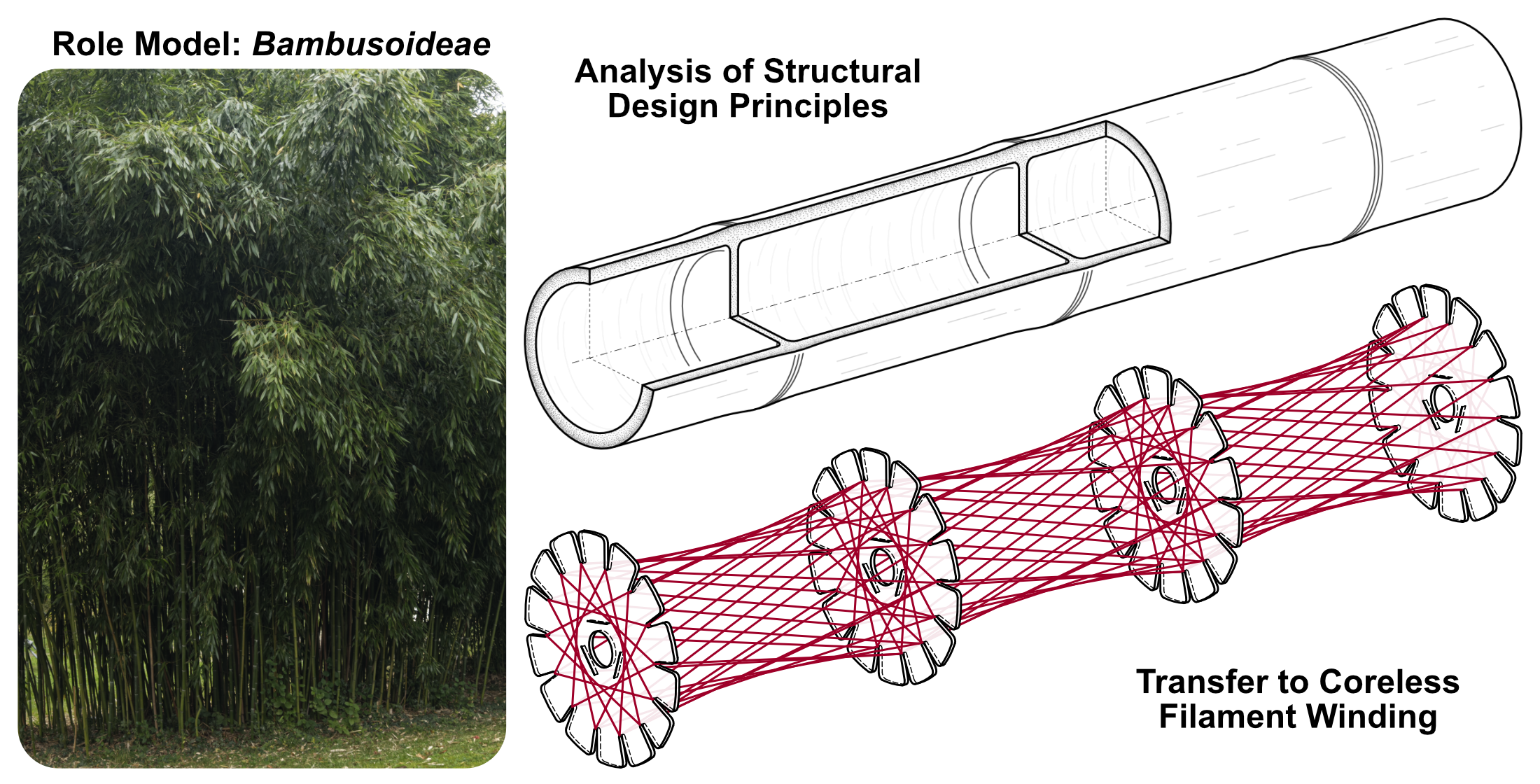
Transferring Structural Design Principles from Bamboo to Coreless Filament-Wound Lightweight Composite Trusses


Abstract

1. Introduction
1.1. Bamboo/Bambusoideae
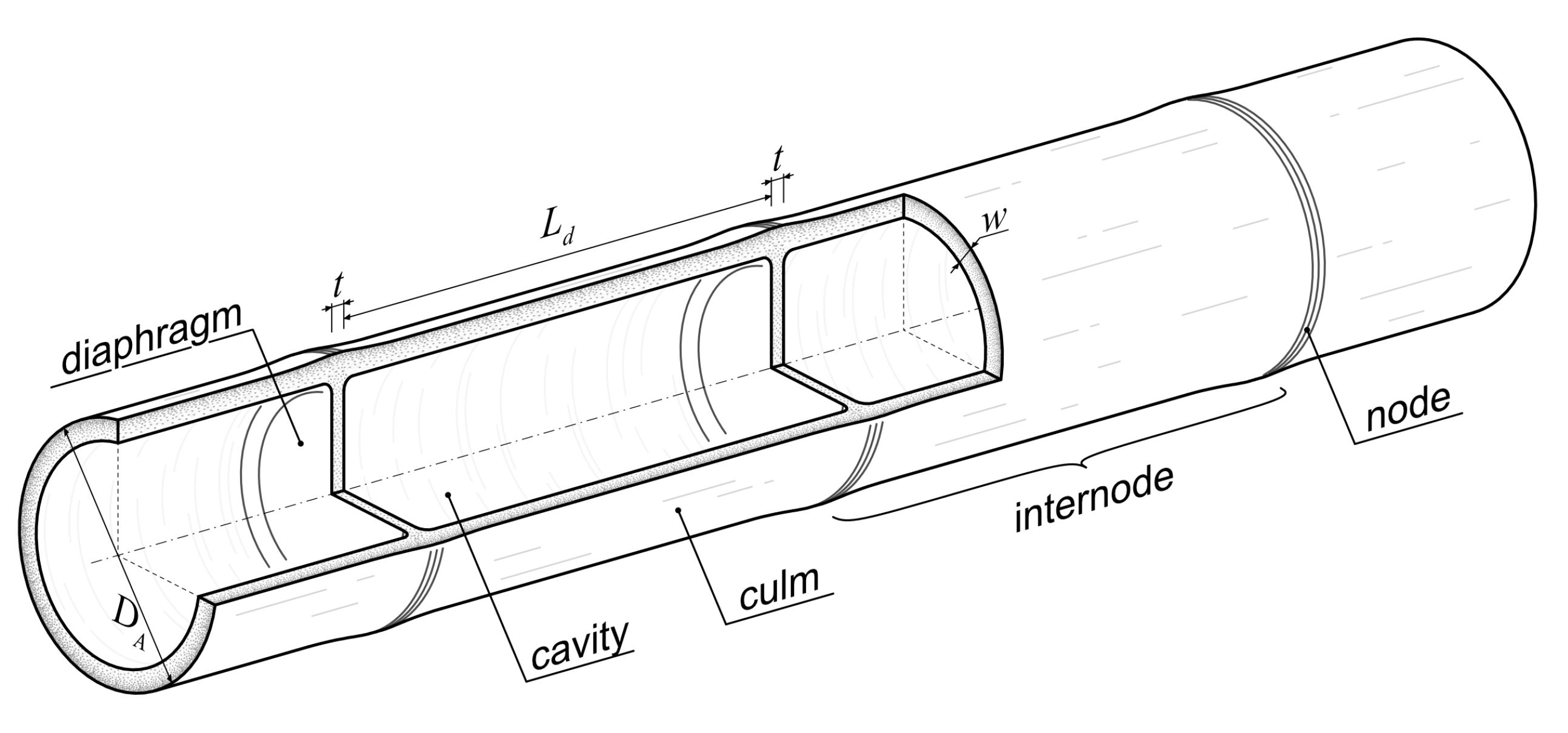
1.2. Bamboo’s Structural System
2. Materials and Methods
2.1. Feature Selection
2.2. Feature Abstraction
2.2.1. FE Model and Design Space Ranges
2.2.2. Material Properties
- axial modulus of elasticity in fiber direction [GPa], here 121 GPa;
- axial modulus of elasticity transverse to fiber direction [GPa], here 8.6 GPa;
- shear modulus of elasticity [GPa]; here 4.7 GPa;
- Poisson’s coefficient [-], here 0.27;
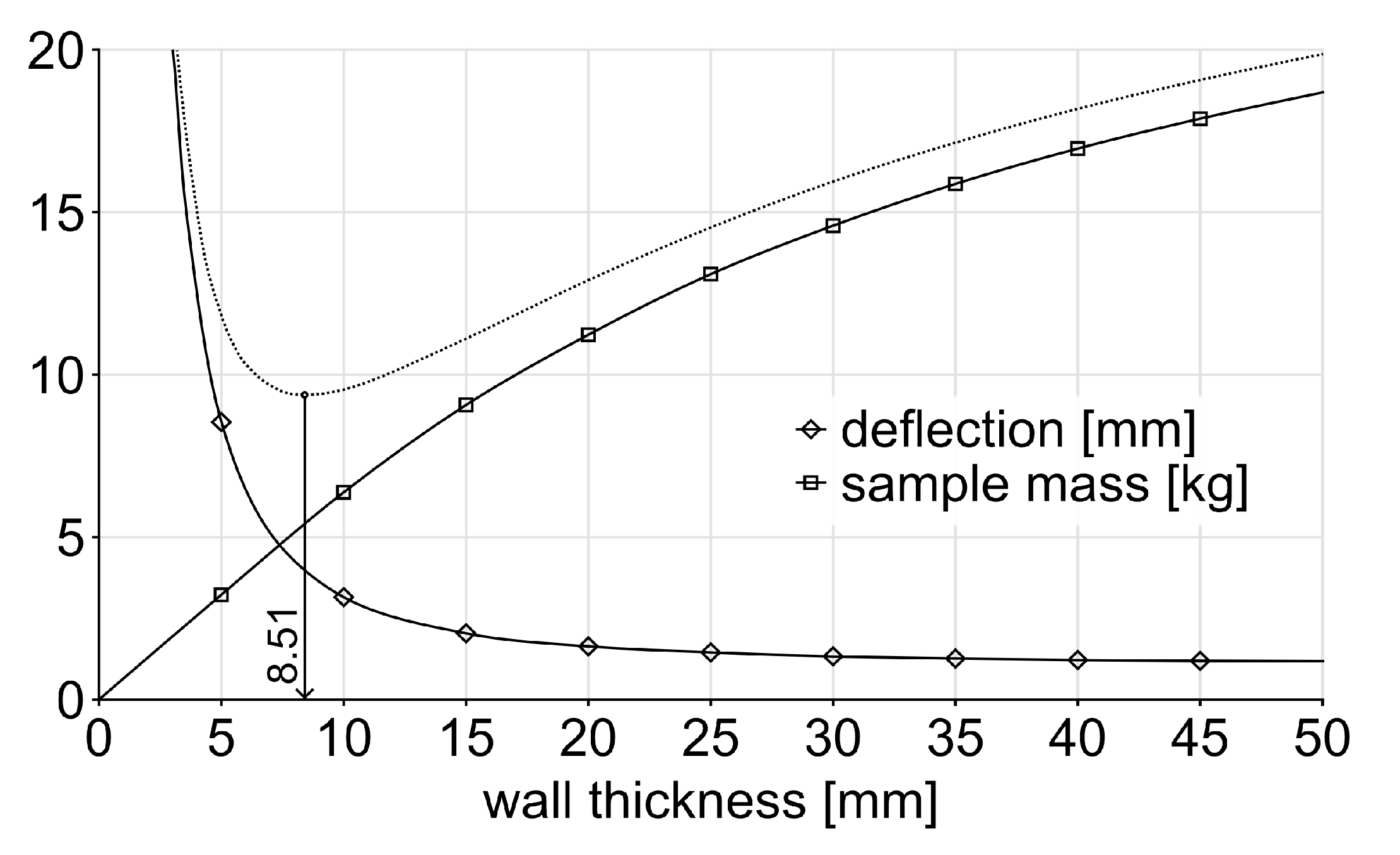
2.2.3. Determination of Wall Thickness
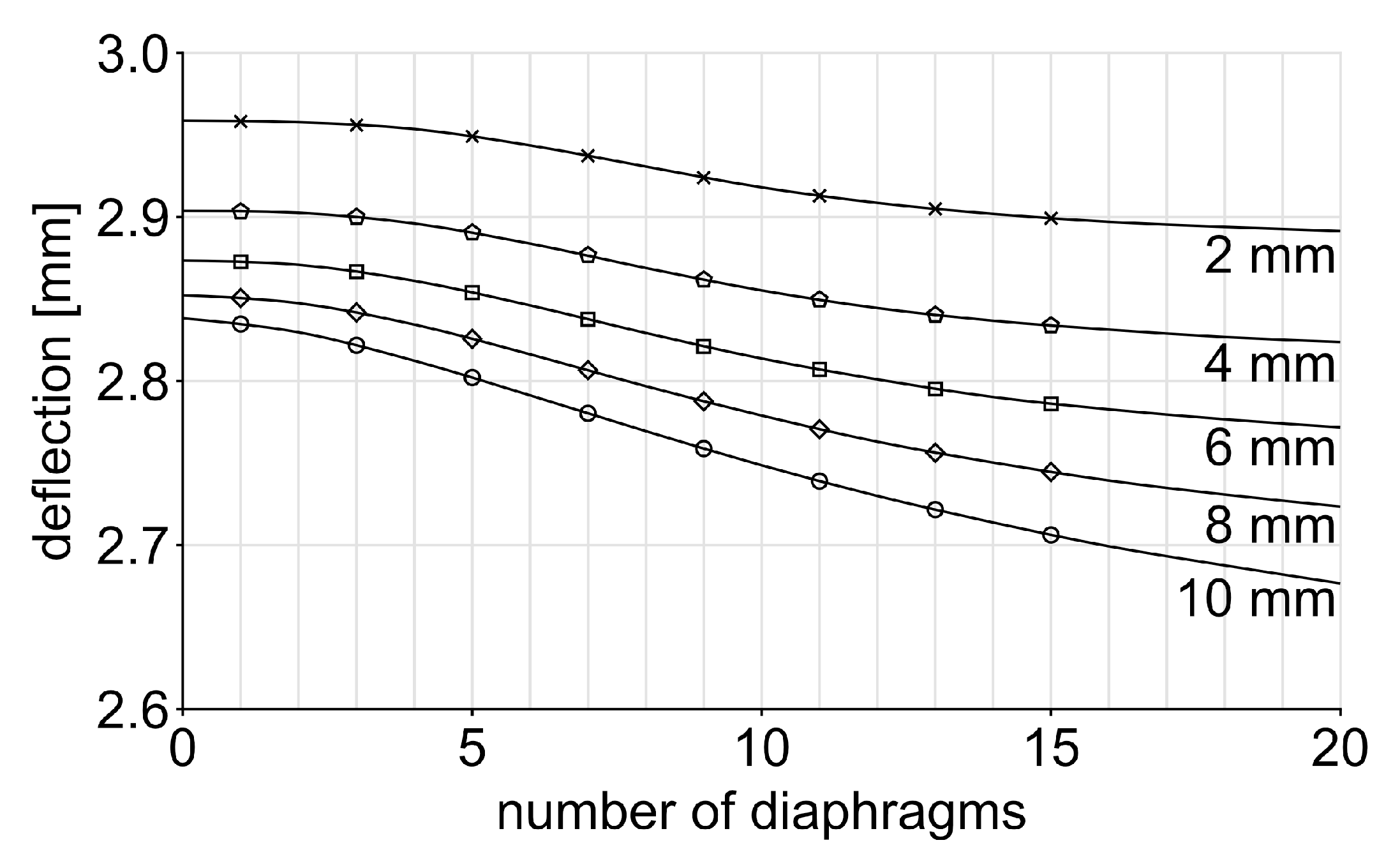
2.2.4. Determination of Diaphragm Parameters
- mass of the structure (analytical);
- maximum bending deflection under line load (numerical);
- ratio between diaphragm’s partial load and max. buckling force (analytical);
- eigenfrequency of the structure (numerical);
Structural Mass
- M
- total structural mass [kg];
- mass of the culm [kg] without diaphragms, here 5.487 kg;
- mass of an individual diaphragm of 1 mm thickness [kg], here 4.975 g;
- n
- number of diaphragms [-];
- t
- (average) diaphragm thickness [mm].
Bending Deflection
Radial Buckling
- culm outer diameter [mm];
- w
- culm wall thickness [mm].
- axial load per diaphragm [N];
- Euler’s buckling load (rotation and translation fixed at both ends) [N];
- accumulated line load along culm [N], here 20 kN;
- outer diameter of the culm [mm], here 100 mm;
- w
- wall thickness of the culm [mm], here 8.51 mm, see Section 2.2.3;
- E
- elastic modulus of the diaphragm’s material [N/m2], see Equation (1);
- n
- number of diaphragms [-];
- h
- width of the diaphragms [mm], see Equation (4);
- t
- thickness of the diaphragms [mm].
Eigenfrequency
Weighting of Influences
Generalization
- internode length, accounting for diaphragm thickness;
- total culm length;
- n
- number of diaphragms (no diaphragms at culm end);
- t
- diaphragm thickness.
2.3. Material System
2.3.1. Fiber System
2.3.2. Matrix System
2.4. Sample Fabrication
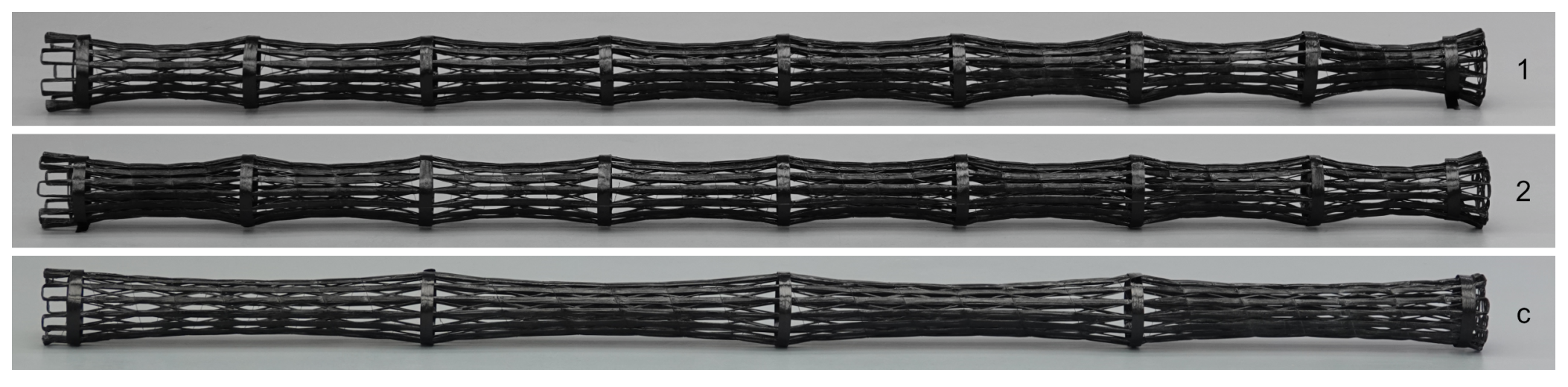
2.4.1. Sample Plan
2.4.2. Tiling into Subcomponents
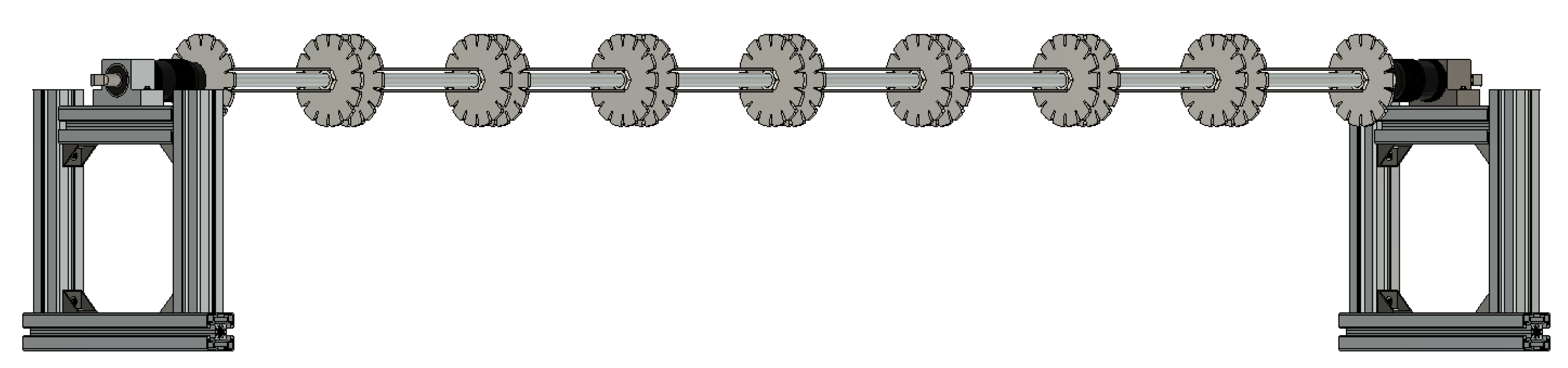
2.4.3. Winding Frame
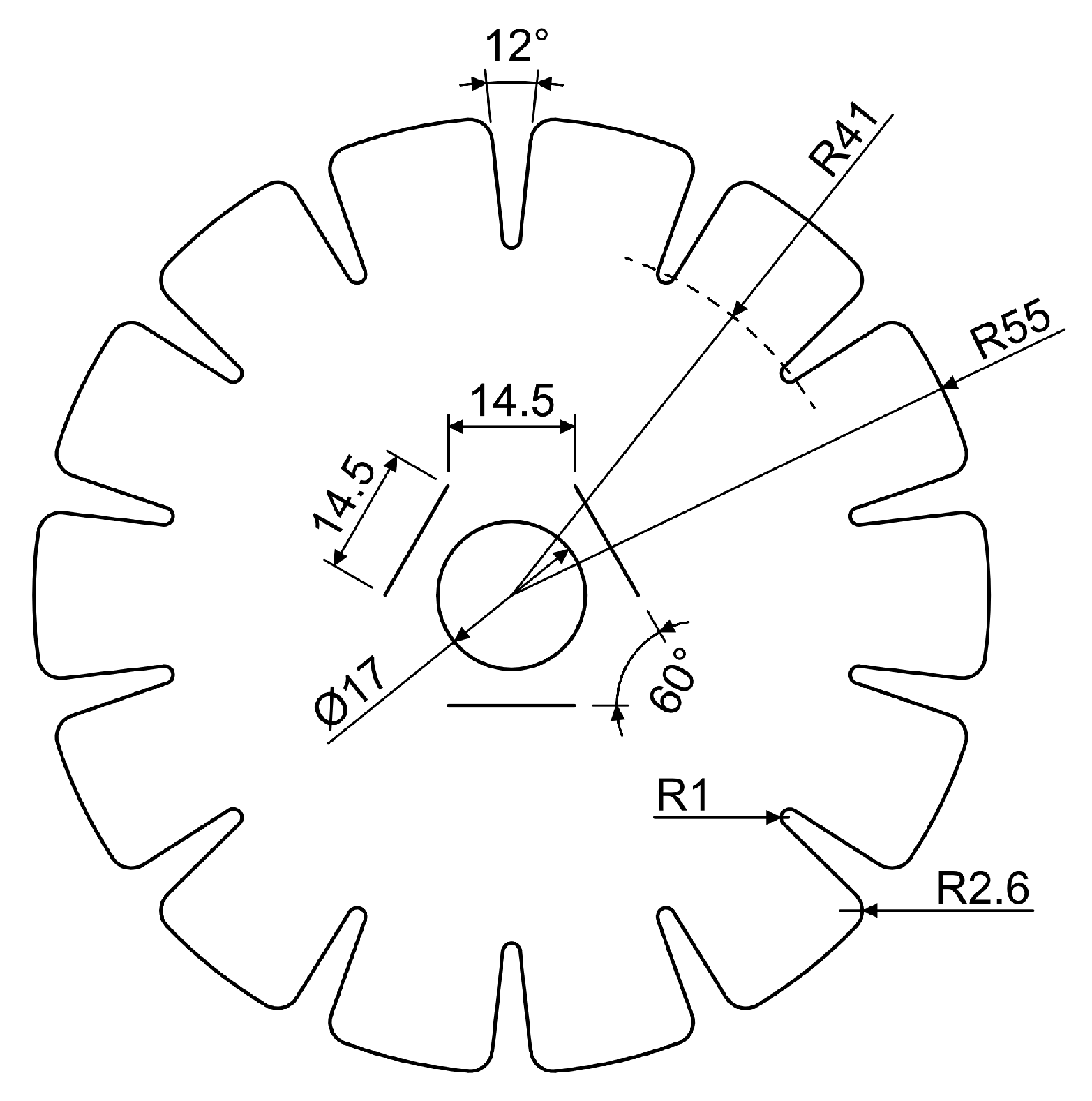
2.4.4. Winding Anchors
2.4.5. Winding Syntax


| Sample Type | Stage | Subsyn. | Subcomp. | Repet. | Winding Sequence |
|---|---|---|---|---|---|
| bamboo-inspired sample | 1 | 1.1 | each indiv. subcomp. 1 to 8 | 2 | 1, 15, 16, 2, 3, 17, 18, 4, 5, 19, 20, 6, 7, 21, 22, |
| 8, 9, 23, 24, 10, 11, 25, 26, 12, 13, 27, 28, 14, 1 | |||||
| 1.2 | each indiv. subcomp. 1 to 8 | 2 | 1, 18, 23, 12, 3, 20, 25, 14, 5, 22, 27, 2, 7, 24, | ||
| 15, 4, 9, 26, 17, 6, 11, 28, 19, 8, 13, 16, 21, 10, | |||||
| 1, 26, 21, 4, 13, 24, 19, 2, 11, 22, 17, 14, 9, 20, | |||||
| 15, 12, 7, 18, 27, 10, 5, 16, 25, 8, 3, 28, 23, 6, 1 | |||||
| 2 | 2.1 | across all subcomp., hooking at 1 and 8 | 18 | 1, 15 *, 16 *, 2, 3, 17 *, 18 *, 4, 5, 19 *, 20 *, 6, 7, | |
| 21 *, 22 *, 8, 9, 23 *, 24 *, 10, 11, 25 *, 26 *, 12, | |||||
| 13, 27 *, 28 *, 14, 1 | |||||
| 2.2 | between subcomp. | 3 | 15, 1, 14, 28, 27, 13, 12, 26, 25, 11, 10, 24, 23, | ||
| (sin-cos) | 9, 8, 22, 21, 7, 6, 20, 19, 5, 4, 18, 17, 3, 2, 16, 15 | ||||
| 2.3 | between subcomp. | 3 | 28, 14, 13, 27, 26, 12, 11, 25, 24, 10, 9, 23, 22, | ||
| (offset sin-cos) | 8, 7, 21, 20, 6, 5, 19, 18, 4, 3, 17, 16, 2, 1, 15, 28 | ||||
| 2.4 | between subcomp. | 2 | 15, 10, 9, 18, 17, 12, 11, 20, 19, 14, 13, 22, 21, | ||
| (circumferential) | 2, 1, 24, 23, 4, 3, 26, 25, 6, 5, 28, 27, 8, 7, 16, 15 | ||||
| comparison sample | 1 | 1.1 | - | 2 | 1, 57, 58, 2, 3, 59, 60, 4, 5, 61, 62, 6, 7, 63, 64, |
| 8, 9, 65, 66, 10, 11, 67, 68, 12, 13, 69, 70, 14, 1 | |||||
| 1.2 | - | 2 | 1, 21, 41, 47, 67, 58, 50, 42, 20, 12, 3, 23, 29, 49, | ||
| 69, 60, 52, 30, 22, 14, 5, 25, 31, 51, 57, 62, 54, 32, | |||||
| 24, 2, 7, 27, 33, 53, 59, 64, 56, 34, 26, 4, 9, 15, 35, | |||||
| 55, 61, 66, 44, 36, 28, 6, 11, 17, 37, 43, 63, 68, 46, | |||||
| 38, 16, 8, 13, 19, 39, 45, 65, 70, 48, 40, 18, 10, 1, | |||||
| 23, 31, 53, 61, 70, 50, 30, 24, 4, 13, 21, 29, 51, 59, | |||||
| 68, 48, 42, 22, 2, 11, 19, 41, 49, 57, 66, 46, 40, 20, | |||||
| 14, 9, 17, 39, 47, 69, 64, 44, 38, 18, 12, 7, 15, 37, | |||||
| 45, 67, 62, 56, 36, 16, 10, 5, 27, 35, 43, 65, 60, 54, | |||||
| 34, 28, 8, 3, 25, 33, 55, 63, 58, 52, 32, 26, 6, 1 | |||||
| 2 | 2.1 | - | 18 | 1, 57, 58, 2, 3, 59, 60, 4, 5, 61, 62, 6, 7, 63, 64, | |
| 8, 9, 65, 66, 10, 11, 67, 68, 12, 13, 69, 70, 14, 1 |
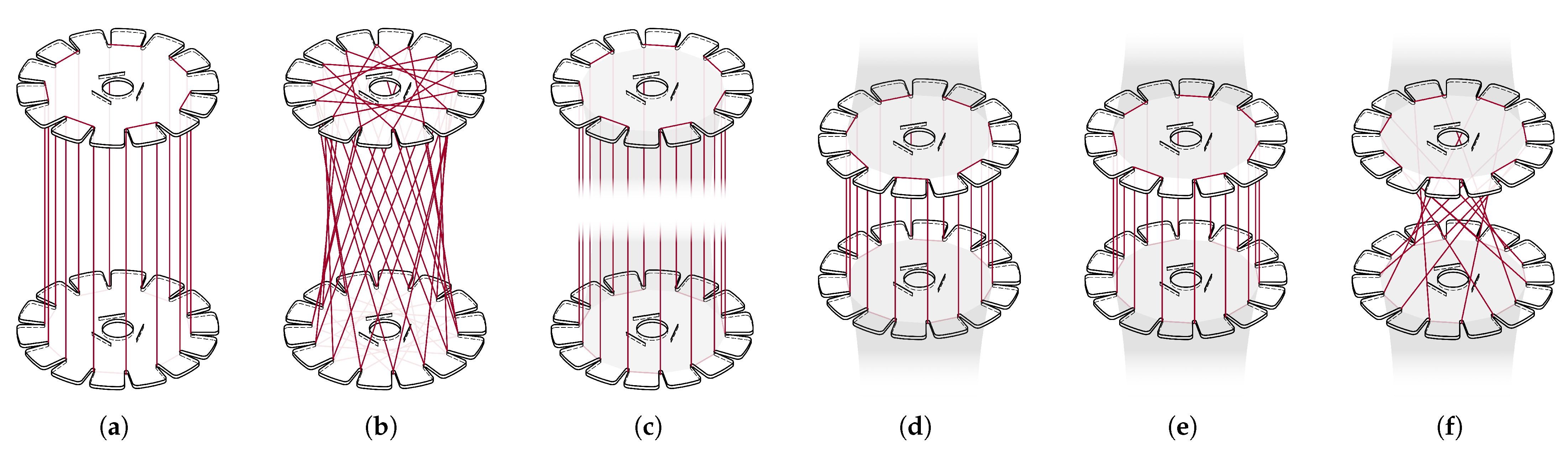
2.4.6. Fabrication Stages
2.5. Testing Setup and Parameters
2.6. Sample Parameters
3. Results and Discussion
3.1. Strain Measurement
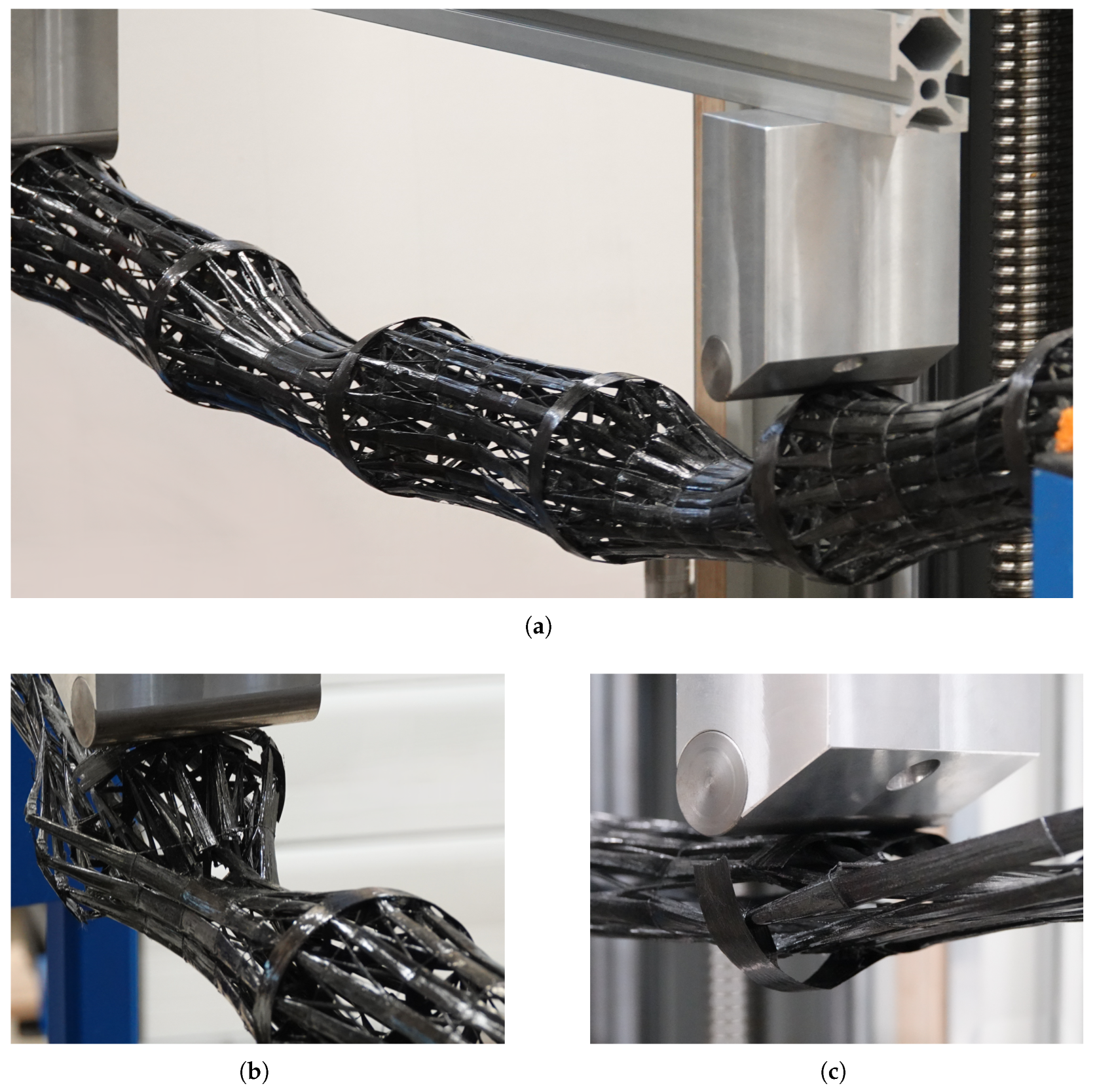
3.2. Failure Behavior
3.2.1. Ovalization
3.2.2. Bending Shape
3.2.3. Structural Failure
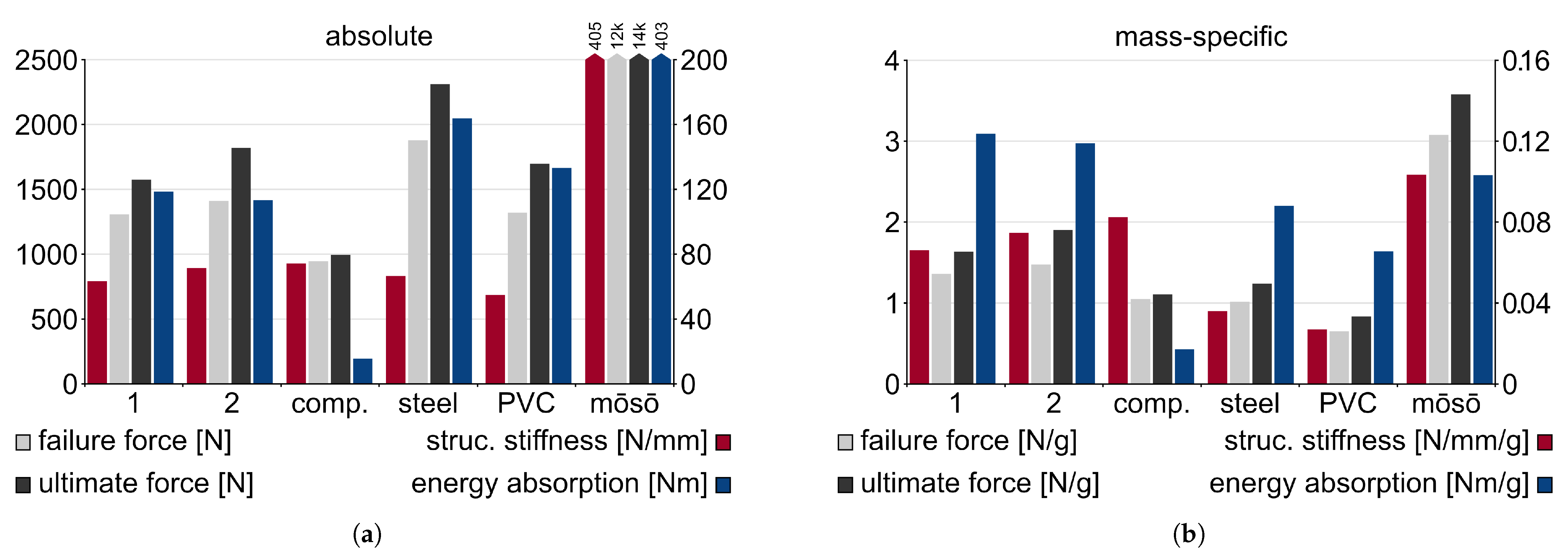
3.3. Structural Testing Results
3.3.1. Absolute Mechanical Performance
3.3.2. Mass-Specific Mechanical Performance
4. Conclusions
Author Contributions
Funding
Institutional Review Board Statement
Informed Consent Statement
Data Availability Statement
Acknowledgments
Conflicts of Interest
References
- Rajak, D.K.; Pagar, D.D.; Menezes, P.L.; Linul, E. Fiber-Reinforced Polymer Composites: Manufacturing, Properties, and Applications. Polymers 2019, 11, 1667. [Google Scholar] [CrossRef]
- Cai, R.; Jin, T. The effect of microstructure of unidirectional fibre-reinforced composites on mechanical properties under transverse loading: A review. J. Reinf. Plast. Compos. 2018, 37, 1360–1377. [Google Scholar] [CrossRef]
- He, C.; Ge, J.; Cao, X.; Chen, Y.; Chen, H.; Fang, D. The effects of fiber radius and fiber shape deviations and of matrix void content on the strengths and failure mechanisms of UD composites by computational micromechanics. Compos. Sci. Technol. 2022, 218, 109139. [Google Scholar] [CrossRef]
- Li, Y.; Qin, H.; Jia, L.; Tay, T.E.; Tan, V.B.C.; Liu, Y. Microstructure dependent transverse strength criterion for UD-CFRP composites via computational micromechanics and machine learning. Compos. Sci. Technol. 2024, 251, 110551. [Google Scholar] [CrossRef]
- Hofmann, M.; Machado, M.; Shahid, A.; Dourado, F.; Garrido, M.; Bordado, J.C.; Correia, J.R. Pultruded carbon fibre reinforced polymer strips produced with a novel bio-based thermoset polyester for structural strengthening. Compos. Sci. Technol. 2023, 234, 109936. [Google Scholar] [CrossRef]
- Ma, Q.; Rejab, R.; Mat Sahat, I.; Nallapaneni, M.K.; Merzuki, M. Robotic filament winding technique (RFWT) in industrial application: A review of state of the art and future perspectives. Res. J. Eng. Technol. 2019, 5, 1668–1676. [Google Scholar]
- Patekar, V.; Kale, K. State of the art review on mechanical properties of sandwich composite structures. Polym. Compos. 2022, 43, 5820–5830. [Google Scholar] [CrossRef]
- Schütze, R. Lightweight carbon fibre rods and truss structures. Mater. Des. 1997, 18, 231–238. [Google Scholar] [CrossRef]
- Rackliffe, M.E.; Jensen, D.W.; Lucas, W.K. Local and global buckling of ultra-lightweight IsoTruss® structures. Compos. Sci. Technol. 2006, 66, 283–288. [Google Scholar] [CrossRef]
- Tao, Y.; Lai, C.; Zhang, L.; Pan, D.; Fan, H. IsoTruss lattice cylinder: Additive manufacture, homogenization and vibration analyses. Int. J. Mech. Sci. 2025, 304, 110685. [Google Scholar] [CrossRef]
- Hunt, C.J.; Zhao, Y.; Wisnom, M.R.; Woods, B.K. WrapToR composite truss structures: Measurement and modelling of mechanical response. Compos. Struct. 2020, 254, 112834. [Google Scholar] [CrossRef]
- Zhao, M.; Macquart, T.; Woods, B.K. WrapToR composite truss joints: Concept introduction and coaxial joint analysis and demonstration. Compos. Part A Appl. Sci. Manuf. 2025, 188, 108573. [Google Scholar] [CrossRef]
- Mindermann, P.; Müllner, R.; Dieringer, E.; Ocker, C.; Klink, R.; Merkel, M.; Gresser, G.T. Design of Fiber-Composite/Metal–Hybrid Structures Made by Multi-Stage Coreless Filament Winding. Appl. Sci. 2022, 12, 2296. [Google Scholar] [CrossRef]
- Mindermann, P.; Acker, D.; Wegner, R.; Fasoulas, S.; Gresser, G.T. Long-span Fiber Composite Truss made by Coreless Filament Winding for Large-scale Satellite Structural Systems Demonstrated on a Planetary Sunshade Concept. Sci. Rep. 2024, 14, 8190. [Google Scholar] [CrossRef]
- Lopatin, A.; Morozov, E.; Shatov, A. Buckling of uniaxially compressed composite anisogrid lattice plate with clamped edges. Compos. Struct. 2016, 157, 187–196. [Google Scholar] [CrossRef]
- Amada, S.; Ichikawa, Y.; Munekata, T.; Nagase, Y.; Shimizu, H. Fiber texture and mechanical graded structure of bamboo. Compos. Part B Eng. 1997, 28, 13–20. [Google Scholar] [CrossRef]
- Mersch, J.; Friese, D.; Le Xuan, H. Toward the Automation of the 3D Robotic Coreless Filament Winding Process for High-Performance Composite Materials With Multiple Reinforcement Levels. Appl. Res. 2025, 4, e202400145. [Google Scholar] [CrossRef]
- Carosella, S.; Hügle, S.; Helber, F.; Middendorf, P. A short review on recent advances in automated fiber placement and filament winding technologies. Compos. Part B Eng. 2024, 287, 111843. [Google Scholar] [CrossRef]
- La Magna, R.; Waimer, F.; Knippers, J. Coreless Winding and Assembled Core – Novel fabrication approaches for FRP based components in building construction. Constr. Build. Mater. 2016, 127, 1009–1016. [Google Scholar] [CrossRef]
- Mo, Y.; Ye, S.; Qaiser, Z.; Johnson, S. Structural and winding sequence optimization of coreless filament wound composite lattice structures. Int. J. Adv. Manuf. Technol. 2023, 127, 4903–4914. [Google Scholar] [CrossRef]
- Polini, W.; Sorrentino, L. Winding Trajectory and Winding Time in Robotized Filament Winding of Asymmetric Shape Parts. J. Compos. Mater. 2005, 39, 1391–1411. [Google Scholar] [CrossRef]
- Xu, J.; Yang, H.; Liu, M.; Tian, J.; Liu, B. Research on winding trajectory planning for elbow pipe based on industrial robot. Int. J. Adv. Manuf. Technol. 2017, 93, 537–545. [Google Scholar] [CrossRef]
- Mindermann, P.; Gresser, G.T. Adaptive winding pin and hooking capacity model for coreless filament winding. J. Reinf. Plast. Compos. 2023, 42, 26–38. [Google Scholar] [CrossRef]
- Gil Pérez, M.; Dambrosio, N.; Rongen, B.; Menges, A.; Knippers, J. Structural optimization of coreless filament wound components connection system through orientation of anchor points in the winding frames. In Proceedings of the IASS Annual Symposium, Barcelona, Spain, 7–10 October 2019; Lázaro, C., Bletzinger, K.U., Oñate, E., Eds.; International Association for Shell and Spatial Structures (IASS): Barcelona, Spain, 2019; pp. 1381–1388. [Google Scholar]
- Minsch, N.; Müller, M.; Gereke, T.; Nocke, A.; Cherif, C. 3D truss structures with coreless 3D filament winding technology. J. Compos. Mater. 2019, 53, 2077–2089. [Google Scholar] [CrossRef]
- Hildebrandt, H.; He, M.; Chen, P.A.; Estrada, R.D.; Zechmeister, C.; Menges, A. Slack Pack: Fabrication System for the Dual Robotic Winding of Spatial Fiber Structures. In Proceedings of the Phygital Intelligence, Shanghai, China, 4 January 2024; Yan, C., Chai, H., Sun, T., Yuan, P.F., Eds.; Springer Nature: Singapore, 2024; pp. 476–491. [Google Scholar]
- Duque Estrada, R.; Kannenberg, F.; Wagner, H.J.; Yablonina, M.; Menges, A. Spatial winding: Cooperative heterogeneous multi-robot system for fibrous structures. Constr. Robot. 2020, 4, 205–215. [Google Scholar] [CrossRef]
- Mindermann, P.; Lv, Y.; Behera, M.P.; Meot, R.; Guen, M.J.L.; Singamneni, S. Exploring the sustainability potential of lightweight structures made from Phormium tenax fibers by hybrid coreless filament winding. Compos. Part A 2025, 199, 109168. [Google Scholar] [CrossRef]
- Sorrentino, L.; Anamateros, E.; Bellini, C.; Carrino, L.; Corcione, G.; Leone, A.; Paris, G. Robotic filament winding: An innovative technology to manufacture complex shape structural parts. Compos. Struct. 2019, 220, 699–707. [Google Scholar] [CrossRef]
- Sorrentino, L.; Marchetti, M.; Bellini, C.; Delfini, A.; Del Sette, F. Manufacture of high performance isogrid structure by Robotic Filament Winding. Compos. Struct. 2017, 164, 43–50. [Google Scholar] [CrossRef]
- Döbrich, O.; Steiner, S.; Böhler, P.; Radis, R. Planar fibre winding for topological optimized composite structures. Compos. Part C Open Access 2025, 16, 100545. [Google Scholar] [CrossRef]
- Früh, N.; Knippers, J. Multi-stage filament winding: Integrative design and fabrication method for fibre-reinforced composite components of complex geometries. Compos. Struct. 2021, 268, 113969. [Google Scholar] [CrossRef]
- Dupas, N.; Amudhan, K.; Gil Pérez, M. Multi-scale uncertainty mapping in fibre-wound bio-composite structures. ce/papers 2025, 8, 451–458. [Google Scholar] [CrossRef]
- Minsch, N.; Herrmann, F.; Gereke, T.; Nocke, A.; Cherif, C. Analysis of Filament Winding Processes and Potential Equipment Technologies. Procedia CIRP 2017, 66, 125–130. [Google Scholar] [CrossRef]
- Xu, X.; Guo, Y.; Shen, Z.; Liu, B.; Yan, F.; Zhong, N. Aramid Fiber-Reinforced Plastics (AFRPs) in Aerospace: A Review of Recent Advancements and Future Perspectives. Polymers 2025, 17, 2254. [Google Scholar] [CrossRef]
- Mindermann, P.; Witt, M.U.; Gresser, G.T. Pultrusion-winding: A novel fabrication method for coreless wound fiber-reinforced thermoset composites with distinct cross-section. Compos. Part A 2022, 154, 106763. [Google Scholar] [CrossRef]
- Minsch, N.; Müller, M.; Gereke, T.; Nocke, A.; Cherif, C. Novel fully automated 3D coreless filament winding technology. J. Compos. Mater. 2018, 52, 3001–3013. [Google Scholar] [CrossRef]
- Wang, Q.; Li, T.; Wang, B.; Liu, C.; Huang, Q.; Ren, M. Prediction of void growth and fiber volume fraction based on filament winding process mechanics. Compos. Struct. 2020, 246, 112432. [Google Scholar] [CrossRef]
- Gil Pérez, M. Structural design challenges of bio-based composites and digital fabrication towards sustainable building systems. In Proceedings of the IASS 2024 Symposium: Redefining the Art of Structural Design, Zurich, Switzerland, 26–30 August 2024; Block, P., Boller, G., DeWolf, C., Pauli, J., Kaufmann, W., Eds.; IASS: Madrid, Spain, 2024; pp. 1–10. [Google Scholar]
- Bodea, S. Upscaled, Robotic Coreless Filament Winding Methods for Lightweight Building Elements for Architecture. Ph.D. Thesis, University of Stuttgart, Stuttgart, Germany, 2023. [Google Scholar] [CrossRef]
- Mindermann, P. Advancements in Coreless Filament Winding Towards a Digital Process Characterization. Ph.D. Thesis, University of Stuttgart, Stuttgart, Germany, 2022. [Google Scholar] [CrossRef]
- Gil Pérez, M. Integrative Structural Design of Non-Standard Building Systems: Coreless Filament-Wound Structures as a Case Study. Ph.D. Thesis, University of Stuttgart, Stuttgart, Germany, 2023. [Google Scholar] [CrossRef]
- Zechmeister, C. Computational Fiber Architecture-Co-Design of Large-Scale, Load-Adapted Fiber Composite Building Components for Robotic Pre-Fabrication. Ph.D. Thesis, University of Stuttgart, Stuttgart, Germany, 2024. [Google Scholar] [CrossRef]
- Gil Pérez, M.; Zechmeister, C.; Kannenberg, F.; Mindermann, P.; Balangé, L.; Guo, Y.; Hügle, S.; Gienger, A.; Forster, D.; Bischoff, M.; et al. Computational co-design framework for coreless wound fibre-polymer composite structures. J. Comput. Des. Eng. 2022, 9, 310–329. [Google Scholar] [CrossRef]
- Gil Pérez, M.; Mindermann, P.; Zechmeister, C.; Forster, D.; Guo, Y.; Hügle, S.; Kannenberg, F.; Balangé, L.; Schwieger, V.; Middendorf, P.; et al. Data processing, analysis, and evaluation methods for co-design of coreless filament-wound building systems. J. Comput. Des. Eng. 2023, 10, 1460–1478. [Google Scholar] [CrossRef]
- Kannenberg, F.; Zechmeister, C.; Gil Pérez, M.; Guo, Y.; Yang, X.; Forster, D.; Hügle, S.; Mindermann, P.; Abdelaal, M.; Balangé, L.; et al. Toward reciprocal feedback between computational design, engineering, and fabrication to co-design coreless filament-wound structures. J. Comput. Des. Eng. 2024, 11, 374–394. [Google Scholar] [CrossRef]
- Guo, Y.; Serhat, G.; Gil Pérez, M.; Knippers, J. Maximizing buckling load of elliptical composite cylinders using lamination parameters. Eng. Struct. 2022, 262, 114342. [Google Scholar] [CrossRef]
- Mindermann, P.; Witt, M.U.; Samie, A.; Selvarayan, S.K.; Gresser, G.T. Integration of ceramic matrix systems into coreless filament wound fiber-reinforced composite lightweight structures for lunar resource utilization. Compos. Part C Open Access 2024, 15, 100508. [Google Scholar] [CrossRef]
- Gil Pérez, M.; Früh, N.; La Magna, R.; Knippers, J. Integrative structural design of a timber-fibre hybrid building system fabricated through coreless filament winding: Maison Fibre. J. Build. Eng. 2022, 49, 104114. [Google Scholar] [CrossRef]
- Prado, M. Skeletal composites: Robotic fabrication processes for lightweight multi-nodal structural components. Constr. Robot. 2020, 4, 217–226. [Google Scholar] [CrossRef]
- Dambrosio, N.; Zechmeister, C.; Pérez, M.G.; Dörstelmann, M.; Stark, T.; Rinderspacher, K.; Knippers, J.; Menges, A. Livmats Pavilion: Design and Development of a Novel Building System Based on Natural Fibres Coreless-Wound Structural Components for Applications in Architecture. J. Int. Assoc. Shell Spat. Struct. 2024, 65, 133–145. [Google Scholar] [CrossRef]
- Gil Pérez, M.; Guo, Y.; Knippers, J. Integrative material and structural design methods for natural fibres filament-wound composite structures: The LivMatS pavilion. Mater. Des. 2022, 217, 110624. [Google Scholar] [CrossRef]
- Dambrosio, N.; Zechmeister, C.; Bodea, S.; Koslowski, V.; Gil Pérez, M.; Rongen, B.; Knippers, J.; Menges, A. Buga Fibre Pavilion: Towards an architectural application of novel fiber composite building systems. In Proceedings of the 39th Annual Conference of the Association for Computer Aided Design in Architecture: Ubiquity and Autonomy, ACADIA 2019, Austin, TX, USA, 24–26 October 2019; pp. 140–149. [Google Scholar]
- Gil Pérez, M.; Rongen, B.; Koslowski, V.; Knippers, J. Structural design assisted by testing for modular coreless filament-wound composites: The BUGA Fibre Pavilion. Constr. Build. Mater. 2021, 301, 124303. [Google Scholar] [CrossRef]
- Chen, T.Y.; Prandini, R.; Neubauer, G.; Hänzka, S.; Knippers, J. Instantaneous and long-term structural behavior of timber-flax beams: Design and evaluation of the hybrid flax pavilion component. Dev. Built Environ. 2025, 24, 100782. [Google Scholar] [CrossRef]
- Kuznetsov, I.; Kozhin, V.; Novokshenov, A.; Elsken, T.; Nemov, A. Optimization approach for the core structure of a wind turbine blade. Struct. Multidiscip. Optim. 2024, 67, 108. [Google Scholar] [CrossRef]
- Motro, R. Robert Le Ricolais (1894–1977) “Father of Spatial Structures”. Int. J. Space Struct. 2007, 22, 233–238. [Google Scholar] [CrossRef]
- Akinlabi, E.T.; Anane-Fenin, K.; Akwada, D.R. Bamboo: The Multipurpose Plant; Bamboo Taxonomy and Distribution Across the Globe; Springer International Publishing: Cham, Switzerland, 2017; pp. 1–37. [Google Scholar]
- Clark, L.G.; Londoño, X.; Ruiz-Sanchez, E. Bamboo: The Plant and Its Uses; Bamboo Taxonomy and Habitat; Walter, L., Michael, K., Eds.; Springer International Publishing: Cham, Switzerland, 2015; pp. 1–30. [Google Scholar]
- Yeasmin, L.; Ali, M.N.; Gantait, S.; Chakraborty, S. Bamboo: An overview on its genetic diversity and characterization. 3 Biotech 2015, 5, 1–11. [Google Scholar] [CrossRef] [PubMed]
- Akinlabi, E.T.; Anane-Fenin, K.; Akwada, D.R. Bamboo: The Multipurpose Plant; Properties of Bamboo; Springer International Publishing: Cham, Switzerland, 2017; pp. 87–147. [Google Scholar]
- Banik, R.L. Bamboo: The Plant and its Uses; Morphology and Growth; Walter, L., Michael, K., Eds.; Springer International Publishing: Cham, Switzerland, 2015; pp. 43–89. [Google Scholar]
- Xie, Y.; Zheng, H.; Bai, Y.; Xu, J.; Song, H.; Cao, Z.; Wu, C.; Mu, C.; Jiang, J.; Gao, J. Photosynthesis in culms of non-foliar organs and effect of light on culm development of Moso bamboo (Phyllostachys edulis). Environ. Exp. Bot. 2024, 220, 105672. [Google Scholar] [CrossRef]
- Rusch, F.; Ceolin, G.B.; Hillig, É. Morphology, density and dimensions of bamboo fibers: A bibliographical compilation. Pesqui. Agropecu. Trop. 2019, 49, e55007. [Google Scholar] [CrossRef]
- Elejoste, A.; Arevalillo, A.; Gabilondo, N.; Butron, A.; Peña-Rodriguez, C. Morphological Analysis of Several Bamboo Species with Potential Structural Applications. Polymers 2021, 13, 2126. [Google Scholar] [CrossRef]
- Emamverdian, A.; Ding, Y.; Ranaei, F.; Ahmad, Z. Application of Bamboo Plants in Nine Aspects. Sci. World J. 2020, 2020, 7284203. [Google Scholar] [CrossRef]
- Palombini, F.L.; Nogueira, F.M. (Eds.) Bamboo Science and Technology, 1st ed.; Environmental Footprints and Eco-design of Products and Processes; Springer: Singapore, 2023; pp. 32–39. [Google Scholar] [CrossRef]
- Chen, T.Y.; Suzuki, S.; Pérez, M.G.; Guo, Y.; Knippers, J. Integrative structural design methods for bamboo woven deployable structures: The BamX! Research Pavilion. In Proceedings of the IASS 2024 Symposium: Redefining the Art of Structural Design, Zurich, Switzerland, 26–30 August 2024; Block, P., Boller, G., DeWolf, C., Paulin, J., Kaufmann, W., Eds.; International Association for Shell and Spatial Structures (IASS): Madrid, Spain, 2024; pp. 1–10. [Google Scholar]
- Yu, W.; Chung, K.; Chan, S. Axial buckling of bamboo columns in bamboo scaffolds. Eng. Struct. 2005, 27, 61–73. [Google Scholar] [CrossRef]
- Zhang, W.; Wang, C.; Gu, S.; Yu, H.; Cheng, H.; Wang, G. Physical-Mechanical Properties of Bamboo Fiber Composites Using Filament Winding. Polymers 2021, 13, 2913. [Google Scholar] [CrossRef]
- Mofidi, A.; Abila, J.; Ng, J.T.M. Novel Advanced Composite Bamboo Structural Members with Bio-Based and Synthetic Matrices for Sustainable Construction. Sustainability 2020, 12, 2485. [Google Scholar] [CrossRef]
- Hossain, M.; Islam, M.; Numan, S. Multipurpose Uses of Bamboo Plants: A Review. Int. Res. J. Biol. Sci. 2015, 4, 57–60. [Google Scholar]
- NIKLAS, K.J. Responses of Hollow, Septate Stems to Vibrations: Biomechanical Evidence that Nodes Can Act Mechanically as Spring-like Joints. Ann. Bot. 1997, 80, 437–448. [Google Scholar] [CrossRef]
- Shima, H.; Sato, M.; Inoue, A. Self-adaptive formation of uneven node spacings in wild bamboo. Phys. Rev. E 2016, 93, 022406. [Google Scholar] [CrossRef] [PubMed]
- Chaowana, K.; Wisadsatorn, S.; Chaowana, P. Bamboo as a Sustainable Building Material—Culm Characteristics and Properties. Sustainability 2021, 13, 7376. [Google Scholar] [CrossRef]
- Benton, A. Bamboo: The Plant and its Uses; Priority Species of Bamboo; Walter, L., Michael, K., Eds.; Springer International Publishing: Cham, Switzerland, 2015; pp. 31–41. [Google Scholar]
- Kappel, R.; Mattheck, C.; Bethge, K.; Tesari, I. Bamboo as a composite structure and its mechanical failure behaviour. Des. Nat. II 2004, 73, 285–293. [Google Scholar]
- Chen, S.M.; Zhang, S.C.; Gao, H.L.; Wang, Q.; Zhou, L.; Zhao, H.Y.; Li, X.Y.; Gong, M.; Pan, X.F.; Cui, C.; et al. Mechanically robust bamboo node and its hierarchically fibrous structural design. Natl. Sci. Rev. 2022, 10, nwac195. [Google Scholar] [CrossRef] [PubMed]
- Liese, W.; Tang, T.K.H. Bamboo: The Plant and its Uses; Properties of the Bamboo Culm; Walter, L., Michael, K., Eds.; Springer International Publishing: Cham, Switzerland, 2015; pp. 227–256. [Google Scholar]
- Sato, M.; Inoue, A.; Shima, H. Bamboo-inspired optimal design for functionally graded hollow cylinders. PLoS ONE 2017, 12, e0175029. [Google Scholar] [CrossRef]
- Chen, L.; Wang, X.; Huang, B.; Yuan, J.; Ma, X.; Fang, C.; Zhang, X.; Sun, F.; Fei, B. Observation of the fundamental properties of bamboo pith ring. Wood Sci. Technol. 2024, 58, 797–810. [Google Scholar] [CrossRef]
- Speck, T.; Burgert, I. Plant stems: Functional design and mechanics. Annu. Rev. Mater. Res. 2011, 41, 169–193. [Google Scholar] [CrossRef]
- Niklas, K.J.; Walker, I.D. The challenges of inferring organic function from structure and its emulation in biomechanics and biomimetics. Biomimetics 2021, 6, 21. [Google Scholar] [CrossRef]
- Lupăşteanu, V.; Ţăranu, N.; Hohan, R.; Ciobanu, P. Off-Axis Mechanical Properties of FRP Composites. In Proceedings of the ICAMS 2014–5th International Conference on Advanced Materials and Systems, Iasi, Romania, 23–25 October 2014; pp. 1–6. [Google Scholar]
- Gao, X.; Zhu, D.; Fan, S.; Rahman, M.Z.; Guo, S.; Chen, F. Structural and mechanical properties of bamboo fiber bundle and fiber/bundle reinforced composites: A review. J. Mater. Res. Technol. 2022, 19, 1162–1190. [Google Scholar] [CrossRef]
- Mindermann, P.; Gil Pérez, M.; Kamimura, N.; Knippers, J.; Gresser, G.T. Implementation of fiber-optical sensors into coreless filament-wound composite structures. Compos. Struct. 2022, 290, 115558. [Google Scholar] [CrossRef]
- Ibrahim, S.; Polyzois, D. Ovalization analysis of fiber-reinforced plastic poles. Compos. Struct. 1999, 45, 7–12. [Google Scholar] [CrossRef]
- Sorrentino, L.; Marchetti, M.; Bellini, C.; Delfini, A.; Albano, M. Design and manufacturing of an isogrid structure in composite material: Numerical and experimental results. Compos. Struct. 2016, 143, 189–201. [Google Scholar] [CrossRef]
- Thinvongpituk, C.; Poonaya, S.; Choksawadee, S.; Lee, M. The Ovalisation of Thin-walled Circular Tubes Subjected to Bending. In Proceedings of the World Congress on Engineering 2008 Vol II, London, UK, 2–4 July 2008. [Google Scholar]
- Mouka, T.; Dimitrakopoulos, E.G.; Lorenzo, R. Insight into the behaviour of bamboo culms subjected to bending. J. R. Soc. Interface 2022, 19, 20210913. [Google Scholar] [CrossRef] [PubMed]
- Richard, M.J.; Gottron, J.; Harries, K.A.; Ghavami, K. Experimental evaluation of longitudinal splitting of bamboo flexural components. Proc. Inst. Civ. Eng. Struct. Build. 2016, 170, 265–274. [Google Scholar] [CrossRef]


| Features of the Bamboo Culm | Structural/Biological Function | Technical Adaptation in CFW |
|---|---|---|
| circular cross-section | direction-independent structural resistance | approximating a circular cross-section |
| hollow cross-section | allocating material where it is most efficient | tubular cross-section |
| homogeneous wall thickness | avoiding stress concentrations | approximating equal wall thickness |
| axial variation in outer diameter/ wall thicknesss. | keeping bending stresses constant | not integrated (sample too short) |
| structural segmentation by diaphragms | preventing ovalization of tubular structure | incorporation of diaphragms |
| internodal length variations | keeping bending stresses constant | not integrated (sample too short) |
| outer wall thickening at node | avoiding weak points | circumferentially reinforcing the node |
| shared fibers between diaphragm/internode | avoiding delamination between struc. members | uninterrupted fiber paths |
| several reinforcing schemes of VBs | resilient connection between struc. members | not integrated (too high complexity of process) |
| unidirectional fiber orientation in internode | maximize (bending) resistance | incorporation of unidirectional fiber layers |
| random fiber orientation in diaphragm | utilizing material’s tensile resistance | incorporation of fibers at different angles |
| VBs embedded in parenchyma cells | anisotropic material system | fiber-reinforced composite material |
| vessels bundled in VBs | nutrient and water transport | not integrated (not struc. significant) |
| sclerenchyma cells bundles in VBs | bundling for protecting VBs | not integrated (no intentional fiber bundling) |
| radial gradient of VBs in cross-section | allocating reinf. material where it is most efficient | approximated by the winding syntax |
| radial gradient in vascular bundle diameter | denser packing of VBs | not integrated (fibers with singular diameter) |
| epidermal layer | environmental protection of the structure | not integrated (env. prot. not relevant) |
| pith ring | transport of liquids | not integrated (not structurally significant) |
| Coeff. | For a | For b | For c | For d |
|---|---|---|---|---|
| a | 3.126137 ± 0.07604 | 3.362831 ± 0.06932 | 9.314523 ± 0.0737 | 2.92553 ± 0.0808 |
| b | 0.792139 ± 0.2273 | 1.294047 ± 0.2058 | 3.321382 ± 0.6431 | 1.228597 ± 1.524 |
| c | 2.940157 ± 0.7278 | 16.25195 ± 7.037 | 431.5042 ± 9.938 | 428,455.3 ± 2.154 × 10¹¹ |
| d | 2.725459 ± 0.03892 | −1.329854 ± 1.544 | 1,221,961 ± 9.347 × 10¹⁰ | −162,874.5 ± 1.006 × 10¹¹ |
| R2 | 100% | 100% | 99.97% | 99.77% |
| Sample | Stage | Fiber | Matrix | FVR |
|---|---|---|---|---|
| 1 | 1 | 153.2 | 127.2 | 42.8 |
| 2 | 373.1 | 290.0 | 44.4 | |
| 2 | 1 | 154.7 | 128.4 | 42.8 |
| 2 | 374.8 | 275.3 | 45.8 | |
| comp. | 1 | 159.5 | 90.3 | 52.3 |
| 2 | 371.6 | 253.0 | 47.7 | |
| g | g | % |
| Sample | Mass | Length | Intern. Length | ØInternode | ØNode | Diaphragm Thickness | Wall Thickness |
|---|---|---|---|---|---|---|---|
| 1 | 943.5 | 1736 | 216.03 ± 1.49 | 67.4 ± 2.7 | 91.5 ± 1.9 | 1.94 ± 0.17 | 3.77 ± 0.45 |
| 2 | 933.2 | 1755 | 218.27 ± 3.82 | 67.6 ± 4.7 | 92.2 ± 2.2 | 2.51 ± 0.33 | 4.26 ± 0.09 |
| comp. | 874.4 | 1717 | 429.25 ± 1.78 | 67.3 ± 1.0 | 93.6 ± 0.8 | - | 4.85 ± 0.30 |
| steel | 2100 | 2000 | - | 25.0 ± 0.1 (edge length) | - | 1.50 ± 0.04 | |
| PVC | 2300 | 2090 | - | 110.0 ± 0.2 | - | 3.20 ± 0.15 | |
| mōsō | 4400 | 2000 | 198.27 ± 44.93 | 109.0 ± 5.6 | 110.9 ± 5.9 | 3.46 ± 0.23 | 11.80 ± 0.50 |
| g | mm | mm | mm | mm | mm | mm | |
Disclaimer/Publisher’s Note: The statements, opinions and data contained in all publications are solely those of the individual author(s) and contributor(s) and not of MDPI and/or the editor(s). MDPI and/or the editor(s) disclaim responsibility for any injury to people or property resulting from any ideas, methods, instructions or products referred to in the content. |
© 2025 by the authors. Licensee MDPI, Basel, Switzerland. This article is an open access article distributed under the terms and conditions of the Creative Commons Attribution (CC BY) license (https://creativecommons.org/licenses/by/4.0/).
Share and Cite
Mindermann, P.; Grupp, M.E. Transferring Structural Design Principles from Bamboo to Coreless Filament-Wound Lightweight Composite Trusses. Biomimetics 2025, 10, 840. https://doi.org/10.3390/biomimetics10120840
Mindermann P, Grupp ME. Transferring Structural Design Principles from Bamboo to Coreless Filament-Wound Lightweight Composite Trusses. Biomimetics. 2025; 10(12):840. https://doi.org/10.3390/biomimetics10120840
Chicago/Turabian StyleMindermann, Pascal, and Martha Elisabeth Grupp. 2025. "Transferring Structural Design Principles from Bamboo to Coreless Filament-Wound Lightweight Composite Trusses" Biomimetics 10, no. 12: 840. https://doi.org/10.3390/biomimetics10120840
APA StyleMindermann, P., & Grupp, M. E. (2025). Transferring Structural Design Principles from Bamboo to Coreless Filament-Wound Lightweight Composite Trusses. Biomimetics, 10(12), 840. https://doi.org/10.3390/biomimetics10120840