Abstract
Integrating offshore renewable energy (ORE) into power systems is vital for sustainable energy transitions. This paper examines the challenges and opportunities in integrating ORE, focusing on offshore wind and floating solar, into grid systems. A simulation was conducted using a 5 MW offshore wind turbine and a 2 MW floating PV (FPV) system, complemented by a 10 MWh battery energy storage system (BESS). The simulation utilized the typical load profile of Belgium and actual 2023 electricity price data, along with realistic wind and solar generation patterns for a location at the sea border of Belgium and the Netherlands. The use of real operational and market data ensures the practical relevance of the results. This study highlights the importance of BESS, targeting a significant revenue by participating in system imbalance and providing ancillary services (aFRR and mFRR). Key findings emphasize the need for grid infrastructure transformation to support ORE’s growing investments and deployment. This research underscores the essential role of technological innovation and strategic planning in optimizing the potential of ORE sources.
1. Introduction
The rapid expansion of offshore renewable energy (ORE), particularly offshore wind, presents a transformative opportunity for decarbonizing the global energy sector and mitigating climate change impacts [1,2]. Offshore wind has emerged as a key pillar of sustainable energy strategies due to its vast potential for large-scale electricity generation and proximity to densely populated coastal regions. As nations strive to meet ambitious renewable energy targets and transition away from fossil fuels, the integration of offshore renewables into existing grid infrastructure becomes increasingly critical.
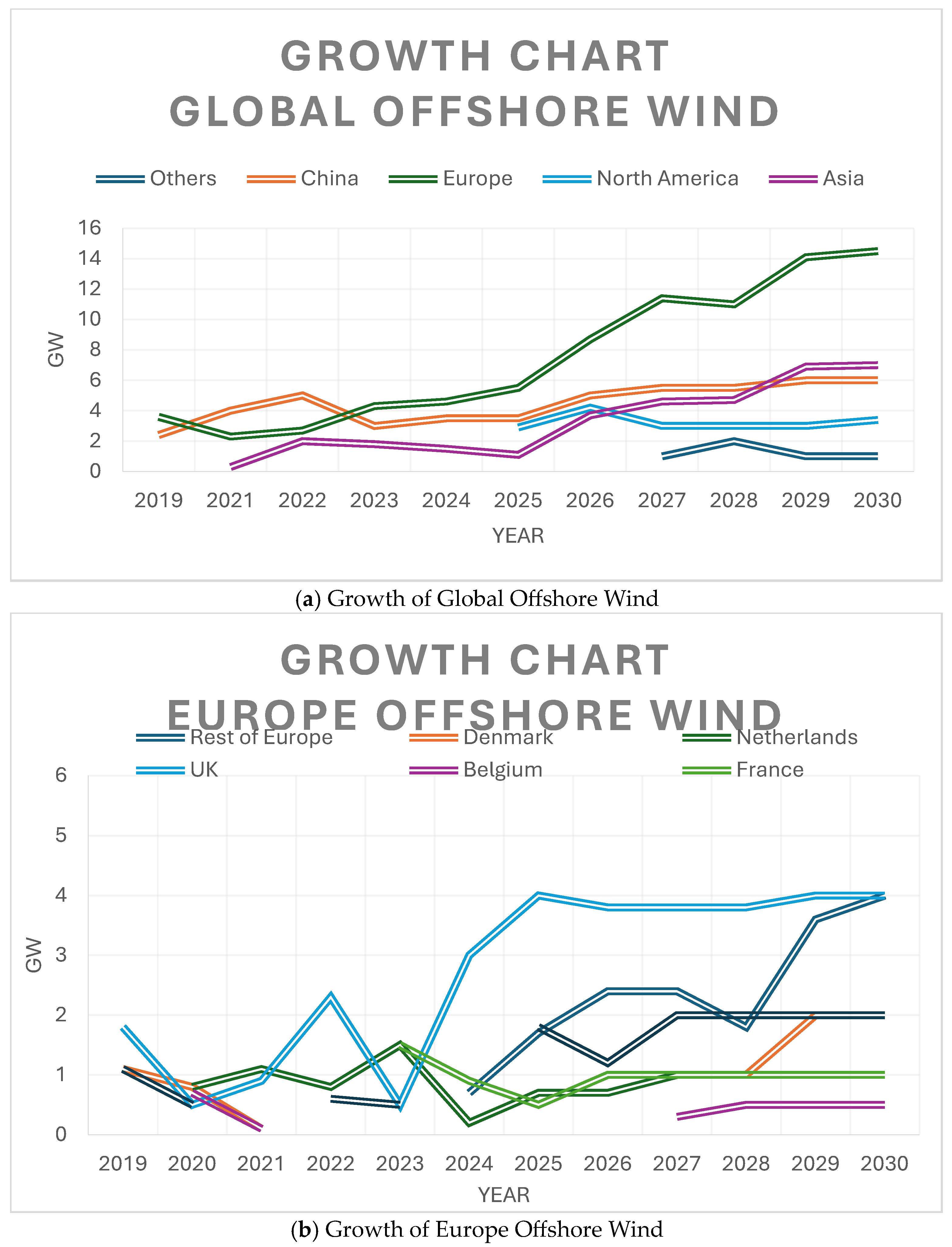
The European Commission’s publication of a dedicated EU strategy on ORE (COM(2020)741) on 19 November 2020 marked a pivotal step towards leveraging ORE to meet the EU’s ambitious energy and climate targets for 2030 and 2050 [3]. This strategy not only sets specific targets for offshore wind and ocean energy capacity by 2030 and 2050 but also recognizes the need to address broader issues beyond mere energy production. Recent years have witnessed remarkable progress in offshore wind technology, driven by declining costs and supportive policy frameworks, leading to a surge in offshore wind projects globally. The International Energy Agency (IEA) projects a fourfold increase in global offshore wind capacity by 2030, exceeding 250 GW [4]. Nonetheless, the seamless integration of offshore renewables into the grid requires navigating complex technical, regulatory, and economic challenges, emphasizing the authorities to effectively tackle these complexities to fully harness the potential of these abundant energy sources. Some of the key aspects addressed in the EU strategy include ensuring access to sea-space, fostering regional and international cooperation, enhancing industrial and employment dimensions, and facilitating the transfer of research projects from laboratory settings to practical applications. However, the trend of ORE specially offshore wind is gaining ascending momentum in the world and Europe as illustrated in Figure 1a and 1b, respectively [5].
Figure 1.
Growth Chart of Offshore Wind [5].
Grid integration of ORE entails the seamless incorporation of variable and intermittent energy sources, such as offshore wind and tidal energy, into existing electricity transmission and distribution networks. This process involves overcoming a myriad of challenges, including grid stability, transmission constraints, market design, and environmental considerations. Grid stability emerges as a primary concern due to the inherent variability of ORE, which can lead to fluctuations in power output and grid imbalances. To address this challenge, grid operators employ advanced control strategies, grid-scale energy storage systems, and flexible demand–response mechanisms [6]. Additionally, the spatial distribution of offshore wind farms and the distance to onshore grid connections influence transmission losses and grid congestion, requiring careful planning and optimization of transmission infrastructure [7].
Recent literature highlights several promising approaches and innovative solutions to enhance the integration of OREs into the grid. Advanced grid modeling techniques, such as high-resolution weather forecasting and machine learning algorithms, enable more accurate prediction of renewable energy output and grid behavior, facilitating optimal grid operation and planning [8]. Moreover, grid-forming converter technologies and different transmission options like high-voltage direct current (HVDC) or high-voltage AC transmission systems offer enhanced grid stability and flexibility, enabling the efficient integration of large-scale offshore wind farms [9,10].
Recent advances in the integration of offshore renewable energy sources, such as offshore wind and FPV systems, have increasingly focused on the role of BESS in enhancing grid flexibility and economic viability. For example, several studies have explored coordinated control strategies for wind–BESS systems to minimize curtailment and provide ancillary services such as frequency regulation and reserve support [11,12]. The emergence of hybrid offshore platforms that combine wind turbines and FPV with shared infrastructure has also drawn attention for its potential to optimize space and reduce grid connection costs [13]. In parallel, the integration of BESS into real-time electricity markets, including participation in aFRR and mFRR has been shown to significantly improve revenue streams while supporting grid stability [14,15]. Furthermore, recent modeling approaches have emphasized the need for location-specific, data-driven simulations that reflect market dynamics and weather variability to better assess techno-economic feasibility [16]. These developments highlight the growing need for flexible, market-aware strategies for renewable integration, motivating the present study.
Within the European context, Belgium and the Netherlands stand out as frontrunners in offshore renewable energy development, with ambitious plans to expand their offshore wind capacity in the North Sea, aiming for a targeted CO2-free energy system and high security of supply. Belgium targets to achieve 5.8 GW of offshore wind capacity by 2030, tripling its existing capacity [17,18], while the Netherlands targets 21 GW by 2030 [19] and 40 GW by 2050 [20]. These targets highlight the need to reconfigure grid infrastructure to accommodate the anticipated expansion of offshore wind generation in these coastal regions.
In Belgium, ongoing initiatives such as the Modular Offshore Grid (MOG) project demonstrate innovative approaches to offshore grid development, including the integration of multiple offshore wind farms through a shared grid connection hub [21]. Similarly, the Netherlands is advancing its offshore grid infrastructure through projects like the Borssele Alpha and Beta offshore platforms, which serve as key hubs for connecting offshore wind farms to the onshore grid [22].
One of the important aspects of ORE is the energy storage system, which significantly increases revenue generation. BESS supports energy trade by storing extra energy when demand and prices are low and discharging when prices are at peak, ultimately boosting revenue [23]. In addition, BESS can offer several grid services that generate extra revenue streams, e.g., frequency regulation, where it stabilizes the frequency of the grid by swiftly balancing fluctuations between supply and demand; and spinning reserve, by immediately discharging power to the grid as a reserve when needed. Several incentives and compensation mechanisms for these essential grid functions are being offered by markets, which encourage the deployment of BESS for these purposes [24,25]. Moreover, the BESS can significantly reduce power curtailment losses by storing surplus power that would otherwise not used due to grid constraints or due to positive system imbalance, ensuring maximum energy utilization [26].
This paper is part of the “Offshore for Sure (O4S)” research project, focusing on advancing a CO2-free, secure, and affordable energy system while advancing innovation and economic growth [27]. The project aims to increase knowledge valorization, strengthen supply chains, and promote nature-inclusive offshore wind farm designs in collaboration with environmental organizations. Moreover, the project underlines optimizing conditions for scaling ORE through research and stakeholder engagement, supporting high-quality coastal employment via educational partnerships, and addressing climate change impacts through integrated mitigation and adaptation strategies. Furthermore, it advocates adaptive policies that leverage expertise from the oil and gas sector, hydraulic engineering, ports, and the offshore wind industry to facilitate innovation and sustainable expansion.
Despite growing deployments of offshore wind and floating solar technologies, their integration into existing power systems remains challenging due to variability, curtailment, and grid congestion. Current literature often treats offshore renewables and battery storage independently or lacks location-specific simulations incorporating real-world market participation. This paper addresses this gap by presenting a case study using realistic Belgian load, weather, and market data to simulate the co-integration of offshore wind, floating PV, and BESS. This study focuses on how BESS can enhance system flexibility, reduce curtailment, and generate revenue through ancillary services. In particular, this paper explores how BESS can participate in automatic frequency restoration reserve (aFRR) and manual frequency restoration reserve (mFRR) markets, providing fast-response balancing services that support grid stability and unlock additional revenue streams.
This paper aims to evaluate the technical and economic impact of integrating offshore wind and floating solar with battery energy storage in a realistic grid context. This study simulates a hybrid system using Belgian 2023 load data, real weather conditions, and market prices. It investigates the role of BESS in enhancing system flexibility, reducing curtailment, and providing ancillary services. Additionally, it assesses the potential of BESS to support grid congestion management as outlined in the O4S project objectives. The findings are intended to inform future planning and policy decisions related to offshore renewable integration.
2. Offshore Renewable Energy (ORE)
Offshore renewable energy entails harnessing renewable resources situated in marine environments, typically beyond coastal regions. This form of energy generation has garnered substantial attention and momentum in recent years owing to its potential to combat climate change, bolster energy security, and drive sustainable development. Offshore renewable energy encompasses several types, including offshore wind [28], offshore solar, offshore ocean energy, and offshore biomass energy. Table 1 provides a comprehensive overview of these types, focusing on parameters such as efficiency, service life, CO2 emissions, environmental impact, and more. By diversifying energy sources and reducing reliance on fossil fuels, offshore renewable energy plays a crucial role in transitioning towards a cleaner and more sustainable energy future.
Table 1.
Levelized Cost of Electricity (LCOE) by Technology.
Offshore wind energy stands at the forefront of the renewable energy revolution, offering unparalleled advantages in energy generation, grid integration, and technical innovation. Harnessing the powerful offshore winds in expansive maritime territories, offshore wind farms provide a reliable and efficient source of clean electricity on a large scale. The proximity of offshore wind installations to densely populated coastal areas facilitate seamless grid integration, bolstered by advanced technologies such as HVDC transmission systems and offshore substations. Moreover, the scalability and modularity of offshore wind projects enable phased development and incremental capacity additions, while ongoing advancements in turbine design, foundation technologies, and installation methods contribute to cost-effectiveness and reliability. By integrating battery energy storage systems (BESSs), offshore wind projects further enhance their reliability, flexibility, and grid stability, smoothing out fluctuations in energy supply and demand and capturing additional revenue streams through ancillary services. As offshore wind and BESS technologies continue to evolve and mature, they play a pivotal role in accelerating the transition to a sustainable, resilient energy infrastructure, driving economic growth, and mitigating the impacts of climate change.
3. Offshore Wind Energy (OWE)
OWE had been rapidly advancing and maturing, particularly in regions like Europe and parts of Asia [28]. Technological advancements, cost reductions, supportive policies, and increasing investor confidence were driving significant growth in the offshore wind sector. However, to compare the insights and challenges of OWE with onshore wind energy, a brief explanation is provided in Table 2 [29,40,41,42,43]. Overall, while both onshore and offshore wind energy offer significant potential for renewable energy generation, they each come with their own set of opportunities and challenges that need to be carefully considered during project planning and development.
Table 2.
Advantages of Onshore versus Offshore Wind Energy [19,21,22,23].
Despite the successful deployment of offshore wind farms, effectively addressing climate change concerns and significantly reducing emissions, the integration of such large-scale offshore wind power plants into the power system poses challenges such as increased power quality (PQ) issues and system stability concerns. The challenges faced by the system stem from the operational mode (standalone or grid-connected) as well as structural and performance limitations inherent to the offshore wind power plants (OWPP). These PQ issues encompass concerns such as flickers, harmonics, voltage fluctuations, as well as voltage sag and swells [6,44,45].
4. Enhancing Grid Connection of OWPP
Mitigating grid connection and stability issues has garnered significant attention from researchers and operators due to the increasing integration of offshore wind power plants (OWPPs) into the grid. Recently, various devices and control techniques have been developed to enhance the overall interconnection of the interconnected power grid. Numerous studies have tackled these issues, e.g., Li and Yu et al. [46] explore the parallel operation of a diode rectifier-based high-voltage direct current (DR-HVDC) system and a modular multilevel converter-based HVDC (MMC-HVDC) system for transmitting offshore wind energy. This paper presents an improved active power control strategy for the offshore MMC station, designed to optimize power flow allocation between the MMC-HVDC and DR-HVDC transmission links connected to the wind farm’s AC grid. The method regulates the offshore voltage to direct all wind-generated power through the DR-HVDC line during low wind speeds while keeping the MMC’s power output close to zero, thereby reducing transmission losses. This approach leverages the greater efficiency of the DR-HVDC system compared to the MMC system. The stability of HVDC-connected offshore wind power plants (OWPPs) can be affected by oscillatory interactions involving power electronic converters, AC grid compensation devices, and dynamic control systems [47,48]. Key contributors to harmonic resonance oscillations in such systems include overcharging of extensive subsea cables and inrush currents associated with transformer connections.
Power quality (PQ) issues in OWPPs can significantly impact the stability and reliability of the power grid. To address these challenges, OWPPS needs to comply with stringent grid codes. These grid codes set forth standards and requirements for power quality, including limits on harmonics, voltage sags, flicker, and other disturbances. By adhering to these regulations, OWPPs can ensure that their integration into the power grid does not adversely affect overall grid performance, thereby enhancing both system stability and reliability. Ensuring compliance with grid codes is crucial for the seamless operation and acceptance of renewable energy sources within the broader energy infrastructure.
To ensure the implementation of grid codes in Belgium, the requirements set by Elia and other system operators involved developed a proposal for power generation modules (PGM) in Article 7(4) of the Network Code Requirements for Generators (NC RfG) [49]. Further, in line with the NC RfG Art. 5, Elia has proposed the following choice of maximum capacity thresholds for the determination of the type of PGM:
where is the maximum (installed) capacity of the power-generating modules and Vcp is the voltage level at the connection point.
Considering voltage sag/swell as per European standard EN 50160 and IEEE 1159 [50,51,52], a voltage sag caused by the penetration of wind generators may lead to disconnection if the voltage drops below a certain threshold. This voltage dip can also result in a high current through the IGBT inverter that connects a permanent magnet synchronous generator (PMSG) to the grid [53]. Therefore, the rapid mitigation of sags and swells in such events is crucial. Table 3 [6] outlines the voltage and time duration limits permitted by grid codes and regulations in various countries.
Table 3.
Grid Standards of connecting OREs.
The increased penetration of OWPP in the grid has drawn the attention of researchers and operators to the mitigation of PQ and stability issues. Recently, various devices and control techniques have been developed to enhance the power quality of the interconnected power grid, i.e., converter-based control technique, active power filtering using FACTS devices, energy storage systems, etc.
4.1. Converter-Based Technique
Recent developments have achieved better PQ and minimized harmonic currents by using converter-based control. While many studies have been conducted on DFIG controllers, newer systems often employ PMSG for their enhanced performance in variable-speed applications and their full converter systems with simplified grid integration [54].
Improvements in PQ and the mitigation of harmonic currents have been documented in the literature through the application of control algorithms on DFIG converters [55]. In reference [56], the grid-side control (GSC) of the wind energy system is adjusted to regulate the DC link voltage using the d-q transformation method. This method not only modifies the DC link voltage through active filtering but also mitigates harmonic currents. Reference [57] illustrates a DFIG-based wind energy system with nonlinear loads at the PCC. This (DFIG) system operates as both an active power generator and a harmonic filter. The grid-side converter (GSC) suppresses harmonic currents produced by nonlinear loads, while the rotor-side converter (RSC) utilizes a voltage-oriented control scheme to maintain unity power factor at the stator and enable maximum power point tracking (MPPT). Additionally, a sensorless stator flux-oriented control method is implemented for the RSC, further minimizing grid harmonics.
Zhang et al. [58] proposed a novel predictive control strategy for DFIG systems that significantly improves harmonic suppression and dynamic performance under fluctuating wind conditions. This is paralleled in PMSG systems, where Mourabit et al. (2024) demonstrated that adaptive predictive controllers for PMSG systems maintain robust harmonic suppression and dynamic response with fewer complexities than in DFIG systems [59]. Additionally, Lv and Bhat (2024) utilized an unscented Kalman filter in predictive current control for wind energy conversion systems using PMSG and superconducting magnetic energy storage to maintain stale grid connection during any variability in weather or connected load [60].
4.2. Active Power Filtering Using FACTS Devices
Flexible alternating current transmission systems (FACTS) are advanced power electronic devices designed to enhance the control and regulation of active and reactive power in electrical power networks. These devices can be configured in series, shunt, or combined topologies, depending on the specific needs of the power system grid [61].
Series-connected FACTS devices, such as thyristor-controlled series capacitors (TCSCs) and static synchronous series compensators (SSSCs) [62], are employed to control power flow and improve system stability by adjusting line impedance. Shunt-based FACTS devices, including static VAR compensators (SVCs) and static synchronous compensators (STATCOMs), provide dynamic reactive power support to maintain voltage levels and improve power quality. Hybrid FACTS devices, like the unified power flow controller (UPFC), combine both series and shunt functionalities to simultaneously control voltage and power flow, offering comprehensive solutions for network optimization [63].
Recent advancements in the field have focused on enhancing the efficiency and responsiveness of these devices through innovative control algorithms and integration techniques. For instance, Riahinasab et al. (2023) developed an advanced control strategy for UPFCs that significantly improves the dynamic response and stability of power systems under varying load conditions. This strategy leverages real-time data and adaptive control mechanisms to optimize performance [64]. Additionally, Kumar and Amit proposed an innovative approach to optimizing STATCOM performance using machine learning techniques. Their method dynamically adjusts operational parameters based on predictive models, resulting in more efficient voltage regulation and enhanced power quality [65].
4.3. Solution Based on Energy Storage System (ESS)
Energy storage systems (ESSs) play a significant role in improving the power quality (PQ) of generated power by regulating the output voltage of OWPP. The electrical power produced by wind turbines is dependent on wind speed, affecting both PQ and system planning [66]. ESSs typically include components such as batteries, flywheels, superconducting magnetic energy storage systems (SMES), supercapacitors, compressed air systems, pumped hydro storage, and hydrogen production systems. An ESS is usually connected to the intermediate DC link capacitor of back-to-back power electronic converters for power conversion. The battery energy storage system (BESS), besides storing energy, also regulates active and reactive power at the point of common coupling (PCC), thereby maintaining system stability [67].
A control strategy for enhancing the stability of grid-connected wind farms using superconducting magnetic energy storage (SMES) for reactive power compensation is introduced in [68]. This hierarchical control approach improves transient stability by leveraging the SMES’s rapid four-quadrant power control capabilities. Ref. [69] further demonstrates enhanced transient performance and voltage regulation using a fuzzy logic-controlled SMES. Another study [70] proposes a hybrid system integrating a doubly fed induction generator (DFIG) with a fuel cell, employing vector-controlled back-to-back converters to manage power distribution among the grid, fuel cell, and generator.
Beyond SMES, flywheel energy storage (FES) systems have proven effective in suppressing power surges during grid faults in offshore wind power plants (OWPPs) [71]. Another study reported in [72] investigates the role of FES in stabilizing power fluctuations, specifically in an 80 MW DFIG-based OWPP. Additionally, supercapacitor-based energy storage systems (ESS) offer a viable solution for mitigating voltage flicker in weak grids with high wind penetration. When combined with advanced filtering control methods, these systems outperform conventional reactive power compensation in flicker suppression [73,74].
The International Renewable Energy Agency (IRENA) has outlined a strategic action agenda for the deployment of offshore renewables, emphasizing the importance of integrating advanced ESS. This agenda aims to facilitate the large-scale adoption of offshore wind, ocean energy, and floating photovoltaics, which are essential for maintaining PQ and supporting grid stability [75]. Table 4 provides the summarized recommendations of IRENA’s strategic action plans for ESS in ORE.
Table 4.
Comparison of ESS in ORE.
The integration of ESSs is crucial for improving the PQ of offshore renewable energy systems. Technologies such as BESSs, FES, SMES, and supercapacitors offer effective solutions for managing power variability and ensuring stable grid operation. Continued research and strategic planning are essential to harness the full potential of ESSs in supporting the global transition to renewable energy.
Besides improving the PQ of ORE, ESSs mitigate the impact of intermittency associated with renewable power, enhance grid stability, and reduce reliance on fossil fuel-based peaking plants, contributing to a cleaner energy mix. They also support reducing power curtailment by storing excess energy that would otherwise be wasted when generation exceeds grid capacity. This stored energy can be dispatched when generation is low or demand is high, ensuring continuous and optimal use of generated power. Moreover, integrating BESSs with ORE can significantly enhance revenue generation by enabling the storage and sale of excess power during peak demand periods. This increases the value of the electricity generated and allows for participation in frequency regulation and ancillary service markets, providing additional revenue streams.
5. Simulation Model of BESS Connected to Offshore Wind and Floating Solar PV
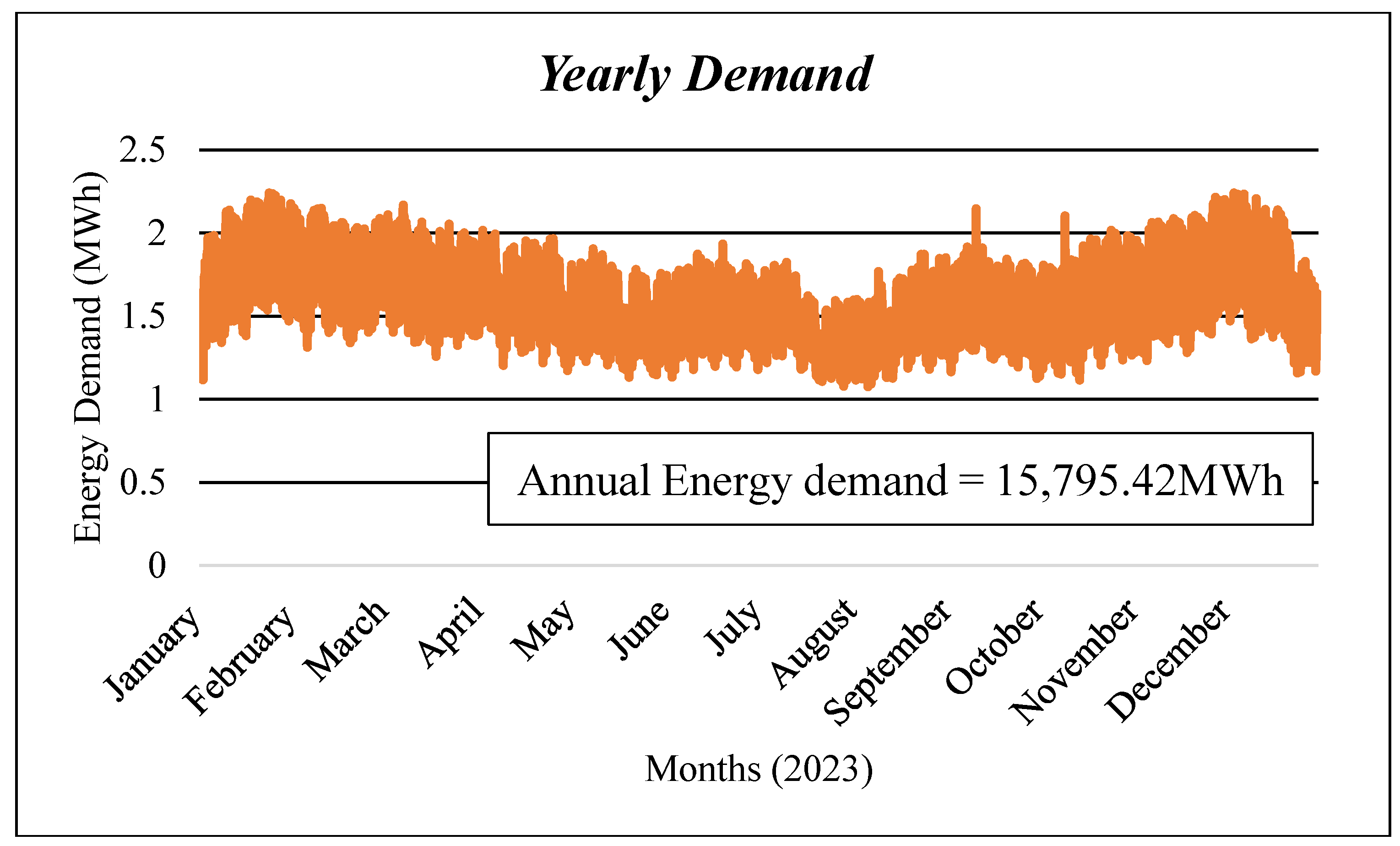
An autonomous offshore renewable energy-based simulation model was developed in Python Spyder Version 5. The model consists of a grid-connected offshore wind farm with a maximum power generation capacity of 5 MW; a variable wind speed profile was considered, with an average wind speed of 13 m/s, whereas the cut-in and cut-out wind speed were 3.5 m/s and 25 m/s, respectively. While floating solar PV of 2 MW is supplying power to the transmission line through a DC-AC converter. The simulation was carried out for one year (2023) with a time step of 1 h, with a converter efficiency of 95% [86,87] to have full power captured from ORE sources. The considered load profile during the simulation is shown in Figure 2, a typical pattern of Belgian energy demand of year 2023, here considered as a fractional part just for analysis purposes of the designed ORE.
Figure 2.
Power Demand Profile.
5.1. Characteristics of Wind Turbine
The output power of wind turbines is calculated based on cut-in and cut-out speed as in Equation (1):
For practical consideration, the value of air density (ρ) is 1.225 kg/m3, rotor radius is 90 m, and power coefficient Cp is 0.4. To calculate wind energy Ewind over the period of T, the following mathematical expression was used, and Pwind has been integrated.
5.2. Floating Solar PV
A floating solar PV or floating PV (FPV) system involves solar panels mounted on a floating structure on a body of water, i.e., rivers, lakes, or oceans. This modern approach powers the unemployed surface of water bodies to produce electricity without occupying valued land resources [88,89,90]. To model the power output of floating solar systems, various aspects must be considered, involving solar irradiance, efficiency of panel, effects of temperature, and the incidence angle [91]. Mathematical expressions for solar irradiations and efficiency are mentioned below:
- Solar irradiance
- Efficiency of Panels
The output power from FPV concerning time can be calculated as per Equation (5):
where A is the total area of solar panels and T(t) is the operational temperature of panels at time t. The operating temperature T(t) of the floating solar panels is influenced by the ambient temperature Tambient(t) and the cooling effect of the water, such as below:
where ΔT is an increase in temperature due to the operation of the panels, which is lower in FPV due to the temperature of the water.
5.3. Battery Energy Storage System (BESS)
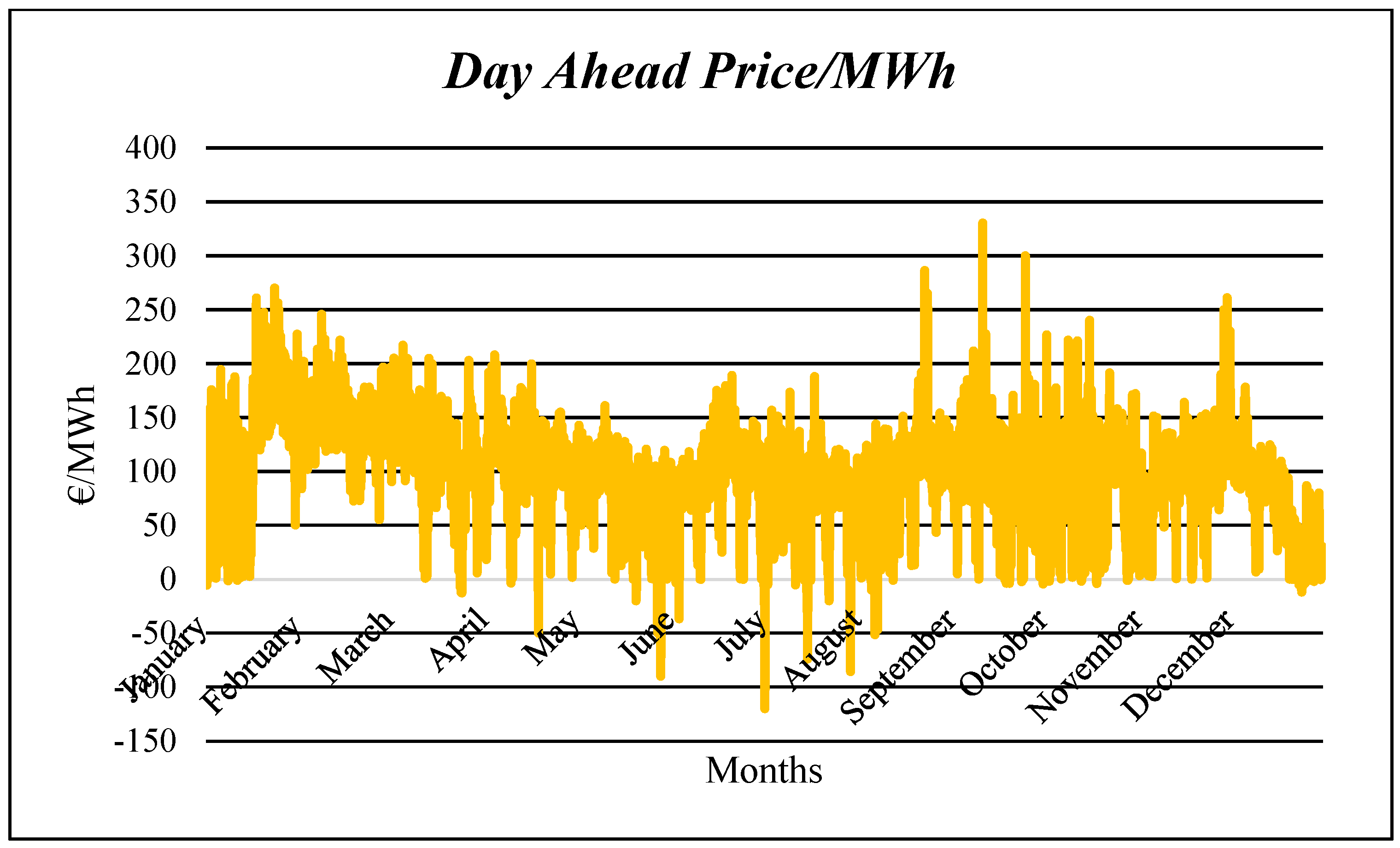
The BESS in an ORE setup serves as an energy storage unit that supports balanced supply/demand and provides ancillary services. Although, to participate in market reserve services, there is a bidding process and all energy suppliers participate, and there is a risk of losing the bidding process. However, if successful in the bidding process, then BESSs can be capable of generating extra revenue. With the decreasing trend in price and increasing trend of output efficiency of battery technology, the payback time has been shortened by a big margin [92]. In this simulation, day-ahead pricing taken from openly available data from the Elia website [93] for the year 2023 has been considered, as illustrated in Figure 3. With this, the following constraints have been implemented to make sure that system participates to generate additional revenue keeping in the pricing mechanism. Hence, the system makes a decision based on historical data where it has been assumed the successful bidding of providing market reserve services. Which in this case, 10% of total BESS capacity is reserved for these services.
Figure 3.
Considered day-ahead price profile for year 2023 [93].
- Price Thresholds: Buy electricity when prices are low, sell when prices are high.
- Time-based Rules: Charge during off-peak hours and discharge during peak demand hours, leveraging daily price fluctuations.
- Charging/Discharging: The battery can only charge or discharge at each time step.
- Energy Arbitrage vs. Grid Services: The BESS can be programmed to prioritize grid services (e.g., frequency regulation or balancing supply and demand) over energy arbitrage when needed, ensuring grid stability takes precedence.
- Dynamic Rule Adjustments: The system can dynamically adjust between arbitrage and grid services based on real-time price signals and grid service compensation rates. The BESS will prioritize providing these services if compensation for grid services is higher than energy arbitrage profits.
6. Results and Discussion
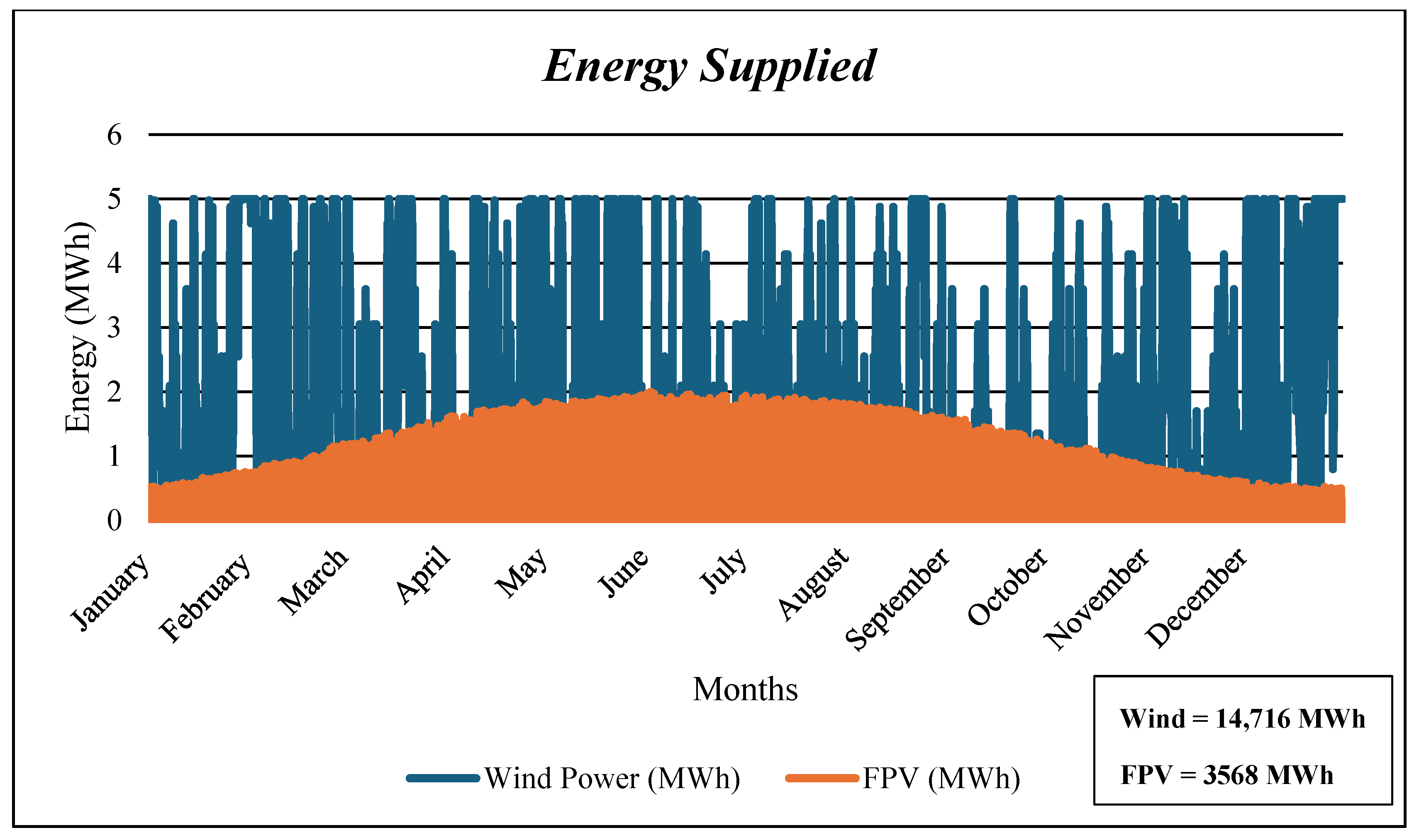
To show the importance of utilizing BESS in the considered ORE system, validation has been conducted with BESS and without BESS. All the other parameters are kept the same, i.e., wind and FPV generation as can be seen in Figure 4, load profile, pricing mechanism (day-ahead) data taken from Belgium annual energy consumption of year 2023, and limit for energy export/import from grid. Furthermore, the simulation begins with the input of energy supplied by wind and FPV for one calendar year at the time step of 1 h, as seen in Figure 3, with the total energy supplied by individual technology during the year 2023 mentioned in the boxes. The system is supposed to supply the load profile provided in Figure 2 by maintaining energy balance between supply and demand by importing energy from grid and exporting when the ORE has surplus power keeping historical data of day-ahead pricing in case of ORE without a BESS.
Figure 4.
Annual Energy Output of Wind and FPV.
In the case of ORE without BESS, the ORE only participates in energy arbitrage and is restricted by grid congestion, and the system must curtail power and revenue generation from the export of energy will be limited. The total revenue will be calculated based on Equation (7), as follows:
However, in the case of ORE with a BESS, the system will minimize the operational cost by following the constraints mentioned in sub-Section 5.3. By following the constraints, the system will be intelligent enough to decide when to export/import energy and charge/discharge battery based on historical data. Hence, the revenue calculation used Equation (8), as follows:
To calculate revenue more realistically from BESS technology (Li-ion), the CAPEX, OPEX (fixed and variable OMC), capacity degradation factor, self-discharge rate per 1000 h of use, and battery service life have been considered. Table 5 below provides a comparison of energy supplied during the year 2023 by ORE, grid, and BESS.
Table 5.
Energy Comparison of the Proposed System.
As can be seen from Table 5, with the utilization of BESSs, the energy exported to the grid increases, which shows that additional revenue streams can be generated from energy arbitrage. However, the option to participate in providing market ancillary services with the BESS, which in this case is considered to provide aFRR and mFRR in ensuring grid stability, also generates extra revenue. However, the total revenue generation from energy arbitrage and grid services is accumulated in Table 6.
Table 6.
Cost and Revenue Comparison of the Proposed System.
From the above table and based on the revenue calculation formula mentioned in Equations (7) and (8), the net profit from both the system are
One of the major concerns of investors is certainty in participating in market reserve services, and which energy supplier is going to win the bid. To tackle this issue, the simulation was conducted with BESS and without participation in the market reserve service (aFRR and mFRR). The system now only participates in energy arbitrage (import/export), and the amount of energy exported and imported is 9225 MWh and 7257 MWh. Hence, by using Equation (7), the revenue is estimated as below:
With the above net revenue generated from different cases, BESS technology can provide additional revenue based on its participation in arbitrage and market reserve services. For more analysis based on the investment in BESS technology, the payback time can be calculated on CAPEX, OPEX, and service life. For this, Table 7 [94] provides details about the payback time of different available BESS technologies, keeping the annual revenue generation constant.
Table 7.
Payback period of BESS Technologies.
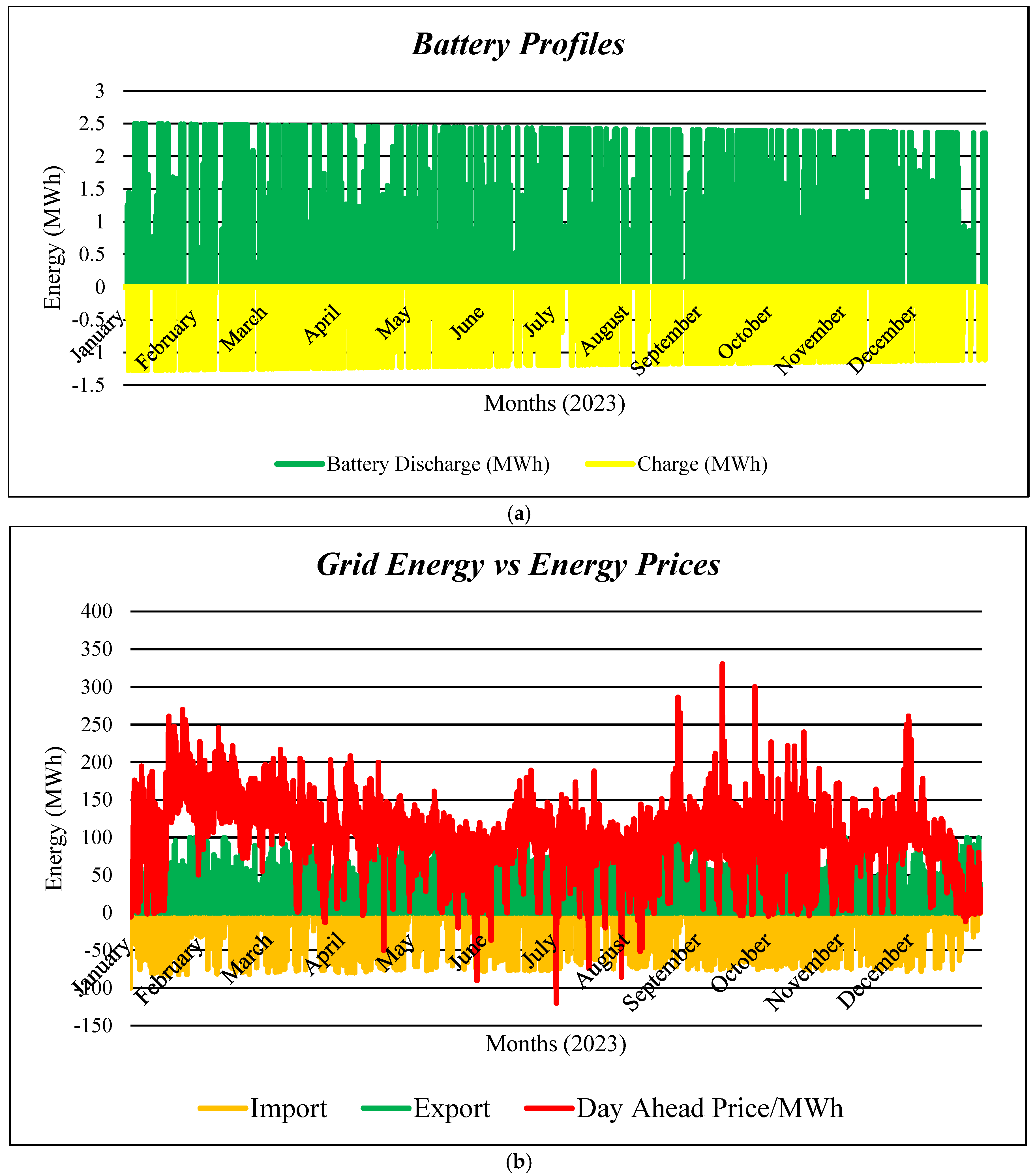
The energy profiles of battery charge/discharge and grid import/export for the year 2023 considered are given in Figure 5a,b below. For the figure, the proposed system is optimizing the total energy cost by importing and exporting energy based on the given constraints.
Figure 5.
Profiles of energy: (a) charging/discharging of BESS and (b) grid import/export.
The findings of this study offer practical insights for policymakers and investors involved in offshore renewable energy planning. The integration of offshore wind, floating PV, and battery storage aligns with Belgium’s National Energy and Climate Plan (NECP) targets, supporting the transition to a low-carbon energy system. By demonstrating the economic viability of allocating a portion of BESS capacity for ancillary services (aFRR and mFRR), this study highlights the need for regulatory frameworks that incentivize storage participation in balancing markets. Furthermore, the BESS contributes to congestion management by storing excess generation and deferring the need for immediate grid reinforcements. This co-located hybrid system also enhances the investment case through diversified revenue streams, including energy arbitrage and reserve services, which improve project bankability. The proposed model is scalable and can be replicated in other European coastal regions where offshore expansion and grid bottlenecks are major concerns.
7. Conclusions
This paper highlights the viability and advantages of incorporating BESSs with ORE and the existing power grid, as proven by the proposed case study. The system successfully demonstrated the utilization of BESSs by following the constraints and maintaining a balance between supply and demand. A total of 10% of the total BESS capacity was reserved for providing market reserve services, which in turn increased the net revenue. The use of 2023 Belgian load and electricity price data, along with location-specific renewable generation profiles, ensures that the findings are grounded in real-world operational and market conditions. The results obtained also demonstrated the ability of BESSs to play their part in a sustainable and environmentally friendly energy system with their high efficiency and minimum payback time, as mentioned in Table 7. Additionally, as of the project O4S requirement to demonstrate BESSs as one of the solutions to reduce grid congestion, this BESS can be utilized to store the access energy to reduce power curtailment and supply the energy when there is no congestion.
Future research should expand the scope of this work by integrating advanced data-driven techniques and addressing operational uncertainties. In particular, machine learning models, such as those presented in Giannelos et al., 2023 [95], which follow a structured 10-step development and evaluation framework, can be employed to improve the forecasting accuracy of renewable generation, load profiles, and market prices. These improvements would enhance the operational planning and revenue optimization strategies for hybrid offshore renewable and storage systems. Additionally, incorporating uncertainty quantification techniques, such as those proposed by Memon et al., 2020 [96], will be critical for capturing the stochastic behavior of renewable resources and market dynamics. This would enable the design of more resilient control and dispatch strategies. Future studies should also explore the application of reinforcement learning, digital twins for real-time system emulation, and sector coupling strategies (e.g., integration with hydrogen or district heating systems) to further increase the flexibility and value of offshore renewable systems with BESSs.
Author Contributions
Conceptualization, methodology, software, S.H.Q.; validation, M.D.K. and D.B.; formal analysis, S.H.Q. and D.B.; investigation, S.H.Q.; writing—original draft preparation, S.H.Q.; writing—review and editing, M.D.K., D.B. and L.V.; visualization, and supervision, L.V.; funding acquisition, L.V. All authors have read and agreed to the published version of the manuscript.
Funding
This research is partly financed by the Offshore For Sure project, which receives funding from the Interreg Vlaanderen-Nederland 2021-2027 program VI, financed by the European Regional Development Fund under subsidy contract number Int6B015.
Data Availability Statement
The original contributions presented in the study are included in the article, further inquiries can be directed to the corresponding author.
Acknowledgments
We extend our gratitude to the Ministry of Economic Affairs in the Netherlands, the Dutch provinces of Zeeland, North Brabant, and South Holland, as well as the Flemish Agency for Innovation and Entrepreneurship (VLAIO) and the province of East Flanders for their generous contributions. We are also grateful to our project partners from EcoPower, Belgium, and BlueSpring, the Netherlands, for their valuable input to improve the content.
Conflicts of Interest
Author Marvi Dashi Kalhoro is employed by the Team Lead. The remaining authors declare that the research was conducted in the absence of any commercial or financial relationships that could be construed as a potential conflict of interest.
Abbreviations
| List of Acronyms | |
| BESS | Battery Energy Storage System |
| DFIG | Doubly Fed Induction Generator |
| DR-HVDC | Diode Rectifier High-Voltage Direct Current |
| ELIA | Belgian Transmission System Operator |
| EN | European Norm |
| ESS | Energy Storage System |
| EU | European Union |
| FACTS | Flexible Alternating Current Transmission System |
| FES | Flywheel Energy Storage |
| FPV | Floating Photovoltaic (Solar) |
| GSC | Grid-Side Converter |
| HVAC | High-Voltage Alternating Current |
| HVDC | High-Voltage Direct Current |
| IEA | International Energy Agency |
| IRENA | International Renewable Energy Agency |
| MMC-HVDC | Modular Multilevel Converter High-Voltage Direct Current |
| MPPT | Maximum Power Point Tracking |
| NC RfG | Network Code Requirements for Generators |
| ORE | Offshore Renewable Energy |
| OWE | Offshore Wind Energy |
| OWPP | Offshore Wind Power Plant |
| PGM | Power Generation Module |
| PQ | Power Quality |
| RSC | Rotor Side Converter |
| SMES | Superconducting Magnetic Energy Storage |
| SOC | State of Charge |
| SSSC | Static Synchronous Series Compensator |
| STATCOM | Static Synchronous Compensator |
| SVC | Static VAR Compensator |
| TCSC | Thyristor-Controlled Series Capacitor |
| UPFC | Unified Power Flow Controller |
| VSC | Voltage Source Converter |
| List of Symbols | |
| A | Area of solar panels |
| C_p | Power coefficient |
| E_battery_max | Maximum energy capacity of battery (in MWh) |
| E_total_wind | Total energy output of all wind turbines |
| E_wind | Energy produced by wind |
| I(t) | Solar irradiance at time t |
| I0 | Peak solar irradiance |
| P_charge | Power used to charge (in MW) |
| P_demand | Power demand (load) |
| P_discharge | Power drawn from battery (in MW) |
| P_rated | Rated power output |
| P_renewable_eff | Effective renewable power output |
| P_solar(t) | Power from solar PV at time t |
| P_surplus | Surplus power |
| P_wind(v) | Power output from wind at wind speed v |
| SOC_new | Updated battery state of charge |
| SOC_old | Previous state of charge |
| T | Operating temperature |
| T_ambient(t) | Ambient temperature at time t |
| T_ref | Reference temperature |
| T_sunrise/T_sunset | Time of sunrise and sunset |
| V_cut-in/V_cut-out/V_rated | Cut-in, cut-out, and rated wind speeds |
| beta | Temperature coefficient |
References
- van der Loos, H.A.; Negro, S.O.; Hekkert, M.P. Low-carbon lock-in? Exploring transformative innovation policy and offshore wind energy pathways in The Netherlands. Energy Res. Soc. Sci. 2020, 69, 101640. [Google Scholar] [CrossRef]
- Jefferson, M. Renewable and low carbon technologies policy. Energy Policy 2018, 123, 367–372. [Google Scholar] [CrossRef]
- An EU Strategy to Harness the Potential of Offshore Renewable Energy for a Climate Neutral Future. Available online: https://eur-lex.europa.eu/legal-content/EN/TXT/?uri=COM:2020:741:FIN&qid=1605792629666 (accessed on 15 September 2024).
- IEA 2019 Technical Report Offshore Wind Outlook 2019. Available online: https://www.iea.org/reports/offshore-wind-outlook-2019 (accessed on 15 September 2024).
- Global Offshore Wind Report 2020. 2020. Available online: https://wfo-global.org/wp-content/uploads/2021/09/WFO_Global-Offshore-Wind-Report-2020.pdf (accessed on 15 September 2024).
- Ali, S.W.; Sadiq, M.; Terriche, Y.; Naqvi, S.A.R.; Mutarraf, M.U.; Hassan, M.A.; Yang, G.; Su, C.-L.; Guerrero, J.M. Offshore wind farm-grid integration: A review on infrastructure, challenges, and grid solutions. IEEE Access 2021, 9, 102811–102827. [Google Scholar] [CrossRef]
- Gurung, N.; Bhattarai, R.; Kamalasadan, S. Optimal oscillation damping controller design for large-scale wind integrated power grid. IEEE Trans. Ind. Appl. 2020, 56, 4225–4235. [Google Scholar] [CrossRef]
- Messner, J.W.; Pinson, P.; Browell, J.; Bjerregård, M.B.; Schicker, I. Evaluation of wind power forecasts—An up-to-date view. Wind Energy 2020, 23, 1461–1481. [Google Scholar] [CrossRef]
- Rahman, S.; Khan, I.; Alkhammash, H.I.; Nadeem, M.F. A comparison review on transmission mode for onshore integration of offshore wind farms: HVDC or HVAC. Electronics 2021, 10, 1489. [Google Scholar] [CrossRef]
- Tang, Z.; Yang, Y.; Blaabjerg, F. Power electronics: The enabling technology for renewable energy integration. CSEE J. Power Energy Syst. 2021, 8, 39–52. [Google Scholar]
- Hou, P.; Yang, G.; Enevoldsen, P.; Nielsen, A.H. Cooperation of offshore wind farm with battery storage in multiple electricity markets. In Proceedings of the 2018 53rd International Universities Power Engineering Conference (UPEC), Glasgow, UK, 4–7 September 2018; pp. 1–6. [Google Scholar]
- Elgammal, A.; Jagessar, M. Optimal control strategy for a marine current farm integrated with a hybrid PV system/offshore wind/battery energy storage system. Eur. J. Electr. Eng. Comput. Sci. 2020, 4, 1–8. [Google Scholar] [CrossRef]
- Khurshid, H.; Mohammed, B.S.; Al-Yacoubya, A.M.; Liew, M.; Zawawi, N.A.W.A. Analysis of hybrid offshore renewable energy sources for power generation: A literature review of hybrid solar, wind, and waves energy systems. Dev. Built Environ. 2024, 19, 100497. [Google Scholar] [CrossRef]
- Hu, Y.; Armada, M.; Sánchez, M.J. Potential utilization of battery energy storage systems (BESS) in the major European electricity markets. Appl. Energy 2022, 322, 119512. [Google Scholar] [CrossRef]
- Tian, Y.; Bera, A.; Benidris, M.; Mitra, J. Stacked revenue and technical benefits of a grid-connected energy storage system. IEEE Trans. Ind. Appl. 2018, 54, 3034–3043. [Google Scholar] [CrossRef]
- Bin Abu Sofian, A.D.A.; Lim, H.R.; Siti Halimatul Munawaroh, H.; Ma, Z.; Chew, K.W.; Show, P.L. Machine learning and the renewable energy revolution: Exploring solar and wind energy solutions for a sustainable future including innovations in energy storage. Sustain. Dev. 2024, 32, 3953–3978. [Google Scholar] [CrossRef]
- The Marine Spatial Plan for 2020–2026. Available online: https://www.health.belgium.be/sites/default/files/uploads/fields/fpshealth_theme_file/brochure_something_is_moving_at_sea_2020.pdf (accessed on 18 October 2024).
- Global Offshore Wind: Belgium. Available online: https://www.nortonrosefulbright.com/en-nl/knowledge/publications/816b71d7/global-offshore-wind-netherlands (accessed on 18 October 2024).
- Offshore Wind Energy. Available online: https://www.government.nl/latest/news/2023/12/19/offshore-wind-the-netherlands-well-on-schedule-tender-round-to-double-capacity-will-start-early-2024 (accessed on 25 October 2024).
- Dutch Offshore Wind Market Report 2024. Available online: https://www.rvo.nl/sites/default/files/2023-04/Offshore-Wind-Market-Report.pdf (accessed on 12 October 2024).
- Elia. Modular Offshore Grid (MOG). 2022. Available online: https://www.google.com/url?sa=t&rct=j&q=&esrc=s&source=web&cd=&ved=2ahUKEwjZuu7iwqKNAxV98bsIHbAJArIQFnoECBwQAQ&url=https%3A%2F%2Fwww.elia.be%2F-%2Fmedia%2Fproject%2Felia%2Fshared%2Fdocuments%2Felia-news%2F2022%2Felia-news-february-2022_en.pdf&usg=AOvVaw13oeZGO9H1TWu6ClxZfglt&opi=89978449 (accessed on 11 September 2024).
- Development Framework for Offshore Wind Energy. Available online: https://english.rvo.nl/sites/default/files/2023-07/Development%20Framework%20offshore%20wind%20energy%20%28June%202022%29.pdf (accessed on 11 September 2024).
- Maeyaert, L.; Vandevelde, L.; Döring, T. Battery storage for ancillary services in smart distribution grids. J. Energy Storage 2020, 30, 101524. [Google Scholar] [CrossRef]
- Qazi, S.H.; Bozalakov, D.V.; Vandevelde, L. Frequency and power shaving controller for grid-connected vanadium redox flow batteries for improved energy storage systems. Front. Energy Res. 2024, 12, 1393728. [Google Scholar] [CrossRef]
- Engels, J.; Claessens, B.; Deconinck, G. Techno-economic analysis and optimal control of battery storage for frequency control services, applied to the German market. Appl. Energy 2019, 242, 1036–1049. [Google Scholar] [CrossRef]
- International Renewable Energy Agency. Utility-scale batteries. In Innovation Landscape Brief; International Renewable Energy Agency: Abu Dhabi, United Arab Emirates, 2019. [Google Scholar]
- Offshore For Sure (O4S). Available online: https://interregvlaned.eu/offshore-for-sure-o4s/ (accessed on 15 September 2024).
- Bórawski, P.; Bełdycka-Bórawska, A.; Jankowski, K.J.; Dubis, B.; Dunn, J.W. Development of wind energy market in the European Union. Renew. Energy 2020, 161, 691–700. [Google Scholar] [CrossRef]
- Desalegn, B.; Gebeyehu, D.; Tamrat, B.; Tadiwose, T.; Lata, A. Onshore versus offshore wind power trends and recent study practices in modeling of wind turbines’ life-cycle impact assessments. Clean. Eng. Technol. 2023, 17, 100691. [Google Scholar] [CrossRef]
- Paredes, M.G.; Padilla-Rivera, A.; Güereca, L.P. Life cycle assessment of ocean energy technologies: A systematic review. J. Mar. Sci. Eng. 2019, 7, 322. [Google Scholar] [CrossRef]
- Uihlein, A. Life cycle assessment of ocean energy technologies. Int. J. Life Cycle Assess. 2016, 21, 1425–1437. [Google Scholar] [CrossRef]
- Rahman, A.; Farrok, O.; Haque, M.M. Environmental impact of renewable energy source based electrical power plants: Solar, wind, hydroelectric, biomass, geothermal, tidal, ocean, and osmotic. Renew. Sustain. Energy Rev. 2022, 161, 112279. [Google Scholar] [CrossRef]
- Li, G.; Zhu, W. Tidal current energy harvesting technologies: A review of current status and life cycle assessment. Renew. Sustain. Energy Rev. 2023, 179, 113269. [Google Scholar] [CrossRef]
- Islam, M.; Hasanuzzaman, M.; Pandey, A.; Rahim, N. Modern energy conversion technologies. In Energy for Sustainable Development; Elsevier: Amsterdam, The Netherlands, 2020; pp. 19–39. [Google Scholar]
- Langer, J.; Quist, J.; Blok, K. Recent progress in the economics of ocean thermal energy conversion: Critical review and research agenda. Renew. Sustain. Energy Rev. 2020, 130, 109960. [Google Scholar] [CrossRef]
- Vo, T.T.E.; Ko, H.; Huh, J.; Park, N. Overview of possibilities of solar floating photovoltaic systems in the offshore industry. Energies 2021, 14, 6988. [Google Scholar] [CrossRef]
- Hooper, T.; Armstrong, A.; Vlaswinkel, B. Environmental impacts and benefits of marine floating solar. Sol. Energy 2021, 219, 11–14. [Google Scholar] [CrossRef]
- Santhakumar, S.; Meerman, H.; Faaij, A. Future costs of key emerging offshore renewable energy technologies. Renew. Energy 2024, 222, 119875. [Google Scholar] [CrossRef]
- Ni, T.N.K.; Hang, H.T.M.; Uyen, N.T.; Binh, N.H.; Jamet, C.; Tin, H.C. Quantifying biomass and canopy cover of submerged aquatic vegetation on an offshore island. Reg. Stud. Mar. Sci. 2023, 66, 103117. [Google Scholar] [CrossRef]
- Gao, A.M.-Z.; Huang, C.-H.; Lin, J.-C.; Su, W.-N. Review of recent offshore wind power strategy in Taiwan: Onshore wind power comparison. Energy Strategy Rev. 2021, 38, 100747. [Google Scholar] [CrossRef]
- Adedipe, O.; Abolarin, M.; Mamman, R. A review of onshore and offshore wind energy potential in Nigeria. IOP Conf. Ser. Mater. Sci. Eng. 2018, 413, 012039. [Google Scholar] [CrossRef]
- Hevia-Koch, P.; Jacobsen, H.K. Comparing offshore and onshore wind development considering acceptance costs. Energy Policy 2019, 125, 9–19. [Google Scholar] [CrossRef]
- Ling-Chin, J.; Roskilly, A.P. A comparative life cycle assessment of marine power systems. Energy Convers. Manag. 2016, 127, 477–493. [Google Scholar] [CrossRef]
- Ferdinand, R.; Melzer, P.; Monti, A. Power quality issues at the grid connection point of HVDC connected offshore wind farms and their influence on the production. In Proceedings of the 2018 IEEE PES Innovative Smart Grid Technologies Conference Europe (ISGT-Europe), Sarajevo, Bosnia and Herzegovina, 21–25 October 2018; pp. 1–6. [Google Scholar]
- Qin, C.; Ju, P.; Wu, F.; Jin, Y.; Chen, Q.; Sun, L. A coordinated control method to smooth short-term power fluctuations of hybrid offshore renewable energy conversion system (HORECS). In Proceedings of the 2015 IEEE Eindhoven PowerTech, Eindhoven, The Netherlands, 29 June–2 July 2015; pp. 1–5. [Google Scholar]
- Li, R.; Yu, L.; Xu, L.; Adam, G.P. Coordinated control of parallel DR-HVDC and MMC-HVDC systems for offshore wind energy transmission. IEEE J. Emerg. Sel. Top. Power Electron. 2019, 8, 2572–2582. [Google Scholar] [CrossRef]
- Harnefors, L.; Yepes, A.G.; Vidal, A.; Doval-Gandoy, J. Passivity-based controller design of grid-connected VSCs for prevention of electrical resonance instability. IEEE Trans. Ind. Electron. 2014, 62, 702–710. [Google Scholar] [CrossRef]
- Cheah-Mane, M.; Liang, J.; Jenkins, N.; Sainz, L. Electrical resonance instability study in HVDC-connected offshore wind power plants. In Proceedings of the 2016 IEEE Power and Energy Society General Meeting (PESGM), Boston, MA, USA, 17–21 July 2016; pp. 1–5. [Google Scholar]
- Network Code Requirements for Generators’ or ‘NC RfG’: Commission Regulation (EU) 2016/631 of 14 April 2016 Establishing a Network Code on Requirements for Grid Connection of Generators. 2016. Available online: https://eur-lex.europa.eu/legal-content/EN/TXT/PDF/?uri=CELEX:32016R0631&from=EN (accessed on 15 October 2024).
- Han, Y.; Feng, Y.; Yang, P.; Xu, L.; Xu, Y.; Blaabjerg, F. Cause, classification of voltage sag, and voltage sag emulators and applications: A comprehensive overview. IEEE Access 2019, 8, 1922–1934. [Google Scholar] [CrossRef]
- Std 1159-1995; IEEE Recommended Practice for Monitoring Electric Power Quality. IEEE: New York, NY, USA, 2019.
- Dhakulkar, S.D.; Manwar, V.A.; Banole, S.G.; Rakhonde, B.S. Inspection of Voltage Sags and Voltage Swells Incident in Power Quality Problems—A Review. Int. Res. J. Eng. Technol. 2017, 4, 1734–1736. [Google Scholar]
- Eskander, M.N.; Amer, S.I. Mitigation of voltage dips and swells in grid-connected wind energy conversion systems. IETE J. Res. 2011, 57, 515–524. [Google Scholar] [CrossRef]
- Shutari, H.; Ibrahim, T.; Nor, N.B.M.; Abdulrab, H.Q.; Saad, N.; Al-Tashi, Q. Coordination of enhanced control schemes for optimal operation and ancillary services of grid-tied VSWT system. IEEE Access 2023, 11, 43520–43535. [Google Scholar] [CrossRef]
- Hafez, W.A.; Abd El Sattar, M.; Alaboudy, A.H.K.; Elbaset, A.A. Power quality issues of grid connected wind energy system focus on DFIG and various control techniques of active harmonic filter: A review. In Proceedings of the IEEE 21st International Middle East Power Systems Conference (MEPCON), Cairo, Egypt, 17–19 December 2019; pp. 1006–1014. [Google Scholar]
- Mesbahi, N.; Ouari, A.; Mesbahi, T. Active filtering of wind energy conversion system with DFIG for nonlinear or unbalanced load. In Proceedings of the 2ème Conférence Internationale des Énergies Renouvelables (CIER), Bali, Indonesia, 27–28 September 2014. [Google Scholar]
- Naidu, N.S.; Singh, B. Doubly fed induction generator for wind energy conversion systems with integrated active filter capabilities. IEEE Trans. Ind. Inform. 2015, 11, 923–933. [Google Scholar] [CrossRef]
- Li, C.; Chen, D.; Wei, J.; Wu, Q.; Yu, H.; Zhang, X.; Ren, W. Parallel impedance-reshaping control strategy for suppressing wide range high-frequency resonance of shunt compensated DFIG system. IEEE Trans. Ind. Appl. 2023, 59, 5672–5681. [Google Scholar] [CrossRef]
- Mourabit, Y.E.; Salime, H.; Bossoufi, B.; Motahhir, S.; Derouich, A.; Mobayen, S.; Zhilenkov, A. Enhanced Performance in PMSG-Based Wind Turbine Systems: Experimental Validation of Adaptive Backstepping Control Design. Energies 2023, 16, 7481. [Google Scholar] [CrossRef]
- Lv, R.; Bhat, R.A. Enhanced grid integration through advanced predictive control of a permanent magnet synchronous generator-Superconducting magnetic energy storage wind energy system. Heliyon 2024, 10, e33942. [Google Scholar] [CrossRef]
- Kapetanaki, A.; Levi, V.; Buhari, M.; Schachter, J.A. Maximization of wind energy utilization through corrective scheduling and FACTS deployment. IEEE Trans. Power Syst. 2017, 32, 4764–4773. [Google Scholar] [CrossRef]
- Jordehi, A.R. Particle swarm optimisation (PSO) for allocation of FACTS devices in electric transmission systems: A review. Renew. Sustain. Energy Rev. 2015, 52, 1260–1267. [Google Scholar] [CrossRef]
- Khusalani, G.; Patel, S.; Dhaked, D.; Sharma, O. FACTS controllers for power flow control: A brief review. In Proceedings of the International Conference on Creativity and Innovation in Technology Development, Banjarmasin, Indonesia, 23–24 November 2018. [Google Scholar]
- Riahinasab, M.; Dehghani, M.; Fathollahi, A.; Behzadfar, M.R. A Brief Overview of the Application of Unified Power Flow Controller in Power Systems. Int. J. Smart Electr. Eng. 2023, 1, 183–189. [Google Scholar]
- Kumar, A.; Choudhary, J. Power quality improvement of hybrid renewable energy systems-based microgrid for statcom: Hybrid-deep-learning model and mexican axoltl dingo optimizer (MADO). Eng. Res. Express 2023, 5, 045031. [Google Scholar] [CrossRef]
- Abed, N.; Teleke, S.; Castaneda, J. Planning and operation of dynamic energy storage for improved integration of wind energy. In Proceedings of the 2011 IEEE Power and Energy Society General Meeting, Detroit, MI, USA, 24–28 July 2011; pp. 1–7. [Google Scholar]
- Banham-Hall, D.D.; Taylor, G.A.; Smith, C.A.; Irving, M.R. Flow batteries for enhancing wind power integration. IEEE Trans. Power Syst. 2012, 27, 1690–1697. [Google Scholar] [CrossRef]
- Molina, M.G.; Mercado, P.E. Power flow stabilization and control of microgrid with wind generation by superconducting magnetic energy storage. IEEE Trans. Power Electron. 2010, 26, 910–922. [Google Scholar] [CrossRef]
- Ali, M.H.; Murata, T.; Tamura, J. Stabilization of power system including wind generator by fuzzy logic-controlled superconducting magnetic energy storage. In Proceedings of the 2005 International Conference on Power Electronics and Drives Systems, Kuala Lumpur, Malaysia, 28 November–1 December 2005; Volume 2, pp. 1611–1616. [Google Scholar]
- Palle, B.; Simoes, M.; Farret, F. Dynamic interaction of an intergrated doubly-fed induction generator and a fuel cell connected to grid. In Proceedings of the 2005 IEEE 36th Power Electronics Specialists Conference, Dresden, Germany, 16 June 2005; pp. 185–190. [Google Scholar]
- Daoud, M.I.; Massoud, A.M.; Abdel-Khalik, A.S.; Elserougi, A.; Ahmed, S. A flywheel energy storage system for fault ride through support of grid-connected VSC HVDC-based offshore wind farms. IEEE Trans. Power Syst. 2015, 31, 1671–1680. [Google Scholar] [CrossRef]
- Wang, L.; Jan, S.-R.; Li, C.-N.; Li, H.-W.; Huang, Y.-H.; Chen, Y.-T.; Wang, S.-W. Study of a hybrid offshore wind and seashore wave farm connected to a large power grid through a flywheel energy storage system. In Proceedings of the 2011 IEEE Power and Energy Society General Meeting, Detroit, MI, USA, 24–28 July 2011; pp. 1–7. [Google Scholar]
- Ammar, M.; Joós, G. A short-term energy storage system for voltage quality improvement in distributed wind power. IEEE Trans. Energy Convers. 2014, 29, 997–1007. [Google Scholar] [CrossRef]
- Zhang, H.; Zhai, X.; Zhang, J.; Bai, X.; Li, Z. Mechanism Analysis of the Effect of the Equivalent Proportional Coefficient of Inertia Control for a Doubly Fed Wind Generator on Frequency Stability in Extreme Environments. Sustainability 2024, 16, 4965. [Google Scholar] [CrossRef]
- IRENA. Offshore Renewables, An Action Agenda for Deployment. 2021. Available online: https://www.irena.org/-/media/Files/IRENA/Agency/Publication/2021/Jul/IRENA_G20_Offshore_renewables_2021.pdf?rev=9e3ad6549dd44dc9aaaaedae16b747bb (accessed on 25 October 2024).
- Divya, K.C.; Østergaard, J. Battery energy storage technology for power systems—An overview. Electr. Power Syst. Res. 2009, 79, 511–520. [Google Scholar] [CrossRef]
- Behabtu, H.A.; Messagie, M.; Coosemans, T.; Berecibar, M.; Anlay Fante, K.; Kebede, A.A.; Mierlo, J.V. A review of energy storage technologies’ application potentials in renewable energy sources grid integration. Sustainability 2020, 12, 10511. [Google Scholar] [CrossRef]
- Arani, A.K.; Karami, H.; Gharehpetian, G.; Hejazi, M. Review of Flywheel Energy Storage Systems structures and applications in power systems and microgrids. Renew. Sustain. Energy Rev. 2017, 69, 9–18. [Google Scholar] [CrossRef]
- Ji, W.; Hong, F.; Zhao, Y.; Liang, L.; Du, H.; Hao, J.; Fang, F.; Liu, J. Applications of flywheel energy storage system on load frequency regulation combined with various power generations: A review. Renew. Energy 2024, 223, 119975. [Google Scholar] [CrossRef]
- Kim, B.K.; Sy, S.; Yu, A.; Zhang, J. Electrochemical supercapacitors for energy storage and conversion. In Handbook of Clean Energy Systems; John Whiley and Sons: Hoboken, NJ, USA, 2015; pp. 1–25. [Google Scholar]
- Worku, M.Y. Recent advances in energy storage systems for renewable source grid integration: A comprehensive review. Sustainability 2022, 14, 5985. [Google Scholar] [CrossRef]
- Yang, C.-J.; Jackson, R.B. Opportunities and barriers to pumped-hydro energy storage in the United States. Renew. Sustain. Energy Rev. 2011, 15, 839–844. [Google Scholar] [CrossRef]
- Blakers, A.; Stocks, M.; Lu, B.; Cheng, C. A review of pumped hydro energy storage. Prog. Energy 2021, 3, 022003. [Google Scholar] [CrossRef]
- Borri, E.; Tafone, A.; Comodi, G.; Romagnoli, A.; Cabeza, L.F. Compressed air energy storage—An overview of research trends and gaps through a bibliometric analysis. Energies 2022, 15, 7692. [Google Scholar] [CrossRef]
- Zhang, X.; Gao, Z.; Zhou, B.; Guo, H.; Xu, Y.; Ding, Y.; Chen, H. Advanced compressed air energy storage systems: Fundamentals and applications. Engineering 2024, 34, 246–269. [Google Scholar] [CrossRef]
- Elibol, E.; Özmen, Ö.T.; Tutkun, N.; Köysal, O. Outdoor performance analysis of different PV panel types. Renew. Sustain. Energy Rev. 2017, 67, 651–661. [Google Scholar] [CrossRef]
- Woyte, A.; Goy, S. Large grid-connected photovoltaic power plants: Best practices for the design and operation of large photovoltaic power plants. In The Performance of Photovoltaic (PV) Systems; Elsevier: Amsterdam, The Netherlands, 2017; pp. 321–337. [Google Scholar]
- Choi, Y.-K. A study on power generation analysis of floating PV system considering environmental impact. Int. J. Softw. Eng. Appl. 2014, 8, 75–84. [Google Scholar] [CrossRef]
- Trapani, K.; Redón Santafé, M. A review of floating photovoltaic installations: 2007–2013. Prog. Photovolt. Res. Appl. 2015, 23, 524–532. [Google Scholar] [CrossRef]
- World Bank Group. Where Sun Meets Water: Floating Solar Market Report 2019. Available online: https://www.worldbank.org/en/topic/energy/publication/where-sun-meets-water (accessed on 21 October 2024).
- Cazzaniga, R.; Cicu, M.; Rosa-Clot, M.; Rosa-Clot, P.; Tina, G.; Ventura, C. Floating photovoltaic plants: Performance analysis and design solutions. Renew. Sustain. Energy Rev. 2018, 81, 1730–1741. [Google Scholar] [CrossRef]
- NREL. Utility-Scale Battery Storage. Available online: https://atb.nrel.gov/electricity/2024/utility-scale_battery_storage?utm_source (accessed on 21 October 2024).
- Elia. Day-Ahead Energy Pricing. Available online: https://www.elia.be/nl/grid-data/transmissie/day-ahead-referentieprijs (accessed on 21 October 2024).
- Qazi, S.H.; Rodríguez, R.C.; Vandevelde, L. Vanadium Redox Flow Batteries: Performance Insights and Innovative Applications for a Greener Future. In Proceedings of the International Conference on Sustainability: Developments and Innovations, Riyadh, Saudi Arabia, 18–22 February 2024; pp. 53–60. [Google Scholar]
- Giannelos, S.; Moreira, A.; Papadaskalopoulos, D.; Borozan, S.; Pudjianto, D.; Konstantelos, I.; Sun, M.; Strbac, G. A machine learning approach for generating and evaluating forecasts on the environmental impact of the buildings sector. Energies 2023, 16, 2915. [Google Scholar] [CrossRef]
- Memon, Z.A.; Trinchero, R.; Manfredi, P.; Canavero, F.; Stievano, I.S.; Xie, Y. Machine learning for the uncertainty quantification of power networks. IEEE Lett. Electromagn. Compat. Pract. Appl. 2020, 2, 138–141. [Google Scholar] [CrossRef]
Disclaimer/Publisher’s Note: The statements, opinions and data contained in all publications are solely those of the individual author(s) and contributor(s) and not of MDPI and/or the editor(s). MDPI and/or the editor(s) disclaim responsibility for any injury to people or property resulting from any ideas, methods, instructions or products referred to in the content. |
© 2025 by the authors. Licensee MDPI, Basel, Switzerland. This article is an open access article distributed under the terms and conditions of the Creative Commons Attribution (CC BY) license (https://creativecommons.org/licenses/by/4.0/).