
Numerical Simulation of Low-Frequency Magnetic Fields and Gradients for Magnetomechanical Applications



Abstract
1. Introduction
2. Materials and Methods
- (i)
- Jordan et al. [29] investigated the endocytosis of superparamagnetic magnetite nanoparticles (13 nm) and their intracellular hyperthermic effect on human mammary carcinoma BT20 cells. The reported maximum uptake was 500 pg of Fe per cell, corresponding to approximately magnetite nanoparticles per cell, assuming a magnetite density of . In this study, human carcinoma cells were incubated with dextran-coated magnetite nanoparticles and exposed to a high-frequency alternating magnetic field (520 kHz, 7–13 kA m−1) to investigate the feasibility of intracellular magnetic particle hyperthermia. Cells were allowed to internalize nanoparticles for up to 100 h at a concentration of 0.8 mg ferrite/mL. Cells were subsequently heated either by water bath hyperthermia or by AC magnetic field exposure. Although theoretical calculations predicted sufficient intracellular heating for cell inactivation (SAR ≈ 44 mW/mL), no enhanced cytotoxic effect was observed for magnetic hyperthermia compared with conventional water-bath heating. Electron microscopy revealed lysosomal degradation of the dextran coating, leading to particle aggregation and SAR reduction. As a result, this study concluded that dextran-coated magnetite nanoparticles were not suitable for intracellular MFH-induced cancer cell killing. Thus, no enhancement of cancer cell killing beyond conventional thermal effects was observed despite significant nanoparticle uptake, demonstrating the limitations of intracellular magnetic hyperthermia under these conditions.
- (ii)
- Chalkidou et al. [30] examined the heating efficiency of Fe/MgO core–shell nanoparticles (with a 75 nm single-domain iron core) under an alternating magnetic field, using human breast cancer MCF7 cells. Cellular uptake and cytotoxicity assays were conducted to evaluate the biological response. The maximum iron uptake measured was 250 pg Fe per cell, equivalent to nanoparticles per cell, considering an iron density of . Nanoparticles were internalized through energy-dependent endocytosis. AC magnetic field exposure produced specific absorption rates (SAR) in the range of 100–500 W g−1 Fe, leading to a rapid temperature rise of ~15 °C within 10 min. Selective cytotoxicity assays demonstrated that magnetic hyperthermia caused statistically significant cancer cell death, with biological response depending on cancer subtype. SAR values scaled proportionally with field amplitude and inversely with nanoparticle concentration. The authors explicitly characterize this work as a first proof-of-principle in vitro demonstration of effective intracellular magnetic hyperthermia, while emphasizing that further optimization is required before in vivo translation.
- (iii)
- Spyridopoulou et al. [31] studied the influence of magnetic fields, generated using a similar experimental device, on the growth of magnetite nanoparticle-treated HT29 colon cancer cells. The nanoparticles consisted of aqueous magnetite dispersions with an average hydrodynamic diameter of 100 nm and a core size of approximately 85 nm, comprising several single-domain crystallites—thus classifying them as multidomain particles. Each nanoparticle featured a magnetite core coated with a hydrophilic starch polymer to prevent aggregation. The maximum uptake was 11 pg Fe per cell, corresponding to nanoparticles per cell, assuming a magnetite density of . The field-mode-dependent biological responses are demonstrated in the absence of measurable temperature rise, with static and rotating fields inducing growth inhibition and alternating fields promoting frequency-dependent proliferation. This study provides quantitatively defined intracellular nanoparticle uptakes together with well-characterized magnetic field protocols and distinct biological endpoints, thereby enabling a consistent physical estimation of magneto-mechanical forces per cell and supporting the relevance of the present numerical simulations for both hyperthermic and non-thermal magneto-mechanical cancer treatment concepts.
3. Results
3.1. Magnetic Field
3.2. Magnetic Force
4. Discussion
5. Conclusions
Supplementary Materials
Author Contributions
Funding
Institutional Review Board Statement
Informed Consent Statement
Data Availability Statement
Conflicts of Interest
References
- Johannsen, M.; Gneveckow, U.; Thiesen, B.; Taymoorian, K.; Cho, C.H.; Waldöfner, N.; Scholz, R.; Deger, S.; Wust, P.; Jordan, A. Morbidity and quality of life during thermotherapy using magnetic nanoparticles in locally recurrent prostate cancer: Results of a prospective phase I trial. Int. J. Hyperth. 2007, 23, 315–323. [Google Scholar] [CrossRef]
- Saville, S.L.; Qi, B.; Baker, J.; Stone, J.; Middleton, C.; Pankhurst, Q.A.; Levy, R.; Rogers, S.E. The formation of linear aggregates in magnetic hyperthermia: Implications on specific absorption rate and magnetic anisotropy. J. Colloid Interface Sci. 2014, 424, 141–151. [Google Scholar] [CrossRef]
- Villanueva, A.; Cañete, M.; Roca, A.G.; Calero, M.; Veintemillas-Verdaguer, S.; Serna, C.J.; Morales, M.P.; Miranda, R. Hyperthermia HeLa cell treatment with silica-coated manganese oxide nanoparticles. J. Phys. Chem. C 2010, 114, 1976–1981. [Google Scholar] [CrossRef]
- Jadhav, N.V.; Prasad, A.I.; Kumar, A.; Mishra, R.; Sharma, S.; Kale, S.N. Synthesis of oleic acid functionalized Fe3O4 magnetic nanoparticles and studying their interaction with tumor cells for potential hyperthermia applications. Colloids Surf. B Biointerfaces 2013, 108, 158–168. [Google Scholar] [CrossRef]
- Parkinson, W.C. Electromagnetic fields in biological studies. Bioelectromagnetics 1985, 13, 6. [Google Scholar] [CrossRef]
- Mizuki, T.; Takahashi, H.; Hatanaka, K.; Enomoto, T.; Mizukami, F. Activity of an enzyme immobilized on superparamagnetic particles in a rotational magnetic field. Biochem. Biophys. Res. Commun. 2010, 393, 779–782. [Google Scholar] [CrossRef]
- Zhang, E.; Kircher, M.F.; Koch, M.; Eliasson, L.; Goldberg, S.N.; Renström, E. Dynamic magnetic fields remote-control apoptosis via nanoparticle rotation. ACS Nano 2014, 8, 3192–3201. [Google Scholar] [CrossRef]
- Golovin, Y.I.; Gribanovskii, S.L.; Klyachko, N.L.; Kabanov, A.V. Nanomechanical control of the activity of enzymes immobilized on single-domain magnetic nanoparticles. Tech. Phys. 2014, 59, 932–935. [Google Scholar] [CrossRef]
- Golovin, Y.I.; Gribanovskii, S.L.; Golovin, D.Y.; Klyachko, N.L.; Kabanov, A.V. Single-domain magnetic nanoparticles in an alternating magnetic field as mediators of local deformation of the surrounding macromolecules. Phys. Solid State 2014, 56, 1342–1351. [Google Scholar] [CrossRef]
- Golovin, Y.I.; Gribanovskii, S.L.; Klyachko, N.L.; Kabanov, A.V. A new approach to the control of biochemical reactions in a magnetic nanosuspension using a low-frequency magnetic field. Tech. Phys. Lett. 2013, 39, 240–243. [Google Scholar] [CrossRef]
- Wang, B.; Zhang, J.; Chen, S.; Chen, Y.; Xia, G.; Liu, Y. Necrosis of HepG2 cancer cells induced by the vibration of magnetic particles. J. Magn. Magn. Mater. 2013, 344, 193–201. [Google Scholar] [CrossRef]
- Bouchlaka, M.N.; Sckisel, G.D.; Chen, M.; Mirsoian, A.; Zamora, A.E.; Maverakis, E.; Wilkins, D.E.; Sun, R.; Murphy, W.J. Mechanical disruption of tumors by iron particles and magnetic field application results in increased anti-tumor immune responses. PLoS ONE 2012, 7, e48049. [Google Scholar] [CrossRef]
- Liu, D.; Wang, L.; Wang, Z.; Cuschieri, A. Magnetoporation and magnetolysis of cancer cells via carbon nanotubes induced by rotating magnetic fields. Nano Lett. 2012, 12, 5117–5121. [Google Scholar] [CrossRef]
- Wong, D.; Yang, Y.; Gan, W.; Liu, N.; Purnama, I.; Murapaka, C.; Wong, S.; Ding, J.; Lew, W. Magnetic nanoparticles for magnetomechanical cell destruction and magnetic hyperthermia agents. In Proceedings of the 2015 IEEE International Magnetics Conference (INTERMAG 2015), Beijing, China, 11–15 May 2015. [Google Scholar]
- Kim, D.H.; Rozhkova, E.A.; Ulasov, I.V.; Bader, S.D.; Rajh, T.; Lesniak, M.S.; Novosad, V. Biofunctionalized magnetic-vortex microdiscs for targeted cancer-cell destruction. Nat. Mater. 2010, 9, 165–171. [Google Scholar] [CrossRef] [PubMed]
- Vakkila, J.; Lotze, M.T. Inflammation and necrosis promote tumour growth. Nat. Rev. Immunol. 2004, 4, 641–648. [Google Scholar] [CrossRef]
- Golovin, Y.I.; Klyachko, N.L.; Majouga, A.G.; Chekhonin, V.P.; Kabanov, A.V. Towards nanomedicines of the future: Remote magneto-mechanical actuation of nanomedicines by alternating magnetic fields. J. Control. Release 2015, 219, 43–60. [Google Scholar] [CrossRef]
- Kim, S.C.; Im, W.; Shim, J.Y.; Kim, S.K.; Kim, B.J. Static magnetic field controls cell cycle in cultured human glioblastoma cells. Cytotechnology 2016, 68, 2745–2751. [Google Scholar] [CrossRef]
- Zablotskii, V.; Lunov, O.; Kubinova, S.; Polyakova, T.; Sykova, E.; Dejneka, A. Effects of high-gradient magnetic fields on living cell machinery. J. Phys. D Appl. Phys. 2016, 49, 493003. [Google Scholar] [CrossRef]
- Kato, M. Electromagnetics in Biology; Springer: Tokyo, Japan, 2006. [Google Scholar]
- Wu, B.; Eliscovich, C.; Yoon, Y.J.; Singer, R.H. Translation dynamics of single mRNAs in live cells and neurons. Science 2016, 352, 1430–1435. [Google Scholar] [CrossRef]
- Yang, L.; Li, X.; Gao, L.; Zheng, L.; Kou, J.; Zhu, X.; Jiang, Y.; Zhong, Z.; Dan, J.; Xu, H.; et al. The efficacy and mechanism of apoptosis induction by hypericin-mediated sonodynamic therapy in THP-1 macrophages. Int. J. Nanomed. 2015, 10, 3487–3500. [Google Scholar] [CrossRef][Green Version]
- Suresh, S. Biomechanics and biophysics of cancer cells. Acta Mater. 2007, 55, 3989–4014. [Google Scholar] [CrossRef]
- Ikai, A. The World of Nano-Biomechanics; Elsevier: Amsterdam, The Netherlands, 2008. [Google Scholar]
- Maniotis, N.; Makridis, A.; Myrovali, E.; Theopoulos, A.; Samaras, T.; Angelakeris, M. Magneto-mechanical action of multimodal field configurations on magnetic nanoparticle environments. J. Magn. Magn. Mater. 2019, 470, 6–11. [Google Scholar] [CrossRef]
- Makridis, A.; Maniotis, N.; Papadopoulos, D.; Kyriazopoulos, P.; Angelakeris, M. A novel two-stage 3D-printed Halbach array-based device for magneto-mechanical applications. Magnetochemistry 2024, 10, 21. [Google Scholar] [CrossRef]
- Furlani, E.P.; Ng, K.C. Analytical model of magnetic nanoparticle transport and capture in the microvasculature. Phys. Rev. E 2006, 73, 061919. [Google Scholar] [CrossRef]
- Furlani, E.J.; Furlani, E.P. A model for predicting magnetic targeting of multifunctional particles in the microvasculature. J. Magn. Magn. Mater. 2007, 312, 187–193. [Google Scholar] [CrossRef]
- Jordan, A.; Scholz, R.; Wust, P.; Fähling, H.; Roland, F. Endocytosis of dextran and silan-coated magnetite nanoparticles and the effect of intracellular hyperthermia on human mammary carcinoma cells in vitro. J. Magn. Magn. Mater. 1999, 194, 185–196. [Google Scholar] [CrossRef]
- Chalkidou, A.; Simeonidis, K.; Angelakeris, M.; Samaras, T.; Martinez-Boubeta, C.; Balcells, L.; Papazisis, K.; Dendrinou-Samara, C.; Kalogirou, O. In vitro application of Fe/MgO nanoparticles as magnetically mediated hyperthermia agents for cancer treatment. J. Magn. Magn. Mater. 2011, 323, 775–780. [Google Scholar] [CrossRef]
- Spyridopoulou, K.; Makridis, A.; Maniotis, N.; Karypidou, N.; Myrovali, E.; Samaras, T.; Angelakeris, M.; Chlichlia, K.; Kalogirou, O. Effect of low frequency magnetic fields on the growth of MNP-treated HT29 colon cancer cells. Nanotechnology 2018, 29, 175101. [Google Scholar] [CrossRef] [PubMed]
- Kinouchi, Y.; Tanimoto, S.; Ushita, T.; Sato, K.; Yamaguchi, H.; Miyamoto, H. Effects of static magnetic fields on diffusion in solutions. Bioelectromagnetics 1988, 9, 159–166. [Google Scholar] [CrossRef]
- Zablotskii, V.; Polyakova, T.; Lunov, O.; Dejneka, A. Life on magnets: Stem cell networking on micro-magnet arrays. PLoS ONE 2013, 8, e70416. [Google Scholar] [CrossRef]
- Zablotskii, V.; Polyakova, T.; Lunov, O.; Dejneka, A. How a high-gradient magnetic field could affect cell life. Sci. Rep. 2016, 6, 37407. [Google Scholar] [CrossRef] [PubMed]
- Zablotskii, V.; Syrovets, T.; Schmidt, Z.W.; Dejneka, A.; Simmet, T. Modulation of monocytic leukemia cell function and survival by high-gradient magnetic fields and mathematical modeling studies. Biomaterials 2014, 35, 3164–3171. [Google Scholar] [CrossRef] [PubMed]
- Tseng, P.; Judy, J.W.; Di Carlo, D. Magnetic nanoparticle-mediated massively parallel mechanical modulation of single-cell behavior. Nat. Methods 2012, 9, 1113–1119. [Google Scholar] [CrossRef] [PubMed]
- Zablotskii, V.; Polyakova, T.; Lunov, O.; Dejneka, A. Down-regulation of adipogenesis of mesenchymal stem cells by oscillating high-gradient magnetic fields and mechanical vibration. Appl. Phys. Lett. 2014, 105, 103702. [Google Scholar] [CrossRef]
- Zablotskii, V.; Polyakova, T.; Lunov, O.; Dejneka, A. Nanomechanics of magnetically driven cellular endocytosis. Appl. Phys. Lett. 2011, 99, 183702. [Google Scholar] [CrossRef]
- Prishchepa, A.V.; Savchenko, A.G.; Chmelyuk, N.S.; Nikitin, A.A.; Abakumov, M.A. Effect of nanoparticles shape on the magneto-mechanical actuation of biomolecules in magnetic fields of various configurations. J. Magn. Magn. Mater. 2025, 614, 172757. [Google Scholar] [CrossRef]



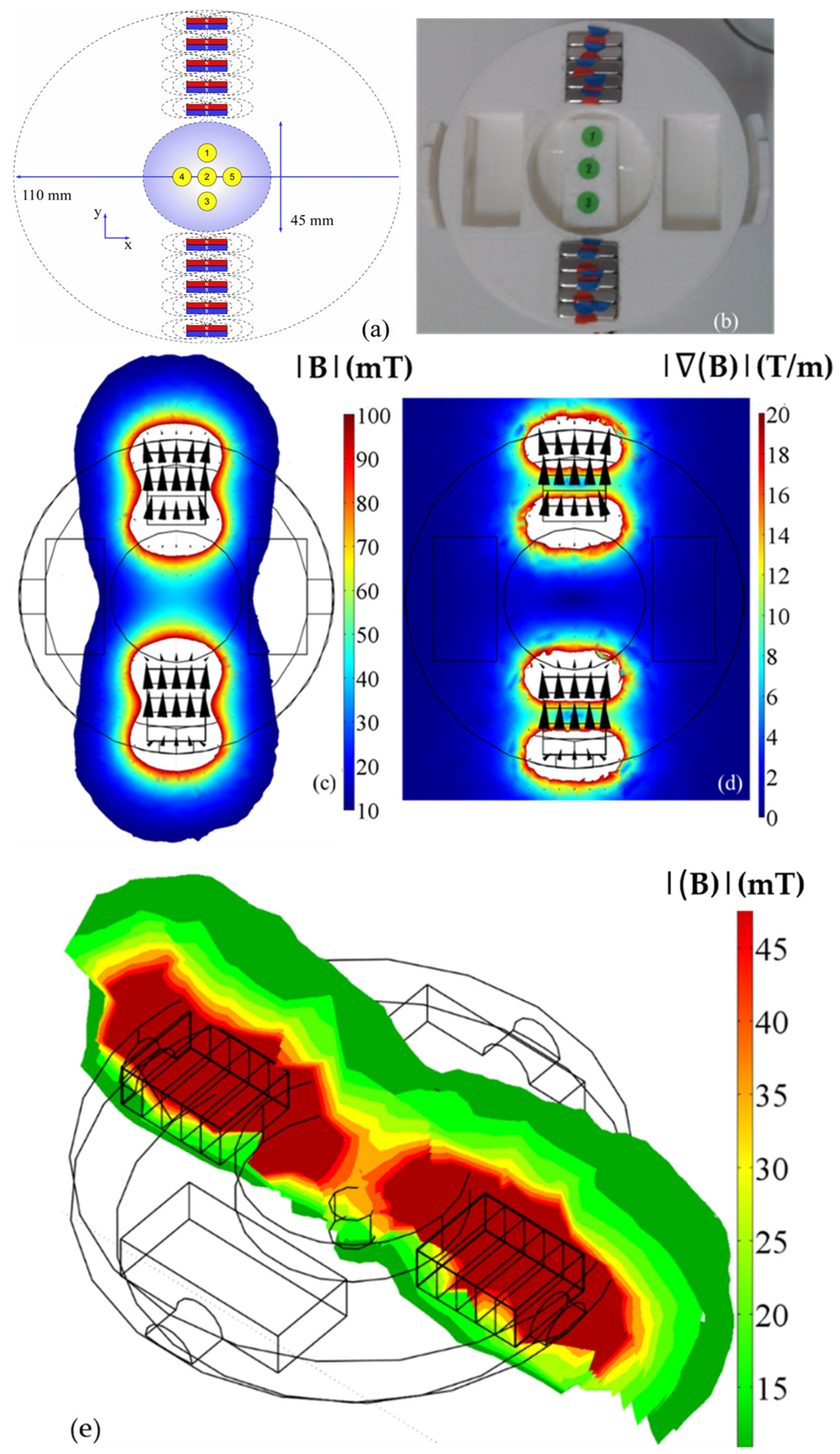
| Position | |Bexp| (mT) | |Bthe| (mT) | Deviation (%) | |∇(B)| (T/m) |
|---|---|---|---|---|
| 1 | 85 | 86 | 1 | 20 |
| 2 | 39 | 38 | 3 | 0 |
| 3 | 75 | 80 | 7 | 20 |
| 4 | 28 | 25 | 11 | 5 |
| 5 | 31 | 35 | 13 | 5 |
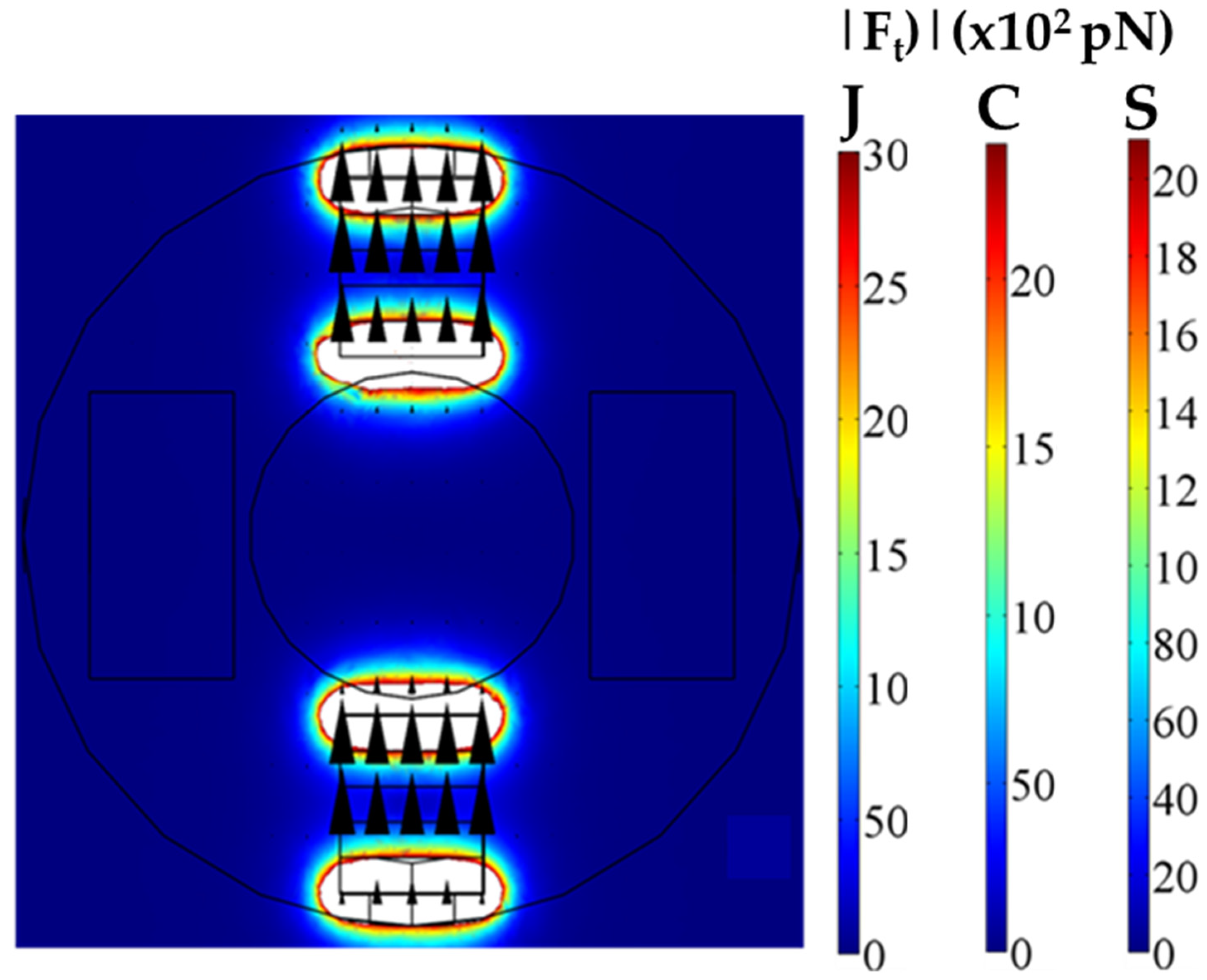
| Work | Cell Line | MNPs | Size/ Morphology | N (MNPs per Cell) | Ft,max (pN) | Biological Outcome |
|---|---|---|---|---|---|---|
| Jordan et al. [29] | BT20 | SPM 13 nm Fe3O4 dextran-coated | ~13 nm, quasi-spherical | 1.1 × 10⁸ | 3000 | magnetic hyperthermia induced cell necrosis |
| Chalkidou et al. [30] | MCF7 | Fe/MgO core–shell, single-domain | ~75 nm, spherical | 1.4 × 10⁵ | 2400 | magnetic hyperthermia induced cell apoptosis |
| Spyridopoulou et al. [31] | HT29 | Fe3O4 multidomain clusters, starch-coated | ~85–100 nm, anisotropic composite morphology | 2.25 × 10⁴ | 2100 | clear MM-driven cell membrane disruption; increased mechanotransduction under rotational and alternating MF |
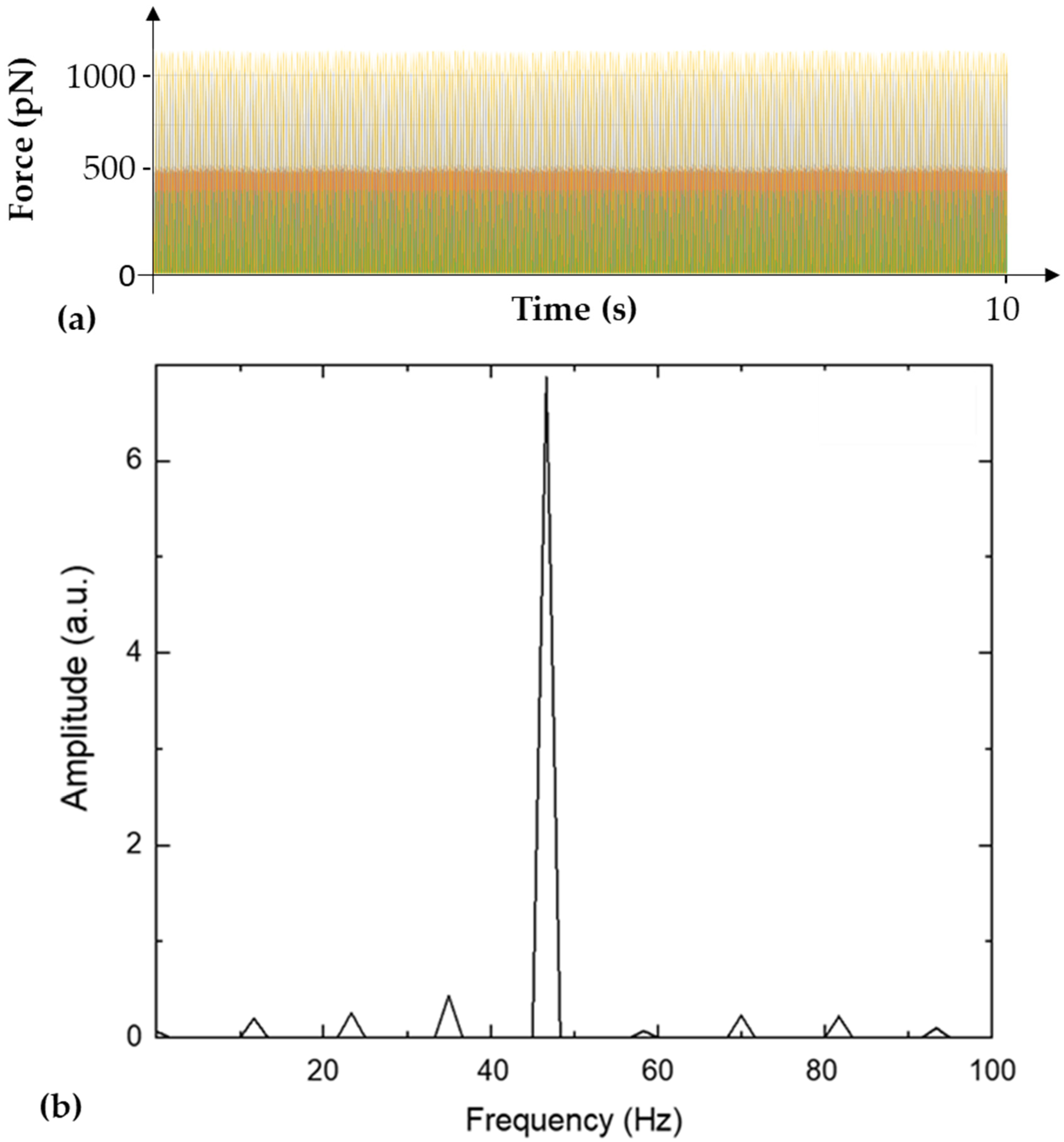
| Field Configuration | Bmax (mT) | Bavg (mT) | BRMS (mT) | FFT Peak Frequency (Hz) |
|---|---|---|---|---|
| Static | 86 | 60 | - | 0 |
| Rotating | 86 | - | 43 | 45 |
| Alternating | 86 | - | 43 | 22.5 |
| Field Configuration | max (T/m) | avg (T/m) | RMS (mT) |
|---|---|---|---|
| Static | 20 | 10 | - |
| Rotating | 20 | - | 7 |
| Alternating | 36 | - | 25 |
| Effects | Threshold Forces (pN) | References |
|---|---|---|
| Diffusion of ions and biologically relevant molecules in solutions | 102–103 | [32] |
| Magnetically assisted cell migration and positioning | 102–103 | [33] |
| Change the membrane potential | 103–104 | [34] |
| Local change in membrane potential | 103–104 | [34] |
| Change the probability of channel switch on/off events | 102–103 | [35] |
| Tumor cells arrest | 103–104 | [34] |
| Magnetically assisted cell division | 102–104 | [34,36] |
| Change the differentiation pathway and gene expression | 1–100 | [37] |
| Magnetically assisted endocytosis | 10–100 | [38] |
| Cell swelling | 100–200 | [35] |
Disclaimer/Publisher’s Note: The statements, opinions and data contained in all publications are solely those of the individual author(s) and contributor(s) and not of MDPI and/or the editor(s). MDPI and/or the editor(s) disclaim responsibility for any injury to people or property resulting from any ideas, methods, instructions or products referred to in the content. |
© 2025 by the authors. Licensee MDPI, Basel, Switzerland. This article is an open access article distributed under the terms and conditions of the Creative Commons Attribution (CC BY) license (https://creativecommons.org/licenses/by/4.0/).
Share and Cite
Maniotis, N.; Makridis, A. Numerical Simulation of Low-Frequency Magnetic Fields and Gradients for Magnetomechanical Applications. Magnetochemistry 2025, 11, 111. https://doi.org/10.3390/magnetochemistry11120111
Maniotis N, Makridis A. Numerical Simulation of Low-Frequency Magnetic Fields and Gradients for Magnetomechanical Applications. Magnetochemistry. 2025; 11(12):111. https://doi.org/10.3390/magnetochemistry11120111
Chicago/Turabian StyleManiotis, Nikolaos, and Antonios Makridis. 2025. "Numerical Simulation of Low-Frequency Magnetic Fields and Gradients for Magnetomechanical Applications" Magnetochemistry 11, no. 12: 111. https://doi.org/10.3390/magnetochemistry11120111
APA StyleManiotis, N., & Makridis, A. (2025). Numerical Simulation of Low-Frequency Magnetic Fields and Gradients for Magnetomechanical Applications. Magnetochemistry, 11(12), 111. https://doi.org/10.3390/magnetochemistry11120111