


Abstract
In this study, an efficient in vitro procedure was developed for bud induction, rooting of developing shoots and greenhouse acclimatization of young plantlets of dragon tree (Dracaena draco). Effects of media (S1 (1 mg/L KIN and 1 mg/L NAA), S2 (3 mg/L KIN and 1 mg/L IAA), S3 (1 mg/L BAP and 2 mg/L IBA) and S4 (1 mg/L BAP and 1 mg/L NAA)) on shoot induction and media (R1 (0 mg/L IBA), R2 (0.5 mg/L IBA), R3 (1 mg/L IBA), and R4 (2 mg/L IBA)) on root induction were examined in order to find optimal plant hormone concentrations for efficient Dracaena draco dormant bud development and subsequent rooting. The best shoot induction and rooting media were S1 and S2, and R3 and R4, respectively. Dormant buds from one-year-old Dracaena draco plants submitted to this in vitro procedure allowed successful recovery of up to 8 individuals per explant used. In vitro grown plants were successfully acclimated in the greenhouse. The potential of this in vitro procedure for multiplication of this endangered tree is discussed in this report.
1. Introduction
Dracaena draco, the Dragon Tree or Drago, is a subtropical plant native to the Canary Islands, Cape Verde, Madeira, and locally in Western Morocco [1,2]. The tree is characterized by a single or multiple trunk growing up to 12 m tall, with a dense umbrella-shaped canopy of thick leaves [3]. It grows slowly, requiring about ten years reaching 1 m tall [4]. Young trees have only a single stem; branching occurs when the tree flowers, when two side shoots at the base of the flower panicle continue the growth as a fork in the stem. Some specimens are believed to be up to 650 years old; the oldest is growing at Icod de los Vinos in Northwest Tenerife [1]. Recently-discovered wild populations in Western Morocco have been described as a separate subspecies, Dracaena draco subsp. ajgal, while those on Gran Canaria are sometimes distinguished as a separate species Dracaena tamaranae [5]. Rising interest in Dracaena draco for its medicinal properties [6] is prompting innovative approaches for efficient use of this endangered tree for food industry and pharmacological applications.
In view of the drastic reduction in the number of individuals and the consequent loss of dragon tree genetic diversity caused by absence of natural regeneration, micropropagation offers many advantages because it potentially can facilitate large-scale production of valuable clones and allow plant reintroduction in its natural ecosystem [7,8,9,10,11]. In addition, micropropagation may be an essential step to obtain plants from frozen collections of dragon tree plant material, the most valuable way of preserving this genus. Unfortunately, most of the published protocols are poorly described, in particular concerning the difficult stage of acclimatization. Therefore, the aim of the present study was to develop an efficient procedure for micropropagation and subsequent acclimatization of Dragon tree (Dracaena draco) under in vitro culture conditions. In this study, suitable explant sources, combinations of plant growth regulators for shoot development, and optimal concentrations of IBA for root induction were investigated.
2. Materials and Methods
2.1. Plant Material
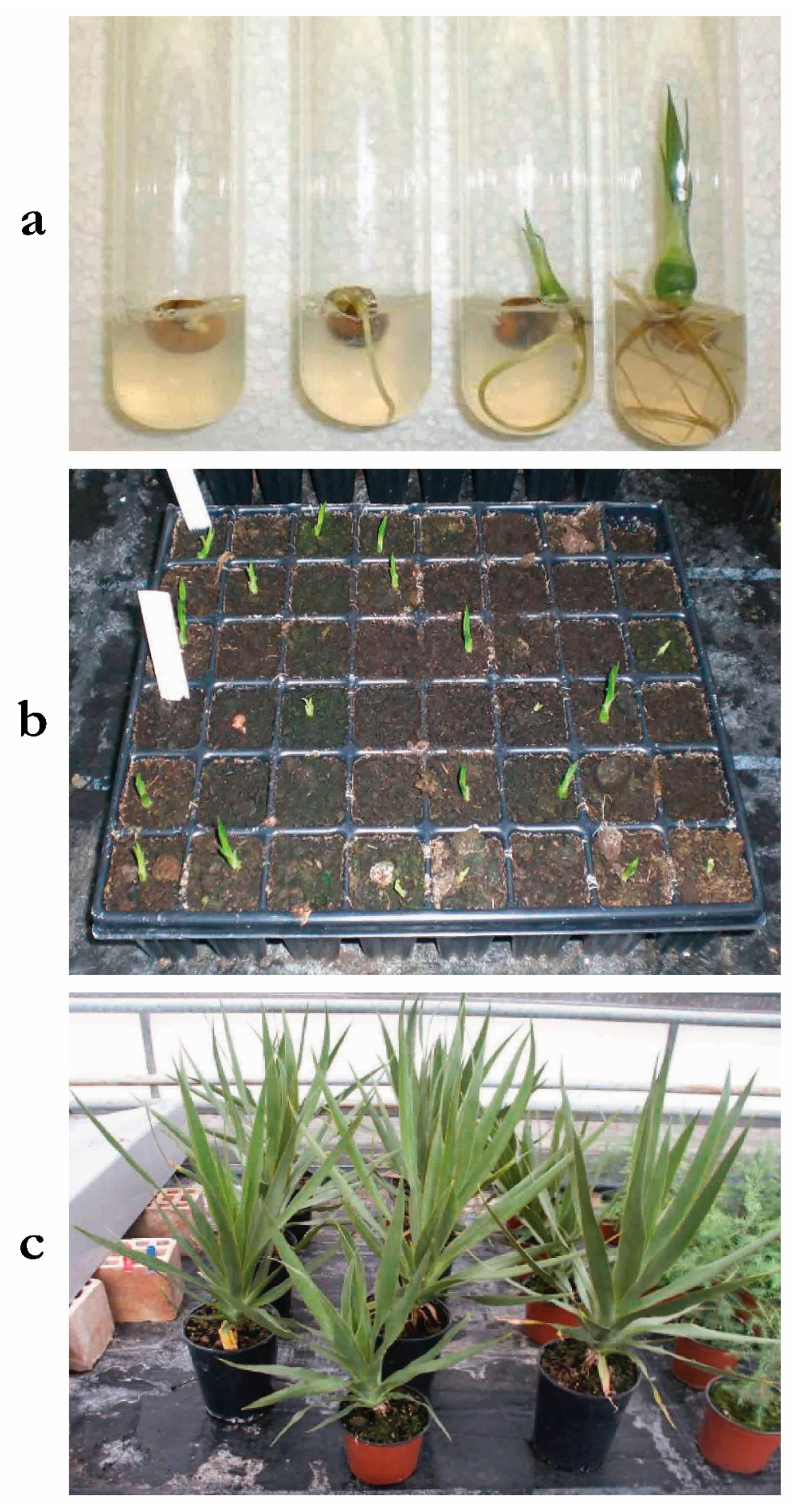
Dracaena draco trees purchased from a French Nursery (Annemasse, France) were used as starting material for isolation of dormant buds. They were maintained in greenhouse at 25 ± 2 °C with a 16-h photoperiod. Light intensity was set at 40 μmol m−2 s−1 and was provided by mercury fluorescent lamps. Additional trees were obtained either by in vitro or in soil germination of fresh D. draco seeds and their growth in a greenhouse for 2 years (Figure 1a,b). They were also used as starting material for the isolation of dormant buds. Dormant buds obtained from mature D. draco trees (Figure 1c) were treated with 70% ethanol for 5 min and used as starting plant material.
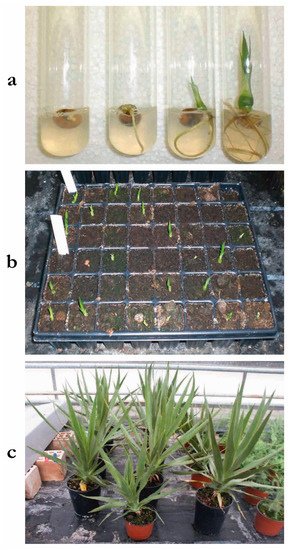
Figure 1.
Culture of D. draco in soil or in vitro: (a) in vitro germination of D. draco seeds; (b) germination of D. draco seeds in soil; (c) one-year-old D. draco plants obtained from in vitro and in soil germinated seeds.
2.2. Dormant Bud Sterilization
Buds were sterilized for varying periods (50 buds per each time of 0.5, 1, 2, 5, 10, and 20 min) in 2.5% HClO (w/v) bleach. Three double distilled water washes (for 10 min) were then performed. The washed buds were transferred to Murashige and Skoog (MS) medium (1.5% sucrose, 0.8% agar, pH 5.8; Sigma-Aldrich, Buchs, Switzerland) [12] and bud contamination was recorded after 3 d of culture. Effective viability of the buds was also checked visually by the absence of tissue damage and visible necroses.
Sterile dormant buds were used in the different experiments for testing shoot and root induction media. All inoculations were performed under aseptic conditions in a sterile cabinet. The medium was adjusted to pH 5.8 prior to autoclaving at 121 °C for 25 min. The cultures were maintained at 25 ± 2 °C with a 16-h photoperiod as described earlier. Explant contamination and survival rates were evaluated 5 days after inoculation and percentages were calculated.
2.3. Shoot Induction
Dormant buds recovered from mature D. draco trees were used to initiate shoot development on MS medium [12] supplemented with different combinations of kinetin (KIN) or 6-benzylaminopurine (BAP) and naphthaleneacetic acid (NAA) or indole-3-butyric acid (IBA). Media were: S1) 1 mg/L KIN and 1 mg/L NAA; S2) 3 mg/L KIN and 1 mg/L IAA; S3) 1 mg/L BAP and 2 mg/L IBA; and S4) 1 mg/L BAP and 1 mg/L NAA were used [13]. There were 50 buds per growth regulator combination, and all experiments were performed in triplicate. Containers used in the experiment consisted of 30 × 160 mm test tubes. Shoot development data were taken after one month of culture. Developing shoots were maintained and used for rooting experiments.
2.4. Rooting of Developing Shoots
Developing shoots were sub-cultured on MS medium containing different concentrations of IBA; R1) 0 mg/L IBA; R2) 0.5 mg/L IBA; R3) 1 mg/L IBA; and R4) 2 mg/L IBA were used. There were 50 buds per growth regulator, and all experiments were performed in triplicate. Container types used in the experiment consisted of 30 × 160 mm test tubes. Root development data were taken after one month of culture.
2.5. Acclimatization of Rooted D. Draco In Vitro Grown Plants
Acclimatization assays performed in this study used plants rooted in R4 medium followed by culture in MS medium without growth regulators [13]. Single plants were transferred to 500 mL pots, with an autoclaved soil mixture of peat and perlite (3/2, v/v), and placed in a glass chamber located in the greenhouse. In the first few days, plants were fogged with sterile water to avoid leaf fade. Time between fogging periods was progressively lengthened to diminish relative humidity. In two independent experiments, plants were transferred to soil and results were examined after 6 weeks.
2.6. Statistical Analysis
The statistical analysis of the data was performed using analysis of variance (ANOVA), using % data from each experiment as a replication. When significant effects (P < 0.05) were detected, the treatments were compared using a post-hoc Tukey’s honestly significant difference (HSD) test at P < 0.05. The statistical program used was IBM SPSS Statistics v. 22. Rooted shoots were maintained and used for acclimatization experiments.
3. Results and Discussion
3.1. Optimization of Dormant Bud Sterilization
The effect of different sterilization periods on bud health and absence of contamination was studied. Table 1 shows that a 2- to 5-min sterilization was optimal for avoiding tissue damage and providing sterile explants (Table 1). Subsequently all sterilization was performed for 3 min. These results are in the same range than those reported by Miller and Murashige [7] for D. godseffiana, Vinterhalter [8] for Dracaena fragrans, Blanco et al. [11] for Dracaena deremensis, and Liu et al. [13] for Dracaena surculosa.

Table 1.
Effect of sterilization time on infection and survival rates of buds cultured in vitro.
3.2. Shoot Induction
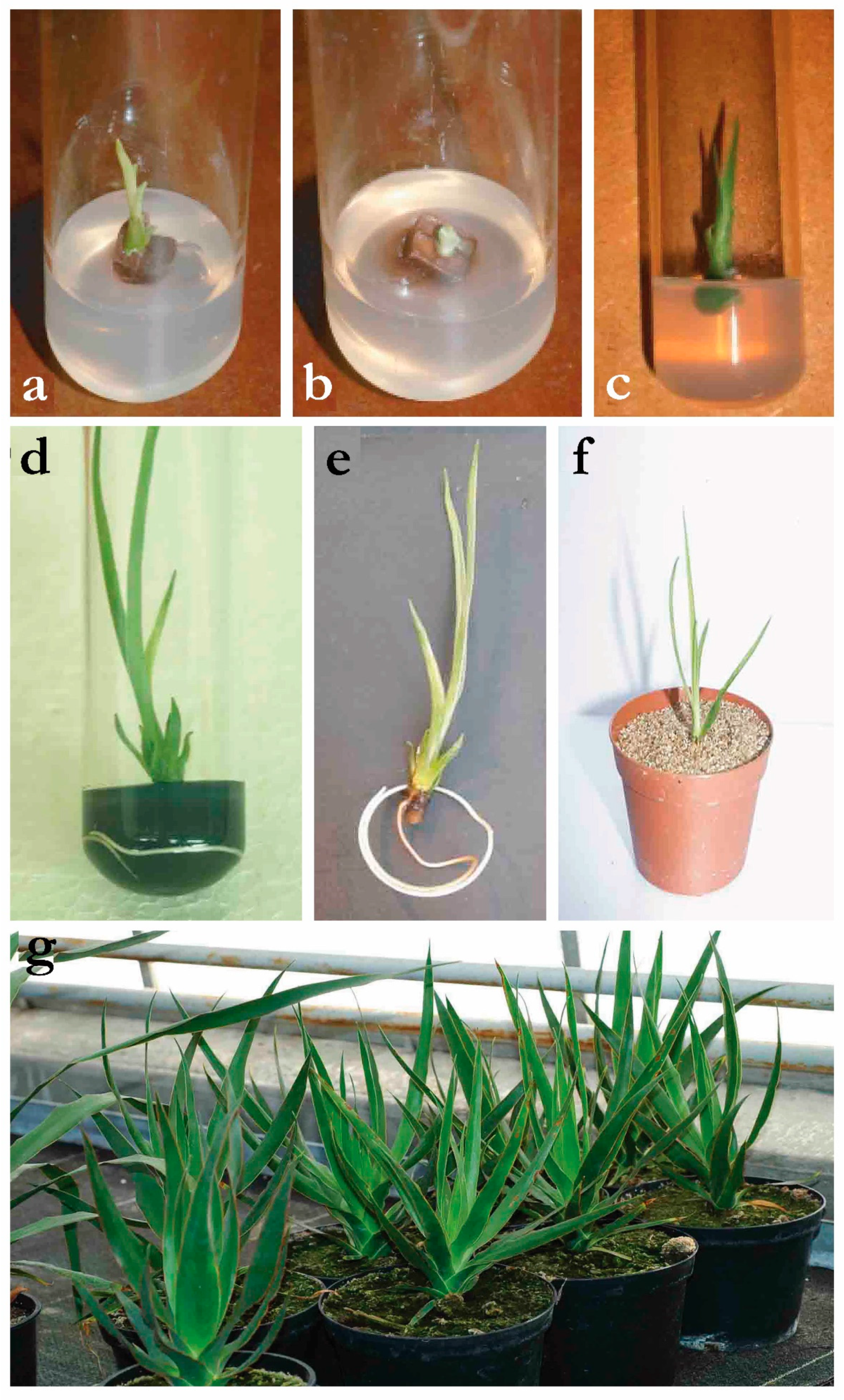
The effect of different treatment combinations of KIN or BAP and NAA or IBA were investigated. Shoot induction results are shown in Table 2. Shoot induction rates varied among the tested media. The highest shoot induction was obtained on media S1 and S2. Shoot induction in the medium S1 was high with up to 80% of the buds developing shoots. Shoot induction on medium S2 was also high approaching a rate of 75% shoot development. Figure 2a–c illustrate an example of developing shoots. Because S1 medium induced the highest shoot induction, this medium was chosen as the standard medium for shoot induction of all dormant buds.
Table 2.
Effect of media hormonal composition on shoot and root induction of D. draco buds.
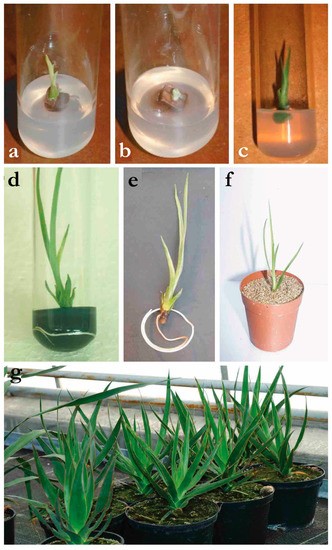
Figure 2.
In vitro multiplication and acclimatization of D. draco: (a) dormant buds collected from 1-year-old D. draco plants in culture; (b–d) development of buds after 3, 6 and 9 weeks of culture in S1 medium, respectively; (e,f) rooted plants in culture; (g) one-year-acclimated plants from in vitro micro-propagated D. draco plants.
Media S1 and S2 used in this study were successfully used by Blanco et al. [11] and Miller and Murashige [7] to induce differentiation and multiplication of D. deremensis and D. godseffiana, respectively. Results obtained in this study indicate that these media were also effective in inducing shoot differentiation in D. draco.
Although having a much lower % shoot induction, medium S3 induced about 24% shoots. This medium has been successfully used by Vinteralter [8] to induce shoot multiplication in D. fragrans. Similar results were also obtained by Perez et al. [14] and Aslam et al. [15] using Dracaena sanderiana.
3.3. Root Induction and Plant Maintenance
Fifty developing shoots obtained on the medium S1 were cultured on different concentrations of IBA for rooting. After a month of culture, root development occurred abundantly in media R3 and R4 (Table 2). Root formation on high concentration of IBA (1–2 mg/L) had higher rhizogenic potential with harder, longer and whiter roots (Figure 2d,e). The best results for rooting were obtained in the medium containing 2 mg/L IBA. Over 50% and 66% of developing shoots produced roots media R3 and R4, respectively, after a month of culture. It is clear from the data in Table 2 that poor root development occurred with low concentrations of IBA. Better results were obtained in at the higher concentrations of IBA rather than the lower concentrations where no rooting occurred. R4 medium was chosen as the optimum medium for rooting in this study.
These results are in disagreement with those of Vinterhalter [8], who reported that during root induction in D. fragrans, 0.5 mg/L IBA was optimal. Parallel with these results, Blanco et al. [11] reported that a hormone-less medium was convenient for rooting D. deremensis. These results seem to indicate that rooting in the genus Dracaena is variable among species [8,11,13,14,15,16].
3.4. Acclimatization of Regenerated Plants
From the plants that rooted in R4 medium (25) and that were transferred to the soil mixture, 100% were totally established after 6 weeks. No morphological differences were found between these plants and the mother plant (Figure 2f). Checking the plants after 18 months for morphological abnormalities revealed no difference with plants obtained from soil grown sites (Figure 2g). In our work, acclimatization was given particular attention. The use of the glass chamber in the greenhouse and fogging during the first days with longer spacing between fogging periods to gradually diminish relative humidity could explain the complete success of acclimatization. Acclimatization success in our study was higher than reported in earlier studies of Vinterhaler [8] for D. fragrans, Blanco et al. [11] for D. deremensis, and Miller and Murashige [7] for D. godseffiana, where low success rates were reported. However, our acclimatization success rates were in the same range reported by Aslam et al. [15] for D. sanderiana Sander ex Mast and by Liu et al. [13] for D. surculosa. Similar to results of Liu et al. [13] and Aslam et al. [15] using D. sanderiana and D. surculosa, respectively, ex vitro established plantlets exhibited no visible phenotypic aberrations.
4. Conclusions
In the present study, the highest shoot induction rate, the greatest percent rooting and acclimatization rates were obtained using the S1 and R4 media containing [1 mg/L KIN, 1 mg/L NAA] and [2 mg/L IBA], respectively. Ex vitro transfer of plantlets to soil resulted in no visible phenotypic aberrations as required for efficient multiplication of the tree. The present in vitro culture procedure yielding up to 8 plants per mature plant (data not shown) could be used for micropropagation of D. draco with the aim of reintroduction of this endangered species in its native ecosystem where natural regeneration is no longer observed. This in vitro culture procedure offers also the potential for efficient use of Dracaena draco by food and pharmacological industries, allowing efficient biotechnological valorization of the species and increasing awareness for its conservation.
Author Contributions
Conceived and designed the experiments: A.G., A.C.B., and L.B. Performed the experiments: A.G., A.C.B., and L.B. Analyzed the data: A.G., L.B., and A.C.B. Contributed reagents/materials/analysis tools: A.G. and L.B. Wrote and enriched the literature: A.G., L.B., and A.C.B.
Funding
This research received no external funding.
Acknowledgments
We are grateful to Maria Dalila Santos (Botanical Gardens of Ajuda, Portugal) for the generous gift of fresh Dracaena draco seeds.
Conflicts of Interest
The coauthors declare no conflict of interest.
References
- Krawczyszyn, J.; Krawczyszyn, T. Photomorphogenesis in Dracaena draco. Trees 2016, 30, 647–664. [Google Scholar] [CrossRef]
- Benabid, A.; Cuzin, F. Dragon tree (Dracaena draco subsp. ajgal Benabid et Cuzin) populations in Morocco: Taxonomical biogeographical and phytosociological values. C. R. Acad. Sci. 1997, 320, 267–277. [Google Scholar] [CrossRef]
- Chen, J.; Mc Connell, D.; Henny, R.; Everitt, K. Environmental Horticulture Department, Institute of Food and Agricultural Sciences, University of Florida. 1998. Available online: http://edis.ifas.ufl.edu (accessed on 20 June 2019).
- Monteiro, A.; Vasconcelos, T.; Tapadabertelli, A. Seed propagation of Dracaena draco. Garcia Orta Sér. Bot. 1999, 14, 187–189. [Google Scholar]
- Marrero, A. A new species of the wild dragon tree, Dracaena (Dracaenaceae) from Gran Canaria and its taxonomic and biogeographic implications. Bot. J. Linn. Soc. 1998, 128, 291–314. [Google Scholar]
- Jura-Morawiec, J.; Tulik, M. Dragon’s blood secretion and its ecological significance. Chemoecology 2016, 26, 101–105. [Google Scholar] [CrossRef]
- Miller, L.R.; Murashige, T. Tissue culture propagation of tropical foliage plants. In Vitro Cell. Dev. Biol. Anim. 1976, 12, 797–813. [Google Scholar] [CrossRef]
- Vinterhalter, D. In vitro Propagation of Green-Foliaged Dracaena-Fragrans Ker. Plant Cell Tissue Org. 1989, 17, 13–19. [Google Scholar]
- Vinterhalter, D.; Vinterhalter, B. Micropropagation of Dracaena Species. In Biotechnology in Agriculture and Forestry; Springer: Berlin/Heidelberg, Germay, 1997; Volume 40, pp. 131–146. [Google Scholar]
- Tian, L.; Tan, H.Y.; Zhang, L. Stem segment culture and tube propagation of Dracaena saneriana cv. virscens. Acta Hortic. Sin. 1999, 26, 133–134. [Google Scholar]
- Blanco, M.; Valverde, R.; Gomez, L. Micropropagation of Dracaena deremensis. Agron. Costarric. 2004, 28, 7–15. [Google Scholar]
- Murashige, T.; Skoog, F. A Revised Medium for Rapid Growth and Bio Assays with Tobacco Tissue Cultures. Physiol. Plant. 1962, 15, 473–497. [Google Scholar] [CrossRef]
- Liu, J.; Deng, M.; Henny, R.J.; Chen, J.; Xie, J. Regeneration of Dracaena surculosa through indirect shoot organogenesis. HortScience 2010, 45, 1250–1254. [Google Scholar] [CrossRef]
- Pérez, G.H.Y.; Claret, M.C.C.; Ada, M.M.M. In vitro morphogenesis of Dracena. Agron. Trop. 2006, 56, 577–583. [Google Scholar]
- Aslam, J.; Mujib, A.; Sharma, M.P. In vitro micropropagation of Dracaena sanderiana Sander ex Mast: An important indoor ornamental plant. Saudi J. Biol. Sci. 2013, 20, 63–68. [Google Scholar] [CrossRef]
- Junaid, A.; Mujib, A.; Sharma, M.P. Effect of growth regulators and ethylmethane sulphonate on growth, and chlorophyll, sugar and proline contents in Dracaena sanderiana cultured in vitro. Biol. Plant. 2008, 52, 569–572. [Google Scholar] [CrossRef]
© 2019 by the authors. Licensee MDPI, Basel, Switzerland. This article is an open access article distributed under the terms and conditions of the Creative Commons Attribution (CC BY) license (http://creativecommons.org/licenses/by/4.0/).