


Abstract
The quality of tea bud harvesting directly affects the final quality of the tea; however, due to the small size of tea buds and the complex natural background, accurately detecting them remains challenging. To address this issue, this paper proposes a lightweight and efficient tea bud detection model named TSF-Net. This model adopts the P2-enhanced bidirectional feature pyramid network (P2A-BiFPN) to enhance the recognition ability of small objects and achieve efficient multi-scale feature fusion. Additionally, coordinate space attention (CSA) is embedded in multiple C3k2 blocks to enhance the feature extraction of key regions, while an A2C2f module based on self-attention is introduced to further improve the fine feature representation. Extensive experiments conducted on the self-built WYTeaBud dataset show that TSF-Net increases mAP@50 by 2.0% and reduces the model parameters to approximately 85% of the baseline, achieving a good balance between detection accuracy and model complexity. Further evaluations on public tea bud datasets and the VisDrone2019 small object benchmark also confirm the effectiveness and generalization ability of the proposed method. Moreover, TSF-Net is converted to the RKNN format and successfully deployed on the RK3588 embedded platform, verifying its practical applicability and deployment potential in intelligent tea bud harvesting.
1. Introduction
Tea, as an important symbol of traditional Chinese culture, has developed and spread over thousands of years and has become one of the most significant beverages in the global consumer market [1,2]. The quality of tea largely depends on the techniques used in tea bud harvesting; however, traditional manual harvesting is facing numerous challenges [3]. On the one hand, the continuous rise in labor costs has made manual harvesting increasingly expensive and unsustainable in the long term. On the other hand, the growing market demand for tea production cannot be met efficiently by manual harvesting alone. As a result, efforts have been made to introduce mechanized harvesting technologies. Nevertheless, current mechanical harvesting methods still lack sufficient precision, particularly in tea bud recognition. Tea buds are characterized by their small size, dense distribution, and severe overlapping, while their color is highly similar to that of the surrounding background. These factors make achieving high-precision tea bud detection extremely challenging [4]. This problem is consistent with the general difficulties faced in small object detection [5,6,7]. Therefore, accurate identification and intelligent harvesting of tea buds hold great practical significance and application value.
In the field of tea bud detection, traditional machine learning methods have achieved certain results. For example, Zhang et al. [8] effectively segmented tea bud images by applying Gaussian filtering for noise reduction, threshold segmentation, and edge detection techniques in combination with the watershed algorithm. Li et al. [9] adopted a support vector machine (SVM) model, integrating the RGB color space with LBP/C operators to extract color, shape, and texture features, which significantly improved recognition accuracy compared with single-feature-based methods. In addition, Shao et al. [10] processed images based on the HSI color model and the S-factor, and utilized an improved K-means algorithm to achieve the separation and identification of tea buds. Although traditional methods have contributed to the development of tea bud detection to some extent, they still encounter significant challenges in practical applications. In particular, conventional approaches struggle to extract features of small objects in densely distributed regions, limiting their ability to improve detection performance [11]. Moreover, the small size of tea buds and their color similarity to the background often result in poor performance in real harvesting scenarios. Since these methods typically rely on handcrafted feature extraction, they are labor-intensive and cumbersome, while also suffering from insufficient accuracy and low processing efficiency when handling large-scale data or complex environments [12]. To address these limitations, researchers have increasingly shifted their attention toward deep learning-based tea bud detection models, aiming to achieve breakthroughs in both detection accuracy and efficiency.
Currently, deep learning-based tea bud detection can be broadly divided into two categories: one-stage detection models and two-stage detection models. Advances in small object detection research have further promoted the development of lightweight detectors, feature enhancement strategies, and attention mechanisms, which have greatly improved the recognition of small and densely distributed targets [13,14,15]. By automatically extracting image features, these models are able to better address challenges such as small target size and complex backgrounds in tea bud detection, thereby demonstrating stronger adaptability and superior detection performance compared to traditional methods. Among two-stage models, a typical representative is Mask R-CNN [16], which is widely applied to tea bud detection tasks due to its strong target localization and segmentation capabilities. Building on this, Cheng et al. [17] proposed an innovative anchor generation strategy and optimized the keypoint detection branch, effectively enhancing the model’s ability to recognize small tea bud targets and significantly improving detection accuracy. Compared with two-stage detection networks, one-stage detection methods, which feature an end-to-end architecture, have higher detection efficiency during inference. Furthermore, with appropriate optimization and training, one-stage networks can achieve desirable detection accuracy while maintaining high-speed inference [18]. Within one-stage models, the YOLO series has been widely adopted for tea bud detection due to its fast detection speed and simple architecture. Chen et al. [19] improved YOLOv3 by integrating semantic segmentation, skeleton extraction, and a minimum bounding rectangle technique, and proposed a novel picking-point localization method. They further designed an intelligent tea-picking device capable of collaborative control between a personal computer and a microcontroller. This method demonstrated certain practicality in real-world harvesting; however, its mean recognition accuracy was only 71.96%, indicating room for improvement in handling complex environments and small object detection. To further enhance the accuracy of YOLO-based models, Chen et al. [20] proposed an improved YOLOv5l tea bud detection model, which integrated CAM, BiFPN, and GhostConv techniques, successfully compressing the model parameters to 29.25 × 10⁶ while maintaining strong detection performance. This improvement achieved a better balance between accuracy and efficiency, particularly excelling in tea bud detection tasks. Similarly, Xie et al. [21] optimized the YOLOv8s model by introducing multiple data augmentation methods to enrich the information and quality of tea bud images. They further combined deformable convolutions, attention mechanisms, and an improved spatial pyramid structure, effectively enhancing the model’s stable recognition capability of tea buds in complex backgrounds. The multi-feature fusion strategy also led to a significant improvement in detection accuracy. However, these improvements substantially increased model parameters and computational costs, potentially limiting their deployment in resource-constrained environments. Liu et al. [22] proposed an automatic tea bud detection method based on YOLO11. This method introduced a Synergistic Object Spatial Attention (SOSA) mechanism and Local Context Attention (LCA) to enhance tea bud region features while suppressing background interference. In addition, a Global–Local Attention-Guided Feature Fusion (GAGFF) strategy was designed to combine global semantic and local detail information, improving feature representation. The integration of SOSA and GAGFF significantly enhanced the detection performance of the model. Addressing the problem of high computational complexity in deep learning models, Fang et al. [23] proposed a lightweight tea bud detection model, TBF-YOLOv8n. This model replaced the original C2f module with a newly designed DSCf module by improving it using efficient Distributed Shift Convolutions (DSConv), effectively reducing model size. Moreover, a coordinate attention (CA) mechanism was incorporated to minimize irrelevant information interference and improve detection accuracy. Additionally, the model adopted the SIOU_Loss function and Dynamic Sampling (DySample) upsampling operators to accelerate convergence and further improve average detection accuracy and overall performance. Although existing object detection algorithms have made remarkable progress in tea bud recognition, several key challenges have not been effectively addressed. These include the small size of tea buds in images, limited detection accuracy, and the complexity of surrounding environments. Such factors still hinder further improvements in detection performance. Consequently, it is crucial to investigate approaches that can achieve a balance between high accuracy and low computational cost.
Therefore, to address the challenges of small target size and complex backgrounds in tea bud detection, this paper proposes an improved model based on YOLO11 (https://github.com/ultralytics/ultralytics, accessed on 10 October 2024), named TSF-Net. The method is specifically optimized for the characteristics of tea bud detection by refining both the network architecture and attention mechanisms. The feature extraction capability of the backbone network is enhanced, and an improved attention mechanism is introduced to strengthen the focus on key regions. In terms of feature extraction structure, the configuration of feature layers is adjusted to improve the perception of small targets. In addition, an efficient multi-scale feature fusion strategy is adopted to further enhance detection accuracy. Our main contributions are as follows:
- (1)
- The WYTeaBud dataset, featuring dense and small-sized targets, was constructed, offering essential data support and an experimental foundation for future research on tea bud object detection.
- (2)
- To strengthen the model’s capability for small object detection, we design a P2-Augmented Bidirectional Feature Pyramid Network (P2A-BiFPN) that not only enhances feature perception of small targets but also reduces parameter overhead and achieves efficient multi-scale feature fusion.
- (3)
- A Coordinate Spatial Attention (CSA) module was designed and integrated into the C3k2 modules of the network to enhance the representation of key regional features and improve detection performance in complex scenarios.
- (4)
- To further enhance the model’s feature extraction capability, the structure of the backbone network was optimized by replacing the last two C3k2 modules with A2C2f modules equipped with a self-attention mechanism, thereby strengthening the model’s ability to capture and represent key features.
2. Materials and Methods
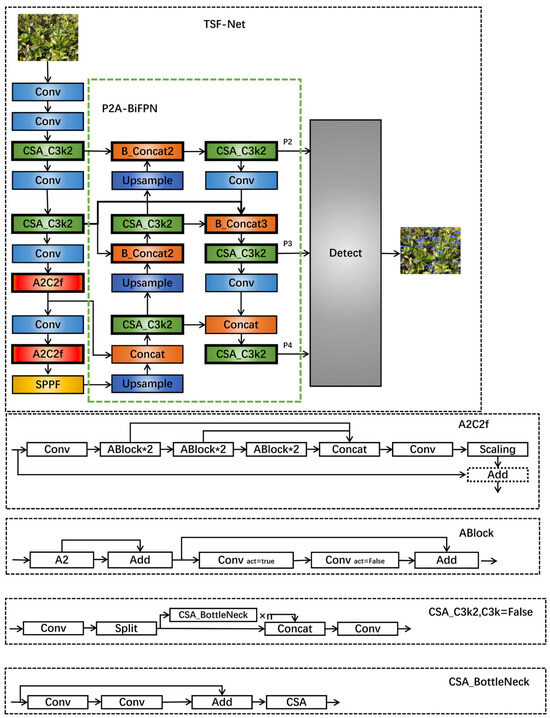
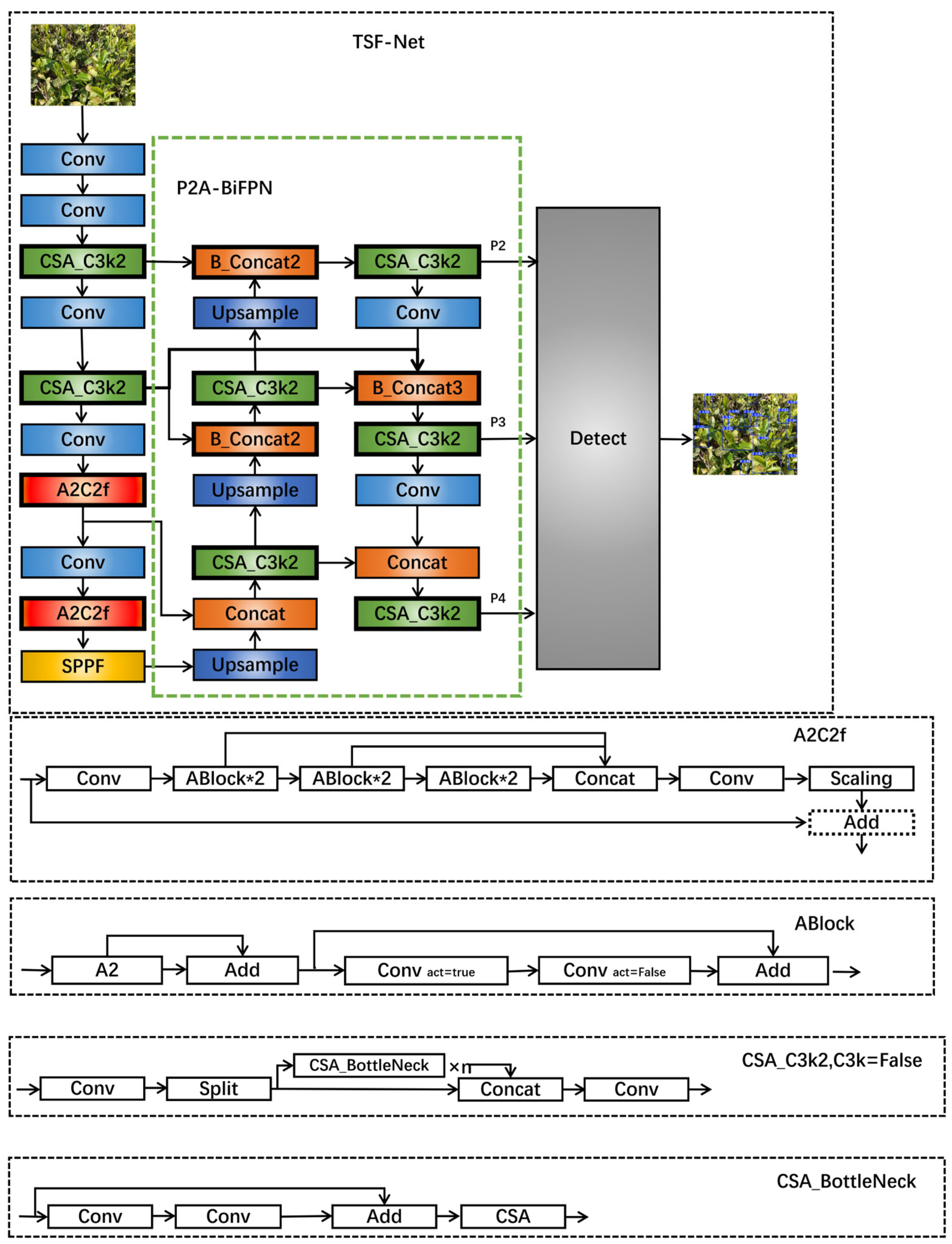
In this section, we propose a novel tea bud detection model, TSF-Net, which enhances the perception of small objects while maintaining high efficiency. Specifically, TSF-Net integrates three functional designs: (1) the proposed P2A-BiFPN strengthens the model’s ability to capture fine details of small objects and achieves efficient multi-scale feature fusion; (2) a Coordinate Spatial Attention (CSA) module is embedded into multiple C3k2 blocks to improve key region feature extraction; (3) a self-attention-based A2C2f module is introduced to enhance fine-grained feature representation. With these improvements, TSF-Net effectively addresses the challenges of tea bud detection in complex environments, significantly improving detection accuracy while balancing performance and computational cost. The overall architecture of TSF-Net is illustrated in Figure 1.
Figure 1.
TSF-Net model structure.
2.1. P2-Augmented Bidirectional Feature Pyramid Network
To address the challenges of small target size and multi-scale variability in tea bud detection, we propose the P2-Augmented Bidirectional Feature Pyramid Network (P2A-BiFPN).
Specifically, we first optimize the YOLO11 architecture by introducing a P2 detection layer and removing the P5 detection layer, aiming to improve small object detection performance while reducing model complexity and parameter count. The P2 layer, located in the lower part of the network, captures high-resolution and fine-grained features, making it particularly effective for small targets such as pedestrians, animals, or compact vehicles in surveillance footage. By focusing on low-level cues such as edges, textures, and shapes, the P2 layer enhances sensitivity to small object details and reduces missed detections. In contrast, the P5 layer mainly captures abstract semantic information, which is more suitable for large object detection but often introduces redundancy and is vulnerable to background noise when applied to small objects [24]. Removing P5 enables the network to focus more on mid- and low-level features, thereby improving small object detection accuracy, simplifying the overall structure, and reducing computational burden. These adjustments enhance YOLO11’s efficiency and stability in real-world small object detection tasks.
In addition, to address multi-scale feature fusion challenges, we integrate the Bidirectional Feature Pyramid Network (BiFPN) module [25] into the neck of the network. Specifically, BiFPN is applied at the B_Concat2 and B_Concat3 fusion points (as shown in Figure 1). BiFPN establishes bidirectional top-down and bottom-up information flows, enabling more comprehensive and flexible interactions among feature maps of different scales. It also introduces learnable weights that allow the network to adaptively balance the contributions of different inputs, effectively overcoming the limitations of traditional FPNs in terms of fusion efficiency and information propagation.
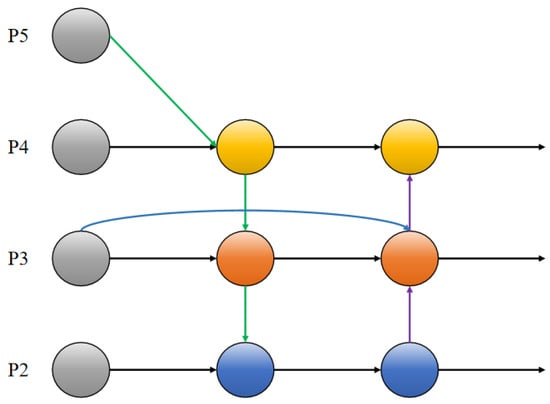
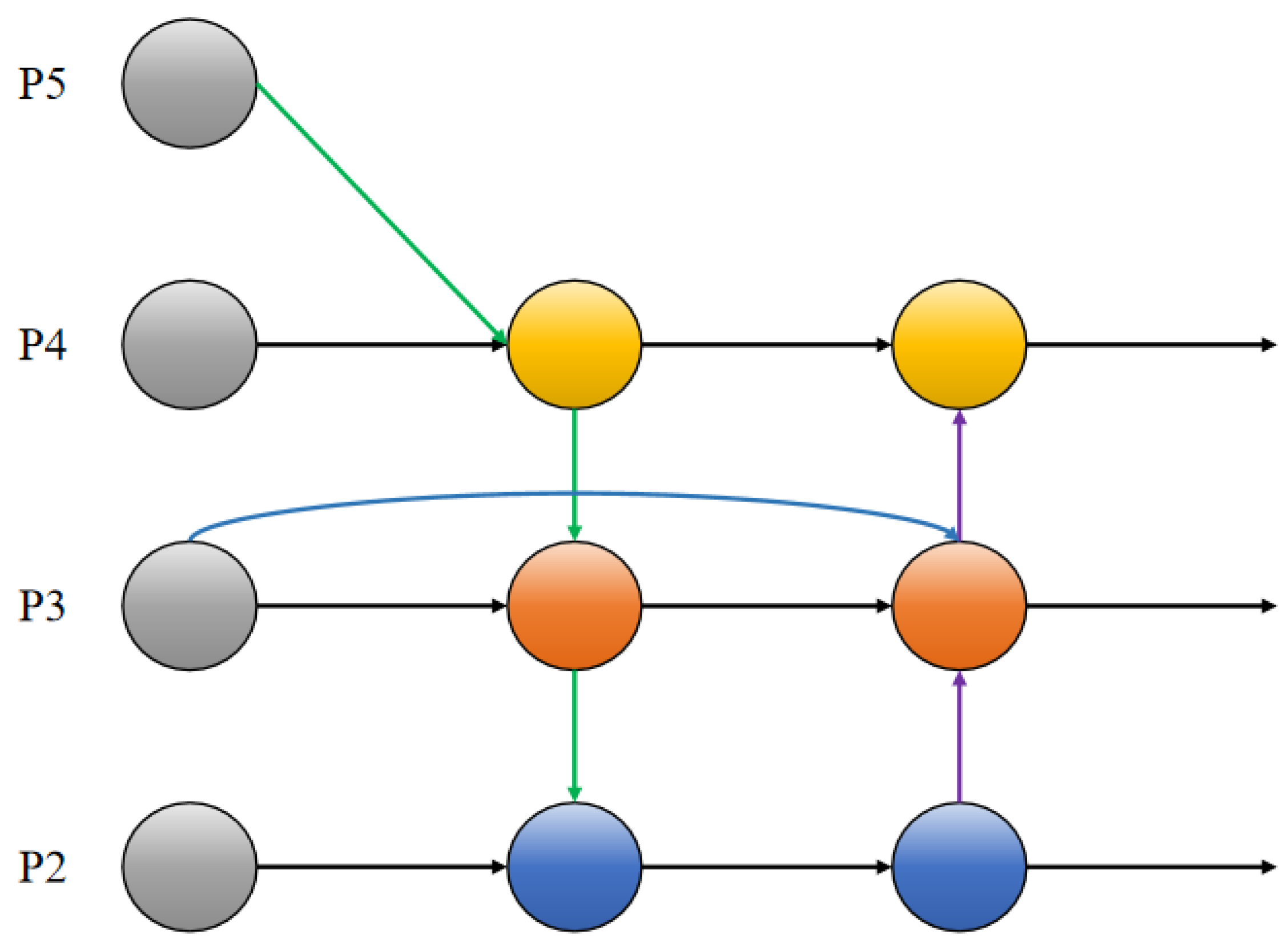
It is worth noting that B_Concat is not applied to all fusion sites. Our experiments showed that full integration at deeper fusion stages leads to information redundancy, whereas selective insertion at key points achieved better results. Partial integration of B_Concat not only enhances robustness in multi-scale object detection but also significantly improves small object performance. Through its bidirectional weighted fusion mechanism, B_Concat effectively aggregates shallow features rich in spatial details with deep features rich in semantic information, leading to a notable overall improvement in detection accuracy and laying a solid foundation for applications in complex scenarios. The architecture of P2A-BiFPN is illustrated in Figure 2.
Figure 2.
The structure of P2A-BiFPN. Black nodes: Original multi-scale backbone feature maps (P2–P5), with resolutions of p2: 160 × 160, P3: 80 × 80, P4: 40 × 40, and P5: 20 × 20. Blue nodes: Fused low-level features. Orange nodes: Fused mid-level features balancing spatial details. Yellow nodes: Fused high-level semantic features. Black arrows: Lateral feature propagation at the same scale. Green arrows: The top-down approach. Blue arrows: Bidirectional cross-scale fusion paths. Purple arrows: Bottom-up enhancement paths.
The network takes multi-scale feature maps {P2, P3, P4, P5} from the backbone as input, corresponding to progressively decreasing spatial resolutions. Black nodes denote the original backbone features before fusion. Colored nodes represent feature maps after selective bidirectional fusion at different semantic levels, where blue, orange, and yellow nodes correspond to low-level, mid-level, and high-level fused features, respectively. Black arrows indicate lateral feature propagation at the same scale. Green arrows represent top-down pathways that propagate high-level semantic information to lower-resolution features. Purple arrows denote bottom-up enhancement paths that reinforce high-level features with fine-grained spatial details. Blue curved connections illustrate bidirectional cross-scale interactions within the P2A-BiFPN, enabling efficient information exchange across different feature levels. Through selective insertion of bidirectional fusion paths, the proposed P2A-BiFPN effectively integrates spatial and semantic information while avoiding redundant feature aggregation, thereby improving small object detection performance.
2.2. Coordinate Spatial Attention Mechanism
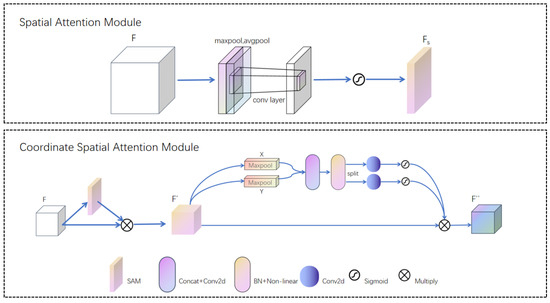
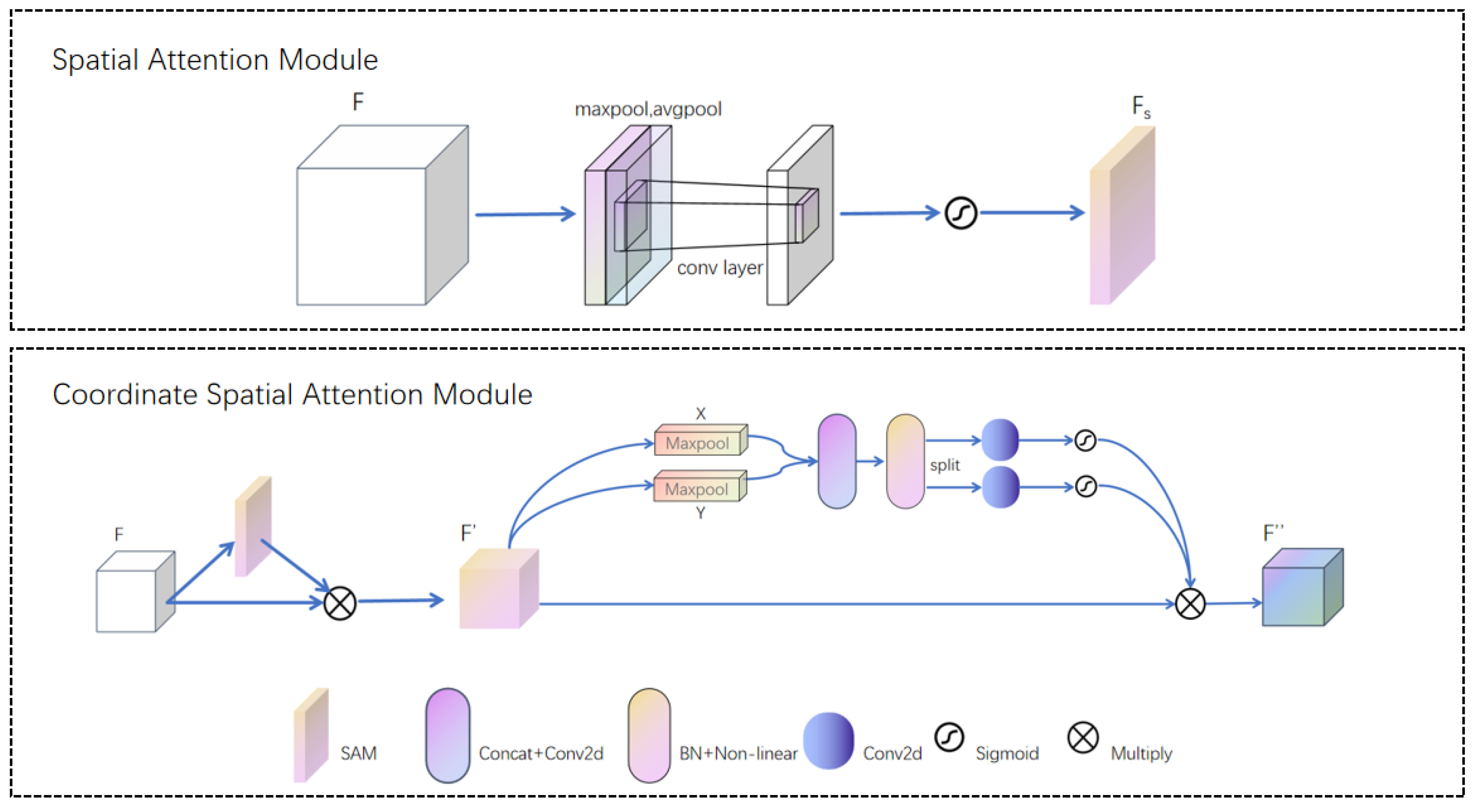
To further enhance the model’s ability to extract features from small-scale tea bud targets in images, we design a hybrid attention mechanism that integrates both spatial and coordinate information. Due to their small pixel occupancy in images, small objects are often easily overlooked. The proposed mechanism guides the model to focus more effectively on these small target regions, thereby improving recognition accuracy. Moreover, small targets are frequently affected by complex background interference. To address this, we first apply a spatial attention module to extract spatial features, followed by the integration of a coordinate attention module to enhance local context modeling. This approach effectively separates targets from the background and suppresses noise interference.
In addition, given the high uncertainty in the position and shape of small targets within images, the hybrid attention mechanism dynamically adjusts the attention distribution based on coordinate information. This enables the model to adaptively focus on varying small object patterns, improving its ability to recognize diverse and changing targets. The mechanism also provides richer spatial and positional cues, thereby enhancing the model’s perception of small objects and improving its robustness and generalization ability.
In the spatial attention component, we adopt the SAM [26]. This method applies average pooling and max pooling operations along the channel axis of the input feature map, then concatenates the resulting two 2D maps. The concatenated map is passed through a convolutional layer followed by an activation function, generating a spatial attention map that captures spatial location information. This attention map is then element-wise multiplied with the original feature map to produce an output that emphasizes spatially important regions.
The corresponding formulation is as follows:
where σ denotes the sigmoid function, represents a convolution operation with a kernel size of , the and refer to the average pooling and max pooling operations applied to the feature map F, respectively. denotes the resulting spatial attention weights.
To further enhance the representation of small object features, we introduce a coordinate attention mechanism on top of spatial attention. Specifically, max pooling operations are performed separately along the X and Y directions [27] to extract more salient features that are sensitive to edges, textures, and other fine-grained details. This approach effectively suppresses background interference and improves the model’s robustness to spatial displacements.
where represents the output of the c-th channel at height position h, and similarly, represents the output of the c-th channel at width position w.
Subsequently, the feature maps from both directions are concatenated and compressed using a convolution followed by an activation function. They are then split along the spatial dimension, and another convolution with a Sigmoid activation is applied to generate the final attention weight map. This weight map is multiplied by the previously obtained spatial feature map to produce the final feature map that fuses spatial and coordinate information.
where is a nonlinear activation function, is a shared convolutional transformation function, and f is an intermediate feature map that encodes spatial information in both horizontal and vertical directions. and are two convolutional transformation functions, and g represents the learned weights, which results in the final feature map . The module structure is shown below (Figure 3).
Figure 3.
Structure of the SA and CSA modules.
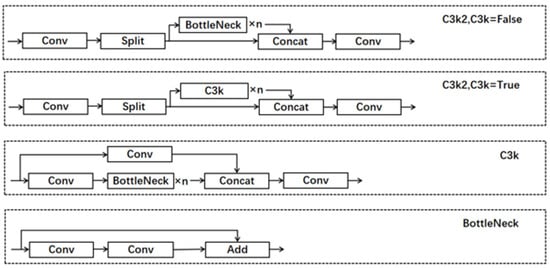
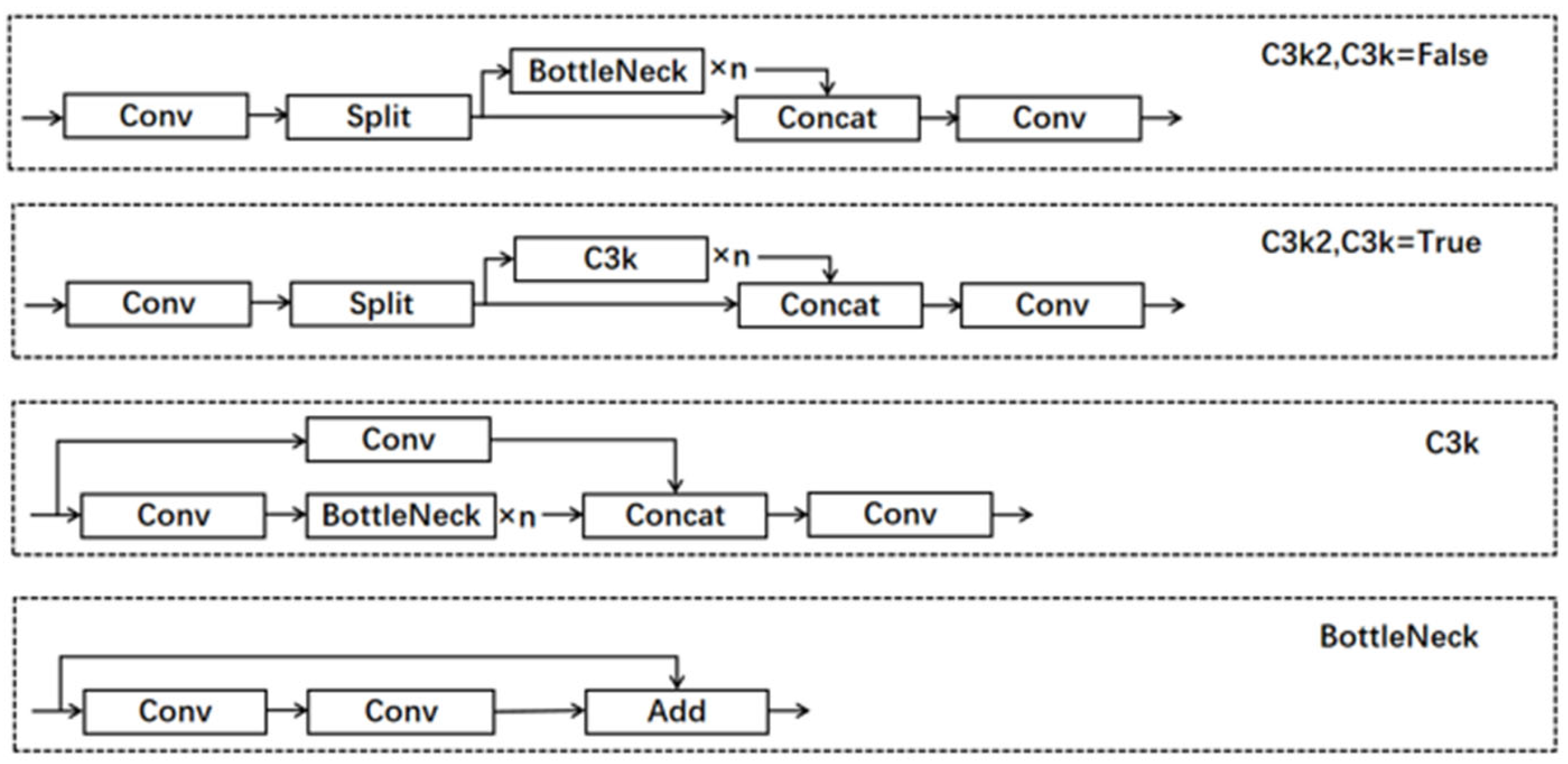
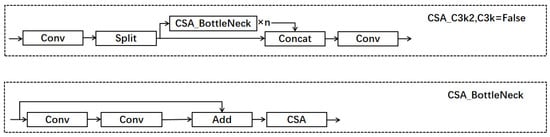
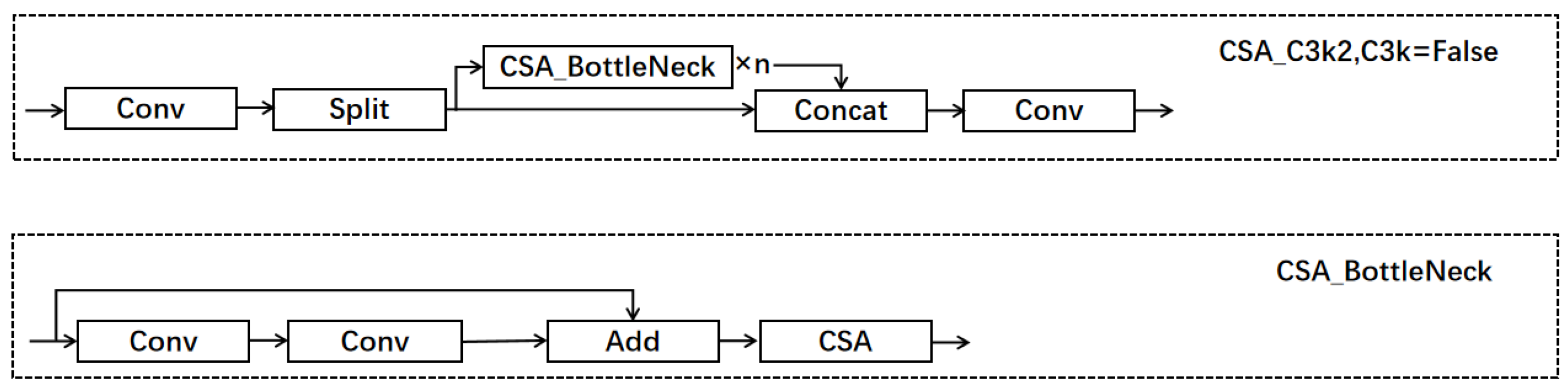
Building on the aforementioned attention mechanism, we have further designed a module called CSA_Bottleneck, as shown in Figure 4. This module effectively integrates the hybrid attention mechanism with a bottleneck structure, specifically engineered to boost small object detection performance. It introduces dynamic attention modulation during the feature extraction process, allowing it to enhance responses in small object regions while maintaining computational efficiency. When C3k = False, the CSA_Bottleneck module replaces the traditional bottleneck structure in shallow networks with the hybrid attention structure, further strengthening feature focus and extraction for small objects. The C3k2 module is an improved form based on the classic C3 structure. Its core idea is to maintain the advantages of the CSP (Cross Stage Partial) structure while introducing an attention mechanism to enhance the feature expression ability. Depending on the value of parameter C3k, there are significant differences in the internal sub-module design of C3k2.
Figure 4.
The network structure of C3k2.
The core idea is that while bottleneck structures can reduce computational burden by compressing and expanding channel numbers, they might lose crucial local details, especially in small object detection. By incorporating the attention mechanism into the bottleneck structure, the network can adaptively focus on small object regions, significantly improving recognition results. In our actual network architecture, we replaced all original C3k2 modules with CSA_C3k2 modules to achieve more efficient small object detection performance. The module structure is shown Figure 5.
Figure 5.
The network structure of CSA_C3k2.
2.3. A2C2f Module Based on Self-Attention Mechanism
In PC-YOLO11 [24], we observed that directly integrating attention mechanisms into the last two C3k2 modules of the backbone network leads to a decrease in model accuracy. This is because, at deeper network layers, the CSA_Bottleneck module, when equipped with an attention mechanism, can introduce information redundancy. Deeper networks are inherently capable of extracting more abstract, high-level features. If an attention mechanism is introduced at this stage, it might cause the model to over-focus on certain regions, leading to wasted computational resources and the introduction of redundant attention weights. To better extract feature information from deep networks, we need a self-attention mechanism to capture more complex relationships, and the A2C2f module [28] proves effective in this regard.
In small object detection tasks, objects are typically small in scale, have sparse texture information, and are highly susceptible to background interference. Conventional feature extraction modules often struggle to effectively preserve their structural and semantic features. Furthermore, small objects are easily compressed and lost in deep feature maps, leading to a drop in detection accuracy. To mitigate this issue, this paper introduces the A2C2f module, which incorporates a regional self-attention mechanism into the backbone network, replacing the original two C3k2 modules.
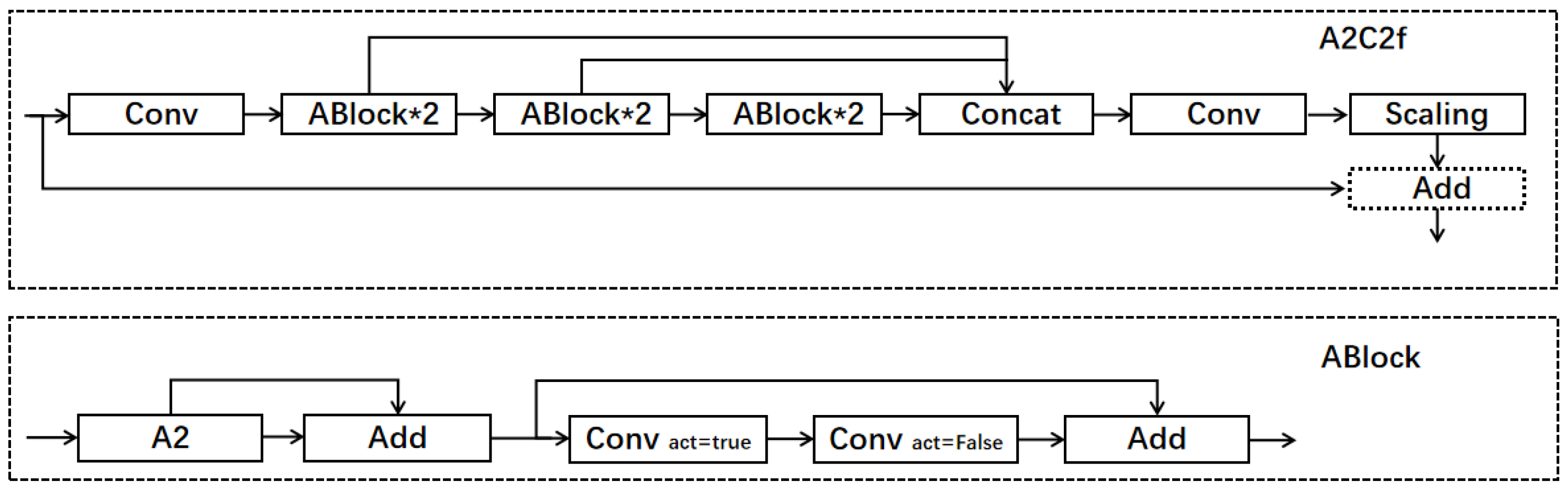
The A2C2f module is designed as a region-attention-enhanced variant of the standard C2f module widely used in YOLO series networks. The structure of the C2f module is shown in Figure 6. Specifically, A2C2f replaces the conventional bottleneck units in C2f with stacked Area-Attention Blocks (ABlocks) [29], thereby introducing regional attention into the feature aggregation process. Through a local self-attention mechanism, it achieves a more fine-grained feature representation. Unlike traditional attention mechanisms, regional attention enhances the model’s local perception ability for small object regions while keeping the computational load manageable. This allows for more effective extraction of crucial details like edges, textures, and shapes of small objects.
Figure 6.
The network structure of C2f.
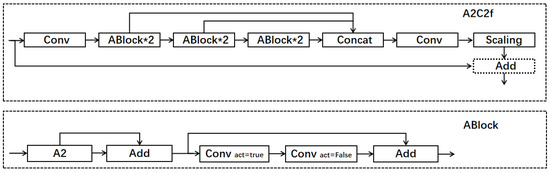
Concurrently, the A2C2f module incorporates multiple stacked ABlocks within its residual structure. This design improves the model’s ability to integrate deep abstract semantics with shallow spatial information. This is particularly beneficial for scenarios with dense or heavily occluded small objects, significantly boosting the model’s discrimination and localization capabilities for fine-grained targets in complex scenes. The structure of the A2C2f module is illustrated in Figure 7.
Figure 7.
The network structure of A2C2f.
By integrating multiple ABlocks within the C2f framework, A2C2f preserves the lightweight and efficient characteristics of the original C2f module, while substantially improving its ability to model fine-grained spatial information.
Overall, deploying the A2C2f module in the deeper stages of the backbone network not only avoids the information redundancy issues typically introduced by conventional attention mechanisms at high semantic levels but also effectively strengthens the model’s ability to focus on and preserve semantic information for small-scale targets. This ultimately enhances both the performance and robustness of small object detection.
3. Experiments
In this section, we conduct object detection experiments using two publicly available datasets and a self-constructed tea bud dataset. To evaluate the effectiveness of the proposed method (TSF-Net), we compare it with several mainstream approaches. The detection performance is assessed using the following metrics: the number of parameters (Params), mean average precision at an IoU threshold of 0.5 (mAP@0.5), and mean average precision across IoU thresholds from 0.5 to 0.95 (mAP@0.5:0.95). The advantages of the proposed method are demonstrated in three parts: Section 3.1 introduces the datasets; Section 3.2 describes the experimental environment and setup in detail; and Section 3.3 presents a comprehensive comparison between TSF-Net and mainstream deep learning-based object detection methods across the three datasets, along with an ablation study to validate the effectiveness of the proposed modules.
3.1. Datasets
3.1.1. Self-Built Dataset
Currently, the available public datasets for tea bud detection are still very limited, and most of the data are collected in controlled environments, which makes it difficult to reflect the complexity of tea gardens under real production conditions. This, in turn, hinders the development of automated tea picking and phenotypic analysis algorithms as well as their fair comparison. The growth of tea buds is influenced by various natural, biological, and technological factors such as climate, soil, altitude, and variety selection. These factors result in significant differences in morphology, density, and color of tea buds, posing challenges for reliable visual detection in actual scenarios.
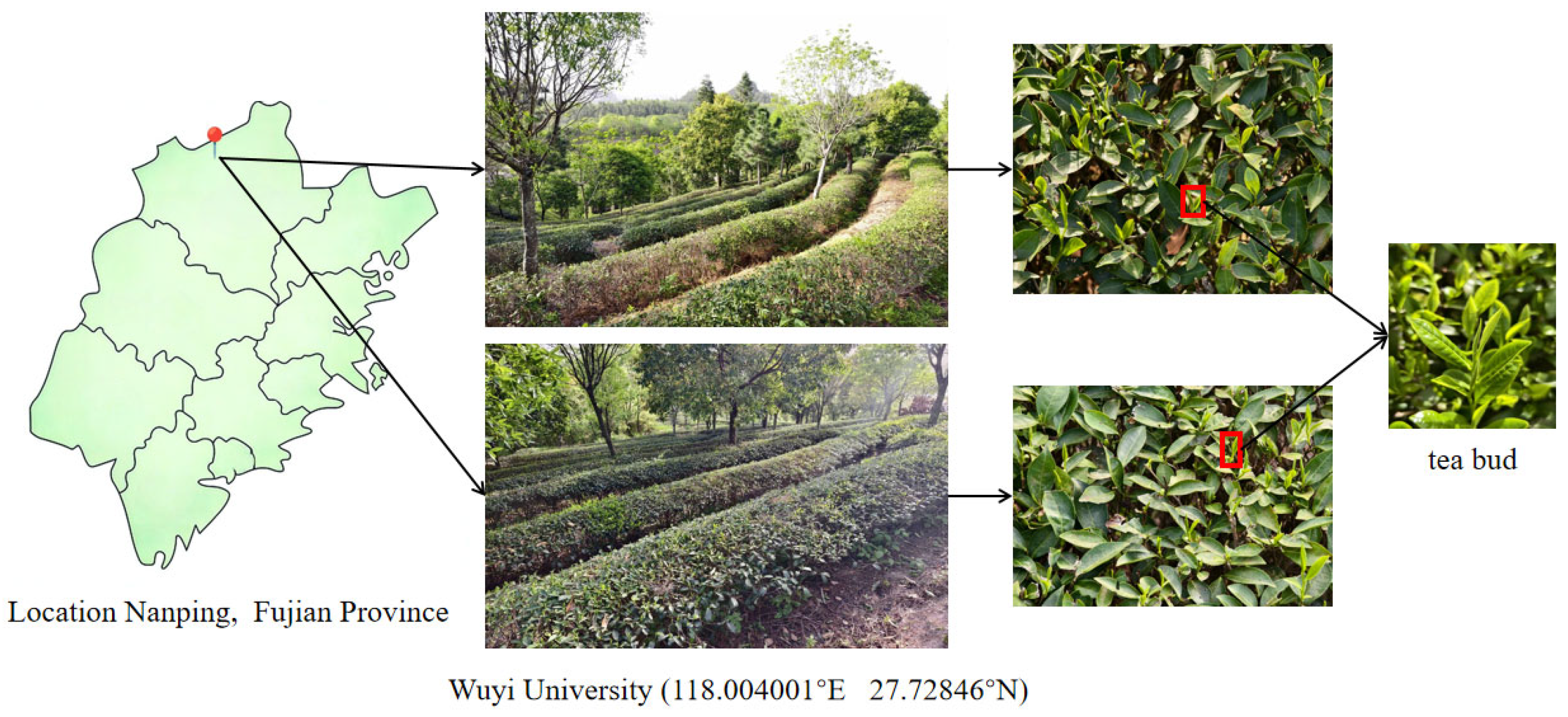
Wuyi Mountain, as an important tea-producing area in China, has typical ecological conditions. This region has a subtropical monsoon climate with abundant rainfall, frequent fog, and significant day-night temperature differences. Its acidic and mineral-rich soil [30], combined with complex terrain and mid-to-high altitude environment, is conducive to the slow growth of tea buds and the formation of dense leaf structures. At the same time, traditional breeding and variety management methods have led to significant differences in bud shape and appearance characteristics among different tea tree varieties, providing ideal conditions for constructing a challenging tea bud detection dataset. Based on these advantages, this paper has constructed a tea bud detection dataset named WYTeaBud. This dataset contains 717 high-resolution images with an original resolution of 3604 × 4986 pixels, all of which were captured from the tea garden on the back hill of Wuyi University. The collection location is shown in Figure 8. They were taken using the HT-GE1000C-T-CL industrial camera (Huatan Vision, Shenzhen, China), ensuring consistency in the collection conditions and traceability of the data source. The dataset covers five representative local tea varieties, such as Maoshou and Fuhou, which have significant differences in bud size, shape, and surface hair characteristics, providing a reliable data foundation for tea bud detection research in complex scenarios.
Figure 8.
Dataset collection location.
From the perspective of data characteristics, WYTeaBud contains densely distributed small target tea buds. Compared with public datasets such as tea-budsyolo (https://www.kaggle.com/datasets/meiling12/tea-budsyolo, accessed on 24 September 2024), these tea buds are often partially obscured by surrounding leaves, making the targets smaller and their colors more similar. To better reflect the complexity of the real tea garden environment, these images were captured under various challenging lighting conditions, including natural sunlight, intense direct sunlight, and backlight scenes, etc. These factors significantly increase the intra-class differences and the difficulty of detection and are more in line with the actual production and picking conditions.
After image acquisition, we used Make Sense to annotate the images, labeling them as “0.” This process generated a.txt file for each corresponding.jpg image file, containing both image location and class information.
To significantly boost the model’s generalization ability and robustness, we applied five data augmentation strategies to the original dataset, including but not limited to horizontal and vertical flipping. We discussed and compared two different data augmentation strategies. The first method, Augment1 [31], divides the dataset into a training set and a validation set in an 8:2 ratio at the original image level, and only performs data augmentation on the training set. The second method, Augment2 [3], performs data augmentation before dividing the dataset into a training set and a validation set in an 8:2 ratio. The corresponding experimental results are shown in Table 1, which are mainly used to analyze the impact of data augmentation on the model performance under the condition of a small sample size. When the sample size is limited, data augmentation is an important means to enhance the robustness of the model. However, from a strict evaluation perspective, Augment2 may introduce the risk of information leakage, that is, the augmented samples generated from the same original image appear simultaneously in both the training set and the validation set, thereby causing the validation performance to be overly optimistic. In this setting, this paper does not impose constraints on the cross-set exclusivity of the augmented samples at the original image level, so the results of Augment2 should not be regarded as the final verification of the model’s generalization ability under no-leakage conditions, but rather, are mainly used to observe the relative change trend of the model performance. Given that the public tea bud dataset used in the subsequent comparative experiments also follows the processing procedure of “augmentation first, then division” in its original research, this paper uniformly adopts this strategy in the related experiments to ensure the comparability of different methods under the same experimental conditions. It should be noted that this process is consistently applied in all comparative methods, so the relative performance differences between different methods still have comparative significance, given the known limitations. Further, in the subsequent experimental discussion, we verified that the proposed method still outperforms the baseline model under the Augment1 setting without information leakage, indicating that the observed performance improvement is not solely due to the augmentation strategy.
Table 1.
YOLO11n experimental results on original vs. augmented datasets. (for trend analysis only).
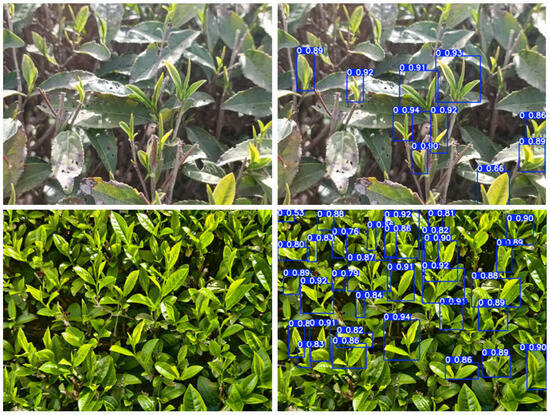
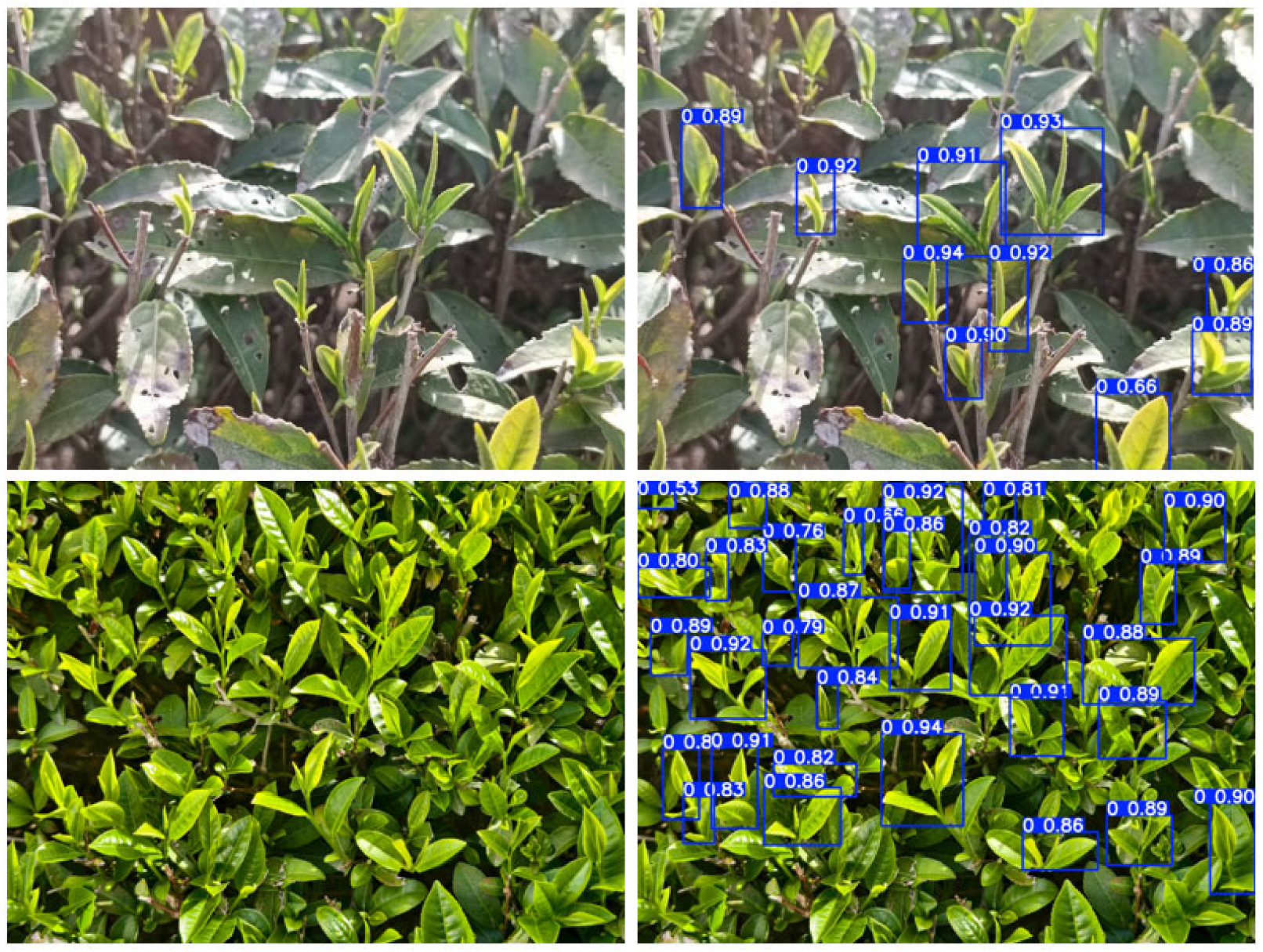
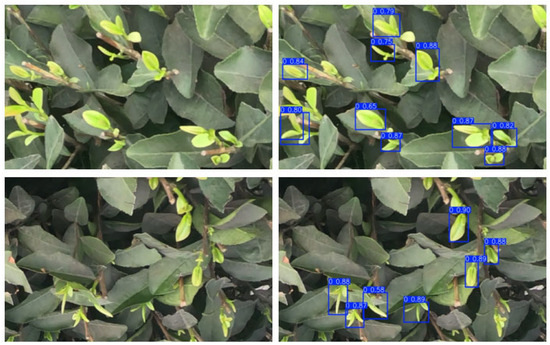
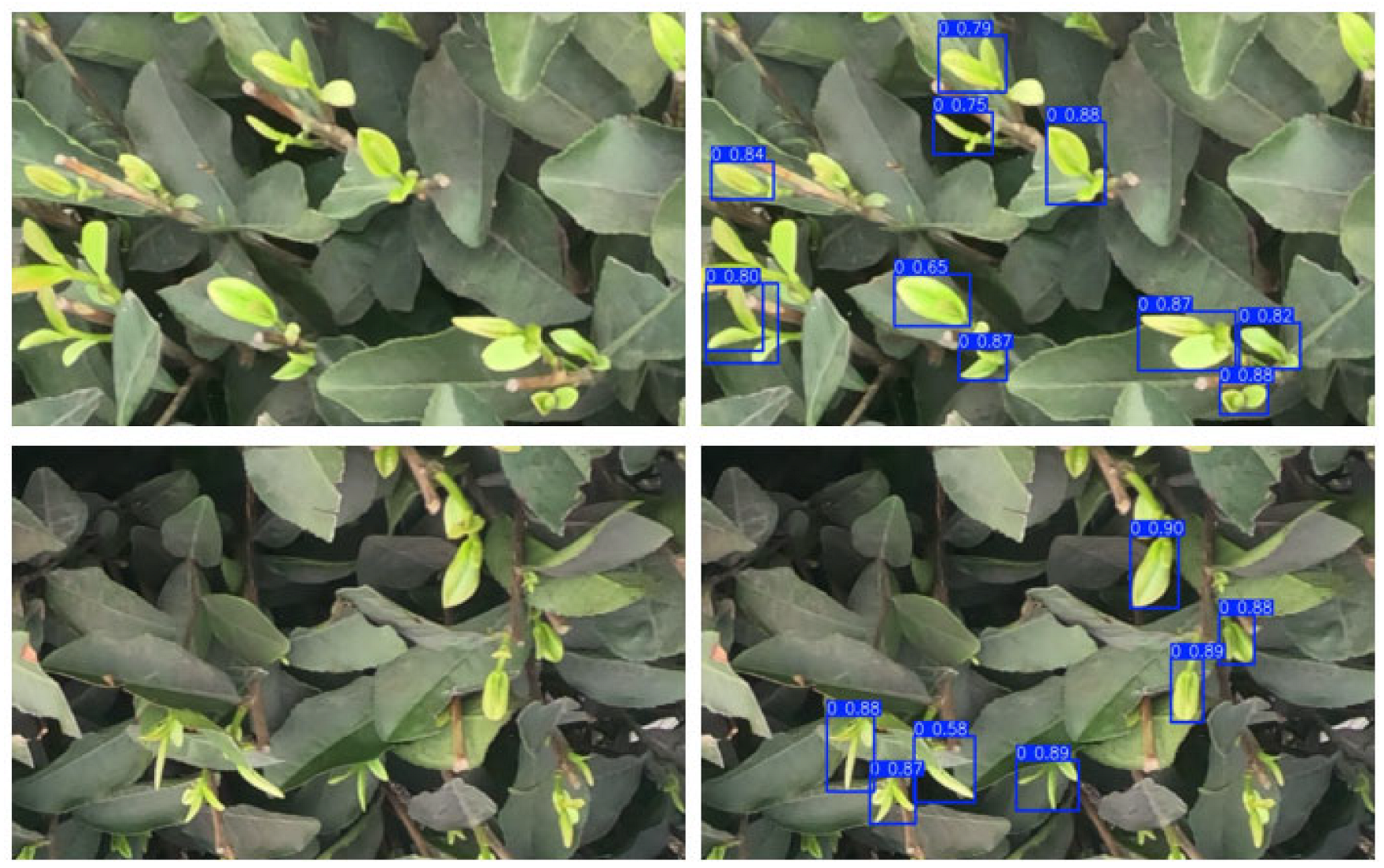
The WYTeaBud dataset consists of 717 original tea bud images collected in a real tea garden environment. Figure 9 shows some of the original images and their corresponding TSF-Net detection results as examples. Our model TSF-Net achieved an mAP@0.5 evaluation metric of 87.0% on the Augment1 processing method of the WYTeaBud dataset. During the model training stage, the original images were augmented based on the Augment2 strategy, expanding the available samples to 4302, with the training set and validation set being 3441 and 861, respectively.
Figure 9.
Visualization of partial images and their detection results in WYTeaBud datasets.
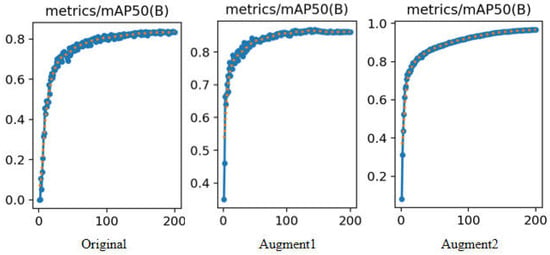
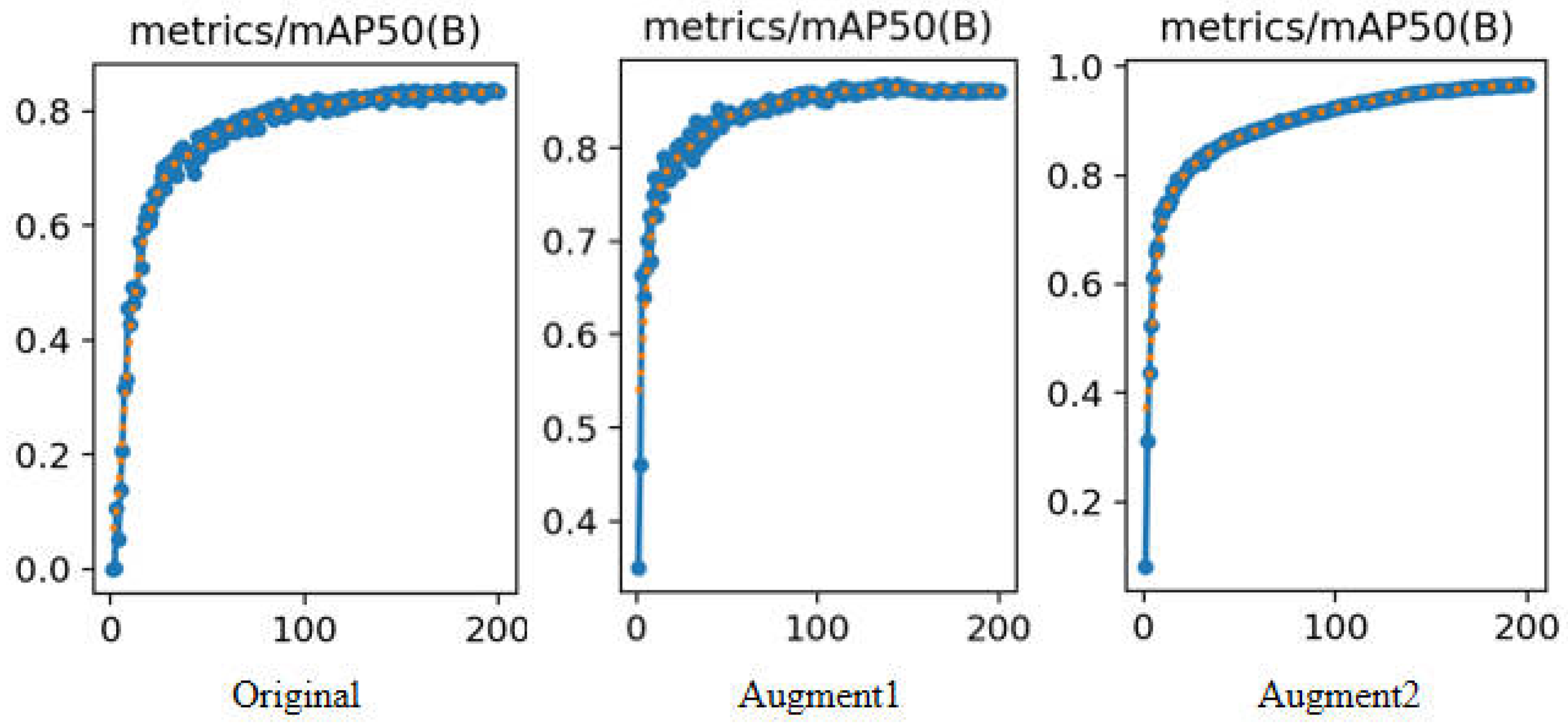
As evident from Figure 10, training the model solely on the original dataset resulted in insufficient convergence and low detection accuracy. This clearly demonstrates the necessity of augmenting the dataset to ensure the model achieves stronger generalization capabilities and higher detection performance.
Figure 10.
mAP@0.5 Iteration Curve.
3.1.2. Public Datasets
To further validate the effectiveness and universality of our proposed method, we conducted additional experiments on the publicly available TeaBud dataset from Kaggle and the VisDrone2019 dataset.
We cropped the original tea bud images from the Kaggle platform (https://www.kaggle.com/datasets/meiling12/tea-budsyolo, accessed on 24 September 2024) and applied a series of image processing techniques, including brightness enhancement, dimming, blurring, and flipping. In total, 6250 images were obtained and divided into training, validation, and testing sets at a ratio of 8:1:1, resulting in 5000 images for training, 625 for validation, and 625 for testing. The experimental results show that our proposed TSF-Net model achieved 85.3% mAP@0.5 on the TeaBud dataset. Select images and their detection results are presented in Figure 11.
Figure 11.
Visualization of original images and their detection effects in the tea bud datasets.
Although the main application scenario of this study is the detection of tea buds in agricultural environments, the proposed TSF-Net aims to enhance the feature representation of small targets and the ability of multi-scale feature fusion, which is a common challenge in multiple visual domains. To verify the cross-domain generalization ability of this model in the task of dense small target detection, this paper conducted additional auxiliary evaluations on the VisDrone2019 dataset.
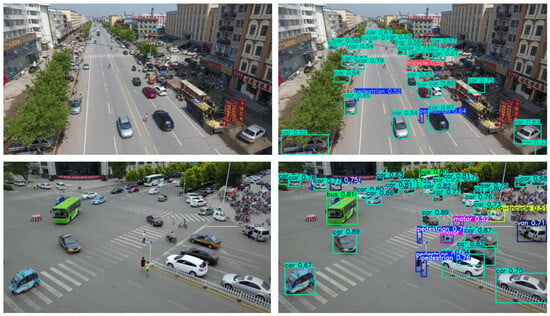
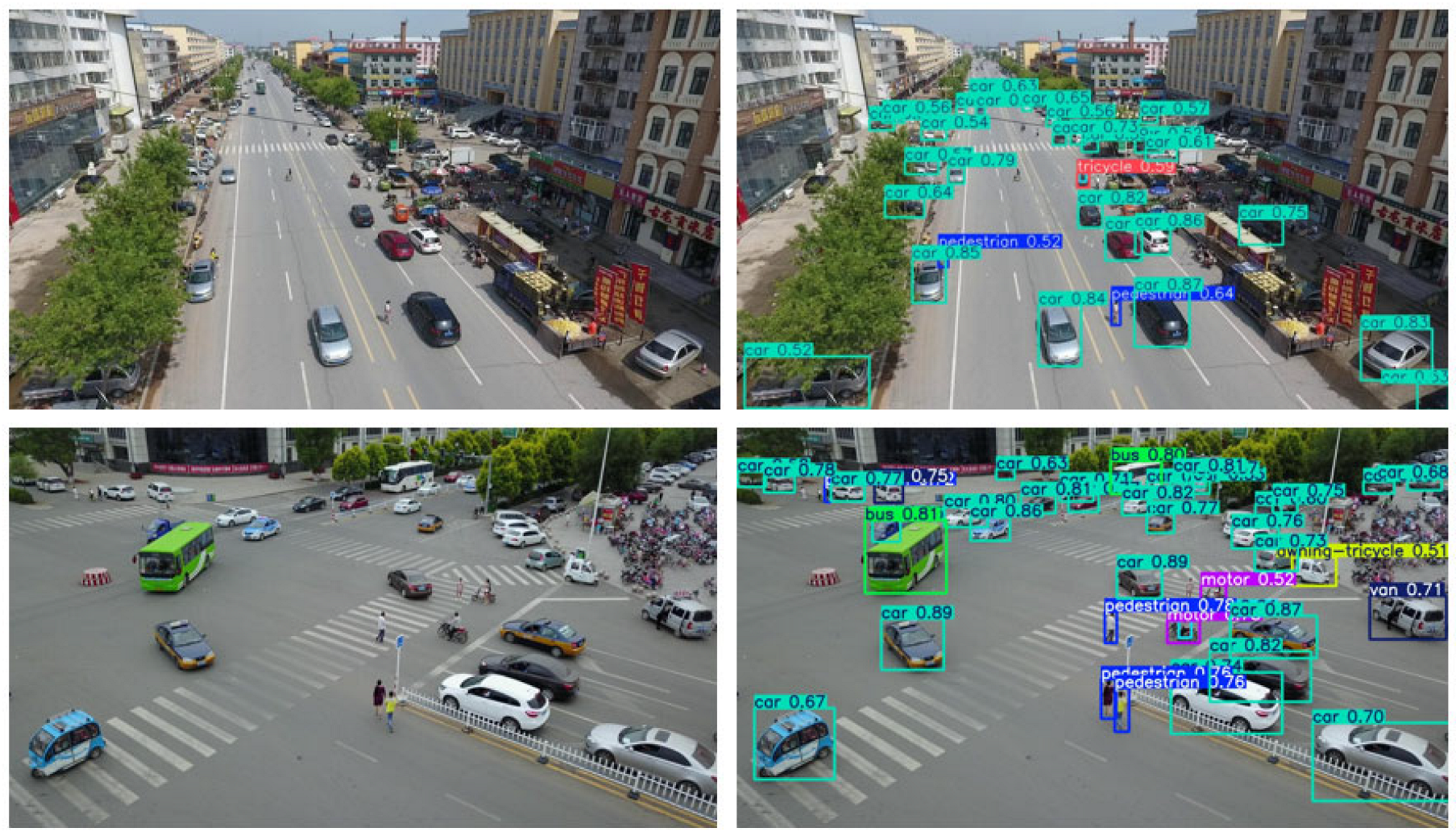
VisDrone2019 [32] contains 8629 high-resolution drone images, including 6471 training images, 548 validation images, and 1610 test images, covering ten types of targets such as pedestrians, vehicles, and bicycles. Due to the imaging characteristics of the aerial perspective, a large number of targets in the dataset are presented in a small size and densely distributed form. Therefore, although the application fields are different, it is still very suitable for evaluating the ability to detect small targets. The experimental results show that TSF-Net achieved an mAP@0.5 of 36.1% on the VisDrone2019 dataset, demonstrating its good performance in detecting densely distributed small targets in complex backgrounds. Some detection results are shown in Figure 10. This experiment is a secondary cross-domain verification. Its purpose is to test whether the small target perception design of TSF-Net can achieve effective generalization beyond agricultural scenarios, thereby indirectly supporting its potential value in actual tea garden environments. Select images and their detection results are presented in Figure 12.
Figure 12.
Visualization of partial images and their detection results in the VisDrone2019 datasets.
3.2. Experimental Environment
All experiments in this study were based on the PyTorch (version 2.1.0) deep learning framework and programmed in Python 3.10. Experimental platform hardware environment: The CPU is 16 vCPU Intel(R) Xeon(R) Platinum 8474C, the GPU is NVIDIA GeForce RTX 4090D 24G, the memory is 80 GB, and the operating system is 64-bit Windows. The specific parameter settings are as follows: learning rate of 0.001, momentum of 0.937, weight decay factor of 0.0005, batch size of 16, number of iterations of 200, and image size of 640 × 640.
3.3. Experimental Results and Discussion
3.3.1. Comparative Experiments
To validate the effectiveness of our proposed method, we conducted comparative experiments against 12 mainstream object detection methods across three different datasets. The chosen comparison models include: YOLOv3-tiny [33], RTDETR-l [34], YOLOv5n (https://github.com/ultralytics/yolov5, accessed on 24 September 2024), YOLOv6n [35], YOLOv7-tiny [36], YOLOv8n (https://github.com/ultralytics/ultralytics, accessed on 24 September 2024), YOLOv9t [37], YOLOv10n [38], YOLOv11n, YOLOv12n [28], PC-YOLO11n [24], and YOLO-EV [39].
The performance comparison results for each method on the three datasets are presented in Table 2, Table 3, and Table 4, respectively. In these tables, bolded text indicates our proposed model and its corresponding experimental results.
Table 2.
Performance comparison of various object detection algorithms on the WYTeaBud dataset.
Table 3.
Performance comparison of object detection methods on the public tea bud dataset.
Table 4.
Performance comparison of object detection methods on the VisDrone2019 dataset.
From Table 2, it is clear that our proposed model achieves optimal performance in detection accuracy. On the WYTeaBud dataset, our method reached 98.3% mAP@0.5 and 79.9% mAP@0.5:0.95. This represents an improvement of 1.6 percentage points and 6.7 percentage points, respectively, compared to the original YOLO11n model. Simultaneously, the model’s parameter count is only 80% that of YOLO11n, significantly reducing model complexity while maintaining high accuracy. This further validates the excellent balance our method strikes between lightweight design and precision.
As Table 3 illustrates, our proposed model also performs exceptionally well on the public tea bud dataset, achieving the current state-of-the-art detection accuracy. Specifically, it reaches 85.3% mAP@0.5 and 64.0% mAP@0.5:0.95. This marks an improvement of 2.1 percentage points and 5.2 percentage points, respectively, compared to the original YOLO11n model. Concurrently, the model’s parameter count is only 80% that of YOLO11n, fully demonstrating our method’s comprehensive advantages in terms of versatility, accuracy, and lightweight design.
As shown in Table 4, our proposed model also achieves the best detection performance on the publicly available VisDrone2019 dataset. On this dataset, the model reached 36.1% mAP@0.5 and 21.4% mAP@0.5:0.95. Compared to the original YOLO11n model, these represent improvements of 3.7 and 2.8 percentage points, respectively, while the model’s parameter count remains at just 80% of YOLO11n. This result further validates the robustness and effectiveness of our proposed method for small object detection in complex scenarios. Considering Table 2, Table 3 and Table 4 comprehensively, our proposed model consistently achieves optimal detection accuracy across all three datasets, demonstrating excellent generalization ability and stability. On the WYTeaBud dataset and the public tea bud dataset, mAP@0.5 reached 98.3% and 85.3%, respectively, with mAP@0.5:0.95 at 79.9% and 64.0%. These are significant improvements over the original YOLO11n. Even in the VisDrone2019 dataset, which features large object scale variations and complex backgrounds, our model still shows superior detection capabilities, achieving 36.1% mAP@0.5 and 21.4% mAP@0.5:0.95. While ensuring improved detection accuracy, the model’s parameter count is only 80% of YOLO11n, effectively reducing model complexity and facilitating efficient deployment on resource-constrained edge devices. These results fully validate the effectiveness and practicality of our method in small object detection tasks.
3.3.2. Ablation Analysis
To further validate the specific contribution of each module in our proposed method to detection performance, we conducted ablation studies on the WYTeaBud dataset. To ensure experimental accuracy, the model’s hyperparameters and operating environment were kept consistent. Table 5 presents the detection performance when the P2A-BiFPN, CSA, and A2C2f modules are individually introduced into the baseline YOLO11n model. It also shows comparative results for their two-way and three-way combinations, allowing us to evaluate the improvement each module and its combinations bring to overall performance.
Table 5.
Ablation experiments of the TSF-Net model. (Bold formatting indicates the best result among all compared methods).
As shown in Table 5, all the proposed modules introduced into the baseline model YOLO11n improve detection performance to varying degrees, demonstrating the effectiveness of the structural enhancements. First, the introduction of P2A-BiFPN makes full use of high-resolution shallow features, which is particularly critical for small object detection. At the same time, the removal of the P5 layer reduces the model’s parameter size without significantly affecting accuracy, highlighting its lightweight advantage. Furthermore, the adaptive weighting mechanism enables efficient multi-scale feature fusion, thereby enhancing contextual awareness and improving the overall robustness of detection. Second, the CSA module, a position-aware spatial attention mechanism, helps the model focus on salient target regions and enhances its perception of key positional information. Finally, the A2C2f module, which incorporates a self-attention mechanism, enhances the model’s ability to capture complex deep features and improves feature representation stability under multi-scale and cluttered background conditions. Together, these modules significantly strengthen the network’s capacity to extract features of tea buds.
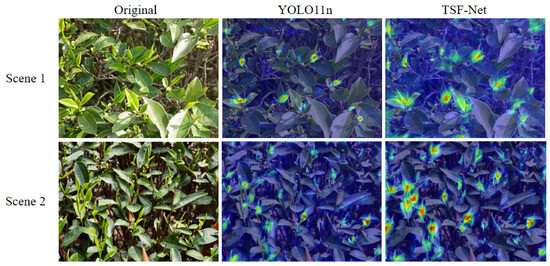
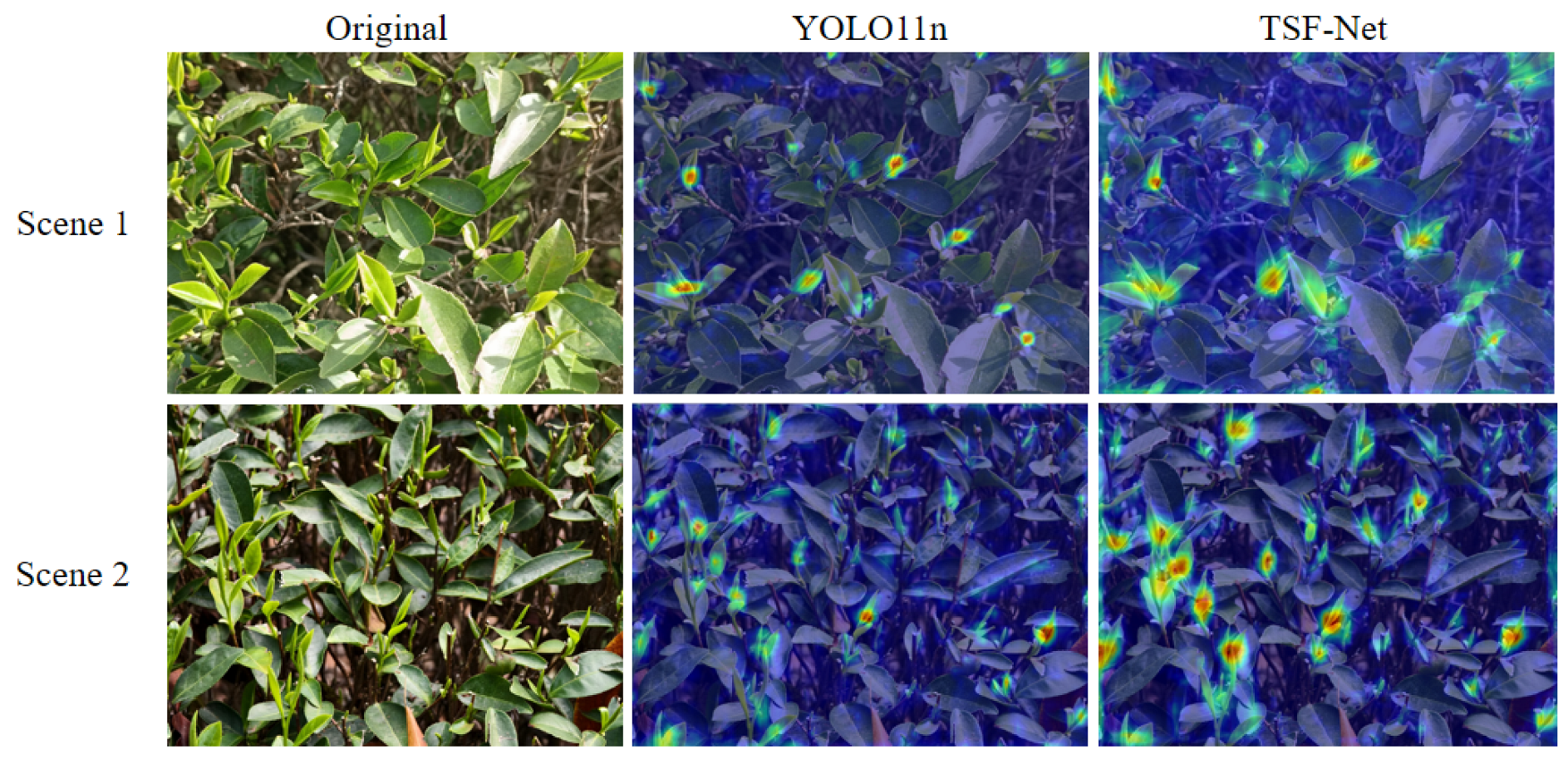
When all these modules are integrated, the model achieves optimal performance: mAP@0.5 reaches 98.3% and mAP@0.5:0.95 reaches 79.9%, representing improvements of 1.6 and 6.7 percentage points, respectively, over the original YOLO11n, while reducing the model’s parameter size to just 80% of the baseline. These results indicate that the proposed modules not only improve detection accuracy but also maintain computational efficiency, making them practically valuable for small object detection tasks. To further analyze the model’s attention to critical regions and validate its feature extraction effectiveness, we employed heatmap visualization on two randomly selected image samples to observe the response distribution. As illustrated in Figure 13, the proposed model demonstrates improved target localization and stronger boundary awareness. Compared to the baseline, it shows better feature aggregation and discriminative capability. This visualization provides an intuitive explanation for the underlying mechanisms driving the model’s performance gains.
Figure 13.
Heatmaps comparison between YOLO11n and TSF-Net.
3.3.3. Analysis of the Effectiveness of Different Detection Layers
The ablation study clearly demonstrates that P2A-BiFPN plays a significant role in improving the model’s detection accuracy. To further validate the effectiveness of the modifications made to the neck of the network—namely, the addition of the P2 detection layer and the removal of the P5 detection layer—we conducted comparative experiments. Specifically, we analyzed model performance under four configurations: the original model (P345), adding only the P2 detection layer (P2345), removing only the P5 detection layer (P34), and applying both adjustments simultaneously (P234).
As shown in Table 6, the introduction of the P2 detection layer proves generally effective in enhancing detection accuracy. However, when P2 and P5 coexist, although the model benefits from richer multi-scale feature information, detection performance does not further improve. Instead, this configuration leads to a noticeable increase in parameter count, revealing an imbalance between performance and efficiency.
Table 6.
Comparison of the effects of different detection layers.
To achieve a more reasonable trade-off between detection accuracy and model complexity, we conducted a comparative analysis based on the P34 structure, focusing on the performance differences between the P345 and P234 configurations. When extending P34 to P345 (i.e., restoring the original three-scale detection structure), the mAP@50 and mAP@50:95 dropped by 0.3% and 1.0%, respectively, while the number of parameters increased by approximately 40%. This indicates that the inclusion of P5 introduces redundant information that negatively impacts detection in this task. In contrast, the P234 structure, which incorporates the shallow P2 feature layer, significantly enhances the model’s ability to perceive small tea bud targets. This results in improvements of 0.6% in mAP@50 and 0.4% in mAP@50:95, with only a modest 4% increase in parameters.
In summary, P234 achieves a more favorable balance between accuracy and model lightweightness. Therefore, it is adopted as the baseline configuration for subsequent architectural enhancements proposed in this study.
3.3.4. Analysis of B_Concat Integration Position
The previous experiment validated the effectiveness of P2A-BiFPN in improving the detection layer structure. To further assess the overall effectiveness of P2A-BiFPN, this experiment, based on the P234 detection structure, conducts an in-depth analysis of the introduction of the B_Concat module, with a focus on a selective application strategy rather than full deployment. Although B_Concat is a powerful feature fusion module, the experimental results indicate that indiscriminately applying it to all deep feature fusions may lead to information redundancy. Our study shows that selective integration of B_Concat outperforms full integration. This targeted strategy allows the model to fully exploit the advantages of B_Concat in specific contexts while avoiding performance degradation caused by redundant information processing. The results further confirm the effectiveness of this optimization strategy: the model achieves a 0.1% improvement in mAP@0.5 and a 0.6% increase in mAP@0.5:0.95. These findings suggest that, in complex detection models, carefully considering the position and manner of applying B_Concat is crucial for maximizing its benefits. The experimental results are summarized in Table 7.
Table 7.
Comparison of B_Concat integration at different positions. (Bold formatting indicates the best result among all compared methods).
3.3.5. Analysis of the Effectiveness of the Attention Mechanism
This section further investigates the impact of inserting the CSA_C3k2 module at different positions within the network architecture, aiming to determine its optimal placement to fully exploit its feature extraction capability. The experiments are conducted on a modified baseline model that already integrates the P2A-BiFPN and the A2C2f module, collectively referred to as APB. The experimental setups and corresponding performance results are summarized in Table 8.
Table 8.
Comparison of the effects of adding attention mechanisms at different positions. (Bold formatting indicates the best result among all compared methods).
The experimental results reveal that inserting the CSA_C3k2 module either solely into the backbone or solely into the neck does not lead to noticeable improvements in model performance. However, when the module is applied to both the backbone and the neck simultaneously, the overall detection performance is significantly enhanced, with mAP@50 and mAP@50:95 reaching 98.3% and 79.9%, respectively. These findings clearly demonstrate that coordinated optimization of both the backbone and neck is crucial for improving feature representation and detection accuracy. The joint integration of the CSA_C3k2 module into both components fully leverages its capability in modeling spatial and positional information.
To further validate the effectiveness of the proposed Coordinate Spatial Attention (CSA) mechanism, we conducted a series of comparative experiments. These experiments were performed on a baseline model that had already incorporated the P2A-BiFPN and A2C2f modules. At identical insertion positions, three different attention mechanisms were evaluated: CBAM, CA, and the proposed CSA. The corresponding results are reported in Table 9.
Table 9.
Comparison of the effects of adding different attention mechanisms. (Bold formatting indicates the best result among all compared methods).
The experimental results clearly demonstrate that the integration of attention mechanisms significantly enhances the model’s performance, validating their effectiveness in object detection tasks. In particular, the proposed Coordinate Spatial Attention (CSA) mechanism achieves accuracy improvements of 0.3% in mAP@0.5 and 1.7% in mAP@50:95. Compared to conventional attention modules such as channel attention, spatial attention, or coordinate attention alone, CSA jointly leverages both spatial and positional features to more precisely enhance the model’s ability to recognize small target regions. Especially in scenarios where targets are small and embedded in complex backgrounds, CSA exhibits superior effectiveness. It significantly improves the model’s localization and identification of small objects, effectively reducing both false positives and missed detections. As a result, it substantially boosts the robustness and accuracy of the overall detection system.
3.3.6. Discussion Under the Split-First Augmentation Protocol (Augment1)
To further evaluate the effectiveness of the proposed TSF-Net under a leakage-free data augmentation protocol, we compare its performance with the baseline YOLO11n model using the Augment1 strategy, where the dataset is first split and data augmentation is applied only to the training set. The results are summarized in Table 10.
Table 10.
Performance comparison under the Augment1 (split-first) protocol. (Bold formatting indicates the best result among all compared methods).
As shown in the table, compared with YOLO11n-Original, the YOLO11n-Augment1 model achieves consistent improvements across all evaluation metrics, confirming that data augmentation itself contributes positively to performance under small-sample conditions. Specifically, mAP@0.5 increases from 83.3% to 85.0%, while mAP@0.5:0.95 improves from 50.9% to 53.0%, without any change in model complexity.
More importantly, under the same Augment1 protocol, the proposed TSF-Net (ours) further outperforms YOLO11n-Augment1, achieving an mAP@0.5 of 87.0% and an mAP@0.5:0.95 of 55.8%, representing gains of 2.0% and 2.8%, respectively. Meanwhile, the number of parameters is reduced from 2.582 M to 2.210 M, indicating that the performance improvement is achieved not by increasing model capacity, but by more effective feature representation and fusion design.
These results demonstrate that the proposed architectural improvements remain effective under a standard, leakage-free evaluation protocol. Even when data augmentation is applied strictly to the training set, TSF-Net consistently outperforms the baseline, providing strong evidence that the observed gains are attributable to the proposed network design rather than to data augmentation artifacts.
4. Model Deployment
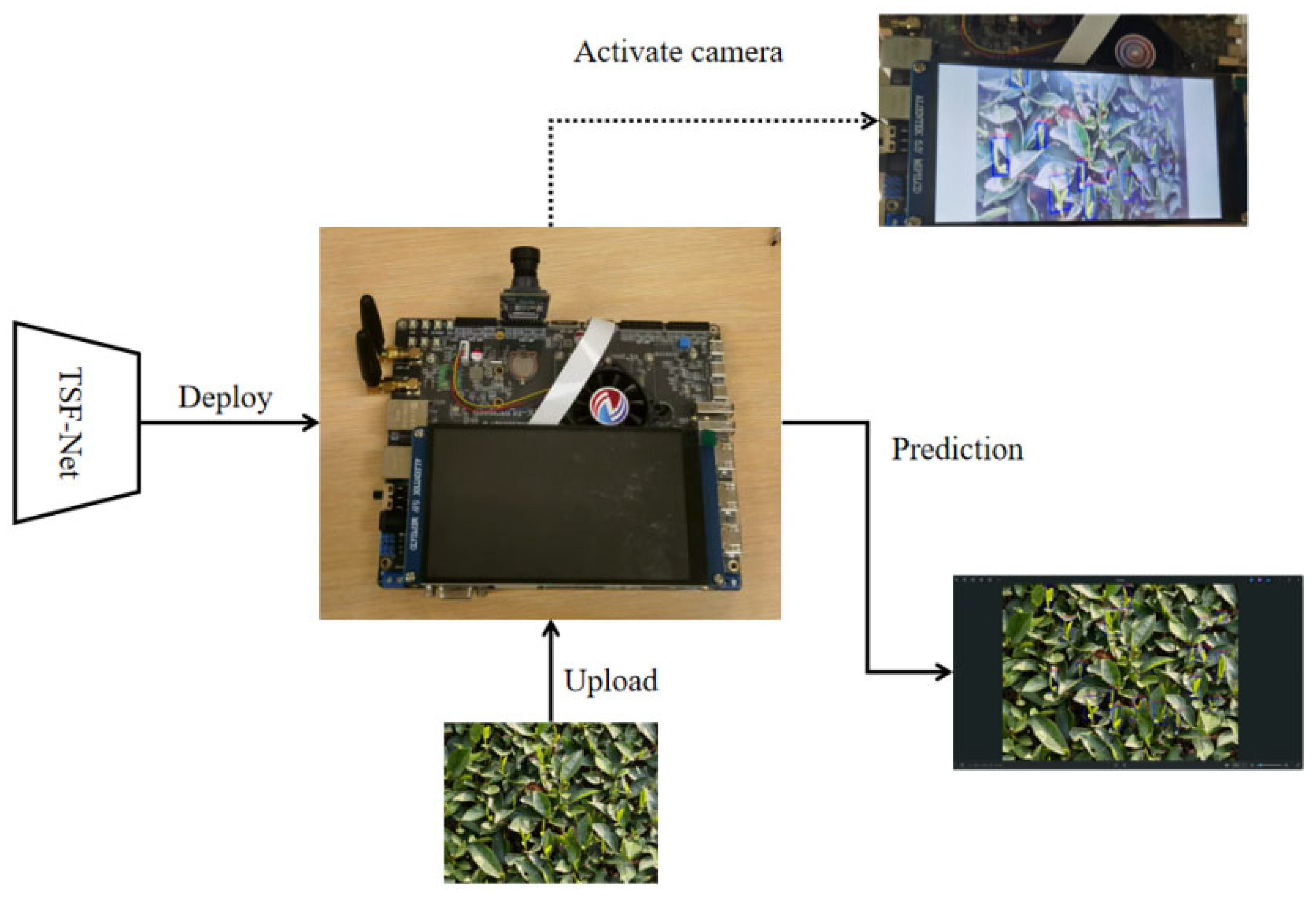
This research is oriented towards the demands of agricultural intelligent applications, aiming to design an efficient, accurate, and lightweight tea bud recognition model and verify its practical deployment feasibility on embedded platforms. To this end, the weights of the trained TSF-Net model were converted to the RKNN format that was suitable for inference on embedded hardware and finally deployed on the RK3588 development board for verification [40].
The RK3588 development board can fully meet the requirements of real-time performance and stability for the tea bud recognition task in terms of hardware configuration. This platform adopts an eight-core heterogeneous CPU architecture, consisting of four high-performance Cortex-A76 cores and four high-energy-efficient Cortex-A55 cores, with a maximum clock speed of up to 2.4 GHz. At the same time, it integrates an NPU accelerator unit with a peak computing power of 6 TOPS, which can provide efficient and stable edge inference support for lightweight target detection models. In terms of multimedia processing, this platform supports 8K@60 fps hardware video decoding and is equipped with a high-performance ISP, enabling low-latency data processing under high-speed image input conditions. In terms of image acquisition and display, the system is equipped with the MCIMX415 professional camera module for obtaining high-resolution and high-quality field images to meet the requirements of small target detection, such as tea buds. This camera module is provided by Zepin Atomic (Dongguan City, Guangdong Province, China). In addition, the system is also equipped with a 5.5-inch MIPI interface 1080p high-definition display for real-time display of the tea bud detection process and recognition results. The configuration table is shown in Table 11.
Table 11.
Embedded deployment platform specifications.
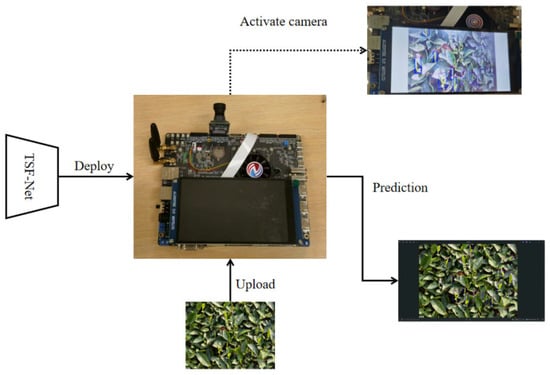
The recognition process is as follows: users can upload images, which are preprocessed and then fed into the TSF-Net model for tea bud recognition. The model outputs the locations of tea buds and provides real-time data support. The recognition results can be directly displayed on connected computer devices for convenient user access. In addition, the system can activate a camera for real-time detection, further enhancing the practicality of on-site applications.
Based on the above hardware configuration, the RK3588 platform can achieve stable and real-time tea bud detection in the actual agricultural field environment, effectively verifying the practicality and expansion potential of TSF-Net on embedded platforms. The embedded deployment experiments were conducted under controlled laboratory conditions, using images collected from the field, aiming to evaluate the stability and real-time performance of the system before field deployment. The experimental results are shown in Table 12. With an input resolution of 640 × 640, the deployed TSF-Net on the RK3588 platform achieved a frame rate of 49.19 frames per second, with an average inference delay of approximately 20.33 milliseconds per frame, which met the real-time requirements for on-site monitoring applications. During the deployment process, the memory usage of the model remained within the available on-board resources of the platform, enabling stable and long-term operation. The deployment device and the detection results in the controlled laboratory conditions are shown in Figure 14.
Table 12.
Comparison of frame rates between training and edge device deployment.
Figure 14.
The deployed device and its detection result.
In practical applications, the bounding boxes generated by tea bud detection can provide key perception information for the automatic picking system, for identifying the pickable tea buds and their precise spatial positions in the field of view. These detection results can be further integrated into the robot picking system to provide effective guidance for motion planning and end-effector alignment during the picking process, thereby enabling the tea bud detection module to play a core perception role in the intelligent tea bud picking system.
5. Conclusions
The core contribution of this study is the proposal of a novel model, TSF-Net, that was designed to tackle the multiple challenges of tea bud detection in natural tea garden environments, including large variations in object size, high density, severe occlusion, and strong visual similarity between tea buds and background colors. The fundamental goal of this research is to improve detection accuracy and enhance model adaptability, as the quality of tea bud picking directly determines the final quality of tea.
The innovation of TSF-Net lies in its refined optimization of the YOLO architecture. First, the proposed P2A-BiFPN significantly improves the model’s perception of tiny targets, reduces the number of model parameters, and enables efficient multi-scale feature fusion. Second, the CSA module is designed and embedded, allowing the model to focus more precisely on critical regional features. Finally, a self-attention-based A2C2f module is introduced in the later stages of the backbone network, greatly enhancing fine-grained feature extraction and thereby improving overall detection accuracy—an essential ability for distinguishing individual tea buds in complex backgrounds.
The experimental results have strongly confirmed the outstanding performance of the TSF-Net. The evaluations on the WYTeaBud dataset with the Augment1 processing method, the publicly available tea bud dataset, and the VisDrone2019 dataset show that this model significantly improves the detection accuracy while maintaining a low computational cost. Specifically, compared with the baseline model, mAP@0.5 has increased by 2.0%, 2.1%, and 3.7%, respectively. It is noteworthy that the number of parameters has been reduced to approximately 85% of the original size, and the model has been successfully deployed on a development board for the detection task. These results not only highlight the powerful potential of TSF-Net for efficiently and accurately detecting tea buds in complex tea garden scenarios, but it also emphasizes its deployment value and practical significance in actual agricultural applications, providing solid technical support for intelligent tea garden management.
Author Contributions
Conceptualization, Z.W., Q.W., H.L., and L.W.; methodology, Z.W., F.K., and Y.S.; validation, H.L., Z.W., and L.W.; formal analysis, H.L., L.W., and Z.W.; investigation, H.L., Z.W., and F.K.; resources, H.L., L.W., and F.K.; data curation, Z.W., H.L., L.W., and P.Z.; writing—original draft preparation, Z.W., H.L., and L.W.; writing—review and editing, Z.W., H.L., and L.W.; visualization, F.K., Y.S., and P.Z.; supervision, L.W. and Q.W.; project administration, L.W.; funding acquisition, L.W. All authors have read and agreed to the published version of the manuscript.
Funding
This research was funded by the Nature Science Foundation of Fujian Province of P. R. China under grants 2025J01585 and 2025J01586, in part by the Special Fund for Scientific and Technological Innovation of Fujian Agriculture and Forestry University under grants KFB23158 and KFB24048; Joint Funding Project for Science and Technology Innovation in Resource Chemistry Industry of Nanping City, N2025Z007, “Research and Demonstration of Key Technologies for Cross-Modal Visual Large Model Platform Aimed at Public Safety”.
Data Availability Statement
The WYTeaBud dataset used in this study is not fully publicly available at this stage, as it will continue to be used in ongoing follow-up studies based on the same data source. However, the dataset can be accessed for academic research purposes upon reasonable request by contacting the authors at 52311049016@fafu.edu.cn. A public release of the dataset is planned after the completion of the related studies.
Acknowledgments
We sincerely thank our fellow students who provided support and assistance during the experiments. We thank all the good teachers and beneficial friends who have cared for, supported, and helped out. Lastly, we heartily thank all the experts who took time out of their busy schedules to review this paper and offer their valuable suggestions.
Conflicts of Interest
The authors declare no conflicts of interest.
References
- Liu, Z.; Zhuo, L.; Dong, C.; Li, J. YOLO-TBD: Tea Bud Detection with Triple-Branch Attention Mechanism and Self-Correction Group Convolution. Ind. Crop. Prod. 2025, 226, 120607. [Google Scholar] [CrossRef] [Scilit]
- Ge, J.; Song, T.; Li, M.; Chen, W.; Li, J.; Gong, S.; Zhao, Y.; Ma, L.; Yu, H.; Li, X.; et al. The medicinal value of tea drinking in the management of COVID-19. Heliyon 2023, 9, e12968. [Google Scholar] [CrossRef] [Scilit] [PubMed]
- Zhao, R.; Liao, C.; Yu, T.; Chen, J.; Li, Y.; Lin, G.; Huan, X.; Wang, Z. IMVTS: A Detection Model for Multi-Varieties of Famous Tea Sprouts Based on Deep Learning. Horticulturae 2023, 9, 819. [Google Scholar] [CrossRef] [Scilit]
- Xu, W.; Zhao, L.; Li, J.; Shang, S.; Ding, X.; Wang, T. Detection and classification of tea buds based on deep learning. Comput. Electron. Agric. 2022, 192, 106547. [Google Scholar] [CrossRef] [Scilit]
- Hou, T.; Leng, C.; Wang, J.; Pei, Z.; Peng, J.; Cheng, I.; Basu, A. MFEL-YOLO for small object detection in UAV aerial images. Expert Syst. Appl. 2025, 291, 128459. [Google Scholar] [CrossRef] [Scilit]
- Wang, H.; Liu, J.; Zhao, J.; Zhang, J.; Zhao, D. Precision and speed: LSOD-YOLO for lightweight small object detection. Expert Syst. Appl. 2025, 269, 126440. [Google Scholar] [CrossRef] [Scilit]
- Iqra; Giri, K.J. SO-YOLOv8: A novel deep learning-based approach for small object detection with YOLO beyond COCO. Expert Syst. Appl. 2025, 280, 127447. [Google Scholar] [CrossRef] [Scilit]
- Zhang, L.; Zou, L.; Wu, C.; Jia, J.; Chen, J. Method of famous tea sprout identification and segmentation based on improved watershed algorithm. Comput. Electron. Agric. 2021, 184, 106108. [Google Scholar] [CrossRef] [Scilit]
- Li, W.; Chen, R.; Gao, Y.-y. Automatic Recognition of Tea Bud Image Based on Support Vector Machine. In International Conference on Advanced Hybrid Information Processing; Springer International Publishing: Cham, Switzerland, 2020. [Google Scholar]
- Shao, P.; Wu, M.; Wang, X.; Zhou, J.; Liu, S. Research on the tea bud recognition based on improved k-means algorithm. In MATEC Web of Conferences; EDP Sciences: Grenoble, France, 2018. [Google Scholar]
- Xie, B.; Wang, Y.; Han, M.; Wang, Y.; Chen, J. Density-guided two-stage small object detection in UAV images. Expert Syst. Appl. 2026, 297, 129346. [Google Scholar] [CrossRef] [Scilit]
- Zhang, W.; Jiang, F. AHN-YOLO: A Lightweight Tomato Detection Method for Dense Small-Sized Features Based on YOLO Architecture. Horticulturae 2025, 11, 639. [Google Scholar] [CrossRef] [Scilit]
- Jing, R.; Zhang, W.; Li, Y.; Li, W.; Liu, Y. Feature aggregation network for small object detection. Expert Syst. Appl. 2024, 255, 124686. [Google Scholar] [CrossRef] [Scilit]
- Ding, S.; Xiong, M.; Wang, X.; Zhang, Z.; Chen, Q.; Zhang, J.; Wang, X.; Zhang, Z.; Li, D.; Xu, S.; et al. Dynamic feature and context enhancement network for faster detection of small objects. Expert Syst. Appl. 2025, 265, 125732. [Google Scholar] [CrossRef] [Scilit]
- Yu, Z.; Liang, H.; Ye, O.; Zhang, Y. ESOD-YOLOv8: Small object detection enhanced with auto-disturbance rejection convolution. Expert Syst. Appl. 2026, 296, 129046. [Google Scholar] [CrossRef] [Scilit]
- Cheng, Y.; Li, Y.; Zhang, R.; Gui, Z.; Dong, C.; Ma, R. Locating Tea Bud Keypoints by Keypoint Detection Method Based on Convolutional Neural Network. Sustainability 2023, 15, 6898. [Google Scholar] [CrossRef] [Scilit]
- Chen, J.; Wang, H.; Zhang, H.; Luo, T.; Wei, D.; Long, T.; Wang, Z. Weed detection in sesame fields using a YOLO model with an enhanced attention mechanism and feature fusion. Comput. Electron. Agric. 2022, 202, 107412. [Google Scholar] [CrossRef] [Scilit]
- He, K.; Gkioxari, G.; Dollár, P.; Girshick, R. Mask R-CNN. In Proceedings of the 2017 IEEE International Conference on Computer Vision (ICCV), Venice, Italy, 22–29 October 2017; pp. 2980–2988. [Google Scholar] [CrossRef] [Scilit]
- Chen, C.; Lu, J.; Zhou, M.; Yi, J.; Liao, M.; Gao, Z. A YOLOv3-based computer vision system for identification of tea buds and the picking point. Comput. Electron. Agric. 2022, 198, 107116. [Google Scholar] [CrossRef] [Scilit]
- Chen, Z.; Chen, J.; Li, Y.; Gui, Z.; Yu, T. Tea Bud Detection and 3D Pose Estimation in the Field with a Depth Camera Based on Improved YOLOv5 and the Optimal Pose-Vertices Search Method. Agriculture 2023, 13, 1405. [Google Scholar] [CrossRef] [Scilit]
- Xie, S.; Sun, H. Tea-YOLOv8s: A Tea Bud Detection Model Based on Deep Learning and Computer Vision. Sensors 2023, 23, 6576. [Google Scholar] [CrossRef] [Scilit]
- Liu, Z.; Zhuo, L.; Dong, C.; Li, J.; Li, Y. TBD-Y: Automatic tea bud detection with synergistic object-spatial attention and global-local attention guided feature fusion. Smart Agric. Technol. 2025, 12, 101066. [Google Scholar] [CrossRef] [Scilit]
- Fang, W.; Chen, W. TBF-YOLOv8n: A Lightweight Tea Bud Detection Model Based on YOLOv8n Improvements. Sensors 2025, 25, 547. [Google Scholar] [CrossRef] [Scilit]
- Wang, Z.; Su, Y.; Kang, F.; Wang, L.; Lin, Y.; Wu, Q.; Li, H.; Cai, Z. PC-YOLO11s: A Lightweight and Effective Feature Extraction Method for Small Target Image Detection. Sensors 2025, 25, 348. [Google Scholar] [CrossRef] [Scilit] [PubMed]
- Tan, M.; Pang, R.; Le, Q.V. EfficientDet: Scalable and efficient object detection. arXiv 2019, arXiv:1911.09070. [Google Scholar]
- Woo, S.; Park, J.; Lee, J.Y.; Kweon, I.S. CBAM: Convolutional Block Attention Module. In Proceedings of the European Conference on Computer Vision (ECCV), Munich, Germany, 8–14 September 2018. [Google Scholar]
- Hou, Q.; Zhou, D.; Feng, J. Coordinate Attention for Efficient Mobile Network Design. In Proceedings of the 2021 IEEE/CVF Conference on Computer Vision and Pattern Recognition (CVPR), Nashville, TN, USA, 19–25 June 2021; pp. 13708–13717. [Google Scholar] [CrossRef] [Scilit]
- Tian, Y.; Ye, Q.; Doermann, D. YOLOv12: Attention-Centric Real-Time Object Detectors. arXiv 2025, arXiv:2502.12524. [Google Scholar]
- Ji, Y.; Ma, T.; Shen, H.; Feng, H.; Zhang, Z.; Li, D.; He, Y. Transmission Line Defect Detection Algorithm Based on Improved YOLOv12. Electronics 2025, 14, 2432. [Google Scholar] [CrossRef] [Scilit]
- Lin, S.; Wang, T.; Zheng, J.; Lin, W.; Jia, X.; Zhang, Q.; Wang, Y.; Ye, J.; Wang, H. Soil Acidification Alters Phosphorus Fractions and phoD-Harboring Microbial Communities in Tea Plantation Soils, Thus Affecting Tea Yield and Quality. Horticulturae 2025, 11, 1191. [Google Scholar] [CrossRef] [Scilit]
- Gao, X.; Li, F.; Yan, J.; Sun, Q.; Meng, X.; Liu, P. A Lightweight Greenhouse Tomato Fruit Identification Method Based on Improved YOLOv11n. Agriculture 2025, 15, 1497. [Google Scholar] [CrossRef] [Scilit]
- Du, D.; Zhu, P.; Wen, L.; Bian, X.; Ling, H.; Hu, Q.; Zheng, J.; Peng, T.; Wang, X.; Zhang, Y.; et al. VisDrone-SOT2019: The Vision Meets Drone Single Object Tracking Challenge Results. In Proceedings of the 2019 IEEE/CVF International Conference on Computer Vision Workshop (ICCVW), Seoul, Republic of Korea, 27–28 October 2019; pp. 199–212. [Google Scholar] [CrossRef] [Scilit]
- Redmon, J.; Farhadi, A. YOLOv3: An incremental improvement. arXiv 2018, arXiv:1804.02767. [Google Scholar] [CrossRef] [Scilit]
- Zhao, Y.; Lv, W.; Xu, S.; Wei, J.; Wang, G.; Dang, Q.; Liu, Y.; Chen, J. DETRs Beat YOLOs on Real-time Object Detection. In Proceedings of the IEEE/CVF Conference on Computer Vision and Pattern Recognition, Seattle, WA, USA, 16–22 June 2024. [Google Scholar]
- Li, C.; Li, L.; Jiang, H.; Weng, K.; Geng, Y.; Li, L.; Ke, Z.; Li, Q.; Cheng, M.; Nie, W.; et al. YOLOv6: A Single-Stage Object Detection Framework for Industrial Applications. arXiv 2022, arXiv:2209.02976. [Google Scholar] [CrossRef] [Scilit]
- Wang, C.-Y.; Bochkovskiy, A.; Liao, H.-Y.M. YOLOv7: Trainable bag-of-freebies sets new state-of-the-art for real-time object detectors. In Proceedings of the IEEE/CVF Conference on Computer Vision and Pattern Recognition, Vancouver, BC, Canada, 17–24 June 2023. [Google Scholar]
- Wang, C.-Y.; Yeh, I.-H.; Liao, H.-Y.M. YOLOv9: Learning What You Want to Learn Using Programmable Gradient Information. In European Conference on Computer Vision; Springer Nature: Cham, Switzerland, 2024. [Google Scholar]
- Wang, A.; Chen, H.; Liu, L.; Chen, K.; Lin, Z.; Han, J. YOLOv10: Real-Time End-to-End Object Detection. Adv. Neural Inf. Process. Syst. 2024, 37, 107984–108011. [Google Scholar]
- Zhou, Q.; Wang, Z.; Zhong, Y.; Zhong, F.; Wang, L. Efficient Optimized YOLOv8 Model with Extended Vision. Sensors 2024, 24, 6506. [Google Scholar] [CrossRef] [Scilit]
- Wang, J.; Gao, Z.; Zhang, Y.; Zhou, J.; Wu, J.; Li, P. Real-Time Detection and Location of Potted Flowers Based on a ZED Camera and a YOLO V4-Tiny Deep Learning Algorithm. Horticulturae 2022, 8, 21. [Google Scholar] [CrossRef] [Scilit]



Disclaimer/Publisher’s Note: The statements, opinions and data contained in all publications are solely those of the individual author(s) and contributor(s) and not of MDPI and/or the editor(s). MDPI and/or the editor(s) disclaim responsibility for any injury to people or property resulting from any ideas, methods, instructions or products referred to in the content. |
© 2026 by the authors. Licensee MDPI, Basel, Switzerland. This article is an open access article distributed under the terms and conditions of the Creative Commons Attribution (CC BY) license.