Thermal Effects on Early Life Stages of Leptocereus (Cactaceae) Species from Cuban Seasonally Dry Tropical Forests
 , , , and
Abstract
1. Introduction
2. Materials and Methods
2.1. Study Species: Seed Collection and Processing

| Species | Locality, Province | Habitat | m a.s.l. | Pm (mm) | SCD | SSD |
|---|---|---|---|---|---|---|
| L. santamarinae | Playa Herradura, Las Tunas | Coastal | 2 | 377 | Aug/17 | Sep/17 |
| L. sylvestris | Sendero el Guafe, Granma | Coastal | 18 | 387 | Sep/15 | Nov/15 |
| L. arboreus | Desembocadura del río Yaguanabo, Cienfuegos | Coastal | 26 | 510 | Sep/15 | Nov/15 |
| L. wrightii | Boca de Jaruco, Mayabeque | Coastal | 29 | 479 | May/17 | May/17 |
| L. maxonii | Mesa de la tinta, Guantánamo | Inland karstic hill | 394 | 501 | Jun/16 | Oct/16 |
| L. carinatus | Sierra del Chorrillo, Camagüey | Inland karstic hill | 244 | 627 | Sep/17 | Sep/17 |
| L. scopulophilus | Pan de Matanzas, Matanzas | Inland karstic hill | 212 | 617 | Jan/17 | Jan/17 |
| L. leonii | Sierra de Anafe, Artemisa | Inland karstic hill | 147 | 575 | May/16 | May/16 |
| L. assurgens | Chichones del Indio, Viñales, Pinar del Río | Inland karstic hill | 348 | 703 | Jun/16 | Oct/16 |
| L. ekmanii | Sierra de Guanes, Pinar del Río | Inland karstic hill | 49 | 611 | Jun/17 | Jun/17 |
2.2. Treatments
- (1)
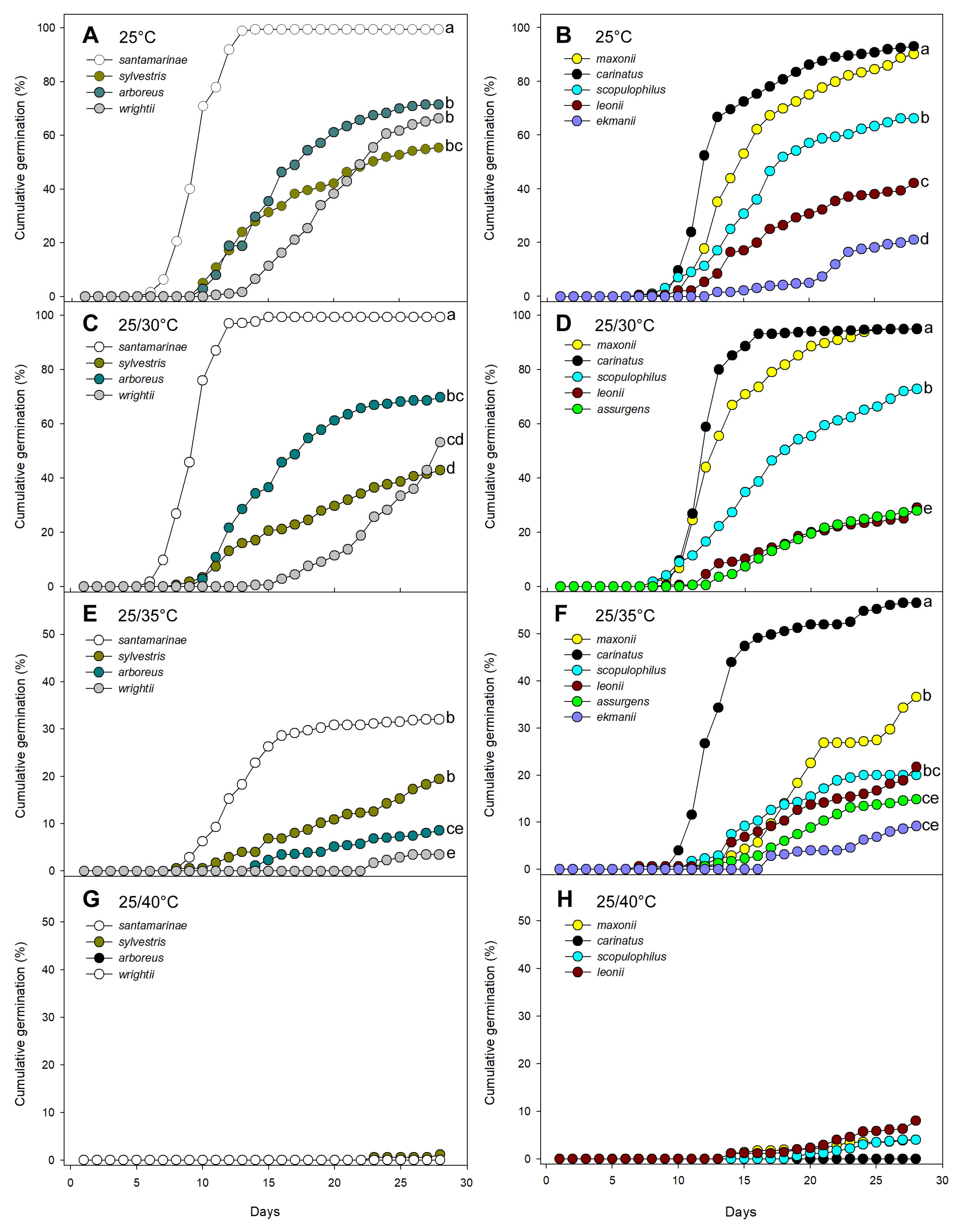
- Minimum germination time (Tmin), which is calculated as the day at which the first germination occurred [22].
- (2)
- (3)
- Germinability (G), the final percentage of germinated seeds at the end of the experiment (day 28) [22].
2.3. Measurement and Projection of Temperatures at Collection Sites
2.4. Data Analysis
3. Results
3.1. Germination Speed (Tmin and MGT)
3.2. Germinability
3.3. Recovery
3.4. Seedling Vigor
3.5. Thermal Buffering Capacity for Optimal Germination (TBCog)
4. Discussion
4.1. Germination and Thermal Buffering Capacity for Optimal Germination
4.2. Recovery and Seed Dormancy
4.3. Seed Photoblastism
4.4. Seedling Vigor
5. Conclusions
Author Contributions
Funding
Data Availability Statement
Acknowledgments
Conflicts of Interest
References
- Root, T.L.; Schneider, S.H. Conservation and climate change: The challenges ahead. Conserv. Biol. 2006, 20, 706–708. [Google Scholar] [CrossRef] [PubMed]
- Corlett, R.T.; Westcott, D.A. Will plant movements keep up with climate change? Trends Ecol. Evol. 2013, 28, 482–489. [Google Scholar] [CrossRef] [PubMed]
- Hultine, K.R.; Majure, L.C.; Nixon, V.S.; Arias, S.; Búrquez, A.; Goettsch, B.; Puentes-Martínez, R.; Zavala-Hurtado, A. The role of botanical gardens in the conservation of Cactaceae. BioScience 2016, 66, 1057–1065. [Google Scholar] [CrossRef]
- Filipe, J.C.; Ahrens, C.C.; Byrne, M.; Hardy, G.; Rymer, P.D. Germination temperature sensitivity differs between co-occurring tree species and climate origins resulting in contrasting vulnerability to global warming. Plant-Environ. Interact. 2023, 4, 146–162. [Google Scholar] [CrossRef]
- Pillet, M.; Goettsch, B.; Merow, C.; Maitner, B.; Feng, X.; Roehrdanz, P.R.; Enquist, B.J. Elevated extinction risk of cacti under climate change. Nat. Plants 2022, 8, 366–372. [Google Scholar] [CrossRef]
- IPCC. Climate Change 2021: The Physical Science Basis. Contribution of Working Group I to the Sixth Assessment Report of the Intergovernmental Panel on Climate Change; Cambridge University Press: Cambridge, UK; New York, NY, USA, 2021; pp. 147–286. [Google Scholar] [CrossRef]
- Godínez-Álvarez, H.; Valiente-Banuet, A. Demography of the columnar cactus Neobuxbaumia macrocephala: A comparative approach using population projection matrices. Plant Ecol. 2004, 174, 109–118. [Google Scholar] [CrossRef]
- Aragón-Gastélum, J.L.; Badano, E.; Yáñez-Espinosa, L.; Ramírez-Tobías, H.M.; Rodas-Ortiz, J.P.; González-Salvatierra, C.; Flores, J. Seedling survival of three endemic and threatened Mexican cacti under induced climate change. Plant Species Biol. 2017, 32, 92–99. [Google Scholar] [CrossRef]
- Aragón-Gastélum, J.L.; Flores, J.; Jurado, E.; Ramírez-Tobías, H.M.; Robles-Díaz, E.; Rodas-Ortiz, J.P.; Yáñez-Espinosa, L. Potential impact of global warming on seed bank, dormancy and germination of three succulent species from the Chihuahuan Desert. Seed Sci. Res. 2018, 28, 312–318. [Google Scholar] [CrossRef]
- Walck, J.L.; Hidayati, S.N.; Dixon, K.W.; Thompson, K.; Poschlod, P. Climate change and plant regeneration from seed. Glob. Change Biol. 2011, 17, 2145–2161. [Google Scholar] [CrossRef]
- Sánchez, J.A.; Suárez, A.G.; Montejo, L.; Muñoz, B.C. El cambio climático y las semillas de las plantas nativas cubanas. Acta Bot. Cub. 2011, 214, 38–50. [Google Scholar]
- Guerra-Coss, F.A.; Flores, J.; Aragón-Gastelum, J.L.; Badano, E.I.; Ramírez-Tobías, H.M. Do nurse plants enhance cactus survival under global warming? Experimental evidence from Coryphantha maiz-tablasensis, a threatened species. J. Arid Environ. 2025, 231, 105461. [Google Scholar] [CrossRef]
- Flores, J.; Pérez-Sánchez, R.M.; Jurado, E. The combined effect of water stress and temperature on seed germination of Chihuahuan Desert species. J. Arid Environ. 2017, 146, 95–98. [Google Scholar] [CrossRef]
- Gurvich, D.E.; Pérez-Sánchez, R.; Bauk, K.; Jurado, E.; Ferrero, M.C.; Funes, G.; Flores, J. Combined effect of water potential and temperature on seed germination and seedling development of cacti from a mesic Argentine ecosystem. Flora 2017, 227, 18–24. [Google Scholar] [CrossRef]
- Ordóñez-Salanueva, C.A.; Seal, C.E.; Pritchard, H.W.; Orozco-Segovia, A.; Canales-Martínez, M.; Flores-Ortiz, C.M. Cardinal temperatures and thermal time in Polaskia Backeb (Cactaceae) species: Effect of projected soil temperature increase and nurse interaction on germination timing. J. Arid Environ. 2015, 115, 73–80. [Google Scholar] [CrossRef]
- Seal, C.E.; Daws, M.I.; Flores, J.; Ortega-Baes, P.; Galíndez, G.; León-Lobos, P.; Sandoval, A.; Stuva, A.C.; Ramírez, N.; Dávila-Aranda, P.; et al. Thermal buffering capacity of the germination phenotype across the environmental envelope of the Cactaceae. Glob. Change Biol. 2017, 23, 5309–5317. [Google Scholar] [CrossRef]
- Barrios, D.; Sánchez, J.A.; Flores, J.; Jurado, E. Seed traits and germination in the Cactaceae family: A review across the Americas. Bot. Sci. 2020, 98, 417–444. [Google Scholar] [CrossRef]
- Sentinella, A.T.; Warton, D.I.; Sherwin, W.B.; Offord, C.A.; Moles, A.T. Tropical plants do not have narrower temperature tolerances, but are more at risk from warming because they are close to their upper thermal limits. Glob. Ecol. Biogeogr. 2020, 29, 1387–1398. [Google Scholar] [CrossRef]
- Barrios, D. Jardín Botánico Nacional, Universidad de La Habana, Carretera El Rocío, km 3½, Calabazar, Boyeros, La Habana, Cuba. 2025; unpublished work. [Google Scholar]
- Barrios, D.; Arias, S.; González-Torres, L.R.; Majure, L.C. Lista anotada de cactus nativos y naturalizados de Cuba. Bot. Sci. 2023, 101, 1249–1300. [Google Scholar] [CrossRef]
- Barrios, D.; Flores, J.; González-Torres, L.R.; Palmarola, A. The role of mucilage in the germination of Leptocereus scopulophilus (Cactaceae) seeds from Pan de Matanzas, Cuba. Botany 2015, 93, 251–255. [Google Scholar] [CrossRef]
- Barrios, D.; Flores, J.; Sánchez, J.A.; González-Torres, L.R. Combined effect of temperature and water stress on seed germination of four Leptocereus spp. (Cactaceae) from Cuban dry forests. Plant Species Biol. 2021, 36, 512–522. [Google Scholar] [CrossRef]
- González-Torres, L.R.; Palmarola, A.; González-Oliva, L.; Bécquer, E.R.; Testé, E.; Barrios, D. (Eds.) Lista Roja de la Flora de Cuba; Sello Editorial AMA: La Habana, Cuba, 2016; Bissea; Volume 10, pp. 1–352. [Google Scholar]
- Barrios, D.; González-Torres, L.R.; Arias, S.; Majure, L.C. Phylogeny and taxonomy of the Antillean endemic genus Leptocereus (Cactaceae) inferred from chloroplast markers and morphological evidence. Plant Syst. Evol. 2020, 306, 63. [Google Scholar] [CrossRef]
- Borhidi, A. Phytogeography and Vegetation Ecology of Cuba; Akadémiai Kiadó: Budapest, Hungary, 1996; pp. 1–931. [Google Scholar]
- Baskin, C.C.; Baskin, J.M. Seeds: Ecology, Biogeography, and Evolution of Dormancy and Germination, 2nd ed.; Elsevier: San Diego, CA, USA, 2014; pp. 1–1602. [Google Scholar]
- Soltani, E.; Ghaderi-Far, F.; Baskin, C.C.; Baskin, J.M. Problems with using mean germination time to calculate rate of seed germination. Aust. J. Bot. 2015, 63, 631–635. [Google Scholar] [CrossRef]
- Ranal, M.A.; Santana, D.G.; Resende, W.; Mendes-Rodrigues, C. Calculating germination measurements and organizing spreadsheets. Revista Brasil. Bot. 2009, 32, 849–855. [Google Scholar] [CrossRef]
- Milberg, P.; Andersson, L.; Thompson, K. Large-seeded species are less dependent on light for germination than small-seeded ones. Seed Sci. Res. 2000, 10, 99–104. [Google Scholar] [CrossRef]
- Funes, G.; Díaz, S.; Venier, P. La temperatura como principal determinante de la germinación en especies del Chaco seco de Argentina. Ecol. Austral 2009, 19, 129–138. [Google Scholar]
- Taylor, K.E.; Stouffer, R.J.; Meehl, G.A. An Overview of CMIP5 and the experiment design. Bull. Am. Meteorol. Soc. 2012, 93, 485–498. [Google Scholar] [CrossRef]
- Moss, R.H.; Edmonds, J.A.; Hibbard, K.A.; Manning, M.R.; Rose, S.K.; van Vuuren, D.P.; Carter, T.R.; Emori, S.; Kainuma, M.; Kram, T. The next generation of scenarios for climate change research and assessment. Nature 2010, 463, 747–756. [Google Scholar] [CrossRef]
- Fick, S.E.; Hijmans, R.J. WorldClim 2: New 1-k m spatial resolution climate surfaces for global land areas. Int. J. Climatol. 2017, 37, 4302–4315. [Google Scholar] [CrossRef]
- WorldClim. Available online: http://worldclim.org (accessed on 20 August 2025).
- R Core Team. R: A Language and Environment for Statistical Computing; R Foundation for Statistical Computing: Vienna, Austria, 2025; Available online: https://www.R-project.org/ (accessed on 20 August 2025).
- De la Barrera, E.; Nobel, P.S. Physiological ecology of seed germination for the columnar cactus Stenocereus queretaroensis. J. Arid Environ. 2003, 53, 297–306. [Google Scholar] [CrossRef]
- Naranjo, M.E.; Rengifo, C.; Soriano, P.J. Effect of ingestion by bats and birds on seed germination of Stenocereus griseus and Subpilocereus repandus (Cactaceae). J. Trop. Ecol. 2003, 19, 19–25. [Google Scholar] [CrossRef]
- Parsons, R.F. Incidence and ecology of very fast germination. Seed Sci. Res. 2012, 22, 161–167. [Google Scholar] [CrossRef]
- Seal, C.E.; Flores, J.; Ceroni Stuva, A.; Dávila Aranda, P.; León-Lobos, P.; Ortega-Baes, P.; Galíndez, G.; Aparicio-González, M.A.; Castro Cepero, V.; Daws, M.I.; et al. The Cactus Seed Biology Database (Release 1); Royal Botanic Gardens, Kew: Richmond, UK, 2009. [Google Scholar]
- Meiado, M.V.; Rojas-Aréchiga, M.; Siqueira-Filhos, J.A.; Leal, I.R. Effects of light and temperature on seed germination of cacti of Brazilian ecosystems. Plant Species Biol. 2016, 31, 87–97. [Google Scholar] [CrossRef]
- Barrios, D.; González-Torres, L. On the identity of Leptocerus ekmanii, a currently disregarded cactus species of Sierra de Los Organos, western Cuba. Bradleya 2015, 33, 92–96. [Google Scholar] [CrossRef]
- González-Oliva, L.; González-Torres, L.R.; Palmarola, A.; Barrios, D.; Testé, E. (Eds.) Categorización de Taxones de la Flora de Cuba—2015; GEPC: La Habana, Cuba, 2015; Bissea; Volume 9, pp. 3–707. [Google Scholar]
- Barrios, D.; Mancina, C.A. Dendrocereus nudiflorus (Cactaceae): Pasado, presente y futuro de un anacronismo en peligro de extinción según modelos de nicho climático. Revista Jard. Bot. Nac. Univ. Habana 2017, 38, 119–132. [Google Scholar]
- Oriol, P. Dendrocereus nudiflorus Britton & Rose, cactus arbóreo amenazado de extinción dentro de una Villa Turística. Bol. Soc. Latinoamer. Caribe Cact. Suc. 2008, 5, 10–11. [Google Scholar]
- González, P.A.; Suárez, S.I.; Leyva, O.; Gómez, J.L.; Carmenate, W. Flora y vegetación de la Reserva Ecológica Caletones, Gibara, Holguín, Cuba. Revista Jard. Bot. Nac. Univ. Habana 2017, 38, 15–40. [Google Scholar]
- Barrios, D.; García-Beltrán, J.A.; Toledo, S.; Díaz, E.; Deroncelé, M.; Palacio, E.; Legra, A.; Guerra, J.L.; Madruga, O.; Morales, A.; et al. Population structure and conservation status of Leptocereus nudiflorus, an endemic cactus from Cuba. Bradleya 2025, 43, 5–24. [Google Scholar] [CrossRef]
- González-Torres, L.R.; Barrios, D.; Palmarola, A. The ecology and natural history of Leptocereus scopulophilus (Cactaceae). Cactus World 2012, 30, 110–114. [Google Scholar]
- Stephenson, T.S.; Vincent, L.A.; Allen, T.; Van Meerbeeck, C.J.; McLean, N.; Peterson, T.C.; Taylor, M.A.; Aaron-Morrison, A.P.; Auguste, T.; Bernard, D.; et al. Changes in extreme temperature and precipitation in the Caribbean region, 1961-2010. Int. J. Climatol. 2014, 34, 2957–2971. [Google Scholar] [CrossRef]
- Cervera, J.C.; Andrade, J.L.; Simá, J.L.; Graham, E.A. Microhabitats, germination, and establishment for Mammillaria gaumeri (Cactaceae), a rare species from Yucatan. Int. J. Plant Sci. 2006, 167, 311–319. [Google Scholar] [CrossRef]
- Ortega-Baes, P.; Rojas-Aréchiga, M. Seed germination of Trichocereus terscheckii (Cactaceae): Light, temperature and gibberellic acid effects. J. Arid Environ. 2007, 69, 169–176. [Google Scholar] [CrossRef]
- Socolowski, F.; Vieira, D.C.M.; Simão, E.; Takaki, M. Influence of light and temperature on seed germination of Cereus pernambucensis Lemaire (Cactaceae). Biota Neotrop. 2010, 10, 53–56. [Google Scholar] [CrossRef]
- Lone, A.B.; Takahashi, L.S.A.; Faria, R.T.; Unemoto, L.K. Germinação de Melocactus bahiensis (Cactaceae) em diferentes substratos e temperaturas. Sci. Agrar. 2007, 8, 365–369. [Google Scholar] [CrossRef]
- Bispo, J.P.; Meiado, M.V.; Siqueira-Filho, J.A. Seed germination of three endangered subspecies of Discocactus Pfeiff (Cactaceae) in response to environmental factors. J. Seed Sci. 2018, 40, 253–262. [Google Scholar] [CrossRef]
- Barrios, D.; Sánchez, J.A.; González-Torres, L.R. Germination, seed traits, and seedling vigor of Pilosocereus robinii (Cactaceae) from northwestern Cuba. J. Bot. Res. Inst. Texas 2024, 18, 359–368. [Google Scholar] [CrossRef]
- Panetta, F.D.; Campbell, S.; Brooks, S.; Brazier, D.; Chauhan, B.S. Germination responses of the invasive hedge cactus (Cereus uruguayanus) to environmental factors. Weed Sci. 2024, 72, 241–246. [Google Scholar] [CrossRef]
- Dau, L.; Labouriau, L.G. Temperature control of seed germiantion in Pereskia aculeata Mill. An. Acad. Bras. Ciênc. 1974, 46, 311–322. [Google Scholar]
- Rojas-Aréchiga, M.; Vázquez-Yanes, C.; Orozco-Segovia, A. Seed response to temperature of Mexican cacti species from two life forms: An ecophysiological interpretation. Plant Ecol. 1998, 135, 207–214. [Google Scholar] [CrossRef]
- Becker, R.; Ri, L.D.; Farias-Singer, R.; Singer, R.B. Unveiling the germination requirements for Cereus hildmannianus (Cactaceae), a potential new crop from southern and southeastern Brazil. Acta Bot. Bras. 2021, 34, 765–771. [Google Scholar] [CrossRef]
- Yang, X.Y.; Pritchard, H.W.; Nolasco, H. Effects of temperature on seed germination in six species of Mexican Cactaceae. In Seed Conservation: Turning Science into Practice; Smith, R.D., Ed.; The Royal Botanical Gardens, Kew: Richmond, UK, 2003; pp. 575–588. [Google Scholar]
- Hill, P.N.; van Staden, J. Thermoinhibition of seed germination. S. Afr. J. Bot. 2003, 69, 455–461. [Google Scholar] [CrossRef]
- Cancino, J.; León, J.L.; Coria, R.; Romero, H. Effect of heat treatment on germination of seeds of cardón [Pachycereus pringlei (S. Wats.) Britt. & Rose, Cactaceae]. J. Ariz.-Nev. Acad. Sci. 1993, 27, 49–54. Available online: https://www.jstor.org/stable/40023705 (accessed on 20 June 2025).
- Nolasco, H.; Vega-Villasante, F.; Romero-Schmidt, H.L.; Díaz-Rondero, A. The effects of salinity, acidity, light and temperature on the germination of seeds of cardón (Pachycereus pringlei (S. Wats.) Britton & Rose, Cactaceae). J. Arid Environ. 1996, 33, 87–94. [Google Scholar] [CrossRef]
- Vega-Villasante, F.; Nolasco, H.; Montaño, C.; Romero-Schmidt, H.; Vega-Villasante, E. Efecto de la temperatura, acidez, iluminación, salinidad, irradiación solar y humedad sobre la germinación de semillas de Pachycereus pecten-aboriginum ‘‘cardón barbón’’(Cactaceae). Cact. Suc. Mex. 1996, 41, 51–61. [Google Scholar]
- Ruedas, M.; Valverde, T.; Castillo, S. Respuesta germinativa y crecimiento de plántulas de Mammillaria magnimamma (Cactaceae) bajo diferentes condiciones ambientales. Bol. Soc. Bot. 2000, 66, 25–35. [Google Scholar] [CrossRef]
- Olvera-Carrillo, Y.; Márquez-Guzmán, J.; Barradas, V.L.; Sánchez-Coronado, M.E.; Orozco-Segovia, A. Germination of the hard seed coated Opuntia tomentosa S.D., a cacti from the México valley. J. Arid Environ. 2003, 55, 29–42. [Google Scholar] [CrossRef]
- Ramírez-Padilla, C.A.; Valverde, T. Germination responses of three congeneric cactus species (Neobuxbaumia) with differing degrees of rarity. J. Arid Environ. 2005, 61, 333–343. [Google Scholar] [CrossRef]
- Sánchez-Soto, B.; Reyes-Olivas, Á.; García-Moya, E.; Terrazas, T. Germinación de tres cactáceas que habitan la región costera del noroeste de México. Interciencia 2010, 35, 299–305. [Google Scholar]
- Pérez-Sánchez, R.M.; Jurado, E.; Chapa-Vargas, L.; Flores, J. Seed germination of Southern Chihuahuan Desert plants in response to elevated temperatures. J. Arid Environ. 2011, 75, 978–980. [Google Scholar] [CrossRef]
- Silva, J.H.C.S.; de Almeida, L.G.A.; da Silva, E.L.F.; Souza, A.d.G.; Alves, E.U. Forest fires affect the germination of columnar cactus seeds in the Caatinga dry forest. Discov. Plants 2025, 2, 298. [Google Scholar] [CrossRef]
- Roca, J.; Jaureguiberry, P.; Gurvich, D.E. Are wildfires affecting seed germination in cactus? An experimental assessment. Austral Ecol. 2021, 46, 818–832. [Google Scholar] [CrossRef]
- García-Beltrán, J.Á.; Barrios, D.; Cuza-Pérez, A. Heteromorphism in seeds of Leptocereus scopulophilus (Cactaceae) from Pan de Matanzas, Cuba. Seed Sci. Res. 2017, 27, 311–320. [Google Scholar] [CrossRef]
- Venable, D.L.; Lawlor, L. Delayed germination and dispersal in desert annuals: Escape in space and time. Oecologia 1980, 46, 272–282. [Google Scholar] [CrossRef]
- Finch-Savage, W.E.; Leubner-Metzger, G. Seed dormancy and the control of germination. New Phytol. 2006, 171, 501–523. [Google Scholar] [CrossRef] [PubMed]
- Willis, C.G.; Baskin, C.C.; Baskin, J.M.; Auld, J.R.; Venable, D.L.; Cavender-Bares, J.; Donohue, K.; Rubio de Casas, R. NESCent Germination Working Group. The evolution of seed dormancy: Environmental cues, evolutionary hubs, and diversification of the seed plants. New Phytol. 2014, 203, 300–309. [Google Scholar] [CrossRef] [PubMed]
- Mandujano, M.C.; Montaña, C.; Rojas-Aréchiga, M. Breaking seed dormancy in Opuntia rastrera from the Chihuahuan desert. J. Arid Environ. 2005, 62, 15–21. [Google Scholar] [CrossRef]
- Orozco-Segovia, A.; Márquez-Guzmán, J.; Sánchez-Coronado, M.E.; Gamboa, A.; Baskin, J.M.; Baskin, C.C. Seed anatomy and water uptake in relation to seed dormancy in Opuntia tomentosa (Cactaceae, Opuntioideae). Ann. Bot. 2007, 99, 581–592. [Google Scholar] [CrossRef]
- Rojas-Aréchiga, M.; García-Morales, E. Dormancy and viability of Ferocactus peninsulae (Cactaceae) seeds. Plant Species Biol. 2022, 37, 173–181. [Google Scholar] [CrossRef]
- Ortega-Baes, P.; Aparicio-González, M.; Galíndez, G.; del Fueyo, P.; Sühring, S.; Rojas-Aréchiga, M. Are cactus growth forms related to germination responses to light? A test using Echinopsis species. Acta Oecol. 2010, 36, 339–342. [Google Scholar] [CrossRef]
- Aragón, L.; Lasso, E. How do young cacti (seeds and seedlings) from tropical xeric environments cope with extended drought periods? J. Arid Environ. 2018, 154, 1–7. [Google Scholar] [CrossRef]
- Meiado, M.V.; Leal, I.R. Biotic and abiotic factors affect soil seed bank of cacti in the Caatinga, a Seasonally Dry Tropical Forest. Bradleya 2024, 42, 46–57. [Google Scholar] [CrossRef]
- Pausas, J.G.; Lamont, B.B.; Keeley, J.E.; Bond, W.J. Bet-hedging and best-bet strategies shape seed dormancy. New Phytol. 2022, 236, 1232. [Google Scholar] [CrossRef] [PubMed]
- Flores, J.; Jurado, E.; Chapa-Vargas, L.; Ceroni-Stuva, A.; Dávila-Aranda, P.; Galíndez, G.; Gurvich, D.E.; León-Lobos, P.; Ordóñez, C.; Ortega-Baes, P.; et al. Seeds photoblastism and its relationship with some plant traits in 136 cacti taxa. Environ. Exp. Bot. 2011, 71, 79–88. [Google Scholar] [CrossRef]
- Rojas-Aréchiga, M.; Golubov, J.; Mandujano, M.C.; Arias, S. Photoblastic response and seed size in species belonging to tribe Pachycereeae (Cactaceae). Int. J. Plant Sci. 2025, 186, 94–104. [Google Scholar] [CrossRef]
- Pons, T.L. Induction of dark dormancy in seeds: Its importance for the seed bank in the soil. Funct. Ecol. 1991, 5, 669–675. [Google Scholar] [CrossRef]
- Thompson, K.; Band, S.R.; Hodgson, J.G. Seed size and shape predict persistence in soil. Funct. Ecol. 1993, 7, 236–241. [Google Scholar] [CrossRef]
- Thompson, K.; Jalili, A.; Hodgson, J.G.; Hamzeh’ee, B.; Asri, Y.; Shaw, S.; Shirvany, A.; Yazdani, S.; Khoshnevis, M.; Zarrinkamar, F.; et al. Seed size, shape and persistence in the soil in an Iranian flora. Seed Sci. Res. 2001, 11, 345–355. [Google Scholar] [CrossRef]
- Jara-Peña, E.; Quiroz, A.J.; Vela Arce, M. Influencia de la luz en la germinación de semillas de 14 especies de cactáceas del Perú. Acta Bot. Mex. 2024, 131, e2273. [Google Scholar] [CrossRef]
- Olvera-Carrillo, Y.; Márquez-Guzmán, J.; Sánchez-Coronado, M.E.; Barradas, V.L.; Rincón, E.; Orozco-Segovia, A. Effect of burial on the germination of Opuntia tomentosa’s (Cactaceae, Opuntioideae) seeds. J. Arid Environ. 2009, 73, 421–427. [Google Scholar] [CrossRef]
- Cheib, A.L.; Souza, Q. Longevity and germination ecology of seeds of endemic Cactaceae species from high-altitude sites in south-eastern Brazil. Seed Sci. Res. 2012, 22, 45–53. [Google Scholar] [CrossRef]
- Ordóñez-Salanueva, C.A.; Orozco-Segovia, A.; Canales-Martínez, M.; Seal, C.E.; Pritchard, H.W.; Flores-Ortiz, C.M. Ecological longevity of Polaskia chende (Cactaceae) seeds in the soil seed bank, seedling emergence and survival. Plant Biol. 2017, 19, 973–982. [Google Scholar] [CrossRef]
- Rojas-Aréchiga, M.; Mandujano, M.C. Latencia secundaria en especies de la tribu Cacteae (Cactaceae). Polibotánica 2017, 44, 137–145. [Google Scholar] [CrossRef]
- Yang, X.Y.; Pritchard, H.W. Stimulatory and inhibitory effects of light on Cereus repandus (Cactaceae) seed germination are strongly dependent on spectral quality. Seed Sci. Res. 2022, 32, 166–174. [Google Scholar] [CrossRef]
- Rojas-Aréchiga, M.; Batis, A.I. Las semillas de cactáceas...¿forman bancos en el suelo? Cact. Suc. Mex. 2001, 46, 76–82. [Google Scholar]
- Flores-Martínez, A.; Manzanero, G.I.; Rojas-Aréchiga, M.; Mandujano, M.C.; Golubov, J. Seed age germination responses and seedling survival of an endangered cactus that inhabits cliffs. Nat. Areas J. 2008, 28, 51–57. [Google Scholar] [CrossRef]
- Zerpa-Catanho, D.; Hernández-Pridybailo, A.; Madrigal-Ortiz, V.; Zúñiga-Centeno, A.; Porras-Martínez, C.; Jiménez, V.M.; Barboza-Barquero, L. Seed germination of pitaya (Hylocereus spp.) as affected by seed extraction method, storage, germination conditions, germination assessment approach and water potential. Crop Improv. 2019, 33, 372–394. [Google Scholar] [CrossRef]
- Podda, L.; Santo, A.; Leone, C.; Mayoral, O.; Bacchetta, G. Seed germination, salt stress tolerance and seedling growth of Opuntia ficus-indica (Cactaceae), invasive species in the Mediterranean Basin. Flora 2017, 229, 50–57. [Google Scholar] [CrossRef]
- Silva, J.H.C.S.; Rodrigues, C.M.; Souza, A.d.G.; Nascimento, N.F.F.d.; Alves, E.U. Effects of temperature and salt stress on Cereus fernambucensis seed germination. Biology 2025, 14, 393. [Google Scholar] [CrossRef]
- Salinas, H.; Reynoso, V.H. Seed shielding, an undescribed process that prevents seed from overheating (and dying) in extreme weather conditions. J. Arid. Environ. 2023, 211, 104926. [Google Scholar] [CrossRef]
- Valiente-Banuet, A.; Ezcurra, E. Shade as a cause of the association between the cactus Neobuxbaumia tetetzo and the nurse plant Mimosa luisana in the Tehuacan Valley, Mexico. J. Ecol. 1991, 79, 961–971. [Google Scholar] [CrossRef]
- Castillo, J.P.; Valiente-Banuet, A. Species-specificity of nurse plants for the establishment, survivorship, and growth of a columnar cactus. Am. J. Bot. 2010, 97, 1289–1295. [Google Scholar] [CrossRef]
- Roque Marca, N.; López, R.P.; Naoki, K. Effect of shade and precipitation on germination and seedling establishment of dominant plant species in an Andean arid region, the Bolivian Prepuna. PLoS ONE 2021, 16, e0248619. [Google Scholar] [CrossRef]


| Species | Cond. | Temp (°C) | Tmin (Days) | MGT (Days) | G (%) | GRL |
|---|---|---|---|---|---|---|
| L. santamarinae | darkness | 25 | 10.28 ± 7.25 | 0.89 | ||
| light | 25 | 6.71 ± 0.76 aD | 9.74 ± 0.33 aE | 99.42 ± 1.51 a | ||
| 25/30 | 6.57 ± 0.53 aE | 9.52 ± 0.27 aG | 98.85 ± 1.95 a | |||
| 25/35 | 9.14 ±0.69 bF | 13.02 ± 1.11 bD | 32.00 ± 11.31 b | |||
| L. sylvestris | darkness | 25 | 2.8 ± 3.8 | 0.95 | ||
| light | 25 | 10.42 ± 0.53 aC | 16.05 ± 1.79 aC | 55.42 ± 10.43 a | ||
| 25/30 | 10.42 ± 0.78 aCD | 17.02 ± 1.88 aCD | 42.85 ± 6.41 a | |||
| 25/35 | 14.14 ± 5.49 bBCD | 21.76 ± 3.84 bA | 19.42 ± 10.18 b | |||
| L. arboreus | darkness | 25 | 0 | 1.00 | ||
| light | 25 | 10.57 ± 0.78 aC | 15.95 ± 0.94 aC | 71.43 ± 9.36 a | ||
| 25/30 | 10.71 ± 0.49 aBC | 15.27 ± 1.57 aDE | 69.71 ± 11.74 a | |||
| 25/35 | 17.00 ± 5.62 bABC | 19.76 ± 4.94 bAB | 8.57 ± 7.81 b | |||
| L. wrightii | darkness | 25 | 0 | 1.00 | ||
| light | 25 | 14.14 ± 2.27 aAB | 19.60 ± 1.73 aAB | 66.28 ± 11.51 a | ||
| 25/30 | 18.28 ± 3.09 bA | 23.71 ± 2.19 bA | 53.14 ± 11.25 a | |||
| 25/35 | 25.00 ± 2.83 cA | 25.00 ± 2.83 bA | 1.14 ± 1.95 b | |||
| L. maxonii | darkness | 25 | 4.0 ± 4.0 | 0.96 | ||
| light | 25 | 10.28 ± 0.75 aC | 15.78 ± 0.96 bC | 90.28 ± 6.87 a | ||
| 25/30 | 9.85 ± 1.46 aCD | 13.88 ± 0.63 aEF | 94.85 ± 5.01 a | |||
| 25/35 | 13.71 ± 2.56 bCDE | 19.95 ± 1.50 cAB | 36.57 ± 10.18 b | |||
| L. carinatus | darkness | 25 | 0 | 1.00 | ||
| light | 25 | 10.14 ± 0.38 aC | 13.63 ± 0.65 aD | 93.14 ± 11.24 a | ||
| 25/30 | 10.00 ± 0.00 aCD | 12.40 ± 0.35 aF | 94.85 ± 1.95 a | |||
| 25/35 | 10.57 ± 0.53 aEF | 13.71 ± 1.18 aCD | 56.71 ± 7.09 b | |||
| L. scopulophilus | darkness | 25 | 0 | 1.00 | ||
| light | 25 | 10.14 ± 2.03 aC | 15.87 ± 1.57 aC | 66.28 ± 13.63 a | ||
| 25/30 | 9.00 ± 1.15 aDE | 16.47 ± 1.19 aD | 73.14 ± 10.76 a | |||
| 25/35 | 12.42 ± 1.51 bDE | 16.82 ± 1.85 aBC | 20.00 ± 6.92 b | |||
| L. leonii | darkness | 25 | 0 | 1.00 | ||
| light | 25 | 11.28 ± 2.49 aBC | 17.30 ± 1.41 aBC | 42.28 ± 5.09 a | ||
| 25/30 | 11.85 ± 1.34 aBC | 18.18 ± 2.49 aBC | 29.14 ± 6.81 ab | |||
| 25/35 | 13.42 ± 3.05 aCDE | 19.92 ± 2.19 bAB | 21.71 ± 9.76 b | |||
| L. assurgens | darkness | 25/30 | 0 | 1.00 | ||
| 25/30 | 14.00 ± 2.16 aAB | 19.83 ± 2.43 aB | 28.00 ± 11.07 a | |||
| 25/35 | 15.57 ± 2.99 aBCD | 19.92 ± 1.59 aAB | 14.86 ± 9.15 b | |||
| L. ekmanii | light | 25 | 17.00 ± 3.61 aA | 21.47 ± 1.09 aA | 25.71 ± 8.60 a | |
| 25/35 | 18.57 ± 2.94 aAB | 22.68 ± 2.16 aA | 11.43 ± 7.80 b |
| Species | Alive Seeds (%) | |||||
|---|---|---|---|---|---|---|
| Darkness | Light | |||||
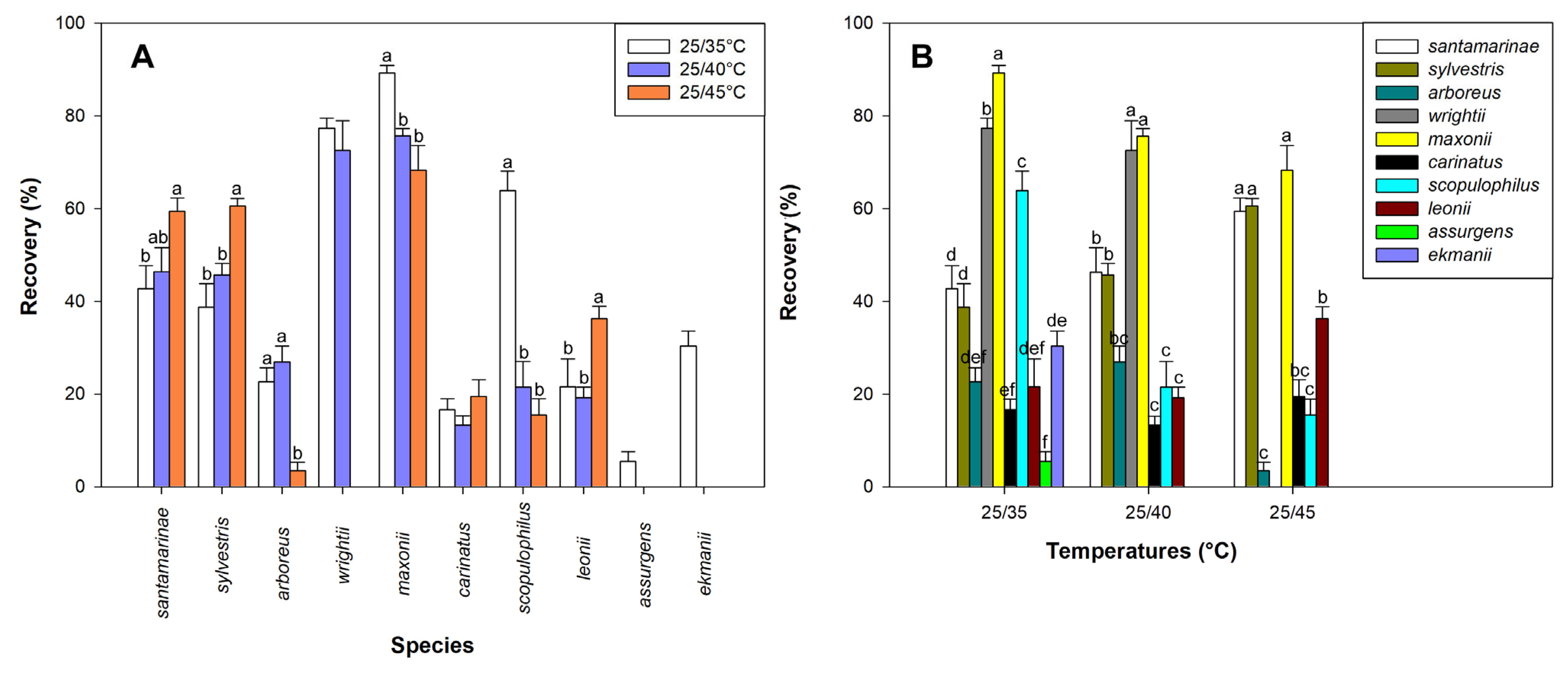
| 25 °C | 25 °C | 25/30 °C | 25/35 °C | 25/40 °C | 25/45 °C | |
| L. santamarinae | 87.50 | NE | NE | 91.83 | 94.05 | 95.65 |
| L. sylvestris | 74.11 | 64.38 | 63.54 | 73.56 | 79.31 | 80.32 |
| L. arboreus | 88.57 | 67.44 | 80.43 | 90.56 | 97.10 | 90.22 |
| L. wrightii | 47.05 | 100 | 13.33 | 70.00 | 66.67 | NE |
| L. maxonii | 100 | 87.50 * | 55.56 * | 91.67 | 97.56 | 92.59 |
| L. carinatus | 93.12 | 100 | 100 | 100 | 100 | 86.76 |
| L. scopulophilus | 87.35 | 77.96 | 67.29 | 58.06 | 87.60 | 85.03 |
| L. leonii | 96.26 * | 94.23 | 85.36 | 92.85 | 90.47 | 90.00 |
| L. assurgens | 100 | NE | 99.06 * | 99.18 * | NE | NE |
| L. ekmanii | NE | 85.71 | NE | 100 | NE | NE |
Disclaimer/Publisher’s Note: The statements, opinions and data contained in all publications are solely those of the individual author(s) and contributor(s) and not of MDPI and/or the editor(s). MDPI and/or the editor(s) disclaim responsibility for any injury to people or property resulting from any ideas, methods, instructions or products referred to in the content. |
© 2025 by the authors. Licensee MDPI, Basel, Switzerland. This article is an open access article distributed under the terms and conditions of the Creative Commons Attribution (CC BY) license (https://creativecommons.org/licenses/by/4.0/).
Share and Cite
Barrios, D.; Sánchez, J.A.; González-Torres, L.R.; Flores, J.; Álvarez-Espino, R. Thermal Effects on Early Life Stages of Leptocereus (Cactaceae) Species from Cuban Seasonally Dry Tropical Forests. Horticulturae 2025, 11, 1541. https://doi.org/10.3390/horticulturae11121541
Barrios D, Sánchez JA, González-Torres LR, Flores J, Álvarez-Espino R. Thermal Effects on Early Life Stages of Leptocereus (Cactaceae) Species from Cuban Seasonally Dry Tropical Forests. Horticulturae. 2025; 11(12):1541. https://doi.org/10.3390/horticulturae11121541
Chicago/Turabian StyleBarrios, Duniel, Jorge A. Sánchez, Luis R. González-Torres, Joel Flores, and Ricardo Álvarez-Espino. 2025. "Thermal Effects on Early Life Stages of Leptocereus (Cactaceae) Species from Cuban Seasonally Dry Tropical Forests" Horticulturae 11, no. 12: 1541. https://doi.org/10.3390/horticulturae11121541
APA StyleBarrios, D., Sánchez, J. A., González-Torres, L. R., Flores, J., & Álvarez-Espino, R. (2025). Thermal Effects on Early Life Stages of Leptocereus (Cactaceae) Species from Cuban Seasonally Dry Tropical Forests. Horticulturae, 11(12), 1541. https://doi.org/10.3390/horticulturae11121541