

Abstract
The color change in the peel of Jaboticaba (Myrciaria cauliflora Berg) ‘Essart’ is primarily driven by the spatiotemporal regulation of anthocyanin biosynthesis, but its molecular mechanism remains unclear. This study employed a multi-omics integrated analysis approach, combining targeted metabolomics, transcriptomics, and small RNA sequencing, to systematically elucidate the regulatory mechanism underlying color change during Jaboticaba fruit peel development. The results showed that during the color-turning stage, the content of most anthocyanins tended to decrease, while the content of Cyanidin significantly increased during the fully ripe stage. Weighted Gene Co-expression Network Analysis (WGCNA) identified the brown module as a highly relevant module for anthocyanin accumulation, which includes a co-expression network of 98 transcription factors and 6 structural genes (F3H, CHI, ANS, CHS). Furthermore, small RNA sequencing results discovered a novel regulatory relationship: plant-MIR408-4—McMYB88. This regulatory relationship exhibited precise temporal dynamics: during the green fruit stage, plant-MIR408-4 was highly expressed and McMYB88 was lowly expressed, thereby inhibiting anthocyanin synthesis; however, during the fully ripe stage, plant-MIR408-4 expression decreased and McMYB88 expression increased, promoting anthocyanin accumulation. In summary, this study revealed the molecular regulatory mechanism of color formation in Jaboticaba fruit peel, providing an important theoretical basis for its color improvement and molecular breeding.
1. Introduction
Jaboticaba (Myrciaria cauliflora Berg), an evergreen shrub belonging to the Myrtaceae family and the genus Myrciaria, is native to Brazil in South America and is commonly known as the precious fruit or tree grape [1]. Currently, it is cultivated in Fujian, Guangdong, Hainan, and Chongqing in China, becoming a newly emerging tropical fruit domestically. The jaboticaba tree has a beautiful form, with dense, evergreen foliage throughout the year, and flowers and fruits in all four seasons. It integrates ornamental value for its leaves, flowers, fruits, and fragrance, making it an excellent species for landscape greening [2]. Pigments can be classified into two categories based on their source: synthetic and natural pigments [3]. The color of fruit peel is primarily determined by three types of pigments: carotenoids, chlorophylls, and anthocyanins [4]. When the content of carotenoids is high, the fruit peel is mostly yellow, orange, or red; a high chlorophyll content results in green peel; and an abundance of anthocyanins leads the peel to a blue-purple or deep black color [5]. These three types of pigments not only give the fruit peel a rich color but also possess health benefits such as delaying aging, antioxidation, and anticancer properties [6,7,8]. The peel of jaboticaba is fragrant and rich in not only anthocyanins but also ellagitannins [9]. Anthocyanins are composed of anthocyanidins and glycosides. The six common anthocyanidins in higher plants are Malvidin (Mv), Pelargonidin (Pg), Cyanidin (Cy), Delphinidin (Dp), Petunidin (Pt), and Peonidin (Pn) [10,11]. Research indicates that anthocyanins, a class of natural pigments within flavonoid compounds, possess powerful antioxidant properties in addition to their role as pigments. Their efficacy depends on the plant species, geographical source, and harvest time. Flavonoids can inhibit and mitigate cell damage caused by free radicals generated during cell metabolism [12]. Flavonoids are major secondary metabolites in plants, including flavones, isoflavones, anthocyanins, flavonols, and proanthocyanidins. The expression of genes in their biosynthetic pathway leads to the unique accumulation of anthocyanins in plant organs, thus resulting in color polymorphism [13,14]. During the growth and development of the ‘Essart’ peel, the color change process of its peel is characterized by clearly defined stages and high consistency, showing a transition from green, through a stage of gradual change, to deep color. This facilitates an accurate comparison of the accumulation pattern of anthocyanins in the peel and the related physiological mechanisms at different developmental stages. Furthermore, this cultivar exhibits a relatively uniform developmental cycle, demonstrating typicality and stability.
The synthesis of anthocyanins involves a series of enzyme-catalyzed modification processes [15]. The relevant enzymes can be broadly divided into two categories: early biosynthetic enzymes and late biosynthetic enzymes [16]. Cinnamoyl-CoA is converted into p-Coumaroyl-CoA through the catalysis of Cinnamate 4-hydroxylase (C4H). Subsequently, p-Coumaroyl-CoA reacts with Malonyl-CoA under the catalysis of CHS (Chalcone Synthase) to generate the important compound chalcone. Chalcone is then converted into Dihydrokaempferol and Dihydroquercetin through the catalysis of CHI (Chalcone Isomerase), F3H (Flavanone 3-hydroxylase), and F3′H (Flavonoid 3′-hydroxylase). Finally, colorful anthocyanins are formed through the catalysis of DFR (Dihydroflavonol 4-reductase) and ANS (Anthocyanidin Synthase) [17,18]. PAL, C4H, 4CL, CHS, CHI, F3H, CYP75A (F3′5′H), and F3′H are collectively known as early enzymes, and the genes encoding these enzymes are collectively referred to as early genes; the late enzymes mainly include DFR, ANS, and UFGT (UDP-glucose:flavonoid 3-O-glucosyltransferase), and the genes encoding these enzymes are called late genes. Anthocyanin synthesis is regulated by a variety of transcription factors, mainly including R2R3-MYB and the MBW complex [19]. These factors regulate anthocyanin accumulation by synergistically acting with the synthesis genes, thus determining the color of the fruit peel [20,21,22].
In recent years, key structural genes involved in plant pigment synthesis have made significant progress in transgenic breeding, flower color regulation, and stress resistance enhancement. Studies have shown that co-expression of F3′5′H and UDPG genes has been confirmed to be essential for the formation of blue chrysanthemum [23]. The F3H gene plays an important role in the drought resistance of wolfberry, and its heterologous overexpression in tobacco can significantly improve the drought resistance of tobacco [24]. Low temperature and UV B treatment can significantly upregulate a series of genes in pepper, including ANS, CHI, CHS, DFR, F3H, F3′5′H, and MYB, thereby promoting the accumulation of flavonoids and anthocyanins [25]. Similarly, UV-A/B treatment enhances the expression of CHS, CHI, F3H, F3′H, F3′5′H, and ANS genes in purple tea, thereby leading to an increase in anthocyanin content [26]. In addition, flower color and branching of orchids have been successfully regulated by overexpressing PhCHS5 and PhF3′5′H genes [27]. MicroRNAs (miRNAs) are important small RNAs that are widely involved in the regulation of plant development and tissue coloration [28]. They mainly regulate pigment accumulation by controlling transcription factors (such as R2R3-MYB) and their regulatory networks associated with anthocyanin synthesis. For example, miR828 and miR858 target VvMYB114 to promote the accumulation of anthocyanins and flavonoids in grape skins [29]; mdm-miR828 targets MdMYB1, while miR408 promotes anthocyanin synthesis in apple skins by regulating the interaction between basic cyanin (BBP), copper homeostasis, and reactive oxygen species (ROS) homeostasis [30,31]. In addition, miR408 also targets the structural gene F3′H, negatively regulating the anthocyanin synthesis pathway in Arabidopsis thaliana [32]. These studies collectively highlight the role of miRNAs in finely regulating pigment accumulation by precisely controlling the transcription factors and structural genes associated with anthocyanin synthesis.
This study systematically dissected the regulatory network controlling anthocyanin metabolism during jaboticaba fruit peel development using an integrated multi-omics approach. Combined analysis of targeted metabolomics and transcriptomics revealed the expression patterns of key anthocyanin biosynthetic genes and their potential transcriptional regulators. Simultaneously, small RNA sequencing identified differentially expressed miRNAs associated with changes in peel color. The results suggest that plant-MIR408-4 may specifically target McMYB88, achieving the precise post-transcriptional regulation of anthocyanin biosynthesis.
2. Materials and Methods
2.1. Plant Material and Sample Collection
The skin of the jaboticaba fruit is rich in anthocyanins. The ‘Essart’ cultivar was selected because of the distinct changes in its peel color during growth and development. All samples were collected from the same healthy, vigorous jaboticaba tree cultivated at Shengda Agricultural Technology Development Co., Ltd. in Qionghai City, China. Peel samples were collected at three clearly defined developmental stages (green fruit stage S1, color change stage S2, and fully ripe stage S3). At each developmental stage, three independent biological replicate samples were randomly collected from the same tree to ensure sample consistency and representativeness. Immediately after collection, all samples were quick-frozen in liquid nitrogen and stored at −80 °C until further analysis.
2.2. Targeted Metabolomics Analysis Based on LC-MS/MS
Targeted anthocyanin detection was performed using the targeted metabolomics method provided by Sanshu Biotechnology Co., Ltd., Nantong, China. An appropriate amount of sample (99.6–101.8 mg) was taken into a centrifuge tube, and 1 mL of extraction solvent (methanol/water/formic acid, 70:30:1, v/v/v) was added. After high-speed vortexing, ultrasonic extraction was performed for 20 min, followed by centrifugation at 12,000 rpm for 10 min. The sample was extracted twice, and the resulting supernatants were combined and mixed thoroughly. This combined solution was then processed using an HLB-SPE column. The column was first conditioned sequentially with 1 mL of 100 methanol and 1 mL of deionized water. After conditioning, all of the supernatant was loaded onto the column, followed by a wash step using 1 mL of water solution. After the liquid was drawn dry, 1 mL of methanol solution (containing 5% formic acid) was added for elution. The eluate was collected into a new centrifuge tube, slowly blown dry under a stream of nitrogen, followed by lyophilization. The residue was redissolved in 0.2 mL of methanol solution, and after appropriate dilution based on the actual situation, the samples were subjected to instrumental analysis. Ultra-High Performance Liquid Chromatography (Vanquish, UPLC, Thermo, Waltham, MA, USA) and High-Resolution Mass Spectrometry (Q Exactive, Thermo, Waltham, MA, USA) were used for analysis. Chromatographic separation was performed on a Waters HSS T3 (50 × 2.1 mm, 1.8 μm, Vanquish, UPLC, Thermo, Waltham, MA, USA) column; mobile phase A was ultrapure water solution (containing 0.1% formic acid), and mobile phase B was acetonitrile solution (containing 0.1% formic acid); the flow rate was 0.3 mL/min, column temperature was 40 °C, and injection volume was 2 μL; the elution gradient was 0 min A/B (95:5, v/v), 1 min A/B (95:5, v/v), 6 min A/B (70:30, v/v), 7 min A/B (5:95, v/v), 8 min A/B (5:95, v/v), 8.1 min A/B (95:5, v/v), 10 min A/B (95:5, v/v). During the entire analysis process, samples were kept in a 4 °C auto-sampler, and a random sequence was used for continuous sample analysis to avoid fluctuations in instrument detection signals. QC samples were uniformly interspersed in the sample analysis queue to monitor and evaluate the stability of the system and the reliability of the experimental data [33]; ESI source parameters were as follows: sheath gas 40 arb, auxiliary gas 10 arb, ion spray voltage +3000 V, temperature 350 °C, and ion transfer tube temperature 320 °C. The scanning mode was Single Ion Monitoring (SIM), the scanning polarity was positive ion, and the primary mass spectrometry scan range (scan m/z range) was 200–700 [34]. The standard curve was generated using TraceFinder software, and the absolute quantification of anthocyanins and related polyphenols was achieved by the external standard method. A linear quantitative model Y = kX was established based on the peak area (Y) and the standard concentration (X, ng/mL), where the slope (k) was obtained from the standard fit and used to calculate the actual content of the target compound in the samples. The standard curve fitting employed a forced-through-zero linear regression model (Origin: Force), with the peak area (Area) serving as the basis for quantification, and the weighting method being equal weighting (W: Equal). The calibration concentration range was 50–2000 ng/mL.
2.3. RNA Extraction and Transcriptome Sequencing
Transcriptome sequencing was performed by Shanghai Personalbio Co., Ltd. (Shanghai, China). The process involved enriching mRNA with polyA structures from total RNA using Oligo(dT) magnetic beads, followed by ion fragmentation to cut the RNA into fragments of approximately 300 bp. Fragments of 300 bp in length were selected. Using RNA as a template, first-strand cDNA was synthesized using random 6-base primers and reverse transcriptase, followed by second-strand cDNA synthesis using the first-strand cDNA as a template. After library construction, fragment enrichment was performed using PCR amplification, followed by fragment size selection, ultimately yielding a 450 bp library. Finally, the library was quality-controlled using an Agilent 2100 bioanalyzer (Agilent Technologies Inc., Santa Clara, CA, USA), and the total and effective concentrations were determined. Subsequently, based on the effective concentration and the required data volume, libraries containing different index sequences (each sample had a unique index added to differentiate sequencing data later) were mixed proportionally. The mixed libraries were uniformly diluted to 2 nM and denatured with alkali to form single-stranded libraries. After RNA extraction, purification, and library construction, these libraries were subjected to next-generation sequencing (NGS) using the Illumina sequencing platform in paired-end sequencing (PE) mode. Raw data quality control was performed using Fastp to remove 3′ adapter sequences and any reads with an average quality score below Q20. Then, HISAT2 (http://ccb.jhu.edu/software/hisat2/index.shtml (accessed on 3 June 2025), an upgrade of TopHat2) was used to align the filtered reads to the jaboticaba reference genome [35]. The read count for each gene was counted using HTSeq to represent the raw gene expression level. FPKM was used for expression normalization; for paired-end sequencing, each fragment contained two reads, and FPKM only counted the number of fragments where both reads mapped to the same transcript. In reference-sequence-based transcriptome analysis, genes with an FPKM > 1 were considered expressed. DESeq is used for differential gene expression analysis.
2.4. Small RNA Library Construction and Sequencing
Total RNA was extracted using Trizol reagent (Shanghai Personalbio Co., Ltd., Shanghai, China), and its concentration, purity, and integrity were determined using a NanoDrop spectrophotometer. One μg of total RNA was taken from each sample and ligated to 3′ and 5′ adapters using a ligase mixture. The resulting samples were then reverse transcribed using Superscript II reverse transcriptase. PCR products were subsequently amplified. Quality control analysis of the small RNA library was performed, with the average size of the insert fragments being approximately 140 to 150 bp. The sequencing library was quantified using an Agilent High Sensitivity DNA Analysis Kit (Agilent Technologies Inc., Santa Clara, CA, USA), and then sequenced on a NovaSeq 6000 platform (Illumina, Foster City, CA, USA). After sequencing, download the raw sequences and calculate the quality information of the raw data in FASTQ format. Use a proprietary script to remove adapters from the raw reads, and then perform quality trimming based on the sequence quality. The raw sequences were searched using a window size of 5 bases. When the average sequencing quality of the bases within the window was below 20, the segment starting from the very beginning of the window was truncated and discarded, resulting in clean reads (≥18 nt) for subsequent analysis. Then, high-quality sequences between 18 and 36 nt in length were filtered and deduplicated to obtain unique sequences for subsequent analysis. A reference genome index was constructed using Bowtie2 (v2.5.1), and high-quality deduplicated sequences were aligned to the reference genome using miRDeep2 (v2.0.0.8) software. Unique sequences were first annotated to known miRNAs in the miRBase database (http://www.mirbase.org/ (accessed on 3 June 2025)), and then to other non-coding RNAs. For sequences without any annotation information, mireap (v0.2) was used for new miRNA prediction analysis. To ensure all small RNAs were classified, existing annotation results were sorted in the following order: known miRNAs > piRNAs > rRNAs > tRNAs > snRNAs > snoRNAs > newly discovered miRNAs. Subsequently, miRNA sequences were BLAST-aligned (https://www.mirbase.org/search/ (accessed on 3 June 2025)) with mature miRNA sequences of phylogenetically related species in the miRBase database to observe interspecific conservation of miRNAs. miRNA read counts were based on the number of sequences aligned to mature miRNAs. Due to the short length of miRNAs, expression level normalization did not require length correction; only the total number of reads across all samples needed to be corrected. CPM values were used to comprehensively assess gene expression patterns in the samples. The formula for calculating CPM is: CPM = C/N × 1,000,000, where C is the number of reads aligned to genes, and N is the total number of reads aligned to all genes.
2.5. Differential Expression Analysis, Functional Enrichment, and Correlation Analysis
We performed Differential Expression Gene (DEG) analysis and Differentially Expressed miRNAs (DE-miRNAs) on the transcriptome data using the DESeq2 R package (v1.38.3) and Differential Accumulation Metabolite (DAM) analysis on the metabolome data. The screening criteria for DAMs were |log2FoldChange| > 1 and a p-value < 0.05, followed by multiple testing correction using FDR < 0.05. The screening criteria for DEGs and DE-miRNAs were |log2FoldChange| > 1 and a p-value < 0.05, with subsequent multiple testing correction applied to the p-value (padj). Soft clustering was performed using the Mfuzz R package (v2.68.0) to identify the temporal expression patterns of DEGs across different developmental stages. KEGG enrichment analysis was conducted using the clusterProfiler R package (v4.16.0). For correlation analysis, the data were first log-transformed, and then the Pearson correlation coefficient and its corresponding p-value were calculated.
2.6. Weighted Gene Co-Expression Network Analysis
The WGCNA analysis was performed using the WGCNA R package (v1.73) to identify gene co-expression modules associated with anthocyanin accumulation. Genes with an FPKM > 1 in at least one developmental stage were included in the analysis. A signed weighted correlation network was constructed, and the soft threshold (softPower = 11) was selected based on the scale-free topology criterion. Module–trait relationships were assessed by calculating the Pearson correlation between the Module Eigengene (ME) values and the anthocyanin content. The MEbrown module, which showed the strongest correlation with anthocyanin-related metabolites, was selected for further analysis. Finally, a gene-transcription factor (TF) network was constructed based on an edge weight ≥ 0.3 and visualized using Cytoscape (v3.8.0).
2.7. miRNA Target Prediction
Target gene prediction for differentially expressed miRNAs was performed by using the mRNA 3′UTR sequences of the target species as the target sequences. Potential target sites were predicted based on the complementary pairing principle between the miRNA and the mRNA using software such as MiRanda and psRobot_tar, which yielded a set of potential target genes corresponding to the differentially expressed miRNAs, thus providing the foundational data for subsequent enrichment analysis.
3. Results
3.1. Changes in Pericarp Color and Dynamic Accumulation of Anthocyanins During the Development of ‘Essart’ Jaboticaba
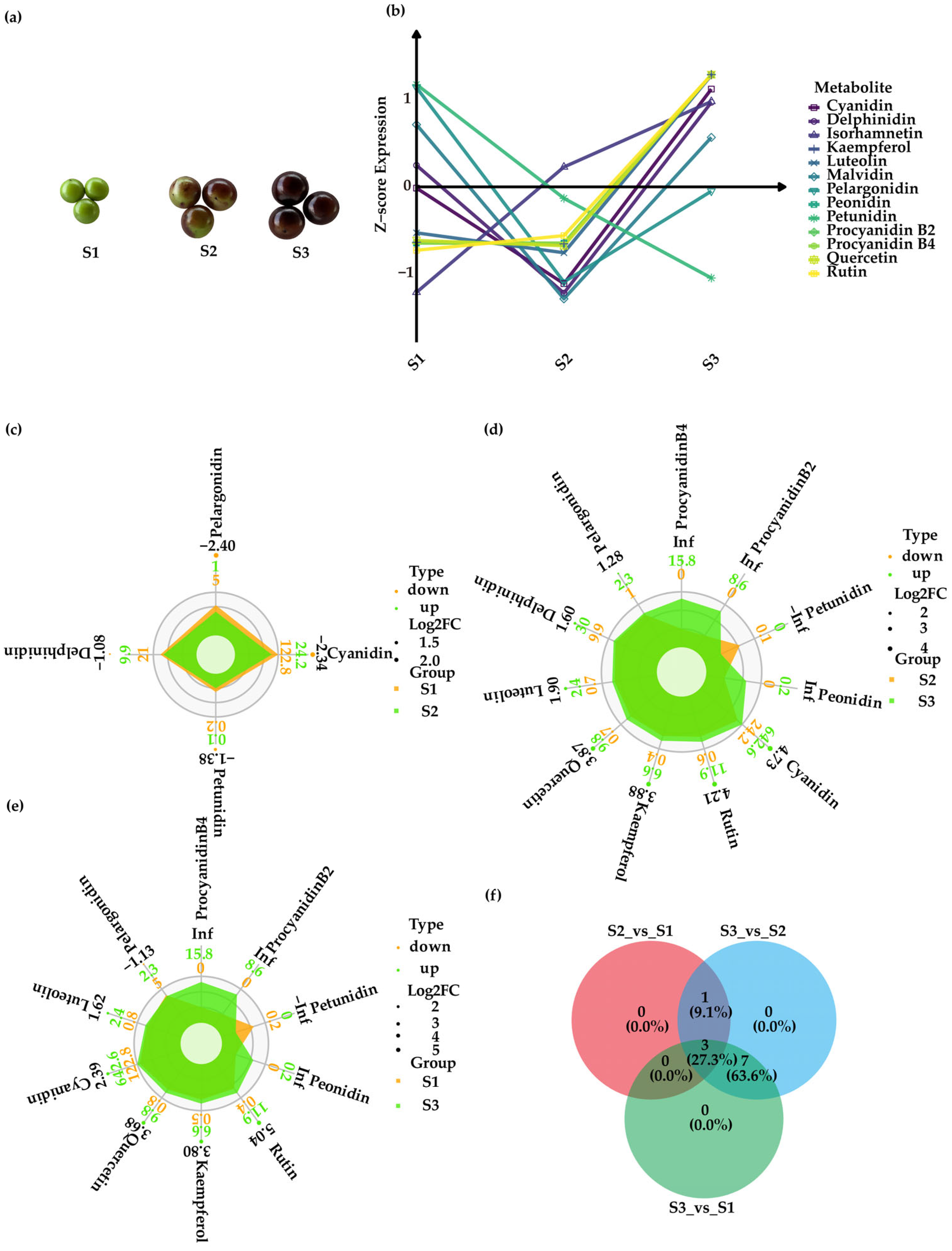
The peel color of ‘Essart’ gradually transitions from green to deep black (Figure 1a), primarily due to the accumulation of anthocyanins. The consistent peak shapes and stable retention times in the TIC chromatograms of different samples indicate the reliability of the method, providing a guarantee for subsequent targeted anthocyanin detection and analysis. Quality Control (QC) samples were uniformly interspersed within the analytical sample sequence during instrumental analysis, and the QC RSD was less than 30% for all, indicating the relative stability of the detection system (Figure S1 and Table S1). Principal Component Analysis (PCA) of all samples showed that PC1 and PC2 accounted for 75.1% and 24.8% of the total variance, respectively, sufficiently reflecting the main differences between samples. These components clearly display the sample structure in a lower dimension, providing a reliable basis for further analysis (Figure S2a). Targeted anthocyanin detection identified a total of 15 metabolites, among which the absolute contents of Cyanidin-3,5-diglucoside and Cyanidin-3-galactoside were 0 at all stages. The remaining 13 substances mainly included: 6 anthocyanidins, namely Delphinidin, Cyanidin, Petunidin, Pelargonidin, Peonidin, and Malvidin; 4 flavonols, namely Rutin, Quercetin, Kaempferol, and Isorhamnetin; 2 tannins, namely Procyanidin B4 and Procyanidin B2; and 1 flavone, Luteolin (Figure S2b). After log-transformation and z-standardization of the metabolite data during the growth and development of ‘Essart’, four anthocyanidins (Delphinidin, Cyanidin, Pelargonidin, and Malvidin) exhibited similar trends, while Petunidin showed a continuous downward trend. Procyanidin B4, Procyanidin B2, and Peonidin were only detected at the fully ripe stage. It can be observed that the content of most compounds decreased during the veraison (color change) stage but increased at the fully ripe stage (Figure 1b and Table S2). Multiple DAMs were identified in this study. In S2_vs_S1, a total of 4 DAMs (Delphinidin, Cyanidin, Petunidin, and Pelargonidin) were detected, all of which were downregulated (Figure 1c); in S3_vs_S2, a total of 11 DAMs (Delphinidin, Cyanidin, Procyanidin B4, Procyanidin B2, Petunidin, Pelargonidin, Peonidin, Rutin, Luteolin, Quercetin, and Kaempferol) were detected, with all but Petunidin being upregulated (Figure 1d); in S3_vs_S1, a total of 10 DAMs (Cyanidin, Procyanidin B4, Procyanidin B2, Petunidin, Pelargonidin, Peonidin, Rutin, Luteolin, Quercetin, and Kaempferol) were detected, among which Petunidin and Pelargonidin were downregulated, and the remaining metabolites were upregulated (Figure 1e and Table S3). As ‘Essart’ developed, the metabolism of anthocyanins significantly increased, with the accumulation of Cyanidin being the most prominent: compared to the S1 stage, the content of Cyanidin increased by 2.38 times at the S3 stage, and by 4.73 times compared to the S2 stage. The significant accumulation of Cyanidin may constitute the main metabolic basis for the peel color transition from green to deep black. Through Venn analysis, 3 DAMs (Cyanidin, Petunidin, Pelargonidin) were consistently identified throughout the entire growth and development process, with Petunidin showing a continuous downward trend (Figure 1f and Table S3).
Figure 1.
Analysis of anthocyanin targeted detection in fruit peel. (a) Phenotype map of fruit peel color changes during the development of ‘Essart’. (b) Trend map of changes in the content of different substances during the development of ‘Essart’ (log-transformed and z-standardization); (c–e) are the DAMs radar plots for S2_vs_S1, S3_vs_S2, and S3_vs_S1, respectively. (f) Venn analysis of S2_vs_S1, S3_vs_S2, and S3_vs_S1.
3.2. Transcriptomic Analysis of Fruit Peel Color Dynamics in ‘Essart’ Jaboticaba During Developmental Stages
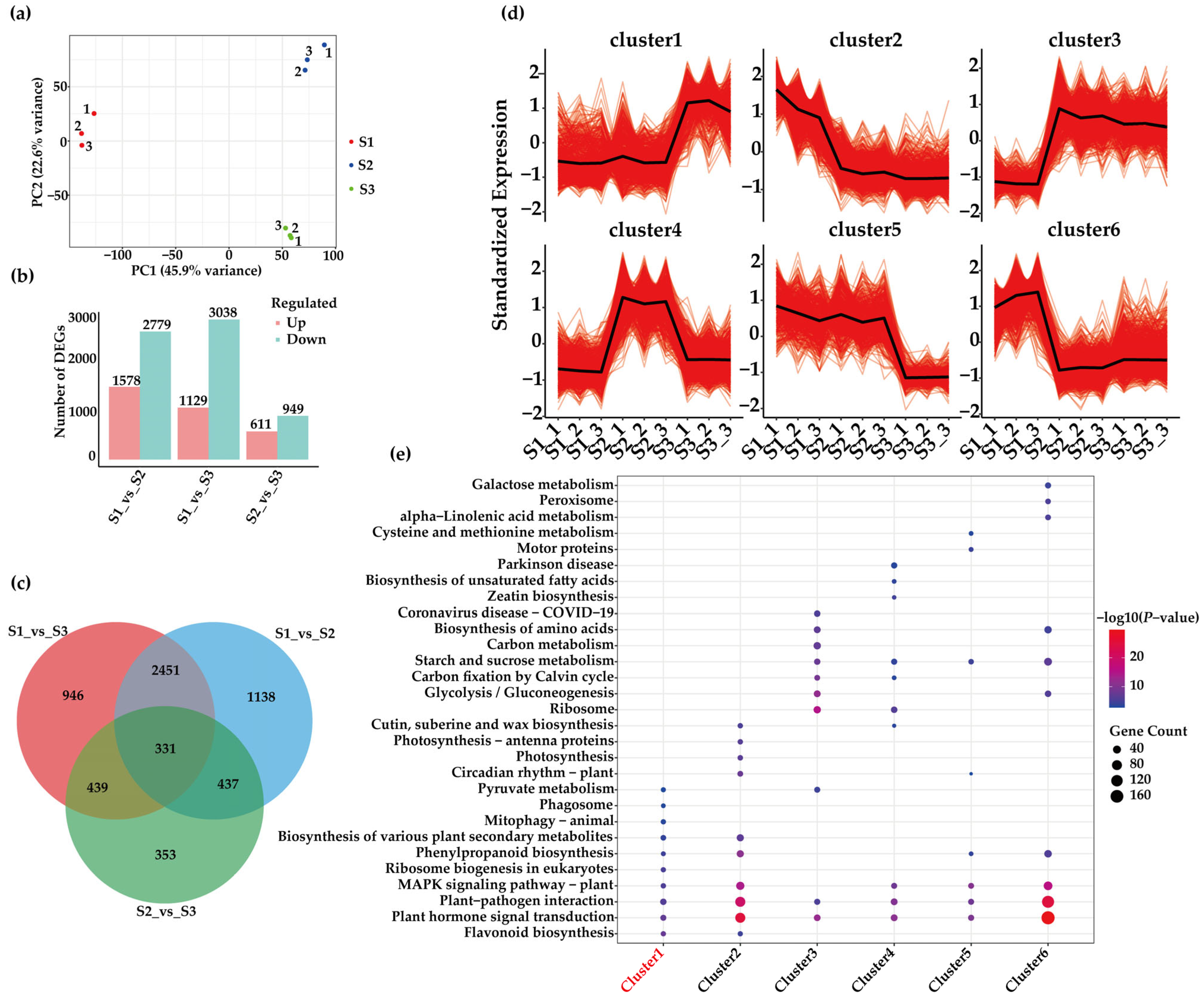
To investigate the transcriptional regulatory mechanism of peel color change in ‘Essart’, RNA sequencing was performed on the fruit peels at three developmental stages. After quality assessment and filtering of the raw data, the Clean Data % of all samples exceeded 99.85%, indicating minimal data loss. The Q30 percentages of all samples ranged from 96.81% to 97.94%, significantly higher than the standard threshold (90%), and the GC content was uniformly distributed across samples, suggesting extremely low sequencing error rates, no contamination, and very low proportions of ambiguous bases (N%). The sequencing output data quality was excellent, providing a solid and reliable foundation for subsequent transcriptome analysis. Initially, 31,235 genes were detected per sample. After data filtering (removing all-zero/missing values and non-variant genes), 22,394 genes were retained for further analysis. PCA showed that PC1 and PC2 accounted for 45.9% and 22.6% of the total variation, respectively, with gradually increasing transcriptional differentiation and clear separation between developmental stages, and clustering of biological replicates within each stage, confirming the high reliability and reproducibility of the transcriptome data (Figure 2a). A total of 6095 DEGs were identified in this study, with 4357 and 4167 DEGs detected in the S2 and S3 stages, respectively, compared to the S1 stage (Figure 2b). A total of 331 genes were DEGs in all pairwise comparisons (Figure 2c and Table S4). To further characterize the expression dynamics, DEGs were grouped into six clusters using soft clustering, each representing a distinct temporal expression pattern (Figure 2d). These included continuously downregulated clusters (Cluster 2 and Cluster 5), patterns of upregulation followed by downregulation (Cluster 3 and Cluster 4), and patterns of downregulation followed by upregulation (Cluster 1 and Cluster 6). KEGG pathway enrichment analysis (Figure 2e) revealed distinct functional roles for each cluster. Genes in Clusters 2, 5, and 6 were highly expressed in the S1 phase and significantly enriched in photosynthetic antenna proteins, carotenoid biosynthesis, starch and sucrose metabolism, and plant hormone signal transduction pathways, hinting that photosynthetic activity may be vigorous in the S1 phase, followed by a rapid decline, with the cell shifting from photosynthesis to other functions. Cluster 3 and Cluster 4 were highly expressed at S2 and significantly enriched in pathways such as ribosome, carbon metabolism, biosynthesis of amino acids, and biosynthesis of unsaturated fatty acids. The S2 phase likely focuses more on the synthesis of material and structural foundations, providing raw materials and energy for the subsequent pigment accumulation. Cluster 1 exhibits significantly high expression during the S3 stage and is enriched in pathways such as plant–pathogen interaction, plant hormone signal transduction, and various secondary metabolic pathways. This hints that this stage may be associated with the regulation of pericarp development and the enhancement of secondary metabolism. Notably, key structural genes related to anthocyanin biosynthesis, including CHS, CHI, F3H, and ANS, are enriched in Cluster 1. Furthermore, the change in the gene expression of this cluster across different developmental stages is consistent with the observed trend of anthocyanin accumulation and peel color change.
Figure 2.
Transcriptomic analysis of genes involved in anthocyanin biosynthesis during ‘Essart’ development. (a) Principal Component Analysis (PCA) of transcriptome data showing clear separation of samples from the three developmental stages. (b) Number of Differentially Expressed Genes (DEGs) for S2_vs_S1, S3_vs_S2, and S3_vs_S1. (c) Venn analysis of DEGs for S2_vs_S1, S3_vs_S2, and S3_vs_S1. (d) Soft clustering of DEGs into six expression pattern clusters. (e) KEGG enrichment analysis (top 10) for the 6096 DEGs in the six clusters. Key clusters related to peel color are indicated in red font.
3.3. Transcriptomic and Metabolic Regulatory Analysis of Peel Color Changes During Development of Jaboticaba ‘Essart’
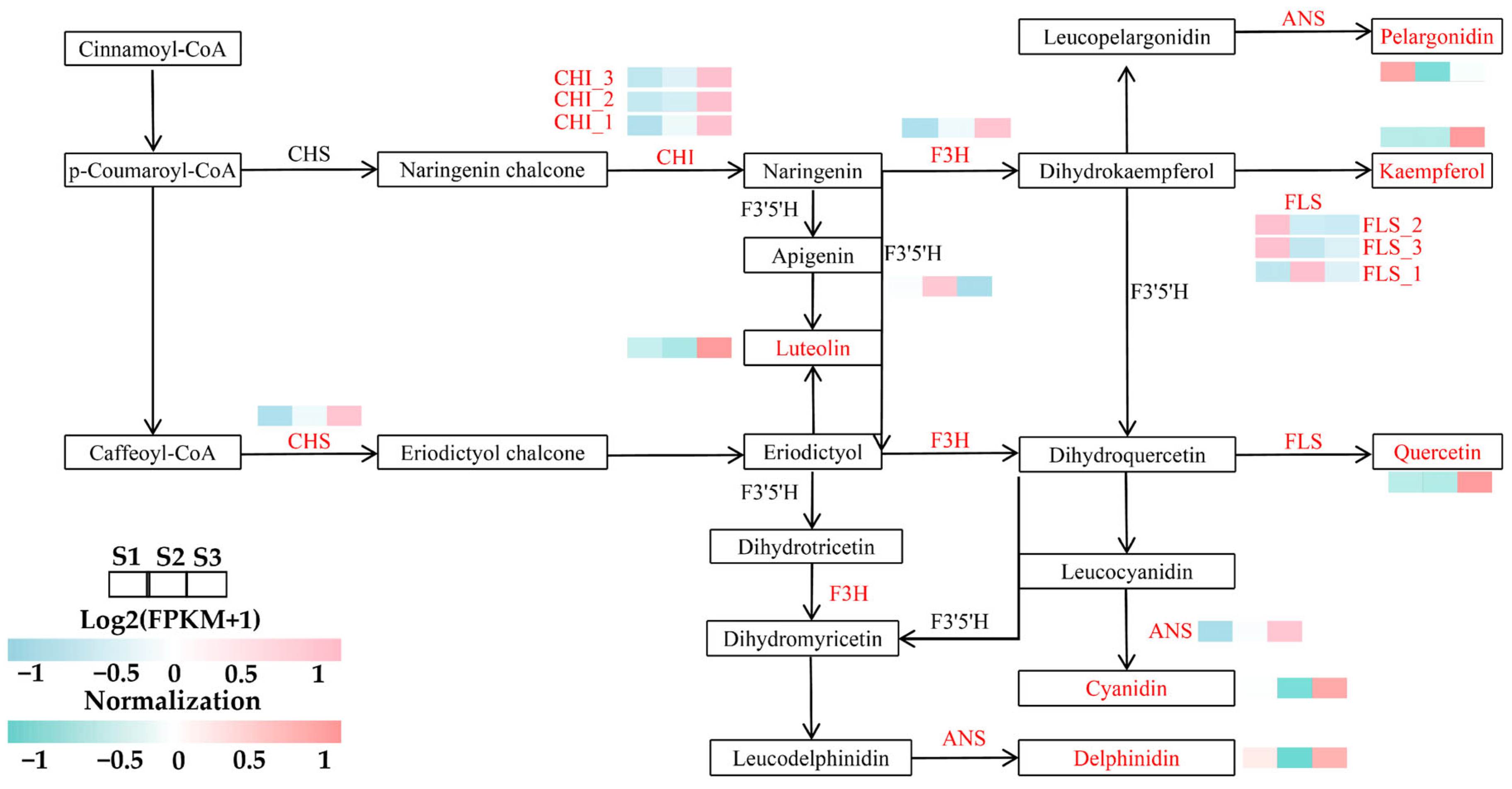
Combining targeted metabolomics and transcriptomics analysis, we delved into 10 key enzyme genes and 6 DAMs involved in the flavonoid biosynthesis pathway. The expression of the structural genes CHS and CHI (CHI_1, CHI_2, CHI_3) was continuously elevated during the development of the ‘Essart’ cultivar, collectively promoting the accumulation of naringenin. The expression of the structural gene F3H promotes the accumulation of Dihydrokaempferol (DHK), which in turn drives the synthesis of downstream flavonoids such as Kaempferol, Quercetin, and Anthocyanins, while reducing the Naringenin content. Therefore, even if the expression of the structural gene FLS decreases, Kaempferol and Quercetin may still increase. In the S2–S3 stages, the expression of the structural gene ANS significantly increased, leading to a significant accumulation of anthocyanins. As the peel gradually matured during development, Delphinidin and Cyanidin became the major anthocyanins, while Pelargonidin remained at a relatively low level (Figure 3 and Table S5).
Figure 3.
The biosynthetic pathways of six DAMs (labeled in red) and the expression profiles of key enzyme genes. Key structural genes identified in Cluster 1 are labeled in red. Enzyme abbreviations are as follows: CHS, chalcone synthase; CHI, chalcone isomerase; F3H, flavanone 3-hydroxylase; F3′5′H, flavonoid 3′5′-hydroxylase; FLS, flavonol synthase; ANS, anthocyanidin synthase.
3.4. Transcriptional Regulatory Network and Co-Expression Module Analysis of Fruit Peel Coloration in Jaboticaba ‘Essart’
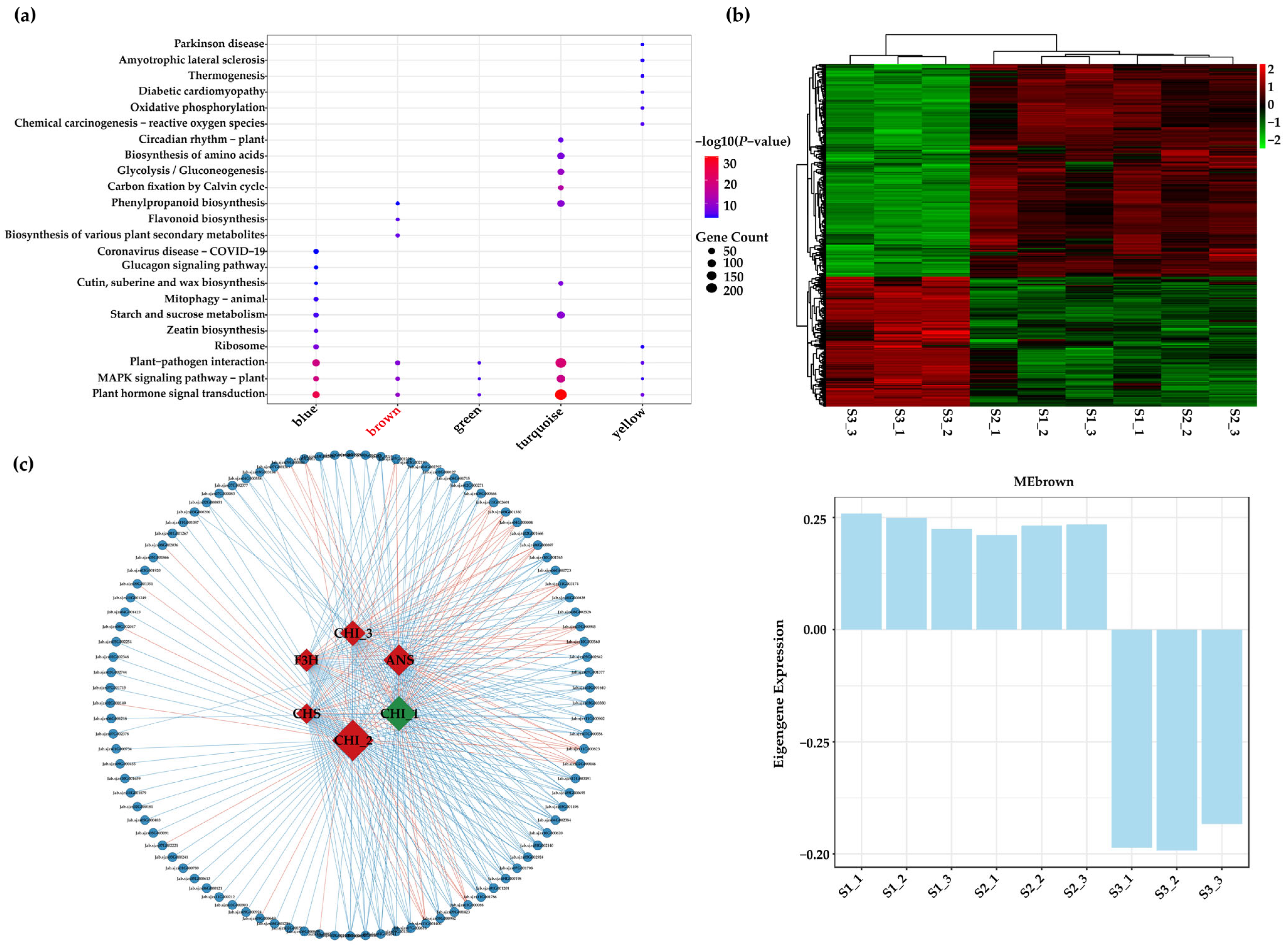
To identify differentially expressed genes (DEGs) involved in fruit peel pigmentation during the development of Jaboticaba ‘Essart’, a Gene-Transcription Factor co-expression network was constructed using Weighted Gene Co-expression Network Analysis (WGCNA). This method allowed for the identification of key genes potentially regulating pigment accumulation. Among the 6095 identified DEGs, WGCNA clustered them into five distinct gene co-expression modules based on their correlations with six crucial Differentially Accumulated Metabolites (DAMs): Delphinidin, Cyanidin, Pelargonidin, Quercetin, Kaempferol, and Luteolin. These metabolites were selected due to their significant dynamic changes during development and their enrichment in the flavonoid biosynthetic pathway. The number of genes in each module ranged from 123 to 3762 (Table S6). Notably, the MEbrown module showed strong correlations with multiple DAMs (Figure S3). To further investigate the biological functions of the DEGs within each module, KEGG pathway enrichment analysis was performed for each module. The results indicated that the genes in the MEbrown module were significantly enriched in metabolic pathways related to anthocyanin biosynthesis (Figure 4a and Table S7). Given the strong correlation of this module with DAMs and its significant enrichment in the flavonoid biosynthetic pathway, the DEGs in the MEbrown module were considered the key regulatory module for fruit peel pigment accumulation during the development of ‘Essart’. The results indicate that these six structural genes, together with 98 highly connected transcription factors (TFs), jointly form a co-expression network comprising 104 nodes and 323 high-confidence edges (weight > 0.3, p < 0.05). These TFs are more likely to be considered potential regulatory candidates associated with the process of pericarp pigment accumulation. Notably, CHI_1 belongs to both the structural genes and the NAC family, a phenomenon that suggests it may also participate in the coordinated change of gene expression within this network, in addition to its role as a structural enzyme in the metabolic pathway. Furthermore, these TFs cover multiple families, including ERF, NAC, WRKY, bHLH, and MYB, implying that pericarp pigment formation may be subject to the coordinated involvement of multiple types of regulatory factors (Figure 4c and Table S8). It was also found that two R2R3-MYB transcription factors (McMYB88 and McMYB73) are co-expressed with the six structural genes.
Figure 4.
Weighted Gene Co-expression Network Analysis (WGCNA) was used to identify regulatory modules associated with anthocyanin accumulation. (a) KEGG enrichment analysis (top 10) of genes in different WGCNA modules (The module labeled in red font is the key module associated with anthocyanin biosynthesis). (b) Heatmap and bar chart showing gene expression patterns in the MEbrown module. (c) Gene regulatory network of the MEbrown module, illustrating the interactions between transcription factors and structural genes involved in anthocyanin biosynthesis. The central red nodes represent six key structural genes (F3H, ANS, CHI, CHS), and the surrounding 98 nodes are transcription factors; green nodes represent genes that are both TFs and structural genes. Larger node sizes indicate higher connectivity. Edges represent co-expression relationships (weight ≥ 0.3, p < 0.05), with blue solid lines indicating negative correlations and red solid lines indicating positive correlations, and line thickness reflecting the strength of the correlation.
3.5. sRNA Sequencing Analysis in the Peel of Jaboticaba ‘Essart’
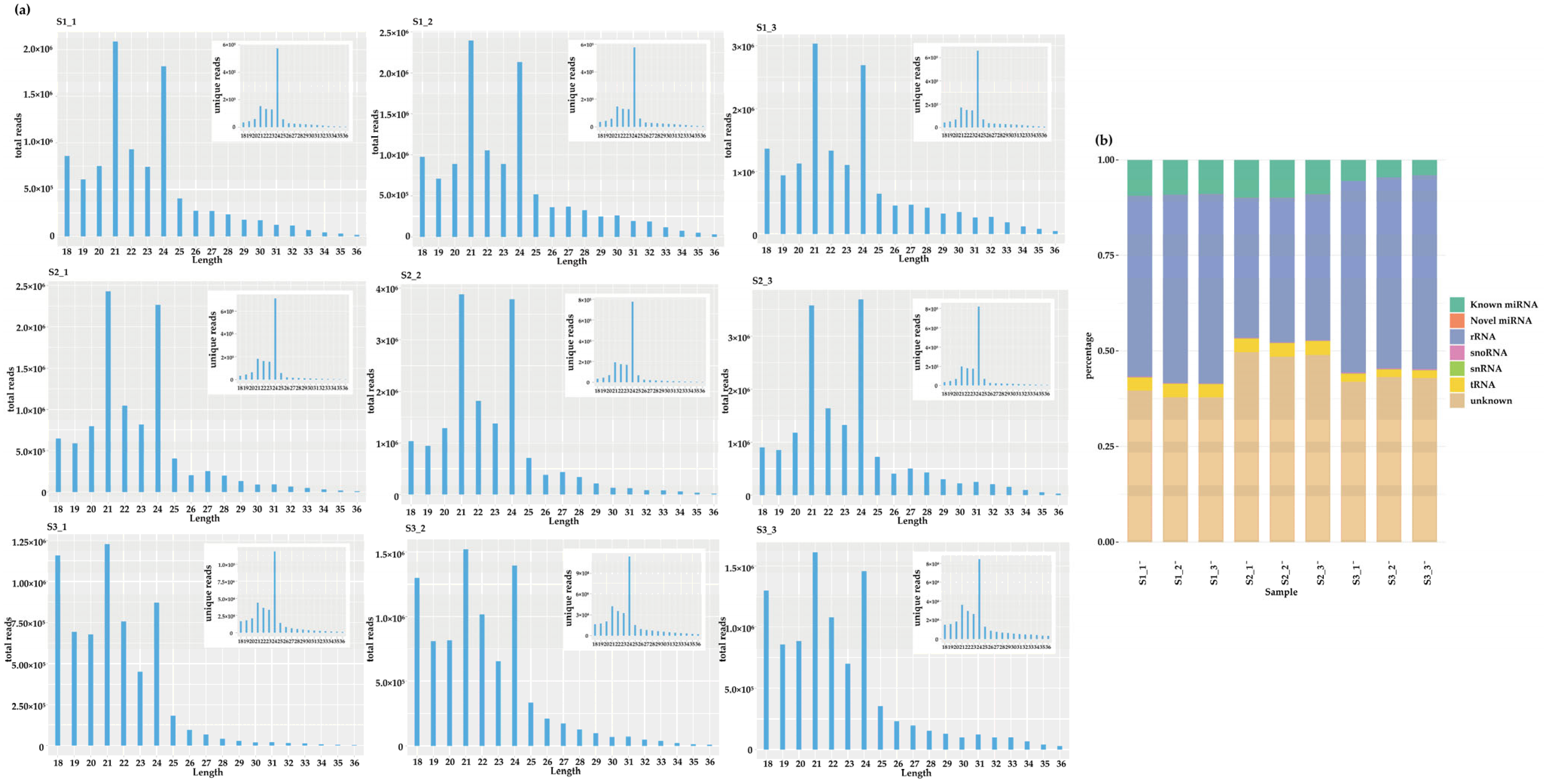
This study constructed three developmental stage small RNA (sRNA) libraries to elucidate the regulatory role of sRNAs in the peel color change during the growth and development of ‘Essart’ jaboticaba peel. A total of 104,736,270 clean reads were obtained from nine samples (Table S9). Clean reads with lengths between 18 nt and 36 nt were selected for subsequent analysis. The sRNA length distribution was statistically based on total clean reads to reflect the overall abundance of different sRNA lengths in the samples. The results showed significant peaks at 21 nt and 24 nt in all developmental stages, indicating that these two classes of sRNAs play critical regulatory roles during ‘Essart’ jaboticaba fruit development (Figure 5a). It is noteworthy that a prominent 18 nt peak was detected during the S3 stage. This phenomenon may reflect the accumulation of atypical short-chain RNAs or a change in sRNA processing/degradation activity during this stage, or it could be the result of degradation products. Although it is currently impossible to definitively determine whether these 18 nt sequences belong to functional small RNAs, their appearance suggests that specific gene regulation or metabolic activity changes may occur during the S3 stage. Simultaneously, the overall sRNA expression peaked at the S2 stage, suggesting that this phase is a key window for transcriptional regulation. To reveal the compositional characteristics of sRNAs during the growth and development of ‘Essart’ jaboticaba, the nine sRNA libraries from the three developmental stages were classified and quantified (Figure 5b and Table S10). The results indicate that the main sRNA types in each sample included known miRNAs, novel miRNAs, rRNAs, tRNAs, snRNAs, snoRNAs, and unannotated sRNAs. Among these, rRNA exhibited a high proportion in all samples. The miRNA class (including known and novel) also had a high abundance at all stages, reaching its highest level in the S2 stage, which suggests a significantly enhanced miRNA-mediated post-transcriptional regulation activity during this phase. The large proportion of unannotated sRNAs suggests the existence of potential novel sRNA molecules awaiting further identification.
Figure 5.
Small RNA (sRNA) sequencing analysis of pericarp development in Jaboticaba ‘Essart’. (a) Length distribution of sRNAs in ‘Essart’, showing enrichment of 21-nucleotide (21nt) and 24-nucleotide (24nt) classes at all developmental stages. (b) Abundance statistics of different classification labels across various samples.
3.6. Differential Expression and Enrichment Analysis of miRNAs in Jaboticaba ‘Essart’
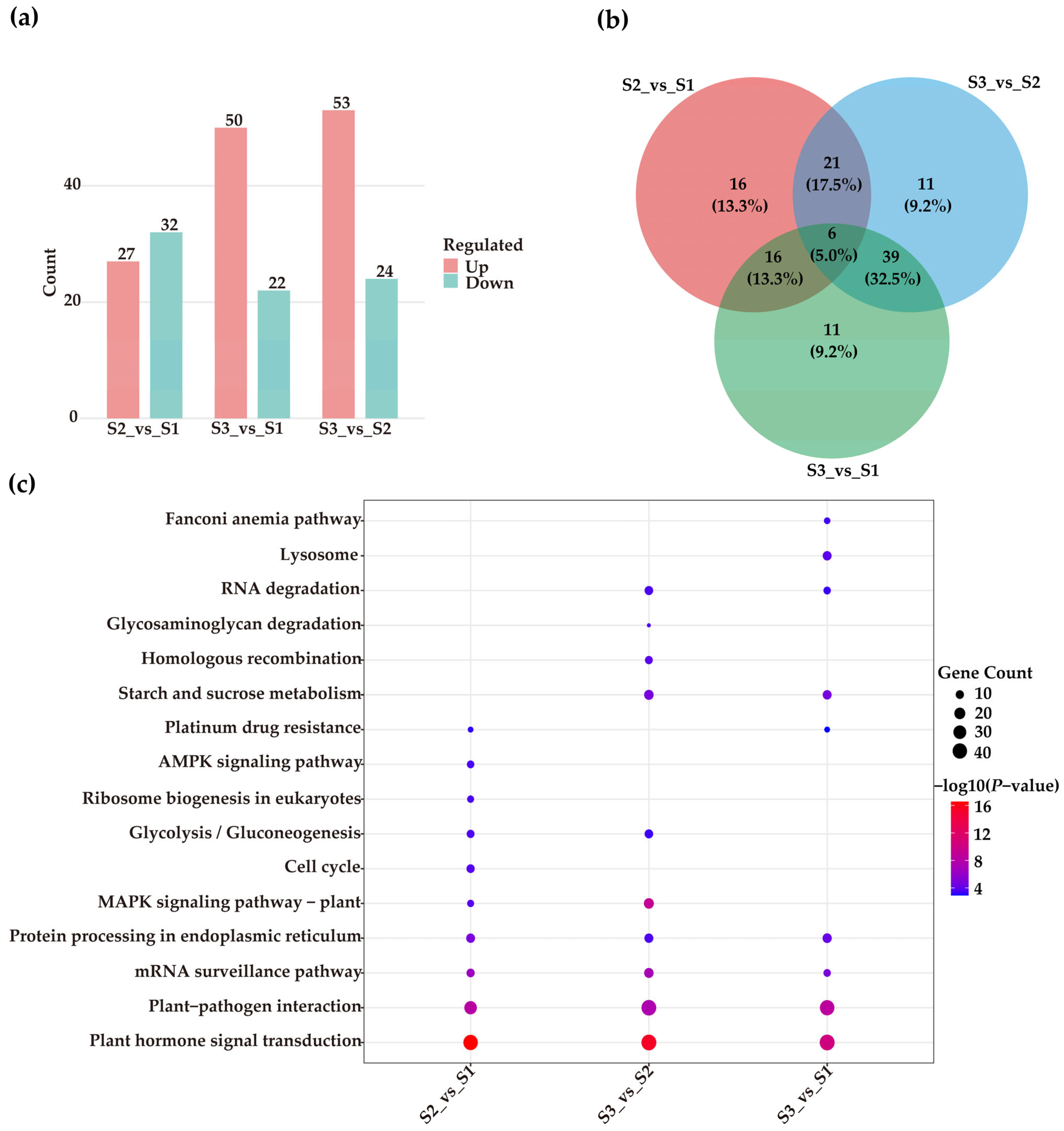
Based on the number of sequences aligned to conserved miRNAs, the Reads Count values of miRNAs were statistically analyzed and differential expression analysis was performed (Table S11), identifying a total of 120 DE-miRNAs. In S2_vs_S1, 32 upregulated and 27 downregulated miRNAs were identified; in S3_vs_S2, 24 upregulated and 53 downregulated miRNAs were identified; and in S3_vs_S1, 22 upregulated and 50 downregulated miRNAs were identified (Figure 6a). Venn analysis revealed 6 DE-miRNAs (plant-undef-14, plant-undef-141, plant-undef-158, plant-undef-191, plant-undef-192, plant-undef-30) present in all three comparisons (S2_vs_S1, S3_vs_S2, S3_vs_S1) (Figure 6b). Target prediction analysis of all DE-miRNAs found 684 target genes in S2_vs_S1, 1155 in S3_vs_S2, and 955 in S3_vs_S1 (Table S12). KEGG pathway enrichment analysis of differentially expressed miRNA target genes in jaboticaba peel (Figure 6c and Table S13) revealed significant enrichment in pathways related to signal perception and response, such as plant hormone signal transduction, MAPK signaling pathway, and plant–pathogen interaction. The target genes in these pathways are closely associated with hormone response, external stimulus perception, and defense-related signals, suggesting that small RNAs (sRNAs) may regulate the expression of downstream metabolic genes by inhibiting or activating these signaling factors. It is likely that as ‘Essart’ develops, sRNA-mediated signal regulation is crucial for triggering anthocyanin synthesis and pigment accumulation. In terms of energy metabolism and substance synthesis, pathways like starch and sucrose metabolism, glycolysis/gluconeogenesis, ribosome biogenesis, and protein processing were significantly enriched. The related target genes are closely linked to enhanced energy supply, substrate production, and protein synthesis capacity, indicating that sRNAs, through fine-tuning the regulation of metabolism-related target genes, may provide sufficient substrates and energy for pigment formation in the peel. Regarding cellular quality control and homeostasis maintenance, enriched pathways such as homologous recombination, mRNA surveillance pathway, and lysosome suggest that sRNAs participate in the maintenance of genetic information, the clearance of erroneous nucleic acids and proteins, and the regulation of cellular homeostasis. These processes ensure the accuracy of cellular metabolism and gene expression during development, thereby potentially safeguarding the normal progression of subsequent development and pigment synthesis.
Figure 6.
Differential and Enrichment Analysis of miRNAs during Pericarp Development in ‘Essart’ Jabuticaba. (a) Statistics of differentially expressed miRNAs (DE-miRNAs) at different developmental stages. (b) Venn analysis of DE-miRNAs at different developmental stages. (c) KEGG enrichment analysis (top 10) of target genes of DE-miRNAs at different developmental stages.
3.7. Prediction of DE-miRNAs Targeting Anthocyanin-Related MYB TFs
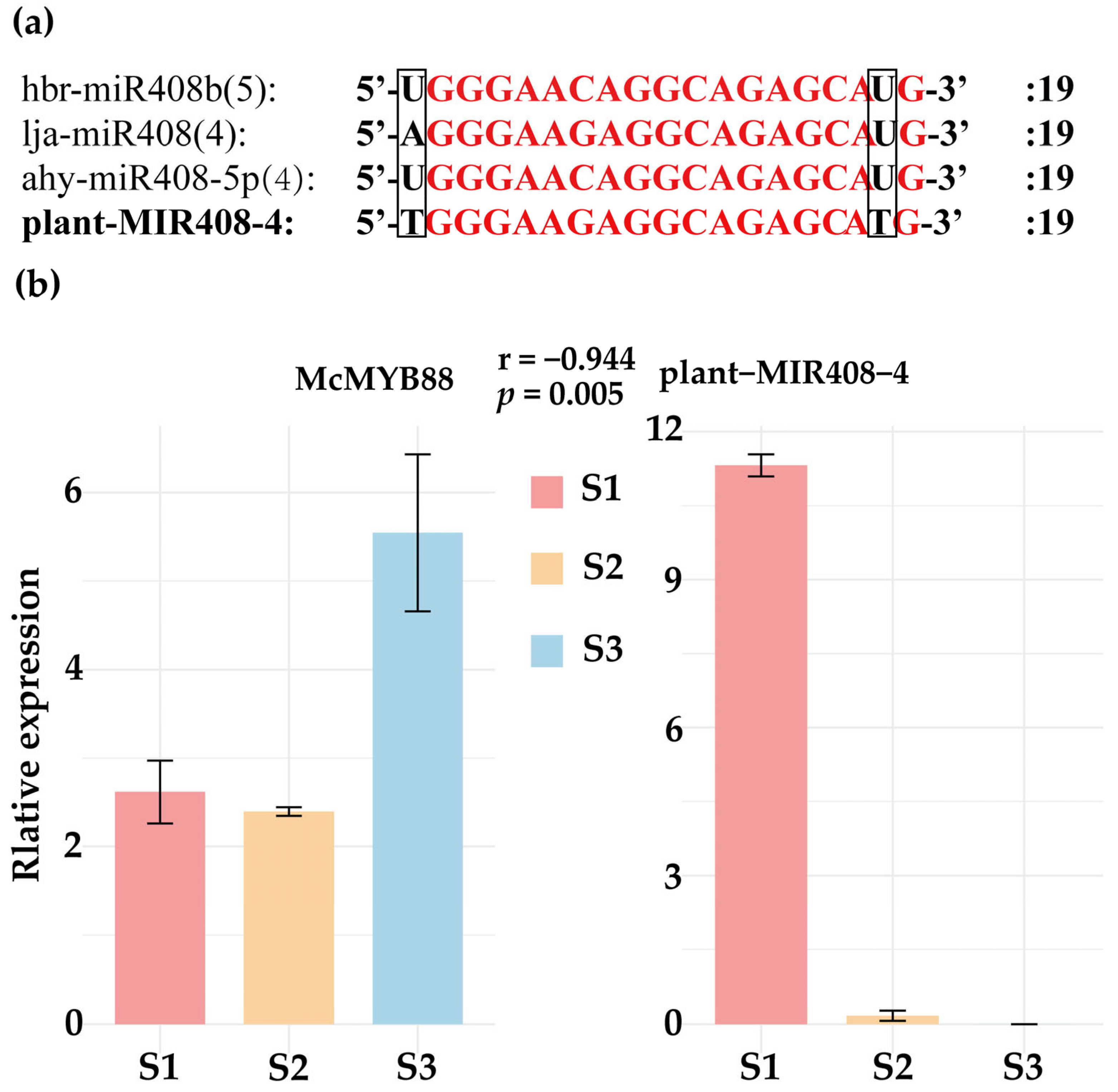
To investigate the possible post-transcriptional regulatory role of DE-miRNAs in anthocyanin biosynthesis, target prediction analysis was performed on two MYB genes related to the anthocyanin synthesis pathway. The results revealed that plant-MIR408-4 targets McMYB88. To evaluate the conservation of this miRNA across different species, the mature miRNA sequence of the target species was aligned with miRNA sequences of closely related species in the miRBase database. Sequence alignment results showed that plant-MIR408-4 differed from ahy-miR408-5p (4), hbr-miR408b (5), and lja-miR408 (4) sequences by only two nucleotides, indicating a high degree of evolutionary conservation. This high level of conservation suggests that plant MIR408-4 may be universally involved in similar regulatory pathways across plants, and likely plays an important regulatory role in metabolic processes such as anthocyanin biosynthesis (Figure 7a and Table S14). Furthermore, correlation analysis results indicated a negative correlation between the expression levels of plant-MIR408-4 and its predicted target gene McMYB88 (r = −0.944, p = 0.005). It is thus hypothesized that plant-MIR408-4 may function by targeting and suppressing this MYB gene, and that its expression decline during growth and development might relieve the inhibition on the MYB, thereby promoting the expression of anthocyanin biosynthesis-related genes and pigment accumulation (Figure 7b).
Figure 7.
Prediction of DE-miRNAs Targeting Anthocyanin-Related MYB TFs. (a) Multiple sequence alignment of the conserved plant MIR408 family, with conserved nucleotides marked in red. (b) The expression patterns of plant MIR408-4 and McMYB88 showed a significant negative correlation during the development of the jaboticaba fruit peel. ahy: Arachis hypogaea (Peanut); hbr: Hevea brasiliensis (Rubber Tree); lja: Lotus japonicus (Japanese Lotus).
4. Discussion
Over the years, jaboticaba has garnered increasing attention due to its high nutritional value and potential applications in the food industry, which is mainly attributed to the rich accumulation of anthocyanins in its peel [36]. However, molecular studies on its regulatory mechanism remain scarce. To understand this molecular mechanism, the current study employed an integrated multi-omics approach, combining targeted metabolomics, transcriptomics, and small RNA sequencing, on the peel of the ‘Essart’ cultivar at its green, color-transition, and fully ripe stages. This research aimed to identify the structural genes, transcription factors, and miRNAs that regulate anthocyanin biosynthesis, thereby systematically elucidating the changes in the ‘Essart’ peel color throughout its growth and development.
Studies have shown that the anthocyanin content in jaboticaba is significantly higher than in blueberry and black raspberry [37]. Our research indicates that the ‘Essart’ cultivar accumulates Cyanidin significantly at the fully ripe stage, showing a maximum 4.73-fold difference; conversely, the absolute content of Pelargonidin and Petunidin declines throughout the entire developmental process. Procyanidin B4, Procyanidin B2 (proanthocyanidins), and Peonidin (an anthocyanin) are detected in small quantities at stage S3. The main flavonols (Luteolin, Quercetin, and Kaempferol) all exhibited a clear increase in content. Experimental studies confirm that different flavonols can act as co-pigments to significantly enhance anthocyanin color saturation and stability [38]. Although the Delphinidin content also showed an increasing trend during the entire developmental stage, its absolute content was significantly lower than that of Cyanidin, suggesting that it may play an auxiliary or synergistic role in fruit peel coloration. Transcriptomic analysis revealed that ten DEGs in the flavonoid biosynthesis pathway were associated with the synthesis of six DAMs: Cyanidin, Delphinidin, Pelargonidin, Luteolin, Quercetin, and Kaempferol. F3′5′H and F3′H play key roles in the anthocyanin biosynthesis pathway; F3′5′H and F3′H determine the ratio of delphinidin-type to cyanidin-type anthocyanins in the fruit peel, which not only affects the peel’s coloration properties but may also impact its ability to resist photo-oxidative damage, as different types of anthocyanins vary in their light absorption and free radical scavenging capabilities [39,40]. Furthermore, the relative upregulation of F3H accompanied by the downregulation of F3′5′H suggests a metabolic flux regulation occurring in the anthocyanin biosynthesis pathway during maturation. Additionally, the upregulation of ANS provides more stable terminal catalytic support, metabolically reinforcing the deposition and stability of anthocyanins in the mature peel, thus providing a metabolic foundation for the peel’s physiological and ecological strategies, such as antioxidant defense, UV light shielding, and the presentation of ripening signals [41]. LAR significantly influences the accumulation of the proanthocyanidins Procyanidin B4 and Procyanidin B2 [42]. The upregulation of the structural gene LAR during the S2–S3 stages may cause the trace accumulation of proanthocyanidins at stage S3. Proanthocyanidins are almost colorless themselves, but they can enhance the deep-color visual effect of the fruit peel by forming co-pigment complexes with anthocyanins and altering optical scattering/absorption properties [43,44]. Weighted Gene Co-expression Network Analysis (WGCNA) identified the brown module as the primary module regulating the biosynthesis of anthocyanins and flavonoids. The brown module as a whole was significantly positively correlated with delphinidin, pelargonidin, and luteolin, but significantly negatively correlated with cyanidin, quercetin, and kaempferol (p < 0.05). However, further gene-level analysis based on Gene Significance (GS) and Module Membership (MM) showed that the structural genes F3H, CHI, CHS, and ANS all had |MM| values greater than 0.89, indicating high connectivity and representativeness within this module. Furthermore, these core structural genes (F3H, CHI, CHS, ANS) all displayed high positive GS values with cyanidin, quercetin, and kaempferol, but showed negative GS values with delphinidin, pelargonidin, and luteolin. It is noteworthy that the expression trends of these core structural genes were highly consistent with the accumulation pattern of total anthocyanin content during jaboticaba fruit peel development, suggesting that they may play a key role in specific anthocyanin branch pathways. Based on existing research, anthocyanin biosynthesis is regulated by a complex of transcription factors, including R2R3-MYB, bHLH, and WD40, acting synergistically [45,46,47]. Besides transcriptional regulation, small RNA sequencing and target gene prediction analysis suggest the potential of plant-MIR408-4 to target McMYB88. During fruit peel development, the expression levels of plant-MIR408-4 and McMYB88 exhibit a negative correlation: the expression level of plant MIR408-4 is extremely high in the S1 stage and significantly decreases by the S3 stage, while the expression level of McMYB88 is extremely low in the S1 stage and significantly increases by the S3 stage. This hints that plant MIR408-4 may regulate the expression of McMYB88. This negative correlation expression pattern between a miRNA and its target gene is a typical characteristic of miRNA-mediated gene regulation and has been widely reported across various developmental and metabolic regulatory networks in plants [48,49].
5. Conclusions
This study systematically elucidated the molecular mechanism underlying the color change of ‘Essart’ jaboticaba (Myrciaria cauliflora) fruit peel during growth and development through multi-omics joint analysis. The results indicated that anthocyanin biosynthesis is strictly controlled by a complex and sophisticated regulatory network and exhibits significant time-specificity. Cyanidin was identified as the main anthocyanin component influencing the color change of the ‘Essart’ fruit peel, while Delphinidin may play an auxiliary role; both anthocyanins showed similar dynamic changes with the color change of the fruit peel: their contents significantly decreased during the color-turning stage and then notably increased by the full-ripening stage, exhibiting a typical “initial decrease followed by an increase” trend. Overall, the dynamic changes in the contents of key anthocyanins were consistent with the process of fruit peel color transition. Weighted Gene Co-expression Network Analysis (WGCNA) revealed that the brown module was significantly correlated with anthocyanin biosynthesis. This module contains 98 transcription factors co-expressed with 6 structural genes. Among these, CHI_1 possesses the dual characteristics of both a structural gene and a transcription factor, potentially playing a core regulatory role in the early stage of anthocyanin synthesis. Furthermore, by combining transcriptome and small RNA analysis, the plant-MIR408-4—McMYB88 regulatory relationship was identified as potentially having a key position in this network, providing important theoretical basis and potential molecular targets for the genetic improvement of flower color in jaboticaba and other ornamental plants.
Supplementary Materials
The following supporting information can be downloaded at: https://www.mdpi.com/article/10.3390/horticulturae11121515/s1, Figure S1: Metabolite chromatograms and QC-RSDs; Figure S2: Metabolite PCA and classification; Figure S3: WGCNA module-trait heatmap. Table S1: Sample chromatography information sheet; Table S2: Targeted anthocyanin detection substances and absolute content; Table S3: Differential metabolites and Venn analysis; Table S4: Transcriptome analysis; Table S5: Key structural genes synthesizing anthocyanin based on differentially expressed genes in the flavonoid biosynthesis pathway. Table S6: Number of genes in each WGCNA module and gene significance (GS) values for genes and metabolites in the brown module; Table S7: KEGG enrichment analysis of each module; Table S8: Weights and correlations between key structural genes and transcription factors in the brown module; Table S9: Small RNA sequencing analysis; Table S10: Small RNA classification statistics (Total); Table S11: MiRNA differential analysis and Venn analysis; Table S12: DE-miRNAs and their corresponding target genes; Table S13: Target gene KEGG enrichment analysis; Table S14: MiRNA conservation analysis.
Author Contributions
Conceptualization, funding acquisition, methodology, supervision, project administration, resources, writing—review and editing: L.Z. and F.C.; writing—original draft preparation, formal analysis, visualization: Z.L.; validation, investigation, data curation: K.D. All authors have read and agreed to the published version of the manuscript.
Funding
This research was funded by the Sanya Yazhou Bay Science and Technology City Elite Talent Science and Technology Special Project (SCKJ-JYRC-2024-31).
Data Availability Statement
The raw transcriptome and small RNA data from this study have been stored at the National Genome Data Center (NGDC) and are available to the public. The data can be accessed through the NGDC official website https://ngdc.cncb.ac.cn/ (accessed on 28 October 2025), with project numbers PRJCA049513 and PRJCA049664, respectively.
Conflicts of Interest
The authors declare no conflicts of interest.
Abbreviations
The following abbreviations are used in this manuscript:
| FPKM | Fragments Per Kilobase of transcript per Million mapped reads |
| CPM | Counts Per Million |
| TIC | Total Ion Chromatogram |
| LAR | Leucoanthocyanidin Reductase |
References
- Wu, S.-B.; Long, C.; Kennelly, E.J. Phytochemistry and health benefits of jaboticaba, an emerging fruit crop from Brazil. Food Res. Int. 2013, 54, 148–159. [Google Scholar] [CrossRef]
- Barros, R.S.; Finger, F.L.; Magalhães, M.M. Changes in non-structural carbohydrates in developing fruit of Myrciaria jaboticaba. Sci. Hortic. 1996, 66, 209–215. [Google Scholar] [CrossRef]
- Alegbe, E.O.; Uthman, T.O. A review of history, properties, classification, applications and challenges of natural and synthetic dyes. Heliyon 2024, 10, e33646. [Google Scholar] [CrossRef]
- Nabi, B.G.; Mukhtar, K.; Ahmed, W.; Manzoor, M.F.; Ranjha, M.M.A.N.; Kieliszek, M.; Bhat, Z.F.; Aadil, R.M. Natural pigments: Anthocyanins, carotenoids, chlorophylls, and betalains as colorants in food products. Food Biosci. 2023, 52, 102403. [Google Scholar] [CrossRef]
- Habibi, F.; Sarkhosh, A.; Kim, J.; Shahid, M.; Gmitter, F.; Brecht, J. Citrus Fruit Pigments: HS1472, 11/2023. EDIS 2023, HS1472. [Google Scholar] [CrossRef]
- Pietta, P.G. Flavonoids as antioxidants. J. Nat. Prod. 2000, 63, 1035–1042. [Google Scholar] [CrossRef]
- Sesso, H.D.; Buring, J.E.; Norkus, E.P.; Gaziano, J.M. Plasma lycopene, other carotenoids, and retinol and the risk of cardiovascular disease in women. Am. J. Clin. Nutr. 2004, 79, 47–53. [Google Scholar] [CrossRef]
- Gonzali, S.; Mazzucato, A.; Perata, P. Purple as a tomato: Towards high anthocyanin tomatoes. Trends Plant Sci. 2009, 14, 237–241. [Google Scholar] [CrossRef]
- Castangia, I.; Manca, M.L.; Allaw, M.; Hellström, J.; Granato, D.; Manconi, M. Jabuticaba (Myrciaria jaboticaba) peel as a sustainable source of anthocyanins and ellagitannins delivered by phospholipid vesicles for alleviating oxidative stress in human keratinocytes. Molecules 2021, 26, 6697. [Google Scholar] [CrossRef]
- Xu, Y.; Li, H.; Shi, T.; Luo, Q.; Chen, Y.; Guo, S.; Tian, W.; An, W.; Zhao, J.; Yin, Y.; et al. High-quality genome of black wolfberry (Lycium ruthenicum Murr.) provides insights into the genetics of anthocyanin biosynthesis regulation. Hortic. Res. 2025, 12, uhae298. [Google Scholar] [CrossRef] [PubMed]
- Duan, X.; Wang, K.; Tang, R.; Liu, J.; Cheng, K.; Gao, G.; Wang, Y.; Qin, G. Recent advances in biosynthesis and regulation of strawberry anthocyanins. Hortic. Res. 2025, 12, uhaf135. [Google Scholar] [CrossRef]
- Sadowska-Bartosz, I.; Bartosz, G. Antioxidant activity of anthocyanins and anthocyanidins: A critical review. Int. J. Mol. Sci. 2024, 25, 12001. [Google Scholar] [CrossRef]
- Luo, P.; Ning, G.; Wang, Z.; Shen, Y.; Jin, H.; Li, P.; Huang, S.; Zhao, J.; Bao, M. Disequilibrium of flavonol synthase and dihydroflavonol-4-reductase expression associated tightly to white vs. red color flower formation in plants. Front. Plant Sci. 2016, 6, 1257. [Google Scholar] [CrossRef] [PubMed]
- Meng, Y.; Si, W.; Ma, T.; Chen, D.; Zhou, Y.; Bai, Y. Physiological and biochemical basis of flower coloration in Aquilegia oxysepala with a functional study of AoDFR08. BMC Plant Biol. 2025, 25, 1147. [Google Scholar] [CrossRef] [PubMed]
- Chen, J.; Wu, W.; Gao, S.; Jahan, M.S.; Xiao, J.; Guo, T.; Chen, C.; Li, B.; Luo, C.; He, X.; et al. Integrated transcriptome and metabolome analyses reveal anthocyanin biosynthesis in red and green mango pericarps under light and shade conditions. Sci. Hortic. 2024, 338, 113617. [Google Scholar] [CrossRef]
- Petroni, K.; Tonelli, C. Recent advances on the regulation of anthocyanin synthesis in reproductive organs. Plant Sci. 2011, 181, 219–229. [Google Scholar] [CrossRef]
- Jaakola, L. New insights into the regulation of anthocyanin biosynthesis in fruits. Trends Plant Sci. 2013, 18, 477–483. [Google Scholar] [CrossRef]
- Koes, R.; Verweij, W.; Quattrocchio, F. Flavonoids: A colorful model for the regulation and evolution of biochemical pathways. Trends Plant Sci. 2005, 10, 236–242. [Google Scholar] [CrossRef]
- Wu, Z.; Bian, R.; Zhang, Z.; Li, L.; Zhang, J. Transcription factors repressing anthocyanin biosynthesis in horticultural crops. Fruit Res. 2024, 5, e007. [Google Scholar] [CrossRef]
- Zhang, Z.; Wang, X.; Gao, Y.; Xian, X.; Zhang, D.; Zhao, W.; Wang, X.; Wang, Y. Orchestrating anthocyanin biosynthesis in fruit of fruit trees: Transcriptional, post-transcriptional, and post-translational regulation. Int. J. Biol. Macromol. 2025, 307, 141835. [Google Scholar] [CrossRef]
- Xu, W.; Dubos, C.; Lepiniec, L. Transcriptional control of flavonoid biosynthesis by MYB–bHLH–WDR complexes. Trends Plant Sci. 2015, 20, 176–185. [Google Scholar] [CrossRef]
- Zhang, Y.; Sun, Y.; Du, W.; Sun, S.; Zhang, S.; Nie, M.; Liu, Y.; Irfan, M.; Zhang, L.; Chen, L. Ethylene promotes anthocyanin synthesis in ‘Viviana’lily via the LvMYB5-LvERF113-LvMYB1 module. Hortic. Res. 2025, 12, uhaf059. [Google Scholar] [CrossRef]
- Noda, N.; Yoshioka, S.; Kishimoto, S.; Nakayama, M.; Douzono, M.; Tanaka, Y.; Aida, R. Generation of blue chrysanthemums by anthocyanin B-ring hydroxylation and glucosylation and its coloration mechanism. Sci. Adv. 2017, 3, e1602785. [Google Scholar] [CrossRef]
- Song, X.; Diao, J.; Ji, J.; Wang, G.; Guan, C.; Jin, C.; Wang, Y. Molecular cloning and identification of a flavanone 3-hydroxylase gene from Lycium chinense, and its overexpression enhances drought stress in tobacco. Plant Physiol. Biochem. 2016, 98, 89–100. [Google Scholar] [CrossRef] [PubMed]
- León-Chan, R.G.; Lightbourn-Rojas, L.A.; López-Meyer, M.; Amarillas, L.; Heredia, J.B.; Martínez-Bastidas, T.F.; Villicaña, C.; León-Félix, J. Differential gene expression of anthocyanin biosynthetic genes under low temperature and ultraviolet-B radiation in bell pepper (Capsicum annuum). Int. J. Agric. Biol. 2020, 23, 501–508. [Google Scholar]
- Han, Y.; Huang, K.; Liu, Y.; Jiao, T.; Ma, G.; Qian, Y.; Wang, P.; Dai, X.; Gao, L.; Xia, T. Functional analysis of two flavanone-3-hydroxylase genes from Camellia sinensis: A critical role in flavonoid accumulation. Genes 2017, 8, 300. [Google Scholar] [CrossRef] [PubMed]
- Lou, Y.; Zhang, Q.; Xu, Q.; Yu, X.; Wang, W.; Gai, R.; Ming, F. PhCHS5 and PhF3′ 5′ H genes over-expression in petunia (Petunia hybrida) and Phalaenopsis (Phalaenopsis aphrodite) regulate flower color and branch number. Plants 2023, 12, 2204. [Google Scholar] [CrossRef]
- Zhang, X.; Cheng, L.; Shang, H.; Chen, Q.; Lu, M.; Mu, D.; Li, X.; Meng, X.; Wu, Y.; Han, X.; et al. Research advances of coloring mechanism regulated by MicroRNAs in plants. Plant Physiol. Biochem. 2024, 215, 109036. [Google Scholar] [CrossRef] [PubMed]
- Tirumalai, V.; Swetha, C.; Nair, A.; Pandit, A.; Shivaprasad, P.V. miR828 and miR858 regulate VvMYB114 to promote anthocyanin and flavonol accumulation in grapes. J. Exp. Bot. 2019, 70, 4775–4792. [Google Scholar] [CrossRef]
- Zhang, B.; Yang, H.J.; Yang, Y.Z.; Zhu, Z.Z.; Li, Y.N.; Qu, D.; Zhao, Z.Y. mdm-miR828 participates in the feedback loop to regulate anthocyanin accumulation in apple peel. Front. Plant Sci. 2020, 11, 608109. [Google Scholar] [CrossRef]
- Hu, Y.; Ji, J.; Cheng, H.; Luo, R.; Zhang, J.; Li, W.; Wang, X.; Yao, Y. The miR408a-BBP-LAC3/CSD1 module regulates anthocyanin biosynthesis mediated by crosstalk between copper homeostasis and ROS homeostasis during light induction in Malus plants. J. Adv. Res. 2023, 51, 27–44. [Google Scholar] [CrossRef] [PubMed]
- Azad, M.F.; Dawar, P.; Esim, N.; Rock, C.D. Role of miRNAs in sucrose stress response, reactive oxygen species, and anthocyanin biosynthesis in Arabidopsis thaliana. Front. Plant Sci. 2023, 14, 1278320. [Google Scholar] [CrossRef]
- Barnes, J.S.; Nguyen, H.P.; Shen, S.; Schug, K.A. General method for extraction of blueberry anthocyanins and identification using high performance liquid chromatography–electrospray ionization-ion trap-time of flight-mass spectrometry. J. Chromatogr. A 2009, 1216, 4728–4735. [Google Scholar] [CrossRef]
- Glauser, G.; Grund, B.; Gassner, A.-L.; Menin, L.; Henry, H.; Bromirski, M.; Schütz, F.; McMullen, J.; Rochat, B. Validation of the mass-extraction-window for quantitative methods using liquid chromatography high resolution mass spectrometry. Anal. Chem. 2016, 88, 3264–3271. [Google Scholar] [CrossRef]
- Zhao, L.; Li, Z.; Jiang, S.; Xia, C.; Deng, K.; Liu, B.; Wang, Z.; Liu, Q.; He, M.; Zou, M.; et al. The Telomere-to-Telomere Genome of Jaboticaba Reveals the Genetic Basis of Fruit Color and Citric Acid Content. Int. J. Mol. Sci. 2024, 25, 11951. [Google Scholar] [CrossRef]
- Inada, K.O.P.; Leite, I.B.; Martins, A.B.N.; Fialho, E.; Tomás-Barberán, F.A.; Perrone, D.; Monteiro, M. Jaboticaba berry: A comprehensive review on its polyphenol composition, health effects, metabolism, and the development of food products. Food Res. Int. 2021, 147, 110518. [Google Scholar] [CrossRef]
- Calloni, C.; Agnol, R.D.; Martínez, L.S.; de Siqueira Marcon, F.; Moura, S.; Salvador, M. Jaboticaba (Plinia trunciflora (O. Berg) Kausel) fruit reduces oxidative stress in human fibroblasts cells (MRC-5). Food Res. Int. 2015, 70, 15–22. [Google Scholar] [CrossRef]
- Alcalde-Eon, C.; Escribano-Bailón, M.-T.; García-Estévez, I. Ability of Different Flavonols and Commercial Mannoproteins to Enhance Wine Colour through Copigmentation. Aust. J. Grape Wine Res. 2024, 2024, 6822967. [Google Scholar] [CrossRef]
- Kobayashi, H.; Suzuki, S.; Tanzawa, F.; Takayanagi, T. Low expression of flavonoid 3′, 5′-hydroxylase (F3′, 5′ H) associated with cyanidin-based anthocyanins in grape leaf. Am. J. Enol. Vitic. 2009, 60, 362–367. [Google Scholar] [CrossRef]
- Lee, S.G.; Vance, T.M.; Nam, T.-G.; Kim, D.-O.; Koo, S.I.; Chun, O.K. Contribution of anthocyanin composition to total antioxidant capacity of berries. Plant Foods Hum. Nutr. 2015, 70, 427–432. [Google Scholar] [CrossRef] [PubMed]
- Zhao, K.; Zhang, Q.; Wang, Y.; Wei, Q.; Wang, Y. Advances in the biosynthesis and regulatory mechanisms of anthocyanins in horticultural plants: A comprehensive review. Trop. Plants 2024, 4, e010. [Google Scholar] [CrossRef]
- Lin, J.; Lai, G.; Guo, A.; He, L.; Yang, F.; Huang, Y.; Che, J.; Lai, C. Overexpression of LAR1 suppresses anthocyanin biosynthesis by enhancing catechin competition leading to promotion of proanthocyanidin pathway in spine grape (Vitis davidii) cells. Int. J. Mol. Sci. 2024, 25, 12087. [Google Scholar] [CrossRef]
- Yang, Y.; Yao, G.; Yue, W.; Zhang, S.; Wu, J. Transcriptome profiling reveals differential gene expression in proanthocyanidin biosynthesis associated with red/green skin color mutant of pear (Pyrus communis L.). Front. Plant Sci. 2015, 6, 795. [Google Scholar] [CrossRef]
- Boulton, R. The copigmentation of anthocyanins and its role in the color of red wine: A critical review. Am. J. Enol. Vitic. 2001, 52, 67–87. [Google Scholar] [CrossRef]
- Li, S. Transcriptional control of flavonoid biosynthesis: Fine-tuning of the MYB-bHLH-WD40 (MBW) complex. Plant Signal. Behav. 2014, 9, e27522. [Google Scholar] [CrossRef]
- Menconi, J.; Perata, P.; Gonzali, S. Novel R2R3 MYB transcription factors regulate anthocyanin synthesis in Aubergine tomato plants. BMC Plant Biol. 2023, 23, 148. [Google Scholar] [CrossRef] [PubMed]
- Li, M.; Zhou, Y.; Li, K.; Guo, H. Genome-wide comparative analysis of the r2r3-myb gene family in six ipomoea species and the identification of anthocyanin-related members in sweet potatoes. Plants 2023, 12, 1731. [Google Scholar] [CrossRef]
- Liu, Q.; Chen, Y.-Q. Insights into the mechanism of plant development: Interactions of miRNAs pathway with phytohormone response. Biochem. Biophys. Res. Commun. 2009, 384, 1–5. [Google Scholar] [CrossRef]
- Voinnet, O. Origin, biogenesis, and activity of plant microRNAs. Cell 2009, 136, 669–687. [Google Scholar] [CrossRef] [PubMed]
Disclaimer/Publisher’s Note: The statements, opinions and data contained in all publications are solely those of the individual author(s) and contributor(s) and not of MDPI and/or the editor(s). MDPI and/or the editor(s) disclaim responsibility for any injury to people or property resulting from any ideas, methods, instructions or products referred to in the content. |
© 2025 by the authors. Licensee MDPI, Basel, Switzerland. This article is an open access article distributed under the terms and conditions of the Creative Commons Attribution (CC BY) license (https://creativecommons.org/licenses/by/4.0/).