


You are currently viewing a new version of our website. To view the old version click .

Non-Coding RNA, Volume 6, Issue 2

June 2020 - 10 articles

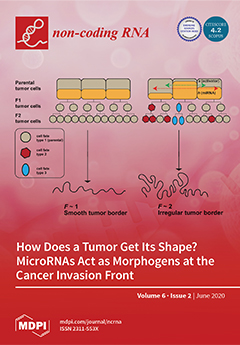
Cover Story: We hypothesized that circulating microRNAs (miRNAs) act as morphogenetic inhibitors in shaping the tumor border of cancers. Using a reaction diffusion model, we observed that the diffusion coefficient of miRNAs is a major factor influencing the invasion front configuration. Three different cell generations are represented: parental, F1 and F2. If the concertation of activator and miRNA inhibitor does not change in parental cells, F1 and F2 cells preserve the same fate type and the tumor border is smooth (left). If the activator (a) and miRNA inhibitor (h) diffuse into neighboring parental cells, new cell fate types emerge, and the tumor border becomes irregular (right). From a translational perspective, our observations can be used for better diagnosis of cancer aggressiveness. View this paper
  • Issues are regarded as officially published after their release is announced to the table of contents alert mailing list .
  • You may sign up for email alerts to receive table of contents of newly released issues.
  • PDF is the official format for papers published in both, html and pdf forms. To view the papers in pdf format, click on the "PDF Full-text" link, and use the free Adobe Reader to open them.

Articles (10)

  • Review
  • Open Access
17 Citations
6,375 Views
21 Pages

Long noncoding RNAs (lncRNAs) are RNAs with a length of over 200 nucleotides that do not have protein-coding abilities. Recent studies suggest that lncRNAs are highly involved in physiological functions and diseases. lncRNAs HNF1α-AS1 and HNF4&...

  • Article
  • Open Access
3 Citations
4,902 Views
14 Pages

How Does a Tumor Get Its Shape? MicroRNAs Act as Morphogens at the Cancer Invasion Front

  • Catalin Vasilescu,
  • Mihai Tanase,
  • Dana Giza,
  • Livia Procopiuc,
  • Mihnea P. Dragomir and
  • George A. Calin

The generation and organization of the invasion front shape of neoplasms is an intriguing problem. The intimate mechanism is not yet understood, but the prevailing theory is that it represents an example of morphogenesis. Morphogenesis requires the p...

  • Review
  • Open Access
220 Citations
15,355 Views
17 Pages

MALAT1 Long Non-Coding RNA: Functional Implications

  • Gayatri Arun,
  • Disha Aggarwal and
  • David L. Spector

The mammalian genome is pervasively transcribed and the functional significance of many long non-coding RNA (lncRNA) transcripts are gradually being elucidated. Metastasis Associated Lung Adenocarcinoma Transcript 1 (MALAT1) is one of the most well-s...

  • Brief Report
  • Open Access
3 Citations
5,804 Views
10 Pages

RNA editing is a post-transcriptional modification, which can provide tissue-specific functions not encoded in DNA. Adenosine-to-inosine is the predominant editing event and, along with cytosine-to-uracil changes, constitutes canonical editing. The r...

  • Review
  • Open Access
20 Citations
8,811 Views
12 Pages

An increasing number of studies have revealed that long non-coding RNAs (lncRNAs) play important roles in gene regulation and nuclear organization. Although the mechanisms are still largely unknown, many lncRNAs have been shown to interact with chrom...

  • Article
  • Open Access
28 Citations
6,459 Views
13 Pages

HOX Transcript Antisense RNA HOTAIR Abrogates Vasculogenic Mimicry by Targeting the AngiomiR-204/FAK Axis in Triple Negative Breast Cancer Cells

  • Allan Lozano-Romero,
  • Horacio Astudillo-de la Vega,
  • María Cruz del Rocío Terrones-Gurrola,
  • Laurence A. Marchat,
  • Daniel Hernández-Sotelo,
  • Yarely M. Salinas-Vera,
  • Rosalío Ramos-Payan,
  • Macrina B. Silva-Cázares,
  • Stephanie I. Nuñez-Olvera and
  • Olga N. Hernández-de la Cruz
  • + 1 author

HOX transcript antisense RNA (HOTAIR) is an oncogenic long non-coding RNA frequently overexpressed in cancer. HOTAIR can enhance the malignant behavior of tumors by sponging microRNAs with tumor suppressor functions. Vasculogenic mimicry is a hypoxia...

  • Meeting Report
  • Open Access
3 Citations
7,259 Views
20 Pages

A Year in the Life of the EU-CardioRNA COST Action: CA17129 Catalysing Transcriptomics Research in Cardiovascular Disease

  • Emma Louise Robinson,
  • Clarissa Pedrosa da Costa Gomes,
  • Ines Potočnjak,
  • Jan Hellemans,
  • Fay Betsou,
  • David de Gonzalo-Calvo,
  • Monika Stoll,
  • Mehmet Birhan Yilmaz,
  • Bence Ágg and
  • Dimitris Beis
  • + 12 authors

The EU-CardioRNA Cooperation in Science and Technology (COST) Action is a European-wide consortium established in 2018 with 31 European country members and four associate member countries to build bridges between translational researchers from academ...

  • Communication
  • Open Access
1 Citations
4,655 Views
14 Pages

Out of respect for the institution’s wishes, in agreement with the Non-Coding RNA Editorial Office, and in agreement with the author, this article has been removed from the public record and marked as retracted. Please refer to the retraction note.

  • Article
  • Open Access
9 Citations
4,281 Views
13 Pages

Intratumoral Heterogeneity of Expression of 16 miRNA in Luminal Cancer of the Mammary Gland

  • Yuliya A. Veryaskina,
  • Sergei E. Titov,
  • Vlada V. Kometova,
  • Valerii V. Rodionov and
  • Igor F. Zhimulev

The purpose of this work is to determine the intratumoral distribution of miRNA expression profiles in luminal breast cancer (BC). The study included 33 certain BC cases of the luminal A or luminal B (Her2-) subtypes. The relative expression levels o...

  • Article
  • Open Access
12 Citations
5,855 Views
18 Pages

Schistosoma japonicum is a flatworm that causes schistosomiasis, a neglected tropical disease. S. japonicum RNA-Seq analyses has been previously reported in the literature on females and males obtained during sexual maturation from 14 to 28 days post...

Get Alerted

Add your email address to receive forthcoming issues of this journal.

XFacebookLinkedIn
Non-Coding RNA - ISSN 2311-553X