


Taxonomy, Phylogeny, Divergence Time Estimation, and Biogeography of the Family Pseudoplagiostomataceae (Ascomycota, Diaporthales)

 ,
, 
Abstract
1. Introduction
2. Materials and Methods
2.1. Isolation and Morphology
2.2. DNA Extraction and Amplification
2.3. Phylogenetic Analyses
2.4. Divergence Time Estimation
2.5. Inferring Historical Biogeography
3. Results
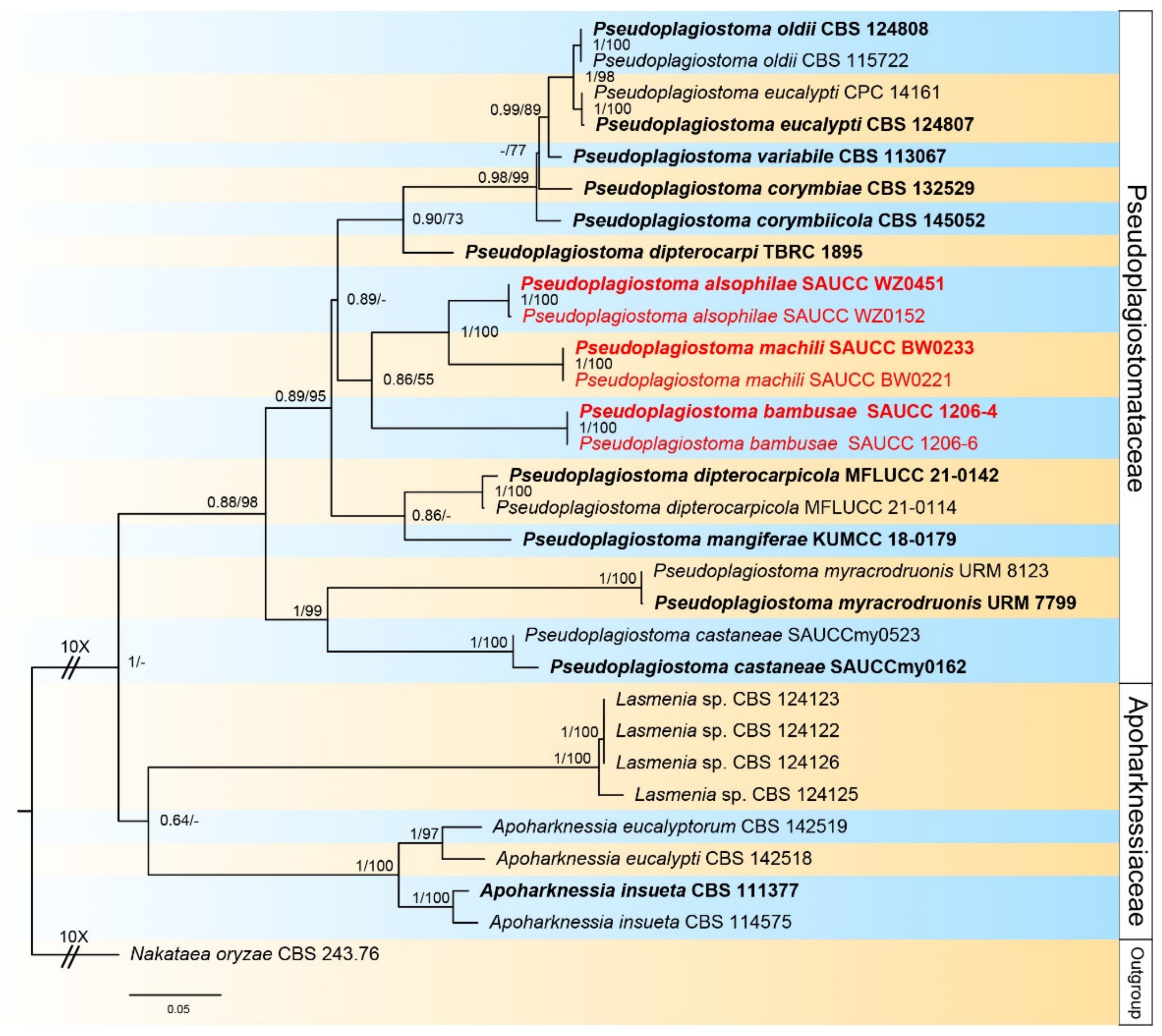
3.1. Phylogenetic Analyses
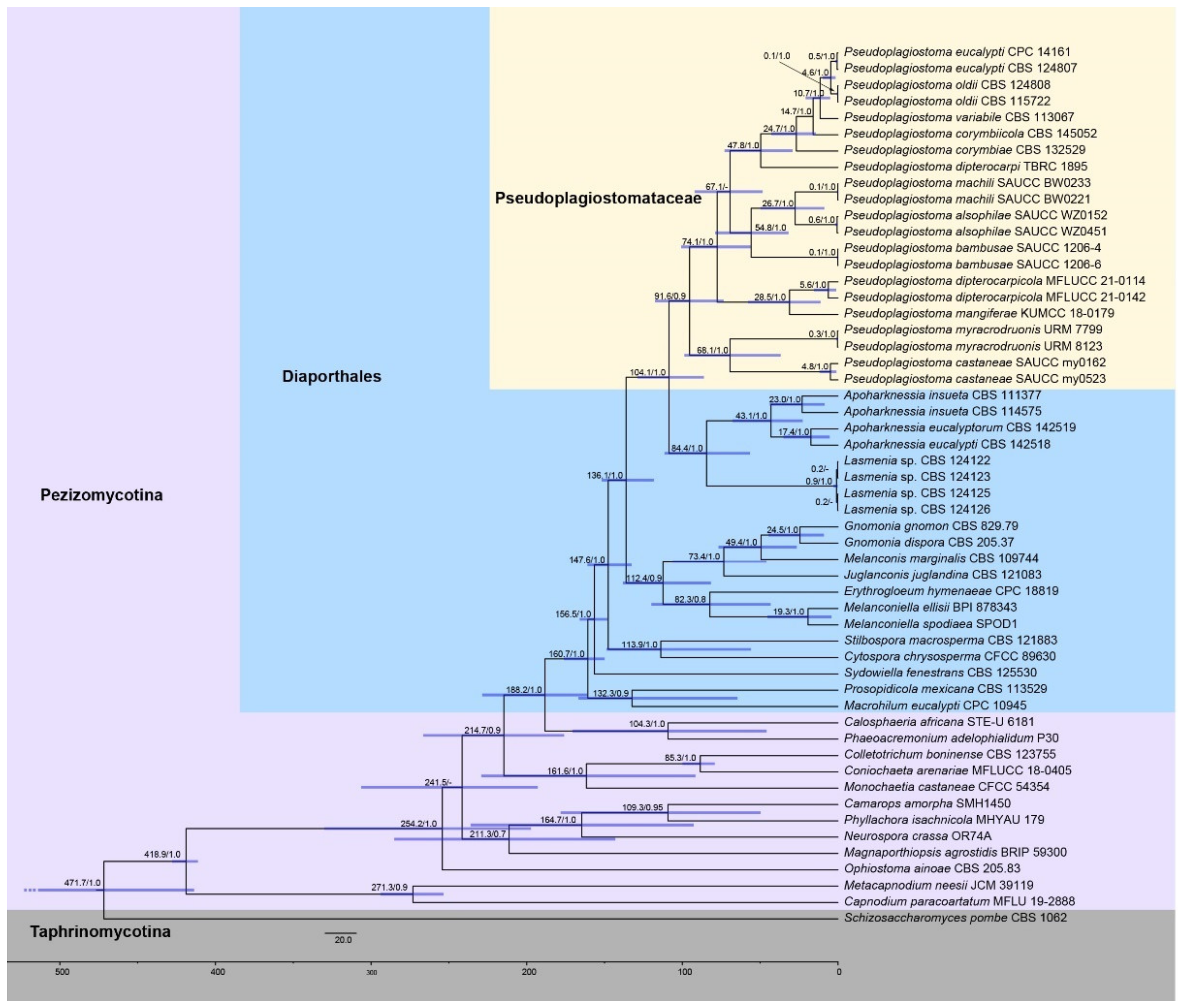
3.2. Divergence Time Estimation for Pseudoplagiostomataceae
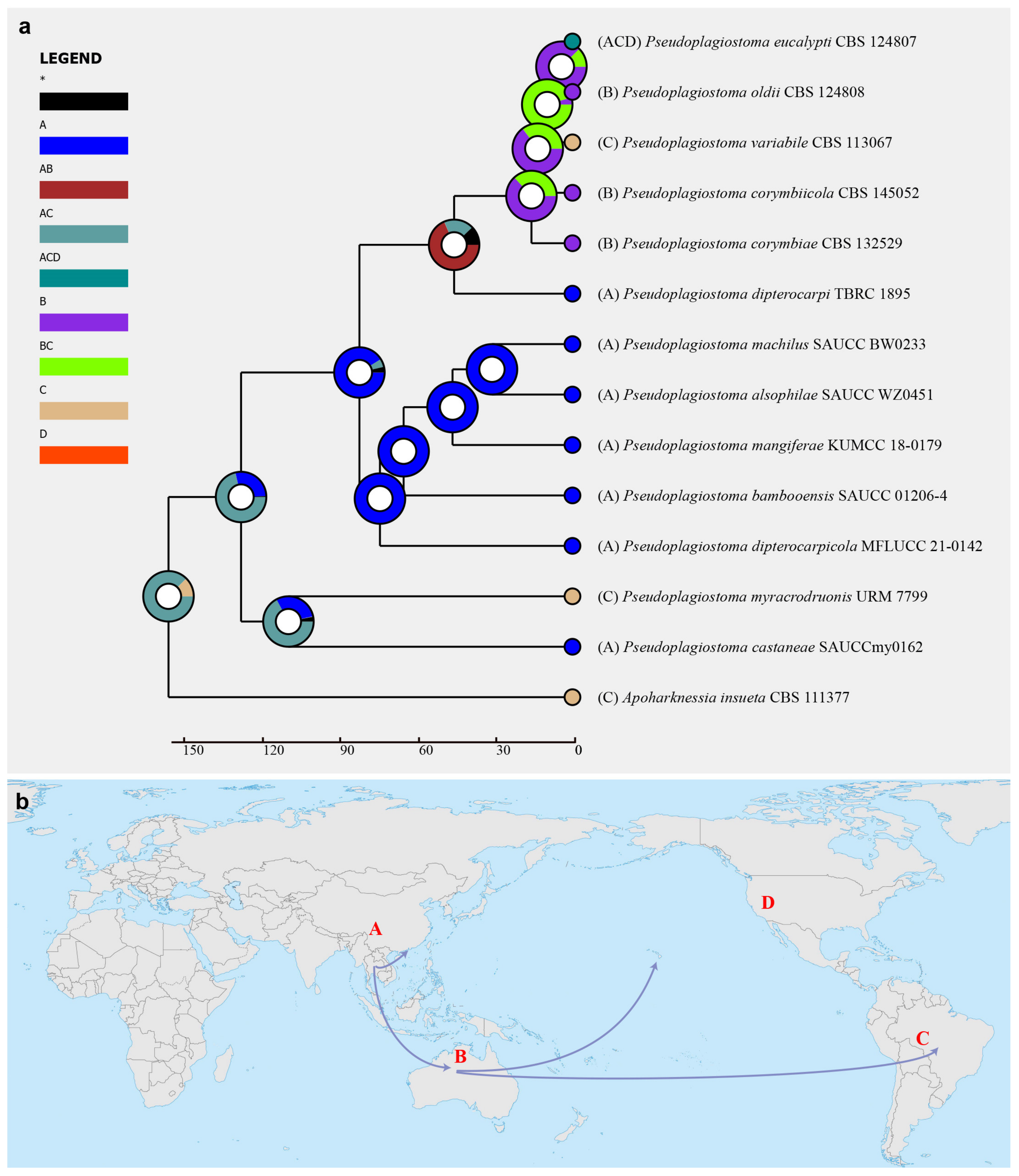
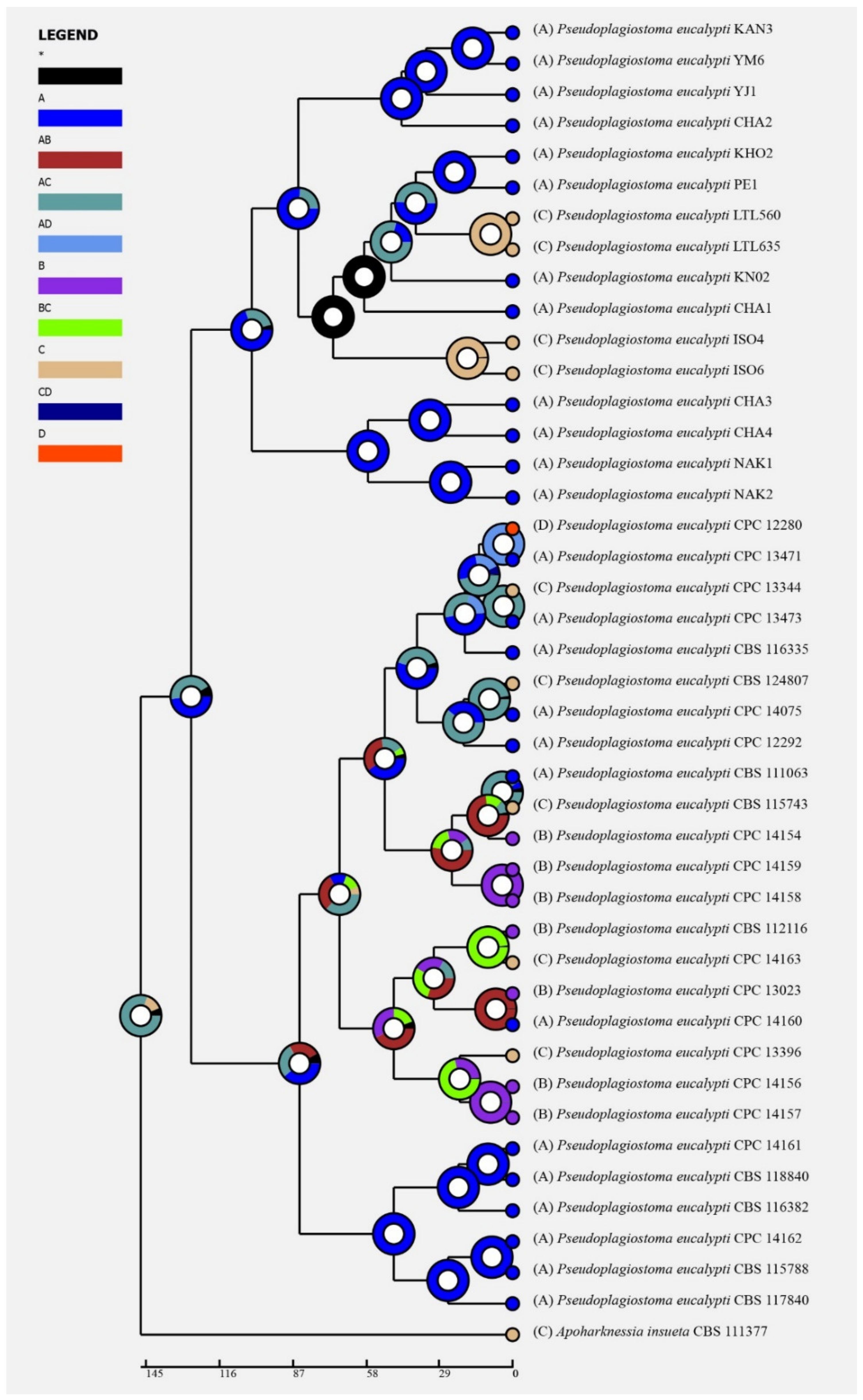
3.3. The Historical Biogeography of Pseudoplagiostomataceae
3.4. Taxonomy
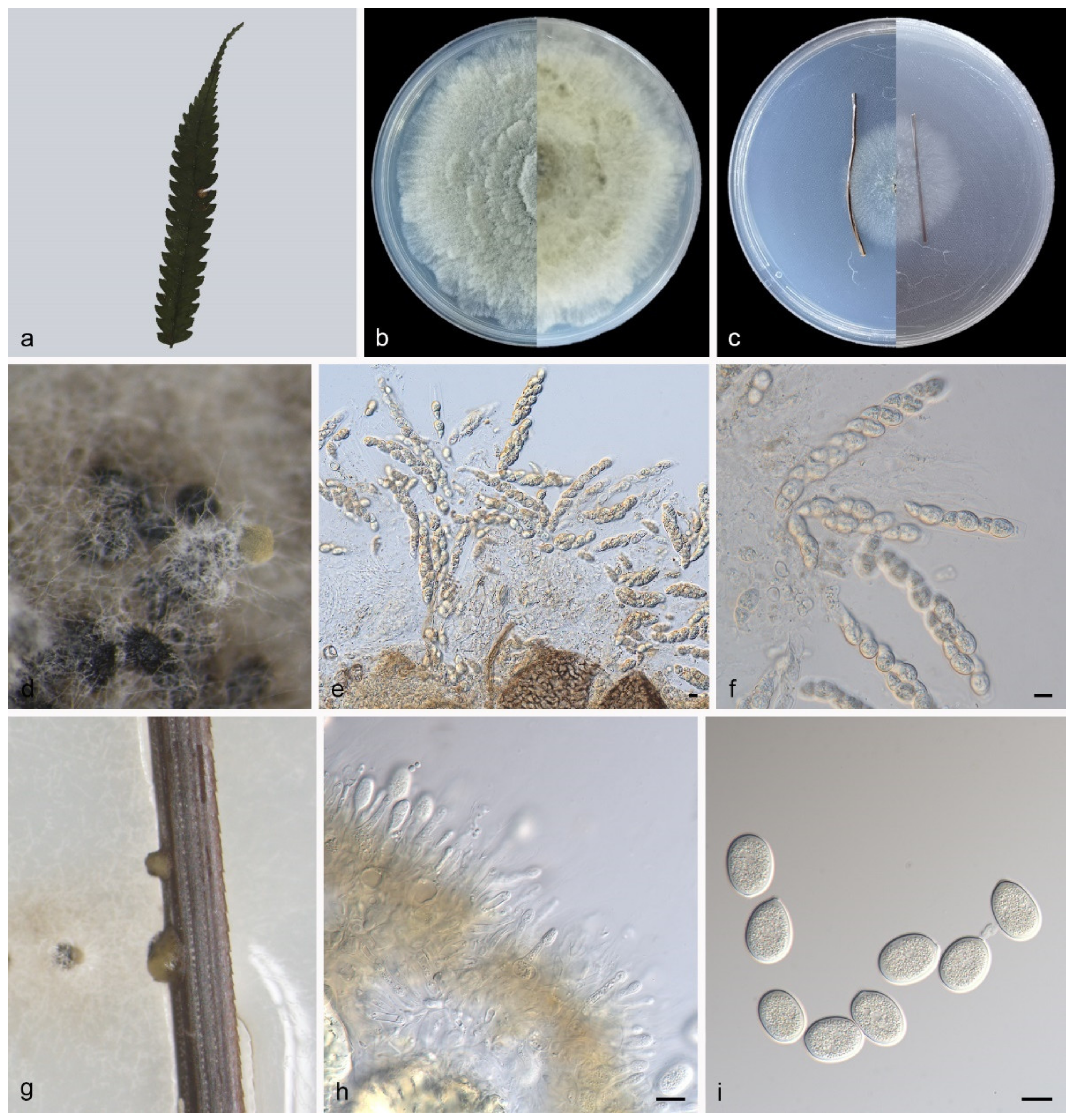
3.4.1. Pseudoplagiostoma alsophilae Z.X. Zhang, Z. Meng and X.G. Zhang, sp. nov.
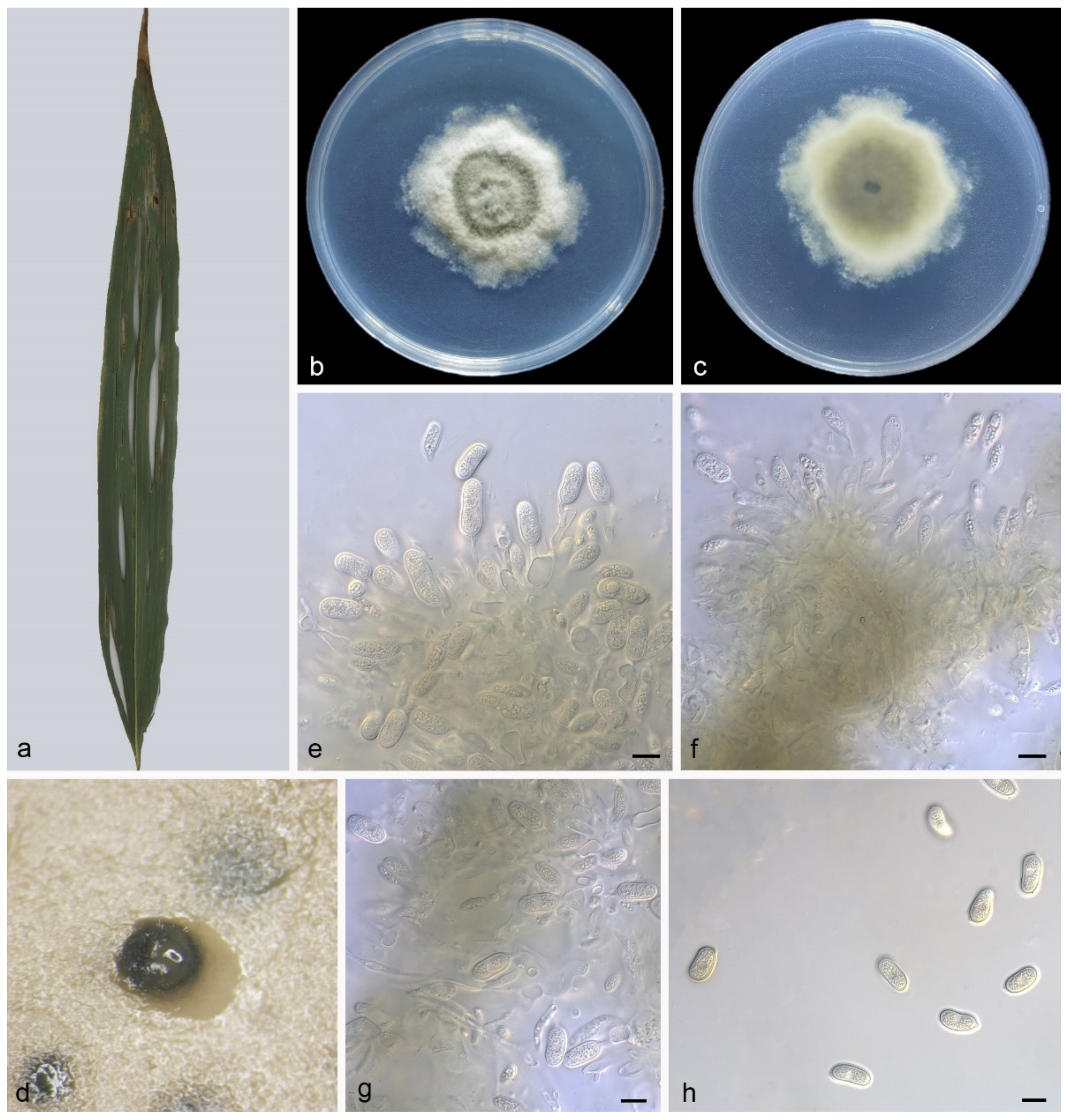
3.4.2. Pseudoplagiostoma bambusae Z.X. Zhang, Z. Meng, and X.G. Zhang, sp. nov.
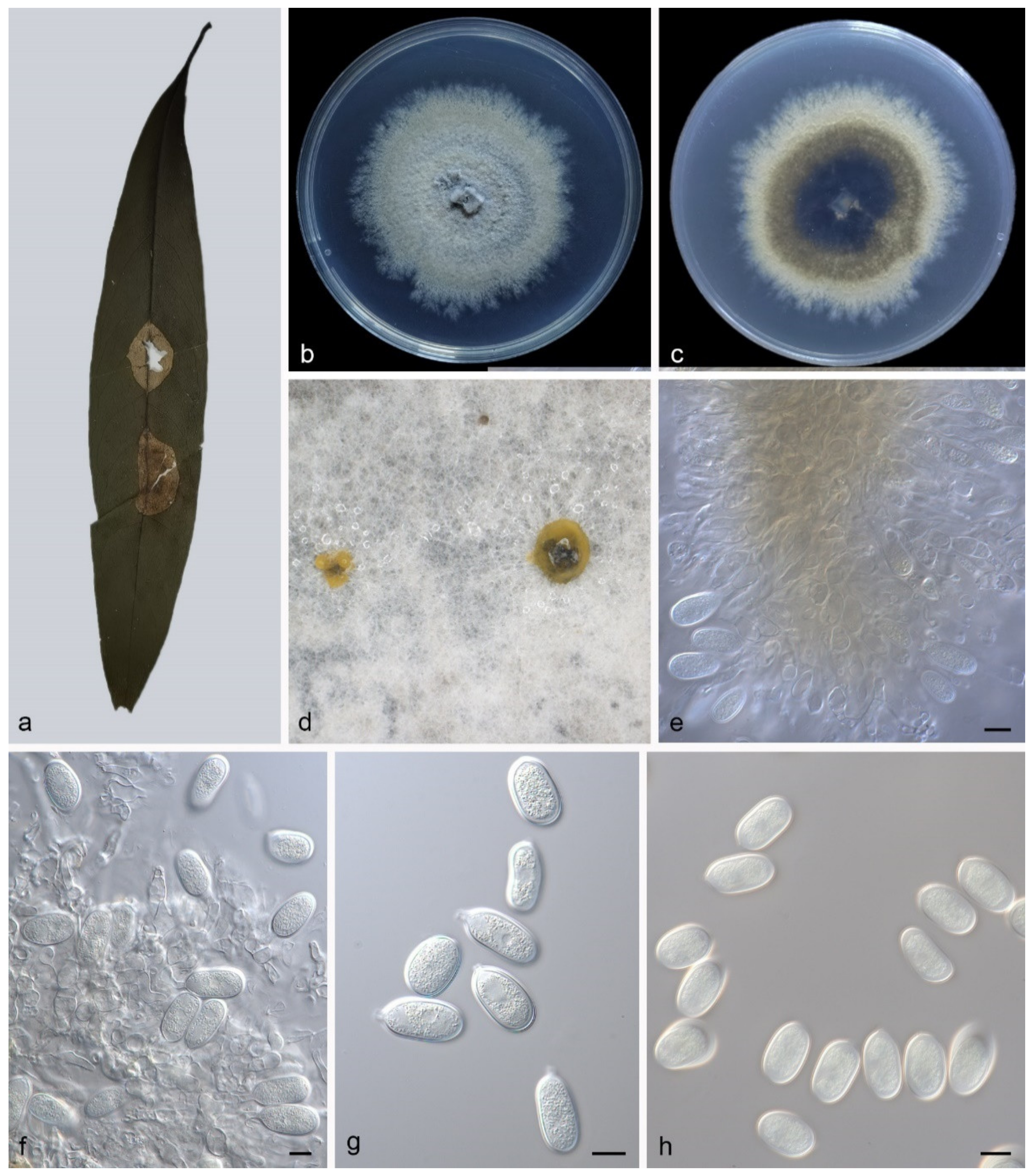
3.4.3. Pseudoplagiostoma machili Z.X. Zhang, Z. Meng, and X.G. Zhang, sp. nov.
4. Discussion
Supplementary Materials
Author Contributions
Funding
Institutional Review Board Statement
Informed Consent Statement
Data Availability Statement
Acknowledgments
Conflicts of Interest
References
- Cheewangkoon, R.; Groenewald, J.Z.; Verkley, G.J.M.; Hyde, K.D.; Wingfield, M.J.; Gryzenhout, M.; Summerell, B.A.; Denman, S.; Toanun, C.; Crous, P.W. Re-evaluation of Cryptosporiopsis eucalypti and Cryptosporiopsis-like species occurring on Eucalyptus leaves. Fungal Divers. 2010, 44, 89–105. [Google Scholar] [CrossRef]
- Mu, T.C.; Zhang, Z.X.; Liu, R.Y.; Li, Z.; Zhang, X.G.; Xia, J.W. Morphological and molecular identification of Pseudoplagiostoma castaneae sp. nov. (Pseudoplagiostomataceae, Diaporthales) in Shandong Province, China. Nova Hedwig. 2022, 114, 171–180. [Google Scholar] [CrossRef]
- Suwannarach, N.; Kumla, J.; Lumyong, S. Pseudoplagiostoma dipterocarpi sp. nov., a new endophytic fungus from Thailand. Mycoscience 2016, 57, 118–122. [Google Scholar] [CrossRef]
- Crous, P.W.; Summerell, B.A.; Shivas, R.G.; Burgess, T.I.; Decock, C.A.; Dreyer, L.L.; Granke, L.L.; Guest, D.I.; Hardy, G.E.; Hausbecket, M.K.; et al. Fungal Planet description sheets: 107–127. Persoonia 2012, 28, 138–182. [Google Scholar] [CrossRef]
- Crous, P.W.; Luangsa-Ard, J.J.; Wingfield, M.J.; Carnegie, A.J.; Hernandez-Restrepo, M.; Lombard, L.; Roux, J.; Barreto, R.W.; Baseia, I.G.; Cano-Lira, J.F.; et al. Fungal Planet description sheets: 785–867. Persoonia 2018, 41, 238–417. [Google Scholar] [CrossRef]
- Crous, P.W.; Wingfield, M.J.; Cheewangkoon, R.; Carnegie, A.J.; Burgess, T.I.; Summerell, B.A.; Edwards, J.; Taylor, P.W.J.; Groenewald, J.Z. Foliar pathogens of eucalypts. Stud. Mycol. 2019, 94, 125–298. [Google Scholar] [CrossRef]
- Bezerra, J.D.P.; Pádua, A.P.S.L.; Oliveira, T.G.L.; Paiva, L.M.; Guarnaccia, V.; Fan, X.L.; Souza-Motta, C.M. Pseudoplagiostoma myracrodruonis (Pseudoplagiostomataceae, Diaporthales): A new endophytic species from Brazil. Mycol. Prog. 2019, 18, 1329–1339. [Google Scholar] [CrossRef]
- Phookamsak, R.; Hyde, K.D.; Jeewon, R.; Bhat, D.J.; Jones, E.B.G.; Maharachchikumbura, S.S.N.; Raspé, O.; Karunarathna, S.C.; Wanasinghe, D.N.; Hongsanan, S.; et al. Fungal diversity notes 929–1035: Taxonomic and phylogenetic contributions on genera and species of fungi. Fungal Divers. 2019, 95, 1–273. [Google Scholar] [CrossRef]
- Tang, X.; Jayawardena, R.S.; Stephenson, S.L.; Kang, J.C. A new species Pseudoplagiostoma dipterocarpicola (Pseudoplagiostomataceae, Diaporthales) found in northern Thailand on members of the Dipterocarpaceae. Phytotaxa 2022, 543, 233–243. [Google Scholar] [CrossRef]
- Wang, C.L.; Yang, S.W.; Chiang, C.Y. The First Report of Leaf Spot of Eucalyptus robusta Caused by Pseudoplagiostoma eucalypti in Taiwan. Plant Dis. 2016, 100, 1504. [Google Scholar] [CrossRef]
- Liu, N.G.; Ariyawansa, H.A.; Hyde, K.D.; Maharachchikumbura, S.S.N.; Zhao, R.L.; Phillips, A.J.L.; Jayawardena, R.S.; Thambugala, K.M.; Dissanayake, A.J.; Wijayawardene, N.N.; et al. Perspectives into the value of genera, families and orders in classification. Mycosphere 2016, 7, 1649–1668. [Google Scholar] [CrossRef]
- Zhao, R.L.; Zhou, J.L.; Chen, J.; Margaritescu, S.; Sánchez-Ramírez, S.; Hyde, K.D.; Callac, P.; Parra, L.A.; Li, G.-J.; Moncalvo, J.-M. Towards standardizing taxonomic ranks using divergence times—A case study for reconstruction of the Agaricus taxonomic system. Fungal Divers. 2016, 78, 239–292. [Google Scholar] [CrossRef]
- Hyde, K.D.; Maharachchikumbura, S.S.N.; Hongsanan, S.; Samarakoon, M.C.; Lücking, R.; Pem, D.; Harishchandra, D.; Jeewon, R.; Zhao, R.-L.; Xu, J.-C.; et al. The ranking of fungi: A tribute to David L. Hawksworth on his 70th birthday. Fungal Divers. 2017, 84, 1–23. [Google Scholar] [CrossRef]
- Beimforde, C.; Feldberg, K.; Nylinder, S.; Rikkinen, J.; Tuovila, H.; Dorfelt, H.; Gube, M.; Jackson, D.J.; Reitner, J.; Seyfullah, L.J.; et al. Estimating the Phanerozoic history of the Ascomycota lineages: Combining fossil and molecular data. Mol. Phylogenet. Evol. 2014, 78, 386–398. [Google Scholar] [CrossRef]
- Hongsanan, S.; Sánchez-Ramírez, S.; Crous, P.W.; Ariyawansa, H.A.; Zhao, R.L.; Hyde, K.D. The evolution of fungal epiphytes. Mycosphere 2016, 7, 1690–1712. [Google Scholar] [CrossRef]
- Samarakoon, M.C.; Hyde, K.D.; Promputtha, I.; Ariyawansa, H.A.; Hongsanan, S. Divergence and ranking of taxa across the kingdoms Animalia, Fungi and Plantae. Mycosphere 2016, 7, 1678–1689. [Google Scholar] [CrossRef]
- Divakar, P.K.; Crespo, A.; Kraichak, E.; Leavitt, S.D.; Singh, G.; Schmitt, I.; Lumbsch, H.T. Using a temporal phylogenetic method to harmonize family- and genus-level classification in the largest clade of lichen-forming fungi. Fungal Divers. 2017, 84, 101–117. [Google Scholar] [CrossRef]
- Bromham, L.; Penny, D. The modern molecular clock. Nat. Rev. Genet. 2003, 4, 216–224. [Google Scholar] [CrossRef]
- Kumar, S. Molecular clocks: Four decades of evolution. Nat. Rev. Genet. 2005, 6, 654–662. [Google Scholar] [CrossRef]
- Vijaykrishna, D.; Jeewon, R.; Hyde, K.D. Molecular taxonomy, origins and evolution of freshwater ascomycetes. Fungal Divers. 2006, 23, 351–390. [Google Scholar]
- Jiang, N.; Voglmayr, H.; Ma, C.Y.; Xue, H.; Piao, C.G.; Li, Y. A new Arthrinium-like genus of Amphisphaeriales in China. MycoKeys 2022, 92, 27–43. [Google Scholar] [CrossRef]
- Jiang, N.; Voglmayr, H.; Xue, H.; Piao, C.G.; Li, Y. Morphology and Phylogeny of Pestalotiopsis (Sporocadaceae, Amphisphaeriales) from Fagaceae Leaves in China. Microbiol. Spectr. 2022, 10, e03272-22. [Google Scholar] [CrossRef] [PubMed]
- Braun, U.; Nakashima, C.; Crous, P.W.; Groenewald, J.Z.; Moreno-Rico, O.; Rooney-Latham, S.; Blomquist, C.L.; Haas, J.; Marmolejo, J. Phylogeny and taxonomy of the genus Tubakia s. lat. Fungal Syst. Evol. 2018, 1, 41–99. [Google Scholar] [CrossRef] [PubMed]
- Zhao, H.; Zhou, M.; Liu, X.Y.; Wu, F.; Dai, Y.C. Phylogeny, Divergence Time Estimation and Biogeography of the Genus Onnia (Basidiomycota, Hymenochaetaceae). Front. Microbiol. 2022, 13, 907961. [Google Scholar] [CrossRef]
- Kumar, S.; Stecher, G.; Tamura, K. MEGA7: Molecular evolutionary genetics analysis version 7.0 for bigger datasets. Mol. Biol. Evol. 2016, 33, 1870–1874. [Google Scholar] [CrossRef]
- White, T.J.; Bruns, T.; Lee, S.; Taylor, F.J.R.M.; Lee, S.H.; Taylor, L.; Shawe-Taylor, J. Amplification and direct sequencing of fungal ribosomal rna genes for phylogenetics. In PCR Protocols: A Guide to Methods and Applications; Innis, M.A., Gelfand, D.H., Sninsky, J.J., Eds.; Academic Press Inc.: New York, NY, USA, 1990; pp. 315–322. [Google Scholar] [CrossRef]
- Rehner, S.A.; Samuels, G.J. Taxonomy and phylogeny of Gliocladium analysed from nuclear large subunit ribosomal DNA sequences. Mycol. Res. 1994, 98, 625–634. [Google Scholar] [CrossRef]
- Vilgalys, R.; Hester, M. Rapid genetic identification and mapping of enzymatically amplified ribosomal DNA from several Cryptococcus species. J. Bacteriol. 1990, 172, 4238–4246. [Google Scholar] [CrossRef]
- Liu, Y.J.; Whelen, S.; Hall, B.D. Phylogenetic Relationships among Ascomycetes: Evidence from an RNA polymerse II subunit. Mol. Biol. Evol. 1999, 16, 1799–1808. [Google Scholar] [CrossRef]
- O’Donnell, K.; Kistler, H.C.; Cigelnik, E.; Ploetz, R.C. Multiple Evolutionary Origins of the Fungus Causing Panama Disease of Banana: Concordant Evidence from Nuclear and Mitochondrial Gene Genealogies. Proc. Natl. Acad. Sci. USA 1998, 95, 2044–2049. [Google Scholar] [CrossRef]
- Carbone, I.; Kohn, L.M. A method for designing primer sets for speciation studies in filamentous ascomycetes. Mycologia 1999, 91, 553–556. [Google Scholar] [CrossRef]
- Glass, N.L.; Donaldson, G.C. Development of primer sets designed for use with the PCR to amplify conserved genes from filamentous ascomycetes. Appl. Environ. Microbiol. 1995, 61, 1323–1330. [Google Scholar] [CrossRef] [PubMed]
- Katoh, K.; Rozewicki, J.; Yamada, K.D. MAFFT online service: Multiple sequence alignment, interactive sequence choice and visualization. Brief. Bioinform. 2019, 20, 1160–1166. [Google Scholar] [CrossRef] [PubMed]
- Miller, M.A.; Pfeiffer, W.; Schwartz, T. The CIPRES science gateway: Enabling high-impact science for phylogenetics researchers with limited resources. In Proceedings of the 1st Conference of the Extreme Science and Engineering Discovery Environment. Bridging from the Extreme to the Campus and Beyond, Chicago, IL, USA, 16 July 2012; p. 8. [Google Scholar] [CrossRef]
- Stamatakis, A. RAxML Version 8: A tool for phylogenetic analysis and post-analysis of large phylogenies. Bioinformatics 2014, 30, 1312–1313. [Google Scholar] [CrossRef] [PubMed]
- Nylander, J.A.A. MrModelTest v. 2. Program distributed by the author. In Evolutionary Biology Centre; Uppsala University: Uppsala, Sweden, 2004. [Google Scholar]
- Huelsenbeck, J.P.; Ronquist, F. MRBAYES: Bayesian inference of phylogeny. Bioinformatics 2001, 17, 754–755. [Google Scholar] [CrossRef] [PubMed]
- Ronquist, F.; Huelsenbeck, J.P. MrBayes 3: Bayesian Phylogenetic Inference under Mixed Models. Bioinformatics 2003, 19, 1572–1574. [Google Scholar] [CrossRef]
- Ronquist, F.; Teslenko, M.; van der Mark, P.; Ayres, D.L.; Darling, A.; Höhna, S.; Larget, B.; Liu, L.; Suchard, M.A.; Huelsenbeck, J.P. MrBayes 3.2: Efficient Bayesian phylogenetic inference and model choice across a large model space. Syst. Biol. 2012, 61, 539–542. [Google Scholar] [CrossRef]
- Posada, D.; Crandall, K.A. Modeltest: Testing the model of DNA substitution. Bioinformatics 1998, 14, 817–818. [Google Scholar] [CrossRef]
- Kar, R.K.; Sharma, N.; Verma, U.K. Plant pathogen Protocolletotrichum from a Deccan intertrappean bed (Maastrichtian), India. Cretac. Res. 2004, 25, 945–950. [Google Scholar] [CrossRef]
- Bronson, A.W.; Klymiuk, A.A.; Stockey, R.A.; Tomescu, A.M.F. A perithecial Sordariomycete (Ascomycota, Diaporthales) from the Lower Cretaceous of Vancouver Island, British Columbia, Canada. Int. J. Plant Sci. 2013, 174, 278–292. [Google Scholar] [CrossRef]
- Taylor, T.N.; Hass, H.; Kerp, H. The oldest fossil ascomycetes. Nature 1999, 399, 648. [Google Scholar] [CrossRef]
- Taylor, T.N.; Hass, H.; Kerp, H.; Krings, M.; Hanlin, R.T. Perithecial ascomycetes from the 400 million year old Rhynie chert: An example of ancestral polymorphism. Mycologia 2005, 97, 269–285. [Google Scholar] [CrossRef] [PubMed]
- Yu, Y.; Blair, C.; He, X. RASP 4: Ancestral state reconstruction tool for multiple genes and characters. Mol. Biol. Evol. 2020, 37, 604–606. [Google Scholar] [CrossRef] [PubMed]
- Yu, Y.; Harris, A.J.; Blair, C.; He, X. RASP (Reconstruct Ancestral State in Phylogenies): A tool for historical biogeography. Mol. Phylogenet. Evol. 2015, 87, 46–49. [Google Scholar] [CrossRef] [PubMed]
- Guterres, D.C.; Galvao-Elias, S.; de Souza, B.C.P.; Pinho, D.B.; Dos Santos, M.; Miller, R.N.G.; Dianese, J.C. Taxonomy, phylogeny, and divergence time estimation for Apiosphaeria guaranitica, a Neotropical parasite on bignoniaceous hosts. Mycologia 2018, 110, 526–545. [Google Scholar] [CrossRef]
- Hibbett, D.S.; Hansen, K.; Donoghue, M.J. Phylogeny and biogeography of Lentinula inferred from an expanded rDNA dataset. Mycol. Res. 1998, 102, 1041–1049. [Google Scholar] [CrossRef][Green Version]
- Chen, J.J.; Cui, B.K.; Zhou, L.W.; Korhonen, K.; Dai, Y.C. Phylogeny, divergence time estimation, and biogeography of the genus Heterobasidion (Basidiomycota, Russulales). Fungal Divers. 2015, 71, 185–200. [Google Scholar] [CrossRef]
- Sánchez-Ramírez, S.; Tulloss, R.E.; Amalfi, M.; Moncalvo, J.M. Palaeotropical origins, boreotropical distribution and increased rates of diversification in a clade of edible ectomycorrhizal mushrooms (Amanita section Caesareae). J. Biogeogr. 2015, 42, 351–363. [Google Scholar] [CrossRef]
- Truong, C.; Sánchez-Ramírez, S.; Kuhar, F.; Kaplan, Z.; Smith, M.E. The Gondwanan connection—Southern temperate Amanita lineages and the description of the first sequestrate species from the Americas. Fungal Biol. 2017, 121, 638–651. [Google Scholar] [CrossRef]
- Wang, C.S.; Zhao, X.X.; Liu, Z.F.; Lippert, P.C.; Graham, S.A.; Coe, R.S.; Yi, H.S.; Zhu, L.D.; Liu, S.; Li, Y.L. Constraints on the early uplift history of the Tibetan Plateau. Proc. Natl. Acad. Sci. USA 2008, 105, 4987–4992. [Google Scholar] [CrossRef]
- Copley, A.; Avouac, J.P.; Royer, J.Y. India-Asia collision and the Cenozoic slowdown of the Indian plate: Implications for the forces driving plate motions. J. Geophys. Res. 2010, 115, B03410. [Google Scholar] [CrossRef]
- Ding, L.; Maksatbek, S.; Cai, F.L.; Wang, H.Q.; Song, P.P.; Ji, W.Q.; Xu, Q.; Zhang, L.Y.; Muhammad, Q.; Upendra, B. Processes of initial collision and suturing between India and Asia. Sci. China Earth Sci. 2017, 60, 635–651. [Google Scholar] [CrossRef]
- Najman, Y.; Jenks, D.; Godin, L.; Boudagher-Fadel, M.; Millar, I.; Garzanti, E.; Horstwood, M.; Bracciali, L. The Tethyan Himalayan detrital record shows that India-Asia terminal collision occurred by 54 Ma in the Western Himalaya. Earth Planet. Sci. Lett. 2017, 459, 301–310. [Google Scholar] [CrossRef]
- Zheng, Y.F.; Wu, F.Y. The timing of continental collision between India and Asia. Sci. Bull. 2018, 63, 1649–1654. [Google Scholar] [CrossRef]
- Sun, W.; Zhang, L.; Liao, R.; Sun, S.; Li, C.; Liu, H. Plate convergence in the Indo-Pacific region. J. Oceanol. Limnol. 2020, 38, 1008–1017. [Google Scholar] [CrossRef]
- Hopper, S.D.; Gioia, P. The Southwest Australian Floristic Region: Evolution and Conservation of a Global Hot Spot of Biodiversity. Annu. Rev. Ecol. Evol. Syst. 2004, 35, 623–650. [Google Scholar] [CrossRef]
- Swee–Hock, S. The Population of Malaysia; Institute of Southeast Asian Studies: Pasir Panjang, Singapore, 2007. [Google Scholar]




| Loci | PCR Primers | Sequence (5′—3′) | PCR Cycles | References |
|---|---|---|---|---|
| ITS | ITS5 ITS4 | GGA AGT AAA AGT CGT AAC AAG G TCC TCC GCT TAT TGA TAT GC | (95 °C: 30 s, 55 °C: 30 s, 72 °C: 1 min) × 35 cycles | [26] |
| LSU | LR0R LR5 | GTA CCC GCT GAA CTT AAG C TCC TGA GGG AAA CTT CG | (95 °C: 30 s, 52 °C: 30 s, 72 °C: 1 min) × 35 cycles | [27,28] |
| rpb2 | fRPB2-5F fRPB2-7R | GAY GAY MGW GAT CAY TTY GG CCC ATW GCY TGC TTM CCC AT | (95 °C: 30 s, 56 °C: 30 s, 72 °C: 1 min) × 35 cycles | [29] |
| tef1α | EF1-728F EF-2 | CAT CGA GAA GTT CGA GAA GG GGA RGT ACC AGT SAT CAT GTT | (95 °C: 30 s, 48 °C: 30 s, 72 °C: 1 min) × 35 cycles | [30,31] |
| tub2 | Bt-2a Bt-2b | GGT AAC CAA ATC GGT GCT GCT TTC ACC CTC AGT GTA GTG ACC CTT GGC | (95 °C: 30 s, 53 °C: 30 s, 72 °C: 1 min) × 35 cycles | [32] |
| Fungal Species | Voucher | Substrate | Country | GenBank Accession | ||||
|---|---|---|---|---|---|---|---|---|
| ITS | LSU | tef1α | tub2 | rpb2 | ||||
| Apoharknessia eucalypti | CBS 142518 | Eucalyptus pellita | Malaysia | MG934432 | MN162172 | – | MG934505 | – |
| A. eucalyptorum | CBS 142519 | Eucalyptus pellita | Malaysia | KY979752 | KY979807 | – | KY979919 | – |
| A. insueta | CBS 111377 * | Eucalyptus pellita | Brazil | JQ706083 | AY720814 | MN271820 | – | – |
| CBS 114575 | Eucalyptus pellita | Brazil | MN172402 | MN172370 | MN271821 | – | – | |
| Calosphaeria africana | STE-U 6181 | Prunus armeniaca | South Africa | EU367445 | EU367455 | – | EU367465 | – |
| Camarops amorpha | SMH1450 | – | Puerto Rico | AY780054 | – | AY780093 | AY780156 | |
| Capnodium paracoartatum | MFLU 19-2888 | Ficus sp. | Thailand | MT177926 | MT177953 | – | – | – |
| Colletotrichum boninense | CBS 123755 | Crinum asiaticum | Japan | MH863323 | MH874855 | – | JQ005588 | – |
| Coniochaeta arenariae | MFLUCC 18-0405 * | Ammophila arenaria | UK | MN047126 | MN017896 | – | – | – |
| Cytospora chrysosperma | CFCC 89630 | Salix psammophila | China | KF765674 | KF765690 | – | – | KF765706 |
| Erythrogloeum hymenaeae | CPC 18819 | Hymenaea courbaril | Brazil | JQ685519 | JQ685525 | – | – | – |
| Gnomonia dispora | CBS 205.37 | – | Netherlands | MH855886 | MH867397 | – | – | – |
| G. gnomon | CBS 829.79 | Populus sp. | Switzerland | AY818957 | AY818964 | EU221905 | EU219172 | – |
| Juglanconis juglandina | CBS 121083 | Juglans regia | Austria | KY427148 | KY427148 | KY427217 | – | KY427198 |
| Lasmenia sp. | CBS 124122 | Nephelium lappaceum | Puerto Rico | GU797405 | JF838337 | – | – | – |
| CBS 124123 | Nephelium lappaceum | Puerto Rico | GU797406 | JF838338 | – | – | – | |
| CBS 124124 | Nephelium lappaceum | Puerto Rico | JF838336 | JF838341 | – | – | – | |
| CBS 124125 | Nephelium lappaceum | Puerto Rico | GU797407 | JF838340 | – | – | – | |
| Macrohilum eucalypti | CPC 10945 | Eucalyptus sp. | New Zealand | DQ195781 | DQ195793 | – | – | – |
| Magnaporthiopsis agrostidis | BRIP 59300 | Agrostis stolonifera | Australia | KT364753 | KT364754 | KT364756 | – | – |
| Melanconiella ellisii | BPI 878343 | Carpinus caroliniana | USA | JQ926271 | JQ926271 | JQ926406 | – | JQ926339 |
| M. spodiaea | SPOD1 | Carpinus betulus | Austria | JQ926301 | JQ926301 | JQ926434 | – | JQ926367 |
| Melanconis marginalis | AR 3442 | Alnus rubra | Canada | EU199197 | AF408373 | EU221991 | EU219103 | EU219301 |
| Metacapnodium neesii | JCM 39119 | – | Japan | LC576698 | LC576694 | LC576697 | – | LC576696 |
| Monochaetia castaneae | CFCC 54354 * | Castanea mollissima | China | MW166222 | MW166263 | MW199741 | MW218515 | MW199737 |
| Nakataea oryzae | CBS 243.76 | Oryza sativa | Italy | MH860975 | DQ341498 | – | – | KM485077 |
| Neurospora crassa | OR74A | – | India | HQ271348 | AF286411 | XM959775 | – | AF107789 |
| Ophiostoma ainoae | CBS 205.83 | – | Norway | MH861571 | MH873301 | – | – | – |
| Phaeoacremonium adelophialidum | P30 | Vitis vinifera | Algeria | MW689543 | MW689544 | – | – | – |
| Phyllachora isachnicola | MHYAU 179 | Isachne albens | China | MH018561 | MH018563 | – | – | – |
| Prosopidicola mexicana | CBS 113529 | Prosopis glandulosa | Netherlands | AY720709 | – | – | – | – |
| Pseudoplagiostoma alsophilae | SAUCC WZ0451 * | Alsophila spinulosa | China | OP810625 | OP810631 | OP828580 | OP828586 | OP828578 |
| SAUCC WZ0152 | Alsophila spinulosa | China | OP810626 | OP810632 | OP828581 | OP828587 | OP828579 | |
| P. bambusae | SAUCC 1206-4 * | Bambusoideae sp. | China | OP810629 | OP810635 | OP828584 | OP828590 | – |
| SAUCC 1206-6 | Bambusoideae sp. | China | OP810630 | OP810636 | OP828585 | OP828591 | – | |
| P. castaneae | SAUCCmy0162 * | Castanea mollissima | China | MZ156982 | MZ156985 | MZ220321 | MZ220325 | MZ220323 |
| SAUCCmy0523 | Castanea mollissima | China | MZ156983 | MZ156986 | MZ220322 | MZ220326 | MZ220324 | |
| P. corymbiae | CBS 132529 * | Corymbia sp. | Australia | JX069861 | JX069845 | – | – | – |
| P. corymbiicola | CBS 145052 * | Corymbia citriodora | Australia | MK047425 | MK047476 | MK047558 | MK047577 | – |
| P. dipterocarpi | TBRC 1895 * | Dipterocarpus tuberculatus | Thailand | KR994682 | KR994683 | – | – | – |
| P. dipterocarpicola | MFLUCC 21-0142 * | Dipterocarpus sp. | Thailand | OM228844 | OM228842 | OM219629 | OM219638 | – |
| MFLUCC 21-0114 | Dipterocarpus sp. | Thailand | OM228843 | OM228841 | OM219628 | OM219637 | – | |
| P. eucalypti | CBS 124807 * | Eucalyptus urophylla | Venezuela | GU973512 | GU973606 | GU973542 | GU973575 | – |
| CPC 14161 | Eucalyptus camaldulensis | Viet Nam | GU973510 | GU973604 | GU973540 | GU973573 | – | |
| KAN3 | Eucalyptus sp. | Thailand | AB627948 | – | – | – | – | |
| KHO2 | Eucalyptus sp. | Thailand | AB630954 | – | – | – | – | |
| CHA1 | Eucalyptus sp. | Thailand | AB630955 | – | – | – | – | |
| CHA2 | Eucalyptus sp. | Thailand | AB630956 | – | – | – | – | |
| CHA3 | Eucalyptus sp. | Thailand | AB630957 | – | – | – | – | |
| CHA4 | Eucalyptus sp. | Thailand | AB630958 | – | – | – | – | |
| NAK1 | Eucalyptus sp. | Thailand | AB630959 | – | – | – | – | |
| NAK2 | Eucalyptus sp. | Thailand | AB630960 | – | – | – | – | |
| KN02 | Eucalyptus pulverulenta | Japan | AB978371 | – | – | AB978372 | – | |
| CPC 12280 | Eucalyptus sp. | USA | GU973507 | GU973601 | GU973537 | GU973570 | – | |
| CBS 111063 | – | Malaysia | GU973508 | GU973602 | GU973538 | GU973571 | – | |
| CPC 115743 | Eucalyptus globulus | Uruguay | GU973509 | GU973603 | GU973539 | GU973572 | – | |
| CPC 13344 | Eucalyptus urophylla | Venezuela | GU973511 | GU973605 | GU973541 | GU973574 | – | |
| CBS 112116 | Angophora sp. | Australia | GU973513 | GU973607 | GU973543 | GU973576 | – | |
| CBS 116382 | Eucalyptus camaldulensis | Thailand | GU973514 | GU973608 | GU973544 | GU973577 | – | |
| CPC 12292 | Eucalyptus camaldulensis | Bhutan | GU973515 | – | GU973545 | GU973578 | – | |
| CBS 118840 | Eucalyptus camaldulensis | Thailand | GU973517 | – | GU973547 | GU973580 | – | |
| CPC 14163 | Eucalyptus globulus | Uruguay | GU973518 | – | GU973548 | GU973581 | – | |
| CPC 14075 | Eucalyptus urophylla | China | GU973519 | – | GU973549 | GU973582 | – | |
| CBS 116335 | Eucalyptus camaldulensis | Viet Nam | GU973520 | – | GU973550 | GU973583 | – | |
| CPC 13023 | Eucalyptus longifolia | Australia | GU973521 | – | GU973551 | GU973584 | – | |
| CPC 14160 | Eucalyptus camaldulensis | Viet Nam | GU973522 | – | GU973552 | GU973585 | – | |
| CPC 13396 | Eucalyptus sp. | Venezuela | GU973523 | – | GU973553 | GU973586 | – | |
| CPC 14156 | Eucalyptus saligna | Australia | GU973524 | – | GU973554 | GU973587 | – | |
| CPC 14157 | Eucalyptus saligna | Australia | GU973525 | – | GU973555 | GU973588 | – | |
| CPC 14159 | Eucalyptus pellita | Australia | GU973526 | – | GU973556 | GU973589 | – | |
| CPC 14154 | Eucalyptus urophylla | Australia | GU973527 | – | GU973557 | GU973590 | – | |
| CPC 14158 | Eucalyptus pellita | Australia | GU973528 | – | GU973558 | GU973591 | – | |
| CPC 13471 | Eucalyptus camaldulensis | Thailand | GU973529 | – | GU973559 | GU973592 | – | |
| CPC 13473 | Eucalyptus camaldulensis | Thailand | GU973530 | – | GU973560 | GU973593 | – | |
| CPC 14162 | Eucalyptus camaldulensis | Viet Nam | GU973531 | – | GU973561 | GU973594 | – | |
| CBS 115788 | Eucalyptus camaldulensis | Thailand | GU973532 | – | GU973562 | GU973595 | – | |
| CBS 117840 | Eucalyptus camaldulensis | Viet Nam | GU973533 | – | GU973563 | GU973596 | – | |
| PE1 | Eucalyptus robusta | China | KT831771 | – | KT831772 | – | ||
| LTL560 | Eucalyptus microcorys | Brazil | MF663591 | – | – | – | ||
| LTL635 | Eucalyptus microcorys | Brazil | MF663594 | – | – | – | ||
| ISO4 | Eucalyptus grandis x Eucalyptus urophylla | Brazil | MG832418 | – | MG832416 | – | – | |
| ISO6 | Eucalyptus grandis x Eucalyptus urophylla | Brazil | MG832419 | – | MG832417 | – | – | |
| YJ1 | – | China | MT801070 | – | – | MT829072 | – | |
| YM6 | – | China | MT801071 | – | – | MT829073 | – | |
| P. mangiferae | KUMCC 18-0179 * | Mangifera sp. | China | MK084824 | MK084825 | – | – | – |
| P. myracrodruonis | URM 7799 * | Astronium urundeuva | Brazil | MG870421 | MK982151 | MK982557 | MN019566 | MK977723 |
| URM 8123 | Astronium urundeuva | Brazil | MK982150 | MK982152 | MK982558 | MN019567 | MK977724 | |
| P. machili | SAUCC BW0233 * | Machilus nanmu | China | OP810627 | OP810633 | OP828582 | OP828588 | – |
| SAUCC BW0221 | Machilus nanmu | China | OP810628 | OP810634 | OP828583 | OP828589 | – | |
| P. oldii | CBS 115722 | Eucalyptus camaldulensis | Australia | GU973535 | GU973610 | GU973565 | GU993864 | – |
| CBS 124808 * | Eucalyptus camaldulensis | Australia | GU973534 | GU973609 | GU973564 | GU993862 | – | |
| P. variabile | CBS 113067 * | Eucalyptus globulus | Uruguay | GU973536 | GU973611 | GU973566 | GU993863 | – |
| Schizosaccharomyces pombe | CBS 1062 | – | Netherlands | KY105378 | KY109602 | – | – | – |
| Stilbospora macrosperma | CBS 121883 | Carpinus betulus | Austria | JX517290 | JX517299 | – | – | KF570196 |
| Sydowiella fenestrans | CBS 125530 | Chamerion angustifolium | USA | JF681956 | EU683078 | – | – | – |
| Genus/Species | Means of Stem Age (Mya)/95% HPD (Mya)/Posterior Probabilities | Means of Crown Age (Mya)/95% HPD (Mya)/Posterior Probabilities |
|---|---|---|
| Pseudoplagiostoma | 104.1/86.0–129.0/1.0 | 91.6/73.4–117.6/0.9 |
| P. alsophilae | 26.7/8.7–49.9/1.0 | 0.6/0.1–1.8/1.0 |
| P. bambusae | 55.8/31.8–79.0/1.0 | 0.1/0.1–0.8/1.0 |
| P. castaneae | 68.1/36.7–98.8/1.0 | 4.8/0.9–12.0/1.0 |
| P. corymbiae | 24.7/14.1–42.9/1.0 | 24.7/14.1–42.9/1.0 |
| P. corymbiicola | 6.0/7.6–27.4/1.0 | 6.0/7.6–27.4/1.0 |
| P. dipterocarpi | 47.8/29.1–73.0/1.0 | 47.8/29.1–73.0/1.0 |
| P. dipterocarpicola | 28.5/11.2–57.9/1.0 | 5.6/1.1–15.4/1.0 |
| P. eucalypti | 4.6/1.5–9.7/1.0 | 0.5/0.1–1.9/1.0 |
| P. machili | 26.7/8.7–49.9/1.0 | 0.1/0.1–0.7/1.0 |
| P. mangiferae | 28.5/11.2–57.9/1.0 | 28.5/11.2–57.9/1.0 |
| P. myracrodruonis | 68.1/36.7–98.8/1.0 | 0.3/0.1–1.3/1.0 |
| P. oldii | 4.6/1.5–9.7/1.0 | 0.1/0.1–0.8/1.0 |
| P. variabile | 10.7/5.0–21.0/1.0 | 10.7/5.0–21.0/1.0 |
| Species | Conidiogenous Cells | Size of Conidiogen-Ous Cells (μm) | Conidia | Size of Conidia (μm) | References |
|---|---|---|---|---|---|
| P. alsophilae | Cylindrical to ampulliform | 8–13 × 1.5–3 | Globose to irregular globose, broad ellipsoid | 17–21 × 13–15 | This study |
| P. bambusae | Cylindrical to ampulliform | 5–13 × 1.5–2.5 | Oblong to broad ellipsoid | 13–20 × 5.7–7.6 | This study |
| P. castaneae | Cylindrical to ampulliform | 8–35 × 1–2 | Ellipsoid, slightly curved | 9–13.5 × 2–4.5 | [2] |
| P. corymbiae | Cylindrical to ampulliform with long cylindrical neck | 10–20 × 4–7 | Elongate ellipsoidal | 14–19 × 7–10 | [4] |
| P. corymbiicola | Cylindrical to ampulliform with long cylindrical neck | 15–30 × 3–5 | Elongate ellipsoidal | 15–20 × 6–8 | [5] |
| P. dipterocarpi | Cylindrical to ampulliform | 18–25 × 2.5–4.5 | Elongate ellipsoidal | 14–36 × 7–11 | [3] |
| P. dipterocarpicola | Cylindrical to ampulliform | 5–11 × 1–2.5 | Ellipsoidal to elongated ellipsoidal | 9–22 × 4–7.5 | [9] |
| P. eucalypti | Cylindrical to ampulliform | 6–15 × 2–6 | Ellipsoidal | 15–23 × 6.5–8.5 | [1] |
| P. machili | Cylindrical to ampulliform | 7–16 × 2–3.5 | Ellipsoid to broad ellipsoid | 17.5–23 × 10.5–13.5 | This study |
| P. mangiferae | Cylindrical to ampulliform | 5–11 × 3.2–12.6 | Ellipsoidal | 18–24 × 11–14 | [8] |
| P. myracrodruonis | Lageniform to ampulliform | 7–7.5 × 2–3.5 | Ellipsoid, oblong-cylindrical | 10–19 × 4–7.5 | [7] |
| P. oldii | Cylindrical to ampulliform | 8.5–26 × 2–4.5 | Ellipsoidal | 15–23 × 6–9 | [1] |
| P. variabile | Cylindrical to ampulliform | 12–23 × 2–4.5 | Ellipsoidal | 12.5–23.5 × 5.5–9 | [1] |
Disclaimer/Publisher’s Note: The statements, opinions and data contained in all publications are solely those of the individual author(s) and contributor(s) and not of MDPI and/or the editor(s). MDPI and/or the editor(s) disclaim responsibility for any injury to people or property resulting from any ideas, methods, instructions or products referred to in the content. |
© 2023 by the authors. Licensee MDPI, Basel, Switzerland. This article is an open access article distributed under the terms and conditions of the Creative Commons Attribution (CC BY) license (https://creativecommons.org/licenses/by/4.0/).
Share and Cite
Zhang, Z.; Liu, X.; Tao, M.; Liu, X.; Xia, J.; Zhang, X.; Meng, Z. Taxonomy, Phylogeny, Divergence Time Estimation, and Biogeography of the Family Pseudoplagiostomataceae (Ascomycota, Diaporthales). J. Fungi 2023, 9, 82. https://doi.org/10.3390/jof9010082
Zhang Z, Liu X, Tao M, Liu X, Xia J, Zhang X, Meng Z. Taxonomy, Phylogeny, Divergence Time Estimation, and Biogeography of the Family Pseudoplagiostomataceae (Ascomycota, Diaporthales). Journal of Fungi. 2023; 9(1):82. https://doi.org/10.3390/jof9010082
Chicago/Turabian StyleZhang, Zhaoxue, Xinye Liu, Mengfei Tao, Xiaoyong Liu, Jiwen Xia, Xiuguo Zhang, and Zhe Meng. 2023. "Taxonomy, Phylogeny, Divergence Time Estimation, and Biogeography of the Family Pseudoplagiostomataceae (Ascomycota, Diaporthales)" Journal of Fungi 9, no. 1: 82. https://doi.org/10.3390/jof9010082
APA StyleZhang, Z., Liu, X., Tao, M., Liu, X., Xia, J., Zhang, X., & Meng, Z. (2023). Taxonomy, Phylogeny, Divergence Time Estimation, and Biogeography of the Family Pseudoplagiostomataceae (Ascomycota, Diaporthales). Journal of Fungi, 9(1), 82. https://doi.org/10.3390/jof9010082