Abstract
Eight hyphomycetes were collected as part of an investigation into the diversity of hyphomycetous fungi in China. Based on morphology and multi-loci (LSU, ITS, tef1α, and rpb2) phylogenetic analyses, five new taxa, including a new Aquapteridospora species A. hyalina and four novel Distoseptispora species, viz D. aquisubtropica, D. septata, D. tropica, and D. wuzhishanensis were introduced in Distoseptisporales (Sordariomycetes). Two new habitat records, viz Distoseptispora pachyconidia and D. xishuangbannaensis were firstly reported. Also provided in this study are detailed descriptions of eight new collections and a revised phylogenetic tree for the Distoseptisporales.
1. Introduction
The two genera, Distoseptispora (Distoseptisporaceae) and Aquapteridospora (Aquapteridosporaceae) were recently introduced to Distoseptisporales (Diaporthomycetidae) [1,2,3]. Yang et al. [4] established Aquapteridospora (Diaporthomycetidae) as a monotypic genus, with A. lignicola as the type species. In later research, Hyde et al. [1] introduced Aquapteridosporaceae to accommodate Aquapteridospora and placed this family in the order Distoseptisporales based on divergence estimates, morphological characteristics, and phylogenetic analysis. This was followed in the “Outline of Fungi and fungus-like taxa” by Wijayawardene et al. [5]. Currently, Aquapteridospora consists of five species, most of which were collected from freshwater habitats. Only, A. bambusinum was discovered on dead bamboo culms [6]. The genus is distinguished by its macronematous, mononematous, solitary, unbranched, cylindrical conidiophores; its polyblastic, pale brown conidiogenous cells; and its fusiform, euseptate, guttulate conidia [1,4]. According to phylogenetic analyses, Aquapteridospora formed a distinct sister clade to all Distoseptispora species [4,7]. Morphologically, Aquapteridospora has macronematous, mononematous and unbranched conidiophores, monoblastic conidiogenous cells, and solitary conidia, similar to Distoseptispora. However, Aquapteridospora differs from Distoseptispora in its terminal conidiogenous cells, longer conidiophores, and fusiform euseptate conidia [2,3,4,8].
The type species of Distoseptispora was designated as D. fluminicola by Su et al. [9]. In recent years, a number of Distoseptispora (Distoseptisporaceae, Distoseptisporales) species have been accepted. Currently, 55 species including 41 freshwater species and 14 terrestrial species have been accepted in Distoseptispora [2,10,11,12,13,14,15,16]. Most Distoseptispora species are located in Asia, primarily in China and Thailand, with 26 species in the former and 27 in the latter [3,17,18,19,20,21], while two species viz D. adscendens and D. leonensis [22,23] were found in Hungary and Malaysia, respectively. Most Distoseptispora species are saprobic on palms, Pandanus, Tectona, bamboo, Clematidis, and Carex including unidentified submerged wood [9,24,25,26,27,28], and only D. caricis has been reported as an endophytic species [29]. In addition, D. hyalina is the only one species known to have a sexual morph [7].
During a survey of hyphomycetes in China, eight hyphomycetous taxa were collected from Hainan and Guizhou Provinces. Based on morphological evidence and phylogenetic analyses of sequence combinations of LSU, ITS, tef1α, and rpb2, five new species in genera Aquapteridospora and Distoseptispora, namely A. hyalina, D. aquisubtropica, D. septata, D. tropica, and D. wuzhishanensis, and two new habitat records of D. pachyconidia and D. xishuangbannaensis, were identified, and their full descriptions and illustrations are provided in the present report.
2. Materials and Methods
2.1. Sample Collection, Specimen Examination, and Isolation
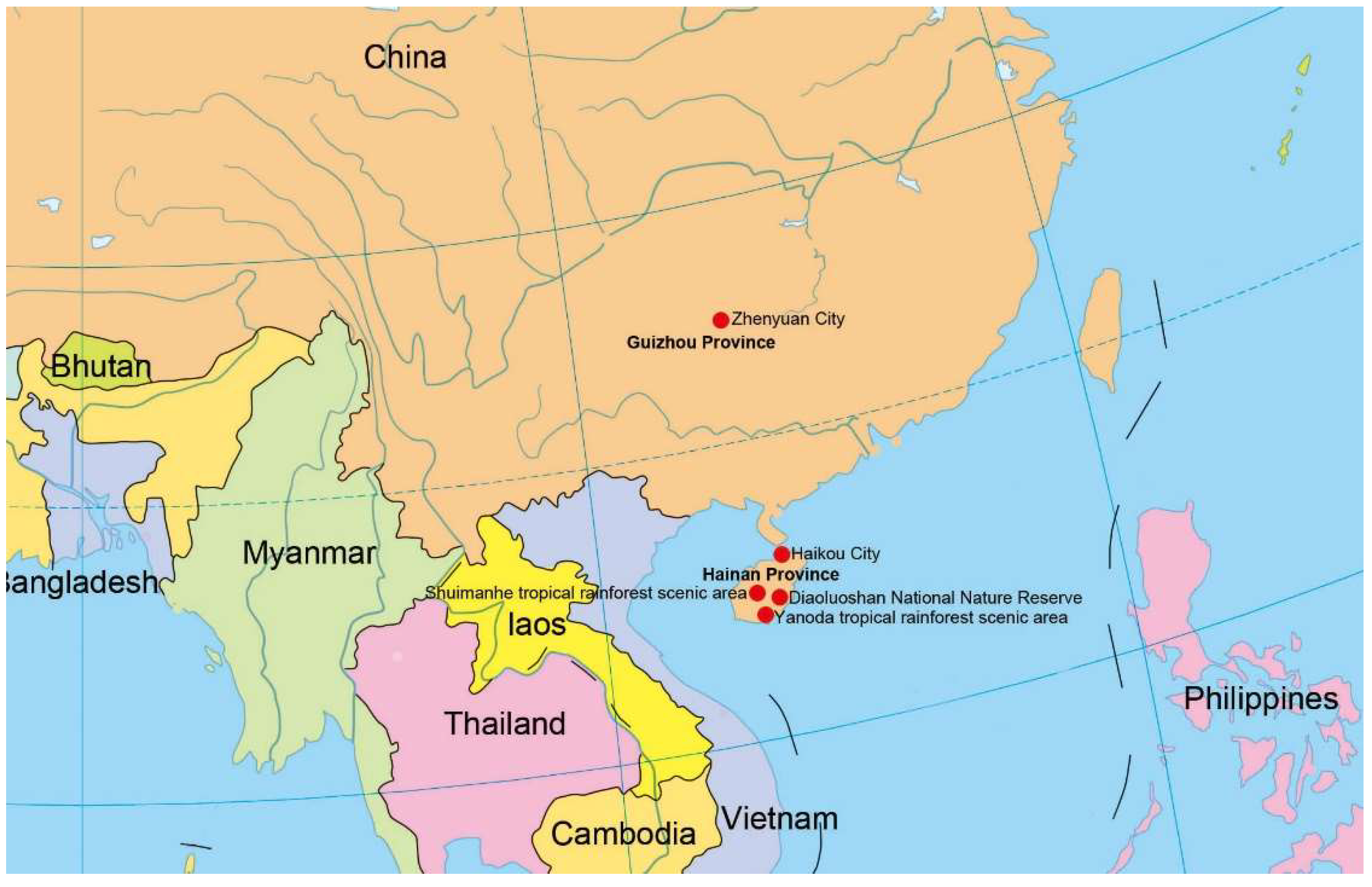
Fresh specimens of decaying wood were randomly collected from freshwater and terrestrial habitats in Hainan and Guizhou Province, China (Figure 1). Samples were brought back to the laboratory in plastic bags with the collection details including localities and dates. Samples were incubated at room temperature in ziplock bags or sterile moist plastic boxes for about two weeks. Colonies on decaying wood surface were examined, observed, and photographed for their appearance with stereomicroscopes (SMZ 745 and SMZ 800N, Nikon, Tokyo, Japan) from low (0.75 times) to high (5 times) magnification. Fresh colonies were picked with sterile needles at a stereomicroscope magnification of 5 times and placed on a slide with a small amount of distilled water, and then placed under a Nikon EOS 90D digital camera attached to ECLIPSE Ni compound microscope (Nikon, Tokyo, Japan) for microscopic morphological characteristics. The dimensions of conidiophores, conidiogenous cells, and conidia were measured using Tarosoft (R) Image Frame Workprogram. In the species descriptions, arithmetic means as “”, and “n” stand for the number of measured elements. Photoplates were processed with Adobe PhotoShop CC 2019 (Adobe Systems, San Jose, CA, USA).
Figure 1.
Collecting sites in this study (red dots).
Single spore isolations were performed on water agar (WA) and germinated conidia were aseptically transferred to fresh potato dextrose agar (PDA) following the method of Senanayake et al. [30]. Cultures were grown on PDA and incubated in an incubator at 25 °C for 5 weeks and morphological characters, including color, shape, and size were recorded. The dried specimens were deposited at the Herbarium of Kunming Institute of Botany, Chinese Academy of Sciences (HKAS), Kunming, China, and the Herbarium of Guizhou Academy of Agriculture Sciences (GZAAS), Guiyang, China. Cultures were deposited in Guizhou Culture Collection, China (GZCC). Index Fungorum and Faces of Fungi numbers were acquired by the guideline in Jayasiri et al. [31] and Index Fungorum (2022) [32].
2.2. DNA Extraction, PCR Amplification, and Sequencing
Fresh fungal mycelia were scraped with sterilized toothpicks and transferred to 1.5 mL microcentrifuge tubes. Genomic DNA was extracted using the Biospin Fungus Genomic DNA Extraction Kit (BioFlux, Shanghai, China), following the manufacturer’s protocol. The primer pairs of LR0R/LR5, ITS5/ITS4, 983F/2218R, and frpb2-5f/frpb2-7cr were used to amplify the large subunit ribosomal DNA (LSU) [33], the internal transcribed spacer (ITS) [34], the translation elongation factor 1 alpha (tef1α) [35] and the RNA polymerase II second largest subunit (rpb2) gene regions [36], respectively. The amplification reactions were completed in a 50 μL reaction volume, including 2 μL DNA template, 2 μL of each forward and reverse primers, and 44 μL of 1.1 × T3 Supper PCR Mix (Qingke Biotech, Chongqing, China). Amplification reactions were carried out as follows (Table 1).
Table 1.
PCR protocols.
The quality of PCR amplification products was verified on 1% agarose electrophoresis gels stained with ethidium bromide. Purification and sequencing of PCR products were completed at Beijing Tsingke Biological Engineering Technology and Services Co., Ltd. (Beijing, China).
2.3. Phylogenetic Analyses
Original sequences were checked using BioEdit v 7.0.5.3 [37]. Forward and reverse sequences were assembled using SeqMan v. 7.0.0 (DNASTAR, Madison, WI, USA). The taxa used in this study were selected based on the closest matches from BLASTn search results (https://blast.ncbi.nlm.nih.gov/Blast.cgi, accessed on 15 October 2022), and from previous studies (Table 2) [7,12,28]. Sequence alignments for each locus were performed using the online multiple alignment program MAFFT version 7 (https://mafft.cbrc.jp/alignment/server/, accessed on 20 October 2022) [37,38], and auto-adjusted by trimAl tool [39]. A phylogenetic tree, which infers a phylogenetic relationship, was reconstructed based on a concatenated LSU, ITS, tef1α, and rpb2 dataset using the online CIPRES Science Gateway (https://www.phylo.org/portal2/home.action, accessed on 29 October 2022) and analyzed using Maximum Likelihood (ML), Maximum Parsimony (MP) and Bayesian Inference (BI).
Table 2.
Taxa used in this study and the GenBank accession numbers of DNA sequences.
The “ALTER” (http://www.sing-group.org/ALTER/, accessed on 29 October 2022) website was used to convert the aligned fasta file to the phylip format for ML analyses [40]. ML analyses were performed through the CIPRES science Gateway V. 3.3 (https://www.phylo.org/portal2/home.action, accessed on 29 October 2022) [41]. The ML analysis was carried out using the RAxML-HPC v.8 on XSEDE (8.2.12) tool using a GTRGAMMA approximation with rapid bootstrap analysis followed by 1000 bootstrap replicates [42]. Maximum Parsimony (MP) analysis was carried out by using PAUP on XSEDE (4.a168) online website [43]. The 1000 random taxa were added for a heuristic search to infer MP trees. The value of MaxTrees, which collapsed branches of zero length and saved all multiple parsimonious trees, was set to 5000. Parsimony score values of tree length (TL), consistency index (CI), retention index (RI), and homoplasy index (HI) were calculated for trees generated under different optimum criteria. Clade stability was estimated using a bootstrap analysis with 1000 replicates, and the taxa was added for the random stepwise of each with 10 replicates [44].
The aligned fasta file was converted to the nexus format file for BI analysis by using AliView v. 1.27 [40]. Bayesian Inference (BI) analyses were performed by using MrBayes on XSEDE (3.2.7a) via CIPRES [42]. The best-fit evolutionary model for the individual and combined datasets was determined using MrModeltest v. 2.3. 10 [45]. GTR + G + I substitution model was selected for LSU, ITS, tef1α, and rpb2. The posterior probabilities (PP) were determined based on Bayesian Markov chain Monte Carlo (BMCMC) sampling [46]. Four simultaneous Markov chains were run for 10,000,000 generations, and trees were sampled every 1000th generation (resulting in 10,000 trees). The first 2500 trees, which represented the burn-in phase of the analysis, were discarded. The posterior probabilities (PP) in the majority rule consensus tree were calculated by the remaining 7500 trees.
Phylogenetic trees were visualized with FigTree v. 1.4.4. Adobe PhotoShop CC 2019 (Adobe Systems, San Jose, CA, USA) and Adobe Illustrator CC 2019v. 23.1.0 (Adobe Systems, San Jose, CA, USA) were used to edit trees and figures layout. Sequences generated in this study were deposited in GenBank (Table 2).
3. Phylogenetic Results
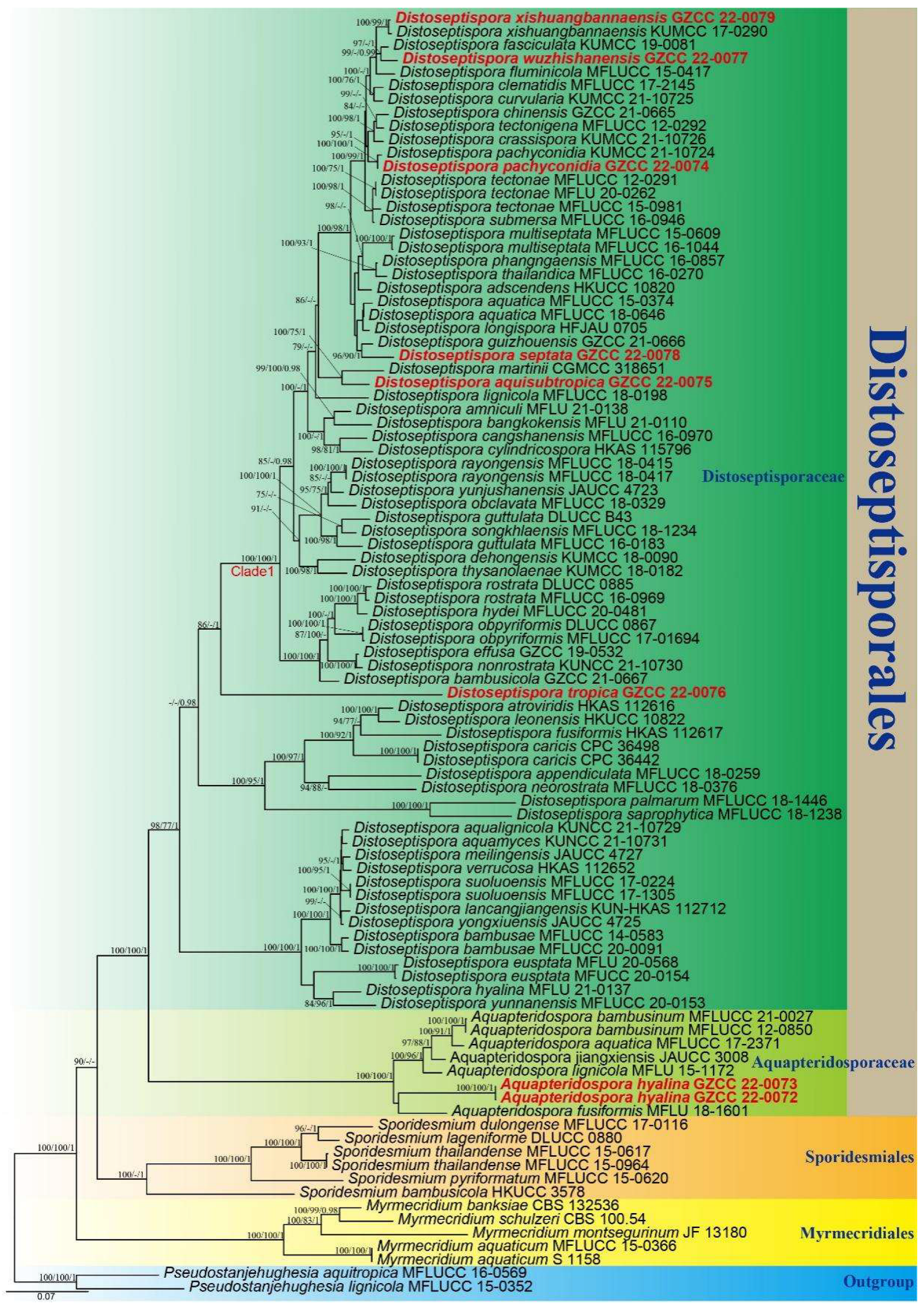
Using partial nucleotide sequences from four genes, the phylogenetic placements of our new collections were determined. The concatenated sequence matrix comprised LSU (1–855 bp), ITS (856–1448 bp), tef1α (1449–2367 bp), and rpb2 (2368–3420 bp) with a total of 3420 characters for 93 taxa and two outgroups (Pseudostanjehughesia aquitropica MFLUCC 16-0569 and Ps. lignicola MFLUCC 15-0352) [7,12,16,47,48,49,50]. Four gene analyses were conducted to compare the respective topologies and clade stabilities. There were 1733 distinct alignment patterns in the matrix, along with 31.09% undetermined characters or gaps. The ML, MP, and BI analyses of the concatenated LSU, ITS, tef1α, and rpb2 dataset yielded similar tree topologies, and Figure 2 depicts the final likelihood value of the ML analysis.
Figure 2.
Phylogenetic tree generated from maximum likelihood (ML) analysis based on a combined of LSU, ITS, tef1α, and rpb2 sequence data. Bootstrap support values of maximum likelihood (ML) and Maximum Parsimony (MP) equal to or greater than 75%, and Bayesian posterior probabilities (PP) equal to or greater than 0.95 are given near the nodes as ML/MP/PP. T Pseudostanjehughesia aquitropica (MFLUCC 16-0569) and Ps. lignicola (MFLUCC 15-0352) were used as outgroup taxa. The newly generated sequences are indicated in red bold.
The phylogenetic tree (Figure 2) demonstrates that our eight collections represent seven species within Distoseptisporales. Two isolates (GZCC 22-0072 and GZCC 22-0073) represent the new species Aquapteridospora hyalina which forms a distinct clade from other taxa of Aquapteridospora with strong support. Distoseptispora aquisubtropica and D. martinii are distinguished by their distinct conidial characteristics. Distoseptispora septata forms a sister lineage to D. guizhouensis with well support (96% ML/90% MP/1 PP). Distoseptispora tropica (GZCC 22-0076) is a significantly distinct lineage from other taxa (Figure 2). Distoseptispora wuzhishanensis forms a sister lineage to D. fasciculata with well support (97% ML/1 PP). Our isolate GZCC 22-0079 is recognized as D. xishuangbannaensis and GZCC 22-0074 as D. pachyconidia, and their molecular data are provided, respectively.
4. Taxonomy
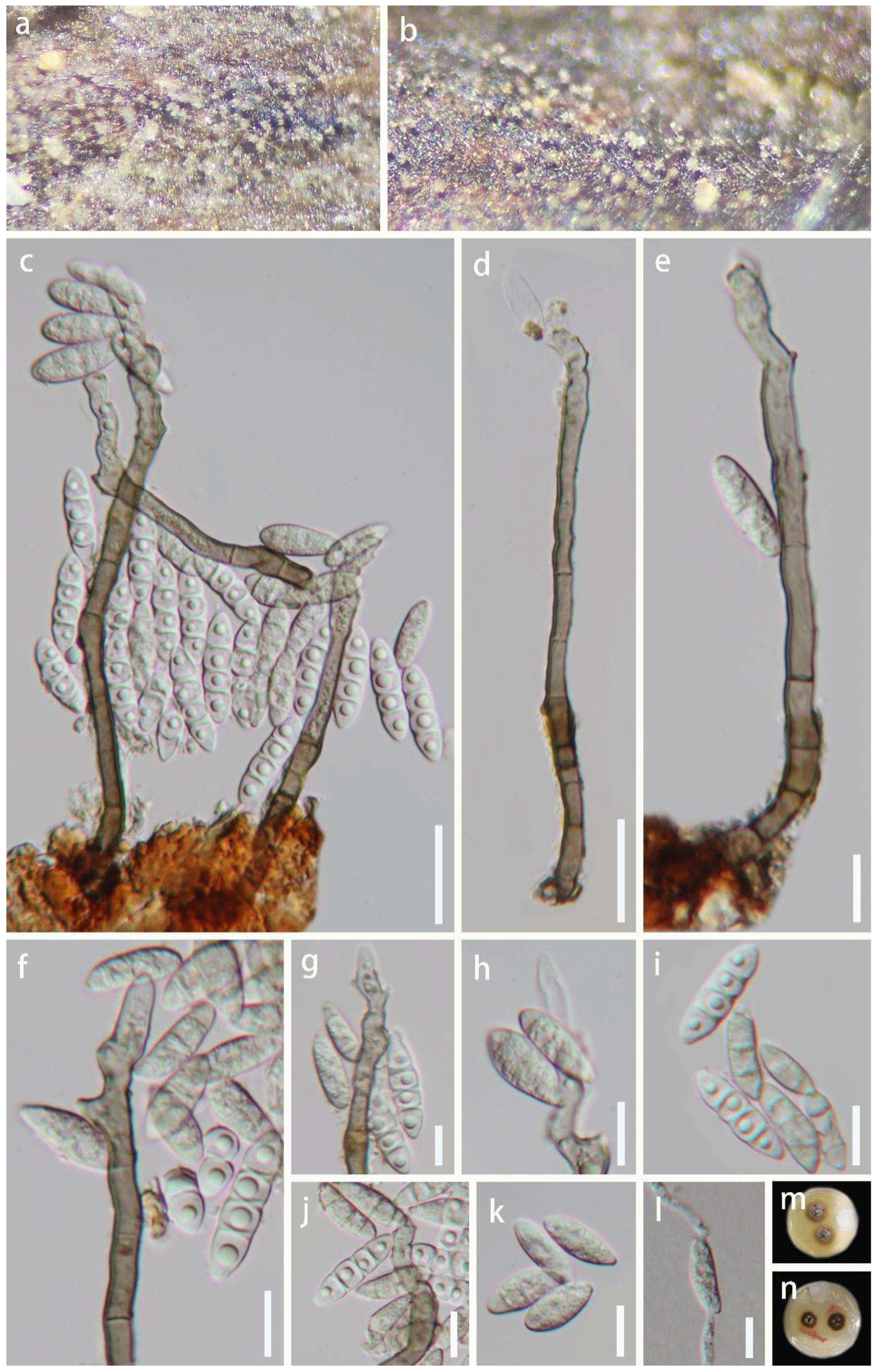
Aquapteridospora hyalina J. Ma and Y.Z. Lu., sp. nov., Figure 3.
Figure 3.
Aquapteridospora hyalina (HKAS 123764, holotype). (a,b) Colonies on the host surface. (c–e) Conidiophores, conidiogenous cells with attached conidia. (f–h) Conidiogenous cells bearing conidia. (i–k) Conidia. (l) Germinated conidium. (m,n) Colonies on PDA, m from above, n from below. Scale bars: (e–l) 20 μm, (c,d) 10 μm.
Index Fungorum number: IF559932; Facesoffungi number: FoF11002.
Etymology: The epithet ‘hyalina’ referring to the colourless conidia.
Holotype: HKAS 123764.
Saprobic on decaying wood in a freshwater habitat. Sexual morph: Undetermined. Asexual morph: Colonies on the natural substrate, effuse, solitary, hyaline. Mycelium mostly superficial, consisting of branched, septate, smooth, pale brown to brown hyphae. Conidiophores 68–130 × 4.5–6.5 μm ( = 91 × 5.5 μm, n = 30), macronematous, mononematous, solitary, erect, simple, straight, or slightly flexuous, unbranched, smooth, cylindrical, 3–7-septate, thick-walled, smooth-walled, brown at the base, subhyaline to pale brown towards apex. Conidiogenous cells 25–62 × 4–6.5 μm ( = 44 × 5 μm, n = 30), polyblastic, monoblastic, smooth-walled, terminal, sub-cylindrical or gradually tapering towards tip, sub-hyaline to pale brown, forming conidia sympodially on conspicuous denticles, bearing tiny, protuberant, circular scars. Conidia 17–28 × 4–6 μm ( = 20 × 5.5 μm, n = 50) acropleurogenous, solitary, fusiform, 1–3-septate, truncate obtuse at septum, hyaline when young, sub-hyaline to pale brown when mature, tapering and pointed at both ends, smooth-walled, often with single guttulate in each cell when young.
Culture characteristics: Conidia were germinated on water agar and produced germ tubes within 10 h. Colonies grown on PDA, circular, flat, reaching 18 mm diam. after 25 days of incubation at 25 °C, lightly gray at the entire margin, brown in the center, reverse-side pale brown or brown at the entire margin, pale grey in the center.
Material examined: China, Hainan Province, Baoting County, Sandao Town, Yanoda Rainforest cultural tourism area, 18°46′ N, 109°65′ E, on rotting wood in a freshwater stream, 23 October 2021, Jian Ma, Y6 (HKAS 123764, holotype; GZAAS 22-0077, isotype), ex-type living culture GZCC 22-0072; idem, Y10-1 (HKAS 123763), living culture GZCC 22-0073.
Notes: The proposed new species Aquapteridospora hyalina shares similar characteristics with other species of the genus Aquapteridospora in having macronematous, mononematous, unbranched, polyblastic conidiophores, sympodial proliferations conidiogenous cells, and fusiform and acropleurogenous conidia [4]. However, A. hyalina differs from all species of Aquapteridospora in having hyaline to pale brown conidia with distinguished guttulae in each cell when young. The phylogenetic analyses confirmed that the two strains (GZCC 22-0072 and GZCC 22-0073) of A. hyalina form a distinct clade sister to A. fusiformis within Aquapteridosporaceae (Figure 2). Therefore, based on the morphological evidence with multi-gene phylogenetic results, a new species A. hyalina is introduced.
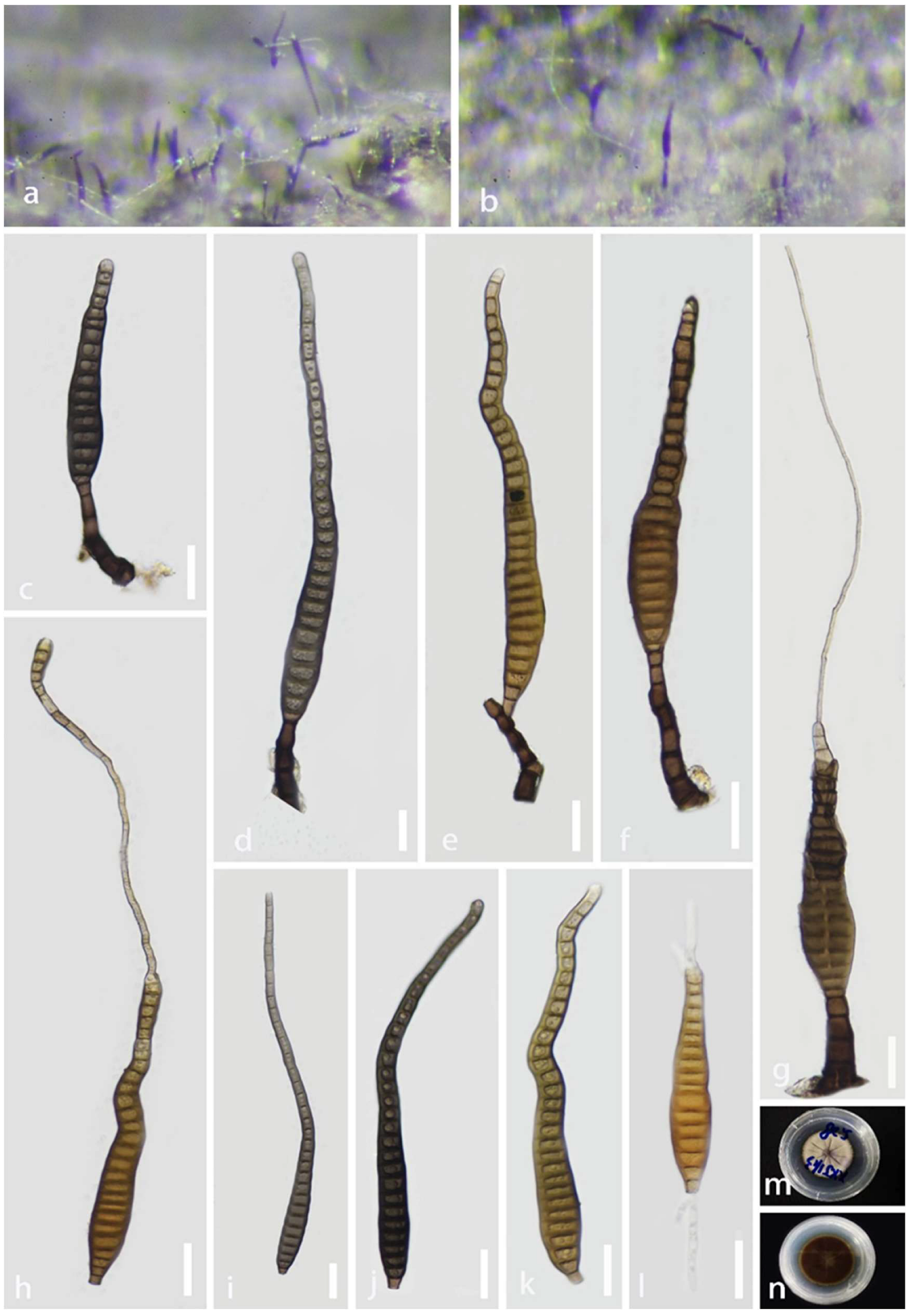
Distoseptispora aquisubtropica J. Ma and Y.Z. Lu, sp. nov., Figure 4.
Figure 4.
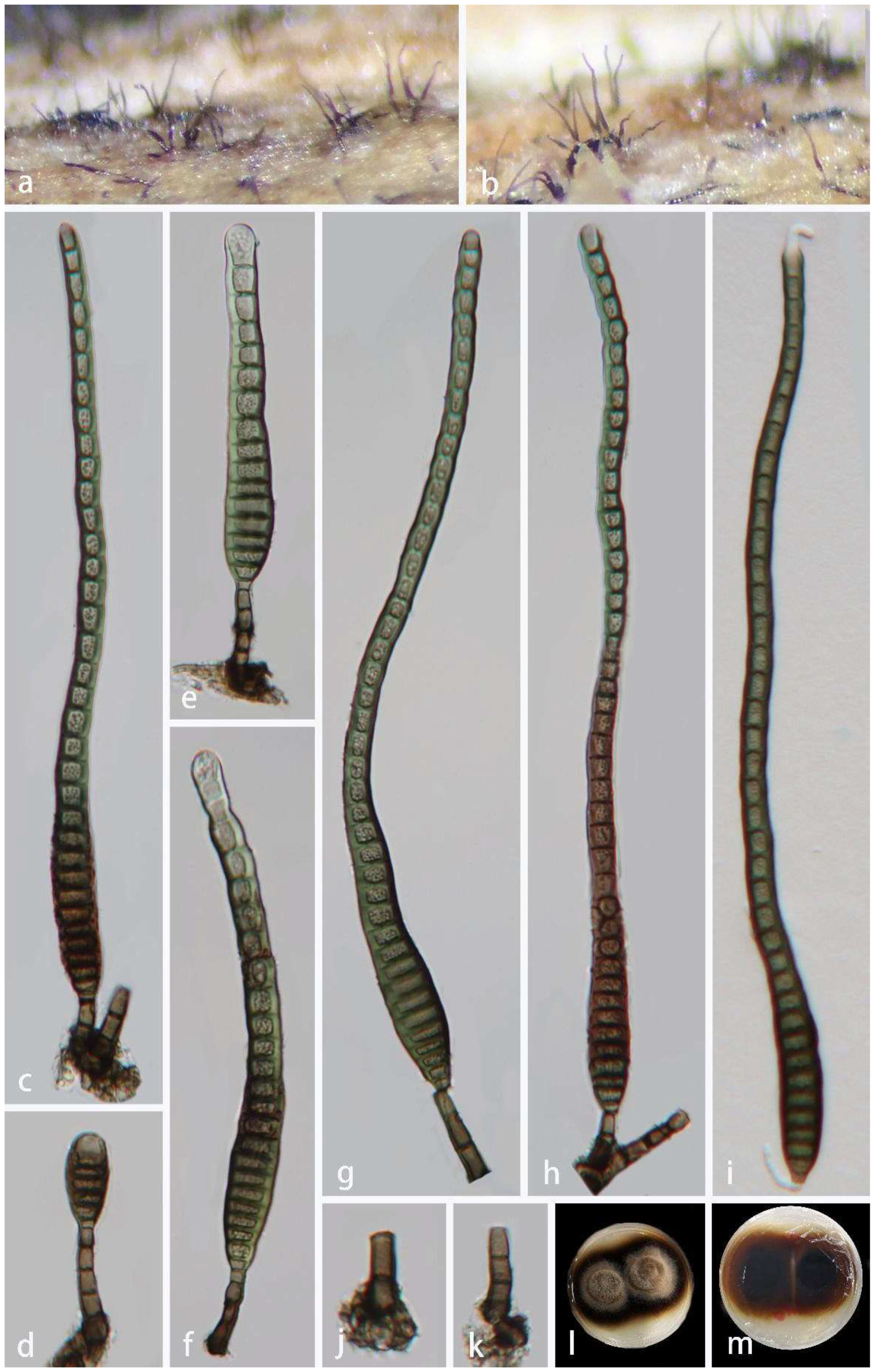
Distoseptispora aquisubtropica (GZAAS 22-0080, holotype). (a,b) Colonies on the host surface. (c–g) Conidiophores and conidiogenous cells bearing conidia. (h–k) Conidia. (l) Germinating conidium. (m,n) Colonies on PDA, m from above, n from below. Scale bars: (c–l) 20 μm.
Index Fungorum number: IF559686; Facesoffungi number: FoF11334.
Etymology: ‘aquisubtropica’ is derived from subtropical, which means climate type and ‘aqui’ refers to its presence in aquatic habitat.
Holotype: HKAS 124023.
Saprobic on decaying wood submerged in a freshwater habitat. Sexual morph: Undetermined. Asexual morph: hyphomycetous. Colonies on natural substrate superficial, effuse, gregarious, smooth, septate, hairy, brown, or dark brown. Mycelium mostly immersed, composed of branched, septate, smooth, pale brown to brown hyphae. Conidiophores 16–83 × 5–11 μm (= 51 × 8 μm, n = 25), macronematous, mononematous, cylindrical, erect, simple, straight, or slightly flexuous, unbranched, smooth, thick-walled, solitary, brown at the base, pale brown or sub-hyaline towards the apex, 2–5-septate. Conidiogenous cells 3–11 × 3–7 μm ( = 6 × 5.5 μm, n = 25), holoblastic, monoblastic, terminal, integrated, cylindrical, pale brown or brown, smooth. Conidia 43–278 × 11–19 μm (= 141 × 14.5 μm, n = 38), acrogenous, solitary, multi-distoseptate, obclavate or lanceolate, rostrate, straight or slightly curved, verrucose, guttulate, thick-walled, smooth-walled, pale brown or dark brown, olivaceous, 16–31-distoseptate, usually paler towards apex, sometimes have conspicuous hyphae attached to the conidium, rounded at apex, with a truncate base.
Culture characteristics: Conidia were germinated on water agar and produced germ tubes within 10 h. Colonies grown on PDA, circular, flat, dense, dark gray, fluffy, reaching 34 mm diam. after 25 days of incubation at 25 °C, break in the center, from below olivaceous to brown at the center, pale yellow at the entire margin.
Material examined: China, Guizhou Province, Zhenyuan County, 27°05′ N, 108°41′ E, on decaying wood submerged from a freshwater stream, 1 May 2021, Jian Ma, XXJ11-3 (HKAS 124023, holotype; GZAAS 22-0080, isotype), ex-type living culture GZCC 22-0075.
Notes: According to a BLASTn search on NCBI GenBank, the ITS and LSU sequences of the new isolate (Distoseptispora aquisubtropica) share 92.95% similarity across 85% of the query sequence coverage and 99.6% similarity across 86% of the query sequence coverage with D. martini, respectively. The phylogenetic results indicate that D. aquisubtropica forms a sister clade to D. martinii with well-supported values (100% ML/75% MP/1 PP). The morphological features of D. aquisubtropica are compatible with the Distoseptispora generic concept, while D. martini resembles Acrodictys rather than Distoseptospora [13]. Distoseptospora aquisubtropica can be distinguished from D. martini by its obclavate or lanceolate conidia, while the latter is oblate or subglobose [13]. Based on a pairwise comparison of ITS and LSU nucleotides, D. aquisubtropica differs from D. martinii in 24/453 bp (5.3%) for ITS and 5/515 bp (0.97%) for LSU, respectively. Therefore, we identified D. aquisubtropica as a novel species, according to the species delimitation guidelines proposed by Chethana et al. and Maharachchikumbura et al. [51,52].
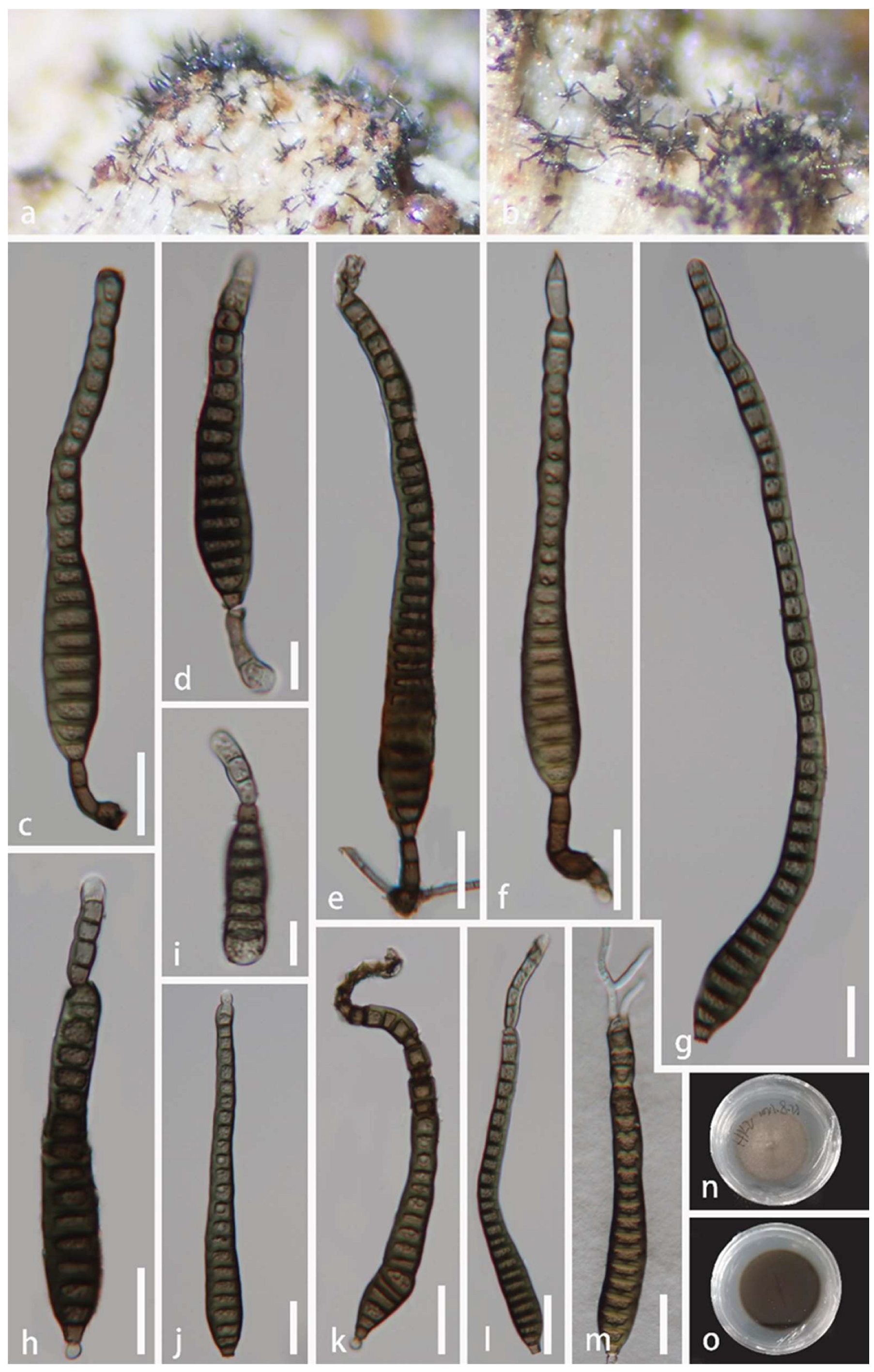
Distoseptispora pachyconidia R. Zhu and H. Zhang. Journal of Fungi 30: 22 (2022). Figure 5.
Figure 5.
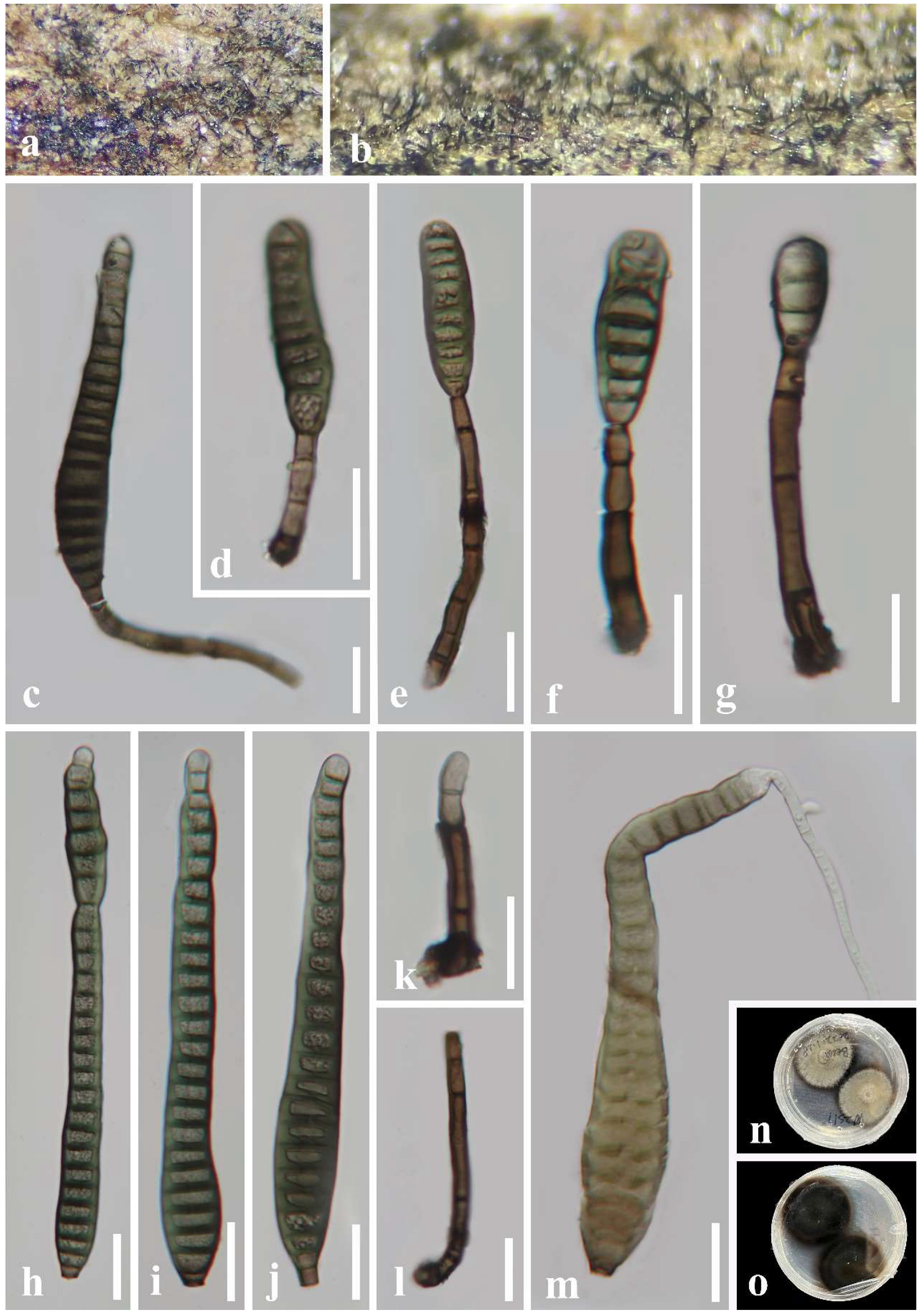
Distoseptispora pachyconidia (HKAS 123754). (a,b) Colonies on the host surface. (c–f) Conidiophores and conidiogenous cells bearing conidia. (g–l) Conidia. (m) Germinating conidium. (n,o) Colonies on PDA, n from above, o from reverse. Scale bars: (c,e–h,j–m) 20 μm, (d,i) 10 μm.
Index Fungorum Number: IF559924; Facesoffungi number: FoF12581.
Saprobic on decaying wood in terrestrial habitats. Sexual morph: Undetermined. Asexual morph: Colonies effuse, gregarious, brown, or dark brown, hairy. Mycelium immersed and partly superficial, consisting of branched, septate, smooth, pale brown to brown hyphae. Conidiophores 14–44 × 4–7 μm ( = 26 × 5 μm, n = 20), macronematous, mononematous, brown to dark brown, solitary, 2–4-septate, erect, straight, or flexuous, unbranched, smooth, cylindrical, singly or in groups, truncate at the apex, slightly constricted at septa. Conidiogenous cells 4–9 × 4–5.5 μm ( = 6 × 4.5 μm, n = 20), holoblastic, monoblastic, integrated, terminal, determinate, pale brown to brown, smooth, cylindrical. Conidia 50–242 × 11–20 μm ( = 111 × 13 μm, n = 30) acrogenous, solitary, obclavate, rostrate, smooth-walled, straight or slightly curved, up to 38-distoseptate, guttulate, olivaceous to dark brown, mostly slightly constricted at septa, tapering towards the rounded apex, truncate at the base.
Culture characteristics: Conidia were germinated on water agar and produced germ tubes within 10 h. Colonies grown on PDA, circular, mycelium flat, dense, reaching 40 mm diam. after 30 days of incubation at 25 °C, gray or brown, reverse-side dark brown.
Material examined: China, Hainan Province, Haikou City, Xiuying District, Ecological leisure trail, on decaying wood on the ground, 20°01′ N, 110°25′ E, 10 August 2021, Jian Ma, HK2 (HKAS 123754), living culture GZCC 22-0074.
Notes: Zhang et al. [16] introduced Distoseptispora pachyconidia from decaying wood in Yunnan Province, China. Analyses of multi-gene revealed that the new isolate GZCC 22-0074 clustered with D. pachyconidia. The morphological characteristics of this isolate are similar to the protologue of D. pachyconidia. However, GZCC 22-0074 differs from D. pachyconidia in having different colors of conidia (olivaceous to dark brown vs. pale-brown with a green tinge) and the number of conidial septa (up to 38 vs. 8–21-distoseptate) [16]. According to a pairwise nucleotide comparison of ITS, LSU, tef1α and rpb2, our isolate differs from the type strain of D. pachyconidia (HKAS 122179) in 1/520 bp (0.2%) for ITS, 1/852 bp (0.1%) for LSU, 1/913 bp (0.1%) for tef1α and 0/1052 bp (0%) for rpb2, respectively. Thus, the phylogenetic evidence did not show significant differences between them (Figure 2). We therefore identified the new isolate as D. pachyconidia.
Distoseptispora septata J. Ma and Y.Z. Lu, sp. nov., Figure 6.
Figure 6.
Distoseptispora septata (HKAS 123759, holotype). (a,b) Colonies on the host surface. (c–g) Conidiophores and conidiogenous cells bearing conidia. (h–j) Conidia. (k,l) Conidiophores and conidiogenous cells. (m) Germinating conidium. (n,o) Colonies on PDA, n from above, o from reverse. Scale bars: (c–m) 20 μm.
Index Fungorum number: IF559688; Facesoffungi number: FoF11337.
Etymology: ‘septata’ referring to ‘septate’ conidia.
Holotype: HKAS 123759.
Saprobic on decaying wood submerged in a freshwater habitat. Sexual morph: Undetermined. Asexual morph: hyphomycetous. Colonies on natural substrate superficial, effuse, gregarious, smooth, septate, hairy, brown, or dark brown. Mycelium mostly immersed, composed of branched, septate, smooth, pale brown to brown hyphae. Conidiophores 23–86 × 3–7 μm ( = 44 × 5.5 μm, n = 30), macronematous, mononematous, cylindrical, erect, simple, mostly flexuous, unbranched, smooth, thick-walled, solitary, brown, 1–6-septate. Conidiogenous cells 5–18 × 4–6 μm ( = 9 × 5 μm, n = 30), holoblastic, monoblastic, terminal, integrated, cylindrical, pale brown or brown, smooth. Conidia 22–179 × 10–16 μm ( = 89 × 13 μm, n = 35), acrogenous, solitary, multi-distoseptate and up to 25-septate, obclavate, rostrate, straight or slightly curved, verrucose, guttulate, thick-walled, smooth-walled, pale brown or dark brown, olivaceous-green, usually paler towards apex, rounded at apex, with a truncate base.
Culture characteristics: Conidia were germinated on water agar and produced germ tubes within 10 h. Colonies grown on PDA, circular, flat, dense, fluffy, reaching 35 mm diam. after 25 days of incubation at 25 °C, olivaceous-green, paler brown and dark brown, reverse-side dark brown.
Material examined: China, Hainan Province, Wuzhishan City, Shui Man Town, Wuzhishan National Nature Reserve, 18°92′ N, 109°63′ E, on dead wood in a freshwater stream, 26 December 2021, Xia Tang, W17 (HKAS 123759, holotype; GZAAS 22-0083, isotype), ex-type living culture GZCC 22-0078.
Notes: Distoseptispora septata shares a sister relationship to D. guizhouensis with strong support (96% ML/90% MP/1 PP). However, D. septata differs from D. guizhouensis in having smaller conidia (22–179 × 10–16 μm vs. 90–273 × 15–21 μm). Particularly, D. guizhouensis is distinguished from D. septata by distinctly flexuous conidiophores. Based on a pairwise comparison of ITS nucleotides, D. septata differs from D. guizhouensis by 13/535 bp (2.4%). Following the guidelines for defining species boundaries of Chethana et al. and Pem et al. [51,53], we therefore introduce GZCC 22-0078 as a new species.
Distoseptispora tropica J. Ma and Y.Z. Lu, sp. nov., Figure 7.
Figure 7.
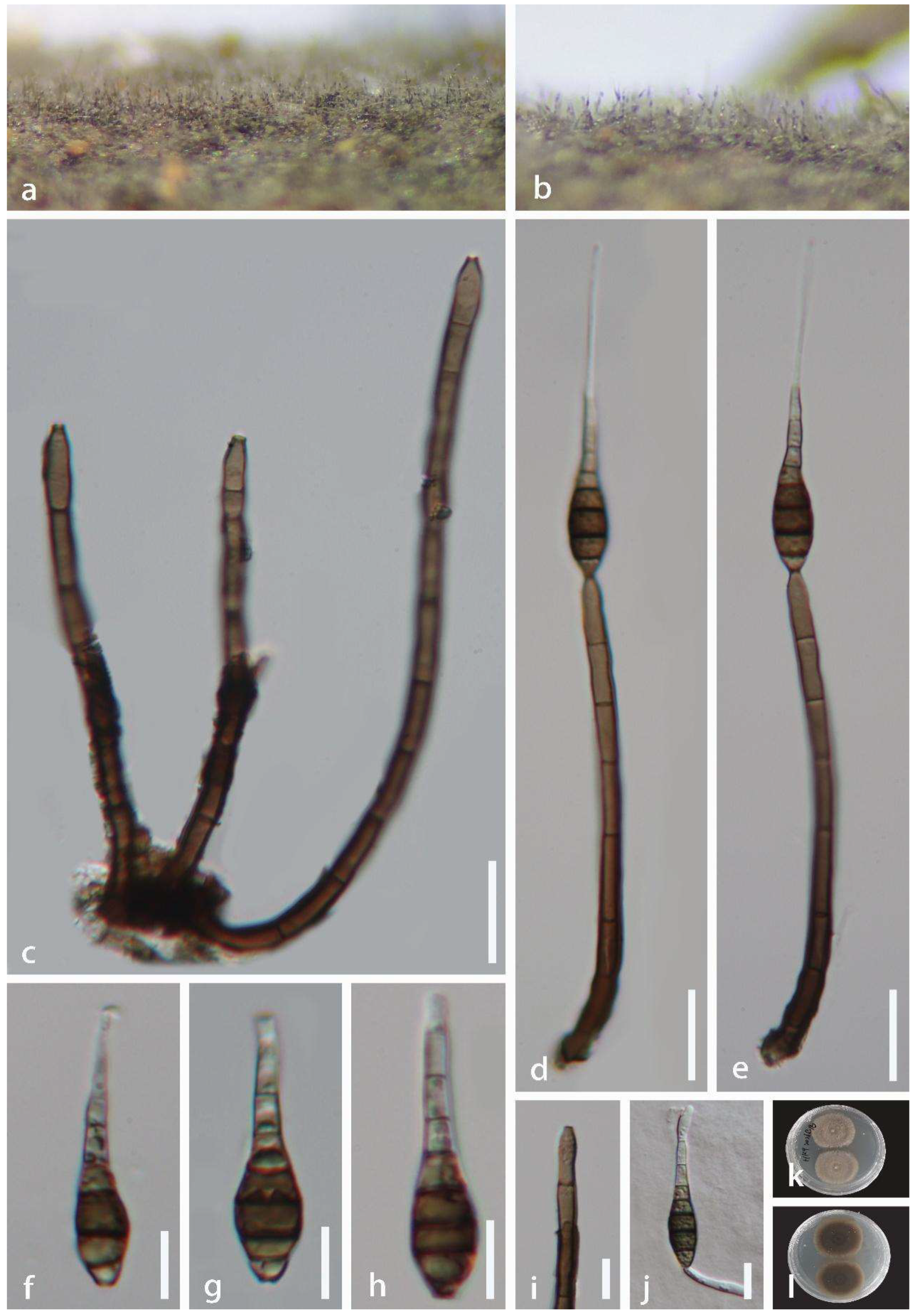
Distoseptispora tropica (HKAS 123761, holotype). (a,b) Colonies on the host surface. (c) Conidiophores and conidiogenous cells. (d,e) Conidiophores with attached conidia. (f–h) Conidia. (i) Conidiogenous cell. (j) Germinating conidium. (k,l) Colonies on PDA, k from above, l from reverse. Scale bars: (c–e) 20 μm, (f–j) 10 μm.
Index Fungorum number: IF559689; Facesoffungi number: FoF11335.
Etymology: ‘tropica’ derived from the climate in which the species was discovered.
Holotype: HKAS 123761.
Saprobic on dead wood, in terrestrial habitat. Sexual morph: Undetermined. Asexual morph: hyphomycetous. Colonies on dead wood, effuse, scattered or in small groups, gregarious, hairy, smooth, brown, or dark brown. Mycelium mostly immersed, composed of branched, septate, smooth, brown to dark brown. Conidiophores 60–151 × 3.5–7 μm ( = 94 × 5 μm, n = 20), macronematous, mononematous, cylindrical, erect, straight, or slightly flexuous, unbranched, smooth, thick-walled, dark brown, solitary or caespitose, dark brown and rounded at the apex, paler brown at the upper part, 5–7 septate. Conidiogenous cells 10–21 × 3.5–6 μm ( = 159 × 5 μm, n = 20), holoblastic, monoblastic, terminal, integrated, cylindrical, pale brown or brown, smooth. Conidia 39–75 × 7.5–10.5 μm ( = 47 × 8 μm, n = 30), acrogenous, verrucose, solitary, multi-distoseptate, obclavate, rostrate, upper part tapering towards the apex, guttulate, thick-walled, smooth, olivaceous brown or dark brown, 5–7 distoseptate, with conspicuous hyphae attachment conidium, with a truncate base.
Culture characteristics: Conidia were germinated on water agar and produced germ tubes within 10 h. Colonies grown on PDA, circular, flat, dense, fluffy, reaching 40 mm diam. after 40 days of incubation at 25 °C, grayish brown mycelium on the surface, reverse-side dark brown.
Material examined: China, Hainan Province, Haikou City, Xiuying District, Ecological leisure trail, 20°01′ N, 110°25′ E, on decaying wood in terrestrial habitat, 10 August 2021, Jian Ma, HK9 (HKAS 123761, holotype; GZAAS 22-0081, isotype), ex-type living culture GZCC 22-0076.
Notes: Distoseptispora tropica shares an extremely similar morphology with the species of Distoseptispora, Ellisembia, and Sporidesmium [7,9,54]. However, phylogenetic analysis (Figure 2) indicates that D. tropica belongs to Distoseptispora. Distoseptispora tropica forms a distinct lineage basal to Clade 1 with strong support (100% ML/100% MP/1 PP). However, D. tropica differs from other taxa in Clade 1 in having longer conidiophores and smaller conidia.
Distoseptispora wuzhishanensis J. Ma and Y.Z. Lu, sp. nov., Figure 8.
Figure 8.
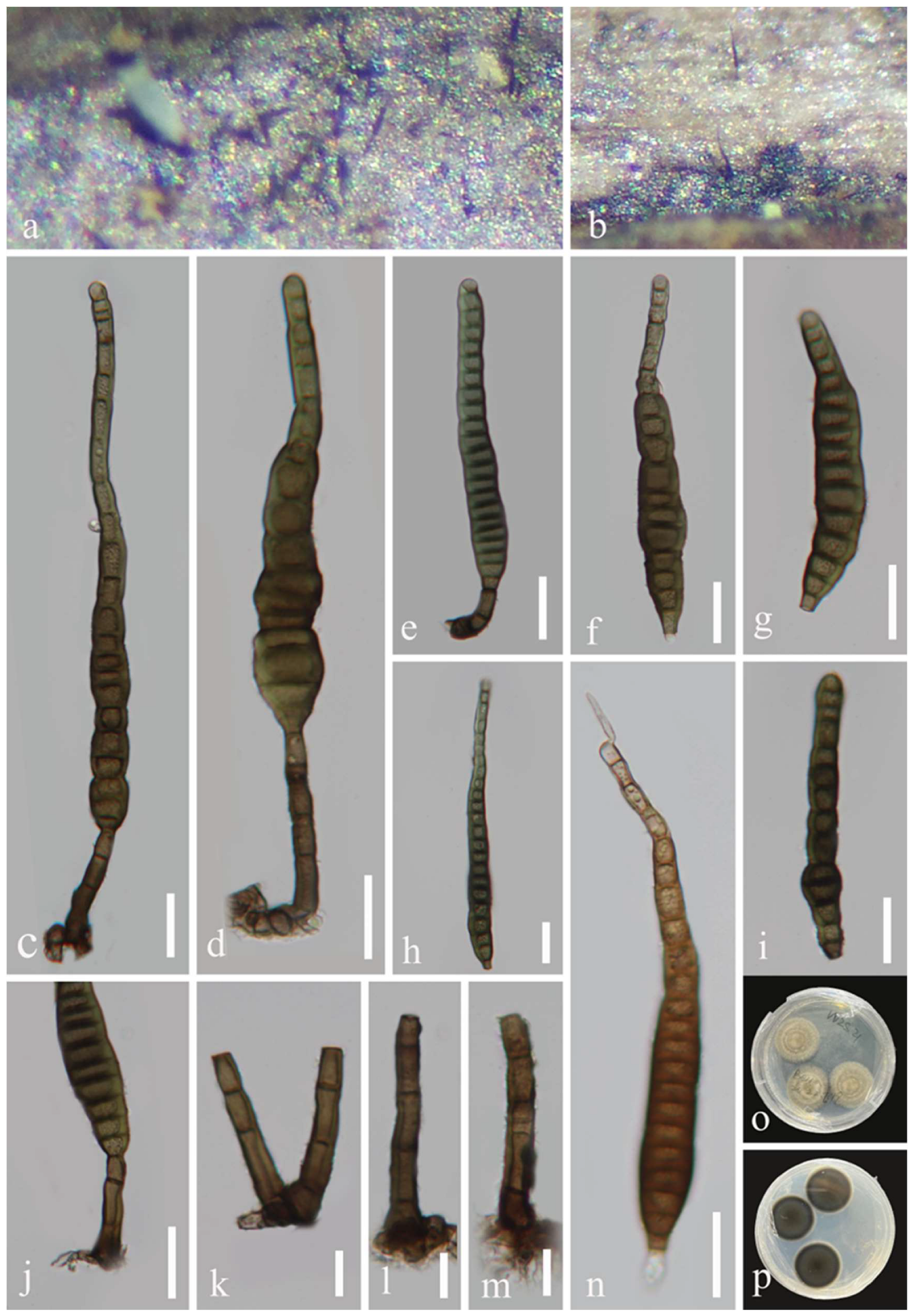
Distoseptispora wuzhishanensis (HKAS 123762, holotype). (a,b) Colonies on the host surface. (c–e) Conidiophores and conidia. (f–i) Conidia. (j–m) Conidiophores and conidiogenous cells. (n) Germinating conidium. (o,p) Colonies on PDA, o from above, p from reverse. Scale bars: (c–j,n) 20 μm, (k–m) 10 μm.
Index Fungorum number: IF559706; Facesoffungi number: FoF11336.
Etymology: ‘wuzhishanensis’ derived from the city where the species was discovered.
Holotype: HKAS 123762.
Saprobic on decaying wood in a freshwater habitat. Sexual morph: Undetermined. Asexual morph: hyphomycetous. Colonies on substrate superficial, effuse, solitary, smooth, septate, hairy, brown, or dark brown. Mycelium mostly immersed, composed of branched, septate, smooth, pale brown to brown hyphae. Conidiophores 16–56 × 5–7 μm ( = 35 × 6 μm, n = 25), macronematous, mononematous, cylindrical, erect, scattered or in small groups, straight or slightly flexuous, unbranched, smooth, thick-walled, brown at the base, pale brown towards the apex, 1–4 septate. Conidiogenous cells 6.5–10.5 × 4.5–6 μm ( = 8 × 5 μm, n = 25), holoblastic, monoblastic, terminal, integrated, cylindrical, pale brown or brown, smooth. Conidia 76–143 × 11–17 μm ( = 108 × 13.5 μm, n = 40), acrogenous, solitary, multi-distoseptate, obclavate, rostrate, straight, or slightly curved, verrucose, guttulate, thick-walled, smooth-walled, pale brown or dark brown, olivaceous-green and yellow, usually up to 22-distoseptate, strongly constricted at septa, usually paler towards apex, rounded at apex, with a truncate base.
Culture characteristics: Conidia were germinated on water agar and produced germ tubes within 10 h. Colonies grown on PDA, circular, flat, dense, fluffy, reaching 24 mm diam. after 25 days of incubation at 25 °C, olivaceous-green or brown mycelium on the surface, reverse side partly paler brown to dark brown.
Material examined: China, Hainan Province, Wuzhishan City, Shui Man Town, Wuzhishan National Nature Reserve, 18°92′ N, 109°63′ E, on dead wood in a freshwater stream, 26 December 2021, Xia Tang, W21 (HKAS 123762, holotype; GZAAS 22-0082, isotype), ex-type living culture GZCC 22-0077.
Notes: According to phylogenetic tree (Figure 2), Distoseptispora wuzhishanensis forms a close lineage to D. fasciculata with high bootstrap support (99% ML/0.99 PP). The morphological characteristics of the new taxon match well with the species concept of Distoseptispora in conidiophores and conidia. However, D. wuzhishanensis differs from D. fasciculata in having longer conidiophores (16–56 × 5–7 μm vs. 12–16 × 5–6 μm) [3].
Distoseptispora xishuangbannaensis Tibpromma and K.D. Hyde. Fungal Diversity 93: 82 (2018). Figure 9.
Figure 9.
Distoseptispora xishuangbannaensis (HKAS 123760). (a,b) Colonies on the host surface. (c–h) Conidiophores, conidiogenous cells with attached conidia. (i) Germinating conidium. (j,k) Conidiophores and conidiogenous cells. (l,m) Colonies on PDA, l from above, m from below. Scale bars: (c,k,e–i) 20 μm, (d,j) 10 μm.
Index Fungorum Number: IF554554; Facesoffungi number: FoF04563.
Saprobic on decaying wood, submerged in freshwater habitats. Sexual morph: Undetermined. Asexual morph: hyphomycetous. Colonies effuse, hairy, gregarious, olivaceous, or brown. Mycelium mostly immersed, composed of branched, smooth, septate, pale brown to brown hyphae. Conidiophores 19–52 × 5–7 μm ( = 29 × 6 μm, n = 20), macronematous, mononematous, unbranched, solitary, straight or slightly flexuous, brown at the base, pale brown towards the apex, slightly tapering distally, truncate at the apex, 1–4 septate. Conidiogenous cells 2–8.5 × 4.0–7 μm (= 6 × 5 μm, n = 20), blastic, holoblastic, monoblastic, terminal, integrated, cylindrical, pale brown. Conidia 88–269 × 11–15 μm ( = 165 × 13 μm, n = 30), solitary, acrogenous, cylindric-obclavate, rostrate, straight, or slightly curved, guttulate, thick-walled, smooth-walled, green-brown or brown, up to 42-distoseptate, usually paler olivaceous towards apex, rounded at apex, with a truncate base.
Culture characteristics: Conidia were germinated on water agar and produced germ tubes within 10 h. Colonies grown on PDA, circular, fluffy, reaching 36 mm diam. after 28 days of incubation at 25 °C, lightly grey in the center, olivaceous at the entire margin, reverse side pale brown and brown mycelium.
Material examined: China, Hainan Province, Lingshui Lizu Autonomous County, Diaoluoshan National Nature Reserve, 18°43′ N, 109°43′ E, on rotting wood in a freshwater habitat, 24 August 2021, Jian Ma, DL40 (HKAS 123760), living culture GZCC 22-0079.
Notes: Tibpromma et al. [20] introduced Distoseptispora xishuangbannaensis from dead leaf sheaths of Pandanus utilis in China. Analyses of multiple genes revealed that our new isolate (GZCC 22-0079) is closely related to D. xishuangbannaensis. Distoseptispora xishuangbannaensis possesses macronematous, straight or slightly flexuous conidiophores, holoblastic, monoblastic, brown conidiogenous cells, and acrogenous, cylindrical-obclavate conidia. The morphological characteristics of our isolate share similar characters with the holotype of D. xishuangbannaensis (HKAS 101809), but our isolate has longer and wider conidiophores (19–52 × 5–7 μm vs. 12–17 × 2–5 μm) and smaller conidia (88–269 × 11–15 μm vs. 160–305 × 8–15 μm) [20]. According to a pairwise nucleotide comparison of ITS, tef1α and rpb2, our new isolate differs from D. xishuangbannaensis in 5/498 bp (1%) for ITS, 3/898 bp (0.3%) for tef1α and 2/1052 bp (0.2%) for rpb2, respectively, and the phylogenetic result did not show significant differences between the new isolate and D. xishuangbannaensis (Figure 2). We therefore identified the new isolate as D. xishuangbannaensis.
5. Discussion
In recent years, studies on the number of saprotrophic fungi have received extensive attention [55,56]. For example, freshwater fungi occur in streams and other aquatic bodies [2,57], Calabon et al. [51] listed 3870 species, and numerous taxa are still being discovered [1]. Calabon et al. [51] listed 22 Distoseptispora species from freshwater and this study brings the total to 40 species. Analyses of morphological characteristics and molecular data indicate that eight collections, including five new species, namely A. hyalina, D. aquisubtropica, D. septata, D. tropica, and D. wuzhishanensis are introduced. Five Aquapteridospora epithets (A. lignicola, A. fusiformis, A. bambusinum, A. jiangxiensis, and A. aquatica) are listed in Index Fungorum [32,58]. Morphologically, A. hyalina corresponds well with the generic concept of Aquapteridospora [4,6,58]. However, the new isolate differs from other new species of genus Aquapteridospora by having conidia that have a truncate obtuse at their septum. Multi-gene analyses indicated that A. hyalina, a species phylogenetically distinct in the genus Aquapteridospora, was most closely related to A. fusiformis with weak support.
Morphologically, the asexual morph of Distoseptispora resembles Sporidesmium taxa [9]. Yang et al. [7] reported the existence of the sexual morph of Distoseptispora. Combining the morphological characteristics and the phylogenetic evidence of all species in genus Distoseptispora, we found that some Distoseptispora species form sister clades in phylogeny but have different morphologies. For example, D. martini and D. aquisubtropica have a close phylogenetic relationship. However, D. martini has distinctive oblate or subglobose conidia, while D. aquisubtropica has obclavate or lanceolate conidia. In addition, there are some species with similar morphologies but are genetically unrelated. For example, D. tropica and D. verrocosa have an identical morphology of conidiophores and conidia, but the two species have a distant phylogenetic relationship. Considering this phenomenon, additional molecular data and morphological characteristics are required for verification and expansion.
Previous studies of Distoseptispora have primarily been conducted in China (Guizhou, Yunnan, Sichuan, and Jiangxi Provinces) and in Thailand, which are subtropical and tropical regions. In this paper, eight collections were discovered in freshwater and terrestrial habitats in the Provinces of Hainan and Guizhou, China. Thus, it is unclear whether it has a close relationship with the climate. It may be a result of the limited geographical regions sampled.
Author Contributions
The specimens in this study were collected by J.M., X.-J.X. and Y.-Z.L. Morphological data were collected by J.M. and X.-J.X. Molecular data and phylogenetic analyses were performed by J.M. and X.-J.X. Writing the original draft, and review and editing were completed by J.M., J.-Y.Z., X.-J.X., Y.-P.X., X.T., S.B., J.-C.K. and Y.-Z.L. All authors have read and agreed to the published version of the manuscript.
Funding
This work was funded by the Science and Technology Foundation of Guizhou Province ([2020]1Y058), the National Natural Science Foundation of China (NSFC 31900020), China Postdoctoral Science Foundation (2020M683657XB), Youth Science and Technology Talent Development Project from Guizhou Provincial Department of Education (QJHKYZ [2021]263) and Guizhou Province high-level talent innovation and entrepreneurship merit funding project (No. 202104).
Institutional Review Board Statement
Not applicable.
Informed Consent Statement
Not applicable.
Data Availability Statement
All sequences generated in this study were submitted to GenBank (https://www.ncbi.nlm.nih.gov/genbank/, accessed on 16 May 2022).
Acknowledgments
We would like to thank Shaun Pennycook (Manaaki Whenua Landcare Research, New Zealand) for advising on fungal nomenclature. Jian Ma would like to thanks Na Wu, Xing-Juan Xiao, Meng-Lan Chen, Xue-Mei Chen, Chuan-Gen Lin, Yao Feng, Ya-ya Chen, Hong-zhi Du their valuable suggestions and help. We thank Abhaya Balasuriya under the Reinventing Visiting Professor Program 2022, Mae Fah Luang University for his valuable correction and suggestion.
Conflicts of Interest
The authors declare no conflict of interest.
References
- Hyde, K.D.; Bao, D.F.; Hongsanan, S.; Chethana, K.; Yang, J.; Suwannarach, N. Evolution of freshwater Diaporthomycetidae (Sordariomycetes) provides evidence for five new orders and six new families. Fungal Divers. 2021, 107, 71–105. [Google Scholar] [CrossRef]
- Luo, Z.L.; Hyde, K.D.; Liu, J.K.; Maharachchikumbura, S.S.N.; Jeewon, R.; Bao, D.F.; Bhat, D.J.; Lin, C.G.; Li, W.L.; Yang, J.; et al. Freshwater Sordariomycetes. Fungal Divers. 2019, 99, 451–660. [Google Scholar] [CrossRef]
- Dong, W.; Hyde, K.D.; Jeewon, R.; Doilom, M.; Yu, X.D.; Wang, G.N.; Liu, N.G.; Hu, D.M.; Nalumpang, S.; Zhang, H. Towards a natural classification of annulatascaceae-like taxa II: Introducing five new genera and eighteen new species from freshwater. Mycosphere 2021, 12, 1–88. [Google Scholar] [CrossRef]
- Yang, J.; Maharachchikumbura, S.S.N.; Hyde, K.D.; Bhat, D.J.; McKenzie, E.H.C.; Bahkali, A.H.; Gareth Jones, E.B.G.; Liu, Z.Y. Aquapteridospora lignicola gen. et sp. nov., a new hyphomycetous taxon (Sordariomycetes) from wood submerged in a freshwater stream. Cryptogam. Mycol. 2015, 36, 469–478. [Google Scholar] [CrossRef]
- Wijayawardene, N.N.; Hyde, K.D.; Al-Ani, L.K.T.; Tedersoo, L.; Haelewaters, D.; Rajeshkumar, K.C.; Zhao, R.L.; Aptroot, A.; Leontyev, D.V.; Saxena, R.K.; et al. Outline of Fungi and fungus-like taxa. Mycosphere 2020, 11, 1060–1456. [Google Scholar] [CrossRef]
- Dai, D.Q.; Phookamsak, R.; Wijayawardene, N.N.; Li, W.J.; Bhat, D.J.; Xu, J.C.; Taylor, J.E.; Hyde, K.D.; Chukeatirote, E. Bambusicolous fungi. Fungal Divers. 2016, 82, 1–105. [Google Scholar] [CrossRef]
- Yang, J.; Liu, L.L.; Jones, E.B.G.; Li, W.L.; Hyde, K.D.; Liu, Z.Y. Morphological variety in Distoseptispora and introduction of six novel species. J. Fungi. 2021, 7, 945. [Google Scholar] [CrossRef]
- Bao, D.F.; Hyde, K.D.; McKenzie, E.H.C.; Jeewon, R.; Su, H.Y.; Nalumpang, S.; Luo, Z.L. Biodiversity of lignicolous freshwater hyphomycetes from China and Thailand and description of sixteen species. J. Fungi. 2021, 7, 669. [Google Scholar] [CrossRef] [PubMed]
- Su, H.Y.; Hyde, K.D.; Maharachchikumbura, S.; Ariyawansa, H.A.; Luo, Z.L.; Promputtha, I.; Tian, Q.; Lin, C.G.; Shang, Q.J.; Zhao, Y.C.; et al. The families Distoseptisporaceae fam. nov., Kirschsteiniotheliaceae, Sporormiaceae and Torulaceae, with new species from freshwater in Yunnan Province, China. Fungal Divers. 2016, 80, 375–409. [Google Scholar] [CrossRef]
- Yang, J.; Maharachchikumbura, S.; Liu, J.K.; Hyde, K.D.; Jones, E.B.G.; Al-Sadi, A.M.; Liu, Z.Y. Pseudostanjehughesia aquitropica gen. et sp. nov. and Sporidesmium sensu lato species from freshwater habitats. Mycol. Prog. 2018, 17, 591–616. [Google Scholar] [CrossRef]
- Monkai, J.; Boonmee, S.; Ren, G.; Wei, D.; Phookamsak, R.; Mortimer, P.E. Distoseptispora hydei sp. nov. (Distoseptisporaceae), a novel lignicolous fungus on decaying bamboo in Thailand. Phytotaxa 2020, 459, 93–107. [Google Scholar] [CrossRef]
- Shen, H.W.; Bao, D.F.; Hyde, K.D.; Su, H.Y.; Bhat, D.J.; Luo, Z.L. Two novel species and two new records of Distoseptispora from freshwater habitats in China and Thailand. MycoKeys 2021, 84, 79–101. [Google Scholar] [CrossRef] [PubMed]
- Xia, J.W.; Ma, Y.R.; Li, Z.; Zhang, X.G. Acrodictys-like wood decay fungi from southern China, with two new families Acrodictyaceae and Junewangiaceae. Sci. Rep. 2017, 7, 7888. [Google Scholar] [CrossRef] [PubMed]
- Hyde, K.D.; Hongsanan, S.; Jeewon, R.; Bhat, D.J.; McKenzie, E.H.C.; Jones, E.B.G.; Phookamsak, R.; Ariyawansa, H.; Boonmee, S.; Zhao, Q.; et al. Fungal diversity notes 367–490: Taxonomic and phylogenetic contributions to fungal taxa. Fungal Divers. 2016, 80, 1–270. [Google Scholar] [CrossRef]
- Hyde, K.D.; Tennakoon, D.S.; Jeewon, R.; Bhat, D.J.; Maharachchikumbura, S.; Rossi, W.; Leonardi, M.; Lee, H.B.; Mun, H.Y.; Houbraken, J.; et al. Fungal diversity notes 1036–1150: Taxonomic and phylogenetic contributions on genera and species of fungal taxa. Fungal Divers. 2019, 96, 1–242. [Google Scholar] [CrossRef]
- Zhang, H.; Zhu, R.; Qing, Y.; Yang, H.; Li, C.X.; Wang, G.N.; Zhang, D.; Ning, P. Polyphasic identification of Distoseptispora with six new species from freshwater. J. Fungi 2022, 8, 1063. [Google Scholar] [CrossRef]
- Maharachchikumbura, S.S.N.; Hyde, K.D.; Jones, E.B.G.; McKenzie, E.H.C.; Bhat, D.J.; Dayarathne, M.C.; Huang, S.K.; Norphanphoun, C.; Senanayake, I.C.; Perera, R.H.; et al. Families of Sordariomycetes. Mycosphere 2016, 79, 1–317. [Google Scholar] [CrossRef]
- Luo, Z.L.; Hyde, K.D.; Liu, J.K.; Bhat, D.J.; Su, H.; Bao, D.F.; Li, W.L. Lignicolous freshwater fungi from China II: Novel Distoseptispora (Distoseptisporaceae) species from northwestern Yunnan Province and a suggested unified method for studying lignicolous freshwater fungi. Mycosphere 2018, 9, 444–461. [Google Scholar] [CrossRef]
- Phookamsak, R.; Hyde, K.D.; Jeewon, R.; Bhat, D.J.; Jones, E.B.G.; Maharachchikumbura, S.; Raspé, O.; Karunarathna, S.C.; Wanasinghe, D.; Hongsanan, S.; et al. Fungal diversity notes 929–1035: Taxonomic and phylogenetic contributions on genera and species of fungi. Fungal Divers. 2019, 95, 1–273. [Google Scholar] [CrossRef]
- Tibpromma, S.; Hyde, K.D.; Mckenzie, E.; Bhat, D.J.; Phillips, A.J.L.; Wanasinghe, D.N.; Samarakoon, M.C.; Jayawardena, R.S. Fungal diversity notes 840–928: Micro-fungi associated with Pandanaceae. Fungal Divers. 2018, 100, 1–160. [Google Scholar] [CrossRef]
- Li, W.L.; Liu, Z.P.; Zhang, T.; Dissanayake, A.J.; Luo, Z.L.; Su, H.Y.; Liu, J.K. Additions to Distoseptispora (Distoseptisporaceae) associated with submerged decaying wood in China. Phytotaxa 2021, 520, 75–86. [Google Scholar] [CrossRef]
- Shoemaker, R.A.; White, G.P. Lasiosphaeria caesariata with Sporidesmium hormiscioides and L. triseptata with S. adscendens. Sydowia 1985, 38, 278–283. [Google Scholar]
- McKenzie, E.H.C. Dematiaceous hyphomycetes on Pandanaceae. 5. Sporidesmium sensu lato. Mycotaxon 1995, 56, 9–29. [Google Scholar]
- Hyde, K.D. Mycosphere notes 325-344–Novel species and records of fungal taxa from around the world. Mycosphere 2021, 12, 1101–1156. [Google Scholar] [CrossRef]
- Sun, Y.; Goonasekara, I.D.; Thambugala, K.M.; Jayawardena, R.S.; Wang, Y.; Hyde, K.D. Distoseptispora bambusae sp. nov. (Distoseptisporaceae) on bamboo from China and Thailand. Biodivers. Data J. 2020, 8, e53678. [Google Scholar] [CrossRef]
- Phukhamsakda, C.; McKenzie, E.H.C.; Phillips, A.; Jones, E.B.G.; Bhat, D.J.; Stadler, M.; Bhunjun, C.S.; Wanasinghe, D.N.; Thongbai, B.; Camporesi, E.; et al. Microfungi associated with Clematis (Ranunculaceae) with an integrated approach to delimiting species boundaries. Fungal Divers. 2020, 102, 1–203. [Google Scholar] [CrossRef]
- Phukhamsakda, C.; Nilsson, R.H.; Bhunjun, C.S.; Farias, A.R.G.D.; Sun, Y.; Wijesinghe, S.N.; Raza, M.; Bao, D.F.; Lu, L.; Tibpromma, S.; et al. The numbers of fungi: Contributions from traditional taxonomic studies and challenges of metabarcoding. Fungal Divers. 2022, 114, 327–386. [Google Scholar] [CrossRef]
- Zhai, Z.J.; Yan, J.Q.; Li, W.W.; Gao, Y.; Hu, H.J.; Zhou, J.P.; Song, H.Y.; Hu, D.M. Three novel species of Distoseptispora (Distoseptisporaceae) isolated from bamboo in Jiangxi Province, China. MycoKeys 2022, 88, 35–54. [Google Scholar] [CrossRef]
- Crous, P.; Wingfield, M.; Lombard, L.; Roets, F.; Swart, W.; Alvarado, P.; Carnegie, A.; Moreno, G.; Luangsa-Ard, J.; Thangavel, R.; et al. Fungal Planet description sheets: 951–1041. Pers. Mol. Phylogeny Evol. Fungi. 2019, 43, 223–425. [Google Scholar] [CrossRef]
- Senanayake, I.C.; Rathnayaka, A.R.; Marasinghe, D.S.; Calabon, M.S.; Gentekaki, E.; Lee, H.B.; Hurdeal, V.G.; Pem, D.; Dis-sanayake, L.S.; Wijesinghe, S.N.; et al. Morphological approaches in studying fungi: Collection, examination, isolation, sporulation and preservation. Mycosphere 2020, 11, 2678–2754. [Google Scholar] [CrossRef]
- Jayasiri, S.C.; Hyde, K.D.; Ariyawansa, H.A.; Bhat, J.; Buyck, B.; Cai, L.; Dai, Y.C.; Abd-Elsalam, K.A.; Ertz, D.; Hidayat, I.; et al. The Faces of Fungi database: Fungal names linked with morphology, phylogeny and human impacts. Fungal Divers. 2015, 74, 3–18. [Google Scholar] [CrossRef]
- Index Fungorum. Available online: http://www.indexfungorum.org/names/names.asp. (accessed on 5 May 2021).
- Vilgalys, R.; Hester, M. Rapid genetic identification and mapping of enzymatically amplified ribosomal DNA from several Cryptococcus species. J. Bacteriol. 1990, 172, 4238–4246. [Google Scholar] [CrossRef] [PubMed]
- White, T.; Bruns, T.; Lee, S.; Taylor, J. Amplification and direct sequencing of fungal ribosomal RNA genes for phylogenetics. In PCR Protocols—A Guide to Methods and Applications; Innis, M.A., Gelfand, D.H., Sninsky, J.J., White, T.J., Eds.; Academic Press: San Diego, CA, USA, 1990; pp. 315–322. [Google Scholar]
- Rehner, S.A.; Samuels, G.J. Taxonomy and phylogeny of Gliocladium analysed from nuclear large subunit ribosomal DNA sequences. Mycol. Res. 1994, 98, 625–634. [Google Scholar] [CrossRef]
- Liu, Y.J.; Whelen, S.; Hall, B.D. Phylogenetic relationships among ascomycetes: Evidence from an RNA polymerse II subunit. Biol. Evol. 1999, 16, 1799–1808. [Google Scholar] [CrossRef] [PubMed]
- Hall, T.A. BioEdit: A user-friendly biological sequence alignment editor and analysis program for windows 95/98/NT. Nucleic Acids Symp. Ser. 1999, 41, 95–98. [Google Scholar]
- Katoh, K.; Standley, D.M. Evolution. MAFFT multiple sequence alignment software version 7: Improvements in performance and usability. Biol. Evol. 2013, 30, 772–780. [Google Scholar] [CrossRef]
- Capella-Gutiérrez, S.; Silla-Martínez, J.M.; Gabaldón, T. trimAl: A tool for automated alignment trimming in large-scale phylogenetic analyses. Bioinformatics 2009, 25, 1972–1973. [Google Scholar] [CrossRef]
- Daniel, G.P.; Daniel, G.B.; Miguel, R.J.; Florentino, F.R.; David, P. ALTER: Program-oriented conversion of DNA and protein alignments. Nucleic Acids Res. 2010, 38, W14–W18. [Google Scholar] [CrossRef]
- Miller, M.A.; Pfeiffer, W.; Schwartz, T. Creating the CIPRES Science Gateway for inference of large phylogenetic trees. In Proceedings of the 2010 Gateway Computing Environments Workshop (GCE), New Orleans, LA, USA, 14 November 2010; pp. 1–8. [Google Scholar] [CrossRef]
- Stamatakis, A. RAxML version 8: A tool for phylogenetic analysis and post-analysis of large phylogenies. Bioinformatics 2014, 30, 1312–1313. [Google Scholar] [CrossRef]
- Swofford, D.L. PAUP*. Phylogenetic Analysis Using Parsimony (*and Other Methods); Version 4; Sinauer Associates: Sunderland, UK, 2003. [Google Scholar]
- Hillis, D.M.; Bull, J.J. An Empirical Test of Bootstrapping as a Method for Assessing Confidence in Phylogenetic Analysis. Syst. Biol. 1993, 42, 182–192. [Google Scholar] [CrossRef]
- Nylander, J.A.A.; Zoology, S.; Posada, D.; Mrmodeltest, R.; Os, F. MrModeltest2 v. 2.3 (Program for Selecting DNA Substitution Models Using PAUP*); Evolutionary Biology Centre: Uppsala, Sweden, 2008. [Google Scholar]
- Huelsenbeck, J.P.; Ronquist, F.J.B. MRBAYES: Bayesian inference of phylogenetic trees. Bioinformatics 2001, 17, 754–755. [Google Scholar] [CrossRef] [PubMed]
- Zhang, H.; Dong, W.; Hyde, K.D.; Maharachchikumbura, S.S.; Hongsanan, S.; Bhat, D.J.; Al-Sadi, A.M.; Zhang, D. Towards a natural classification of Annulatascaceae-like taxa: Introducing Atractosporales ord. nov. and six new families. Fungal Divers. 2017, 85, 75–110. [Google Scholar] [CrossRef]
- Crous, P.W.; Summerell, B.A.; Shivas, R.G.; Burgess, T.I.; Decock, C.A.; Dreyer, L.L.; Granke, L.L.; Guest, D.I.; Hardy, G.; Hausbeck, M.; et al. Fungal Planet description sheets: 107–127. Persoonia 2012, 28, 138–182. [Google Scholar] [CrossRef] [PubMed]
- Arzanlou, M.; Groenewald, J.Z.; Gams, W.; Braun, U.; Shin, H.D.; Crous, P.W. Phylogenetic and morphotaxonomic revision of Ramichloridium and allied genera. Stud. Mycol. 2007, 58, 57–93. [Google Scholar] [CrossRef] [PubMed]
- Réblová, M.; Fournier, J.; Štěpánek, V. Two new lineages of aquatic ascomycetes: Atractospora gen. nov. and Rubellisphaeria gen. et sp. nov., and a sexual morph of Myrmecridium montsegurinum sp. nov. Mycol. Prog. 2016, 15, 21. [Google Scholar] [CrossRef]
- Chethana, K.W.T.; Manawasinghe, I.S.; Hurdeal, V.G.; Bhunjun, C.S.; Appadoo, M.A.; Gentekaki, E.; Raspé, O.; Promputtha, I.; Hyde, K.D. What are fungal species and how to delineate them? Fungal Divers. 2021, 109, 1–25. [Google Scholar] [CrossRef]
- Maharachchikumbura, S.S.N.; Chen, Y.; Ariyawansa, H.A.; Hyde, K.D.; Haelewaters, D.; Perera, R.H.; Samara-koon, M.C.; Wanasinghe, D.N.; Bustamante, D.E.; Liu, J.K.; et al. Integrative approaches for species delimitation in Ascomycota. Fungal Divers. 2021, 109, 155–179. [Google Scholar] [CrossRef]
- Pem, D.; Jeewon, R.; Chethana, K.W.T.; Hongsanan, S.; Doilom, M.; Suwannarach, N.; Hyde, K.D. Species concepts of Dothideomycetes: Classification, phylogenetic inconsistencies and taxonomic standardization. Fungal Divers. 2021, 109, 283–319. [Google Scholar] [CrossRef]
- Shenoy, B.D.; Jeewon, R.; Wu, W.P.; Bhat, D.J.; Hyde, K.D. Ribosomal and RPB2 DNA sequence analyses suggest that Sporidesmium and morphologically similar genera are polyphyletic. Mycol. Res. 2006, 110, 916–928. [Google Scholar] [CrossRef]
- Bhunjun, C.S.; Niskanen, T.; Suwannarach, N.; Wannathes, N.; Chen, Y.-J.; McKenzie, E.H.C.; Maharachchikumbura, S.S.N.; Buyck, B.; Zhao, C.-L.; Fan, Y.-G.; et al. The numbers of fungi: Are the most speciose genera truly diverse? Fungal Divers. 2022, 114, 387–462. [Google Scholar] [CrossRef]
- Hyde, K.D.; Jeewon, R.; Chen, Y.J.; Bhunjun, C.S.; Calabon, M.S.; Jiang, H.B.; Lin, C.G.; Norphanphoun, C.; Sysouphanthong, P.; Pem, D.; et al. The numbers of fungi: Is the descriptive curve flattening? Fungal Divers. 2020, 103, 219–271. [Google Scholar] [CrossRef]
- Dong, W.; Wang, B.; Hyde, K.D.; McKenzie, E.H.C.; Raja, H.A.; Tanaka, K.; Abdel-Wahab, M.A.; Abdel-Aziz, F.A.; Doilom, M.; Phookamsak, R.; et al. Freshwater Dothideomycetes. Fungal Divers. 2020, 105, 319–575. [Google Scholar] [CrossRef]
- Peng, S.Q.; Liu, Y.L.; Huang, J.E.; Li, X.H.; Yan, X.Y.; Song, H.Y.; Gao, Y.; Zhai, Z.J.; Liu, Y.Q.; Hu, D.M. Aquapteridospora jiangxiensis, a new aquatic hyphomycetous fungus from a freshwater habitat in China. Arch. Microbiol. 2022, 204, 378. [Google Scholar] [CrossRef] [PubMed]
Publisher’s Note: MDPI stays neutral with regard to jurisdictional claims in published maps and institutional affiliations. |
© 2022 by the authors. Licensee MDPI, Basel, Switzerland. This article is an open access article distributed under the terms and conditions of the Creative Commons Attribution (CC BY) license (https://creativecommons.org/licenses/by/4.0/).