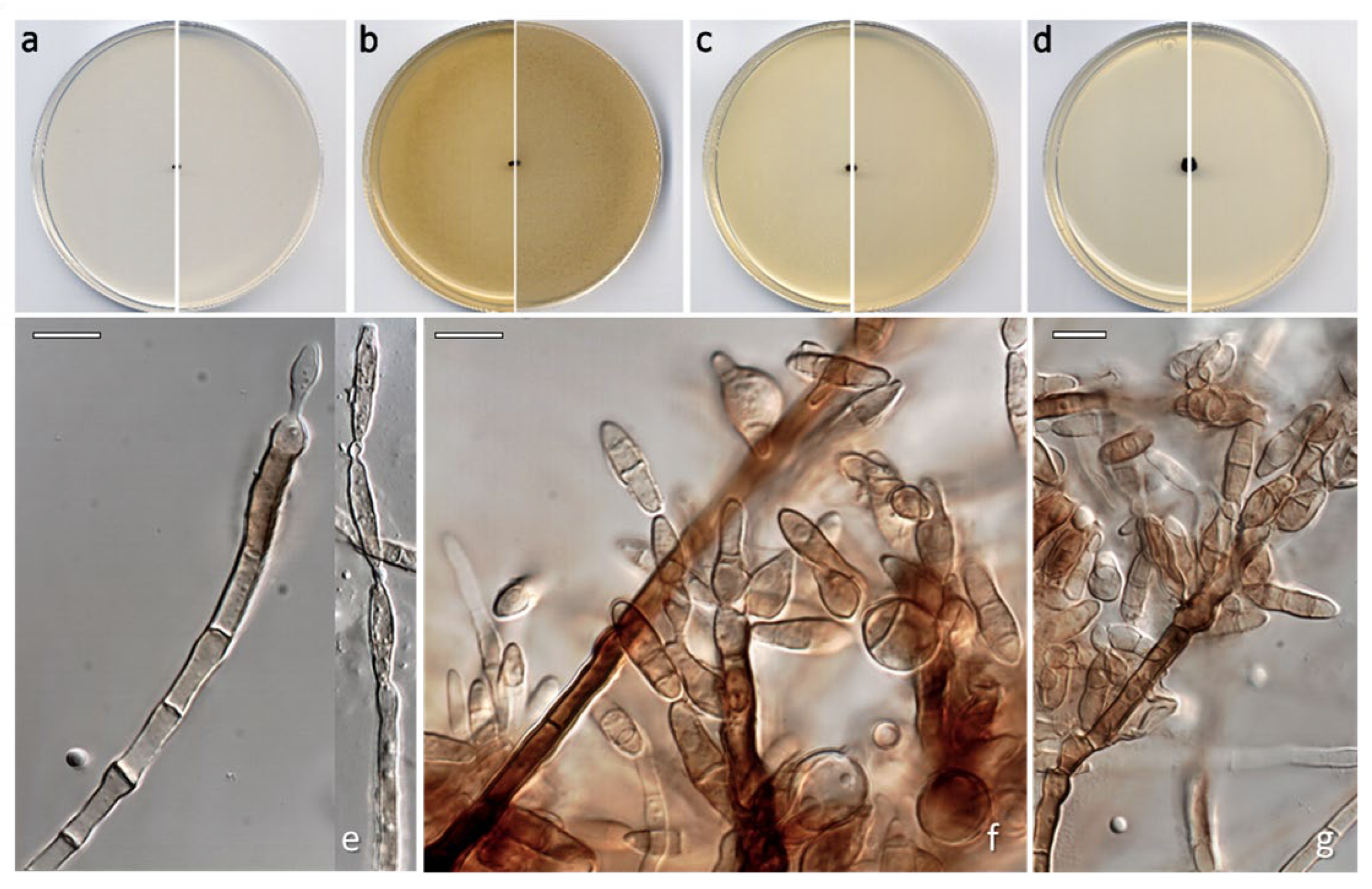


Novel Freshwater Ascomycetes from Submerged Plant Debris in the Zújar River (Extremadura Community, Spain)




Abstract
1. Introduction
2. Materials and Methods
2.1. Sampling and Fungal Isolation
2.2. Phenotypic Study
2.3. DNA Extraction, Amplification, and Sequencing
2.4. Phylogenetic Analysis
3. Results
Taxonomy
4. Discussion
5. Conclusions
Author Contributions
Funding
Institutional Review Board Statement
Informed Consent Statement
Data Availability Statement
Acknowledgments
Conflicts of Interest
Abbreviations
| act | Actin |
| BCC | BIOTEC Culture Collection |
| BI | Bayesian Inference |
| BLAST | Basic Local Alignment Search Tool |
| BS | Bootstrap Support |
| CBS | Centraalbureau voor Schimmelcultures, Westerdijk Fungal Biodiversity Institute |
| CGMCC | China General Microbiological Culture Collection Center |
| comb. nov. | Novel Combination |
| CPC | Culture Collection of P.W. Crous |
| DAOM | National Mycological Herbarium, Department of Agriculture Ottawa |
| FMR | Faculty of Medicine of Reus |
| GJO | Universalmuseum Joanneum |
| GKM | G.K. Mugambi personal culture collection |
| GZAAS | Guizhou Academic of Agriculture Sciences |
| GZCC | Guizhou Culture Collection |
| HKAS | Herbarium of the Kunming Institute of Botany |
| HKUCC | University of Hong Kong Culture Collection |
| HVVV | Personal collection of Wayne Pitt from Vitis vinifera |
| ICMP | International Collection of Microorganisms |
| IFRDCC | International Fungal Research & Development Centre Culture Collection |
| ITS | Internal Transcribed Spacers |
| JCM | Japan Collection of Microorganisms |
| JK | University of Turku |
| KAS | Kunming Institute of Botany Academia Sinica Culture Collection |
| KUMCC/KUNCC | Kunming Institute of Botany Culture Collection |
| LSU | D1–D2 Domains of the 28S nrRNA |
| MCMC | Markov–Monte Carlo Chains |
| MEA | 2% Malt Extract Agar |
| MEGA | Molecular Evolutionary Genetics Analysis |
| MFLU | Herbarium of the Mae Fah Luang University |
| MFLUCC | Culture Collection of the Mae Fah Luang University |
| mm | Millimeter |
| ML | Maximum Likelihood |
| MLI | Maximum Level of Identity |
| MUSCLE | Comparison of Multiple Sequences by Expectation |
| NIL | Strains in BCC |
| OA | Oatmeal Agar |
| PCA | Potato Carrot Agar |
| PCR | Polymerase Chain Reaction |
| PDA | Potato Dextrose Agar |
| PP | Posterior Probability |
| rpb1 | RNA Polymerase II Subunit 1 |
| rpb2 | RNA Polymerase II Subunit 2 |
| SBRH | Swedish Museum of Natural History |
| sp. | Species |
| spp. | Species (plural) |
| tef-1α | Translation Elongation Factor 1α |
| TK | Tomsk State University |
| YMF | Key Laboratory of Industrial Microbiology and Fermentation Technology of Yunnan |
| YNF | Strains in CGMCC |
Appendix A

| Living Strains (and Holotype) | Identification | Molecular Markers | Sequence Identity (%) * | GenBank Accession Number |
|---|---|---|---|---|
| FMR 20899 | Acremonium sclerotigenum | ITS | 100% | MF075142 |
| LSU | 100% | MH868961 | ||
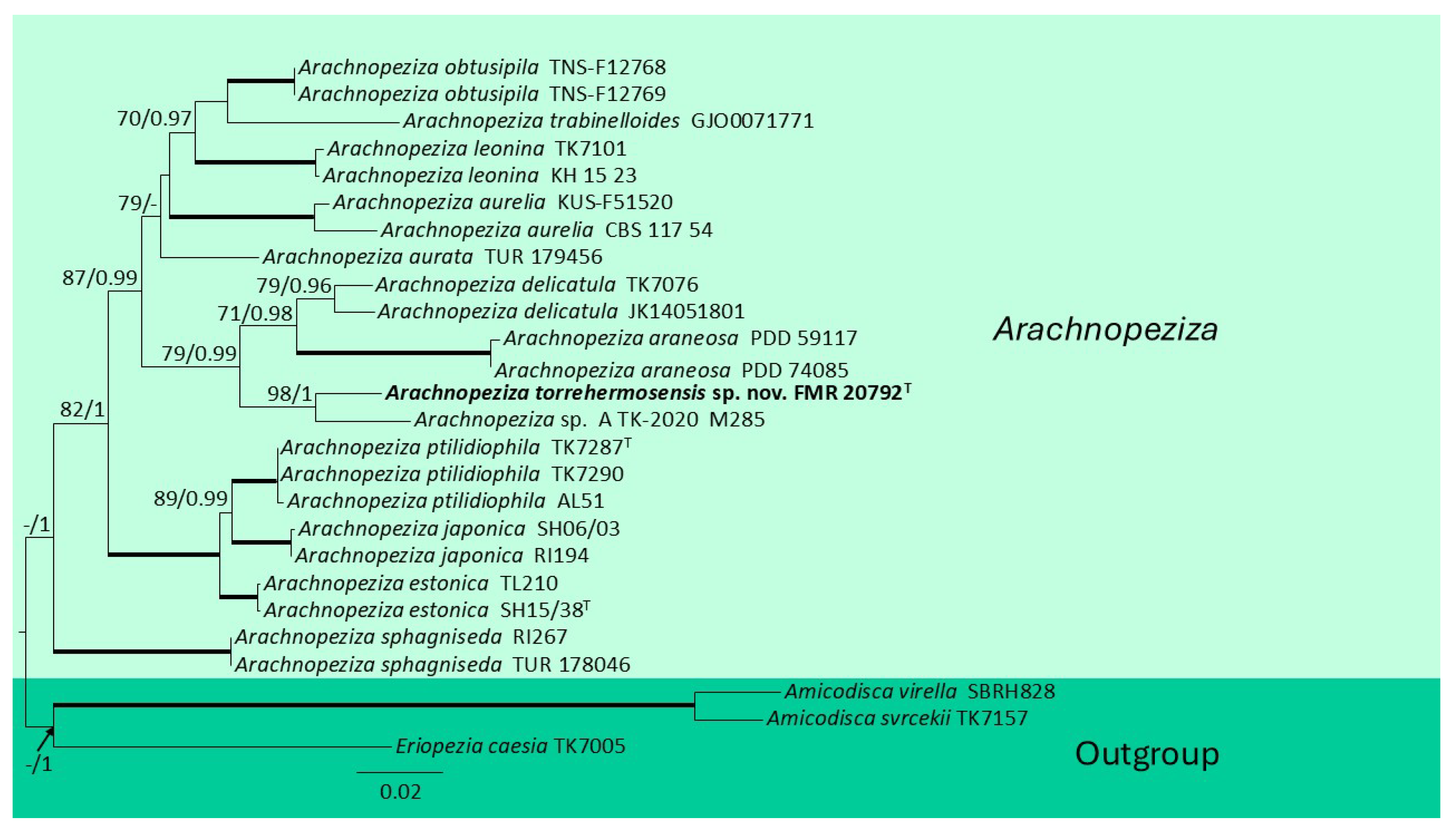
| FMR 20792 (CBS H-25766) | Arachnopeziza torrehermosensis | ITS | 97.12% | MT231651 |
| LSU | 98.84% | MT231655 | ||
| tef-1α | 94.50% | MT254566 | ||
| rpb1 | 93.07% | MT216587 | ||
| FMR 20502 | Bartalinia robillardoides | ITS | 100% | NR_126145 |
| LSU | 99.71% | EU552102 | ||
| FMR 20796 | Bartalinia robillardoides | ITS | 100% | NR_126145 |
| LSU | 100% | EU552102 | ||
| FMR 20811 | Cladosporium ramotenellum | tef-1α | 98.44% | KT600533 |
| act | 99.39% | KT600622 | ||
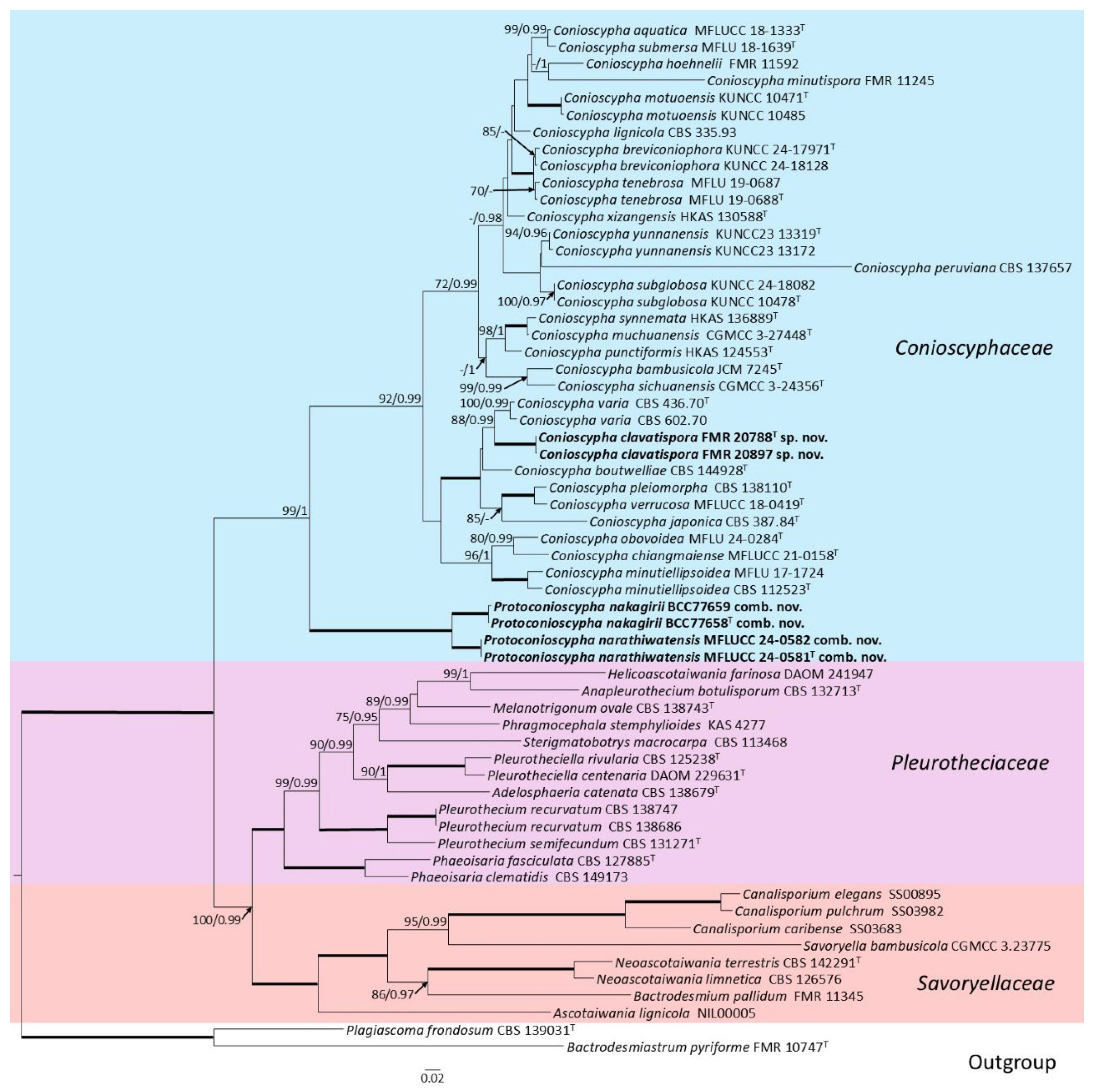
| FMR 20788 = CBS 154005 (CBS H-25765) | Conioscypha clavatispora | ITS | 93.18% | NR_168821 |
| LSU | 97.93% | MH871548 | ||
| rpb2 | 88.36% | MN061668 | ||
| FMR 20897 | Conioscypha clavatispora | ITS | 93.18% | NR_168821 |
| LSU | 97.89% | MH871654 | ||
| rpb2 | 88.55% | MN061668 | ||
| FMR 20789 | Dichotomopilus indicus | tub2 | 99.40% | JF772451 |
| FMR 20781 | Fusarium oxysporum | ITS | 99.80% | OM977105 |
| LSU | 99.54% | MH876100 | ||
| tef-1α | 98.74% | JQ429355 | ||
| FMR 20552 | Hongkongmyces brunneosporus | LSU | 99.57% | MW004646 |
| FMR 20798 | Hongkongmyces brunneosporus | LSU | 100% | MW004643 |
| FMR 20799 | Hongkongmyces brunneosporus | LSU | 100% | MW004645 |
| FMR 20803 | Hongkongmyces brunneosporus | LSU | 99.76% | MW004646 |
| FMR 20805 | Hongkongmyces brunneosporus | LSU | 99.51% | MW004645 |
| FMR 20810 | Hongkongmyces brunneosporus | LSU | 99.76% | MW004644 |
| FMR 20898 | Hongkongmyces brunneosporus | LSU | 99.86% | MW004643 |
| FMR 20553 | Hongkongmyces snookiorum | ITS | 99.49% | OR004657 |
| LSU | 99.52% | MW757254 | ||
| FMR 20780 | Hongkongmyces snookiorum | ITS | 99.35% | MH161189 |
| FMR 20813 | Lecanicillium psalliotae | ITS | 99.44% | JN797793 |
| FMR 20801 | Lecanicillium saksenae | ITS | 99.64% | PP620758 |
| LSU | 100.00% | MH861374 | ||
| FMR 20786 = CBS 154006 (CBS H-25767) | Neoanungitea torrehermosensis | ITS | 94.68% | NR_156383 |
| LSU | 99.76% | MG386031 | ||
| FMR 20793 | Neoanungitea torrehermosensis | ITS | 94.70% | NR_156383 |
| LSU | 99.76% | MG386031 | ||
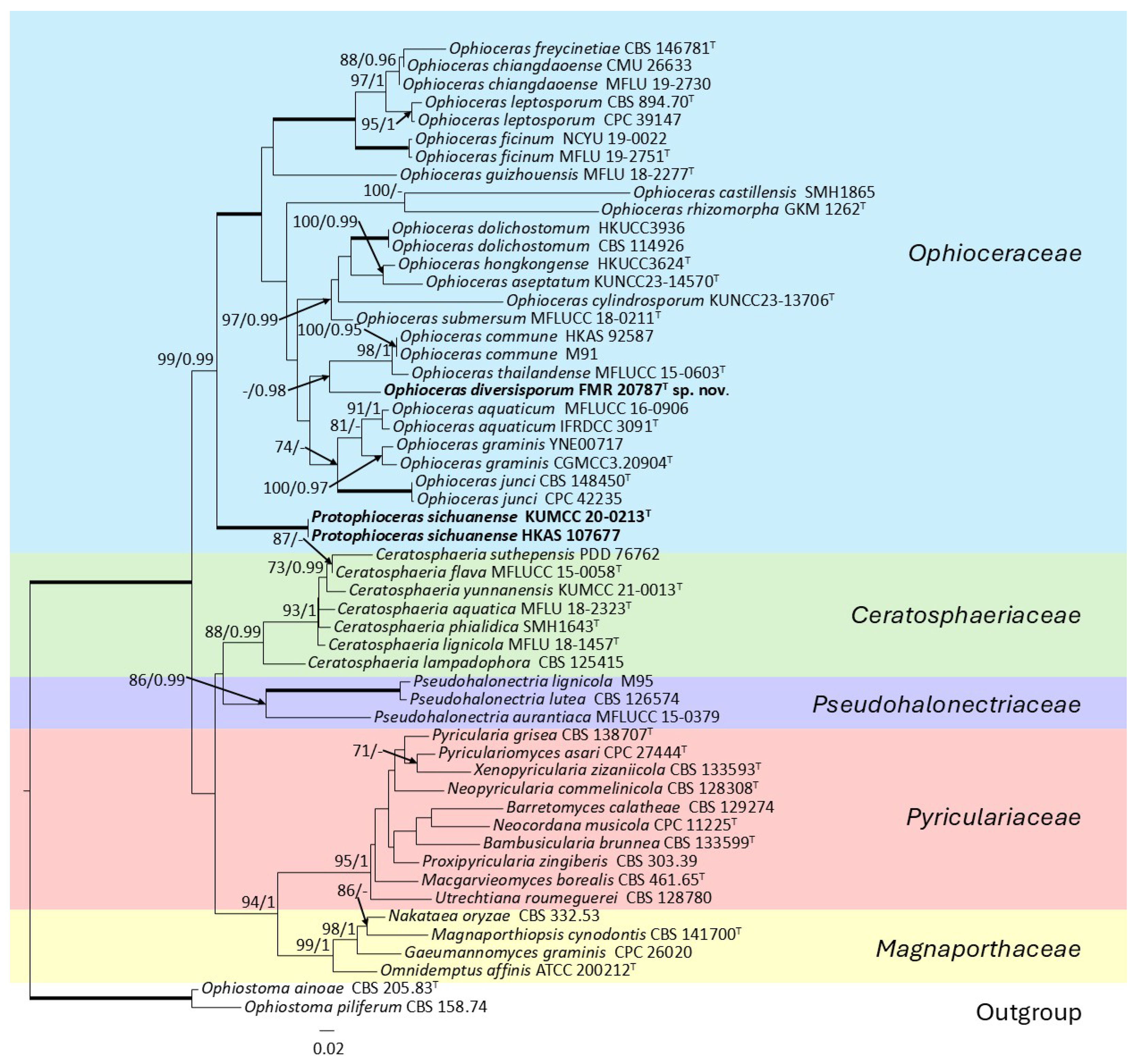
| FMR 20787 = CBS 154004 (CBS H-25764) | Ophioceras diversisporum | ITS | 88.69% | NR_197509 |
| LSU | 97.00% | NG_067778 | ||
| rpb1 | 83.52% | JX134731 | ||
| FMR 20541 | Paraphaeosphaeria sporulosa | ITS | 100% | JX496045 |
| LSU | 100% | JX496175 | ||
| FMR 20665 | Paraphaeosphaeria sporulosa | ITS | 100% | JX496114 |
| FMR 20783 | Paraphaeosphaeria sporulosa | ITS | 100% | JX496110 |
| FMR 20785 | Paraphaeosphaeria sporulosa | ITS | 100% | JX496108 |
| LSU | 100% | JX496187 | ||
| FMR 20791 | Paraphaeosphaeria sporulosa | ITS | 100% | MH854865 |
| FMR 20800 | Paraphaeosphaeria sporulosa | ITS | 99.82% | JX496084 |
| LSU | 99.79% | MH871696 | ||
| FMR 20802 | Paraphaeosphaeria sporulosa | ITS | 100% | JX496045 |
| FMR 20804 | Paraphaeosphaeria sporulosa | ITS | 99.82% | JX496114 |
| LSU | 100% | MH866362 | ||
| FMR 20809 | Paraphaeosphaeria sporulosa | ITS | 99.85% | JX496114 |
| FMR 20895 | Paraphaeosphaeria sporulosa | LSU | 98.71% | JX496186 |
| FMR 20504 | Paraphaeosphaeria sporulosa | ITS | 100% | JX496108 |
| FMR 20500 | Parascedosporium putredinis | ITS | 100% | MN047111 |
| FMR 20669 | Phialophora americana | LSU | 100% | MH877539 |
| FMR 20794 | Phialophora americana | tef-1α | 98.12% | MH048681 |
| FMR 20797 | Plectosphaerella cucumerina | ITS | 99.81% | MH862743 |
| LSU | 100% | MH874350 | ||
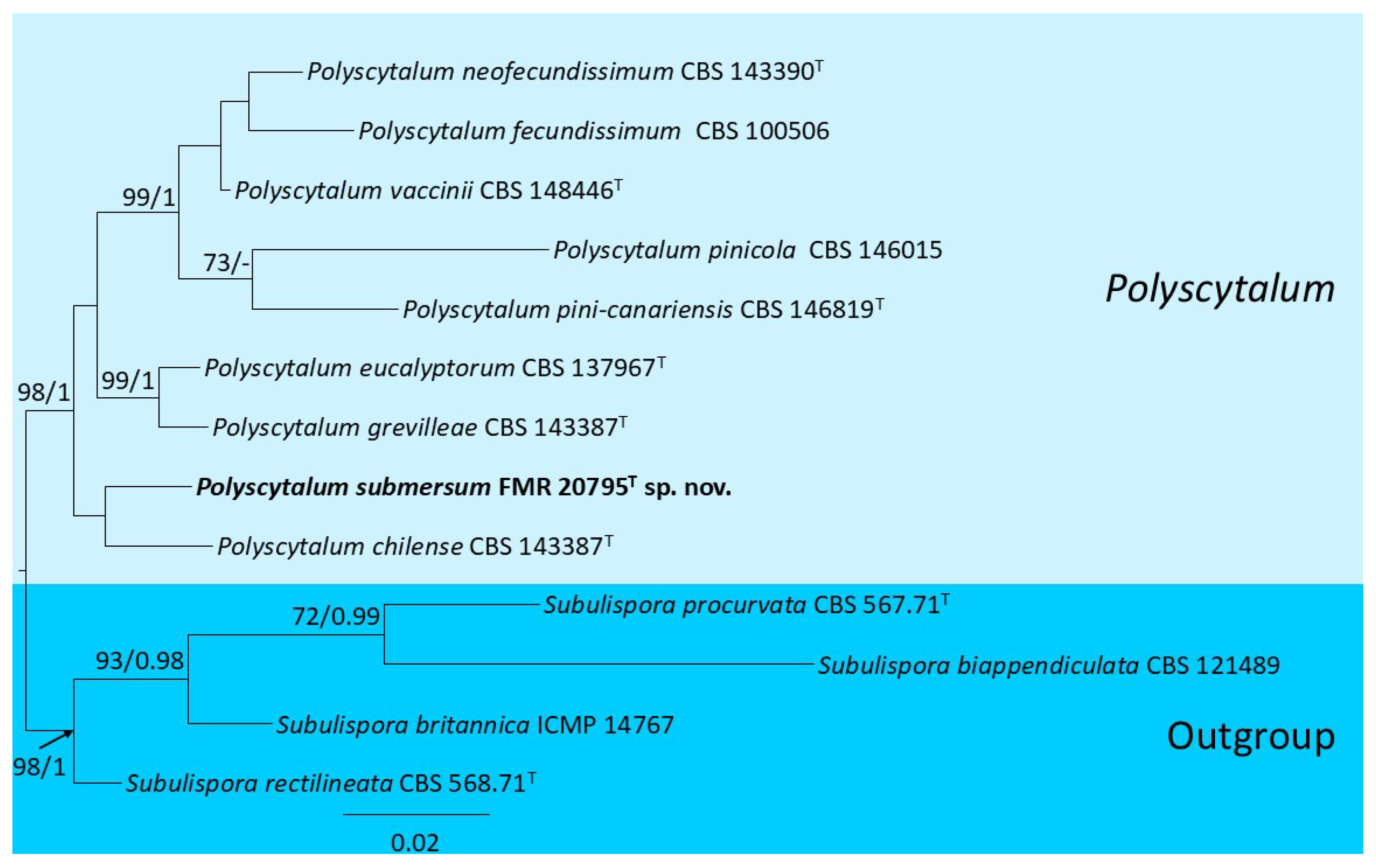
| FMR 20795 = CBS 154003 (CBS H-25763) | Polyscytalum submersum | ITS | 95.68% | KJ869118 |
| LSU | 99.38% | NG_074425 | ||
| FMR 20812 | Prosthemium neobetulinum | ITS | 98.77% | MH856774 |
| FMR 20807 | Stagonospora pseudoperfecta | ITS | 100% | MK442625 |
| LSU | 100% | NG_059399 | ||
| FMR 20782 | Sympoventuria capensis | ITS | 98.89% | NR_121323 |
| FMR 20790 | Sympoventuria capensis | ITS | 99.10% | NR_121323 |
| FMR 20660 | Talaromyces muroii | tub2 | 99.74% | KJ865727 |
| FMR 20676 | Talaromyces muroii | tub2 | 99.73% | KM066151 |
| FMR 20505 | Typhicola typharum | ITS | 99.85% | KF251192 |
| FMR 20663 | Typhicola typharum | ITS | 99.27% | MK442590 |
| FMR 20806 | Typhicola typharum | ITS | 99.57% | KF251192 |
| LSU | 99.88% | MK442530 | ||
| FMR 20501 | Vermiculariopsiella dichapetali | ITS | 100% | MH107924 |
| LSU | 100% | MH107970 |
References
- Dudgeon, D.; Arthington, A.H.; Gessner, M.O.; Kawabata, Z.I.; Knowler, D.J.; Lévêque, C.; Naiman, R.J.; Prieur-Richard, A.H.; Soto, D.; Stiassny, M.L.J.; et al. Freshwater biodiversity: Importance, threats, status and conservation challenges. Biol. Rev. 2006, 81, 163–182. [Google Scholar] [CrossRef]
- Cantonati, M.; Poikane, S.; Pringle, C.M.; Stevens, L.E.; Turak, E.; Heino, J.; Richardson, J.S.; Bolpagni, R.; Borrini, A.; Cid, N.; et al. Characteristics, main impacts, and stewardship of natural and artificial freshwater environments: Consequences for biodiversity conservation. Water 2020, 12, 260. [Google Scholar] [CrossRef]
- Gallart, F.; Llorens, P.; Latron, J.; Regüés, D. Hydrological processes and their seasonal controls in a small Mediterranean mountain catchment in the Pyrenees. Hydrol. Earth. Syst. Sci. 2002, 6, 527–537. [Google Scholar] [CrossRef]
- Navarro, R.S.; Stewardson, M.; Breil, P.; De Jalón, D.G.; Eisele, M. Hydrological impacts affecting endangered fish species: A Spanish case study. River. Res. Appl. 2007, 23, 511–523. [Google Scholar] [CrossRef]
- Goh, T.K.; Hyde, K.D. Biodiversity of Freshwater Fungi. J. Ind. Microbiol. Biotechnol. 1996, 17, 328–345. [Google Scholar] [CrossRef]
- Calabon, M.S.; Hyde, K.D.; Jones, E.B.G.; Bao, D.F.; Bhunjun, C.S.; Phukhamsakda, C.; Shen, H.W.; Gentekaki, E.; Al Sharie, A.H.; Barros, J.; et al. Freshwater fungal biology. Mycosphere 2023, 14, 195–413. [Google Scholar] [CrossRef]
- Calabon, M.S.; Hyde, K.D.; Jones, E.B.G.; Luo, Z.L.; Dong, W.; Hurdeal, V.G.; Gentekaki, E.; Rossi, W.; Leonardi, M.; Thiyagaraja, V.; et al. Freshwater fungal numbers. Fungal. Divers. 2022, 114, 3–235. [Google Scholar] [CrossRef]
- Fiuza, P.O.; de Paiva Ottoni-Boldrini, B.M.; Monteiro, J.S.; Catena, N.R.; Hamada, N.; Gusmão, L.F.P. First Records of Ingoldian Fungi from the Brazilian Amazon. Braz. J. Bot. 2015, 38, 615–621. [Google Scholar] [CrossRef]
- Yamaguchi, K. Recent studies on aero-aquatic fungi, with special reference to diversity of conidial morphology and convergent evolution. Mycoscience 2023, 64, 128–135. [Google Scholar] [CrossRef]
- Révay, Á.; Gönczöl, J. Rainborne hyphomycete conidia from evergreen trees. Nova Hedwigia 2010, 91, 151–163. [Google Scholar] [CrossRef]
- Ingold, C.T. An illustrated guide to aquatic and water-borne hyphomycetes fungi imperfecti with notes on their biology. Sci. Publ. Freshw. Biol. Assoc. 1975, 30, 1–96. [Google Scholar]
- Goh, T.K. Tropical Freshwater Hyphomycetes. In Biodiversity of Tropical Microfungi, 1st ed.; Hyde, K.D., Ed.; Hong Kong University Press: Hong Kong, China, 1997; pp. 189–227. [Google Scholar]
- Jiménez, M.J.; Ruíz de Clavijo, E. Catálogo florístico de la Cuenca Hidrográfica del Río Zújar. Monograf. Jard. Bot. 1997, 6, 5–89. [Google Scholar]
- Cardenal, M.M.; Corrales, J.M.; Hernández, A.M.; Maldonado, J.J.; Rodríguez, M.; Vázquez, J. Conociendo El Medio Natural, Social y Cultural de La Siberia, 1st ed.; Diputación de Badajoz: Badajoz, Spain, 2017; pp. 1–213. [Google Scholar]
- Schnabel, S.; Francisco, J.; Contador, L.; Gómez, A.; García, R. Aportaciones a la Geografía Física de Extremadura Con Especial Referencia a Las Dehesas, 1st ed.; Asociación Profesional para la Ordenación del Territorio, el Ambiente y el Desarrollo Sostenible: Valencia, Spain, 2010; pp. 1–256. [Google Scholar]
- Hermoso, V.; Blanco-Garrido, F.; Prenda, J. Spatial distribution of exotic fish species in the Guadiana river basin, with two new records. Limnetica 2008, 27, 189–194. [Google Scholar] [CrossRef]
- López-Albacete, I.; Gavira, O.; Blanco-Garrido, F.; Herrera-Grao, A. Nueva especie de helófito (Butomus umbellatuss) a incluir en el catálogo de flora de Extremadura. Acta Bot. Malacit. 2010, 35, 145–147. [Google Scholar] [CrossRef]
- Méndez, L.; Perdices, A.; Machordom, A. Genetic Structure and Diversity of the Iberian Populations of the Freshwater Blenny Salaria Fluviatilis (Asso, 1801) and Its Conservation Implications. Conserv. Genet. 2019, 20, 1223–1236. [Google Scholar] [CrossRef]
- Benovics, M.; Desdevises, Y.; Šanda, R.; Vukić, J.; Scheifler, M.; Doadrio, I.; Sousa-Santos, C.; Šimková, A. High diversity of fish ectoparasitic monogeneans (Dactylogyrus) in the Iberian Peninsula: A case of adaptive radiation? Parasitology 2020, 147, 418–430. [Google Scholar] [CrossRef]
- Arroyo, B.; Pinilla, A.; Mougeot, F.; Crystal, F.; Guerrero, A.; Palacios, M.J. Selección de hábitat y zonas de caza del aguilucho cenizo en Extremadura: Implicaciones para la conservación. In Conservación y Situación Poblacional de los Aguiluchos en Eurasia, 1st ed.; Alarcos, S., Ed.; Dirección General del Medio Natural. Consejería de Industria, Energía y Medio Ambiente. Junta de Extremadura: Extremadura, Spain, 2009; pp. 51–59. [Google Scholar]
- Samson, R.A.; Houbraken, J.; Thrane, U.; Frisvad, J.C.; Andersen, B. Food and Indoor Fungi, 2nd ed.; CBS-KNAW Fungal Biodiversity Centre: Utrecht, The Netherlands, 2010; pp. 1–475. [Google Scholar]
- Onions, A.H.S. Preservation of Fungi. In Methods in Microbiology, 1st ed.; Gurtler, V., Ed.; Academic Press: London, UK, 1971; Volume 4, pp. 113–151. [Google Scholar]
- Chupp, C. Further notes on double cover-glass mounts. Mycologia 1940, 32, 269–270. [Google Scholar] [CrossRef]
- Müller, F.M.; Werner, K.E.; Kasai, M.; Francesconi, A.; Chanock, S.J.; Walsh, T.J. Rapid extraction of genomic DNA from medically important yeasts and filamentous fungi by high-speed cell disruption. J. Clin. Microbiol. 1998, 36, 1625–1629. [Google Scholar] [CrossRef] [PubMed]
- White, T.J.; Bruns, T.; Lee, S.J.W.T.; Taylor, J. Amplification and direct sequencing of fungal ribosomal RNA genes for phylogenetics. In PCR Protocols: A Guide to Methods and Applications, 1st ed.; Innis, M.A., Gelfand, D.H., Sninsky, J.J., White, T.J., Eds.; Academic Press: San Diego, CA, USA, 1990; pp. 315–322. [Google Scholar]
- Vilgalys, R.; Hester, M. Rapid genetic identification and mapping of enzymatically amplified ribosomal DNA from several Cryptococcus species. J. Bacteriol. 1990, 172, 4238–4246. [Google Scholar] [CrossRef]
- Carbone, I.; Kohn, L.M. A method for designing primer sets for speciation studies in filamentous Ascomycetes. Mycologia 1999, 91, 553–556. [Google Scholar] [CrossRef]
- Rehner, S.A.; Buckley, E. A Beauveria phylogeny inferred from nuclear ITS and EF1-α sequences: Evidence for cryptic diversification and links to Cordyceps teleomorphs. Mycologia 2005, 97, 84–98. [Google Scholar] [CrossRef] [PubMed]
- Glass, N.L.; Donaldson, G.C. Development of Primer Sets Designed for Use with the PCR To Amplify Conserved Genes from Filamentous Ascomycetes. Appl. Environ. Microbiol. 1995, 61, 1323–1330. [Google Scholar] [CrossRef]
- Sung, G.H.; Sung, J.M.; Hywel-Jones, N.L.; Spatafora, J.W. A multi-gene phylogeny of Clavicipitaceae (Ascomycota, Fungi): Identification of localized incongruence using a combinational bootstrap approach. Mol. Phylogenet. Evol. 2007, 44, 1204–1223. [Google Scholar] [CrossRef]
- Liu, Y.J.; Whelen, S.; Hall, B.D. Phylogenetic relationships among Ascomycetes: Evidence from an RNA Polymerse II Subunit. Mol. Biol. Evol. 1999, 16, 1799–1808. [Google Scholar] [CrossRef]
- Feng, J.W.; Liu, W.T.; Chen, J.J.; Zhang, C.L. Biogeography and ecology of Magnaporthales: A case study. Front. Microbiol. 2021, 12, 654380. [Google Scholar] [CrossRef]
- Rodríguez-Andrade, E.; Cano-Lira, J.F.; Wiederhold, N.; Pérez-Cantero, A.; Guarro, J.; Stchigel, A.M. A revision of Malbranchea-like fungi from clinical specimens in the United States of America reveals unexpected novelty. IMA Fungus 2021, 12, 25. [Google Scholar] [CrossRef]
- Torres-Garcia, D.; García, D.; Cano-Lira, J.F.; Gené, J. Two novel genera, Neostemphylium and Scleromyces (Pleosporaceae) from freshwater sediments and their global biogeography. J. Fungi 2022, 8, 868. [Google Scholar] [CrossRef]
- Tamura, K.; Stecher, G.; Peterson, D.; Filipski, A.; Kumar, S. MEGA7: Molecular evolutionary genetics analysis version 7.0. Mol. Biol. Evol. 2013, 30, 2725–2729. [Google Scholar] [CrossRef] [PubMed]
- Thompson, J.D.; Higgins, D.G.; Gibson, T.J. CLUSTAL W: Improving the sensitivity of progressive multiple sequence alignment through sequence weighting, position-specific gap penalties and weight matrix choice. Nucleic Acids Res. 1994, 22, 4673–4680. [Google Scholar] [CrossRef]
- Edgar, R.C. MUSCLE: Multiple sequence alignment with high accuracy and high throughput. Nucleic Acids Res. 2004, 32, 1792–1797. [Google Scholar] [CrossRef] [PubMed]
- Miller, M.A.; Pfeifferm, W.; Schwartz, T. The CIPRES science gateway: Enabling high-impact science for phylogenetics researchers with limited resources. In Proceedings of the 1st Conference of the Extreme Science and Engineering Discovery Environment: Bridging from the Extreme to the Campus and Beyond, Chicago, IL, USA, 16–20 July 2012; Association for Computing Machinery: New York, NY, USA, 2012; pp. 1–8. [Google Scholar]
- Stamatakis, A. RAxML version 8: A tool for phylogenetic analysis and post-analysis of large phylogenies. Bioinformatics 2014, 30, 1312–1313. [Google Scholar] [CrossRef]
- Hillis, D.M.; Bull, J.J. An Empirical Test of Bootstrapping as a Method for Assessing Confidence in Phylogenetic Analysis. Syst. Biol. 1993, 42, 182–192. [Google Scholar] [CrossRef]
- Ronquist, F.; Teslenko, M.; Van Der Mark, P.; Ayres, D.L.; Darling, A.; Höhna, S.; Larget, B.; Liu, L.; Suchard, M.A.; Huelsenbeck, J.P. Mrbayes 3.2: Efficient Bayesian Phylogenetic Inference and Model Choice across a Large Model Space. Syst. Biol. 2012, 61, 539–542. [Google Scholar] [CrossRef] [PubMed]
- Darriba, D.; Taboada, G.L.; Doallo, R.; Posada, D. JModelTest 2: More Models, New Heuristics and Parallel Computing. Nat. Methods 2012, 9, 772. [Google Scholar] [CrossRef] [PubMed]
- Hespanhol, L.; Vallio, C.S.; Costa, L.M.; Saragiotto, B.T. Understanding and Interpreting Confidence and Credible Intervals around Effect Estimates. Braz. J. Phys. Ther. 2019, 23, 290–301. [Google Scholar] [CrossRef]
- Jiang, H.B.; Hyde, K.D.; Yang, E.F.; Kakumyan, P.; Bahkali, A.H.; Elgorban, A.M.; Karunarathna, S.C.; Phookamsak, R.; Lumyong, S. Morphological and phylogenetic appraisal of Ophioceras (Ophioceraceae, Magnaporthales). PLoS ONE 2021, 16, e0253853. [Google Scholar] [CrossRef]
- Chuaseeharonnachai, C.; Somrithipol, S.; Suetrong, S.; Klaysuban, A.; Pornputtapong, N.; Gareth Jones, E.B.; Boonyuen, N. Conioscypha nakagirii, a new species from naturally submerged wood in Thailand based on morphological and molecular data. Mycoscience 2017, 58, 424–431. [Google Scholar] [CrossRef]
- Karimi, O.; Hyde, K.; Asghari, R.; Chethana, K.; Kaewchai, S.; Al-Otibi, F.; Li, Q. Peat Swamp Ascomycota Associated with Palms (Arecaceae) from Narathiwat, Thailand. Mycosphere 2025, 16, 2456–2575. [Google Scholar] [CrossRef]
- Riess, H. Beiträge zur Pilzkunde. Bot. Zeitung 1853, 11, 129–140. [Google Scholar]
- Spegazzini, C. Mycetes Argentinenses (Series V). Anales Mus. Nac. Hist. Nat. Buenos Aires 1910, 13, 329–467. [Google Scholar]
- Castañeda, R.F.; Kendrick, B. Ninety-nine conidial fungi from Cuba and three from Canada. Univ. Waterloo Biol. Ser. 1991, 35, 1–132. [Google Scholar]
- Crous, P.W.; Schumacher, R.K.; Wingfield, M.J.; Akulov, A.; Denman, S.; Roux, J.; Braun, U.; Burgess, T.I.; Carnegie, A.J.; Váczy, K.Z.; et al. New and interesting fungi 1. Fungal. Syst. Evol. 2018, 1, 169–215. [Google Scholar] [CrossRef] [PubMed]
- Cooper, J.A. New Zealand hyphomycete fungi: Additional records, new species, and notes on interesting collections. New Zealand J. Bot. 2005, 43, 323–349. [Google Scholar] [CrossRef][Green Version]
- Kirk, P.M. New or Interesting Microfungi II. Dematiaceous Hyphomycetes from Esher Common, Surrey. Trans. Br. Mycol. Soc. 1981, 77, 279–297. [Google Scholar] [CrossRef]
- Sutton, B.C.; Hodges, C.S. Eucalyptus microfungi: Miscellaneous Hyphomycetes. Nova Hedwigia 1977, 28, 487–498. [Google Scholar]
- Cheewangkoon, R.; Groenewald, J.Z.; Summerell, B.A.; Hyde, K.D.; To-anun, C.; Crows, P.W. Myrtaceae, a cache of fungal biodiversity. Persoonia 2009, 23, 55–85. [Google Scholar] [CrossRef]
- Crous, P.W.; Wingfield, M.J.; Schumacher, R.K.; Akulov, A.; Bulgakov, T.S.; Carnegie, A.J.; Jurjevic, Ž.; Decock, C.; Denman, S.; Lombard, L.; et al. New and interesting fungi 3. Fungal. Syst. Evol. 2020, 6, 157–231. [Google Scholar] [CrossRef]
- Barron, G.L. The Genera of Hyphomycetes From Soil, 1st ed.; Williams & Wilkins: Baltimore, MD, USA, 1968; pp. 1–310. [Google Scholar]
- Marvanová, L.; Landvik, S.; Fisher, P.J.; Moss, S.T.; Ainsworth, A.M. A new fungus with arthroconidia from foam. Nova Hedwig. 2002, 75, 255–269. [Google Scholar] [CrossRef]
- Sutton, B.C. Three new hyphomycetes from Britain. Trans. Br. Mycol. Soc. 1978, 71, 167–171. [Google Scholar] [CrossRef]
- Kirk, P.M. New or interesting microfungi I. Dematiaceous hyphomycetes from Devon. Trans. Br. Mycol. Soc. 1981, 76, 71–87. [Google Scholar] [CrossRef]
- Thongkantha, S.; Jeewon, R.; Vijaykrishna, D.; Lumyong, S.; McKenzie, E.H.C.; Hyde, K.D. Molecular Phylogeny of Magnaporthaceae (Sordariomycetes) with a New Species, Ophioceras chiangdaoense from Dracaena loureiroi in Thailand. Fungal Divers. 2014, 34, 157–173. [Google Scholar]
- Zhang, N.; Luo, J.; Rossman, A.Y.; Aoki, T.; Chuma, I.; Crous, P.W.; Dean, R.; De Vries, R.P.; Donofrio, N.; Hyde, K.D.; et al. Generic names in Magnaporthales. IMA Fungus 2016, 7, 155–159. [Google Scholar] [CrossRef] [PubMed]
- Freeman, J.; Ward, E. Gaeumannomyces graminis, the take-all fungus and its relatives. Mol. Plant. Pathol. 2004, 5, 235–252. [Google Scholar] [CrossRef]
- Klaubauf, S.; Tharreau, D.; Fournier, E.; Groenewald, J.Z.; Crous, P.W.; de Vries, R.P.; Lebrun, M.H. Resolving the polyphyletic nature of Pyricularia (Pyriculariaceae). Stud. Mycol. 2014, 79, 85–120. [Google Scholar] [CrossRef]
- Luo, Z.L.; Hyde, K.D.; Liu, J.K.; Maharachchikumbura, S.S.N.; Jeewon, R.; Bao, D.F.; Bhat, D.J.; Lin, C.G.; Li, W.L.; Yang, J.; et al. Freshwater Sordariomycetes. Fungal. Divers. 2019, 99, 451–660. [Google Scholar] [CrossRef]
- Hyde, K.; Norphanphoun, C.; Maharachchikumbura, S.S.N.; Bhat, D.J.; Jones, E.B.G.; Bundhun, D.; Chen, Y.J.; Bao, D.F.; Boonmee, S.; Calabon, M.S.; et al. Refined Families of Sordariomycetes. Mycosphere 2020, 11, 305–1059. [Google Scholar] [CrossRef]
- Saccardo, P.A. Sylloge Pyrenomycetum, Vol. II. Syll. Fung. 1883, 2, 1–813. [Google Scholar]
- Hu, D.M.; Cai, L.; Hyde, K.D. Three New Ascomycetes from Freshwater in China. Mycologia 2012, 104, 1478–1489. [Google Scholar] [CrossRef] [PubMed]
- Shearer, C.A.; Crane, J.L.; Chen, W. Freshwater Ascomycetes: Ophioceras species. Mycologia 1999, 91, 145–156. [Google Scholar] [CrossRef]
- Höhnel, F.V. Fragmente zur Mykologie: VI. Mitteilung (Nr. 182 bis 288). Sitz. -Ber. K. Akad. Wiss. Math.-Naturw. Kl. Abt. I. 1909, 118, 275–452. [Google Scholar]
- Tilak, S.T.; Kale, S.B. Contribution to our knowledge of Ascomycetes of India-XI. Mycopathol. Mycol. Appl. 1966, 38, 377–382. [Google Scholar] [CrossRef]
- Walker, J. Gaeumannomyces, Linocarpon, Ophiobolus and several other genera of scolecospored Ascomycetes and Phialophora conidial states, with a note on hyphopodia. Mycotaxon 1980, 11, 1–129. [Google Scholar] [CrossRef]
- Matsushima, T. Matsushima. Mycol. Mem. 2003, 10, 1–214. [Google Scholar]
- Tsui, C.K.M.; Leung, Y.M.; Hyde, K.D.; Hodgkiss, I.J. Three new Ophioceras species (Ascomycetes) from the Tropics. Mycoscience 2001, 42, 321–326. [Google Scholar] [CrossRef]
- Tennakoon, D.S.; Kuo, C.H.; Maharachchikumbura, S.S.N.; Thambugala, K.M.; Gentekaki, E.; Phillips, A.J.L.; Bhat, D.J.; Wanasinghe, D.N.; de Silva, N.I.; Promputtha, I.; et al. Taxonomic and phylogenetic contributions to Celtis formosana, Ficus ampelas, F. septica, Macaranga tanarius and Morus australis leaf litter inhabiting microfungi. Fungal Divers. 2021, 108, 1–215. [Google Scholar] [CrossRef]
- Crous, P.W.; Cowan, D.A.; Maggs-Kölling, G.; Yilmaz, N.; Thangavel, R.; Wingfield, M.J.; Noordeloos, M.E.; Dima, B.; Brandrud, T.E.; Jansen, G.M.; et al. Fungal Planet Description Sheets: 1182–1283. Persoonia 2021, 46, 313–528. [Google Scholar] [CrossRef]
- Crous, P.W.; Osieck, E.R.; Jurjević, Ž.; Boers, J.; Van Iperen, A.L.; Starink-Willemse, M.; Dima, B.; Balashov, S.; Bulgakov, T.S.; Johnston, P.R.; et al. Fungal Planet Description Sheets: 1284–1382. Persoonia 2021, 47, 178–374. [Google Scholar] [CrossRef]
- Huhndorf, S.M.; Greif, M.; Mugambi, G.K.; Miller, A.N. Two new genera in the Magnaporthaceae, a new addition to Ceratosphaeria and two new species of Lentomitella. Mycologia 2008, 100, 940–955. [Google Scholar] [CrossRef] [PubMed]
- Feng, J.W.; Chen, X.Y.; Chen, K.Y.; Druzhinina, I.S.; Voglmayr, H.; Crous, P.W.; Kubicek, C.P.; Zhang, C.L. A reappraisal of families within the order Magnaporthales and description of new endophytic taxa associated with Poaceae plants in China. Mycosphere 2024, 15, 6240–6346. [Google Scholar] [CrossRef]
- Dong, J.Y.; Wang, L.; Song, H.C.; Wang, L.M.; Shen, K.Z.; Sun, R.; Li, G.H.; Li, L.; Zhang, K.Q. Ophiocerol, a novel macrocylic neolignan from the aquatic fungus Ophioceras dolichostomum YMF1.00988. Nat. Prod. Res. 2010, 24, 1004–1012. [Google Scholar] [CrossRef] [PubMed]
- Chethana, K.W.T.; Jayawardena, R.S.; Chen, Y.J.; Konta, S.; Tibpromma, S.; Abeywickrama, P.D.; Gomdola, D.; Balasuriya, A.; Xu, J.; Lumyong, S.; et al. Diversity and Function of Appressoria. Pathogens 2021, 10, 746. [Google Scholar] [CrossRef] [PubMed]
- Réblová, M.; Seifert, K.A.; Fournier, J.; Štepánek, V. Newly recognised lineages of perithecial Ascomycetes: The new orders Coni-oscyphales and Pleurotheciales. Persoonia 2016, 37, 57–81. [Google Scholar] [CrossRef]
- Höhnel, F.V. Mycologische Fragmente. Ann. Mycol. 1904, 2, 38–60. [Google Scholar]
- Crous, P.W.; Luangsa-Ard, J.J.; Wingfield, M.J.; Carnegie, A.J.; Hernández-Restrepo, M.; Lombard, L.; Roux, J.; Barreto, R.W.; Baseia, I.G.; Cano-Lira, J.F.; et al. Fungal Planet Description Sheets: 785–867. Persoonia 2018, 41, 239–251. [Google Scholar] [CrossRef] [PubMed]
- Matsushima, T. Matsushima Mycological Memoirs. No. 9; Matsushima Fungus Collection: Kobe, Japan, 1996; 120p. [Google Scholar]
- Kirk, P.M. New or interesting microfungi XII. A new species of Conioscypha (Hyphomycetes). Trans. Br. Mycol. Soc. 1984, 82, 177–178. [Google Scholar] [CrossRef]
- Shearer, C.A.; Motta, J.J. Ultrastructure and conidiogenesis in Conioscypha (Hyphomycetes). Can. J. Bot. 1973, 51, 1747–1751. [Google Scholar] [CrossRef]
- Zelski, S.E.; Raja, H.A.; Miller, A.N.; Shearer, C.A. Conioscypha peruviana sp. nov., its phylogenetic placement based on 28S rRNA gene, and a report of Conioscypha gracilis comb. nov. from Peru. Mycoscience 2015, 56, 319–325. [Google Scholar] [CrossRef]
- Crous, P.W.; Shivas, R.G.; Quaedvlieg, W.; van der Bank, M.; Zhang, Y.; Summerell, B.A.; Guarro, J.; Wingfield, M.J.; Wood, A.R.; Alfenas, A.C.; et al. Fungal Planet Description Sheets: 214–280. Persoonia 2014, 32, 184–306. [Google Scholar] [CrossRef]
- Hernández-Restrepo, M.; Gené, J.; Castañeda-Ruiz, R.F.; Mena-Portales, J.; Crous, P.W.; Guarro, J. Phylogeny of saprobic microfungi from Southern Europe. Stud. Mycol. 2017, 86, 53–97. [Google Scholar] [CrossRef]
- Li, L.; Du, H.Z.; Thiyagaraja, V.; Bhat, D.J.; Phookamsak, R.; Cheewangkoon, R. Two novel freshwater hyphomycetes, in Acrogenospora (Minutisphaerales, Dothideomycetes) and Conioscypha (Conioscyphales, Sordariomycetes) from Southwestern China. MycoKeys 2024, 101, 249–273. [Google Scholar] [CrossRef]
- Shearer, C.A. Fungi of the Chesapeake Bay and its tributaries II. The genus Conioscypha. Mycologia 1973, 65, 128–136. [Google Scholar] [CrossRef]
- Liu, N.G.; Bhat, D.J.; Hyde, K.D.; Liu, J.K.J. Conioscypha tenebrosa sp. nov. (Conioscyphaceae) from China and notes on Conioscypha species. Phytotaxa 2019, 413, 159–171. [Google Scholar] [CrossRef]
- Fuckel, L. Symbolae mycologicae. Beiträge zur Kenntniss der Rheinischen Pilze. Jahrb. Nassau. Ver. Naturkd. 1870, 23–24, 1–459. [Google Scholar]
- Hosoya, T.; Han, J.-G.; Baral, H. Arachnopezizaceae. Index Fungorum 2015, 225, 1–3. [Google Scholar]
- Kosonen, T.; Huhtinen, S.; Hansen, K. Taxonomy and systematics of Hyaloscyphaceae and Arachnopezizaceae. Persoonia 2021, 46, 26–62. [Google Scholar] [CrossRef]
- Cash, E.K. Some Ascomycetes new to California. Mycologia 1936, 28, 247–252. [Google Scholar] [CrossRef]
- Yu, Z.H.; Zhuang, W.Y. New taxa and new records of Lachnum and Arachnopeziza (Helotiales, Hyaloscyphaceae) from Tropical China. Nova Hedwigia 2002, 74, 415–428. [Google Scholar] [CrossRef]
- Baral, H.O. Beiträge zur Taxonomie der Discomyceten I. Z. Mykol. 1989, 55, 119–130. [Google Scholar]
- Raitviír, A. New or forgotten Helotiales from Greenland 1. Dermateaceae and Hyaloscyphaceae. Mycotaxon 2003, 87, 359–378. [Google Scholar] [CrossRef]
- Wang, Y.Z. A new species of Arachnopeziza from Taiwan. Mycotaxon 2009, 108, 485–489. [Google Scholar] [CrossRef]
- Korf, R.P. A Monograph of the Arachnopezizeae. Lloydia 1951, 14, 129–180. [Google Scholar]
- Hongsanan, S.; Hyde, K.D.; Phookamsak, R.; Wanasinghe, D.N.; McKenzie, E.H.C.; Sarma, V.V.; Lücking, R.; Boonmee, S.; Bhat, J.D.; Liu, N.G.; et al. Refined families of Dothideomycetes: Orders and families Incertae sedis in Dothideomycetes. Fungal Divers. 2020, 105, 17–318. [Google Scholar] [CrossRef]
- Liu, L.; Yang, J.; Zhou, S.; Gu, X.; Gou, J.; Wei, Q.; Zhang, M.; Liu, Z. Novelties in Microthyriaceae (Microthyriales): Two new asexual genera with three new species from freshwater habitats in Guizhou province, China. J. Fungi 2023, 9, 178. [Google Scholar] [CrossRef] [PubMed]
- Crous, P.W.; Wingfield, M.J.; Burgess, T.I.; Carnegie, A.J.; Hardy, G.E.S.J.; Smith, D.; Summerell, B.A.; Cano-Lira, J.F.; Guarro, J.; Houbraken, J.; et al. Fungal Planet Description Sheets: 625–715. Persoonia 2017, 39, 270–467. [Google Scholar] [CrossRef]
- Crous, P.W.; Wingfield, M.J.; Lombard, L.; Roets, F.; Swart, W.J.; Alvarado, P.; Carnegie, A.J.; Moreno, G.; Luangsa-Ard, J.; Thangavel, R.; et al. Fungal Planet Description Sheets: 951–1041. Persoonia 2019, 43, 223–425. [Google Scholar] [CrossRef]
- Shen, H.-W.; Bao, D.-F.; Wu, N.; Al-Otibi, F.; Luo, Z.-L.; Hyde, K.D. Paramirandina guttulata (Microthyriaceae, Microthyriales), a new lignicolous freshwater fungi from a plateau lake in Yunnan province, China. Biodivers. Data J. 2024, 12, e137989. [Google Scholar] [CrossRef]


| Taxon | Strain | GenBank Sequence Accession | ||||
|---|---|---|---|---|---|---|
| ITS | LSU | rpb1 | rpb2 | tef-1α | ||
| Adelosphaeria catenata | CBS 138679T | NR_145396 | NG_057081 | - | KT278743 | |
| Amicodisca svrcekii | TK7157 | MT231647 | MT231647 | MT216583 | - | MT434824 |
| Amicodisca virella | SBRH828 | MT231648 | MT231648 | MT216584 | - | MT254577 |
| Anapleurothecium botulisporum | CBS 132713T | KY853423 | KY853483 | - | - | - |
| Anungitopsis lauri | CBS 145067T | NR_161129 | - | - | - | - |
| Anungitopsis speciosa | CBS 181.95 | EU035401 | EU035401 | - | - | - |
| Arachnopeziza araneosa | PDD 59117 | MH578555 | - | - | - | - |
| Arachnopeziza araneosa | PDD 74085 | MH578557 | - | - | - | - |
| Arachnopeziza aurelia | KUS-F51520 | JN033409 | JN086712 | - | - | - |
| Arachnopeziza aurelia | CBS 117.54 | MH857261 | MH868796 | - | - | - |
| Arachnopeziza aurata | TUR 179456 | MT231649 | MT231649 | - | MT241676 | |
| Arachnopeziza delicatula | TK7076 | MT231650 | MT231650 | MT216585 | -- | MT254567 |
| Arachnopeziza delicatula | JK14051801 | MT231651 | MT231651 | MT216586 | - | MT241687 |
| Arachnopeziza estonica | SH15/38T | MT231657 | MT231657 | MT216589 | - | MT241693 |
| Arachnopeziza estonica | TL210 | MT231658 | MT231658 | MT216590 | - | MT241677 |
| Arachnopeziza japonica | SH06/03 | MT231661 | MT231661 | MT216593 | - | MT241683 |
| Arachnopeziza japonica | RI194 | MT231662 | MT231662 | MT216594 | - | MT241684 |
| Arachnopeziza leonina | TK7101 | MT231666 | MT231666 | MT216598 | - | MT241694 |
| Arachnopeziza leonina | KH.15.23 | MT231665 | MT231665 | MT216597 | - | MT254566 |
| Arachnopeziza obtusipila | TNS-F12768 | JN033445 | JN086746 | - | - | - |
| Arachnopeziza obtusipila | TNS-F12769 | JN033446 | JN086747 | - | - | - |
| Arachnopeziza ptilidiophila | TK7287T | MT231668 | MT231668 | MT216600 | - | - |
| Arachnopeziza ptilidiophila | TK7290 | MT231670 | MT231670 | - | - | - |
| Arachnopeziza ptilidiophila | AL51 | MT231671 | MT435517 | MT216603 | - | MT241681 |
| Arachnopeziza sp. | TM285 | MT435517 | MT435517 | MT216603 | - | MT241681 |
| Arachnopeziza sphagniseda | RI267 | MT231676 | MT231676 | MT216608 | - | - |
| Arachnopeziza sphagniseda | TUR 178046 | MT231677 | MT231677 | - | - | - |
| Arachnopeziza torrehermosensis | FMR 20792T | PV029860 | PV029867 | PV014926 | - | PV014925 |
| Arachnopeziza trabinelloides | GJO0071771 | MT231679 | MT231679 | MT216609 | - | MT241697 |
| Ascotaiwania lignicola | NIL00005 | HQ446341 | HQ446364 | - | HQ446419 | - |
| Bactrodesmiastrum pyriform | FMR 10747T | NR_152536 | FR870265 | - | - | - |
| Bactrodesmium pallidum | FMR 11345 | KY853425 | KY853485 | - | - | - |
| Bambusicularia brunnea | CBS 133599T | NR_145387 | - | - | - | - |
| Barretomyces calatheae | CBS 129274 | MH865202 | - | KM485045 | - | - |
| Canalisporium caribense | SS03683 | GQ390284 | GQ390268 | - | HQ446421 | - |
| Canalisporium elegans | SS00895 | GQ390286 | GQ390271 | - | - | - |
| Canalisporium pulchrum | SS03982 | GQ390292 | GQ390277 | - | - | |
| Ceratosphaeria aquatica | MFLU 18-2323T | NR_168793 | NG_068628 | - | - | - |
| Ceratosphaeria flava | MFLUCC 15-0058T | OP377883 | OP377969 | - | - | - |
| Ceratosphaeria lampadophora | CBS 125415 | MH863598 | MH875074 | - | - | - |
| Ceratosphaeria lignicola | MFLU 18-1457T | NR_168794 | MK835813 | - | - | - |
| Ceratosphaeria phialidica | SMH1643T | AY346295 | - | - | - | |
| Ceratosphaeria suthepensis | PDD 76762 | NG_079624 | - | - | - | |
| Ceratosphaeria yunnanensis | KUMCC 21-0013T | NR_184381 | NG_149017 | - | - | - |
| Conioscypha aquatica | MFLUCC 18-1333T | MK878383 | MK835857 | - | MN194030 | - |
| Conioscypha bambusicola | JCM 7245T | NR_154660 | NG_059037 | - | - | - |
| Conioscypha boutwelliae | CBS 144928T | LR025182 | LR025183 | - | - | - |
| Conioscypha breviconiophora | KUNCC 24-17971T | PQ168253 | PQ152641 | - | - | - |
| Conioscypha breviconiophora | KUNCC 24-18128 | PQ168252 | PQ152640 | - | - | - |
| Conioscypha chiangmaiense | MFLUCC 21-0158T | NR_182481 | NG_149018 | - | - | - |
| Conioscypha clavatispora | FMR 20788T | PV029859 | PV029866 | - | PV014924 | - |
| Conioscypha clavatispora | FMR 20897 | PV029858 | PV029865 | - | PV014923 | - |
| Conioscypha hoehnelii | FMR 11592 | KY853437 | KY853497 | - | - | - |
| Conioscypha japonica | CBS 387.84T | - | AY484514 | - | JQ429259 | - |
| Conioscypha lignicola | CBS 335.93 | - | AY484513 | - | JQ429260 | - |
| Conioscypha minutiellipsoidea | CBS 112523T | NR_175115 | NG_078663 | - | - | - |
| Conioscypha minutiellipsoidea | MFLU 17-1724 | MN513033 | MN512342 | - | MT150077 | - |
| Conioscypha minutispora | FMR 11245T | NR_137847 | KF924559 | - | - | - |
| Conioscypha motuoensis | KUNCC 10471T | OR458372 | OR473154 | - | - | - |
| Conioscypha motuoensis | KUNCC 10485 | PP087960 | PP087963 | - | - | - |
| Conioscypha muchuanensis | CGMCC 3.27448T | PQ067931 | PQ067761 | - | PQ186983 | - |
| Conioscypha obovoidea | MFLU 24-0284T | PQ570854 | PQ570871 | - | - | - |
| Conioscypha peruviana | CBS 137657 | - | NG_058867 | - | - | - |
| Conioscypha pleiomorpha | CBS 138110T | KY853438 | KY853498 | - | - | - |
| Conioscypha punctiformis | HKAS 124553T | PP657272 | PP657307 | - | PP887801 | - |
| Conioscypha sichuanensis | CGMCC 3.24356T | NR_197543 | NG_243946 | - | OR862128 | - |
| Conioscypha subglobosa | KUNCC 10478T | OR458379 | PQ152638 | - | - | - |
| Conioscypha subglobosa | KUNCC 24-18082 | - | PQ152639 | - | - | - |
| Conioscypha submersa | MFLU 18-1639T | MK878382 | MK835856 | - | - | - |
| Conioscypha synnemata | HKAS 136889T | PQ570853 | PQ570870 | - | - | - |
| Conioscypha tenebrosa | MFLU 19-0688T | MK804506 | MK804508 | - | MK828514 | - |
| Conioscypha tenebrosa | MFLU 19-0687 | MK804507 | MK804509 | - | MK828515 | - |
| Conioscypha varia | CBS 436.70T | MH859785 | MH871548 | - | - | - |
| Conioscypha varia | CBS 602.70 | MH859868 | MH871654 | - | - | - |
| Conioscypha verrucosa | MFLUCC 18-0419T | MN061350 | NG_068893 | - | MN061668 | - |
| Conioscypha xizangensis | HKAS 130588T | OR674790 | OR674849 | - | OR684565 | - |
| Conioscypha yunnanensis | KUNCC23-13319T | OR234669 | OR478379 | - | OR487158 | - |
| Conioscypha yunnanensis | KUNCC23-13172 | OR478183 | OR478380 | - | OR487157 | - |
| Eriopezia caesia | TK7005 | MT231685 | MT231685 | MT216615 | - | MT241673 |
| Gaeumannomyces graminis | CPC 26020 | KX306498 | KX306568 | KX306633 | - | - |
| Helicoascotaiwania farinosa | DAOM 241947 | JQ429145 | JQ429230 | - | - | - |
| Isthmomyces oxysporus | YMF1.04513T | MF740793 | MF740793 | - | - | - |
| Keqinzhangia aquatica | YMF1.04262T | MK569507 | MK569507 | - | - | - |
| Macgarvieomyces borealis | CBS 461.65T | NR_145384 | NG_058088 | KM485070 | - | - |
| Magnaporthiopsis cynodontis | CBS 141700T | NR_172813 | NG_075193 | - | - | - |
| Melanotrigonum ovale | CBS 138743T | NR_145397 | NG_058197 | - | KT278745 | - |
| Microthyrium buxicola | MFLUCC 15-0212T | - | KT306551 | - | - | - |
| Microthyrium buxicola | MFLUCC 15-0213 | - | KT306552 | - | - | - |
| Microthyrium chinens | HKAS 92487T | - | NG_241900 | - | - | - |
| Microthyrium fici-septicae | MFLU 19-2789T | - | NG_079545 | - | - | - |
| Microthyrium ilicinum | CBS 143808 | - | MG844151 | - | - | - |
| Microthyrium macrosporum | CBS 143810 | - | MG844159 | - | - | - |
| Microthyrium microscopicum | CBS 115976 | OL739259 | OL739259 | - | - | - |
| Microthyrium propagulensis | IFRDCC 9037T | - | NG_060339 | - | - | - |
| Nakataea oryzae | CBS 332.53 | MH857230 | MH868767 | KM485083 | - | - |
| Neoanungitea eucalypti | CBS 143173T | MG386031 | MG386031 | - | - | - |
| Neoanungitea eucalyptorum | CBS 146028T | NR_166310 | NR_166310 | - | - | - |
| Neoanungitea torrehermosensis | FMR 20793T | PV029861 | PV029868 | - | - | - |
| Neoanungitea torrehermosensis | FMR 20786 | PV029862 | PV029869 | - | - | - |
| Neoascotaiwania limnetica | CBS 126576 | KY853452 | KY853513 | - | - | - |
| Neoascotaiwania terrestris | CBS 142291T | NR_154260 | NG_058460 | - | - | - |
| Neocordana musicola | CPC 11225T | NR_154266 | - | - | - | - |
| Neopyricularia commelinicola | CBS 128308T | NR_154226 | NG_058112 | KM485087 | - | - |
| Nothoanungitopsis urophyllae | CPC 38059T | MW883433 | MW883433 | - | - | - |
| Omnidemptus affinis | ATCC 200212T | NR_154292 | NG_059478 | JX134728 | - | - |
| Ophioceras aquaticum | IFRDCC 3091T | NR_165842 | NG_067778 | - | - | - |
| Ophioceras aquaticum | MFLUCC 16-0906 | MK828611 | MK835810 | - | - | - |
| Ophioceras aseptatum | KUNCC:23-14570T | OR589313 | OR600961 | - | - | - |
| Ophioceras castillensis | SMH1865 | - | EU527997 | - | - | - |
| Ophioceras chiangdaoense | CMU 26633 | - | NG_066356 | - | - | - |
| Ophioceras chiangdaoense | MFLU 19-2730 | - | MW114438 | - | - | - |
| Ophioceras commune | HKAS 92587 | MH795814 | MH795819 | - | - | - |
| Ophioceras commune | M91 | JX134675 | JX134687 | JX134729 | - | - |
| Ophioceras cylindrosporum | KUNCC:23-13706T | OR589314 | OR600962 | - | - | - |
| Ophioceras diversisporum | FMR 20787T | PV029857 | PV029864 | PV014922 | - | - |
| Ophioceras dolichostomum | CBS 114926 | JX134677 | JX134689 | JX134731 | - | - |
| Ophioceras dolichostomum | HKUCC3936 | - | DQ341508 | - | - | - |
| Ophioceras ficinum | MFLU 19-2751T | - | NG_079552 | - | - | - |
| Ophioceras ficinum | NCYU 19-0022 | - | MW114437 | - | - | - |
| Ophioceras freycinetiae | CBS 146781T | NR_173031 | NG_076724 | - | - | - |
| Ophioceras graminis | CGMCC3.20904T | MW479093 | - | MW482855 | - | - |
| Ophioceras graminis | YNE00717 | MW479094 | - | MW482856 | - | - |
| Ophioceras guizhouensis | MFLU 18-2277T | NR_191278 | - | - | - | - |
| Ophioceras hongkongense | HKUCC3624T | - | NG_088007 | - | - | - |
| Ophioceras junci | CBS 148450T | NR_175243 | OK663789 | OK651155 | - | - |
| Ophioceras junci | CPC 42235 | OK664751 | OK663790 | OK651156 | - | - |
| Ophioceras leptosporum | CBS 894.70T | NR_111768 | NG_057959 | JX134732 | - | - |
| Ophioceras leptosporum | CPC 39147 | MW883435 | MW883827 | - | - | - |
| Ophioceras rhizomorpha | GKM 1262T | - | NG_153826/EU527998 | - | - | - |
| Ophioceras submersum | MFLUCC 18-0211T | - | NG_068627 | - | - | - |
| Ophioceras thailandense | MFLUCC 15-0603T | OP377882 | NG_243762 | - | - | - |
| Ophiostoma ainoae | CBS 205.83T | NR_147579 | NG_067421 | - | - | - |
| Ophiostoma piliferum | CBS 158.74 | - | DQ470955 | DQ471147 | - | - |
| Paramirandina aquatica | GZCC 19-0408T | OQ025199 | OQ025199 | - | - | - |
| Paramirandina cymbiformis | HKAS 112619T | - | NG_243192 | - | - | - |
| Phaeoisaria clematidis | CBS 149173 | ON811520 | ON811578 | - | - | - |
| Phaeoisaria fasciculata | CBS 127885T | NR_145395 | NG_064241 | - | - | - |
| Phragmocephala stemphylioides | DAOM 673211 | KT278730 | KT278717 | - | - | - |
| Plagiascoma frondosum | CBS 139031T | - | NG_058198 | - | KT278749 | - |
| Pleurotheciella centenaria | DAOM 229631T | NR_111709 | NG_060098 | - | JQ429265 | - |
| Pleurotheciella rivularia | CBS 125238T | NR_111711 | NG_057950 | - | JQ429263 | - |
| Pleurothecium recurvatum | CBS 138747 | - | KT278714 | - | - | - |
| Pleurothecium recurvatum | CBS 138686 | KT278727 | KT278715 | - | - | - |
| Pleurothecium semifecundu | CBS 131271T | NR_111710 | NG_057951 | - | JQ429270 | - |
| Polyscytalum chilense | CBS 143387T | NR_158958 | MH107954 | - | - | - |
| Polyscytalum eucalyptorum | CBS 137967 | NR_132904 | KJ869176 | - | - | - |
| Polyscytalum fecundissimum | CBS 100506 | EU035441 | EU035441 | - | - | - |
| Polyscytalum grevilleae | CBS 141282T | NR_154719 | KX228304 | - | - | - |
| Polyscytalum neofecundissimum | CBS 143390T | NR_158959 | NG_066207 | - | - | - |
| Polyscytalum pini-canariensis | CBS 146819T | NR_171768 | NG_074496 | - | - | - |
| Polyscytalum pinicola | CPC 36759T | NR_170062 | NG_074425 | - | - | - |
| Polyscytalum vaccinii | CPC 39935 | OK664709 | OK663748 | - | - | - |
| Polyscytalum submersum | FMR 20795T | PV029856 | PV029863 | - | - | - |
| Protoconioscypha nakagirii | BCC77658T | KY859266 | KU509985 | - | KU513952 | - |
| Protoconioscypha nakagirii | BCC77659 | KY859267 | OR478379 | - | KU513953 | - |
| Protoconioscypha narathiwatensis | MFLUCC 24-0581T | PV271887 | PV271926 | - | PV340529 | - |
| Protoconioscypha narathiwatensis | MFLUCC 24-0582 | PV271888 | PV271927 | - | PV340534 | - |
| Protophioceras sichuanense | KUMCC 20-0213T | MT995045 | MT995046 | - | - | - |
| Protophioceras sichuanense | HKAS 107677 | MW057782 | MW057779 | - | - | - |
| Proxipyricularia zingiberis | CBS 303.39 | KM484871 | KM484989 | KM485092 | - | - |
| Pseudocorniculariella guizhouensis | GZCC 19-0513T | OQ025200 | OQ025200 | - | - | - |
| Pseudohalonectria aurantiaca | MFLUCC 15-0379 | OP377881 | - | - | - | - |
| Pseudohalonectria lignicola | M95 | JX134679 | JX134691 | JX134733 | - | - |
| Pseudohalonectria lutea | CBS 126574 | MH864160 | - | - | - | - |
| Pyricularia grisea | CBS 138707T | NR_172230 | MH877665 | - | - | - |
| Pyriculariomyces asari | CPC 27444T | NR_145407 | NG_058246 | KX228368 | - | - |
| Savoryella bambusicola | CGMCC 3.23775 | OQ428269 | OQ428261 | - | OQ437185 | - |
| Spirosphaera beverwijkiana | CBS 469.66T | HQ696657 | HQ696657 | - | - | - |
| Spirosphaera beverwijkiana | CBS 470.66 | MH858860 | MH870500 | - | - | - |
| Spirosphaera beverwijkiana | CBS 474.66 | MH858861 | MH858861 | - | - | - |
| Spirosphaera carici-graminis | CBS 617.97T | NR_171738 | - | - | - | - |
| Spirosphaera floriformis | CBS 402.52T | NR_138376 | MH868632 | - | - | - |
| Spirosphaera floriformis | CBS 403.52 | MH857098 | MH868633 | - | - | - |
| Spirosphaera minuta | CBS 475.66T | - | NG_064056 | - | - | - |
| Spirosphaera minuta | CBS 476.66 | HQ696659 | MH870503 | - | - | - |
| Spirosphaera minuta | CBS 477.66 | MH858862 | MH870504 | - | - | - |
| Spirosphaera minuta | CBS 498.66 | MH858870 | MH870511 | - | - | - |
| Sterigmatobotrys macrocarpa | CBS 113468 | JQ429154 | - | - | JQ429271 | - |
| Subulispora biappendiculata | CBS 121489 | MH863112 | MH874667 | - | - | - |
| Subulispora britannica | ICMP 14767 | EF029198 | - | - | - | - |
| Subulispora procurvata | CBS 567.71 | MH860265 | - | - | - | - |
| Subulispora rectilineata | CBS 568.71 | MH860266 | MH872029 | - | - | - |
| Sympodiella multiseptata | CBS 566.71 | MH860264 | MH860264 | - | - | - |
| Triscelophorus anisopteroideus | YMF1 04267T | MK569511 | MK569511 | - | - | - |
| Utrechtiana roumeguerei | CBS 128780 | MH865092 | - | KM485047 | - | - |
| Xenopyricularia zizaniicola | CBS 133593T | NR_185354 | - | KM485161 | - | - |
| Zeloasperisporium ficusicola | MFLUCC 15-0221T | - | NG_059598 | - | - | - |
| Zeloasperisporium hyphopodioides | CBS 218.95T | EU035442 | EU035442 | - | - | - |
| Strain | Locus | Closest Species and Strain | % Identity * | Identical/Total ** | Gaps | GenBank Accession | Order |
|---|---|---|---|---|---|---|---|
| FMR 20795 | ITS | Polyscytalum eucalyptorum CBS 137967 | 95.68 | 339/353 | 1 | JF449466 | Xylariales |
| Polyscytalum chilense CBS 143387 | 94.70 | 482/509 | 3 | NR_158958 | |||
| LSU | Polyscytalum pinicola CPC 36759 Polyscytalum chilense CBS 143387 | 99.38 | 798/803 | 1 | NG_074425 | ||
| 99.29 | 834/840 | 2 | MH107954 | ||||
| FMR 20787 | ITS | Ophioceras thailandense MFLUCC 15-0603 | 88.69 | 345/389 | 13 | NR_197509 | Magnaportales |
| LSU | Ophioceras aquaticum IFRDCC 3091 | 97.00 | 777/801 | 0 | NG_067778 | ||
| rpb1 | Ophioceras dolichostomum CBS 114926 | 83.50 | 522/625 | 7 | JX134731 | ||
| FMR 20788 | ITS | Conioscypha submersa MFLU 18-1639 | 93.18 | 205/220 | 2 | NR_168820 | Conioscyphales |
| LSU | Conioscypha varia CBS 436.70 | 97.93 | 805/822 | 4 | MH871548 | ||
| rpb2 | Conioscypha verrucosa MFLU 18-1503 | 88.36 | 774/876 | 4 | MN061668 | ||
| FMR 20897 | ITS | Conioscypha submersa MFLU 18-1639 | 93.18 | 205/220 | 2 | NR_168820 | Conioscyphales |
| LSU | Conioscypha varia CBS 436.70 | 97.89 | 788/805 | 4 | MH871548 | ||
| rpb2 | Conioscypha verrucosa MFLU 18-1503 | 88.55 | 781/882 | 4 | MN061668 | ||
| FMR 20792 | ITS | Arachnopeziza delicatula JK14051801 | 97.12 | 512/525 | 4 | HM030576 | Helotiales |
| LSU | Arachnopeziza delicatula TK7152 | 98.84 | 682/690 | 1 | MT231656 | ||
| tef-1α | Arachnopeziza leonina KH.15.23 | 94.50 | 790/836 | 0 | MT254566 | ||
| rpb1 | Arachnopeziza delicatula JP6655 | 93.07 | 658/707 | 2 | MT216587.1 | ||
| FMR 20786 | ITS | Neoanungitea eucalypti CBS 143173 | 94.40 | 354/375 | 9 | NR_156383.1 | Xylariales * |
| LSU | Neoanungitea eucalypti CBS 143173 | 99.76 | 831/833 | 1 | MG386031.2 | ||
| FMR 20793 | ITS | Neoanungitea eucalypti CBS 143173 | 94.37 | 620/657 | 14 | NR_156383.1 | Xylariales * |
| LSU | Neoanungitea eucalypti CBS 143173 | 99.76 | 830/832 | 0 | MG386031.2 |
Disclaimer/Publisher’s Note: The statements, opinions and data contained in all publications are solely those of the individual author(s) and contributor(s) and not of MDPI and/or the editor(s). MDPI and/or the editor(s) disclaim responsibility for any injury to people or property resulting from any ideas, methods, instructions or products referred to in the content. |
© 2026 by the authors. Licensee MDPI, Basel, Switzerland. This article is an open access article distributed under the terms and conditions of the Creative Commons Attribution (CC BY) license.
Share and Cite
Barnés-Guirado, M.; Stchigel, A.M.; Cano-Lira, J.F. Novel Freshwater Ascomycetes from Submerged Plant Debris in the Zújar River (Extremadura Community, Spain). J. Fungi 2026, 12, 102. https://doi.org/10.3390/jof12020102
Barnés-Guirado M, Stchigel AM, Cano-Lira JF. Novel Freshwater Ascomycetes from Submerged Plant Debris in the Zújar River (Extremadura Community, Spain). Journal of Fungi. 2026; 12(2):102. https://doi.org/10.3390/jof12020102
Chicago/Turabian StyleBarnés-Guirado, María, Alberto Miguel Stchigel, and José Francisco Cano-Lira. 2026. "Novel Freshwater Ascomycetes from Submerged Plant Debris in the Zújar River (Extremadura Community, Spain)" Journal of Fungi 12, no. 2: 102. https://doi.org/10.3390/jof12020102
APA StyleBarnés-Guirado, M., Stchigel, A. M., & Cano-Lira, J. F. (2026). Novel Freshwater Ascomycetes from Submerged Plant Debris in the Zújar River (Extremadura Community, Spain). Journal of Fungi, 12(2), 102. https://doi.org/10.3390/jof12020102