

EMTReK Model for Advance Care Planning in Long-Term Care: Qualitative Findings from mySupport Study
 ,
,  , ,
, ,  , , , ,
  , , and
Abstract
1. Introduction
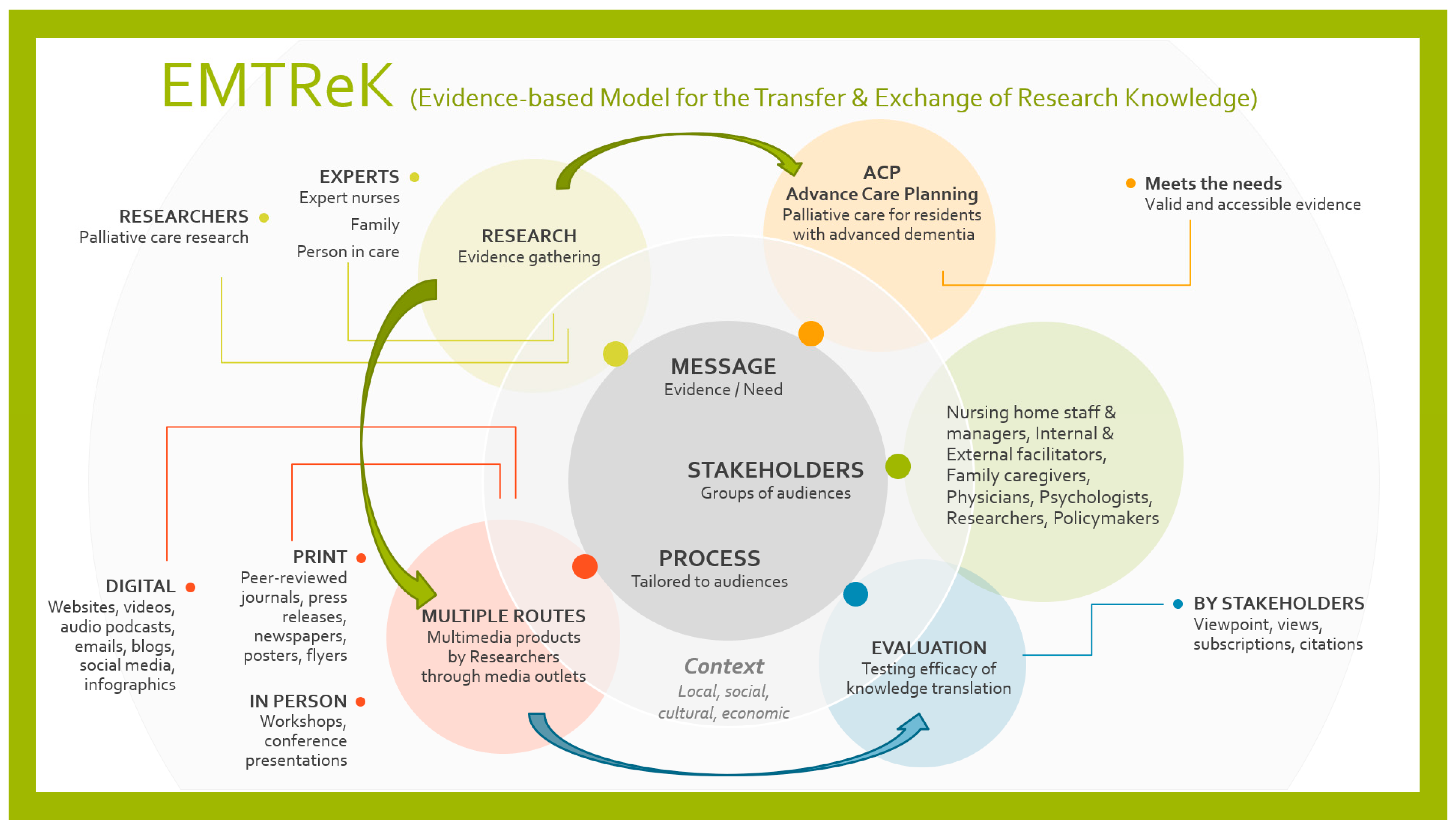
- The message—the information or evidence to be communicated.
- The process—the activities and methods enabling knowledge transfer, including facilitators and champions.
- The stakeholders—the individuals or groups generating or applying knowledge [11]. These components operate within two types of contexts.
- Local context—the immediate organisational setting (e.g., nursing homes).
- Broader context—social, cultural, and economic factors shaping research and implementation.
- Outcomes—mechanism to evaluate the success of the knowledge transfer.
2. Materials and Methods
2.1. Patient and Public Involvement and Contribution
2.2. Introduction to the Advance Care Planning Intervention Study
2.3. Data Analysis:
3. Results
3.1. The Message
3.2. The Stakeholders
3.3. Multiple Processes
3.4. The Local Context
3.5. The Wider Social, Cultural and Economic Context
3.6. Evaluation of the Model
4. Discussion
4.1. Integration of EMTReK Components in Advance Care Planning Implementation
4.2. Stakeholder Engagement and Interdisciplinary Collaboration
4.3. Adaptability and Resilience in Implementation
4.4. Cultural and Contextual Considerations in Advance Care Planning Implementation
4.5. Implications for Gerontological Nursing Practice
4.6. Limitations and Future Directions
5. Conclusions
Author Contributions
Funding
Data Availability Statement
Acknowledgments
Conflicts of Interest
Abbreviations
| ACDs | Advance Care Directives |
| ACP | Advance Care Planning |
| CA | Canada |
| CCB | Comfort Care Booklet |
| CoP | Community of Practice |
| CZ | Czech Republic (Czechia) |
| EMTReK | Evidence-based Model for the Transfer and Exchange of Research Knowledge |
| FAMILY CARE CONFERENCE | Family Care Conference |
| FCDS | Family Carer Decision Support |
| iKT | Integrated Knowledge Translation |
| IRL | Republic of Ireland |
| IT | Italy |
| KT | Knowledge Translation |
| KTE | Knowledge Transfer and Exchange |
| NI | Northern Ireland |
| NL | The Netherlands |
| UK | United Kingdom |
Appendix A

| Components /Subcomponents | Analysis of Application of Knowledge Transfer and Exchange (n = 160) |
|---|---|
| The Message | Research produces knowledge. From this knowledge multiple messages can be derived. Researchers should reflect on the knowledge to be transferred and adapt their KTE plan accordingly. Includes components relating to the relevance, usability and quality of the knowledge to be transferred. |
| Knowledge meets user’s need | Most participants indicated that they did not have an in-depth knowledge of advance care planning prior to the intervention (IRL). In most cases, detailed resources specific to advance care planning were provided by the Family Care Conference and the Comfort Care Booklet, which enabled participants to explain to their families what the nursing home could do for their relative in care (IRL). Nursing home staff (CA, CZ, IT, NL, UK), physicians, psychologists (NL), managers (IT, NL), internal facilitators (IT), and external facilitators (CZ): Appreciated booklet and workshops for the information and training on discussing challenging topics (CZ, IT). Internal facilitators and family caregivers received written resources (IT). Some family members cited the sensitive topic as a reason why not to engage (UK). Family caregivers (CA, CZ, IT, NL, UK) informed at a Family Care Conference by external facilitator (CZ). Researchers shared that they hoped to be inspired to carry out similar projects in the future (CA, CZ, IT, NL). Policymakers: Were given information on the impact of family conferences on the quality of end-of-life care for nursing home residents and their family caregivers and potential cost savings. Evidence has potential for human resource allocation policies (IT). Or policymakers and other nursing home providers to be contacted in the future (CZ). |
| Knowledge is accessible | The booklet, question prompt list, and flyer were customised to suit language and practice in all partner countries (Czech, Dutch, English, French Canadian, and Italian) Arcand’s video had subtitles in all languages of participating partners. Infographic available in Italian. mySupport website available in Italian. Online training replicated in Czech by external facilitator. Developed training manual for staff in Czech. Online training offered in Canvas in three parts by external facilitator (CA) Environment: Training conducted during staff meetings online (accessed on site, from desk, or from home) (CA). International newsletters translated to Dutch. Information sheets in Dutch adhered to guidelines for human research. The UK partners had four online meetings with six external facilitators during three months of data collection, and there was a Community of Practice initiative lead by Queen’s University Belfast that was frustrated by events related to the COVID-19 pandemic. UK internal facilitators expressed that training could have been streamlined for clarity. Staff suggested adding an interactive element and an opportunity to ask questions and discuss issues. Study material for family carers could be more accessible. |
| Multiple types of knowledge are valid | Researchers collected data before and after interviews and after the conference (CZ). Clinical records and interviews were made available (CA, IT). The external facilitator research pack contained all the relevant documentation, including timesheets and reflection templates. Staff used individual Samsung tablets. Champions and Community of Practice (CoP) initiatives supported training and processing information (IRL). Researcher field notes kept (CA, CZ, IT) as “in-action” reflection (IT), while research diary (CA, IT) as “on-action” reflection (IT). These were used to develop new knowledge and strategies to implement the mySupport study (CA, IT). Study progress information and updates appeared in the newsletter including quantitative and qualitative data (NL). It was important to value all types of expertise: the external facilitator was an expert in advance care planning and dementia care, while the internal facilitators were experts in caring for their residents (UK) |
| Knowledge is credible | Credibility and trustworthiness achieved by consistent presence of the team on site and online, using reflexivity, debriefing, staff input, and collaboration. Use of an external facilitator to role model the intervention (CA). Knowledge originating from multiple sources, including interviews with staff and carers, facilitators, and client receipt inventory, is more credible and trustworthy. Data collected in the Czech Republic was analysed by more than one researcher. The external facilitator completed online training through Canvas and participated in an online Community of Practice in Ireland. Community of Practice online meetings were scheduled over two months with the participation of six external facilitators. Several debriefing sessions between facilitators and research team used for reflexivity, which was pivotal throughout the project (IT). Booklet developed by experts from several disciplines and intervention adopted by two experienced nurse practitioners in hospice and nursing home care (NL). |
| Knowledge is actionable | The intervention materials were tailored to local ethics and protocols. The booklet was based on best-practice approach to care and staff training matched their environment, hierarchical structures, and protocols (CA). Guidelines, podcasts, and blogs have potential to change practice provided the target audience is reached with all the produced knowledge (CZ). The family conferences (Family Carer Decision Support) were viewed as a means of clarifying information and coordinating communication with families; the Comfort Care Booklet was a useful resource to share with the family and a complement to the Family Care Conferences (IRL). The Family Carer Decision Support is seen as a positive addition to the Advance Care Directives used in the home. However, some families may be reluctant to engage in family meetings and discuss end-of-life issues (IRL). Staff suggested the Family Carer Decision Support may introduce discussions about Advance Care Directives to the family by providing information on the topic in a gentler manner (IRL). Tablets were supplied where needed to facilitate training. All internal facilitators were given manuals with information leaflets, a copy of the booklet, pre/post Family Care Conference questionnaires, PowerPoint slides with project timelines/schematic, timesheets, and researchers’ contact details (IRL). KTE activities, the developing of materials by participating countries, and data from the study were widespread on social media and other forums (IRL, IT). The booklet prompts family caregivers to discuss the information with relevant healthcare providers, including physicians, to draft a care plan. The training material includes implementation guidelines (NL). UK participants shared that the booklet could make a real difference to the lives of residents and family carers. The Family Care Conference provided additional structure for service delivery. |
| The Stakeholders | Stakeholders include palliative care researchers, service users, carers—both informal and formal—and citizens with an interest in palliative care, palliative care service providers, academic institutions, health professionals—both specialist and generalist—and agencies. Researchers should identify appropriate stakeholders to be involved in the transfer activities. This should include people on either and/or both sides of the exchange process. |
| Involves multiple stakeholders | Nursing home staff and managers, family caregivers, palliative care researchers (CA, CZ, IT, NL), physicians (CA, NL), head nurses, team leads, front-line care staff, social work interns (CA), academic institutions (CA, IT), persons living with dementia (CA), local health network of the region (CA), and potentially lay public through website and social media (CZ). UK suggested developing an easy-read knowledge transfer document targeted at decision makers. |
| Knowledge producers | From the perspective of knowledge producers, researchers coordinated the entire process from design to data collection and delivering workshops (CA, CZ, IT, NL). These workshops were held in person but matched the material available online in Canvas (CZ). Family caregivers and nursing home staff and managers also contributed to knowledge production (IT). Researchers capture the process using research diaries and in-the-field notes (IT). Field notes and decision-making templates were useful for documenting knowledge (UK). Both external and internal facilitators assisted with training (CA). Study progress continues to be shared with staff (CA). |
| Knowledge users (consumers) | From the perspective of knowledge users, nursing home staff and managers (CA, CZ, IT, NL, UK), physicians, nurses and front-line staff (CA), palliative care researchers and policymakers (CA, IT), and internal and external facilitators (CZ, UK) were involved. |
| Knowledge beneficiaries | From the perspective of knowledge beneficiaries, family caregivers (CA, CZ, IT, NL), residents with advanced dementia (CA, IT), nursing home healthcare professionals (CA, IT, UK), care partners (families and friends of people with dementia) (CA), and palliative care researchers and policymakers (CA) were involved. |
| The Process | From the perspective of the process, strategies for communication can include both traditional (peer-reviewed journal, abstracts, posters, speaking at conferences, workshops, etc.) and non-traditional tools (blogs, podcasts, open access web journals, infographics, leaflets) for knowledge dissemination. Researchers should identify appropriate processes or strategies for implementing the transfer. This is a “push–pull” process influenced by both the researchers’ actions and the needs of other stakeholders. |
| Interactive exchange | The in-person workshops gave the opportunity to use role-play to demonstrate the typical family conference and discussed the topic and booklet afterwards (CZ, NL, UK). An initial meeting with researchers, key informants, nursing home managers, and internal and external facilitators provided the setting to discuss the topic and materials (IT). Sharing new material, e.g., newsletters, videos, social media, was followed up by informal communication with the internal facilitator (CA, IT). Future updates by team leads planned (CA). Regular research meetings to discuss project issues (UK). |
| Skilled facilitation | In some instances, the external facilitator was a clinical social worker and a seasoned facilitator and programme developer with experience working in the local health system and caring for a person living with dementia (CA, NL), supported by research team and clinicians (CA). The researcher became the main contact for information for the nursing home and to provide psychological support (CZ, NL). Monthly meetings of researchers with internal and external facilitators used to discuss issues that needed solving in the project (IT). |
| Opinion leaders/champions | The nursing home manager was involved from the beginning and collaborated with internal facilitators (CZ). Key stakeholders included the following: General public, involved via outreach websites like FRidA (research forum lead by the university of Turin, Italy) that included links to promotion videos and to mySupport website, flyer, social media, infographic, press release, and dissemination through a local Alzheimer Café (IT). Educators, involved via UniTo (University of Turin) flash news with links to media mentioned above (IT). Students, involved via academic email and links to media above (IT). Nursing home staff involved by training workshops, external newsletters, and media above (IT). Training of internal facilitators and managers (CA). Internal facilitators helped in participant recruitment and promotion of the study in their areas during intervention (CA). Site managers made the study a priority during implementation (CA). A practical trainer or a quality nurse was involved in training (NL). Family caregivers involved via the comfort booklet, question prompt list, and media above (IT). Scientific societies involved via promotional video, flyer, and detailed study protocol aimed at Italian Societies of Geriatrics (IT). Policymakers and researchers involved via conference presentations and publications about mySupport study via peer-reviewed journals (IT). KTE champions involved via meetings to develop and enhance skills in KTE facilitation (UK). |
| Marketing knowledge by knowledge being accessible | Video: Promotional video of mySupport available in English with subtitles in all main languages spoken in the participating countries. Additional two-part training video for healthcare staff and care partners (CA, NI collaboration with Dr Arcand) (CA). mySupport video in English with French subtitles, shared by email on site (CA). Audio: Podcast recording with research assistance in 2021 for social work students (CA). Podcast recording with members of SGC about their involvement, experience, and impact (CA). Digital publication: Publication of mySupport study Newsletter [Tétrault, B. 2021] (CA). Information on mySupport study and copies of booklet and questionnaire shared with physicians and nurses and six care homes in the region (CA). Newsletter shared with nursing home managers and staff with regular updates on the project (IT). Italian flyer shared with nursing home staff and geriatric hospice societies (IT). Newsletter, intervention material, and email included the mySupport logo and layout (NL). Online package to launch in 2022: Initiative mySupport study, Creating Comfort Care Awareness (CA). UniTo Flash News newsletter circulated to approx. 3900 academic staff at the University of Turin including links to promotional video and mySupport website (IT). Academic informative email to approx. 81,000 students at the University of Turin including the above links (IT). mySupport informative package including links published on the FRidA (research forum lead by the university of Turin, Italy) website, with audience including researchers, university staff, students at university and high school, journalists, and lay population; the website counted 20,000 users in 2020 <https://frida.unito.it/57_my-support---un-supporto-per-le-scelte-difficili-di-fine-vita> (IT) (accessed on 4 May 2023). mySupport information package including links published on the homepage of the University of Turin’s new pages. Print: Press release in local newspaper covering nursing homes (IT). External facilitator created a brief overview of the Family Care Conference facilitator training (NL). Researcher created a factsheet with a scientific summary of the project in lay terms (NL). Workshops: Researchers and external facilitators provided workshops about the intervention for a broad audience (NL). Translations: Czech translation of all materials provided to nursing home staff, branded with mySupport study logo (CZ). Italian translation of all materials (IT). |
| Diverse activities - Comfort Care Booklet - Family Care Conference conversations with staff - Other media such as website and leaflets related to mySupport study | Dissemination of study materials, newsletter, weblinks, and flyers to staff, internal managers, participants, and other LTC homes (CA, IT, NL, UK). Informal phone calls, emails, in-person conversations, and factsheets (NL). Family Care Conference time slots tailored to staff availability (CA). The complete study presented in the Czech Journal E-Psychology and information available on the website: Centre for Palliative Care. (CZ). Nursing home managers and internal/external facilitators and the research team met at the start of the study to discuss the use of the booklet, this established trusting relationships (IT). Regular conversations between staff and researchers help define improvements in family recruitment (IT). One UK site made a small presentation to external colleagues to announce their involvement in the study, using videos, websites, and other resources. |
| Targeted, timely activities | From the perspective of targeted timely activities, regular checks were conducted to maintain momentum, and updates were provided periodically to managers (CA, CZ, IT, NL, UK). Regular email checks were sent to participants, with confirmations sent after completing tasks or attending events (CA). Contacts were intensified near recruitment and events (NL). All stakeholders asked to publicise the project and disseminate resources in a snowball approach (NL). |
| The Local Context | Researchers must consider the impact and influence that relevant local settings in which the transfer will occur can have on the process. Can include organisational settings. |
| Impact and influence of local setting on the transfer process | The organisation is part of the local health network that provides professional development opportunities for staff. The site is also linked to a university and is considered a research site. Efforts in place to share with regional health networks (CA). Staff and caregivers required translation and adaptation of all the material into Czech (CZ). Access to computers was limited, therefore requiring face-to-face training by an external facilitator (CZ, NL). Because care staff are not desk-based, printed information distributed to staff rooms might be more effective than online electronic information. This was a challenge in the context of remote delivery (UK). |
| Organisational influence | Managers and team lead promoted the involvement in professional development training in collaboration with researchers (CA, CZ, IT, NL). COVID-19 had a significant impact on the capacity to collaborate (CA). Internal facilitators felt supported by managers (IT). |
| Organisational culture | The culture of the organisation supported and welcomed professional development opportunities (CA). The organisation has experience hosting research studies on site (CA). The two participating nursing homes had different palliative care programmes in place; both benefitted from the Family Care Conferences (CZ). In one site, the manager appreciated the value of research in improving the quality of care provided for their residents; this appreciation was thought to be related to the higher education of that manager, which indirectly influenced the process of KTE (IT). Nursing homes are becoming more person-centred, recognising the importance of family carers and the need to inform them and get them more involved in the process of care (NL). Understanding an organisation’s values, priorities, strategies, and action plans can influence the application of KTE as an addition to the model they already have (UK). |
| Readiness is key | Sites had limited time for reflection and intervention and various levels of readiness for the study despite efforts from the research team, mainly because the study took place during the COVID-19 pandemic, which required prioritisation (CA). Nursing homes were prepared for change, having already started Family Care Conferences, and wanted to start with palliative care earlier (CZ). Nursing home staff and management were ready for change as they saw an opportunity to improve the quality of care and discuss neglected topics, education, and reflection. Internal facilitators looked forward to sustainable changes to overcome complacency and resistance to change (IT). In the second nursing home they were in strong need of change to improve communications among staff and managers and contact with family caregivers (NL). |
| Resourcing KTE | To help with implementation, uptake, and effectiveness, collaborations were built between researchers, care home staff, facilitators, and participants. Ongoing support provided to alleviate demand on care home, empower staff to engage in a new approach, and organise Family Care Conferences including room booking, invitations, and confirmations. Thank-you gift cards provided to internal facilitators afterwards (CA). Project activities were seen as a burden to nursing home staff and required some convincing (CZ). It was essential to establish a partnership with stakeholders to achieve an effective process of KTE (IT). Managers of the second nursing home facilitated staff extra hours to devote to the project (NL). |
| Social, cultural and economic context | The local culture considers talking about end-of-life and death as a taboo in Italy; family carers and nursing home managers avoid the terms “death” and “end of life”, and they are rarely discussed with families. This cultural context was considered in the translation of the materials given to family caregivers and written in lay terms for the public (IT). This is elaborated in a blog by the early career researchers available at https://mysupportstudy.eu/cultural-differences-and-advance-care-planning-for-residents-with-dementia-in-nursing-homes-emerging-considerations-and-recommendations-from-the-mysupport-study/ (accessed on 2 July 2022). |
| Efficacy (evaluation) | The COVID-19 pandemic caused a delay in the implementation of the study; staff had difficulty taking up the intervention, and the external facilitators provided additional requested training. Internal facilitators were supported and made the booklet accessible, but it was not utilised to its fullest potential. As internal facilitators expected, only one physician attended training despite all being invited. The booklet was considered clear and informative to all (CA). In the first nursing home, staff saw training as a burden and had no personnel to organise conferences; when these conferences occurred, no information was shared with those outside the participants. The second nursing home welcomed the study and will probably continue offering the Family Care Conferences. Outcomes of the project were shared with all staff (CZ). Dissemination strategies were tailored to stakeholders (IT). |
References
- CIHR. Knowledge Mobilisation and Translation Learning. Available online: https://www.cihr-irsc.gc.ca/e/49443.html (accessed on 19 February 2025).
- Kastner, M.; Makarski, J.; Hayden, L.; Lai, Y.; Chan, J.; Treister, V.; Harris, K.; Munce, S.; Holroyd-Leduc, J.; Graham, I.D.; et al. Improving KT tools and products: Development and evaluation of a framework for creating optimized, Knowledge-activated Tools (KaT). Implement. Sci. Commun. 2020, 1, 47. [Google Scholar] [CrossRef]
- Brazil, K.; Carter, G.; Cardwell, C.; Clarke, M.; Hudson, P.; Froggatt, K.; McLaughlin, D.; Passmore, P.; Kernohan, W.G. Effectiveness of advance care planning with family carers in dementia nursing homes: A paired cluster randomized controlled trial. Palliat. Med. 2018, 32, 603–612. [Google Scholar] [CrossRef]
- Harding, A.J.E.; Doherty, J.; Bavelaar, L.; Walshe, C.; Preston, N.; Kaasalainen, S.; Sussman, T.; van der Steen, J.T.; Cornally, N.; Hartigan, I.; et al. A Family Carer Decision Support Intervention for people with advance dementia residing in a nursing home: A study protocol for an international advance care planning intervention (mySupport study). BMC Geriatr. 2022, 22, 822. [Google Scholar] [CrossRef]
- McDermott, E.; Selman, L.E. Cultural factors influencing advance care planning in progressive, incurable disease: A systematic review with narrative synthesis. J. Pain Symptom Manag. 2018, 56, 613–636. [Google Scholar] [CrossRef]
- Soheilipour, S.; Jang, K.; de Vries, B.; Kwan, H.; Gutman, G. A confluence of cultures: Advance care planning in long-term care settings. J. Long-Term Care 2023, 2023, 120–134. [Google Scholar] [CrossRef]
- Sinclair, C.; Sellars, M.; Buck, K.; Detering, K.M.; White, B.P.; Nolte, L. Association between region of birth and Advance Care Planning documentation among older Australian migrant communities: A multicenter audit study. J. Gerontol. Ser. B Psychol. Sci. Soc. Sci. 2021, 76, 109–120. [Google Scholar] [CrossRef]
- Esmail, R.; Hanson, H.M.; Holroyd-Leduc, J.; Brown, S.; Strifler, L.; Straus, S.E.; Niven, D.J.; Clement, F.M. A scoping review of full-spectrum knowledge translation theories, models, and frameworks. Implement. Sci. 2020, 15, 11. [Google Scholar] [CrossRef]
- King, O.; West, E.; Alston, L.; Beks, H.; Callisaya, M.; Huggins, C.E.; Murray, M.; McNamara, K.; Pang, M.; Payne, W.; et al. Models and approaches for building knowledge translation capacity and capability in health services: A scoping review. Implement. Sci. IS 2024, 19, 7. [Google Scholar] [CrossRef]
- Payne, C.; Brown, M.J.; Guerin, S.; Kernohan, W.G. EMTReK: An Evidence-based Model for the Transfer & Exchange of Research Knowledge—Five Case Studies in Palliative Care. SAGE Open Nurs. 2019, 5, 2377960819861854. [Google Scholar] [CrossRef]
- Prihodova, L.; Guerin, S.; Tunney, C.; Kernohan, W.G. Key components of knowledge transfer and exchange in health services research: Findings from a systematic scoping review. J. Adv. Nurs. 2018, 75, 313–326. [Google Scholar] [CrossRef]
- Arcand, M.; Brazil, K.; Nakanishi, M.; Nakashima, T.; Alix, M.; Desson, J.-F.; Morello, R.; Belzile, L.; Beaulieu, M.; Hertogh, C.M.; et al. Educating families about end-of-life care in advanced dementia: Acceptability of a Canadian family booklet to nurses from Canada, France, and Japan-PubMed. Int. J. Palliat. Nurs. 2013, 19, 67–74. [Google Scholar] [CrossRef]
- van der Steen, J.T.; Toscani, F.; de Graas, T.; Finetti, S.; Nakanishi, M.; Nakashima, T.; Brazil, K.; Hertogh, C.M.P.M.; Arcand, M. Physicians’ and nurses’ perceived usefulness and acceptability of a family information booklet about comfort care in advanced dementia-PubMed. J. Palliat. Med. 2011, 14, 614–622. [Google Scholar] [CrossRef]
- Tong, A.; Sainsbury, P.; Craig, J. Consolidated criteria for reporting qualitative research (COREQ): A 32-item checklist for interviews and focus groups. Int. J. Qual. Health Care 2007, 19, 349–357. [Google Scholar] [CrossRef]
- Vellani, S.; Yous, M.-L.; Rivas, V.M.; Lucchese, S.; Kruizinga, J.; Sussman, T.; Abelson, J.; Akhtar-Danesh, N.; Bravo, G.; Brazil, K.; et al. Patient and public involvement in international research: Perspectives of a team of researchers from six countries on collaborating with people with lived experiences of dementia and end-of-life. Health Expect. 2024, 27, e13942. [Google Scholar] [CrossRef]
- mySupport. The mySupport Study. Available online: https://www.ucc.ie/en/ppi-ignite/ppicasestudies/themysupportstudy/ (accessed on 22 April 2025).
- Brazil, K.; Walshe, C.; Doherty, J.; Harding, A.J.E.; Preston, N.; Bavelaar, L.; Cornally, N.; Di Giulio, P.; Gonella, S.; Hartigan, I.; et al. Implementation of an Advance Care Planning Intervention in Nursing Homes: An International Multiple Case Study. Gerontologist 2024, 64, gnae007. [Google Scholar] [CrossRef]
- Ritchie, J.; Spencer, L.; O’Connor, W. Carrying out qualitative analysis. In Qualitative Research Practice: A Guide for Social Science Students and Researchers; Ritchie, J., Lewis, J., Eds.; Sage: London, UK, 2003. [Google Scholar]
- Creswell, J.W.; Poth, C.N. Qualitative Inquiry and Research Design, 4th ed.; SAGE Publications Ltd.: London, UK, 2018; p. 459. [Google Scholar]
- Shelton, R.C.; Adsul, P.; Emmons, K.M.; Linnan, L.A.; Allen, J.D. Fidelity and its relationship to effectiveness, adaptation, and implementation. In Dissemination and Implementation Research in Health: Translating Science to Practice, 3rd ed.; Brownson, R.C., Colditz, G.A., Proctor, E.K., Eds.; Oxford University Press: Oxford, UK, 2023; pp. 147–171. [Google Scholar]
- Hanson, L.C.; Song, M.-K.; Zimmerman, S.; Gilliam, R.; Rosemond, C.; Chisholm, L.; Lin, F.-C. Fidelity to a behavioral intervention to improve goals of care decisions for nursing home residents with advanced dementia. Clin. Trials 2016, 13, 599–604. [Google Scholar] [CrossRef]
- Archibald, M.M. Co-implementation: Collaborative and concurrent approaches to advance embedded implementation in the health sciences. Front. Health Serv. 2023, 3, 1068297. [Google Scholar] [CrossRef]
- O’Donnell, D.; Davies, C.; Christophers, L.; Ní Shé, É.; Donnelly, S.; Kroll, T. An examination of relational dynamics of power in the context of supported (assisted) decision-making with older people and those with disabilities in an acute healthcare setting. Health Expect. 2023, 26, 1339–1348. [Google Scholar] [CrossRef]
- O’Donnell, D.; Dickson, C.A.W.; Phelan, A.; Brown, D.; Byrne, G.; Cardiff, S.; Cook, N.F.; Dunleavy, S.; Kmetec, S.; McCormack, B. A mixed methods approach to the development of a person-centred curriculum framework: Surfacing person-centred principles and practices. Int. Pract. Dev. J. 2022, 12, 1–14. [Google Scholar] [CrossRef]
- Palmer, J.A.; Parker, V.A.; Mor, V.; Volandes, A.E.; Barre, L.R.; Belanger, E.; Carter, P.; Loomer, L.; McCreedy, E.; Mitchell, S.L. Barriers and facilitators to implementing a pragmatic trial to improve advance care planning in the nursing home setting. BMC Health Serv. Res. 2019, 19, 527. [Google Scholar] [CrossRef]
- Gilissen, J.; Pivodic, L.; Wendrich-van Dael, A.; Gastmans, C.; Vander Stichele, R.; Van Humbeeck, L.; Deliens, L.; Van den Block, L. Implementing advance care planning in routine nursing home care: The development of the theory-based ACP+ program. PLoS ONE 2019, 14, e0223586. [Google Scholar] [CrossRef] [PubMed]
- Garland, A.; Keller, H.; Quail, P.; Boscart, V.; Heyer, M.; Ramsey, C.; Vucea, V.; Choi, N.; Bains, I.; King, S.; et al. BABEL (Better tArgeting, Better outcomes for frail ELderly patients) advance care planning: A comprehensive approach to advance care planning in nursing homes: A cluster randomised trial. Age Ageing 2022, 51, afac049. [Google Scholar] [CrossRef]
- Aasmul, I.; Husebo, B.S.; Flo, E. Description of an advance care planning intervention in nursing homes: Outcomes of the process evaluation. BMC Geriatr. 2018, 18, 26. [Google Scholar] [CrossRef]
- Katie, W.; Lan, F.M.; Judith, S. Implementing advance care planning in palliative and end of life care: A scoping review of community nursing perspectives. BMC Geriatr. 2024, 24, 294. [Google Scholar] [CrossRef]
- Whitehead, P.; Frechman, E.; Johnstone-Petty, M.; Kates, J.; Tay, D.L.; DeSanto, K.; Fink, R.M. A scoping review of nurse-led advance care planning. Nurs. Outlook 2022, 70, 96–118. [Google Scholar] [CrossRef] [PubMed]
- Garcia, P.; Kim, H.J.; Barbour, S.; Cooper, A.S. Empowering nurses to increase engagement in advance care planning in a medicine transitional care unit: A best practice implementation project. JBI Evid. Implement. 2023, 21, 310–324. [Google Scholar] [CrossRef] [PubMed]

| Framework/Model Name | Description | Typical Application in Healthcare |
|---|---|---|
| Knowledge to Action (KTA) | Overarching process from knowledge creation to implementation and sustainability | Guiding research into practice and policy |
| Evidence-based Model for the Transfer and Exchange of Research Knowledge (EMTReK) | Focuses on developing key messages for specific audiences and contexts | Research dissemination and stakeholder engagement |
| Practical Robust Implementation and Sustainability Model (PRISM) | Emphasises implementation, sustainability, and contextual fit of interventions | Sustaining evidence-based interventions |
| Diffusion of Innovations Theory | Describes how innovations diffuse across populations | Adoption of new practices or technologies |
| Understanding-User-Context Framework | Tailors’ knowledge translation by focusing on user needs and context | Customising knowledge translation (KT) strategies for different settings |
| Consolidated Framework for Implementation Research (CFIR) | Provides a comprehensive structure for assessing implementation across multiple domains | Implementation research and evaluation |
| Promoting Action on Research Implementation in Health Services (PARIHS) | Highlights the interplay between evidence, context, and facilitation in successful implementation | Facilitating evidence-based practice |
| Theoretical Domains Framework (TDF) | Identifies determinants of behaviour change | Designing behaviour change interventions |
| Ottawa Model of Research Use | Focuses on the process of research uptake and factors influencing use | Promoting research use in clinical practice |
| Knowledge Transfer Effectiveness (KTE) | Emphasises effectiveness of knowledge transfer processes | Technology transfer and innovation |
| Components and Subcomponents of Interview Questionnaires | |
|---|---|
| 1. The Message | |
| Knowledge meets user’s need Knowledge is accessible Multiple types of knowledge are valid | Knowledge is credible Knowledge is actionable |
| 2. The Stakeholders | |
| Involves multiple stakeholders Knowledge producers | Knowledge users (consumers) Knowledge beneficiaries |
| 3. The Process | |
| Interactive exchange Skilled facilitation Opinion leaders/champions Marketing knowledge by knowledge being accessible Targeted, timely activities | Diverse activities
|
| 4. The Local Context | |
| Impact and influence of local setting on the transfer process Organisational influence Organisational culture | Readiness is key Resourcing KTE Social, cultural, and economic context Efficacy (evaluation) |
| KTE Component and Subcomponents | Summary of Insights from Participating Countries | Examples from Study Sites |
|---|---|---|
| The Message | Focused on person-centred advance care planning; adapted culturally through translated videos, booklets, and discussion guides. | All countries. Local relevance emphasised. |
| Knowledge Relevance | Addressed identified gaps in advance care planning knowledge; emphasised communication skills for end-of-life care planning. | Ireland, Netherlands, UK. |
| Knowledge Accessibility | Use of accessible formats (print, digital, video) to reach varied literacy and technological capacities. | Czech Republic (print); Canada and Netherlands (digital). |
| Credibility of Knowledge | Built through trusted facilitation, clinical documentation, and evidence-informed resources. | Noted in Italy, Ireland, and UK. |
| Multiple Knowledge Forms | Combined formal research, clinical experience, and carer perspectives; use of tablets and online platforms | Canada and Netherlands emphasised digital support. |
| Actionability | Training translated into practice through Family Care Conferences and local planning tools. | Italy and UK emphasised actionable outputs. |
| Stakeholders | Involved care staff, family carers, managers, students, and researchers in co-design and delivery. | Strong engagement in Ireland and UK. |
| Interactive Exchange | Supported through workshops, reflective practice, and informal dialogue, encouraging bidirectional learning. | Canada, Czech Republic, Ireland. |
| Facilitation and Leadership | Required proactive leadership and champions to support adaptation and implementation. | Strong facilitation in Canada and Netherlands. |
| Knowledge Dissemination | Strategies extended to podcasts, blogs, press releases, and social media to increase reach and impact. | Ireland and UK leveraged multiple media platforms. |
| Local Context | Delivery was influenced by language, staffing, cultural norms, and organisational structures. | Clear contrasts between Czech Republic and Canada. |
| Organisational Readiness and Resourcing | Contextual enablers included openness to innovation, leadership buy-in, and a culture of person-centred care. Practical supports (e.g., protected time, space, incentives) facilitated participation and sustainability. | Netherlands, UK, Ireland, and Italy highlighted resourcing needs. |
| Evaluating Efficacy | Palliative care interventions require comprehensive, multidimensional communication that reflects the complexity of patient and caregiver needs. | All countries valued the booklet as a resource to support continuity and coordination of care 2 |
Disclaimer/Publisher’s Note: The statements, opinions and data contained in all publications are solely those of the individual author(s) and contributor(s) and not of MDPI and/or the editor(s). MDPI and/or the editor(s) disclaim responsibility for any injury to people or property resulting from any ideas, methods, instructions or products referred to in the content. |
© 2025 by the authors. Licensee MDPI, Basel, Switzerland. This article is an open access article distributed under the terms and conditions of the Creative Commons Attribution (CC BY) license (https://creativecommons.org/licenses/by/4.0/).
Share and Cite
Hartigan, I.; Buckley, C.; Cornally, N.; Brazil, K.; Doherty, J.; Walshe, C.; Harding, A.J.E.; Preston, N.; Bavelaar, L.; van der Steen, J.T.; et al. EMTReK Model for Advance Care Planning in Long-Term Care: Qualitative Findings from mySupport Study. Geriatrics 2025, 10, 171. https://doi.org/10.3390/geriatrics10060171
Hartigan I, Buckley C, Cornally N, Brazil K, Doherty J, Walshe C, Harding AJE, Preston N, Bavelaar L, van der Steen JT, et al. EMTReK Model for Advance Care Planning in Long-Term Care: Qualitative Findings from mySupport Study. Geriatrics. 2025; 10(6):171. https://doi.org/10.3390/geriatrics10060171
Chicago/Turabian StyleHartigan, Irene, Catherine Buckley, Nicola Cornally, Kevin Brazil, Julie Doherty, Catherine Walshe, Andrew J. E. Harding, Nancy Preston, Laura Bavelaar, Jenny T. van der Steen, and et al. 2025. "EMTReK Model for Advance Care Planning in Long-Term Care: Qualitative Findings from mySupport Study" Geriatrics 10, no. 6: 171. https://doi.org/10.3390/geriatrics10060171
APA StyleHartigan, I., Buckley, C., Cornally, N., Brazil, K., Doherty, J., Walshe, C., Harding, A. J. E., Preston, N., Bavelaar, L., van der Steen, J. T., Di Giulio, P., Gonella, S., Kaasalainen, S., Sussman, T., Tétrault, B., Loučka, M., Vlčková, K., Gonzales, R. A., & on behalf of the mySupport Study Group. (2025). EMTReK Model for Advance Care Planning in Long-Term Care: Qualitative Findings from mySupport Study. Geriatrics, 10(6), 171. https://doi.org/10.3390/geriatrics10060171