Clinical Reasoning Uncertainty in Veterinary Medical Encounters with a Clinical Example



Simple Summary
Abstract
1. Introduction
2. Search Methodology
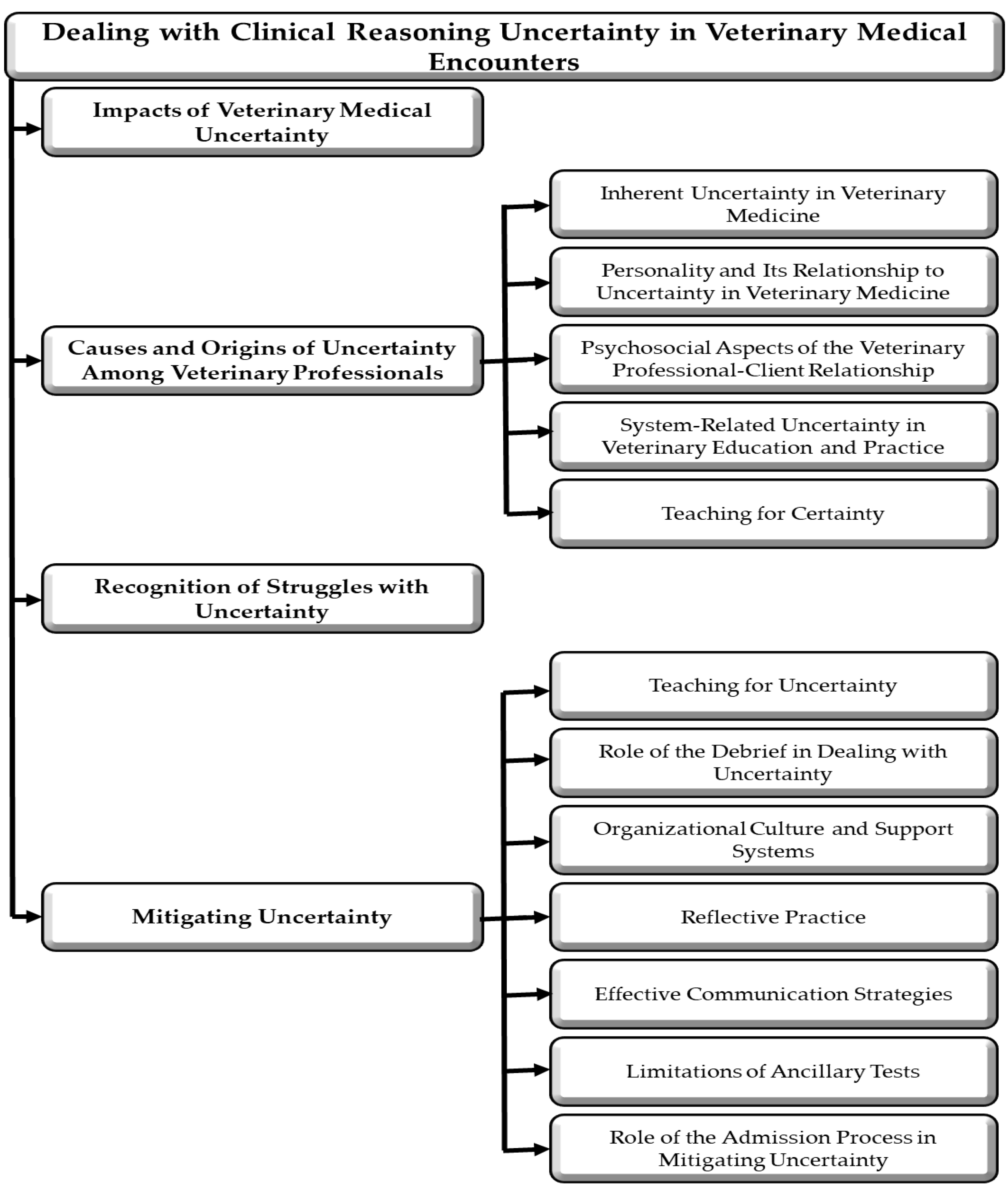
3. Impacts of Veterinary Medical Uncertainty
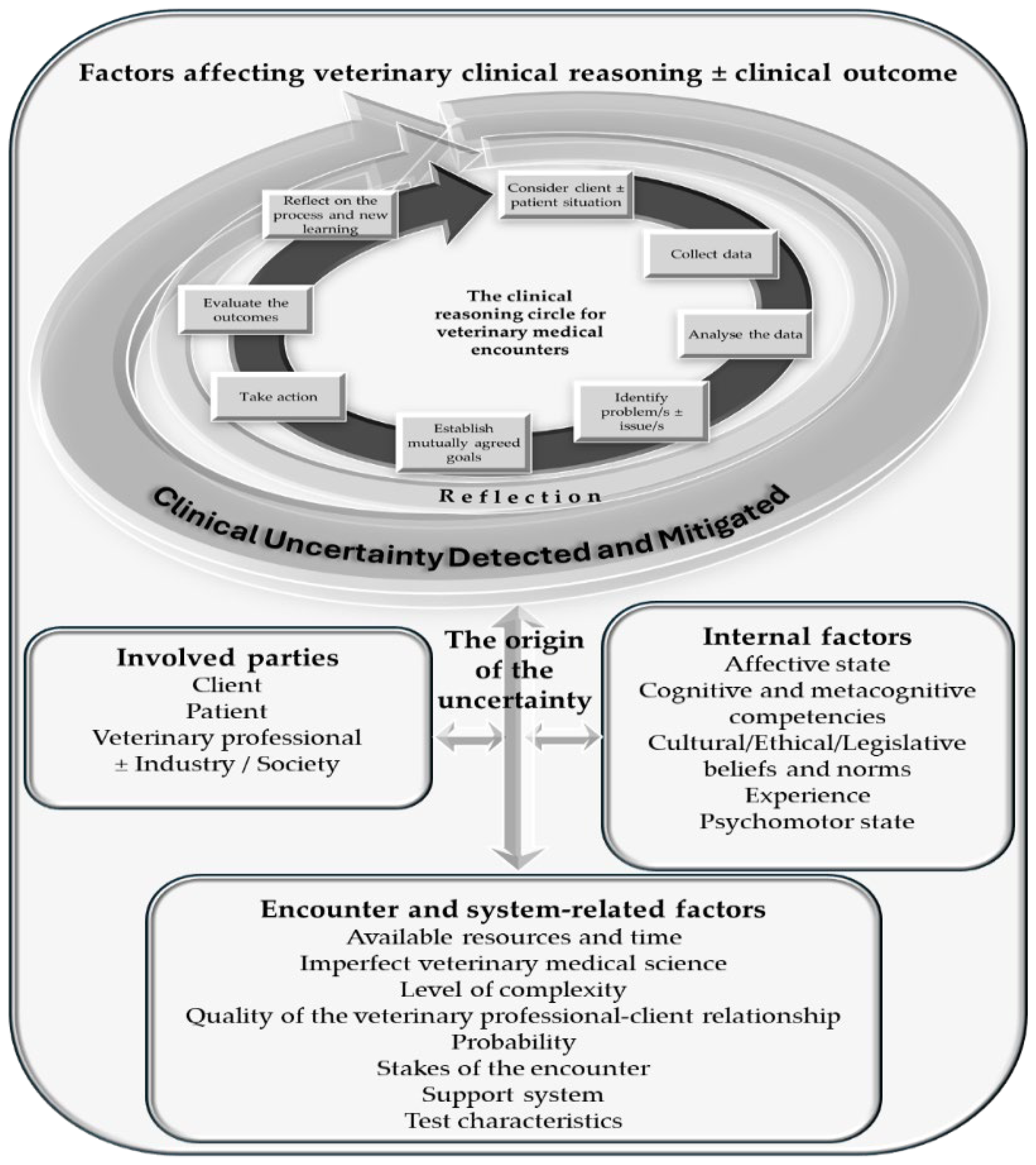
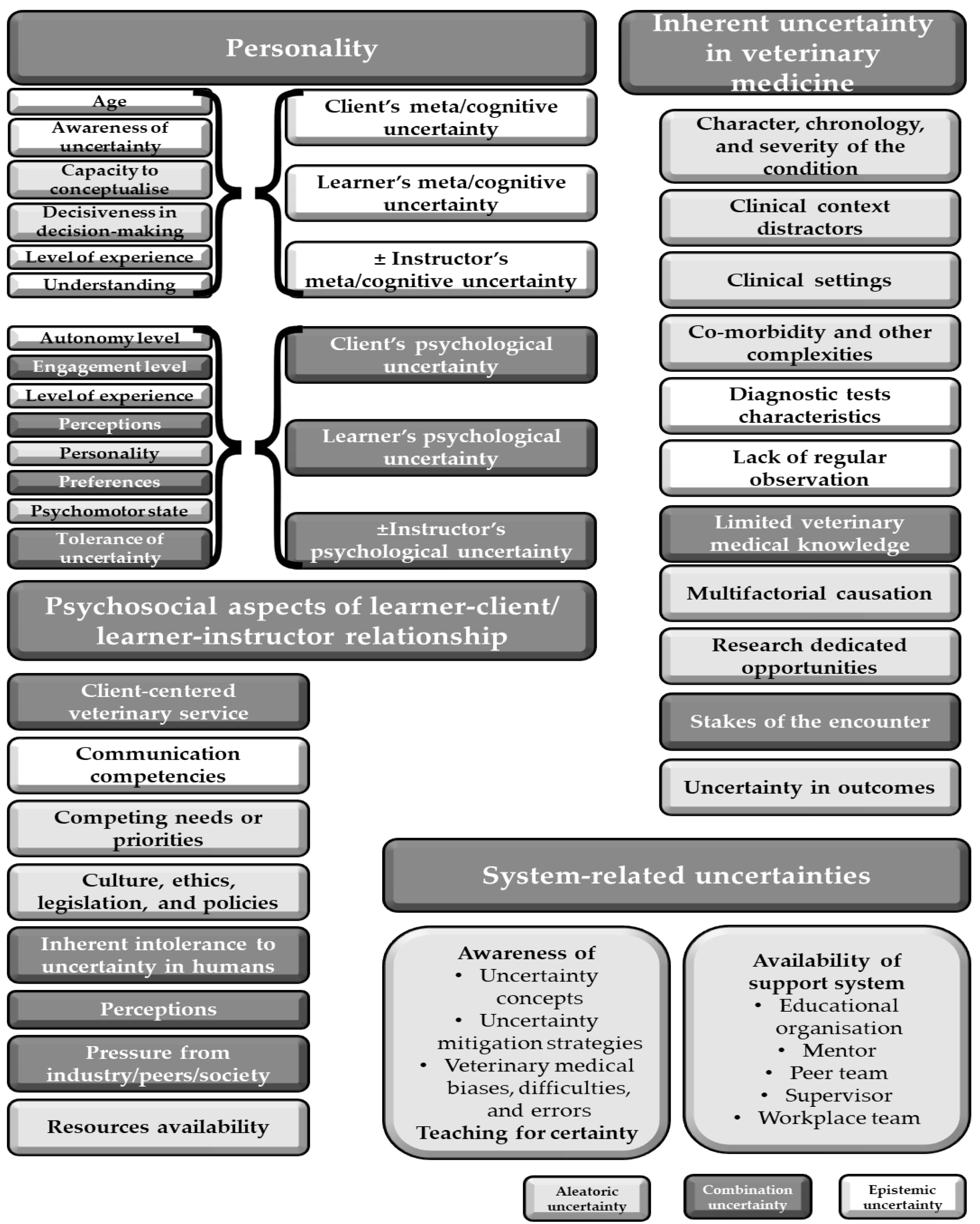
4. Causes and Origins of Uncertainty Among Veterinary Professionals
4.1. Inherent Uncertainty in Veterinary Medicine
4.1.1. Uncertainties Related to the Nature of Veterinary Medicine
4.1.2. Uncertainties Related to the Clinical Context
4.1.3. Uncertainties Related to the Clinical Setting
4.1.4. Uncertainties Related to Limited Veterinary Medical Knowledge
4.2. Personality and Its Relationship to Uncertainty in Veterinary Medicine
Personality Traits Related to Variability in Tolerance of Uncertainty
4.3. Psychosocial Aspects of the Veterinary Professional–Client Relationship
4.3.1. Uncertainties Related to Perceptions and Expectations
4.3.2. Uncertainties Related to Contextual Influences
4.3.3. Uncertainties Related to Communication Competencies
4.4. System-Related Uncertainty in Veterinary Education and Practice
4.4.1. Uncertainty Related to the Veterinary Clinical Settings
4.4.2. Pressures Affecting Decision-Making in the Clinical Reasoning of Veterinary Practitioners
4.4.3. Effect of Support System on Uncertainty
4.5. Teaching for Certainty
5. Recognition of Struggles with Uncertainty

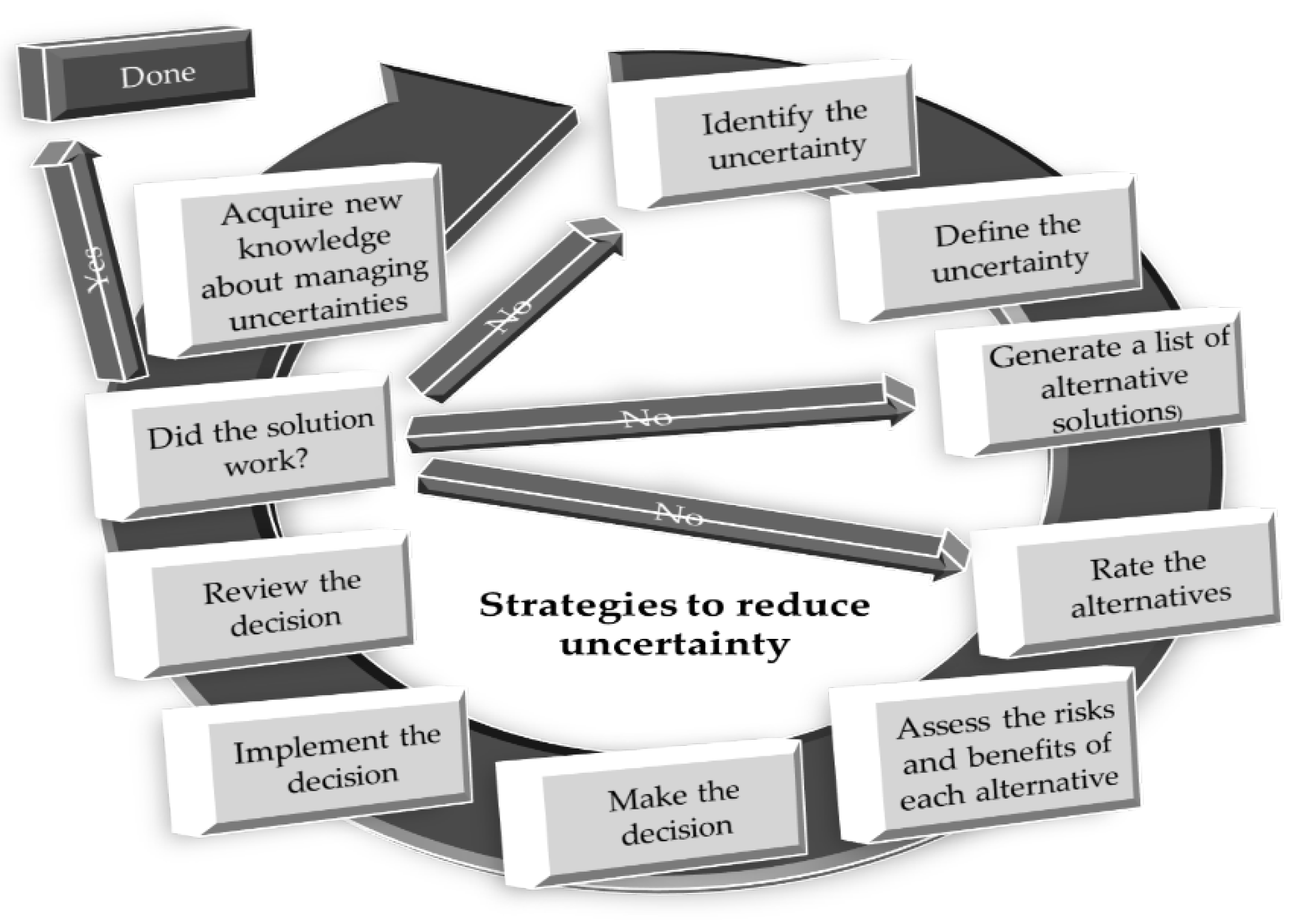
6. Mitigating Uncertainty


| Origin of Uncertainty | Factor | Proposed Strategies | References |
|---|---|---|---|
| Inherent uncertainty in veterinary medicine | Character, chronology, and severity of the condition | An assessment methodology that enables tolerance of variability in the presentation of morbidity | [2,6] |
| Cognitive forcing strategies; Collecting sufficient (but not excessive) data; Continuing education | [1,3,6,10,13,18,21,44,48,58,74,134] | ||
| Debrief | [34] | ||
| Dedicated research opportunities | [3,18,74] | ||
| Developing clinical reasoning competency of the veterinary professional | [10,48,79] | ||
| Developing general and clinical problem-solving skills | [6,10,11,13,95] | ||
| Peer discussions/teaching | [3,8,10,34,45,58,74] | ||
| Repeated practice | [19,34,134] | ||
| Use of artificial intelligence | [130] | ||
| Use of clinical teaching models (e.g., The five microskills, SNAPPS) | [1,24,28,48,83,95,135,136,137] | ||
| Use of other clinical teaching strategies (e.g., diagnostic pause, role modeling) | [1,27,28] | ||
| Clinical encounter context distractors | Address the distractors | [41,74] | |
| Vigilance | [18] | ||
| Clinical settings | Ensuring good orientation and setting expectations | NA | |
| Comorbidity and other complexities | An assessment methodology that enables tolerance of comorbidity/other complexity | [2,6] | |
| Cognitive forcing strategies; Collecting sufficient (but not excessive) data; Continuing education; Repeated practice | [1,3,6,18,21,44,48,58,102] | ||
| Dedicated research opportunities | [18,58,74] | ||
| Gamification | [6,95] | ||
| Peer discussions/teaching | [58,102] | ||
| Use of artificial intelligence | [130] | ||
| Diagnostic tests characteristics | Awareness of diagnostic test limitations | [1,48,56,96,108,132] | |
| Consider the use of an alternative diagnostic test | [74] | ||
| Peer discussions/teaching | [58] | ||
| Repeated practice | [10,48,74,95] | ||
| Use of artificial intelligence | [130] | ||
| Use of evidence-based veterinary medicine | [48,58,67,74,87] | ||
| Use of technology, including artificial intelligence | [74] | ||
| High-stake encounter | Awareness of high-stakes encounters | [75,96,128] | |
| Awareness of expected communication | [75] | ||
| Cognitive forcing strategies | [48,75,128] | ||
| Developing general and clinical problem-solving skills | [6,13,133] | ||
| Peer discussions/teaching | [128] | ||
| Regular use of reflective practice | [6,34,74] | ||
| Repeated practice | [75,96] | ||
| Lack of regular observation | Client education | NA | |
| Regular analysis of the client’s records to stimulate record-keeping | NA | ||
| Limited veterinary medical knowledge | Assisting the mental organization of knowledge | [13] | |
| Cognitive forcing strategies | [13,18,48,58] | ||
| Facilitated discussion intertwined with uncertainty | [1,3,8,22,23,24,28,38,95] | ||
| More research; Preparation of veterinary medical practice guidelines | [3,48,51,58,116] | ||
| Peer discussions/teaching | [34,58] | ||
| Use of artificial intelligence | [130] | ||
| Multifactorial causation | An assessment methodology that enables tolerance of multifactorial causation | [2,6] | |
| Cognitive forcing strategies; Collecting sufficient (but not excessive) data; Continuing education | [1,3,6,18,21,44,48,58] | ||
| Dedicated research opportunities | [18,58,74] | ||
| Regular use of reflective practice | [34,84] | ||
| Peer discussions/teaching | [34,58] | ||
| Repeated practice | [21,34,48] | ||
| Research dedicated opportunities | Allowing time for research related to uncertainty | [58,74] | |
| Uncertainty in outcomes | Cognitive forcing strategies | [48] | |
| Peer discussions/teaching | [34,58] | ||
| Regular use of reflective practice | [3,6,32,34,42,74,84,95] | ||
| Use of artificial intelligence | [130] | ||
| Use of clinical teaching models (e.g., The five microskills, SNAPPS) | [1,24,28,83,95,136,137] | ||
| Personality | Age | NA | NA |
| Autonomy level | Gradual development of professional autonomy in veterinary professionals | [53] | |
| Repeated practice | [6,16,34] | ||
| Awareness of uncertainty | An assessment methodology that enables tolerance of uncertainty | [2,6,8,34,102] | |
| Cognitive forcing strategies | [8,40,101,102] | ||
| Facilitated discussion intertwined with uncertainty | [1,3,6,8,22,23,24,28,38,83,95] | ||
| Gamification (e.g., tactical decision games) | [6,95,121] | ||
| Inclusion of uncertainty in veterinary medical education curricula and continuing education events; Tolerating uncertainty as a ‘normal’ occurrence in veterinary medicine | [3,6,8,17,21,22,27,32,40,42,43,44,48,87,106] | ||
| Peer/Workplace team members’ discussions | [1,3,17,22,45,102] | ||
| Reflective practice | [8,48,84,102,122] | ||
| Simple verbal acknowledgement of uncertainty by instructors | [8,84,102,122] | ||
| Understanding that, despite all professional development, some level of uncertainty will be a regular occurrence in veterinary clinical practice | [21,22,37,83] | ||
| Use of clinical teaching models (e.g., The five microskills, SNAPPS) | [8,48,122,137] | ||
| Linguistic imperfections | Effective communication; Use of summary and clarification | [12,54,55,104] | |
| The client’s cognitive uncertainty | Assess the uncertainty in the client and discuss it further | [19,54,55] | |
| Include elements of shared decision-making | [44,48,84,93] | ||
| Use of a safety net approach | [3,13,19,59,84,93,96,104] | ||
| Client’s psychological uncertainty | Assess the uncertainty in the client and discuss it further | [19,54,55] | |
| Provide emotional support to the client | [19,54] | ||
| Capacity to conceptualize | Developing general and clinical problem-solving skills | [6,13,76,133] | |
| Developing clinical reasoning competency of the veterinary professional | [31,79,86] | ||
| Repeated practice | [21,42,44] | ||
| Decisiveness in decision-making | Developing general and clinical problem-solving skills | [13,76,133] | |
| Developing clinical reasoning competency of the veterinary professional | [79] | ||
| Utilize artificial intelligence and technology | [17,27,42,43,48,117] | ||
| Engagement level | Use of clinical teaching models (e.g., The five microskills, SNAPPS) | [1,24,28,136] | |
| Use of other clinical teaching strategies (e.g., diagnostic pause, role modeling) | [1,27,28] | ||
| Prevention of bias | Awareness of common biases | [16,40,81] | |
| Use of artificial intelligence | [130] | ||
| Veterinary professionals’ cognitive uncertainty | Cognitive forcing strategies; Collecting sufficient (but not excessive) data; Continuing education; Repeated practice | [1,3,6,17,19,21,24,44,48,85] | |
| Facilitate the development of cognitive and meta-cognitive competencies | |||
| Facilitating a transfer between the types of clinical reasoning; Opting more towards the analytical type of clinical reasoning | [21,27,43,78,79] | ||
| Facilitating reflective practice | [81] | ||
| Improving the organization of veterinary medical knowledge in a clinically relevant manner | [6,37,44] | ||
| Peer/Workplace team members’ discussions/teaching | [1,3,10,17,22,58,62,121] | ||
| Use of a safety net approach | [3,19,42,84,87,96,104,138] | ||
| Use of clinical teaching models (e.g., The five microskills, SNAPPS) | [1,24,28,136,137] | ||
| Use of other clinical teaching strategies (e.g., diagnostic pause, role modeling) | [1,27,28] | ||
| Vigilance | [18] | ||
| Veterinary professionals’ psychological uncertainty | Adjusting attention | [58] | |
| Adjusting epistemic expectations | [58] | ||
| An assessment methodology that enables tolerance of uncertainty | [2,6] | ||
| Gradual development of professional autonomy in veterinary professionals | [53,87] | ||
| Exercising flexibility | [58] | ||
| Include elements of shared decision-making | [22,44,78,84,90,93] | ||
| Participate in work–life balance activities (e.g., arts, social functions, sports) | [36,76,112] | ||
| Prioritizing uncertainty | [58] | ||
| Regular use of debriefing for veterinary medical learners and early-career veterinary professionals | [1,6,48,121,136] | ||
| Repeated practice | [42,48] | ||
| Regular use of reflective practice | [1,17,22,32,34,48,74] | ||
| Use of clinical teaching models (e.g., The five microskills, SNAPPS) | [1,24,28,136] | ||
| Level of experience | Gradual development of professional autonomy in veterinary professionals | [53,87] | |
| Repeated practice | [21,31,44] | ||
| Perceptions | Assess the assumptions | ||
| Preferences | Assess the preferences of the client for the encounter | [54] | |
| Psychomotor state | Exercising compartmentalization | [58] | |
| Regular use of debriefing for veterinary medical learners and early-career veterinary professionals | [1,3,6,53,79,121,136] | ||
| Self-management strategies (e.g., improved work–life balance, relaxation techniques, and sports) | [23,36,58,76,112,123] | ||
| Tolerance of uncertainty | Accepting that some tolerance of uncertainty is inevitable | [3,86,93,102] | |
| An assessment methodology that enables tolerance of uncertainty | [2,6,48,102] | ||
| Inclusion of uncertainty in veterinary medical education curricula and continuing education events; Tolerating uncertainty as a ‘normal’ occurrence in veterinary medicine | [6,32,48,84,102] | ||
| Disclosing and discussing the uncertainty increases the level of tolerance | [21,44,58,84,102] | ||
| Participate in work–life balance activities (e.g., sports) | [36,76,112] | ||
| Understanding | Development of effective veterinary professional–client relationship; Effective communication; | [29,42,54,55] | |
| Repeated practice | [31] | ||
| Psychosocial aspects of the veterinary professional-client relationship | Client-centered veterinary service | Identifying the client’s agenda, including the ‘hidden agenda’ | [54,116] |
| Include elements of shared decision-making | [22,44,78,84,90,93,102] | ||
| Communication competencies | Assessing communication preferences by the client | [19,96,100,116] | |
| An assessment methodology that enables communication of uncertainty | [2,6,102] | ||
| Effective communication both about and within situations of uncertainty | [3,19,22,24,27,28,44,53,54,55,56,58,116,136] | ||
| Use of a framework for effective communication in clinical encounters | [42,54,55,100,116] | ||
| Repeated practice | [54,55,102] | ||
| Competing needs or priorities | Assessing the possibility of the presence of competing needs | [10,108,116] | |
| Culture, ethics, legislation, and policies | Familiarity with local and client culture; Familiarity with applicable ethics, legislation, and policies | [31,34] | |
| Repeated practice | |||
| Inherent intolerance to uncertainty in humans | Cognitive forcing strategies facilitate awareness and acceptance of tolerance | [1,3,6,98] | |
| Participate in work–life balance activities (e.g., sports) | [36,76,112] | ||
| Perceptions | Assess the assumptions | [3,17,34,39,44,90] | |
| Pressure from industry/peers/society | Assess the causes of pressure | [116] | |
| Familiarity with industry requirements | |||
| Resources availability | Identification of available resources | ||
| System-related uncertainty | Availability of organizational support system | Regular use of debriefing for veterinary medical learners and early-career veterinary professionals | [1,3,6,41,45,53,79,84,121,136] |
| Availability of mentor/peer team/supervisor/workplace team | Debriefing; Discussions; Support | [1,3,6,21,32,34,45,53,58,62,74,121] | |
| Safe learning/working environment | [3,31,45,74,77] | ||
| Awareness of concepts of uncertainty | Inclusion of uncertainty in veterinary medical education curricula and continuing education events; Tolerating uncertainty as a ‘normal’ occurrence in veterinary medicine | [3,6,17,19,21,22,27,28,43,44,56,67,75,85,90,92,102,106,136] | |
| Facilitate disclosure of uncertainty by creating a safe learning/working environment | [21,58,74,83,84,98,114,129] | ||
| Peer discussions/teaching | [8,67,120,123,139] | ||
| Peer/Workplace team members’ discussions | [1,3,17,22,84,121] | ||
| Awareness of uncertainty mitigation strategies | Inclusion of uncertainty mitigation strategies in veterinary medical education curricula and continuing education events | [3,67,84,90,92,129] | |
| Peer/Workplace team members’ discussions | [1,3,17,22,98,103] | ||
| Awareness of veterinary medical biases, difficulties, and errors | Inclusion of biases, difficulties, and errors in clinical reasoning in veterinary medical education curricula and continuing education events | [1,16,44,81] | |
| Use of a framework for remediating difficulties and errors in clinical reasoning | [16] | ||
| Decreasing the workload | Use of artificial intelligence | [130] | |
| Teaching for uncertainty | An assessment methodology that enables tolerance of uncertainty and its communication | [2,6,34,129] | |
| Anonymous discussion forums | [34] | ||
| Cognitive forcing strategies (e.g., role modeling, ‘think-aloud’) | [84] | ||
| Facilitated discussion intertwined with uncertainty | [1,3,22,23,24,28,38,75,83,84,95,98,121] | ||
| Gamification | [6,95,121] | ||
| Reflective practice with informal feedback | [34,84,90] | ||
| Repeated practice | [6,90,93,95,138] | ||
| Teaching veterinary medicine humanities competencies | [6,8,31,34,95,102,140] | ||
| Use of artificial intelligence | [130] | ||
| Use of clinical teaching models (e.g., The five microskills, SNAPPS) | [1,24,28,83,95,136,137] |
6.1. Teaching for Uncertainty
6.1.1. Shifting Assessment Paradigms
6.1.2. Integration of Uncertainty Paradigms
6.1.3. Instructor Preparedness for Teaching Uncertainty
6.2. Role of the Debrief in Dealing with Uncertainty
6.3. Organizational Culture and Support Systems
6.4. Reflective Practice
6.5. Effective Communication Strategies
6.6. Limitations of Ancillary Tests
6.7. Role of the Admission Process in Mitigating Uncertainty
7. Gaps in Veterinary Literature and Translational Challenges Using Medical Literature to Apply Principles to the Veterinary Medical Field
8. Conclusions
Supplementary Materials
Author Contributions
Funding
Institutional Review Board Statement
Informed Consent Statement
Data Availability Statement
Conflicts of Interest
Glossary
| Term | Meaning |
| Aleatoric (uncertainty) | Uncertainty arises from the fundamental nature of reality and sampling selection being unpredictable. Synonyms: metaphysical or stochastic uncertainty. |
| Ambiguity | The perception of uncertainty in diagnosis, treatment, or prognosis for a clinical encounter due to the presence of information that is vague, unclear, or open to multiple interpretations (epistemic uncertainty). |
| Analytical type of clinical reasoning | Based on more deliberate, explicit, purposeful, rational, and slow, and focuses on hypothesis generation and deductive reasoning that is closer to the cognitive processes associated with problem-solving. Common synonyms: Deductive, Deliberate, Rational, Rule-governed or System/Type 2 clinical reasoning. |
| Clinical encounter context distractors | Situational factors arising from the patient, physician, or environment that draw attention away from the primary clinical objectives and can negatively affect the clinical reasoning process and diagnostic accuracy. |
| Clinical reasoning | The cognitive process interjected with unconscious operations during which a learner or practitioner collects information (clinical and context), processes it, comes to an understanding of the problem presented during a clinical encounter, and prepares a management plan, followed by evaluation of the outcome and self-reflection. Common synonyms: Clinical/Diagnostic/Medical: Acumen/Cognition/Critical thinking/Decision-making/Information processing/Judgment/Problem solving/Rationale/Reasoning. |
| Clinical teaching | A form of interpersonal communication between a clinical instructor and a learner that involves a physical or virtual clinical encounter. |
| Cognition | A mental activity or a process of acquiring knowledge and understanding. |
| Cognitive forcing strategies | A group of interventions that use mechanisms to disrupt the heuristic processing of information. It is part of the metacognitive approach |
| Combination uncertainty | The overall uncertainty in an encounter that arises from the joint presence of both aleatoric and epistemic uncertainty. Common synonyms: mixed, predictive, and total uncertainty. |
| Context (in clinical reasoning and veterinary encounters) | A complex interaction of factors (including but not limited to affective/physical state, client, encounter, environment, finances, patient, and social environment) that affects the clinical reasoning competence of the learner/veterinary professional. |
| Deep learning | Learner aims for mastery of essential academic content; thinking critically and solving complex problems; working collaboratively and communicating effectively; having an academic mindset; and being empowered through self-directed learning. |
| DOPS (Direct Observation of Procedural Skills) | Workplace-based assessment tool, used to evaluate a learner’s performance of a procedure. |
| Dual type of clinical reasoning | Clinical reasoning that utilizes concurrently the analytical and intuitive types. Common synonyms: Dual-/Mixed–process clinical reasoning/theory. |
| (Clinical/Veterinary) encounter | Any physical or virtual contact with a veterinary patient and client (e.g., owner, employee of an enterprise) with a primary responsibility to carry out clinical assessment or activity. |
| Epistemic (uncertainty) | Uncertainty that arises from the lack of knowledge, scientific evidence, or understanding of the issue. Synonyms: cognitive or uncertainty of ignorance (medical ambiguity). NOTE: This uncertainty, theoretically, can be lowered with more data and research. |
| (Clinical/Veterinary) instructor | A person who, in addition to the regular veterinary practitioner’s duties, is a clinical instructor should fulfill the roles of assessor, facilitator, mentor, preceptor, role model, supervisor, and teacher of veterinary learners in a clinical teaching environment. It may include any of the following: Apprentice/intern in the upper years, Resident, Veterinary educator/teacher, or Veterinary practitioner. |
| High-stake encounter | Clinical encounters associated with a high-stress environment or situation (e.g., euthanasia, loss of a patient, or population-level emergency) |
| Intuitive type of clinical reasoning | Based more on cognitive shortcuts (e.g., heuristics) than real intuitive (Gestalt effect) processes. Therefore, even the intuitive type of clinical reasoning is not equal to the real meaning of intuitive (‘judgment made quickly and without apparent effort’). Common synonyms: Experiential, ‘Gut feeling’, Inductive, Non-analytical, Tacit, or System/Type 1 clinical reasoning. |
| (Veterinary medical) learner | A person studying to become a veterinarian, doctor or surgeon of veterinary medicine and/or surgery, or a veterinary paraprofessional, encompassing individuals from vocational students to those in advanced veterinary medical programs. Common synonyms: apprentice, student. |
| Metacognition | Critical awareness of one’s thought processes and learning, and an understanding of the patterns of thinking and learning (‘thinking about thinking’). |
| Nosocomial | Originating in a hospital or other animal health facility, and was not present at the time of admission. |
| OSCE (Objective Structured Clinical Examination) | Assessment methodology that typically consists of a circuit of multiple exam stations, each with a different task, which learners visit rotating |
| Psychosocial causes of medical uncertainty | Uncertainties that stem from the interaction between an individual’s psychological state and their social environment, creating ambiguity or a lack of sureness in healthcare situations. |
| Reflection | The metacognitive process that may occur before, during or after an encounter aims to develop a deeper understanding of the encounter and self ± the team to inform the ongoing and/or future actions, behaviors, and encounters. |
| Reflection-for-action | A process of self-evaluation of the action to happen, including planning for action and performing the action, anticipating the unexpected, and planning and executing adjustments from before, during and after the encounter. |
| Reflection-in-action | A process of self-evaluation of the action as it happens, resulting in ongoing adjustments during the encounter. |
| Reflection-on-action | A process of self-evaluation of the action after it has been completed, planning for adjustment in future encounters. |
| Safety net approach | A strategy used in medical and veterinary encounters to manage diagnostic uncertainty and ensure client and patient safety by providing information on potential risks and unknowns, empowering the client to actively participate in the management. |
| SCT (Script Concordance Test) | Learners’ assessment methodology based on the extent to which learners’ responses on a clinical case reflect those of an ‘expert’ panel. |
| Self-management | Taking responsibility for one’s own well-being and achievement of personal or professional goals, by controlling own actions, behaviors, emotions, and thoughts. |
| SNAPPS model of clinical teaching | A learner-centered model of clinical teaching: 1. Summarize briefly the history and findings; 2. Narrow the differential to two or three relevant possibilities; 3. Analyze the differential by comparing and contrasting the possibilities; 4. Probe the preceptor by asking questions about uncertainties, difficulties, or alternative approaches; 5. Plan management for the patient’s medical issues; and 6. Select a case-related issue for self-directed learning. |
| The Five Microskills model of clinical teaching | An instructor-centered model of clinical teaching: 1) Get a commitment; 2) Probe for supporting evidence; 3) Teach general rules; 4) Reinforce what was done well; and 5) Correct mistakes. An additional stage is the ‘Debrief’. |
| Tolerance of uncertainty | The ability of a person to accept that things are unpredictable, to cope with the complex/unfamiliar/unknown situation, and their behavioral, cognitive, and emotional response. |
| Uncertainty | The dynamic, subjective perception of an inability to provide an accurate explanation of the patient’s health problem or the client’s worries resulting in behavioral, cognitive, and emotional responses. |
| Workplace (learning) | An educational method that immerses the learners in the workplace. Common synonyms: Experiential learning; Exposure to practice. |
References
- Gheihman, G.; Johnson, M.; Simpkin, A.L. Twelve tips for thriving in the face of clinical uncertainty. Med. Teach. 2020, 42, 493–499. [Google Scholar] [CrossRef]
- Sam, A.H.; Wilson, R.K.; Lupton, M.; Melville, C.; Halse, O.; Harris, J.; Meeran, K. Clinical prioritisation questions: A novel assessment tool to encourage tolerance of uncertainty? Med. Teach. 2020, 42, 416–421. [Google Scholar] [CrossRef] [PubMed]
- Scott, I.A.; Doust, J.A.; Keijzers, G.B.; Wallis, K.A. Coping with uncertainty in clinical practice: A narrative review. Med. J. Aust. 2023, 218, 418–425. [Google Scholar] [CrossRef] [PubMed]
- Sarkis, S.; Raphael, C. Understanding uncertainty and ambiguity in medicine and medical education: A narrative review with implications for training. Postgrad. Med. J. 2025, 10, qgaf170. [Google Scholar] [CrossRef] [PubMed]
- Hillen, M.A.; Gutheil, C.M.; Strout, T.D.; Smets, E.M.A.; Han, P.K.J. Tolerance of uncertainty: Conceptual analysis, integrative model, and implications for healthcare. Soc. Sci. Med. 2017, 180, 62–75. [Google Scholar] [CrossRef]
- Patel, P.; Hancock, J.; Rogers, M.; Pollard, S.R. Improving uncertainty tolerance in medical students: A scoping review. Med. Educ. 2022, 56, 1163–1173. [Google Scholar] [CrossRef]
- Bochatay, N.; Bajwa, N.M. Learning to manage uncertainty: Supervision, trust and autonomy in residency training. Sociol. Health Illn. 2020, 42, 145–159. [Google Scholar] [CrossRef]
- Moffett, J.; Hammond, J.; Murphy, P.; Pawlikowska, T. The ubiquity of uncertainty: A scoping review on how undergraduate health professions’ students engage with uncertainty. Adv. Health Sci. Educ. 2021, 26, 913–958. [Google Scholar] [CrossRef]
- Stephens, G.C.; Sarkar, M.; Lazarus, M.D. ‘A whole lot of uncertainty’: A qualitative study exploring clinical medical students’ experiences of uncertainty stimuli. Med. Educ. 2022, 56, 736–746. [Google Scholar] [CrossRef]
- Lygo-Baker, S.; Kokotailo, P.K.; Young, K.M. Developing confidence in uncertainty: Conflicting roles of trainees as they become educators in veterinary and human medicine. J. Vet. Med. Educ. 2015, 42, 364–372. [Google Scholar] [CrossRef]
- Lee, C.; Hall, K.; Anakin, M.; Pinnock, R. Medical students’ responses to uncertainty: A cross-sectional study using a new self-efficacy questionnaire in Aotearoa New Zealand. BMJ Open 2023, 13, e066154. [Google Scholar] [CrossRef] [PubMed]
- Han, P.K.J.; Klein, W.M.P.; Arora, N.K. Varieties of uncertainty in health care: A conceptual taxonomy. Med. Decis. Mak. 2011, 31, 828–838. [Google Scholar] [CrossRef]
- Evans, L.; Trotter, D.R.M.; Jones, B.G.; Ragain, R.M.; Cook, R.L.; Prabhu, F.R.; Linton, K.S. Epistemology and uncertainty: A follow-up study with third-year medical students. Fam. Med. 2012, 44, 14–21. [Google Scholar] [PubMed]
- Wichowski, H.C.P.R.N.; Kubsch, S.P.R.N. How nurses react to and cope with the uncertainty of unfamiliar technology: Validation for continuing education. J. Contin. Educ. Nurs. 1995, 26, 174–178. [Google Scholar] [CrossRef]
- Brun, C.; Zerhouni, O.; Akinyemi, A.; Houtin, L.; Monvoisin, R.; Pinsault, N. Impact of uncertainty intolerance on clinical reasoning: A scoping review of the 21st-century literature. J. Eval. Clin. Pract. 2023, 29, 539–553. [Google Scholar] [CrossRef]
- Petrovski, K.R.; Kirkwood, R.N. Common biases, difficulties, and errors in clinical reasoning in veterinary medical encounters with a case example. Encyclopedia 2025, 5, 14. [Google Scholar] [CrossRef]
- Babenko, O.; Lee, A. Ambiguity and uncertainty tolerance and psychological needs of medical students: A cross-sectional survey. Clin. Teach. 2022, 19, e13523. [Google Scholar] [CrossRef]
- Stoewen, D.L.; Coe, J.B.; MacMartin, C.; Stone, E.A.; Dewey, C.E. Identification of illness uncertainty in veterinary oncology: Implications for service. Front. Vet. Sci. 2019, 6, 147. [Google Scholar] [CrossRef]
- Simpkin, A.L.; Armstrong, K.A. Communicating uncertainty: A narrative review and framework for future research. J. Gen. Intern. Med. 2019, 34, 2586–2591. [Google Scholar] [CrossRef]
- Lukšaitė, E.; Fricker, R.A.; McKinley, R.K.; Dikomitis, L. Conceptualising and teaching biomedical uncertainty to medical students: An exploratory qualitative study. Med. Sci. Educ. 2022, 32, 371–378. [Google Scholar] [CrossRef]
- Cunha, L.D.M.; Pestana-Santos, M.; Lomba, L.; Santos, M.R. Barriers and facilitators to managing uncertainty in nurses’ clinical reasoning in post-anaesthesia care units: A qualitative thematic analysis. Aust. J. Adv. Nurs. 2023, 40, 4–12. [Google Scholar] [CrossRef]
- Luther, V.P.; Crandall, S.J. Commentary: Ambiguity and uncertainty: Neglected elements of medical education curricula? Acad. Med. 2011, 86, 799–800. [Google Scholar] [CrossRef] [PubMed]
- Nakhostin-Ansari, A.; Maghbouli, N.; Shayestefar, M. Ambiguity tolerance among medical students and its relationship with personality and participation in the mentoring program: A cross-sectional study. Ann. Med. Surg. 2021, 62, 425–430. [Google Scholar] [CrossRef]
- Santhosh, L.; Chou, C.L.; Connor, D.M. Diagnostic uncertainty: From education to communication. Diagnosis 2019, 6, 121–126. [Google Scholar] [CrossRef] [PubMed]
- Stojan, J.N.; Daniel, M.; Hartley, S.; Gruppen, L. Dealing with uncertainty in clinical reasoning: A threshold model and the roles of experience and task framing. Med. Educ. 2022, 56, 195–201. [Google Scholar] [CrossRef] [PubMed]
- Bhise, V.; Rajan, S.S.; Sittig, D.F.; Morgan, R.O.; Chaudhary, P.; Singh, H. Defining and measuring diagnostic uncertainty in medicine: A systematic review. J. Gen. Intern. Med. 2018, 33, 103–115. [Google Scholar] [CrossRef]
- Kim, K.; Lee, Y.M. Understanding uncertainty in medicine: Concepts and implications in medical education. Korean J. Med. Educ. 2018, 30, 181–188. [Google Scholar] [CrossRef]
- Moulder, G.; Harris, E.; Santhosh, L. Teaching the science of uncertainty. Diagnosis 2023, 10, 13–18. [Google Scholar] [CrossRef]
- Rising, K.L.; Papanagnou, D.; McCarthy, D.; Gentsch, A.; Powell, R. Emergency medicine resident perceptions about the need for increased training in communicating diagnostic uncertainty. Curēus 2018, 10, e2088. [Google Scholar] [CrossRef]
- Knopes, J. When physicians don’t know. Perspect. Biol. Med. 2020, 63, 444–457. [Google Scholar] [CrossRef]
- Yap, A.; Johanesen, P.; Walsh, C. Moderators uncertainty tolerance (UT) in healthcare: Agam systematic review. Adv. Health Sci. Educ. 2023, 28, 1409–1440. [Google Scholar] [CrossRef]
- Stephens, G.C.; Rees, C.E.; Lazarus, M.D. Exploring the impact of education on preclinical medical students’ tolerance of uncertainty: A qualitative longitudinal study. Adv. Health Sci. Educ. 2021, 26, 53–77. [Google Scholar] [CrossRef] [PubMed]
- Hammond, J.A.; Hancock, J.; Martin, M.S.; Jamieson, S.; Mellor, D.J. Development of a new scale to measure ambiguity tolerance in veterinary students. J. Vet. Med. Educ. 2017, 44, 38–49. [Google Scholar] [CrossRef] [PubMed]
- Stephens, G.C.; Sarkar, M.; Lazarus, M.D. Medical student experiences of uncertainty tolerance moderators: A longitudinal qualitative study. Front. Med. 2022, 9, 864141. [Google Scholar] [CrossRef] [PubMed]
- Hancock, J.; Mattick, K. Tolerance of ambiguity and psychological well-being in medical training: A systematic review. Med. Educ. 2020, 54, 125–137. [Google Scholar] [CrossRef]
- Strout, T.D.; Hillen, M.; Gutheil, C.; Anderson, E.; Hutchinson, R.; Ward, H.; Kay, H.; Mills, G.J.; Han, P.K.J. Tolerance of uncertainty: A systematic review of health and healthcare-related outcomes. Patient Educ. Couns. 2018, 101, 1518–1537. [Google Scholar] [CrossRef]
- Murdoch, A.I.K.; Blum, J.; Chen, J.; Baziotis-Kalfas, D.; Dao, A.; Bai, K.; Bekheet, M.; Atwal, N.; Cho, S.S.H.; Ganhewa, M.; et al. Determinants of clinical decision making under uncertainty in dentistry: A scoping review. Diagnostics 2023, 13, 1076. [Google Scholar] [CrossRef]
- Carr, D.; Gormley, G.J. ‘Visiting uncertainty’: An immersive primary care simulation to explore decision-making when there is clinical uncertainty. Educ. Prim. Care 2022, 33, 237–243. [Google Scholar] [CrossRef]
- Han, P.K.J. Conceptual, methodological, and ethical problems in communicating uncertainty in clinical evidence. Med. Care Res. Rev. 2013, 70, 14S–36S. [Google Scholar] [CrossRef]
- Xia, X.; Zeng, Y.; Pi, P.; Wu, X.; Fang, X.; Chen, J.; Zhong, Y. The effect of uncertainty training on the improvement of diagnostic ability in Chinese medical students. J. Med. Educ. Curric. Dev. 2024, 11, 23821205241226818. [Google Scholar] [CrossRef]
- Gamborg, M.L.; Mylopoulos, M.; Mehlsen, M.; Paltved, C.; Musaeus, P. Exploring adaptive expertise in residency: The (missed) opportunity of uncertainty. Adv. Health Sci. Educ. 2024, 29, 389–424. [Google Scholar] [CrossRef]
- Darok, M.C.; Ho, L.; Holstrom-Mercader, M.S.; Lorenz, F.J.; Freiberg, A.S.; Dellasega, C.A. How medical students make meaning of uncertainty through a novel pediatric psycho-oncology rotation. Health Prof. Educ. 2024, 10, 17–56. [Google Scholar] [CrossRef]
- Tonelli, M.R.; Upshur, R.E.G. A philosophical approach to addressing uncertainty in medical education. Acad. Med. 2019, 94, 507–511. [Google Scholar] [CrossRef] [PubMed]
- Kerr, A.M.; Thompson, C.M.; Stewart, C.A.; Rakowsky, A. “I want them to still trust me with their child’s care”: A longitudinal study of pediatric residents’ reactions to and communication with parents about medical uncertainty across residency. Health Commun. 2023, 38, 1054–1064. [Google Scholar] [CrossRef] [PubMed]
- Lee, C.; Hall, K.H.; Anakin, M. Finding themselves, their place, their way: Uncertainties identified by medical students. Teach. Learn. Med. 2024, 36, 577–587. [Google Scholar] [CrossRef]
- Hancock, J.; Roberts, M.; Monrouxe, L.; Mattick, K. Medical student and junior doctors’ tolerance of ambiguity: Development of a new scale. Adv. Health Sci. Educ. 2015, 20, 113–130. [Google Scholar] [CrossRef]
- Cox, C.; Hatfield, T.; Fritz, Z. How and why do doctors communicate diagnostic uncertainty: An experimental vignette study. Health Expect. 2024, 27, e13957. [Google Scholar] [CrossRef]
- Lee, C.; Hall, K.; Anakin, M.; Pinnock, R. Towards a new understanding of uncertainty in medical education. J. Eval. Clin. Pract. 2021, 27, 1194–1204. [Google Scholar] [CrossRef]
- Stephens, G.C.; Lazarus, M.D.; Sarkar, M.; Karim, M.N.; Wilson, A.B. Identifying validity evidence for uncertainty tolerance scales: A systematic review. Med. Educ. 2023, 57, 844–856. [Google Scholar] [CrossRef]
- Poço, P.C.E.; Collares, C.F.; Haydar, A.; de Oliveira, V.B.; de Arruda Martins, M.; Tempski, P.Z. Measurement of uncertainty tolerance revisited. Clin. Teach. 2023, 20, 9. [Google Scholar] [CrossRef]
- Rababa, M.; Tawalbeh, R.; Abu-Zahra, T. Nurses’ perception of uncertainty regarding suspected pain in people with dementia: A qualitative descriptive study. PLoS ONE 2024, 19, e0300517. [Google Scholar] [CrossRef]
- Gerrity, M.S.; White, K.P.; DeVellis, R.F.; Dittus, R.S. Physicians’ reactions to uncertainty: Refining the constructs and scales. Motiv. Emot. 1995, 19, 175–191. [Google Scholar] [CrossRef]
- Herchline, D.; Cohen, M.E.; Ambrose, M.; Hwang, J.; Kaminstein, D.; Kilberg, M.; Rosenblatt, S.; Ziemba, J.; Boyer, D. Into the unknown: Characterizing fellow uncertainty during the transition to unsupervised practice. J. Grad. Med. Educ. 2023, 15, 201–208. [Google Scholar] [CrossRef]
- Carr, A.N.; Kirkwood, R.N.; Petrovski, K.R. The art and science of consultations in bovine medicine: Use of Modified Calgary—Cambridge Guides, Part 2. Maced. Vet. Rev. 2023, 46, 5–16. [Google Scholar] [CrossRef]
- Petrovski, K.; McArthur, M. The art and science of consultations in bovine medicine: Use of modified Calgary—Cambridge guides. Maced. Vet. Rev. 2015, 38, 137–147. [Google Scholar] [CrossRef]
- Simpkin Arabella, L.; Schwartzstein Richard, M. Tolerating uncertainty—The next medical revolution? N. Engl. J. Med. 2016, 375, 1713–1715. [Google Scholar] [CrossRef]
- Nevalainen, M.; Kuikka, L.; Sjöberg, L.; Eriksson, J.; Pitkälä, K. Tolerance of uncertainty and fears of making mistakes among fifth-year medical students. Fam. Med. 2012, 44, 240–246. [Google Scholar]
- Han, P.K.J.; Strout, T.D.; Gutheil, C.; Germann, C.; King, B.; Ofstad, E.; Gulbrandsen, P.; Trowbridge, R. How physicians manage medical uncertainty: A qualitative study and conceptual taxonomy. Med. Decis. Mak. 2021, 41, 275–291. [Google Scholar] [CrossRef]
- Evans, L.; Trotter, D.R.M. Epistemology and uncertainty in primary care: An exploratory study. Fam. Med. 2009, 41, 319–326. [Google Scholar]
- ACGME. Family Medicine Milestones. Available online: https://www.acgme.org/specialties/family-medicine/milestones/ (accessed on 14 January 2025).
- Royal Australia College of General Practitioners. Managing uncertainty. In Standards for General Practices, 5th ed.; The Royal Australia College of General Practitioners: East Melbourne, VIC, Australia, 2023; p. 277. [Google Scholar]
- Gärtner, J.; Berberat, P.O.; Kadmon, M.; Harendza, S. Implicit expression of uncertainty—Suggestion of an empirically derived framework. BMC Med. Educ. 2020, 20, 83. [Google Scholar] [CrossRef]
- Australian Veterinary Boards Council. AVBC Day One Competencies—Version 1 January 2024. Available online: https://avbc.asn.au/wp-content/uploads/2023/01/AVBC-Day-One-Competencies_Final_2024-v1-Jan-24.pdf (accessed on 21 October 2023).
- Chaney, K.; Hodgson, J.; Banse, H.; Danielson, J.; Foreman, J.; Kedrowicz, A.; Meekins, J.; Read, E.; Salisbury, K.; Taylor, R.; et al. Competency-Based Veterinary Education: CBVE 2.0; American Association of Veterinary Medical Colleges: Washington, DC, USA, 2024. [Google Scholar] [CrossRef]
- Royal College of Veterinary Surgeons. RCVS Day One Competences. Available online: https://www.rcvs.org.uk/news-and-views/publications/rcvs-day-one-competences-feb-2022/ (accessed on 21 October 2023).
- Carney, K.; Thompson, R.R. Grief in response to uncertainty distress among veterinary students during the early stages of the COVID-19 pandemic. Front. Vet. Sci. 2021, 8, 662198. [Google Scholar] [CrossRef] [PubMed]
- Cooper, M.; Sornalingam, S.; Jegatheesan, M.; Fernandes, C. The undergraduate ‘corridor of uncertainty’: Teaching core concepts for managing clinical uncertainty as the ‘special technique’ of general practice. Educ. Prim. Care 2022, 33, 120–124. [Google Scholar] [CrossRef] [PubMed]
- Peters, M.D.J.; Marnie, C.; Tricco, A.C.; Pollock, D.; Munn, Z.; Alexander, L.; McInerney, P.; Godfrey, C.M.; Khalil, H. Updated methodological guidance for the conduct of scoping reviews. JBI Evid. Synth. 2020, 18, 2119–2126. [Google Scholar] [CrossRef] [PubMed]
- Kolaski, K.; Logan, L.R.; Ioannidis, J.P.A. Guidance to best tools and practices for systematic reviews. JBI Evid Synth 2023, 21, 1699–1731. [Google Scholar] [CrossRef]
- Gregory, A.T.; Denniss, A.R. An Introduction to Writing Narrative and Systematic Reviews—Tasks, Tips and Traps for Aspiring Authors. Heart Lung Circ. 2018, 27, 893–898. [Google Scholar] [CrossRef]
- Sarkar, S.; Bhatia, G. Writing and appraising narrative reviews. J. Clin. Sci. Res. 2021, 10, 169–172. [Google Scholar] [CrossRef]
- Sukhera, J. Narrative Reviews: Flexible, Rigorous, and Practical. J. Grad. Med. Educ. 2022, 14, 414–417. [Google Scholar] [CrossRef]
- Cooke, G.P.E.; Doust, J.A.; Steele, M.C. A survey of resilience, burnout, and tolerance of uncertainty in Australian general practice registrars. BMC Med. Educ. 2013, 13, 2. [Google Scholar] [CrossRef]
- Wattamwar, K.; Garg, T.; Wheeler, C.A.; Burns, J. Diagnostic uncertainty in radiology: A perspective for trainees and training programs. Radiographics 2022, 42, E193–E196. [Google Scholar] [CrossRef]
- Parikh, R.B.; Khullar, D. On the ground floor looking up—Managing trainees’ uncertainty at the end of life. Healthcare 2017, 5, 155–157. [Google Scholar] [CrossRef]
- Lodewyk, K.; Linkiewich, D.; Lee, A.; Babenko, O. From Jerseys to Scrubs: Is sport background associated with medical students’ tolerance of ambiguity and uncertainty? Health Prof. Educ. 2020, 6, 501–505. [Google Scholar] [CrossRef]
- Johnson, M.W.; Gheihman, G.; Thomas, H.; Schiff, G.; Olson, A.P.J.; Begin, A.S. The impact of clinical uncertainty in the graduate medical education (GME) learning environment: A mixed-methods study. Med. Teach. 2022, 44, 1100–1108. [Google Scholar] [CrossRef] [PubMed]
- Guenter, D.; Fowler, N.; Lee, L. Clinical uncertainty: Helping our learners. Can. Fam. Physician Med. Fam. Can. 2011, 57, 120–122. [Google Scholar]
- Berger, S.; Krug, K.; Goetz, K. Encountering uncertainty and complexity in decision-making: An observational study of clinical reasoning among medical and interprofessional groups of health care students. J. Interprof. Care 2023, 37, 262–271. [Google Scholar] [CrossRef] [PubMed]
- Kuhn, G.; Goldberg, R.; Compton, S. Tolerance for uncertainty, burnout, and satisfaction with the career of emergency medicine. Ann. Emerg. Med. 2009, 54, 106–113.e106. [Google Scholar] [CrossRef]
- Cooke, S.; Lemay, J.F. Transforming medical assessment: Integrating uncertainty into the evaluation of clinical reasoning in medical education. Acad. Med. 2017, 92, 746–751. [Google Scholar] [CrossRef]
- Weissenstein, A.; Ligges, S.; Brouwer, B.; Marschall, B.; Friederichs, H. Measuring the ambiguity tolerance of medical students: A cross-sectional study from the first to sixth academic years. BMC Fam. Pract. 2014, 15, 6. [Google Scholar] [CrossRef]
- Beck, J.B.; Long, M.; Ryan, M.S. Into the unknown: Helping learners become more comfortable with diagnostic uncertainty. Pediatrics 2020, 146, ee2020027300. [Google Scholar] [CrossRef]
- Ingham, G. To do or not to do: Teaching the skill of deciding what to do in the face of uncertainty. Aust. J. Gen. Pract. 2024, 53, 900–903. [Google Scholar] [CrossRef]
- Iannello, P.; Mottini, A.; Tirelli, S.; Riva, S.; Antonietti, A. Ambiguity and uncertainty tolerance, need for cognition, and their association with stress. A study among Italian practicing physicians. Med. Educ. Online 2017, 22, 1270009. [Google Scholar] [CrossRef]
- Kim, K. Exploring factors influencing coping with uncertainties in medical practice: Insights from residents’ experience. Korean J. Med. Educ. 2022, 34, 213–222. [Google Scholar] [CrossRef] [PubMed]
- Lawton, R.; Robinson, O.; Harrison, R.; Mason, S.; Conner, M.; Wilson, B. Are more experienced clinicians better able to tolerate uncertainty and manage risks? A vignette study of doctors in three NHS emergency departments in England. BMJ Qual. Saf. 2019, 28, 382–388. [Google Scholar] [CrossRef] [PubMed]
- Gordon, G.H.; Joos, S.K.; Byrne, J. Physician expressions of uncertainty during patient encounters. Patient Educ. Couns. 2000, 40, 59–65. [Google Scholar] [CrossRef] [PubMed]
- Bovier, P.A.; Perneger, T.V. Stress from uncertainty from graduation to retirement—A population-based study of Swiss physicians. J. Gen. Intern. Med. 2007, 22, 632–638. [Google Scholar] [CrossRef]
- Kerr, A.M.; Thompson, C.M. Medical students’ reactions to uncertainty during clinical rotations. Fam. Med. 2022, 54, 285–289. [Google Scholar] [CrossRef]
- Xia, J.; Wu, L.; Yan, B.; Pan, J.; Fang, L.; Zhu, W.; Chen, L. Correlation between uncertainty stress and depression among healthcare professionals in China: A nationwide cross-sectional survey. BMJ Open 2024, 14, e078198. [Google Scholar] [CrossRef]
- Escourrou, E.; Bergeaut, M.; Gimenez, L.; Durliat, I.; Stillmunkés, A.; Oustric, S.; Dupouy, J. Evolution of reactions to uncertainty among residents during a clinical rotation. Fam. Med. 2019, 52, 339–345. [Google Scholar] [CrossRef]
- Gardner, N.P.; Gormley, G.J.; Kearney, G.P. Learning to navigate uncertainty in primary care: A scoping literature review. BJGP Open 2024, 8, BJGPO.2023.0191. [Google Scholar] [CrossRef]
- Alam, R.; Cheraghi-Sohi, S.; Panagioti, M.; Esmail, A.; Campbell, S.; Panagopoulou, E. Managing diagnostic uncertainty in primary care: A systematic critical review. BMC Fam. Pract. 2017, 18, 79. [Google Scholar] [CrossRef]
- Lazarus, M.D.; Gouda-Vossos, A.; Ziebell, A.; Parasnis, J.; Mujumdar, S.; Brand, G. Mapping educational uncertainty stimuli to support health professions educators’ in developing learner uncertainty tolerance. Adv. Health Sci. Educ. Theory Pract. 2025, 30, 259–280. [Google Scholar] [CrossRef]
- Meyer, A.N.D.; Giardina, T.D.; Khawaja, L.; Singh, H. Patient and clinician experiences of uncertainty in the diagnostic process: Current understanding and future directions. Patient Educ. Couns. 2021, 104, 2606–2615. [Google Scholar] [CrossRef] [PubMed]
- Meyer, A.N.D.; Giardina, T.D.; Khanna, A.; Bhise, V.; Singhal, G.R.; Street, R.L., Jr.; Singh, H. Pediatric clinician perspectives on communicating diagnostic uncertainty. Int. J. Qual. Health Care 2019, 31, G107–G112. [Google Scholar] [CrossRef] [PubMed]
- Cooke, G.; Tapley, A.; Holliday, E.; Morgan, S.; Henderson, K.; Ball, J.; van Driel, M.; Spike, N.; Kerr, R.; Magin, P. Responses to clinical uncertainty in Australian general practice trainees: A cross-sectional analysis. Med. Educ. 2017, 51, 1277–1288. [Google Scholar] [CrossRef] [PubMed]
- Simpkin, A.L.; Khan, A.; West, D.C.; Garcia, B.M.; Sectish, T.C.; Spector, N.D.; Landrigan, C.P. Stress from uncertainty and resilience among depressed and burned out residents: A cross-sectional study. Acad. Pediatr. 2018, 18, 698–704. [Google Scholar] [CrossRef]
- Frostholm, L.; Fink, P.; Oernboel, E.; Christensen, K.S.; Toft, T.; Olesen, F.; Weinman, J. The uncertain consultation and patient satisfaction: The impact of patients’ illness perceptions and a randomized controlled trial on the training of physicians’ communication skills. Psychosom. Med. 2005, 67, 897–905. [Google Scholar] [CrossRef]
- Domen, R.E. The ethics of ambiguity: Rethinking the role and importance of uncertainty in medical education and practice. Acad. Pathol. 2016, 3, 2374289516654712. [Google Scholar] [CrossRef]
- Papanagnou, D.; Ankam, N.; Ebbott, D.; Ziring, D. Towards a medical school curriculum for uncertainty in clinical practice. Med. Educ. Online 2021, 26, 1972762. [Google Scholar] [CrossRef]
- Farnan, J.M.; Johnson, J.K.; Meltzer, D.O.; Humphrey, H.J.; Arora, V.M. Resident uncertainty in clinical decision making and impact on patient care: A qualitative study. Qual. Saf. Health Care 2008, 17, 122–126. [Google Scholar] [CrossRef]
- Cox, C.L.; Miller, B.M.; Kuhn, I.; Fritz, Z. Diagnostic uncertainty in primary care: What is known about its communication, and what are the associated ethical issues? Fam. Pract. 2021, 38, 654–668. [Google Scholar] [CrossRef]
- van Iersel, M.B.; Brantjes, E.; de Visser, M.; Looman, N.; Bazelmans, E.; van Asselt, D. Tolerance of clinical uncertainty by geriatric residents: A qualitative study. Eur. Geriatr. Med. 2019, 10, 517–522. [Google Scholar] [CrossRef]
- Davies, H. Clinical uncertainty and the consequent ethical responsibilities for today’s doctors. Medicine 2024, 52, 436–438. [Google Scholar] [CrossRef]
- Politi, M.C.; Légaré, F. Physicians’ reactions to uncertainty in the context of shared decision making. Patient Educ. Couns. 2010, 80, 155–157. [Google Scholar] [CrossRef] [PubMed]
- Miao, M.; Dahm, M.R.; Li, J.; Thomas, J.; Georgiou, A. Managing uncertainty during the communication of diagnostic test information between patients and clinicians in Australian emergency care. Qual. Health Res. 2020, 30, 1287–1300. [Google Scholar] [CrossRef]
- Schwerdtfeger, K.A.; Bahramsoltani, M.; Spangenberg, L.; Hallensleben, N.; Glaesmer, H. Depression, suicidal ideation and suicide risk in German veterinarians compared with the general German population. Vet. Rec. 2020, 186, e2. [Google Scholar] [CrossRef] [PubMed]
- Brscic, M.; Contiero, B.; Schianchi, A.; Marogna, C. Challenging suicide, burnout, and depression among veterinary practitioners and students: Text mining and topics modelling analysis of the scientific literature. BMC Vet. Res. 2021, 17, 294. [Google Scholar] [CrossRef]
- da Silva, C.R.; Domingues Gomes, A.A.; dos Santos-Doni, T.R.; Antonelli, A.C.; da Costa Vieira, R.F.; da Silva, A.R.S. Suicide in veterinary medicine: A literature review. Vet. World 2023, 16, 1266–1276. [Google Scholar] [CrossRef]
- Cake, M.A.; McArthur, M.M.; Matthew, S.M.; Mansfield, C.F. Finding the balance: Uncovering resilience in the veterinary literature. J. Vet. Med. Educ. 2017, 44, 95–105. [Google Scholar] [CrossRef]
- Ilgen, J.S.; Eva, K.W.; de Bruin, A.; Cook, D.A.; Regehr, G. Comfort with uncertainty: Reframing our conceptions of how clinicians navigate complex clinical situations. Adv. Health Sci. Educ. 2019, 24, 797–809. [Google Scholar] [CrossRef]
- Carr, A.N.; Ferlini Agne, G.; Kirkwood, R.N.; Petrovski, K.R. Teaching clinical reasoning to veterinary medical learners with a case example. Encyclopedia 2024, 4, 753–775. [Google Scholar] [CrossRef]
- Ogden, J.; Fuks, K.; Gardner, M.; Johnson, S.; McLean, M.; Martin, P.; Shah, R. Doctors expressions of uncertainty and patient confidence. Patient Educ. Couns. 2002, 48, 171–176. [Google Scholar] [CrossRef]
- Endres, K.; Burm, S.; Weiman, D.; Karol, D.; Dudek, N.; Cowley, L.; LaDonna, K. Navigating the uncertainty of health advocacy teaching and evaluation from the trainee’s perspective. Med. Teach. 2022, 44, 79–86. [Google Scholar] [CrossRef] [PubMed]
- Zhao, X.; Sun, B.; Chu, X.; Wu, D.; Jiang, G.; Zhou, H.; Cai, J. A decision-making approach under uncertainty based on ensemble learning model with multimodal data and its application in medical diagnosis. Expert Syst. Appl. 2025, 265, 125983. [Google Scholar] [CrossRef]
- Datta, R.; Kiwak, E.; Fried, T.R.; Benjamin, A.; Iannone, L.; Krein, S.L.; Carter, W.; Cohen, A.B. Diagnostic uncertainty and decision-making in home-based primary care: A qualitative study of antibiotic prescribing. J. Am. Geriatr. Soc. 2024, 72, 1468–1475. [Google Scholar] [CrossRef] [PubMed]
- Carr, A.N.M.; Kirkwood, R.N.; Petrovski, K.R. Effective veterinary clinical teaching in a variety of teaching settings. Vet. Sci. 2022, 9, 17. [Google Scholar] [CrossRef]
- White, G.; Williams, S. The certainty of uncertainty: Can we teach a constructive response? Med. Educ. 2017, 51, 1200–1202. [Google Scholar] [CrossRef]
- Moffett, J.; Armitage-Chan, E.; Hammond, J.; Kelly, S.; Pawlikowska, T. “It’s okay to not know …” a qualitative exploration of faculty approaches to working with uncertainty. BMC Med. Educ. 2022, 22, 135. [Google Scholar] [CrossRef]
- Wray, C.M.; Loo, L.K. The diagnosis, prognosis, and treatment of medical uncertainty. J. Grad. Med. Educ. 2015, 7, 523–527. [Google Scholar] [CrossRef]
- Ofri, D. Medical humanities: The Rx for uncertainty? Acad. Med. 2017, 92, 1657–1658. [Google Scholar] [CrossRef]
- Han, P.K.J.; Schupack, D.; Daggett, S.; Holt, C.T.; Strout, T.D. Temporal changes in tolerance of uncertainty among medical students: Insights from an exploratory study. Med. Educ. Online 2015, 20, 28285. [Google Scholar] [CrossRef]
- Geller, G.; Grbic, D.; Andolsek, K.M.; Caulfield, M.; Roskovensky, L. Tolerance for ambiguity among medical students: Patterns of change during medical school and their implications for professional development. Acad. Med. 2021, 96, 1036–1042. [Google Scholar] [CrossRef]
- Schor, R.; Pilpel, D.; Benbassat, J. Tolerance of uncertainty of medical students and practicing physicians. Med. Care 2000, 38, 272–280. [Google Scholar] [CrossRef]
- Witt, E.E.; Onorato, S.E.; Schwartzstein, R.M. Medical students and the drive for a single right answer teaching complexity and uncertainty. ATS Sch. 2022, 3, 27–37. [Google Scholar] [CrossRef] [PubMed]
- Loewenthal, J.V.; Beltran, C.P.; Atalay, A.; Schwartz, A.W.; Ramani, S. “What’s going to happen?”: Internal medicine resident experiences of uncertainty in the care of older adults. J. Gen. Intern. Med. 2024, 40, 226–233. [Google Scholar] [CrossRef] [PubMed]
- Carr, A.N.; Kirkwood, R.N.; Petrovski, K.R. Practical use of the (Observer)—Reporter—Interpreter—Manager—Expert ((O)RIME) framework in veterinary clinical teaching with a clinical example. Encyclopedia 2022, 2, 1666–1677. [Google Scholar] [CrossRef]
- Alli, S.R.; Hossain, S.Q.; Das, S.; Upshur, R. The potential of artificial intelligence tools for reducing uncertainty in medicine and directions for medical education. JMIR Med. Educ. 2024, 10, e51446. [Google Scholar] [CrossRef]
- Gardner, N.P.; Gormley, G.J.; Kearney, G.P. Is there ever a single best answer (SBA): Assessment driving certainty in the uncertain world of GP? Educ. Prim. Care 2023, 34, 180–183. [Google Scholar] [CrossRef]
- White, G.H. Trusting numbers: Uncertainty and the pathology laboratory. Med. J. Aust. 2002, 177, 153–155. [Google Scholar] [CrossRef]
- Carr, A.N.; Kirkwood, R.N.; Petrovski, K.R. Facilitating development of Problem-Solving Skills in veterinary learners with clinical examples. Vet. Sci. 2022, 9, 510. [Google Scholar] [CrossRef]
- Scott, A.; Sudlow, M.; Shaw, E.; Fisher, J. Medical education, simulation and uncertainty. Clin. Teach. 2020, 17, 497–502. [Google Scholar] [CrossRef]
- Carr, A.N.; Kirkwood, R.N.; Petrovski, K.R. Using the five-microskills method in veterinary medicine clinical teaching. Vet. Sci. 2021, 8, 89. [Google Scholar] [CrossRef]
- Rising, K.L.; Cameron, K.A.; Salzman, D.H.; Papanagnou, D.; Doty, A.M.B.; Piserchia, K.; Leiby, B.E.; Shimada, A.; McGaghie, W.C.; Powell, R.E.; et al. Communicating diagnostic uncertainty at emergency department discharge: A simulation-based mastery learning randomized trial. Acad. Med. 2023, 98, 384–393. [Google Scholar] [CrossRef]
- Wolpaw, T.; Côté, L.; Papp, K.K.; Bordage, G. Student uncertainties drive teaching during case presentations: More so with SNAPPS. Acad. Med. 2012, 87, 1210–1217. [Google Scholar] [CrossRef] [PubMed]
- Hewson, M.G.; Kindy, P.J.; Van Kirk, J.; Gennis, V.A.; Day, R.P. Strategies for managing uncertainty and complexity. J. Gen. Intern. Med. 1996, 11, 481–485. [Google Scholar] [CrossRef] [PubMed]
- Hazel, S.J.; Heberle, N.; McEwen, M.-M.; Adams, K. Team-Based Learning Increases Active Engagement and Enhances Development of Teamwork and Communication Skills in a First-Year Course for Veterinary and Animal Science Undergraduates. J. Vet. Med. Educ. 2013, 40, 333–341. [Google Scholar] [CrossRef] [PubMed]
- Bentwich, M.E.; Gilbey, P. More than visual literacy: Art and the enhancement of tolerance for ambiguity and empathy. BMC Med. Educ. 2017, 17, 200. [Google Scholar] [CrossRef]
- de Jong, L.H.; Bok, H.G.J.; Schellekens, L.H.; Kremer, W.D.J.; Jonker, F.H.; van der Vleuten, C.P.M. Shaping the right conditions in programmatic assessment: How quality of narrative information affects the quality of high-stakes decision-making. BMC Med Educ 2022, 22, 409. [Google Scholar] [CrossRef]
- Bok, H.G.; Teunissen, P.W.; Favier, R.P.; Rietbroek, N.J.; Theyse, L.F.; Brommer, H.; Haarhuis, J.C.; van Beukelen, P.; van der Vleuten, C.P.; Jaarsma, D.A. Programmatic assessment of competency-based workplace learning: When theory meets practice. BMC Med. Educ. 2013, 13, 123. [Google Scholar] [CrossRef]
- Carr, A.; Kirkwood, R.; Petrovski, K. Use of effective feedback in veterinary clinical teaching. Encyclopedia 2023, 3, 928–946. [Google Scholar] [CrossRef]
- Chaou, C.-H.; Chang, Y.-C.; Yu, S.-R.; Tseng, H.-M.; Hsiao, C.-T.; Wu, K.-H.; Monrouxe, L.V.; Ling, R.N.Y. Clinical learning in the context of uncertainty: A multi-center survey of emergency department residents’ and attending physicians’ perceptions of clinical feedback. BMC Med. Educ. 2019, 19, 174. [Google Scholar] [CrossRef]
- Segal, E.S. Maintaining communication in a time of uncertainty. Arch. Fam. Med. 1995, 4, 1066–1067. [Google Scholar] [CrossRef]
- Ferlini Agne, G.; Carr, A.N.; Kirkwood, R.N.; Petrovski, K.R. Assisting the learning of clinical reasoning by veterinary medical learners with a case example. Vet. Sci. 2024, 11, 433. [Google Scholar] [CrossRef]
- Scott, I.; Gingerich, A.; Eva, K.W. Twelve tips for clinicians dealing with uncertainty when assessing learners. Med. Teach. 2019, 41, 888–894. [Google Scholar] [CrossRef]
- Jach, H.K.; Smillie, L.D. To fear or fly to the unknown: Tolerance for ambiguity and Big Five personality traits. J. Res. Personal. 2019, 79, 67–78. [Google Scholar] [CrossRef]
- Hancock, J.; Hammond, J.A.; Roberts, M.; Mattick, K. Comparing tolerance of ambiguity in veterinary and medical students. J. Vet. Med. Educ. 2017, 44, 523–530. [Google Scholar] [CrossRef]
- Cardiff, R.D.; Ward, J.M.; Barthold, S.W. One medicine—One pathology’: Are veterinary and human pathology prepared? Lab. Investig. 2008, 88, 18–26. [Google Scholar] [CrossRef]
- Kedrowicz, A.A.; Royal, K.D. A Comparison of Public Perceptions of Physicians and Veterinarians in the United States. Vet. Sci. 2020, 7, 50. [Google Scholar] [CrossRef]


| Type of Impact | Common Subtypes | Reference/s |
|---|---|---|
| Aversive cognitive manifestations | Cognitive discomfort and lack of confidence | [21,22,25,33,41,44,77] |
| Decreased clinical reasoning competence | [15,17,21,26,78,79,80,81] | |
| Decreased tendency to adopt new techniques and technologies | [3,14,15,23,81] | |
| Interruptions in routine | [18] | |
| Tendency of decreased adherence to best practice guidelines | [82] | |
| Tendency to take shortcuts | [83] | |
| Aversive emotional response | Avoidance of confrontation | [21,84] |
| Carrier and job choice/dissatisfaction | [3,8,21,22,23,27,35,46,50,73,78,79,80,85,86,87,88,89] | |
| Decreased engagement (with the encounter, socially, or with the team) | [3,13,21,23] | |
| Decreased tolerance to uncertainty | [33,41,90] | |
| Maladaptive coping strategies | [1,3,9,18,21,23,24,27,32,35,44,45,73,85] | |
| Mental health and psychological well-being effects | [1,3,6,8,9,11,15,18,21,23,24,25,27,28,32,33,34,35,42,43,44,46,48,49,50,53,73,74,76,77,78,79,80,81,82,83,84,85,86,88,89,91,92,93,94,95,96,97,98,99,100,101,102] | |
| Professional fragility | [15,18,21,31,35,78,93,103] | |
| Reticence to recognize and disclose uncertainty | [13,15,19,58,62,74,77,80,81,92,93,94,98,101,103,104,105] | |
| Seeking a single best answer (certainty) | [2,19,22,26,98,106] | |
| Limited professional development opportunities | Limited career and job choices | [3,21,22,23,27,33,73,78,82,85,96,101] |
| Limited leadership opportunities | [3,46,98] | |
| Suboptimal veterinary service provision | Altered patient safety | [2,13,15,18,21,31,37,62,76,79,86,90,98] |
| Change in clinical practice approaches | [81,88] | |
| Client dissatisfaction | [96,97,100,101] | |
| Compromised veterinary professional-client relationship | [1,3,8,13,15,18,19,22,27,50,56,81,87,94,95,97,101,104] | |
| Decreased communication competency | [2,15,19,21,29,44,77,97] | |
| Decreased likelihood of shared decision-making | [2,19,21,37,44,81,84] | |
| Delayed decision-making | [8,11,21,22,26,37,39,41,58,87,96,103,107] | |
| Higher risk of introduction of biases and errors in clinical reasoning | [15,46,80,81,87,93,94,103,108] | |
| Ineffective use of resources | [1,2,3,9,13,15,17,22,24,25,26,31,33,41,43,48,49,56,58,59,73,74,76,77,78,81,82,83,84,85,86,87,88,90,92,93,94,96,98,104,105,108] | |
| Risk to trade | ||
| Suboptimal management | [11,37,103] | |
| Suboptimal care | [34,42,46,48,58,95,96] | |
| Unnecessary animal suffering | [15] | |
| Positive effects | Ability to disclose uncertainty in future encounters | [95] |
| Decreased level of errors in clinical reasoning | [8] | |
| Facilitation of problem-solving competencies | [8,21,25,32,87,92] | |
| Facilitation of open discussion | [45,82,95] | |
| Facilitation of veterinary medical research | [12] | |
| Greater client satisfaction | [8] | |
| Humility | [45] | |
| Increased resilience | [21,25,58,80] | |
| Openness to new ideas | [82] |
| Category | Subcategory | Comparison to the Uncertainty in Human Medical Fields |
|---|---|---|
| Aleatoric | Age | Probably the same |
| Awareness of uncertainty | Probably the same | |
| Client’s meta/cognitive uncertainty | Probably the same | |
| Communication competencies | Probably the same | |
| Diagnostic test characteristics | Probably the same, although medical practitioners have better access to regular updates | |
| Lack of regular observation | Probably higher, as animals are not closely observed, particularly in extensive production systems | |
| Instructor’s metacognitive uncertainty | Probably the same | |
| Learner’s meta/cognitive uncertainty | Probably the same | |
| Level of experience | Probably the same | |
| Understanding | Probably the same | |
| Epistemic | Availability of the support system by the educational organization | Probably the same |
| Availability of the support system by a mentor | Probably the same | |
| Availability of the support system by a peer team | Probably the same | |
| Availability of the support system by information technology, including software | Probably higher, as fewer technologies, including software, are available to veterinary practitioners | |
| Availability of the support system by a supervisor | Probably the same | |
| Availability of the support system by the workplace team | Probably the same | |
| Awareness of uncertainty concepts | Probably the same | |
| Awareness of uncertainty mitigation strategies | Probably the same | |
| Awareness of veterinary medical biases, difficulties and errors | Probably the same, although these are less presented in veterinary medical education | |
| Capacity to conceptualize | Probably the same | |
| Character of the morbidity | Probably higher, as there is less evidence-based literature available to veterinary practitioners | |
| Clinical context distractors | Probably higher, particularly in ambulatory practice, as often there is a lack of appropriate facilities to prevent several distractors | |
| Clinical settings | Probably higher, particularly in ambulatory practice, as often there is a lack of appropriate facilities | |
| Comorbidity | Probably higher, as there is less evidence-based literature available to veterinary practitioners | |
| Competing needs or priorities | Probably the same | |
| Culture | Probably the same | |
| Decisiveness in decision-making | Probably the same | |
| Ethics | Probably the same | |
| Legislation | Probably the same, although some legislation is restrictive to the options for management available to veterinary practitioners | |
| Multifactorial causation | Probably higher, as there is less evidence-based literature available to veterinary practitioners | |
| Personality | Probably the same | |
| Policies | Probably the same, although some policies are restrictive to the options for management available to veterinary practitioners | |
| Psychomotor state | Probably the same | |
| Resources availability | Probably higher, as there are less equipment, evidence-based literature facilities, and guidelines available to veterinary practitioners | |
| Teaching for certainty | Probably the same, or higher, as medical education has already included uncertainty in many curricula | |
| Uncertainty in outcomes | Probably the same, although medical practitioners have higher access to regular updates | |
| Combination | Client-centered veterinary services | Probably the same |
| Client’s psychological uncertainty | Probably the same | |
| Engagement level | Probably the same | |
| Inherent intolerance to uncertainty in humans | Probably the same | |
| Instructor’s psychological uncertainty | Probably the same | |
| Learner’s psychological uncertainty | Probably the same | |
| Limited veterinary medical knowledge | Probably higher, as there is less evidence-based literature available to veterinary practitioners | |
| Perceptions | Probably the same | |
| Preferences | Probably the same | |
| Pressure from industry/peers/society | Probably the same | |
| Stakes of the encounter | Probably lower (as medical professionals deal with human life; except when the veterinary encounter has potential public health implications) |
| Parameter | Characteristic | Effect on Uncertainty Tolerance | References | ||
|---|---|---|---|---|---|
| Negative | Neutral | Positive | |||
| Age | Increase | ++ | + | ++ | [8,11,27,36,57,98,126] |
| Awareness of uncertainty | Presence | - | + | +++ | [5,17,21,26,32,83,87,90,96,98,125] |
| Belief in certainty in medicine | Presence | ++ | - | - | [1,2,32,104] |
| Burnout | Presence | +++ | - | - | [36] |
| Cognitive/Metacognitive capacity | Higher | - | + | ++ | [3,51,90,102] |
| Complexity of the encounter | Complex | + | - | - | [3,97] |
| Country of practice | Developed | - | - | + | [36] |
| Country of training | Developed | - | - | ++ | [36,126] |
| Cultural background | Prohibitive | +++ | - | - | [8,17,23,31,32,51,97,108] |
| Discussion of uncertainty with the client | Common | + | + | ++ | [36,57,97] |
| Educational background and knowledge of the client | Higher | + | + | ++ | [5,88,97] |
| Ethnicity | Prohibitive | ++ | + | [36] | |
| Gender | Female | +++ | ++ | ++ | [11,27,37,57,82,89,98,107,126] |
| Generation characteristics | Z and above | + | - | - | [127] |
| High resilience | Presence | - | - | ++ | [36] |
| Intrinsic tolerance of uncertainty | Present | - | + | ++ | [8,31,36,57,88,98,107] |
| Lack of veterinary medical knowledge | Present | ++ | + | - | [48,96,128] |
| Length of professional experience | Longer | - | + | +++ | [8,13,15,23,27,31,32,34,45,46,51,77,83,87,89,90,92,93,98,107,124,125,126] |
| Length of workplace learning placement | Longer | - | - | + | [93] |
| Linguistic imperfections | Present | ++ | + | - | [12,39,51,97] |
| Organizational culture | Prohibitive | +++ | - | - | [8,17,44,45,51] |
| Organizational structure | Highly hierarchical | +++ | - | - | [17,27,44,45,97,103] |
| Participation in extracurricular activities (e.g., sports) | Regular | - | - | + | [76] |
| Peer discussion of uncertainty | Common | - | - | + | [97,103] |
| Perception of ethical or moral issues | Presence | ++ | + | - | [3,17,43,104] |
| Perception of risk of being seen as incompetent | Presence | ++ | + | - | [1,11,27,31,36,44,94,96,98,103,129] |
| Perception of risk of malpractice | Presence | +++ | - | ++ | [19,34,36,44,57,82,87,88,90,98] |
| Perception of risk of repercussion | Presence | +++ | - | - | [8,27,31,32,82] |
| Perception of the lack of evidence | Present | ++ | - | - | [36,39,48] |
| Perception of unwanted economic effects | Present | + | ++ | - | [36] |
| Personal beliefs, views and values | Against | +++ | - | - | [15,31,36,39] |
| Preparedness to disclose uncertainty | Presence | - | - | ++ | [8,27] |
| Prior history of similar experience | Presence | ++ | + | - | [11,23,26,44,87,96] |
| Psychosocial state | Altered | +++ | - | - | [8,15,23,27,36,45,66,87,98,107] |
| Sociodemographic factors | Prohibitive | ++ | + | - | [36,126] |
| Supportive team | Presence | - | - | +++ | [3,17,31,32,34,41,44,57,66,93,97] |
| The stakes of the encounter | High | ++ | + | + | [1,27,31,57,97] |
| Traumatic events (e.g., pandemics) | Presence | + | - | - | [66] |
| Veterinary field of work | Emergency or Surgery | ++ | - | ++ | [3,13,15,29,36,57,59,75,80,82,89,90,97,98,105,108] |
| Work–life balance | Good | - | - | + | [36] |
Disclaimer/Publisher’s Note: The statements, opinions and data contained in all publications are solely those of the individual author(s) and contributor(s) and not of MDPI and/or the editor(s). MDPI and/or the editor(s) disclaim responsibility for any injury to people or property resulting from any ideas, methods, instructions or products referred to in the content. |
© 2025 by the authors. Licensee MDPI, Basel, Switzerland. This article is an open access article distributed under the terms and conditions of the Creative Commons Attribution (CC BY) license (https://creativecommons.org/licenses/by/4.0/).
Share and Cite
Petrovski, K.R.; Kirkwood, R.N. Clinical Reasoning Uncertainty in Veterinary Medical Encounters with a Clinical Example. Vet. Sci. 2025, 12, 1203. https://doi.org/10.3390/vetsci12121203
Petrovski KR, Kirkwood RN. Clinical Reasoning Uncertainty in Veterinary Medical Encounters with a Clinical Example. Veterinary Sciences. 2025; 12(12):1203. https://doi.org/10.3390/vetsci12121203
Chicago/Turabian StylePetrovski, Kiro Risto, and Roy Neville Kirkwood. 2025. "Clinical Reasoning Uncertainty in Veterinary Medical Encounters with a Clinical Example" Veterinary Sciences 12, no. 12: 1203. https://doi.org/10.3390/vetsci12121203
APA StylePetrovski, K. R., & Kirkwood, R. N. (2025). Clinical Reasoning Uncertainty in Veterinary Medical Encounters with a Clinical Example. Veterinary Sciences, 12(12), 1203. https://doi.org/10.3390/vetsci12121203