

Metadata Schema for Managing Digital Data and Images of Thai Human Skulls


Abstract
:1. Introduction
2. Objectives
3. Methodology
3.1. Needs Assessment and Content Analysis
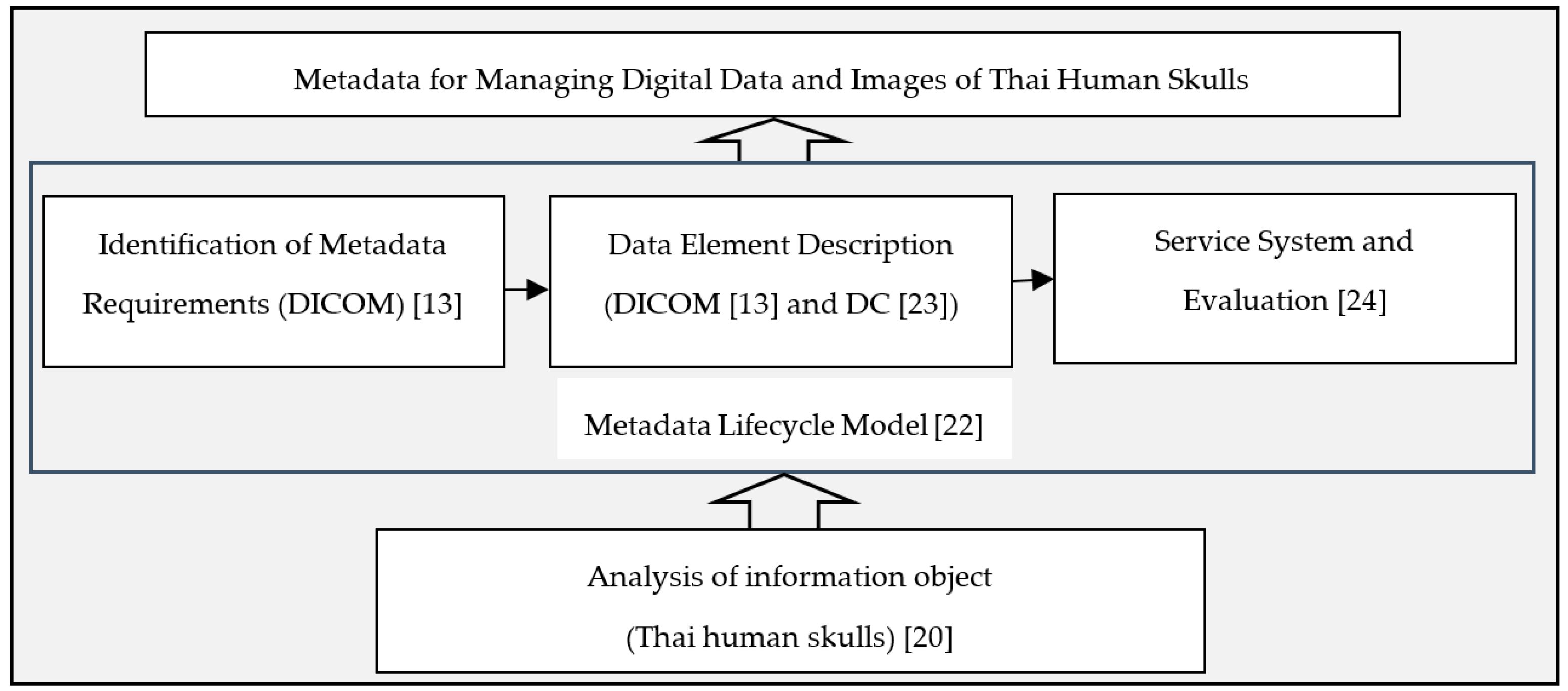
3.2. Identification of Metadata Requirements
3.3. Metadata Schema Development
3.4. Metadata Service and Evaluation
4. Results
4.1. Structure of Metadata Schema
4.2. Description of Metadata Schema
4.3. Metadata Evaluation
4.4. Linked Open Standard
5. Discussion
6. Conclusions
Author Contributions
Funding
Institutional Review Board Statement
Informed Consent Statement
Data Availability Statement
Acknowledgments
Conflicts of Interest
Nomenclature
| Acronyms/Abbreviations | Full names |
| DICOM | Digital Imaging and Communications in Medicine |
| NEMA | National Electrical Manufacturers Association |
| CT Scan | Computerized Tomography Scan |
| Dublin Core or DC | Dublin Core Metadata Element Set |
| MOD | Metadata Object Description Schema |
| VRA | Visual Resource Association |
| CDWA | Categories for the Description of Works of Art |
| OAI-PMH | Open Archives Initiative—Protocol for Metadata Harvesting |
| RDF | RDF (Resource Description Framework) |
References
- Renfrew, C.; Bahn, P. Archaeology Theories, Methods and Practice; Thames and Hudson: London, UK, 1993. [Google Scholar]
- Chapman, R.; Kinnes, I.; Randsborg, K. (Eds.) The Archaeology of Death; Cambridge University Press: London, UK, 1981. [Google Scholar]
- Corruccini, R.S. An examination of the meaning of cranial discrete traits for human skeletal biological studies. Am. J. Phys. Anthropol. 1974, 40, 425–445. [Google Scholar] [CrossRef] [PubMed]
- Boyd, D.C. Skeleton correlates of human behavior in the Americas. J. Archaeol. Method Theory 1996, 3, 189–251. [Google Scholar] [CrossRef]
- Department of Fine Arts. Act of Ancient Sites, Antiquities, Artifacts, and National Museums, (Issue No.2) A.D. 2535; The Department: Bangkok, Thailand, 2003. [Google Scholar]
- Saengwician, S. (Ed.) Physical Anthropology of Skulls and Skeletons of Thai People; Mahidol University: Bangkok, Thailand, 2007. [Google Scholar]
- Chanpak, S. The Study of Guidelines for Improvement of Exhibition in the Museum of Anatomy Kong Don; Mahidol University: Bangkok, Thailand, 2009. [Google Scholar]
- Princess Maha Chaki Sirindhorn Anthropology Center. Thailand Physical Anthropology Database. Available online: https://www.sac.or.th/databases/physanth/app/about.php (accessed on 2 February 2021).
- Phillips, V.M. Skeleton Remains Identification by Facial Reconstruction. Available online: https://archives.fbi.gov/archives/about-us/lab/forensic-science-communications/fsc/jan2001/phillips.htm (accessed on 11 March 2021).
- Haynes, D. Metadata for Information Management and Retrieval; Facet: London, UK, 2004. [Google Scholar]
- Baca, M.; The Getty Research Institute. Introduction to Metadata, 2nd ed.; Baga, M., Ed.; The Getty Research Institute: Los Angeles, CA, USA, 2008; Available online: https://www.worldcat.org/title/introduction-to-metadata/oclc/199464527 (accessed on 11 March 2021).
- Woodley, M.S. Metadata matters: Connecting people and information. In Introduction to Metadata, 3rd ed.; Baca, M., Ed.; The Getty Research Institute: Los Angeles, CA, USA, 2016; Available online: www.getty.edu/publications/intrometadata/metadata-matters/ (accessed on 11 March 2021).
- NEMA. The DICOM Standard. Available online: https://www.dicomstandard.org/current (accessed on 2 February 2021).
- Dublin CoreTM. Metadata Initiatives. DCMI Metadata Terms. 2020. Available online: https://www.dublincore.org/specifications/dublin-core/dcmi-terms/ (accessed on 4 April 2021).
- Library of Congress. Metadata Object Description Schema (MODS). 2020. Available online: https://www.loc.gov/standards/mods/mods-schemas.html (accessed on 5 April 2021).
- Library of Congress. VRA Core Schemas and Documentation. 2015. Available online: https://www.loc.gov/standards/vracore/schemas.html (accessed on 6 April 2021).
- Getty Research Institute. Categories for Description of Works of Arts. 2019. Available online: https://www.getty.edu/research/publications/electronic_publications/cdwa/introduction.html (accessed on 4 April 2021).
- Caplan, P. Metadata Fundamentals for All Librarians; American Library Association: Chicago, IL, USA, 2003. [Google Scholar]
- Tirado-Ramos, A.; Hu, J.; Lee, K.P. Information object definition-based unified modeling language representation of DICOM structure reporting. J. Am. Med. Inf. Assoc. 2002, 9, 63–72. [Google Scholar] [CrossRef] [PubMed] [Green Version]
- Gilliland, A.J. Setting the stage. In Introduction to Metadata, 3rd ed.; Baga, M., Ed.; The Getty Research Institute: Los Angeles, CA, USA, 2016; Available online: https://www.getty.edu/publications/intrometadata/setting-the-stage/ (accessed on 11 March 2021).
- Tuamsuk, P.; Nonsrijun, N.; Sirisin, J. Craniometry study of 3D-human skulls in Srinagarind Hospital, Khon Kaen University, Thailand. In Proceedings of the 37th Annual Conference of the Anatomy Association of Thailand, The Cultural Center of Lower Northern Region, Phitsanulok, Thailand, 7–9 May 2014. [Google Scholar]
- MATT. Metadata Lifecycle Model. Available online: https://metadata.teldap.tw/design/lifecycle_eng.htm (accessed on 2 February 2021).
- NISO. The Dublin Core Metadata Element Set; National Information Standards Organization: Bethesda, ML, USA, 2001; Available online: https://core.ac.uk/download/pdf/58953858.pdf (accessed on 2 February 2021).
- Bruce, T.R.; Hillmann, D.I. The Continuum of Metadata Quality: Defining, Expressing, Exploiting; American Library Association: Chicago, IL, USA, 2004. [Google Scholar]
- Yosakonkun, S.; Tuamsuk, P.; Tuamsuk, K. Analysis of the human skull data using information object analysis concept. Silpakorn Univ. J. 2021, in press. [Google Scholar]
- Namking, M. Skeleton system. In Basic Anatomy 1; Kerdkoonchon, M., Woraputporn, W., Amatayakong, P., Aiamsaard, S., Namking, M., Eds.; Faculty of Medicine, Khon Kaen University: Khon Kaen, Thailand, 2016; pp. 109–148. [Google Scholar]
- Nilprapan, A. Three-Dimensional Analysis of Thai Skulls Collected in Northeast Thailand. Master’s Thesis, Graduate School, Khon Kaen University, Khon Kaen, Thailand, May 1996. [Google Scholar]
- DICOM Library. DICOM Tags. Available online: https://www.dicomlibrary.com/dicom/dicom-tags/?fbclid=IwAR3esqvTbjlKIB2Iq5avRnrSfrd0ehmyFyF94IwUO1Va5GVLAIDXhcUlsm0 (accessed on 2 February 2021).
- Suleman, H. Introduction to the open archives initiative protocol for metadata harvesting. In Proceedings of the 2nd ACM/IEEE-CS Joint Conference on Digital Libraries, Portland, OR, USA, 14–18 July 2002; ACM Press: Roanoke, VA, USA, 2002; p. 414. [Google Scholar]
- Houck, M.M. (Ed.) Forensic Anthropology; Academic Press: Cambridge, MA, USA, 2017. [Google Scholar]



| Module | Module Description | Data Element | Data Based on Information Object Analysis |
|---|---|---|---|
| Series | Data set on the content of human skull | Element 1: Bone | Content data |
| Element 2: Landmark | Content data | ||
| Patients | Data set on the patient whose skull was CT scanned | Element 3: Patient | Context data |
| Element 4: Craniometric length | Structure data | ||
| Images | Image of CT scan of the patient’s skull | Element 5: Image | Context data |
| Study | Data set on the study (cranial index of the patient’s skull) | Element 6: Cranial index | Structure data |
| Element 7: Standard index | Standard data |
| DICOM Tag | DICOM Name | Metadata of Thai Human Skull |
|---|---|---|
| (0010,0020) | Patient ID | PatientID |
| (0010,0030) | Patient’s Birth Date | PatientBirthDate |
| (0010,0040) | Patient’s Sex | PatientSex |
| (0010,0010) | Patient’s AgeF | PatientAge |
| (0010,1030) | Patient’s Weight | PatientWeight |
| (0010,1040) | Patient’s Address | PatientAddress |
| (0018,9329) | CT Image Fame Type Sequence | CTImage |
| (0018,9329) | View Position | ViewPosition |
| Module | Data Element | Data | Property |
|---|---|---|---|
| Series | 1. Bone | 1.1 BoneName_English | |
| 1.2 BoneName_Thai | |||
| 1.3 BoneHistogenesis | |||
| 1.4 BoneTissue | |||
| 1.5 BoneShape | |||
| 2. Landmark | 2.1 LandmarkID | ||
| 2.2 LandmarkName | |||
| 2.3 LandmarkDescription | |||
| Patients | 3. Patient | 3.1 PatientID | |
| 3.2 CTDate | |||
| 3.3 PatientBirthDate | |||
| 3.4 PatientAge | Name | ||
| 3.5 PatientSex | Definition | ||
| 3.6 PatientRace | Format | ||
| 3.7 PatientHeight | Comment | ||
| 3.8 PatientWeight | Example | ||
| 3.9 PatientBMI | References | ||
| 3.10 PatientAddress | |||
| 4. Craniometric length | 4.1 CraniometricLengthID | ||
| 4.2 CraniometricLengthName | |||
| 4.3 CraniometricPointToPoint 4.4 CraniometricLengthDescription | |||
| 4.5 CraniometricLength | |||
| Image | 5. Image | 5.1 ViewPosition | |
| 5.2 CTImage | |||
| Study | 6. Cranial index | 6.1 CranialIndexName | |
| 6.2 CranialIndexValue | |||
| 7. Standard index | 7.1 SkullType | ||
| 7.2 StandardIndexValue |
| Module 1—Series | This Module Specifies the Data Regarding Bones and Landmarks on the Human Skull |
|---|---|
| Element 1: Bone | Element set of data on the bones of human skulls |
| Name 1.1 | BoneName_English |
| Definition | English name of the bone |
| Format | Text |
| Comment | Use an English term as shown in an anatomical textbook |
| Example | Frontal bone |
| References | - |
| Name 1.2 | BoneName_Thai |
| Definition | Thai name of the bone |
| Format | Text |
| Comment | Use a Thai term as shown in the Dictionary of Thai Medical Terms or Thai textbook of Anatomy |
| Example | กระดูกหน้าผาก (Thai language for Frontal bone) |
| References | - |
| Name 1.3 | BoneHistogenesis |
| Definition | The origin or development method of the bone |
| Format | Text |
| Comment | There are two methods: 1. intramembranous ossification and 2. intracartilaginous ossification |
| Example | Intramembranous ossification |
| References | - |
| Name 1.4 | BoneTissue |
| Definition | Characteristic of the bone’s tissue |
| Format | Text |
| Comment | There are two characteristics: 1. compact and 2. spongy |
| Example | Compact |
| References | - |
| Name 1.5 | BoneShape |
| Definition | Shape of the bone |
| Format | Text |
| Comment | There are five shapes: 1. long, 2. short, 3. flat, 4. irregular, and 5. sesamoid |
| Example | Flat |
| References | - |
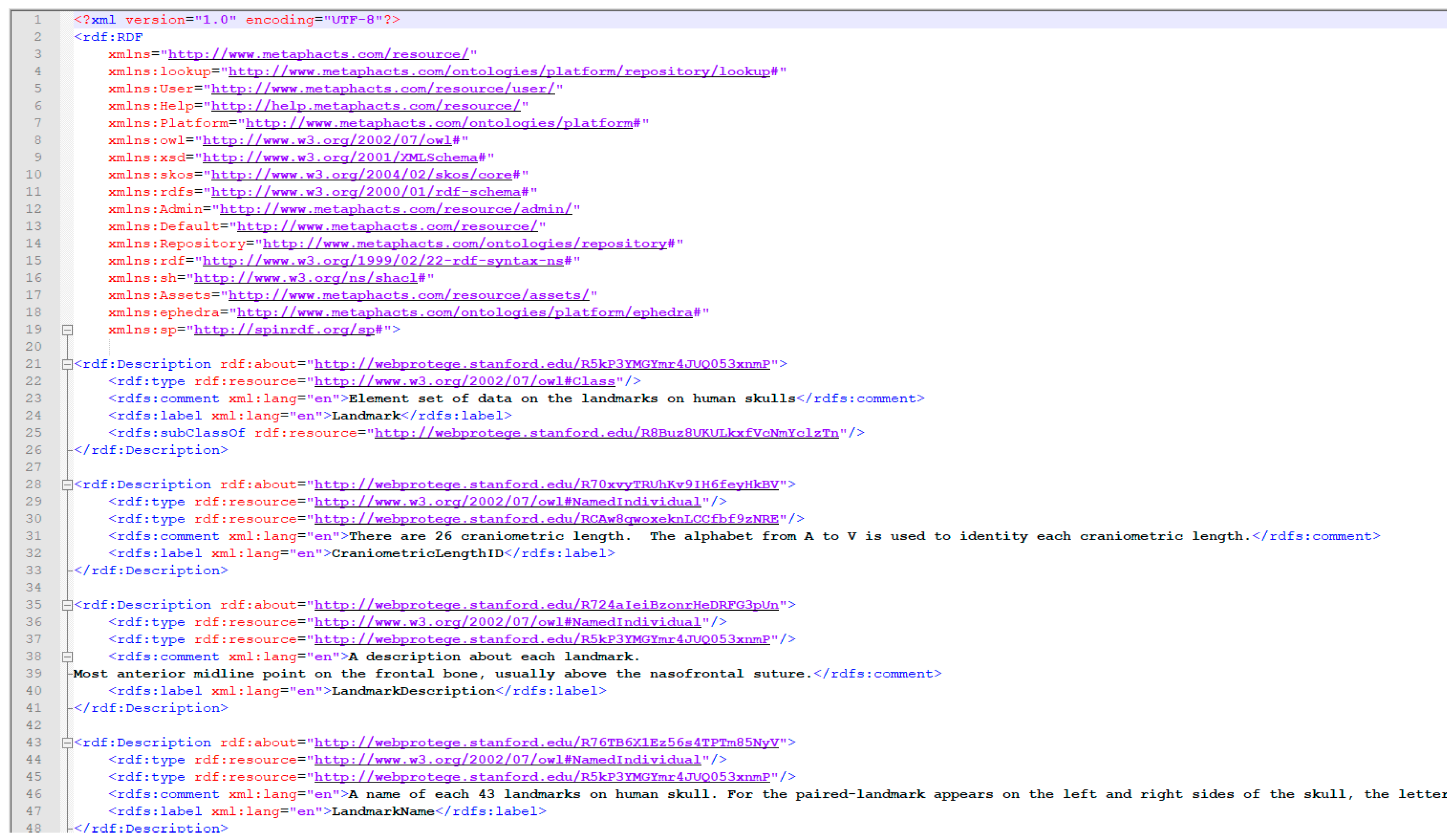
| Element 2: Landmark | Element set of data on the landmarks on human skulls |
| Name 2.1 | LandmarkID |
| Definition | Identification number of the landmark on the human skull |
| Format | Text |
| Comment | There are 43 landmarks on the human skull. Typically, a landmark ID starts from number 1 to 43. As the paired landmark appears on the left and right sides of the skull, the letter L or R shall be added as appropriate. |
| Example | 2 |
| References | - |
| Name 2.2 | LandmarkName |
| Definition | Name of the landmark on the human skull |
| Format | Text |
| Comment | Name of all 43 landmarks on the human skull. For the paired-landmark appearing on the left and right sides of the skull, the letter L or R shall be added as appropriate. |
| Example | Glabella |
| References | - |
| Name 2.3 | LandmarkDescription |
| Definition | Description of the landmark on the human skull |
| Format | Text |
| Comment | A description of each landmark |
| Example | Most anterior midline point on the frontal bone, usually above the nasofrontal suture |
| References | - |
| Module 2—Patients | This module specifies the data regarding the patients whose CT scan of skulls were studied in this set of data. |
| Element 3: Patient | Element set of demographic data of the patient |
| Name 3.1 | PatientID |
| Definition | Identification number of the anonymous patient |
| Format | Number |
| Comment | A patient ID starts from number 1 to an n case. |
| Example | 1 |
| References | - |
| Name 3.2 | CTDate |
| Definition | Skull CT scan date of each patient |
| Format | Date |
| Comment | dd/mm/yyyy (A.D. year) |
| Example | 24 September 2009 |
| References | - |
| Name 3.3 | PatientBirthDate |
| Definition | Patient’s birth date |
| Format | Date |
| Comment | dd/mm/yyyy (A.D. year) |
| Example | 13 February 1966 |
| References | - |
| Name 3.4 | PatientAge |
| Definition | Age of the patient as of the CT date |
| Format | Number |
| Comment | Input the age of the patient as of the CT scan date in numeric format |
| Example | 43 |
| References | - |
| Name 3.5 | PatientSex |
| Definition | Gender of the patient |
| Format | Text |
| Comment | Input M for male and F for female. |
| Example | M |
| References | - |
| Name 3.6 | PatientRace |
| Definition | Race of the patient |
| Format | Text |
| Comment | Input a race of the patient. Note that all patients in the data set of this research are Thai. |
| Example | Thai |
| References | - |
| Name 3.7 | PatientHeight |
| Definition | Patient’s height |
| Format | Number |
| Comment | Input the patient’s height in centimeter |
| Example | 167 |
| References | - |
| Name 3.8 | PatientWeight |
| Definition | Patient’s weight |
| Format | Number |
| Comment | Input the patient’s weight in kilogram |
| Example | 71.5 |
| References | - |
| Name 3.9 | PatientBMI |
| Definition | Value of body mass index (BMI) of the patient |
| Format | Number |
| Comment | Input value of the patient’s BMI |
| Example | 25.53 |
| References | - |
| Name 3.10 | PatientAddress |
| Definition | The place of patient’s address. |
| Format | Text |
| Comment | The place of patient’s address, in this data set is the name of the province of Thailand. Input an English name of the province according to the official name. |
| Example | Khon Kaen |
| References | Names of places and province of Thailand in English. http://www.thailaws.com/download/thaidownload/provinces_eng.pdf (accessed on 4 April 2021) |
| Element 4: Craniometric length | Element set of data regarding craniometric length of the patient |
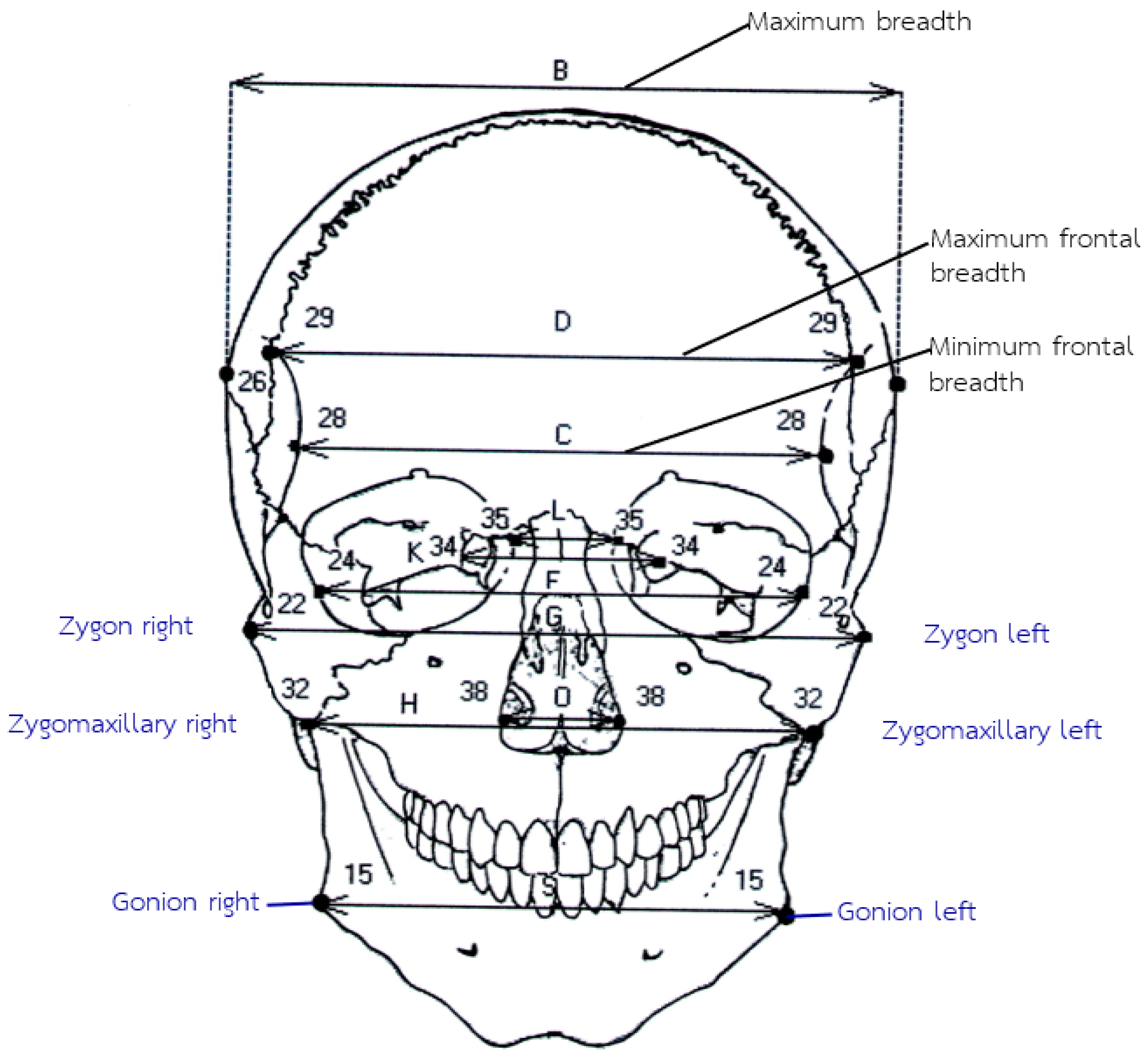
| Name 4.1 | CraniometricLengthID |
| Definition | Identification number of the craniometric length |
| Format | Text |
| Comment | There are 26 craniometric lengths. The alphabet from A to V is used to identify each craniometric length. |
| Example | D |
| References | - |
| Name 4.2 | CraniometricLengthName |
| Definition | Name of each craniometric length |
| Format | Text |
| Comment | Input name of each craniometric length |
| Example | Maximum front breadth |
| References | - |
| Name 4.3 | CraniometricPointToPoint |
| Definition | Landmark point-to-point ID that specified each craniometric length. |
| Format | Text |
| Comment | Input the landmark ID from the starting point to the point of each craniometric length |
| Example | 29L–29R |
| References | - |
| Name 4.4 | CraniometricLengthDescription |
| Definition | Description of each craniometric length |
| Format | Text |
| Comment | Input the description of each craniometric length |
| Example | Direct distance between the two frontotemporal areas is extended |
| References | - |
| Name 4.5 | CraniometricLength |
| Definition | The length from landmark’s point to point, measured in millimeter |
| Format | Number |
| Comment | Input numeric value of the craniometric length of each patient in millimeter |
| Example | 106.12 |
| References | - |
| Module 3—Images | This module specifies the data regarding the images of CT scan of skulls of patients. |
| Element 5: Image | Element set of the image of CT scan of human skull of each patient |
| Name 5.1 | ViewPosition |
| Definition | Image view of CT scan of the patient’s skull |
| Format | Text |
| Comment | There are 6 views of the image in this data set: 1. anterior, 2. posterior, 3. superior, 4. Interior, 5. lateral left, and 6. lateral right. |
| Example | Anterior |
| References | - |
| Name 5.2 | CT_Image |
| Definition | Image of CT scan of the patient’s skull |
| Format | .PNG file |
| Comment | Upload a CT scan image file. Link to location of the image file. |
| Example | - |
| References | - |
| Module 6—Study | This module specifies the data regarding the cranial index of the CT scan of skulls of patients. |
| Element 6: Cranial index | Element set of the cranial index of the human skull of each patient |
| Name 6.1 | CranialIndexName |
| Definition | Name of each cranial index |
| Format | Text |
| Comment | Input name of each cranial index |
| Example | Cranial index |
| References | - |
| Name 6.2 | CranialIndexValue |
| Definition | Value of each cranial index in percentage as a result of calculation |
| Format | Formular |
| Comment | Automatic input from the "CraniometricLength" data and then calculate according to the pre-set formula. The value is presented in percentage. |
| Example | Maximum breadth × 100 |
| Maximum length | |
| References | - |
| Element 7: Standard index | Element set of the standard index identifying the type of the human skull from cranial index value |
| Name 7.1 | SkullType |
| Definition | Type of human skull that can be used to identify human identity in forensic anthropology |
| Format | Text |
| Comment | There are several types of human skulls, for example, ultradolichocranial, hyperdolichocranial, dolichocranial, mesocranial, brachycranial, hyperbrachycranial, and ultrabrachycranial skulls |
| Example | Dolichocranial |
| References | - |
| Name 7.2 | StandardIndexValue |
| Definition | Value of each standard index for type of human skull in percentage |
| Format | Text |
| Comment | Percentage value or range of values for identifying the type of human skull |
| Example | 80–85 |
| References | - |
| Module Name | DICOM Standards | Metadata of Thai Human Skulls |
|---|---|---|
| Series | This module specifies the attributes that identify and describe general information about the Series within a study. | Data sets of human skull elements (this research only compiled bone information and landmarks, which are used for forensic anthropological analyses). |
| Patient | This module specifies the attributes of the Patient that describe and identify the Patient who is the subject of a study. This module contains attributes of the Patient that are needed for interpretation of the composite instances and are common for all studies performed on the Patient. | Attributes of the patient whose skull was imaged can be used to study information of a skull in series, and the skull index can be analyzed. This research compiled information of Thai people whose skulls were CT scanned for the purpose of research. |
| Image | This module specifies the attributes that identify and describe an Image within a particular series. | There are details regarding the CT scan image sets of Thai human skulls that were imaged for research purposes in the patient information set. |
| Study | This module specifies the attributes that describe and identify the Study performed upon the patient. | The data sets on the analyses of patient skulls, resulting from measuring the lengths of different parts of the CT scan images and calculations (for use in forensic anthropology analysis, which is emphasized in this research). |
| Equipment | This module specifies the attributes that identify and describe the piece of Equipment that produced a series of composite instances. | Not specified, as there are no data sets for equipment (no application). |
| References | https://dicomiseasy.blogspot.com/2011/12/chapter-4-dicom-objects-in-chapter3.html?m=1&fbclid=IwAR06QFpD34WVkqCppuUO57wfd0EfLnQ1oKDzBKEC4sXDEJMBRgjhUK3WJMU (accessed on 4 April 2021) | The results of skull data analyses in the research conducted by Tuamsuk, Nonsrichan, and Sirisilp [16] and interviews with doctors specializing in anatomy and forensic anthropology. |
Publisher’s Note: MDPI stays neutral with regard to jurisdictional claims in published maps and institutional affiliations. |
© 2021 by the authors. Licensee MDPI, Basel, Switzerland. This article is an open access article distributed under the terms and conditions of the Creative Commons Attribution (CC BY) license (https://creativecommons.org/licenses/by/4.0/).
Share and Cite
Yosakonkun, S.; Tuamsuk, P.; Chansanam, W.; Tuamsuk, K. Metadata Schema for Managing Digital Data and Images of Thai Human Skulls. Data 2021, 6, 114. https://doi.org/10.3390/data6110114
Yosakonkun S, Tuamsuk P, Chansanam W, Tuamsuk K. Metadata Schema for Managing Digital Data and Images of Thai Human Skulls. Data. 2021; 6(11):114. https://doi.org/10.3390/data6110114
Chicago/Turabian StyleYosakonkun, Satapon, Panya Tuamsuk, Wirapong Chansanam, and Kulthida Tuamsuk. 2021. "Metadata Schema for Managing Digital Data and Images of Thai Human Skulls" Data 6, no. 11: 114. https://doi.org/10.3390/data6110114
APA StyleYosakonkun, S., Tuamsuk, P., Chansanam, W., & Tuamsuk, K. (2021). Metadata Schema for Managing Digital Data and Images of Thai Human Skulls. Data, 6(11), 114. https://doi.org/10.3390/data6110114