


Abstract
This paper proposes a workflow so that engineering scholars can learn to ask effective questions to establish systems of consultation to workers following the indications of the international standard ISO 45001 “Occupational health and safety management systems” (Chapter 5.1) in the context of a medium-size developer and construction company. The methodology has been specifically designed to assess whether it is possible for students to acquire skills in ISO 45001 by developing an innovative method for their own employee questionnaires, and this new standard requires professionals who know how to apply the fundamentals in an industrial context. An experiment with 31 mechanical engineering students was carried out. The new methodology was applied based on three learning levels: large group, working group, and individual student. Different research instruments have been applied to evaluate how they perceive the activity with respect to the usefulness for learning and adaptation to reality. It has also tried to evaluate the subjective sensation during the development of the activity: feelings of happiness, self-confidence, and satisfaction of the scholars. The results show that students considered the activity as interesting, useful for learning, and adapted to reality, posing an important challenge that may have served to improve intrinsic motivation in the learning of management systems.
1. Introduction
The number of occupational accidents in the European Union during 2019 was 31,401,950, according to the latest Eurostat report. In Spain, the ratio was 1.8 accidents per 100,000 workers, 1.7 that of the entire European Union. The sectors most affected by the accidents were construction, transportation and storage, and manufacturing [1].
Despite several previous attempts and the lack of consensus to develop an international standard on occupational safety and health [2,3], the International Organization for Standardization finally published the ISO 45001:2018 standard [4] on Occupational Health and Safety Management System (OHSMS) based on the collaborative efforts of representatives from 70 countries [5].
Since 12 March 2018, OHSMS has for the first time an international ISO standard (ISO 45001) [4], which replaces the previous current standard of greater application: the British standard OHSAS 18001 [6] and other non-ISO standards issued by national/supranational normative bodies that can be consulted in chronological order [7]. Companies with an OHSMS certification according to OHSAS 18001 have had three years since the publication of ISO 45001 to adopt the new requirements. This deadline lasted for six months, until 30 September 2021, owing to the SARS-CoV-2 pandemic. Therefore, today, many organizations are immersed in the incorporation or updating of the new standard and the number of valid certificates is increasing exponentially: from 11,952 certificates emitted in 2018 to 190,481 in 2020 [8].
This latest standard promises a renewed approach by placing Occupational Safety and Health (OSH) at the center of an organization’s objectives and strategy, encouraging proactive risk management and requiring the maintenance of effective OSH [9], and, in this manner, ensuring more effective health and safety [7]
A more detailed comparative analysis between ISO 45001 and another widely applicable standard AS/NZS 4801:2001 suggests that ISO 45001 includes, among other important issues, the participation and commitment of the occupants [10]. This is a key aspect to train future professionals on the application or certification of this novel standard. In this respect, it should be noted that OHSMS is also embedded in integrated management systems. In addition, communication with all stakeholders is part of the systems integration process [11,12], and occupants are really an interested party from whom the opinion should be known, not only in terms of occupational risk prevention but also in other aspects such as quality, human resources, environmental management, etc.
To ascertain the opinion of the occupants, based-on questionnaires consultation systems or other tools must be established to obtain an accurate and sincere answer about preventive measures and the perception of the occupational risks. These questionnaires must be designed in a personalized way for each job and occupant’s characteristics.
Additionally, ISO 45001 can help organizations move beyond an analytical approach (focused on individual system components) to a better understanding of the system as a whole, almost always through systems thinking [13]. The requirements for occupants’ consultation and participation are established in chapter 5.1 of ISO 45001, depending on the approach to risks and opportunities [14]. In this regard, the main objective is to obtain information that empowers decision-making at the occupational risk preventive level. This is a novelty with respect to previous non-ISO occupational safety management systems. Therefore, new tools to learn this point are important and make a scientific contribution today.
Health and Safety as an academic discipline aims to reduce risks through preventive techniques and training [15,16]. The engineering programs related to Health and Security disciplines are critical ones because future engineers will have to face safety risks that may affect them, their colleagues, and the general public.
For training on safety and health, different methods can be used [17,18] and they can be more or less passive [19]. In this way, different innovative initiatives have been carried out in health and safety in recent years [16].
Given the importance of prevention in an area as critical as mechanical engineering and because of the consultation and participation requirements established on the recently created ISO 45001, it is important that engineering students know how to extract preventive information from occupants using a consultation system based on a collection of questions. To this end, the activity has been specifically designed and the students’ perception has been evaluated. The objective is to provide an appropriate and engaging methodology for students based on three levels of learning that will enable students to address the participation requirements of the standard.
2. Methodological Design
The methodology will consist of applying a novel activity specifically designed to aim the training objectives and, subsequently, asking the students about the activity. The approach has been based on the author’s experience and the requirements of the standard ISO 45001. In this way, it will be possible to validate the students’ perception after the development of the activity, which is the main objective of this research.
2.1. Activity Design
The proposed activity was ad-hoc and designed to focus the tasks on three levels (Figure 1):
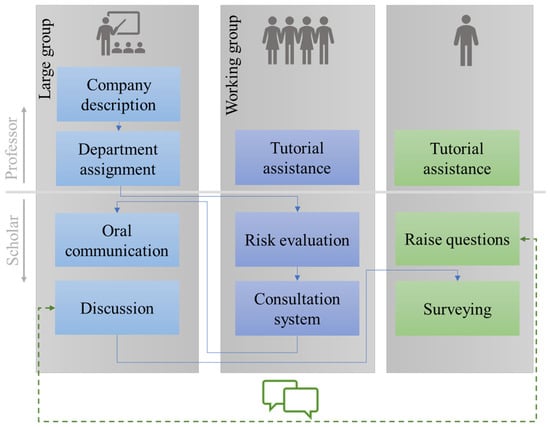
Figure 1.
Workflow for the activity development.
- Large group: all the students are in the classroom. At this level, an expository class will be held to explain details about the activity.
- Working groups: teams formed by a maximum of four students. The heaviest workload of scholars will be at this level. The aim is to enhance skills related to teamwork and oral communication.
- Individual student: at this level, the student must individually reflect and ask his colleagues about the results of their works. Furthermore, the individual perception of the student will be studied.
The students have received previous classes on occupational health and safety systems. First, the professors will explain to the students the description of a company in the large group. In this case, a fictitious construction development and promotion company was chosen due to the high relationship with the scope of the mechanical engineering program (Table 1). The authors decided to use a fictitious company because, in this way, students could be given the working methods and processes of each department. In real companies, there are aspects that are difficult for outsiders to learn about.

Table 1.
Fictitious Company description.
In this step, the academic will explain to the large group the main processes of the organization, as well as the different company departments and their relationship between them. This phase is not easy because explaining the operation of an organization can be complex and it is necessary to focus on the most important aspects of the management of occupational risk prevention. In addition, mechanical engineering students may not have an overview of business organization. However, they do have basic knowledge because they have all taken the subject entitled “Business Administration and Industrial Organization” in the first year of a Bachelor’s degree.
Once the activity has been explained, all the students of the large group will be divided into working groups (of four scholars). Each working group will be assigned a department of the company (Table 2). Students will need to work to perform the risk assessment and based-on questionary consultation system design for assigned department workers that will be used to survey them. Once the students have worked in the working groups and have written the consultation system, each group must make an oral presentation to their classmates to explain each question to raise to the occupants and its purpose in the field of prevention. This will provoke a debate because the rest of the students will be able to pose questions to the group that presents their work. In this phase, the professors will act as mere moderators.
Table 2.
Department to be assigned to each working group.
The activity will be Implemented following the requirements set out in Table 3. Scholars will know these requirements from the explanation of the activity (Figure 1) in advance and these should be considered to design the consultation system. The structure and all the sections of ISO 45001 were previously explained in the classroom. The activity will be carried out for two hours in the presence of the professors. In this way, the professors will be able to solve the students’ doubts and observe their attitudes (Figure 1). After this period, students will work autonomously (out of class), but the professors will remain as a consultant for 4 h a week. In these mentoring spaces, students will be able to go to the professor’s office to ask any questions they may have.
Table 3.
Requirements for the questions raised for each working group in the context of ISO 45001.
2.2. Research Instruments
Once the activity has been fully carried out following the steps indicated in Figure 1, scholars will be surveyed anonymously using a brief questionnaire with the following questions, all of them on a Likert 1–5 scale. This questionnaire has been used in previous research in teaching innovation in engineering (e.g., [20,21]).
As the reader can see in Table 4, the first three questions aim to ascertain if the activity has been beneficial for the students and if it has aroused their interest, and if it has seemed close to reality. The following three questions seek to know the personal sensations and emotions that the student has had while carrying out the activity. These last are considered to have indications about the improvement of intrinsic motivation [21] since this is beneficial for the student because it favors student involvement in learning through satisfaction and enjoyment [22,23].
Table 4.
Questions on the questionnaire for students’ perception analysis.
The results of the questionnaire will be processed using descriptive statistics and correlation analysis between the results of the questions, although first the Crombab Alpha will be calculated to evaluate the coherence of the questionnaire.
Additionally, the professor will have participated as an observer in all phases of the development of the activity, trying to collect qualitative information by means of field notebook entries. This qualitative information will complement the results of the questionnaire [21].
3. Results
Once the activity was carried out, 31 scholars were surveyed using the questions indicated in Table 4, all of them posed using a Likert scale from 1 to 5. The questionnaire was performed completely anonymously to prevent scholars from being conditioned. All of them answered all the questions raised.
Alpha de Cronbach was calculated from the scholar responses, the value being 0.8074. It is higher than 0.7 (reference value), which implies that all items measure satisfaction with the activity and are coherent with questionaries of the same type applied in other research [21,24]. Therefore, the questions raised are coherent with the aim of the research.
The results of the questionnaire can be seen in Table 5. As the reader can see, for all questions, the mean was above 3.5 and the median was 4 in all cases. The best result in terms of mean was obtained in question C2, which is related to the usefulness of learning the subject. The lowest average result was obtained in question C6 related to the feeling of happiness that the scholars felt while performing the activity. The adjusted mean and standard deviation values are mostly consistent.
Table 5.
Results for each raised question.
The matrix of correlation coefficients between the answers given by each scholar to each of the questions was also calculated (Table 6) (Figure 2). In this way, the reader can see how there is a slight correlation between C1 and C2; between C1 and C3; and between C1 and C2 and C3. Answers to questions C4, C5, and C6 generally maintain a low correlation with questions C1, C2, and C3.
Table 6.
Correlation matrix for questions’ responses.
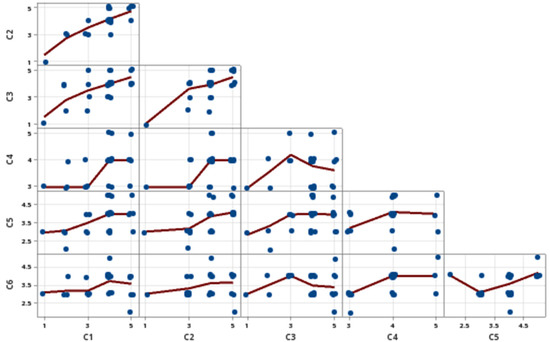
Figure 2.
Scattering plot of the six questions raised.
In the participant observation, the professor was able to verify that the scholars took the activity seriously, tried to imagine what the work was like in the department that had been assigned to them, and put themselves in the place of work to find those potential risks to ask about.
- 4.
- Most of the doubts that the professor had to answer were about the formal approach of the questions (type of scale, the form of writing, etc.). During the activity development, the scholars usually consulted the international standards [4], the regulations of occupational risk prevention in Spain [25], and the materials of the subject. It was also possible to observe how they consulted the websites of similar companies on the Internet and additional information.
4. Discussion
When interpreting the data, the context in which the research has been developed must first be considered: students enrolled in a degree in mechanical engineering without previous knowledge of occupational risk prevention. Among the interests of these scholars, it is not common that there are subjects related to prevention and even so, the acceptance has been wide, and they have mostly considered the activity as useful for learning and interest.
The result in the question regard”ng h’ppiness is slightly lower than that obtained for the rest of the questions. This may be because this is a subjective sensation and depends on the psychology of the person. This result was therefore expected, although the fact that the adjusted average is higher implies the existence of outliers. The question that shows the greatest variability is question C1. This could be because students may have different interests because of the multidisciplinary nature of the Bachelor’s program in mechanical engineering.
An analysis of correlations shows some correlation between question C1 and question C2. That is a slight correlation between the “perception of utility” and the “interest in the activity”. This is something to be expected because engineering students usually consider interest the activities that have a real utility for learning, and on the contrary. There is also a slight correlation between C3 and C2: the “perception about the actual application of the activity” and the “usefulness for learning respectively”. This may be hypothetical because scholars perceive the activities that are proposed with real or quasi-real statements (not theoretical) as more useful for their learning. This aspect has already been detected in other educational research contexts [16,26,27] where real practical examples are proposed, even during the pandemic [28]. In turn, the objective questions about the perception of reality (C1, C2, and C3) show a poor correlation with the subjective questions that analyze how the student feels after the development of the activity (C4, C5, and C6).
Although it was noticeable that the scholars were accustomed to answering surveys in their daily lives (nowadays customer surveys come to us constantly), the professor was able to verify that the fact that they were the ones who wrote the questions, which in some cases generated doubts and insecurity. This is something logical and totally expected and is proof that the activity was an important learning activity in terms of transversal competencies because today it is very important to know how to write questions to obtain information from customers, workers, users, etc. both in the contexts of prevention and for any other management system.
5. Conclusions
In this work, a learning activity in Occupational Health and Safety has been designed and evaluated. The objective is to educate engineering students on the requirements related to occupants’ consultation and participation in the well-known ISO 45001 standard (specifically Chapter 5.1.), applicable internationally for all types of organizations regardless of their sector and size [4] and with different benefits not only in security but also in terms of productivity, reduction of costs of stoppages, and reduction of losses of production [29].
The strategy proposed in this work responds to a real training need that can be addressed through teamwork and provides an innovative solution for this that has been validated from the perception of the scholars.
The perception study was conducted from a point of view of the usefulness of the tool, a correct adaptation of the activity to the formative interests of the scholars, and, also, from a subjective point of view. It was concluded that the activity has been pleasant and has made them feel good about themselves, which enhances their intrinsic motivation. The data of the perception study was consistent with the observations made by the teacher during the course of the activity and were consistent with what was observed in other works in which activities close to reality were also carried out in the classroom [21].
Finally, it should be noted that this activity has been carried out in a face-to-face training modality. However, through videoconferencing and other virtual tools that allow attendees to be segmented into working groups, it could be possible to reproduce the study carried out to verify the results in e-learning contexts. Future work could address this line of research. Furthermore, due to the high-level structure (shared by different management standards), the based-on three levels workflow designed (Figure 1) could be adapted to other training requirements, not only in OHSMS but also in other training contexts in industrial standardization and management systems such as quality, environment, and information security.
Author Contributions
Conceptualization, M.R.-M.; methodology, M.R.-M. and P.R.-G.; validation, M.R.-M. and R.D.; formal analysis, M.R.-M. and R.D.; resources, M.R.-M.; data curation, M.R.-M. and P.R.-G.; writing—original draft preparation, M.R.-M. and P.R.-G.; writing—review and editing, M.R.-M. and P.R.-G.; visualization, M.R.-M., P.R.-G., and R.D. All authors have read and agreed to the published version of the manuscript.
Funding
This research received no external funding.
Conflicts of Interest
The authors declare no conflict of interest.
References
- Eurostat. «Accidents at Work Statistics». 2022. Available online: https://ec.europa.eu/eurostat/statistics-explained/index.php?title=Accidents_at_work_statistics (accessed on 12 January 2022).
- Hasle, P.; Zwetsloot, G. Occupational health and safety management. Saf. Sci. 2011, 49, 961–963. [Google Scholar] [CrossRef]
- Hansen, M. International standardization of safety management systems: Is there a need? Prof. Saf. 1996, 41, 56. [Google Scholar]
- ISO 45001:2018; Occupational Health and Safety Management Systems-Requirements with Guidance for Use. ISO: Geneva, Switzerland, 2018.
- Rostykus, W.G.; Dustin, A.N. Managing ergonomics: Applying ISO45001 as a model. Prof. Saf. 2016, 61, 34–42. [Google Scholar]
- BS OSHAS 18001; Occupational Health and Safety Audit & Certification. BSI: London, UK, 1999.
- Šolc, M.; Blaško, P.; Girmanová, L.; Kliment, J. The Development Trend of the Occupational Health and Safety in the Context of ISO 45001:2018. Standards 2022, 2, 294–305. [Google Scholar] [CrossRef]
- CQI-IRCA, 2020 ISO Survey of Management System Standards Reveals 17% Increase in Certifications. 2020. Available online: https://www.quality.org/article/2020-iso-survey-management-system-standards-reveals-17-increase-certifications (accessed on 14 September 2022).
- Neag, P.N.; Ivascu, L.; Draghici, A. A debate on issues regarding the new ISO 45001:2018 standard adoption. In Proceedings of the 9th International Symposium on Occupational Health and Safety (SESAM 2019), Petrosani, Romania, 17 January 2020. [Google Scholar]
- Karanikas, N.; Bruschi, K.; Brown, S.; Weber, D.E. The evolution of Occupational Health and Safety Management Standards: A comparison between AS/NZS 4801:2001 and AS/NZS ISO 45001:2018. J. Health Saf. Environ. 2021, 37, 117–142. [Google Scholar]
- Savage, C.; Nicholas, S. ISO 9001, 14001 and 45001: Managing Risk Effectively and Efficiently in the Construction Industry. Available online: https://saiassurance.com/iso-9001-14001-and-45001-managing-risk-effectively-and-efficiently-in-the-construction-industry/ (accessed on 2 July 2022).
- Lopes, A.; Polónia, D.; Gradim, A.; Cunha, J. Challenges in the Integration of Quality and Innovation Management Systems. Standards 2022, 2, 52–65. [Google Scholar] [CrossRef]
- Karanikas, N.; Weber, D.; Bruschi, F.; Brown, S. Identification of systems thinking aspects in ISO 45001:2018 on occupational health & safety management. Saf. Sci. 2022, 148, 105671. [Google Scholar]
- ONR 49002-2:2004; Risk Management for Organizations and Systems-Part 2: Guidelines for the Integration of Risk Management Into the General Management System (FOREIGN STANDARD). ONR: Arlington, VA, USA, 2014.
- Benito, A.; Casanova, M.; Rodríguez, M.E.; Gutierrez, M.T.; Rodríguez-Martín, M. Based-on gamification activity for training in occupational risk prevention in the context of the works at height. In Proceedings of the TEEM ’21: Ninth International Conference on Technological Ecosystems for Enhancing Multiculturality, Barcelona, Spain, 27–29 October 2021. [Google Scholar]
- Rodríguez Martín, M.; Benito, A.; Aguado, L.; Rodríguez-Gonzálvez, P. Based on simulation training on ventilation calculation for the reduction of occupational risk of SARS CoV-2 infection. In Proceedings of the TEEM ’21: Ninth International Conference on Technological Ecosystems for Enhancing Multiculturality, Barcelona, Spain, 27–29 October 2021. [Google Scholar]
- Caffaro, F.; Bagagiolo, G.; Cremasco, M.; Vigoroso, L.; Cavallo, E. Tailoring safety training material to migrant farmworkers: An ergonomic user-centred approach. Int. J. Environ. Res. Public Health 2020, 17, 2104. [Google Scholar] [CrossRef] [PubMed]
- Elkind, P.; Pitts, K. Theater as a Mechanism for Increasing Farm Health and Safety Knowledge. Am. J. Ind. Med. 2002, 2, 28–35. [Google Scholar] [CrossRef] [PubMed]
- Vigoroso, L.; Caffaro, F.; Micheletti Cremasco, M.; Cavallo, E. Innovating Occupational Safety Training: A Scoping Review on Digital Games and Possible Applications in Agriculture. Int. J. Environ. Res. Public Health 2021, 18, 1868. [Google Scholar] [CrossRef] [PubMed]
- Vergara, D.; Rodríguez-Martín, M.; Rubio, M.; Ferrer, J.; Nuñez, F.; Moralejo, L. Technical staff training in ultrasonic non-destructive testing using virtual reality. DYNA 2018, 93, 150–154. [Google Scholar] [CrossRef] [PubMed]
- Giménez, A.; Martín-Vaquero, J.; Rodríguez-Martín, M. Analysis of Industrial Engineering Students’ Perception after a Multiple Integrals-Based Activity with a Fourth-Year Student. Mathematics 2022, 10, 1764. [Google Scholar] [CrossRef]
- Ryan, R.; Deci, E. Intrinsic and extrinsic motivations: Classic definitions and new directions. Contemp. Educ. Psychol. 2000, 25, 54–67. [Google Scholar] [CrossRef] [PubMed]
- Ryan, R.; Deci, E. Intrinsic and extrinsic motivation from a self-determination theory perspective: Definitions, theory, practices, and future directions. Contemp. Educ. Psychol. 2020, 61, 101860. [Google Scholar] [CrossRef]
- Caridade, C.; Encinas, A.; Martín-Vaquero, J.; Queiruga-Dios, A.A. CAS and real life problems to learn basic concepts in Linear Algebra course. Comput. Appl. Eng. Educ. 2015, 23, 567–577. [Google Scholar] [CrossRef]
- del Estado, B.O. Ley 31/1995, de 8 de Noviembre, de Prevención de Riesgos Laborales; Government of Spain: Madrid, Spain, 1995.
- Rodríguez-Martín, M.; Vergara, D.; Rodríguez-Gonzálvez, P. Simulation of a Real Call for Research Projects as Activity to Acquire Research Skills: Perception Analysis of Teacher Candidates. Sustainability 2020, 12, 7431. [Google Scholar] [CrossRef]
- Urquiza-Fuentes, J.; Paredes-Velasco, M. Investigating the effect of realistic projects on students’ motivation, the case of Human-Computer interaction course. Comput. Hum. Behav. 2017, 72, 692–700. [Google Scholar] [CrossRef]
- Rahm, A.K.; Töllner, M.; Hubert, M.O.; Klein, K.; Wehling, C.; Sauer, T.; Hennemann, H.M.; Hein, S.; Kender, Z.; Günther, J.; et al. Effects of realistic e-learning cases on students’ learning motivation during COVID-19. PLoS ONE 2021, 16, e0249425. [Google Scholar] [CrossRef] [PubMed]
- Morgado, L.; Silva, F.F.G.; Fonseca, L.M. Mapping Occupational Health and Safety Management Systems in Portugal: Outlook for ISO 45001:2018 adoption. Procedia Manuf. 2019, 38, 755–764. [Google Scholar] [CrossRef]
Disclaimer/Publisher’s Note: The statements, opinions and data contained in all publications are solely those of the individual author(s) and contributor(s) and not of MDPI and/or the editor(s). MDPI and/or the editor(s) disclaim responsibility for any injury to people or property resulting from any ideas, methods, instructions or products referred to in the content. |
© 2023 by the authors. Licensee MDPI, Basel, Switzerland. This article is an open access article distributed under the terms and conditions of the Creative Commons Attribution (CC BY) license (https://creativecommons.org/licenses/by/4.0/).