


You are currently viewing a new version of our website. To view the old version click .

Toxics, Volume 5, Issue 1

March 2017 - 9 articles

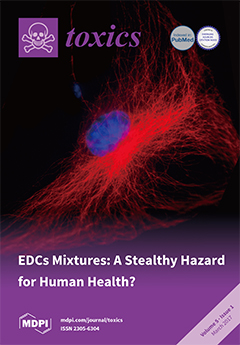
Cover Story: Endocrine disrupting chemicals (EDCs) are exogenous agents that have the capacity to behave as biological signals and interfere with/or mimic estrogenic hormones. Environmental relevant concentrations can induce micronucleus formation and interfere with cell-division processes, with associated transcriptional alterations in chromosome segregation genes, and interferes with senescence in primary vascular endothelial cells (HUVEC). The aneugenic potential can be observed in the image representative of immunofluorescence results of in situ detection of α-tubulin (red) showing senescent HUVEC cells, with DNA loss, after continuous exposure to 4µ of BPA (693h). DNA is DAPI stained (blue).
  • Issues are regarded as officially published after their release is announced to the table of contents alert mailing list .
  • You may sign up for email alerts to receive table of contents of newly released issues.
  • PDF is the official format for papers published in both, html and pdf forms. To view the papers in pdf format, click on the "PDF Full-text" link, and use the free Adobe Reader to open them.

Articles (9)

  • Communication
  • Open Access
52 Citations
10,065 Views
8 Pages

11 March 2017

For decades, compounds present in foods and beverages have been implicated in the etiology of human cancers. The World Health Organization (WHO) International Agency for Research on Cancer (IARC) continues to classify such agents regarding their pote...

  • Article
  • Open Access
45 Citations
7,212 Views
16 Pages

Cytotoxic and Inflammatory Potential of Air Samples from Occupational Settings with Exposure to Organic Dust

  • Susana Viegas,
  • Liliana Aranha Caetano,
  • Merja Korkalainen,
  • Tiago Faria,
  • Cátia Pacífico,
  • Elisabete Carolino,
  • Anita Quintal Gomes and
  • Carla Viegas

1 March 2017

Organic dust and related microbial exposures are the main inducers of several respiratory symptoms. Occupational exposure to organic dust is very common and has been reported in diverse settings. In vitro tests using relevant cell cultures can be ver...

  • Article
  • Open Access
30 Citations
9,450 Views
10 Pages

8 February 2017

The rapid expansion of the artisanal and small-scale gold mining (ASGM) industry in developing countries has marginalized the local communities in poverty, and resulted in occupational exposure to mercury via the gold extraction process. We investiga...

  • Review
  • Open Access
120 Citations
10,735 Views
17 Pages

EDCs Mixtures: A Stealthy Hazard for Human Health?

  • Edna Ribeiro,
  • Carina Ladeira and
  • Susana Viegas

7 February 2017

Endocrine disrupting chemicals (EDCs) are exogenous chemicals that may occur naturally (e.g., phytoestrogens), while others are industrial substances and plasticizers commonly utilized worldwide to which human exposure, particularly at low-doses, is...

  • Article
  • Open Access
58 Citations
6,991 Views
10 Pages

Tannery Effluent Treatment by Yeast Species Isolates from Watermelon

  • Stanley Irobekhian Reuben Okoduwa,
  • Bernard Igiri,
  • Chinyere Blessing Udeh,
  • Chidi Edenta and
  • Balli Gauje

4 February 2017

The quest for an effective alternative means for effluent treatment is a major concern of the modern-day scientist. Fungi have been attracting a growing interest for the biological treatment of industrial wastewater. In this study, Saccharomycescerev...

  • Article
  • Open Access
20 Citations
6,166 Views
7 Pages

6 January 2017

Urinary naphthol is an established human biomarker used for assessing both occupational and environmental exposure. However, 1-naphthol is a metabolite of the insecticide carbaryl while both the 1- and 2-isomers are metabolites of naphthalene. Thus,...

  • Article
  • Open Access
23 Citations
7,017 Views
13 Pages

Comparative Analysis between Ecotoxicity of Nitrogen-, Phosphorus-, and Potassium-Based Fertilizers and Their Active Ingredients

  • Nathan De Castro Soares Simplício,
  • Daphne Heloísa de Freitas Muniz,
  • Fernanda Regina Moreira Rocha,
  • Denis Cavalcanti Martins,
  • Zélia Malena Barreira Dias,
  • Bruno Pereira da Costa Farias and
  • Eduardo Cyrino Oliveira-Filho

27 December 2016

This study aimed to analyze the ecotoxicity of nitrogen-, phosphorus-, and potassium-based compounds to organisms of two different trophic levels in order to compare the toxic effect between high-purity substances and these substances as components o...

  • Review
  • Open Access
89 Citations
15,761 Views
15 Pages

A Review of Heavy Metal Concentration and Potential Health Implications of Beverages Consumed in Nigeria

  • Sylvester Chibueze Izah,
  • Iniobong Reuben Inyang,
  • Tariwari C. N. Angaye and
  • Ifeoma Peace Okowa

22 December 2016

Beverages are consumed in Nigeria irrespective of age, sex, and socioeconomic status. Beverages may be alcoholic (wine, spirits, and beers) or non-alcoholic (soft drink, energy drinks, candies, chocolates, milks). Notwithstanding, most beverages are...

Get Alerted

Add your email address to receive forthcoming issues of this journal.

XFacebookLinkedIn
Toxics - ISSN 2305-6304