

Longitudinal Health Risk Assessment of Neonicotinoid Exposure and Its Association with Dietary Sources in School-Aged Children: A Prospective Cohort Study

 ,
, Highlights
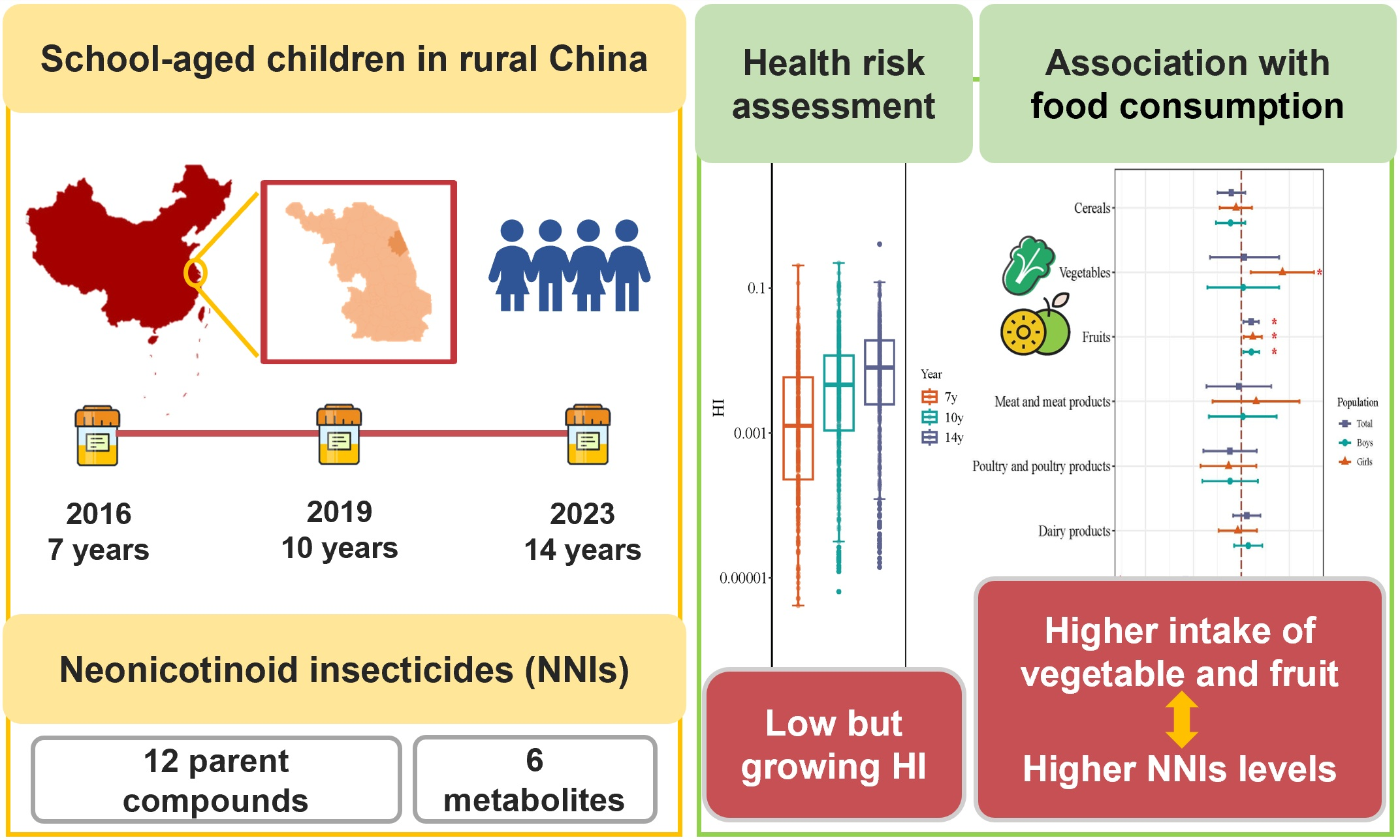
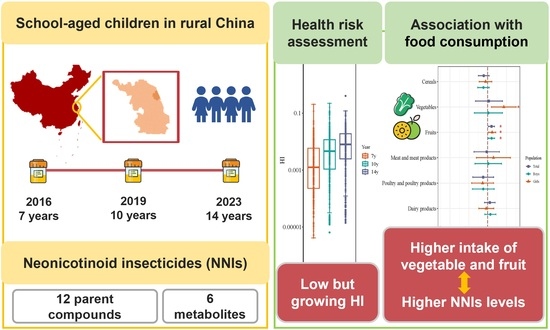
- The longitudinal urinary concentrations of 12 neonicotinoids and 6 metabolites were assessed in a rural Chinese birth cohort at ages 7, 10, and 14.
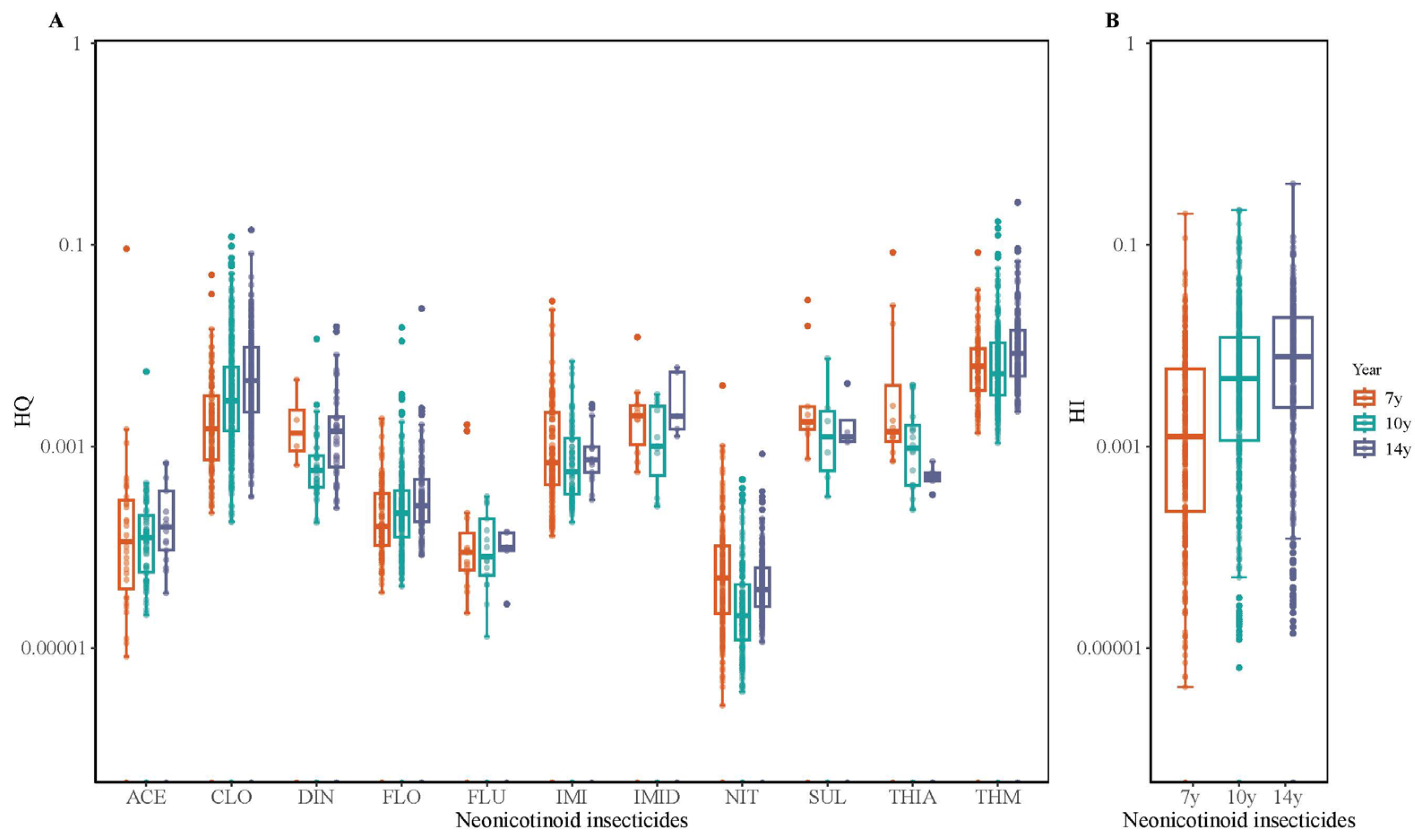
- NNI exposure among school-aged children was widespread and generally below health risk thresholds, yet hazard indices showed a gradual increase with age.
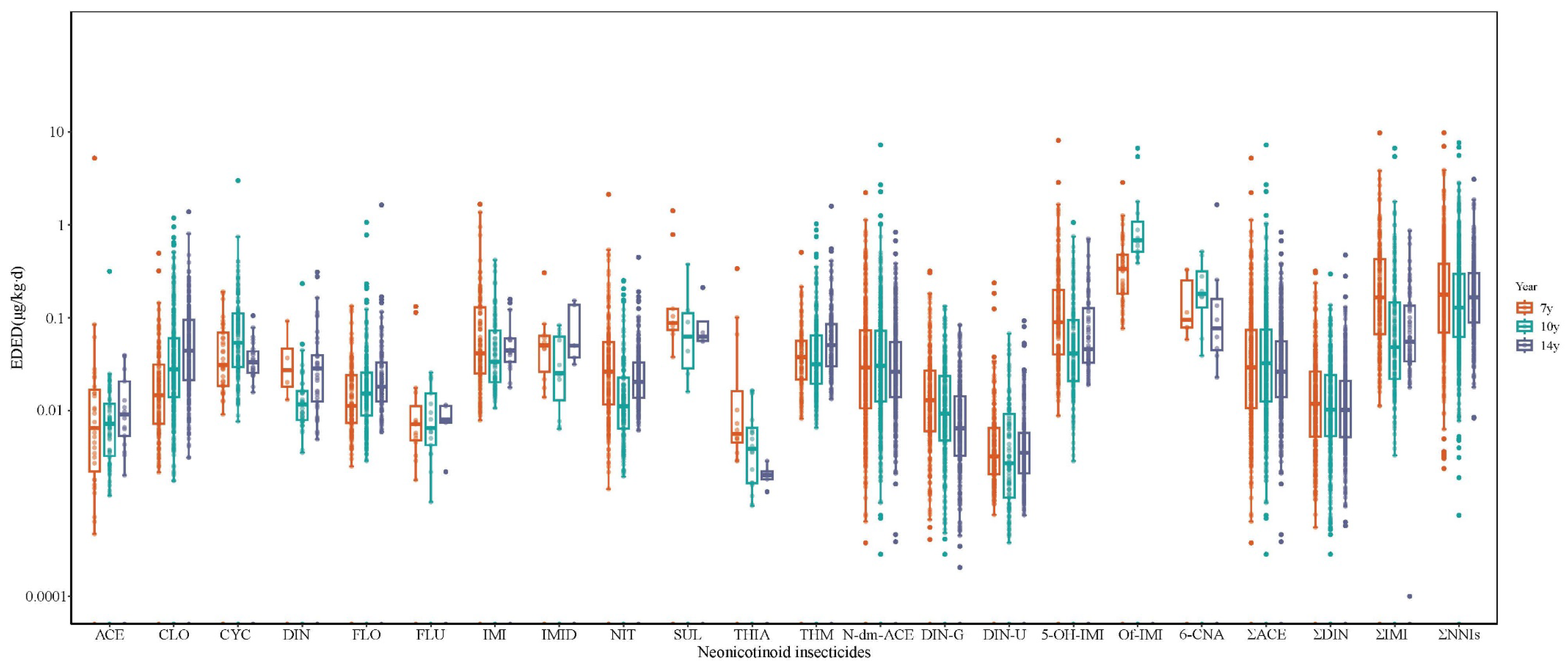
- Temporal patterns showed declining IMI levels but increasing CLO and THM levels over childhood.
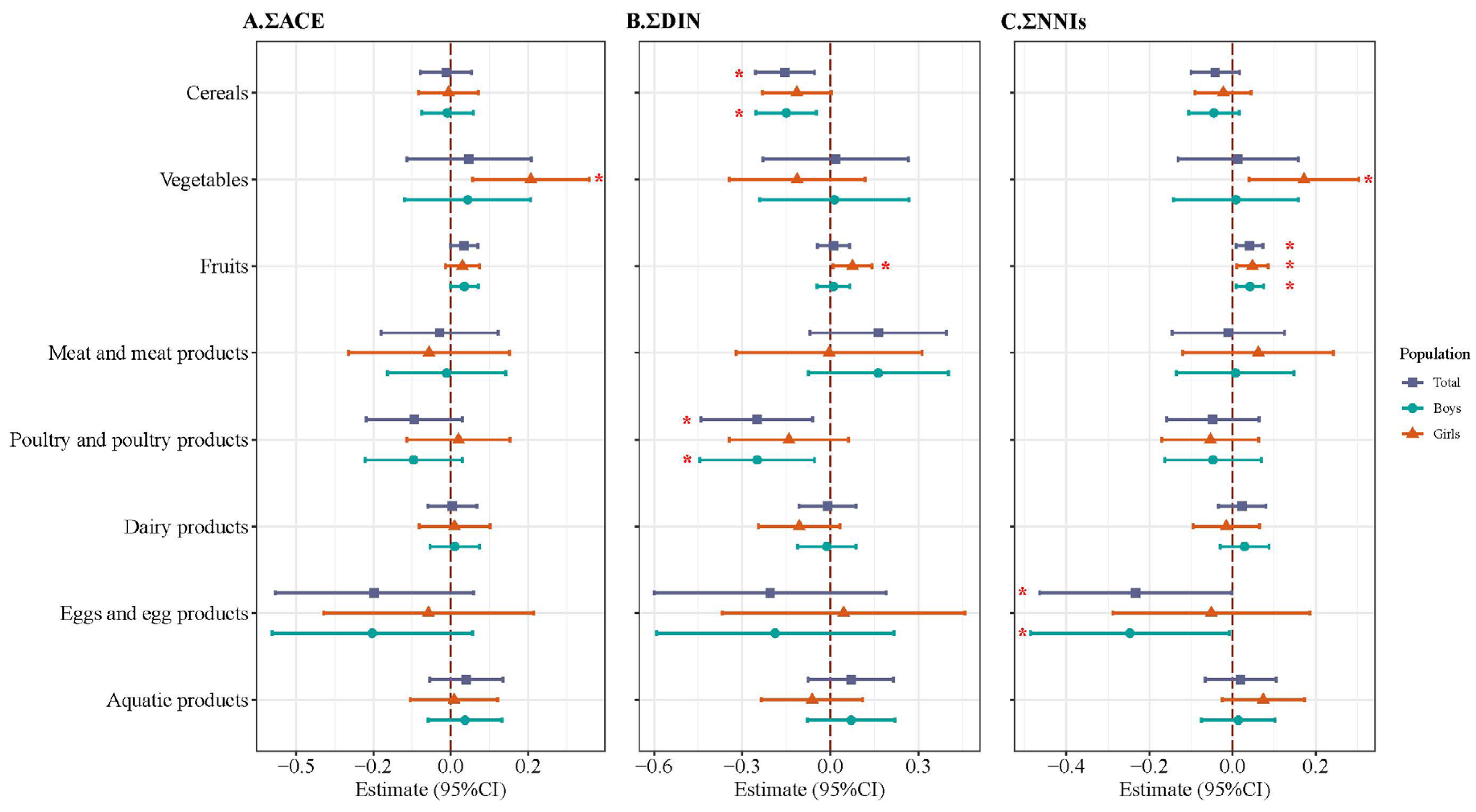
- Fruits and vegetables were identified as major dietary contributors to NNI exposure, while cereals, poultry, and eggs showed inverse associations in boys.
- These findings highlight the evolving nature of NNI exposure during childhood and underscore the need for ongoing biomonitoring and targeted dietary risk mitigation.
Abstract
1. Introduction
2. Method and Materials
2.1. Study Design and Study Population
2.2. Measurement of NNIs in Urine
2.3. Estimation of Daily Exposure Dose (EDED)
2.4. Health Risk Assessment
2.5. Dietary Assessment
2.6. Statistical Analysis
3. Results
3.1. Characteristics of the Study Population
3.2. Urinary NNI Concentrations
3.3. Estimation of Daily Exposure Dose and Health Risk of NNIs


3.4. Association of Dietary Food Groups and Childhood NNI Exposure

4. Discussion
5. Conclusions
Supplementary Materials
Author Contributions
Funding
Institutional Review Board Statement
Informed Consent Statement
Data Availability Statement
Acknowledgments
Conflicts of Interest
Abbreviations
References
- Jeschke, P.; Nauen, R.; Beck, M.E. Nicotinic Acetylcholine Receptor Agonists: A Milestone for Modern Crop Protection. Angew. Chem. Int. Ed. 2013, 52, 9464–9485. [Google Scholar] [CrossRef] [PubMed]
- Brown, L.A.; Ihara, M.; Buckingham, S.D.; Matsuda, K.; Sattelle, D.B. Neonicotinoid insecticides display partial and super agonist actions on native insect nicotinic acetylcholine receptors. J. Neurochem. 2006, 99, 608–615. [Google Scholar] [CrossRef] [PubMed]
- Jeschke, P.; Nauen, R. Neonicotinoids—From zero to hero in insecticide chemistry. Pest Manag. Sci. 2008, 64, 1084–1098. [Google Scholar] [CrossRef] [PubMed]
- Bass, C.; Denholm, I.; Williamson, M.S.; Nauen, R. The global status of insect resistance to neonicotinoid insecticides. Pestic. Biochem. Physiol. 2015, 121, 78–87. [Google Scholar] [CrossRef]
- Zhang, D.; Lu, S. Human exposure to neonicotinoids and the associated health risks: A review. Environ. Int. 2022, 163, 107201. [Google Scholar] [CrossRef]
- Hyland, C.; Bradman, A.; Gerona, R.; Patton, S.; Zakharevich, I.; Gunier, R.B.; Klein, K. Organic diet intervention significantly reduces urinary pesticide levels in U.S. children and adults. Environ. Res. 2019, 171, 568–575. [Google Scholar] [CrossRef]
- Chen, M.; Tao, L.; McLean, J.; Lu, C. Quantitative Analysis of Neonicotinoid Insecticide Residues in Foods: Implication for Dietary Exposures. J. Agric. Food Chem. 2014, 62, 6082–6090. [Google Scholar] [CrossRef]
- Simon-Delso, N.; Amaralrogers, V.; Belzunces, L.P.; Bonmatin, J.M.; Chagnon, M.; Downs, C.; Furlan, L.; Gibbons, D.W.; Giorio, C.; Girolami, V.; et al. Systemic insecticides (neonicotinoids and fipronil): Trends, uses, mode of action and metabolites. Environ. Sci. Pollut. Res. 2015, 22, 5–34. [Google Scholar] [CrossRef]
- Chen, D.; Zhang, Y.; Lv, B.; Liu, Z.; Han, J.; Li, J.; Zhao, Y.; Wu, Y. Dietary exposure to neonicotinoid insecticides and health risks in the Chinese general population through two consecutive total diet studies. Environ. Int. 2020, 135, 105399. [Google Scholar] [CrossRef]
- Ramirez, M.N.M.; Bejarano, M.S.C. Children’s health and the environment. Exposure to pesticide in vulnerable populations. Pediatria 2024, 51, 115–126. [Google Scholar]
- Rosas, L.G.; Eskenazi, B. Pesticides and child neurodevelopment. Curr. Opin. Pediatr. 2008, 20, 191–197. [Google Scholar] [CrossRef] [PubMed]
- Roberts, J.R.; Karr, C.J. Pesticide exposure in children. Pediatrics 2012, 130, e1765–e1788. [Google Scholar] [CrossRef] [PubMed]
- Wang, A.; Wan, Y.; Mahai, G.; Qian, X.; Li, Y.; Xu, S.; Xia, W. Association of Prenatal Exposure to Organophosphate, Pyrethroid, and Neonicotinoid Insecticides with Child Neurodevelopment at 2 Years of Age: A Prospective Cohort Study. Environ. Health Perspect. 2023, 131, 107011. [Google Scholar] [CrossRef] [PubMed]
- Yang, Z.; Wang, Y.; Tang, C.; Han, M.; Wang, Y.; Zhao, K.; Liu, J.; Tian, J.; Wang, H.; Chen, Y.; et al. Urinary neonicotinoids and metabolites are associated with obesity risk in Chinese school children. Environ. Int. 2024, 183, 108366. [Google Scholar] [CrossRef]
- Chronister, B.N.; Justo, D.; Wood, R.J.; Lopez-Paredes, D.; Gonzalez, E.; Suarez-Torres, J.; Gahagan, S.; Martinez, D.; Jacobs, D.R.; Checkoway, H.; et al. Sex and adrenal hormones in association with insecticide biomarkers among adolescents living in ecuadorian agricultural communities. Int. J. Hyg. Environ. Health 2024, 259, 114386. [Google Scholar] [CrossRef]
- Li, F.; Xiong, W.; Zhang, C.; Wang, D.; Zhou, C.; Li, W.; Zeng, G.; Song, B.; Zeng, Z. Neonicotinoid insecticides in non-target organisms: Occurrence, exposure, toxicity, and human health risks. J. Environ. Manag. 2025, 383, 125432. [Google Scholar] [CrossRef]
- Benchikh, I.; Ziani, K.; Mateos, A.G.; Khaled, B.M. Non-acute exposure of neonicotinoids, health risk assessment, and evidence integration: A systematic review. Crit. Rev. Toxicol. 2024, 54, 194–213. [Google Scholar] [CrossRef]
- Wintermantel, D.; Odoux, J.-F.; Decourtye, A.; Henry, M.; Allier, F.; Bretagnolle, V. Neonicotinoid-induced mortality risk for bees foraging on oilseed rape nectar persists despite EU moratorium. Sci. Total Environ. 2020, 704, 135400. [Google Scholar] [CrossRef]
- Hou, J.; Chen, L.; Han, B.; Li, Y.; Yu, L.; Wang, L.; Tao, S.; Liu, W. Distribution characteristics and risk assessment of neonicotinoid insecticides in planting soils of mainland China. Sci. Total Environ. 2023, 902, 166000. [Google Scholar] [CrossRef]
- Song, S.; Zhang, T.; Huang, Y.; Zhang, B.; Guo, Y.; He, Y.; Huang, X.; Bai, X.-Y.; Kannan, K. Urinary Metabolites of Neonicotinoid Insecticides: Levels and Recommendations for Future Biomonitoring Studies in China. Environ. Sci. Technol. 2020, 54, 8210–8220. [Google Scholar] [CrossRef]
- Qi, X.; Zheng, M.; Wu, C.; Wang, G.; Feng, C.; Zhou, Z. Urinary pyrethroid metabolites among pregnant women in an agricultural area of the Province of Jiangsu, China. Int. J. Hyg. Environ. Health 2012, 215, 487–495. [Google Scholar] [CrossRef] [PubMed]
- De Onis, M.; Lobstein, T. Defining obesity risk status in the general childhood population: Which cut-offs should we use? Int. J. Pediatr. Obes. 2010, 5, 458–460. [Google Scholar] [CrossRef] [PubMed]
- Zhang, B.; Wang, Z.; Zhang, J.; Dai, Y.; Ding, J.; Guo, J.; Chen, Y.; Lu, D.; Wu, C.; Zhou, Z. Simultaneous determination of twelve neonicotinoids and six metabolites in human urine with isotope-dilution UPLC-Q-Orbitrap HRMS. J. Chromatogr. B-Anal. Technol. Biomed. Life Sci. 2024, 1237, 124084. [Google Scholar] [CrossRef] [PubMed]
- Søeborg, T.; Frederiksen, H.; Andersson, A.-M. Considerations for estimating daily intake values of nonpersistent environmental endocrine disruptors based on urinary biomonitoring data. Reproduction 2014, 147, 455–463. [Google Scholar] [CrossRef]
- Wang, H.; Yang, J.; Yu, X.; Zhao, G.; Zhao, Q.; Wang, N.; Jiang, Y.; Jiang, F.; He, G.; Chen, Y.; et al. Exposure of Adults to Antibiotics in a Shanghai Suburban Area and Health Risk Assessment: A Biomonitoring-Based Study. Environ. Sci. Technol. 2018, 52, 13942–13950. [Google Scholar] [CrossRef]
- Remer, T.; Neubert, A.; Maser-Gluth, C. Anthropometry-based reference values for 24-h urinary creatinine excretion during growth and their use in endocrine and nutritional research. Am. J. Clin. Nutr. 2002, 75, 561–569. [Google Scholar] [CrossRef]
- Harada, K.H.; Tanaka, K.; Sakamoto, H.; Imanaka, M.; Niisoe, T.; Hitomi, T.; Kobayashi, H.; Okuda, H.; Inoue, S.; Kusakawa, K.; et al. Biological Monitoring of Human Exposure to Neonicotinoids Using Urine Samples, and Neonicotinoid Excretion Kinetics. PLoS ONE 2016, 11, e0146335. [Google Scholar] [CrossRef]
- Wrobel, S.A.; Bury, D.; Koslitz, S.; Hayen, H.; Koch, H.M.; Brüning, T.; Käfferlein, H.U. Quantitative Metabolism and Urinary Elimination Kinetics of Seven Neonicotinoids and Neonicotinoid-Like Compounds in Humans. Environ. Sci. Technol. 2023, 57, 19285–19294. [Google Scholar] [CrossRef]
- Wu, C.H. The Behaviors and Toxic Effects of Neonicotinoid Pesticides in Model Organisms. Ph.D Dissertation, Zhejiang University, Hangzhou, China, 2016. [Google Scholar]
- FAO/WHO. Pesticide Residues in Food 2006; World Health Organization: Rome, Italy, 2006. [Google Scholar]
- Wang, Y.; Gesang, Y.; Wang, Y.; Yang, Z.; Zhao, K.; Liu, J.; Li, C.; Ouzhu, L.; Wang, H.; Chen, Y.; et al. Source and health risk of urinary neonicotinoids in Tibetan pregnant women. Chemosphere 2024, 349, 140774. [Google Scholar] [CrossRef]
- Wang, H.; Yang, D.; Fang, H.; Han, M.; Tang, C.; Wu, J.; Chen, Y.; Jiang, Q. Predictors, sources, and health risk of exposure to neonicotinoids in Chinese school children: A biomonitoring-based study. Environ. Int. 2020, 143, 105918. [Google Scholar] [CrossRef]
- Zhang, Q.; Lu, Z.; Chang, C.-H.; Yu, C.; Wang, X.; Lu, C. Dietary risk of neonicotinoid insecticides through fruit and vegetable consumption in school-age children. Environ. Int. 2019, 126, 672–681. [Google Scholar] [CrossRef] [PubMed]
- Shao, X.; Liu, Z.; Xu, X.; Li, Z.; Qian, X. Overall status of neonicotinoid insecticides in China: Production, application and innovation. J. Pestic. Sci. 2013, 38, 1–9. [Google Scholar] [CrossRef]
- Zhao, Y.; Zhu, Z.; Xiao, Q.; Li, Z.; Jia, X.; Hu, W.; Liu, K.; Lu, S. Urinary neonicotinoid insecticides in children from South China: Concentrations, profiles and influencing factors. Chemosphere 2022, 291, 132937. [Google Scholar] [CrossRef] [PubMed]
- Lu, Z.; Hu, Y.; Tse, L.A.; Yu, J.; Xia, Z.; Lei, X.; Zhang, Y.; Shi, R.; Tian, Y.; Gao, Y. Urinary neonicotinoid insecticides and adiposity measures among 7-year--old children in northern China: A cross-sectional study. Int. J. Hyg. Environ. Health 2023, 251, 114188. [Google Scholar] [CrossRef] [PubMed]
- Wu, X.; Liu, Q.; Li, Y.; Yue, M.; Su, Q.; Luo, J.; Li, Y.; Zeng, S.; Gao, J. Urinary neonicotinoid concentrations and obesity: A cross-sectional study among Chinese adolescents. Environ. Pollut. 2024, 345, 123516. [Google Scholar] [CrossRef]
- Oya, N.; Ito, Y.; Ebara, T.; Kato, S.; Ueyama, J.; Aoi, A.; Nomasa, K.; Sato, H.; Matsuki, T.; Sugiura-Ogasawara, M.; et al. Cumulative exposure assessment of neonicotinoids and an investigation into their intake-related factors in young children in Japan. Sci. Total Environ. 2021, 750, 141630. [Google Scholar] [CrossRef]
- Su, Q.; Luo, J.; Zhou, Y.; Liu, M.; Zeng, S.; Li, Y.; Gao, J. Sex steroid hormones mediate the association between neonicotinoids and obesity among children and adolescents. Ecotoxicol. Environ. Saf. 2025, 289, 117708. [Google Scholar] [CrossRef]
- Ikenaka, Y.; Miyabara, Y.; Ichise, T.; Nakayama, S.M.; Nimako, C.; Ishizuka, M.; Tohyama, C. Exposures of children to neonicotinoids in pine wilt disease control areas. Environ. Toxicol. Chem. 2019, 38, 71–79. [Google Scholar] [CrossRef]
- Liu, H.Y.; Lin, X.Y.; Ma, C.; Zhu, B.; Gao, Y.; Xie, M.L. Research on the distribution of main crops in Jiangsu province. J. Chin. Agric. Mech. 2017, 38, 108–117. [Google Scholar] [CrossRef]
- Cavallaro, M.C.; Morrissey, C.A.; Headley, J.V.; Peru, K.M.; Liber, K. Comparative chronic toxicity of imidacloprid, clothianidin, and thiamethoxam to and estimation of toxic equivalency factors. Environ. Toxicol. Chem. 2017, 36, 372–382. [Google Scholar] [CrossRef]
- Chen, Y.; Wu, R.; Zhang, L.; Ling, J.; Yu, W.; Shen, G.; Du, W.; Zhao, M. High spatial resolved cropland coverage and cultivation category determine neonicotinoid distribution in agricultural soil at the provincial scale. J. Hazard. Mater. 2022, 430, 128476. [Google Scholar] [CrossRef]
- Li, C.J.; Zhu, H.; Li, C.; Qian, H.; Yao, W.; Guo, Y. The present situation of pesticide residues in China and their removal and transformation during food processing. Food Chem. 2021, 354, 129552. [Google Scholar] [CrossRef]
- Luo, S.; Liao, S.; Luo, B.; Xiong, A.; Ma, W.; Zhao, L. Dietary patterns of Chinese children and adolescents and their associations with family characteristics and functioning: A multicenter cross-sectional study. BMC Public Health 2024, 24, 3492. [Google Scholar] [CrossRef]
- Elbert, A.; Haas, M.; Springer, B.; Thielert, W.; Nauen, R. Applied aspects of neonicotinoid uses in crop protection. Pest Manag. Sci. 2008, 64, 1099–1105. [Google Scholar] [CrossRef]
- Bajwa, U.; Sandhu, K.S. Effect of handling and processing on pesticide residues in food—A review. J. Food Sci. Technol. 2014, 51, 201–220. [Google Scholar] [CrossRef]
- Xu, L.; Xu, X.; Wu, X.; Kuang, H.; Xu, C. Sex-Dependent Environmental Health Risk Analysis of Flupyradifurone. Environ. Sci. Technol. 2022, 56, 1841–1853. [Google Scholar] [CrossRef]
- Ding, L.; Ding, Y.; Xu, S.; Han, S.; Li, X.; Zhang, B.; Zhang, X.; Li, C.; Wei, M.; Mei, X.; et al. Reference ranges for 24-h urinary protein/creatinine ratio and urinary microalbumin/creatinine ratio in Chinese children. Pediatr. Nephrol. 2025, 40, 2311–2318. [Google Scholar] [CrossRef]

| Characteristics | 7 Years (N = 411) | 10 Years (N = 485) | 14 Years (N = 356) | p-Value |
|---|---|---|---|---|
| Sex | 0.472 | |||
| Boys | 230 (56.0) | 256 (52.8) | 184 (51.7) | |
| Girls | 181 (44.0) | 229 (47.2) | 172 (48.3) | |
| Maternal education | <0.001 | |||
| Under high school | 290 (70.6) | 349 (72.0) | 208 (58.4) | |
| Above or equivalent high school | 121 (29.4) | 136 (28.0) | 148 (41.6) | |
| Maternal occupation type | <0.001 | |||
| Mental work | 107 (26.1) | 127 (26.2) | 81 (22.8) | |
| Manual work | 195 (47.4) | 303 (62.5) | 226 (63.5) | |
| Other | 109 (26.5) | 55 (11.3) | 49 (13.8) | |
| Annual household income | <0.001 | |||
| ≤30,000 CNY | 182 (44.3) | 67 (13.8) | 48 (13.5) | |
| >30,000 CNY | 229 (55.7) | 418 (86.2) | 308 (86.5) | |
| Residence | 0.745 | |||
| Suburb | 130 (31.6) | 154 (31.8) | 118 (33.1) | |
| Town | 92 (22.4) | 97 (20.0) | 73 (20.5) | |
| Countryside | 189 (46) | 234 (48.2) | 165 (46.3) | |
| Passive smoking | <0.001 | |||
| Yes | 137 (33.3) | 234 (48.2) | 62 (17.4) | |
| No | 274 (66.7) | 251 (51.8) | 294 (82.6) | |
| Body Mass Index z-score (BMI z-score) | 0.3 ± 1.3 | 0.6 ± 1.4 | 0.6 ± 1.3 | 0.002 |
| Non-overweight or obese | 310 (75.4) | 303 (62.5) | 215 (60.4) | <0.001 |
| Overweight | 60 (14.6) | 98 (20.2) | 68 (19.1) | |
| Obese | 41 (10.0) | 84 (17.3) | 73 (20.5) |
| Analytes | 7 Years (n = 411) | 10 Years (n = 485) | 14 Years (n = 356) | ||||||
|---|---|---|---|---|---|---|---|---|---|
| ≥LOD (%) | Median (25th, 75th, 95th) | Max | ≥LOD (%) | Median (25th, 75th, 95th) | Max | ≥LOD (%) | Median (25th, 75th, 95th) | Max | |
| p-NNIs (μg/g) | |||||||||
| ACE | 7.54 | <LOD (<LOD, <LOD, 0.09) | 134.6 | 14.02 | <LOD (<LOD, <LOD, 0.22) | 5.11 | 4.78 | <LOD | 0.82 |
| CLO | 30.66 | <LOD (<LOD, 0.2, 1.46) | 18.32 | 65.15 | 0.43 (<LOD, 1.33, 7.83) | 32.19 | 77.81 | 0.98 (0.21, 2.37, 6.51) | 34.58 |
| CYC | 8.76 | <LOD (<LOD, <LOD, 1.2) | 7.44 | 30.93 | <LOD (<LOD, 0.97, 7.07) | 109.01 | 6.74 | <LOD (<LOD, <LOD, 0.98) | 3.98 |
| DIN | 0.97 | <LOD | 5.29 | 8.66 | <LOD (<LOD, <LOD, 0.44) | 10.06 | 10.39 | <LOD (<LOD, <LOD, 1.12) | 12.89 |
| FLO | 29.44 | <LOD (<LOD, 0.16, 0.79) | 3.77 | 44.33 | <LOD (<LOD, 0.38, 1.14) | 26.48 | 33.43 | <LOD (<LOD, 0.35, 1.16) | 38.77 |
| FLU | 3.65 | <LOD | 2.28 | 3.51 | <LOD | 0.55 | 1.40 | <LOD | 0.23 |
| IMI | 28.95 | <LOD (<LOD, 0.15, 1.18) | 11.38 | 16.7 | <LOD (<LOD, <LOD, 0.48) | 2.74 | 4.78 | <LOD | 1.57 |
| IMID | 2.43 | <LOD | 2.12 | 2.27 | <LOD | 0.76 | 1.40 | <LOD | 0.99 |
| NIT | 45.26 | <LOD (<LOD, 0.58, 2.48) | 61.67 | 31.96 | <LOD (<LOD, 0.14, 0.84) | 5.81 | 73.88 | 0.39 (<LOD, 0.5, 1.40) | 8.18 |
| THIA | 2.92 | <LOD | 11.43 | 4.12 | <LOD | 0.76 | 1.40 | <LOD | 0.12 |
| ∑SUL | 2.19 | <LOD | 38.87 | 1.24 | <LOD | 11.31 | 1.12 | <LOD | 5.09 |
| THM | 24.09 | <LOD (<LOD, <LOD, 2.47) | 20.66 | 48.66 | <LOD (<LOD, 1.30, 4.55) | 42.57 | 52.53 | 0.79 (<LOD, 1.96, 5.79) | 49.96 |
| m-NNIs (μg/g) | |||||||||
| N-dm-ACE | 96.35 | 0.88 (0.31, 2.24, 9.99) | 61.45 | 96.08 | 0.91 (0.36, 2.22, 7.42) | 273.86 | 99.16 | 0.82 (0.43, 1.76, 5.46) | 22.3 |
| DIN-G | 54.99 | 0.1 (<LOD, 0.73, 2.83) | 17.65 | 49.28 | <LOD (<LOD, 0.46, 2.09) | 7.16 | 71.63 | 0.19 (<LOD, 0.49, 1.42) | 3.48 |
| DIN-U | 46.47 | <LOD (<LOD, 0.15, 0.62) | 12.99 | 20.41 | <LOD (<LOD, <LOD, 0.42) | 4.58 | 70.51 | 0.12 (<LOD, 0.21, 0.77) | 3.33 |
| 5-OH-IMI | 42.82 | <LOD (<LOD, 1.18, 6.87) | 129.09 | 36.08 | <LOD (<LOD, 0.43, 2.63) | 19.88 | 17.13 | <LOD (<LOD, <LOD, 1.70) | 14.58 |
| 6-CNA | 1.46 | <LOD | 1.44 | 1.65 | <LOD | 1.92 | 2.25 | <LOD | 8.78 |
| Of-IMI | 11.19 | <LOD (<LOD, <LOD, 5.49) | 39.98 | 3.09 | <LOD | 105.79 | 0 | <LOD | <LOD |
| Molar sum of p-NNs and m-NNs (nmol/g) | |||||||||
| ∑ACE | 96.59 | 4.37 (1.54, 10.76, 50.47) | 603.39 | 96.08 | 4.47 (1.74, 10.77, 36.00) | 1309.96 | 99.16 | 3.93 (2.04, 8.43, 26.14) | 106.68 |
| ∑DIN | 73.97 | 2.33 (<LOD, 5.93, 20.89) | 111.65 | 61.86 | 1.28 (<LOD, 4.01, 14.73) | 66.5 | 87.36 | 2.52 (1.09, 5.24, 15.08) | 106.39 |
| ∑IMI | 48.42 | <LOD (<LOD, 9.57, 42.37) | 518.94 | 40.21 | <LOD (<LOD, 1.89, 19.21) | 383.28 | 17.70 | <LOD (<LOD, <LOD, 6.57) | 59.04 |
| ∑NNIs | 100.00 | 22.19 (11.24, 40.51, 107.49) | 782.02 | 98.76 | 22.65 (10.71, 45.32, 119.96) | 1386.16 | 100.00 | 23.56 (13.07, 38.79, 86.81) | 322.95 |
Disclaimer/Publisher’s Note: The statements, opinions and data contained in all publications are solely those of the individual author(s) and contributor(s) and not of MDPI and/or the editor(s). MDPI and/or the editor(s) disclaim responsibility for any injury to people or property resulting from any ideas, methods, instructions or products referred to in the content. |
© 2025 by the authors. Licensee MDPI, Basel, Switzerland. This article is an open access article distributed under the terms and conditions of the Creative Commons Attribution (CC BY) license (https://creativecommons.org/licenses/by/4.0/).
Share and Cite
Zhang, B.; Dai, Y.; Zhang, J.; Wang, Z.; Ding, J.; Zhou, X.; Qi, X.; Zhou, Z. Longitudinal Health Risk Assessment of Neonicotinoid Exposure and Its Association with Dietary Sources in School-Aged Children: A Prospective Cohort Study. Toxics 2025, 13, 1058. https://doi.org/10.3390/toxics13121058
Zhang B, Dai Y, Zhang J, Wang Z, Ding J, Zhou X, Qi X, Zhou Z. Longitudinal Health Risk Assessment of Neonicotinoid Exposure and Its Association with Dietary Sources in School-Aged Children: A Prospective Cohort Study. Toxics. 2025; 13(12):1058. https://doi.org/10.3390/toxics13121058
Chicago/Turabian StyleZhang, Boya, Yiming Dai, Jiming Zhang, Zheng Wang, Jiayun Ding, Xingzu Zhou, Xiaojuan Qi, and Zhijun Zhou. 2025. "Longitudinal Health Risk Assessment of Neonicotinoid Exposure and Its Association with Dietary Sources in School-Aged Children: A Prospective Cohort Study" Toxics 13, no. 12: 1058. https://doi.org/10.3390/toxics13121058
APA StyleZhang, B., Dai, Y., Zhang, J., Wang, Z., Ding, J., Zhou, X., Qi, X., & Zhou, Z. (2025). Longitudinal Health Risk Assessment of Neonicotinoid Exposure and Its Association with Dietary Sources in School-Aged Children: A Prospective Cohort Study. Toxics, 13(12), 1058. https://doi.org/10.3390/toxics13121058