

Noble Metal-Enhanced Chemically Sensitized Bi2WO6 for Point-of-Care Detection of Listeria monocytogenes in Ready-to-Eat Foods

Abstract
1. Introduction
2. Materials and Methods
2.1. Reagents and Instruments
2.2. Synthesis of Bi2WO6 with Different Morphologies
2.3. Synthesis of Au Nanoparticles (NPs)
2.4. Synthesis of Au-Bi2WO6
2.5. Practical Sample Analysis of LM
2.6. Method Validation
3. Results
3.1. Characterizations of Materials
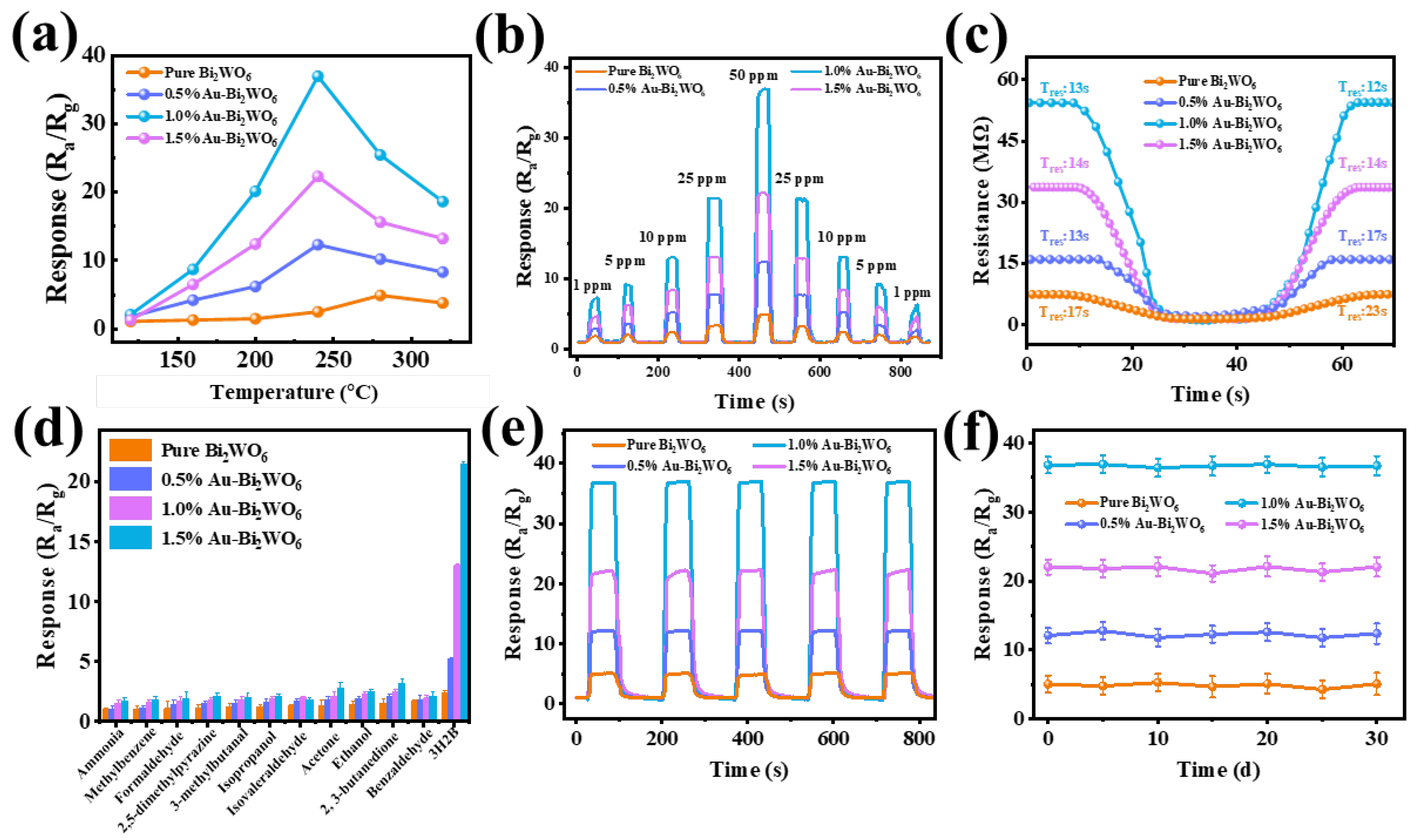
3.2. Gas Sensitivity Performance
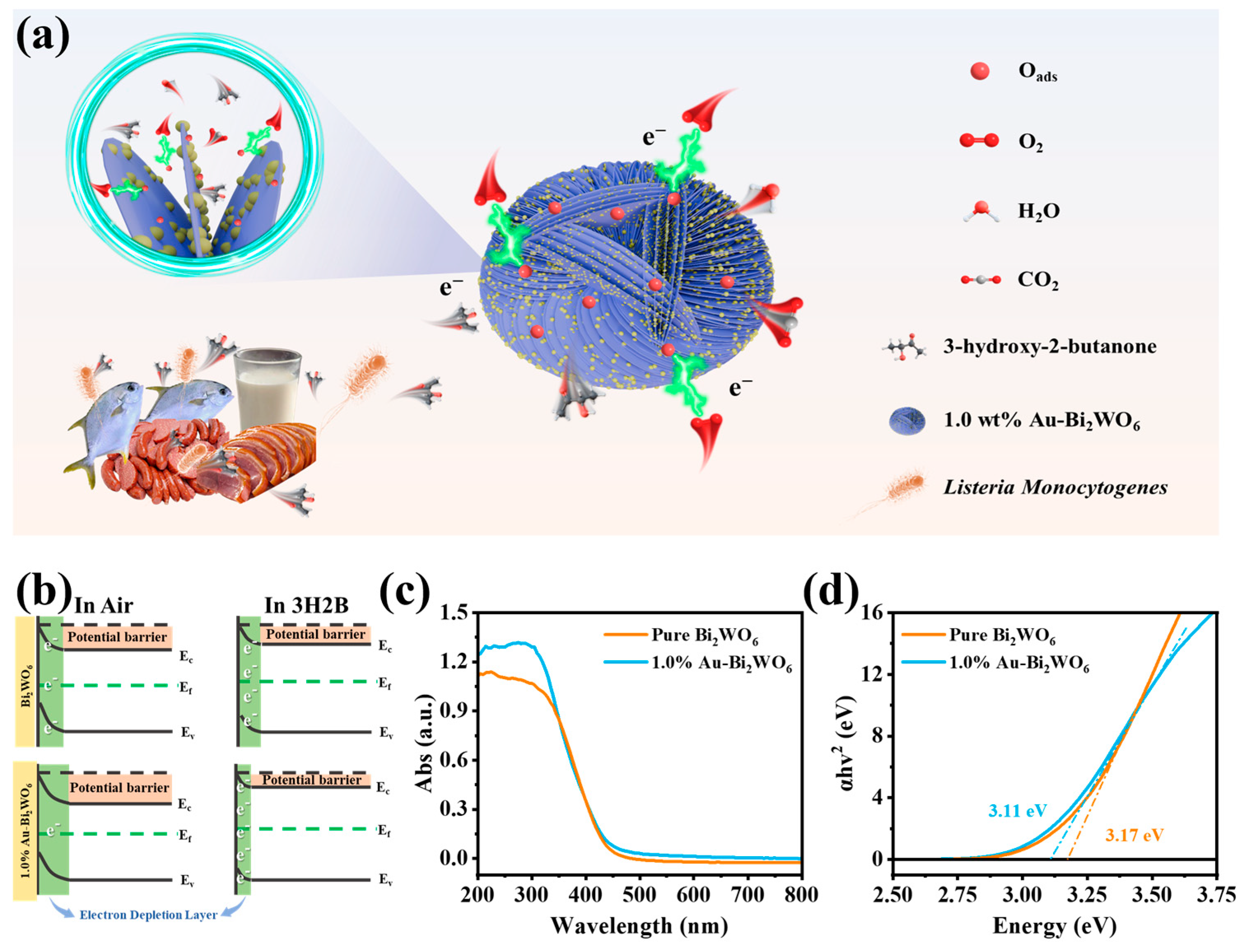
3.3. Gas-Sensing Mechanism
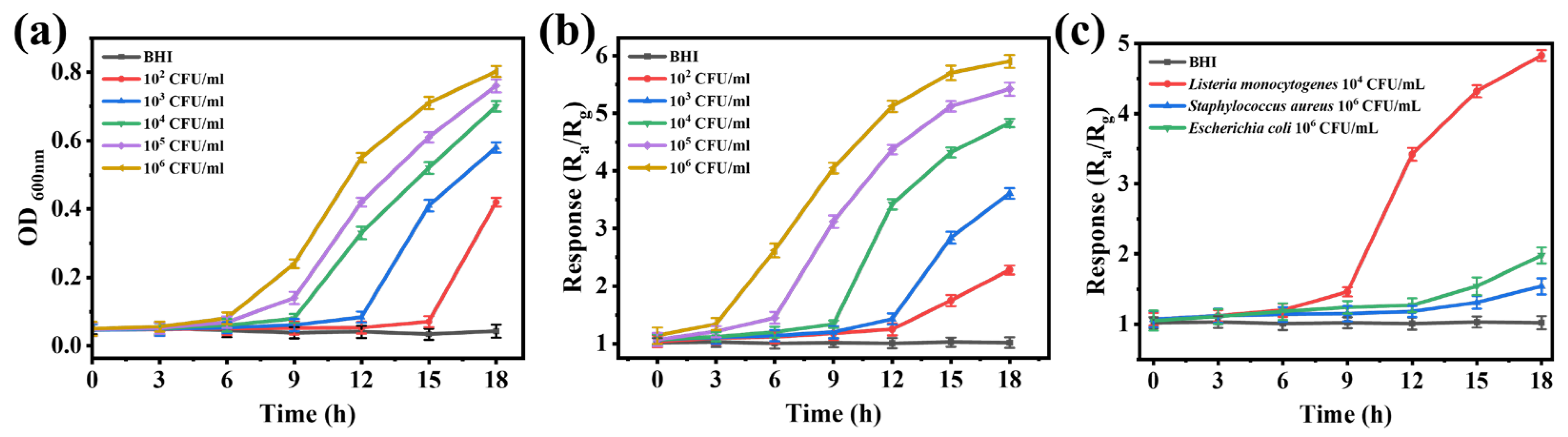
3.4. Practical Application
4. Conclusions
Supplementary Materials
Author Contributions
Funding
Institutional Review Board Statement
Informed Consent Statement
Data Availability Statement
Acknowledgments
Conflicts of Interest
Abbreviations
| BET | Brunauer–Emmett–Teller |
| Bi2WO6 | Bismuth tungstate |
| LM | Listeria monocytogenes |
| LOD | Limit of Detection |
| LOQ | limit of quantitation |
| MVOC | Microbial volatile organic compound |
| MEMS | Micro-Electro-Mechanical Systems |
| NPs | Nanoparticles |
| OD600 | Optical density measurement at 600 nm |
| Olat | Lattice oxygen |
| Oads | Defect oxygen |
| Odef | Adsorbed oxygen |
| QCM | Quartz crystal microbalance |
| RSD | Relative standard deviation |
| SD | Standard deviation |
| SEM | Scanning electron microscopy |
| TEM | Transmission electron microscopy |
| UV-Vis DRS | UV-Vis diffuse reflectance spectroscopy |
| XPS | X-ray photoelectron spectroscopy |
| XRD | X-ray diffraction |
| 3H2B | 3-hydroxy-2-butanone |
References
- Zakrzewski, A.J.; Gajewska, J.; Chajecka-Wierzchowska, W.; Zaluski, D.; Zadernowska, A. Prevalence of Listeria monocytogenes and other Listeria species in fish, fish products and fish processing environment: A systematic review and meta-analysis. Sci. Total Environ. 2024, 907, 167912. [Google Scholar] [CrossRef] [Scilit]
- Liu, X.; Xia, X.; Liu, Y.; Li, Z.; Shi, T.; Zhang, H.; Dong, Q. Recent advances on the formation, detection, resistance mechanism, and control technology of Listeria monocytogenes biofilm in food industry. Food Res. Int. 2024, 180, 114067. [Google Scholar] [CrossRef] [Scilit]
- Bai, X.; Huang, J.; Li, W.; Song, Y.; Xiao, F.; Xu, Q.; Xu, H. Portable dual-mode biosensor based on smartphone and glucometer for on-site sensitive detection of Listeria monocytogenes. Sci. Total Environ. 2023, 874, 162450. [Google Scholar] [CrossRef] [Scilit] [PubMed]
- van Asselt, E.D.; van der Fels-Klerx, H.J.; Marvin, H.J.P.; van Bokhorst-van de Veen, H.; Groot, M.N. Overview of food safety hazards in the European dairy supply chain. Compr. Rev. Food Sci. Food Saf. 2017, 16, 59–75. [Google Scholar] [CrossRef] [Scilit]
- Mukherjee, A.; Shem Tov, I.; Rosenwaks, Y. Electrostatically formed nanowire (EFN) transistor—An ultrasensitive VOC and gas sensor. Appl. Phys. Rev. 2024, 11, 011310. [Google Scholar] [CrossRef] [Scilit]
- Yu, Y.X.; Sun, X.H.; Liu, Y.; Pan, Y.J.; Zhao, Y. Odor fingerprinting of Listeria monocytogenes recognized by SPME-GC-MS and E-nose. Can. J. Microbiol. 2015, 61, 367–372. [Google Scholar] [CrossRef] [Scilit] [PubMed]
- Mousavi, M.; Alzgool, M.; Davaji, B.; Towfighian, S. High signal-to-noise ratio event-driven MEMS motion sensing. Small 2024, 20, e2304591. [Google Scholar] [CrossRef] [Scilit]
- Wei, W.; Liu, J.; Duan, Z.; Bao, X.; Zhang, F.; Zhao, J. Enhanced cyclohexane resistive gas sensing using Mg-doped Bi2WO6 hollow microtubes derived from selective etching of MOF. Mikrochim. Acta 2025, 192, 704. [Google Scholar] [CrossRef] [Scilit]
- Ashwin, C.; Sundari, M.M.; Devendran, P.; Ravikumar, P.; Kajli, S.K.; Mohan, R.; Ayyar, M.; Senthilkumar, R.; Vikas, B. Scalable binder-free one pot hydrothermal synthesis of 2D flower-like Bi2WO6 nanoparticles for high performance supercapacitor application. Mater. Sci. Eng. B 2026, 323, 118899. [Google Scholar] [CrossRef] [Scilit]
- Wu, K.; Xu, Z.; Xu, K.; Xu, J.; Zhang, C. Bismuth-based compounds platforms: From fundamentals to chemiresistive gas sensor applications. Coord. Chem. Rev. 2026, 548, 217174. [Google Scholar] [CrossRef] [Scilit]
- Liang, Y.; Ru, C.; Tang, H.; Zhao, X.; Tang, L.; Yao, S.; Yang, Y. Enhanced spatial charge separation and gas adsorption in Bi2WO6 facet junction for efficient visible light-excited gas detection at room temperature. J. Mater. 2025, 11, 101062. [Google Scholar] [CrossRef] [Scilit]
- El-Muraikhi, M.D.; Ayesh, A.I.; Mirzaei, A. Review of nanostructured Bi2O3, Bi2WO6, and BiVO4 as resistive gas sensors. Surf. Interfaces 2025, 60, 106003. [Google Scholar] [CrossRef] [Scilit]
- Guo, W.; Zhang, X.; Li, X.; Wang, S.; Zhang, H. A novel heterostructure of Bi2MoO6 nanoparticles decorated Bi2WO6 flower for sensing triethylamine with dramatically enhanced performance. Microchem. J. 2025, 218, 115459. [Google Scholar] [CrossRef] [Scilit]
- Wang, J.; Lin, P.; Yu, W.; Xu, P.; Zhang, B.; Cao, G. Pt-loaded Bi2WO6 microdiscs for highly sensitive and selective triethylamine monitoring. Ceram. Int. 2024, 50, 7737–7744. [Google Scholar] [CrossRef] [Scilit]
- Zeb, S.; Cui, Y.; Zhao, H.; Sui, Y.; Yang, Z.; Khan, Z.U.; Ahmad, S.M.; Ikram, M.; Gao, Y.; Jiang, X. Synergistic effect of Au-PdO modified Cu-doped K2W4O13 nanowires for dual selectivity high performance gas sensing. ACS Appl. Mater. Interfaces 2022, 14, 13836–13847. [Google Scholar] [CrossRef] [Scilit] [PubMed]
- Han, S.; Kim, Y.W.; Ji, S.H.; Lee, S.Y.; Yoon, E.; Ha, A.; Park, S.; Kim, H.S.; Chun, D.W.; Choi, M.S.; et al. Tuning gas sensor selectivity via morphological engineering of Au catalysts on TiO2-based nanosheets. Small 2025, 21, e09219. [Google Scholar] [CrossRef] [Scilit] [PubMed]
- Choi, M.S.; Na, H.G.; Park, J.; Choi, S.-W.; Lee, K.H.; Jin, C. Synergistic effect of Au catalysts induced by two-dimensional semiconducting films on Au nanoparticle surfaces. Compos. Part B Eng. 2026, 310, 113160. [Google Scholar] [CrossRef] [Scilit]
- Chen, H.; Liu, J.; Zhao, Y.; Ma, B.; Zhang, G.; Kou, H.; Luo, D.; Chen, C.; Wang, X.; Tang, T. Controllable synthesis and self-assembling of Au/Pd core-shell nanoparticles for high-performance hydrogen sensing. Int. J. Hydrogen Energy 2025, 191, 152320. [Google Scholar] [CrossRef] [Scilit]
- Hyodo, T.; Okusa, T.; Sakata, W.; Ueda, T.; Shimizu, Y. Impacts of surface modification of Pt-sensing electrodes with Au on hydrogen-sensing properties and mechanism of diode-type gas sensors based on anodized titania. ACS Sens. 2023, 8, 61–70. [Google Scholar] [CrossRef] [Scilit]
- Mirzaei, A.; Kim, J.-H. Highly sensitive NO2 gas sensor based on Au-decorated MoS2 nanosheets/SnO2 nanowires heterostructures with self-heating capability. J. Alloys Compd. 2025, 1041, 183815. [Google Scholar] [CrossRef] [Scilit]
- Xie, S.; Wan, Z.; Chen, H.; Li, J.; Na, E.; Wang, F.; Gao, R.; Wu, Y.; Wang, S.; Li, G.-D. Triethylamine gas sensor based on Au-functionalized CdGa2O4 for the practical detection of fish freshness. Sens. Actuators B Chem. 2025, 440, 137891. [Google Scholar] [CrossRef] [Scilit]
- Fan, Y.; Song, L.; Wang, W.; Fan, H. Nano-micro structure of metal oxide semiconductors for triethylamine sensors: ZnO and In2O3. Nanomaterials 2025, 15, 427. [Google Scholar] [CrossRef] [Scilit]
- Adhikari, S.; Mandal, S.; Kim, D.H. Recent development strategies for bismuth-driven materials in sustainable energy systems and environmental restoration. Small 2023, 19, 2206003. [Google Scholar] [CrossRef] [Scilit]
- Zhang, B.; Wang, H.; Xi, J.; Zhao, F.; Zeng, B. Novel Bi2+xWO6 p-n homojunction nanostructure: Preparation, characterization, and application for a self-powered cathodic photoelectrochemical immunosensor. ACS Sens. 2020, 5, 2876–2884. [Google Scholar] [CrossRef] [Scilit]
- Sun, S.; Zhao, C.; Zhang, Z.; Wang, D.; Yin, X.; Han, J.; Wei, J.; Zhao, Y.; Zhu, Y. Highly selective QCM sensor based on functionalized hierarchical hollow TiO2 nanospheres for detecting ppb-level 3-hydroxy-2-butanone biomarker at room temperature. Chin. Chem. Lett. 2025, 36, 109939. [Google Scholar] [CrossRef] [Scilit]
- Xie, S.; Zhao, C.; Shen, J.; Wei, J.; Liu, H.; Pan, Y.; Zhao, Y.; Zhu, Y. Hierarchical flower-like WO3 nanospheres decorated with bimetallic Au and Pd for highly sensitive and selective detection of 3-Hydroxy-2-butanone biomarker. ACS Sens. 2023, 8, 728–738. [Google Scholar] [CrossRef] [Scilit] [PubMed]
- Montazeri, K.; Currie, M.; Barsoum, M.W.; Nabet, B. Ultra-High Speed, High-Sensitivity Spin-Cast MXene-Semiconductor-MXene Photodetectors. Adv. Funct. Mater. 2022, 32, 2206942. [Google Scholar] [CrossRef] [Scilit]
- Wang, X.-Y.; Liu, P.-P.; Cai, H.-J.; Li, M.-M.; Deng, C.-H.; Zhao, Y.; Zhang, Z.-H.; Zhu, Y.-H. PdRh bimetallic-loaded α-Fe2O3 nanospindles with ppb-limit of 3-hydroxy-2-butanone biomarker detection: Particle dimension regulation and oxygen spillover effect. Chem. Eng. J. 2025, 512, 162686. [Google Scholar] [CrossRef] [Scilit]
- Shokraiyan, J.; Jahed, V.; Rabbani, M. Study of photocatalytic activity of Bi2WO6 tire-like microstructure. J. Chin. Chem. Soc. 2021, 68, 1880–1886. [Google Scholar] [CrossRef] [Scilit]
- Ganesan, M.; Harish, S.; Shanmugasundaram, K.; Mohan, M.K.; Archana, J.; Navaneethan, M. Highly sensitive and selective Au-loaded WO3 nanoplates for NO2 gas detection. Sens. Actuators B Chem. 2025, 440, 137900. [Google Scholar] [CrossRef] [Scilit]
- Sun, Y.; Li, J.; Hou, Y.; Wang, B.; Zhang, W.; Suematsu, K.; Chen, L.; Hu, J. Room-temperature response of Ni3(HITP)2 nanosheets co-functionalized with Au NPs and WS2 QDs based flexible chemiresistive NO2 gas sensor. Sens. Actuators B Chem. 2025, 441, 138052. [Google Scholar] [CrossRef] [Scilit]
- Zhang, H.; Guo, S.; Zheng, W.; Wang, H.; Li, H.-Y.; Yu, M.-H.; Chang, Z.; Bu, X.-H.; Liu, H. Facile engineering of metal–organic framework derived SnO2-ZnO composite based gas sensor toward superior acetone sensing performance. Chem. Eng. J. 2023, 469, 143927. [Google Scholar] [CrossRef] [Scilit]
- Wang, X.; Liu, P.; Cai, H.; Zhao, C.; Wu, W.; Zhou, H.; Song, Y.; Zhang, Z.; Zhao, Y.; Zhu, Y. From hidden danger to rapid detection: Silver-enhanced urchin-like tungsten oxide MEMS sensors for Listeria monocytogenes detection in refrigerated dairy. Food Chem. 2025, 497, 146967. [Google Scholar] [CrossRef] [Scilit]
- Van Tran, T.; Ahemad, M.J.; Kim, D.S.; Le, T.D.; Dao, V.; Yu, Y.T. Ultra high response for hydrogen gas on Pd–Augr-alloy@ZnO core-shell nanoparticles with Pd–Au gradient composition alloy core. Mater. Today Nano 2023, 21, 100292. [Google Scholar] [CrossRef] [Scilit]
- Yang, X.; Deng, Y.; Yang, H.; Liao, Y.; Cheng, X.; Zou, Y.; Wu, L.; Deng, Y. Functionalization of mesoporous semiconductor metal oxides for gas sensing: Recent advances and emerging challenges. Adv. Sci. 2022, 10, e2204810. [Google Scholar] [CrossRef] [Scilit]
- Zhang, Z.; Zhang, Y.; Li, T.; Zhang, C.; Luo, Z.; Luo, B.; Tian, B.; Zhao, Y.; Wang, H. A Resilient MEMS sensor array-AI system for DGA-based transformer fault monitoring in high-H2 environments. ACS Sens. 2025, 10, 8007–8015. [Google Scholar] [CrossRef] [Scilit]
- Kim, M.Y.; Park, C.O.; Choa, H.; To, D.T.H.; Mendoza, E.R.; Lee, S.Y.; Myung, N.V.; Lee, K.H. Gold nanoparticles-driven sensing performance enhancement of porous ZnO nanosheet toward NH3, acetone, and NO2. Chem. Eng. J. 2025, 521, 167090. [Google Scholar] [CrossRef] [Scilit]
- Li, Q.; Yang, S.; Lu, X.; Wang, T.; Zhang, X.; Fu, Y.; Qi, W. Controllable fabrication of PdO-PdAu ternary hollow shells: Synergistic acceleration of H2-sensing speed via morphology regulation and electronic structure modulation. Small 2022, 18, e2106874. [Google Scholar] [CrossRef] [Scilit] [PubMed]
- Marikutsa, A.; Rumyantseva, M.; Konstantinova, E.A.; Gaskov, A. The key role of active sites in the development of selective metal oxide sensor materials. Sensors 2021, 21, 2554. [Google Scholar] [CrossRef] [Scilit]
- Liu, B.; Li, K.; Luo, Y.; Gao, L.; Duan, G. Sulfur spillover driven by charge transfer between AuPd alloys and SnO2 allows high selectivity for dimethyl disulfide gas sensing. Chem. Eng. J. 2021, 420, 129881. [Google Scholar] [CrossRef] [Scilit]
- Zhu, Y.; Zhao, Y.; Ma, J.; Cheng, X.; Xie, J.; Xu, P.; Liu, H.; Liu, H.; Zhang, H.; Wu, M.; et al. Mesoporous tungsten oxides with crystalline framework for highly sensitive and selective detection of foodborne pathogens. J. Am. Chem. Soc. 2017, 139, 10365–10373. [Google Scholar] [CrossRef] [Scilit] [PubMed]
- Liu, L.; Corma, A. Bimetallic Sites for Catalysis: From binuclear metal sites to bimetallic nanoclusters and nanoparticles. Chem. Rev. 2023, 123, 4855–4933. [Google Scholar] [CrossRef] [Scilit] [PubMed]
- Cossettini, A.; Vidic, J.; Maifreni, M.; Marino, M.; Pinamonti, D.; Manzano, M. Rapid detection of Listeria monocytogenes, Salmonella, Campylobacter spp., and Escherichia coli in food using biosensors. Food Control 2022, 137, 108962. [Google Scholar] [CrossRef] [Scilit]


Disclaimer/Publisher’s Note: The statements, opinions and data contained in all publications are solely those of the individual author(s) and contributor(s) and not of MDPI and/or the editor(s). MDPI and/or the editor(s) disclaim responsibility for any injury to people or property resulting from any ideas, methods, instructions or products referred to in the content. |
© 2026 by the authors. Licensee MDPI, Basel, Switzerland. This article is an open access article distributed under the terms and conditions of the Creative Commons Attribution (CC BY) license.
Share and Cite
Zhang, Y.; Yu, H.; Han, Y.; Cui, S.; Yang, J.; Huo, B.; Wang, J. Noble Metal-Enhanced Chemically Sensitized Bi2WO6 for Point-of-Care Detection of Listeria monocytogenes in Ready-to-Eat Foods. Foods 2026, 15, 293. https://doi.org/10.3390/foods15020293
Zhang Y, Yu H, Han Y, Cui S, Yang J, Huo B, Wang J. Noble Metal-Enhanced Chemically Sensitized Bi2WO6 for Point-of-Care Detection of Listeria monocytogenes in Ready-to-Eat Foods. Foods. 2026; 15(2):293. https://doi.org/10.3390/foods15020293
Chicago/Turabian StyleZhang, Yong, Hai Yu, Yu Han, Shu Cui, Jingyi Yang, Bingyang Huo, and Jun Wang. 2026. "Noble Metal-Enhanced Chemically Sensitized Bi2WO6 for Point-of-Care Detection of Listeria monocytogenes in Ready-to-Eat Foods" Foods 15, no. 2: 293. https://doi.org/10.3390/foods15020293
APA StyleZhang, Y., Yu, H., Han, Y., Cui, S., Yang, J., Huo, B., & Wang, J. (2026). Noble Metal-Enhanced Chemically Sensitized Bi2WO6 for Point-of-Care Detection of Listeria monocytogenes in Ready-to-Eat Foods. Foods, 15(2), 293. https://doi.org/10.3390/foods15020293