Encoded Microspheres in Multiplex Detection of Mycotoxins and Other Analytes


 , ,
, ,
Abstract
1. Introduction
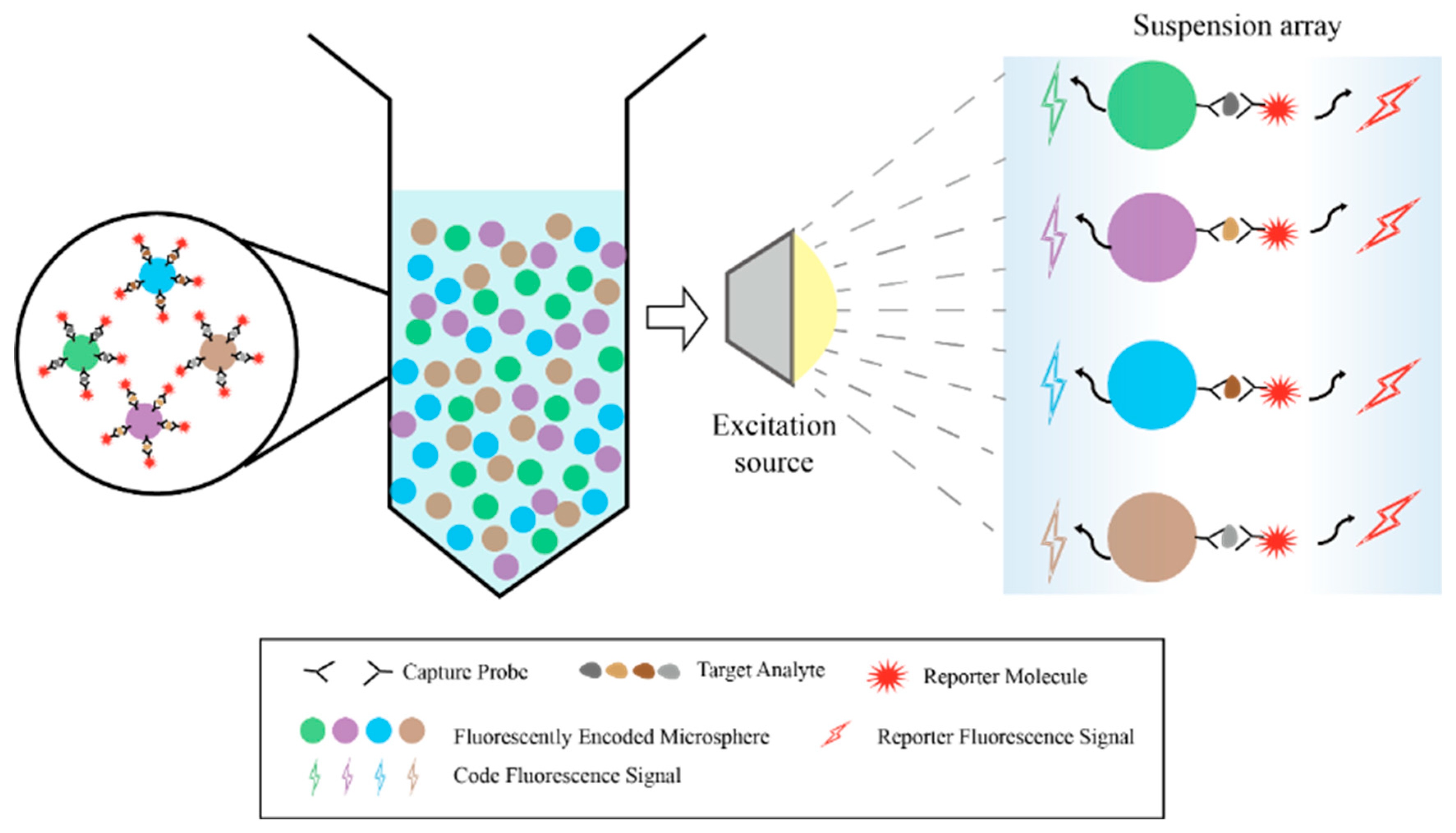
2. Encoding Strategies for Microspheres
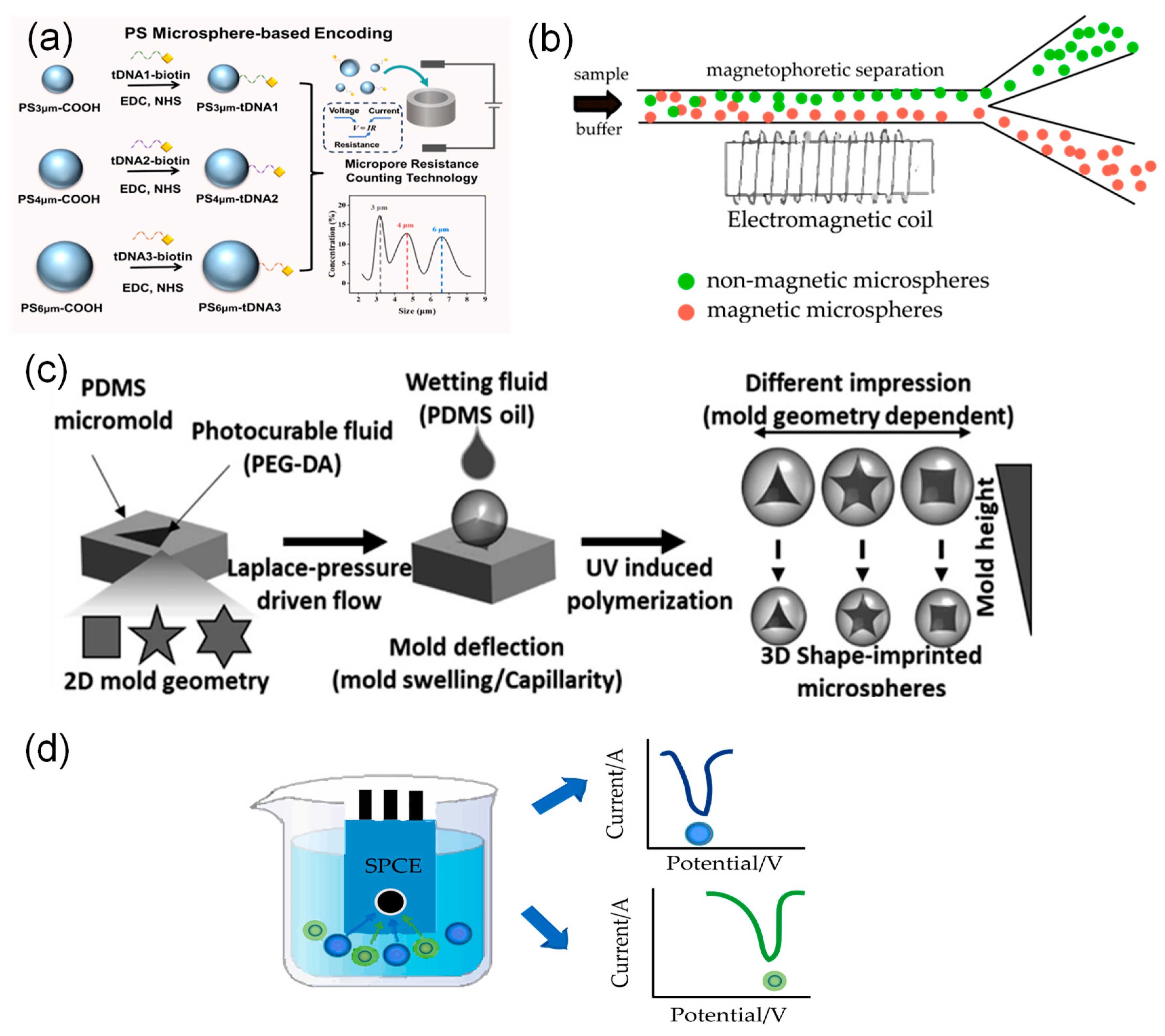
2.1. Physical Encoding
2.2. Optical Encoding
2.2.1. Encoding Strategies Based on Wavelength and Intensity Spectral Characteristics
2.2.2. Encoding Strategies Based on Optical Structures
2.2.3. Encoding Strategies Based on Temporal and Spatial Characteristics
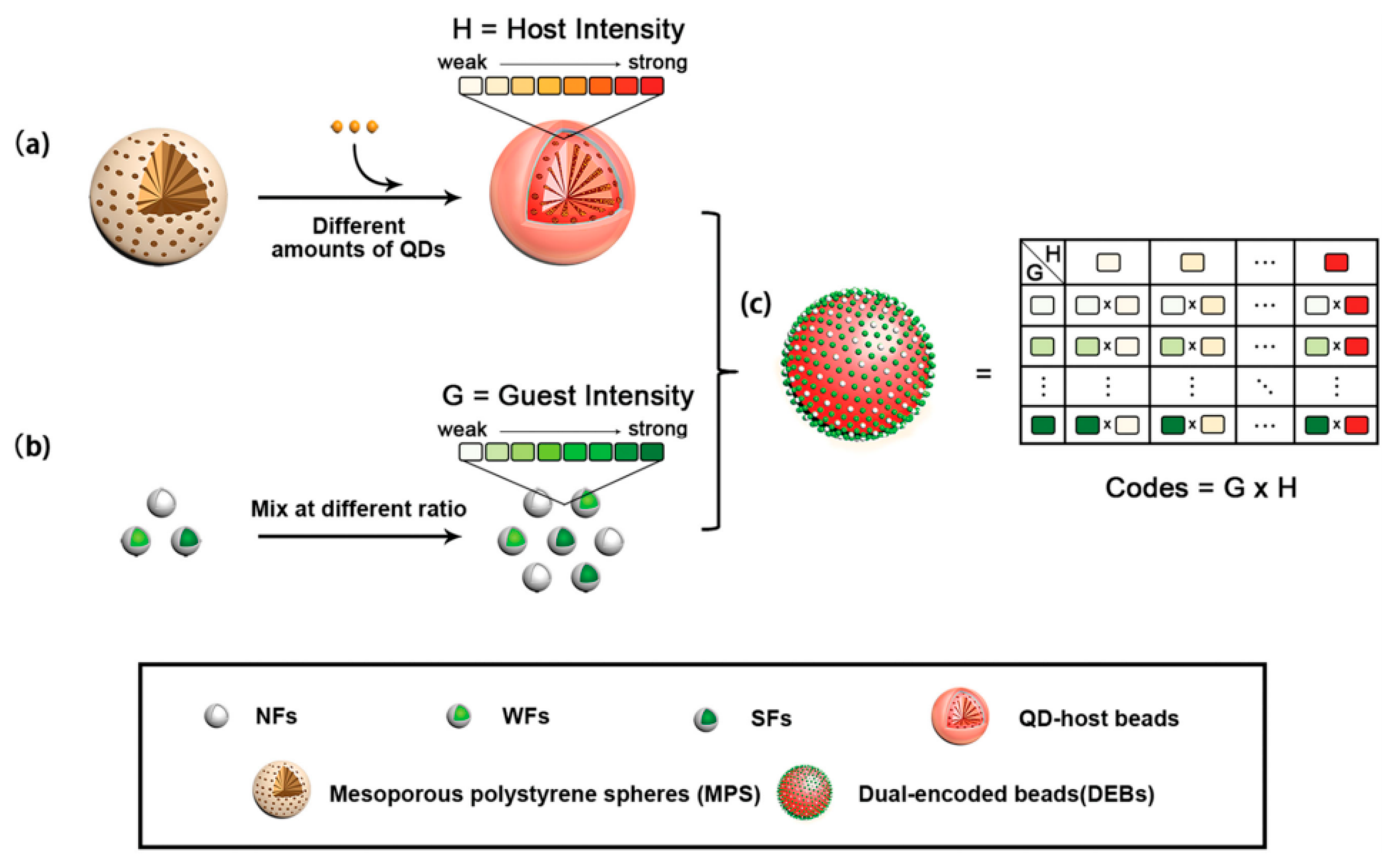
2.3. Combining Multiple Encoding Methods Increases Encoding Capacity
3. Construction of Encoded Microspheres: Matrix Materials and Preparation Methods
3.1. Surface Modification Strategies
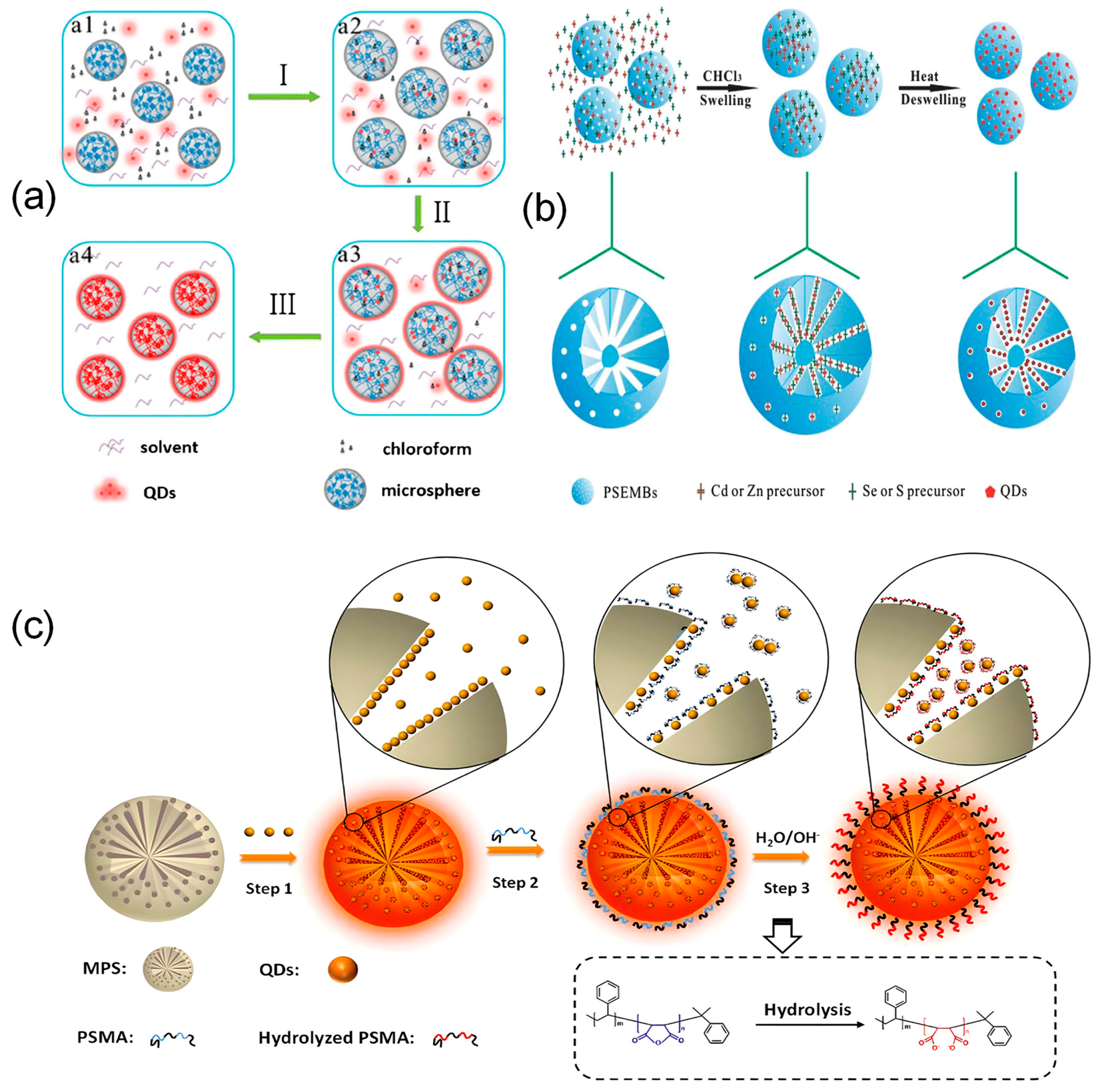
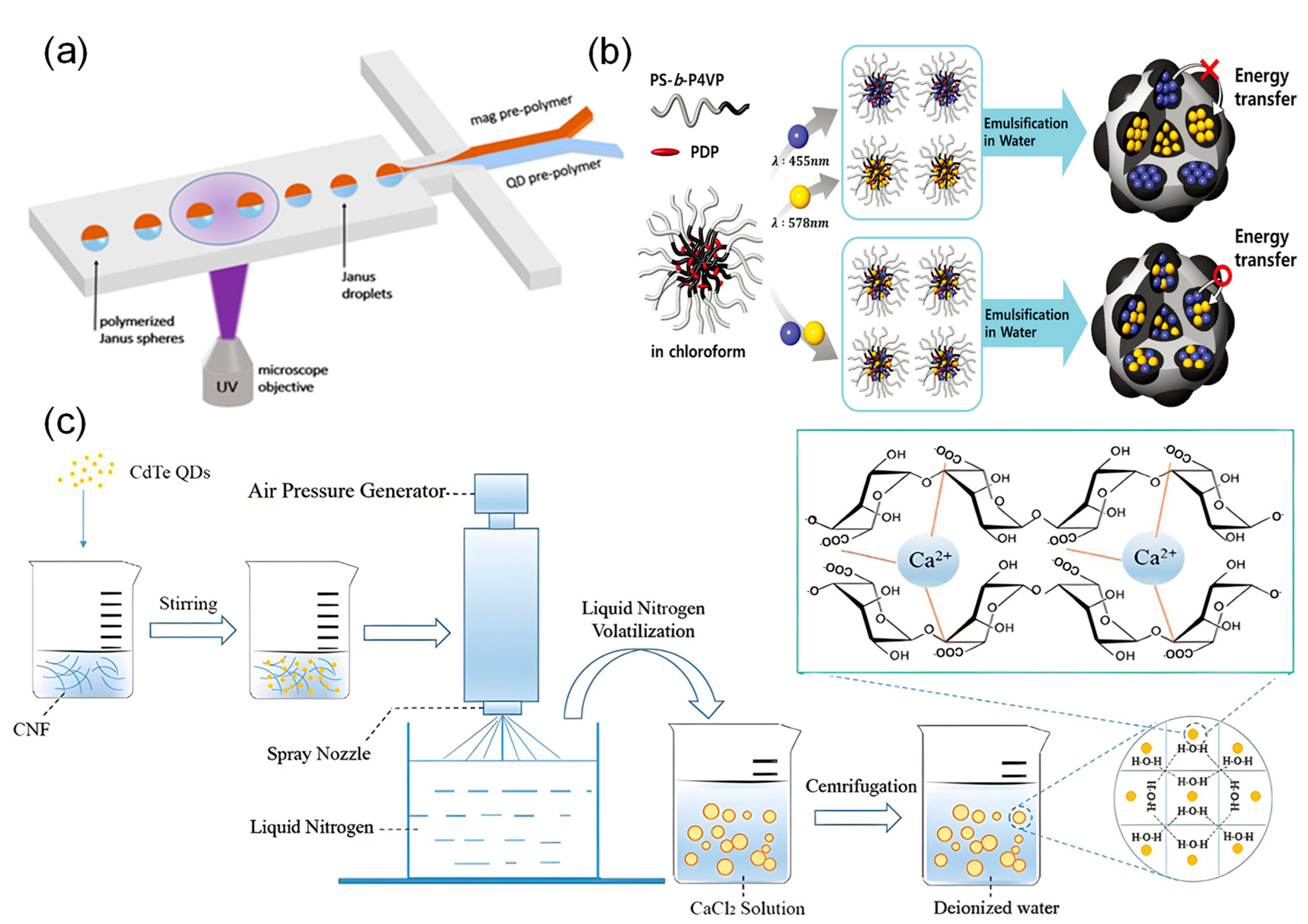
3.2. Integration Strategy
3.3. Magnetic Composite Matrix: An Innovative Preparation Strategy for Resolving Fluorescence Quenching
3.4. Natural Polymers and Molecularly Imprinted Polymers: Green Preparation
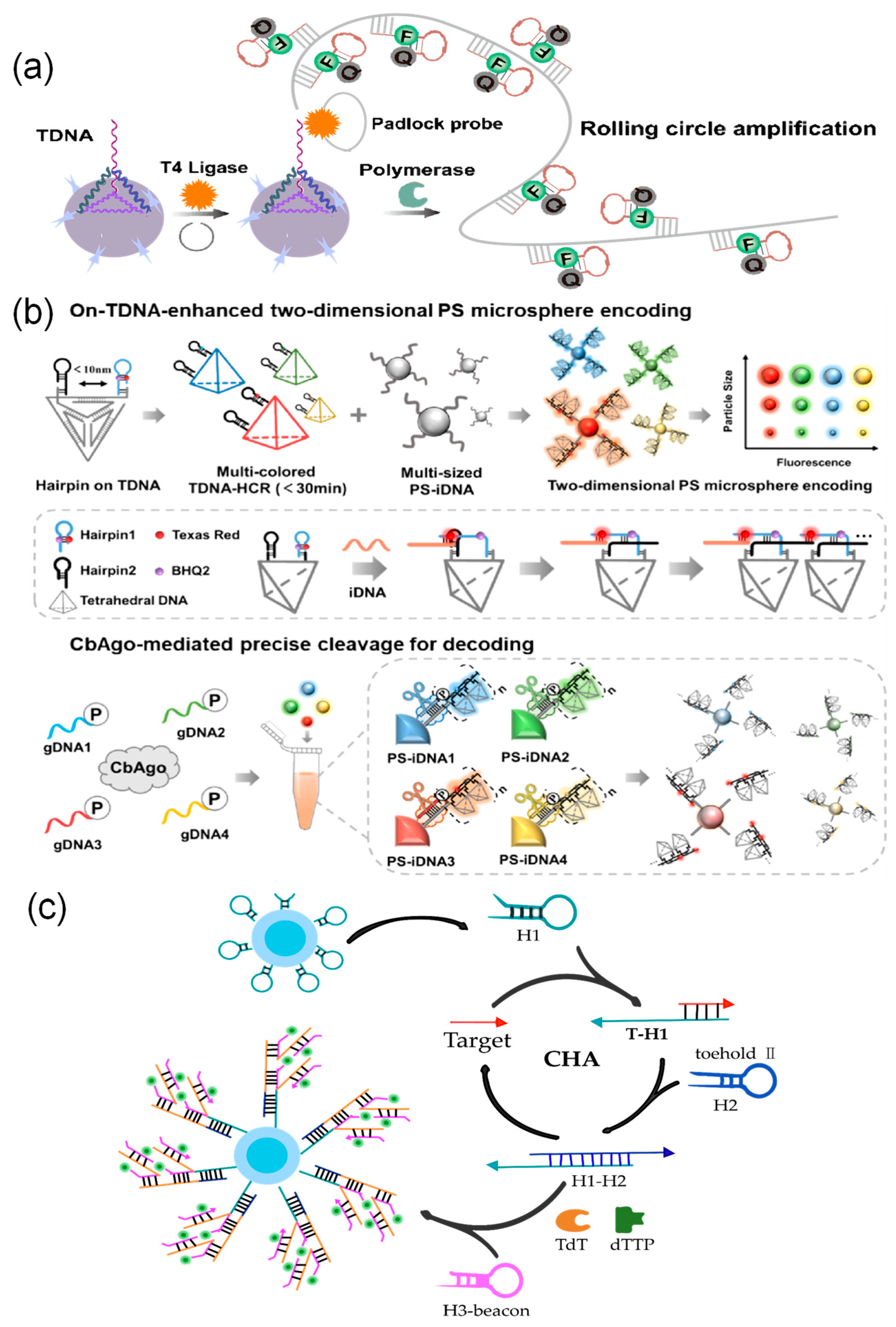
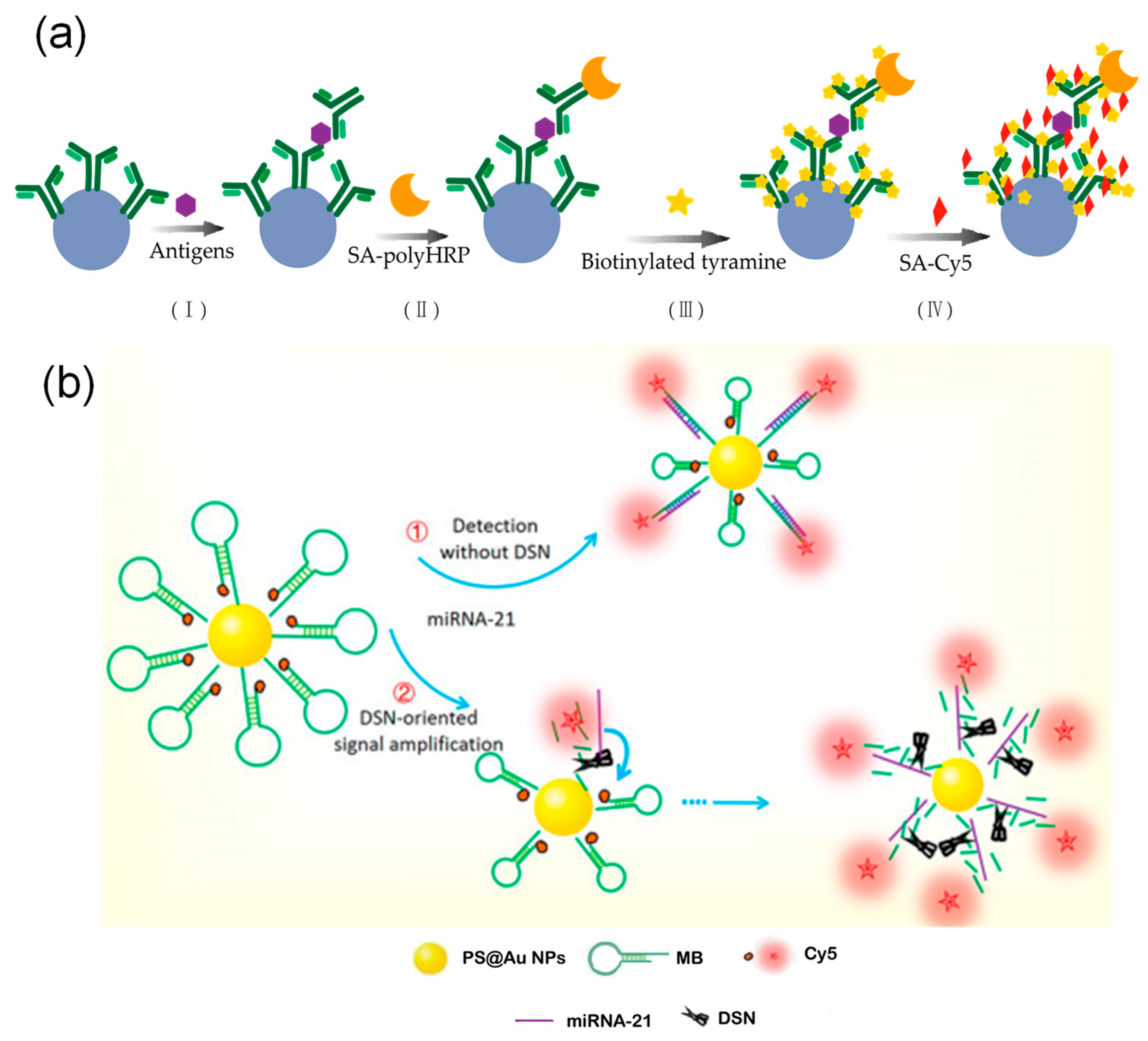
4. Signal Amplification
5. Technical Application Platform of Encoded Microsphere Suspension Arrays for Mycotoxin Detection
6. Conclusions and Perspectives
Author Contributions
Funding
Institutional Review Board Statement
Informed Consent Statement
Data Availability Statement
Acknowledgments
Conflicts of Interest
References
- Xu, H.; Wang, L.; Sun, J.; Wang, L.; Guo, H.; Ye, Y.; Sun, X. Microbial detoxification of mycotoxins in food and feed. Crit. Rev. Food Sci. Nutr. 2022, 62, 4951–4969. [Google Scholar] [CrossRef]
- Xie, H.; Wang, X.; van der Hooft, J.J.J.; Medema, M.H.; Chen, Z.-Y.; Yue, X.; Zhang, Q.; Li, P. Fungi population metabolomics and molecular network study reveal novel biomarkers for early detection of aflatoxigenic Aspergillus species. J. Hazard. Mater. 2022, 424, 127173. [Google Scholar] [CrossRef]
- Xu, J.; Li, W.; Liu, R.; Yang, Y.; Lin, Q.; Xu, J.; Shen, P.; Zheng, Q.; Zhang, Y.; Han, Z.; et al. Ultrasensitive low-background multiplex mycotoxin chemiluminescence immunoassay by silica-hydrogel photonic crystal microsphere suspension arrays in cereal samples. Sens. Actuators B Chem. 2016, 232, 577–584. [Google Scholar] [CrossRef]
- Huang, N.; Sheng, W.; Bai, D.; Sun, M.; Ren, L.; Wang, S.; Jin, Z. Multiplex fluorescence quenching immunoassay based on multicolor magnetic quantum dot and dual spectral-overlapped polydopamine nanospheres for ultrasensitive detection of aflatoxin B1, zearalenone, ochratoxin A, and fumonisin B1. Sens. Actuators B Chem. 2024, 414, 135968. [Google Scholar] [CrossRef]
- Ramu, G.A.; Kannan, M.; Durairaj, K.R.; Pillay, A.A.; Palanisami, T.; Sathishkumar, P.; Conterno, L. Distribution, toxicity, interactive effects, and detection of ochratoxin and deoxynivalenol in food: A review. Food Chem. 2022, 378, 131978. [Google Scholar] [CrossRef]
- Vejdovszky, K.; Hahn, K.; Braun, D.; Warth, B.; Marko, D. Synergistic estrogenic effects of Fusarium and Alternaria mycotoxins in vitro. Arch. Toxicol. 2017, 91, 1447–1460. [Google Scholar] [CrossRef]
- Tang, X.; Zuo, J.; Yang, C.; Jiang, J.; Zhang, Q.; Ping, J.; Li, P. Current trends in biosensors for biotoxins (mycotoxins, marine toxins, and bacterial food toxins): Principles, application, and perspective. TrAC Trends Anal. Chem. 2023, 165, 117144. [Google Scholar] [CrossRef]
- Dai, H.; Liang, S.; Wang, C.; Qian, X. Research Progress on Simultaneous Detection of Multiple Types of Mycotoxins in Food. Chin. J. Food Sci. 2022, 22, 398–415. [Google Scholar]
- Fulton, R.J.; McDade, R.L.; Smith, P.L.; Kienker, L.J.; Kettman, J.R., Jr. Advanced multiplexed analysis with the FlowMetrix system. Clin. Chem. 1997, 43, 1749–1756. [Google Scholar] [CrossRef]
- Jun, B.-H.; Kang, H.; Lee, Y.-S.; Jeong, D.H. Fluorescence-Based Multiplex Protein Detection Using Optically Encoded Microbeads. Molecules 2012, 17, 2474–2490. [Google Scholar] [CrossRef]
- Laamiri, N.; Fällgren, P.; Zohari, S.; Ben Ali, J.; Ghram, A.; Leijon, M.; Hmila, I. Accurate Detection of Avian Respiratory Viruses by Use of Multiplex PCR-Based Luminex Suspension Microarray Assay. J. Clin. Microbiol. 2016, 54, 2716–2725. [Google Scholar] [CrossRef]
- Gao, Y.; Wang, Y.; Wang, Y.; Magaud, P.; Liu, Y.; Zeng, F.; Yang, J.; Baldas, L.; Song, Y. Nanocatalysis meets microfluidics: A powerful platform for sensitive bioanalysis. TrAC Trends Anal. Chem. 2023, 158, 116887. [Google Scholar] [CrossRef]
- Macarron, R.; Banks, M.N.; Bojanic, D.; Burns, D.J.; Cirovic, D.A.; Garyantes, T.; Green, D.V.S.; Hertzberg, R.P.; Janzen, W.P.; Paslay, J.W.; et al. Impact of high-throughput screening in biomedical research. Nat. Rev. Drug Discov. 2011, 10, 188–195. [Google Scholar] [CrossRef]
- Wang, Z.; Zong, S.; Li, W.; Wang, C.; Xu, S.; Chen, H.; Cui, Y. SERS-Fluorescence Joint Spectral Encoding Using Organic-Metal-QD Hybrid Nanoparticles with a Huge Encoding Capacity for High-Throughput Biodetection: Putting Theory into Practice. J. Am. Chem. Soc. 2012, 134, 2993–3000. [Google Scholar] [CrossRef]
- Jeong, S.; Kang, H.; Cha, M.G.; Lee, S.G.; Kim, J.; Chang, H.; Lee, Y.-S.; Jeong, D.H. Two-dimensional SERS encoding method for on-bead peptide sequencing in high-throughput bioanalysis. Chem. Commun. 2019, 55, 2700–2703. [Google Scholar] [CrossRef] [PubMed]
- Vafajoo, A.; Rostami, A.; Foroutan Parsa, S.; Salarian, R.; Rabiee, N.; Rabiee, G.; Rabiee, M.; Tahriri, M.; Vashaee, D.; Tayebi, L.; et al. Multiplexed microarrays based on optically encoded microbeads. Biomed. Microdevices 2018, 20, 66. [Google Scholar] [CrossRef]
- Foroutan Parsa, S.; Vafajoo, A.; Rostami, A.; Salarian, R.; Rabiee, M.; Rabiee, N.; Rabiee, G.; Tahriri, M.; Yadegari, A.; Vashaee, D.; et al. Early diagnosis of disease using microbead array technology: A review. Anal. Chim. Acta 2018, 1032, 1–17. [Google Scholar] [CrossRef]
- Birtwell, S.W.; Broder, G.R.; Roach, P.L.; Morgan, H. Multiplexed suspension array platform for high-throughput protein assays. Biomed. Microdevices 2012, 14, 651–657. [Google Scholar] [CrossRef]
- He, Q.; Guan, T.; He, Y.; Lu, B.; Li, D.; Chen, X.; Feng, G.; Liu, S.; Ji, Y.; Xin, M. Digital encoding based molecular imprinting suspension array for multiplexed label-free sensing of phenol derivatives. Sens. Actuators B Chem. 2018, 271, 367–373. [Google Scholar] [CrossRef]
- Lim, C.T.; Zhang, Y. Bead-based microfluidic immunoassays: The next generation. Biosens. Bioelectron. 2007, 22, 1197–1204. [Google Scholar] [CrossRef]
- Wang, Y.; Shang, L.; Bian, F.; Zhang, X.; Wang, S.; Zhou, M.; Zhao, Y. Hollow Colloid Assembled Photonic Crystal Clusters as Suspension Barcodes for Multiplex Bioassays. Small 2019, 15, 1900056. [Google Scholar] [CrossRef]
- Wu, W.; Yu, X.; Gao, M.; Gull, S.; Shen, L.; Wang, W.; Li, L.; Yin, Y.; Li, W. Precisely Encoded Barcodes Using Tetrapod CdSe/CdS Quantum Dots with a Large Stokes Shift for Multiplexed Detection. Adv. Funct. Mater. 2020, 30, 1906707. [Google Scholar] [CrossRef]
- Li, L.; Wang, M.; Dong, Y.; Yu, D.; Chen, Y. Micropore Resistance Counting Platform for Multiplexed and Ultrasensitive Detection of Mycotoxins and Biomarkers. ACS Nano 2025, 19, 920–932. [Google Scholar] [CrossRef] [PubMed]
- Falconnet, D.; She, J.; Tornay, R.; Leimgruber, E.; Bernasconi, D.; Lagopoulos, L.; Renaud, P.; Demierre, N.; van den Bogaard, P. Rapid, sensitive and real-time multiplexing platform for the analysis of protein and nucleic-acid biomarkers. Anal. Chem. 2015, 87, 1582–1589. [Google Scholar] [CrossRef] [PubMed]
- Nicewarner Peña, S.R.; Freeman, R.G.; Reiss, B.D.; He, L.; Peña, D.J.; Walton, I.D.; Cromer, R.; Keating, C.D.; Natan, M.J. Submicrometer metallic barcodes. Science 2001, 294, 137–141. [Google Scholar] [CrossRef]
- Hu, J.; Xie, M.; Wen, C.-Y.; Zhang, Z.-L.; Xie, H.-Y.; Liu, A.-A.; Chen, Y.-Y.; Zhou, S.-M.; Pang, D.-W. A multicomponent recognition and separation system established via fluorescent, magnetic, dualencoded multifunctional bioprobes. Biomaterials 2010, 32, 1177–1184. [Google Scholar] [CrossRef] [PubMed]
- Sheng, T.; Xie, Z.Y.; Liu, P.M.; Chen, J.L.; Chen, S.; Ding, H.L.; Deng, J.Z.; Yuan, Y.; Deng, D.W. Magnetic Encoding Plasmonic Janus Microbead-Based Suspension Array for High Sensitivity Multiplex Analysis. Adv. Mater. Interfaces 2018, 5, 1800343. [Google Scholar] [CrossRef]
- Zhang, B.; Qiu, Y.; Xu, Y.; Guo, A.; Cao, Y.; Hu, Y. Unique Fluorescent Protein-Encoded Microbeads with Supramaximal Encoding Capacity and High Sensitivity for Multiplex Bioassays. Anal. Chem. 2023, 95, 6667–6677. [Google Scholar] [CrossRef]
- Gu, Z.; Zhao, S.; Xu, G.; Chen, C.; Wang, Y.; Gu, H.; Sun, Y.; Xu, H. Solid-phase PCR based on thermostable, encoded magnetic microspheres for simple, highly sensitive and multiplexed nucleic acid detection. Sens. Actuators B Chem. 2019, 298, 126953. [Google Scholar] [CrossRef]
- Guo, C.; Zhai, J.; Wang, Y.; Du, X.; Wang, Z.; Xie, X. Photoswitch-Based Fluorescence Encoding of Microspheres in a Limited Spectral Window for Multiplexed Detection. Anal. Chem. 2022, 94, 1531–1536. [Google Scholar] [CrossRef]
- Makino, K.; Susaki, E.A.; Endo, M.; Asanuma, H.; Kashida, H. Color-Changing Fluorescent Barcode Based on Strand Displacement Reaction Enables Simple Multiplexed Labeling. J. Am. Chem. Soc. 2022, 144, 1572–1579. [Google Scholar] [CrossRef] [PubMed]
- Tian, Y.; Peng, M.; Zhang, F.; Li, Q.; Wang, P. Construction of a Microfluidic Platform with Core-Shell CdSSe@ZnS Quantum Dot-Encoded Superparamagnetic Iron Oxide Microspheres for Screening and Locating Matrix Metalloproteinase-2 Inhibitors From Fruits of Rosa roxburghii. Front. Nutr. 2022, 9, 869528. [Google Scholar]
- Wang, M.; Li, L.; Wei, L.; Han, Y.; Chen, Y. Multiplexed Pathogenic Bacteria Detection via a Two-Dimensional Encoded Fluorescent Microsphere System. Nano Lett. 2025, 25, 2256–2265. [Google Scholar] [CrossRef] [PubMed]
- Zhou, D.L.; Fan, D.Y.; Wang, D.R.; Li, D.X.; Fan, D.L.; Zhang, P.F. High-Capacity Upconversion Wavelength and Lifetime Binary Encoding for Multiplexed Biodetection. Angew. Chem. Int. Ed. 2018, 57, 12824–12829. [Google Scholar] [CrossRef] [PubMed]
- Ganguly, R.; Choi, C.-H.; Lee, C.-S. Interfacial deformation of confined photocurable fluid for fabrication of shape-imprinted microspheres. J. Polym. Sci. 2022, 60, 1778–1785. [Google Scholar] [CrossRef]
- Wang, Y.; Chen, C.; He, J.; Cao, Y.; Fang, X.; Chi, X.; Yi, J.; Wu, J.; Guo, Q.; Masoomi, H.; et al. Precisely Encoded Barcodes through the Structure-Fluorescence Combinational Strategy: A Flexible, Robust, and Versatile Multiplexed Biodetection Platform with Ultrahigh Encoding Capacities. Small 2021, 17, 2100315. [Google Scholar] [CrossRef]
- Li, C.; Li, G.; Liu, H.; Xiao, Z.; Jin, M.; Yuan, C. A novel gold nanoparticles decorated magnetic microbead-based molecular beacon for DNA multiplexing detection by flow cytometry. Anal. Chim. Acta 2020, 1110, 19–25. [Google Scholar] [CrossRef]
- Chen, K.; Chou, L.Y.T.; Song, F.; Chan, W.C.W. Fabrication of metal nanoshell quantum-dot barcodes for biomolecular detection. Nano Today 2013, 8, 228–234. [Google Scholar] [CrossRef]
- Shao-Li, H.; Xuan, W.; Zhong-Hua, B.; Meng-Fan, Z.; Man, T.; Nangang, Z.; Huihong, L.; Zi-Yuan, Z.; Kan, L.; Zhi-Liang, C.; et al. Simultaneous detection of multiple influenza virus subtypes based on microbead-encoded microfluidic chip. Anal. Chim. Acta 2023, 1279, 341773. [Google Scholar] [CrossRef]
- Zhao, K.; Peng, Z.; Jiang, H.; Lv, X.; Li, X.; Deng, Y. Shape-coded hydrogel microparticles integrated with hybridization chain reaction and a microfluidic chip for sensitive detection of multi-target miRNAs. Sens. Actuators B Chem. 2022, 361, 131741. [Google Scholar] [CrossRef]
- Hu, J.; Shen, Z.; Tan, L.; Yuan, J.; Gan, N. Electrochemical aptasensor for simultaneous detection of foodborne pathogens based on a double stirring bars-assisted signal amplification strategy. Sens. Actuators B Chem. 2021, 345, 130337. [Google Scholar] [CrossRef]
- Martino, N.; Kwok, S.J.J.; Liapis, A.C.; Forward, S.; Jang, H.; Kim, H.-M.; Wu, S.J.; Wu, J.; Dannenberg, P.H.; Jang, S.-J.; et al. Wavelength-encoded laser particles for massively multiplexed cell tagging. Nat. Photonics 2019, 13, 720–727. [Google Scholar] [CrossRef]
- Han, M.; Gao, X.; Su, J.Z.; Nie, S. Quantum-dot-tagged microbeads for multiplexed optical coding of biomolecules. Nat. Biotechnol. 2001, 19, 631–635. [Google Scholar] [CrossRef]
- Schattling, D.; Cerruti, P.; Climent, E.; Sjöberg, R.; Röder, K. Multifunctional Polystyrene Core/Silica Shell Microparticles with Antifouling Properties for Bead-Based Multiplexed and Quantitative Analysis. ACS Appl. Mater. Interfaces 2019, 11, 1321–1334. [Google Scholar]
- Sun, Y.; Zang, L.; Lau, C.; Zhang, X.; Lu, J. Sensitive detection of transcription factor by coupled fluorescence-encoded microsphere with exonuclease protection. Talanta 2021, 229, 122272. [Google Scholar] [CrossRef] [PubMed]
- Luminex Corporation. Available online: http://www.luminexcorp.com/ (accessed on 26 May 2025).
- Masoomi, H.; Wang, Y.; Fang, X.; Wang, P.; Chen, C.; Liu, K.; Gu, H.; Xu, H. Ultrabright dye-loaded spherical polyelectrolyte brushes and their fundamental structure-fluorescence tuning principles. Nanoscale 2019, 11, 14050–14059. [Google Scholar] [CrossRef] [PubMed]
- Zhang, J.; Wu, J.; Chen, C.; He, G.; Liu, W.; Xu, S.; Gu, H.; Wang, Y.; Xu, H. A micro-chamber free digital bio-detection for multiplexed and ultrasensitive immunoassay based on encoded magnetic microbeads and tyramide signal amplification strategy. Talanta 2023, 262, 124685. [Google Scholar] [CrossRef]
- Zhang, J.; Shikha, S.; Mei, Q.; Liu, J.; Zhang, Y. Fluorescent microbeads for point-of-care testing: A review. Mikrochim. Acta 2019, 186, 361. [Google Scholar] [CrossRef]
- Bera, D.; Qian, L.; Tseng, T.-K.; Holloway, P.H. Quantum Dots and Their Multimodal Applications: A Review. Materials 2010, 3, 2260–2345. [Google Scholar] [CrossRef]
- Bannikova, R.; Nabiev, I.; Sukhanova, A. Quantum Dot-Based Nanotools for Bioimaging, Diagnostics, and Drug Delivery. ChemBioChem 2016, 17, 2103–2114. [Google Scholar]
- Shen, H.; Gao, Q.; Zhang, Y.; Lin, Y.; Lin, Q.; Li, Z.; Chen, L.; Zeng, Z.; Li, X.; Jia, Y.; et al. Visible quantum dot light-emitting diodes with simultaneous high brightness and efficiency. Nat. Photonics 2019, 13, 192. [Google Scholar] [CrossRef]
- Huang, L.; Liao, T.; Wang, J.; Ao, L.; Su, W.; Hu, J. Brilliant Pitaya-Type Silica Colloids with Central-Radial and High-Density Quantum Dots Incorporation for Ultrasensitive Fluorescence Immunoassays. Adv. Funct. Mater. 2018, 28, 1705380. [Google Scholar] [CrossRef]
- Zhang, Y.; Lv, Y.; Li, L.-S.; Zhao, X.-J.; Zhao, M.-X.; Shen, H. Aminophosphate precursors for the synthesis of near-unity emitting InP quantum dots and their application in liver cancer diagnosis. Exploration 2022, 2, 20220082. [Google Scholar] [CrossRef]
- Lv, Y.; Fan, J.; Zhao, M.; Wu, R.; Li, L.S. Recent advances in quantum dot-based fluorescence-linked immunosorbent assays. Nanoscale 2023, 15, 5560–5578. [Google Scholar] [CrossRef] [PubMed]
- Kang, S.; Kim, K.M.; Jung, K.; Son, Y.; Mhin, S.; Ryu, J.H.; Shim, K.B.; Lee, B.; Han, H.; Song, T. Graphene Oxide Quantum Dots Derived from Coal for Bioimaging: Facile and Green Approach. Sci. Rep. 2019, 9, 4101. [Google Scholar] [CrossRef]
- Sun, Y.; Jiang, Y.; Sun, X.W.; Zhang, S.; Chen, S. Beyond OLED: Efficient Quantum Dot Light-Emitting Diodes for Display and Lighting Application. Chem. Rec. 2019, 19, 1729–1752. [Google Scholar] [CrossRef]
- Giri, S.; Syed, A.M.; Tinkham, J.S.; Chan, W.C.W. Rapid screening of genetic biomarkers of infectious agents using quantum dot barcodes. ACS Nano 2011, 5, 1580–1587. [Google Scholar] [CrossRef] [PubMed]
- Dagher, M.; Kleinman, M.; Ng, A.; Juncker, D. Ensemble multicolour FRET model enables barcoding at extreme FRET levels. Nat. Nanotechnol. 2018, 13, 925–932. [Google Scholar] [CrossRef]
- Chen, C.; Ao, L.; Wu, Y.-T.; Cifliku, V.; dos Santos, M.C.; Bourrier, E.; Delbianco, M.; Parker, D.; Zwier, J.M.; Huang, L.; et al. Single-Nanoparticle Cell Barcoding by Tunable FRET from Lanthanides to Quantum Dots. Angew. Chem. Int. Ed. 2018, 57, 13686–13690. [Google Scholar] [CrossRef] [PubMed]
- Bora, A.; Prudnikau, A.; Fu, N.; Huebner, R.; Borchert, K.B.L.; Schwarz, D.; Gaponik, N.; Lesnyak, V. Seed-Mediated Synthesis of Photoluminescent Cu-Zn-In-S Nanoplatelets. Chem. Mater. 2022, 34, 9251–9260. [Google Scholar] [CrossRef]
- Wang, R.; Tong, X.; Long, Z.; Charm, A.I.; Zhao, H.; Li, X.; Cai, M.K.; You, Y.M.; Sun, X.P.; Wang, Z.M. Rational design of eco-friendly Mn-doped nonstoichiometric CuInSe/ZnSe core/shell quantum dots for boosted photoelectrochemical efficiency. Nano Res. 2022, 15, 7614–7621. [Google Scholar] [CrossRef]
- Agarwal, K.; Rai, H.; Mondal, S. Quantum dots: An overview of synthesis, properties, and applications. Mater. Res. Express 2023, 10, 062001. [Google Scholar] [CrossRef]
- Leng, Y.; Wu, W.; Li, L.; Lin, K.; Sun, K.; Chen, X.; Li, W. Magnetic/Fluorescent Barcodes Based on Cadmium-Free Near-Infrared-Emitting Quantum Dots for Multiplexed Detection. Adv. Funct. Mater. 2016, 26, 7581–7589. [Google Scholar] [CrossRef]
- Zhang, F.; Shi, Q.; Zhang, Y.; Shi, Y.; Ding, K.; Zhao, D.; Stucky, G. Fluorescence Upconversion Microbarcodes for Multiplexed Biological Detection: Nucleic Acid Encoding. Adv. Mater. 2011, 23, 3775–3779. [Google Scholar] [CrossRef] [PubMed]
- Yang, M.; Cui, M.; Wang, W.; Yang, Y.; Chang, J.; Hao, J.; Wang, H. Background-free upconversion-encoded microspheres for mycotoxin detection based on a rapid visualization method. Anal. Bioanal. Chem. 2020, 412, 81–91. [Google Scholar] [CrossRef]
- Li, X.; Zhang, F.; Zhao, D. Lab on upconversion nanoparticles: Optical properties and applications engineering via designed nanostructure. Chem. Soc. Rev. 2015, 44, 1346–1378. [Google Scholar] [CrossRef]
- Dubey, N.; Chandra, S. Upconversion nanoparticles: Recent strategies and mechanism based applications. J. Rare Earths 2022, 40, 1343–1359. [Google Scholar] [CrossRef]
- Bian, S.; Jin, T.; Lu, W. Recent advances in point-of-care testing (POCT) system based on upconversion luminescent materials. Mater. Sci. Eng. B 2025, 314, 118049. [Google Scholar] [CrossRef]
- Zeng, J.; Shang, Y.; Hao, S.; Chen, T.; Sun, Z.; Liu, H.; Yang, C. Advances in single upconverting nanoparticle sensing. Mater. Today Phys. 2024, 46, 101520. [Google Scholar] [CrossRef]
- Chen, H.; Ding, B.; Ma, P.; Lin, J. Recent progress in upconversion nanomaterials for emerging optical biological applications. Adv. Drug Deliv. Rev. 2022, 188, 114414. [Google Scholar] [CrossRef]
- Zheng, B.; Kang, Y.-F.; Zhang, T.; Li, C.-Y.; Huang, S.; Zhang, Z.-L.; Wu, Q.; Qi, C.; Pang, D.; Tang, H. Improving Flow Bead Assay: Combination of Near-Infrared Optical Tweezers Stabilizing and Upconversion Luminescence Encoding. Anal. Chem. 2020, 92, 5258–5266. [Google Scholar] [CrossRef] [PubMed]
- Wu, W.; Wang, X.; Shen, M.; Li, L.; Yin, Y.; Shen, L.; Wang, W.W.; Cui, D.X.; Ni, J.; Chen, X.Y.; et al. AIEgens Barcodes Combined with AIEgens Nanobeads for High-sensitivity Multiplexed Detection. Theranostics 2019, 9, 7210–7221. [Google Scholar] [CrossRef] [PubMed]
- Zou, D.; Wu, W.; Zhang, J.; Ma, Q.; Fan, S.; Cheng, J.; Li, D.; Niu, J.; Qian, X.; Li, W.; et al. Multiplex detection of miRNAs based on aggregation-induced emission luminogen encoded microspheres. RSC Adv. 2019, 9, 39976–39985. [Google Scholar] [CrossRef] [PubMed]
- Wang, H.; Liu, G. Advances in luminescent materials with aggregation-induced emission (AIE) properties for biomedical applications. J. Mater. Chem. B 2018, 6, 4029–4042. [Google Scholar] [CrossRef]
- Ni, X.; Zhang, X.; Duan, X.; Zheng, H.-L.; Xue, X.-S.; Ding, D. Near-Infrared Afterglow Luminescent Aggregation-Induced Emission Dots with Ultrahigh Tumor-to-Liver Signal Ratio for Promoted Image-Guided Cancer Surgery. Nano Lett. 2019, 19, 318–330. [Google Scholar] [CrossRef]
- Zhai, P.; Liu, C.; Feng, G.; Cao, Y.; Xiang, L.; Zhou, K.; Guo, P.; Li, J.; Jiang, W. Aggregation-induced emission luminogens-encoded microspheres preparation and flow-through immunoaffinity chromatographic assay development for microcystin-LR analysis. Food Chem. 2023, 402, 134398. [Google Scholar] [CrossRef]
- Wang, X.; Wang, G.; Li, W.; Zhao, B.; Xing, B.; Leng, Y.; Dou, H.; Sun, K.; Shen, L.; Yuan, X.; et al. NIR-Emitting Quantum Dot-Encoded Microbeads through Membrane Emulsification for Multiplexed Immunoassays. Small 2013, 9, 3327–3335. [Google Scholar] [CrossRef]
- Ma, W.; He, C.; Shen, C.; Zhang, G.; Pan, J.; Tang, Y.; Wang, J.; Gao, T. Bead-based spontaneous Raman codes for multiplex immunoassay. Anal. Chim. Acta 2024, 1316, 342813. [Google Scholar] [CrossRef]
- Zou, B.; Lou, S.; Wang, J.; Zhou, S.; Wang, Y. Periodic Surface-Enhanced Raman Scattering-Encoded Magnetic Beads for Reliable Quantitative Surface-Enhanced Raman Scattering-Based Multiplex Bioassay. Anal. Chem. 2022, 94, 11557–11563. [Google Scholar] [CrossRef]
- Nie, S.; Emory, S.R. Probing Single Molecules and Single Nanoparticles by Surface-Enhanced Raman Scattering. Science 1997, 275, 1102–1106. [Google Scholar] [CrossRef]
- Liu, X.; Li, M.; Yu, X.; Shen, L.; Li, W. Silent region barcode particle arrays for ultrasensitive multiplexed SERS detection. Biosens. Bioelectron. 2023, 219, 114804. [Google Scholar] [CrossRef]
- Li, J.; Dong, S.; Tong, J.; Zhu, P.; Diao, G.; Yang, Z. 3D ordered silver nanoshells silica photonic crystal beads for multiplex encoded SERS bioassay. Chem. Commun. 2016, 52, 284–287. [Google Scholar] [CrossRef]
- Mahadevegowda, S.H.; Hou, S.; Ma, J.; Keogh, D.; Zhang, J.; Mallick, A.; Liu, X.-W.; Duan, H.; Chan-Park, M.B. Raman-encoded, multivalent glycan-nanoconjugates for traceable specific binding and killing of bacteria. Biomater. Sci. 2018, 6, 1339–1346. [Google Scholar] [CrossRef]
- Yang, Y.; Su, Z.; Wu, D.; Liu, J.; Zhang, X.; Wu, Y.; Li, G. Low background interference SERS aptasensor for highly sensitive multiplex mycotoxin detection based on polystyrene microspheres-mediated controlled release of Raman reporters. Anal. Chim. Acta 2022, 1218, 340000. [Google Scholar] [CrossRef] [PubMed]
- Li, X.; Duan, X.; Li, L.; Ye, S.; Tang, B. An accurate and ultrasensitive SERS sensor with Au-Se interface for bioimaging and in situ quantitation. Chem. Commun. 2020, 56, 9320–9323. [Google Scholar] [CrossRef] [PubMed]
- Wang, Y.; Yan, B.; Chen, L. SERS Tags: Novel Optical Nanoprobes for Bioanalysis. Chem. Rev. 2013, 113, 1391–1428. [Google Scholar] [CrossRef] [PubMed]
- Zhao, J.; Cai, L.; Wang, Y.; Bian, F.; Wang, S.; Zhang, D. Rapid multiplex assay of SARS-CoV-2 antigens based on magnetic Janus photonic barcodes. Mater. Des. 2024, 238, 112625. [Google Scholar] [CrossRef]
- Yablonovitch, E. Inhibited spontaneous emission in solid-state physics and electronics. Phys. Rev. Lett. 1987, 58, 2059–2062. [Google Scholar] [CrossRef]
- Zhao, Y.; Zhao, X.; Sun, C.; Li, J.; Zhu, R.; Gu, Z. Encoded silica colloidal crystal beads as supports for potential multiplex immunoassay. Anal. Chem. 2008, 80, 1598–1605. [Google Scholar] [CrossRef]
- Ortgies, D.H.; Tan, M.; Ximendes, E.C.; del Rosal, B.; Hu, J.; Xu, L.; Wang, X.; Martín Rodríguez, E.; Jacinto, C.; Fernandez, N.; et al. Lifetime-Encoded Infrared-Emitting Nanoparticles for in Vivo Multiplexed Imaging. ACS Nano 2018, 12, 4362–4368. [Google Scholar] [CrossRef]
- Medintz, I.; Hildebrandt, N. FRET-Förster Resonance Energy Transfer; Wiley-VCH Verlag GmbH & Co. KGaA: Weinheim, Germany, 2013. [Google Scholar]
- Lu, Y.; Zhao, J.; Zhang, R.; Liu, Y.; Liu, D.; Goldys, E.M.; Yang, X.; Xi, P.; Sunna, A.; Lu, J.; et al. Tunable lifetime multiplexing using luminescent nanocrystals. Nat. Photonics 2014, 8, 33–37. [Google Scholar] [CrossRef]
- Huang, Q.; Chen, B.; Shen, J.; Liu, L.; Li, J.; Shi, J.; Li, Q.; Zuo, X.; Wang, L.; Fan, C.; et al. Encoding Fluorescence Anisotropic Barcodes with DNA Frameworks. J. Am. Chem. Soc. 2021, 143, 10735–10742. [Google Scholar] [CrossRef] [PubMed]
- Checovich, W.J.; Bolger, R.E.; Burke, T. Fluorescence polarization—A new tool for cell and molecular biology. Nature 1995, 375, 254–256. [Google Scholar] [CrossRef]
- Huang, W.; Cheng, Y.; Zhai, J.; Qin, Y.; Zhang, W.; Xie, X. Expanded single-color barcoding in microspheres with fluorescence anisotropy for multiplexed biochemical detection. Analyst 2023, 148, 4406–4413. [Google Scholar] [CrossRef]
- Xia, H.; Ding, Y.; Gong, J.; Lilienkampf, A.; Xie, K.; Bradley, M. Programmable and Flexible Fluorochromic Polymer Microarrays for Information Storage. ACS Appl. Mater. Interfaces 2022, 14, 27107–27117. [Google Scholar] [CrossRef]
- Zhang, J.; Qin, S.; Zhang, S.; Sun, C.; Ren, Y.; Zhang, L.; Liu, J.; Xiao, J.; Hu, W.; Yang, H.; et al. Programmable Dynamic Information Storage Composite Film with Highly Sensitive Thermochromism and Gradually Adjustable Fluorescence. Adv. Mater. 2024, 36, 2305872. [Google Scholar] [CrossRef]
- Ji, H.; Chen, H.; Mao, T.; Zhao, L.; Zhang, K.; Yang, M.; Zhou, X.; Wang, Q.; Wu, L.; Qin, Y. Encryption-Decryption Strategy of High Security Constructed via Encoded Fluorescence Sensing and Linear Discriminant Analysis Technique. Adv. Opt. Mater. 2023, 11, 2300991. [Google Scholar] [CrossRef]
- Badilli, U.; Mollarasouli, F.; Bakirhan, N.K.; Ozkan, Y.; Ozkan, S.A. Role of quantum dots in pharmaceutical and biomedical analysis, and its application in drug delivery. TrAC Trends Anal. Chem. 2020, 131, 116013. [Google Scholar] [CrossRef]
- Leng, Y.; Sun, K.; Chen, X.; Li, W. Suspension arrays based on nanoparticle-encoded microspheres for high-throughput multiplexed detection. Chem. Soc. Rev. 2015, 44, 5552–5595. [Google Scholar] [CrossRef] [PubMed]
- Zhang, B.; Tian, W.-S.; Ding, S.-N. Magnetic quantum dots barcodes using Fe3O4/TiO2 with weak spectral absorption in the visible region for high-sensitivity multiplex detection of tumor markers. Biosens. Bioelectron. 2023, 227, 115153. [Google Scholar] [CrossRef]
- Wang, X.; Yan, X.; Li, W.; Sun, K. Doped quantum dots for white-light-emitting diodes without reabsorption of multiphase phosphors. Adv. Mater. 2012, 24, 2742–2747. [Google Scholar] [CrossRef]
- Deka, S.; Quarta, A.; Lupo, M.G.; Falqui, A.; Boninelli, S.; Giannini, C.; Morello, G.; De Giorgi, M.; Lanzani, G.; Spinella, C.; et al. CdSe/CdS/ZnS double shell nanorods with high photoluminescence efficiency and their exploitation as biolabeling probes. J. Am. Chem. Soc. 2009, 131, 2948–2958. [Google Scholar] [CrossRef]
- Jung, J.; Lin, C.H.; Yoon, Y.J.; Malak, S.T.; Zhai, Y.; Thomas, E.L.; Vardeny, V.; Tsukruk, V.V.; Lin, Z. Crafting Core/Graded Shell-Shell Quantum Dots with Suppressed Re-absorption and Tunable Stokes Shift as High Optical Gain Materials. Angew. Chem. Int. Ed. 2016, 55, 5071–5075. [Google Scholar] [CrossRef]
- Ding, S.-Z.Z.; Yang, J.; Yang, H.; Zhu, Y.; Zhang, S.; Zhu, Y.; Wei, D.; Lin, Y.; Wang, P.; Fu, Q.; et al. Dual-Encoded Microbeads through a Host-Guest Structure: Enormous, Flexible, and Accurate Barcodes for Multiplexed Assays. Adv. Funct. Mater. 2016, 26, 6146–6157. [Google Scholar]
- Wu, W.; Liu, X.; Shen, M.; Shen, L.; Ke, X.; Cui, D.; Li, W. Multicolor quantum dot nanobeads based fluorescence-linked immunosorbent assay for highly sensitive multiplexed detection. Sens. Actuators B Chem. 2021, 338, 129827. [Google Scholar] [CrossRef]
- Li, J.; Lv, Y.; Li, N.; Wu, R.; Xing, M.; Shen, H.; Li, L.S.; Chen, X. Robust synthesis of bright multiple quantum dot-embedded nanobeads and its application to quantitative immunoassay. Chem. Eng. J. 2019, 361, 499–507. [Google Scholar] [CrossRef]
- Lv, Y.; Li, N.; Wang, L.; Fan, J.; Xing, H.; Shi, Y.; Yu, S.; Wu, R.; Shen, H.; Li, L.S. Tailored three-color quantum dots nanobeads for multiplexed detection with tunable detection range and multilevel sensitivity of signal-amplified immunosensor. Talanta 2024, 269, 125416. [Google Scholar] [CrossRef] [PubMed]
- Fang, M.; Zhou, L.; Zhang, H.; Liu, L.; Gong, Z.-Y. A molecularly imprinted polymers/carbon dots-grafted paper sensor for 3-monochloropropane-1,2-diol determination. Food Chem. 2019, 274, 156–161. [Google Scholar] [CrossRef]
- Hamed, A.; Farjadian, F.; M-Salehi, M. Entacapone detection by a GOQDs-molecularly imprinted silica fluorescent chemical nanosensor. Anal. Bioanal. Chem. 2019, 411, 1075–1084. [Google Scholar] [CrossRef]
- Barman, B.K.; Watanabe, K.; Nagao, T. Carbonized Polymer Dots-Based Spectrally Adaptable Photonic Microbarcodes. Adv. Opt. Mater. 2025, 13, 2500822. [Google Scholar] [CrossRef]
- Yan, J.; Pan, G.; Lin, W.; Tang, Z.; Zhang, J.; Li, J.; Li, W.; Lin, X.; Luo, H.; Yi, G. Multi-responsive graphene quantum dots hybrid self-healing structural color hydrogel for information encoding and encryption. Chem. Eng. J. 2023, 451, 138922. [Google Scholar] [CrossRef]
- Haase, M.; Schäfer, H. Photon-upconverting nanoparticles for optical encoding and multiplexing of cells, biomolecules, and microspheres. Angew. Chem. Int. Ed. 2013, 52, 3584–3600. [Google Scholar]
- Feng, W.; Liu, X. Recent advances in the chemistry of lanthanide-doped upconversion nanocrystals. Chem. Soc. Rev. 2009, 38, 976–989. [Google Scholar] [CrossRef]
- Chan, E.M. Combinatorial approaches for developing upconverting nanomaterials: High-throughput screening, modeling, and applications. Chem. Soc. Rev. 2015, 44, 1653–1679. [Google Scholar] [CrossRef] [PubMed]
- Nadort, A.; Zhao, J.; Goldys, E.M. Lanthanide upconversion luminescence at the nanoscale: Fundamentals and optical properties. Nanoscale 2016, 8, 13099–13130. [Google Scholar] [CrossRef]
- Feng, W.; Liu, X. Upconversion multicolor fine-tuning: Visible to near-infrared emission from lanthanide-doped NaYF4 nanoparticles. J. Am. Chem. Soc. 2008, 130, 5642–5643. [Google Scholar]
- Wang, J.; Niu, H.; Chen, H.; Yuan, S.; Zheng, S.; Zhao, T.; Wu, Y.; Liu, J.; Che, H.; Zhang, Y.; et al. Achieving Precision Phototherapy from Start to Finish: Integrating Endosomal Escape, Respiration Inhibition, and ROS Release in a Single Upconversion Nanoparticle. Small Methods 2025, 9, 2401742. [Google Scholar] [CrossRef]
- Zhou, L.; Wang, R.; Yao, C.; Li, X.; Wang, C.; Zhang, X.; Xu, C.; Zeng, A.; Zhao, D.; Zhang, F. Single-band upconversion nanoprobes for multiplexed simultaneous in situ molecular mapping of cancer biomarkers. Nat. Commun. 2015, 6, 6938. [Google Scholar] [CrossRef]
- Zeng, M.; Singh, S.; Hens, Z.; Liu, J.; Artizzu, F.; Van Deun, R. Strong upconversion emission in CsPbBr3 perovskite quantum dots through efficient BaYF5:Yb,Ln sensitization. J. Mater. Chem. C 2019, 7, 2014–2021. [Google Scholar] [CrossRef]
- Zhang, W.; Li, J.; Lei, H.; Li, B. Temperature-dependent Forster resonance energy transfer from upconversion nanoparticles to quantum dots. Opt. Express 2020, 28, 12450–12459. [Google Scholar] [CrossRef]
- Li, X.; Li, Y.; Jia, D.; Hu, G.; Zhang, D.; Jin, S.; Wang, M. Luminescence enhancement of NaGdF4:Yb,Er,Li and its improving effect on the photocatalytic degradation of ZnIn2S4. Opt. Mater. 2025, 162, 116812. [Google Scholar] [CrossRef]
- Zhang, X.; Tang, Y.; Liu, S.; Zhang, Y. The upconversion luminescence biomonitoring and biological properties of rare earth oxide-inorganic composite microspheres enhanced by lithium. Chem. Eng. J. 2024, 502, 157916. [Google Scholar] [CrossRef]
- Lu, C.; Ouyang, J.; Zhang, J. Core-shell upconversion nanoparticles with suitable surface modification to overcome endothelial barrier. Discov. Nano 2024, 19, 181. [Google Scholar] [CrossRef]
- Zhang, Y.; Huang, Y.; Miao, R.; Chen, H. Inorganic-Based Aggregation-Induced Luminescent Materials: Recent Advances and Perspectives. Small Struct. 2023, 4, 2300157. [Google Scholar] [CrossRef]
- Shen, P.; Zhuang, Z.; Zhao, Z.; Tang, B.Z. AIEgens based on main group heterocycles. J. Mater. Chem. C 2018, 6, 11835–11852. [Google Scholar] [CrossRef]
- Luo, J.; Xie, Z.; Lam, J.W.Y.; Cheng, L.; Chen, H.; Qiu, C.; Kwok, H.S.; Zhan, X.; Liu, Y.; Zhu, D.; et al. Aggregation-induced emission of 1-methyl-1,2,3,4,5-pentaphenylsilole. Chem. Commun. 2001, 18, 1740–1741. [Google Scholar] [CrossRef]
- Wang, J.; Zhang, L.; Li, Z. Aggregation-Induced Emission Luminogens with Photoresponsive Behaviors for Biomedical Applications. Adv. Healthc. Mater. 2021, 10, 2101169. [Google Scholar] [CrossRef]
- Deng, H.; Yan, S.; Huang, Y.; Lei, C.; Nie, Z. Design strategies for fluorescent proteins/mimics and their applications in biosensing and bioimaging. TrAC Trends Anal. Chem. 2020, 122, 115757. [Google Scholar] [CrossRef]
- Song, S.; Manook, M.; Kwun, J.; Jackson, A.M.; Knechtle, S.J.; Kelsoe, G. A cell-based multiplex immunoassay platform using fluorescent protein-barcoded reporter cell lines. Commun. Biol. 2021, 4, 1338. [Google Scholar] [CrossRef] [PubMed]
- Langer, J.; de Aberasturi, D.J.; Aizpurua, J.; Alvarez-Puebla, R.A.; Auguié, B.; Baumberg, J.J.; Bazan, G.C.; Bell, S.E.J.; Boisen, A.; Brolo, A.G.; et al. Present and Future of Surface-Enhanced Raman Scattering. ACS Nano 2020, 14, 28–117. [Google Scholar] [CrossRef] [PubMed]
- Cialla-May, D.; Zheng, X.-S.; Weber, K.; Popp, J. Recent progress in surface-enhanced Raman spectroscopy for biological and biomedical applications: From cells to clinics. Chem. Soc. Rev. 2017, 46, 3945–3961. [Google Scholar] [CrossRef]
- Albrecht, M.G.; Creighton, J.A. Anomalously intense Raman spectra of pyridine at a silver electrode. J. Am. Chem. Soc. 1977, 99, 5215–5217. [Google Scholar] [CrossRef]
- Tang, Y.; He, C.; Zheng, X.; Chen, X.; Gao, T. Super-capacity information-carrying systems encoded with spontaneous Raman scattering. Chem. Sci. 2020, 11, 3096–3103. [Google Scholar] [CrossRef]
- Tang, Y.; Zheng, X.; Gao, T. Orthogonal Combinatorial Raman Codes Enable Rapid High-Throughput-Out Library Screening of Cell-Targeting Ligands. Research 2023, 6, 0136. [Google Scholar] [CrossRef] [PubMed]
- Kang, H.; Jeong, S.; Koh, Y.; Cha, M.G.; Yang, J.-K.; Kyeong, S.; Kim, J.; Kwak, S.-Y.; Chang, H.-J.; Lee, H.; et al. Direct Identification of On-Bead Peptides Using Surface-Enhanced Raman Spectroscopic Barcoding System for High-Throughput Bioanalysis. Sci. Rep. 2015, 5, 10144. [Google Scholar] [CrossRef] [PubMed]
- Ding, G.; Wang, A.; Shi, X.; Li, J.; You, L.; Wang, S. Preparation of multiple-spectra encoded polyphosphazene microspheres and application for antibody detection. Polym. Bull. 2022, 79, 6409–6429. [Google Scholar] [CrossRef]
- Jiao, S.; Liu, J.; Sun, J.; Chang, Y.; Wang, S.; Dai, S.; Xu, R.; Dou, M.; Li, Q.; Wang, J.; et al. A highly sensitive and reproducible multiplex mycotoxin SERS array based on AuNPs-loaded inverse opal silica photonic crystal microsphere. Sens. Actuators B Chem. 2022, 355, 131245. [Google Scholar] [CrossRef]
- Jun, B.-H.; Noh, M.S.; Kim, G.; Kang, H.; Kim, J.-H.; Chung, W.-J.; Kim, M.-S.; Kim, Y.-K.; Cho, M.-H.; Jeong, D.H.; et al. Protein separation and identification using magnetic beads encoded with surface-enhanced Raman spectroscopy. Anal. Biochem. 2009, 391, 24–30. [Google Scholar] [CrossRef]
- Zhang, Z.; Chen, Z.; Shang, L.; Zhao, Y. Structural Color Materials from Natural Polymers. Adv. Mater. Technol. 2021, 6, 2100296. [Google Scholar] [CrossRef]
- Xie, Y.; Arno, M.C.; Husband, J.T.; Torrent-Sucarrat, M.; O’Reilly, R.K. Manipulating the fluorescence lifetime at the sub-cellular scale via photo-switchable barcoding. Nat. Commun. 2020, 11, 2460. [Google Scholar] [CrossRef]
- Chen, C.; Corry, B.; Huang, L.; Hildebrandt, N. FRET-Modulated Multihybrid Nanoparticles for Brightness-Equalized Single-Wavelength Barcoding. J. Am. Chem. Soc. 2019, 141, 11123–11141. [Google Scholar] [CrossRef] [PubMed]
- Martynenko, I.V.; Kusić, D.; Weigert, F.; Stafford, S.; Donnelly, F.C.; Evstigneev, R.; Gromova, Y.; Baranov, A.V.; Rühle, B.; Kunte, H.-J.; et al. Magneto-Fluorescent Microbeads for Bacteria Detection Constructed from Superparamagnetic Fe3O4 Nanoparticles and AIS/ZnS Quantum Dots. Anal. Chem. 2019, 91, 12661–12669. [Google Scholar] [CrossRef]
- Trau, M.; Battersby, B.J. Novel Colloidal Materials for High-Throughput Screening Applications in Drug Discovery and Genomics. Adv. Mater. 2001, 13, 975–979. [Google Scholar] [CrossRef]
- Lin, Y.; Xing, G.; Wu, Z.; Lin, J.M.; Lin, J.; Hou, Y.; Zheng, Y.; Xu, Y.; Lin, L. Microfluidic-Enabled Self-Directed Hydrogel Microspheres for Multiplexed MicroRNA Assays. Anal. Chem. 2025, 97, 1972–1976. [Google Scholar] [CrossRef]
- Zheng, B. Research on Novel Methods for Detecting Common Pathogens in Cattle. Ph.D. Dissertation, Huazhong Agricultural University, Wuhan, China, 2024. [Google Scholar]
- Wang, G.; Zhang, P.; Dou, H.; Li, W.; Sun, K.; He, X.; Han, J.; Xiao, H.; Li, Y. Efficient Incorporation of Quantum Dots into Porous Microspheres through a Solvent-Evaporation Approach. Langmuir 2012, 28, 6141–6150. [Google Scholar] [CrossRef]
- Yang, Q.; Li, Y.; Song, T.; Chang, J. Facile single step preparation of high-performance quantum dot barcodes. J. Mater. Chem. 2012, 22, 7043–7049. [Google Scholar] [CrossRef]
- Wang, G.; Leng, Y.; Dou, H.; Wang, L.; Li, W.; Wang, X.; Sun, K.; Shen, L.; Yuan, X.; Li, J.; et al. Highly Efficient Preparation of Multiscaled Quantum Dot Barcodes for Multiplexed Hepatitis B Detection. ACS Nano 2013, 7, 471–481. [Google Scholar] [CrossRef]
- Sha, Z.; Wang, C.; Ma, R.; Gao, X.; Sun, S. Microfluidic synthesis of Janus-structured QD-encoded magnetic microbeads for multiplex immunoassay. Microchim. Acta 2022, 189, 407. [Google Scholar] [CrossRef]
- Fournier-Bidoz, S.; Jennings, T.L.; Klostranec, J.M.; Fung, W.; Rhee, A.; Li, D.; Chan, W.C.W. Facile and rapid one-step mass preparation of quantum-dot barcodes. Angew. Chem. Int. Ed. 2008, 47, 5577–5581. [Google Scholar] [CrossRef] [PubMed]
- Vaidya, S.V.; Gilchrist, M.L.; Maldarelli, C.; Couzis, A. Spectral bar coding of polystyrene microbeads using multicolored quantum dots. Anal. Chem. 2007, 79, 8520–8530. [Google Scholar] [CrossRef] [PubMed]
- Li, Z.; Ma, H.; Guo, Y.; Fang, H.; Zhu, C.; Xue, J.; Wang, W.; Luo, G.; Sun, Y. Synthesis of uniform Pickering microspheres doped with quantum dot by microfluidic technology and its application in tumor marker. Talanta 2023, 262, 124495. [Google Scholar] [CrossRef] [PubMed]
- Zhou, S.; Gao, X.; Wang, Y.; Guan, X.; Zhang, S.; Zhao, J.; Wang, C.; Sun, S. Microfluidic synthesis of dual-encoded microbeads for multiplex immunoassay. Colloids Surf. A Physicochem. Eng. Asp. 2024, 687, 133416. [Google Scholar]
- Sha, Z.; Ling, T.; Yang, W.; Xie, H.; Wang, C.; Sun, S. Microfluidic synthesis and accurate immobilization of low-density QD-encoded magnetic microbeads for multiplex immunoassay. J. Mater. Chem. B 2024, 12, 9028–9038. [Google Scholar] [CrossRef] [PubMed]
- Sun, L.; Yu, X.; Sun, M.; Wang, H.; Xu, S.; Dixon, J.D.; Wang, Y.A.; Li, Y.; Yang, Q.; Xu, X. Preparation of quantum dots encoded microspheres by electrospray for the detection of biomolecules. J. Colloid. Interface Sci. 2011, 358, 73–80. [Google Scholar] [CrossRef]
- Guan, Q.; Song, R.; Wu, W.; Zhang, L.; Jing, Y.; Dai, H.; Fang, G. Fluorescent CdTe-QD-encoded nanocellulose microspheres by green spraying method. Cellulose 2018, 25, 7017–7029. [Google Scholar] [CrossRef]
- Gu, T.; Zhong, J.; Ge, M.; Shi, R.; He, L.; Bai, P. Water-stable perovskite-silica nanocomposites for encoded microbeads construction and multiplexed detection. J. Colloid. Interface Sci. 2024, 657, 580–589. [Google Scholar] [CrossRef]
- Xu, J.; Wei, X.; Zhang, X.; Cai, Z.; Wei, Y.; Liu, W.; Yang, J.; Li, Y.; Cai, X.; Bai, T.; et al. Multiplexed detection of bladder cancer microRNAs based on core-shell-shell magnetic quantum dot microbeads and cascade signal amplification. Sens. Actuators B Chem. 2021, 349, 130824. [Google Scholar] [CrossRef]
- Zhang, Y.; Dong, C.; Su, L.; Wang, H.; Gong, X.; Wang, H.; Liu, J.; Chang, J. Multifunctional Microspheres Encoded with Upconverting Nanocrystals and Magnetic Nanoparticles for Rapid Separation and Immunoassays. ACS Appl. Mater. Interfaces 2016, 8, 745–753. [Google Scholar] [CrossRef]
- Scholtz, L.; Eckert, J.G.; Graf, R.T.; Kunst, A.; Wegner, K.D.; Bigall, N.C.; Resch-Genger, U. Correlating semiconductor nanoparticle architecture and applicability for the controlled encoding of luminescent polymer microparticles. Sci. Rep. 2024, 14, 11904. [Google Scholar] [CrossRef]
- Wang, N.; Song, L.; Deng, T.; Li, J. Microsphere-based suspension array for simultaneous recognition and quantification of multiple cancer-associated miRNA via DNAzyme-Mediated signal amplification. Anal. Chim. Acta 2020, 1140, 69–77. [Google Scholar] [CrossRef]
- Angelos, S.; Liong, M.; Choi, E.; Zink, J.I. Mesoporous silicate materials as substrates for molecular machines and drug delivery. Chem. Eng. J. 2008, 137, 4–13. [Google Scholar] [CrossRef]
- Zhao, W.; Zhou, Y.; Feng, Y.; Niu, X.; Zhao, Y.; Zhao, J.; Dong, Y.; Tan, M.; Xianyu, Y.; Chen, Y. Computer Vision-Based Artificial Intelligence-Mediated Encoding-Decoding for Multiplexed Microfluidic Digital Immunoassay. ACS Nano 2023, 17, 13700–13714. [Google Scholar] [CrossRef]
- Yuan, Z.; Chen, W.; Peng, C.; Liu, L.; Xue, F.; Zhu, S.; Kuang, H.; Xu, C. Facile preparation of fluorescence-encoded microspheres based on microfluidic system. J. Colloid. Interface Sci. 2010, 352, 337–342. [Google Scholar]
- Liu, J.; Sun, L.; Zhan, H.; Fan, L.-J. Preparation of Fluorescence-Encoded Microspheres Based on Hydrophobic Conjugated Polymer-Dye Combination and the Immunoassay. ACS Appl. Bio Mater. 2019, 2, 3009–3018. [Google Scholar] [CrossRef]
- Gaponik, N.; Radtchenko, I.L.; Sukhorukov, G.B.; Weller, H.; Rogach, A.L. Toward Encoding Combinatorial Libraries: Charge-Driven Microencapsulation of Semiconductor Nanocrystals Luminescing in the Visible and Near IR. Adv. Mater. 2002, 14, 879–882. [Google Scholar] [CrossRef]
- Song, T.; Liu, J.; Li, W.; Li, Y.; Yang, Q.; Gong, X.; Xuan, L.; Chang, J. Self-healing Encapsulation Strategy for Preparing Highly Stable, Functionalized Quantum-Dot Barcodes. ACS Appl. Mater. Interfaces 2014, 6, 2745–2752. [Google Scholar] [CrossRef]
- Wei, Y.; Deng, X.; Xie, Z.; Cai, X.; Liang, S.; Ma, P.; Hou, Z.; Cheng, Z.; Lin, J. Enhancing the Stability of Perovskite Quantum Dots by Encapsulation in Crosslinked Polystyrene Beads via a Swelling-Shrinking Strategy toward Superior Water Resistance. Adv. Funct. Mater. 2017, 27, 1703535. [Google Scholar] [CrossRef]
- Zhang, D.S.-Z.; Jiang, Y.; Wei, D.; Wei, X.; Xu, H.; Gu, H. Polymers mediate a one-pot route for functionalized quantum dot barcodes with a large encoding capacity. Nanoscale 2018, 10, 12461–12471. [Google Scholar] [CrossRef] [PubMed]
- Lu, S.; Zhang, D.S.; Wei, D.; Lin, Y.; Zhang, S.; He, H.; Wei, X.; Gu, H.; Xu, H. Three-Dimensional Barcodes with Ultrahigh Encoding Capacities: A Flexible, Accurate, and Reproducible Encoding Strategy for Suspension Arrays. Chem. Mater. 2017, 29, 10398–10408. [Google Scholar] [CrossRef]
- Ji, W.; Zhang, Z.; Tian, Y.; Yang, Z.; Cao, Z.; Zhang, L.; Qi, Y.; Chang, J.; Zhang, S.; Wang, H. Shape Coding Microhydrogel for a Real-Time Mycotoxin Detection System Based on Smartphones. ACS Appl. Mater. Interfaces 2019, 11, 8584–8590. [Google Scholar] [CrossRef] [PubMed]
- Yang, X.; Zhang, Y. Encapsulation of quantum nanodots in polystyrene and silica micro-/nanoparticles. Langmuir 2004, 20, 6071–6073. [Google Scholar] [CrossRef] [PubMed]
- Feng, Y.; White, A.K.; Hein, J.B.; Appel, E.A.; Fordyce, P.M. MRBLES 2.0: High-throughput generation of chemically functionalized spectrally and magnetically encoded hydrogel beads using a simple single-layer microfluidic device. Microsyst. Nanoeng. 2020, 6, 109. [Google Scholar] [CrossRef] [PubMed]
- Kommareddy, D.; Feldhoff, L.; Hoffmann, K.; Tüting, T.; Schmidt, U.; Resch-Genger, U. Close Spectroscopic Look at Dye-Stained Polymer Microbeads. J. Phys. Chem. C 2018, 122, 12782–12791. [Google Scholar] [CrossRef]
- Bicak, T.C.; Liu, H.; Haupt, K.; Gonzato, C.; Fresnais, J.; Ménager, C.; Fensterbank, L.; Ollivier, C.; Néabo, J.R. Uniform Polymer Microspheres by Photoinduced Metal-Free Atom Transfer Radical Precipitation Polymerization. Macromol. Rapid Commun. 2024, 46, 2400502. [Google Scholar] [CrossRef]
- Xu, Q.; Jiang, Y.; Xue, Z.; Zhang, Y.; Lian, H.; Wang, Q. Novel multifunctional NaYF4:Er3+,Yb3+/PEGDA hybrid microspheres: NIR-light-activated photopolymerization and drug delivery. Chem. Commun. 2013, 49, 1527–1529. [Google Scholar]
- Kang, H.K.; Kim, M.P.; Paek, K.; Shin, J.M.; Chung, S.; Jang, S.G.; Chae, W.-S.; Yi, G.-R.; Kim, B.J. Multicolor Emission of Hybrid Block Copolymer-Quantum Dot Microspheres by Controlled Spatial Isolation of Quantum Dots. Small 2013, 9, 2667–2672. [Google Scholar]
- Yin, W.; Liu, H.; Yates, M.Z.; Du, H.; Jiang, F.; Krauss, T.D. Fluorescent Quantum Dot−Polymer Nanocomposite Particles by Emulsification/Solvent Evaporation. Chem. Mater. 2007, 19, 2930–2936. [Google Scholar] [CrossRef]
- Wang, W.; Li, Q.; Zheng, A.; Li, X.; Pan, Z.; Jiang, J.; Zhang, L.; Hong, R.; Zhuang, L. Superparamagnetic iron oxide nanoparticles for full-color photonic materials with tunable properties. Results Phys. 2019, 14, 102366. [Google Scholar] [CrossRef]
- Wang, G.; Leng, Y.; Guo, H.; Song, S.; Jiang, Z.; Yuan, X.; Wang, X.; Sun, K.; Sun, K.; Dou, H. Efficient preparation of magnetic quantum dot barcodes. J. Mater. Chem. B 2014, 2, 8310–8313. [Google Scholar] [CrossRef]
- Dong, B.; Song, H.; Qin, R.; Bai, X.; Wang, F.; Fan, L.; Pan, G.; Lu, S.; Ren, X.; Zhao, H. White luminescence by up-conversion from thin film made with Ln(3+)-doped NaYF4 nanoparticles. J. Nanosci. Nanotechnol. 2008, 8, 1254–1257. [Google Scholar] [CrossRef]
- Ho, B.T.; Roberts, T.K.; Lucas, S. An overview on biodegradation of polystyrene and modified polystyrene: The microbial approach. Crit. Rev. Biotechnol. 2018, 38, 308–320. [Google Scholar] [CrossRef]
- Xu, L.; Pan, M.; Fang, G.; Wang, S. Carbon dots embedded metal-organic framework@molecularly imprinted nanoparticles for highly sensitive and selective detection of quercetin. Sens. Actuators B Chem. 2019, 286, 321–327. [Google Scholar] [CrossRef]
- Liu, Y.; Liu, L.; He, Y.; He, Q.; Ma, H. Quantum-dots-encoded-microbeads based molecularly imprinted polymer. Biosens. Bioelectron. 2016, 77, 886–893. [Google Scholar] [CrossRef]
- Zhao, X.; Cui, Y.; He, Y.; Wang, S.; Wang, J. Synthesis of Multi-mode Quantum Dots Encoded Molecularly Imprinted Polymers Microspheres and Application in Quantitative Detection for Dopamine. Sens. Actuators B Chem. 2020, 304, 127265. [Google Scholar] [CrossRef]
- Zhao, X.; Chen, Y.; Yu, L.; Xu, Z.; Han, Z.; He, J. A facile, fast and intelligent fluorescent sensing strategy for Sudan I detection based on perovskite quantum dots encoded hollow imprinting microspheres. Microchem. J. 2025, 209, 112800. [Google Scholar] [CrossRef]
- Ming, K.; Kim, J.; Biondi, M.J.; Syed, A.; Chen, K.; Lam, A.; Ostrowski, M.; Rebbapragada, A.; Feld, J.J.; Chan, W.C.W. Integrated Quantum Dot Barcode Smartphone Optical Device for Wireless Multiplexed Diagnosis of Infected Patients. ACS Nano 2015, 9, 3060–3074. [Google Scholar] [CrossRef] [PubMed]
- Wei, L.; Han, M.; Wang, Z.; Wang, Z.; Ruan, S.; Chen, Y. Detection of foodborne methicillin-resistant Staphylococcus aureus via fluorescence-encoded microsphere and Argonaute-mediated decoding. Food Chem. 2024, 460, 140615. [Google Scholar] [CrossRef] [PubMed]
- Zhao, Q.; Piao, J.; Peng, W.; Wang, Y.; Zhang, B.; Gong, X.; Chang, J. Simple and Sensitive Quantification of MicroRNAs via PS@Au Microspheres-Based DNA Probes and DSN-Assisted Signal Amplification Platform. ACS Appl. Mater. Interfaces 2018, 10, 3324–3332. [Google Scholar] [CrossRef] [PubMed]
- Lin, Y.; Yang, Z.; Lake, R.J.; Zheng, C.; Lu, Y. Enzyme-Mediated Endogenous and Bioorthogonal Control of a DNAzyme Fluorescent Sensor for Imaging Metal Ions in Living Cells. Angew. Chem. Int. Ed. 2019, 58, 17061–17067. [Google Scholar] [CrossRef]
- Gardner, K.; Aghajamali, M.; Vagin, S.; Pille, J.; Morrish, W.; Veinot, J.G.C.; Rieger, B.; Meldrum, A. Ultrabright Fluorescent and Lasing Microspheres from a Conjugated Polymer. Adv. Funct. Mater. 2018, 28, 1802759. [Google Scholar] [CrossRef]
- Lee, M.; Kang, S.; Kim, S.; Park, N. Advances and Trends in miRNA Analysis Using DNAzyme-Based Biosensors. Biosensors 2023, 13, 856. [Google Scholar] [CrossRef]
- Jin, J.; Wu, L.; Gao, Y.; Ma, G. Quantification and Mitigation of Site-Preferred Nonspecific Interactions in Single-Nanoparticle Biosensors. ACS Sens. 2025, 10, 1302–1310. [Google Scholar] [CrossRef]
- De Colli, L.; Elliott, C.; Finnan, J.; Grant, J.; Arendt, E.K.; McCormick, S.P.; Danaher, M. Determination of 42 mycotoxins in oats using a mechanically assisted QuEChERS sample preparation and UHPLC-MS/MS detection. J. Chromatogr. B 2020, 1150, 122187. [Google Scholar] [CrossRef]
- Niknejad, F.; Escriva, L.; Rad, K.B.A.; Khoshnia, M.; Barba, F.J.; Berrada, H. Biomonitoring of Multiple Mycotoxins in Urine by GC-MS/MS: A Pilot Study on Patients with Esophageal Cancer in Golestan Province, Northeastern Iran. Toxins 2021, 13, 243. [Google Scholar] [CrossRef] [PubMed]
- Zhang, Y.; Liao, Z.; Liu, Y.; Wan, Y.; Chang, J.; Wang, H. Flow cytometric immunoassay for aflatoxin B1 using magnetic microspheres encoded with upconverting fluorescent nanocrystals. Microchim. Acta 2017, 184, 1471–1479. [Google Scholar] [CrossRef]
- Yang, M.; Zhang, Y.; Cui, M.; Tian, Y.; Zhang, S.; Peng, K.; Xu, H.; Liao, Z.; Wang, H.; Chang, J. A smartphone-based quantitative detection platform of mycotoxins based on multiple-color upconversion nanoparticles. Nanoscale 2018, 10, 15865–15874. [Google Scholar] [CrossRef]
- Bonetta, L. Flow cytometry smaller and better. Nat. Methods 2005, 2, 785–795. [Google Scholar] [CrossRef]
- Vignali, D.A. Multiplexed particle-based flow cytometric assays. J. Immunol. Methods 2000, 243, 243–255. [Google Scholar] [CrossRef]
- Stelzer, E.H.K.; Strobl, F.; Chang, B.-J.; Preusser, F.; Preibisch, S.; McDole, K.; Fiolka, R. Light sheet fluorescence microscopy. Nat. Rev. Methods Primers 2021, 1, 73. [Google Scholar] [CrossRef]
- Peng, L.; Chen, Z.; Huang, C.; Miao, L.; Chen, R.; Zhao, Y.; Xianyu, Y.; Chen, X.; Chen, Y. A Wash-Free Spheres-on-Sphere Strategy for On-Site and Multiplexed Biosensing. ACS Nano 2024, 18, 8270–8282. [Google Scholar]
- Yang, Z.; Zhou, W.; Feng, Y.; Niu, X.; Dong, Y.; Chen, Y. Artificial Intelligence-Assisted Digital Immunoassay Based on a Programmable-Particle-Decoding Technique for Multitarget Ultrasensitive Detection. Anal. Chem. 2022, 95, 2008–2015. [Google Scholar]
- Wen, Y.; Wang, L.P.; Yu, Y.L.; Chen, S. A 3D-printed dual-mode gel microspheres kit for multipath smart detection of multiple targets in urine. Talanta 2025, 292, 127889. [Google Scholar] [CrossRef] [PubMed]



| Encoding Dimension | Encoding Methods | Barcode Number | Decoding Method | Advantages | Disadvantages or Problems to be Solved |
|---|---|---|---|---|---|
| Wavelength and intensity | Organic dyes | 500 [46] | FCM | Low cost and good stability in solvents [47,48] | Limited variety of available dyes; self-quenching effect; poor light stability; requires multiple excitation wavelengths [28,49] |
| Wavelength and intensity | QDs | 144 [22] | FCM | Narrow emission peaks; high quantum yield; single-wavelength excitation; tunable emission wavelength [50,51,52,53,54,55,56,57] | Presence of FRET or absorption crosstalk; potential heavy metal toxicity [58,59,60,61,62,63,64] |
| Wavelength and intensity | UCNPs | 10 [65] | fluorescence microscope [66] | Minimal signal crosstalk; narrow emission peaks; low biotoxicity and high stability [67,68,69,70,71] | Limited compatibility with standard equipment and lack of specialized excitation sources [72] |
| Wavelength and intensity | AIEgens | 30 [73] | FCM [73,74] | Resistant to aggregation-caused quenching; low biological toxicity [75,76,77] | Broad transmission peaks, usually allowing for only single-wavelength encoding [64,78] |
| Wavelength and intensity | FP | 223 [28] | FCM [28] | High biocompatibility; environmentally friendly [28] | Inconsistent quantum yield; complex preparation process [28] |
| Optical structures | SERS | 4 [79] 26 [80] | Confocal Raman Microscope [79,80] | Resistant to photobleaching [81,82]; high sensitivity [83]; stable signals and strong multiplexing capability [84] | Uneven heat distribution; low stability when bound to metals; high equipment cost [79,85,86,87] |
| Optical structures | Photonic Crystal | 3 [88] | fluorescence microscope [88] | Resistant to photobleaching; excitation by white light; low cost [88,89] | Limited encoding capacity; complex assembly procedure [88,90] |
| Temporal and spatial characteristics | Life-time | 9 [34] 6 [91] | TCSPC- Fluorescence Microscope System [34]; Time-Gated Imaging System [91] | Lifetime can be adjusted via FRET; suitable for trace-level detection [34,60,92] | Encoding capacity limited by lifetime resolution; complex preparation; signals prone to drift; high system cost [34,60,93] |
| Temporal and spatial characteristics | FA | 8 [94] | LSCM [94] | Avoids spectral crosstalk [94] | Low stability; susceptible to interference from other molecules and environmental factors [95,96] |
| Preparation Method | Applicable Substrate | Technical Principles | Advantages | Disadvantages or Problems to be Solved |
|---|---|---|---|---|
| swelling method | PS, SiO2 | Porous microspheres adsorb dyes after swelling and are embedded after solvent removal | Simple to operate and low cost | Polar solvents may cause fluorescence quenching; multiple processing steps needed; limited encoding capacity and prone to crosstalk [148,149] |
| LBL | PS, SiO2, Magnetic microspheres | Alternating deposition of fluorescent materials and polyelectrolytes using electrostatic or hydrogen bonding to build multilayer films | Allows for use of multiple dyes while reducing crosstalk | Low signal stability due to easy detachment of layers; complex and time-consuming process; poor reproducibility [150]; |
| Polymerization | Hydrogel, MIPs | Surface-modified fluorescent nanoparticles are copolymerized with polymer precursors, followed by crosslinking and curing | Uniform particle distribution; high stability; suitable for large-scale production [151,152] | Poor compatibility can lead to uneven distribution and increased risk of fluorescence quenching [153] |
| Emulsification-solvent evaporation | PS, Magnetic microspheres | Fluorescent nanoparticles are emulsified with polymer precursors without surface modification; microspheres form as solvent evaporates | Combines self-assembly for high encapsulation efficiency; easily produces uniform microspheres at large scale [102,107,154,155,156] | Relatively high cost; organic solvent residues may cause biotoxicity [102,107] |
| Spray method | natural polymers | A solution containing dyes is sprayed and rapidly forms solid microspheres through drying or crosslinking | Excellent particle uniformity; one-step formation; highly efficient process [157] | High equipment cost; uneven dye distribution; electrospray sensitive to voltage changes [157]; microspheres made by green spray tend to be larger [158] |
| Technology | Working Principle | Enzyme | Amplification Mechanism | Advantages |
|---|---|---|---|---|
| RPA | target amplification | Enzyme-dependent | Directly amplifies target nucleic acid sequences through enzymatic reactions under constant temperature | Fast (10–15 min); no need for temperature control equipment; suitable for point-of-care testing [189] |
| RCA | signal labeling amplification | Enzyme-dependent | Produces long DNA strands with many repeating sequences on the microsphere surface via rolling circle amplification | Very high sensitivity; large encoding capacity; suitable for single-molecule detection [190] |
| HCR | signal labeling amplification | Enzyme-independent | Forms double-stranded DNA products through strand displacement reactions using hairpin probes | Low cost [33,146] |
| CHA | signal labeling amplification | Enzyme-independent | Generates DNA primers and signal structures through catalytic hairpin assembly cycles | High sensitivity; reaction completes in under 30 min; can be combined with TdT enzyme for cascade amplification [160] |
Disclaimer/Publisher’s Note: The statements, opinions and data contained in all publications are solely those of the individual author(s) and contributor(s) and not of MDPI and/or the editor(s). MDPI and/or the editor(s) disclaim responsibility for any injury to people or property resulting from any ideas, methods, instructions or products referred to in the content. |
© 2026 by the authors. Licensee MDPI, Basel, Switzerland. This article is an open access article distributed under the terms and conditions of the Creative Commons Attribution (CC BY) license.
Share and Cite
Yu, W.; Zhong, H.; Fu, X.; Zhang, L.; Zhang, M.; Yu, X.; Ye, Z. Encoded Microspheres in Multiplex Detection of Mycotoxins and Other Analytes. Foods 2026, 15, 247. https://doi.org/10.3390/foods15020247
Yu W, Zhong H, Fu X, Zhang L, Zhang M, Yu X, Ye Z. Encoded Microspheres in Multiplex Detection of Mycotoxins and Other Analytes. Foods. 2026; 15(2):247. https://doi.org/10.3390/foods15020247
Chicago/Turabian StyleYu, Wenhan, Haili Zhong, Xianshu Fu, Lingling Zhang, Mingzhou Zhang, Xiaoping Yu, and Zihong Ye. 2026. "Encoded Microspheres in Multiplex Detection of Mycotoxins and Other Analytes" Foods 15, no. 2: 247. https://doi.org/10.3390/foods15020247
APA StyleYu, W., Zhong, H., Fu, X., Zhang, L., Zhang, M., Yu, X., & Ye, Z. (2026). Encoded Microspheres in Multiplex Detection of Mycotoxins and Other Analytes. Foods, 15(2), 247. https://doi.org/10.3390/foods15020247