Next-Generation Strategies for Controlling Foodborne Pathogens: Precision Antimicrobials, Biofilm Disruption, and Emerging Molecular Interventions

Abstract
1. Introduction
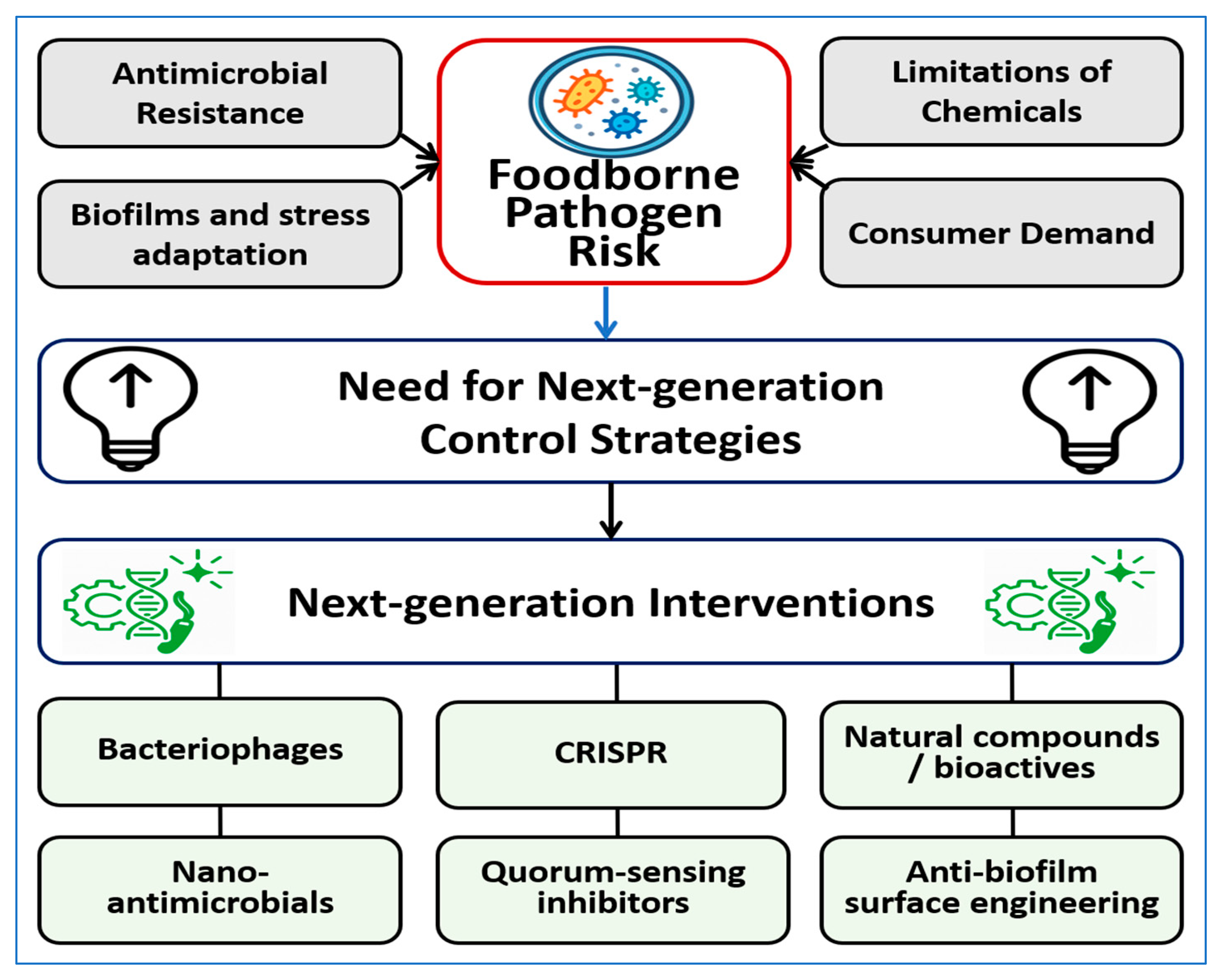
2. Shifting Paradigms in Foodborne Pathogen Control
2.1. From Broad-Spectrum to Precision Antimicrobials
2.2. From Reactive Decontamination to Proactive Prevention
2.3. Integration of Molecular Tools into Food-Safety Systems
2.4. The Role of Biofilm Biology and Microenvironmental Stressors
3. Bacteriophages and Phage-Derived Tools
3.1. Mechanisms of Action and Host Specificity
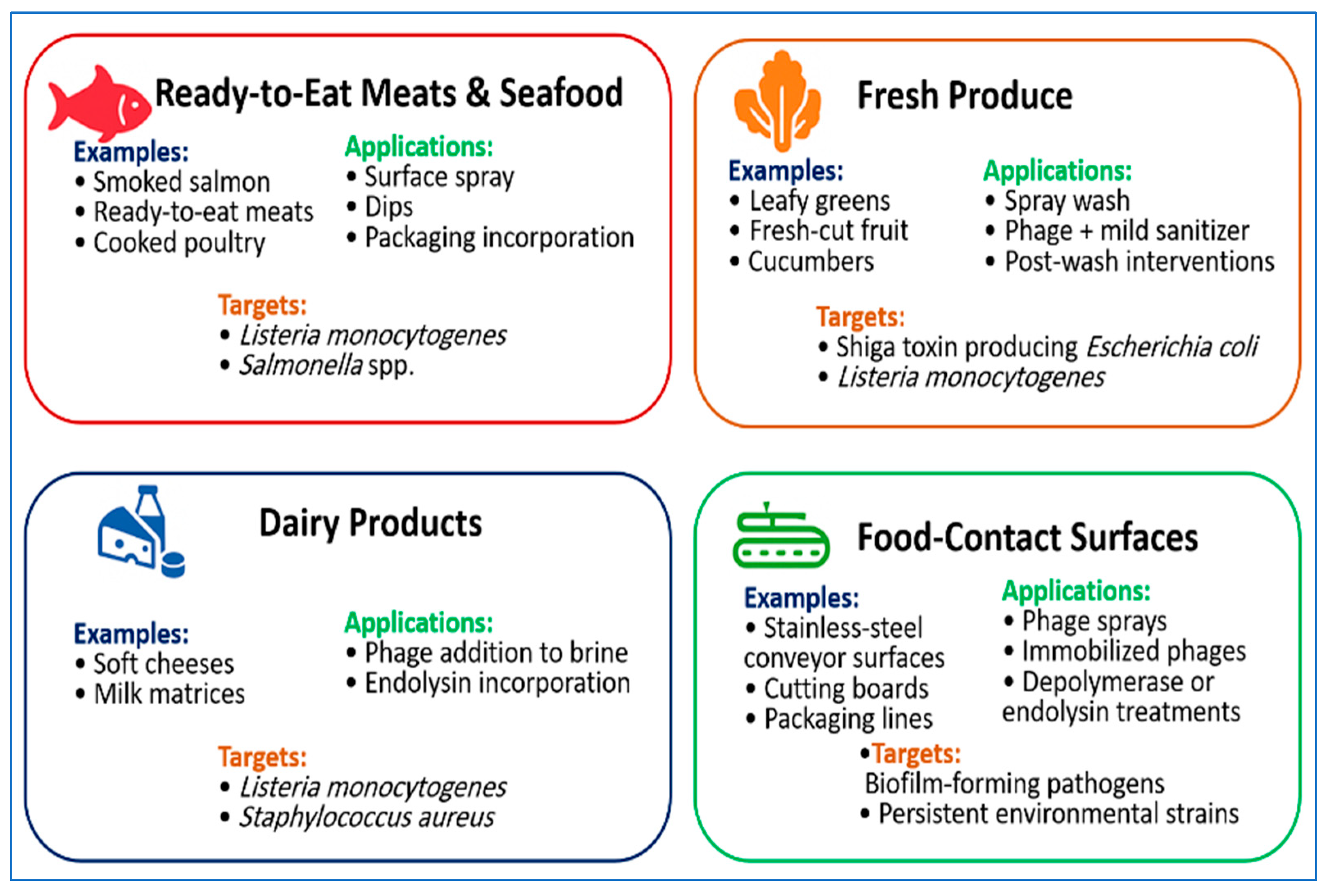
3.2. Applications in Food Matrices and Processing Environments
3.3. Engineered Phages, Endolysins, and CRISPR-Armed Phages
3.4. Regulatory, Safety, and Resistance Concerns
3.5. Future Research Directions
4. Nano-Enabled Antimicrobial Systems
4.1. Classes of Nano-Antimicrobials (Organic, Inorganic, Hybrid)
4.2. Mechanisms of Nanoscale Antimicrobial Action
4.3. Smart Nanocarriers for Controlled-Release Antimicrobial Delivery
4.4. Use in Packaging, Surface Coatings, and Wash Treatments
4.5. Toxicity, Migration, and Regulatory Limitations
4.6. Future Applications in Precision Food Safety
5. QSIs and Anti-Virulence Approaches
5.1. Overview of Quorum Sensing in Major Foodborne Pathogens
5.2. Natural and Synthetic QSIs
5.3. QS Interference for Biofilm Reduction and Virulence Suppression
5.4. Stability and Scalability Challenges
5.5. Long-Term Potential as Anti-Virulence Interventions
6. CRISPR-Based Pathogen Control Technologies
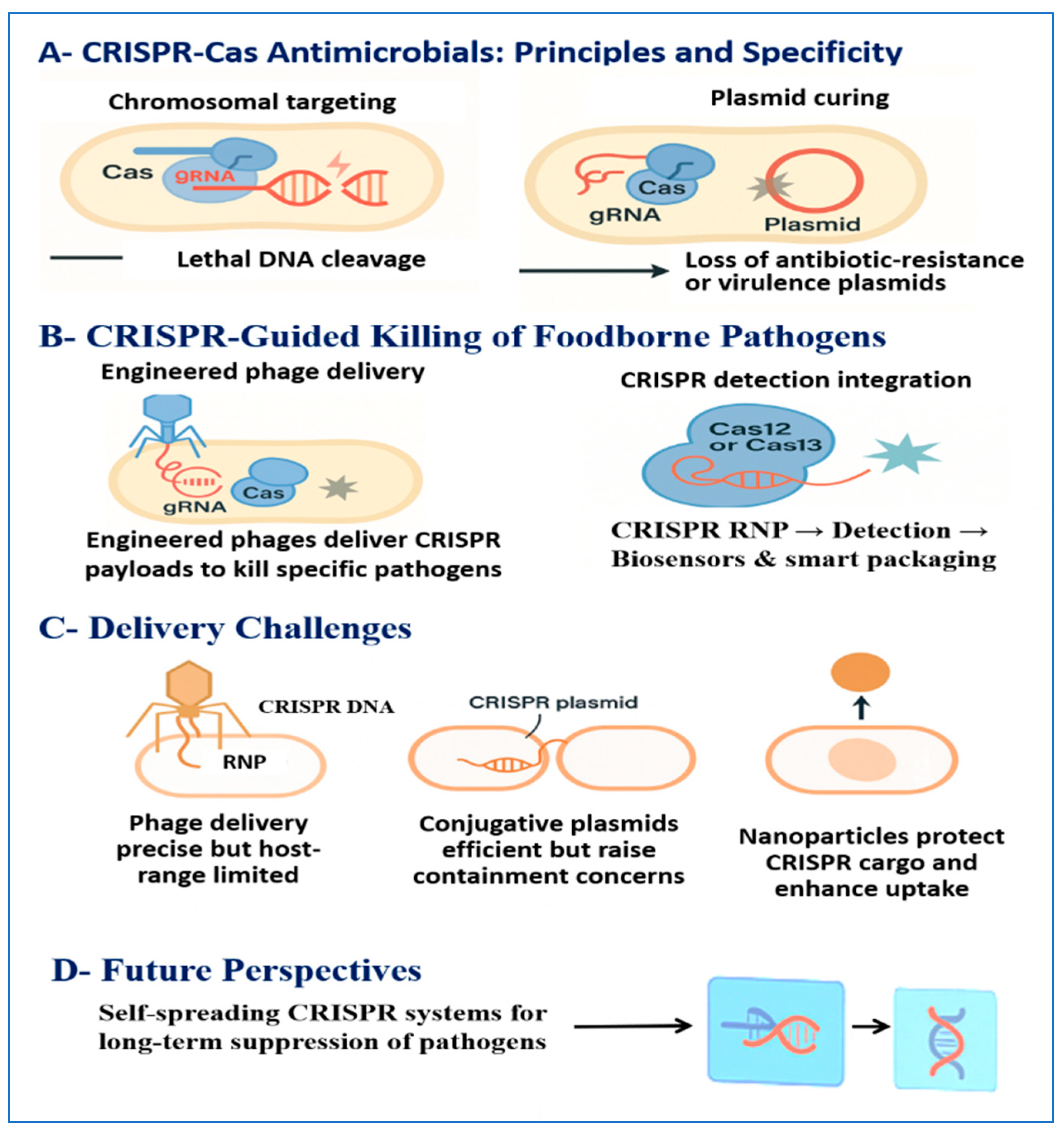
6.1. CRISPR-Cas Antimicrobials: Principles and Specificity
6.2. CRISPR-Guided Killing of Foodborne Pathogens
6.3. Integration into Sensors and Smart Packaging
6.4. Delivery Challenges (Phage, Conjugation, and NPs)
6.5. Future Perspectives: Self-Spreading Antimicrobials and Programmable Sanitation
7. Natural Bioactive Compounds and Microbial-Derived Alternatives
7.1. Plant-Derived Compounds (Polyphenols, EOs, and Alkaloids)
7.2. Bacteriocins and Postbiotic Metabolites
7.3. Synergistic Combinations with Phages, NPs, and QSIs
7.4. Encapsulation and Stability Enhancement Technologies
7.5. Limitations and Processing Challenges
8. Anti-Biofilm Surface Engineering and Contact-Active Materials
8.1. Surface Topography, Nano-Texturing, and Anti-Adhesion Strategies
8.2. Photocatalytic, Catalytic, and Enzyme-Functionalized Surfaces
8.3. Stimuli-Responsive Antimicrobial Surfaces
8.4. Industrial Feasibility and Cleaning-in-Place Compatibility
9. Integrating Emerging Technologies into Precision Food Safety Systems
9.1. Multi-Hurdle Strategies Combining Next-Generation Tools
9.2. AI-Guided Pathogen Prediction and Targeted Interventions
9.3. Digital Twins of Food-Processing Lines
9.4. Pathogen- and Environment-Specific Intervention Mapping
10. Knowledge Gaps, Regulatory Barriers, and Future Research Priorities
11. Conclusions
Author Contributions
Funding
Institutional Review Board Statement
Informed Consent Statement
Data Availability Statement
Acknowledgments
Conflicts of Interest
References
- World Health Organization (WHO). WHO’s First Ever Global Estimates of Foodborne Diseases Find Children Under 5 Account for Almost One Third of Deaths; WHO: Geneva, Switzerland, 2015; Available online: https://www.who.int/news/item/03-12-2015-who-s-first-ever-global-estimates-of-foodborne-diseases-find-children-under-5-account-for-almost-one-third-of-deaths (accessed on 2 December 2025).
- World Health Organization (WHO). Estimating the Burden of Foodborne Diseases; WHO: Geneva, Switzerland, 2024; Available online: https://www.who.int/activities/estimating-the-burden-of-foodborne-diseases? (accessed on 2 December 2025).
- Van Boeckel, T.P.; Brower, C.; Gilbert, M.; Grenfell, B.T.; Levin, S.A.; Robinson, T.P.; Teillant, A.; Laxminarayan, R. Global trends in antimicrobial use in food animals. Proc. Natl. Acad. Sci. USA 2015, 112, 5649–5654. [Google Scholar] [CrossRef] [Scilit]
- Laxminarayan, R.; Duse, A.; Wattal, C.; Zaidi, A.K.; Wertheim, H.F.; Sumpradit, N.; Vlieghe, E.; Hara, G.L.; Gould, I.M.; Goossens, H. Antibiotic resistance—The need for global solutions. Lancet Infect. Dis. 2013, 13, 1057–1098. [Google Scholar] [CrossRef] [Scilit]
- Mazaheri, T.; Cervantes-Huamán, B.R.; Bermúdez-Capdevila, M.; Ripolles-Avila, C.; Rodríguez-Jerez, J.J. Listeria monocytogenes biofilms in the food industry: Is the current hygiene program sufficient to combat the persistence of the pathogen? Microorganisms 2021, 9, 181. [Google Scholar] [CrossRef] [Scilit] [PubMed]
- Lake, F.B.; Chen, J.; van Overbeek, L.S.; Baars, J.J.; Abee, T.; den Besten, H.M. Biofilm formation and desiccation survival of Listeria monocytogenes with microbiota on mushroom processing surfaces and the effect of cleaning and disinfection. Int. J. Food Microbiol. 2024, 411, 110509. [Google Scholar] [CrossRef] [Scilit]
- Carrascosa, C.; Raheem, D.; Ramos, F.; Saraiva, A.; Raposo, A. Microbial biofilms in the food industry—A comprehensive review. Int. J. Environ. Res. Public Health 2021, 18, 2014. [Google Scholar] [CrossRef] [Scilit] [PubMed]
- Ban-Cucerzan, A.; Imre, K.; Morar, A.; Marcu, A.; Hotea, I.; Popa, S.-A.; Pătrînjan, R.-T.; Bucur, I.-M.; Gașpar, C.; Plotuna, A.-M. Persistent threats: A comprehensive review of biofilm formation, control, and economic implications in food processing environments. Microorganisms 2025, 13, 1805. [Google Scholar] [CrossRef] [Scilit] [PubMed]
- Jo, H.-Y.; Tango, C.N.; Oh, D.-H. Influence of different organic materials on chlorine concentration and sanitization of slightly acidic electrolyzed water. LWT 2018, 92, 187–194. [Google Scholar] [CrossRef] [Scilit]
- Bansal, M.; Nannapaneni, R.; Sharma, C.S.; Kiess, A. Listeria monocytogenes response to sublethal chlorine induced oxidative stress on homologous and heterologous stress adaptation. Front. Microbiol. 2018, 9, 2050. [Google Scholar] [CrossRef] [Scilit]
- Gao, H.; Liu, C. Biochemical and morphological alteration of Listeria monocytogenes under environmental stress caused by chloramine-T and sodium hypochlorite. Food Control 2014, 46, 455–461. [Google Scholar] [CrossRef] [Scilit]
- WHO. Global Antibiotic Resistance Surveillance Report 2025; WHO: Geneva, Switzerland, 2025; Available online: https://www.who.int/publications/i/item/9789240116337? (accessed on 2 December 2025).
- Rivera-Lopez, E.O.; Tirko, N.N.; Dudley, E.G. Regulatory Landscape and the Potential of Bacteriophage Applications in the United States’ Food Industry. J. Food Prot. 2025, 88, 100510. [Google Scholar] [CrossRef] [Scilit]
- Center for Regulatory Services, Inc. Transmittal of the FINK TEC GmbH—GRAS Notice for Applied Phage Vegetable S2 Antimicrobial to Control Salmonella enterica spp. on Fresh and Processed Fruits and Vegetables. Submitted to the U.S. Food and Drug Administration, Office of Food Additive Safety, 12 May 2022. Available online: https://www.fda.gov/media/169964/download? (accessed on 2 December 2025).
- EFSA Panel on Food Contact Materials, Enzymes and Processing Aids; Lambré, C.; Barat Baviera, J.M.; Bolognesi, C.; Chesson, A.; Cocconcelli, P.S.; Crebelli, R.; Gott, D.M.; Grob, K.; Lampi, E. Safety assessment of the substance silver nanoparticles for use in food contact materials. EFSA J. 2021, 19, e06790. [Google Scholar] [CrossRef] [Scilit]
- Manová, E. Study Evaluates Migration of Silver Nanoparticles from FCMs. Food Packaging Forum. Available online: https://foodpackagingforum.org/news/study-evaluates-migration-of-silver-nanoparticles-from-fcms? (accessed on 2 December 2025).
- Skandamis, P.N.; Nychas, G.-J.E. Quorum sensing in the context of food microbiology. Appl. Environ. Microbiol. 2012, 78, 5473–5482. [Google Scholar] [CrossRef] [Scilit]
- Zhao, Y.-M.; Zhang, Q.-Y.; Zhang, L.; Bao, Y.-L.; Guo, Y.-T.; Huang, L.-R.; He, R.-H.; Ma, H.-L.; Sun, D.-W. Inhibition of Quorum Sensing-Mediated Biofilm Formation and Spoilage Factors in Pseudomonas fluorescens by Plasma-Activated Water. Foods 2025, 14, 3773. [Google Scholar] [CrossRef] [Scilit] [PubMed]
- Citorik, R.J.; Mimee, M.; Lu, T.K. Sequence-specific antimicrobials using efficiently delivered RNA-guided nucleases. Nat. Biotechnol. 2014, 32, 1141–1145. [Google Scholar] [CrossRef] [Scilit] [PubMed]
- Mayorga-Ramos, A.; Zúñiga-Miranda, J.; Carrera-Pacheco, S.E.; Barba-Ostria, C.; Guamán, L.P. CRISPR-Cas-based antimicrobials: Design, challenges, and bacterial mechanisms of resistance. ACS Infect. Dis. 2023, 9, 1283–1302. [Google Scholar] [CrossRef] [Scilit]
- Falleh, H. Demystifying the power of essential oils: A review of their antibacterial properties and potential as natural food preservatives. EXCLI J. 2025, 24, 828. [Google Scholar]
- Munteanu, B.S.; Vasile, C. Encapsulation of natural bioactive compounds by electrospinning—Applications in food storage and safety. Polymers 2021, 13, 3771. [Google Scholar] [CrossRef] [Scilit]
- Sukhareva, K.; Chernetsov, V.; Burmistrov, I. A review of antimicrobial polymer coatings on steel for the food processing industry. Polymers 2024, 16, 809. [Google Scholar] [CrossRef] [Scilit] [PubMed]
- Chan, Y.; Wu, X.H.; Chieng, B.W.; Ibrahim, N.A.; Then, Y.Y. Superhydrophobic nanocoatings as intervention against biofilm-associated bacterial infections. Nanomaterials 2021, 11, 1046. [Google Scholar] [CrossRef] [Scilit]
- Ubaldi, F.; Valeriani, F.; Volpini, V.; Lofrano, G.; Romano Spica, V. Antimicrobial activity of photocatalytic coatings on surfaces: A systematic review and meta-analysis. Coatings 2024, 14, 92. [Google Scholar] [CrossRef] [Scilit]
- Kumaravel, V.; Nair, K.M.; Mathew, S.; Bartlett, J.; Kennedy, J.E.; Manning, H.G.; Whelan, B.J.; Leyland, N.S.; Pillai, S.C. Antimicrobial TiO2 nanocomposite coatings for surfaces, dental and orthopaedic implants. Chem. Eng. J. 2021, 416, 129071. [Google Scholar] [CrossRef] [Scilit]
- Rezagholizade-Shirvan, A.; Soltani, M.; Shokri, S.; Radfar, R.; Arab, M.; Shamloo, E. Bioactive compound encapsulation: Characteristics, applications in food systems, and implications for human health. Food Chem. X 2024, 24, 101953. [Google Scholar] [CrossRef] [Scilit]
- Silva, J.J.M.d.; Campanharo, S.C.; Paschoal, J.A.R. Ethnoveterinary for food-producing animals and related food safety issues: A comprehensive overview about terpenes. Compr. Rev. Food Sci. Food Saf. 2021, 20, 48–90. [Google Scholar] [CrossRef] [Scilit]
- Dawan, J.; Zhang, S.; Ahn, J. Recent advances in biofilm control technologies for the food industry. Antibiotics 2025, 14, 254. [Google Scholar] [CrossRef] [Scilit]
- Centers for Disease Control and Prevention (CDC). Chemical Disinfectants: Guideline for Disinfection and Sterilization in Healthcare Facilities (2008); CDC: Atlanta, GA, USA, 2008. Available online: https://www.cdc.gov/infection-control/hcp/disinfection-sterilization/chemical-disinfectants.html? (accessed on 3 December 2025).
- Jacobowski, A.C.; Boleti, A.P.A.; Cruz, M.V.; Santos, K.F.D.P.; de Andrade, L.R.M.; Frihling, B.E.F.; Migliolo, L.; Paiva, P.M.G.; Teodoro, P.E.; Teodoro, L.P.R. Combating Antimicrobial Resistance: Innovative Strategies Using Peptides, Nanotechnology, Phages, Quorum Sensing Interference, and CRISPR-Cas Systems. Pharmaceuticals 2025, 18, 1119. [Google Scholar] [CrossRef] [Scilit] [PubMed]
- Ahmed, M.M.; Kayode, H.H.; Okesanya, O.J.; Ukoaka, B.M.; Eshun, G.; Mourid, M.R.; Adigun, O.A.; Ogaya, J.B.; Mohamed, Z.O.; Lucero-Prisno, D.E., III. CRISPR-Cas systems in the fight against antimicrobial resistance: Current status, potentials, and future directions. Infect. Drug Resist. 2024, 17, 5229–5245. [Google Scholar] [CrossRef] [Scilit]
- Spaulding, C.N.; Klein, R.D.; Schreiber, H.L., IV; Janetka, J.W.; Hultgren, S.J. Precision antimicrobial therapeutics: The path of least resistance? npj Biofilms Microbiomes 2018, 4, 4. [Google Scholar] [CrossRef] [Scilit] [PubMed]
- Zhang, R.; Zhu, H.; Chang, Q.; Mao, Q. A Comprehensive Review of Digital Twins Technology in Agriculture. Agriculture 2025, 15, 903. [Google Scholar] [CrossRef] [Scilit]
- Liu, J.; Wu, D.; Chen, J.; Jia, S.; Chen, J.; Wu, Y.; Li, G. CRISPR-Cas systems mediated biosensing and applications in food safety detection. Crit. Rev. Food Sci. Nutr. 2024, 64, 2960–2985. [Google Scholar] [CrossRef] [Scilit]
- Bridier, A.; Briandet, R.; Thomas, V.; Dubois-Brissonnet, F. Resistance of bacterial biofilms to disinfectants: A review. Biofouling 2011, 27, 1017–1032. [Google Scholar] [CrossRef] [Scilit] [PubMed]
- Inês, A.; Cosme, F. Biosensors for Detecting Food Contaminants—An Overview. Processes 2025, 13, 380. [Google Scholar] [CrossRef] [Scilit]
- Abdurrahman, E.E.M.; Ferrari, G. Digital Twin applications in the food industry: A review. Front. Sustain. Food Syst. 2025, 9, 1538375. [Google Scholar] [CrossRef] [Scilit]
- Xie, S.; Yue, Y.; Yang, F. Recent advances in CRISPR/Cas system-based biosensors for the detection of foodborne pathogenic microorganisms. Micromachines 2024, 15, 1329. [Google Scholar] [CrossRef] [Scilit]
- Ghosh, S.; Lahiri, D.; Nag, M.; Sarkar, T.; Pati, S.; Edinur, H.A.; Kumar, M.; Mohd Zain, M.R.; Ray, R.R. Precision targeting of food biofilm-forming genes by microbial scissors: CRISPR-Cas as an effective modulator. Front. Microbiol. 2022, 13, 964848. [Google Scholar] [CrossRef] [Scilit] [PubMed]
- Marvin, H.J.; Janssen, E.M.; Bouzembrak, Y.; Hendriksen, P.J.; Staats, M. Big data in food safety: An overview. Crit. Rev. Food Sci. Nutr. 2017, 57, 2286–2295. [Google Scholar] [CrossRef] [Scilit]
- Rahman, M.A.; Akter, S.; Ashrafudoulla, M.; Jung, S.-J.; Rapak, M.T.; Ha, S.-D. CRISPR–Cas systems as emerging tools for precision biofilm control for food safety: Mechanisms and applications. Food Res. Int. 2025, 222, 117803. [Google Scholar] [CrossRef] [Scilit] [PubMed]
- Rosario, L.; Mohan, H.; Fedin, F.; Dev, S. Biofilms in Food Processing: A Comprehensive Review of Understanding Formation, Challenges, and Future Directions. Bioscan 2024, 19, 400–408. [Google Scholar] [CrossRef] [Scilit]
- Flemming, H.-C.; Wingender, J.; Szewzyk, U.; Steinberg, P.; Rice, S.A.; Kjelleberg, S. Biofilms: An emergent form of bacterial life. Nat. Rev. Microbiol. 2016, 14, 563–575. [Google Scholar] [CrossRef] [Scilit] [PubMed]
- Wozniak, D.J.; Parsek, M.R. Surface-associated microbes continue to surprise us in their sophisticated strategies for assembling biofilm communities. F1000prime Rep. 2014, 6, 26. [Google Scholar] [CrossRef] [Scilit]
- Liberty, J.T.; Bromage, S.; Peter, E.; Ihedioha, O.C.; Alsalman, F.B.; Odogwu, T.S. CRISPR revolution: Unleashing precision pathogen detection to safeguard public health and food safety. Methods 2025, 240, 180–194. [Google Scholar] [CrossRef] [Scilit]
- Hyla, K.; Dusza, I.; Skaradzińska, A. Recent advances in the application of bacteriophages against common foodborne pathogens. Antibiotics 2022, 11, 1536. [Google Scholar] [CrossRef] [Scilit] [PubMed]
- EFSA Panel on Biological Hazards (BIOHAZ). Evaluation of the safety and efficacy of Listex™ P100 for reduction of pathogens on different ready-to-eat (RTE) food products. EFSA J. 2016, 14, e04565. [Google Scholar]
- Egido, J.E.; Costa, A.R.; Aparicio-Maldonado, C.; Haas, P.-J.; Brouns, S.J. Mechanisms and clinical importance of bacteriophage resistance. FEMS Microbiol. Rev. 2022, 46, fuab048. [Google Scholar] [CrossRef] [Scilit] [PubMed]
- Segundo-Arizmendi, N.; Arellano-Maciel, D.; Rivera-Ramírez, A.; Piña-González, A.M.; López-Leal, G.; Hernández-Baltazar, E. Bacteriophages: A challenge for antimicrobial therapy. Microorganisms 2025, 13, 100. [Google Scholar] [CrossRef] [Scilit]
- Degroux, S.; Effantin, G.; Linares, R.; Schoehn, G.; Breyton, C. Deciphering bacteriophage T5 host recognition mechanism and infection trigger. J. Virol. 2023, 97, e01584-01522. [Google Scholar] [CrossRef] [Scilit]
- Lewis, R.; Bolocan, A.S.; Draper, L.A.; Ross, R.P.; Hill, C. The effect of a commercially available bacteriophage and bacteriocin on Listeria monocytogenes in coleslaw. Viruses 2019, 11, 977. [Google Scholar] [CrossRef] [Scilit]
- Latka, A.; Leiman, P.G.; Drulis-Kawa, Z.; Briers, Y. Modeling the architecture of depolymerase-containing receptor binding proteins in Klebsiella phages. Front. Microbiol. 2019, 10, 2649. [Google Scholar] [CrossRef] [Scilit]
- Chen, X.; Liu, M.; Zhang, P.; Xu, M.; Yuan, W.; Bian, L.; Liu, Y.; Xia, J.; Leung, S.S. Phage-derived depolymerase as an antibiotic adjuvant against multidrug-resistant Acinetobacter baumannii. Front. Microbiol. 2022, 13, 845500. [Google Scholar] [CrossRef] [Scilit]
- Guo, Z.; Liu, M.; Zhang, D. Potential of phage depolymerase for the treatment of bacterial biofilms. Virulence 2023, 14, 2273567. [Google Scholar] [CrossRef] [Scilit]
- Sutherland, I.W.; Hughes, K.A.; Skillman, L.C.; Tait, K. The interaction of phage and biofilms. FEMS Microbiol. Lett. 2004, 232, 1–6. [Google Scholar] [CrossRef] [Scilit] [PubMed]
- Zhang, Y.; Lan, W.; Sun, X. Phage-encoded depolymerases and endolysins as prospective strategies to combat multidrug-resistant Klebsiella pneumoniae. Int. J. Biol. Macromol. 2025, 321, 146159. [Google Scholar] [CrossRef] [Scilit]
- Labrie, S.J.; Samson, J.E.; Moineau, S. Bacteriophage resistance mechanisms. Nat. Rev. Microbiol. 2010, 8, 317–327. [Google Scholar] [CrossRef] [Scilit] [PubMed]
- Wang, X.; Leptihn, S. Defense and anti-defense mechanisms of bacteria and bacteriophages. J. Zhejiang Univ.-Sci. B 2024, 25, 181–196. [Google Scholar] [CrossRef] [Scilit] [PubMed]
- Moye, Z.D.; Woolston, J.; Sulakvelidze, A. Bacteriophage applications for food production and processing. Viruses 2018, 10, 205. [Google Scholar] [CrossRef] [Scilit]
- Oliveira, M.; Viñas, I.; Colàs, P.; Anguera, M.; Usall, J.; Abadias, M. Effectiveness of a bacteriophage in reducing Listeria monocytogenes on fresh-cut fruits and fruit juices. Food Microbiol. 2014, 38, 137–142. [Google Scholar] [CrossRef] [Scilit]
- Wójcicki, M.; Świder, O.; Gientka, I.; Błażejak, S.; Średnicka, P.; Shymialevich, D.; Cieślak, H.; Wardaszka, A.; Emanowicz, P.; Sokołowska, B. Effectiveness of a phage cocktail as a potential biocontrol agent against saprophytic bacteria in ready-to-eat plant-based food. Viruses 2023, 15, 172. [Google Scholar] [CrossRef] [Scilit]
- Kawacka, I.; Olejnik-Schmidt, A.; Schmidt, M.; Sip, A. Effectiveness of phage-based inhibition of Listeria monocytogenes in food products and food processing environments. Microorganisms 2020, 8, 1764. [Google Scholar] [CrossRef] [Scilit]
- Shahdadi, M.; Safarirad, M.; Berizi, E.; Hosseinzadeh, S.; Phimolsiripol, Y.; Khaneghah, A.M. Investigating the effect of phage on reducing Salmonella spp. in poultry meat: A systematic review and meta-analysis. Food Control 2024, 160, 110380. [Google Scholar] [CrossRef] [Scilit]
- PhageGuard Middle East. PhageGuard S Featured in Large-Scale Salmonella Field Study on Poultry Carcasses. PhageGuard, 2021. Available online: https://phageguard.com/knowledge-center/phageguard-pgs-large-scale-salmonella-field-study-poultry-carcasses? (accessed on 4 December 2025).
- Safarirad, M.; Shahdadi, M.; Berizi, E.; Mazloomi, S.M.; Hosseinzadeh, S.; Montaseri, M.; Derakhshan, Z. A systematic review and modeling of the effect of bacteriophages on E. coli O157: H7 reduction in vegetables. Heliyon 2023, 9, e22961. [Google Scholar] [CrossRef] [Scilit]
- Schmelcher, M.; Donovan, D.M.; Loessner, M.J. Bacteriophage endolysins as novel antimicrobials. Future Microbiol. 2012, 7, 1147–1171. [Google Scholar] [CrossRef] [Scilit]
- Nazir, A.; Xu, X.; Liu, Y.; Chen, Y. Phage endolysins: Advances in the world of food safety. Cells 2023, 12, 2169. [Google Scholar] [CrossRef] [Scilit]
- Olsen, N.M.; Thiran, E.; Hasler, T.; Vanzieleghem, T.; Belibasakis, G.N.; Mahillon, J.; Loessner, M.J.; Schmelcher, M. Synergistic removal of static and dynamic Staphylococcus aureus biofilms by combined treatment with a bacteriophage endolysin and a polysaccharide depolymerase. Viruses 2018, 10, 438. [Google Scholar] [CrossRef] [Scilit]
- Cademartiri, R.; Anany, H.; Gross, I.; Bhayani, R.; Griffiths, M.; Brook, M.A. Immobilization of bacteriophages on modified silica particles. Biomaterials 2010, 31, 1904–1910. [Google Scholar] [CrossRef] [Scilit]
- Costa, M.J.; Pastrana, L.M.; Teixeira, J.A.; Sillankorva, S.M.; Cerqueira, M.A. Bacteriophage delivery systems for food applications: Opportunities and perspectives. Viruses 2023, 15, 1271. [Google Scholar] [CrossRef] [Scilit]
- Costa, P.; Pereira, C.; Romalde, J.L.; Almeida, A. From Isolation to Application: Designing a Multi-Target Phage Cocktail for Bivalve Safety. Microorganisms 2025, 13, 2708. [Google Scholar] [CrossRef] [Scilit]
- Kim, M.K.; Chen, Q.; Echterhof, A.; Pennetzdorfer, N.; McBride, R.C.; Banaei, N.; Burgener, E.B.; Milla, C.E.; Bollyky, P.L. A blueprint for broadly effective bacteriophage-antibiotic cocktails against bacterial infections. Nat. Commun. 2024, 15, 9987. [Google Scholar] [CrossRef] [Scilit] [PubMed]
- Sillankorva, S.M.; Oliveira, H.; Azeredo, J. Bacteriophages and their role in food safety. Int. J. Microbiol. 2012, 2012, 863945. [Google Scholar] [CrossRef] [Scilit]
- U.S. Food and Drug Administration (FDA). GRN No. 218: Bacteriophage P100 Preparation from Listeria Innocua; FDA: Silver Spring, MD, USA, 2007. Available online: https://hfpappexternal.fda.gov/scripts/fdcc/index.cfm?set=GRASNotices&id=218 (accessed on 5 December 2025).
- Food Standards Australia New Zealand (FSANZ). Application A1045: Bacteriophage Preparation P100 as a Processing Aid—1st Assessment Report; FSANZ: Canberra, ACT, Australia; Wellington, New Zealand, 2011. Available online: https://www.foodstandards.gov.au/sites/default/files/food-standards-code/applications/Documents/A1045%20Bacteriophage%20as%20a%20PA%201AR%20FINAL.pdf? (accessed on 31 December 2025).
- Montañez-Izquierdo, V.Y.; Salas-Vázquez, D.I.; Rodríguez-Jerez, J.J. Use of epifluorescence microscopy to assess the effectiveness of phage P100 in controlling Listeria monocytogenes biofilms on stainless steel surfaces. Food Control 2012, 23, 470–477. [Google Scholar] [CrossRef] [Scilit]
- U.S. Food and Drug Administration (FDA). GRAS Notice No. 435: Preparation Consisting of Six Bacterial Monophages Specific to Salmonella enterica (Monophage Cocktail); FDA: Silver Spring, MD, USA, 2013. Available online: https://hfpappexternal.fda.gov/Scripts/Fdcc/index.cfm?id=435&set=GRASNotices& (accessed on 31 December 2025).
- U.S. Food and Drug Administration (FDA). Agency Response Letter Regarding GRAS Notice No. 435: Preparation Consisting of Six Bacterial Monophages Specific to Salmonella enterica; Center for Food Safety and Applied Nutrition; FDA: Silver Spring, MD, USA, 2021. Available online: https://www.fda.gov/media/151413/download? (accessed on 31 December 2025).
- Intralytix, Inc. Description of the Proposed Action for Use as a Food Additive to Reduce Escherichia coli O157:H7 in Red Meat; Intralytix, Inc.: Baltimore, MD, USA, 2010. Available online: https://www.fda.gov/media/80131/download? (accessed on 31 December 2025).
- Carter, C.D.; Parks, A.; Abuladze, T.; Li, M.; Woolston, J.; Magnone, J.; Senecal, A.; Kropinski, A.M.; Sulakvelidze, A. Bacteriophage cocktail significantly reduces Escherichia coli O157: H7 contamination of lettuce and beef, but does not protect against recontamination. Bacteriophage 2012, 2, 178–185. [Google Scholar] [CrossRef] [Scilit] [PubMed]
- Husain, F.M.; Zahra, A.; Ali, A.; Kamthan, M.; Al-Shabib, N.A.; Farooqui, Z.; Ahmad, N.; Albalawi, T.; Alam, P.; Munawar, N. Bacteriophages and Their Enzymes: Allies Against Microbial Biofilms. Pharmaceuticals 2025, 18, 1771. [Google Scholar] [CrossRef] [Scilit] [PubMed]
- Gencay, Y.E.; Jasinskytė, D.; Robert, C.; Semsey, S.; Martínez, V.; Petersen, A.Ø.; Brunner, K.; de Santiago Torio, A.; Salazar, A.; Turcu, I.C. Engineered phage with antibacterial CRISPR–Cas selectively reduce E. coli burden in mice. Nat. Biotechnol. 2024, 42, 265–274. [Google Scholar] [CrossRef] [Scilit]
- Keim, B. Scientists Build Bacteria-Killing Organisms from Scratch. Wired. 2007. Available online: https://www.wired.com/2007/07/designer-virus/? (accessed on 4 December 2025).
- Khambhati, K.; Bhattacharjee, G.; Gohil, N.; Dhanoa, G.K.; Sagona, A.P.; Mani, I.; Bui, N.L.; Chu, D.T.; Karapurkar, J.K.; Jang, S.H. Phage engineering and phage-assisted CRISPR-Cas delivery to combat multidrug-resistant pathogens. Bioeng. Transl. Med. 2023, 8, e10381. [Google Scholar] [CrossRef] [Scilit]
- Campos, D.L.; Liao, Y.-T.; Harden, L.A.; Zhang, Y.; Wu, V.C. Penetrating the Biofilm Barrier: Characterization of Escherichia Phage vB_EcoS-TPF103dw and Harnessing Depolymerase to Combat Shiga Toxin-Producing E. coli O103 Biofilm. Front. Microbiol. 2025, 16, 1715907. [Google Scholar] [CrossRef] [Scilit]
- Khan, F.M.; Chen, J.-H.; Zhang, R.; Liu, B. A comprehensive review of the applications of bacteriophage-derived endolysins for foodborne bacterial pathogens and food safety: Recent advances, challenges, and future perspective. Front. Microbiol. 2023, 14, 1259210. [Google Scholar] [CrossRef] [Scilit]
- Lopez, M.E.S.; Otero-Herrera, A.M.; Mendoza-Corvis, F.; Salgado-Behaine, J.J.; López-Vergara, R.; Hernández-Arteaga, A.M.; Cortessi, D.; Vidigal, P.M.; Pérez-Sierra, O. Bacteriophages and Endolysins Used in the Biocontrol of Staphylococcus aureus. Microorganisms 2025, 13, 2638. [Google Scholar] [CrossRef] [Scilit]
- Brás, A.; Braz, M.; Martinho, I.; Duarte, J.; Pereira, C.; Almeida, A. Effect of bacteriophages against biofilms of Escherichia coli on food processing surfaces. Microorganisms 2024, 12, 366. [Google Scholar] [CrossRef] [Scilit]
- Roberts, A.; Adler, B.A.; Cress, B.F.; Doudna, J.A.; Barrangou, R. Phage-based delivery of CRISPR-associated transposases for targeted bacterial editing. Proc. Natl. Acad. Sci. USA 2025, 122, e2504853122. [Google Scholar] [CrossRef] [Scilit] [PubMed]
- Fage, C.; Lemire, N.; Moineau, S. Delivery of CRISPR-Cas systems using phage-based vectors. Curr. Opin. Biotechnol. 2021, 68, 174–180. [Google Scholar] [CrossRef] [Scilit]
- Lee, C.; Kim, H.; Ryu, S. Bacteriophage and endolysin engineering for biocontrol of food pathogens/pathogens in the food: Recent advances and future trends. Crit. Rev. Food Sci. Nutr. 2023, 63, 8919–8938. [Google Scholar] [CrossRef] [Scilit] [PubMed]
- dos Santos, D.L.S.; Youssef, O.; Álvarez, J.; García, P.; Silva, N.C.C. Advances in the application and use of bacteriophages and endolysins to inhibit Staphylococcus aureus contamination in foods. Food Control 2025, 182, 111808. [Google Scholar] [CrossRef] [Scilit]
- Pujato, S.A.; Briggiler-Marcó, M.; Mercanti, D.J. Phage biocontrol: Enhancing food safety through effective pathogen reduction. In Advances in Food and Nutrition Research; Elsevier: Amsterdam, The Netherlands, 2025; Volume 116, pp. 359–407. [Google Scholar]
- Trząskowska, M.; Naammo, E.E.; Salman, M.; Afolabi, A.; Wong, C.W.; Kołożyn-Krajewska, D. Risk Profile of Bacteriophages in the Food Chain. Foods 2025, 14, 2257. [Google Scholar] [CrossRef] [Scilit]
- Yosef, I.; Manor, M.; Kiro, R.; Qimron, U. Temperate and lytic bacteriophages programmed to sensitize and kill antibiotic-resistant bacteria. Proc. Natl. Acad. Sci. USA 2015, 112, 7267–7272. [Google Scholar] [CrossRef] [Scilit]
- Topka-Bielecka, G.; Dydecka, A.; Necel, A.; Bloch, S.; Nejman-Faleńczyk, B.; Węgrzyn, G.; Węgrzyn, A. Bacteriophage-derived depolymerases against bacterial biofilm. Antibiotics 2021, 10, 175. [Google Scholar] [CrossRef] [Scilit]
- Zhang, H.; Bao, H.; Billington, C.; Hudson, J.A.; Wang, R. Isolation and lytic activity of the Listeria bacteriophage endolysin LysZ5 against Listeria monocytogenes in soya milk. Food Microbiol. 2012, 31, 133–136. [Google Scholar] [CrossRef] [Scilit]
- Chibeu, A.; Agius, L.; Gao, A.; Sabour, P.M.; Kropinski, A.M.; Balamurugan, S. Efficacy of bacteriophage LISTEX™ P100 combined with chemical antimicrobials in reducing Listeria monocytogenes in cooked turkey and roast beef. Int. J. Food Microbiol. 2013, 167, 208–214. [Google Scholar] [CrossRef] [Scilit]
- Ibarra-Sánchez, L.A.; Van Tassell, M.L.; Miller, M.J. Antimicrobial behavior of phage endolysin PlyP100 and its synergy with nisin to control Listeria monocytogenes in Queso Fresco. Food Microbiol. 2018, 72, 128–134. [Google Scholar] [CrossRef] [Scilit]
- Liu, H.; Li, H.; Liang, Y.; Du, X.; Yang, C.; Yang, L.; Xie, J.; Zhao, R.; Tong, Y.; Qiu, S. Phage-delivered sensitisation with subsequent antibiotic treatment reveals sustained effect against antimicrobial resistant bacteria. Theranostics 2020, 10, 6310. [Google Scholar] [CrossRef] [Scilit] [PubMed]
- Lam, K.N.; Spanogiannopoulos, P.; Soto-Perez, P.; Alexander, M.; Nalley, M.J.; Bisanz, J.E.; Nayak, R.R.; Weakley, A.M.; Yu, F.B.; Turnbaugh, P.J. Phage-delivered CRISPR-Cas9 for strain-specific depletion and genomic deletions in the gut microbiome. Cell Rep. 2021, 37, 109930. [Google Scholar] [CrossRef] [Scilit] [PubMed]
- Zurabov, F.; Glazunov, E.; Kochetova, T.; Uskevich, V.; Popova, V. Bacteriophages with depolymerase activity in the control of antibiotic resistant Klebsiella pneumoniae biofilms. Sci. Rep. 2023, 13, 15188. [Google Scholar] [CrossRef] [Scilit]
- Lu, R.; Liu, B.; Wu, L.; Bao, H.; García, P.; Wang, Y.; Zhou, Y.; Zhang, H. A broad-spectrum phage endolysin (LysCP28) able to remove biofilms and inactivate Clostridium perfringens strains. Foods 2023, 12, 411. [Google Scholar] [CrossRef] [Scilit] [PubMed]
- Cha, Y.; Son, B.; Ryu, S. Effective removal of staphylococcal biofilms on various food contact surfaces by Staphylococcus aureus phage endolysin LysCSA13. Food Microbiol. 2019, 84, 103245. [Google Scholar] [CrossRef] [Scilit]
- Obeso, J.M.; Martínez, B.; Rodríguez, A.; García, P. Lytic activity of the recombinant staphylococcal bacteriophage ΦH5 endolysin active against Staphylococcus aureus in milk. Int. J. Food Microbiol. 2008, 128, 212–218. [Google Scholar] [CrossRef] [Scilit]
- Organisation for Economic Co-operation and Development (OECD). ENV/CBC/MONO(2022)40: Guidance Document for the Regulatory Framework for the Microorganism Group—Bacteriophages. Environment Directorate; Chemicals and Biotechnology Committee; OECD: Paris, France, 2022; Available online: https://www.oecd.org/content/dam/oecd/en/publications/reports/2022/11/guidance-document-for-the-regulatory-framework-for-the-microorganism-group-bacteriophages_92fbf702/706035c7-en.pdf? (accessed on 5 December 2025).
- Kim, J.; Liao, X.; Zhang, S.; Ding, T.; Ahn, J. Application of phage-derived enzymes for enhancing food safety. Food Res. Int. 2025, 209, 116318. [Google Scholar] [CrossRef] [Scilit] [PubMed]
- Ambroa, A.; Blasco, L.; López, M.; Pacios, O.; Bleriot, I.; Fernández-García, L.; Gonzalez de Aledo, M.; Ortiz-Cartagena, C.; Millard, A.; Tomás, M. Genomic analysis of molecular bacterial mechanisms of resistance to phage infection. Front. Microbiol. 2022, 12, 784949. [Google Scholar] [CrossRef] [Scilit] [PubMed]
- Lu, H.; Wang, Y.; Liu, H.; Wang, N.; Zhang, Y.; Li, X. Review of the Presence and Phage-Mediated Transfer of ARGs in Biofilms. Microorganisms 2025, 13, 997. [Google Scholar] [CrossRef] [Scilit]
- Singh, S.; Samson, R.; Hassard, F. Phage therapy for environmental biotechnology applications. Front. Microbiol. 2025, 16, 1621103. [Google Scholar] [CrossRef] [Scilit]
- Wang, Q.; Wang, M.; Yang, Q.; Feng, L.; Zhang, H.; Wang, R.; Wang, R. The role of bacteriophages in facilitating the horizontal transfer of antibiotic resistance genes in municipal wastewater treatment plants. Water Res. 2025, 268, 122776. [Google Scholar] [CrossRef] [Scilit] [PubMed]
- Li, X.; Gao, Y.; Zhang, Z.; Deng, W.; Cao, W.; Wei, X.; Gao, Z.; Yao, L.; Wang, S.; Xie, Y. Biosafety considerations triggered by genome-editing technologies. Biosaf. Health 2025, 7, 141–151. [Google Scholar] [CrossRef] [Scilit]
- Anliker, B.; Childs, L.; Rau, J.; Renner, M.; Schüle, S.; Schuessler-Lenz, M.; Sebe, A. Regulatory considerations for clinical trial applications with CRISPR-based medicinal products. Cris. J. 2022, 5, 364–376. [Google Scholar] [CrossRef] [Scilit]
- Gondil, V.S.; Chhibber, S. Bacteriophage and endolysin encapsulation systems: A promising strategy to improve therapeutic outcomes. Front. Pharmacol. 2021, 12, 675440. [Google Scholar] [CrossRef] [Scilit]
- Yue, Y.; Xu, Z.; Soteyome, T.; Premarathna, M.; Yin, X.; Liu, J. Phage Encapsulation and Delivery Technology: A Strategy for Treating Drug-Resistant Pathogenic Microorganisms. Pharmaceuticals 2025, 18, 1688. [Google Scholar] [CrossRef] [Scilit] [PubMed]
- Duarte, J.; Pereira, C.; Calado, R.; Almeida, A. Phage Stability Research: A Systematic Review Bridging Methodological Gaps and Paving the Way for Industrial and Clinical Applications. PHAGE 2025, 6, 189–200. [Google Scholar] [CrossRef] [Scilit]
- Oechslin, F. Resistance development to bacteriophages occurring during bacteriophage therapy. Viruses 2018, 10, 351. [Google Scholar] [CrossRef] [Scilit]
- Feng, L.; Chen, H.; Qian, C.; Zhao, Y.; Wang, W.; Liu, Y.; Xu, M.; Cao, J.; Zhou, T.; Wu, Q. Resistance, mechanism, and fitness cost of specific bacteriophages for Pseudomonas aeruginosa. Msphere 2024, 9, e00553-23. [Google Scholar] [CrossRef] [Scilit]
- Gulig, P.; Swindle, S.; Fields, M.; Eisenman, D. A review of clinical trials involving genetically modified bacteria, bacteriophages and their associated risk assessments. Appl. Biosaf. 2024, 29, 186–206. [Google Scholar] [CrossRef] [Scilit] [PubMed]
- She, T.; Tan, D.; Balcazar, J.L.; Friman, V.P.; Wang, D.; Zhu, D.; Ye, M.; Sun, M.; Yuan, S.; Hu, F. Phage-mediated horizontal transfer of Salmonella enterica virulence genes with regulatory feedback from the host. iMeta 2025, 4, e70042. [Google Scholar] [CrossRef] [Scilit]
- Braz, M.; Pereira, C.; Freire, C.S.; Almeida, A. A Review on Recent Trends in Bacteriophages for Post-Harvest Food Decontamination. Microorganisms 2025, 13, 515. [Google Scholar] [CrossRef] [Scilit]
- Rodrigues, A.S.; Batista, J.G.; Rodrigues, M.Á.; Thipe, V.C.; Minarini, L.A.; Lopes, P.S.; Lugão, A.B. Advances in silver nanoparticles: A comprehensive review on their potential as antimicrobial agents and their mechanisms of action elucidated by proteomics. Front. Microbiol. 2024, 15, 1440065. [Google Scholar] [CrossRef] [Scilit] [PubMed]
- Serov, D.A.; Gritsaeva, A.V.; Yanbaev, F.M.; Simakin, A.V.; Gudkov, S.V. Review of antimicrobial properties of titanium dioxide nanoparticles. Int. J. Mol. Sci. 2024, 25, 10519. [Google Scholar] [CrossRef] [Scilit]
- Lu, H.; Zhang, S.; Wang, J.; Chen, Q. A review on polymer and lipid-based nanocarriers and its application to nano-pharmaceutical and food-based systems. Front. Nutr. 2021, 8, 783831. [Google Scholar] [CrossRef] [Scilit]
- Sharma, S.; Mulrey, L.; Byrne, M.; Jaiswal, A.K.; Jaiswal, S. Encapsulation of essential oils in nanocarriers for active food packaging. Foods 2022, 11, 2337. [Google Scholar] [CrossRef] [Scilit]
- del Rosario Herrera-Rivera, M.; Torres-Arellanes, S.P.; Cortés-Martínez, C.I.; Navarro-Ibarra, D.C.; Hernández-Sánchez, L.; Solis-Pomar, F.; Pérez-Tijerina, E.; Román-Doval, R. Nanotechnology in food packaging materials: Role and application of nanoparticles. RSC Adv. 2024, 14, 21832–21858. [Google Scholar] [CrossRef] [Scilit]
- Wang, L.; Dekker, M.; Heising, J.; Zhao, L.; Fogliano, V. Food matrix design can influence the antimicrobial activity in the food systems: A narrative review. Crit. Rev. Food Sci. Nutr. 2024, 64, 8963–8989. [Google Scholar] [CrossRef] [Scilit] [PubMed]
- Yemmireddy, V.K.; Farrell, G.D.; Hung, Y.C. Development of titanium dioxide (TiO2) nanocoatings on food contact surfaces and method to evaluate their durability and photocatalytic bactericidal property. J. Food Sci. 2015, 80, N1903–N1911. [Google Scholar] [CrossRef] [Scilit]
- Yemmireddy, V.K.; Hung, Y.C. Using photocatalyst metal oxides as antimicrobial surface coatings to ensure food safety—Opportunities and challenges. Compr. Rev. Food Sci. Food Saf. 2017, 16, 617–631. [Google Scholar] [CrossRef] [Scilit]
- EFSA Scientific Committee; More, S.; Bampidis, V.; Benford, D.; Bragard, C.; Halldorsson, T.; Hernández-Jerez, A.; Bennekou, S.H.; Koutsoumanis, K.; Lambré, C. Guidance on technical requirements for regulated food and feed product applications to establish the presence of small particles including nanoparticles. EFSA J. 2021, 19, e06769. [Google Scholar] [CrossRef] [Scilit]
- Schoonjans, R.; Castenmiller, J.; Chaudhry, Q.; Cubadda, F.; Daskaleros, T.; Franz, R.; Gott, D.; Mast, J.; Mortensen, A.; Oomen, A.G. Regulatory safety assessment of nanoparticles for the food chain in Europe. Trends Food Sci. Technol. 2023, 134, 98–111. [Google Scholar] [CrossRef] [Scilit]
- Yin, I.X.; Zhang, J.; Zhao, I.S.; Mei, M.L.; Li, Q.; Chu, C.H. The antibacterial mechanism of silver nanoparticles and its application in dentistry. Int. J. Nanomed. 2020, 15, 2555–2562. [Google Scholar] [CrossRef] [Scilit] [PubMed]
- Yemmireddy, V.K.; Hung, Y.-C. Effect of food processing organic matter on photocatalytic bactericidal activity of titanium dioxide (TiO2). Int. J. Food Microbiol. 2015, 204, 75–80. [Google Scholar] [CrossRef] [Scilit] [PubMed]
- Mohammad, Z.H.; Ahmad, F. Nanocoating and its application as antimicrobials in the food industry: A review. Int. J. Biol. Macromol. 2024, 254, 127906. [Google Scholar] [CrossRef] [Scilit]
- Mouzakis, A.; Panagopoulos, P.; Papazoglou, D.; Petrakis, V. A Comprehensive Review of Nanoparticles in the Fight Against Antimicrobial Resistance. Pathogens 2025, 14, 1090. [Google Scholar] [CrossRef] [Scilit]
- Joshi, A.A.; Patil, R.H. Nanoparticles Targeting Biofilms: A New Era in Combating Antimicrobial Resistance. Med. Microecol. 2025, 26, 100156. [Google Scholar] [CrossRef] [Scilit]
- Xu, Z.; Chen, J.; Lv, Y.; Du, J.; Rojas, O.J.; Wang, H. Controlled release of active food packaging by nanocarriers: Design, mechanism, models and applications. Food Packag. Shelf Life 2025, 49, 101524. [Google Scholar] [CrossRef] [Scilit]
- Guruprasath, N.; Sankarganesh, P.; Adeyeye, S.A.O.; Babu, A.S.; Parthasarathy, V. Review on emerging applications of nanobiosensor in food safety. J. Food Sci. 2024, 89, 3950–3972. [Google Scholar] [CrossRef] [Scilit] [PubMed]
- Radev, R.; Marinova, V. Antimicrobial edible films and coatings for food. BIO Web Conf. 2025, 194, 01004. [Google Scholar] [CrossRef] [Scilit]
- Dube, E.; Okuthe, G.E. Silver Nanoparticle-Based Antimicrobial Coatings: Sustainable Strategies for Microbial Contamination Control. Microbiol. Res. 2025, 16, 110. [Google Scholar] [CrossRef] [Scilit]
- Li, G.; Tang, L.; Zhang, X.; Dong, J. A review of factors affecting the efficiency of clean-in-place procedures in closed processing systems. Energy 2019, 178, 57–71. [Google Scholar] [CrossRef] [Scilit]
- Balasubramanian, B.; Shah, T.; Allen, J.; Rankin, K.; Xue, J.; Luo, Y.; Mancini, R.; Upadhyay, A. Eugenol nanoemulsion inactivates Listeria monocytogenes, Salmonella Enteritidis, and Escherichia coli O157: H7 on cantaloupes without affecting rind color. Front. Sustain. Food Syst. 2022, 6, 984391. [Google Scholar] [CrossRef] [Scilit]
- EFSA Scientific Committee; More, S.; Bampidis, V.; Benford, D.; Bragard, C.; Halldorsson, T.; Hernández-Jerez, A.; Hougaard Bennekou, S.; Koutsoumanis, K.; Lambré, C. Guidance on risk assessment of nanomaterials to be applied in the food and feed chain: Human and animal health. EFSA J. 2021, 19, e06768. [Google Scholar] [CrossRef] [Scilit]
- Herrera-Rodríguez, M.A.; del Pilar Ramos-Godinez, M.; Cano-Martínez, A.; Segura, F.C.; Ruiz-Ramírez, A.; Pavón, N.; Lira-Silva, E.; Bautista-Pérez, R.; Thomas, R.S.; Delgado-Buenrostro, N.L. Food-grade titanium dioxide and zinc oxide nanoparticles induce toxicity and cardiac damage after oral exposure in rats. Part. Fibre Toxicol. 2023, 20, 43. [Google Scholar] [CrossRef] [Scilit]
- Gupta, R.K.; Guha, P.; Srivastav, P.P. Investigating the toxicological effects of nanomaterials in food packaging associated with human health and the environment. J. Hazard. Mater. Lett. 2024, 5, 100125. [Google Scholar] [CrossRef] [Scilit]
- Paidari, S.; Tahergorabi, R.; Anari, E.S.; Nafchi, A.M.; Zamindar, N.; Goli, M. Migration of various nanoparticles into food samples: A review. Foods 2021, 10, 2114. [Google Scholar] [CrossRef] [Scilit]
- Li, L.; Yu, T.; Yuan, L.; Doulgeraki, A.I.; Iseppi, R. Biofilm formation and quorum sensing of foodborne microorganism. Front. Microbiol. 2022, 13, 1107603. [Google Scholar] [CrossRef] [Scilit] [PubMed]
- Falà, A.K.; Álvarez-Ordóñez, A.; Filloux, A.; Gahan, C.G.; Cotter, P.D. Quorum sensing in human gut and food microbiomes: Significance and potential for therapeutic targeting. Front. Microbiol. 2022, 13, 1002185. [Google Scholar] [CrossRef] [Scilit]
- Sholpan, A.; Lamas, A.; Cepeda, A.; Franco, C.M. Salmonella spp. quorum sensing: An overview from environmental persistence to host cell invasion. AIMS Microbiol. 2021, 7, 238. [Google Scholar] [CrossRef]
- Rutherford, S.T.; Bassler, B.L. Bacterial quorum sensing: Its role in virulence and possibilities for its control. Cold Spring Harb. Perspect. Med. 2012, 2, a012427. [Google Scholar] [CrossRef] [Scilit] [PubMed]
- Li, Y.-H.; Tian, X. Quorum sensing and bacterial social interactions in biofilms. Sensors 2012, 12, 2519–2538. [Google Scholar] [CrossRef] [Scilit]
- Jayathilake, P.G.; Jana, S.; Rushton, S.; Swailes, D.; Bridgens, B.; Curtis, T.; Chen, J. Extracellular polymeric substance production and aggregated bacteria colonization influence the competition of microbes in biofilms. Front. Microbiol. 2017, 8, 1865. [Google Scholar] [CrossRef] [Scilit]
- Rodríguez-Urretavizcaya, B.; Vilaplana, L.; Marco, M.-P. Strategies for quorum sensing inhibition as a tool for controlling Pseudomonas aeruginosa infections. Int. J. Antimicrob. Agents 2024, 64, 107323. [Google Scholar] [CrossRef] [Scilit]
- Singh, S.; Bhatia, S. Quorum sensing inhibitors: Curbing pathogenic infections through inhibition of bacterial communication. Iran. J. Pharm. Res. 2021, 20, 486. [Google Scholar]
- Parsek, M.R.; Greenberg, E. Sociomicrobiology: The connections between quorum sensing and biofilms. Trends Microbiol. 2005, 13, 27–33. [Google Scholar] [CrossRef] [Scilit]
- Jakobsen, T.H.; van Gennip, M.; Phipps, R.K.; Shanmugham, M.S.; Christensen, L.D.; Alhede, M.; Skindersoe, M.E.; Rasmussen, T.B.; Friedrich, K.; Uthe, F. Ajoene, a sulfur-rich molecule from garlic, inhibits genes controlled by quorum sensing. Antimicrob. Agents Chemother. 2012, 56, 2314–2325. [Google Scholar] [CrossRef] [Scilit]
- Christensen, L.D.; Van Gennip, M.; Jakobsen, T.H.; Alhede, M.; Hougen, H.P.; Høiby, N.; Bjarnsholt, T.; Givskov, M. Synergistic antibacterial efficacy of early combination treatment with tobramycin and quorum-sensing inhibitors against Pseudomonas aeruginosa in an intraperitoneal foreign-body infection mouse model. J. Antimicrob. Chemother. 2012, 67, 1198–1206. [Google Scholar] [CrossRef] [Scilit]
- Proctor, C.R.; Taggart, M.G.; O’Hagan, B.M.; McCarron, P.A.; McCarthy, R.R.; Ternan, N.G. Furanone loaded aerogels are effective antibiofilm therapeutics in a model of chronic Pseudomonas aeruginosa wound infection. Biofilm 2023, 5, 100128. [Google Scholar] [CrossRef] [Scilit]
- Zhao, J.; Cheng, W.; He, X.; Liu, Y.; Li, J.; Sun, J.; Li, J.; Wang, F.; Gao, Y. Association of furanone C-30 with biofilm formation & antibiotic resistance in Pseudomonas aeruginosa. Indian J. Med. Res. 2018, 147, 400–406. [Google Scholar] [PubMed]
- Parga, A.; Muras, A.; Otero-Casal, P.; Arredondo, A.; Soler-Ollé, A.; Àlvarez, G.; Alcaraz, L.D.; Mira, A.; Blanc, V.; Otero, A. The quorum quenching enzyme Aii20J modifies in vitro periodontal biofilm formation. Front. Cell. Infect. Microbiol. 2023, 13, 1118630. [Google Scholar] [CrossRef] [Scilit] [PubMed]
- Chen, Y.; Liu, P.; Wu, J.; Yan, W.; Xie, S.; Sun, X.; Ye, B.-C.; Chu, X. N-acylhomoserine lactonase-based hybrid nanoflowers: A novel and practical strategy to control plant bacterial diseases. J. Nanobiotechnol. 2022, 20, 347. [Google Scholar] [CrossRef] [Scilit]
- Balasubramanian, B.; Xue, J.; Luo, Y.; Upadhyay, A. Eugenol nanoemulsion reduces Listeria monocytogenes biofilm by modulating motility, quorum sensing, and biofilm architecture. Front. Sustain. Food Syst. 2023, 7, 1272373. [Google Scholar] [CrossRef] [Scilit]
- Roy, S.; Acosta, J.A.; Karak, M.; Ramirez-Velez, I.; Torikai, K.; Ren, D.; Barbosa, L.C. Effects of Synthetic Tetronamides and Methylated Denigrins on Bacterial Quorum Sensing and Biofilm Formation. ACS Omega 2023, 8, 37798–37807. [Google Scholar] [CrossRef] [Scilit]
- Koutsoudis, M.D.; Tsaltas, D.; Minogue, T.D.; von Bodman, S.B. Quorum-sensing regulation governs bacterial adhesion, biofilm development, and host colonization in Pantoea stewartii subspecies stewartii. Proc. Natl. Acad. Sci. USA 2006, 103, 5983–5988. [Google Scholar] [CrossRef] [Scilit]
- Fu, J.; Zhang, Y.; Lin, S.; Zhang, W.; Shu, G.; Lin, J.; Li, H.; Xu, F.; Tang, H.; Peng, G. Strategies for interfering with bacterial early stage biofilms. Front. Microbiol. 2021, 12, 675843. [Google Scholar] [CrossRef] [Scilit] [PubMed]
- Saxena, P.; Joshi, Y.; Rawat, K.; Bisht, R. Biofilms: Architecture, resistance, quorum sensing and control mechanisms. Indian J. Microbiol. 2019, 59, 3–12. [Google Scholar] [CrossRef] [Scilit]
- Cella, M.A.; Coulson, T.; MacEachern, S.; Badr, S.; Ahmadi, A.; Tabatabaei, M.S.; Labbe, A.; Griffiths, M.W. Probiotic disruption of quorum sensing reduces virulence and increases cefoxitin sensitivity in methicillin-resistant Staphylococcus aureus. Sci. Rep. 2023, 13, 4373. [Google Scholar] [CrossRef] [Scilit]
- Kiran, S.; Sharma, P.; Harjai, K.; Capalash, N. Enzymatic quorum quenching increases antibiotic susceptibility of multidrug resistant Pseudomonas aeruginosa. Iran. J. Microbiol. 2011, 3, 1. [Google Scholar]
- Ivanova, K.; Ivanova, A.; Hoyo, J.; Pérez-Rafael, S.; Tzanov, T. Nano-formulation endows quorum quenching enzyme-antibiotic hybrids with improved antibacterial and antibiofilm activities against Pseudomonas aeruginosa. Int. J. Mol. Sci. 2022, 23, 7632. [Google Scholar] [CrossRef] [Scilit] [PubMed]
- Chen, F.; Gao, Y.; Chen, X.; Yu, Z.; Li, X. Quorum quenching enzymes and their application in degrading signal molecules to block quorum sensing-dependent infection. Int. J. Mol. Sci. 2013, 14, 17477–17500. [Google Scholar] [CrossRef] [Scilit]
- Okano, C.; Murota, D.; Nasuno, E.; Iimura, K.-I.; Kato, N. Effective quorum quenching with a conformation-stable recombinant lactonase possessing a hydrophilic polymeric shell fabricated via electrospinning. Mater. Sci. Eng. C 2019, 98, 437–444. [Google Scholar] [CrossRef] [Scilit] [PubMed]
- Jacobson, R.; Castonguay, C.; Elias, M.H. Durable formulations of quorum quenching enzymes. Sci. Rep. 2025, 15, 27435. [Google Scholar] [CrossRef] [Scilit]
- Wang, J.; Lu, X.; Wang, C.; Yue, Y.; Wei, B.; Zhang, H.; Wang, H.; Chen, J. Research progress on the combination of quorum-sensing inhibitors and antibiotics against bacterial resistance. Molecules 2024, 29, 1674. [Google Scholar] [CrossRef] [Scilit]
- Hu, C.; He, G.; Yang, Y.; Wang, N.; Zhang, Y.; Su, Y.; Zhao, F.; Wu, J.; Wang, L.; Lin, Y. Nanomaterials regulate bacterial quorum sensing: Applications, mechanisms, and optimization strategies. Adv. Sci. 2024, 11, 2306070. [Google Scholar] [CrossRef] [Scilit]
- Hetta, H.F.; Ramadan, Y.N.; Rashed, Z.I.; Alharbi, A.A.; Alsharef, S.; Alkindy, T.T.; Alkhamali, A.; Albalawi, A.S.; Battah, B.; Donadu, M.G. Quorum sensing inhibitors: An alternative strategy to win the battle against multidrug-resistant (MDR) bacteria. Molecules 2024, 29, 3466. [Google Scholar] [CrossRef] [Scilit]
- Busetti, A.; Shaw, G.; Megaw, J.; Gorman, S.P.; Maggs, C.A.; Gilmore, B.F. Marine-derived quorum-sensing inhibitory activities enhance the antibacterial efficacy of tobramycin against Pseudomonas aeruginosa. Mar. Drugs 2014, 13, 1–28. [Google Scholar] [CrossRef] [Scilit]
- Gerdt, J.P.; Blackwell, H.E. Competition studies confirm two major barriers that can preclude the spread of resistance to quorum-sensing inhibitors in bacteria. ACS Chem. Biol. 2014, 9, 2291–2299. [Google Scholar] [CrossRef] [Scilit]
- Wei, G.; Lo, C.; Walsh, C.; Hiller, N.L.; Marculescu, R. In silico evaluation of the impacts of quorum sensing inhibition (QSI) on strain competition and development of QSI resistance. Sci. Rep. 2016, 6, 35136. [Google Scholar] [CrossRef] [Scilit]
- Alum, E.U.; Gulumbe, B.H.; Izah, S.C.; Uti, D.E.; Aja, P.M.; Igwenyi, I.O.; Offor, C.E. Natural product-based inhibitors of quorum sensing: A novel approach to combat antibiotic resistance. Biochem. Biophys. Rep. 2025, 43, 102111. [Google Scholar] [CrossRef] [Scilit]
- Uribe, R.V.; Rathmer, C.; Jahn, L.J.; Ellabaan, M.M.H.; Li, S.S.; Sommer, M.O.A. Bacterial resistance to CRISPR-Cas antimicrobials. Sci. Rep. 2021, 11, 17267. [Google Scholar] [CrossRef] [Scilit]
- Davidson, A.R.; Lu, W.-T.; Stanley, S.Y.; Wang, J.; Mejdani, M.; Trost, C.N.; Hicks, B.T.; Lee, J.; Sontheimer, E.J. Anti-CRISPRs: Protein inhibitors of CRISPR-Cas systems. Annu. Rev. Biochem. 2020, 89, 309–332. [Google Scholar] [CrossRef] [Scilit] [PubMed]
- Borges, A.L.; Davidson, A.R.; Bondy-Denomy, J. The discovery, mechanisms, and evolutionary impact of anti-CRISPRs. Annu. Rev. Virol. 2017, 4, 37–59. [Google Scholar] [CrossRef] [Scilit] [PubMed]
- Sun, Y.; Wen, T.; Zhang, P.; Wang, M.; Xu, Y. Recent Advances in the CRISPR/Cas-Based Nucleic Acid Biosensor for Food Analysis: A Review. Foods 2024, 13, 3222. [Google Scholar] [CrossRef] [Scilit] [PubMed]
- Janudin, A.A.; Kurup, C.P.; Chee, L.Y.; Mohd-Naim, N.F.; Ahmed, M.U. Amplification-based CRISPR/Cas12a biosensor targeting the COX1 gene for specific detection of porcine DNA. ACS Omega 2023, 8, 38212–38219. [Google Scholar] [CrossRef] [Scilit]
- Wu, F.; Li, N.; Xiao, Y.; Palanki, R.; Yamagata, H.; Mitchell, M.J.; Han, X. Lipid Nanoparticles for Delivery of CRISPR Gene Editing Components. Small Methods 2025, 2401632. [Google Scholar] [CrossRef] [Scilit]
- Rauf, M.A.; Rao, A.; Sivasoorian, S.S.; Iyer, A.K. Nanotechnology-based delivery of CRISPR/Cas9 for cancer treatment: A comprehensive review. Cells 2025, 14, 1136. [Google Scholar] [CrossRef] [Scilit]
- Anastassopoulou, C.; Tsakri, D.; Panagiotopoulos, A.-P.; Saldari, C.; Sagona, A.P.; Tsakris, A. Armed Phages: A New Weapon in the Battle Against Antimicrobial Resistance. Viruses 2025, 17, 911. [Google Scholar] [CrossRef] [Scilit] [PubMed]
- Onyeyili, I.N.; Ogbozor, F.I.; Kehinde, A.B.; Ohaekwe, C.; Ovada, E.; Ali, V.; Hussaini, M. Phage-based CRISPR delivery systems for targeted eradication of drug-resistant bacterial infections. Int. J. Life Sci. Res. 2025, 9, 6–34. [Google Scholar] [CrossRef] [Scilit]
- Gootenberg, J.S.; Abudayyeh, O.O.; Lee, J.W.; Essletzbichler, P.; Dy, A.J.; Joung, J.; Verdine, V.; Donghia, N.; Daringer, N.M.; Freije, C.A. Nucleic acid detection with CRISPR-Cas13a/C2c2. Science 2017, 356, 438–442. [Google Scholar] [CrossRef] [Scilit]
- Chen, J.S.; Ma, E.; Harrington, L.B.; Da Costa, M.; Tian, X.; Palefsky, J.M.; Doudna, J.A. CRISPR-Cas12a target binding unleashes indiscriminate single-stranded DNase activity. Science 2018, 360, 436–439. [Google Scholar] [CrossRef] [Scilit]
- Jia, X.; Yuan, B.; Wang, W.; Wang, K.; Ling, D.; Wei, M.; Hu, Y.; Guo, W.; Chen, Z.; Du, L. Gene editing tool-loaded biomimetic cationic vesicles with highly efficient bacterial internalization for in vivo eradication of pathogens. J. Nanobiotechnol. 2024, 22, 787. [Google Scholar] [CrossRef] [Scilit] [PubMed]
- Gyawali, R.; Ibrahim, S.A. Natural products as antimicrobial agents. Food Control 2014, 46, 412–429. [Google Scholar] [CrossRef] [Scilit]
- Putri, D.A.; Lei, J.; Rossiana, N.; Syaputri, Y. Biopreservation of food using bacteriocins from lactic acid bacteria: Classification, mechanisms, and commercial applications. Int. J. Microbiol. 2024, 2024, 8723968. [Google Scholar] [CrossRef] [Scilit]
- De Rossi, L.; Rocchetti, G.; Lucini, L.; Rebecchi, A. Antimicrobial potential of polyphenols: Mechanisms of action and microbial responses—A narrative review. Antioxidants 2025, 14, 200. [Google Scholar] [CrossRef] [Scilit]
- Mandal, M.K.; Domb, A.J. Antimicrobial activities of natural bioactive polyphenols. Pharmaceutics 2024, 16, 718. [Google Scholar] [CrossRef] [Scilit] [PubMed]
- da Silva, W.P.; Lopes, G.V.; Ramires, T.; Kleinubing, N.R. May phenolics mitigate the antimicrobial resistance in foodborne pathogens? Curr. Opin. Food Sci. 2024, 55, 101107. [Google Scholar] [CrossRef] [Scilit]
- Menikheim, C.B.; Mousavi, S.; Bereswill, S.; Heimesaat, M.M. Polyphenolic compounds in the combat of foodborne infections–An update on recent evidence. Eur. J. Microbiol. Immunol. 2024, 14, 116–125. [Google Scholar] [CrossRef] [Scilit]
- Taguri, T.; Tanaka, T.; Kouno, I. Antimicrobial activity of 10 different plant polyphenols against bacteria causing food-borne disease. Biol. Pharm. Bull. 2004, 27, 1965–1969. [Google Scholar] [CrossRef] [Scilit]
- Li, G.-Q.; Wang, Y.-F.; Yang, B.-Y.; He, R.-J.; Liu, Z.-B.; Huang, Y.-L. Plant polyphenols: Antibacterial activity and structural insights. Fitoterapia 2025, 185, 106763. [Google Scholar] [CrossRef] [Scilit]
- Pandey, V.K.; Tripathi, A.; Srivastava, S.; Dar, A.H.; Singh, R.; Farooqui, A.; Pandey, S. Exploiting the bioactive properties of essential oils and their potential applications in food industry. Food Sci. Biotechnol. 2023, 32, 885–902. [Google Scholar] [CrossRef] [Scilit]
- Bibow, A.; Oleszek, W. Essential oils as potential natural antioxidants, antimicrobial, and antifungal agents in active food packaging. Antibiotics 2024, 13, 1168. [Google Scholar] [CrossRef] [Scilit]
- Duong, T.H.; Dinh, K.B.; Luu, T.; Chapman, J.; Baji, A.; Truong, V.K. Nanoengineered sustainable antimicrobial packaging: Integrating essential oils into polymer matrices to combat food waste. Int. J. Food Sci. Technol. 2024, 59, 5887–5901. [Google Scholar] [CrossRef] [Scilit]
- Sendra, E. Essential oils in foods: From ancient times to the 21st century. Foods 2016, 5, 43. [Google Scholar] [CrossRef] [Scilit]
- Ju, J.; Chen, X.; Xie, Y.; Yu, H.; Guo, Y.; Cheng, Y.; Qian, H.; Yao, W. Application of essential oil as a sustained release preparation in food packaging. Trends Food Sci. Technol. 2019, 92, 22–32. [Google Scholar] [CrossRef] [Scilit]
- Ng, Z.J.; Zarin, M.A.; Lee, C.K.; Tan, J.S. Application of bacteriocins in food preservation and infectious disease treatment for humans and livestock: A review. RSC Adv. 2020, 10, 38937–38964. [Google Scholar] [CrossRef] [Scilit]
- Parada Fabián, J.C.; Álvarez Contreras, A.K.; Natividad Bonifacio, I.; Hernández Robles, M.F.; Vázquez Quiñones, C.R.; Quiñones Ramírez, E.I.; Vázquez Salinas, C. Toward safer and sustainable food preservation: A comprehensive review of bacteriocins in the food industry. Biosci. Rep. 2025, 45, 277–302. [Google Scholar] [CrossRef] [Scilit]
- Demirgül, F.; Kaya, H.İ.; Ucar, R.A.; Mitaf, N.A.; Şimşek, Ö. Expanding Layers of Bacteriocin Applications: From Food Preservation to Human Health Interventions. Fermentation 2025, 11, 142. [Google Scholar] [CrossRef] [Scilit]
- Afraei, M.; Razavi, S.H.; Nouri, M.; Jahan, F.M.; Shafiepour, M. Innovative Applications of Pediocin in Food Preservation: A Natural Alternative to Chemical Additives—A review. Microbe 2025, 8, 100452. [Google Scholar] [CrossRef] [Scilit]
- Yasmin, S.; Bhattacharyya, S.; Lahiri, S. Bacteriocins in Food Safety and Food Preservation. Int. J. Biomed. Clin. Anal. 2025, 5, 35–52. [Google Scholar] [CrossRef] [Scilit]
- Salminen, S.; Collado, M.C.; Endo, A.; Hill, C.; Lebeer, S.; Quigley, E.M.; Sanders, M.E.; Shamir, R.; Swann, J.R.; Szajewska, H. The International Scientific Association of Probiotics and Prebiotics (ISAPP) consensus statement on the definition and scope of postbiotics. Nat. Rev. Gastroenterol. Hepatol. 2021, 18, 649–667. [Google Scholar] [CrossRef] [Scilit] [PubMed]
- Calvanese, C.M.; Villani, F.; Ercolini, D.; De Filippis, F. Postbiotics versus probiotics: Possible new allies for human health. Food Res. Int. 2025, 217, 116869. [Google Scholar] [CrossRef] [Scilit]
- Rendueles, C.; Duarte, A.C.; Escobedo, S.; Fernández, L.; Rodríguez, A.; García, P.; Martínez, B. Combined use of bacteriocins and bacteriophages as food biopreservatives. A review. Int. J. Food Microbiol. 2022, 368, 109611. [Google Scholar] [CrossRef] [Scilit] [PubMed]
- Dykes, G.; Moorhead, S. Combined antimicrobial effect of nisin and a listeriophage against Listeria monocytogenes in broth but not in buffer or on raw beef. Int. J. Food Microbiol. 2002, 73, 71–81. [Google Scholar] [CrossRef] [Scilit] [PubMed]
- Barache, N.; Belguesmia, Y.; Martinez, B.; Seal, B.S.; Drider, D. Bacteriocins and bacteriophages as dual biological players for food safety applications. Encyclopedia 2024, 4, 79–90. [Google Scholar] [CrossRef] [Scilit]
- Komora, N.; Maciel, C.; Pinto, C.A.; Ferreira, V.; Brandão, T.R.; Saraiva, J.M.; Castro, S.M.; Teixeira, P. Non-thermal approach to Listeria monocytogenes inactivation in milk: The combined effect of high pressure, pediocin PA-1 and bacteriophage P100. Food Microbiol. 2020, 86, 103315. [Google Scholar] [CrossRef] [Scilit]
- Fokas, R.; Giormezis, N.; Vantarakis, A. Synergistic Approaches to Foodborne Pathogen Control: A Narrative Review of Essential Oils and Bacteriophages. Foods 2025, 14, 1508. [Google Scholar] [CrossRef] [Scilit]
- Kim, J.; Kim, S.; Wang, J.; Ahn, J. Synergistic antimicrobial activity of essential oils in combination with phage endolysin against Salmonella Typhimurium in cooked ground beef. Food Control 2024, 157, 110187. [Google Scholar] [CrossRef] [Scilit]
- Hossen, M.A.; Shimul, I.M.; Sameen, D.E.; Rasheed, Z.; Dai, J.; Li, S.; Qin, W.; Tang, W.; Chen, M.; Liu, Y. Essential oil–loaded biopolymeric particles on food industry and packaging: A review. Int. J. Biol. Macromol. 2024, 265, 130765. [Google Scholar] [CrossRef] [Scilit]
- Sheikh, A.R.; Wu-Chen, R.A.; Matloob, A.; Mahmood, M.H.; Javed, M. Nanoencapsulation of volatile plant essential oils: A paradigm shift in food industry practices. Food Innov. Adv. 2024, 3, 305–319. [Google Scholar] [CrossRef] [Scilit]
- Angane, M.; Swift, S.; Huang, K.; Perera, J.; Chen, X.; Butts, C.A.; Quek, S.Y. Synergistic antimicrobial interaction of plant essential oils and extracts against foodborne pathogens. Food Sci. Nutr. 2024, 12, 1189–1206. [Google Scholar] [CrossRef] [Scilit]
- Sodéré, P.; Somda, M.K.; Zongo, L.; Mihin, H.B.; Mogmenga, I.; Akakpo, A.Y.; Dicko, M.H. Synergy and Mechanism of the Action of the Combination of Essential Oils and Antibiotics Against Antibiotic-Resistant Food Borne Disease Bacteria in Burkina Faso. Infect. Drug Resist. 2025, 18, 2743–2763. [Google Scholar] [CrossRef] [Scilit] [PubMed]
- García-Díez, J.; Alheiro, J.; Pinto, A.L.; Falco, V.; Fraqueza, M.J.; Patarata, L. Synergistic activity of essential oils from herbs and spices used on meat products against food borne pathogens. Nat. Prod. Commun. 2017, 12, 1934578X1701200236. [Google Scholar] [CrossRef] [Scilit]
- Worku, B.M.; Shibeshi, N.T.; Zhiyuan, T.; Cho, J.-Y.; Eun, J.-B. Encapsulated essential oils in protein-polysaccharide biopolymers: Characteristics and applications in the biomedical and food industries. Food Sci. Biotechnol. 2025, 34, 851–869. [Google Scholar] [CrossRef] [Scilit]
- Maurya, A.; Yadav, A.; Soni, M.; Paul, K.K.; Banjare, U.; Jha, M.K.; Dwivedy, A.K.; Dubey, N.K. Nanoencapsulated essential oils for post-harvest preservation of stored cereals: A review. Foods 2024, 13, 4013. [Google Scholar] [CrossRef] [Scilit] [PubMed]
- Wang, Y.; Shaukat, M.; Farhan, M.; Pan, J. Role of essential oil nanoemulsion and biopolymer-based edible coatings on postharvest quality preservation of fruits and vegetables during cold storage. J. Hortic. Sci. Technol. 2025, 8, 1–11. [Google Scholar] [CrossRef] [Scilit]
- Hyldgaard, M.; Mygind, T.; Meyer, R.L. Essential oils in food preservation: Mode of action, synergies, and interactions with food matrix components. Front. Microbiol. 2012, 3, 12. [Google Scholar] [CrossRef] [Scilit]
- Barboza, G.R.; ALMEIDA, J.M.d.; Silva, N.C.C. Use of natural substrates as an alternative for the prevention of microbial contamination in the food industry. Food Sci. Technol. 2021, 42, e05720. [Google Scholar] [CrossRef] [Scilit]
- Martinengo, P.; Arunachalam, K.; Shi, C. Polyphenolic antibacterials for food preservation: Review, challenges, and current applications. Foods 2021, 10, 2469. [Google Scholar] [CrossRef] [Scilit]
- Amiri, S.; Moghanjougi, Z.M.; Bari, M.R.; Khaneghah, A.M. Natural protective agents and their applications as bio-preservatives in the food industry: An overview of current and future applications. Ital. J. Food Sci. 2021, 33, 55–68. [Google Scholar] [CrossRef] [Scilit]
- Quinto, E.J.; Caro, I.; Villalobos-Delgado, L.H.; Mateo, J.; De-Mateo-Silleras, B.; Redondo-Del-Río, M.P. Food safety through natural antimicrobials. Antibiotics 2019, 8, 208. [Google Scholar] [CrossRef] [Scilit] [PubMed]
- Karnwal, A.; Malik, T. Exploring the untapped potential of naturally occurring antimicrobial compounds: Novel advancements in food preservation for enhanced safety and sustainability. Front. Sustain. Food Syst. 2024, 8, 1307210. [Google Scholar] [CrossRef] [Scilit]
- Kumar, A.; Das, S.; Ali, S.; Jaiswal, S.G.; Rabbani, A.; Rahman, S.M.E.; Chelliah, R.; Oh, D.-H.; Liu, S.; Wei, S. Mechanisms, applications and challenges of natural antimicrobials in food system. Food Biosci. 2025, 74, 107864. [Google Scholar] [CrossRef] [Scilit]
- Baptista, R.C.; Horita, C.N.; Sant’Ana, A.S. Natural products with preservative properties for enhancing the microbiological safety and extending the shelf-life of seafood: A review. Food Res. Int. 2020, 127, 108762. [Google Scholar] [CrossRef] [Scilit]
- Diogo Gonçalves, S.; Paiva-Cardoso, M.d.N.; Caramelo, A. Green Preservation Strategies: The Role of Essential Oils in Sustainable Food Preservatives. Sustainability 2025, 17, 7326. [Google Scholar] [CrossRef] [Scilit]
- Obafemi, Y.D.; Obiukwu, A.C.; Oranusi, S.U. Revisiting the application, current trends, and prospect of bacteriocins in food preservation. Discov. Food 2025, 5, 165. [Google Scholar] [CrossRef] [Scilit]
- DeFlorio, W.; Liu, S.; White, A.R.; Taylor, T.M.; Cisneros-Zevallos, L.; Min, Y.; Scholar, E.M. Recent developments in antimicrobial and antifouling coatings to reduce or prevent contamination and cross-contamination of food contact surfaces by bacteria. Compr. Rev. Food Sci. Food Saf. 2021, 20, 3093–3134. [Google Scholar] [CrossRef] [Scilit]
- Boyd, R.D.; Verran, J.; Hall, K.; Underhill, C.; Hibbert, S.; West, R. The cleanability of stainless steel as determined by X-ray photoelectron spectroscopy. Appl. Surf. Sci. 2001, 172, 135–143. [Google Scholar] [CrossRef] [Scilit]
- Ivanova, E.P.; Hasan, J.; Webb, H.K.; Truong, V.K.; Watson, G.S.; Watson, J.A.; Baulin, V.A.; Pogodin, S.; Wang, J.Y.; Tobin, M.J. Natural bactericidal surfaces: Mechanical rupture of Pseudomonas aeruginosa cells by cicada wings. Small 2012, 8, 2489. [Google Scholar] [CrossRef] [Scilit] [PubMed]
- Ban, G.-H.; Li, Y.; Wall, M.M.; Jun, S. A nanoengineered stainless steel surface to combat bacterial attachment and biofilm formation. Foods 2020, 9, 1518. [Google Scholar] [CrossRef] [Scilit] [PubMed]
- Prudnikov, E.; Polishchuk, I.; Sand, A.; Hamad, H.A.; Massad-Ivanir, N.; Segal, E.; Pokroy, B. Self-Assembled Fatty Acid Crystalline Coatings Display Non-Toxic Superhydrophobic Antimicrobial Properties. arXiv 2022, arXiv:2208.08895. [Google Scholar]
- Faure, E.; Vreuls, C.; Falentin-Daudré, C.; Zocchi, G.; Van de Weerdt, C.; Martial, J.; Jérôme, C.; Duwez, A.-S.; Detrembleur, C. A green and bio-inspired process to afford durable anti-biofilm properties to stainless steel. Biofouling 2012, 28, 719–728. [Google Scholar] [CrossRef] [Scilit]
- Aboudalle, A.; Barthomeuf, M.; Castel, X.; Le Gendre, L.; Pissavin, C. Antibacterial activity of photocatalytic titanium dioxide (TiO2) thin films for Listeria monocytogenes biofilms disinfection. Photochem. Photobiol. 2025, 101, 14105. [Google Scholar] [CrossRef] [Scilit]
- Tao, L.; Vojnits, K.; Lam, M.I.; Lu, X.; Pakpour, S.; Liu, J. Antibacterial Activity of Zinc Oxide Thin Films by Atomic Layer Deposition for Personal Protective Equipment Applications. arXiv 2023, arXiv:2302.02039. [Google Scholar] [CrossRef] [Scilit]
- Bastarrachea, L.J.; Denis-Rohr, A.; Goddard, J.M. Antimicrobial food equipment coatings: Applications and challenges. Annu. Rev. Food Sci. Technol. 2015, 6, 97–118. [Google Scholar] [CrossRef] [Scilit]
- Tomičić, R.; Čebela, M.; Tomičić, Z.; Čabarkapa, I.; Kocić-Tanackov, S.; Raspor, P. ZnO nanoparticles enhance the efficiency of sodium hypochlorite disinfectant in reducing the adhesion of pathogenic bacteria to stainless steel surfaces. Food Microbiol. 2025, 129, 104760. [Google Scholar] [CrossRef] [Scilit] [PubMed]
- Minier, M.; Salmain, M.; Yacoubi, N.; Barbes, L.; Méthivier, C.; Zanna, S.; Pradier, C.-M. Covalent immobilization of lysozyme on stainless steel. Interface spectroscopic characterization and measurement of enzymatic activity. Langmuir 2005, 21, 5957–5965. [Google Scholar] [CrossRef] [Scilit]
- Zhang, L.; Zhang, J.; Zhang, J.; Huang, X.; Shi, J. Advances in pH-Responsive Release Technologies in Food System: Mechanisms, Strategies, Application Forms and Future Directions. Foods 2025, 14, 3896. [Google Scholar] [CrossRef] [Scilit]
- Zou, J.; Wong, J.; Lee, C.-R.; Nitin, N.; Wang, L.; Sun, G. Protein-Based Rechargeable and Replaceable Antimicrobial and Antifouling Coatings on Hydrophobic Food-Contact Surfaces. ACS Appl. Bio Mater. 2024, 7, 1842–1851. [Google Scholar] [CrossRef] [Scilit]
- Suja, E.; Gummadi, S.N. Advances in the applications of Bacteriophages and phage products against food-contaminating bacteria. Crit. Rev. Microbiol. 2024, 50, 702–727. [Google Scholar]
- Masilamani, S.; Natarajan, V.; Radhakrishnan, M. Recent advances in nonthermal hurdle approach in the food sector. Qual. Assur. Saf. Crops Foods 2025, 17, 19–36. [Google Scholar] [CrossRef] [Scilit]
- Imran, A.; Shehzadi, U.; Islam, F.; Afzaal, M.; Ali, R.; Ali, Y.A.; Chauhan, A.; Biswas, S.; Khurshid, S.; Usman, I. Bacteriophages and food safety: An updated overview. Food Sci. Nutr. 2023, 11, 3621–3630. [Google Scholar] [CrossRef] [Scilit]
- Pellegrino, M.; Elechi, J.O.G.; Tundis, R.; Pino, R.; Marsico, S.; Loizzo, M.R. Recent advances in innovative strategies for controlling microbial growth in food system: A concise review. Ital. J. Food Sci./Riv. Ital. Sci. Degli Aliment. 2025, 37, 18–52. [Google Scholar] [CrossRef] [Scilit]
- Cacciatore, F.A.; Brandelli, A.; Malheiros, P.d.S. Combining natural antimicrobials and nanotechnology for disinfecting food surfaces and control microbial biofilm formation. Crit. Rev. Food Sci. Nutr. 2021, 61, 3771–3782. [Google Scholar] [CrossRef] [Scilit]
- Singh, S.; Shalini, R. Effect of hurdle technology in food preservation: A review. Crit. Rev. Food Sci. Nutr. 2016, 56, 641–649. [Google Scholar] [CrossRef] [Scilit]
- Devi, N.; Babar, S. Effective bio preservation of food using bacteriocins with hurdle technology. World J. Pharm. Res 2018, 7, 274–283. [Google Scholar]
- Revelou, P.-K.; Tsakali, E.; Batrinou, A.; Strati, I.F. Applications of Machine Learning in Food Safety and HACCP Monitoring of Animal-Source Foods. Foods 2025, 14, 922. [Google Scholar] [CrossRef] [Scilit] [PubMed]
- Zhang, Q.; Lu, Z.; Liu, Z.; Li, J.; Chang, M.; Zuo, M. Application of Machine Learning in Food Safety Risk Assessment. Foods 2025, 14, 4005. [Google Scholar] [CrossRef] [Scilit]
- Kim, J.H.; Koo, J.-Y.; Kim, J.-S.; Om, A.-S. Role of Artificial Intelligence (AI) and Machine Learning (ML) in Food Safety and Quality Improvement. Food Suppl. Biomater. Health 2025, 5, e11. [Google Scholar] [CrossRef] [Scilit]
- Abdi, Y.H.; Bashir, S.G.; Abdullahi, Y.B.; Abdi, M.S.; Ahmed, N.I. Artificial intelligence applications for strengthening global food safety systems. Discov. Food 2025, 5, 391. [Google Scholar] [CrossRef] [Scilit]
- Feng, Y.; Shi, J.; Liu, J.; Yuan, Z.; Gao, S. Advancing food safety surveillance: Rapid and sensitive biosensing technologies for foodborne pathogenic bacteria. Foods 2025, 14, 2654. [Google Scholar] [CrossRef] [Scilit]
- Onyeaka, H.; Akinsemolu, A.; Miri, T.; Nnaji, N.D.; Emeka, C.; Tamasiga, P.; Pang, G.; Al-sharify, Z. Advancing food security: The role of machine learning in pathogen detection. Appl. Food Res. 2024, 4, 100532. [Google Scholar] [CrossRef] [Scilit]
- Taiwo, O.R.; Onyeaka, H.; Oladipo, E.K.; Oloke, J.K.; Chukwugozie, D.C. Advancements in predictive microbiology: Integrating new technologies for efficient food safety models. Int. J. Microbiol. 2024, 2024, 6612162. [Google Scholar] [CrossRef] [Scilit]
- Naseem, S.; Rizwan, M. The role of artificial intelligence in advancing food safety: A strategic path to zero contamination. Food Control 2025, 175, 111292. [Google Scholar] [CrossRef] [Scilit]
- Zhao, R.; Zou, G.; Su, Q.; Zou, S.; Deng, W.; Yu, A.; Zhang, H. Digital twins-based production line design and simulation optimization of large-scale mobile phone assembly workshop. Machines 2022, 10, 367. [Google Scholar] [CrossRef] [Scilit]
- Verboven, P.; Defraeye, T.; Datta, A.K.; Nicolai, B. Digital twins of food process operations: The next step for food process models? Curr. Opin. Food Sci. 2020, 35, 79–87. [Google Scholar] [CrossRef] [Scilit]
- Menegon, M.; Di Loreto, A.; Piazza, L. Preliminary Phases of Implementing a Digital Twin Solution in the Food Industry: A Case Study. Chem. Eng. Trans. 2025, 118, 43–48. [Google Scholar]
- Gupta, P.; Adhikari, A. Novel approaches to environmental monitoring and control of Listeria monocytogenes in food production facilities. Foods 2022, 11, 1760. [Google Scholar] [CrossRef] [Scilit] [PubMed]
- Mota, J.D.O.; Boué, G.; Prévost, H.; Maillet, A.; Jaffres, E.; Maignien, T.; Arnich, N.; Sanaa, M.; Federighi, M. Environmental monitoring program to support food microbiological safety and quality in food industries: A scoping review of the research and guidelines. Food Control 2021, 130, 108283. [Google Scholar] [CrossRef] [Scilit]
- Foundation FSSC. FSSC 22000—Guidance Document: Environmental Monitoring, Version 2; Foundation FSSC: The Hague, The Netherlands, 2023; Available online: https://www.fssc.com/wp-content/uploads/2023/03/FSSC-22000-V6-Guidance-Document-Environmental-Monitoring-2.pdf? (accessed on 7 December 2025).
- United Fresh Food Safety & Technology Council (UFFSTC). Guidance on Environmental Monitoring and Control of Listeria for the Fresh Produce Industry, 2nd ed.; United Fresh Produce Association: Washington, DC, USA, 2018; Available online: https://www.freshproduce.com/siteassets/files/reports/food-safety/guidance-on-environmental-monitoring-and-control-of-listeria.pdf? (accessed on 7 December 2025).
- Bian, W.; Hou, H.; Chen, J.; Zhou, B.; Xia, J.; Xie, S.; Liu, T. Evaluating the spatial risk of bacterial foodborne diseases using vulnerability assessment and geographically weighted logistic regression. Remote Sens. 2022, 14, 3613. [Google Scholar] [CrossRef] [Scilit]
- Ma, R.; Liu, T.; Fang, L.; Chen, J.; Yao, S.; Lei, H.; Song, Y. Forecasting Foodborne Disease Risk Caused by Vibrio parahaemolyticus Using a SARIMAX Model Incorporating Sea Surface Environmental and Climate Factors: Implications for Seafood Safety in Zhejiang, China. Foods 2025, 14, 1800. [Google Scholar] [CrossRef] [Scilit]
- Baker-Austin, C.; Lake, I.; Archer, E.; Hartnell, R.; Trinanes, J.; Martinez-Urtaza, J. Stemming the rising tide of Vibrio disease. Lancet Planet. Health 2024, 8, e515–e520. [Google Scholar] [CrossRef] [Scilit] [PubMed]
- Xiao, L.; Li, Z.; Dou, X.; Long, Y.; Li, Z.; Liu, Y.; Dong, Q. Advancing microbial risk assessment: Perspectives from the evolution of detection technologies. npj Sci. Food 2025, 9, 157. [Google Scholar] [CrossRef] [Scilit] [PubMed]
- Jamal, Y.; Usmani, M.; Brumfield, K.D.; Singh, K.; Huq, A.; Nguyen, T.H.; Colwell, R.; Jutla, A. Quantification of climate footprints of Vibrio vulnificus in coastal human communities of the United States Gulf Coast. GeoHealth 2024, 8, e2023GH001005. [Google Scholar] [CrossRef] [Scilit]



| Key Studies | System/Model | Main Findings | Quantitative Effect |
|---|---|---|---|
| Zhang et al. [98] | Soya milk (4 °C); purified endolysin LysZ5 | Rapid lysis of Listeria spp. under refrigeration | >4.0 log10 CFU/mL reduction after 3 h at 4 °C |
| Montañez-Izquierdo et al. [77] | Stainless-steel coupons; 72 h L. monocytogenes biofilms; phage P100 | Disruption and reduction in established biofilms | 3.5–5.4 log10 CFU/cm2 reduction (MOI- and time-dependent) |
| Chibeu et al. [99] | RTE roast beef and cooked turkey; LISTEX™ P100 (107 PFU/cm2) | Initial reduction and sustained suppression during refrigerated storage | 1.5–2.1 log10 CFU/cm2 initially; ~2 log10 lower counts over 28 days at 4 °C |
| Ibarra-Sánchez et al. [100] | Queso Fresco; endolysin PlyP100 ± nisin | Synergistic control and prevention of pathogen recovery | No detectable cells after 28 days at 4 °C when combined with nisin |
| Liu et al. [101] | Planktonic cultures and mouse infection models; CRISPR-delivered resistance targeting | Removal of resistance plasmids and restored antibiotic susceptibility | >6-log10 reduction in vitro; ~5-log10 reduction in mice |
| Lam et al. [102] | Mouse gut model; engineered M13 CRISPR–Cas9 phage | Sequence-specific chromosomal targeting and selective strain depletion | Target strains reduced to 0.0001–0.1% of gut community |
| Gencay et al. [83] | In vitro biofilms and animal models; engineered CRISPR phages (SNIPR001) | Reduced biofilm activity and limited emergence of tolerant mutants | ~45–84% reduction in biofilm activity; dose-dependent CFU reductions in vivo |
| Zurabov et al. [103] | Klebsiella pneumoniae (K. pneumoniae) mature biofilms; depolymerase-active phage cocktail | Extensive extracellular matrix disruption and biomass reduction | 85–100% biofilm biomass loss; >2–3 log10 CFU reduction |
| Lu et al. [104] | Duck meat; endolysin LysCP28 (50–100 µg/mL); 4 °C storage | Dose-dependent biofilm removal and pathogen reduction | 3.2 log10 CFU/g (100 µg/mL); 3.08 log10 CFU/g (50 µg/mL) |
| Cha et al. [105] | In vitro biofilms and food-contact surfaces; endolysin LysCSA13 | Broad biofilm removal across materials and conditions | ~80–90% reduction in biofilm mass |
| Obeso et al. [106] | Pasteurized milk; recombinant endolysin LysH5 | Rapid bactericidal activity with reported synergy | S. aureus undetectable after 4 h at 37 °C |
| Nano-Antimicrobial Class | Typical Applications in Food Systems | Key Regulatory/Safety Considerations | References |
|---|---|---|---|
| Photocatalytic TiO2NPs | Self-disinfecting food-contact surfaces and equipment; light-activated antimicrobial sanitation | Performance depends on illumination conditions; evaluation focuses on ROS generation, surface stability, and potential particle migration | [129] |
| Photocatalytic metal-oxide antimicrobial coatings | Antimicrobial coatings for food-contact surfaces and processing lines | Requires nano-specific characterization, controlled activation, and assessment of particle stability during use and cleaning | [130] |
| Nanomaterials in food and feed (regulatory perspective) | Packaging materials, nano-enabled coatings, and applications requiring pre-market approval | Emphasizes particle size and surface characterization, migration testing, toxicology, and exposure modeling | [131] |
| NPs in the food chain: regulatory and toxicological review | Packaging, coatings, and processing aids evaluated by food-safety authorities | Highlights exposure estimation, compliance with Europe nano-specific guidance, and integration of toxicological and migration data | [132] |
| Pathogen/Model System | Treatment | Experimental Matrix | Verified Quantitative Outcome | References |
|---|---|---|---|---|
| P. aeruginosa PAO1 (in vitro; murine model) | Ajoene (garlic-derived QSI) | In vitro biofilms; mouse infection model | QS gene suppression; enhanced tobramycin-mediated biofilm killing; improved infection clearance | [157] |
| P. aeruginosa | Halogenated furanone in polyvinyl alcohol aerogels | In vitro biofilm assays | Up to 98.8% inhibition of biofilm formation; reduced biomass in pre-formed biofilms | [159] |
| Multispecies oral/subgingival biofilms | Aii20J AHL-lactonase | In vitro multispecies biofilm models | Biomass reduction of ~30–60% across tested communities | [161] |
| P. aeruginosa | Nano-hybrid quorum-quenching enzyme combined with antibiotic | Planktonic and biofilm assays | ~97% attenuation of QS-regulated virulence factors | [170] |
| L. monocytogenes | Eugenol nanoemulsion | Stainless-steel coupons | 1.89 log CFU/coupon reduction in developing biofilms; ~7 log CFU inactivation at higher concentrations | [163] |
| E. coli | Synthetic tetronamide and denigrin analogues | In vitro biofilm assays | 60–94% biofilm inhibition depending on compound and dose | [164] |
| Mixed/pathogen model systems | AHL-lactonase hybrid nanoflowers | In vitro and plant–pathogen assays | Strong QS suppression with significant biofilm reduction | [162] |
| Subsection | Focus/Mechanism | Key Supporting Evidence | References |
|---|---|---|---|
| CRISPR-Cas antimicrobials: principles and specificity | Guide RNA–directed Cas nucleases target chromosomal or plasmid DNA with sequence-level specificity | Chromosomal cleavage induces lethal genotoxic stress; plasmid targeting results in curing. Specificity depends on guide design, protospacer adjacent motif constraints, and off-target screening | [19] |
| CRISPR-guided killing of foodborne pathogens | Selective elimination of targeted bacterial strains or resistance determinants | Phage-delivered CRISPR systems reduce target bacteria in cultures, biofilms, and animal models; plasmid targeting restores antibiotic susceptibility | [19,83] |
| Integration into biosensors and smart packaging | Collateral cleavage activity of Cas12 and Cas13 enables rapid nucleic acid detection | SHERLOCK and DETECTR platforms support sensitive pathogen detection and proposed smart packaging applications | [190,191] |
| Delivery challenges (phage, conjugation, and NPs) | Transport of CRISPR components into target bacteria | Phage delivery validated in vitro and in vivo but constrained by host range; conjugative plasmids raise ecological concerns; and NP carriers improve delivery in model systems | [19,83,90,192] |
| Future perspectives: self-spreading antimicrobials and programmable sanitation | Replicative CRISPR dissemination and detection-triggered sanitation concepts | CRISPR–transposase and replicating phage systems demonstrate controlled propagation; studies emphasize containment and regulatory oversight | [19,90,190] |
Disclaimer/Publisher’s Note: The statements, opinions and data contained in all publications are solely those of the individual author(s) and contributor(s) and not of MDPI and/or the editor(s). MDPI and/or the editor(s) disclaim responsibility for any injury to people or property resulting from any ideas, methods, instructions or products referred to in the content. |
© 2026 by the authors. Licensee MDPI, Basel, Switzerland. This article is an open access article distributed under the terms and conditions of the Creative Commons Attribution (CC BY) license.
Share and Cite
Elbehiry, A.; Alajaji, A.I. Next-Generation Strategies for Controlling Foodborne Pathogens: Precision Antimicrobials, Biofilm Disruption, and Emerging Molecular Interventions. Foods 2026, 15, 194. https://doi.org/10.3390/foods15020194
Elbehiry A, Alajaji AI. Next-Generation Strategies for Controlling Foodborne Pathogens: Precision Antimicrobials, Biofilm Disruption, and Emerging Molecular Interventions. Foods. 2026; 15(2):194. https://doi.org/10.3390/foods15020194
Chicago/Turabian StyleElbehiry, Ayman, and Ahmed I. Alajaji. 2026. "Next-Generation Strategies for Controlling Foodborne Pathogens: Precision Antimicrobials, Biofilm Disruption, and Emerging Molecular Interventions" Foods 15, no. 2: 194. https://doi.org/10.3390/foods15020194
APA StyleElbehiry, A., & Alajaji, A. I. (2026). Next-Generation Strategies for Controlling Foodborne Pathogens: Precision Antimicrobials, Biofilm Disruption, and Emerging Molecular Interventions. Foods, 15(2), 194. https://doi.org/10.3390/foods15020194