You are currently viewing a new version of our website. To view the old version click .
Foods
  • This is an early access version, the complete PDF, HTML, and XML versions will be available soon.
  • Article
  • Open Access

14 December 2025

Adoption of 3D-Printed Food in Romania: Price Perception as a Key Determinant of Consumer Acceptance


,
,
,
,
and
1
Faculty of Psychology and Education Sciences, Spiru Haret University, 060821 Bucharest, Romania
2
Faculty of Marketing, Bucharest University of Economic Studies, 010374 Bucharest, Romania
3
Faculty of Economic Sciences, Spiru Haret University, 060821 Bucharest, Romania
4
Doctoral School of Marketing, “Dunărea de Jos” University of Galați, 800008 Galați, Romania
This article belongs to the Section Sensory and Consumer Sciences

Abstract

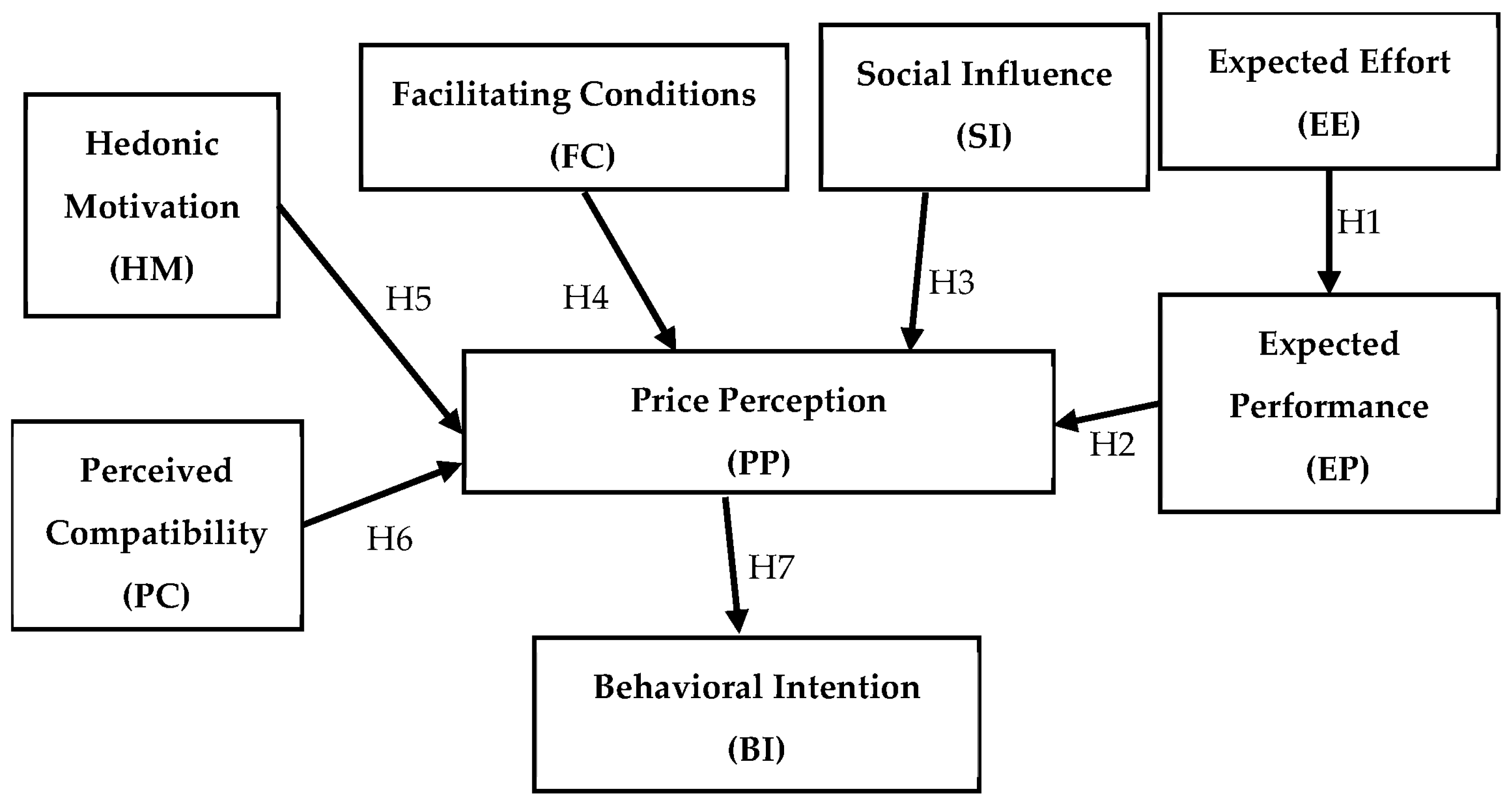
Three-dimensional printed food has rapidly positioned itself at the intersection of food technology and personalized nutrition, opening up new perspectives for sustainable production, creative customization, and more efficient resource use. Although global interest in this innovation continues to grow, consumer acceptance remains largely underexplored in Central and Eastern Europe. This study analyzes how Romanian consumers approach the adoption of 3D-printed food by applying an extended UTAUT2 framework to a sample of 608 urban respondents. Using structural equation modeling, it examines the influence of expected effort, performance expectancy, social influence, and perceived compatibility on adoption intention, while price perception is introduced as a key mediating variable—a novel and meaningful contribution to the literature on food technology acceptance. Given the non-probabilistic sampling design, the difficulties encountered in measuring Hedonic Motivation and Facilitating Conditions, and the early diffusion stage of 3D food printing in Romania, the present work should be viewed as a robust exploratory investigation based on Structural Equation Modeling (SEM) among urban Romanian consumers, providing first empirical evidence on 3D-printed food acceptance in Eastern Europe rather than definitive conclusions for the entire population. The results highlight that utilitarian and social factors are decisive: expected effort enhances perceived performance, while performance, social influence, and compatibility significantly strengthen perceptions of price fairness. In turn, price perception strongly predicts consumers’ behavioral intention to adopt 3D-printed food. Hedonic motivation and facilitating conditions were not statistically significant and were therefore removed from the final model. These findings show that, in emerging food markets, consumers tend to make adoption decisions based more on rational value assessments than on novelty or convenience. The study contributes to theory by embedding price perception into the UTAUT2 framework and to practice by identifying the key elements that can boost market readiness—transparent pricing and closer alignment with consumer values. By filling an important gap in the empirical literature from Eastern Europe and focusing on price as a cognitive bridge between technological and psychological drivers, this paper offers a timely and relevant contribution to ongoing research on consumer perception and acceptance of food innovations. For Eastern European food innovation research, this study provides one of the first quantitative analyses of 3D-printed food acceptance that explicitly links technology-related beliefs to price perception in a regional, price-sensitive context.

Article Metrics

Citations

Article Access Statistics

Multiple requests from the same IP address are counted as one view.