Abstract
Faced with the transformation of food and the rapid pace of life among university students, consumption behaviors for food products such as Andean grains have become significant topics. To better understand this issue, this study aimed to analyze the factors that influence the purchase intention of Andean grains in university students, based on the theory of planned behavior, self-identity, moral obligation, and willingness to pay more. The study recruited 900 university students, and the results report that moral obligation is the strongest predictor (β = 0.295), followed by self-identity (β = 0.293). These findings confirm the need to explore new opportunities for transforming and innovating Andean grains.
1. Introduction
Quinoa is a product recognized for its high-quality proteins and nutritional values. It has been recognized as an important grain that is part of the history of the Andean peoples [1,2], and is considered in some studies a superfood that is environmentally friendly and is capable of reducing the risk of various diseases [3]. One of the most notable characteristics of this Andean grain is its resilience to climate change, which is why the United Nations Food and Agriculture Organization has recognized it as an example of sustainable agriculture [4]. Its production in the Andean region is significant, with a greater emphasis on Peru, a country that boasts around 3000 varieties of crops, making it one of the world’s leading producers of quinoa [5]. Although this Andean grain has gone through various price fluctuations due to high production costs [6], due to its high nutritional value, national and international entities are promoting its use worldwide to combat malnutrition and support sustainable agriculture [7,8].
Consequently, quinoa is in high demand for export, and its production has spread to 123 countries [9,10]. According to the information above, its consumption internationally is increasing. However, what is happening in the national territory, a territory where this Andean grain is grown and where greater accessibility of consumption is assumed? To answer this question, a rapid review of the literature was carried out, where it was identified that after the arrival of the pandemic, consumers increased awareness regarding their health, which translated, in the Peruvian context, into a greater consumption of quinoa, with women and people with higher incomes adopting this purchasing behavior [11].
On the other hand, in the same Peruvian context, it was found that quinoa consumers are segmented into two groups: the first being consumers due to attitude and ethnic identity; the second group being consumers due to subjective norms and previous experience [12]. In addition, according to the research of [13], Peruvians tend to increase their consumption of quinoa every time their family income rises; in contrast, they give greater priority to investing in the purchase of basic foods such as rice, pasta, and potatoes at lower incomes. Meanwhile, other evidence from the literature establishes that, at the level of South America, Bolivia and Peru are the countries that have the highest consumption of quinoa in both rural households and urban segments [14], and despite price volatility, quinoa consumption is a constant for Peruvian producers of this food.
Until now, the nutritional and environmental advantages of Andean grains have been exposed, and it has been mentioned that the consumption of quinoa in Peru is a constant practice by the adult population; however, the consumption behavior of this superfood in the youth population is unknown and has not been identified in the literature. Specifically, studies have not considered university students, a population characterized by an accelerated pace of academic life, where studying represents a greater priority and students often limit themselves in consuming healthy foods due to having greater accessibility to fast food [15,16], or simply because healthy foods made from Andean grains are usually more expensive [17], acquiring bad eating habits during university life. Taking into account this knowledge gap, this study proposes to analyze the factors that influence the purchase intention of Andean grains among Peruvian university students. For this purpose, the factors of planned behavior, moral obligation, self-identity, and the intention to pay more are analyzed.
This study addresses the lack of knowledge regarding young university students, who are considered agents of change in dietary transitions. These students are highly likely to adopt sustainable diets that contribute to their health [18,19]. This is reinforced at the university level through the promotion of health care by universities, which coincides with the time when students shape their consumption patterns, due to their independence, social influence, and other factors that lead to decision-making in their food choices [20,21,22]. Thus, the perception of this population takes on unique relevance in the Andean grain market, since unlike other consumers, this population remains highly open to experimenting with new or rediscovered foods [23,24]. This research demonstrates how young university students can reconcile cultural identity with modern food preferences. This knowledge closes an important gap in our understanding of consumer behavior among a population that can contribute to the sustainability of the Andean grain value chain.
2. Literature Review and Hypothesis Development
Self-identity has been defined as the way a person perceives themselves and how they define themselves within the role of consumer, which is reflected in their choice of a product or brand, thereby projecting or approximating their own image [25,26]. According to previous research, self-identity is one of the most significant predictors of the intention to acquire products that improve or preserve health [27,28]. It is shown that when a person makes purchase decisions, they seek to make them consistent with their way of being, with their image, thus generating harmony between who they are and their purchase choices [29]. Research has shown that self-identity is an important factor in the intention to purchase healthy, organic products, as people are now more health-conscious [30,31]. This fact has been confirmed in previous research, which supports the idea that consumers with self-identity are more likely to purchase products with which they identify or describe themselves [32,33].
Specifically in university students, when nutritional knowledge is part of their identity, they are more likely to buy products that contribute to the conservation of their health, adopting a healthy eating behavior over time [34]. In addition, self-identity, being considered an outstanding part of oneself, describes characteristics with which a person defines themselves, the same ones that directly influence the planning of actions and decision-making related to consumption [35]; for example, in students, to the extent that they are oriented towards the care of their health and make this idea their own, their interest and intention to consume healthy products can be increased due to the self-identity they develop every time university facilities offer healthy options such as fruits, vegetables, or other healthy choices [27,35]. Based on what is referred to in these paragraphs, the following hypothesis is proposed:
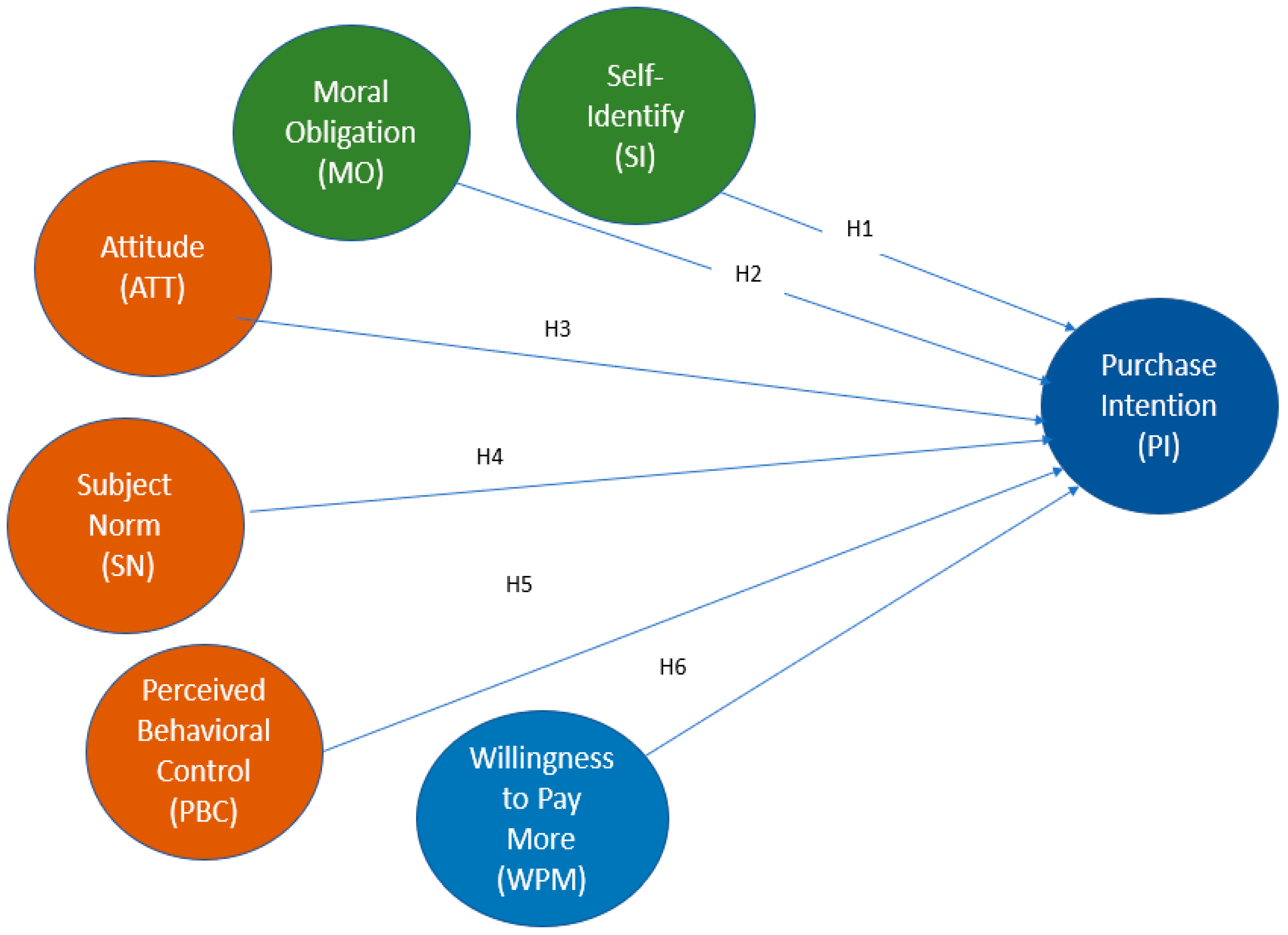
H1:
Self-identity (SI) has a positive influence on the purchase intention (PI) of Andean grains among university students.
Another factor that influences purchase intention is moral obligation, which refers to a person’s duties or responsibilities towards others. These duties are fundamentally based on moral principles [36]. In addition, moral obligation is a feeling that arises from social interaction. It motivates individuals to fulfill their duties of cooperation, encompassing sense of responsibility, social interaction, and philosophical principles [37,38], also referred to as the duty a consumer feels to do the right or wrong thing in a specific situation [39]. The theoretical framework of these three moral motives provides a better understanding of this fact by distinguishing the benefits of doing good for others from complying with rules and being consistent with one’s identity [40]. In this context, a consumer who maintains a sense of responsibility, translated into moral obligation, acts under principles and values that allow them to choose appropriate products that contribute to fair trade and generate personal benefits [41], since it is known that a consumer with moral obligation maintains a favorable valuation of a particular product as long as it maintains characteristics that benefit themselves and others [42]. Previous studies have shown that the theory of planned behavior has significant predictive power regarding purchase intention. However, other research shows that integrating moral obligation can increase this power even more [43].
Faced with this reality, the following hypothesis is proposed:
H2:
Moral obligation (MO) has a positive influence on the purchase intention (PI) of Andean grains among university students.
Consumer behavior is a variable that has been measured by different models, some of which are referred to in the scientific literature, such as the behavioral perspective model [44], Hull–Spence behavior theory [45], and the theory of planned behavior [46,47]. The common denominator of the theories referred to is that they all measure consumer attitudes; this means that when a consumer maintains a positive attitude towards a particular product, this feeling significantly influences purchase intention [48]. When the consumer has a positive attitude, purchase intention increases, even more so when it comes to products that generate general well-being [49]. In general, previous and recent research has shown that consumer behavior predicts purchase intention; in this context, it has been demonstrated that the application of planned behavior theory predicts purchase intention across various cultural contexts and various products, including healthy and heritage foods [50,51,52].
Specifically, the subjective norm, being exposed to social pressure, can regulate consumer behavior. This means that when a consumer perceives that their social circle has a preference tendency, they feel pressured to adopt the same preferences, driving this fact to purchase intention [53]. A likely explanation for this fact is that a large percentage of people feel good when their environment approves of each action they take. In this context, the subjective norm produces emotions that lead to making purchase decisions [54,55]. Likewise, behavioral control is the perception of the complexity of adopting a specific behavior, which is dependent on factors such as previous experiences and anticipated obstacles [49]; therefore, every time a consumer maintains control over their purchase decisions, the probability of consuming a specific product increases, and if it is a healthy product, which generates benefits for the same consumer, this influence increases [56]. Based on these studies, the following hypotheses are proposed:
H3:
Attitude towards behavior (ATT) positively influences the purchase intention (PI) of Andean grains in university students.
H4:
The subjective norm (SN) positively influences the purchase intention (PI) of Andean grains in university students.
H5:
Perceived behavioral control (PBC) positively influences the purchase intention (PI) of Andean grains in university students.
Another factor that has been analyzed to explain purchase intention is the willingness to pay more, which is defined as the monetary amount that a consumer is willing to give in exchange for a product or service, and depends on its usefulness [57]. In this regard, a background has been identified that one of the drivers of the purchase intention of products that are beneficial for health is price [47,56]. Since, for many, this represents the value of the product, this means that for consumers, a high price is a symbol of quality and positive effects [58,59]. This fact has had greater emphasis since the arrival of the pandemic, a scenario where the purchasing behavior of consumers was modified, because they stopped comparing prices and looking for discounts or reasonable offers in order to achieve their well-being; in this context, it is stated that price sensitivity influences their purchase intention [60,61]. Based on this, the following hypothesis is proposed:
H6:
The willingness to pay more (WPM) positively influences the purchase intention (PI) of Andean grains in university students.
Based on the information presented in the previous paragraphs, Figure 1 is provided, which illustrates the proposed theoretical model.
Figure 1.
Theoretical model.
In addition to the theoretical evidence supporting the proposed model, previous studies have been identified that provide empirical evidence of the intention to purchase healthy foods among university students (Table 1). These studies are based on different theories that analyze consumer behavior, specifically that of university students.
Table 1.
Synthesis of previous studies.
3. Materials and Methods
This research was developed through a non-experimental, cross-sectional design. For sampling, a non-probabilistic method was employed at the researchers’ convenience [68], which was selected for its accessibility and feasibility. Since this study was based on collecting data in university institutions, this sampling method allowed for obtaining a substantial sample efficiently, reaching 900 participants and thus maximizing the response rate. Similarly, non-probabilistic sampling was established because there was a defined target population, in this case, Peruvian university students [69]. The sample consisted of currently registered university students who were Peruvian adults and gave informed consent, thus promoting voluntary and anonymous participation. The study participants were 900 university students. The average age was 23.03 years, the minimum age was 18 years, and the median age was 21 years. The sample’s characteristics are stated in Table 2.
Table 2.
Demographic characteristics (n = 900).
Scales
For data collection, a survey was used, which was disseminated through social networks, shared with teachers for distribution of the questionnaire, and administered via the Google Forms platform. To measure the variables, the factors of attitude, subjective norm, perceived behavioral control, moral obligation, and purchase intention were taken into account, all of which consisted of 4 items validated and applied by Duran et al. [70]. Regarding the intention to pay more metric, it consisted of two items, taken and adapted from [71]. Self-identity was measured using 4 items [72]. Each of the items was formulated to be measured on a 1–5 Likert scale, where 1 represented ‘totally disagree’ and 5 meant ‘totally agree’. To analyze the intention to pay more and self-identity, the instruments were translated through the process of back-translation by a native speaker who was not affiliated with this research. Afterward, the scales were subjected to semantic validity testing with a representative sample of 06 participants.
4. Results
4.1. Convergent Validity
The results of the analysis demonstrate that the model exhibits satisfactory convergent validity across all its constructs. The factor loadings of all indicators exceed the recommended minimum threshold of 0.70 [73], ranging from 0.836 for SN2 to 0.935 for WPM2. According to [74], loads greater than 0.70 indicate that a construct explains more than 50% of the variance of an indicator, which is considered satisfactory for establishing convergent validity. The constructs that present the highest loads are willingness to pay more (WPM), with loadings ranging from 0.925 to 0.935, purchase intention (PI), with loadings ranging from 0.890 to 0.919, and moral obligation (MO), with loadings ranging from 0.855 to 0.903.
In terms of composite reliability, all constructs exceed the minimum recommended value of 0.70 [75], with ranges between 0.727 for subjective norms (SN) and 0.863 for willingness to pay more (WPM). These results indicate high internal consistency of the indicators within each latent construct. Additionally, all constructs have Average Extracted Variance (AVE) values above the critical threshold of 0.50 [74], with ranges between 0.561 for subjective norms and 0.823 for self-identity. This confirms that each construct explains more than 50% of the variance of its respective indicators, fulfilling the convergent validity criterion established by Hair et al. [76].
The three criteria evaluated for convergent validity are consistently met in the proposed model, indicating that the indicators of each construct converge adequately to measure the underlying theoretical concept [77]. This empirical evidence supports the strength of the measurement instrument used and provides confidence in the model’s ability to capture the factors that influence the purchase intention of Andean grains in Peruvian university students.
Since all data were collected through self-administered questionnaires from the same respondents at a single point in time, there was a potential risk of common method bias (CMB) [78] To assess the presence of CMB, two complementary tests were conducted following established guidelines in PLS-SEM research [73].
First, Harman’s single-factor test was performed by loading all measurement items (n = 27) into an exploratory factor analysis (EFA) without rotation. The results revealed that the first unrotated factor explained 60.24% of the total variance, which exceeds the traditional 50% threshold suggested by Podsakoff et al. [79]. However, recent methodological research indicates that this criterion may be overly conservative, particularly in studies examining theoretically related constructs where conceptual overlap is expected [80,81].
To provide a more robust assessment of CMB, a full collinearity test was conducted by examining the variance inflation factors (VIFs) of all predictor constructs in the inner structural model, as recommended by Kock [82]. The VIF values for the constructs predicting purchase intention ranged from 2.457 (subjective norms) to 4.696 (self-identity), with a mean VIF of 3.670. While five of the six constructs exceeded the conservative threshold of 3.3, all VIF values remained well below the critical threshold of 10, which is considered indicative of severe collinearity that would signal problematic common method bias [82,83]. VIF values between 3.3 and 5.0 typically reflect moderate collinearity that can be attributed to theoretically meaningful relationships among constructs rather than methodological artifacts [84].
The moderate VIF values observed are consistent with the theoretical framework, as constructs such as attitude, moral obligation, self-identity, and perceived behavioral control are conceptually related within the theory of planned behavior and its extensions. These constructs share common theoretical foundations but measure distinct psychological mechanisms [85]. Additionally, the satisfactory discriminant validity demonstrated through the Fornell–Larcker criterion (Table 2) provides empirical evidence that the constructs are sufficiently distinct, further supporting that common method variance does not pose a substantial threat to the validity of our findings [81].
Moreover, several procedural remedies were implemented during data collection to minimize CMB, including the use of validated scales established in the literature, clear and concise item wording, assurances of anonymity and confidentiality, and counterbalancing of question order [79]. Taken together, these results suggest that while some method variance may be present, it does not significantly compromise the substantive findings of this study. The combination of acceptable VIF values, strong discriminant validity, and methodological precautions provides confidence in the robustness of the structural relationships identified in the model. (See Table 3).
Table 3.
Convergent validity of the model.
4.2. Discriminant Validity
The results of the discriminant validity analysis demonstrate that the Fornell–Larcker criterion is satisfactorily met for all the constructs in the model. The values on the diagonal, which represent the square root of the AVE, range between 0.853 for the subjective norm (SN) and 0.929 for willingness to pay more (WPM). These values are consistently higher than all correlations between constructs in their respective rows and columns, confirming that each construct shares more variance with its own indicators than with other constructs in the model [77].
The highest correlations between constructs are observed between perceived behavioral control (PCB) and attitude (ATT), with a value of 0.868, followed by the correlation between moral obligation (MO) and attitude (ATT), with 0.886. Despite these relatively high correlations, which are theoretically expected given that these constructs are conceptually related, the values of the square root of the AVE (0.868 for PCB, 0.906 for ATT, and 0.886 for MO) are equal to or exceed these correlations, maintaining the discriminant validity of the model [75] (see Table 4).
Table 4.
Discriminant validity with the Fornell–Larcker criterion.
Empirical evidence confirms that all the constructs of the model have adequate discriminant validity, indicating that each latent variable captures unique phenomena not represented by other constructs in the model [86]. This conceptual and empirical distinction between the constructs strengthens the validity of the theoretical model proposed to explain the purchase intention of Andean grains in Peruvian university students.
4.2.1. Hypothesis Testing
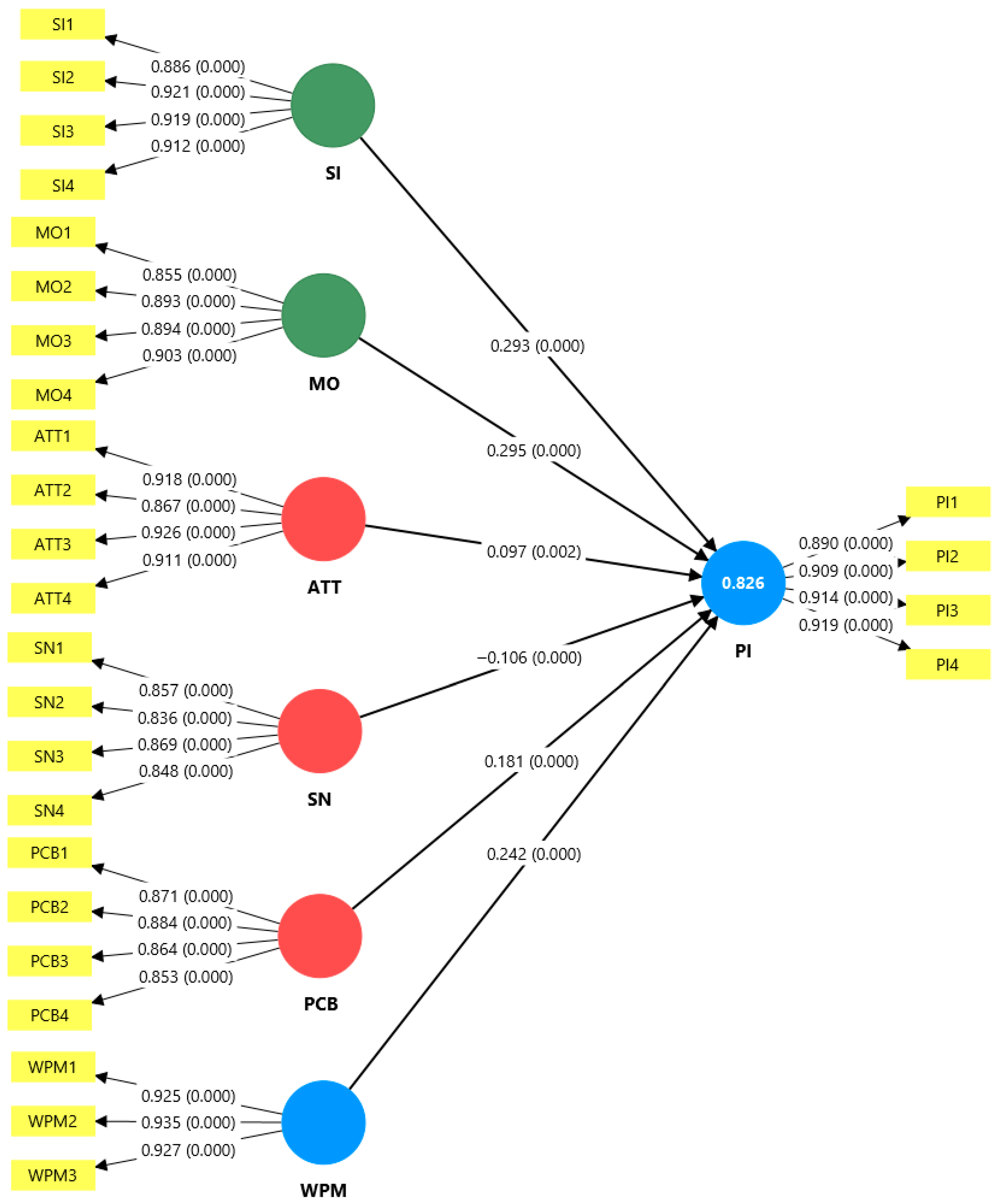
The structural equation model estimated by PLS-SEM demonstrates substantial predictive power, explaining 82.6% of the variance in the purchase intention of Andean grains (R2 = 0.826), which is considered a significant effect according to Cohen’s (1988) [87] criteria. The results reveal that moral obligation (MO) emerges as the strongest predictor with a path coefficient of 0.293 (p < 0.001), suggesting that the sense of responsibility towards the consumption of traditional Peruvian products constitutes an important factor in the purchase decision. It is followed by perceived behavioral control (PCB) with β = 0.242 (p < 0.001) and willingness to pay more (WPM) with β = 0.191 (p < 0.001), indicating that the perception of ease of access and willingness to pay a premium price significantly influence purchase intention.
On the other hand, attitude (ATT) presents a moderate positive relationship (β = 0.097, p = 0.002). Interestingly, subjective norms (SNs) show a significant negative relationship (β = −0.106, p < 0.001), suggesting that external social pressure may act as an inhibitor of purchasing behavior in this specific context, possibly due to competing social influences or perceptions about modernity versus tradition in youth consumption patterns among Peruvian university students [88]. All indicators have factor loadings greater than 0.70, ranging between 0.848 and 0.935, confirming the convergent validity of the model and providing solid empirical evidence for the structural relationships identified (see Figure 2).
Figure 2.
Structural model.
Likewise, the results shown in Table 3 of the hypothesis test conducted via bootstrapping (5000 resamples with bias-corrected confidence intervals) reveal that all the structural relationships proposed in the model are statistically significant, which allows accepting the six hypotheses raised. Student’s t-values far exceed the critical threshold of 1.96 for a 95% confidence level, ranging from 3.122 to 6.963, providing robust evidence of empirical support for each causal relationship. Importantly, all 95% confidence intervals exclude zero, reinforcing the statistical significance and practical relevance of the findings.
H2 (MO → PI) presents the most significant statistical support with a t-value of 6.963, confirming that moral obligation is a strong predictor of purchase intention with a coefficient of 0.295 (95% CI [0.215, 0.379], p < 0.001). The confidence interval indicates that we can be 95% confident that the true population parameter for this relationship lies between 0.215 and 0.379, demonstrating a consistent positive effect. H6 (WPM → PI) shows a t-value of 6.486 with a positive coefficient of 0.242 (95% CI [0.172, 0.319], p < 0.001), indicating that willingness to pay more has a significant and stable influence on purchase intention. H1 (SI → PI) yields a t-value of 6.049 with a positive relationship of β = 0.293 (95% CI [0.183, 0.383], p < 0.001), indicating that greater self-identity as a conscious consumer significantly increases the purchase intention of Andean grains, with a confidence interval suggesting a robust effect.
The hypotheses with moderate statistical strength, though equally significant, are H5 (PCB → PI), with t = 5.165 and a positive coefficient of 0.181 (95% CI [0.114, 0.252], p < 0.001), suggesting that perceived behavioral control positively influences purchasing behavior with a consistent effect size, and H4 (SN → PI), with t = 4.596 and a negative relationship of β = −0.106 (95% CI [−0.155, −0.061], p < 0.001), indicating that subjective norms act as inhibitors of purchase intention. The negative confidence interval for subjective norms confirms that this inhibitory effect is stable across the population. H3 (ATT → PI) presents a t-value of 3.122 with β = 0.097 (95% CI [0.035, 0.157], p = 0.002), confirming that attitude is positively but moderately related to purchase intention. Although this effect is the smallest among the significant predictors, the confidence interval excludes zero, supporting its practical relevance.
The narrow confidence intervals observed across all path coefficients (average width of 0.12) reflect the precision of the estimates and the stability of the relationships, which is attributable to the large sample size (n = 900) and the robustness of the bootstrapping procedure [57]. The standard deviation of all estimates is low (0.024–0.048), further indicating stability in the coefficients estimated through the resampling procedure (see Table 5). These findings provide robust empirical support for the proposed theoretical model, with all hypothesized relationships demonstrating both statistical significance and substantive meaningfulness, as evidenced by the confidence intervals and effect sizes [73].
Table 5.
Hypothesis testing.
4.2.2. Multi-Group Analysis by Gender
To address potential gender differences in the structural relationships of the model, a multi-group analysis (MGA) was conducted using PLS-SEM with a permutation test (5000 permutations), comparing the path coefficients between male and female university students. Table 6 presents the results of this analysis, examining whether gender moderates the relationships between the constructs and purchase intention of Andean grains.
Table 6.
Multi-group analysis by gender using permutation test.
The permutation test results indicate that there are no statistically significant differences between genders in any of the structural relationships examined (all p-values > 0.05). This finding suggests that the mechanisms influencing purchase intention of Andean grains operate similarly for both male and female university students, despite some observable differences in the magnitude of the path coefficients.
Although not statistically significant, some noteworthy patterns emerge from the descriptive comparison of path coefficients. For H1 (SI → PI), self-identity shows a numerically stronger positive influence among females (β = 0.363) compared to males (β = 0.227), with a difference of −0.136 (p = 0.172). Similarly, for H3 (ATT → PI), females exhibit a higher coefficient (β = 0.141) than males (β = 0.046), with a difference of −0.095 (p = 0.108), suggesting that attitude may play a somewhat more important role in women’s purchase intentions, though this difference does not reach statistical significance.
Conversely, H2 (MO → PI) reveals that males present a numerically higher coefficient (β = 0.357) compared to females (β = 0.244), with a difference of 0.113 (p = 0.165), indicating that moral obligation may have a slightly stronger effect on male consumers. Similarly, H6 (WPM → PI) shows males with a higher willingness to pay more coefficient (β = 0.282) than females (β = 0.196), with a difference of 0.086 (p = 0.259).
For H5 (PCB → PI) and H4 (SN → PI), the differences between genders are minimal. Perceived behavioral control shows nearly equivalent effects for both groups (males: β = 0.162; females: β = 0.191; difference = −0.029, p = 0.705), while subjective norms present negative coefficients for both genders, with a small difference (males: β = −0.082; females: β = −0.126; difference = 0.044, p = 0.390).
These findings suggest that the theoretical model proposed to explain purchase intention of Andean grains is robust across gender, with the same psychological and behavioral mechanisms operating similarly for both male and female Peruvian university students. From a practical standpoint, this implies that marketing strategies for Andean grains do not necessarily need to be gender-differentiated, as the key drivers of purchase intention (moral obligation, self-identity, willingness to pay more, perceived behavioral control, attitude, and subjective norms) function equivalently across gender groups. This gender invariance strengthens the generalizability of the model and suggests that interventions to promote Andean grain consumption can be designed with a unified approach for university students, regardless of gender.
5. Discussion
This study aimed to analyze the factors that influence the purchase intention of Andean grains in university students. The influence of self-identity on the purchase intention of these products has been demonstrated; this means that young people who identify as conscious consumers of healthy and/or traditional Peruvian products will have a greater intention to purchase Andean grains. In support of these findings, previous research reports that when university students are aware of their poor eating habits and decide to change their food decisions, they have greater intention to purchase products that preserve their health [26], and in the case of consumers who manage to identify firmly with health awareness, they are more likely to make purchases of products that align with this identity [33]. Self-identity represents a consumption pattern with which the consumer describes themself, and is a factor that could prevent inappropriate consumption behavior [89]. Our results can be compared with studies in other contexts, where it has been found that in countries such as South Africa, China, Malaysia, and Indonesia, self-identity predicts the intention to purchase organic products, as consumers with a strong sense of self-identity have a high tendency to align their purchasing decisions with their personal values and self-perception [29,33,90]. This means that self-identity has become a universal factor acquired by today’s consumers, and although it does not have the same intensity in all contexts, its effect is a cross-cultural constant.
Likewise, it has been shown that moral obligation positively influences purchase intention in the study population. This finding translates into a sense of responsibility towards the consumption of traditional Peruvian products and the support of local producers that university students have, causing the purchase intention of Andean grains to increase. A study that coincides with these results states that moral obligation stimulates the purchase intention of a specific product when it presents benefits when consumed, and the explanatory power of moral obligation adequately describes purchase intention [91,92]. One possible explanation is that consumers are putting pressure on companies to be responsible to society, which allows them to feel morally obliged to buy healthy products from local entrepreneurs, as they think it is the right thing to do according to their conscience [93,94,95]. This finding is reinforced by other studies establishing that, in countries such as Mexico, the Netherlands, China, India, and Taiwan, moral obligation is an important factor in consumers’ intention to purchase healthy products because they feel committed to sustainability, ecology, and health [96,97,98,99].
On the other hand, when evaluating the theory of planned behavior, it has been identified that attitude is a factor that positively influences the purchase intention of Andean grains; therefore, a favorable evaluation towards the consumption of Andean grains (nutritional benefits, flavor, cultural value) will allow an increase in the purchase intention of these products. Studies that support the results of this research establish that a positive attitude towards a product or service significantly influences purchase intention [95,100,101]. Regarding the subjective norm, the results indicate that, in the study population, the perception of people who are part of consumers’ social circles (family, friends, referents) alters purchase intention; a study that coincides with these findings establishes that much of consumers’ behavior is the result of social pressure, thus configuring the behavior to be the same [102,103,104]. To be more specific, in the university population, studies indicate that young people value their autonomy very much, above external or family influences; therefore, their rejection of social pressure is a response to their independence. In this population, there is a high possibility that there are economic limitations that would make the subjective norm a burden, thus generating the negative relationship with the purchase intention of Andean grains [105,106].
Within the same framework, this research provides enough evidence that demonstrates that perceived behavioral control positively influences the purchase intention of Andean grains; in other words, young people who perceive greater ease of access, economic availability, and knowledge about where to acquire Andean grains will show greater purchase intention, and the development of products that contribute to well-being remains a constant concern at any age and allows for new behavior [107,108]. Another study that supports this conclusion establishes that the components that are part of the theory of planned behavior, including perceived behavioral control, show high predictability for purchase intention [104,109], and so it is affirmed that perceived behavioral control influences consumer purchase intention, regardless of whether it is natural, healthy, ecological, or due to other products [110,111]. However, when self-identity was analyzed, the results reported that it decreases the purchase intention of Andean grains. To understand this behavior, [112,113] explain that sometimes young people resist traditional norms and seek modernity, innovation, and/or differentiation, or even prefer products that are positioned in the market or represented by famous people (influencers). The reality embodied regarding the behavior of university students is a response to globalization, an environment where traditional eating patterns are no longer attractive and they are in search of processed products, or products that are mostly accepted in their environment whenever they carry out social activities [113,114].
Likewise, this study demonstrates that the willingness to pay more influences the purchase intention of university students; this result suggests that even when the price exceeds the traditional cost of the market, university students are willing to pay more to acquire healthy food options [115]. A possible explanation for this could be that the attributes of the products and the motivation to consume them affect the willingness to pay [116,117]. Likewise, the results of this research coincide with previous studies that establish that the willingness to pay a premium price affects purchase intention and assumes a crucial role in the formation of purchase intention [118,119]. Although some cognitive factors may influence the price, it is necessary to take into account that cognitive capacity does not eliminate purchase intention. However, it could alter it [120].
6. Conclusions
Subsequently, it has been found that moral obligation predicts purchase intention. From this, it can be understood that the study population feels a moral duty to support local products and maintains the intention to preserve the consumption of Andean grains (β = 0.295, p < 0.001). Following this, it has been demonstrated that self-identity is the factor that positively predicts the intention to purchase Andean grains with the lowest percentage (β = 0.293, p < 0.001), which means that students identify with the consumption of Andean grains. This result suggests that educational institutions should join forces with the government to develop campaigns that connect consumers with their own cultural identity, also awakening in them the decision to support rural communities. Additionally, it is recommended to promote marketing campaigns focused on appealing to social responsibility and cultural identity, a dual approach that focuses on extrinsic ethical motivations and intrinsic ethical motivations.
Additionally, attitude and behavior have been found to be weak predictors of the intention to purchase Andean grains (β = 0.097, p < 0.001; β = 0.181, p < 0.002). This means that the availability of resources and opportunities facilitate students’ ability to translate their attitudes and intentions into concrete decisions. In this context, it is recommended that universities prioritize the availability of Andean grains at sales outlets near and within the institution, promote innovation with these grains, and encourage new ventures associated with their consumption.
Similarly, this study has shown that subjective norms have a negative effect on purchase intention (β = −0.106, p < 0.001). From this result, it can be deduced that young university students may resist external recommendations whenever they feel that their autonomy is at risk. Therefore, it is recommended to mitigate campaigns that reinforce young people to adopt predetermined behaviors. To this end, advertising messages that say “you should consume” should be replaced with other terms that empower autonomous decision-making, such as “discover what it means for you.”
Another predictor of the intention to purchase Andean grains is the intention to pay more (β = 0.242, p < 0.001). This means that a percentage of participants value these products and are willing to pay a higher price. This result also confirms that there is a differentiated market that values quality, trade, and the production of these grains, suggesting that companies should establish market segmentation strategies in order to serve price-sensitive consumers and value-oriented consumers.
6.1. Implications
This study shows that self-identity significantly predicts purchase intention. This provides an opportunity for educational institutions to reinforce students’ sense of identity and culture strategically. This finding aligns with previous research demonstrating that education supports students in maintaining a connection with their identity and encourages them to expand their knowledge of their heritage [121,122]. In this context, universities could implement strategies that include academic activities, such as fairs and projects, which incorporate these products to promote healthy and conscious eating habits. These activities instill a fair and accurate appreciation of the products [123].
On the other hand, identifying that moral obligation predicts purchase intention leads to the assertion that, in the study population, there is a latent ethical sensitivity. It is therefore important for the university to activate and reinforce this moral dimension in order to connect purchasing actions with social consequences such as support for the regional economy and contribution to a sustainable agricultural system, as it is precisely in this scenario that educational institutions could be a channel for acquiring experiences that can materialize moral obligation into practical action. This implication responds to evidence from previous studies that establish that educational institutions have the capacity to implement educational programs that involve action-oriented experiential learning, thus promoting rational and adequate food consumption and awareness of social, environmental, and economic consequences [124,125]. This means that decision-makers could encourage students to develop a sense of social and cultural responsibility while promoting innovative skills in these foods and supporting the preservation of this culinary heritage in the face of globalization.
Similarly, this research provides evidence of the applicability of the theory of planned behavior to traditional foods, such as Andean grains. This finding has important practical implications for universities that promote educational programs aimed at changing students’ beliefs about Andean grains and the nutritional and academic benefits of these versatile products in desserts, beverages, and more. Universities could also provide students with a social experience in which opinion leaders promote the consumption of Andean grains, making these grains available and accessible on campus to reinforce this message. Previous studies support these implications, arguing that universities have the capacity to influence consumer behavior toward healthy foods [126,127].
6.2. Limitations and Future Research
This study has demonstrated the behavior of the university consumer, specifically adopting non-probability sampling at the researchers’ convenience, which was used for its accessibility, feasibility, and because there was a defined target population [69]. Selection bias is acknowledged given that respondents may have answered based on their interest in or prior knowledge of Andean grains. This means positive attitudes and purchase intentions may have been overestimated. Additionally, this sampling method has limitations, such as the inability to directly extrapolate to the general population.
Additionally, since it is a cross-sectional study, perceptions were evaluated at a single point in time. This limits the ability to identify reverse causality over time. Furthermore, capturing perceptions and behaviors at a single point in time did not allow for observation of the evolution of relationships between analyzed variables. Future studies could therefore focus on longitudinal designs, such as panel studies, which re-evaluate the perceptions and behaviors of the same participants at different points in time. Similarly, longitudinal studies with experimental components are recommended to combine temporal follow-up with experimental manipulations, which can increase internal and external validity [128].
Another limitation of this study is that since it contains quantitative research that collects data through a survey, there is a risk of bias if university students have responded to the items according to what is socially desirable; to mitigate this bias, future studies could conduct analyses through qualitative research focused on exploring the motivations and barriers to the purchase of Andean grains.
Finally, this research has shown that, among university students, planned behavior theory combined with moral obligation, intention to pay more, and self-identity are predictors of the intention to purchase Andean grains. The study found no difference in perceptions between male and female groups. It is important to note that, although the study participants are from three regions of Peru, the findings cannot be generalized because Peru is known for maintaining a strong cultural heritage, including through Andean grains, which are considered part of the country’s traditional culinary heritage. Therefore, future studies could be applied to contexts without an Andean heritage to analyze replicability.
Author Contributions
Conceptualization, D.Y.M.-L. and E.M.-P.; methodology, E.E.G.-S. and D.Y.M.-L.; software, E.E.G.-S. and E.M.-P.; validation, D.Y.M.-L. and E.E.G.-S.; formal analysis, E.E.G.-S.; investigation, D.Y.M.-L. and E.M.-P.; resources, E.M.-P.; data curation, D.Y.M.-L. and E.E.G.-S.; writing—original draft preparation, E.M.-P. and D.Y.M.-L.; writing—review and editing, E.E.G.-S. and D.Y.M.-L.; visualization, E.M.-P.; supervision, D.Y.M.-L.; project administration, E.E.G.-S. and D.Y.M.-L.; funding acquisition, E.M.-P. All authors have read and agreed to the published version of the manuscript.
Funding
This work was funded by the Universidad Peruana Unión (UPeU) within the framework of the internal competition PICST-2024-01 “Research Projects in Social and Theological Sciences”, approved under resolution No. 2659-2024/UPeU-CU.
Institutional Review Board Statement
The Institutional Research Ethics Committee of the Graduate School of the Universidad Peruana Unión approved the study on 6 December 2024, with protocol code 2024-CEEPG-00158. The study was conducted in accordance with the standards outlined in the Declaration of Helsinki.
Informed Consent Statement
Before completing the surveys, study participants voluntarily gave their informed consent. To ensure this, the objectives of the study were explained and the confidentiality of the information collected was emphasized, as well as the right to withdraw from the study without any consequences. In addition, all surveys were anonymous in order to protect personal data.
Data Availability Statement
The original contributions presented in the study are included in the article; further inquiries can be directed to the corresponding author.
Acknowledgments
The authors would like to thank the Peruvian Union University (UPeU) for funding this research project as part of the internal PICST-2024-01 competition.
Conflicts of Interest
The authors declare that they have no conflicts of interest.
References
- Anaya, R.; De La Cruz, E.; Muñoz-Centeno, L.; Cóndor, R.; León, R.; Carhuaz, R. Food and Medicinal Uses of Ancestral Andean Grains in the Districts of Quinua and Acos Vinchos (Ayacucho-Peru). Agronomy 2022, 12, 1014. [Google Scholar] [CrossRef]
- Gonyea, A.; Esteban, E.; Repo-Carrasco-Valencia, R.; Martinez, M. Grains of wisdom: Insights into the minds of top chefs—A synthesis of expert interviews and literature. Int. J. Gastron. Food Sci. 2025, 40, 101174. [Google Scholar] [CrossRef]
- Bvenura, C.; Kambizi, L. Future grain crops. In Future Foods; Elsevier: Amsterdam, The Netherlands, 2022; pp. 81–105. [Google Scholar] [CrossRef]
- Bojanic, A. La Quinua: Cultivo Milenario para Contribuir a la Seguridad Alimentaria Mundial; FAO: Rome, Italy, 2011. [Google Scholar]
- Villacrés, E.; Quelal, M.; Galarza, S.; Iza, D.; Silva, E. Nutritional Value and Bioactive Compounds of Leaves and Grains from Quinoa (Chenopodium quinoa Willd.). Plants 2022, 11, 213. [Google Scholar] [CrossRef]
- Hirich, A.; Choukr-Allah, R.; El Gharouss, M.; Rafik, S.; Calle, J.P.R.; Mhada, M.; El Mejahed, K.; Azaykou, F.; Filali, K. Quinoa Rehamna Project: High-Yielding Quinoa Cultivars Introduction. In Environmental Science and Engineering; Springer International Publishing: Cham, Switzerland, 2021; pp. 1175–1179. [Google Scholar] [CrossRef]
- Bazile, D. Quinoa, A Model Crop for Tomorrow’s Agriculture. In Biology and Biotechnology of Quinoa; Springer: Singapore, 2021; pp. 397–417. [Google Scholar] [CrossRef]
- Bazile, D.; Pulvento, C.; Verniau, A.; Al-Nusairi, M.S.; Ba, D.; Breidy, J.; Hassan, L.; Mohammed, M.I.; Mambetov, O.; Otambekova, M.; et al. Worldwide Evaluations of Quinoa: Preliminary Results from Post International Year of Quinoa FAO Projects in Nine Countries. Front. Plant Sci. 2016, 7, 850. [Google Scholar] [CrossRef]
- Alandia, G.; Rodriguez, J.; Jacobsen, S.; Bazile, D.; Condori, B. Global expansion of quinoa and challenges for the Andean region. Glob. Food Sec. 2020, 26, 100429. [Google Scholar] [CrossRef]
- Rambal, S.; Ratte, J.; Mouillot, F.; Winkel, T. Trends in Quinoa Yield over the Southern Bolivian Altiplano: Lessons from Climate and Land-Use Projections. In Quinoa: Improvement and Sustainable Production; Wiley: Hoboken, NJ, USA, 2015; pp. 47–62. [Google Scholar] [CrossRef]
- Higuchi, A.; Maehara, R.; Sánchez-Pérez, L.d.L.Á. Factors related to Quinoa Consumption in Peru during the COVID-19 Pandemic. Innovar 2022, 32, 27–42. [Google Scholar] [CrossRef]
- Higuchi, A.; Maehara, R. A factor-cluster analysis profile of consumers. J. Bus. Res. 2021, 123, 70–78. [Google Scholar] [CrossRef]
- Morales, L.; Higuchi, A. Who is eating quinoa?: How consumer characteristics and beliefs affect the expenditure on this functional food versus traditional staple items. J. Sens. Stud. 2022, 37, e12725. [Google Scholar] [CrossRef]
- Flores, E.; Rodriguez-Huamani, R.; Arce-Ortiz, N.; García-Tejada, G. Cultura y comportamiento del consumidor de quinua como producto orgánico. Idesia 2022, 40, 133–142. [Google Scholar] [CrossRef]
- Ramos, P. Prejudices and Barriers Which Explain Poor Diets Among Young University Students; Universitat Oberta de Catalunya: Barcelona, Spain, 2025. [Google Scholar]
- Pelletier, J.; Graham, D.; Laska, M. Social Norms and Dietary Behaviors among Young Adults. Am. J. Health Behav. 2014, 38, 144–152. [Google Scholar] [CrossRef]
- Li, X.; Braakhuis, A.; Li, Z.; Roy, R. How Does the University Food Environment Impact Student Dietary Behaviors? A Systematic Review. Front. Nutr. 2022, 9, 840818. [Google Scholar] [CrossRef]
- Kim, H.H.; Jung, S.D.; Yoon, K.; Hur, E.; Kim, S. Sustainability as Collective Action: Co-Design Model Leveraging University Stakeholders to Design Sustainable Seaweed-Based Menu; Springer International Publishing: Cham, Switzerland, 2025; pp. 225–236. [Google Scholar] [CrossRef]
- Rosenau, N.; Neumann, U.; Hamblett, S.; Ellrott, T. University Students as Change Agents for Health and Sustainability: A Pilot Study on the Effects of a Teaching Kitchen-Based Planetary Health Diet Curriculum. Nutrients 2024, 16, 521. [Google Scholar] [CrossRef]
- Socarrás, V.; Martínez, A. Food habits and health-related behaviors in a university population. Nutr. Hosp. 2015, 31, 449–457. [Google Scholar]
- Remolina, I.; Teuber, M.J.; Lee, E.; Fetter, D.S. Using Culturally Relevant Meal Kits to Improve Cooking Skills, Reduce Food Waste, and Promote Engagement with a Campus Food Access Resource: An Exploratory Pilot Study. Nutrients 2025, 17, 843. [Google Scholar] [CrossRef]
- Mensah, F.Z.; Lane, K.E.; Richardson, L.D. Determinants of eating behaviour in Black, Asian and Minority Ethnic (BAME) university students when living at and away from home: With a focus on the influence of food enculturation and food acculturation. Appetite 2022, 171, 105932. [Google Scholar] [CrossRef]
- Conti, C.; Costa, A.; Balzaretti, C.M.; Russo, V.; Tedesco, D.E.A. Survey on Food Preferences of University Students: From Tradition to New Food Customs? Agriculture 2018, 8, 155. [Google Scholar] [CrossRef]
- Yang, F.; Ren, L.; Sun, J.; Gu, C. A study of the purchase intention of alternative foods. Sci. Rep. 2025, 15, 6146. [Google Scholar] [CrossRef] [PubMed]
- Hojjati, M.; Mirzaei, A.; Hemmati, N.; Shamsabadi, B. Predicting consumers’ intention and behavior towards industrial dairy products: A study based on an extended theory of planned behavior. Appl. Food Res. 2025, 5, 101129. [Google Scholar] [CrossRef]
- Jung, S.; Bice, C. The Role of Self-Identity in Predicting College Students’ Intention to Consume Fruits and Vegetables. J. Nutr. Educ. Behav. 2019, 51, 173–181. [Google Scholar] [CrossRef] [PubMed]
- Carfora, V.; Caso, D.; Conner, M. The role of self-identity in predicting fruit and vegetable intake. Appetite 2016, 106, 23–29. [Google Scholar] [CrossRef]
- Rise, J.; Sheeran, P.; Hukkelberg, S. The Role of Self-identity in the Theory of Planned Behavior: A Meta-Analysis. J. Appl. Soc. Psychol. 2010, 40, 1085–1105. [Google Scholar] [CrossRef]
- Tan, Z.Y.; Cheah, J.S.S. Beyond good intentions: Why consumers choose social enterprise products. Soc. Enterp. J. 2025, 21, 765–785. [Google Scholar] [CrossRef]
- Nazzaro, C.; Uliano, A.; Stanco, M. Beyond Conventional: Italian Consumer Perceptions, Purchasing Habits, and Willingness to Pay for Ancient Grain Pasta. Nutrients 2025, 17, 2298. [Google Scholar] [CrossRef]
- Felicetti, A.; Linzalone, R.; Filippelli, S.; Bigliardi, B. Connecting the dots in green food purchasing behavior literature: A system thinking approach for systematic literature reviews. Bus. Ethics Environ. Responsib. 2025, 34, 1831–1859. [Google Scholar] [CrossRef]
- Escobar-Farfán, M.; García-Salirrosas, E.E.; Guerra-Velásquez, M.; Veas-González, I.; Gómez-Bayona, L.; Gallardo-Canales, R. Psychological Determinants of Healthy Food Purchase Intention: An Integrative Model Based on Health Consciousness. Nutrients 2025, 17, 1140. [Google Scholar] [CrossRef]
- Widyaningtyas, D. The Role of Consumer Self-Identity and Perceived Susceptibility on Intentions Toward Herbal Products. Malays. J. Consum. Fam. Econ. 2024, 33, 39–61. [Google Scholar] [CrossRef]
- Strachan, S.; Brawley, L. Healthy-eater Identity and Self-efficacy Predict Healthy Eating Behavior: A Prospective View. J. Health Psychol. 2009, 14, 684–695. [Google Scholar] [CrossRef]
- Canova, L.; Bobbio, A.; Manganelli, A. Predicting fruit consumption: A multi-group application of the Theory of Planned Behavior. Appetite 2020, 145, 104490. [Google Scholar] [CrossRef]
- Attie-Picker, M. Obligations of feeling. Eur. J. Philos. 2022, 30, 1282–1297. [Google Scholar] [CrossRef]
- Clark, M.; Earp, B.; Crockett, M. Who are ‘we’ and why are we cooperating? Insights from social psychology. Behav. Brain Sci. 2020, 43, e66. [Google Scholar] [CrossRef] [PubMed]
- Tomasello, M. The moral psychology of obligation. Behav. Brain Sci. 2020, 43, e56. [Google Scholar] [CrossRef]
- Oh, J.; Yoon, S. Theory-based approach to factors affecting ethical consumption. Int. J. Consum. Stud. 2014, 38, 278–288. [Google Scholar] [CrossRef]
- Goenka, S.; Sen, S.; Thomas, M. Moral Motives in Consumption. J. Assoc. Consum. Res. 2025, 10, 1–10. [Google Scholar] [CrossRef]
- Haj-Salem, N. Determinants of Consumer Intention to Purchase Fair Trade Products in the Middle East: Does Gender Matter? Soc. Mar. Q. 2024, 30, 19–42. [Google Scholar] [CrossRef]
- Gui, B. In search of a market morality for making real the ‘Community of Advantage’: A note on Sugden’s ‘Principle of Mutual Benefit’. Int. Rev. Econ. 2021, 68, 131–140. [Google Scholar] [CrossRef]
- Liu, M.T.; Liu, Y.; Mo, Z. Moral norm is the key. Asia Pac. J. Mark. Logist. 2020, 32, 1823–1841. [Google Scholar] [CrossRef]
- Lee, S. Consumer Attitudes and Purchase Intentions Toward Eco-Friendly Agricultural and Food Packaging: A Case Study in Chungnam Province, South Korea. J. Environ. Earth Sci. 2025, 7, 47–57. [Google Scholar] [CrossRef]
- Rossiter, J.; Foxall, G. Hull-Spence Behavior Theory as a paradigm for consumer behavior. Mark. Theory 2008, 8, 123–141. [Google Scholar] [CrossRef]
- Foxall, G. Invitation to Consumer Behavior Analysis. J. Organ. Behav. Manag. 2010, 30, 92–109. [Google Scholar] [CrossRef]
- Albornoz, R.; García-Salirrosas, E.; Millones-Liza, D.; Villar-Guevara, M.; Toyohama-Pocco, G. Using the Theory of Perceived Value to Determine the Willingness to Consume Foods from a Healthy Brand: The Role of Health Consciousness. Nutrients 2024, 16, 1995. [Google Scholar] [CrossRef] [PubMed]
- Rehman, Z.; Lohana, S.; Irfan, M. Driving and Deterrent Factors Affecting Green Products’ Consumption. Extended the Theory of Planned Behavior. In Proceedings of the 2024 Global Conference on Wireless and Optical Technologies (GCWOT), Malaga, Spain, 25–27 September 2024; IEEE: New York, NY, USA, 2024; pp. 1–9. [Google Scholar] [CrossRef]
- Bautista, R.; Dui, R.; Jeong, L.; Paredes, M. Does Altruism Affect Purchase Intent of Green Products? A Moderated Mediation Analysis. Asia-Pac. Soc. Sci. Rev. 2020, 20, 14. [Google Scholar] [CrossRef]
- Shanta, S.E.; Hossain, M.J.; Biswas, R.; Alim, M.A.; Ara, M.A. Consumers’ Organic Food Purchase Behavior in Bangladesh: An Extended Theory of Planned Behavior Approach. Indian J. Mark. 2025, 55, 64. [Google Scholar] [CrossRef]
- Ferreira, S.; Pereira, O. Antecedents of Consumers’ Intention and Behavior to Purchase Organic Food in the Portuguese Context. Sustainability 2023, 15, 9670. [Google Scholar] [CrossRef]
- Randall, T.; Cousins, A.L.; Neilson, L.; Price, M.; Hardman, C.A.; Wilkinson, L.L. Sustainable food consumption across Western and Non-Western cultures: A scoping review considering the theory of planned behaviour. Food Qual. Prefer. 2024, 114, 105086. [Google Scholar] [CrossRef]
- Wang, L.; Zhang, Q.; Wong, P. Purchase Intention for Green Cars Among Chinese Millennials: Merging the Value–Attitude–Behavior Theory and Theory of Planned Behavior. Front. Psychol. 2022, 13, 786292. [Google Scholar] [CrossRef]
- Wang, L.; Wong, P.; Narayanan, E.; Chee, W. Green Hotel Selection of Chinese Consumers: A Planned Behavior Perspective. J. China Tour. Res. 2019, 15, 192–212. [Google Scholar] [CrossRef]
- Xu, Y.; Du, J.; Khan, M.A.S.; Jin, S.; Altaf, M.; Anwar, F.; Sharif, I. Effects of Subjective Norms and Environmental Mechanism on Green Purchase Behavior: An Extended Model of Theory of Planned Behavior. Front. Environ. Sci. 2022, 10, 779629. [Google Scholar] [CrossRef]
- Müller-Pérez, J.; Acevedo-Duque, Á.; García-Salirrosas, E.E.; Escobar-Farfán, M.; Esponda-Pérez, J.A.; Cachicatari-Vargas, E.; Álvarez-Becerra, R.; De Fortoul, S.A. Factors influencing healthy product consumer behavior: An integrated model of purchase intention. Front. Public Health 2025, 13, 1576427. [Google Scholar] [CrossRef]
- Tengli, A.; Srinivasan, S. An Exploratory Study to Identify the Gender-Based Purchase Behavior of Consumers of Natural Cosmetics. Cosmetics 2022, 9, 101. [Google Scholar] [CrossRef]
- Troll, E.; Frankenbach, J.; Friese, M.; Loschelder, D. A meta-analysis on the effects of just-below versus round prices. J. Consum. Psychol. 2024, 34, 299–325. [Google Scholar] [CrossRef]
- Monroe, K.B. Price and Customers’ Perceptions of Value. In Advances in Business Marketing and Purchasing; Emerald Group Publishing Limited: Bingley, UK, 2012; pp. 129–152. [Google Scholar] [CrossRef]
- Yue, H.; Xu, Y. Production quality and pricing strategy for substitutable products under comparison effects. J. Manag. Sci. Eng. 2023, 8, 529–557. [Google Scholar] [CrossRef]
- Deshpande, R. Choice Determination Under Various Price Offer Frames. Indian J. Mark. 2016, 46, 53. [Google Scholar] [CrossRef]
- Bakti, I.G.M.Y.; Sumaedi, S.; Astrini, N.J.; Rakhmawati, T.; Yarmen, M.; Damayanti, S. Applying the Theory of Planned Behavior in Functional Food Purchasing: A Young Consumers Perception. In IOP Conference Series: Materials Science and Engineering; Institute of Physics Publishing: Bristol, UK, 2020. [Google Scholar] [CrossRef]
- Ali, H.; Li, M.; Hao, Y. Purchasing behavior of organic food among chinese university students. Sustainability 2021, 13, 5464. [Google Scholar] [CrossRef]
- Sousa, S.; Correia, E.; Viseu, C.; Larguinho, M. Analysing the Influence of Companies’ Green Communication in College Students’ Green Purchase Behaviour: An Application of the Extended Theory of Planned Behaviour Model. Adm. Sci. 2022, 12, 80. [Google Scholar] [CrossRef]
- Sellamuthu, M.; Krishnasamy, H.N.; Bin, M.; Lertatthakornkit, T.; Senathirajah, A.R.B.S.; Haque, R. Determinants of intention to purchase online eco-friendly items amongst university students in Nilai, Malaysia. Environ. Soc. Psychol. 2024, 9, 2865. [Google Scholar] [CrossRef]
- Chang, H.P.; Ma, C.C.; Chen, H.S. The impacts of young consumers’ health values on functional beverages purchase intentions. Int. J. Environ. Res. Public Health 2020, 17, 3479. [Google Scholar] [CrossRef] [PubMed]
- Saintila, J.; Florián-Castro, R.O.; Macedo-Barrera, E.M.; Pérez-Facundo, R.P.; Calizaya-Milla, Y.E. Health Consciousness, Sensory Appeal, and Perception of Front-of-Package Food Labels as Predictors of Purchase Intention for Unhealthy Foods in Peruvian University Students. Nutrients 2025, 17, 1921. [Google Scholar] [CrossRef] [PubMed]
- Malhotra, N. Investigación de Mercados: Un Enfoque Aplicado, 4th ed.; Pearson Educación: Ciudad de México, Mexico, 2004. [Google Scholar]
- Etikan, I. Comparison of Convenience Sampling and Purposive Sampling. Am. J. Theor. Appl. Stat. 2016, 5, 1. [Google Scholar] [CrossRef]
- Durán, A.; Estrada, C.; García, J.; Banda, D. Consumo de productos eco-friendly en la generación Z: Aplicación de la Teoría del Comportamiento planificado. Rev. Venez. Gerenc. 2024, 29, 1216–1236. [Google Scholar] [CrossRef]
- Schniederjans, D.; Starkey, C. Intention and willingness to pay for green freight transportation: An empirical examination. Transp. Res. D Transp. Environ. 2014, 31, 116–125. [Google Scholar] [CrossRef]
- Yazdanpanah, M.; Forouzani, M. Application of the Theory of Planned Behaviour to predict Iranian students’ intention to purchase organic food. J. Clean. Prod. 2015, 107, 342–352. [Google Scholar] [CrossRef]
- Hair, J.F.; Hult, G.T.M.; Ringle, C.M.; Sarstedt, M. A Primer on Partial Least Squares Structural Equation Modeling (PLS-SEM), 2nd ed.; Sage Publication: Thousand Oaks, CA, USA, 2017. [Google Scholar]
- Fornell, C.; Larcker, D. Evaluating Structural Equation Models with Unobservable Variables and Measurement Error. J. Mark. Res. 1981, 18, 39–50. [Google Scholar] [CrossRef]
- Bagozzi, R.; Yi, Y.; Phillips, L. Assessing Construct Validity in Organizational Research. Adm. Sci. Q. 1991, 36, 421. [Google Scholar] [CrossRef]
- Hair, J.F., Jr.; Hult, G.T.M.; Ringle, C.M.; Sarstedt, M.; Apraiz, J.C.; Carrión, G.A.C.; Roldán, J.L. Manual de Partial Least Squares Structural Equation Modeling (PLS-SEM), 2nd ed.; OmniaScience: Barcelona, Spain, 2019. [Google Scholar] [CrossRef]
- Henseler, J.; Ringle, C.; Sarstedt, M. A new criterion for assessing discriminant validity in variance-based structural equation modeling. J. Acad. Mark. Sci. 2015, 43, 115–135. [Google Scholar] [CrossRef]
- Podsakoff, P.M.; MacKenzie, S.B.; Lee, J.-Y.; Podsakoff, N.P. Common method biases in behavioral research: A critical review of the literature and recommended remedies. J. Appl. Psychol. 2003, 88, 879–903. [Google Scholar] [CrossRef] [PubMed]
- Podsakoff, P.M.; MacKenzie, S.B.; Podsakoff, N.P. Sources of Method Bias in Social Science Research and Recommendations on How to Control It. Annu. Rev. Psychol. 2012, 63, 539–569. [Google Scholar] [CrossRef] [PubMed]
- Fuller, C.M.; Simmering, M.J.; Atinc, G.; Atinc, Y.; Babin, B.J. Common methods variance detection in business research. J. Bus. Res. 2016, 69, 3192–3198. [Google Scholar] [CrossRef]
- Tehseen, S.; Ramayah, T.; Sajilan, S. Testing and Controlling for Common Method Variance: A Review of Available Methods. J. Manag. Sci. 2017, 4, 142–168. [Google Scholar] [CrossRef]
- Kock, N. Common Method Bias in PLS-SEM. Int. J. E-Collab. 2015, 11, 1–10. [Google Scholar] [CrossRef]
- Hair, J.F.; Risher, J.J.; Sarstedt, M.; Ringle, C.M. When to use and how to report the results of PLS-SEM. Eur. Bus. Rev. 2019, 31, 2–24. [Google Scholar] [CrossRef]
- Diamantopoulos, A.; Siguaw, J.A. Formative Versus Reflective Indicators in Organizational Measure Development: A Comparison and Empirical Illustration. Br. J. Manag. 2006, 17, 263–282. [Google Scholar] [CrossRef]
- Kock, N.; Lynn, G. Lateral Collinearity and Misleading Results in Variance-Based SEM: An Illustration and Recommendations. J. Assoc. Inf. Syst. 2012, 13, 546–580. [Google Scholar] [CrossRef]
- Hair, J.; Hollingsworth, C.; Randolph, A.; Chong, A. An updated and expanded assessment of PLS-SEM in information systems research. Ind. Manag. Data Syst. 2017, 117, 442–458. [Google Scholar] [CrossRef]
- Cohen, J. Statistical Power Analysis for the Behavioral Sciences, 2nd ed.; Routledge: London, UK, 1988. [Google Scholar] [CrossRef]
- Khare, A. Antecedents to green buying behaviour: A study on consumers in an emerging economy. Mark. Intell. Plan. 2015, 33, 309–329. [Google Scholar] [CrossRef]
- Jin, H.; Oh, J. How Social Labeling Enhances Pro-Environmental Intentions: Identity and Anticipated Guilt as Mediators. Soc. Mar. Q. 2025, 31, 123–142. [Google Scholar] [CrossRef]
- Fatoki, O. Young consumer’s purchase intention of organic personal care products. J. Leg. Ethical Regul. Issues 2020, 23, 1. [Google Scholar]
- Chen, M. The impacts of perceived moral obligation and sustainability self-identity on sustainability development: A theory of planned behavior purchase intention model of sustainability-labeled coffee and the moderating effect of climate change skepticism. Bus. Strategy Environ. 2020, 29, 2404–2417. [Google Scholar] [CrossRef]
- Alyahya, M.; Agag, G.; Aliedan, M.; Abdelmoety, Z.H. Understanding the factors affecting consumers’ behaviour when purchasing refurbished products: A chaordic perspective. J. Retail. Consum. Serv. 2023, 75, 103492. [Google Scholar] [CrossRef]
- Bigliardi, B.; Filippelli, S.; Quinto, I. Environmentally-conscious behaviours in the circular economy. An analysis of consumers’ green purchase intentions for refurbished smartphones. J. Clean. Prod. 2022, 378, 134379. [Google Scholar] [CrossRef]
- Liao, Y.-K.; Wu, W.-Y.; Pham, T.-T. Influence of Environmental Concerns and Moral Obligation on Purchase Intention: Evidence from Cambodia. Asian J. Bus. Res. 2021, 11, 63–82. [Google Scholar] [CrossRef]
- AAl Aflak, A.; Vij, P. Going Green: The Effects of Moral Obligation and Social Media on Green Purchase Intention; Emerald Publishing Limited: Bingley, UK, 2024; pp. 289–304. [Google Scholar] [CrossRef]
- Müller-Pérez, J.; Acevedo-Duque, Á.; Llanos-Herrera, G.R.; García-Salirrosas, E.E.; Ovalles-Toledo, L.V.; Barraza, L.A.S.; Álvarez-Becerra, R. The Mexican Ecological Conscience: A Predictive Model. Sustainability 2022, 14, 7050. [Google Scholar] [CrossRef]
- Beldad, A.; Hegner, S. A Steak for Supper if the Cow Did Not Suffer: Understanding the Mechanisms Behind People’s Intention to Purchase Animal Welfare-Friendly (AWF) Meat Products. J. Agric. Environ. Ethic 2020, 33, 461–486. [Google Scholar] [CrossRef]
- Jin, H.; Quoquab, F.; Mohammad, J.; Ku, L. Buying for a Better World: The Power of Marketing to Encourage Millennials to Choose Second-Hand Luxury Clothing. J. Community Appl. Soc. Psychol. 2025, 35, e70131. [Google Scholar] [CrossRef]
- Sia, J.K.-M.; Ho, J.M.; Hii, I.S.H. Green meets food delivery services: Consumers’ intention to reuse food delivery containers in the post-pandemic era. J. Hosp. Tour. Insights 2024, 7, 541–561. [Google Scholar] [CrossRef]
- Sharma, M.; Goel, M.; Sindwani, R. What drives Indian consumers to purchase organic personal care products: Investigation using a mediated moderation model. Int. J. Process Manag. Benchmarking 2024, 16, 180–199. [Google Scholar] [CrossRef]
- Pardana, D.; Abdullah, R.; Mahmuda, D.; Malik, E.; Pratiwi, E.T.; Dja’wA, A.; Abdullah, L.O.D.; Hardin; Hamid, R.S. Attitude analysis in the theory of planned behavior: Green marketing against the intention to buy environmentally friendly products. IOP Conf. Ser. Earth Environ. Sci. 2019, 343, 012128. [Google Scholar] [CrossRef]
- Neto, J.; Kazama, A.; Pereira, S. Determinants of the theory of planned behavior of consumer related to intention to purchase of organic vegetables. Biosci. J. 2019, 35, 431–440. [Google Scholar] [CrossRef]
- Mainardes, E.; Marcarini, B. Antecedents to premium fruit and vegetable consumption: The new theory of planned behaviour. Int. Soc. Sci. J. 2024, 74, 1557–1575. [Google Scholar] [CrossRef]
- Marzuki, S.; Halim, R.A.; Hilmi, Z.A.G.; Ishak, M. Structural Equation Modeling for Healthy Food Products Purchase Intentions. Adv. Sci. Lett. 2017, 23, 3097–3101. [Google Scholar] [CrossRef]
- Wardhana, A.; Pradana, M.; Syarifuddin, S.; Alves, A.; Firmansyah, I. Marketing mix analysis of an Internet service provider in Indonesia. In International Conference on Mathematical and Statistical Physics, Computational Science, Education, and Communication (ICMSCE 2022); Abdullah, L., Alias, N.b., Eds.; SPIE: New York, NY, USA, 2023; p. 8. [Google Scholar] [CrossRef]
- Neulinger, Á.; Zsótér, B. Mother-child interactions in youth purchase decisions. Soc. Econ. 2014, 36, 387–406. [Google Scholar] [CrossRef][Green Version]
- Alami, Y.; Jazi, S. Exploring the Antecedents of Purchase Intention for Organic and Healthy Foods: A Systematic Literature Review. In Proceedings of Ninth International Congress on Information and Communication Technology; Springer: Singapore, 2024; pp. 215–226. [Google Scholar] [CrossRef]
- Dangaiso, P. Extending the theory of planned behavior to predict organic food adoption behavior and perceived consumer longevity in subsistence markets: A post-peak COVID-19 perspective. Cogent Psychol. 2023, 10, 2258677. [Google Scholar] [CrossRef]
- Paul, J.; Modi, A.; Patel, J. Predicting green product consumption using theory of planned behavior and reasoned action. J. Retail. Consum. Serv. 2016, 29, 123–134. [Google Scholar] [CrossRef]
- Tarkiainen, A.; Sundqvist, S. Subjective norms, attitudes and intentions of Finnish consumers in buying organic food. Br. Food J. 2005, 107, 808–822. [Google Scholar] [CrossRef]
- Shin, Y.H.; Jung, S.E.; Im, J.; Severt, K. Applying an extended theory of planned behavior to examine state-branded food product purchase behavior: The moderating effect of gender. J. Foodserv. Bus. Res. 2020, 23, 358–375. [Google Scholar] [CrossRef]
- Elliott, C.; Truman, E.; Stephenson, N. Food Marketing and Power: Teen-Identified Indicators of Targeted Food Marketing. Int. J. Environ. Res. Public Health 2022, 19, 7815. [Google Scholar] [CrossRef] [PubMed]
- Qutteina, Y.; Hallez, L.; Mennes, N.; De Backer, C.; Smits, T. What Do Adolescents See on Social Media? A Diary Study of Food Marketing Images on Social Media. Front. Psychol. 2019, 10, 2637. [Google Scholar] [CrossRef]
- Batal, M.; Deaconu, A.; Steinhouse, L. The Nutrition Transition and the Double Burden of Malnutrition. In Nutrition and Health (United Kingdom); Springer International Publishing: Cham, Switzerland, 2023; pp. 33–44. [Google Scholar] [CrossRef]
- García-Salirrosas, E.E.; Esponda-Perez, J.A.; Millones-Liza, D.Y.; Haro-Zea, K.L.; Moreno-Barrera, L.A.; Ezcurra-Zavaleta, G.A.; Rivera-Echegaray, L.A.; Escobar-Farfan, M. The Influence of Healthy Lifestyle on Willingness to Consume Healthy Food Brands: A Perceived Value Perspective. Foods 2025, 14, 213. [Google Scholar] [CrossRef] [PubMed]
- Cicia, G.; Del-Giudice, T.; Ramunno, I. Environmental and Health Components in Consumer Perception of Organic Products: Estimation of Willingness to Pay. J. Food Prod. Mark. 2009, 15, 324–336. [Google Scholar] [CrossRef]
- Hansen, T.; Sørensen, M.I.; Eriksen, M.-L.R. How the interplay between consumer motivations and values influences organic food identity and behavior. Food Policy 2018, 74, 39–52. [Google Scholar] [CrossRef]
- Tudoran, A.A.; Olsen, S.O. Analyzing the returns of the first transaction satisfaction on intention to purchase and willingness to pay: Evidence for new food products. J. Consum. Behav. 2017, 16, 372–386. [Google Scholar] [CrossRef]
- Helinski, C.; Westmattelmann, D.; Schewe, G. Necessary and sufficient values: A dual perspective on consumers’ willingness to pay premiums and purchase intentions for circular fashion. J. Clean. Prod. 2025, 501, 145220. [Google Scholar] [CrossRef]
- Simonson, I.; Drolet, A. Anchoring Effects on Consumers’ Willingness-to-Pay and Willingness-to-Accept. J. Consum. Res. 2004, 31, 681–690. [Google Scholar] [CrossRef]
- Castro-Fernández, B.; Castro-Calviño, L.; Conde-Miguélez, J.; Lopez-Facal, R. Concepciones del profesorado sobre el uso educativo del patrimonio. Rev. Interuniv. Form. Profesorado. Contin. Antig. Rev. Esc. Norm. 2020, 34, 77–96. [Google Scholar] [CrossRef]
- Montanares, E.; Muñoz, C.; Vásquez, G. Educación patrimonial para la gestión del patrimonio cultural en Chile. Opción 2018, 87, 1371–1390. [Google Scholar]
- Mao, R. EmbrNet: Quantitative Evaluation Model for the Inheritance of Embroidery as an Intangible Cultural Heritage. In Proceedings of the 2025 IEEE 6th International Seminar on Artificial Intelligence, Networking and Information Technology (AINIT), Shenzhen, China, 11–13 April 2025; IEEE: New York, NY, USA, 2025; pp. 1761–1765. [Google Scholar] [CrossRef]
- Migliorini, P.; Lieblein, G. Facilitating Transformation and Competence Development in Sustainable Agriculture University Education: An Experiential and Action Oriented Approach. Sustainability 2016, 8, 1243. [Google Scholar] [CrossRef]
- Carmenado, I.D.L.R.; Gallegos, A.A.; Lahoz, S.Q.; Rincón, R.O.; Correa, P.N.; Zuluaga, L.C.; Burgos, M.R. FESBAL-UPM Food Bank Chair and the Service-Learning Projects from the ‘Working with People’ Perspective; Springer International Publishing: Cham, Switzerland, 2023; pp. 79–90. [Google Scholar] [CrossRef]
- Harrington, M.R.; Ickes, M.; Bradley, K.; Noland, M. The Theory of Planned Behavior and the USDA Summer Food Service Program. J. Nutr. Educ. Behav. 2020, 52, 944–951. [Google Scholar] [CrossRef] [PubMed]
- Tomasone, J.R.; Meikle, N.; Bray, S.R. Intentions and Trait Self-control Predict Fruit and Vegetable Consumption During the Transition to First-Year University. J. Am. Coll. Health 2015, 63, 172–179. [Google Scholar] [CrossRef]
- Shadish, W.; Cook, T.; Campbell, D. Experimental and Quasi-Experimental Designs for Generalized Causal Inference; Houghton, Mifflin and Company: Boston, MA, USA, 2002. [Google Scholar]
Disclaimer/Publisher’s Note: The statements, opinions and data contained in all publications are solely those of the individual author(s) and contributor(s) and not of MDPI and/or the editor(s). MDPI and/or the editor(s) disclaim responsibility for any injury to people or property resulting from any ideas, methods, instructions or products referred to in the content. |
© 2025 by the authors. Licensee MDPI, Basel, Switzerland. This article is an open access article distributed under the terms and conditions of the Creative Commons Attribution (CC BY) license (https://creativecommons.org/licenses/by/4.0/).