


Abstract
A holmium-doped yttrium aluminum garnet (Ho:YAG) thin disk was experimentally investigated under Q-switching and cavity-dumping operation schemes, pumped by a 1.9 µm laser diode (LD). The laser generated pulses at 2090 nm with energies more than 6 mJ and pulse duration down to 3.8 ns, corresponding to a peak power of 1.6 MW with near-diffraction-limited beam quality. The compact and robust system was used for laser-induced breakdown spectroscopy (LIBS) experiments, demonstrating its practical usability. These results represent, to the best of our knowledge, the first demonstration of a Ho:YAG thin-disk laser providing MW peak power in the nanosecond regime.
1. Introduction
Thin-disk lasers have become the workhorses of high-power and high-energy laser systems, alongside slab and fiber lasers [1,2,3]. Their advantageous geometry, which enables efficient heat dissipation, allows power scaling to the kilowatt level without compromising beam quality. Yb-doped materials, typically Yb:YAG, operating near 1 µm have been successfully implemented in thin-disk architectures and have demonstrated tremendous progress over the past decades [4]. Consequently, Yb thin-disk lasers are commonly used as drivers for wavelength extension via nonlinear wavelength conversion techniques, such as harmonic generation for shorter wavelengths [5,6] and optical parametric oscillation/amplification (OPO/OPA) for longer wavelengths [7]. However, these methods suffer from limited conversion efficiency and require meticulous alignment. As Yb thin-disk lasers approach their performance limits, extending the thin-disk concept to other gain media that can directly generate other wavelengths has attracted growing interest [8,9].
In particular, the short-wave infrared (SWIR) region around 2 µm is of great interest. Owing to its eye-safe nature, the SWIR region is well suited for industrial applications such as spectroscopy [10], remote sensing [11], and material processing [12]. Scientific applications include driver sources for OPA [13], high-harmonic generation [14], laser–Compton scattering [15,16], and extreme-ultraviolet generation via laser-produced plasma [17]. Among the available laser gain media, Tm- and Ho-doped materials are prominent choices [18,19,20]. Ho lasers are particularly attractive for applications concerning atmospheric transmission windows (e.g., free-space optical communication), whereas Tm laser emissions can be strongly absorbed by water vapor [21]. Combined with the favorable properties of the YAG host—namely its high thermal conductivity, high mechanical strength, and isotropic structure—Ho:YAG is a promising medium for high-power 2 µm lasers. In continuous waves (CWs), average power as high as 450 W is reported using a master oscillator power amplifier (MOPA) configuration [22]. In the nanosecond regime, values of 110.4 mJ and 28 ns (3.94 MW peak power) at a 1 kHz repetition rate were demonstrated by a Q-switched MOPA system [23]. In addition, single-frequency operation of Q-switched Ho:YAG lasers has been demonstrated in [24,25]. Regarding picosecond pulse generation, gigawatt-level peak power is achieved utilizing chirped-pulse amplification (CPA) [26] and gain-switched MOPA schemes [27]. Despite these advances, the implementation of Ho:YAG in thin-disk architectures remains comparatively less explored, particularly in the nanosecond regime.
Here, we report our experimental results on a pulsed Ho:YAG thin-disk laser oscillator operated under Q-switching and cavity-dumping schemes. Q-switching is a well-established technology for generating nanosecond pulses by rapidly modulating the intracavity loss. The energy stored inside the gain medium during the high-loss state (i.e., low-Q) is suddenly released by the combination of a polarizer and a Pockels cell, forming a short, intense pulse that exits through an output coupler (OC). In contrast, in cavity dumping, the OC is replaced by a high-reflectivity (HR) mirror, thus forming a high-Q resonator. The stored intracavity energy is rapidly extracted in a single round trip by switching the Pockels cell.
2. Materials and Methods
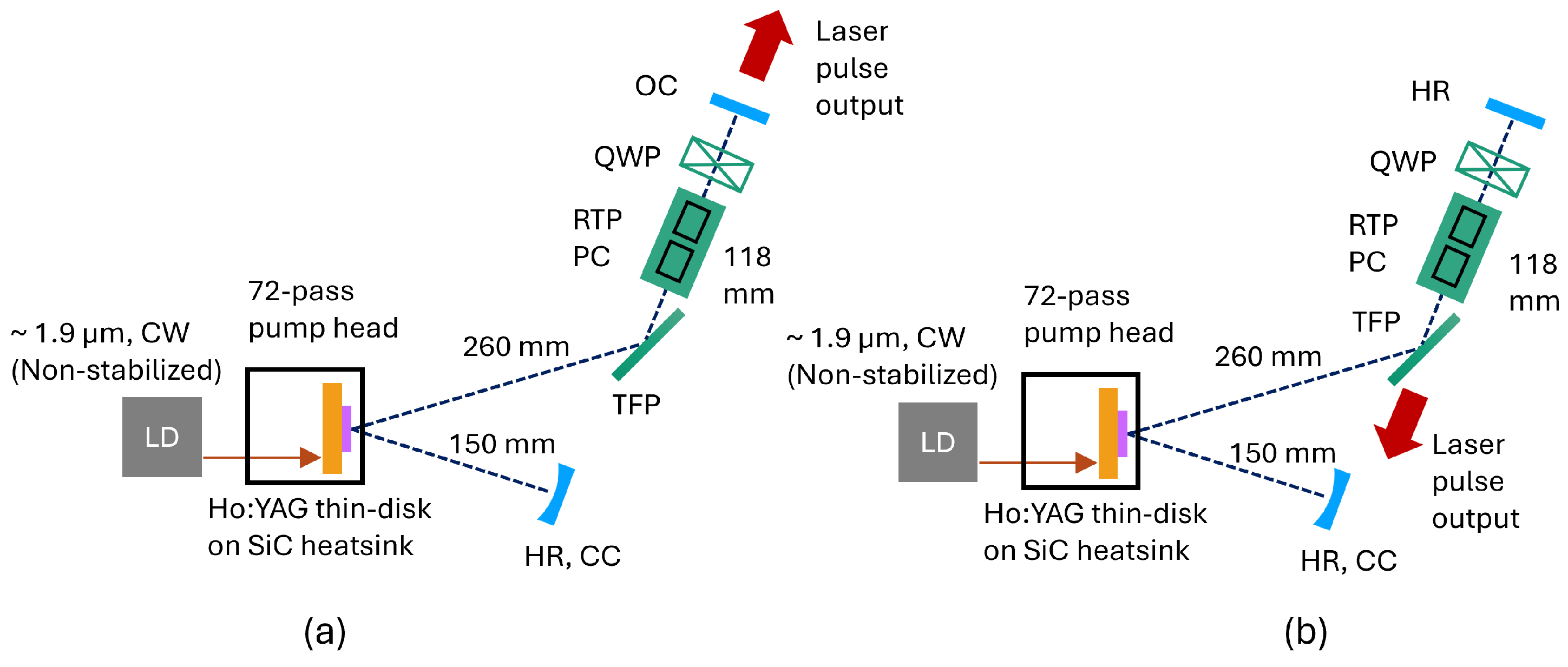
A Ho:YAG thin-disk crystal with a doping concentration of 1.5 at.% and thickness of 400 µm was used. The doping level is higher than that typically used in rod lasers [23] to compensate for the low gain inherent to the thin-disk geometry. However, higher doping also leads to undesirable effects such as increased heat generation, energy-transfer upconversion (ETU), and excited-state absorption (ESA) [28,29]. Regarding the thickness, a thinner crystal would improve the heat dissipation but reduce both the gain and the pump absorption. Sufficient pump absorption is important, as residual pump light may be reflected back to the pump source. To ensure safe operation and higher gain, we selected a comparatively thick crystal in this study. The heat sink was made of silicon carbide (SiC), which has three times lower thermal conductivity than chemical vapor-deposited (CVD) diamond, but offers a cost-effective alternative [30]. The Ho:YAG thin disk was mounted in a 72-pass pumping head. The pump source was a commercial LD manufactured by QPC Lasers, Inc., Sylmar, CA, USA, delivering up to 50 W of CW power at around 1.91 µm, corresponding to in-band pumping. However, it was not wavelength-stabilized using a volume Bragg grating (VBG), resulting in a broadband emission (12 nm full width at half maximum (FWHM)), and a temperature-dependent center wavelength. The pump spot diameter was 2.4 mm, corresponding to a maximum pump intensity of 1.1 kW/cm2. For Q-switching and cavity-dumping operations, a pair of rubidium titanyl phosphate (RTP) crystals (6 × 6 × 10 mm3) was used as a Pockels cell (PC) with an extinction ratio greater than 30 dB, driven by a high-voltage (HV) driver with a rise time below 5 ns. The experimental setup is depicted in Figure 1. It is a simple setup with one arm containing a polarizer and an optical switch.
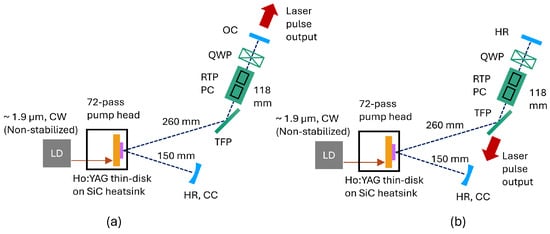
Figure 1.
Schematic of the experimental setup for (a) Q-switching and (b) cavity-dumping operations. OC: output coupler; QWP: quarter waveplate; RTP: rubidium titanyl phosphate; PC: Pockels cell; TFP: thin film polarizer; HR: high-reflective; CC: concave.
In Q-switching, the pump energy is first stored in the gain medium. Ho:YAG possesses a long upper-state lifetime of about 7 ms [31], which is advantageous for Q-switching. When an HV is applied to the PC, the resonator becomes low-loss (i.e., high-Q), allowing laser buildup and pulse emission through the OC. OCs with measured transmittance of 2.6%, 4.6%, 5.8%, and 7.1% were tested, and the best performance was obtained with the 4.6% OC. In cavity dumping, the OC is replaced with an HR mirror. When the intracavity energy reaches its maximum, the PC is switched off, and the stored energy is dumped through the polarizer within one cavity round trip.
3. Results and Discussion
3.1. Q-Switching
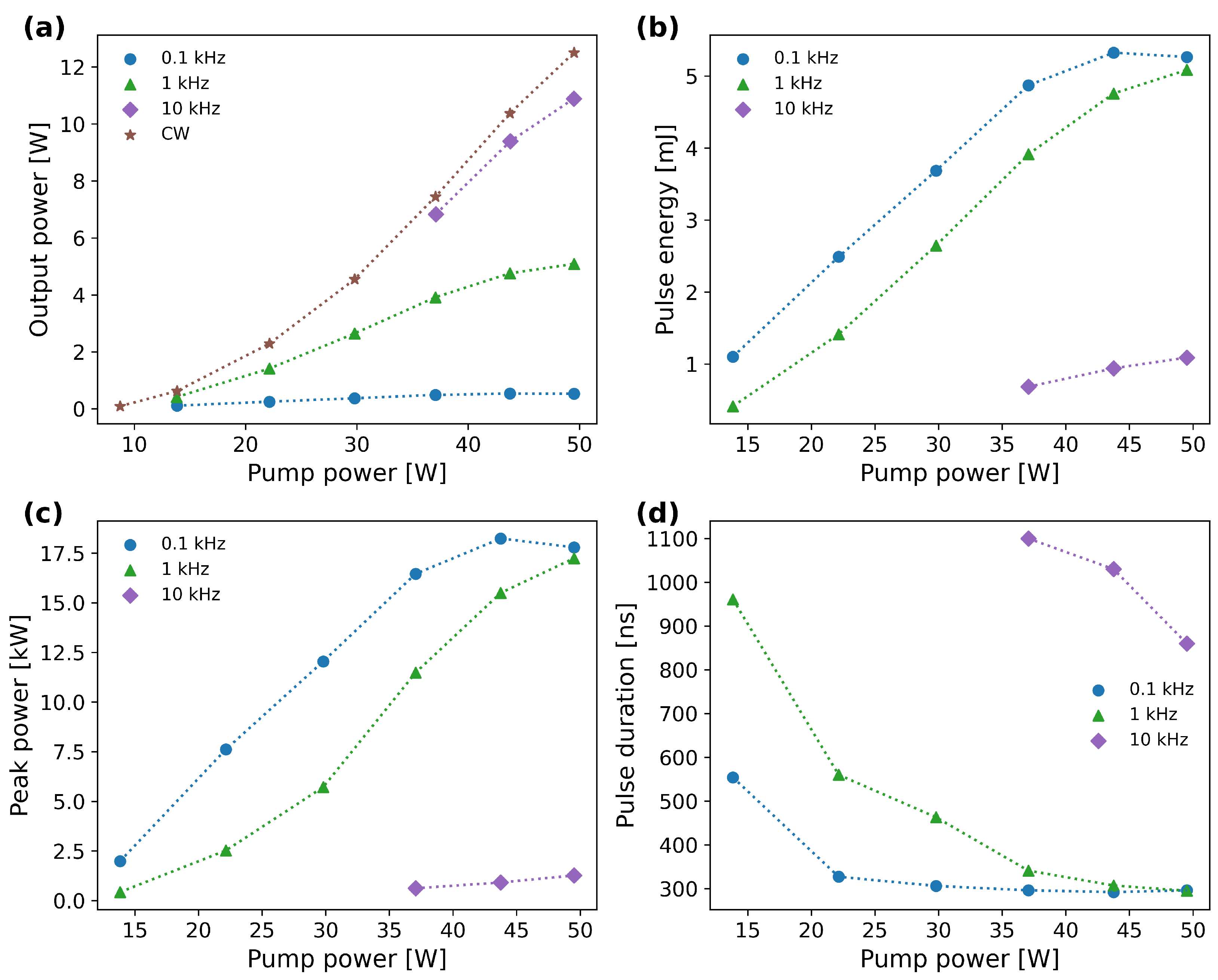
The results of the Q-switched laser operation are shown in Figure 2.
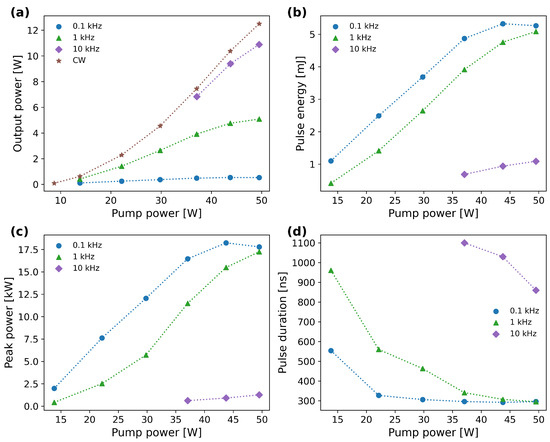
Figure 2.
(a) Average power, (b) pulse energy, (c) peak power, and (d) pulse duration at repetition rates of 0.1, 1, and 10 kHz. The CW power is also plotted on (a).
At a repetition rate of 10 kHz, the pulse energy was unstable at low pump power. This is because the upper-state population does not fully replenish within the short interval between pulses [32]. Pulse energies exceeding 5 mJ were obtained at repetition rates of 1 kHz or lower. A clear rollover of the output pulse energy was observed near the maximum pump level. This behavior can be attributed to the non-stabilized pump spectrum, the elevated temperature of the Ho:YAG thin-disk crystal (exceeding 100 °C, as measured by a thermal camera), and the ETU process. The pulse duration decreased with increasing pump power due to the higher gain. The pulse duration remained longer than 292 ns, which limited the maximum peak power to 18.3 kW. To obtain shorter pulses, a higher net gain is required, which is inherently limited by the thin-disk geometry. Therefore, cavity dumping is considered a more suitable approach for generating higher-peak-power pulses in thin-disk lasers.
3.2. Cavity Dumping
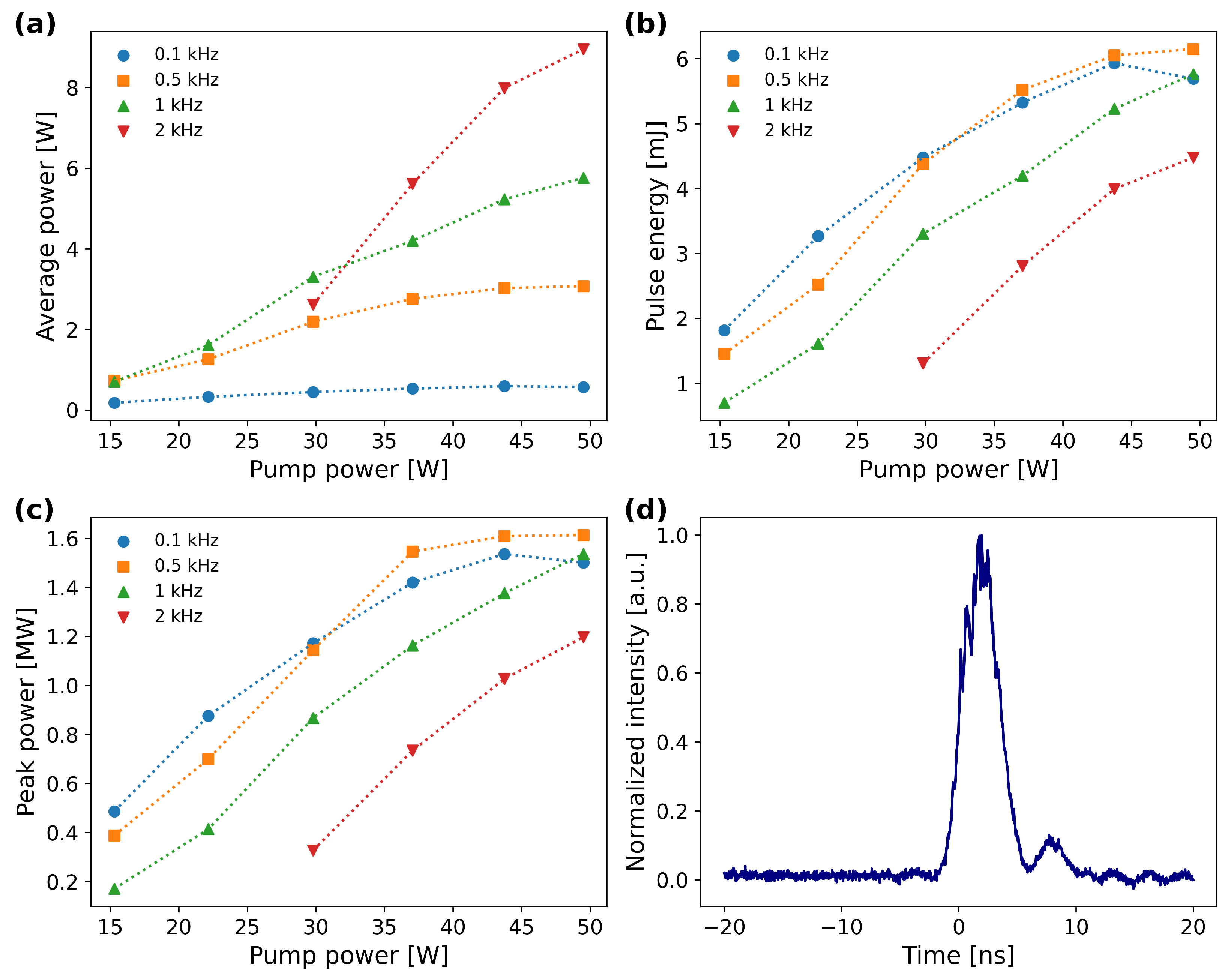
The results of the cavity-dumped operation at different repetition rates, including the average power, pulse energy, peak power, and a representative temporal waveform, are shown in Figure 3.
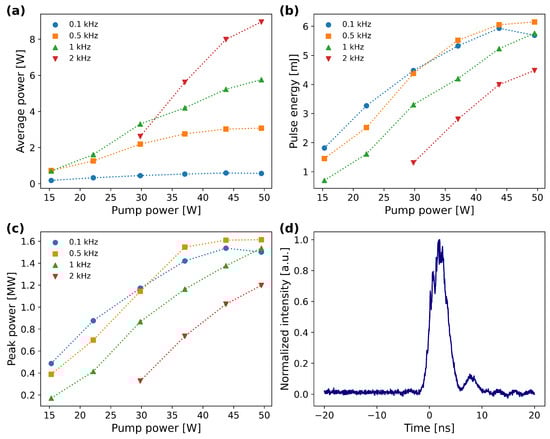
Figure 3.
(a) Average power, (b) pulse energy, and (c) peak power at different repetition rates. (d) Temporal waveform of a cavity-dumped pulse.
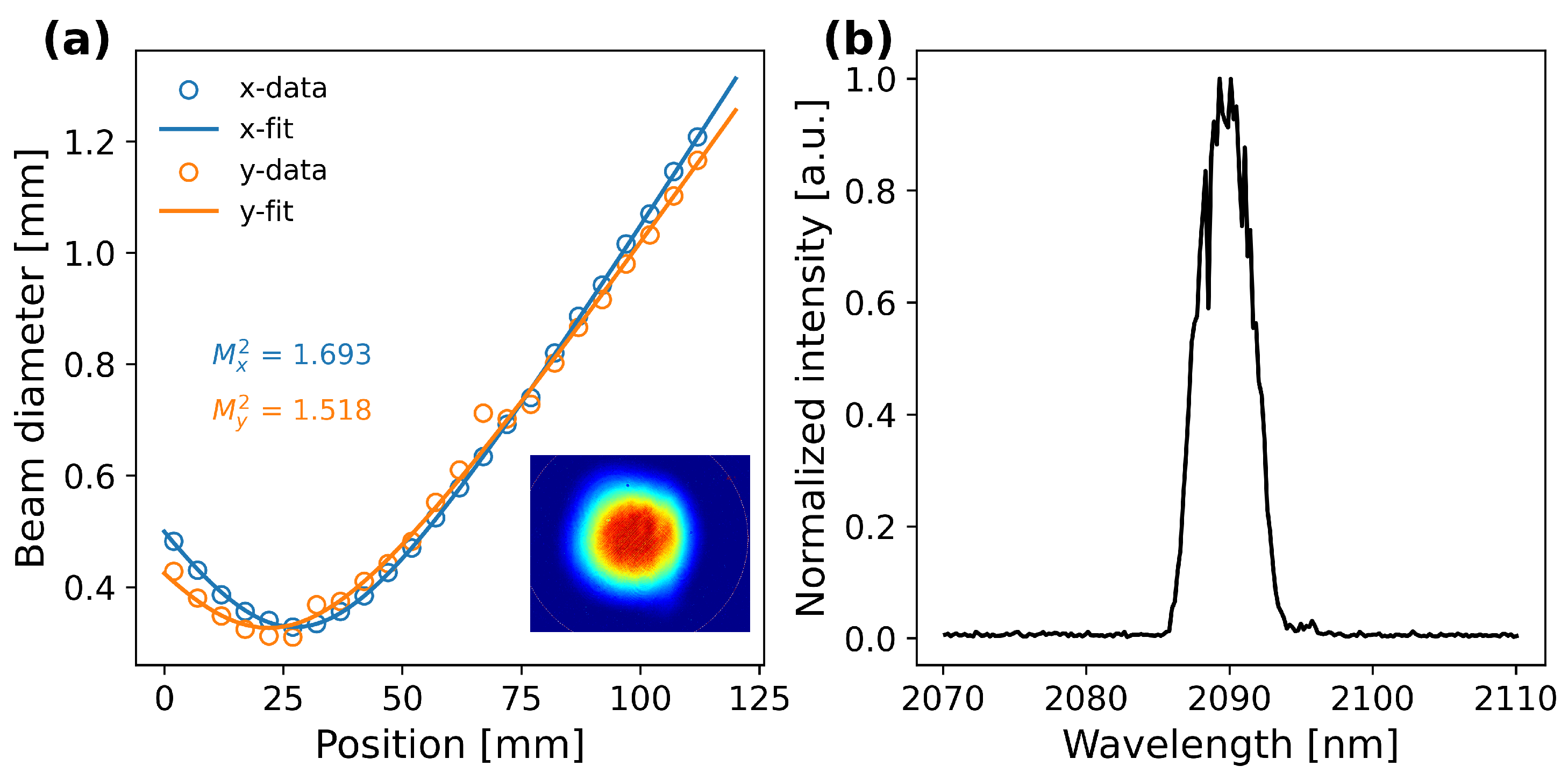
At 2 kHz, the pulse energy was unstable at low pump power due to the insufficient gain. The pulse duration was approximately 3.8 ns in all cases, corresponding to the round-trip time of the 114 cm optical cavity. A pulse duration two orders of magnitude shorter compared with the Q-switched pulses enabled the generation of peak powers up to 1.6 MW. The beam quality, characterized by the M2 factor, was evaluated by measuring the beam caustic using a 150 mm focal-length lens and a beam profiler. The measured M2 values were approximately 1.7 in the horizontal and 1.5 in the vertical directions at a repetition rate of 0.5 kHz and a peak power of 1.5 MW, as shown in Figure 4, together with the emission spectrum measured using a rotating grating spectrometer (APE, waveScan). The inset of Figure 4a shows the beam profile after the beam expander. The beam was expanded to achieve higher intensity upon focusing for LIBS experiments [33].
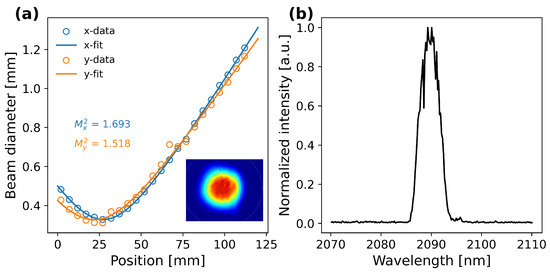
Figure 4.
(a) M2 measurement conforming to ISO 11146-1 [34]. The blue circles and orange circles represent the measured beam diameters in the x- and y-directions, respectively, while the solid lines indicate the corresponding fits.The inset shows the beam profile after the beam expander. (b) Spectrum of the cavity-dumped pulse.
3.3. Energy Scaling
In order to further increase the pulse energy, four strategies can be considered. Firstly, the simplest approach is to use a Ho:YAG thin disk bonded to a CVD-diamond heat sink instead of SiC. The threefold higher thermal conductivity of diamond would reduce the crystal temperature. Our experience with Yb:YAG disks showed a 28% reduction in temperature when diamond was used instead of SiC. In Ho:YAG, maintaining a low temperature is even more crucial than in Yb:YAG, since ETU becomes more pronounced at elevated temperatures. Secondly, a straightforward improvement is to employ a narrow-linewidth, wavelength-stabilized pump source. However, high-power LDs at the 1.9 µm wavelength remain niche in the market; to our knowledge, 60 W is currently the highest power commercially available. Therefore, a more practical alternative is to develop a Tm-fiber laser tuned to 1907 nm, pumped by 793 nm LDs. This configuration would enhance pump absorption and reduce thermal loading, leading to more efficient laser operation. In our preliminary experiments with a simple V-shaped cavity, Tm-fiber pumping yielded a slope efficiency of 52%, compared with 45% achieved with the broadband LD. Thirdly, the number of passes through the thin-disk gain medium per round trip can be increased [35]. For instance, introducing two reflections instead of one effectively doubles the number of passes (from four to eight) per round trip. While this is expected to increase the pulse energy and shorten the Q-switched pulse duration, in cavity-dumping operations, a longer cavity length would result in longer pulse duration. Finally, optimization of the doping concentration and crystal thickness is essential. A thinner crystal provides better heat dissipation at the cost of lower gain and reduced pump absorption. The ETU rate is considered to scale quadratically with doping concentration [29,36]. Therefore, moderate doping levels on the order of 1–3 at.% are typically employed in Ho:YAG thin-disk lasers. Identifying the optimal balance between doping concentration and crystal thickness remains an active topic in the community.
4. Conclusions
We have demonstrated the Q-switching and cavity-dumping operation of a Ho:YAG thin-disk laser pumped by a 1.9 µm LD. The laser delivered more than 5 mJ of pulse energy in Q-switching at repetition rates of 1 kHz or lower. The shortest pulse duration achieved was 292 ns, and the highest peak power was 18.3 kW. By employing cavity dumping, the pulse duration was significantly reduced to 3.8 ns, which is determined by the cavity round-trip time, leading to a peak power as high as 1.6 MW. These results confirm that a cavity-dumping Ho:YAG thin-disk laser is an effective approach for generating high-peak-power nanosecond pulses around 2.1 µm. In comparison, Q-switching offers a simple approach for generating millijoule-level pulses at moderate peak power, benefiting from the long upper-state lifetime of Ho:YAG. However, the achievable peak power is limited by the relatively long pulse duration determined by the net gain. In contrast, cavity dumping enables efficient extraction of the stored intracavity energy within a single round trip, resulting in significantly shorter pulses and megawatt-level peak power. Further performance improvements can be expected by using a CVD-diamond heat sink, a wavelength-stabilized or Tm-fiber-based pump source, multi-reflection geometry, and optimized doping concentration and disk thickness. In addition, the laser was used for LIBS experiments [33]. Encouraged by these results, we plan to leverage the Ho:YAG thin-disk as a main amplifier in a CPA scheme, aiming for picosecond pulses with millijoule-level pulse energies.
Author Contributions
Conceptualization, Y.K., J.M.; methodology, Y.K., J.M.; software, M.D., Y.K.; validation, Y.K.; formal analysis, Y.K.; investigation, Y.K., J.M.; resources, S.K., A.F.; data curation, Y.K., M.D., J.M.; writing—original draft preparation, Y.K.; writing—review and editing, Y.K., J.M., M.S., A.F.; visualization, Y.K.; supervision, J.M., M.S.; project administration, J.M., M.S.; funding acquisition, Y.K., J.M., M.S., T.M. All authors have read and agreed to the published version of the manuscript.
Funding
This work was supported by the MERIT Programme (No. 101081195), administered by the Central Bohemian Innovation Center and co-funded by the European Union. It was also supported by the project LasApp (No. CZ.02.01.01/00/22_008/0004573), which is co-funded by the European Union and the state budget of the Czech Republic.
Institutional Review Board Statement
Not applicable.
Informed Consent Statement
Not applicable.
Data Availability Statement
The data that support the findings of this study are openly available in Zenodo at https://doi.org/10.5281/zenodo.18352687 (accessed on 19 March 2026).
Conflicts of Interest
Author Matyáš Dvořák was employed by the company Celestia Energy s r.o. Authors Sabina Kudělková and Antonín Fajstavr were employed by the company CRYTUR, spol. s r.o. The remaining authors declare that the research was conducted in the absence of any commercial or financial relationships that could be construed as a potential conflict of interest.
References
- Giesen, A.; Speiser, J. Fifteen years of work on thin-disk lasers: Results and scaling laws. IEEE J. Sel. Top. Quantum Electron. 2007, 13, 598–609. [Google Scholar] [CrossRef]
- Fattahi, H.; Barros, H.G.; Gorjan, M.; Nubbemeyer, T.; Alsaif, B.; Teisset, C.Y.; Schultze, M.; Prinz, S.; Haefner, M.; Ueffing, M.; et al. Third-generation femtosecond technology. Optica 2014, 1, 45–63. [Google Scholar] [CrossRef]
- Saraceno, C.J.; Sutter, D.; Metzger, T.; Ahmed, M.A. The amazing progress of high-power ultrafast thin-disk lasers. J. Eur. Opt. Soc.-Rapid Publ. 2019, 15, 15. [Google Scholar] [CrossRef]
- Smrž, M.; Mužik, J.; Nagisetty, S. YAG Lasers for Lithography and Metrology. In Photon Sources for Lithography and Metrology; Bakshi, V., Ed.; SPIE Press: Bellingham, WA, USA, 2023; Chapter 22; pp. 911–997. [Google Scholar]
- Dietrich, T.; Piehler, S.; Rumpel, M.; Villeval, P.; Lupinski, D.; Abdou-Ahmed, M.; Graf, T. Highly-efficient continuous-wave intra-cavity frequency-doubled Yb:LuAG thin-disk laser with 1 kW of output power. Opt. Express 2017, 25, 4917–4925. [Google Scholar] [CrossRef]
- Turcicova, H.; Novak, O.; Muzik, J.; Stepankova, D.; Smrz, M.; Mocek, T. Laser induced damage threshold (LIDT) of β-barium borate (BBO) and cesium lithium borate (CLBO)—Overview. Opt. Laser Technol. 2022, 149, 107876. [Google Scholar] [CrossRef]
- Csanaková, B.; Novák, O.; Roškot, L.; Mužík, J.; Smrž, M.; Jelínková, H.; Mocek, T. High power single crystal KTA optical parametric amplifier for efficient 1.4–3.5 μm mid-IR radiation generation. Laser Phys. 2024, 34, 075401. [Google Scholar] [CrossRef]
- Tomilov, S.; Hoffmann, M.; Wang, Y.; Saraceno, C.J. Moving towards high-power thin-disk lasers in the 2 μm wavelength range. J. Phys. Photonics 2021, 3, 022002. [Google Scholar] [CrossRef]
- Demirbas, U.; Kärtner, F.X. Alexandrite: An attractive thin-disk laser material alternative to Yb:YAG? J. Opt. Soc. Am. B 2020, 37, 459–472. [Google Scholar] [CrossRef]
- Thiré, N.; Chatterjee, G.; Pertot, Y.; Albert, O.; Karras, G.; Zhang, Y.; Wyatt, A.S.; Towrie, M.; Springate, E.; Greetham, G.M.; et al. A versatile high-average-power ultrafast infrared driver tailored for high-harmonic generation and vibrational spectroscopy. Sci. Rep. 2023, 13, 18874. [Google Scholar] [CrossRef]
- Li, K.; Niu, C.; Wu, C.; Yu, Y.; Ma, Y. Development of a 2 µm Solid-State Laser for Lidar in the Past Decade. Sensors 2023, 23, 7024. [Google Scholar] [CrossRef]
- Scholle, K.; Lamrini, S.; Koopmann, P.; Fuhrberg, P. 2 µm Laser Sources and Their Possible Applications. In Frontiers in Guided Wave Optics and Optoelectronics; Pal, B., Ed.; IntechOpen: London, UK, 2010; Chapter 21. [Google Scholar] [CrossRef]
- Malevich, P.; Kanai, T.; Hoogland, H.; Holzwarth, R.; Baltuška, A.; Pugžlys, A. Broadband mid-infrared pulses from potassium titanyl arsenate/zinc germanium phosphate optical parametric amplifier pumped by Tm, Ho-fiber-seeded Ho:YAG chirped-pulse amplifier. Opt. Lett. 2016, 41, 930–933. [Google Scholar] [CrossRef] [PubMed]
- Walke, D.; Koç, A.; Gores, F.; Zhan, M.; Forget, N.; Maksimenka, R.; Wilkinson, I. High-average-power, few-cycle, 2.1 µm OPCPA laser driver for soft-X-ray high-harmonic generation. Opt. Express 2025, 33, 10006–10019. [Google Scholar] [CrossRef]
- Hornberger, B.; Kasahara, J.; Ruth, R.; Loewen, R.; Khaydarov, J. Inverse Compton scattering X-ray source for research, industry and medical applications. In International Conference on X-Ray Lasers 2020; Bleiner, D., Ed.; International Society for Optics and Photonics; SPIE: Bellingham, WA, USA, 2021; Volume 11886, p. 1188609. [Google Scholar] [CrossRef]
- Mușat, V.; Latina, A.; D’Auria, G. A High-Energy and High-Intensity Inverse Compton Scattering Source Based on CompactLight Technology. Photonics 2022, 9, 308. [Google Scholar] [CrossRef]
- Mostafa, Y.; Behnke, L.; Engels, D.J.; Bouza, Z.; Sheil, J.; Ubachs, W.; Versolato, O.O. Production of 13.5 nm light with 5% conversion efficiency from 2 µm laser-driven tin microdroplet plasma. Appl. Phys. Lett. 2023, 123, 234101. [Google Scholar] [CrossRef]
- Walsh, B.M. Review of Tm and Ho materials; spectroscopy and lasers. Laser Phys. 2009, 19, 855–866. [Google Scholar] [CrossRef]
- Zhang, J.; Schulze, F.; Mak, K.F.; Pervak, V.; Bauer, D.; Sutter, D.; Pronin, O. High-Power, High-Efficiency Tm:YAG and Ho:YAG Thin-Disk Lasers. Laser Photonics Rev. 2018, 12, 1700273. [Google Scholar] [CrossRef]
- Zhang, L.; Lei, B.; Cheng, Y.; Yao, S.; Wang, L.; Wang, Y.; Xie, X.; Zhao, W.; Lin, H.; Fu, Y. Hundred-watt-level cryogenic near diffraction-limited composite thin-disk Ho:YLF oscillator at 2 µm. Opt. Express 2025, 33, 20699–20708. [Google Scholar] [CrossRef]
- Zhang, J.; Mak, K.F.; Pronin, O. Kerr-lens mode-locked 2-μm thin-disk lasers. IEEE J. Sel. Top. Quantum Electron. 2018, 24, 1102111. [Google Scholar] [CrossRef]
- Mi, S.; Tang, J.; Wei, D.; Yao, B.; Li, J.; Yang, K.; Dai, T.; Duan, X. Thermal-birefringence-induced depolarization in a 450 W Ho:YAG MOPA system. Opt. Express 2022, 30, 21501–21511. [Google Scholar] [CrossRef] [PubMed]
- Qian, C.; Yao, B.; Ju, Y.; Duan, X.; Zhao, B.; Dai, T.; Wang, Y. 110.4 mJ, 1 kHz repetition rate, Ho:YAG master oscillator power amplifier. Appl. Opt. 2019, 58, 879–882. [Google Scholar] [CrossRef] [PubMed]
- Zhang, Y.; Gao, C.; Wang, Q.; Na, Q.; Zhang, M.; Ye, Q.; Gao, M.; Zhang, J. Single-frequency, injection-seeded Q-switched Ho: YAG ceramic laser pumped by a 1.91 μm fiber-coupled LD. Opt. Express 2016, 24, 27805–27811. [Google Scholar] [CrossRef]
- Wang, Q.; Gao, C.; Na, Q.; Zhang, Y.; Ye, Q.; Gao, M. Single-frequency injection-seeded Q-switched Ho:YAG laser. Appl. Phys. Express 2017, 10, 042701. [Google Scholar] [CrossRef]
- Flöry, T.; Astrauskas, I.; Carpeggiani, P.; Baltuška, A.; Pugžlys, A. Spectral broadening in a hollow core capillary and post compression of millijoule picosecond pulses at 2 μm. In Advanced Solid State Lasers; Optica Publishing Group: Washington, DC, USA, 2021; paper JM3A.19. [Google Scholar]
- Tang, J.; Hua, X.; Wu, M.; Cheng, W.; Zhou, Z.; Yao, B.; Dai, T.; Duan, X. 111 W picosecond Ho:YAG amplifier and its application to 10 μm mid-infrared generation. Opt. Lett. 2025, 50, 6161–6164. [Google Scholar] [CrossRef]
- Barnes, N.P.; Walsh, B.M.; Filer, E.D. Ho: Ho upconversion: Applications to Ho lasers. J. Opt. Soc. Am. B 2003, 20, 1212–1219. [Google Scholar] [CrossRef]
- Tomilov, S.; Loiko, P.; Eremeev, K.; Ono-Suzuki, A.; Redkin, M.; Braud, A.; Camy, P.; Saraceno, C.J. Modeling and Optimization of In-band Pumped Ho:YAG Lasers for High-Power Operation. In Laser Congress 2024 (ASSL, LAC, LS&C); Technical Digest Series; Optica Publishing Group: Washington, DC, USA, 2024; paper JTu2A.6. [Google Scholar] [CrossRef]
- Cvrček, J.; Cimrman, M.; Vojna, D.; Štěpánková, D.; Foršt, O.; Smrž, M.; Novák, O.; Slezák, O.; Chyla, M.; Jelínek, M.; et al. Investigation of the lasing performance of a crystalline-coated Yb:YAG thin-disk directly bonded onto a silicon carbide heatsink. Opt. Express 2022, 30, 7708–7715. [Google Scholar] [CrossRef] [PubMed]
- Šulc, J.; Němec, M.; Vyhlídal, D.; Jelínková, H.; Nejezchleb, K.; Polák, J. Holmium doping concentration influence on Ho:YAG crystal spectroscopic properties. In Solid State Lasers XXX: Technology and Devices; Clarkson, W.A., Shori, R.K., Eds.; International Society for Optics and Photonics; SPIE: Bellingham, WA, USA, 2021; Volume 11664, p. 1166413. [Google Scholar] [CrossRef]
- Kroetz, P.; Ruehl, A.; Calendron, A.L.; Chatterjee, G.; Cankaya, H.; Murari, K.; Kaertner, F.X.; Hartl, I.; Miller, R. Study on laser characteristics of Ho:YLF regenerative amplifiers: Operation regimes, gain dynamics, and highly stable operation points. Appl. Phys. B 2017, 123, 126. [Google Scholar] [CrossRef]
- Vozár, T.; Čechová, L.; Buday, J.; Füleky, M.; Molnárová, K.; Lenža, L.; Mužík, J.; Koshiba, Y.; Smrž, M.; Pořízka, P.; et al. Comparison of two laser wavelengths for LIBS bioimaging of plants grown in lunar regolith. Spectrochim. Acta Part B 2025, in press. [Google Scholar] [CrossRef]
- ISO 11146-1; Lasers and Laser-Related Equipment—Test Methods for Laser Beam Widths, Divergence Angles and Beam Propagation Ratios—Part 1: Stigmatic and Simple Astigmatic Beams. International Organization for Standardization: Geneva, Switzerland, 2005.
- Radmard, S.; Moshaii, A.; Pasandideh, K.; Arabgari, S. Introducing a 2V-resonator for the improvement of pulse stability in a high-gain Q-switched Yb:YAG thin-disk laser. Opt. Express 2023, 31, 12128–12137. [Google Scholar] [CrossRef] [PubMed]
- Shaw, L.; Chang, R.; Djeu, N. Measurement of up-conversion energy-transfer probabilities in Ho:Y3Al5O12 and Tm:Y3Al5O12. Phys. Rev. B 1994, 50, 6609. [Google Scholar] [CrossRef] [PubMed]
Disclaimer/Publisher’s Note: The statements, opinions and data contained in all publications are solely those of the individual author(s) and contributor(s) and not of MDPI and/or the editor(s). MDPI and/or the editor(s) disclaim responsibility for any injury to people or property resulting from any ideas, methods, instructions or products referred to in the content. |
© 2026 by the authors. Licensee MDPI, Basel, Switzerland. This article is an open access article distributed under the terms and conditions of the Creative Commons Attribution (CC BY) license.