Wide-Range All-Fiber Optical Current Transformer Based on Spatial Non-Reciprocal Phase Modulation

Abstract
1. Introduction
2. Principle and Analysis
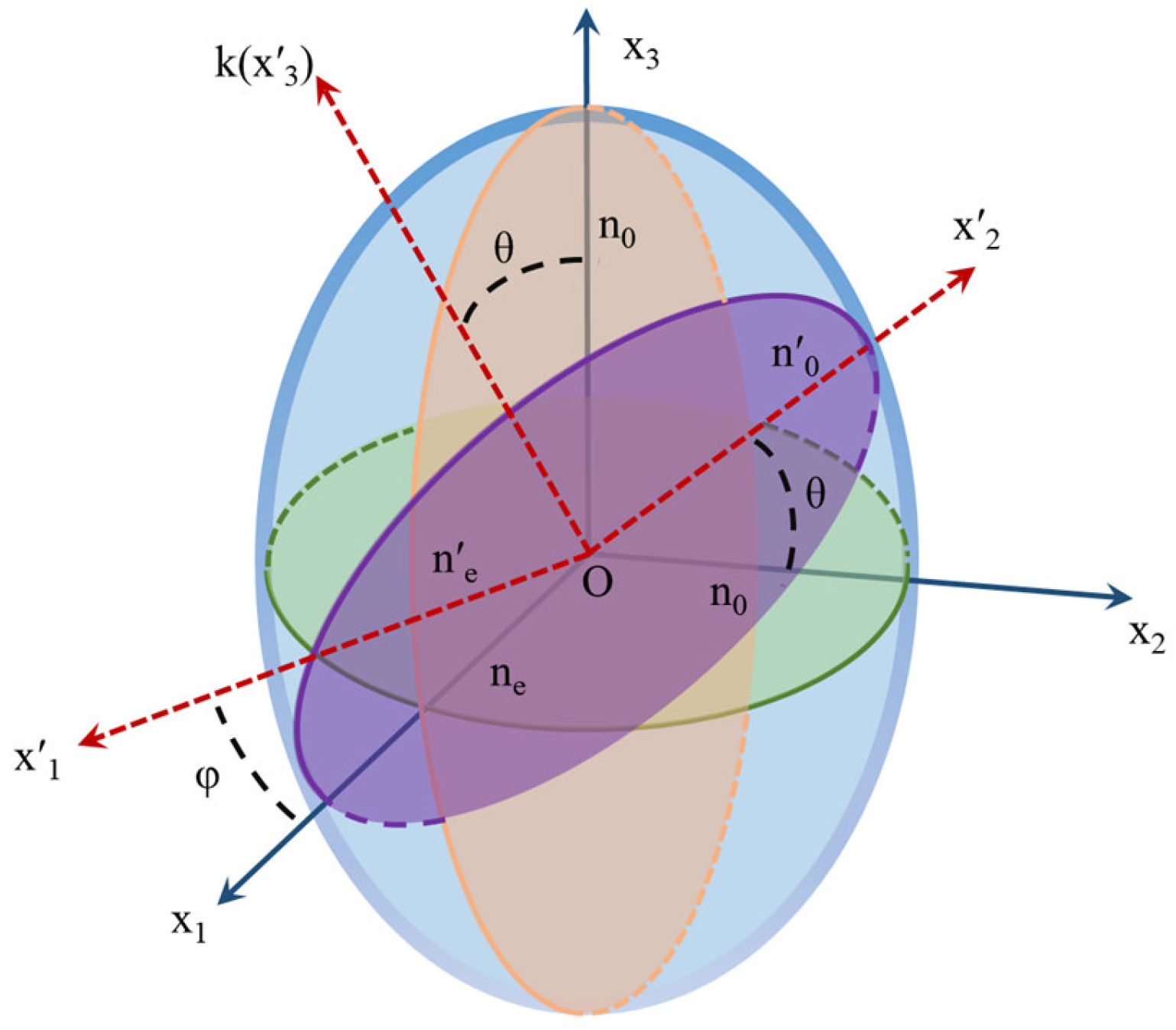
2.1. Spatial Non-Reciprocal Phase Modulator
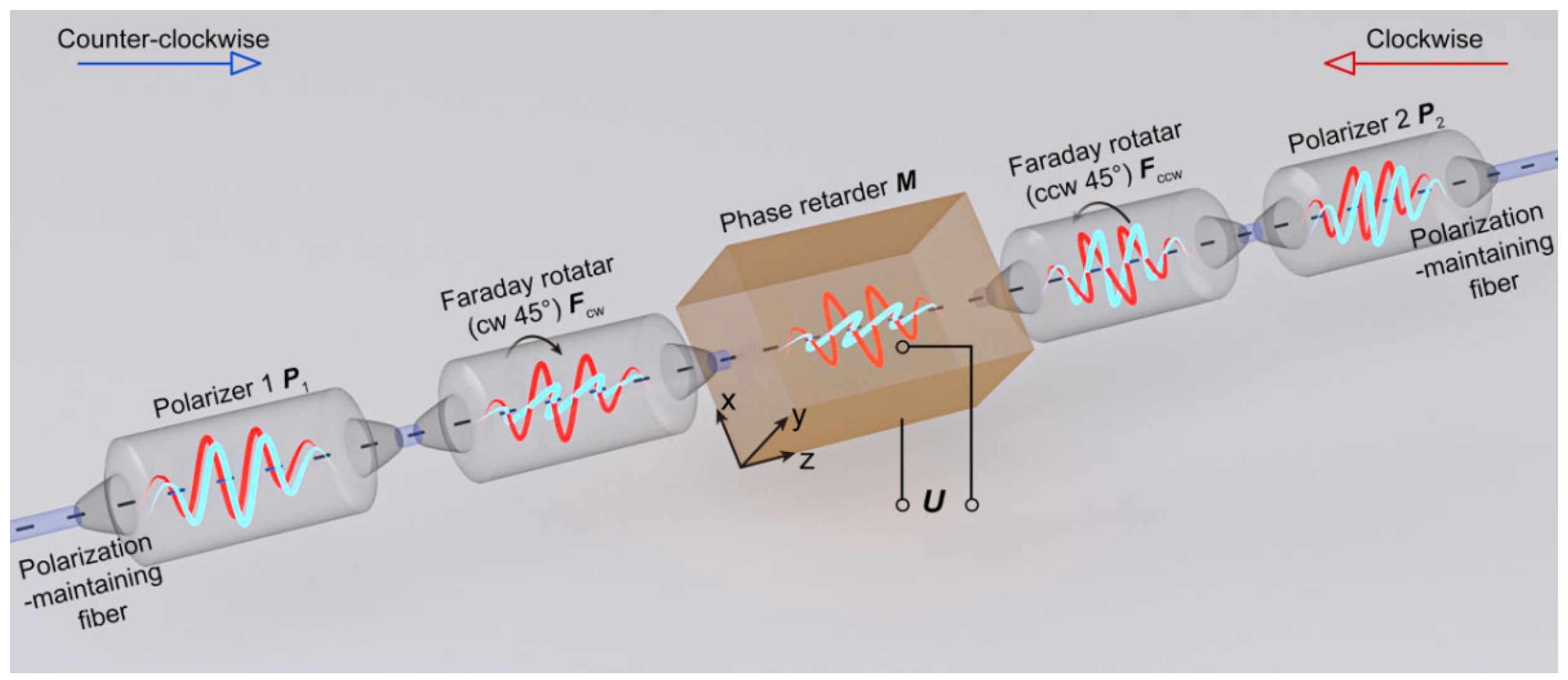
2.2. Optimization of Phase Delay Wave Plate
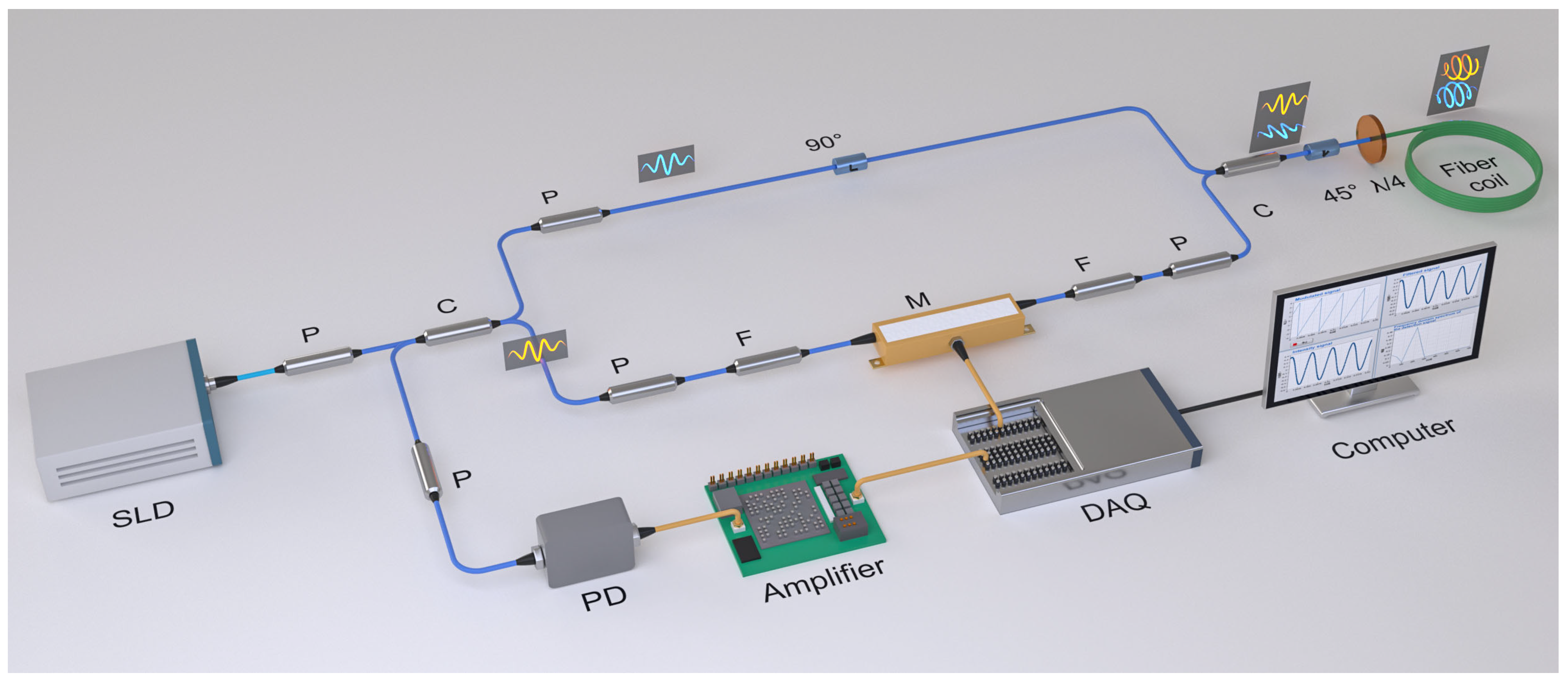
2.3. Structure of AFOCT
2.4. Derivation of Jones Matrix
3. Experiment and Result
3.1. Current Sensing Experiments
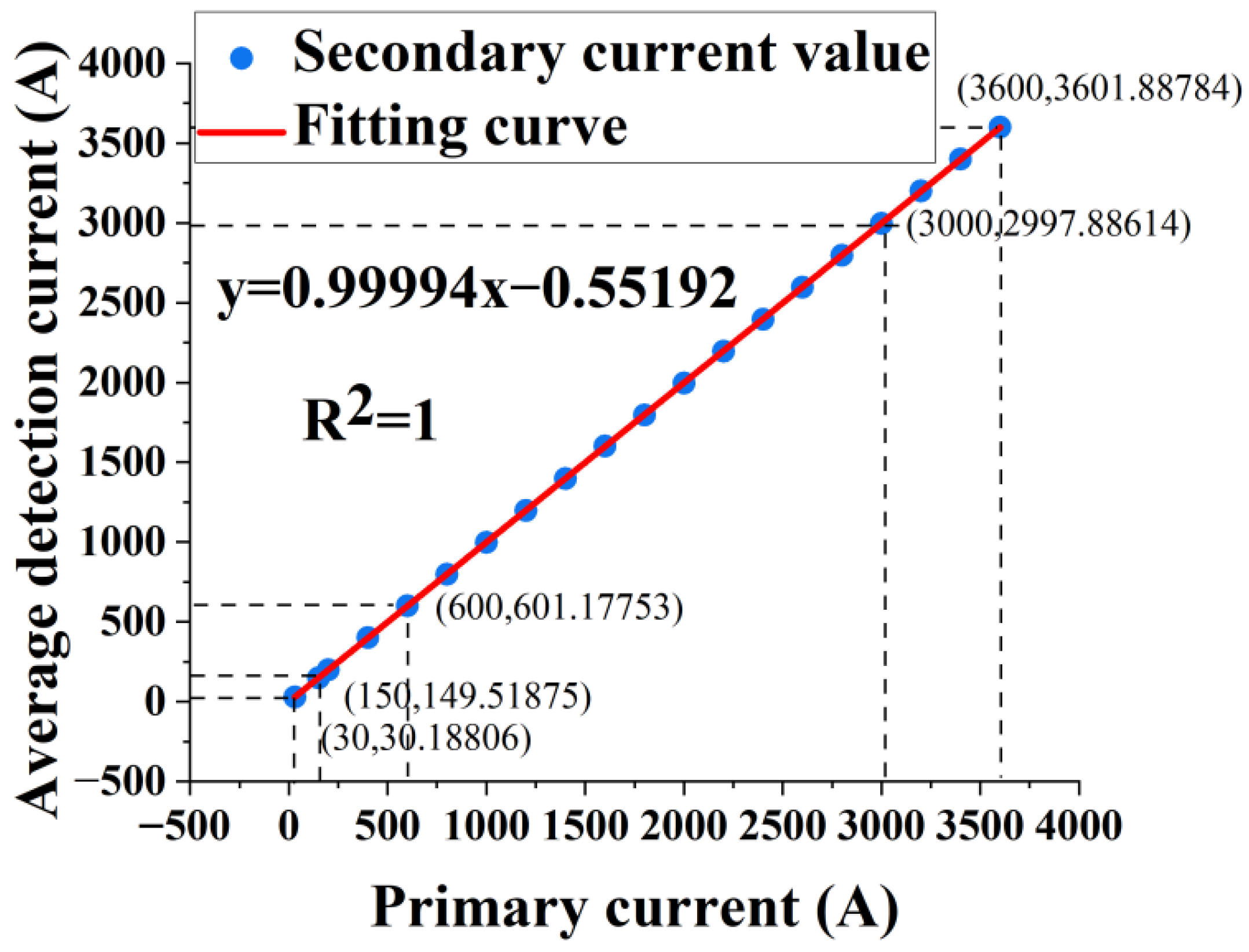
3.2. Linearity
3.3. Peak Error
3.4. Measurement Error
4. Conclusions
Author Contributions
Funding
Data Availability Statement
Conflicts of Interest
References
- Shair, J.; Li, H.; Hu, J.; Xie, X. Power system stability issues, classifications and research prospects in the context of high-penetration of renewables and power electronics. Renew. Sustain. Energy Rev. 2021, 145, 111111. [Google Scholar] [CrossRef]
- Saitoh, M.; Kimura, T.; Minami, Y.; Yamanaka, N.; Maruyama, S.; Nakajima, T.; Kosakada, M. Electronic instrument transformers for integrated substation systems. In Proceedings of the IEEE/PES Transmission and Distribution Conference and Exhibition, Yokohama, Japan, 6–10 October 2002; IEEE: New York, NY, USA, 2002; pp. 459–464. [Google Scholar]
- Wang, R.; Xu, S.; Li, W.; Wang, X. Optical fiber current sensor research: Review and outlook. Opt. Quant. Electron. 2016, 48, 442. [Google Scholar] [CrossRef]
- Li, Z.; Cui, J.; Chen, H.; Lu, H.; Zhou, F.; Rocha, P.R.F.; Yang, C. Research progress of all-fiber optic current transformers in novel power systems: A review. Microw. Opt. Technol. Lett. 2025, 67, e70061. [Google Scholar] [CrossRef]
- Kurosawa, K. Development of fiber-optic current sensing technique and its applications in electric power systems. Photonic Sens. 2014, 4, 12–20. [Google Scholar] [CrossRef]
- Kucuksari, S.; Karady, G.G. Experimental comparison of conventional and optical current transformers. IEEE Trans. Power Deliv. 2010, 25, 2455–2463. [Google Scholar] [CrossRef]
- Peng, N.; Huang, Y.; Wang, S.; Wen, T.; Liu, W.; Zuo, Q.; Wang, L. Fiber optic current sensor based on special spun highly birefringent fiber. IEEE Photon. Technol. Lett. 2013, 25, 1668–1671. [Google Scholar] [CrossRef]
- Kim, D.-H.; Kang, J.U. Sagnac loop interferometer based on polarization maintaining photonic crystal fiber with reduced temperature sensitivity. Opt. Express 2004, 12, 4490–4495. [Google Scholar] [CrossRef]
- Liu, S.; Huang, Y.; Deng, C.; Hu, C.; Huang, C.; Dong, Y.; Shang, Y.; Chen, Z.; Zhang, X.; Wang, T. Magneto-refractive properties and measurement of an erbium-doped fiber. Opt. Express 2021, 29, 34577–34589. [Google Scholar] [CrossRef]
- Cai, W.; Xing, J.; Yang, Z.; Yao, R. Mechanism analysis of faraday effect based on magneto-optic coupling. Laser Optoelectron. Prog. 2017, 54, 062601. [Google Scholar] [CrossRef]
- Müller, G.M.; Gu, X.; Yang, L.; Frank, A.; Bohnert, K. Inherent temperature compensation of fiber-optic current sensors employing spun highly birefringent Fiber. Opt. Express 2016, 24, 11164–11173. [Google Scholar] [CrossRef]
- Yao, P.; Yao, X.S.; Chen, X.; Xiao, H.; Li, J. Relative error’s quadratic dependence on the electric current and the techniques for its compensation in fiber optic current sensor systems. Opt. Express 2022, 30, 471–487. [Google Scholar] [CrossRef]
- Lenner, M.; Frank, A.; Yang, L.; Roininen, T.M.; Bohnert, K. Long-term reliability of fiber-optic current sensors. IEEE Sens. J. 2020, 20, 823–832. [Google Scholar] [CrossRef]
- Wu, J.; Zhang, X.; Chen, L.; Wu, B.; Peng, C. Research on all-fiber dual-modulation optic current sensor based on real-time temperature compensation. IEEE Photonics J. 2022, 14, 6822609. [Google Scholar] [CrossRef]
- Sima, W.; Zeng, L.; Yang, M.; Yuan, T.; Sun, P. Improving the temperature and vibration robustness of fiber optic current transformer using fiber polarization rotator. IEEE Trans. Instrum. Meas. 2022, 71, 9000612. [Google Scholar] [CrossRef]
- Zhao, J.; Shi, L.; Sun, X. Design and performance study of a temperature compensated ±1100-kV UHVdc all fiber current transformer. IEEE Trans. Instrum. Meas. 2021, 70, 7001206. [Google Scholar] [CrossRef]
- Huang, Y.; Xia, L.; Pang, F.; Yuan, Y.; Ji, J. Self-compensative fiber optic current sensor. J. Light. Technol. 2021, 39, 2187–2193. [Google Scholar] [CrossRef]
- Muller, G.M.; Frank, A.; Yang, L.; Gu, X.; Bohnert, K. Temperature compensation of interferometric and polarimetric fiber-optic current sensors with spun highly birefringent fiber. J. Light. Technol. 2019, 37, 4507–4513. [Google Scholar] [CrossRef]
- Lenner, M.; Hsu, C.-P.; Yang, L.; Frank, A.; Bohnert, K. Performance and long-term reliability of polarization-maintaining fiber connectors for fiber-optic current sensors. In Proceedings of the 2018 IEEE SENSORS, New Delhi, India, 28–31 October 2018; IEEE: New York, NY, USA, 2018; pp. 1–4. [Google Scholar]
- Yu, A.; Pang, F.; Yuan, Y.; Huang, Y.; Li, S.; Yu, S.; Zhou, M.; Xia, L. Simultaneous current and vibration measurement based on interferometric fiber optic sensor. Opt. Laser Technol. 2023, 161, 109223. [Google Scholar] [CrossRef]
- Su, S.; Wan, L.; Zhou, Y.; Sun, J.; Liu, L. Transversal electro-optic effect of light propagating in arbitrary direction in LiNbO3. Acta Opt. Sin. 2010, 30, 2972–2977. [Google Scholar] [CrossRef]
- Tudi, A.; Han, S.; Yang, Z.; Pan, S. Potential optical functional crystals with large birefringence: Recent advances and future prospects. Coord. Chem. Rev. 2022, 459, 214380. [Google Scholar] [CrossRef]
- Wooten, E.L.; Kissa, K.M.; Yi-Yan, A.; Murphy, E.J.; Lafaw, D.A.; Hallemeier, P.F.; Maack, D.; Attanasio, D.V.; Fritz, D.J.; McBrien, G.J.; et al. A review of lithium niobate modulators for fiber-optic communications systems. IEEE J. Sel. Top. Quant. Electron. 2000, 6, 69–82. [Google Scholar] [CrossRef]
- Yin, X.; Zhang, S.; Tian, Z. Refractive indices of biaxial crystals evaluated from the refractive indices ellipsoid equation. Opt. Laser Technol. 2007, 39, 510–513. [Google Scholar] [CrossRef]
- Qi, Y.; Wang, M.; Jiang, F.; Zhang, X.; Cong, B.; Liu, Y. Novel fiber optic current transformer with new phase modulation technique. Photonic Sens. 2020, 10, 275–282. [Google Scholar] [CrossRef]
- Ghosh, A.; Gupta, P.B.D.; Mandal, A.K. Development of a fiber-optic current sensor with range-changing facility using shunt configuration. IEEE Sens. J. 2013, 13, 1347–1354. [Google Scholar] [CrossRef]
- Liu, Y.; Song, H. Theoretical analysis on polarization characteristics of spun birefringent optical fiber based on an analytical Jones matrix model. Optik 2021, 228, 166179. [Google Scholar] [CrossRef]
- Feng, H.; Jin, S.; An, Y.; Zeng, Z.; Qu, Z. Phase distortion analysis and passive demodulation for pipeline safety system based on Jones matrix modeling. Measurement 2011, 44, 1531–1538. [Google Scholar] [CrossRef]
- Yang, X.; Chen, M.; Chen, H.; Lu, Y.; Wang, J. Online measurement of birefringence of sensing fibers in the AFOCT system. Microw. Opt. Technol. Lett. 2024, 66, e34029. [Google Scholar] [CrossRef]



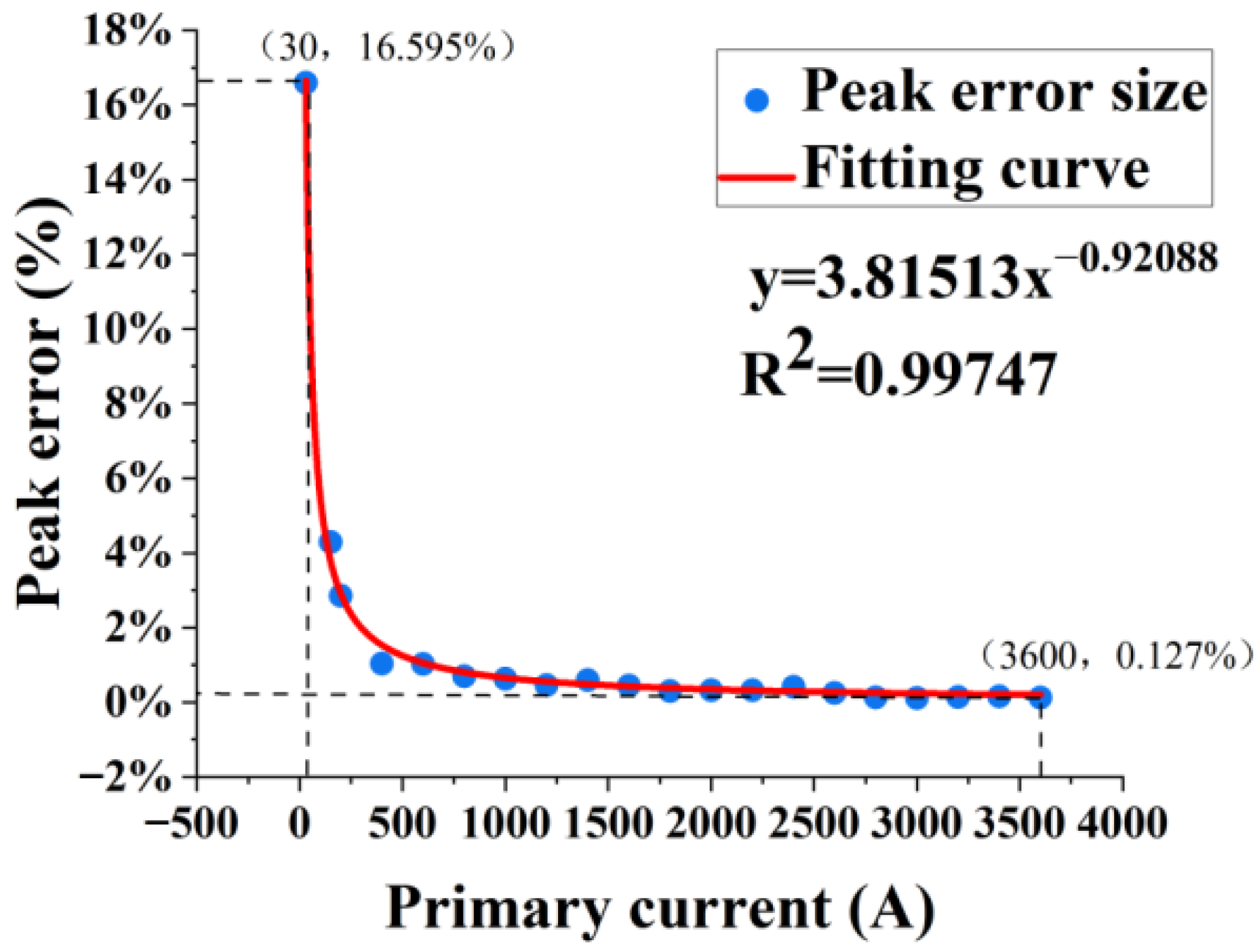
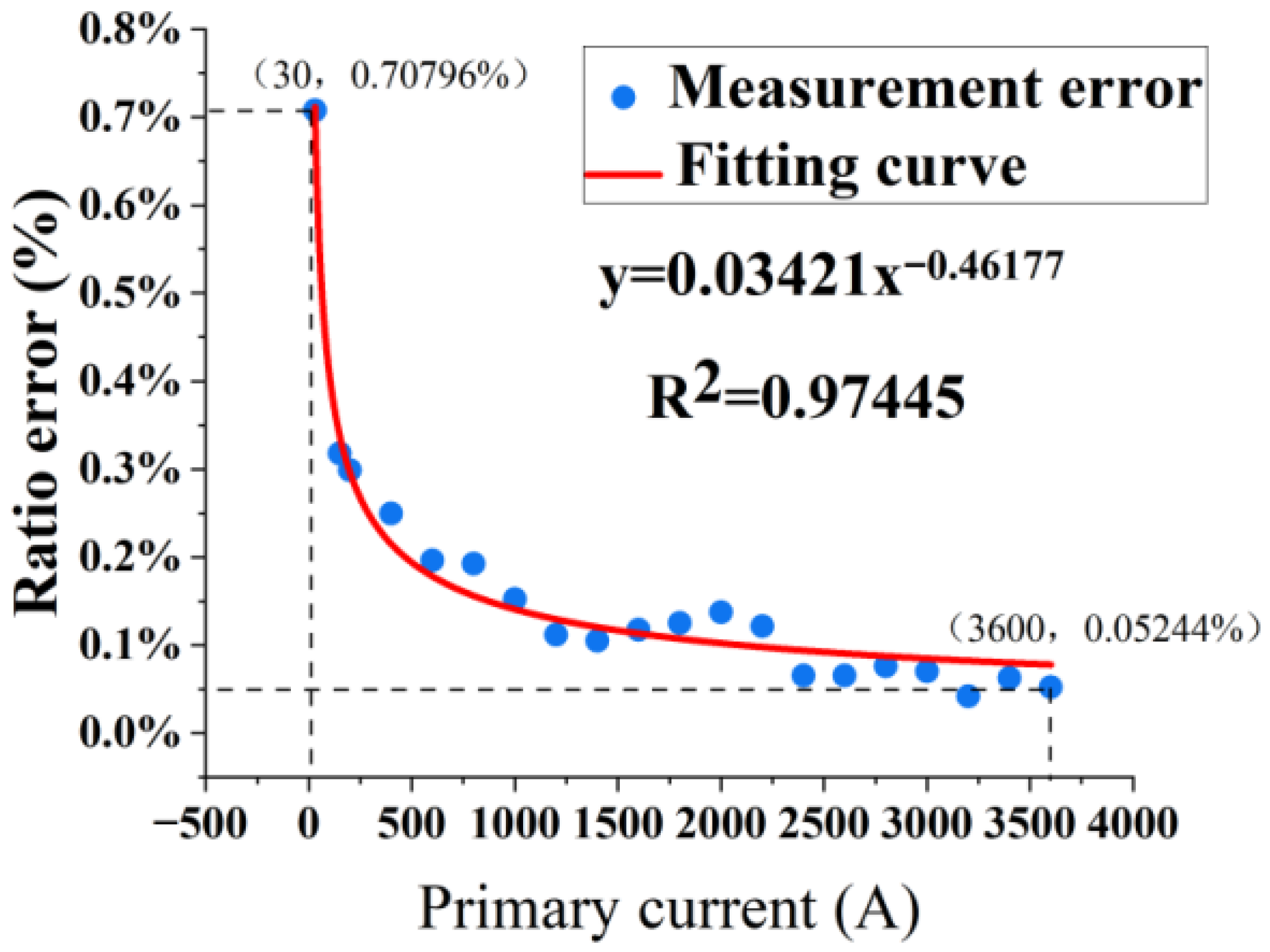

| Accuracy Level | Current (Ratio) Error ±% at the Following Rated Currents (%) | Phase Error ± Crad at the Following Rated Currents (%) | ||||||||
|---|---|---|---|---|---|---|---|---|---|---|
| 1 | 5 | 20 | 100 | 120 | 1 | 5 | 20 | 100 | 120 | |
| 0.2S | 0.75 | 0.35 | 0.2 | 0.2 | 0.2 | 0.9 | 0.45 | 0.3 | 0.3 | 0.3 |
| 0.5S | 1.5 | 0.75 | 0.5 | 0.5 | 0.5 | 2.7 | 1.35 | 0.9 | 0.9 | 0.9 |
| Characteristics | Conventional Current Transformer | Traditional Structure AFOCT | Previous Scheme AFOCT | Optimized Scheme AFOCT |
|---|---|---|---|---|
| Fundamental principles | Electromagnetic induction. | Faraday magneto-optical effect. | ||
| Frequency bandwidth | 0.1 Hz–5 MHz | Due to the microsecond-level time for light to pass through the sensing section, the width of the frequency band is only determined by the circuit response speed of the signal processing unit. | ||
| Measurement range and accuracy | There is a problem of magnetic saturation, which is prone to distortion at high currents or with DC components. | There is no magnetic saturation problem, and the measurement range is extremely wide. | ||
| Security | Relying on solid insulation materials, such as silicone oil and ceramics, the insulation structure is complex. | The insulation structure is simple, and the sensing head is made of optical fiber, which is essentially insulated. No risk of explosion or oil leakage and high safety, especially suitable for ultra-high voltage scenarios. | ||
| Size and installation | The iron core and winding result in a large volume, heavy weight, and inconvenient installation. | Small in size and light in weight, the sensing fiber can be flexibly wound around the tested conductor, and there are various installation methods. | Further reducing the cost and size of the transformer. | |
| Complexity of the demodulation | It does not involve demodulation steps. | Complex. | The absence of intrinsic frequency limitations eliminates the demand for precise timing control in demodulation, thereby simplifying the demodulation circuit. | |
| Application scenarios | Suitable for metering, protection, and control of the vast majority of medium- and low-voltage AC power grids. | Mainly used in high-voltage/ultra-high-voltage AC/DC transmission systems with high performance requirements, digital substations, active power grids, and complex environments with severe electromagnetic interference. | ||
| Temperature stability | Due to the influence of the magnetic properties of the iron core, the temperature stability is generally average. | Optical devices are temperature sensitive and require complex temperature compensation algorithms to ensure stability. | ||
| Characteristics | Previous Scheme AFOCT | Optimized Scheme AFOCT |
|---|---|---|
| Structure | There is redundancy in the optical path. | Simplified the optical path coupling devices, reducing the number of components such as fiber couplers. |
| Modulation principle | Spatial non-reciprocal phase modulation technique. | |
| Align the optical axis of the modulator | Space optical path alignment. | All-fiber optical axis alignment. |
| Half-wave voltage | 600 V | 4 V |
| Size | The chip length is 19.3 cm, and the thickness is 1.3 cm. | The chip length is 4 cm, and the thickness is 26.75 μm. |
| Temperature stability | Optical devices are temperature sensitive and require complex temperature compensation algorithms to ensure stability. Due to the tangential orientation of the chip, the former has slightly stronger temperature stability than the latter. | |
Disclaimer/Publisher’s Note: The statements, opinions and data contained in all publications are solely those of the individual author(s) and contributor(s) and not of MDPI and/or the editor(s). MDPI and/or the editor(s) disclaim responsibility for any injury to people or property resulting from any ideas, methods, instructions or products referred to in the content. |
© 2025 by the authors. Licensee MDPI, Basel, Switzerland. This article is an open access article distributed under the terms and conditions of the Creative Commons Attribution (CC BY) license.
Share and Cite
Zhang, T.; Feng, W.; Yang, H.; Liu, Y.; Qi, Y. Wide-Range All-Fiber Optical Current Transformer Based on Spatial Non-Reciprocal Phase Modulation. Photonics 2026, 13, 26. https://doi.org/10.3390/photonics13010026
Zhang T, Feng W, Yang H, Liu Y, Qi Y. Wide-Range All-Fiber Optical Current Transformer Based on Spatial Non-Reciprocal Phase Modulation. Photonics. 2026; 13(1):26. https://doi.org/10.3390/photonics13010026
Chicago/Turabian StyleZhang, Tianxiao, Weibin Feng, Haosong Yang, Yanyan Liu, and Yuefeng Qi. 2026. "Wide-Range All-Fiber Optical Current Transformer Based on Spatial Non-Reciprocal Phase Modulation" Photonics 13, no. 1: 26. https://doi.org/10.3390/photonics13010026
APA StyleZhang, T., Feng, W., Yang, H., Liu, Y., & Qi, Y. (2026). Wide-Range All-Fiber Optical Current Transformer Based on Spatial Non-Reciprocal Phase Modulation. Photonics, 13(1), 26. https://doi.org/10.3390/photonics13010026