Abstract
The temporal dynamics and statistical characteristics of Raman random fiber lasers are of great significance for studying their physical properties and applications. In this paper, the effect of pump dynamics on the temporal intensity statistical properties of Raman random fiber lasers is experimentally studied under full bandwidth measurements. The measured intensity probability density function (PDF) of the Raman random fiber laser pumped by an ytterbium-doped random fiber laser (YRFL) deviates inward from the exponential distribution. We further use the spectrally filtered YRFL with different temporal dynamics properties as the Raman pump, and the results reveal that the PDF of the Raman random fiber laser deviates outward from the exponential distribution, and the probability of extreme values increases by using a filtered YRFL pump with larger temporal intensity fluctuations. This work provides experimental evidence of the important role of pump properties on the statistics of a random Raman fiber laser, which could be crucial to tailoring the dynamics of random fiber lasers for various applications such as frequency doubling, supercontinuum generation, and laser inertial confinement fusion.
1. Introduction
Rayleigh backscattering can be utilized to provide random distributed feedback for generating random lasing in fibers [1]. In 2010, a random fiber laser (RFL) that utilizes Rayleigh backscattering in passive fibers and Raman gain was proposed and demonstrated [2]. Its uniqueness lies in abandoning the traditional resonant cavity structure, eliminating the fixed mode and low temporal coherence characteristics. Raman random fiber laser (RRFL) utilizes stimulated Raman scattering in optical fibers to achieve laser frequency conversion [3,4]. This type of laser has many remarkable advantages, such as high efficiency [5,6], high power [7], low noise [8], and tunable wavelength [9,10]. Benefit from its advantages and low coherence, it has important applications in long-distance communication and sensing [11,12], speckle-free imaging [13], time-domain ghost imaging [14], supercontinuum generation [15,16], nonlinear frequency conversion [17,18], and ICF [19].
Besides achieving performance improvements, Raman random fiber laser also exhibits rich physical properties in both the frequency and time domains. These properties arise from the disorder and randomness introduced by Rayleigh scattering, as well as various nonlinear interactions. Consequently, RRFL serves as an ideal platform for studying complex physical systems. The simulation model, which is based on wave kinetic theory [20] and the nonlinear Schrödinger equation [21], has been extensively employed to describe the spectral and temporal characteristics of RRFLs. Furthermore, the latest advancements for RRFL in spectral manipulation and time-domain intensity statistical properties are detailed in refs. [22,23].
In spectral measurement, precise measurement of real-time spectra of RRFL was achieved using a scanning Fabry–Perot interferometer. Researchers discovered spectral components with long lifetimes and narrow bandwidths. By calculating the Pearson correlation coefficient, the research revealed that there is a correlation between different frequency components in the spectrum of Raman random fiber lasers [24]. Further research uncovered that the intensity statistical characteristics of RRFL adhere to a Levy distribution, and these statistical properties are intimately connected to the laser’s operating power [25]. And recently, researchers from UESTC have concluded that in steady state of RRFL, the partial correlation between frequency domain and time domain comes from coherent feedback formed by weak scattering feedback mechanism [26]. In addition, since Conti. C et al. discovered the phenomenon of replication symmetry breaking (RSB) in random lasers [27], extensive research on RSB has been conducted in various types of random fiber lasers [28,29,30,31]. Recently, the intrinsic mechanisms of photonic phase transition in an RS-based RFL system are investigated through both theoretical and experimental approaches [32].
In the time domain, Smirnov initially simulated the temporal dynamics and statistical properties of random fiber lasers. The results indicated that the statistical properties were closely tied to the Raman gain coefficient and dispersion. Specifically, a larger Raman gain coefficient and smaller dispersion accentuate the nonlinear effects among different frequency components, which in turn heightens the correlation between them [21]. Building on this finding, researchers from UESTC ingeniously integrated optical fibers with different dispersion types to customize the radiation statistical characteristics [33]. Moreover, when the optical bandwidth exceeds the electrical bandwidth of the device, it becomes possible to examine the statistical characteristics at different positions within the spectral components via optical filtering [34]. Recent studies have also demonstrated that the probability density function of RRFL under full bandwidth conditions is associated with the observation location [35].
However, these studies have certain limitations as they did not consider how pump time-domain fluctuations affect the statistical properties of Raman random fiber lasers. Therefore, characterizing the time-domain statistical characteristics of RRFL pumped by different pump structures under full bandwidth conditions is of great practical significance for revealing its properties and providing accurate guidance for its applications in many fields.
In this paper, the influence of Raman pumping with different time-domain characteristics under full bandwidth conditions on the statistical properties of RRFL is studied. Firstly, using unfiltered YRFL as the Raman pump, the probability density function of the Raman random fiber laser deviates inward from the exponential distribution. It indicates that the frequency components are correlated. Secondly, when using the filtered YRFL as a Raman pump, the probability density functions of YRFL at different filtering positions were the same as the previous experimental results. However, the probability density functions of Raman random fiber lasers all deviated outward from the probability density function of YRFL, and as the filtering position gradually moved away from the center of the YRFL spectrum, the probability intensity function of Raman random fiber lasers exhibited heavy-tailed characteristics. This discovery provides a new perspective for a deeper understanding of the intrinsic mechanisms of Raman random fiber lasers and provides guidance for customizing the statistical properties of RRFLs.
2. Principle and Method
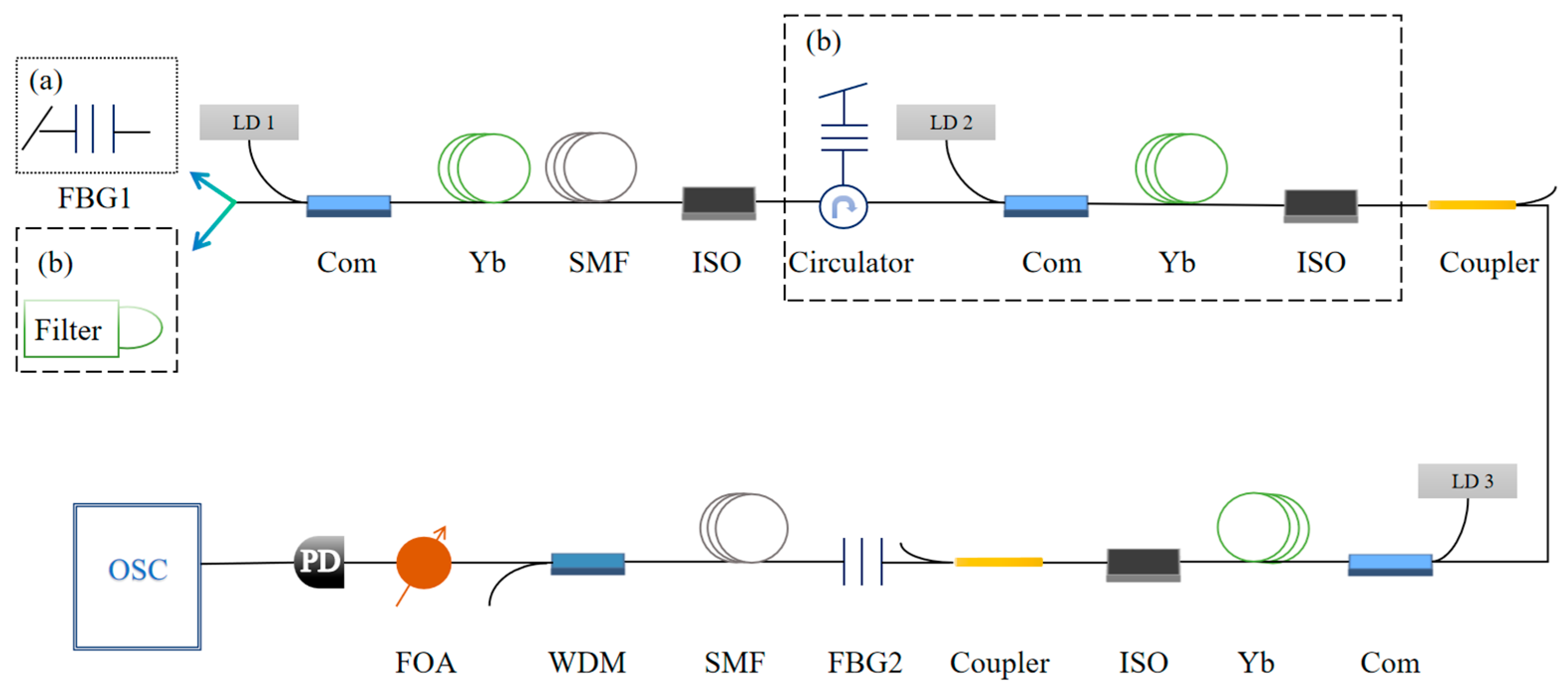
Figure 1 shows the experimental setup of a Raman random fiber laser based on a controllable temporal dynamic pump under full bandwidth. To compare the time-domain characteristics of Raman random fiber lasers, two pump source designs were adopted:
Figure 1.
Experimental setup of Raman random fiber laser based on a controllable temporal dynamics pump. (a): Yb−doped random fiber laser as pump; (b):Temporal dynamic controllable pump; LD: 976 nm laser diode; Com: combiner; Yb: Yb−doped fiber; SMF: single-mode fiber; ISO: optical isolator; Coupler: (2 × 2)1:99 fiber coupler; FBG1: 1095.03 nm; FBG2: 1153.9 nm; WDM: Wavelength Division Multiplexing (pass port: 1050–1110 nm, reflection port: 1150–1250 nm); FOA: fiber optical attenuator; PD: photodiode; OSC: oscilloscope.
Scheme (a) uses fiber Bragg grating (FBG, MC fiber optic, Shenzhen, China) as point feedback. The center wavelength of the FBG is 1095.03 nm, with a 3 dB bandwidth of 0.04 nm and a peak reflectivity of 95%. The ytterbium-doped random fiber laser (YRFL) is pumped by a 976 nm laser diode (LD 1), with a 6 m long ytterbium-doped double clad fiber (YDF, Nufern LMA-YDF-10/130, East Granby, CT, USA) providing gain, and a 10 km standard single-mode fiber (SMF, Corning G.652, Shanghai, China) providing random distributed feedback. At a pump power of 6.5 W LD 1, stable output of quasi continuous YRFL was achieved with an output power of approximately 300 mW. At the same time, the spectrum was observed without the generation of first-order Raman laser. The generated ytterbium-doped random fiber laser is injected directly into the main oscillator power amplifier without filtering.
Scheme (b) adopts a temporal dynamic controllable pump, which consists of a wavelength-tunable ytterbium-doped random fiber laser, a fiber optic circulator(MC fiber optic, Shenzhen, China), and a 1095.03 nm FBG. This FBG is the same as the FBG of the ytterbium-doped random fiber laser pump source in scheme (a). To achieve wavelength-tunable YRFL output, a tunable filter with a bandwidth of 0.1 nm is introduced into a fiber loop mirror based on a 1:1 fiber coupler to provide wavelength selective point feedback. And the ytterbium-doped random fiber laser filtered by FBG is used as a time-domain dynamic controllable light seed.
Subsequently, by accurately adjusting the detuning between the center wavelength of the tunable ytterbium-doped random fiber laser and the 1095.03 nm FBG, specific spectral components such as the center or edge of the YRFL spectrum can be filtered.
Due to the low seed power after being spectrally filtered, the input power of LD 2 is adjusted by monitoring the coupler’s 1% port to increase the seed power to 300 mW. Subsequently, the spectrally filtered YRFL seed is amplified in the main oscillator power amplifier using a 6 m YDF and measuring the output power after the isolator. The output laser is injected into the SMF through another 1:99 coupler and 1153 nm FBG.
In order to generate Raman random fiber laser, a forward pumping scheme was used in the experiment. Fix the wavelength of the output laser using an FBG with a center wavelength of 1153.9 nm, a 3 dB bandwidth of 0.04 nm, and a reflectivity of 95%. A 15 km single-mode fiber provides backward Rayleigh scattering feedback and Raman gain, combined with a fiber Bragg grating (FBG) to form a half-opened laser cavity, thereby generating a 1153.9 nm Raman random fiber laser in quasi-continuous mode with large temporal intensity fluctuations in the time scale of sub-ns level. The generated Raman random fiber laser is filtered through WDM, with ports (pass port: 1050–1110 nm, reflection port: 1150–1250 nm) used to separate residual pump light and signal light, ensuring that subsequent measurements are not affected by pump light. Use a 45 GHz photodetector (New Focus, Wuxi, China, Model 1014) and a 32 GHz oscilloscope (Agilent Technologies, Santa Clara, CA, USA, DSO-X 93204A) to detect the time-domain signal of the signal light. For spectral measurement, we used a spectral analyzer with a resolution of 0.02 nm (Yokogawa, Tokyo, Japan, AQ6370D).
3. Results
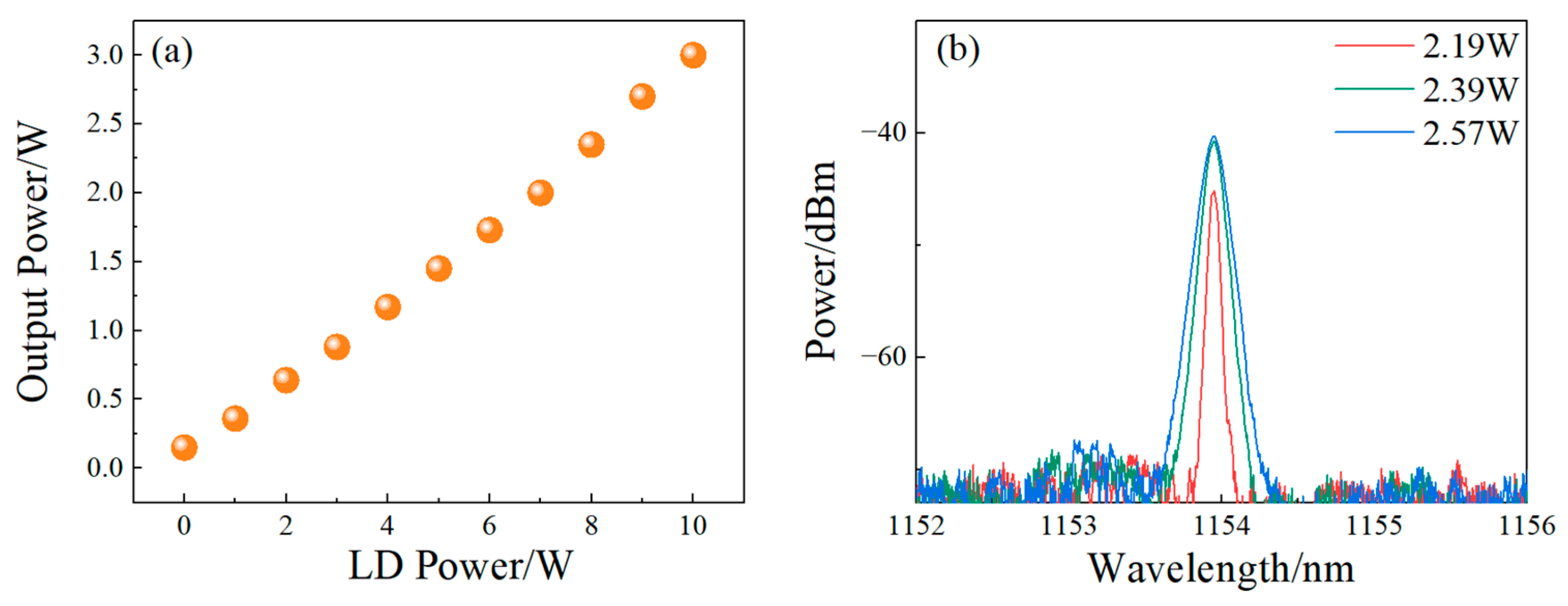
Firstly, scheme (a) is adopted to investigate the power enhancement of the main oscillation power amplification and the corresponding spectrum evolution of the Raman random fiber laser for the ytterbium-doped random fiber laser seed without being spectrally filtered, as shown in Figure 2. When LD 1 inputs 6.5 W, the 3 dB bandwidth of the ytterbium-doped random fiber laser seed is measured to be 0.2 nm after the isolator, and the output power is 300 mW. Subsequently, the seed laser is directly injected into the main oscillation power amplification stage. When the power of LD 3 is 10 W, the output power reaches 3 W, and its output slope efficiency is 28.5%. Amplified YRFL as pump for Raman random fiber laser. Figure 2b shows the spectrum evolution process of Raman random fiber laser. The threshold of Raman random fiber laser is about 2.14 W. It can be clearly seen that as the pump power increases from 2.19 W to 2.57 W, the 3 dB bandwidth of the Raman random fiber laser spectrum gradually widens from the initial 0.06 nm to 0.12 nm.
Figure 2.
(a) Output power of spectrally unfiltered ytterbium−doped random fiber laser versus LD3 power; (b) Raman random fiber laser spectrum evolution diagram.
Due to the maximum bandwidth of Raman random fiber laser being 27 GHz, which is smaller than the electrical bandwidth of photodetectors (45 GHz) and oscilloscopes (32 GHz), it avoids the frequency averaging effect caused by equipment bandwidth limitations [36]. At the same time, in the measurement, we carefully inject the optical power into the photodetector by using an adjustable optical attenuator to ensure that the saturation of the detector is not reached, while ensuring sufficient average power to avoid the influence of background noise in the photodetector.
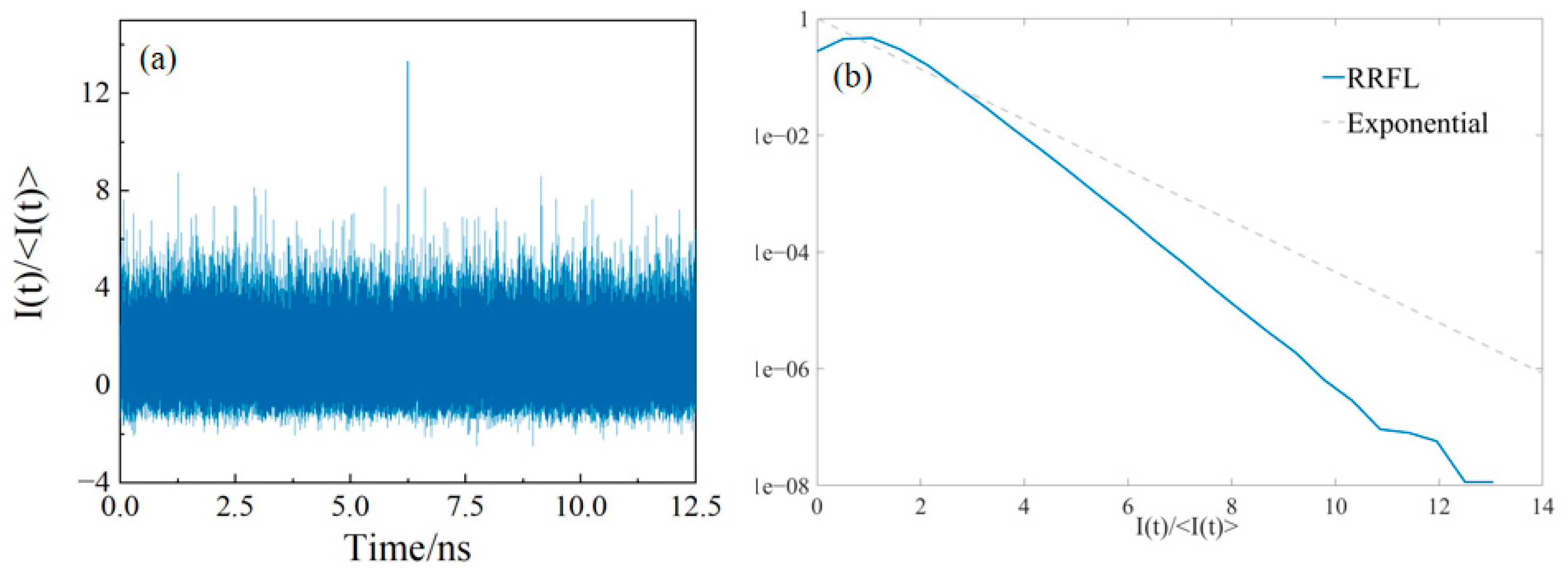
In the experiment, we used an oscilloscope with a sampling rate of up to 80 GSa/s to record 1.6 × 10⁸ data points. Figure 3a shows the time characteristics of the Raman random fiber laser at a pump power of 2.57 W. From the graph, events with intensities up to 13 times the average can be observed. Based on experimental data, the normalized probability density function of radiation intensity was further calculated and plotted in the logarithmic coordinate system of Figure 3b. The gray dashed line represents the exponential distribution. For radiation fields composed of statistically independent frequency components with Gaussian statistical properties, their intensity probability density functions should exhibit an exponential distribution [21,35]. However, from the probability density function in Figure 3b, it can be seen that its probability density function deviates inward from an exponential distribution, indicating that the frequency components it contains are correlated [26,37].
Figure 3.
(a) Time dynamics of Raman random fiber laser pumped by unfiltered YRFL; (b) its probability density function.
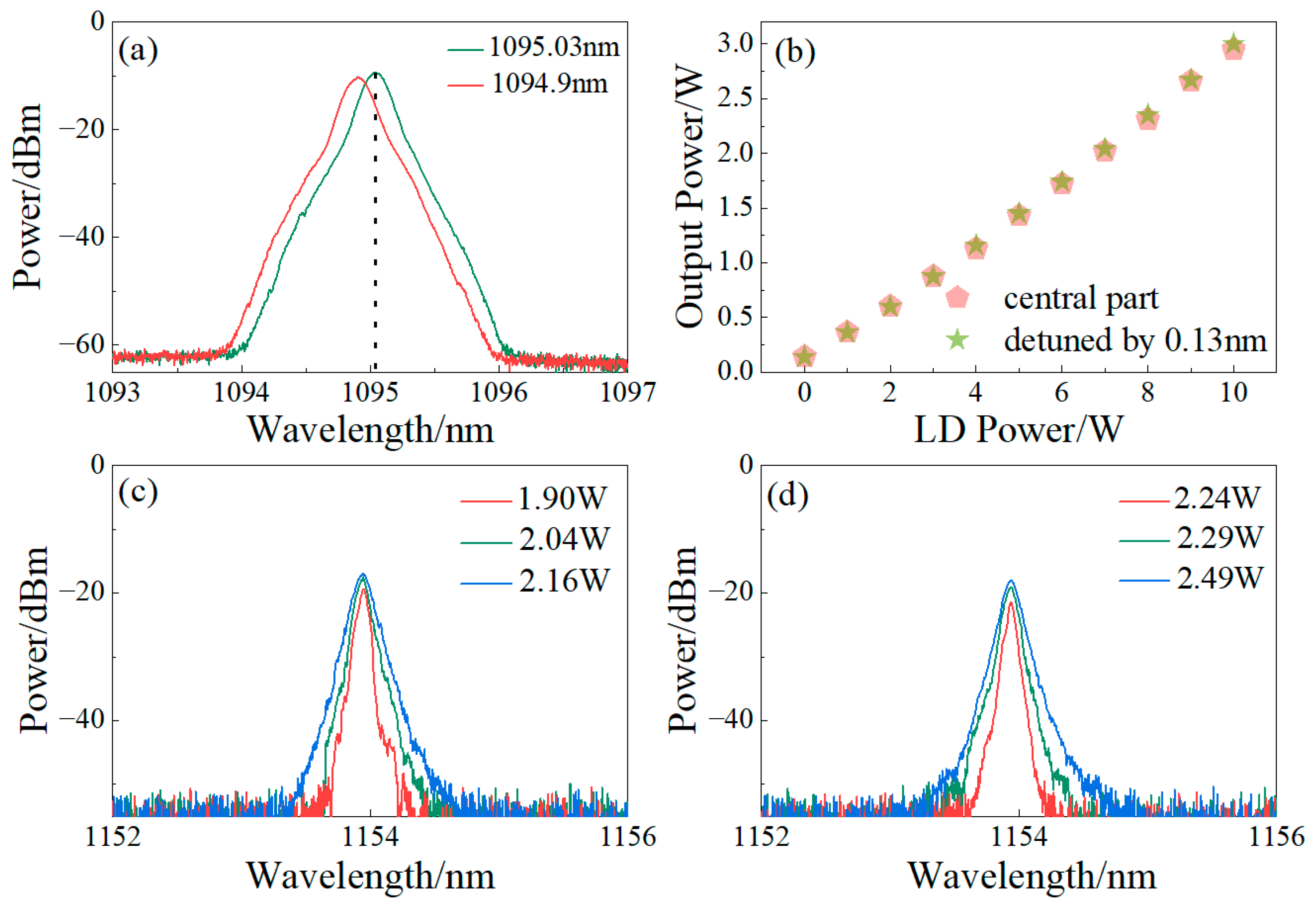
Using scheme (b) to characterize the output characteristics of ytterbium-doped random fiber laser at different filtering positions. As shown in Figure 4a, by finely adjusting the center wavelength of the tunable ytterbium-doped random fiber laser seed from 1095.03 nm to 1094.9 nm, the transfer of ytterbium-doped random fiber laser radiation from the spectral center region to the edge region was achieved. During this process, the black dashed line clearly indicates the center wavelength of the FBG. After being spectrally filtered, the obtained seed power is in the milliwatt level.
Figure 4.
Output characteristics of different filtering positions. (a) Spectral tuning; (b) output power curve after mopa; (c) spectral evolution of Raman random fiber laser pumped by ytterbium-doped random fiber laser under central filtering and (d) edge filtering.
It is worth noting that in the main oscillation power amplification, in order to avoid self-excited phenomena caused by ineffective amplification due to low power after being filtered, it is necessary to ensure that the input seed light has sufficient power. Based on this, we input the filtered seed light into the signal end of a (2 + 1) × 1 pump combiner. LD2 pumps a 5 m 10/130 μm ytterbium-doped fiber to increase power to 300 mW. At the same time, by monitoring the output power of the coupler’s 1% port in real time, we strictly ensure that the output power of the radiation after the pre−amplifier is consistent at different filtering positions.
The seed light that has completed the pre−amplifier is then input to the signal port of another (2 + 1) × 1 pump combiner. LD 3 pumps a 6 m long 10/130 μm YDF through the pump combiner to further amplify the power of the seed light. Finally, the amplified laser output power was measured at the end of the isolator, as shown in Figure 4b. During this process, the amplification efficiency of the ytterbium-doped random fiber laser under edge filtering showed superior performance. Under 10 W LD 3 pumping, the output power reached 3 W and the slope efficiency was as high as 28.6%; under the same pumping conditions, the YRFL under center filtering has an output power of 2.95 W with a slope efficiency of 28%. The amplified YRFL is used as the pump for the Raman random fiber laser in scheme (b).
Monitor the time-domain and spectral characteristics of YRFL after MOPA using the 1% port of a 1:99 coupler to ensure that the effect of spontaneous emission (ASE) is negligible. The pump light output from the coupler is injected into a 15 km SMF through a 1153.9 nm FBG, and residual pump light is filtered out using WDM. At the refractive port of WDM, use a spectral analyzer to record spectral evolution of RRFL. As shown in Figure 4c,d, the figure details the spectral evolution of RRFL at bandwidths of 0.06 nm, 0.09 nm, and 0.12 nm, and corresponding pump power.
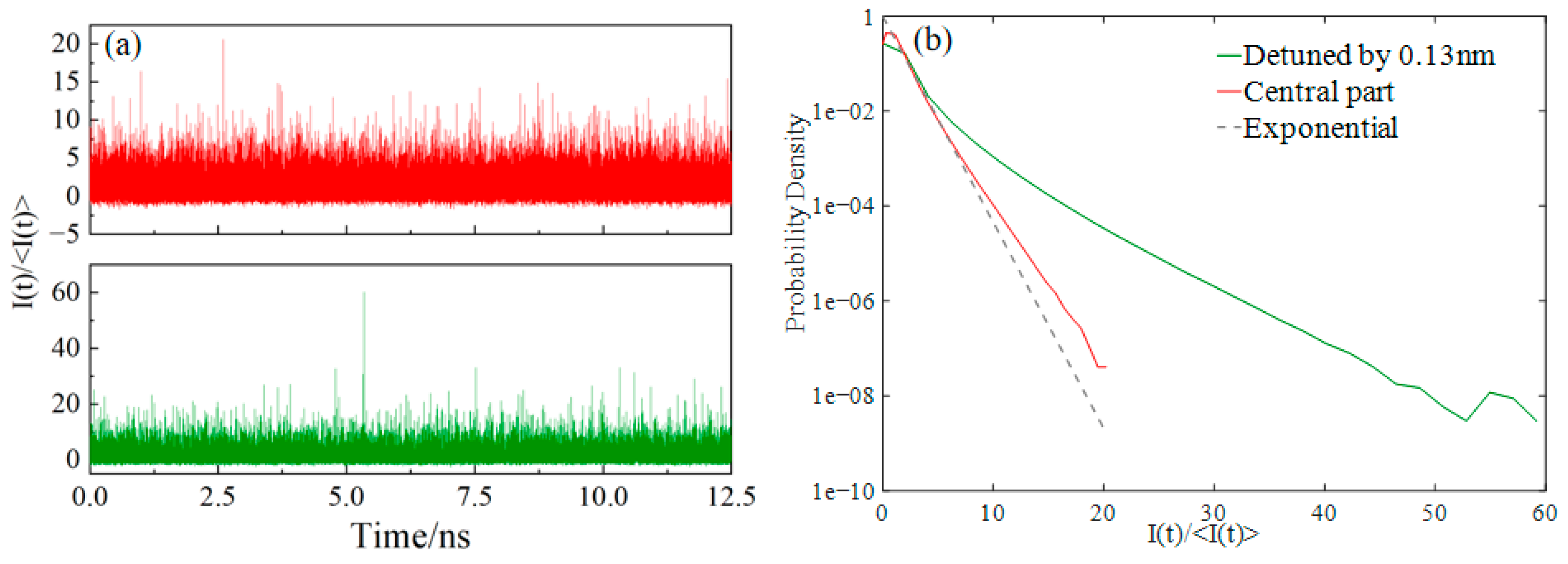
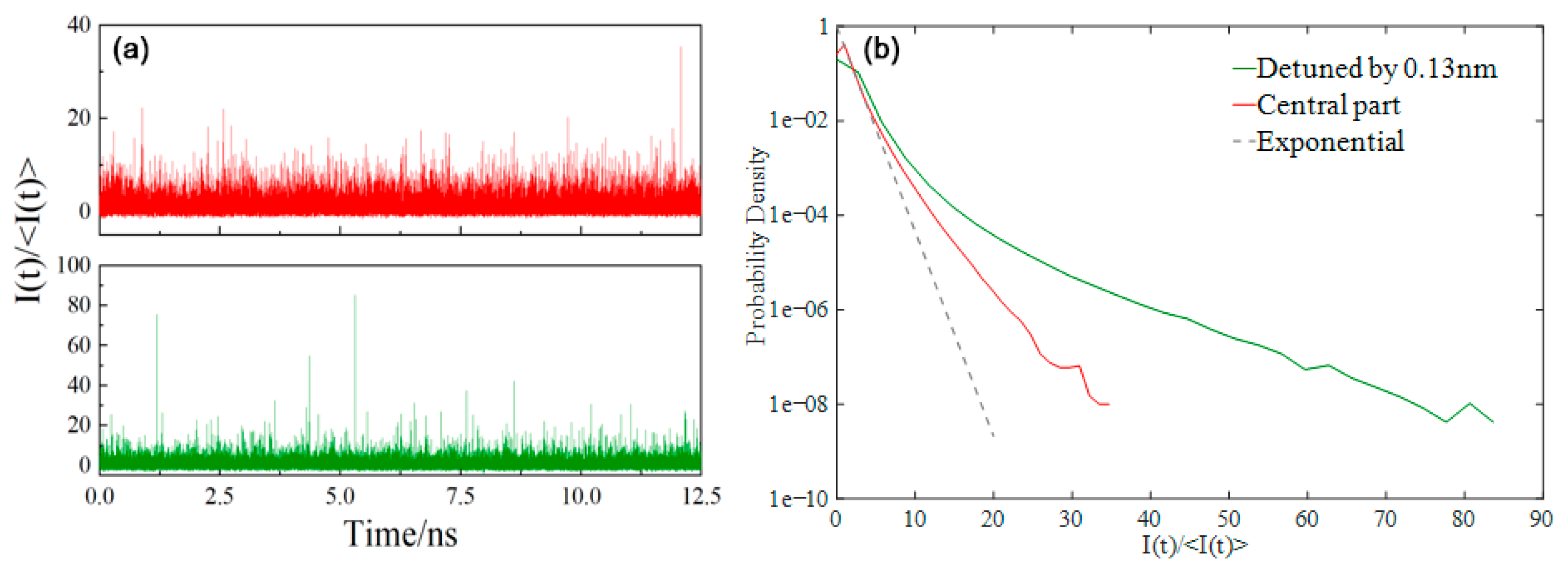
At the 1% port of the second 1:99 coupler, YRFL time-domain signals were collected at a center filtering output power of 2.16 W and an edge filtering output power of 2.49 W, respectively. As the bandwidth of the filtered YRFL remained at 0.04 nm, its time-domain signals could be accurately collected, as shown in Figure 5. Figure 5a shows the temporal dynamics of YRFL at different filtering positions, where the red and green solid lines represent the YRFL after center filtering and edge filtering, respectively. It can be seen that in the central part of the YRFL spectrum, events with intensities up to 20 times the average were observed, while in the edge part of the spectrum, extreme events with intensities 60 times higher than the average appeared. Figure 5b shows the probability density function normalized by the filtered YRFL intensity. The YRFL under central filtering approximately follows an exponential distribution, while the YRFL under edge filtering exhibits significant heavy-tailed characteristics. The probability of extreme events occurring is much higher than the probability defined by the exponential distribution. This situation is consistent with observations in Raman fiber lasers [38] and multiwavelength RFL [39]. Due to the tunable filter bandwidth of YRFL being only 0.1 nm, the seed light undergoes a quasi-turbulent four-wave mixing process in SMF, resulting in spectral broadening. Therefore, these intense events at the spectral edges are related to quasi-turbulent four-wave mixing between different frequency components [40].
Figure 5.
(a) Time dynamics of YRFL with two different time-domain characteristics; (b) its probability density function.
The temporal fluctuations of the Raman pump can significantly influence the dynamics of RRFL [41]. Therefore, we further measured the temporal dynamics and probability density function of the RRFL pumped by YRFL with two different time-domain characteristics, as shown in Figure 6. The red and green solid lines represent the time-domain signals of RRFL pumped by YRFL under center filtering and edge filtering, respectively. As shown in Figure 6a, intense events up to 37 and 84 times the average value were generated, respectively. Compared with the corresponding YRFL time domain, the probability of extreme values occurring in Raman random fiber lasers increased significantly. In addition, from Figure 6b, it can be seen that the PDF of the Raman random fiber laser pumped by the YRFL under center filtering also deviates outward from the exponential distribution.
Figure 6.
(a) Time dynamics of Raman random fiber laser pumped by YRFL with two different time-domain characteristics; (b) probability density function of Raman random fiber laser.
4. Discussion
In RRFL, the pump interacts with the Raman random fiber laser through the SRS effect, and the response time of Raman gain in fiber is 100 fs level. Therefore, for Raman random fiber lasers with fluctuation times in the sub-ns level, the time-domain intensity fluctuations of the pump can be transferred to the Raman random fiber lasing. On the other hand, due to the temporal walk-off effect between pump waves and Raman random fiber lasing, there is a low-pass filtering effect in the transfer of pump intensity fluctuations. Therefore, the bandwidth of pump laser also plays an important role in the temporal dynamics of Raman random fiber laser.
Our experiment thoroughly investigated and confirmed the significant impact of pump waves on the temporal dynamic and statistical properties of Raman random fiber lasers. This research achievement has shown broad application prospects in multiple fields. Specifically, Raman random fiber lasers with different time-domain characteristics can be used as pump sources for holmium-doped or thulium-doped fiber lasers, and their time-domain and statistical characteristics can be controlled. In addition, the time-domain characteristics of the 1154 nm Raman random fiber laser have a significant impact on the frequency doubling efficiency, which opens up a new path for effectively regulating the generation of 577 nm yellow light.
5. Conclusions
In this paper, the time-domain intensity statistical characteristics of a Raman random fiber laser based on controllable time dynamic pumping were studied. The experimental results confirm that due to the walk-off effect between the Raman pump and Raman random fiber laser, the time-domain fluctuations of the low-frequency component of the Raman pump will be effectively transmitted to the Raman random fiber laser through stimulated Raman scattering process, resulting in high intensity fluctuation and high peak powers. Therefore, the time-domain characteristics of the Raman pump can be controlled to tailor Raman random fiber lasers with different statistical properties. This provides important assistance for Raman random fiber lasers in a range of fields.
Author Contributions
H.W. and M.F. designed the experiment. H.W. and Z.L. built the experimental setups and carried out all the experiments. M.F., H.W. and Z.L. prepared the manuscript. All authors have read and agreed to the published version of the manuscript.
Funding
China Academy of Engineering Physics President’s Fund (YZJJZQ2023020); Sichuan Province Natural Science Foundation (2025ZNSFSC1453).
Data Availability Statement
The data that supports the plots and maps within this paper and other findings are available from the corresponding authors upon reasonable request.
Conflicts of Interest
The authors declare no conflicts of interest.
References
- Fotiadi, A.A.; Kiyan, R.V. Cooperative stimulated Brillouin and Rayleigh backscattering process in optical fiber. Opt. Lett. 1998, 23, 1805–1807. [Google Scholar] [CrossRef]
- Turitsyn, S.K.; Babin, S.A.; EI-Taher, A.E.; Harper, P.; Churkin, D.V.; Kablukov, S.I.; Ania-Castanon, J.D.; Karalekas, V.; Podivilov, E.V. Random distributed feedback fiber laser. Nat. Photonics 2010, 14, 231–235. [Google Scholar] [CrossRef]
- Vatnik, I.D.; Churkin, D.V.; Babin, S.A.; Nikulin, M.A. Cascaded random distributed feedback Raman fiber laser operating at 1.2 μm. Opt. Express 2011, 19, 18486–18494. [Google Scholar] [CrossRef]
- Zhang, Y.; Song, J.; Ye, J.; Xu, J.; Yao, T.; Zhou, P. Tunable random Raman fiber laser at 1.7 µm region with high spectral purity. Opt. Express 2019, 27, 28800–28807. [Google Scholar] [CrossRef]
- Babin, S.A.; Vatnik, I.D.; Laptev, A.Y.; Bubnov, M.M.; Dianov, E.M. High-efficiency cascaded Raman fiber laser with random distributed feedback. Opt. Express 2014, 22, 24929–24934. [Google Scholar] [CrossRef]
- Vatnik, I.D.; Churkin, D.V.; Podivilov, E.V.; Babin, S.A. High-efficiency generation in a short random fiber laser. Laser Phys. Lett. 2014, 11, 075101. [Google Scholar] [CrossRef][Green Version]
- Xu, J.; Huang, L.; Jiang, M.; Ye, J.; Ma, P.; Leng, J.; Wu, J.; Zhang, H.; Zhou, P. Near-diffraction-limited linearly polarized narrow-linewidth random fiber laser with record kilowatt output. Photonics Res. 2017, 5, 350–354. [Google Scholar] [CrossRef]
- Zhang, L.; Xu, Y.; Gao, S.; Saxena, B.; Chen, L.; Bao, X. Linearly polarized low-noise Brillouin random fiber laser. Opt. Lett. 2017, 42, 739–742. [Google Scholar] [CrossRef] [PubMed]
- Zhang, L.; Jiang, H.; Yang, X.; Pan, W.; Cui, S.; Feng, Y. Nearly-octave wavelength tuning of a continuous wave fiber laser. Sci. Rep. 2017, 7, 42611. [Google Scholar] [CrossRef]
- Zhang, Y.; Ye, J.; Ma, X.; Xu, J.; Song, J.; Yao, T.; Zhou, P. High power tunable multiwavelength random fiber laser at 1.3 μm waveband. Opt. Express 2021, 29, 5516–5524. [Google Scholar] [CrossRef]
- Han, B.; Wu, H.; Liu, Y.; Dong, S.; Rao, Y.; Wang, Z.; Xu, J.; Ma, L. Ultralong Single-Ended Random Fiber Laser and Sensor. Laser Photonics Rev. 2023, 17, 2200923. [Google Scholar] [CrossRef]
- Jia, X.; Rao, Y.; Peng, F.; Wang, Z.; Zhang, W.; Wu, H.; Jiang, Y. Random-lasing-based distributed fiber-optic amplification. Opt. Express 2013, 21, 6572–6577. [Google Scholar] [CrossRef] [PubMed]
- Wang, S.; Zhang, W.; Yang, N.; Ma, R.; Zhang, Y.; Wang, Z.; Zhang, J.; Rao, Y. High-Power Multimode Random Fiber Laser for Speckle-Free Imaging. Ann. Phys. 2021, 533, 2100284. [Google Scholar]
- Wu, H.; Hu, B.; Chen, L.; Peng, F.; Wang, Z.; Genty, G.; Liang, H. Mid-infrared computational temporal ghost imaging. Light Sci. Appl. 2024, 13, 45. [Google Scholar] [CrossRef] [PubMed]
- Jiang, L.; Wu, J.; Song, R.; Chen, Z.; Zhu, X.; Li, F.; Li, K.; Zhang, H.; Hou, J. Kilowatt-level supercontinuum generation in a single-stage random fiber laser with a half-open cavity. High. Power Laser Sci. Eng. 2023, 11, e80. [Google Scholar] [CrossRef]
- He, J.; Song, R.; Tao, Y.; Hou, J. Supercontinuum generation directly from a random fiber laser based on photonic crystal fiber. Opt. Express 2020, 28, 27308–27315. [Google Scholar] [CrossRef]
- Cui, S.; Qian, J.; Zeng, X.; Cheng, X.; Gu, X.; Feng, Y. A watt-level yellow random laser via single-pass frequency doubling of a random Raman fiber laser. Opt. Fiber Technol. 2021, 64, 102545. [Google Scholar] [CrossRef]
- Wu, H.; Wang, W.; Hu, B.; Li, Y.; Tian, K.; Ma, R.; Li, C.; Liu, J.; Yao, J.; Liang, H. Widely tunable continuous-wave visible and mid-infrared light generation based on a dual-wavelength switchable and tunable random Raman fiber laser. Photonics Res. 2023, 11, 808–816. [Google Scholar] [CrossRef]
- Fan, M.; Lin, S.; Yao, K.; Qi, Y.; Zhang, J.; Zheng, J.; Wang, P.; Ni, L.; Bao, X.; Zhou, D.; et al. Spectrum-tailored random fiber laser towards ICF laser facility. Matter Radiat. Extrem. 2023, 8, 025902. [Google Scholar] [CrossRef]
- Churkin, D.V.; Kolokolov, I.V.; Podivilov, E.V.; Vatnik, I.D.; Nikulin, M.A.; Vergeles, S.S.; Terekhov, I.S.; Lebedev, V.V.; Falkovich, G.; Babin, S.A.; et al. Wave kinetics of random fiber lasers. Nat. Commun. 2015, 6, 6214. [Google Scholar] [CrossRef]
- Smirnov, S.V.; Churkin, D.V. Modeling of spectral and statistical properties of a random distributed feedback fiber laser. Opt. Express 2013, 21, 21236–21241. [Google Scholar] [CrossRef]
- Han, B.; Cheng, Q.; Tao, Y.; Ma, Y.; Liang, H.; Ma, R.; Qi, Y.; Zhao, Y.; Wang, Z.; Wu, H. Spectral Manipulations of Random Fiber Lasers: Principles, Characteristics, and Applications. Laser Photonics Rev. 2024, 18, 2400122. [Google Scholar] [CrossRef]
- Churkin, D.V.; Sugavanam, S.; Vatnik, I.D.; Wang, Z.; Podivilov, E.V.; Babin, S.A.; Rao, Y.; Turitsyn, S.K. Recent advances in fundamentals and applications of random fiber lasers. Adv. Opt. Photonics 2015, 7, 516–569. [Google Scholar] [CrossRef]
- Sugavanam, S.; Sorokina, M.; Churkin, D.V. Spectral correlations in a random distributed feedback fiber laser. Nat. Commun. 2017, 8, 15514. [Google Scholar] [CrossRef] [PubMed]
- Li, J.; Wu, H.; Wang, Z.; Lin, S.; Lu, C.; Raposo, E.P.; Gomes, A.S.L.; Rao, Y. Lévy spectral intensity statistics in a Raman random fiber laser. Opt. Lett. 2019, 44, 2799–2802. [Google Scholar] [CrossRef]
- Ni, L.; Qi, Y.; Bao, X.; Zhang, J.; Wang, P.; Wu, H.; Wang, Z. Temporal-spectral correlation dynamics of Raman random fiber laser. Sci. China Inf. Sci. 2025, 68, 112301. [Google Scholar] [CrossRef]
- Ghofraniha, N.; Viola, I.; Di Maria, F.; Barbarella, G.; Gigli, G.; Leuzzi, L.; Conti, C. Experimental evidence of replica symmetry breaking in random lasers. Nat. Commun. 2015, 6, 6058. [Google Scholar] [CrossRef]
- Gomes, A.S.L.; Lima, B.C.; Pincheira, P.I.R.; Moura, A.L.; Gagné, M.; Raposo, E.P.; Araújo, C.B.; Kashyap, R. Glassy behavior in a one-dimensional continuous-wave erbium-doped random fiber laser. Phys. Rev. A 2016, 94, 011801. [Google Scholar] [CrossRef]
- Zhang, L.; Zhang, J.; Pang, F.; Wang, T.; Chen, L.; Bao, X. Transient replica symmetry breaking in Brillouin random fiber lasers. PhotoniX 2023, 4, 33. [Google Scholar] [CrossRef]
- Zhong, Z.; Zhang, L.; Guo, X.; Zhang, J.; Zhu, M.; Pang, F.; Wang, T. Observation and all-optical manipulation of replica symmetry breaking dynamics in a multi-Stokes-involved Brillouin random fiber laser photonic system. Opt. Express 2024, 32, 18639–18649. [Google Scholar] [CrossRef]
- Li, Y.; Zhong, Z.; Zhang, L.; Wei, Z.; Khalil, D.; Kotb, H.; Wei, H.; Zhu, M.; Wen, J.; Pang, F.; et al. Replica symmetry breaking dynamics in high-order optical mode multi-Stokes coherent random fiber laser. APL Photonics 2025, 10, 070804. [Google Scholar] [CrossRef]
- Qi, Y.; Ni, L.; Ye, Z.; Zhang, J.; Bao, X.; Wang, P.; Rao, Y.; Raposo, E.P.; Gomes, A.S.L.; Wang, Z. Replica symmetry breaking in 1D Rayleigh scattering system: Theory and validations. Light Sci. Appl. 2024, 13, 151. [Google Scholar] [CrossRef] [PubMed]
- Bao, X.; Lin, S.; Zhang, J.; Ni, L.; Qi, Y.; Wan, A.; Wang, Z. Characterization and tailoring of statistical properties of erbium-doped random fiber lasers. Chin. Opt. Lett. 2024, 22, 121401. [Google Scholar] [CrossRef]
- Gorbunov, O.A.; Sugavanam, S.; Vatnik, I.D.; Churkin, D.V. Poisson distribution of extreme events in radiation of random distributed feedback fiber laser. Opt. Lett. 2020, 45, 2375–2378. [Google Scholar] [CrossRef] [PubMed]
- Zhang, J.; Lin, S.; Bao, X.; Wang, P.; Qi, Y.; Wu, H.; Liang, J.; Wang, Z. Full bandwidth statistical properties of the Raman randomfiber laser. Chin. Opt. Lett. 2024, 22, 061401. [Google Scholar] [CrossRef]
- Gorbunov, O.A.; Sugavanam, S.; Churkin, D.V. Revealing statistical properties of quasi-CW fibre lasers in bandwidth-limited measurements. Opt. Express 2014, 22, 28071–28076. [Google Scholar] [CrossRef]
- Wu, H.; Han, B.; Wang, Z.; Liang, H. Statistical properties of Er/Yb co-doped random Rayleigh feedback fiber laser. Chin. Opt. Lett. 2021, 19, 021402. [Google Scholar] [CrossRef]
- Randoux, S.; Suret, P. Experimental evidence of extreme value statistics in Raman fiber lasers. Opt. Lett. 2012, 37, 500–502. [Google Scholar] [CrossRef]
- Gorbunov, O.A.; Sugavanam, S.; Vatnik, I.D.; Churkin, D.V. Statistical properties of radiation of multi-wavelength random DFB fiber laser. Opt. Express 2016, 24, 19417–19423. [Google Scholar] [CrossRef]
- Churkin, D.V.; Gorbunov, O.A.; Smirnov, S.V. Extreme value statistics in Raman fiber lasers. Opt. Lett. 2011, 36, 3617–3619. [Google Scholar] [CrossRef]
- Ye, J.; Ma, X.; Zhang, Y.; Xu, J.; Zhang, H.; Yao, T.; Leng, J.; Zhou, P. Revealing the dynamics of intensity fluctuation transfer in a random Raman fiber laser. Photonics Res. 2022, 10, 618–627. [Google Scholar] [CrossRef]
Disclaimer/Publisher’s Note: The statements, opinions and data contained in all publications are solely those of the individual author(s) and contributor(s) and not of MDPI and/or the editor(s). MDPI and/or the editor(s) disclaim responsibility for any injury to people or property resulting from any ideas, methods, instructions or products referred to in the content. |
© 2025 by the authors. Licensee MDPI, Basel, Switzerland. This article is an open access article distributed under the terms and conditions of the Creative Commons Attribution (CC BY) license (https://creativecommons.org/licenses/by/4.0/).