


Abstract
Let be a connected graph with n vertices and m edges. A bijection is an edge labeling of G. For any vertex x of G, we define as the vertex label or weight of x, where is the set of edges incident to x, and f is called a local antimagic labeling of G, if for any two adjacent vertices . It is clear that any local antimagic labelling of G induces a proper vertex coloring of G by assigning the vertex label to any vertex x of G. The local antimagic chromatic number of G, denoted by , is the minimum number of different vertex labels taken over all colorings induced by local antimagic labelings of G. In this paper, we present explicit local antimagic chromatic numbers of and , where is the friendship graph with n triangles and v is any vertex of . Moreover, we explicitly construct an infinite class of connected graphs G such that , where is the join graph of G and the complement graph of complete graph . This fact leads to a counterexample to a theorem of Arumugam et al. in 2017, and our result also provides a partial solution to Problem 3.19 in Lau et al. in 2021.
1. Introduction
Throughout, we only consider undirected connected simple graphs. Let be a connected graph with n vertices and m edges. A bijection is an edge labeling of G. For any vertex x of G, we define as the vertex label or weight of x, where is the set of edges incident to x, and f is called an antimagic labeling of G, if for any two distinct vertices . A graph G is called antimagic if G has an antimagic labeling.
The antimagic labeling of a graph was initially introduced by Hartsfield and Ringel [1] in 1990. They conjectured that every connected graph except admits such an antimagic labeling, which remains open till today.
Recently, based on the concept of antimagic labeling, Arumugam et al. [2] and Bensmail et al. [3] independently introduced the notation local antimagic labeling of graphs in 2017, which is weaker than antimagic labeling of graphs. Let be a connected graph of order n and size m. A bijection is called a local antimagic labeling of G if any two adjacent vertices u and v in G satisfy . It is clear that assigning to x for each naturally induced a proper vertex coloring of G, which is called a local antimagic vertex coloring of G. A graph G is called local antimagic if G has a local antimagic labeling. Haslegrave [4] showed that every connected graph with at least three vertices is local antimagic. The local antimagic chromatic number of G, denoted by , is the minimum number of different vertex labels taken over all colorings of G induced by local antimagic labelings of G. If f is a local antimagic labeling of G, the number of distinct induced vertex labels under f, denoted by , is called the color number of f.
A friendship graph, denoted by , is a simple graph in which any two vertices have exactly one common neighbour, which consists of n triangles with a common vertex. In [2], Arumugam et al. gave the exact value of the local antimagic chromatic numbers of special graphs, such as , and , where and are path and cycle with n vertices, respectively, is the complete bipartite graph (), is the wheel graph (), and is the graph obtained by inserting a vertex to each edge of the star . Ref. [5] was used in [2] to determine local antimagic chromatic numbers of complete bipartite graphs. When the graph is the wheel graph for or the join graph for , where is the complement graph of complete graph , they also provided the lower and upper bounds of the local antimagic chromatic numbers of these graphs.
In 2018, Lau et al. [6] gave counterexamples to the lower bound of that was obtained in [2]. Another counterexample was independently found by Shaebani [7]. A sharp lower bound of and sufficient conditions for the given lower bound were obtained. Moreover, they gave affirmative solutions on Problem 3.3 of [2] and settled Theorem 2.15 of [2]. They also completely determined the local antimagic chromatic number of complete bipartite graphs.
In [8], Lau et al. provided several sufficient conditions for , where H is obtained from G with a certain number of edge-deleted or -added operations. They then determined the exact values of the local antimagic chromatic numbers of many cycle-related join graphs.
In 2019, Lau et al. [9] gave the sharp lower bound of the local antimagic chromatic number of a graph with cut-vertices given by pendant edges and then solved Problem 3.3 in [2] affirmatively. In Section 2 of [9], Lau et al. gave sufficient conditions for the one-point union of cycles with . In Section 3 of [9], they determined the exact values of the local antimagic chromatic numbers of many families of graphs with pendant edges. Finally, in Section 4, they obtained a few families of graphs with . This partially answered Problem 3.1 in [2].
Based on some known results, in this paper, we present the exact local antimagic chromatic numbers of and , where v is any vertex of . Moreover, we explicitly construct an infinite class of connected graphs G such that , where is the join graph of G and the complement graph of . This fact leads to a counterexample to a theorem of [2], and our result also provides a partial solution to Problem 3.19 in [8].
2. Main Results
In [2], the authors gave the local antimagic chromatic number of the friendship graph as shown in the following lemma.
Lemma 1
([2]). Let be a friendship graph, then we have .
For two vertex disjoint graphs and , let denote the join graph obtained by joining every vertex of with every vertex of . In the proof of the local antimagic chromatic number of , we write () as in the following formula. The following theorem gives an exact value of the local antimagic chromatic number of .
Theorem 1.
Let H be the join graph , then we have
Proof.
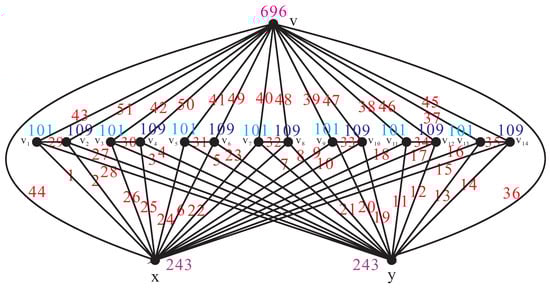
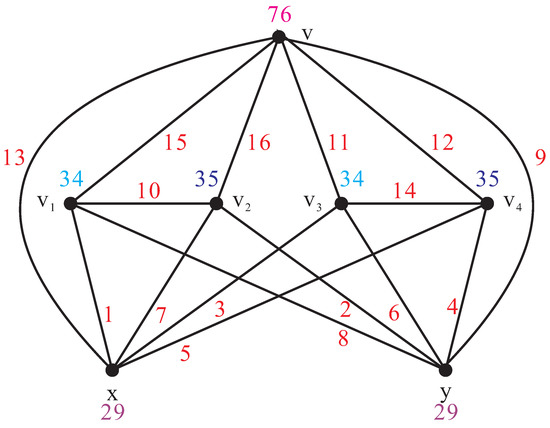
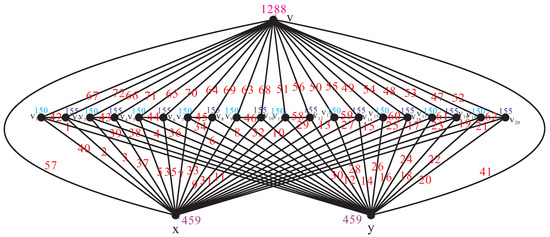
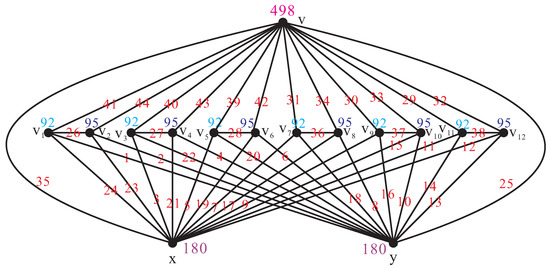
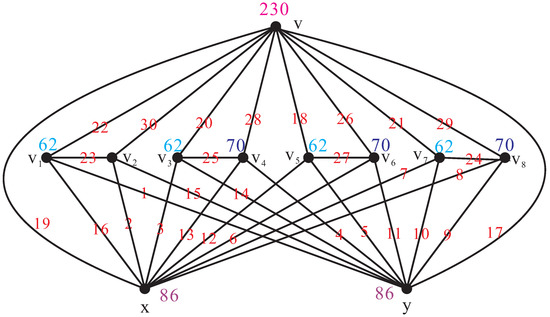
Let be the vertex set of the friendship graph , where v is its central vertex, and let be the two vertices of . It is clear that there are edges in H, namely, . Since is an induced subgraph of H, we have . In order to prove , it suffices to provide a local antimagic labeling of H that induces a local antimagic vertex coloring using exactly four colors.
We suppose that there is a local antimagic labeling , such that . It means that , , and , which are distinct with . In this regard, we first assign or and or i, for each , then determine the exact value of remaining edges of H. Let us consider the following four cases.
Case 1.
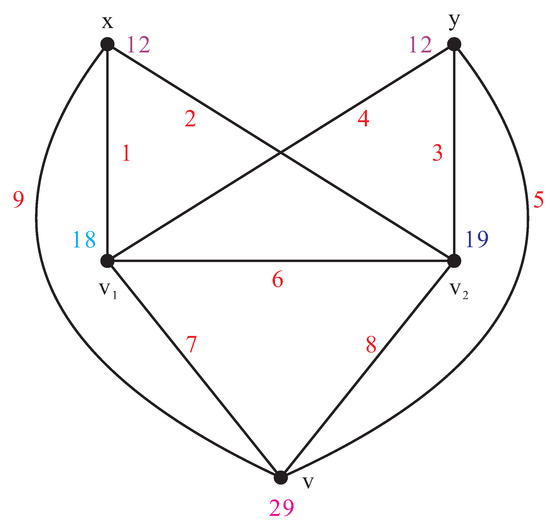
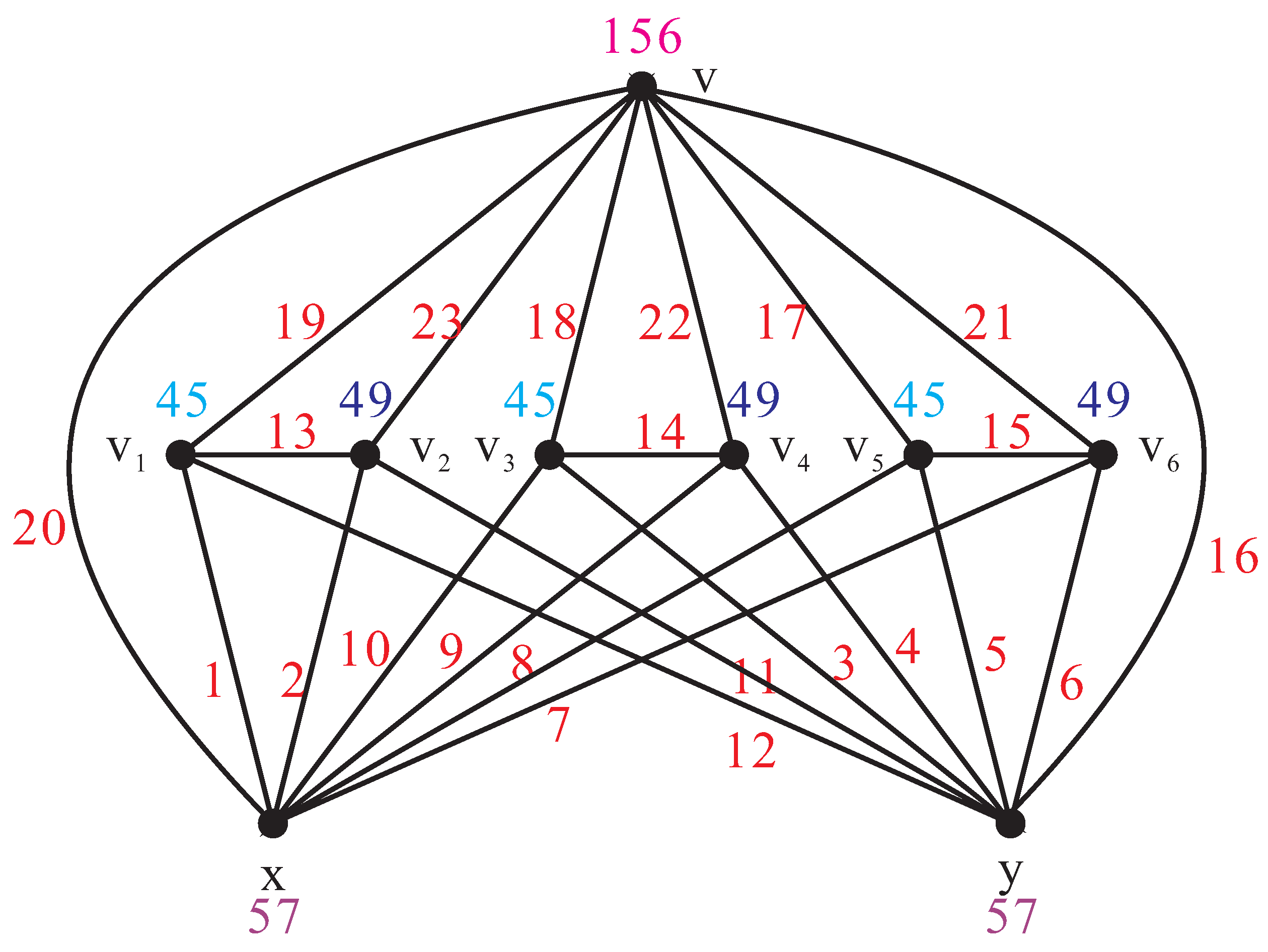
For , the graph admits a local antimagic labeling f with as shown in Figure 1, which shows that , and so .
Figure 1.
.
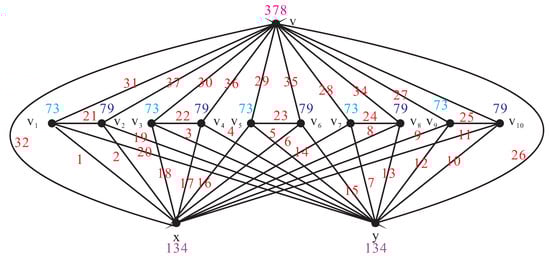
For , we give the exact value of every edge label for the graph as shown in Figure 2.
Figure 2.
.
It is obvious that
From the above labeling, f is a local antimagic labeling of H that induces a local antimagic vertex coloring using exactly four colors. It means that , and so .
For , define in the following way:
Let , and determine the values of and for each as follows.
Then label the edges and for , respectively.
Finally, we give the exact value of the remaining edges as follows.
Since and , we have , and so the number of vertices in is divisible by 8.
If and , then
Accordingly, we have
Since
It is clear that f is a local antimagic labeling of H and
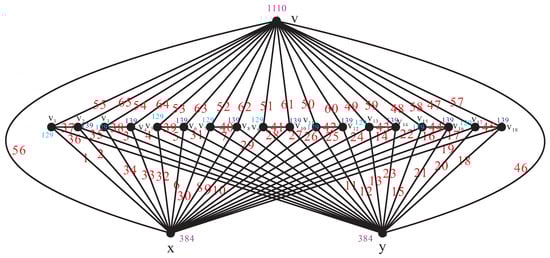
Hence, . The local antimagic labeling of the graph is shown in Figure 3.
Figure 3.
.
Case 2.
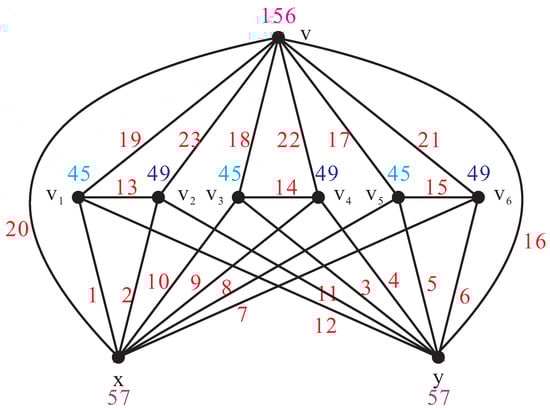
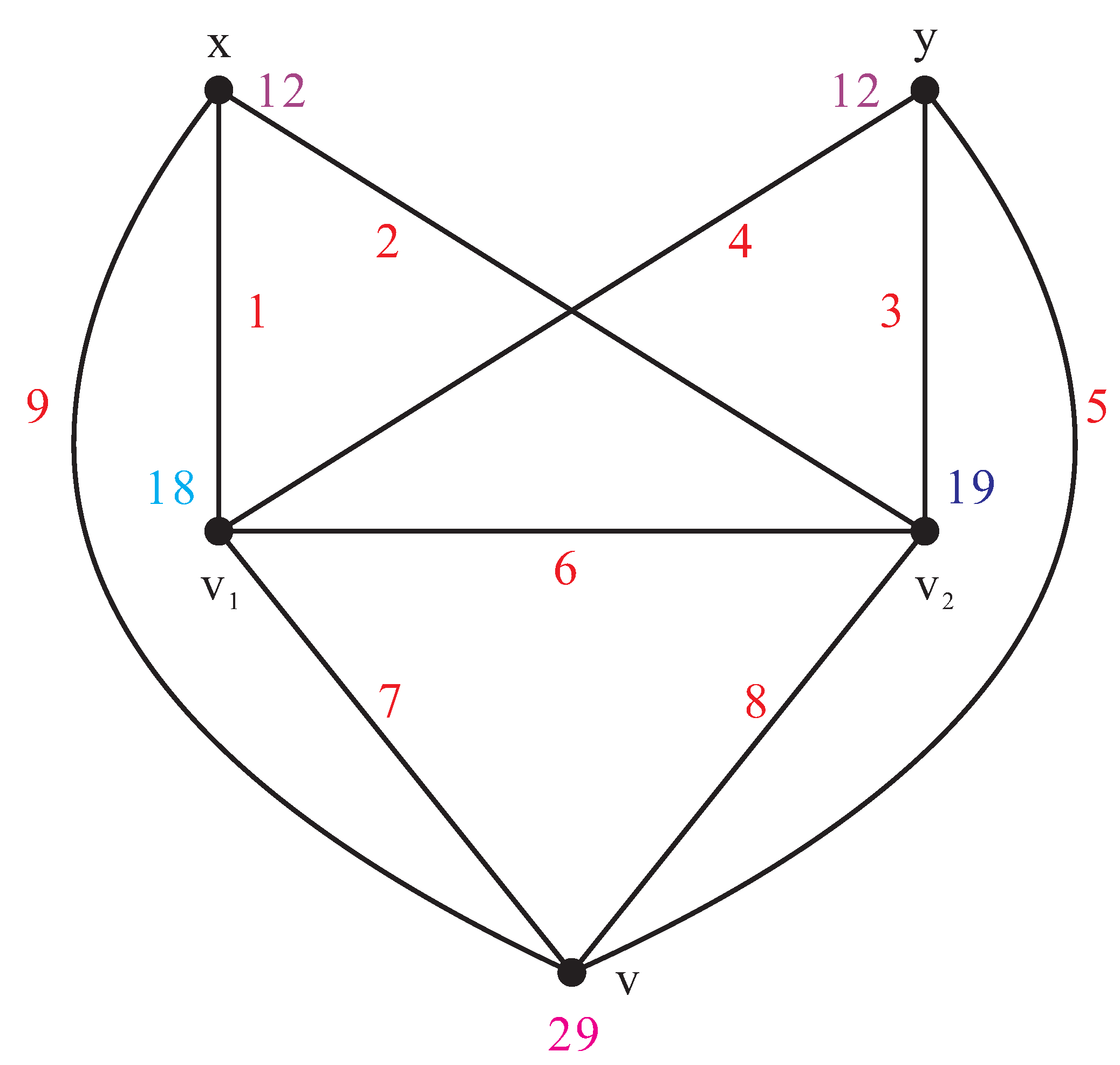
For as shown in Figure 4, we obtain a local antimagic labeling of with .
Figure 4.
.
For , define by the following
Firstly, we set the following assignments of and for some special i, respectively.
Secondly, considering the following assignments of the edges and for ,
Finally, label the remaining edges as follows.
Because and , we have , and so the number of vertices in is divisible by 8.
If and , then
We can obtain that
Since
For the vertex weights we have
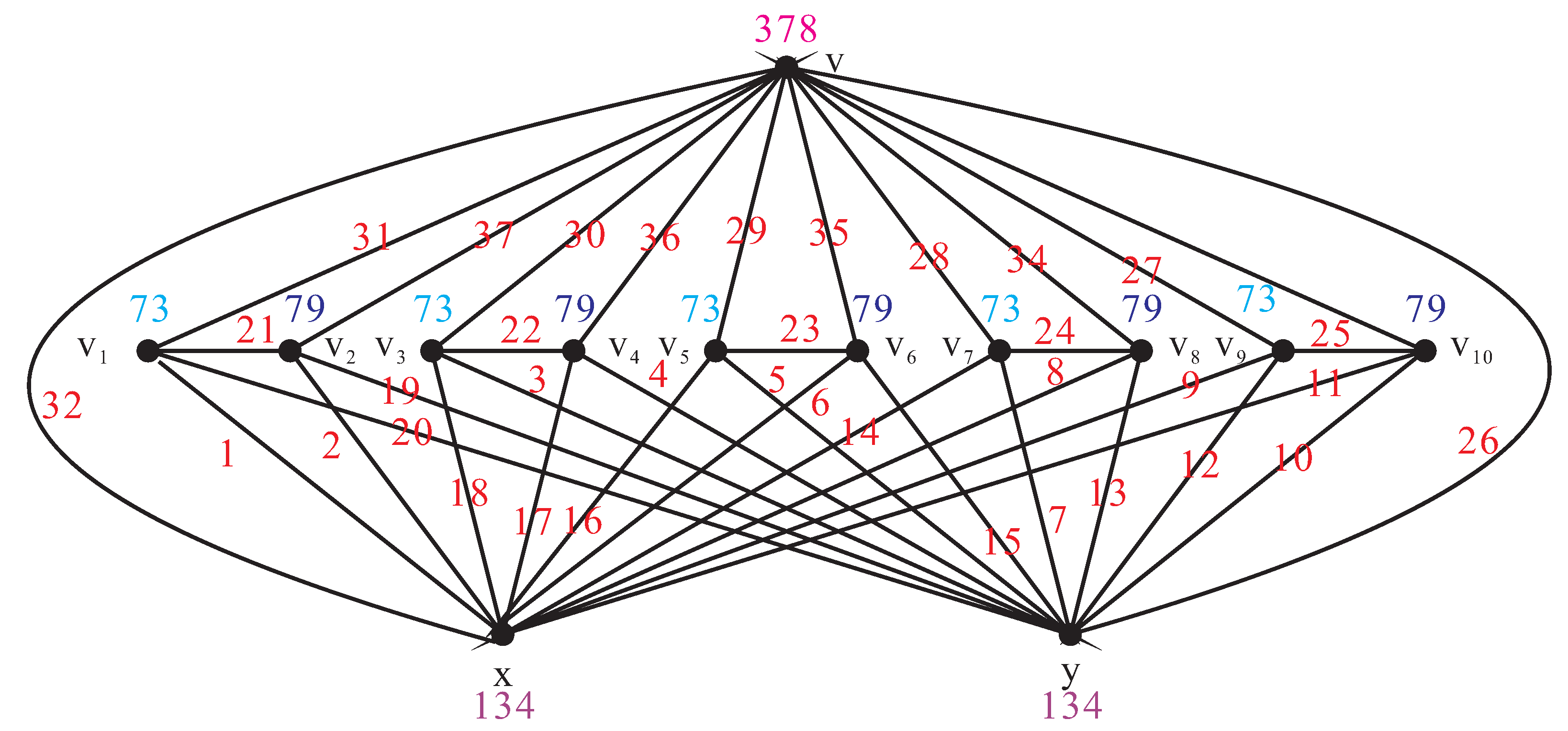
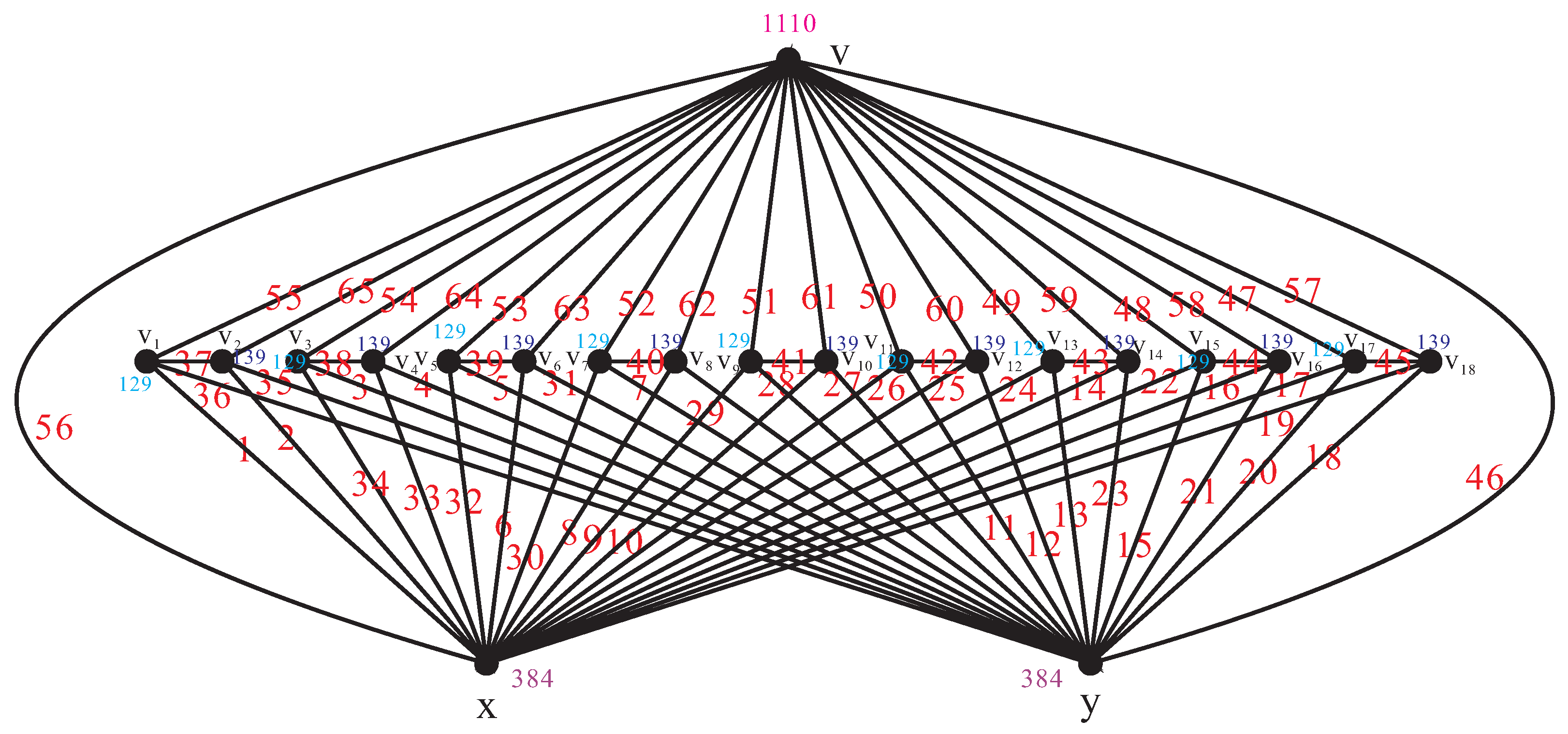
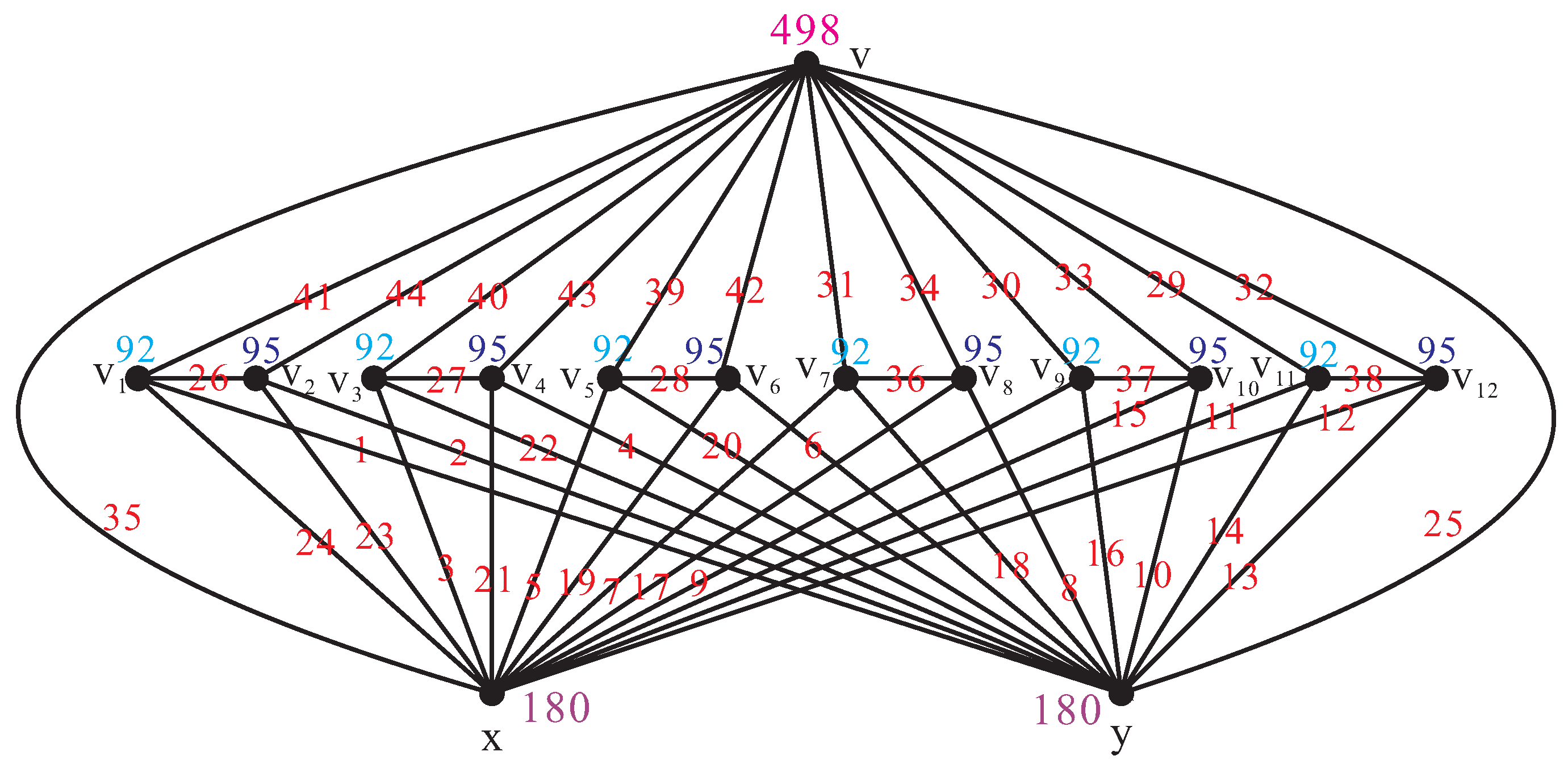
Hence, we can obtain that . For , the exact values of each edge label of the graph are given in Figure 5.
Figure 5.
.
Case 3.
In this case, we consider and , respectively.
Subcase 3.1.
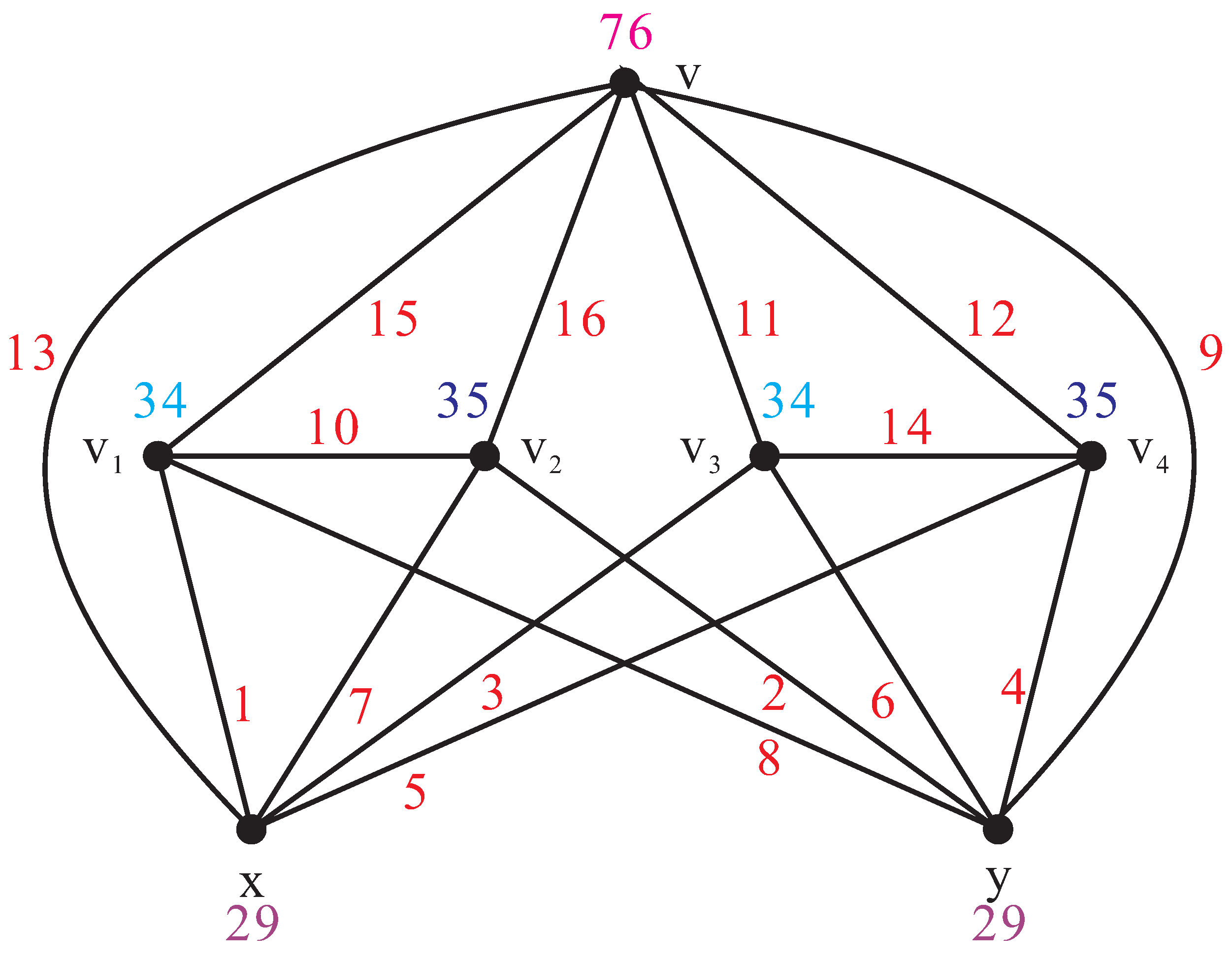
For , there is a local antimagic labeling of the graph in Figure 6. Hence, we have .
Figure 6.
.
For , define the edge labeling as follows:
Assume that , then we give the following exact values of and for .
Then label the remaining edges as follows:
It is clear that f is a local antimagic labeling of H, and we have
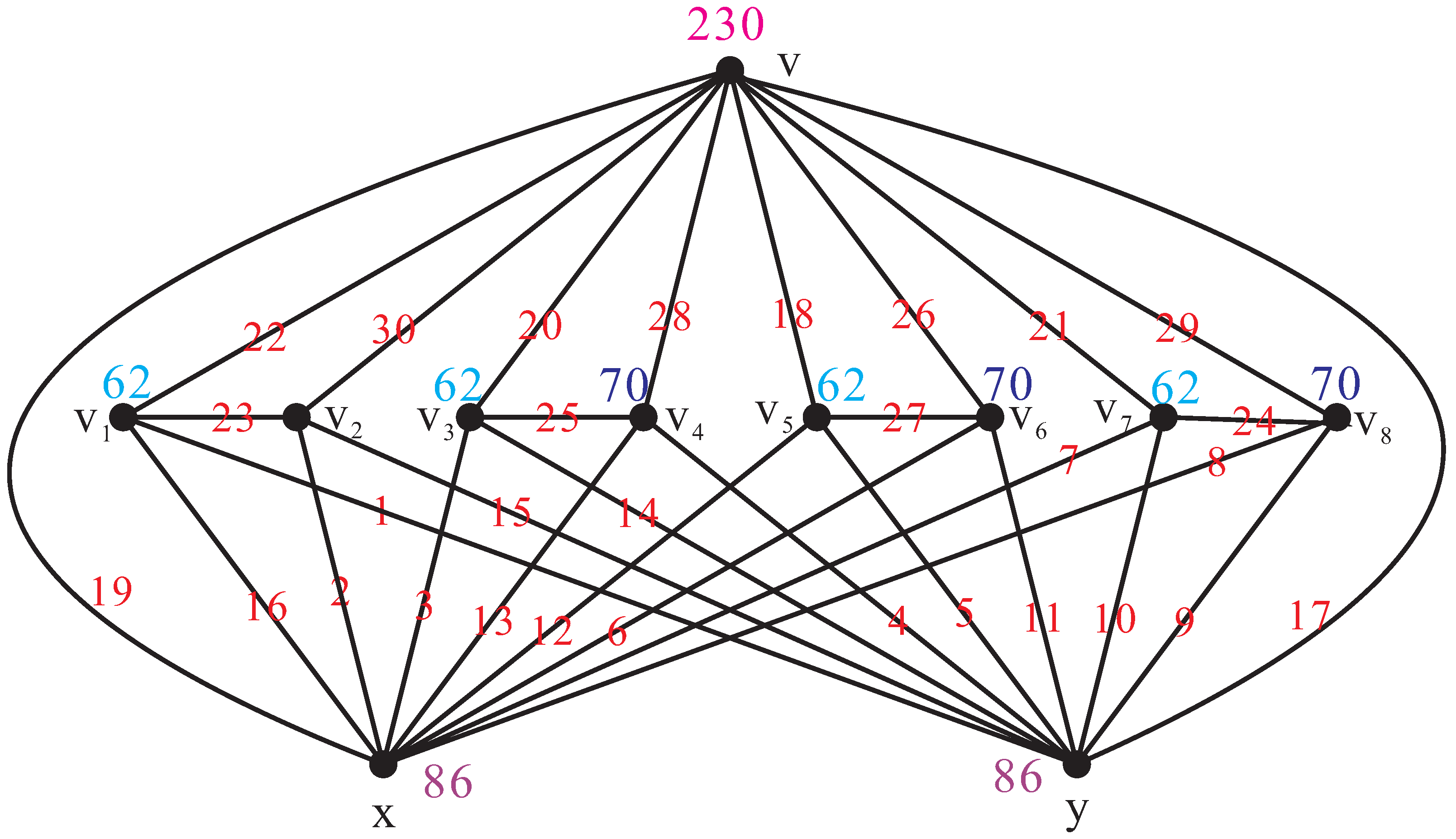
So, we have for . The local antimagic labeling of the graph is shown in Figure 7.
Figure 7.
.
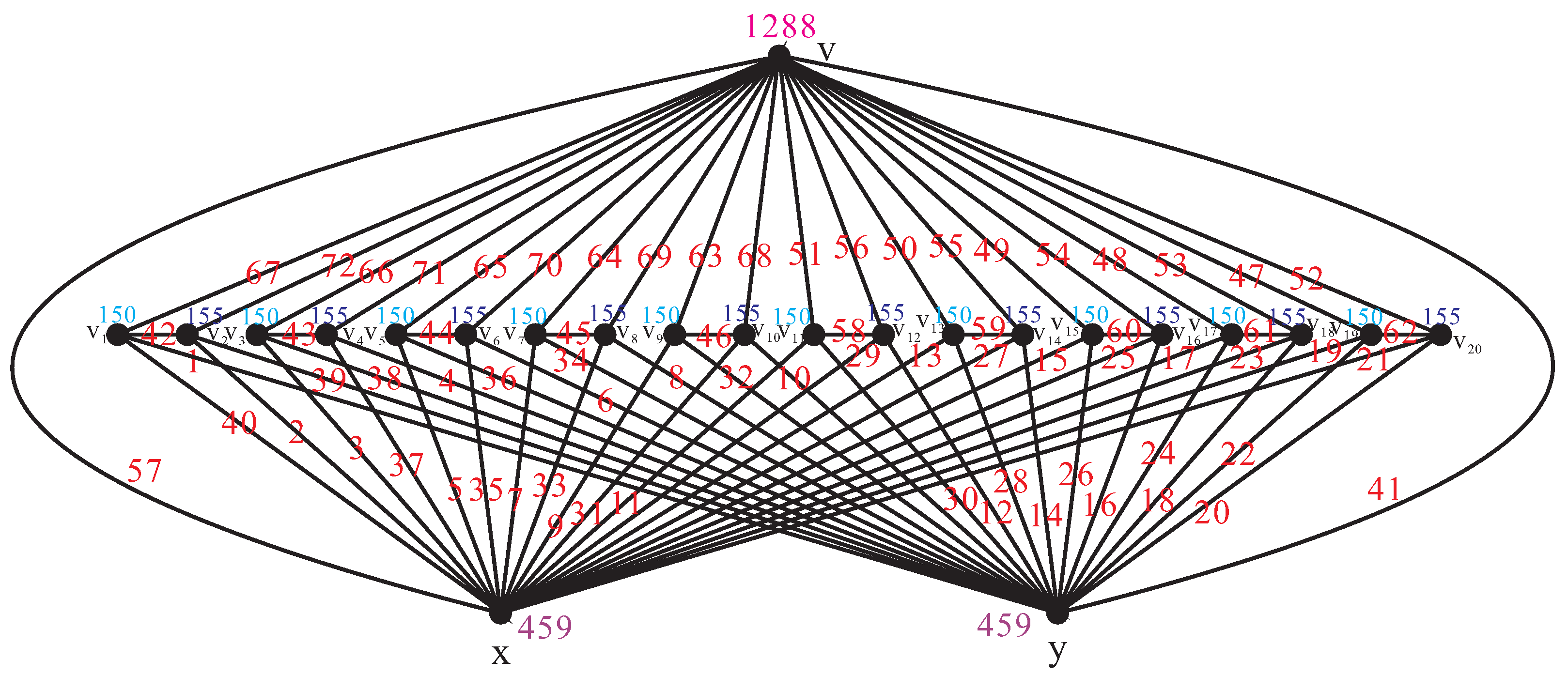
Subcase 3.2.
For , label the edges of H by the labeling such that
Assume , then we label and for each i such that .
For the last vertex ,
Now, determine the exact value of for each i such that .
When i is odd for , we can label as follows.
For the vertex weights under the labeling f, we have
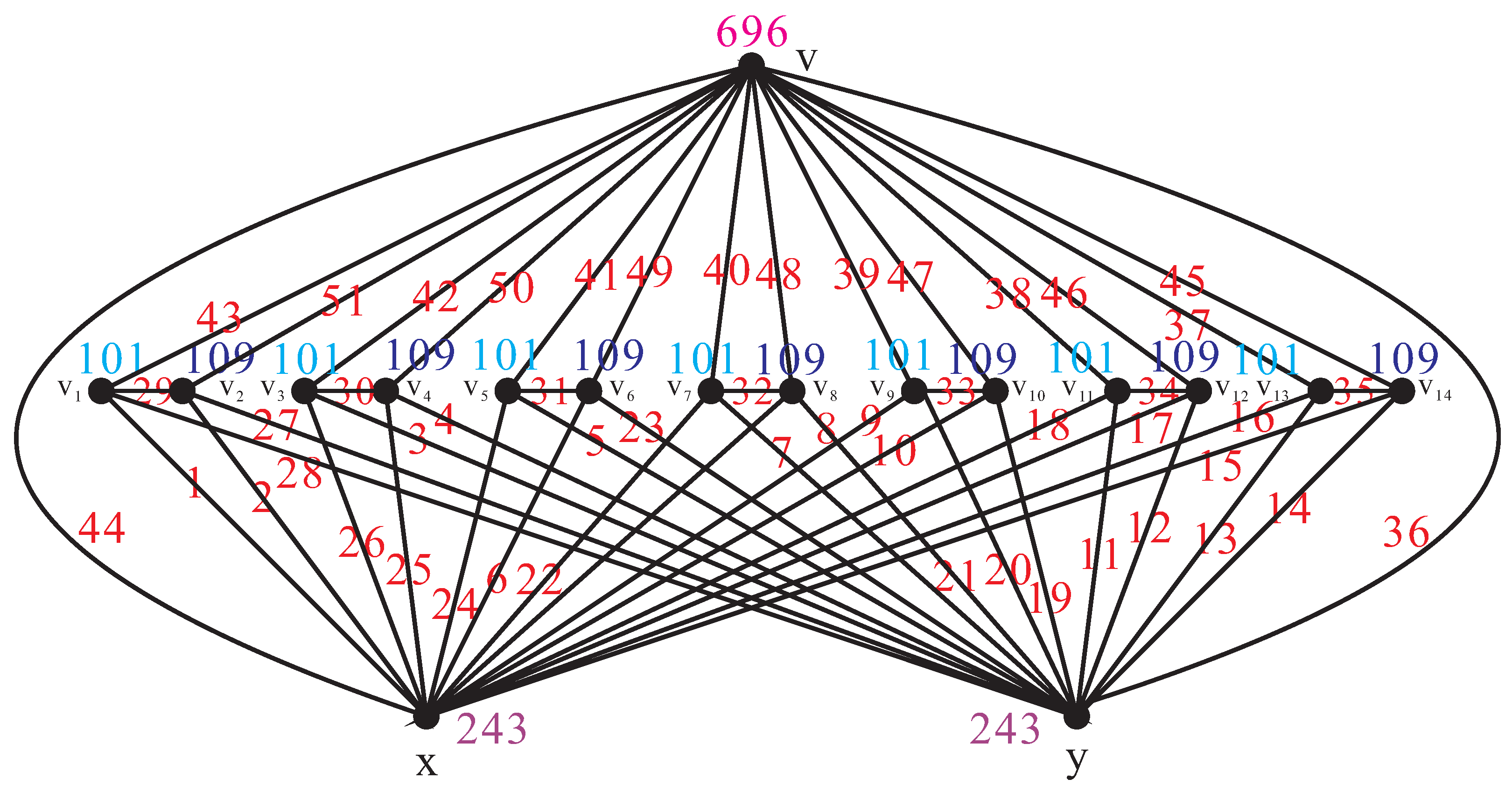
This implies that . For , we obtain the local antimagic labeling of the graph under f as shown in Figure 8.
Figure 8.
.
Case 4.
We define as follows:
The following labeling has the desired properties:
For the vertex weights under the labeling f, we have
The above arguments indicate that f is a local antimagic labeling of H with four colors, and so . The exact values of each edge label of the graph are given in Figure 9. The proof is completed. □
Figure 9.
.
Let be a graph obtained from the friendship graph by deleting any vertex v of . If the deleted vertex is its central vertex, then H does not have a local antimagic labeling. Thus, we only consider that the deleted vertex is a vertex with degree 2.
Theorem 2.
Let H be the graph , where v is any vertex of with degree 2, then we have
Proof.
Let and . Without loss of generality, we assume that the deleted vertex is , then define by
Clearly, h is a local antimagic labeling of H and we have
Thus, . Since ; it follows that . □
Theorem 2.16 of [2] asserts that if a graph G has at least four vertices, then , when G is of even order n. In this section, we explicitly construct an infinite class of connected graphs G such that and . Our procedure is to consider path that satisfies for each positive integer . We show that if n is even, then . Our result provides partial solution to Problem 3.19 in [8].
Theorem 3.
If is a path of order n, then we have for even n.
Proof.
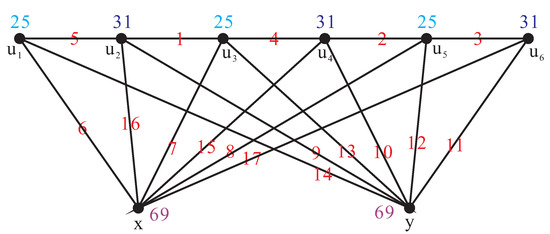
The lower bound of the local antimagic chromatic number of the join graph even for n is clearly obtained. We have since is a induced subgraph of . We show that the upper bound of the chromatic number is attainable.
Let and be the vertex set of the path and the complement graph of , respectively. Then , and .
Label the edges as follows:
Then, label the edges as follows:
Finally, label the edges as follows:
We can conclude that
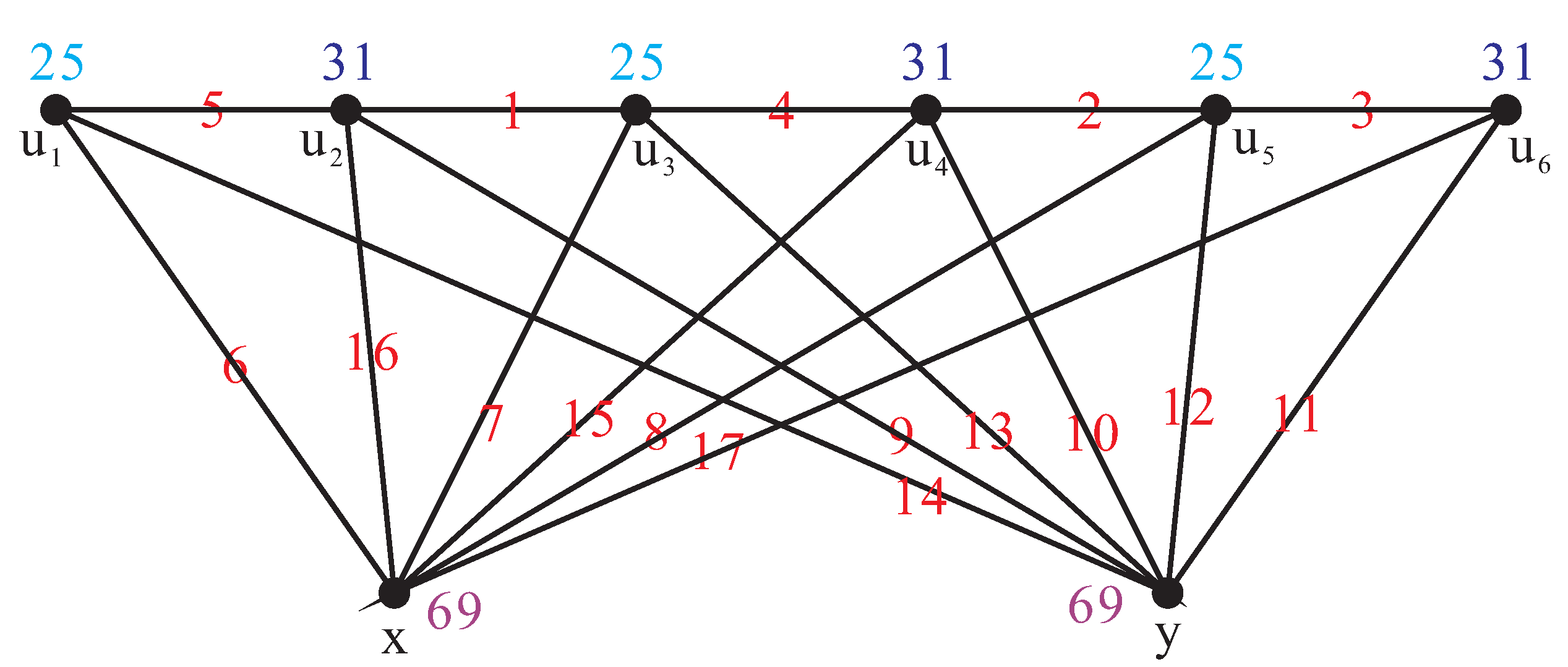
Therefore, f is a local antimagic labeling of that induces a local antimagic vertex coloring using exactly three colors. The local antimagic labeling of the graph as an example is shown in Figure 10. □
Figure 10.
.
3. Conclusions and Scope
In this paper, we obtain the exact values of the local antimagic chromatic number of the join graphs , and the graph . Hence, the following problem arises naturally.
Problem 1.
Find the local antimagic chromatic number of the cartesian product of simple graphs G and H.
Problem 2.
Find the local antimagic chromatic number of other operations of graphs.
Problem 3.
Characterize the class of a graph G for which .
Author Contributions
Conceptualization, X.Y. and H.B.; methodology, X.Y.; software, H.Y.; validation, X.Y., H.B. and H.Y.; formal analysis, D.L.; investigation, X.Y.; resources, H.B.; data curation, H.Y.; writing—original draft preparation, X.Y.; writing—review and editing, H.B.; visualization, D.L.; supervision, H.B.; project administration, H.B.; funding acquisition, H.B. All authors have read and agreed to the published version of the manuscript.
Funding
The research and publication of our article was funded by the National Natural Science Foundation of China (11761070, 61662079) and 2021 Xinjiang Uygur Autonomous Region National Natural Science Foundation Joint Research Fund (2021D01C078), 2020 Special Foundation for First-class Specialty of Applied Mathematics Xinjiang Normal University. H.B. was supported by the National Natural Science Foundation of China (11761070) and 2020 Special Foundation for First-class Specialty of Applied Mathematics Xinjiang Normal University. H.Y. was supported by the National Natural Science Foundation of China (61662079) and 2021 Xinjiang Uygur Autonomous Region National Natural Science Foundation Joint Research Fund (2021D01C078).
Acknowledgments
The authors thank the anonymous referees for their helpful suggestions to improve the exposition.
Conflicts of Interest
The authors declare that there is no conflict of interest regarding the publication of this paper.
References
- Hartsfield, N.; Ringel, G. Pearls in Graph Theory; Academic Press Inc.: Boston, MA, USA, 1994. [Google Scholar]
- Arumugam, S.; Premalatha, K.; Bacǎ, M.; Semaničová-Feňovčíková, A. Local antimagic vertex coloring of a graph. Graphs Comb. 2017, 33, 275–285. [Google Scholar] [CrossRef]
- Bensmail, J.; Senhaji, M.; Lyngsie, K.S. On a combination of the 1-2-3 Conjecture and the Antimagic Labelling Conjecture. Discret. Math. Theor. Comput. Sci. 2017, 19, 1–17. [Google Scholar]
- Haslegrave, J. Proof of a local antimagic conjecture. Discr. Math. Theor. Comp. Sci. 2018, 20, 1–14. [Google Scholar]
- Hagedorn, T.R. Magic rectangles revisited. Discrete Math. 1990, 207, 65–72. [Google Scholar] [CrossRef] [Green Version]
- Lau, G.C.; Shiu, W.C.; Ng, H.K. Affirmative solutions on local antimagic chromatic number. Graphs Comb. 2020, 5, 69–78. [Google Scholar] [CrossRef]
- Shaebani, S. On local antimagic chromatic number of graphs. Algebr. Syst. 2020, 7, 245–256. [Google Scholar]
- Lau, G.C.; Shiu, W.C.; Ng, H.K. On local antimagic chromatic number of cycle-related join graphs. Discuss. Math. Graph Theory 2021, 41, 133–152. [Google Scholar] [CrossRef]
- Lau, G.C.; Shiu, W.C.; Ng, H.K. On local antimagic chromatic number of graphs with cut-vertices. arXiv 2018, arXiv:1805.04801v6. [Google Scholar]
Publisher’s Note: MDPI stays neutral with regard to jurisdictional claims in published maps and institutional affiliations. |
© 2021 by the authors. Licensee MDPI, Basel, Switzerland. This article is an open access article distributed under the terms and conditions of the Creative Commons Attribution (CC BY) license (https://creativecommons.org/licenses/by/4.0/).