


Abstract
Phytoremediation consists of taking advantage of the capacity of certain plants to absorb, accumulate, or metabolize contaminants. In this study, Eichornia crassipes (water lily) treated with water (WLW) and NaOH (WLN) was investigated as an adsorbent for removal of Ni(II) and Cu(II) present in aqueous solution, focusing on determining the most efficient conditions (adsorbent concentration, contact time, pretreatment, temperature). The results showed that equilibrium adsorption was favorable and carried out by a multilayer physical process with both bioadsorbents. The maximum adsorption at 30 °C in WLW and WLN was 349 and 293.8 mg/g of Ni(II), respectively, and 294.1 and 276.3 mg/g of Cu(II), respectively. The thermodynamic analysis indicated that the removal in both metals was spontaneous and exothermic. The Avrami model was the most adequate in the kinetic study of Ni(II) and Cu(II) removal in both treatments, which revealed that the adsorption process was carried out by several mechanisms. In the characterization of the adsorbents, it was determined that the functional groups of WL as well as the attractive forces on the surface of the materials participated in the metal removal process.
1. Introduction
At present, due to great growth in the use of various chemical products in industry, their waste has increased considerably, and consequently, the concentrations of contaminants in the water, such as dyes, organic waste, heavy metals, and others, have increased [1,2]. Heavy metals are a major source of concern among the various contaminants found in industrial effluents. In underdeveloped countries, the treatment of effluents containing heavy metals before discharge into the sewer is often inadequate [3,4,5]. Heavy metals are non-biodegradable, exhibit high mobility in aquatic systems, and are soluble in water, which allows them to be adsorbed in cells and accumulate in the tissues of organisms, causing serious damage to the composition of blood and the respiratory and nervous systems [2,4,5,6,7]. Among the heavy metals that cause the most concern are Ni, Cu, and Co, which are used in electroplating, paint, fertilizers, tanning, metallurgy, etc. [1,2,4]. In addition, Ni, Cu, and Co are essential metals for animals, plants, and humans since they stimulate the production of red blood cells [1,2,8]. At concentrations higher than 15 ppm, they are usually toxic and cause diseases such as kidney damage, liver, cyanosis, and lung cancer, among others [2,4,7].
Due to this hypertoxicity of heavy metals, removal methods have been developed such as those that use physical barriers (reverse osmosis membranes), electrochemical processes (electrolytic extraction and electrodialysis), chemical precipitation, ion exchange, and other techniques [2,3,7,9], which are effective but turn out to have high costs for infrastructure and control and require too much energy [1,2,3,5,6,9]. Adsorption is a cost-effective and efficient method used to remove pollutants such as dyes (methylene blue, methyl orange, phenol red) and heavy metals such as Cr, Ni, Pb, Cd, Cu, Zn, and Fe, among others [2,3,4,5,10,11,12]. Different types of adsorbents, including clays, mesoporous materials, zeolites, and reducible oxides, can be used with this method [10,11,12]. In recent years, there has been growing interest in finding low-cost and abundant adsorbents with comparable adsorption capacities to conventional options. Agroindustrial residues, including orange peel, grapefruit, rice, wheat, egg, and walnut, among others, have emerged as promising alternatives [13,14,15,16,17]. Among the alternatives, phytoremediation employs plants that are able to adsorb and accumulate compounds present in the aquifers where these plant bodies are found [18,19,20,21]. Plants such as Nymphaea alba (white nymph), Nymphaea nucifera (sacred lotus), Pistia stratrioes (water lettuce), and Oesdogonium [18,19,20,21,22,23,24], among others, have presented very good results for the adsorption of contaminants from water. Among these plants, the water lily (Eichhornia crassipes) is considered a critical problem as it represents one of the main aquatic weeds. The water lily causes great economic losses due to its accelerated and uncontrollable growth, causing stagnation of water, and its long roots suspended in the water manifest a comfortable environment for aerobic microorganisms, which encourages a decrease in oxygen levels present in the water, affecting all aquatic species and causing various health problems, just to mention a few problems [21,22,23,24,25]. However, E. crassipes has shown high adsorption efficiency towards heavy metals such as Cr, Pb, Cu, etc., removing 90% of the metals present in water and it can be reused several times in the adsorption process [21,23,24]. In the literature, there are several reports of pretreating water lily before its use in the adsorption of contaminants, which results in better outcomes compared to commercial adsorbents [26,27,28]. There are studies on the parameters (contact time, pH, initial concentration, among others) that reduce the adsorption of heavy metals with water lily. In addition, the removal process is carried out by one or two active sites on the surface of the absorbent [18,19,20,21,22,23,24,25,26,27,28].
Based on this premise, the objective of this work was to investigate the potential of water lily (WL) extracted from the Yuriria lagoon, Guanajuato, Mexico, as a bioadsorbent for removing Ni(II) and Cu(II) from aqueous solutions. The study considered the impact of surface modification by treating water lily with water and NaOH and explored the effects of some parameters on heavy metal adsorption, including temperature, contact time, initial metal concentration, and adsorbent concentration. Through these experiments, the adsorption mechanisms of both metals were determined, and the biomaterial was characterized during the metal adsorption process.
2. Materials and Methods
2.1. Reagents
All reagents used were analytical grade. The water used for all solutions in the experiments was deionized. Hydrochloric acid (HCl) from J. T. Baker (CAS: 7647-01-0, 36.5–38%), sodium hydroxide (NaOH) from J. T. Baker (CAS: 1310-73-2, 98%), cupric sulfate pentahydrate (CuSO4 5H2O) from Merck (CAS: 7758-99-8, 98%), and nickel nitrate hexahydrate (Ni(NO3)2 6H2O) from Sigma-Aldrich (CAS:13478-00-7, 99.99%) were the reagents used for the different experiments.
2.2. Pretreatment of Water Lily (E. crassipes)
The water lily (WL) was washed with running water at room temperature, dried in a forced convection oven (Shel Lab CE5F) at 80 °C for 24 h, and crushed using an industrial blender (Tapisa T12L) to obtain a fine powder (100 mesh) for subsequent pretreatment. The water lily was subjected to treatment with deionized water (WLW) a a ratio of 30 g/L (P/V) at 75 °C and constant stirring for 1 h, followed by subsequent filtration with a vacuum pump (Thomas 1CZC8). This process was repeated until a crystalline filtrate was obtained. WL was treated with 0.5 M sodium hydroxide (NaOH) (WLN) at a ratio of 30 g/L (P/V), with an initial pH of 13.65, and it was stirred for 2 h at 60 °C. Subsequently, it was filtered, and the solid was mixed with 1 M HCl solution (pH ~1) while stirring for 1 h at room temperature. Subsequently, the solid was filtered and washed 10 times with the amount of water used for the HCl solution. Finally, it was dried at 85 °C overnight in a forced convection oven [29].
2.3. Adsorption Isotherms
For the equilibrium study of the adsorption of the metals, an adsorbent/volume mass ratio of 0.5 g/L solution was used and the concentration was varied from 0 to 5000 ppm of Ni(II) and Cu(II). Next, the mixtures were shaken in a shaker (ZHWY-200D) at 200 rpm and at 30, 45, and 60 °C until equilibrium was reached (~12 h of contact time). Then, the samples were centrifuged (Generic 6-TRPR) at 6000 rpm for 10 min. The heavy metal concentration was determined using an atomic absorption spectrometer (Analyst-100, PerkinElmer). The amount of dye removed by adsorbent, qe, was obtained with the following expression [30,31]:
where C0 and Ce represent the initial concentration in equilibrium (mg/L), V is the volume of solution (L), and m is the mass of WL (g). The equilibrium models proposed to fit the experimental data for metals are in the following table.
The removal percentage, %R, was calculated as follows [30,31]:
The different models of the isotherms are shown in Table 1. The regression coefficient was calculated to evaluate the fit of each nonlinear model and the separation factor, RL, which allowed prediction of the affinity between the adsorbent and adsorbate using the following equation [30,31]:
where KL is the constant of the Langmuir model and C0 is the initial concentration of Ni(II) and Cu(II). To understand the thermodynamics of the adsorption process, thermodynamic parameters such as the apparent Gibbs free energy were determined.
where KL is the constant of the Langmuir model) (L/mol), R the ideal gas constant, and T is the absolute temperature (K).

Table 1.
Non-linear equilibrium (isotherm) adsorption models [30,31].
The values of ΔH and ΔS were determined by the slope and sorted to the origin of the ΔG chart as a function of 1/T.
2.4. Batch Dye Removal (Adsorption Kinetics)
The adsorption kinetics were performed using 2500 ppm solutions for both metals and the adsorbent concentration varied from 0 to 5 g/L. The mixtures were shaken in a shaker at 200 rpm and at 30, 45, and 60 °C, with a contact time of 9 h. An aliquot was taken every 1.5 h, which was centrifuged at 6000 rpm for 10 min. The heavy metal concentration was determined using an atomic absorption spectrometer (Analyst-100, PerkinElmer). Experimental data were adjusted with the adsorption kinetics models found in Table 2. In addition to using the coefficient of determination to compare the efficiency of the different kinetic and equilibrium models, the standard deviation, Δq%, was calculated [30,31]:
where N is the number of data, and qexp and qcal (mg/g) are the experimental and calculated values of the removed dyes, respectively. The kinetics models proposed to fit the experimental data for the metals are in the following table.
Table 2.
Adsorption kinetic models used in the analysis of experimental data [31].
2.5. Characterization of Bioadorbent
Attenuated total reflectance–Fourier-transform spectroscopy (ATR–FTIR) analyses were carried out over the wavenumber range of 4000–400 cm−1 using a Thermo Scientific Nicolet iS10 analyzer before and after the adsorption of DNS. A total of 32 scans were obtained with a resolution of 4 cm−1. X-ray diffraction patterns (XRD) were obtained using a diffractometer (Ultima IV Rigaku). To determine the isoelectric point (pHzpc), 0.05 g of adsorbent in 50 mL of water was stirred at 200 rpm for 24 h, and the pH was determined using a potentiometer (Science Med SM-25CW). An additional 0.05 g of adsorbent was added every 24 h until the pH did not change. Scanning electron microscopy and X-ray energy dispersion spectroscopy (SEM–EDS–EDX) were performed using a JOEL spectrometer (6510 pus, Peabody, Boston, MA, USA).
3. Results and Discussions
3.1. Effect of the Initial Concentration of Metals on Adsorption with WL
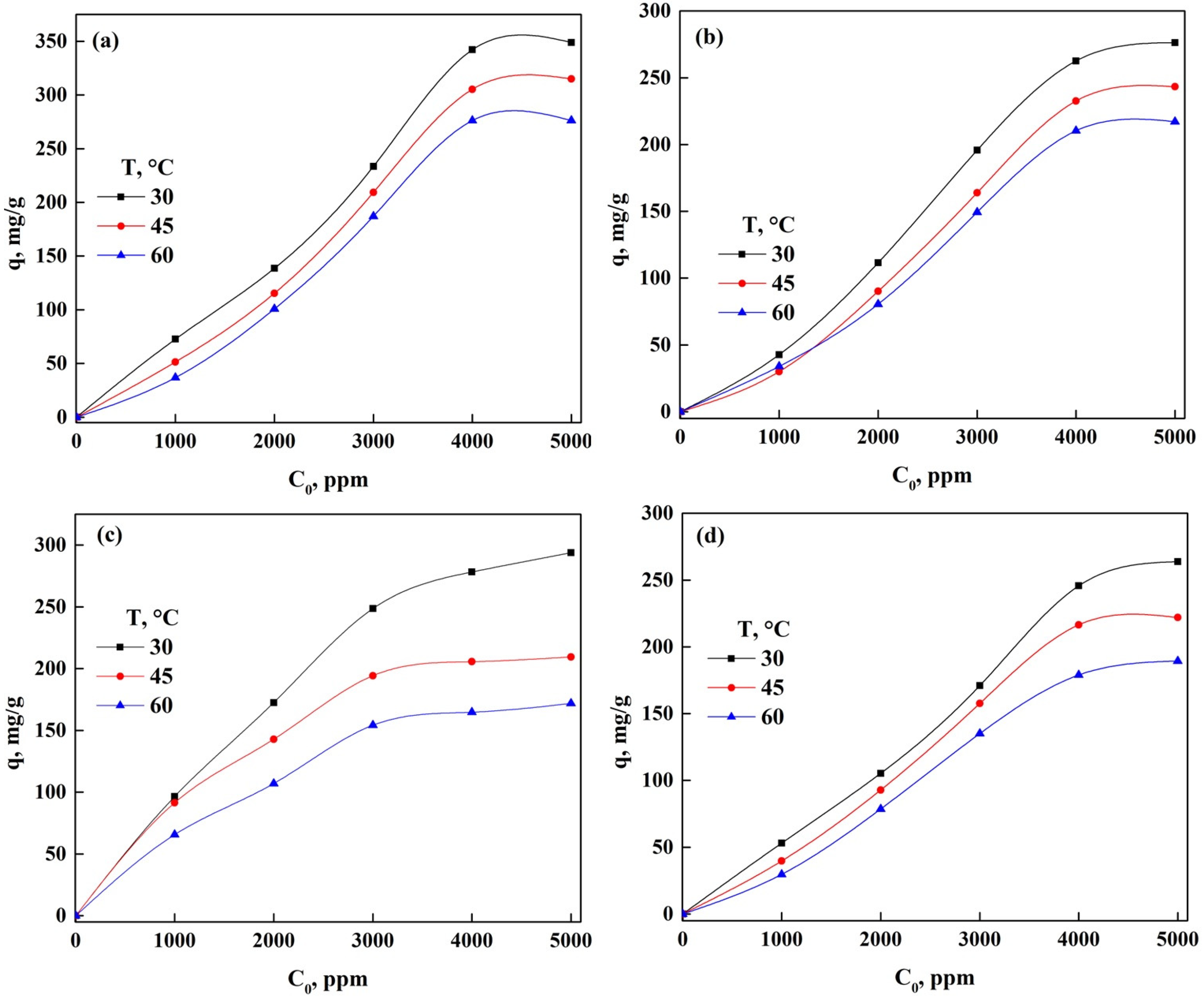
The analysis of the parameters that influenced the adsorption of metal ions, such as the contact time, the concentration of the bioadsorbent and the initial concentration of the metals, allowed us to find the optimal parameters to carry out the adsorption process with WL [29]. In terms of the effect of the initial concentration of Ni(II) and Cu(II), the results allows us to identify when the mass transfer resistance between the liquid and solid phases had been overcome due to the modification of the driving force [32]. In Figure 1, it can be seen that regardless of the treatment carried out on the surface of WL, there was a rapid increase in the adsorption capacities of Ni(II) and Cu(II) until reaching equilibrium at an initial concentration of 4000 ppm. This indicated that increasing the concentration of metal ions led to an increase in bioadsorption, which was directly related to the increased difference in concentrations in the solid and liquid phases, which allowed us to avoid limitations due to mass transfer of the process [33,34,35,36,37,38].
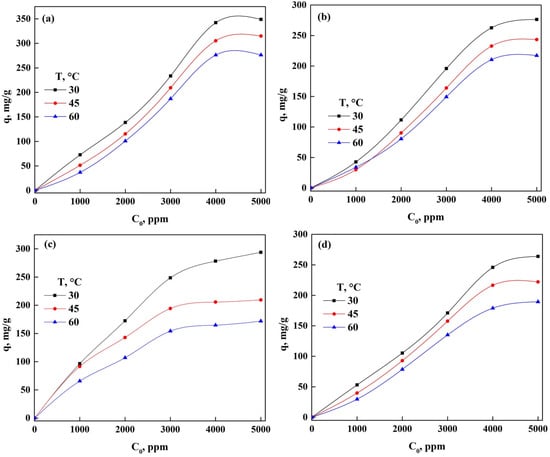
Figure 1.
Effect of the initial concentration of Ni(II) and Cu(II) on the adsorption process: (a) Ni–WLW, (b) Cu–WLW, (c) Ni–WLN and (d) Cu–WLN.
In terms of the percentage of removal of metal ions (Figure S1), it decreased with the increase in concentration, with removal decreasing from 53% to 41% and from 39% to 24% for Ni and Cu, respectively, with WLW. In the case of WLN, the percentage of removal decreased from 58% to 37% for Ni and from 37% to 30% for Cu. This was due to the effect that occurred when the concentration of sites for the adsorption of metal ions remained constant, resulting in greater ease of disposition at these sites at low metal concentrations but preventing further metals from being removed from solution when the available sites became saturated [39,40,41,42,43,44,45].
3.2. Effect of the Amount of Adsorbent on the Adsorption of Ni(II) and Cu(II)
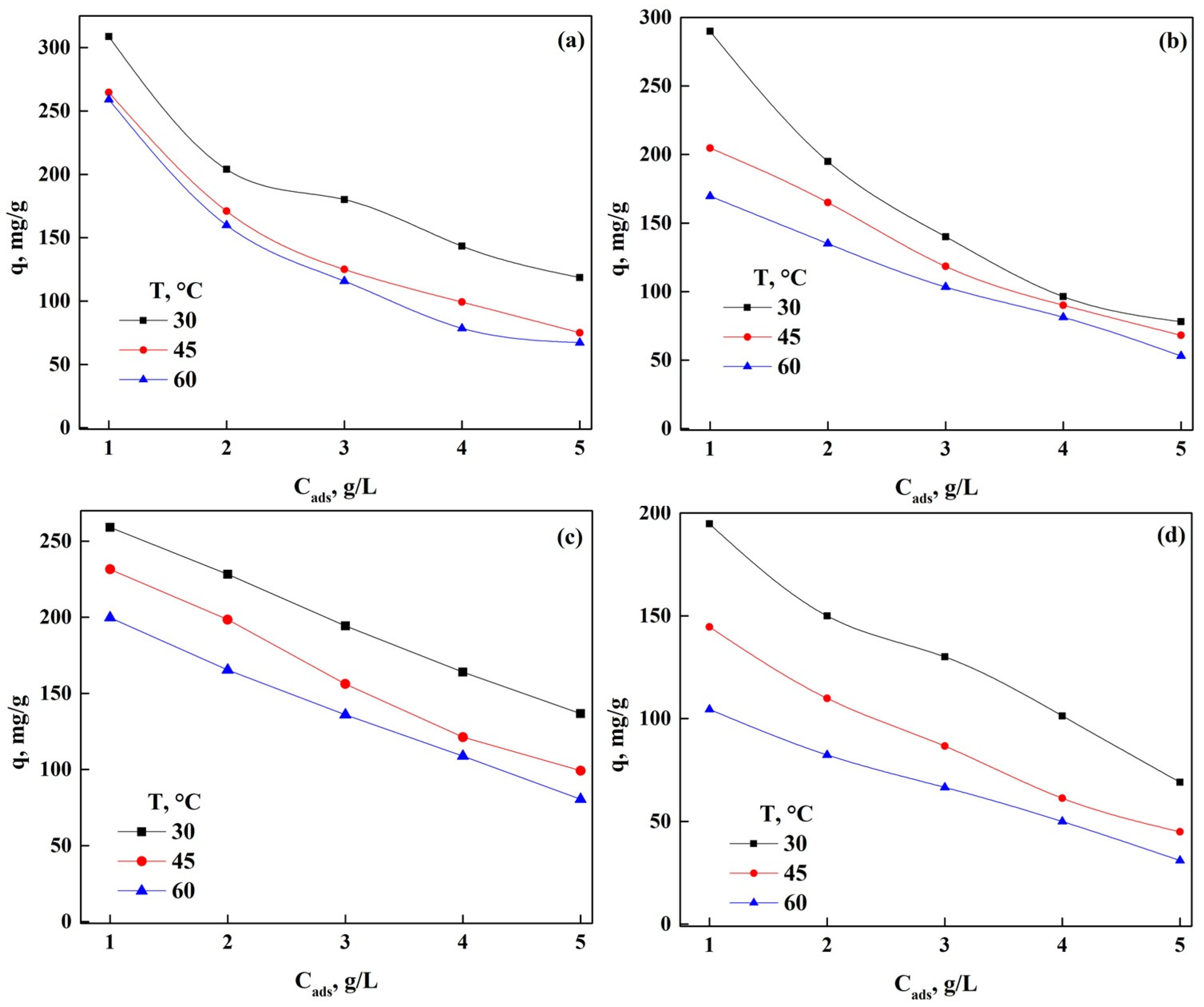
The quantity of the adsorbent is a relevant parameter in the biosorption process since it allows determining the viability of the adsorbent to renew the active sites for the capture of metal ions [34,44,46]. The amount of bioadsorbent is directly related to the concentration of available active sites. In addition, an increase in the amount of adsorbent causes an increase in the area of the bioadsorbent [37,46]. Figure 2 shows the effect of the bioadsorbent concentration on the adsorption process of Ni(II) and Cu(II). It was noted that the adsorption capacity of metal ions in WLW decreased significantly, with maximum losses in the adsorption capacity of 64.7% and 61.9% for Ni and Cu, respectively. In the case of WLN, there were maximum losses in the adsorption capacity of 47.23% and 67.14% for Ni and Cu, respectively. This was due to the fact that the adsorption capacity was affected by the amount of bioadsorbent present in the adsorption process, which agreed with the results reported for different adsorbents such as biocarbon from wheat and rice [47], activated carbon [36], almond shell [39], water lily treated with citric acid [48], modified sediments [46], and residual sludge [49].
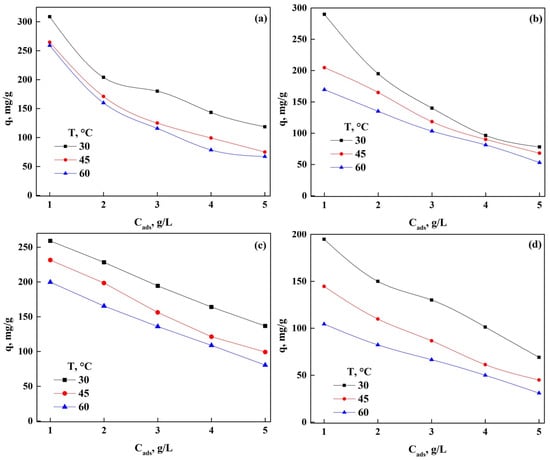
Figure 2.
Effect of adsorbent concentration on Ni(II) and Cu(II) adsorption: (a) Ni–WLW, (b) Cu–WLW, (c) Ni–WLN and (d) Cu–WLN.
In terms of the percentage of removal of metal ions, it increased with the increase in the concentration of the bioadsorbent, as shown in Figure S2, regardless of the treatment performed on the surface of WL. It was observed that the percentage of adsorption increased rapidly due to the increase in the surface area of the bioadsorbent and the concentration of available sites. This may also have been due to the electrostatic forces present on the surface of WL [34,36,38,41,44,46,47,48,49,50]. Taking the parameter of bioadsorbent quantity into account is important because an insufficient amount of bioadsorbent may not effectively remove metals from the solution. However, an excess amount of bioadsorbent would cause unnecessary waste of resources and increase the costs associated with the adsorption process [39].
3.3. Ni(II) and Cu(II) Adsorption Isotherms Using WLW and WLN
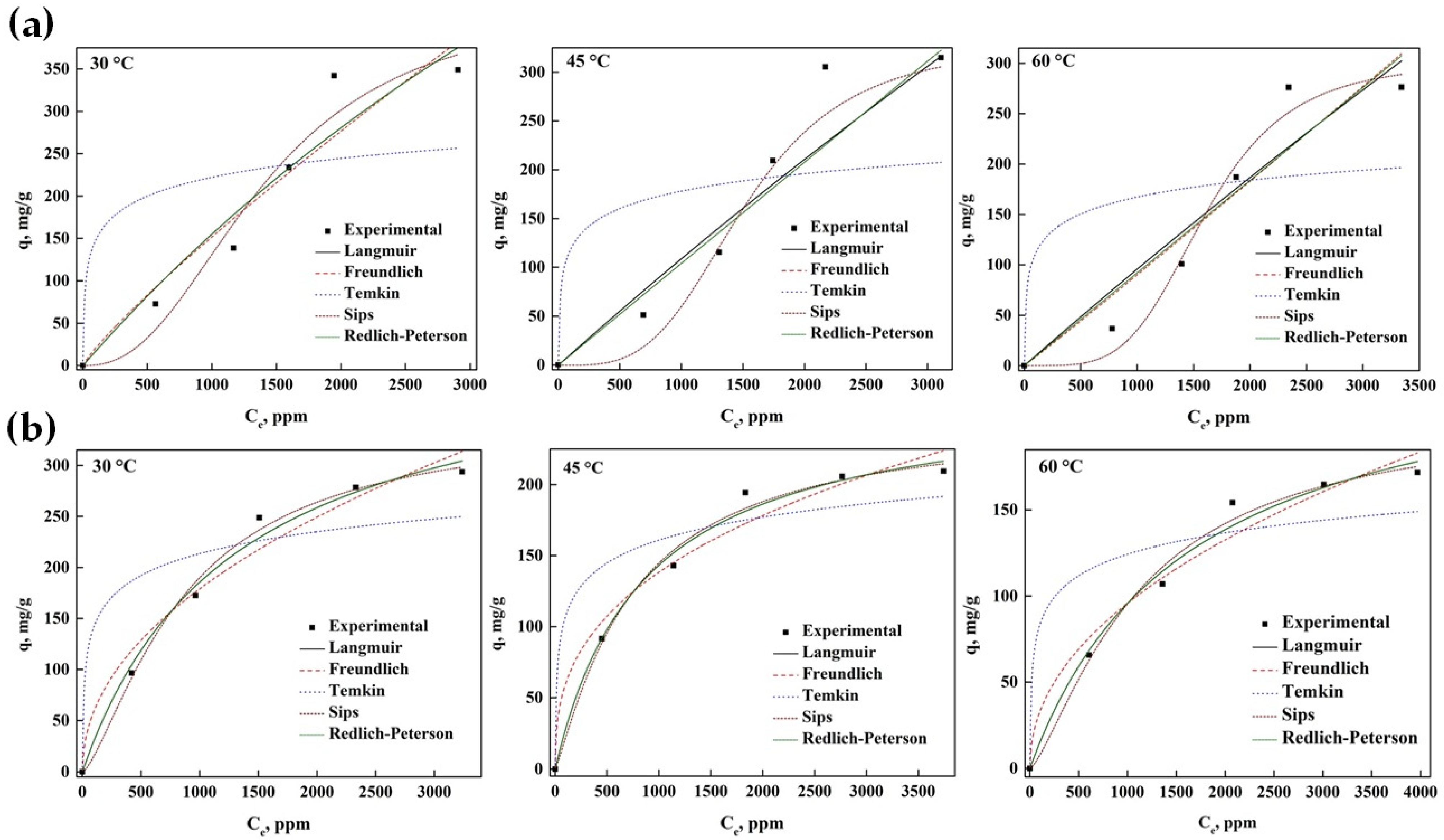
The equilibrium adsorption data provided information on the relationship between the metal concentration in solution and the surfaces of WLW and WLN. This, coupled with the adjustment made to the experimental data using the different isotherm models (Table 1), helped us to understand the mechanism of the metal removal process [29]. Figure 3 shows the adjustments of the adsorption isotherms at different temperatures for Ni (Figure 3a) and Cu (Figure 3b) using WLW as a bioadsorbent. It was observed that the adsorption capacities of both metals decreased with the temperature increase, which indicated that the removal of metals was favored at low temperatures. The parameters of the different adsorption models were obtained using the Sigmaplot® v12 program, as shown in Table 3, taking as criteria the deterministic coefficient (R2) and the normalized standard deviation (∆q%) to establish the best adjustment to the experimental data.
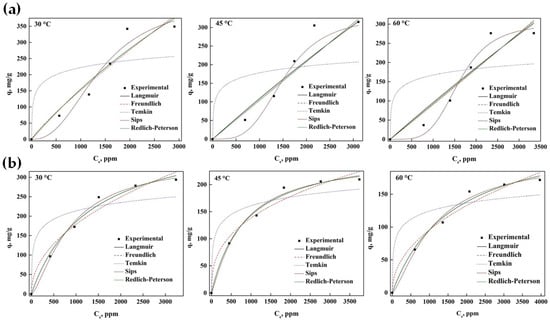
Figure 3.
Isotherm curves at different temperatures using WLW: (a) Ni(II) and (b) Cu(II).
Table 3.
Equilibrium parameters of Ni and Cu adsorption data using WLW.
Based on these established criteria, the Sips model presented the best fit for both metals, which indicated that the equilibrium adsorption process of the heavy metals was carried out on a surface abundant with different adsorption energies. This allowed having more than one layer to capture the Ni and Cu ions. In addition, the process was physical (nS > 1), which indicated that there was heterogeneity in the surface of WLW [5,29,51]. The Freundlich (n > 1) and DR (E < 8 kJ/mol) models confirmed that a physical adsorption process of metals took place on the surface, as indicated by the parameters related to the type of adsorption process (physical or chemical) [51,52,53]. In addition, the energy necessary to remove the metal ions from solution (E) increased with the increase in temperature due to the nature of the removal process of both metals, thus favoring adsorption at low temperatures, as can be seen in Table 3. On the other hand, both metals having RL values between 0 and 1 revealed that equilibrium adsorption was favorable at all temperatures [51,52,53,54,55]. The adsorption capacities of Ni(II) in WLN were 348.92, 315.01, and 276.25 mg/g at 30, 45, and 60 °C, respectively. In comparison, the adsorption capacities of water lily treated with water were between 27.88 and 44.3 mg/g. Notably, these values were lower and the models that described the adsorption process were Freundlich [41] and Langmuir [54], respectively.
In other studies that have used different adsorbents, the adsorption capacity has been found to be between 0.256 and 190.38 mg/g using CoFeO2/SO2 nanoparticles [54], magnetized graphene [56], magnetite–bentonite nanocomposites [57], sapropel humic acids [58], calcium carbonate in bacterial magnetosomes [36], hydroxyapatite [59], lemon peel [60], bamboo modified with mercaptoacetic acid and carbon disulfide [61], wheat and rice biochar [46], charred bones [62], and charcoal [63]. ©. These results indicated that WLW had greater efficiency for the adsorption of this metallic ion in solution, and there was a maximum removal percentage of 51.31%.
In terms of Cu(II) adsorption in WLW, adsorption capacities of 293.82, 209.46, and 171.88 mg/g were obtained at 30, 45, and 60 °C, respectively, with a maximum removal percentage of 51.8%. The adsorption capacities of various adsorbents, including ZnCl2-activated carbon [64], almond shell [39], CoFeO2/SO2 nanoparticles [55], bamboo modified with mercaptoacetic acid and carbon disulfide [61], magnetite-bentonite nanocomposites [15], lime shell [65], peanut shell [40], charcoal [60,61], hydroxyapatite [59], charred bones [62], sapropel humic acids [58], calcium alginate beads immobilized on rice bran [66], residual sludge [46], bentonite [43], and bentonite pretreated with CaCl2 [52], ranged from 2.44 to 128.21 mg/g. These adsorbents used the Langmuir model to describe the adsorption of Cu(II) on their surfaces. Regarding the use of other isotherm models to analyze the adsorption of Cu(II) on the surfaces of adsorbents, the Freundlich model for the adsorption of Cu on orange peel and banana peel [33] showed an adsorption capacity of 309 mg/g. The Sips model was used to analyze the adsorption of Cu on DCPD [35], resulting in an adsorption capacity of 309 mg/g, while the Temkin model was used to analyze the adsorption of Cu on chitosan [34], resulting in an adsorption capacity of 166.6 mg/g.
The adsorption capacity of water lily treated with water as an adsorbent has been reported as 0.65 mg/g [29,31], 2.04 mg/g [43], and 22.7 mg/g [16]. Carbon obtained from water lily has shown an adsorption capacity of 19.62 mg/g [15], 32 mg/g [66], and 48.2 mg/g [50] for Cu(II). The Freundlich and Langmuir models are reported to provide the best fit for the experimental data of Cu(II) adsorption. Generally, the Langmuir and Freundlich isotherms are considered to be the best models for describing the adsorption process of Ni(II) and Cu(II). The Sips model, which is the combination of these two isotherms, also allows the adjustment of the experimental data of the adsorption of these two metals in equilibrium, as obtained in this work.
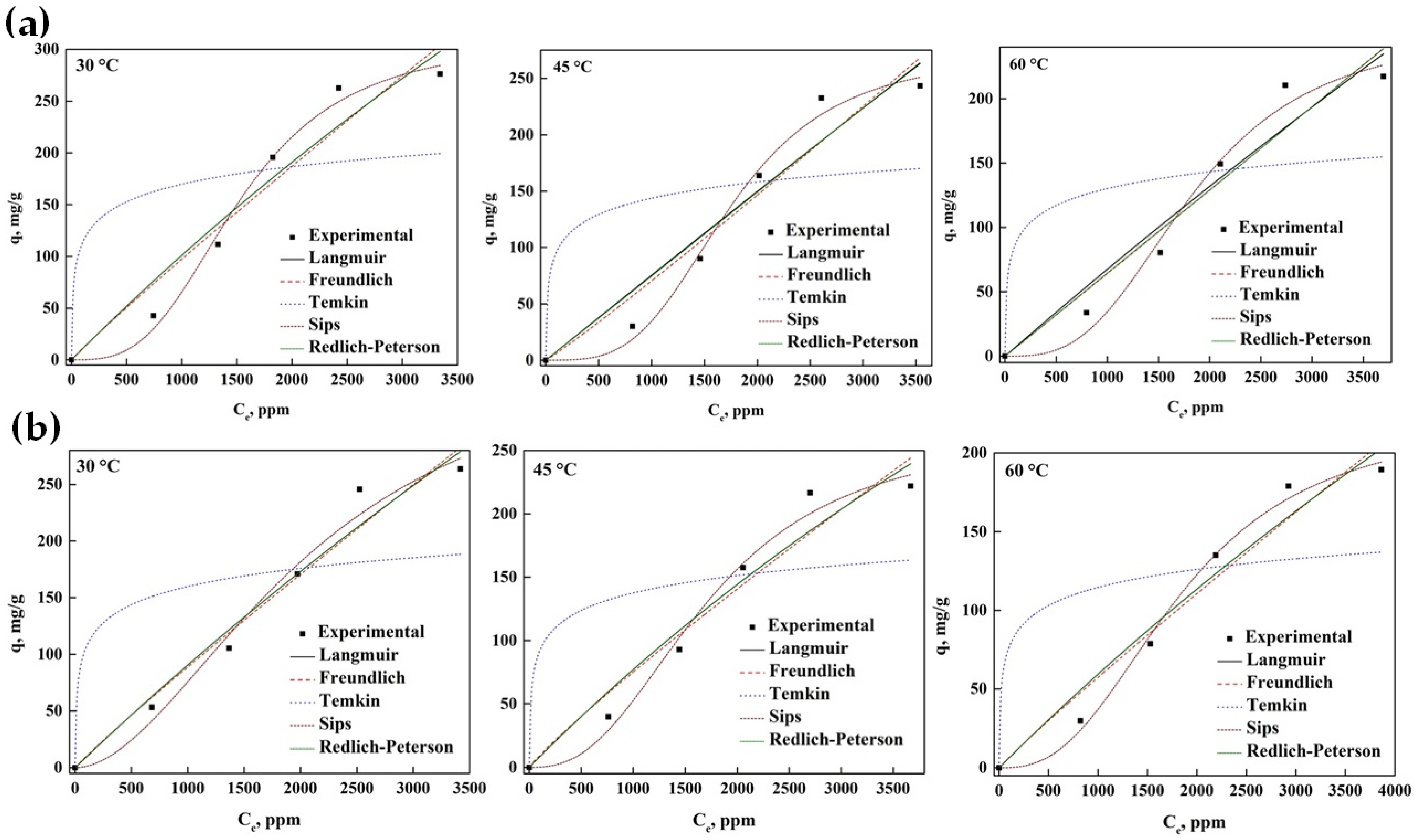
In terms of the removal of Ni and Cu using WLN as a bioadsorbent, Figure 4 shows the experimental data at different temperatures with the adjustments made with the isotherm models. It was possible to observe that as the temperature increased, the adsorption capacities of both metals decreased, which revealed that the elimination of both metals was favored in the same way as using WLW; that is, there was better removal of these metals at low temperatures [5,29,51]. Table 4 presents the isotherm model parameters for both metals. Based on the criteria of R2 and ∆q%, the Sips model showed the best fit. This suggested that the equilibrium adsorption of heavy metals occurred on a heterogeneous surface with varying adsorption energies, which allowed for the formation of more than one layer for the capture of Ni and Cu ions. Furthermore, the process was physical (nS > 1), indicating the presence of different active sites on the surface of WLN [51,53]. This was confirmed by the Freundlich (n > 1) and DR (E < 8 kJ/mol) models, in which the parameters related to the type of adsorption process (physical or chemical) taking place on the surface indicated that there was a physisorption of the metals. This behavior was similar to the adsorption with WLN with respect to the energy needed to remove metals from the aqueous solution towards the surface of WL [51,52,53,67]. On the other hand, the fact that both metals had RL values between 0 and 1 revealed that equilibrium adsorption was favorable at all temperatures [5,51,53].
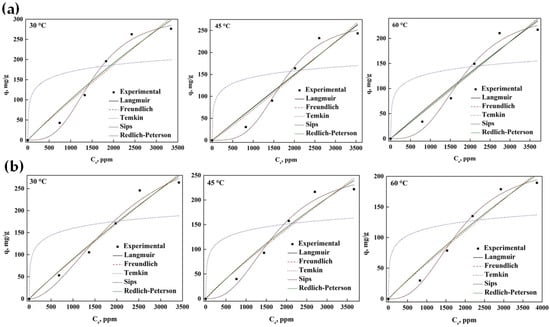
Figure 4.
Isotherm curves at different temperatures using WLN: (a) Ni(II) and (b) Cu(II).
Table 4.
Equilibrium parameters of Ni and Cu adsorption data using WLN.
The adsorption capacities of Ni(II) in WLN at 30, 45, and 60 °C are shown in Table 4. The values obtained were 276.25, 243.32, and 217.16 mg/g, respectively. The maximum removal percentage achieved was 39.4%. These results indicated that treating WL with NaOH caused a loss of removal efficiency of around 21.67% for Ni(II) adsorption. Studies conducted on various adsorbents treated with NaOH have indicated that the Langmuir, Freundlich, and Sips models offer better descriptions of the Ni(II) equilibrium adsorption process. In these studies, the adsorption capacities for Ni(II) were found to be 0.2, 0.123, and 41.75 mg/g using pineapple shell [64], peanut shell [44], and palm biochar [40], respectively. It was determined that the Langmuir model best fits the experimental data for the adsorption capacity of WL treated with HCl [32], methanol and acetonitrile [54], and citric acid [48]. The adsorption capacities of Ni(II) for each treatment were 0.29, 26.5, 53, and 77.98 mg/g, respectively. This indicated that WLN had greater efficiency in the adsorption of Ni(II) in solution than materials reported in the literature using NaOH in the pretreatment of different agro-industrial residues or water lily treated with organic compounds and acids.
On the other hand, the adsorption capacities of Cu(II) in WLN were 201.95, 158.52, and 107.57 mg/g at 30, 45, and 60 °C, respectively, which represented efficiency losses of 31.27%, 24.32%, and 37.41%, respectively. The maximum removal percentage obtained was 49.68%, which meant that despite losing efficiency in Cu(II) adsorption capacity, the removal percentage was not significantly affected by the treatment in WL. Palm biochar [40] and rice husk [68] exhibited adsorption capacities of 0.2 and 12.66 mg/g, respectively, when treated with NaOH. Furthermore, modifying the surface of orange peel with mercaptoacetic acid [69] resulted in an adsorption capacity of 70.67 mg/g. For water lily treated with acetic acid [48] and nitric-perchloric acid [42], the models that described the equilibrium adsorption process were Langmuir and Freundlich, respectively, and the adsorption capacities were 59.64 and 96.67 mg/g, respectively. These results indicated that despite the loss of efficiency in the adsorption of Cu(II), there was still very good removal taking into account that there was a high concentration (5000 ppm) of the heavy metal.
3.4. Study of the Thermodynamics of Ni and Cu Removal Process in Pretreated WL
The nature of the equilibrium removal of Ni and Cu was studied by determining the thermodynamic parameters, as shown in Table 5. It was observed that independent of the pretreatment carried out with WL, the adsorption process of Ni and Cu was spontaneous (ΔG < 0). Regarding the Gibbs free energy, the energy increased with increasing temperature, and this behavior was directly related to the energy needed to remove metal ions from the solution [31,34,48,50,56,67,70]. In addition, the process was exothermic (ΔH < 0), which confirmed what was observed in the adsorption isotherms, that is, the adsorption capacities decreased with increasing temperature in both WLW and WLN. This same behavior was reported in various papers [31,34,39,48,50,70]; however, some reports determined that the process was exothermic [56,67]. A random change in the fluid–solid interface (ΔS < 0) was also observed in the metal removal process, causing a delay in the interaction between Cu and Ni ions with the surfaces of WLW and WLN. This caused a decrease in the adsorption of the metals [39,56,65], although when using magnetized graphene [34], CaMg phosphate [70], and water lily carbon [15], the adsorption process increased due to the increase in randomness in the solid–fluid interface.
Table 5.
Thermodynamic parameters of Ni and Cu removal using WLW and WLN.
3.5. Effect of Contact Time on Metal Adsorption
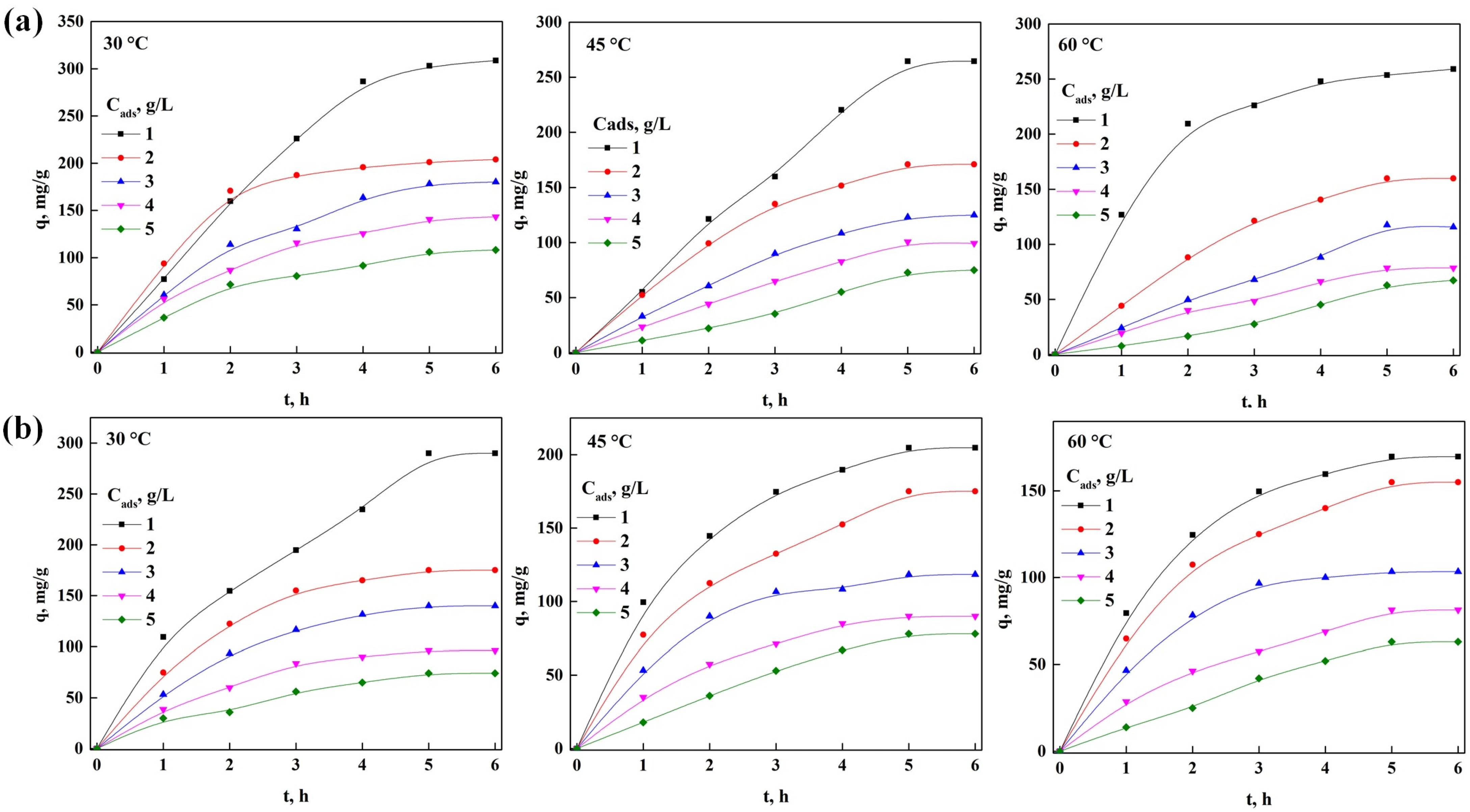
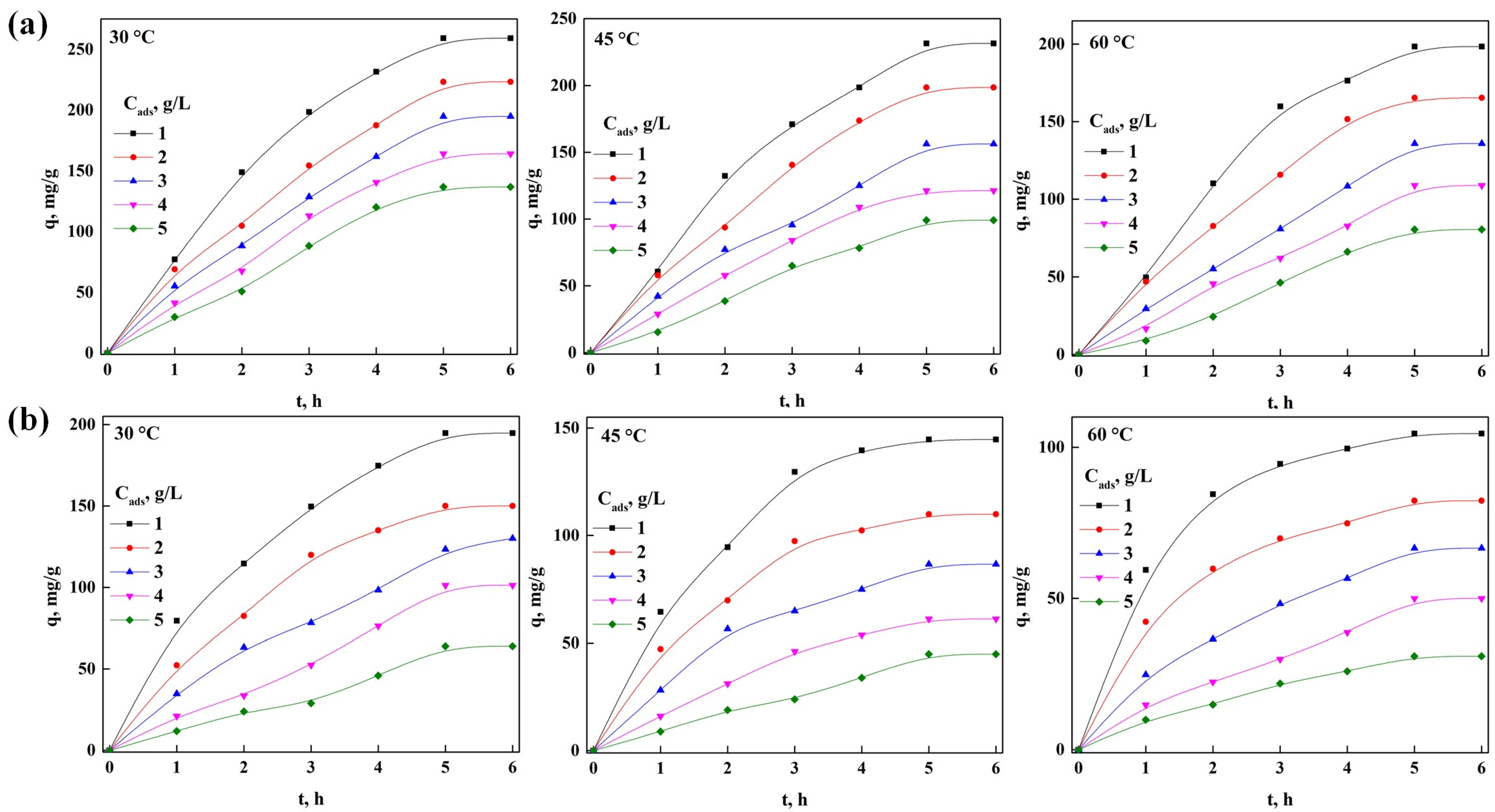
For the metal ion adsorption process to be considered profitable, a very important parameter must be analyzed, which is the contact time between the solution and the bioadsorbent’s surface [63]. In Figure 5 and Figure 6, it was possible to observe the adsorption process for Ni(II) and Cu(II), respectively, in which the adsorption was carried out in three stages: the first being a rapid increase of the adsorption capacity, followed by a slow stage to reach equilibrium, and stage 3 in which the adsorption of metals was almost constant [34,35,36,44,67,70,71]. This behavior was due to the great availability of sites at the beginning of the process, but since the adsorption was gradual over time, the sites became depleted, which caused a slowdown in the adsorption of the heavy metals [32,36,37,41,46,48,63,65]. The analysis of this parameter in the adsorption of Ni and Cu had the same behavior reported with different adsorbents, such as chitosan [34], peanut shell [44], DCPD [35], rice hull [68], CaMg phosphates [70], charcoal [63], lime peel [65], peanut peel [37], banana peel [71], and water lily treated with water [32,41,43], HCl [32], citric acid [48], and charred [36,67]. In addition, the adsorption capacity decreased as the amount of bioadsorbent increased, as can be seen in Figure 2. Figures S3 and S4 show the removal percentages of Ni(II) and Cu(II) at different temperatures, where it was possible to appreciate that the removal of metal ions increased by increasing the contact time between the solution and the bioadsorbent’s surface until reaching equilibrium, which occurred around 5 h after the process started. This behavior agreed with that reported in the literature [37,38,39,40,41,43,46,49,54].
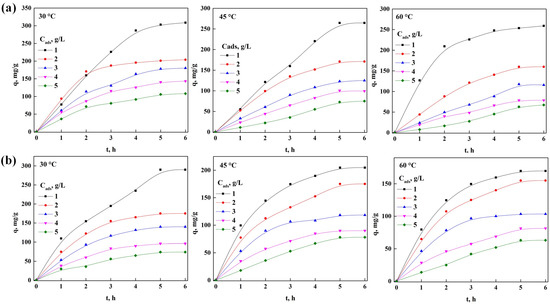
Figure 5.
Isotherm curves at different temperatures using WLN: (a) Ni(II) and (b) Cu(II).
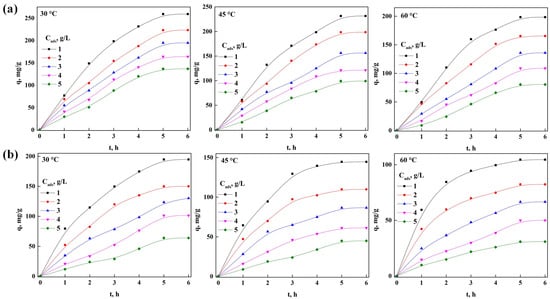
Figure 6.
Isotherm curves at different temperatures using WLN: (a) Ni(II) and (b) Cu(II).
3.6. Kinetic Mechanism of Ni(II) and Cu(II) Adsorption
The kinetic study of Ni(II) and Cu(II) adsorption at different temperatures using WLW and WLN enabled us to identify the process that controlled the removal of these metals from the solution. To achieve this, we analyzed the experimental data presented in Figure 5 and Figure 6 by applying the kinetic models outlined in Table 2. To better understand the adsorption of Ni(II) and Cu(II) in WLW, Table 6 and Table 7 provide kinetic parameters that reveal multiple models that show a good fit. By using the criteria R2 and ∆q% to select the best fit for the experimental data, the Avrami model was determined to best describe the adsorption of Ni(II) and Cu(II) regardless of temperature. This suggested that the adsorption process underwent changes in the adsorption mechanism (nA < 1) [71,72,73,74]. This allowed us to infer that in addition to the physical adsorption of metals on the WLW surface, other mechanisms may have intervened (ion exchange, intervention of functional groups, etc.), in addition to not having external and internal mass transfer limitations [59]. The maximum capacities for Ni(II) obtained at 30, 45, and 60 °C were 308.73, 264.62, and 259.11 mg/g, respectively, and for Cu(II), they were 289.93, 204.74, and 169.67 mg/g at 30, 45, and 60 °C, respectively. These results confirmed the nature of the equilibrium adsorption process for Ni(II) and Cu(II) as well as the thermodynamic analysis of the process. The fact that the maximum adsorption capacity was observed at 30 °C suggested the elimination of an endothermic process.
Table 6.
Kinetic parameters obtained from the fit of the experimental data of Ni adsorption in WLW.
Table 7.
Kinetic parameters obtained from the fit of the experimental data of Cu adsorption in WLW.
For the adsorption of Ni, there are reports in the literature about the use of different adsorbents for the removal of Ni(II), such as chitosan [34], magnetized graphene [54], sapropel humic acids [58], modified sediment [46], charred bones [62], and palm activated carbon with magnetite particles [38], with adsorption capacities ranging from 3.66 to 50.68 mg/g. In the reports where they used WLW, adsorption capacities of 0.2899 [40] and 39.6 mg/g [71] were obtained. In terms of what has been reported in the literature for Cu(II) adsorption using adsorbents such as Zn–Cl2-activated carbon [64], chitosan [34], DCDP [34], sapropel humic acids [58], almond [39], peanut shell [37], charred bones, and bentonite [52], the reported adsorption capacities were between 6.07 and 195.88 mg/g. When comparing the adsorption capacities of WLW and carbonized water lily as adsorbents, the latter had a slightly higher adsorption capacity of 24.3 mg/g [73], compared to WLW with an adsorption capacity of 23 mg/g [67]. However, the results obtained in this study showed a significant increase in the removal efficiency of Ni(II) and Cu(II) compared to other adsorbents and WLW. Specifically, there were increases in Ni(II) removal efficiency of 83.6% and 87.2% compared to other adsorbents and WLW, respectively. Similarly, there were increases in Cu(II) removal efficiency of 32.43% and 91.44% compared to other adsorbents and WLW, respectively. These results demonstrated that the adsorption capacity of water lily as an adsorbent could be significantly improved with appropriate modification and activation.
The kinetic study of Ni(II) and Cu(II) adsorption in WLN at different temperatures yielded the kinetic parameters presented in Table 8 and Table 9. The results showed that the Avrami model provided the best fit to the experimental data for both metals. This suggested that during the adsorption process, more than one mechanism occurred for removing metal ions from the solution (nA < 1). Thus, in addition to the electrostatic forces that attracted Ni(II) and Cu(II) to the surface, the functional groups present in WLN or other mechanisms may have also participated in the adsorption process. It was possible to observe that the adsorption capacity increased with increasing temperature, confirming that the elimination of heavy metals had an endothermic nature. In the adsorption of Ni(II) at 30, 45, and 60 °C, maximum adsorption capacities of 259.11, 231.55, and 198.4 mg/g were obtained, respectively. Compared to the literature on adsorbents treated with NaOH, our study showed higher adsorption capacities for Ni(II) and Cu(II). For instance, pineapple peel [75], peanut [44], and palm carbon [40] had reported adsorption capacities of 9.28, 0.123, and 0.2 mg/g, respectively. Similarly, the use of mercaptoacetic acid and carbon disulfide to modify bamboo as an adsorbent resulted in an adsorption capacity of 8.64 mg/g [61]. Acetic acid-treated WL achieved an adsorption capacity of 16.43 mg/g [48]. All of these reports mentioned that the best fitting model was PSO. In the adsorption of Cu(II) using WLN, we obtained adsorption capacities of 259.11, 231.55, and 194.72 mg/g at 30, 45, and 60 °C, respectively. When comparing our results with the literature, there was a maximum adsorption capacity between 1.03 and 18.58 mg/g with different adsorbents and treatments, including orange peel modified with mercaptoacetic acid [33], rice pretreated with NaOH [68], bamboo modified with mercaptoacetic acid and carbon disulfide [61], palm biocarbon modified with NaOH [40], and water lily modified with acetic acid [48]. Therefore, there was an increase in the adsorption capacity of our adsorbent with respect to these materials, with increases in the adsorption of Ni(II) and Cu(II) using WLN of 93.66% and 90.46%, respectively.
Table 8.
Kinetic parameters obtained from the adjustment of the experimental data of Ni adsorption in WLN.
Table 9.
Kinetic parameters obtained from the fit of the experimental data of Cu adsorption in WLN.
3.7. Characterization of WLW and WLN
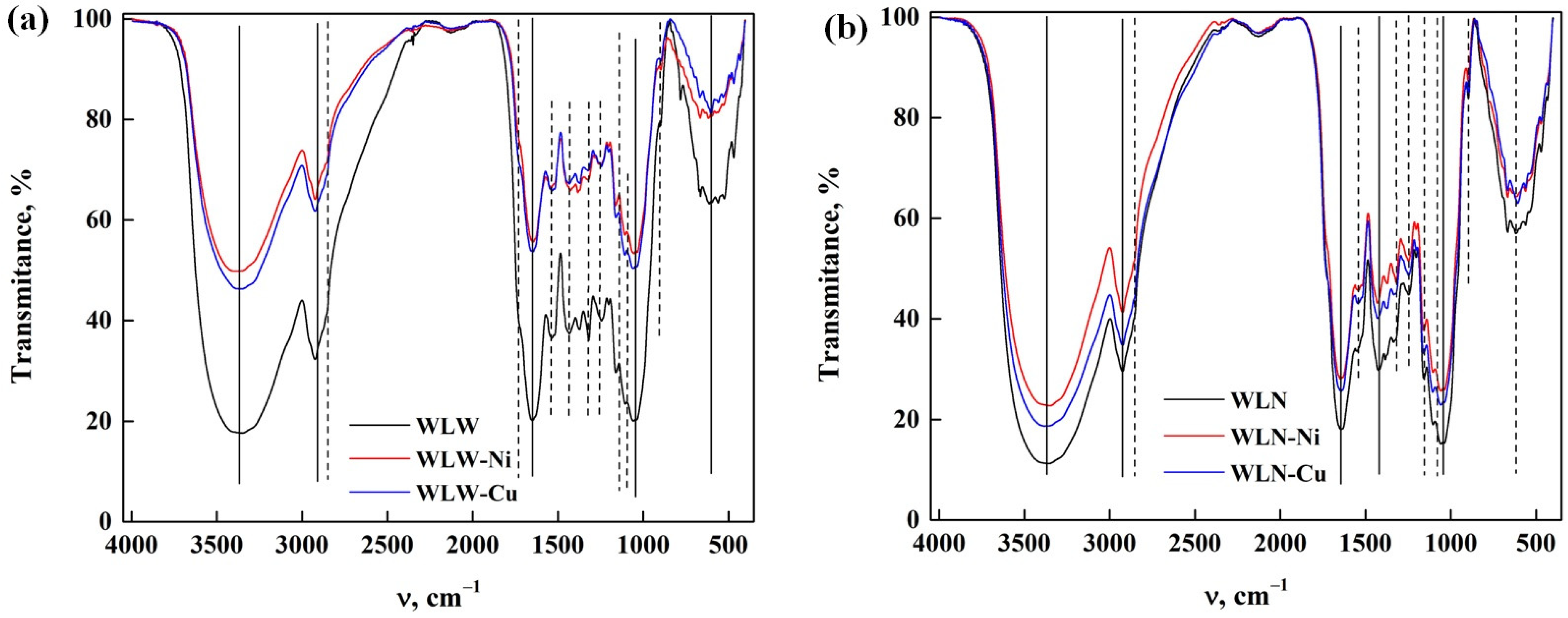
The following figure shows the ATR–FTIR spectra of WLW and WLN. It was possible to observe the different characteristic WL bands, which were related to the functional groups of the compounds present on the surface of WL. In the ATR–FTIR spectrum of WLW shown in Figure 7a, the band at 3368 cm−1 corresponded to the OH- group and links associated with lignin, cellulose, and hemicellulose. The signal at 2927 cm−1 was attributed to the symmetric and asymmetric vibrations of the C-H bond of the methyl and methylene groups [29,45,48,50,71,73]. The shoulder at 2851 cm−1 and the band at 1550 cm−1 were due to the stretching of the CH groups of lignin [29,45,48,50,71,73]. The band at 1649 cm−1 corresponded to the stretching vibrations of the C=O carboxylic bond [29,45,48,50,71,73], while a shoulder at 1726 cm−1 was attributed to the C=O stretching of the carboxylic group [73]. The peak at 1417 cm−1 was assigned to the vibration of aliphatic compounds (-CH2 and -CH3) and methoxy group (O-CH3) [29,45,48,50,71,73]. Additionally, the peaks at 1318, 1252, and 1087 cm−1 corresponded to the symmetry vibration of COO- bond stretching, the presence of the C-H bond of the aromatic group, and the vibration stretching of the C-OH bond of the alcoholic, lignin, and carboxylic acid groups, respectively [29,45,48,50,71,73]. Moreover, the bands at 1153 and 1042 cm−1 were attributed to the stretching vibration in the C-O bond of the lignin structure and the CO-R vibration of the alcohol groups, respectively [29,45,48,50,71,73]. The bands at 898 and 624 cm−1 corresponded to the stretching of the C=O group and the β-glucosidic bonds of cellulose, respectively [29,45,48,50,71,73]. In Figure 7b, the ATR–FTIR spectrum of WLN exhibited changes in all bands compared to WLW. These changes indicated that there were alterations in the functional groups present on the surface of WLN, which in turn affected the adsorption capacity of Ni(II) and Cu(II) in solution. The bands related to the functional groups on WLN’s surface were located at 3373 cm−1 and corresponded to the OH- groups and lignin, cellulose, and hemicellulose bonds. Meanwhile, the peak at 2922 cm−1 was assigned to symmetrical and asymmetric vibrations of the C-H bond of the methylene and methyl groups [29,41,45,48,50,71,73]. The shoulder at 2855 cm−1 and the band at 1544 cm−1 were attributed to the stretching of the CH groups of lignin [29,41,45,48,50,71,73]. The band at 1654 cm−1 corresponded to the stretching vibrations of the C=O carboxylic bond [29,45,48,50,71,73]. A shoulder was observed at 1731 cm−1, corresponding to the C=O stretching of the carboxylic group [73]. The peak at 1434 cm−1 was assigned to the vibration of aliphatic compounds (-CH2 and -CH3) and methoxy group (O-CH3) [29,41,45,48,50,71,73]. The bands at 1323, 1257, and 1092 cm−1 were assigned to the symmetry vibration of COO- bond stretching, the presence of the C-H bond of the aromatic group, and the stretching vibration of the C-OH bond of the alcoholic, lignin, and carboxylic acid groups, respectively [29,41,45,48,50,71,73]. Bands were also observed at 1147 and 1048 cm−1, corresponding to the stretching vibration in the C-O bond of the lignin structure and the CO-R vibration of the alcohol groups, respectively [29,41,45,48,50,71,73]. Finally, the bands at 904 and 596 cm−1 were attributed to the stretching of the C=O group and the β-glucosidic bonds of cellulose, respectively [29,41,45,48,50,71,73]. In the ATR–FTIR spectra of WLW and WLN after metal adsorption, the functional groups involved in the process were identified. The peaks observed corresponded directly to lignin, carboxylic acids, cellulose, hemicellulose, and alcohols [30,31]. The intensity of these bands was significantly reduced after Ni(II) and Cu(II) removal due to the interaction between the surface functional groups of the biomaterials and the metal ions in solution. It was observed that there was a greater interaction between Ni(II) ions and the functional groups than between Cu(II) ions and the functional groups. This was indicated by a greater decrease in the intensity of the bands in the Ni(II) spectrum compared to that in the Cu(II) spectrum [30,31].
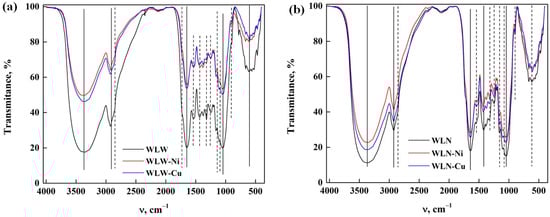
Figure 7.
ATR–FTIR spectra of WL before and after Ni(II) and Cu(II) adsorption: (a) WLW and (b) WLN.
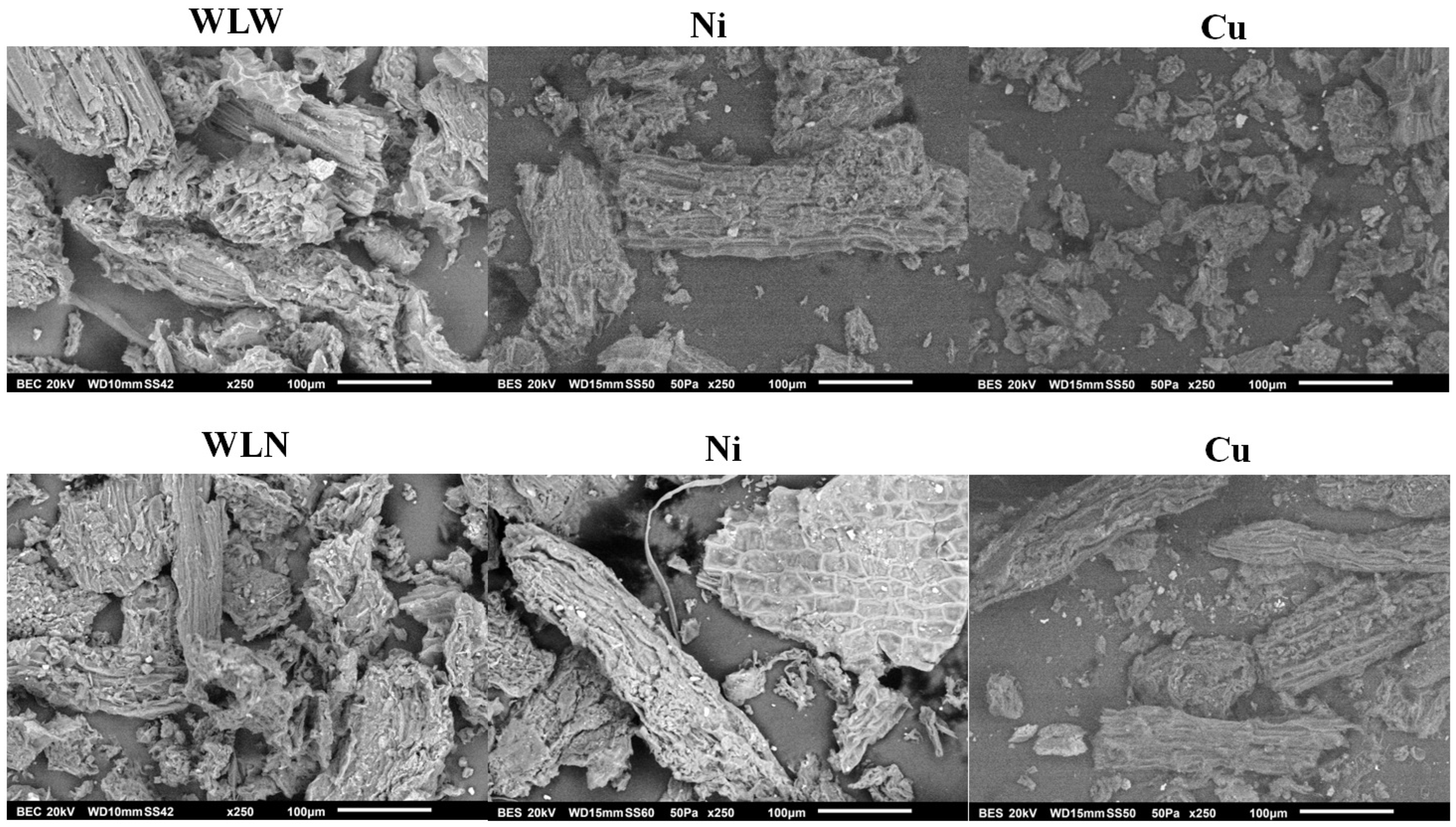
The micrographs in Figure 8 depict the surface characteristics of WLW and WLN. In WLW, the surface appeared to be irregular with pores and holes resulting from water treatment, while in WLN, the surface was fibrous with fractures and pores due to NaOH treatment. These unique surface characteristics indicated the high adsorption capacity for both materials [29,31,48,50]. The micrographs also illustrated the adsorption of Cu(II) and Ni(II) in WLW and WLN. Although no significant changes in the surface of the adsorbents were observed, it could not be concluded that both metal ions were effectively adsorbed since clusters on the surface were visible in the micrographs [19,23,27,29,31].
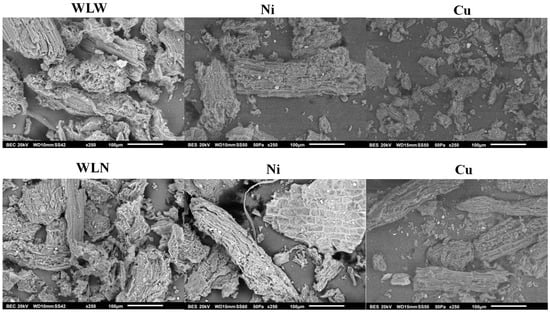
Figure 8.
SEM micrographs of WLW and WLN before and after Ni(II) and Cu(II) adsorption.
The elemental analysis (Table 10) performed on the adsorbents showed changes in the C/O ratio (1.99 and 1.33 for WLW and WLN, respectively) and Ca/Si ratio (2.89 and 1.69 for WLW and WLN, respectively), revealing that there were changes in the functional groups of cellulose, hemicellulose, lignin, carboxylic acids, etc. present on the surfaces of WLW and WLN due to the treatment carried out in WL [29,31,50]. The decrease in the C/O ratio in WLN with respect to that in WLW was 33.17%, while the Ca/Si ratio decreased by 94.15% in WLN compared to that in WLW.
Table 10.
Elemental analysis of WLW and WLN before and after adsorption of Ni(II) and Cu(II).
The analysis carried out on the adsorbents after the adsorption of Ni(II) and Cu(II) also showed changes in the C/O and Ca/Si ratios, indicating which functional groups had the greatest participation in the metal adsorption process. Table 8 shows that for the case of Ni(II) and Cu(II) adsorption using WLW, the C/O ratios were 1.22 and 1.68, respectively, which represented decreases of 38.7% and 15.6%, respectively. The Ca/Si ratios for Ni(II) and Cu(II) were 2.65 and 0, which implied decreases of 7.8% and 100%, respectfully. These results indicated that the functional groups containing Si and Ca had a greater role in the adsorption of Cu(II) compared to Ni(II), while the functional groups containing C and O had a greater role in the adsorption of Ni(II) compared to Cu(II) when using WLW. Therefore, the adsorption capacity of Ni(II) in WLW was greater than that of Cu(II) [29,31,50]. In the case of the adsorption of metals using WLN, the Ca/Si ratios were 0.38 and 0.26, respectively, which implied that there were decreases of 77.46% and 84.62% for Ni(II) and Cu(II), respectively. The C/O ratios were 1.31 and 1.32, which meant that there were decreases of 1.5% and 0.07% for Ni(II) and Cu(II), respectively. These results indicated that the adsorption of metal ions in solution was carried out mainly with the participation of the functional groups that contained Si and Ca, since the participation of the functional groups in which C and O were present was practically insignificant.
The solutions of Ni(II) and Cu(II) were determined to have initial pH values of 6.61 and 4.59, respectively, which indicated that the solutions contained positively charged metal species according to the diagrams obtained by the MEDUSA® program shown in Figure S5. The isoelectric point value of WLW and WLN were 6.25 and 8.8. These results indicated that the adsorption of Ni(II) in WLW was favored by the electrostatic attraction of the species of this metal to the adsorbent surface because pHsol > pHzpc, revealing that the WLW surface was negatively charged [27,29]. The adsorption of Cu(II) took place on a positively charged surface (pHsol < pHzpc), which caused an electrostatic repulsion between the metal species and the WLW surface, causing a decrease in its ability to adsorb Cu(II) compared to Ni(II) for removal [27,29]. In the case of WLN, pHsol < pHzpc was true for both metals, which revealed that the surface of the adsorbent was positively charged [27,29]. This implied that there was an electrostatic repulsion of the Cu(II) and Ni(II) species in solution with the WLN surface, causing a lower adsorption capacity compared to WLW. Based on the results obtained from the characterization of the adsorbents, it could be stated that the removal process of Ni(II) and Cu(II) in solution was carried out through mechanisms involving the participation of functional groups present in WL (lignin, cellulose, etc.) and mainly physical attraction. In the particular case of Ni(II) adsorption in WLW, adsorption by electrostatic forces of attraction was also present, which is why greater removal of this metal with this material was observed compared to WLN.
4. Conclusions
In this work, WL treated with water and NaOH was studied to obtain a low-cost and efficient adsorbent to purify water by eliminating Ni(II) and Cu(II). The results of the analysis of different parameters showed the conditions that give the highest metal adsorption capacity. The adsorption capacity increased as the initial concentration and contact time increased. The optimal conditions for Ni(II) were a contact time of 4 h and an initial concentration of 3500 ppm, while for Cu(II), the optimal conditions were an initial concentration of 4000 ppm with a contact time of 5 h. Additionally, the percentage of removal increased as the adsorbent concentration increased, with an optimum dosage of 3 g/L. The adsorption efficiency decreased when WL was treated with NaOH compared to treatment with water for each metal ion, with decreases in the adsorption capacity of 20.1% for Ni and 31.3% for Cu. The ATR–FTIR analysis revealed the characteristic functional groups of WL, including lignin, cellulose, hemicellulose, and carboxylic acid, among others. The treatment caused changes in these functional groups, with the most significant changes observed in WLN. The changes were confirmed by elemental analysis, which showed that the content of C and O in WLW was decreased compared to that in WLN. This confirmed the participation of functional groups in the adsorption of Ni(II) and Cu(II). Therefore, the adsorption process was carried out by the mechanisms of physical adsorption and participation of functional groups, mainly considering that the nature of the adsorption process was endothermic. These results allow us to suggest that WLW is a promising adsorbent for the removal of these heavy metals.
Supplementary Materials
The following supporting information can be downloaded at: https://www.mdpi.com/article/10.3390/separations10050289/s1, Figure S1. Effect on the removal of Ni(II) and Cu(II) due to the initial concentration: (a) Ni–WLW, (b) Cu–WLW, (c) Ni–WLN, and (d) Cu–WLN, Figure S2. Effect of adsorbent concentration on Ni(II) and Cu(II) removal: (a) Ni–WLW, (b) Cu–WLW, (c) Ni–WLN, and (d) Cu–WLN, Figure S3. Effect of contact time on Ni(II) and Cu(II) removal using WLW as bioadsorbent: (a) Ni and (b) Cu, Figure S4. Effect of contact time on Ni(II) and Cu(II) removal using WLN as bioadsorbent: (a) Ni and (b) Cu, Figure S5. Cu(II) and Ni(II) species diagram in aqueous solution.
Author Contributions
Conceptualization, C.G.-T. and J.A.H.; methodology, C.G.-T. and J.A.H.; software, J.A.H. and R.H.-S.; validation, J.A.H., M.S.-H. and A.T.-L.; formal analysis, C.G.-T. and J.A.H.; investigation, C.G.-T. and J.A.H.; resources, J.M.S.-R.; data curation, M.S.-H. and R.H.-S.; writing—original draft preparation, J.A.H. and A.T.-L.; writing—review and editing, J.A.H. and R.H.-S.; visualization, J.M.S.-R.; supervision, C.G.-T. All authors have read and agreed to the published version of the manuscript.
Funding
This research was funded by Secretaría de Investigación y Posgrado (project SIP: 20220062) of the Instituto Politécnico Nacional (IPN).
Institutional Review Board Statement
Not applicable.
Informed Consent Statement
Not applicable.
Data Availability Statement
The data presented in this study are available on request from the corresponding author.
Acknowledgments
The researchers want to thank UPIIG-IPN and Laboratorio de Investigación y Caracterización de Minerales y Materiales (LICAMM UG).
Conflicts of Interest
The authors declare no conflict of interest.
Sample Availability
Samples of the materials are not available from the authors.
References
- Dai, Y.; Sun, O.; Wang, W.; Lu, L.; Liu, M.; Li, J.; Yang, S.; Sun, Y.; Zhang, K.; Xu, J.; et al. Utilizations of agricultural waste as adsorbent for the removal of contaminants: A review. Chemosphere 2018, 211, 235–253. [Google Scholar] [CrossRef] [PubMed]
- Peng, S.-H.; Wang, R.; Yang, L.-Z.; He, L.; He, X.; Liu, X. Biosorption of copper, zinc, cadmium and chromium ions from aqueous solution by natural foxtail millet shell. Ecotoxicol. Environ. Saf. 2018, 165, 61–69. [Google Scholar] [CrossRef] [PubMed]
- Abukhadra, M.R.; Dardir, F.M.; Shaban, M.; Ahmed, E.A.; Soliman, M.F. Superior removal of Co2+, Cu2+ and Zn2+ contaminants from water utilizing spongy Ni/Fe carbonate–fluorapatite; preparation, application and mechanism. Ecotoxicol. Environ. Saf. 2018, 157, 358–368. [Google Scholar] [CrossRef] [PubMed]
- Cao, F.; Lian, C.; Yu, J.; Yang, H.; Lin, S. Study on the adsorption performance and competitive mechanism for heavy metal contaminants removal using novel multi-pore activated carbons derived from recyclable long-root Eichhornia crassipes. Bioresour. Technol. 2019, 276, 211–218. [Google Scholar] [CrossRef]
- Sarkar, M.; Rahman, A.K.M.L.; Bhoumik, N.C. Remediation of chromium and copper on water hyacinth (E. crassipes) shoot powder. Water Resour. Ind. 2017, 17, 1–6. [Google Scholar] [CrossRef]
- Mwaniki, J.M. Adsorption and Its Applications: Using Zinc Adsorption on Water Hyacinth to Elaborate the Kinetics and Thermodynamics of Adsorption, 1st ed.; George, Z.K., Ed.; Intech Open: London, UK, 2019; Chapter 5. [Google Scholar]
- Joseph, L.; Jun, B.-M.; Flora, J.R.V.; Park, C.M.; Yoon, Y. Removal of heavy metals from water sources in the developing world using low-cost materials: A review. Chemosphere 2019, 229, 142–159. [Google Scholar] [CrossRef]
- Maheshwari, U.; Mathesan, B.; Gupta, S. Efficient adsorbent for simultaneous removal of Cu(II), Zn(II) and Cr(VI): Kinetic, thermodynamics and mass transfer mechanism. Process Saf. Environ. Prot. 2015, 98, 198–210. [Google Scholar] [CrossRef]
- Ranasinghe, S.H.; Navaratne, A.N.; Priyantha, N. Enhancement of adsorption characteristics of Cr(III) and Ni(II) by surface modification of jackfruit peel biosorbent. J. Environ. Chem. Eng. 2018, 6, 5670–5682. [Google Scholar] [CrossRef]
- Lacin, D.; Aroguz, A.Z. Kinetic studies on adsorption behavior of methyl orange using modified halloysite, as an eco-friendly adsorbent. SN Appl. Sci. 2020, 2, 2091–2113. [Google Scholar] [CrossRef]
- Márquez, C.O.; García, V.J.; Guaypatin, J.R.; Fernández-Martínez, F.; Ríos, A.C. Cationic and anionic dye adsorption on a natural clayey composite. Appl. Sci. 2021, 11, 5127. [Google Scholar] [CrossRef]
- Amalraj, R.; Ramsenthil, R.; Durai, G.; Jayakumar, R.; Palaniraj, R. Dyes removal using novel sorbents—A review. J. Pharm. Res. Int. 2021, 33, 355–382. [Google Scholar] [CrossRef]
- Nuhoglu, Y.; Malkoc, E. Thermodynamic and kinetic studies for environmentaly friendly Ni(II) biosorption using waste pomace of olive oil factory. Bioresour. Technol. 2009, 100, 2375–2380. [Google Scholar] [CrossRef] [PubMed]
- Asberry, H.B.; Kuo, C.-Y.; Gung, C.-H.; Conte, E.D.; Suen, S.-Y. Characterization of water bamboo husk biosorbents and their application in heavy metal ion trapping. Microchem. J. 2014, 113, 59–63. [Google Scholar] [CrossRef]
- Elbehiry, F.; Darweesh, M.; Al-Anany, F.S.; Khalifa, A.M.; Almashad, A.A.; El-Ramady, H.; El-Banna, A.; Rajput, V.D.; Jatav, H.S.; Elbasiouny, H. Using Biochar and Nanobiochar of Water Hyacinth and Black Tea Waste in Metals Removal from Aqueous Solutions. Sustainability 2022, 14, 10118. [Google Scholar] [CrossRef]
- Zhang, B.; Wu, Y.; Cha, L. Removal of methyl orange dye using activated biochar derived from pomelo peel wastes: Performance, isotherm, and kinetic studies. J. Dispers. Sci. Technol. 2019, 41, 125–136. [Google Scholar] [CrossRef]
- Kadhom, M.; Albayati, N.; Alalwan, H.; Al-Furaiji, M. Removal of dyes by agricultural waste. Sustain. Chem. Pharm. 2020, 16, 100259. [Google Scholar] [CrossRef]
- Kalam, A.; Rahman, L.; Sarker, A.; Ahmed, N.; Mustofa, M.; Awal, A. Efficient removal of toxic textile dye using petiole part (stem) of Nymphaea alba. Pollution 2021, 7, 643–656. [Google Scholar]
- Rashid, N.S.A.; Naim, M.N.; Che Ma, H.; Abu Bakar, N.F.; Mokhtar, M.N. Evaluation of surface water treated with lotus plant; Nelumbo nucifera. J. Environ. Chem. Eng. 2019, 7, 103048. [Google Scholar] [CrossRef]
- Sharma, R.; Saini, H.; Paul, D.R.; Chaudhary, S.; Nehra, S.P. Removal of organic dyes from wastewater using Eichhornia crassipes: A potential phytoremediation option. Environ. Sci. Pollut. Res. 2021, 28, 7116–7122. [Google Scholar] [CrossRef]
- Patel, S. Threats, management and envisaged utilizations of aquatic weed Eichhornia crassipes: An overview. Rev. Environ. Sci. Biotechnol. 2012, 11, 249–259. [Google Scholar] [CrossRef]
- Rezania, S.; Ponraj, M.; Talaiekhozani, A.; Mohamad, S.A.; Md Din, M.F.; Taib, S.M.; Sabbagh, F.; Sairan, F.M. Perspectives of phytoremediation using water hyacinth for removal of heavy metals, organic and inorganic pollutants in wastewater. J. Environ. Manag. 2015, 163, 125–133. [Google Scholar] [CrossRef] [PubMed]
- Tabinda, A.B.; Arif, R.A.; Yasar, A.; Baquir, M.; Rasheed, R.; Ahmood, A.; Iqbal, A. Treatment of textile effluents with Pistia stratiotes, Eichhornia crassipes and Oedogonium sp. Int. J. Phytorem. 2019, 21, 939–943. [Google Scholar] [CrossRef] [PubMed]
- Panneerselvam, B.; Priya, K.S. Phytoremediation potential of water hyacinth in heavy metal removal in chromium and lead contaminated water. Int. J. Environ. Anal. Chem. 2021, 4, 347–353. [Google Scholar] [CrossRef]
- Priya, E.S.; Selvan, P.S. Water hyacinth (Eichhornia crassipes)—An efficient and economic Adsorbent for textile effluent treatment—A review. Arabian J. Chem. 2017, 10, 3548–3558. [Google Scholar] [CrossRef]
- Tsade-Kara, H.; Anshebo, S.T.; Sabir, F.K.; Workineh, G.A. Removal of methylene blue dye from wastewater using periodiated modified nanocellulose. Int. J. Chem. Eng. 2021, 2021, 9965452. [Google Scholar] [CrossRef]
- Prasad, R.; Sharma, D.; Yadav, K.D.; Ibrahim, H. Eichhornia crassipes as biosorbent for industrial wastewater treatment: Equilibrium and kinetic studies. Can. J. Chem. Eng. 2021, 100, 439–450. [Google Scholar] [CrossRef]
- Acosta-Rodríguez, I.; Rodríguez-Pérez, A.; Pacheco Castillo, N.C.; Enríquez-Domínguez, E.; Cárdenas González, J.F.; Martínez-Juárez, V.M. Removal of cobalt (II) from waters contaminated by the biomass of Eichhornia crassipes. Water 2021, 13, 1725. [Google Scholar] [CrossRef]
- Hernández-Origel, C.D.; Patiño-Saldivar, L.; Salazar-Hernández, M.; Nelly Ardila, A.; Talavera-López, A.; Hernández-Soto, R.; Hernández, J. A: Use of Eichhornia crassipes as a Bioadsorbent for the Removal of Methyl Orange and Methylene Blue Present in Residual Solutions. J. Ecol. Eng. 2022, 23, 193–211. [Google Scholar] [CrossRef]
- Patiño-Saldivar, L.; Hernández, J.A.; Ardila, A.; Salazar-Hernández, M.; Talavera, A.; Hernández-Soto, R. Cr (III) Removal Capacity in Aqueous Solution in Relation to the Functional Groups Present in the Orange Peel (Citrus sinensis). Appl. Sci. 2021, 11, 6346. [Google Scholar] [CrossRef]
- López-Ahumada, E.; Salazar-Hernández, M.; Talavera-López, A.; Solis-Marcial, O.J.; Hernández-Soto, R.; Ruelas-Leyva, J.P.; Hernández, J.A. Removal of Anionic and Cationic Dyes Present in Solution Using Biomass of Eichhornia crassipes as Bioadsorbent. Molecules 2022, 27, 6442. [Google Scholar] [CrossRef] [PubMed]
- Obi, C.; Eigbiremonlen, S. Biosorption Characteristics of Water Hyacinth (Eichhornia crassipes) in the Removal of Nickel (II) Ion under Isothermal Condition. Pak. J. Sci. Ind. Res. Ser. A Phys. Sci. 2016, 59, 118–120. [Google Scholar] [CrossRef]
- Annadurai, G.; Juang, R.S.; Lee, D.J. Adsorption of heavy metals from water using banana and orange peels. Water Sci. Technol. 2002, 47, 185–190. [Google Scholar] [CrossRef]
- Boulaiche, W.; Hamdi, B.; Trari, M. Removal of heavy metals by chitin: Equilibrium, kinetic and thermodynamic studies. Appl. Water Sci. 2009, 9, 39–50. [Google Scholar] [CrossRef]
- El Hamidi, A.; Mulongo Masamba, R.; Khachani, M.; Halim, M.; Arsalane, S. Kinetics modeling in liquid phase sorption of copper ions on brushite di-calcium phosphate di-hydrate CaHPO4·2HO (DCPD). Desalin. Water Treat. 2015, 56, 779–791. [Google Scholar] [CrossRef]
- Jacob, J.J.; Varalakshmi, R.; Gargi, S.; Jayasri, M.A.; Suthindhiran, K. Removal of Cr (III) and Ni(II) from tannery effluent using calcium carbonate coated bacterial magnetosomes. NPJ Clean Water 2018, 1, 1. [Google Scholar] [CrossRef]
- Witek-Krowiak, A.; Szafran, R.G.; Modelski, S. Biosorption of heavy metals from aqueous solutions onto peanut shell as a low-cost biosorbent. Desalination 2011, 265, 126–134. [Google Scholar] [CrossRef]
- Zulaicha, A.S. Modification of Activated Carbon fromElaeis GuineensisJacq Shellwith Magnetite (Fe3O4) Particles and StudyAdsorption-Desorption on Ni(II) Ions in Solution. J. Phys. Conf. Ser. 2021, 1751, 012086. [Google Scholar] [CrossRef]
- Yildiz, S. Kinetic and isotherm analysis of Cu(II) adsorption onto almond shell (Prunus dulcis). Ecol. Chem. Eng. S. 2017, 24, 87–106. [Google Scholar] [CrossRef]
- Imran-Shaukat, M.; Wahi, R.; Rosli, N.R.; Aziz, S.M.A.; Ngaini, Z. Chemically modified palm kernel shell biochar for the removal of heavy metals from aqueous solution. In IOP Conference Series: Earth and Environmental Science; IOP Publishing: Bristol, UK, 2021; Volume 765, p. 012019. [Google Scholar]
- Ogbozige, F.J.; Nwobu, H.U. Biosorption of Ni2+ and Cr3+ in synthetic sewage: Adsorption capacities of water hyacinth (Eichhornia crassipes). Environ. Res. Tec. 2021, 4, 342–351. [Google Scholar] [CrossRef]
- Najem, A.M. Evaluation the Biosorption Capacity of Water Hyacinth (Eichhornia crassipes) Root for Some Heavy Metals. Iraqi J. Sci. 2015, 56, 2846–2852. [Google Scholar]
- Okugbawa, A.; Oghenerume, V.; Egbohs, H.O. Biosorption of Selected Heavy Metal Ions from A Multi-Metal Aqueous Solution using Water Hyacinth (Eichhornia crassipes) Root Powder. Int. J. Scient. Eng. Res. 2020, 12, 883–892. [Google Scholar]
- Burevska, K.A.; Memedi, H.; Lisichkov, K.; Kuvendziev, S.; Marinkovski, M.; Ruseska, G.; Grozdanov, A. Biosorption of nickel ions from aqueous solutions by natural and modified peanut husks: Equilibrium and kinetics. Water Environ. J. 2018, 32, 276–284. [Google Scholar] [CrossRef]
- Jahangiri, F.A.; Moutushi, H.T.; Moniruzzaman, M.; Hoque, S.; Hossain, M.E. Removal of lead from aqueous solutions and wastewaters using water hyacinth (Eichhornia crassipes) roots. Water Pract. Technol. 2021, 16, 404–419. [Google Scholar] [CrossRef]
- Yu, S.; Cheng, Y.; Yang, Y. The study of Ni(II) removal from aqueous solution by modified sediment. In IOP Conference Series: Earth and Environmental Science; IOP Publishing: Bristol, UK, 2017; Volume 64, p. 012062. [Google Scholar]
- Shen, Z.; Zhang, Y.; McMillan, O.; Jin, F.; Al-Tabba, A. Characteristics and mechanisms of nickel adsorption on biochars produced from wheat straw pellets and rice husk. Environ. Sci. Pollut. Res. 2017, 24, 12809–12819. [Google Scholar] [CrossRef]
- Qu, W.; He, D.; Guo, Y.; Tang, Y.; Shang, J.; Zhou, L.; Zhu, R.; Song, R.-J. Modified Water Hyacinth Functionalized with Citric Acid as an Effective and Inexpensive Adsorbent for Heavy Metal-Ion Removal. Ind. Eng. Chem. Res. 2019, 58, 18508–18518. [Google Scholar] [CrossRef]
- Yang, J.; Lin, J.; Yu, Q.; Zhong, H.; Liu, Y.; Chen, L. Study on Adsorption of Cu2+ in WasteWater by Residual Sludge as Adsorbent. In IOP Conference Series: Materials Science and Engineering; IOP Publishing: Bristol, UK, 2018; Volume 394, p. 052009. [Google Scholar]
- Li, Q.; Tang, L.; Hu, J.; Jiang, M.; Shi, X.; Zhang, T.; Li, Y.; Pan, X. Removal of toxic metals from aqueous solution by biochars derived from long-root Eichhornia crassipes. R. Soc. Open Sci. 2018, 5, 180966. [Google Scholar] [CrossRef]
- Hernández-Soto, R.; Hernández, R.A.; Ardila-Arias, A.N.; Salazar-Hernández, M. The Use of Industrial Waste for thBioremediation of Water Used in Industrial Processes, 1st ed.; Eyvaz, M., Yüksel, E., Eds.; Intech Open: London, UK, 2020; Chapter 5. [Google Scholar]
- Ouakouak, A.; Rihani, K.; Youcef, L.; Hamdi, N.; Guergazi, S. Adsorption characteristics of Cu(II) onto CaCl2 pretreated algerian bentonite. Mater. Res. Express 2020, 7, 025045. [Google Scholar] [CrossRef]
- Kyzas, G.Z.; Bikiaris, D.N.; Mitropoulos, A.C. Chitosan adsorbents for dye removal: A review. Polym. Int. 2017, 66, 1800–1811. [Google Scholar] [CrossRef]
- Mahamadi, C.; Madocha, B. Adsorptive Removal of Ni(II) from Water Using Alginate-Fixed Water Hyacinth: Effect of Organic Substances. Am. J. Analyt. Chem. 2013, 4, 373–378. [Google Scholar] [CrossRef]
- Asri, N.S.; Suharyadi, E. Preparation of CoFe2O4/SiO2 Magnetic Nanoparticles as Adsorbent of Ni and Cu ions from Aqueous Solution. AIP Conf. Proc. 2020, 2256, 030022. [Google Scholar]
- Bigui, W.; Xiaofei, Z.; Xiabing, C. Facile Preparation of Magnetic Graphene Oxide and Attapulgite Composite Adsorbent for the Adsorption of Ni(II). In IOP Conference Series: Earth and Environmental Science; IOP Publishing: Bristol, UK, 2017; Volume 104, p. 012019. [Google Scholar]
- Eskandari, M.; Zakeri Khatir, M.; Khodadadi Darban, A.; Meshkini, M. Decreasing Ni, Cu, Cd, and Zn heavy metal using magnetite-bentonite nanocomposites and adsorption isotherm study. Mater. Res. Express 2018, 5, 045030. [Google Scholar] [CrossRef]
- Isakov, V.A. Research on the Adsorption of Heavy Metal Ions from Model Solutions by Humic Acids Isolated from Sapropel. In IOP Conference Series: Earth and Environmental Science; IOP Publishing: Bristol, UK, 2021; Volume 852, p. 012039. [Google Scholar]
- Fernane, F.; Boudia, S.; Aiouache, F. Removal Cu(II) and Ni(II) by natural and synthetic hydroxyapatites: A comparative study. Desalin. Water Treat. 2014, 52, 2856–2862. [Google Scholar] [CrossRef]
- Sudha, R.; Srinivasan, K.; Premkumar, P. Removal of nickel(II) from aqueous solution using Citrus Limettioides peel and seed carbon. Ecotoxicol. Environ. Saf. 2015, 117, 115–123. [Google Scholar] [CrossRef] [PubMed]
- Ai, T.; Jiang, X.; Yu, H.; Xu, H.; Pan, D.; Liu, Q.; Chen, D.; Li, J. Equilibrium, kinetic and mechanism studies on the biosorption of Cu2+ and Ni2+ by sulfur-modified bamboo powder. Korean J. Chem. Eng. 2015, 32, 342–349. [Google Scholar] [CrossRef]
- Martins, J.I.; Órfão, J.J.M.; Soares, O.S.G.P. Sorption of Copper, Nickel and Cadmium on Bone Char. Prot. Metals Phys. Chem. Surf. 2017, 53, 618–627. [Google Scholar] [CrossRef]
- Osińska, M. Removal of lead(II), copper(II), cobalt(II) and nickel(II) ions from aqueous solutions using carbon gels. J. Sol.-Gel. Sci. Technol. 2017, 81, 678–692. [Google Scholar] [CrossRef]
- Alwaan, I.M.; Jaleel, M.A.K. Preparation and Characterization of Activated Carbon with (ZnCl2-Activated) from (PET) Bottle Waste for Removal of Metal ions (Cu+2) in Aqueous Solution. In IOP Conference Series: Materials Science and Engineering; IOP Publishing: Bristol, UK, 2021; Volume 1094, p. 012131. [Google Scholar]
- Panadare, D.C.; Lade, V.G.; Rathod, V.K. Adsorptive removal of copper(II) from aqueous solution onto the waste sweet lime peels (SLP): Equilibrium, kinetics and thermodynamics studies. Desalin. Water Treat. 2014, 52, 7822–7837. [Google Scholar] [CrossRef]
- Suratman, A.; Kamalia, N.Z.; Kusumawati, W.A. Adsorption and desorption of Zn(II) and Cu(II) on Ca alginate immobilized activated rice bran. In IOP Conference Series: Materials Science and Engineering; IOP Publishing: Bristol, UK, 2016; Volume 107, p. 012017. [Google Scholar]
- Attia, A.A.; Shouman, M.A.; Khedr, S.A.; El-Nabarawy, T. Removal of Cu(II) and Cd (II) Ions Onto Water Hyacinth Based Carbonaceous Materials. Carbon Sci. 2006, 7, 249–258. [Google Scholar]
- Li, W.C.; Law, F.Y.; Chan, Y.H.M. Biosorption studies on copper (II) and cadmium (II) using pretreated rice straw and rice husk. Environ. Sci. Pollut. Res. 2017, 24, 8903–8915. [Google Scholar] [CrossRef]
- Liang, S.; Guo, X.; Feng, N.; Tian, Q. Adsorption of Cu2+ and Cd2+ from aqueous solution by mercapto-acetic acid modified orange peel. Colloid. Surf. B Biointerf. 2009, 73, 10–14. [Google Scholar]
- Ivanets, A.I.; Srivastava, V.; Kitikova, N.V.; Shashkova, I.L.; Sillanp, M. Kinetic and thermodynamic studies of the Co(II) and Ni(II) ions removal from aqueous solutions by Ca-Mg phosphates. Chemosphere 2017, 171, 348–354. [Google Scholar] [CrossRef] [PubMed]
- da Silva Correia, I.K.; Fonseca Santos, P.; Santos Santana, C.; Neris, J.B.; Luzardo, F.H.M.; Velasco, F.G. Application of coconut shell, banana peel, spent coffee grounds, eucalyptus bark, piassava (Attalea funifera) and water hyacinth (Eichornia crassipes) in the adsorption of Pb2+ and Ni2+ ions in water. J. Environ. Chem. Eng. 2018, 6, 2319–2334. [Google Scholar] [CrossRef]
- de Menezes, E.W.; Lima, E.C.; Royer, B.; de Souza, F.E.; dos Santos, B.D.; Gregório, J.R.; Costa, T.M.H.; Gushikem, Y.; Benvenutti, E.V. Ionic silica based hybrid material containing the pyridinium group used as an adsorbent for textile dye. J. Colloid Interf. Sci. 2012, 378, 10–20. [Google Scholar] [CrossRef] [PubMed]
- Samily, B.; Dargahi, M. Kinetics and Thermodinamics of adsorption of congo red on cellulose. Eur. J. Chem. 2010, 8, 906–912. [Google Scholar]
- Zheng, J.-C.; Feng, H.-M.; Lam, M.H.-W.; Lam, P.K.-S.; Ding, Y.-W.; Yu, H.-Q. Removal of Cu(II) in aqueous media by biosorption using water hyacinth roots as a biosorbent material. J. Hazard. Mater. 2009, 171, 780–785. [Google Scholar] [CrossRef]
- Arim, L.A.; Guzzo, G.; Quina, M.J.; Gando-Ferreira, L.M. Single and binary sorption of Cr(III) and Ni(II) onto modified pine bark. Environ. Sci. Pollut. Res. 2018, 25, 28039–28049. [Google Scholar] [CrossRef]
Disclaimer/Publisher’s Note: The statements, opinions and data contained in all publications are solely those of the individual author(s) and contributor(s) and not of MDPI and/or the editor(s). MDPI and/or the editor(s) disclaim responsibility for any injury to people or property resulting from any ideas, methods, instructions or products referred to in the content. |
© 2023 by the authors. Licensee MDPI, Basel, Switzerland. This article is an open access article distributed under the terms and conditions of the Creative Commons Attribution (CC BY) license (https://creativecommons.org/licenses/by/4.0/).