


Abstract
The present work deals with the continuous flow systems based on renewable resource biosorbents towards the green removal of various categories of chemical pollutants from aqueous media. The opening discussions are focused on: (a) renewable resources; (b) biosorbents based on renewable resources; (c) dynamic biosorption. After these, the renewable resources biosorbents are reviewed according to the parameters of breakthrough curves. Subsequently, the targeted biosorbents are systematized and analyzed according to the following criteria: (a) their ability to work as remediation agents for heavy metal ions and dyes, respectively; (b) their relevancy for continuous biosorption processes applied both to synthetic aqueous solutions and real wastewaters. The perspective directions of research for the implementation of biosorbents from renewable resources in practical column strategies for wastewater treatment are recommended.
1. Introduction
In the conditions of raw material crisis and the need to find new structures biocompatible with the human body, renewable resources have proven to be particularly useful. The main targeted fields are the biosynthesis processes and the development of biomaterials with multiple applications in industry, medicine, and agriculture. The bio-based polymers originating from renewable resources are remarkable in recycling capacity, biodegradability, and long-term availability. At their center are the polysaccharides that comprise cellulose, lignin, chitin and chitosan, pullulan, starch, dextran, agarose, and alginic acids [1,2,3].
The accelerated development of life has led to the considerable reduction of natural water resources, which is why attention is focused on the application of different methods for purifying the ever-increasing amounts of wastewater, be it industrial, agricultural, or domestic. The wastewaters are loaded with variable amounts of countless pollutants of the most diverse forms and origins: inorganic (metal ions, anions), organic (solvents, pesticides, dyes, herbicides, fertilizers, drugs), biological or microbiological (phytotoxins, microorganisms, biological wastes). Their removal is a mandatory requirement imposed by the need to ensure the quality conditions imposed on drinking water. Numerous methods have been used over time for water depollution: extraction techniques, adsorption, flocculation, chemical precipitation, membrane processes, sonolysis, etc. [1,2,3,4,5,6]. The selection of the wastewater treatment methods is made based on economic and performance criteria, such as: pollutant type, practical implementation conditions, cost-benefit balance, ensuring the highest possible removal efficiency, the production of as low as possible waste quantities to avoid complicated and expensive subsequent techniques for their destruction.
Among the above-mentioned methods, the leader position is occupied by adsorption, with distinctive advantages: ease of application, flexibility, versatility, and a wide range of materials with adsorptive properties usable for both chemical and biological pollutants removal [7,8,9,10,11,12,13,14]. The cleaner alternative of adsorption, namely the biosorption consisting of the transfer of soluble substances from an aqueous medium to the surface of bio-based materials known as biosorbents, is also very challenging [15,16,17,18,19]. Biosorption can be regarded as a separation method that is performed by means of extracellular and intracellular bonds. These interactions are dependent on the nature of chemical species, biosorptive material structure, microbial metabolism, and transport process [20,21,22]. Similar to the biodegradation of organic compounds, biosorption involves the breaking and formation of chemical bonds that alter the molecular structure of the pollutant. This leads to changes in the solubility, adsorption characteristics, transport, and toxicity of metals or radionuclides. Biosorption by biosorbents for the removal of toxic metals and recovery of valuable metals [23,24,25,26,27,28,29,30,31,32,33,34,35,36] or for the retention of organic pollutant species (dyes, phenolic compounds, drugs) from aqueous media [35,36,37,38,39,40,41,42,43,44,45,46,47,48,49,50,51] is an effervescent area of research. By revision Scopus database, a search for the keyword “biosorbents” revealed 1559 studies published over 2018–2022, including 77.293% research articles, 10.712% review articles, 7.184% conference papers, and 3.85% book chapters.
Due to the constant expansion of both materials acting as biosorbents and the types of pollutants to be removed, it is obvious that biosorption remains an open topic. However, the large majority of the research has been performed on synthetic aqueous solutions at lab-scale batch systems. The information obtained from these studies is not sufficient to provide the data required for designing a wastewater treatment system for continuous operation. Therefore, the focus should be on the works on continuous biosorption processes that are not as popular as the batch ones. The studies on the continuous systems of biosorption have been critically analyzed to date in one single review article [52]. Even this article is not completely devoted to dynamic biosorption since, in an attempt to make a comparison between biosorption operation modes, it also addresses issues related to batch biosorption. Furthermore, it is restricted to the fixed bed column biosorption of pollutants, especially metals, from synthetic aqueous solutions.
In light of the above, the present article is intended to be a valuable guide for biosorption transposition to an industrial scale and its applicability to real systems. Thus, this article systematizes and interprets the significant results of research targeting continuous flow systems based on renewable resource biosorbents for pollutant removal. It is divided into three main parts, pointing out the renewable resources, the biosorbents derived from them, and the removal performances of the proposed biosorbents in dynamic systems of biosorption, respectively. The knowledge gained on the removal of metals and organic pollutants from synthetic and real wastewaters via continuous biosorption is, for the first time, brought together by this work.
2. Renewable Resources (Cellulose, Lignin, Chitin, Chitosan)
The most abundant renewable resource of natural polymers, but also the most representative natural polysaccharide, is undoubtedly cellulose [53]. Due to the fibrous structure (determined by the size and distribution of pores), high hygroscopicity (correlated with porous structure and presence of hydroxyl groups), and the possibility of functionalization with organic reagents, nowadays cellulose finds numerous applications in ever wider fields [54,55,56,57]. In its different utilization forms, cellulose is characterized by: (i) availability at low cost; (ii) spherical shape of particles; (iii) possibility of particle size selection; (iv) mechanical strength; (v) high porosity; (vi) wettability; (vii) compatibility with biological structures; (viii) rapid kinetics; (ix) functionalization susceptibility; (x) possibility of processing in different forms; (xi) high specific surface area; (xii) easiness of physical and chemical regeneration; (xiii) tolerance to biological structures; (xiv) relatively fast adsorption [57,58,59]. All these properties, its high abundance in nature, as well as its renewable character make cellulose an inexhaustible source as a raw material to make not only paper and fibers but also a series of biocompatible products for the environment. Depending on the technological process used for their manufacture, cellulose-based materials can be created in several forms and types, ranging from granules, fibers, and microcrystalline powders to softwood pulp and bacterial cellulose.
Chitin belongs to the polyamino saccharides class of animal or vegetable origin, being the main constituent of the shell of crustaceans and of the hard integument of worms [60]. It is also part of the composition of some mushrooms and yeasts such as Chytridiaceae, Blastocladiaceae și Ascomydes. The mycelium of some species of Penicillium can contain up to 20% chitin. Aspergillus niger also represents an important source of chitin [61,62].
Chitosan is a linear polysaccharide of glucosamine and N-acetyl glucosamine, being composed of repeating units of 2-amino-2-deoxy-D-glucopyranose joined by β-D-1→4 linkages and a smaller number of N-acetyl-D-glucosamine (the deacetylated derivative of chitin. It is also an important component of the cell wall in various stages of the life cycle of some fungal species [60,63,64]. It is obtained from chitin through chemical or enzymatic hydrolysis of α-chitin N-partially deacetylated using alkaline solutions (40–50%), at 100–160 °C, for several hours, in a proportion of around 50% [65]. Chitosan structure and properties depend on the chitin deacetylation degree. It is of the most promising materials which can also be used as an efficient biosorbent for the retention of different chemical pollutants.
3. Biosorbents Based on Renewable Resources
The use of conventional materials based on synthetic polymers or obtained by chemical synthesis has many disadvantages, such as the high cost, difficulty of the synthesis technologies, and the pollution generated by these. The need to eliminate these disadvantages and the current tendency to replace “chemical” products with natural products, “green” or “environmentally friendly”, existing in abundance in nature (such as those resulting as waste from agriculture or various industrial sectors) represented a favorable moment for a new type of adsorbent material implementation. These new adsorptive materials are represented by biosorbents that are generated by the processing of renewable resources (i.e., cellulose, lignocellulose, chitin, chitosan, vegetable waste, and algae).
In the last decades, the field of green materials has registered an accelerated development, both concerning the design and in the area of production and use of an ever-wider range of materials resulting from the processing of renewable resources. Their novelty and diversity come from nature, structure, and specific properties but also from the processing method type tailored to the intended applications. These applications are expanding more and more and are based both on the use of techniques for valorizing resources represented by industrial by-products or on innovative approaches (derivatizations, the creation of multi-component assemblies and supramolecular architectures, hybridizations, post-processing in different commercial forms, etc.) on already known materials [66].
An extremely wide spectrum of materials can be used as materials with chemical species retention properties, respectively:
- –
- Biomass that encompasses: phytobiomass (lignocellulosic biomass from woody plants, peat); aquatic biomass; biomass from agricultural wastes, household biomass used in biogas production technologies; microbial biomass resulting from food or pharmaceutical industry [20,21,24,30,33,35,44,51,67,68,69,70,71];
- –
- Physicochemical-modified biomass for the adsorption capacity improvement [72,73,74,75];
- –
- Immobilized biomass is the result of biomass conversion into an easier-to-use form that ultimately contributes to the increase in the process efficiency of separation of pollutant-laden biomass from solution. Biomass immobilization can be carried out on different kinds of supports, with various shapes and porosities [76,77,78]. Immobilized biomass is promising as filling material in columns/bioreactors used in wastewater treatment.
Biosorbents are efficient for the removal of metallic ions from aqueous solutions in the presence of organic compounds or dissolved salts that are considered poisons for ion exchange resins. Biosorbents can be used in the complete treatment of wastes or by coupling with another material, such as activated carbon, in treatments of chemical textile finishing. These materials have superior sorptive properties compared to conventional ones, with particular applicability in the final treatment of effluents.
3.1. Biosorbents Based on Cellulose
Among the renewable resources, available in large amounts and processed with low costs, that are addressed in view of testing their adsorptive properties for use as biosorbents in the treatment of wastewaters, the leader role is played by cellulose. This one can be used in many forms and types, ranging from fibers, microcrystalline powders, softwood pulp, and bacterial cellulose to production wastes and lignocellulosic(agro-industrial) wastes [20,32,66,70,72,79,80,81,82,83,84]. Lignocellulosic biomass provides large amounts of complex biopolymers containing mainly cellulose, hemicellulose, and lignin that are used to obtain nanocellulose [83,85].
In order to increase its efficiency as a biosorbent, the cellulose macromolecule is amenable to numerous relatively inexpensive processes of structural modification, such are the selective oxidations [66,72,86] cross-linking with different agents (acrylonitrile, hydroxylamine, acrylic acid, glycidyl methacrylate, urea) [72] or modifications with chemical reagents through esterification, halogenation, etherification methods [72,75]. New materials with higher specific surface area and porosity and reactive functional groups capable of interacting with polluting chemical species of organic or inorganic nature for their retention are obtained via these strategies.
3.2. Biosorbents Based on Chitosan
The second available biopolymer in nature, chitosan, has structural features due to which it shows distinctive chemical, mechanical, optical, and physical properties, high porosity, low density, regenerability, and biodegradability [60,87,88]. Apart from these, the processing easiness, non-toxicity, antibacterial properties, high reactivity, properties of coagulation, flocculation, and biosorption that are due to the presence of hydroxyl and amine-reactive groups in the macromolecular chains are also remarkable [61,87,89,90,91,92]. These characteristics make chitosan a potential alternative to its synthetic counterparts for environmental applications. Because of the presence of surface-active functional groups, it is possible to easily form bondings with various inorganic and organic substances, allowing its use as a biosorbent in various wastewater treatment processes [60,90,93,94,95,96]. However, some obvious disadvantages, such as the soft structure, high solubility in organic solvents, high percentage of swelling in water, low mechanical strength, and reduced surface, limit its use in industrial applications [97]. Furthermore, the chitin and chitosan processing under powder and flake forms results in a decrease in the adsorption capacity. The increase in adsorption capacity can be performed by its functionalization (grafting, coupling, and cross-linking) [98] or embedding in composite materials.
3.3. Biosorbents Based on Hydrogels
A relatively new and demanding category of biomaterials with adsorptive properties resulting from the processing of renewable resources is represented by hydrogels. These are three-dimensional matrices consisting of dense structures of natural and/or synthetic polymer networks that contain hydrophilic fractions and hydrophobic parts in different proportions, capable of absorbing large amounts of water or biological fluids [99,100,101,102,103,104]. The soft, rubbery consistency similar to living tissues makes them ideal materials for a variety of applications.
The hydrogels show a series of characteristic properties, such as the possibility of desired functionality achieving, reversibility, sterilization, and biocompatibility that fulfill both the requirements of materials used as biological biomaterials to treat or replace tissues and organs or the function of living tissues as well as to interact with the biological system [101,105,106,107]. Different polysaccharides or renewable resources can be used as basic units subjected to the cross-linking process, the more well-known being cellulose, chitin, chitosan, polyvinyl acid, and pullulan [108,109,110,111].
Due to their particular characteristics, especially the capacity of swelling in water, high specific surface area, and the variety of surface functional active groups, the hydrogels have been proven to be very efficient as biosorbents used in water treatments.
4. Dynamic Biosorption
The removal of pollutants from aqueous media via biosorption processes can be carried out in batch and dynamic systems. Distinguished by simplicity and the ability to work with small and constant volumes of solutions, the biosorption batch mode is the preferred option for lab-scale research. It is mainly focused on the study of the influence of the operating variables (pH, temperature, biosorbent dose, initial concentration of chemical species, contact time, agitation, biosorbent structure and size of its particles, structure of the targeted chemical species, size and shape of organic substance molecule or metal ion, electrical charge of chemical species, speciation of metal ions as function of pH values) on the biosorption processes [21]. The provided data serve as useful tools for: (i) setting the most suitable biosorption isotherm for process data modeling up to equilibrium and determination of the maximum capacity of the tested material; (ii) determination of the kinetic parameters and the corresponding kinetic model for rate controlling process step evaluation; (iii) calculation of thermodynamic parameters of the biosorption process in order to establish its spontaneity and thermic effect; (iv) identifying the most probable biosorption mechanism. Alternatively, dynamic systems are more complex and operate with variable and large volumes of solutions. They are of vital importance for the assessment of the biosorption process’s technical feasibility for applications to real-life samples.
4.1. Continuous Flow Systems of Biosorption
Dynamic adsorption usually occurs in an open system in which the aqueous solution containing pollutant molecules or ions continuously flows through a column that uses a bed made of particles of adsorbent. The contact between the adsorbent bed and the liquid phase can be performed in at least four types of column systems that are briefly described in Figure 1: (i) fixed bed (up flow or down flow); (ii) moving bed; (iii) fluidized bed; (iv) pulsed bed.
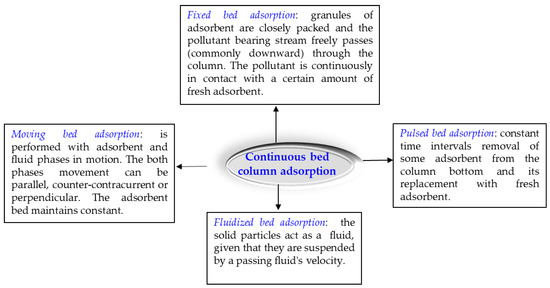
Figure 1.
Main types of column adsorption procedures [9,112,113,114].
Choosing a working procedure in a dynamic regime from those in Figure 1 is made according to a set of criteria, including the nature of the adsorbent and the ratio between treatment efficiency and equipment operating costs. A literature scan has revealed that the continuous fixed and fluidized bed approaches fold the best on the requirements of the biosorption process. Of the above, the greatest attention is paid to the biosorption in fixed bed columns; the one in continuous fluidized beds is rarely addressed. As a proof of concept can be mentioned the biosorption of Pb(II), Cu(II), and Cd(II) ions from industrial wastewater using a fluidized bed of dry leaves of cabbage [115] and the continuous fluidized bed experiments on the removal of Cd(II) [116] and methylene blue dye [117] from aqueous solution using rice husk.
The prevalence of the continuous fixed bed columns over the other operating methods is due to its impressive number of benefits. Among these of special importance are:
- –
- Operation and handling simpleness [118];
- –
- Ensuring the highest possible gradient of concentration that is the process driving force [119];
- –
- High operation yields [120];
- –
- Increased efficiency in the use of biosorption capacity [121];
- –
- Easiness in scaling up from lab-scale procedures [122];
- –
- Quantitative removal of inorganic and organic species from high volumes of aqueous samples with a high level of contaminants by means of a known amount of biosorbent [51];
- –
- Possibility of biosorbent reuse and recovery of valuable components [123];
- –
- Potential for the automatization of the process stages [118,119].
In addition, the data obtained by using fixed bed columns are very useful for the decryption of the mechanism of adsorption that depends on a multitude of phenomena, such as: axial dispersion, fluid diffusion resistance, intraparticle diffusion resistance (pore and surface diffusion resistance) and equilibrium of adsorption [124,125].
4.2. Breakthrough Curves
The effectiveness of the fixed-bed column is assessed by means of breakthrough curves, around which all dynamic studies of biosorption gravitate. These curves are given by the plots of the chemical species concentration or the normalized concentration of the chemical species in the effluent as a function of time or treated solution volume. The typical shape of a breakthrough curve that is a compelling source of information on the nature of the investigated biosorption process and on the pollutant’s loading behavior in a continuous column is shown in Figure 2. The process parameters with the strongest influence on the steepness of the breakthrough curves are the height of the biosorbent bed (h), volumetric flow rate (Fv), and the initial concentration of the pollutant in the feed solution (C0).
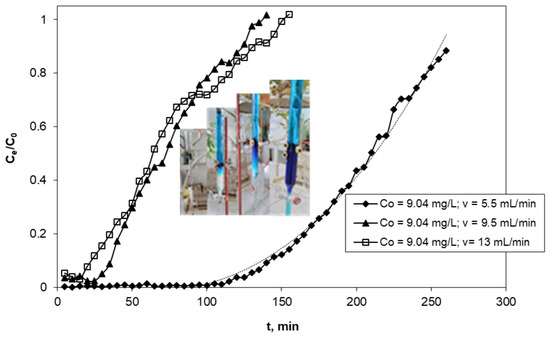
Figure 2.
Breakthrough curve of Methylene Blue dye biosorption in a fixed-bed column filled with granulated Cellets 200 cellulose. Operating conditions: T = 20 °C, C0 = 9.04 mg/L.
The breakthrough curves are characterized by various derived parameters that are very heterogeneously addressed in the fixed bed column biosorption studies. The most representative and frequently reported breakthrough parameters are concisely described in Figure 3. Thus, on the basis of the parameters of breakthrough curves shown in Figure 3, suitable biosorbents for continuous fixed bed column processes are considered those that are distinguished by a long time of breakthrough, shorter time of saturation, and smaller mass transfer zone [9,18]. In view of these aspects, Table 1 systematizes the values of breakthrough curve parameters for the continuous fixed column biosorption of some inorganic and organic pollutant species from synthetic aqueous solutions on renewable resource biosorbents. The interesting data from Table 1 provide conclusive evidence for the implementation of the corresponding biosorbents in practical continuous flow systems for the biosorptive removal of pollutants from real industrial effluents.
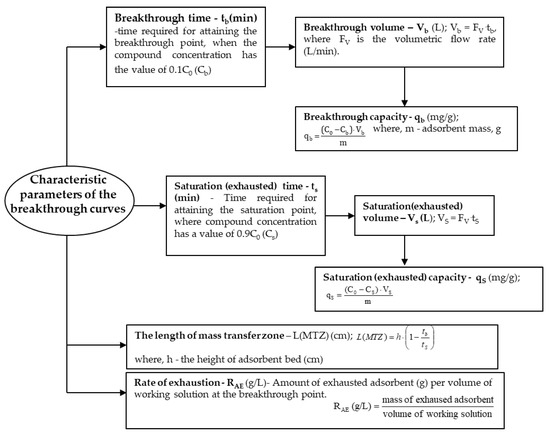
Figure 3.
Characteristic parameters of the breakthrough curves [59,126,127].

Table 1.
Characterization of dynamic biosorption systems for inorganic and organic pollutant removal via the parameters of breakthrough curves.
4.3. Modeling the Biosorption Process in Dynamic Regime
In order to obtain information of high practical value, such as biosorption capacity, service time, usable bed length, and rate constant, the breakthrough data are usually analyzed with the aid of models of fixed bed column dynamics. These models rely on nonlinear isotherms and axial dispersion, intraparticle diffusion, and external film resistance hypotheses [9,10].
The models with extended applicability are the Thomas model, Yoon–Nelson model, Bohart–Adams model, bed depth service time (BDST) model, Clark model, Wolborska model, and the modified dose–response model. The notoriety of these models is due to the fact that their equations can be linearized, allowing assessment of the model parameters by analysis of linear regression [151,152]. A short description of these models is given in Table 2. Among the models in Table 2, the Thomas model is the most commonly used. Similar to the Langmuir maximum capacity of biosorption in batch systems, the dynamic capacity of biosorption provided by the Thomas model usually serves as a reference for biosorbent comparison in continuous flow studies.
Table 2.
Models of continuous fixed bed biosorption [153,154,155,156,157,158,159].
However, due to their empirical or semi-empirical nature, the models in Table 2 are unable to supply detailed information on the design parameters [160,161]. An efficient solution to this problem can be represented by successful computer simulations.
5. Overview of the Biosorbents Targeted in Continuous Biosorption Studies for the Removal of Pollutant Chemical Species from Synthetic Solutions and Real Wastewater
Despite their significance for industrial practicability, especially in the context of sustainable and circular economy, the continuous biosorption processes are not very popularly studied. The results of the relevant studies that describe the effective continuous biosorptive removal ability for heavy metal ions and dyes of biosorbents are displayed in Table 3 and Table 4, respectively. In order to give a faithful picture through these tables, the behavior of renewable resource biosorbents in dynamic systems of biosorption is suggestively presented by means of the models that have been used for breakthrough curve modeling (Table 2), and their performances have been characterized mainly by the dynamic biosorption capacity.
Table 3.
Renewable resource biosorbents for fixed bed column removal of heavy metals from synthetic solutions.
Table 4.
Renewable resource biosorbents for dye removal from synthetic solutions by continuous biosorption processes.
As can be seen from Table 3 and Table 4, the approaches to the behavior of biosorbents based on cellulose in continuous flow systems clearly surpass those related to those based on chitosan. The most targeted heavy metal ion is Cd (II), and Methylene Blue is the model organic pollutant. Although the variability and the variety of the experimental conditions in Table 3 and Table 4 hinder a direct and accurate comparison between biosorbents, the corresponding results can be regarded as a platform for enhancing present knowledge on the continuous biosorption of pollutants for environmental remediation by further research.
The practical relevance of renewable resource biosorbents for large-scale applications in the continuous treatment of wastewater is also strongly conditioned by the degree to which they are able to preserve their efficiency during multiple cycles of repeated uses. Unfortunately, the biosorption-desorption studies aiming at biosorbent reusability assessment for removing heavy metals and organic pollutants are performed rarely and very rarely, respectively. The scarcity of data on the potential recyclability of the targeted biosorbents for heavy metal removal could be due to the limited number of column studies, among which only around 35% address this issue. The data lack of pollutants of organic nature can also be explained on the basis of the complexity of the dynamic systems of biosorption involving organic species, in which some of the interactions between the surface functional groups of biosorbents and the organic molecules are not yet fully deciphered. As illustrative examples can be mentioned:
- –
- Walnut shell functionalized with amino groups [199] and neem sawdust [200] that could be used for further fixed bed column removal of Cr(VI) even two and three cycles, respectively;
- –
- Chrysanthenum indicum [201] with an efficiency of Co(II) desorption in continuous flow systems reduced by 12.3% after four cycles;
- –
- Amino functionalized ramie stalk [202] with unchanged performances of fixed bed column biosorption of Cu(II) for five consecutive cycles;
- –
- Chitosan (with 85% degree of deacetylation of chitin obtained from shrimp (Penaeus brasiliensis) waste) coated glass beads whose efficiency of Tartrazine and Sunset yellow dyes dynamic removal decreased from 36.3% in the first cycle to 33.8% after the fourth cycle [203]
- –
- Agricultural waste biomass of Nelumbo nucifera immobilized in sodium silicate gel with the reusability of three cycles for Congo Red dye removal in dynamic systems [148].
For practical applications, the potential of the features of the continuous flow systems of biosorption pointed out in Table 1, Table 2, Table 3 and Table 4 must be validated in competitive conditions by extensive research on simulated and real wastewaters. Although the very limited number of lab-scale studies available until now on this issue does not allow us to draw pertinent conclusions, their results are very encouraging. In the case of heavy metal ions removal by dynamic biosorption procedures, the most targeted are the real effluents from the electroplating industry. The works related to the biosorptive removal of organic pollutants in column mode are still in the infancy phase, the most interest being focused on the remediation of simulated wastewater contaminated with dyes [150]. The performances of the renewable resource biosorbents in the treatment of real wastewater by continuous biosorption processes are recorded in Table 5. The concentrations of the pollutants in the treated effluents in Table 5 have been reported as being quite far below the permissible limits.
Table 5.
Renewable resource biosorbents for the removal of pollutants from real wastewater in continuous flow systems.
6. Conclusions and Future Prospects
Renewable resource biosorbents possess good potential waiting to be valorized for the development of wastewater treatment technologies based on continuous biosorption processes. The restricted number of studies available until now that have been reviewed in the present work are carried out at a laboratory scale on fixed bed column systems and synthetic aqueous solutions of heavy metal ions and dyes. The addressed issues are related to the influence of the main operational parameters (initial concentration of pollutant, flow rate, and bed height), characterization of the dynamic systems of biosorption by means of breakthrough parameters, and modeling of breakthrough curves. Very little attention is paid to the aspects targeting the recyclability of biosorbents in continuous flow systems and their behavior in real industrial conditions. Therefore, extensive and in-depth research on this topic is imperatively necessary, especially in the following directions:
- –
- Expanding and diversification of biosorbents, pollutants, and column biosorption procedures to be tested;
- –
- The exploitation of the already obtained results on synthetic aqueous solutions to find the most suitable biosorbents for the treatment of real effluents in dynamic conditions;
- –
- The transition from lab-scale studies to pilot- and full-scale studies;
- –
- Assessment of the sustainability of the continuous flow systems of biosorption.
Author Contributions
Conceptualization, L.T. and D.S.; methodology, L.T. and D.S.; software, D.S.; validation, L.T.; formal analysis, L.T. and D.S.; investigation, L.T. and D.S.; resources, L.T. and D.S.; writing—original draft preparation, L.T. and D.S.; writing—review and editing, L.T. and D.S.; visualization, L.T. and D.S.; supervision, L.T. and D.S.; project administration, X.X L.T. and D.S.; All authors have read and agreed to the published version of the manuscript.
Funding
This research received no external funding.
Data Availability Statement
The data presented in this study are available on request from the corresponding author.
Conflicts of Interest
The authors declare no conflict of interest.
References
- Crini, G.; Lichtfouse, E. Advantages and disadvantages of techniques used for wastewater treatment. Environ. Chem. Lett. 2019, 17, 145–155. [Google Scholar] [CrossRef]
- Saravanan, A.; Kumar, P.S.; Jeevanantham, S.; Karishma, S.; Tajsabreen, B.; Yaashikaa, P.R.; Reshma, B. Effective water/wastewater treatment methodologies for toxic pollutants removal: Processes and applications towards sustainable development. Chemosphere 2021, 280, 130595. [Google Scholar] [CrossRef] [PubMed]
- Rodriguez-Narvaez, O.M.; Peralta-Hernandez, J.M.; Goonetilleke, A.; Bandala, E.R. Treatment technologies for emerging contaminants in water: A review. Chem. Eng. J. 2017, 323, 361–380. [Google Scholar] [CrossRef]
- Somma, S.; Reverchon, E.; Baldino, L. Water purification of classical and emerging organic pollutants: An extensive review. ChemEngineering 2021, 5, 47. [Google Scholar] [CrossRef]
- Saravanan, A.; Kumar, P.S.; Hemavathy, R.V.; Jeevanantham, S.; Harikumar, P.; Priyanka, G.; Devakirubai, D.R.A. A comprehensive review on sources, analysis and toxicity of environmental pollutants and its removal methods from water environment. Sci. Total Environ. 2021, 812, 152456. [Google Scholar] [CrossRef]
- Akhtar, A.; Aslam, Z.; Asghar, A.; Bello, M.M.; Raman, A.A.A. Electrocoagulation of dye-containing wastewater: Optimization of operational parameters and process mechanism. J. Environ. Chem. Eng. 2020, 8, 104055. [Google Scholar] [CrossRef]
- Dotto, G.L.; McKay, G. Current scenario and challenges in adsorption for water treatment. J. Environ. Chem. Eng. 2020, 8, 103988. [Google Scholar] [CrossRef]
- Yousef, R.; Qiblawey, H.; El-Naas, M.H. Adsorption as a process for produced water treatment: A review. Processes 2020, 8, 1657. [Google Scholar] [CrossRef]
- Rashid, R.; Shafiq, I.; Akhter, P.; Iqbal, M.J.; Hussain, M. A state-of-the-art review on wastewater treatment techniques: The effectiveness of adsorption method. Environ. Sci. Pollut. Res. 2021, 28, 9050–9066. [Google Scholar] [CrossRef]
- Patel, H. Fixed-bed column adsorption study: A comprehensive review. Appl. Water Sci. 2019, 9, 45. [Google Scholar] [CrossRef]
- Patel, H. Comparison of batch and fixed bed column adsorption: A critical review. Int. J. Environ. Sci. Technol. 2022, 19, 10409–10426. [Google Scholar] [CrossRef]
- Ali, I. Water treatment by adsorption columns: Evaluation at ground level. Sep. Purif. Rev. 2014, 43, 175–205. [Google Scholar] [CrossRef]
- Ahmed, M.J.; Hameed, B.H. Removal of emerging pharmaceutical contaminants by adsorption in a fixed-bed column: A review. Ecotoxicol. Environ. Saf. 2018, 149, 257–266. [Google Scholar] [CrossRef]
- Malik, D.S.; Jain, C.K.; Yadav, A.K. Heavy Metal Removal by Fixed-Bed Column—A Review. Chem. Bio. Eng. Rev. 2018, 5, 173–179. [Google Scholar] [CrossRef]
- Filote, C.; Roșca, M.; Hlihor, R.M.; Cozma, P.; Simion, I.M.; Apostol, M.; Gavrilescu, M. Sustainable application of biosorption and bioaccumulation of persistent pollutants in wastewater treatment: Current practice. Processes 2021, 9, 1696. [Google Scholar] [CrossRef]
- Michalak, I.; Chojnacka, K.; Witek-Krowiak, A. State of the art for the biosorption process—A review. Appl. Biochem. Biototechnol. 2013, 170, 1389–1416. [Google Scholar] [CrossRef]
- Ramírez Calderón, O.A.; Abdeldayem, O.M.; Pugazhendhi, A.; Rene, E.R. Current updates and perspectives of biosorption technology: An alternative for the removal of heavy metals from wastewater. Curr. Pollut. Rep. 2020, 6, 8–27. [Google Scholar] [CrossRef]
- de Freitas, G.R.; da Silva, M.G.C.; Vieira, M.G.A. Biosorption technology for removal of toxic metals: A review of commercial biosorbents and patents. Environ. Sci. Pollut. Res. 2019, 26, 19097–19118. [Google Scholar] [CrossRef]
- Vijayaraghavan, K.; Balasubramanian, R. Is biosorption suitable for decontamination of metal-bearing wastewaters? A critical review on the state-of-the-art of biosorption processes and future directions. J. Environ. Manag. 2015, 160, 283–296. [Google Scholar] [CrossRef]
- Suteu, D.; Zaharia, C.; Malutan, T. Biosorbents based on lignin used in biosorption processes from wastewater treatment in Lignin. In Properties and Applications in Biotechnology and Bioenergy; Paterson, R.J., Ed.; Nova Science Publishers: New York, NY, USA, 2011; pp. 279–305. [Google Scholar]
- Suteu, D.; Zaharia, C. Application of lignin materials for dye removal by sorption processes, In Lignin. In Properties and Applications in Biotechnology and Bioenergy; Paterson, R.J., Ed.; Nova Science Publishers: New York, NY, USA, 2011; pp. 477–488. [Google Scholar]
- Suteu, D.; Zaharia, C.; Blaga, A.C. Biosorption-current bioprocess for wastewater treatment. In Current Topics, Concepts and Research Priorities in Environmental Chemistry; Zaharia, C., Ed.; Universitatii ‘Al.I. Cuza’ Publishing House: Iasi, Romania, 2012; Volume I, pp. 221–244. [Google Scholar]
- da Costa, A.C.A.; Tavares, A.P.M.; de França, F.P. The release of light metals from a brown seaweed (Sargassum sp.) during zinc biosorption in a continuous system. Electron. J. Biotechnol. 2001, 4, 125–129. [Google Scholar] [CrossRef]
- Antumes, W.M.; Luna, A.S.; Henriques, C.A.; daCosta, A.C.A. An Evaluation of Copper Biosorption by Brown Seaweed under Optimized Conditions. Electron. J. Biotechnol. 2003, 6, 174–184. [Google Scholar] [CrossRef]
- Horsfall, M., Jr.; Spiff, A.I. Studies on the effect of pH on the sorption of Pb2+ and Cd2+ ions from aqueous solutions by Caladium bicolor (Wild Cocoyam) biomass. Electron. J. Biotechnol. 2004, 7, 313–323. [Google Scholar] [CrossRef]
- Horsfall, M., Jr.; Spiff, A.I. Effects of temperature on the sorption of Pb2+ and Cd2+ from aqueous solution by Caladium bicolor (Wild Cocoyam) biomass. Electron. J. Biotechnol. 2005, 8, 162–169. [Google Scholar] [CrossRef]
- Horsfall, M., Jr.; Spiff, A.I. Effect of metal ion concentration on the biosorption of Pb super(2+) and Cd super(2+) by Caladium bicolor (wild cocoyam). Afr. J. Biotechnol. 2005, 4, 191–196. [Google Scholar]
- Ahalya, N.; Kanamadi, R.D.; Ramachandra, T.V. Biosorption of chromium (VI) from aqueous solutions by the husk of Bengal gram (Cicer arientinum sp.). Electron. J. Biotechnol. 2005, 8, 258–264. [Google Scholar] [CrossRef]
- Nomanbhay, S.M.; Palanisamy, K. Removal of heavy metal from industrial wastewater using chitosan coated oil palm shell charcoal. Electron. J. Biotechnol. 2005, 8, 43–54. [Google Scholar] [CrossRef]
- Bhatnagar, A.; Vilar, V.J.P.; Botelho, C.M.S.; Boaventura, R.A.R. Coconut-beased biosorbents for water treratment—A review of the recent literature. Adv. Colloid Interface Sci. 2010, 160, 1–15. [Google Scholar] [CrossRef]
- Abdolati, A.; Guo, W.S.; Ngo, H.H.; Chen, S.S.; Nguyen, N.C.; Tnug, K.L. Typical lignocellulosic wastes and by-products for biosorption process in water and wastewater treatment: A critical review. Bioresour. Technol. 2014, 160, 57–66. [Google Scholar] [CrossRef]
- Mo, J.; Yang, Q.; Zhang, N.; Zhang, W.; Zheng, Y.; Zhang, Z. A review on agro-industrial waste (AIW) derived adsorbents for water and wastewater treatment. J. Environ. Manag. 2018, 227, 395–405. [Google Scholar] [CrossRef]
- Pavan-Kumar, G.U.S.R.; Malta, K.A.; Yerra, B.; Rao, K.S. Removal of Cu (II) using three low-cost adsorbents and prediction of adsorption using artificial neural networks. Appl. Water Sci. 2019, 9, 44–53. [Google Scholar] [CrossRef]
- Okolo, B.I.; Oke, E.O.; Agu, C.M.; Nwosu-Obieogu, K.; Adeyi, O.; Akatobi, K.N. Development of new biosorbent materials from agricultural waste materials for the removal of Cd(II) ions from aqueous solution through the batch adsorption process. Environ. Qual. Manag. 2020, 30, 35–46. [Google Scholar] [CrossRef]
- Elgarahy, A.M.; Elwakeel, K.Z.; Mohammad, S.H.; Elshoubaky, G.A. A critical review of biosorption of dyes, heavy metals and metalloids from wastewater as an efficient and green process. Clean. Eng. Technol. 2021, 4, 100209. [Google Scholar] [CrossRef]
- Tanasa, A.; Suteu, D. Biovegetal wastes used as biosorbent for removal of chemical pollutants from wastewater. Res. J. Agric. Sci. 2021, 53, 227–232. [Google Scholar]
- Gorduza, V.M.; Tofan, L.; Suteu, D.; Gorduza, E.V. Biomateriale—Biotehnologii—Biocontrol; Cermi Publishing House: Iasi, Romania, 2002. [Google Scholar]
- Uddin, A.B.M.H.; Sujari, A.N.A.; Nawi, M.A.M. Effectiveness of peat coagulant for the removal of textile dyes from aqueous solution and textile wastewater. Malays. J. Chem. 2003, 5, 34–43. [Google Scholar]
- Bhatnagar, A.; Jain, A.K. A comparative adsorption study with different industrial wastes as adsorbents for the removal of cationic dyes from water. J. Colloid Interface Sci. 2005, 281, 49–55. [Google Scholar] [CrossRef]
- Allen, S.J.; Koumanova, B. Decolourisation of Water/Wastewater Using Adsorption. J. Univ. Chem. Technol. Metall. 2005, 40, 175–192. [Google Scholar]
- Srivastava, V.C.; Swamy, M.M.; Mall, I.D.; Prasad, B.; Mishra, I.M. Adsorptive removal of phenol by bagasse fly ash and activated carbon: Equilibrium, kinetics and thermodynamics. Colloids Surf. A Physicochem Eng. Aspects 2006, 272, 89–104. [Google Scholar] [CrossRef]
- Crini, G.; Badot, P.M. Application of chitosan, a natural aminopolysaccharide, for dye removal from aqueous solution by adsorption processes using batch studies: A review of recent literature. Prog. Polym. Sci. 2008, 33, 399–447. [Google Scholar] [CrossRef]
- de Castro, K.C.; Cossolin, A.S.; Oliveira dos Reis, H.C.; Beraldo de Morais, E. Biosorption of anionic textile dyes from aqueous solution by yeast slurry from brewery. Braz. Archiv. Biol. Technol. 2017, 60, e17160101. [Google Scholar] [CrossRef]
- Mandal, A.; Singh, N.; Nain, L. Agro-waste biosorbents: Effect of physico-chemical properties on atrazine and imidacloprid sorption. J. Environ. Sci. Health Part B 2017, 52, 671–682. [Google Scholar] [CrossRef]
- Zaharia, C.; Suteu, D. Textile organic dyes—Characteristics, polluting effects, and separation/elimination procedures from industrial effluents. A critical overview. In Organic Pollutants—Ten Years after the Stockholm Convention—Environmental and Analytical Update; Puzyn, T., Mostrag-Szlichtyng, A., Eds.; InTech Publisher: Rijeka, Croatia, 2012; pp. 55–86. [Google Scholar]
- Contreras, E.; Sepulveda, L.; Palma, C. Valorization of Agroindustrial Wastes as Biosorbent for the Removal of Textile Dyes from Aqueous Solutions. Int. J. Chem. Eng. 2012, 1, 679352. [Google Scholar] [CrossRef]
- Crominski da Silva, D.C.; Martins, J.; de Abreu Pietrobelli, T. Residual biomass of chia seeds (Salvia hispanica) oil extraction as low cost and eco-friendly biosorbent for effective reactive yellow B2R textile dye removal: Characterization, kinetic, thermodynamic and isotherm studies. J. Environ. Chem. Eng. 2019, 7, 103008. [Google Scholar] [CrossRef]
- Stavrinou, A.; Aggelopoulos, C.A.; Tsakiroglou, C.D. Exploring the adsorption mechanisms of cationic and anionic dyes onto agricultural waste peels of banana, cucumber and potato: Adsorption kinetics and equilibrium isotherms as a tool. J. Environ. Chem. Eng. 2018, 6, 6958–6970. [Google Scholar] [CrossRef]
- Khorasania, A.C.; Shojaosadatib, S.A. Magnetic pectin-Chlorella vulgaris biosorbent for the adsorption of dyes. J. Environ. Chem. Eng. 2019, 7, 103062. [Google Scholar] [CrossRef]
- Adewuyi, A. Chemically modified biosorbents and their role in the removal of emerging pharmaceutical waste in the water system. Water 2020, 12, 1551. [Google Scholar] [CrossRef]
- Bhattachar, C.; Dutta, S.; Saxena, V.K. A review on biosorptive removal of dyes and heavy metals from wastewater using watermelon rind as biosorbent. Environ. Adv. 2020, 2, 100007. [Google Scholar] [CrossRef]
- Thirunavukkarasu, A.; Nithya, R.; Sivashankar, R. Continuous fixed-bed biosorption process: A review. Chem. Eng. J. Adv. 2021, 8, 100188. [Google Scholar] [CrossRef]
- Kaplan, D.L. Introduction to Biopolymers from Renewable Resources. In Biopolymers from Renewable Resources; Kaplan, D.L., Ed.; Springer Publishing: Berlin, Germany, 1998. [Google Scholar]
- Klemm, D.; Kramer, F.; Moritz, S.; Lindstrom, T.; Ankerfors, M.; Gray, D.; Dorris, A. Nanocelluloses: A new family of nature based materials. Angew. Chem. Int. Ed. 2011, 50, 5438–5463. [Google Scholar] [CrossRef]
- Siro, D.; Plackett, D. Microfibrillated cellulose and new nanocomposite materials: A review. Cellulose 2010, 17, 459–494. [Google Scholar] [CrossRef]
- Coseri, S. Insights on cellulose research in the las two decades in Romania. Polymers 2021, 13, 689. [Google Scholar] [CrossRef]
- Lazzari, L.K.; Zampieri, V.B.; Neves, R.M.; Zanini, M.; Zattera, A.J.; Baldasso, C. A study on adsorption isotherm and kinetics of petroleum by cellulose cryogels. Cellulose 2019, 26, 1231–1246. [Google Scholar] [CrossRef]
- Nica, I.; Zaharia, C.; Baron, R.I.; Coseri, S.; Suteu, D. Adsorptive materials based on cellulose: Preparation, characterization and applications for Cooper ions retention. Cell. Chem. Technol. 2020, 54, 579–590. [Google Scholar] [CrossRef]
- Nica, I.; Biliuta, G.; Zaharia, C.; Rusu, L.; Coseri, S.; Suteu, D. Fixed-bed-column studies for methylene blue removal by cellulose cellets. Environ. Eng. Manag. J. 2020, 19, 269–279. [Google Scholar]
- Iber, B.T.; Kasan, N.A.; Torsabo, D.; Omuwa, J.W. A review of various sources of chitin and chitosan in nature. J. Renew. Mater. 2022, 10, 1097–1123. [Google Scholar] [CrossRef]
- Loth, F. Industrial Gums: Polysaccharides and Their Derivatives, 3rd ed.; Roy Whistler, L., Be Miller, J.N., Eds.; Academic Press Inc.: San Diego, CA, USA, 1993. [Google Scholar]
- Bautista, J.; Jover, M.; Gutierrez, J.F.; Corpas, R.; Cremades, O.; Fontiveros, E.; Iglesias, F.; Vega, J. Preparation of crayfish chitin by in situ lactic acid production. Process Biochem. 2001, 37, 229–234. [Google Scholar] [CrossRef]
- Ohno, N. Yeast and Fungal Polysaccharides, in Comprehensive Glycoscience (From Chemistry to Systems Biology); Kamerling, H., Ed.; Elsevier Science: San Diego, CA, USA, 2007; Volume 2, Section II; pp. 559–577. [Google Scholar]
- El-hefian, E.A.; Nasef, M.M.; Yahaya, A.H. Chitosan Physical Forms: A Short Review. Aust. J. Basic Appl. Sci. 2011, 5, 670–677. [Google Scholar]
- Rizzi, Y.S.; Happel, P.; Lenz, S.; Urs, M.J.; Bonin, M.; Cord-Landwehr, S.; Singh, R.; Moerschbacher, B.M.; Kahmann, R. Chitosan and Chitin Deacetylase Activity Are Necessary for Development and Virulence of Ustilago maydis. Mycology 2021, 12, e03419-20. [Google Scholar] [CrossRef]
- Duceac, I.A.; Tanasa, F.; Coseri, S. Selective Oxidation of Cellulose—A Multitask Platform with Significant Environmental Impact. Materials 2022, 15, 5076. [Google Scholar] [CrossRef]
- Voudrias, E.; Fytianos, K.; Bozani, E. Sorption—Desorption isotherms of dyes from aqueous solutions and wastewaters with different sorbent materials. Global Nest Int.J. 2002, 4, 75–83. [Google Scholar]
- Gavrilescu, M. Behaviour of persistent pollutants and risks associated with their presence in the environment–integrated studies. Environ. Eng. Manag. J. 2009, 8, 1517–1531. [Google Scholar] [CrossRef]
- Bilal, M.; Rasheed, T.; Sosa-Hernandez, J.E.; Raza, A.; Nabeel, F.; Igbal, H.M.N. Biosorption: An interplay between marine algae and potentially toxic elements—A review. Mar. Drugs 2018, 16, 65. [Google Scholar] [CrossRef]
- Beni, A.; Esmaeili, A. Biosorption, an efficient method for removing heavy metals from industrial effluents: A review. Environ. Technol. Innov. 2020, 17, 100503. [Google Scholar] [CrossRef]
- Tanasa, A.; Puitel, A.C.; Zaharia, C.; Suteu, D. Sorption of reactive dyes from aqueous media using the lavender waste as biosorbent. Desalin. Water Treat. 2021, 236, 348–358. [Google Scholar] [CrossRef]
- Hokkanen, S.; Bhatnagar, A.; Sillanpaa, M. A review on modification methods to cellulose-based adsorbents to improve adsorption capacity. Water Res. 2016, 91, 156–173. [Google Scholar] [CrossRef] [PubMed]
- Deniz, F.; Karabulut, A. Biosorption of heavy metal ions by chemically modified biomass of coastal seaweed community: Studies on phytoremediation system modeling and design. Ecol. Eng. 2017, 106, 101–108. [Google Scholar] [CrossRef]
- Lamaming, J.; Saalah, S.; Rajin, M.; Ismail, N.M.; Yaser, A.Z. A Review on Bamboo as an Adsorbent for Removal of Pollutants for Wastewater Treatment. Int. J. Chem. Eng. 2022, 2022, 7218759. [Google Scholar] [CrossRef]
- Abegunde, S.M.; Idown, K.S.; Adejuwon, O.M.; Adeyemi-Adejolu, T. A review on the influence of chemical modification on the performance of adsorbents, resources. Environ. Sustain. 2020, 1, 10001. [Google Scholar] [CrossRef]
- Dostalek, P. Immobilized biosorbents for bioreactors and commercial biosorbents. In Miocrobial Biosorption of Metals; Kotrba, P., Mackova, M., Macek, T., Eds.; Springer: Berlin/Heidelberg, Germany, 2011. [Google Scholar]
- Blaga, A.C.; Zaharia, C.; Suteu, D. Polysaccharides as Support for Microbial Biomass-Based Adsorbents with Applications in Removal of Heavy Metals and Dyes. Review. Polymers 2021, 13, 2893. [Google Scholar] [CrossRef]
- Sarkheil, M.; Ameri, M.; Safari, O. Application of alginate-immobiized microalgae beads as biosorbent for removal of total ammonia and phosphorus from water of African cichlid (Labidochromius lividus) recirculating aquaculture system. Environ. Sci. Pollut. Res. 2022, 29, 11432–11444. [Google Scholar] [CrossRef]
- Tran, V.S.; Ngo, H.H.; Hokkanen, W.; Zhang, J.; Liang, S.; Ton-That, C.; Zhang, X. Typical low cost biosorbents for adsorptive removal of specific organic pollutants from water. Bioresour. Technol. 2015, 182, 353–363. [Google Scholar] [CrossRef]
- Kumar, R.; Sharma, R.K.; Singh, A.P. Cellulose based grafted biosorbents—Journey from lignocellulose biomass to toxic metal ions sorption applications—A review. J. Mol. Liq. 2017, 232, 62–93. [Google Scholar] [CrossRef]
- Dhabhai, R.; Niu, C.H.; Dalai, A.K. Agricultural by products-based biosorbents for purification of bioalcohols: A review. Bioresour. Bioprocess 2018, 5, 37–51. [Google Scholar] [CrossRef]
- Mahato, N.; Sharma, K.; Sinha, M.; Baral, E.R.; Koteswararao, R.; Dhyani, A.; Cho, M.H.; Cho, S. Bio-sorbents, industrially important chemicals and novel materials from citrus processing waste as a sustainable and renewable bioresource, A review. J. Adv. Res. 2020, 23, 61–82. [Google Scholar] [CrossRef] [PubMed]
- Tanasa, F.; Teaca, C.A.; Nechifor, M. LignocellulosicWaste Materials for Industrial Water Purification. In Sustainable Green Chemical Processes and Their Allied Applications; Inamuddin, A.A., Ed.; Springer: Cham, Switzerland, 2020; pp. 381–407. [Google Scholar]
- Khadir, A.; Motamedi, M.; Pakzad, E.; Sillanpää, M.; Mahajan, S. The prospective utilization of Luffa fibres as a lignocellulosic bio-material for environmental remediation of aqueous media: A review. J. Environ. Chem. Eng. 2021, 9, 104691. [Google Scholar] [CrossRef]
- Lee, H.V.; Hamid, S.B.A.; Zain, S.K. Conversion of lignocellulosic biomass to nanocellulose: Structure and chemical Process. Sci. World J. 2014, 2014, 63013. [Google Scholar] [CrossRef]
- Isogai, A.; Bergström, L. Preparation of cellulose nanofibers using green and sustainable chemistry. Curr. Opin. Green Sustain. Chem. 2018, 12, 15–21. [Google Scholar] [CrossRef]
- Ozel, N.; Elibol, M. A review on the potential uses of deep eutectic solvents in chitin and chitosan related processes. Carbohydr. Polym. 2021, 262, 117942. [Google Scholar] [CrossRef]
- da Silva Lucas, A.J.; Oreste, E.Q.; Costa, H.L.G.; López, H.M.; Saad, C.D.M.; Prentice, C. Extraction, physicochemical characterization, and morphological properties of chitin and chitosan from cuticles of edible insects. Food Chem. 2021, 343, 128550. [Google Scholar] [CrossRef]
- Wan Ngah, W.S.; Teong, L.C.; Hanafiah, M.A.K.M. Adsorption of dyes and heavy metal ions by chitosan composites: A review. Carbohydr. Polym. 2011, 83, 1446–1456. [Google Scholar] [CrossRef]
- Crini, G.; Torri, G.; Lichtfouse, E.; Kyzas, G.Z.; Wilson, L.D.; Morin-Crini, N. Dye removal by biosorption using cross-linked chitosan-based hydrogels. Environ. Chem. Lett. 2019, 17, 1645–1666. [Google Scholar] [CrossRef]
- Peter, S.; Lyczko, N.; Gopakumar, D.; Maria, H.J.; Nzihou, A.; Thomas, S. Chitin and Chitosan Based Composites for Energy and Environmental Applications: A Review. Waste Biomass Valorization 2021, 12, 4777–4804. [Google Scholar] [CrossRef]
- Rodriguez- Rodriguez, R.; Espinosa-Andrews, H.; Velasquillo-Martinez, C.; Garecia-Carvajal, Z.Y. Composite hydrogel based on gelatin, chitosan and polyvinyl alcohol to biomedical application: A review. Int. J. Polym. Mater. Polym. Biomater. 2020, 69, 1–20. [Google Scholar] [CrossRef]
- Tahira, I.; Aslam, Z.; Abbas, A.; Monim-ul-Mehboob, M.; Ali, S.; Asghar, A. Adsorptive removal of acidic dye onto grafted chitosan: A plausible grafting and adsorption mechanism. Int. J. Biol. Macromol. 2019, 136, 1209–1218. [Google Scholar] [CrossRef]
- Wang, B.; Sun, Y.-C.; Sun, R.-C. Fractionational and structural characterization of lignin and its modification as biosorbents for efficient removal of chromium from wastewater: A review. J. Leather Sci. Eng. 2019, 1, 5. [Google Scholar] [CrossRef]
- Ahmed, M.J.; Hameed, B.H.; Hummadi, E.H. Review on recent progress in chitosan/chitin-carbonaceous material composites for the adsorption of water pollutants. Carbohydr. Polym. 2020, 247, 116690. [Google Scholar] [CrossRef]
- Ayub, A.; Srithilat, K.; Fatima, I.; Panduro-Tenazoa, N.M.; Ahmed, I.; Akhtar, M.U.; Shabbir, W.; Ahmad, K.; Muhammad, A. Arsenic in drinking water: Overview of removal strategies and role of chitosan biosorbent for its remediation. Environ. Sci. Pollut. Res. 2022, 29, 64312–64344. [Google Scholar] [CrossRef]
- Sarode, S.; Upadhyay, P.; Khosa, M.A.; Mak, T.; Shakir, A.; Song, S.; Ullah, A. Overview of wastewater treatment methods with special focus on biopolymer chitin-chitosan. Int. J. Biol. Macromol. 2019, 121, 1086–1100. [Google Scholar] [CrossRef]
- Maliki, S.; Sharma, G.; Kumar, A.; Moral-Zamorano, M.; Moradi, O.; Baselga, J.; Stadler, F.J.; García-Peñas, A. Chitosan as a Tool for Sustainable Development: AMini Review. Polymers 2022, 14, 1475. [Google Scholar] [CrossRef]
- Kurecic, M.; Smole, M.S. Polymer Nanocomposite Hydrogel for Water Purification. In Nanocomposites—New Trends and Development; Ebrahimi, F., Ed.; InechOpen: Rijeka, Croatia, 2012. [Google Scholar]
- Ullah, F.; Othman, M.B.H.; Javed, F.; Ahmad, Z.; Akil, H.M. Classification, processing and application of hydrogels: A review. Mater. Sci. Eng. C 2015, 57, 414–433. [Google Scholar] [CrossRef]
- Varaprasad, K.; Raghavendra, G.M.; Jayaramudu, T.; Yallapu, M.M.; Sadiku, R. A mini review on hydrogels classification and recent developments in miscellaneous application. Mater. Sci. Eng. 2017, 79, 958–971. [Google Scholar] [CrossRef]
- Shalla, A.H.; Yaseen, Z.; Bhat, M.A.; Rangreez, A.; Maswall, M. Recent review for removal of metal ions by hydrogel. Sep. Sci. Technol. 2019, 54, 89–100. [Google Scholar] [CrossRef]
- Bashir, S.; Hina, M.; Igbal, J.; Rajpar, A.H.; Mujtaba, M.A.; Alghamdi, N.A.; Wageh, S.; Ramesh, K.; Ramesh, S. Fundamental Concepts of Hydrogels: Synthesis, Properties and their Applications. Polymers 2009, 12, 2702. [Google Scholar] [CrossRef] [PubMed]
- Akter, M.; Bhattacharjee, M.; Dhar, A.K.; Rahman, F.B.A.; Haque, S.; Rashid, T.U.; Kabir, S.M.F. Cellulose-Based Hydrogels for Wastewater Treatment: A Concise Review. Gels 2021, 7, 30. [Google Scholar] [CrossRef] [PubMed]
- Haque, M.O.; Mondal, M.I.H. Synthesis and Characterization of Cellulose-based Eco-FriendlyHydrogels. Rajshahi Univ. J. Sci. Eng. 2016, 44, 45–53. [Google Scholar] [CrossRef]
- Akalin, G.O.; Pulat, M. Preparation of sodium carboxymethyl cellulose-based hydrogel for controlled release of copper micronutrient. Euroasia Proc. Sci. Eng. Math. 2018, 2, 25. [Google Scholar]
- Jayaramudu, T.; Ko, H.U.; Kim, H.C.; Kim, J.W.; Kim, J. Swelling behavior of polyacrylamide-cellulose nanocrystal hydrogel: Swelling linetics, temperature, and pH effects. Materials 2019, 12, 2080. [Google Scholar] [CrossRef]
- Ahmed, E.M. Hydrogel: Preparation, characterization and application: A review. J. Adv. Res. 2015, 6, 105–121. [Google Scholar] [CrossRef]
- Ma, S.; Yu, B.; Pei, X.; Zhou, F. Structural hydrogels. Polymer 2016, 98, 516–535. [Google Scholar] [CrossRef]
- Aktar, M.F.; Hanif, M.; Ranjha, N.M. Methods of synthesis of hydrogel. A review. Sandi Pharm. J. 2016, 24, 554–559. [Google Scholar] [CrossRef]
- Kundu, R.; Mahada, P.; Chhiang, B.; Das, B. Cellulose hydrogel: Green and sustainable soft biomaterials. Curr. Res. Green Sustain. Chem. 2022, 5, 100252. [Google Scholar] [CrossRef]
- Tien, C. Introduction to Adsorption: Basics, Analysis and Applications; Elsevier: Amsterdam, The Netherlands, 2018. [Google Scholar]
- Volensky, B. Biosorption of Heavy Metals; CRC Press: Boca Raton, FL, USA, 1990. [Google Scholar]
- Worch, E. Adsorption technology in water treatment. In Adsorption Technology in Water Treatment; Walter de Gruyter GmbH & Co. KG: Berlin, Germany, 2021. [Google Scholar]
- Kamar, F.H.; Mohammed, A.A.; Faisal, A.A.; Nechifor, A.C.; Nechifor, G. Biosorption of lead, copper and cadmium ions from industrial wastewater using fluidized bed of dry cabbage leaves. Rev. Chim. 2016, 67, 1039–1046. [Google Scholar]
- Al-Baidhani, J.H.; Al-Salihy, S.T. Removal of heavy metals from aqueous solution by using low cost rice husk in batch and continuous fluidized experiments. Int. J. Chem. Eng. Appl. 2016, 7, 6–10. [Google Scholar] [CrossRef]
- Hummadi, K.K.; Luo, S.; He, S. Adsorption of methylene blue dye from the aqueous solution via bio-adsorption in the inverse fluidized-bed adsorption column using the torrefied rice husk. Chemosphere 2022, 287, 131907. [Google Scholar] [CrossRef]
- Tofan, L.; Bojoaga, C.N.; Paduraru, C. Biosorption the recovery and analysis of rare earth elements and platinum group metals from real samples. A review. Environ. Chem. Lett. 2022, 20, 1225–1248. [Google Scholar] [CrossRef]
- Aksu, Z. Application of biosorption for the removal of organic pollutants: A review. Process Biochem. 2005, 40, 997–1026. [Google Scholar] [CrossRef]
- Das, N.; Das, D. Recovery of rare earth metals through biosorption: An overview. J. Rare Earth 2013, 31, 933–943. [Google Scholar] [CrossRef]
- Park, D.; Yun, Y.-S.; Park, J.M. The past, present and future trends of biosorption. Biotechnol. Bioprocess Eng. 2010, 15, 86–102. [Google Scholar] [CrossRef]
- Rosales, E.; Meijide, J.; Pazos, M.; Sanroman, A. Challenges and recent advances in biochar as low-cost biosorbent: From batch assays to continuous flow systems. Bioresour. Technol. 2017, 246, 176–192. [Google Scholar] [CrossRef]
- da Costa, T.B.; da Silva, M.G.C.; Vieira, M.G.A. Recovery of rare earth metals from aqueous solutions by bio/adsorption using non-conventional materials: A review with recent studies and promising approaches in colum applications. J. Rare Earths 2020, 38, 339–355. [Google Scholar] [CrossRef]
- Kafshgari, F.; Keshtkar, A.R.; Mousavian, M.A. Study of Mo (VI) removal from aqueous solution: Application of different mathematical models to continuous biosorption data. Iran. J. Env. Health Sci. Eng. 2013, 10, 14. [Google Scholar] [CrossRef]
- Miralles, N.; Valderrama, C.; Casas, I.; Martínez, M.; Florido, A. Cadmium and Lead Removal from Aqueous Solution by Grape Stalk Wastes: Modeling of a Fixed-Bed Column. J. Chem. Eng. Data 2010, 55, 3548–3554. [Google Scholar] [CrossRef]
- Tofan, L.; Paduraru, C.; Teodosiu, C.; Toma, O. Fixed bed column study on the removal of chromium (III) ions from aqueous solutions by using hemp fibers with improved sorption performance. Cellul. Chem. Technol. 2015, 49, 219–229. [Google Scholar]
- Mazouz, R.; Filali, N.; Hattab, Z.; Guerfi, K. Valorization of granulated slag of Arcelor-Mittal (Algeria) in cationic dye adsorption from aqueous solution: Column studies. J. Water Reuse Desalin. 2016, 6, 204–213. [Google Scholar] [CrossRef]
- Cruz-Olivares, J.; Pérez-Alonso, C.; Barrera-Díaz, C.; Ureña-Nuñez, F.; Chaparro-Mercado, M.C.; Bilyeu, B. Modeling of lead (II) biosorption by residue of allspice in a fixed-bed column. Chem. Eng. J. 2013, 228, 21–27. [Google Scholar] [CrossRef]
- Kulkarni, R.M.; Dhanyshree, J.K.; Varma, E.; Sirivibha, S.P. Batch and continuous packed bed column studies on biosorption of nickel(II) by sugarcane bagasse. Results Chem. 2022, 4, 100328. [Google Scholar] [CrossRef]
- Davila-Guzman, N.E.; Cerino-Córdova, F.D.J.; Loredo-Cancino, M.; Rangel-Mendez, J.R.; Gómez-González, R.; Soto-Regalado, E. Studies of adsorption of heavy metals onto spent coffee ground: Equilibrium, regeneration, and dynamic performance in a fixed-bed column. Int. J. Chem. Eng. 2016, 2016, 9413879. [Google Scholar] [CrossRef]
- Chen, S.; Yue, Q.; Gao, B.; Li, Q.; Xu, X.; Fu, K. Adsorption of hexavalent chromium from aqueous solution by modified corn stalk: A fixed-bed column study. Bioresour. Technol. 2012, 113, 114–120. [Google Scholar] [CrossRef]
- Yahya, M.D.; Aliyu, A.S.; Obayomi, K.S.; Olugbenga, A.G.; Abdullahi, U.B. Column adsorption study for the removal of chromium and manganese ions from electroplating wastewater using cashew nutshell adsorbent. Cogent Eng. 2020, 7, 1748470. [Google Scholar] [CrossRef]
- Maheshwari, U.; Gupta, S. Removal of Cr (VI) from wastewater using activated neem bark in a fixed-bed column: Interference of other ions and kinetic modelling studies. Desalin. Water Treat. 2016, 57, 8514–8525. [Google Scholar] [CrossRef]
- Chatterjee, A.; Schiewer, S. Effect of competing cations (Pb, Cd, Zn, and Ca) in fixed-bed column biosorption and desorption from citrus peels. Water Air Soil Pollut. 2014, 225, 1854. [Google Scholar] [CrossRef]
- Rodrigues, J.A.V.; Martins, L.R.; Furtado, L.M.; Xavier, A.L.P.; Almeida, F.T.R.D.; Moreira, A.L.D.S.L.; Sacramento Melo, T.A.; Gil, F.L.; Gurgel, L.V.A. Oxidized renewable materials for the removal of cobalt (II) and copper (II) from aqueous solution using in batch and fixed-bed column adsorption. Adv. Polym. Technol. 2020, 2020, 8620431. [Google Scholar] [CrossRef]
- Hanafiah, M.A.K.M.; Zakaria, H.; Ngah, W.S.W. Base Treated Cogon Grass (Imperata cylindrica) as an Adsorbent for the Removal of Ni (II): Kinetic, Isothermal and Fixed-bed Column Studies. Clean–Soil Air Water 2010, 38, 248–256. [Google Scholar] [CrossRef]
- Danish, M.; Ansari, K.B.; Danish, M.; Khan, N.A.; Aftab, R.A.; Zaidi, S.; Khan, M.S.; Al Mesfer, M.K.; Qyyum, M.A.; Nizami, A.S. Developing convective–dispersive transport model to characterize fixed-bed adsorption of lead (II) over activated tea waste biosorbent. Biomass Conv. Bioref. 2022, 12, 4291–4305. [Google Scholar] [CrossRef]
- Harripersadth, C.; Musonge, P. The Dynamic Behaviour of a Binary Adsorbent in a Fixed Bed Column for the Removal of Pb2+ Ions from Contaminated Water Bodies. Sustainability 2022, 14, 7662. [Google Scholar] [CrossRef]
- Masukume, M.; Onyango, M.S.; Maree, J.P. Sea shell derived adsorbent and its potential for treating acid mine drainage. Int. J. Miner. Process. 2014, 133, 52–59. [Google Scholar] [CrossRef]
- Aranda-García, E.; Cristiani-Urbina, E. Effect of pH on hexavalent and total chromium removal from aqueous solutions by avocado shell using batch and continuous systems. Environ. Sci. Pollut. Res. 2019, 26, 3157–3173. [Google Scholar] [CrossRef]
- Li, C.; Champagne, P. Fixed-bed column study for the removal of cadmium (II) and nickel (II) ions from aqueous solutions using peat and mollusk shells. J. Hazard. Mater. 2009, 171, 872–878. [Google Scholar] [CrossRef]
- Du, Z.; Zheng, T.; Wang, P. Experimental and modelling studies on fixed bed adsorption for Cu (II) removal from aqueous solution by carboxyl modified jute fiber. Powder Technol. 2018, 338, 952–959. [Google Scholar] [CrossRef]
- Wang, F.; Yu, J.; Zhang, Z.; Xu, Y.; Chi, R. An amino-functionalized ramie stalk-based adsorbent for highly effective Cu2+ removal from water: Adsorption performance and mechanism. Process Saf. Environ. Prot. 2018, 117, 511–522. [Google Scholar] [CrossRef]
- Lakshmipathy, R.; Sarada, N.C. A fixed bed column study for the removal of Pb2+ ions by watermelon rind. Environ. Sci. Water Res. Technol. 2015, 1, 244–250. [Google Scholar] [CrossRef]
- Borna, M.O.; Pirsaheb, M.; Niri, M.V.; Mashizie, R.K.; Kakavandi, B.; Zare, M.R.; Asadi, A. Batch and column studies for the adsorption of chromium (VI) on low-cost Hibiscus Cannabinus kenaf, a green adsorbent. J. Taiwan Inst. Chem. Eng. 2016, 68, 80–89. [Google Scholar] [CrossRef]
- Abrouki, Y.; Mabroukia, J.; Anouzla, A.; Rifi, S.K.; Zahiria, Y.; Nehhala, S.; El Yadinia, A.; Slimania, R.; El Hajjajia, S.; Loukilib, H.; et al. Optimization and modeling of a fixed-bed biosorption of textile dye using agricultural biomass from the Moroccan Sahara. Des. Water Treat. 2021, 240, 144–151. [Google Scholar] [CrossRef]
- Mohammed, N.; Grishkewich, N.; Waeijen, H.A.; Berry, R.M.; Tam, K.C. Continuous flow adsorption of methylene blue by cellulose nanocrystal-alginate hydrogel beads in fixed bed columns. Carbohydr. Polym. 2016, 136, 1194–1202. [Google Scholar] [CrossRef] [PubMed]
- Parimelazhagan, V.; Jeppu, G.; Rampal, N. Continuous Fixed-Bed Column Studies on Congo Red Dye Adsorption-Desorption Using Free and Immobilized Nelumbo nucifera Leaf Adsorbent. Polymers 2022, 14, 54. [Google Scholar] [CrossRef] [PubMed]
- Jóźwiak, T.; Filipkowska, U. The use of air-lift adsorber with a floating filling from a cross-linked chitosan hydrogels for Reactive Black 5 removal. Sci. Rep. 2021, 11, 13382. [Google Scholar] [CrossRef]
- Verduzco-Navarro, I.P.; Jasso-Gastinel, C.F.; Rios-Donato, N.; Mendizábal, E. Red dye 40 removal by fixed-bed columns packed with alginate-chitosan sulfate hydrogels Remoción del colorante rojo 40 por medio de columnas de lecho fijo empacadas con hidrogeles de alginato-sulfato de quitosano. Rev. Mex. Ing. Química 2020, 19, 1401–1411. [Google Scholar] [CrossRef]
- Chu, K.H. Breakthrough curve analysis by simplistic models of fixed bed adsorption: In defense of the century-old Bohart-Adams model. Chem. Eng. J. 2020, 380, 122513. [Google Scholar] [CrossRef]
- Chu, K.H. Fixed bed sorption: Setting the record straight on the Bohart–Adams and Thomas models. J. Hazard. Mater. 2010, 177, 1006–1012. [Google Scholar] [CrossRef]
- Thomas, H.C. Heterogeneous ion exchange in a flowing system. J. Am. Chem. Soc. 1944, 66, 1466–1664. [Google Scholar] [CrossRef]
- Yoon, Y.H.; Nelson, J.H. Application of Gas Adsorption Kinetics I. A Theoretical Model for Respirator Cartridge Service Life. Am. Ind. Hyg. Assoc. J. 1984, 45, 509–516. [Google Scholar] [CrossRef]
- Bohart, G.S.; Adams, E.Q. Some aspects of the behavior of charcoal with respect to chlorine. J. Am. Chem. Soc. 1920, 42, 523–544. [Google Scholar] [CrossRef]
- Mckay, G.; Bino, M.J. Fixed bed adsorption for the removal of pollutants from water. Environ. Pollut. 1990, 66, 33–53. [Google Scholar] [CrossRef]
- Clark, R.M. Evaluating the cost and performance of field-scale granular activated carbon systems. Environ. Sci. Technol. 1987, 21, 573–580. [Google Scholar] [CrossRef]
- Wolborska, A. Adsorption on activated carbon of p-nitrophenol from aqueous solution. Water Res. 1989, 23, 85–91. [Google Scholar] [CrossRef]
- Yan, G.; Viraraghavan, T.; Chen, M. A new model for heavy metal removal in a biosorption column. Adsorp. Sci. Technol. 2001, 19, 25–43. [Google Scholar] [CrossRef]
- Xavier, A.L.P.; Adarme, O.F.H.; Furtado, L.M.; Ferreira, G.M.D.; Mendes da Silva, L.H.; Gil, L.F.; Gurgel, L.V.A. Modeling adsorption of copper(II), cobalt(II) and nickel(II) metal ions from aqueous solution onto a new carboxylated sugarcane bagasse. Part II: Optimization of monocomponent fixed-bed column adsorption. J. Colloid Interface Sci. 2018, 516, 431–445. [Google Scholar] [CrossRef]
- Xu, Z.; Cai, J.-G.; Pan, B.-C. Mathematically modeling fixed-bed adsorption in aqueous systems. J. Zhejiang Univ. Sci. A 2013, 14, 155–176. [Google Scholar] [CrossRef]
- Duga, N.D.F.; Imperial, P.E.A.; Soriano, A.N.; Nieva, A.D. Packed bed biosorption of lead and copper ions using sugarcane bagasse. ASEAN J. Chem. Eng. 2016, 16, 23–37. [Google Scholar] [CrossRef]
- Vera, L.M.; Bermejo, D.; Uguña, M.F.; Garcia, N.; Flores, M.; González, E. Fixed bed column modeling of lead(II) and cadmium(II) ions biosorption on sugarcane bagasse. Environ. Eng. Res. 2019, 24, 31–37. [Google Scholar] [CrossRef]
- Chao, H.P.; Chang, C.C.; Nieva, A. Biosorption of heavy metals on Citrus maxima peel, passion fruit shell, and sugarcane bagasse in a fixed-bed column. J. Ind. Eng. Chem. 2014, 20, 3408–3414. [Google Scholar] [CrossRef]
- Soetaredjo, F.E.; Kurniawan, A.; Ong, L.K.; Widagdyo, D.R.; Ismadji, S. Investigation of the continuous flow sorption of heavy metals in a biomass-packed column: Revisiting the Thomas design model for correlation of binary component systems. RSC Adv. 2014, 4, 52856–52870. [Google Scholar] [CrossRef]
- Muhamad, H.; Doan, H.; Lohi, A. Batch and continuous fixed bed column biosorption of Cu2+ and Cd2+. Chem. Eng. J. 2010, 158, 369–377. [Google Scholar] [CrossRef]
- Sharma, R.; Singh, B. Removal of Ni (II) ions from aqueous solutions using modified rice straw in a fixed bed column. Bioresour. Technol. 2013, 146, 519–524. [Google Scholar] [CrossRef] [PubMed]
- Cheraghi, E.; Ameri, E.; Moheb, A. Continuous biosorption of Cd (II) ions from aqueous solutions by sesame waste: Thermodynamics and fixed-bed column studies. Desalin. Water Treat. 2016, 57, 6936–6949. [Google Scholar] [CrossRef]
- Banerjee, M.; Bar, N.; Basu, R.K.; Das, S.K. Removal of Cr(VI) from its aqueous solution using green adsorbent, pistachio shell: A fixed bed column study and GA-ANN modeling. Water Conser. Sci. Eng. 2018, 3, 19–31. [Google Scholar] [CrossRef]
- Aranda-García, E.; Cristiani-Urbina, E. Hexavalent chromium removal and total chromium biosorption from aqueous solution by Quercus crassipes acorn shell in a continuous up-flow fixed-bed column: Influencing parameters, kinetics, and mechanism. PLoS ONE 2020, 15, e0227953. [Google Scholar] [CrossRef]
- Mitra, T.; Bar, N.; Das, S.K. Rice husk: Green adsorbent for Pb (II) and Cr (VI) removal from aqueous solution—Column study and GA–NN modeling. SN Appl. Sci. 2019, 1, 486. [Google Scholar] [CrossRef]
- Garba, A.; Nasu, N.M.; Basri, H.; Zain, H.M.; Hayatu, U.S.; Abdulrasheed, A.; Mohsin, R.; Majid, Z.A.; Rashid, N.M. Modelling of Cd(II) uptake from aqueous solutions using treated rice husk: Fixed bed column studies. Chem. Eng. Trans. 2017, 56, 229–234. [Google Scholar] [CrossRef]
- Chatterjee, A.; Schiewer, S. Biosorption of cadmium (II) ions by citrus peels in a packed bed column: Effect of process parameters and comparison of different breakthrough curve models. Clean–Soil Air Water 2011, 39, 874–881. [Google Scholar] [CrossRef]
- Acheampong, M.A.; Pakshirajan, K.; Annachhatre, A.P.; Lens, P.N. Removal of Cu (II) by biosorption onto coconut shell in fixed-bed column systems. J. Ind. Eng. Chem. 2013, 19, 841–848. [Google Scholar] [CrossRef]
- Kumar, S.; Patra, C.; Narayanasamy, S.; Rajamaran, P.V. Performance of acid-activated water caltrop (Trapa natans) shell in fixed bed column for hexavalent chromium removal from simulated wastewater. Environ. Sci. Pollut. Res. 2020, 27, 28042–28052. [Google Scholar] [CrossRef]
- Teixeira, R.N.; Neto, V.O.S.; Oliveira, J.T.; Oliveira, T.C.; Melo, D.Q.; Silva, M.A.; Nascimento, R.F. Study on the use of roasted barley powder for adsorption of Cu2+ ions in batch experiments and in fixed-bed columns. Bioresources 2013, 8, 3556–3573. [Google Scholar] [CrossRef]
- Agrawal, P.; Rao, N.N.; Sharma, A.; Hiremath, L.; Tippareddy, K.S. Modelling and efficiency assessment of the up flow fixed bed process packed with Moringa oleifera for continuous Cd (II) removal from drinking water. J. Mol. Struct. 2021, 1236, 130328. [Google Scholar] [CrossRef]
- Hymavathi, D.; Prabhakar, G. Modeling of cobalt and lead adsorption by Ficus benghalenesis L. in a fixed bed column. Chem. Eng. Commun. 2019, 206, 1264–1272. [Google Scholar] [CrossRef]
- Mitra, T.; Das, S.K. Cr (VI) removal from aqueous solution using Psidium guajava leaves as green adsorbent: Column studies. Appl. Water Sci. 2019, 9, 153. [Google Scholar] [CrossRef]
- Hasfalina, C.M.; Maryam, R.Z.; Luqman, C.A.; Rashid, M. Adsorption of copper (II) from aqueous medium in fixed-bed column by kenaf fibres. APCBEE Procedia 2012, 3, 255–263. [Google Scholar] [CrossRef]
- Al-Shawabkeh, A.F.; Omarb, W.; Hasseinec, A.; Al-Amayreh, M. Experimental study of the application of date palm trunk fiber as biosorbent for removal cadmium using a fixed bed column: Investigation of the influence of particle size. Desalin. Water Treat. 2021, 223, 328–334. [Google Scholar] [CrossRef]
- Vijayaraghavan, K.; Thilakavathi, M.; Palanivelu, K.; Velan, M. Continuous sorption of copper and cobalt by crab shell particles in a packed column. Environ. Technol. 2005, 26, 267–276. [Google Scholar] [CrossRef]
- Nguyena, T.A.; Nhana, C.H.; Lea, M.V.; Huynha, P.H.K.; Phungb, T.K.; Tranc, A.V. Fixed Bed Column Studies for the Adsorption of Cadmium onto Cockle Shell (Anadara Granosa) Powder. Chem. Eng. Trans. 2021, 83, 259–264. [Google Scholar] [CrossRef]
- Van, H.T.; Nguyen, L.H.; Nguyen, X.H.; Nguyen, T.H.; Nguyen, T.V.; Vigneswaran, S.; Rinklebe, J.; Tran, H.N. Characteristics and mechanisms of cadmium adsorption onto biogenic aragonite shells-derived biosorbent: Batch and column studies. J. Environ. Manag. 2019, 241, 535–548. [Google Scholar] [CrossRef]
- Al-Zawahreh, K.; Barral, M.T.; Al-Degs, Y.; Paradelo, R. Competitive removal of textile dyes from solution by pine bark-compost in batch and fixed bed column experiments. Environ. Technol. Innov. 2022, 27, 102421. [Google Scholar] [CrossRef]
- Bharathi, K.S.; Ramesh, S.P.T. Fixed-bed column studies on biosorption of crystal violet from aqueous solution by Citrullus lanatus rind and Cyperus rotundus. Appl. Water Sci. 2013, 3, 673–687. [Google Scholar] [CrossRef]
- Charola, S.; Yadav, R.; Das, P.; Maiti, S. Fixed-bed adsorption of Reactive Orange 84 dye onto activated carbon prepared from empty cotton flower agro-waste. Sustain. Environ. Res. 2018, 28, 298–308. [Google Scholar] [CrossRef]
- Djelloula, C.; Hamdaoui, O. Dynamic adsorption of methylene blue by melon peel in fixed-bed columns. Desalin. Water Treat. 2014, 56, 2966–2975. [Google Scholar] [CrossRef]
- Patel, H.; Vashi, R.T. Fixed bed column adsorption of ACID Yellow 17 dye onto Tamarind Seed Powder. Can. J. Chem. Eng. 2012, 90, 180–185. [Google Scholar] [CrossRef]
- Gupta, V.K.; Tyagi, I.; Agarwal, S.; Singh, R.; Chaudhary, M.; Harit, A.; Kushwaha, S. Column operation studies for the removal of dyes and phenols using a low cost adsorbent. Global J. Environ. Sci. Manag. 2016, 2, 1–10. [Google Scholar] [CrossRef]
- González-López, M.E.; Laureano-Anzaldo, C.M.; Pérez-Fonseca, A.A.; Gómez, C.; Robledo-Ortíz, J.R. Congo red adsorption with cellulose-graphene nanoplatelets beads by differential column batch reactor. J. Environ. Chem. Eng. 2021, 9, 105029. [Google Scholar] [CrossRef]
- Bencheqroun, Z.; Nawdali, M.; El Mrabet, I.; Tanji, K.; Majdoub, M.; Zaitan, H. Fixed-Bed System for Adsorption of Methylene Blue and Congo Red Dyes onto Cuprеssus sempervirens: Single- and Multi-Solute Systems. Lett. Appl. NanoBioSci. 2023, 12, 106. [Google Scholar] [CrossRef]
- López-Cervantes, J.; Sánchez-Machado, D.I.; Sánchez-Duarte, R.G.; Murrieta, M.A.C. Study of a fixed-bed column in the adsorption of an azo dye from an aqueous medium using a chitosan–glutaraldehyde biosorbent. Adsorpt. Sci. Technol. 2018, 36, 215–232. [Google Scholar] [CrossRef]
- Rouf, S.; Nagapadma, M. Impregnated with a Cationic Surfactant Modeling of Fixed Bed Column Studies for Adsorption of Azo Dye on Chitosan. Int. J. Sci. Eng. Res. 2015, 6, 538–545. [Google Scholar] [CrossRef]
- Francis, A.O.; Zaini, M.A.A.; Muhammad, I.M.; Abdulsalam, S.; El-Nafaty, U.A. Adsorption dynamics of dye onto crab shell chitosan/neem leaf Composite. Water Pract. Technol. 2020, 15, 673–682. [Google Scholar] [CrossRef]
- Nguyen, T.A.; Nguyen, V.T.; Tran, T.T.H.; Le, T.Q.N.; Nguyen, N.H. Batch and column adsorption of reactive dyes by eggshell powder–chitosan gel core-shell material. Mor. J. Chem. 2021, 9, 18–27. [Google Scholar]
- Noreen, S.; Bhatti, H.N.; Nausheen, S.; Sadaf, S.; Ashfaq, M. Batch and fixed bed adsorption study for the removal of Drimarine Black CL-B dye from aqueous solution using a lignocellulosic waste: A cost affective adsorbent. Ind. Crops Prod. 2013, 50, 568–579. [Google Scholar] [CrossRef]
- Stavrinou, A.; Aggelopoulos, C.A.; Tsakiroglou, C.D. A Methodology to Estimate the Sorption Parameters from Batch and Column Tests: The Case Study of Methylene Blue Sorption onto Banana Peels. Processes 2020, 8, 1467. [Google Scholar] [CrossRef]
- Dovi, E.; Aryee, A.A.; Kani, A.N.; Mpatani, F.M.; Li, J.; Qu, L.; Han, R. High-capacity amino-functionalized walnut shell for efficient removal of toxic hexavalent chromium ions in batch and column mode. J. Environ. Chem. Eng. 2022, 10, 107292. [Google Scholar] [CrossRef]
- Vinodhini, V.; Das, N. Packed bed column studies on Cr (VI) removal from tannery wastewater by neem sawdust. Desalination 2010, 264, 9–14. [Google Scholar] [CrossRef]
- Vilvanathan, S.; Shanthakumar, S. Modeling of fixed-bed column studies for removal of cobalt ions from aqueous solution using Chrysanthemum indicum. Res. Chem. Intermed. 2017, 43, 229–243. [Google Scholar] [CrossRef]
- Vieira, M.L.G.; Martinez, M.S.; Santos, G.B.; Dotto, G.L.; Pinto, L.A.A. Azo dyes adsorption in fixed bed column packed with different deacetylation degrees chitosan coated glass beads. J. Environ. Chem. Eng. 2018, 6, 3233–3241. [Google Scholar] [CrossRef]
- Basu, M.; Guha, A.K. Analysis of continuous bioadsorptive removal of cadmium in the light of circular economy and sustainability. Bioresour. Technol. Rep. 2022, 18, 101101. [Google Scholar] [CrossRef]
- Abdolali, A.; Ngo, H.H.; Guo, W.; Zhou, J.L.; Zhang, J.; Liang, S.; Chang, S.W.; Nguyen, D.D.; Liu, Y. Application of a breakthrough biosorbent for removing heavy metals from synthetic and real wastewaters in a lab-scale continuous fixed-bed column. Bioresour. Technol. 2017, 229, 78–87. [Google Scholar] [CrossRef]
- Basu, M.; Guha, A.K.; Ray, L. Adsorption of lead on lentil husk in fixed bed column bioreactor. Bioresour. Technol. 2019, 283, 86–95. [Google Scholar] [CrossRef] [PubMed]
- Nithya, K.; Sathish, A.; Kumar, P.S. Packed bed column optimization and modeling studies for removal of chromium ions using chemically modified Lantana camara adsorbent. J. Water Process. Eng. 2020, 33, 101069. [Google Scholar] [CrossRef]
- Sousa, F.W.; Oliveira, A.G.; Ribeiro, J.P.; Rosa, M.F.; Keukeleire, D.; Nascimento, R.F. Green coconut shells applied as adsorbent for removal of toxic metal ions using fixed-bed column technology. J. Environ. Manag. 2010, 91, 1634–1640. [Google Scholar] [CrossRef] [PubMed]
- Sousa, F.W.; Sousa, M.J.; Oliveira, I.R.; Oliveira, A.G.; Cavalcante, R.M.; Fechine, P.B.; Neto, V.O.; de Keukeleire, D.; Nascimento, R.F. Evaluation of a low-cost adsorbent for removal of toxic metal ions from wastewater of an electroplating factory. J. Environ. Manag. 2009, 90, 3340–3344. [Google Scholar] [CrossRef] [PubMed]
- Pereira, F.V.; Gurgel, L.V.; de Aquino, S.F.; Gil, L.F. Removal of Zn2+ from electroplating wastewater using modified wood sawdust and sugarcane bagasse. J. Environ. Eng. 2009, 135, 341–350. [Google Scholar] [CrossRef]
- Vijayaraghavan, K.; Palanivelu, K.; Velan, M. Crab shell-based biosorption technology for the treatment of nickel-bearing electroplating industrial effluents. J. Hazard. Mater. 2005, 119, 251–254. [Google Scholar] [CrossRef]
- Zhou, G.; Luo, J.; Liu, C.; Chu, L.; Crittenden, J. Efficient heavy metal removal from industrial melting effluent using fixed-bed process based on porous hydrogel adsorbents. Water Res. 2018, 131, 246–254. [Google Scholar] [CrossRef]
- Nunez-Gomez, D.; Rodrigues, C.; Lapolli, F.R.; Lobo-Recio, M.A. Adsorption of heavy metals from coal acid mine drainage by shrimp shell waste: Isotherm and continuous-flow studies. J. Environ. Chem. Eng. 2019, 7, 102787. [Google Scholar] [CrossRef]
- Yahya, M.D.; Obayomi, K.S.; Orekoya, B.A.; Olugbenga, A.G.; Akoh, B. Process evaluation study on the removal of Ni (II) and Cu (II) ions from an industrial paint effluent using kola nut pod as an adsorbent. J. Dispers. Sci. Technol. 2021, 43, 105–113. [Google Scholar] [CrossRef]
- Moreira, S.A.; Melo, D.Q.; de Lima, A.C.A.; Sousa, F.W.; Oliveira, A.G.; Oliveira, A.H.B.; Nascimento, R.F. Removal of Ni2+, Cu2+, Zn2+, Cd2+ and Pb2+ ions from aqueous solutions using cashew peduncle bagasse as an eco-friendly biosorbent. Desalin. Water Treat. 2016, 57, 10462–10475. [Google Scholar] [CrossRef]
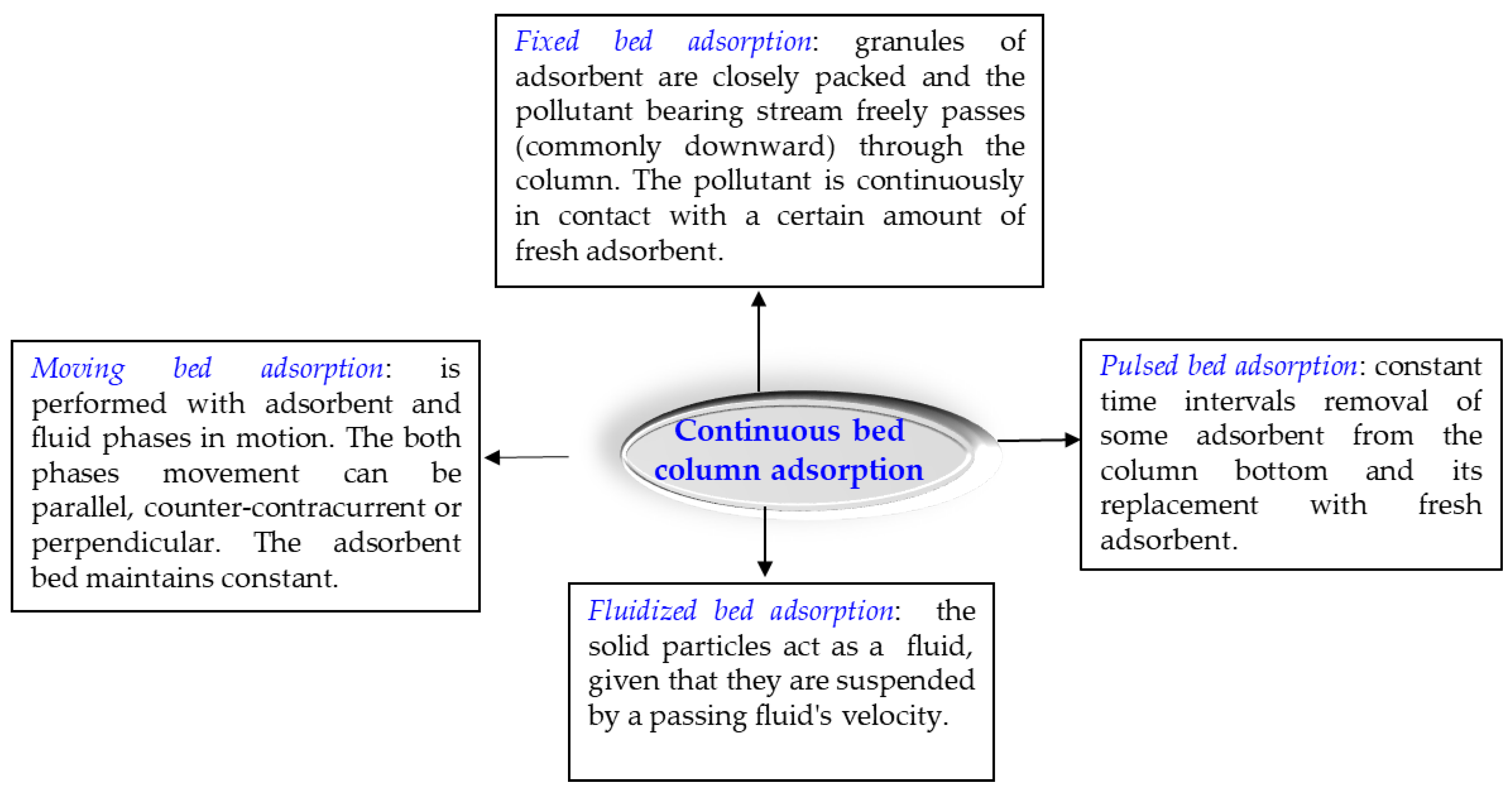
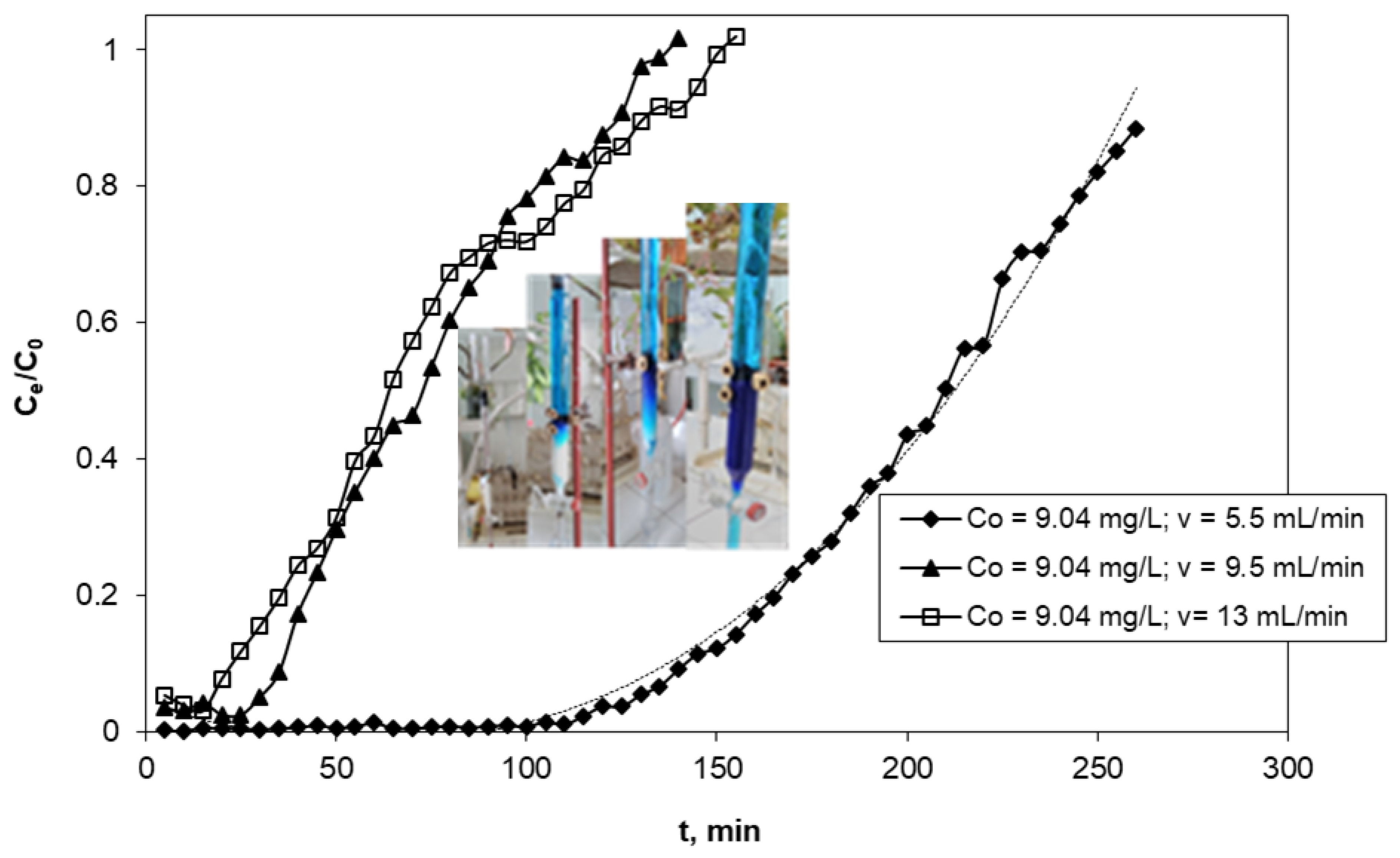
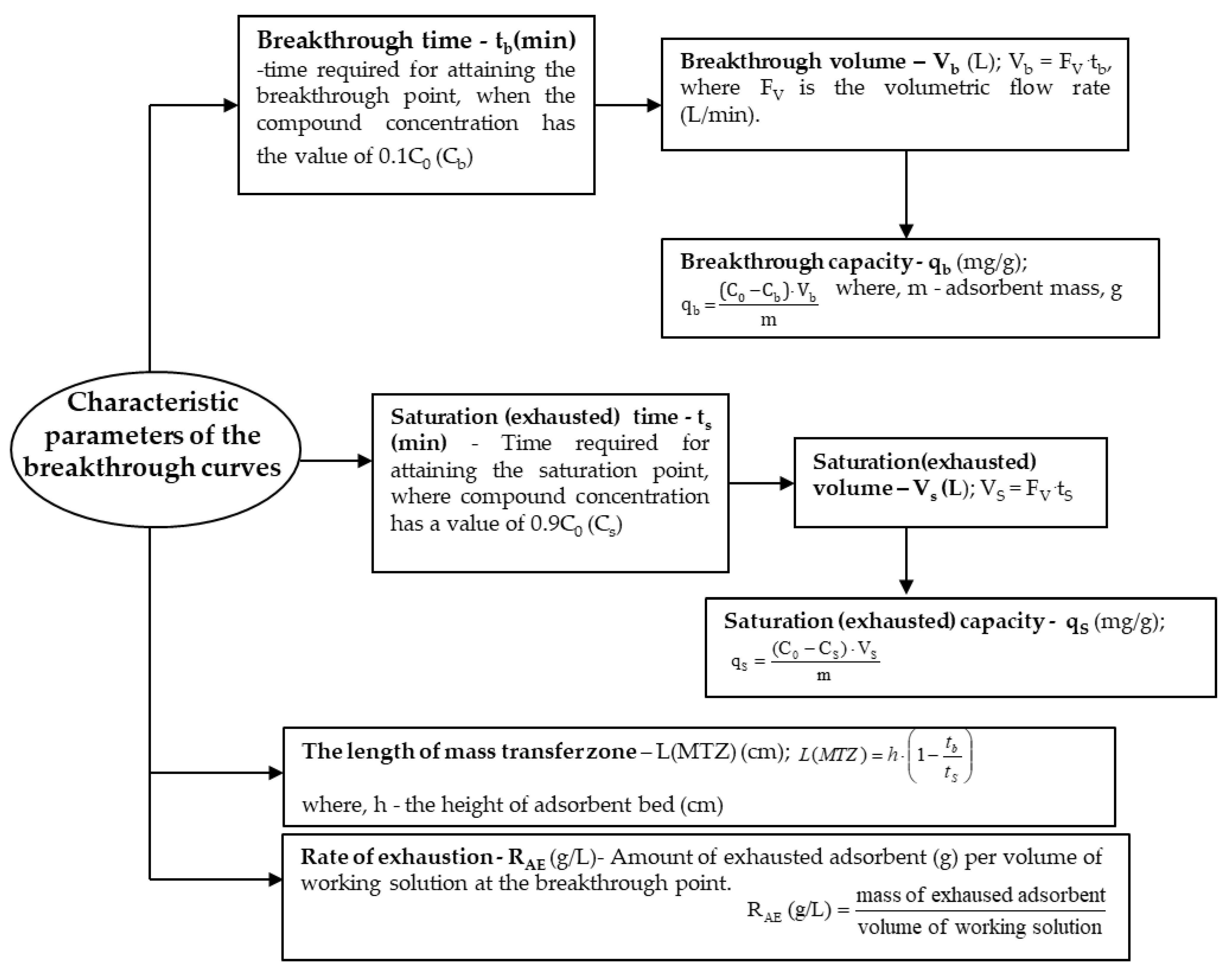
Disclaimer/Publisher’s Note: The statements, opinions and data contained in all publications are solely those of the individual author(s) and contributor(s) and not of MDPI and/or the editor(s). MDPI and/or the editor(s) disclaim responsibility for any injury to people or property resulting from any ideas, methods, instructions or products referred to in the content. |
© 2023 by the authors. Licensee MDPI, Basel, Switzerland. This article is an open access article distributed under the terms and conditions of the Creative Commons Attribution (CC BY) license (https://creativecommons.org/licenses/by/4.0/).