Phytochemical Composition and Enzyme Inhibition Studies of Buxus papillosa C.K. Schneid


 ,
,  ,
,  ,
,
Abstract
1. Introduction
2. Results and Discussion
2.1. HPLC-PDA Analysis
2.2. UHPLC-MS Secondary Metabolites Analysis
2.3. Enzyme Inhibition Potential
3. Materials and Methods
3.1. Plant Material and Extraction
3.2. Phytochemical Composition
3.3. Enzyme Assays
3.4. Statistical Analysis
4. Conclusions
Supplementary Materials
Author Contributions
Funding
Acknowledgments
Conflicts of Interest
References
- Shendge, P.N.; Belemkar, S. Therapeutic potential of Luffa acutangula: A Review on Its traditional uses, phytochemistry, pharmacology and toxicological aspects. Front. Pharmacol. 2018, 9, 1177. [Google Scholar] [CrossRef] [PubMed]
- Cheng, J.-X.; Zhang, B.-D.; Zhu, W.-F.; Zhang, C.-F.; Qin, Y.-M.; Abe, M.; Akihisa, T.; Liu, W.-Y.; Feng, F.; Zhang, J. Traditional uses, phytochemistry, and pharmacology of Ficus hispida Lf: A review. J. Ethnopharmacol. 2019, 248, 112204. [Google Scholar] [CrossRef] [PubMed]
- Geethangili, M.; Ding, S.-T. A review of the phytochemistry and pharmacology of Phyllanthus urinaria L. Front. Pharmacol. 2018, 9, 1109. [Google Scholar] [CrossRef] [PubMed]
- Huang, W.-Y.; Cai, Y.-Z.; Zhang, Y. Natural phenolic compounds from medicinal herbs and dietary plants: Potential use for cancer prevention. Nutr. Cancer 2009, 62, 1–20. [Google Scholar] [CrossRef] [PubMed]
- Silva, N.; Fernandes Júnior, A. Biological properties of medicinal plants: A review of their antimicrobial activity. J. Venom. Anim. Toxins Incl. Trop. Dis. 2010, 16, 402–413. [Google Scholar] [CrossRef]
- Lin, D.; Xiao, M.; Zhao, J.; Li, Z.; Xing, B.; Li, X.; Kong, M.; Li, L.; Zhang, Q.; Liu, Y. An overview of plant phenolic compounds and their importance in human nutrition and management of type 2 diabetes. Molecules 2016, 21, 1374. [Google Scholar] [CrossRef] [PubMed]
- Bouriche, H.; Moussaoui, S.; Meziti, H.; Senator, A. Anti-inflammatory activity of methanolic extract of Santolina chamaecyparissus. In Proceedings of the International Symposium on Medicinal Plants and Natural Products 1098, Montreal, QC, Canada, 17–19 June 2013; pp. 23–30. [Google Scholar]
- Balunas, M.J.; Kinghorn, A.D. Drug discovery from medicinal plants. Life Sci. 2005, 78, 431–441. [Google Scholar] [CrossRef] [PubMed]
- Hamilton, A.C. Medicinal plants, conservation and livelihoods. Biodivers. Conserv. 2004, 13, 1477–1517. [Google Scholar] [CrossRef]
- Zengin, G.; Uysal, A.; Aktumsek, A.; Mocan, A.; Mollica, A.; Locatelli, M.; Custodio, L.; Neng, N.R.; Nogueira, J.M.; Aumeeruddy-Elalfi, Z. Euphorbia denticulata Lam.: A promising source of phyto-pharmaceuticals for the development of novel functional formulations. Biomed. Pharmacother. 2017, 87, 27–36. [Google Scholar] [CrossRef] [PubMed]
- Zengin, G.; Sarikurkcu, C.; Aktumsek, A.; Ceylan, R.; Ceylan, O. A comprehensive study on phytochemical characterization of Haplophyllum myrtifolium Boiss. endemic to Turkey and its inhibitory potential against key enzymes involved in Alzheimer, skin diseases and type II diabetes. Ind. Crop. Prod. 2014, 53, 244–251. [Google Scholar] [CrossRef]
- Mocan, A.; Vlase, L.; Arsene, A.L.; Vodnar, D.; Bischin, C.; Silaghi-Dumitrescu, R.; Crișan, G. HPLC/MS analysis of caffeic and chlorogenic acids from three Romanian Veronica species and their antioxidant and antimicrobial proprieties. Farmacia 2015, 63, 890–896. [Google Scholar]
- Llorent-Martínez, E.; Ortega-Barrales, P.; Zengin, G.; Uysal, S.; Ceylan, R.; Guler, G.; Mocan, A.; Aktumsek, A. Lathyrus aureus and Lathyrus pratensis: Characterization of phytochemical profiles by liquid chromatography-mass spectrometry, and evaluation of their enzyme inhibitory and antioxidant activities. RSC Adv. 2016, 6, 88996–89006. [Google Scholar] [CrossRef]
- Khan, A.-U.; Ali, S.; Gilani, A.-H.; Ahmed, M.; Choudhary, M.I. Antispasmodic, bronchodilator, vasorelaxant and cardiosuppressant effects of Buxus papillosa. BMC Complementary Altern. Med. 2017, 17, 54. [Google Scholar] [CrossRef] [PubMed]
- Loru, F.; Duval, D.; Aumelas, A.; Akeb, F.; Guédon, D.; Guedj, R. Four steroidal alkaloids from the leaves of Buxus sempervirens. Phytochemistry 2000, 54, 951–957. [Google Scholar] [CrossRef]
- Yan, Y.X.; Chen, J.C.; Sun, Y.; Wang, Y.Y.; Su, J.; Li, Y.; Qiu, M.H. Triterpenoid alkaloids from Buxus microphylla. Chem. Biodivers. 2010, 7, 1822–1827. [Google Scholar] [CrossRef]
- Yan, Y.-X.; Hu, X.-D.; Chen, J.-C.; Sun, Y.; Zhang, X.-M.; Qing, C.; Qiu, M.-H. Cytotoxic triterpenoid alkaloids from Buxus microphylla. J. Nat. Prod. 2009, 72, 308–311. [Google Scholar] [CrossRef]
- Choudhary, M.I.; Shahnaz, S.; Parveen, S.; Khalid, A.; Majeed Ayatollahi, S.A.; Atta, U.-R.; Parvez, M. New Triterpenoid alkaloid cholinesterase inhibitors from Buxus h yrcana. J. Nat. Prod. 2003, 66, 739–742. [Google Scholar] [CrossRef]
- Atta-ur-Rahman, M.; Choudhary, S.; Naz, A.; Ata, B. Sener and S. Turkoz. J. Nat. Prod. 1997, 60, 770. [Google Scholar] [CrossRef]
- Matochko, W.L.; James, A.; Lam, C.W.; Kozera, D.J.; Ata, A.; Gengan, R.M. Triterpenoidal alkaloids from Buxus natalensis and their acetylcholinesterase inhibitory activity. J. Nat. Prod. 2010, 73, 1858–1862. [Google Scholar] [CrossRef]
- Ata, A.; Iverson, C.D.; Kalhari, K.S.; Akhter, S.; Betteridge, J.; Meshkatalsadat, M.H.; Orhan, I.; Sener, B. Triterpenoidal alkaloids from Buxus hyrcana and their enzyme inhibitory, anti-fungal and anti-leishmanial activities. Phytochemistry 2010, 71, 1780–1786. [Google Scholar] [CrossRef]
- Cordell, G.A. Introduction to Alkaloids: A Biogenetic Approach; Wiley New York: Hoboken, NJ, USA, 1981. [Google Scholar]
- Asif, E.; Ali, S.S.; Nasir, H.; Jamal, S.A.; Ata, A.; Farooq, A.; Choudhary, M.I.; Sener, B.; Turkoz, S. New steroidal alkaloids from the roots of Buxus papillosa. J. Nat. Prod. 1992, 55, 1063–1066. [Google Scholar]
- Saleem, H.; Htar, T.T.; Naidu, R.; Ahmad, I.; Zengin, G.; Ahmad, M.; Ahemad, N. Investigations into the therapeutic effects of aerial and stem parts of Buxus papillosa CK Schneid: In vitro chemical, biological and toxicological perspectives. J. Pharm. Biomed. Anal. 2019, 166, 128–138. [Google Scholar] [CrossRef] [PubMed]
- Mocan, A.; Zengin, G.; Mollica, A.; Uysal, A.; Gunes, E.; Crişan, G.; Aktumsek, A. Biological effects and chemical characterization of Iris schachtii Markgr. extracts: A new source of bioactive constituents. Food Chem. Toxicol. 2018, 112, 448–457. [Google Scholar] [CrossRef] [PubMed]
- Yerlikaya, S.; Zengin, G.; Mollica, A.; Baloglu, M.C.; Celik Altunoglu, Y.; Aktumsek, A. A multidirectional perspective for novel functional products: In vitro pharmacological activities and in silico studies on Ononis natrix subsp. hispanica. Front. Pharmacol. 2017, 8, 600. [Google Scholar] [CrossRef] [PubMed]
- Ozer, M.S.; Sarikurkcu, C.; Tepe, B. Phenolic composition, antioxidant and enzyme inhibitory activities of ethanol and water extracts of Chenopodium botrys. RSC Adv. 2016, 6, 64986–64992. [Google Scholar] [CrossRef]
- Melucci, D.; Locatelli, M.; Locatelli, C.; Zappi, A.; De Laurentiis, F.; Carradori, S.; Campestre, C.; Leporini, L.; Zengin, G.; Picot, C. A comparative assessment of biological effects and chemical profile of Italian Asphodeline lutea extracts. Molecules 2018, 23, 461. [Google Scholar] [CrossRef]
- Mocan, A.; Zengin, G.; Simirgiotis, M.; Schafberg, M.; Mollica, A.; Vodnar, D.C.; Crişan, G.; Rohn, S. Functional constituents of wild and cultivated Goji (L. barbarum L.) leaves: Phytochemical characterization, biological profile, and computational studies. J. Enzym. Inhib. Med. Chem. 2017, 32, 153–168. [Google Scholar] [CrossRef]
- Picot, M.C.N.; Mahomoodally, M.F. Effects of Aphloia theiformis on key enzymes related to diabetes mellitus. Pharm. Biol. 2017, 55, 864–872. [Google Scholar] [CrossRef]
- Sari, A.C.; Elya, B. Antioxidant activity and lipoxygenase enzyme inhibition assay with total flavonoid assay of Garcinia porrecta Laness. stem bark extracts. Pharmacogn. J. 2017, 9, 257–266. [Google Scholar] [CrossRef]
- Zengin, G.; Cvetanović, A.; Gašić, U.; Stupar, A.; Bulut, G.; Senkardes, I.; Dogan, A.; Seebaluck-Sandoram, R.; Rengasamy, K.R.; Sinan, K.I. Chemical composition and bio-functional perspectives of Erica arborea L. extracts obtained by different extraction techniques: Innovative insights. Ind. Crop. Prod. 2019, 142, 111843. [Google Scholar] [CrossRef]
- Locatelli, M.; Zengin, G.; Uysal, A.; Carradori, S.; De Luca, E.; Bellagamba, G.; Aktumsek, A.; Lazarova, I. Multicomponent pattern and biological activities of seven Asphodeline taxa: Potential sources of natural-functional ingredients for bioactive formulations. J. Enzym. Inhib. Med. Chem. 2017, 32, 60–67. [Google Scholar] [CrossRef] [PubMed]
- Di Sotto, A.; Di Giacomo, S.; Amatore, D.; Locatelli, M.; Vitalone, A.; Toniolo, C.; Rotino, G.; Lo Scalzo, R.; Palamara, A.; Marcocci, M. A polyphenol rich extract from Solanum melongena L. DR2 peel exhibits antioxidant properties and anti-herpes simplex virus type 1 activity in vitro. Molecules 2018, 23, 2066. [Google Scholar] [CrossRef] [PubMed]
- Saleem, H.; Htar, T.T.; Naidu, R.; Nawawi, N.S.; Ahmad, I.; Ashraf, M.; Ahemad, N. Biological, chemical and toxicological perspectives on aerial and roots of Filago germanica (L.) huds: Functional approaches for novel phyto-pharmaceuticals. Food Chem. Toxicol. 2019, 123, 363–373. [Google Scholar] [CrossRef] [PubMed]
- Savran, A.; Zengin, G.; Aktumsek, A.; Mocan, A.; Glamoćlija, J.; Ćirić, A.; Soković, M. Phenolic compounds and biological effects of edible Rumex scutatus and Pseudosempervivum sempervivum: Potential sources of natural agents with health benefits. Food Funct. 2016, 7, 3252–3262. [Google Scholar] [CrossRef] [PubMed]
- Baylac, S.; Racine, P. Inhibition of 5-lipoxygenase by essential oils and other natural fragrant extracts. Int. J. Aromather. 2003, 13, 138–142. [Google Scholar] [CrossRef]


| Phenolic Compounds (μg/g Sample) | B. papillosa Extracts | |||||
|---|---|---|---|---|---|---|
| Aerial-MeOH | Aerial-DCM | Aerial-Hexane | Stem-MeOH | Stem-DCM | Stem-Hexane | |
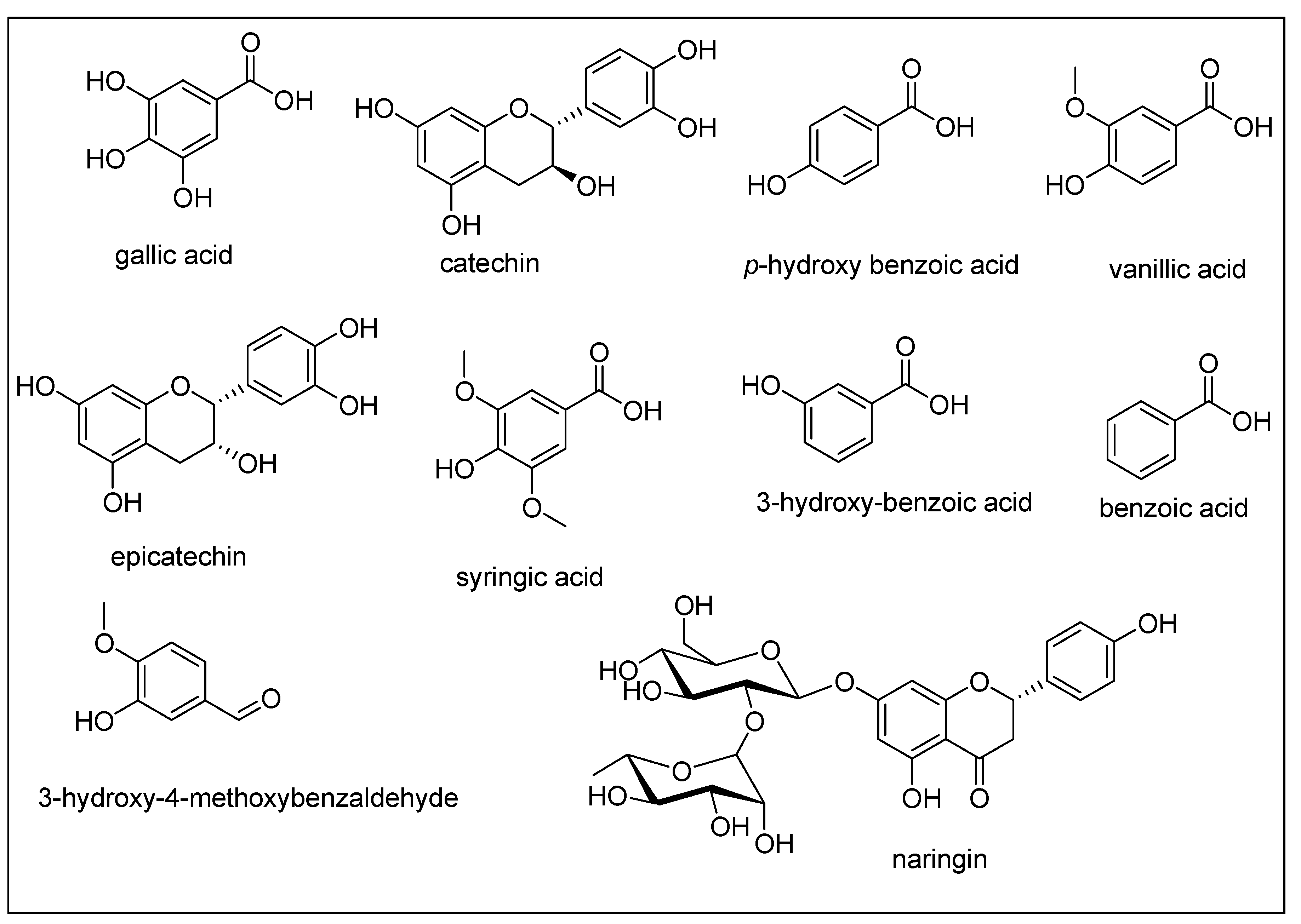
| Gallic acid | nd | nd | nd | BLQ | nd | nd |
| Catechin | 7.62 ± 0.45 | 2.39 ± 0.51 | nd | nd | nd | nd |
| p- hydroxybenzoic acid | nd | nd | nd | 1.06 ± 0.21 | nd | nd |
| Vanillic acid | nd | BLD | nd | nd | nd | nd |
| Epicatechin | nd | 2.76 ± 0.32 | nd | nd | nd | nd |
| Syringic acid | nd | 0.77 ± 0.06 | nd | nd | 0.24 ± 0.02 | nd |
| 3-hydroxy benzoic acid | nd | nd | nd | 0.59 ± 0.06 | nd | nd |
| 3-hydroxy-4-methoxy benzaldehyde | nd | nd | nd | nd | 0.38 ± 0.04 | nd |
| Naringin | BLD | nd | nd | nd | nd | 0.45 ± 0.04 |
| Benzoic acid | nd | 0.47 ± 0.04 | nd | nd | nd | nd |
| S. No | RT (min) | B. Peak (m/z) | Tentative Identification | Comp. Class | Mol. Mass | Mol. Formula |
|---|---|---|---|---|---|---|
| Negative Ionization | ||||||
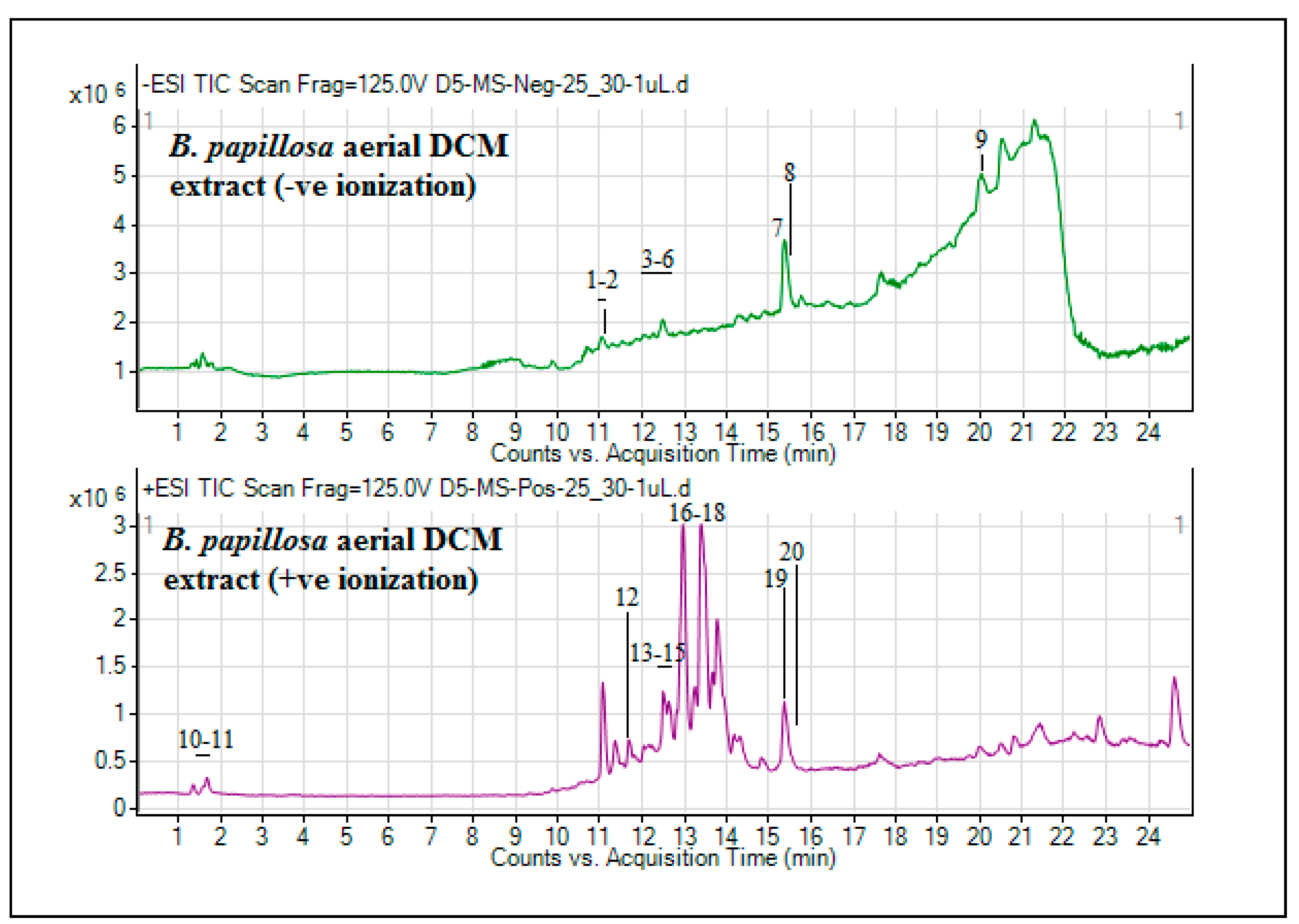
| 1 | 11.014 | 579.2159 | (+)-Syringaresinol O-beta-d-glucoside | Phenolic | 580.2159 | C28H36O13 |
| 2 | 11.029 | 415.2045 | Ethyl 7-epi-12-hydroxyjasmonate glucoside | Glucoside | 416.2045 | C20H32O9 |
| 3 | 12.041 | 577.2003 | Podorhizol beta-d-glucoside | Glucoside | 578.2003 | C28H34O13 |
| 4 | 12.435 | 551.1489 | 1-Hydroxy-3-methoxy-7-primeverosyloxyxanthone | Xanthone glycosides | 552.1489 | C25H28O14 |
| 5 | 12.495 | 581.1594 | 5,7,3’,4’-Tetrahydroxyflavanone7-alpha-l-arabinofuranosyl-(1->6)-glucoside | Flavonoid | 582.1594 | C26H30O15 |
| 6 | 12.695 | 137.0321 | p-Salicylic acid | Phenolic | 138.0321 | C7H6O3 |
| 7 | 15.375 | 343.0908 | Wightin | Flavonoid | 344.0908 | C18H16O7 |
| 8 | 15.554 | 373.1002 | 8-Methoxycirsilineol | Flavonoid | 374.1002 | C19H18O8 |
| 9 | 20.018 | 681.4297 | Cyclopassifloside II | Triterpene | 682.4297 | C37H62O11 |
| Positive ionization | ||||||
| 10 | 1.589 | 160.09 | Calystegine A7 | Alkaloid | 159.09 | C7H13NO3 |
| 11 | 1.687 | 144.0948 | 3beta,6beta-Dihydroxynortropane | Alkaloid | 143.0948 | C7H13NO2 |
| 12 | 11.73 | 197.1101 | 4-(2-hydroxypropoxy)-3,5-dimethyl-Phenol | Phenol | 196.1101 | C11H16O3 |
| 13 | 12.431 | 507.1432 | Morin 3,7,4’-trimethyl ether 2’-glucoside | Glucoside | 506.1432 | C24H26O12 |
| 14 | 12.496 | 537.1532 | Dalpaniculin | Flavonoid | 536.1532 | C25H28O13 |
| 15 | 12.683 | 427.3616 | Nb-Stearoyltryptamine | Alkaloid | 426.3616 | C28H46N2O |
| 16 | 13.393 | 523.4061 | Panaxydol linoleate | Polyacetylenic derivative | 522.4061 | C35H54O3 |
| 17 | 13.459 | 525.4223 | Flavidulol D | Phenol | 524.4223 | C35H56O3 |
| 18 | 13.498 | 362.3339 | 2,4,8-Eicosatrienoic acid isobutylamide | Alkaloid | 361.3339 | C24H43NO |
| 19 | 15.383 | 345.09 | Wightin | Flavonoid | 344.09 | C18H16O7 |
| 20 | 15.566 | 375.1005 | 8-Methoxycirsilineol | Flavonoid | 374.1005 | C19H18O8 |
| S. No | RT (min) | B. Peak (m/z) | Tentative Identification | Comp. Class | Mol. Mass | Mol. Formula |
|---|---|---|---|---|---|---|
| Negative ionization | ||||||
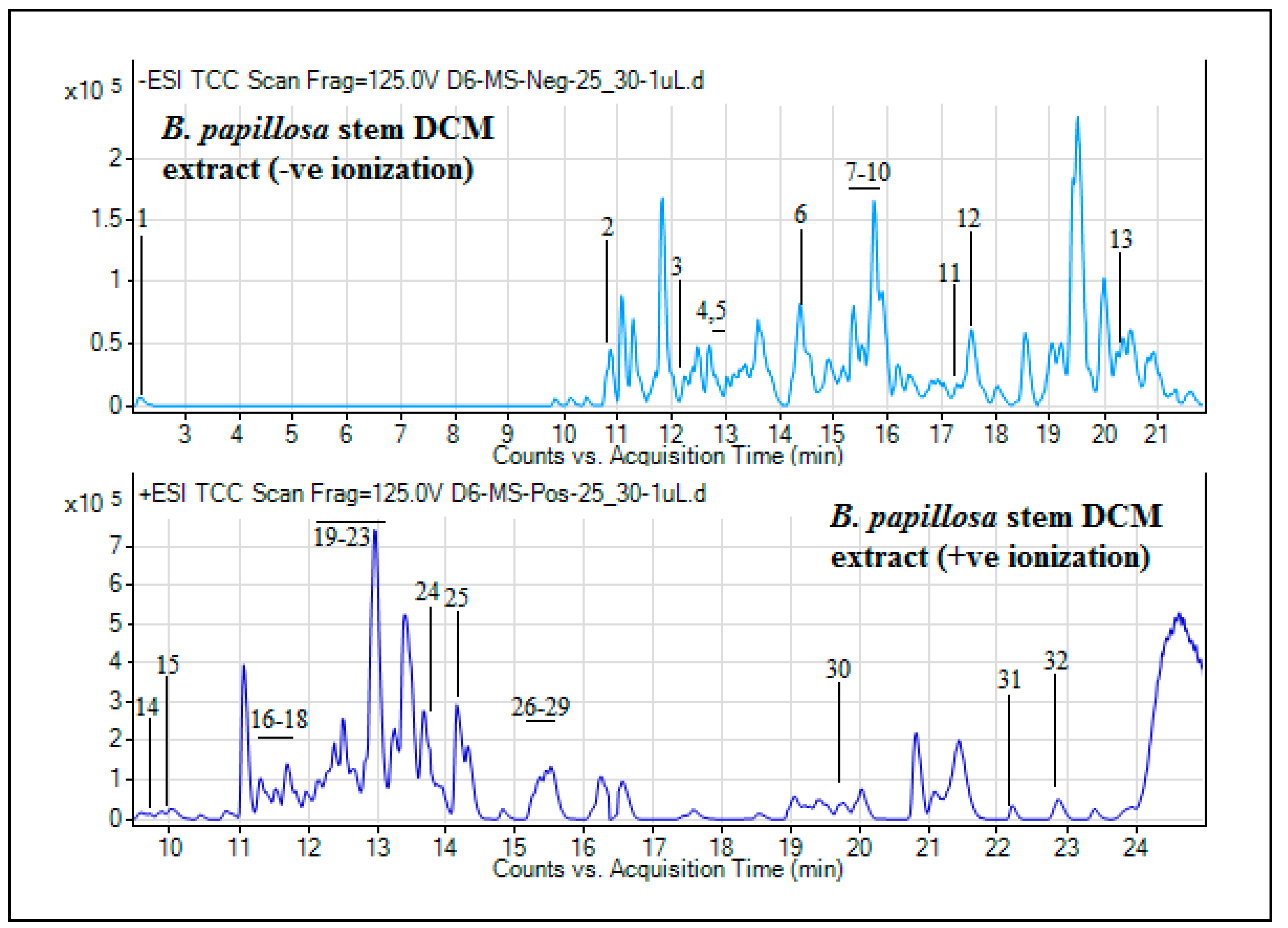
| 1 | 2.176 | 192.027 | Citric acid | Organic acid | 192.027 | C6H8O7 |
| 2 | 10.888 | 174.0892 | Suberic acid | Organic acid | 174.0892 | C8H14O4 |
| 3 | 12.27 | 522.1391 | Chrysosplenoside D | Flavonoid | 522.1391 | C24H26O13 |
| 4 | 12.834 | 386.1011 | Melisimplexin | Flavonoid | 386.1011 | C20H18O8 |
| 5 | 12.87 | 588.401 | 22-Angeloyltheasapogenol A | Triterpenoid | 588.401 | C35H56O7 |
| 6 | 14.388 | 340.2158 | 14,19-Dihydroaspidospermatine | Alkaloid | 340.2158 | C21H28N2O2 |
| 7 | 15.262 | 287.2465 | Prosopinine | Alkaloid | 287.2465 | C16H33NO3 |
| 8 | 15.375 | 344.0901 | Wightin | Flavonoid | 344.0901 | C18H16O7 |
| 9 | 15.559 | 374.0998 | 8-Methoxycirsilineol | Flavonoid | 374.0998 | C19H18O8 |
| 10 | 15.776 | 357.1804 | Uplandicine | Alkaloid | 357.1804 | C17H27NO7 |
| 11 | 17.285 | 488.3486 | Arjunolic acid | Triterpenoid | 488.3486 | C30H48O5 |
| 12 | 17.573 | 472.3548 | Lucidumol A | Triterpene | 472.3548 | C30H48O4 |
| 13 | 20.24 | 486.3345 | Quillaic acid | Triterpene | 486.3345 | C30H46O5 |
| Positive ionization | ||||||
| 14 | 9.584 | 387.3314 | Cyclobuxine D | Alkaloid | 386.3314 | C25H42N2O |
| 15 | 10.046 | 417.377 | Cyclovirobuxine C | Alkaloid | 416.377 | C27H48N2O |
| 16 | 11.358 | 364.3144 | Terminaline | Alkaloid | 363.3144 | C23H41NO2 |
| 17 | 11.436 | 553.3897 | Furohyperforin | Phloroglucinol | 552.3897 | C35H52O5 |
| 18 | 11.735 | 197.1103 | 4-(2-Hydroxypropoxy)-3,5-dimethyl-phenol | Phenol | 196.1103 | C11H16O3 |
| 19 | 12.115 | 431.3552 | Solanocapsine | Alkaloid | 430.3552 | C27H46N2O2 |
| 20 | 12.499 | 537.1533 | Dalpaniculin | Flavonoid | 536.1533 | C25H28O13 |
| 21 | 12.743 | 340.2561 | Evocarpine | Alkaloid | 339.2561 | C23H33NO |
| 22 | 12.923 | 523.4056 | Panaxydol linoleate | Polyacetylenic derivative | 522.4056 | C35H54O3 |
| 23 | 13.046 | 387.101 | Melisimplexin | Flavonoid | 386.101 | C20H18O8 |
| 24 | 13.899 | 583.4064 | 4-Ketolutein D | Carotenoid | 582.4064 | C40H54O3 |
| 25 | 14.252 | 230.2405 | Xestoaminol C | Vitamin | 229.2405 | C14H31NO |
| 26 | 15.264 | 288.2458 | Prosopinine | Alkaloid | 287.2458 | C16H33NO3 |
| 27 | 15.375 | 345.0903 | Wightin | Flavonoid | 344.0903 | C18H16O7 |
| 28 | 15.473 | 318.1262 | Hemanthidine | Alkaloid | 317.1262 | C17 H19 N O5 |
| 29 | 15.563 | 375.1002 | 8-Methoxycirsilineol | Flavonoid | 374.1002 | C19 H18 O8 |
| 30 | 19.752 | 279.1531 | Emmotin A | Sesquiterpenoid | 278.1531 | C16 H22 O4 |
| 31 | 22.219 | 349.1101 | Camptothecin | Alkaloid | 348.1101 | C20 H16 N2 O4 |
| 32 | 22.85 | 593.2707 | Pheophorbide a | Chlorophyll derivative | 592.2707 | C35 H36 N4 O5 |
| Extracts | Tyrosinase (mg KAE/g Extract) | α-Amylase (mmol ACAE/g Extract) | Lipoxygenase | |
|---|---|---|---|---|
| (% Inhibition; 0.5 mg/mL) | IC50 (µg/mL) | |||
| Aerial-MeOH | 25.87 ± 0.28 b,c | 0.08 ± 0.01 c | 13.4 ± 1.5 | >500 ** |
| Aerial-DCM | 24.40 ± 0.52 d | 0.04 ± 0.01 d | 12.3 ± 1.4 | >500 |
| Aerial-hexane | 25.15 ± 0.26 c,d | 0.13 ± 0.01 a | 42.6 ± 1.5 | >500 |
| Stem-MeOH | 25.99 ± 0.27 b | 0.11 ± 0.01 b | 9.4 ± 1.6 | >500 |
| Stem-DCM | 27.14 ± 0.17 a | 0.11 ± 0.01 a,b | 4.7 ± 1.7 | >500 |
| Stem-hexane | 26.62 ± 0.05 a,b | 0.12 ± 0.01 a,b | 12.5 ± 1.6 | >500 |
| Quercetin | nt | nt | 89.2 ± 0.6 | 2.3 ± 0.3 (µM) |
© 2020 by the authors. Licensee MDPI, Basel, Switzerland. This article is an open access article distributed under the terms and conditions of the Creative Commons Attribution (CC BY) license (http://creativecommons.org/licenses/by/4.0/).
Share and Cite
Saleem, H.; Htar, T.T.; Naidu, R.; Zengin, G.; Locatelli, M.; Tartaglia, A.; Zainal Abidin, S.A.; Ahemad, N. Phytochemical Composition and Enzyme Inhibition Studies of Buxus papillosa C.K. Schneid. Processes 2020, 8, 757. https://doi.org/10.3390/pr8070757
Saleem H, Htar TT, Naidu R, Zengin G, Locatelli M, Tartaglia A, Zainal Abidin SA, Ahemad N. Phytochemical Composition and Enzyme Inhibition Studies of Buxus papillosa C.K. Schneid. Processes. 2020; 8(7):757. https://doi.org/10.3390/pr8070757
Chicago/Turabian StyleSaleem, Hammad, Thet Thet Htar, Rakesh Naidu, Gokhan Zengin, Marcello Locatelli, Angela Tartaglia, Syafiq Asnawi Zainal Abidin, and Nafees Ahemad. 2020. "Phytochemical Composition and Enzyme Inhibition Studies of Buxus papillosa C.K. Schneid" Processes 8, no. 7: 757. https://doi.org/10.3390/pr8070757
APA StyleSaleem, H., Htar, T. T., Naidu, R., Zengin, G., Locatelli, M., Tartaglia, A., Zainal Abidin, S. A., & Ahemad, N. (2020). Phytochemical Composition and Enzyme Inhibition Studies of Buxus papillosa C.K. Schneid. Processes, 8(7), 757. https://doi.org/10.3390/pr8070757