


Abstract
The rapid expansion of anaerobic digestion (AD) as a key technology for producing renewable energy has led to a substantial increase in digestate generation. This has intensified the need for sustainable management strategies that align with circular economy principles. While the solid fraction of digestate (SD) is traditionally applied to land or composted, its heterogeneous composition, regulatory constraints, and handling challenges restrict its wider use. This review aims to clarify the current state of SD treatment and highlight emerging opportunities to convert this underexploited resource into value-added bioproducts. A systematic bibliographic analysis of the past decade was conducted to identify consolidated and emerging SD valorisation technologies, supported by an evaluation of EU-level regulatory frameworks and the role of mechanical solid–liquid separation in enabling downstream valorisation. In addition, a comprehensive comparative table compiling physicochemical characterisation data of SD from various feedstocks and separation methods is presented, emphasising the significant variability in composition and its implications for valorisation pathways. The results show that, while composting and thermochemical routes, particularly pyrolysis, remain predominant, novel approaches such as advanced drying, pelletisation, vermicomposting, insect bioconversion, and fermentation-based pathways (including submerged and solid-state fermentation) are rapidly gaining interest. These emerging technologies enable the production of high-value products such as biochar, pellets, enzymes, microbial biopesticides, protein sources, and fungal biomass. However, their adoption is currently limited by feedstock heterogeneity, process complexity, scalability constraints, and economic considerations. Overall, SD is a versatile feedstock whose valorisation is expanding beyond agricultural applications. However, regulatory harmonisation, quality assurance, and process optimisation are still needed to encourage industrial uptake and to fully integrate SD into circular bioeconomy frameworks.
1. Introduction
The growing volume of waste produced by domestic activities, industry and agriculture poses a significant threat to sustainable development, resulting in far-reaching environmental and socio-economic consequences. These pressures are expected to intensify as the global population continues to grow. Therefore, transitioning from the current linear “cradle-to-grave” production model to a circular economy paradigm is therefore essential. In a circular economy, materials are not considered waste, but rather resources that can be continuously recycled, thereby reducing environmental impacts and enhancing resource efficiency [1].
In this context, anaerobic digestion (AD) has proven to be a promising technology for the efficient management of organic waste and the production of renewable energy. In AD, microorganisms break down the organic matter in the absence of oxygen to produce biogas and a nutrient-rich by-product known as digestate [2]. When properly managed, digestate can serve as an organic amendment or fertiliser, enabling nutrient recovery while mitigating environmental risks. Furthermore, controlled anaerobic decomposition substantially reduces odour emissions and the release of harmful gases compared to the uncontrolled degradation of raw organic waste.
Digestate production has increased markedly in recent years. According to the European Biogas Association (EBA), around 31 million tonnes of digestate dry matter (DM) were produced in Europe in 2022 [3]. This figure is expected to rise substantially, driven by the need to increase biomethane production to meet the European Union’s clean energy targets. The REPowerEU plan requires the production of 35 billion cubic metres of biomethane via AD by 2030 [4]. The rapid expansion of AD and biomethane production will lead to unprecedented volumes of digestate, increasing the need for sustainable and economically viable management strategies. Meanwhile, regulatory constraints, logistical limitations, and regional nutrient surpluses are progressively challenging the traditional reliance on direct land application, thereby highlighting the need for alternative valorisation pathways [5].
During AD, most of the biodegradable organic material is converted into biogas. The remaining organic matter is found in three main forms [6]. (1) The poorly biodegradable or stable organic fraction, which is predominantly composed of lignin and cellulose and contributes humus formation. (2) Living organic matter composed of microorganisms that mineralise organic elements into minerals accessible to plants. (3) The biodegradable fraction, which consists of highly mineralisable matter, such as hemicellulose and sugars. This provides energy and nutrients for earthworms and bacteria in the soil.
Due to its high nitrogen, phosphorus, potassium, and organic matter content, digestate can reduce reliance on synthetic fertilisers, the production and overuse of which are associated with negative environmental and health impacts [7]. The organic fraction also improves the physical and biological properties of soil, including humus formation, water and nutrient retention, and microbial activity [8]. However, to ensure agronomic efficiency and prevent pathogen transmission, appropriate stabilisation or sanitisation treatments are essential, particularly to avoid nutrient losses through volatilisation and leaching. Despite its agronomic advantages, the application of digestate faces several limitations. These include variability in quality depending on the feedstock and process conditions, public acceptance issues related to odour and health risks, and the potential for heavy metals and emerging contaminants to accumulate in soil over time through repeated application [6,7].
To date, the most common and cost-effective digestate management strategy remains agricultural application, which enhances the economic viability of anaerobic digestion (AD) and supports nutrient recycling to soils [9]. Direct field application, often on land managed by the plant operator, remains widespread [10]. However, the high water content of raw digestate makes transportation costly. Therefore, it is typically separated mechanically into liquid and solid fractions to facilitate handling, storage and potential downstream applications. The liquid fraction contains most of the nitrogen and potassium, while the solid fraction contains residual fibres and phosphorus [11]. Depending on the characteristics of the feedstock and the separation technology used, the solid fraction typically represents approximately 20–30% of the digestate mass on a wet basis. Solid digestate (SD) is usually composted or dried for reuse, but with the right treatment, it can be used to produce high-value bioproducts.
Several reviews have addressed digestate management, primarily focusing on agronomic reuse, nutrient recovery, or energy-oriented pathways, and frequently considering digestate in its entirety [12]. However, a systematic analysis dedicated to emerging technologies that specifically target the valorisation of the solid fraction of digestate for the production of value-added bioproducts is still lacking. This review aims to this gap by critically evaluating current treatment strategies and novel valorisation routes for solid digestate, providing an updated and focused perspective that complements existing literature. Throughout this review, the term ‘digestate’ refers to all the material obtained as a direct by-product of AD, prior to any separation or processing. Specific references to the solid or liquid fractions are made when relevant.
2. Legal Framework for Digestate at EU Level
The suitability of digestate for direct application to soil depends strongly on the characteristics of the AD feedstock and process conditions, as these influence its microbial load, chemical composition, and potential phytotoxicity [2]. In 2022, around 73% of digestate in Europe was applied directly to agricultural land, while a further 15% was upgraded prior to us [3]. However, direct application can lead to emission of residual methane, ammonia, hydrogen sulphide, and odorous compounds, and phytotoxicity may occur due to volatile fatty acids (VFAs) [13]. As digestate is not fully stabilised, several countries require it to be stored or ponded prior to land application to ensure safer handling and improved agronomic performance.
At the EU level, the management of digestate is governed by a number of complementary regulations designed to balance its benefits as a biofertiliser with its potential environmental and health risks. Key legislative instruments include the Waste Framework Directive, the EU Fertilising Products Regulation, the Animal By-Products Regulation, the Sewage Sludge Directive and the Nitrates Directive. Member States may introduce additional national rules to address local environmental and agricultural requirements, leading to significant variation across the EU.
The Waste Framework Directive (WFD) 2008/98/EC establishes a waste hierarchy, prioritising prevention, reuse, recycling, recovery and disposal. It also provides criteria for determining when a material ceases to be classified as waste. However, implementation varies widely among Member States, with digestate often remaining classified as waste even after undergoing recovery processes.
The EU Fertilising Products Regulation (FPR) (EU) 2019/2009 sets out the requirements for placing EU fertilising products, including recycled organic fertilisers such as compost and digestate, on the market. The regulation introduces Component Material Categories (CMCs), including CMC 4 (fresh crop digestate) and CMC 5 (other digestates). Products that meet the criteria set out in the FPR obtain end-of-waste status. However, digestate and compost derived from sewage sludge are excluded from use as component materials under the FPR.
The diversity of AD feedstocks increases regulatory complexity. Digestate originating from animal by-products is regulated under the Animal By-Products Regulation (ABPR) (EC) No 1069/2009. This regulation defines three risk categories and establishes detailed rules for processing, traceability, permitted uses and disposal. Materials in categories 2 and 3 may be used to produce fertilisers. When digestate is used as a component material under the Feedstuffs Regulation (FPR), the fertilising product is exempt from ABPR requirements, as specified in Delegated Regulation (EU) 2023/1605.
The Sewage Sludge Directive (86/278/EEC) regulates the agricultural use of sewage sludge by imposing limits on the presence of heavy metals and by restricting its application during certain stages of crop growth in order to prevent risks to the soil, plants, animals and humans. While some Member States treat digested sludge as a product under the Water Framework Directive (WFD), others do not, which leads to divergent interpretations and market barriers. Additionally, the Nitrates Directive (91/676/EEC) limits the application of nitrogen, including that from manure-derived digestate, in vulnerable zones to protect water quality. These restrictions sometimes force farmers to supplement or replace organic fertilisers with synthetic ones in order to meet their crops’ nutrient requirements.
Although AD is a key technology for biowaste valorisation, it is not uniformly recognised as a recycling process across the EU. Furthermore, the absence of clear, digestate-specific regulations in several Member States creates uncertainty for producers and users, hindering wider market uptake. Effective harmonisation and simplification of policies are therefore essential in order to support both environmental protection and the practical deployment of digestate-based products.
National legislation also contributes to fragmentation. In Spain, for example, the Waste Law 7/2022 aligns with the FPR’s end-of-waste framework, yet it explicitly excludes compost and digestate derived from sewage sludge from achieving product status [14]. While the Royal Decree 1051/2022 establishes detailed requirements for digestate application to ensure environmental safety, it also introduces administrative burdens, analytical requirements, and economic costs that could limit the competitiveness and accessibility of digestate.
Overall, the EU’s regulatory framework for digestate is complex and inconsistent. There are significant variations between Member States, which depend heavily on the origin of the feedstock. Although the legislation is intended to protect human and environmental health, inconsistencies and exclusions within the framework restrict the broader use and valorisation of digestate, particularly its solid fraction. As legislation defines permissible uses and influences investment and technological development, a more harmonised, innovation-oriented approach is needed to realise digestate’s full potential within the circular bioeconomy.
3. Solid–Liquid Separation
Mechanical solid–liquid separation is typically the first processing step in the digestate management process. The most commonly used techniques include centrifuges, screw presses, and vibrating screens [5,15]. Other methods, such as belt filters, membrane systems, filtration units, and chemical precipitation, may also be employed to improve separation performance [16]. Using flocculants and coagulants can further improve separation efficiency, particularly when combined with high-performance equipment. The efficiency of separation varies across technologies. Centrifuges generally remove dry matter and total phosphorus more effectively than screw presses. When used alongside chemical conditioners, centrifuges can reduce dry matter concentrations in the liquid fraction by up to 30%. However, this increased efficiency comes at the cost of substantially higher energy demand, with centrifuges consuming up to 4.5 times more energy than screw presses [5]. The advantages and disadvantages of common solid–liquid separation techniques for digestate are summarised in Table 1.

Table 1.
Advantages and disadvantages of common solid–liquid separation techniques for digestate.
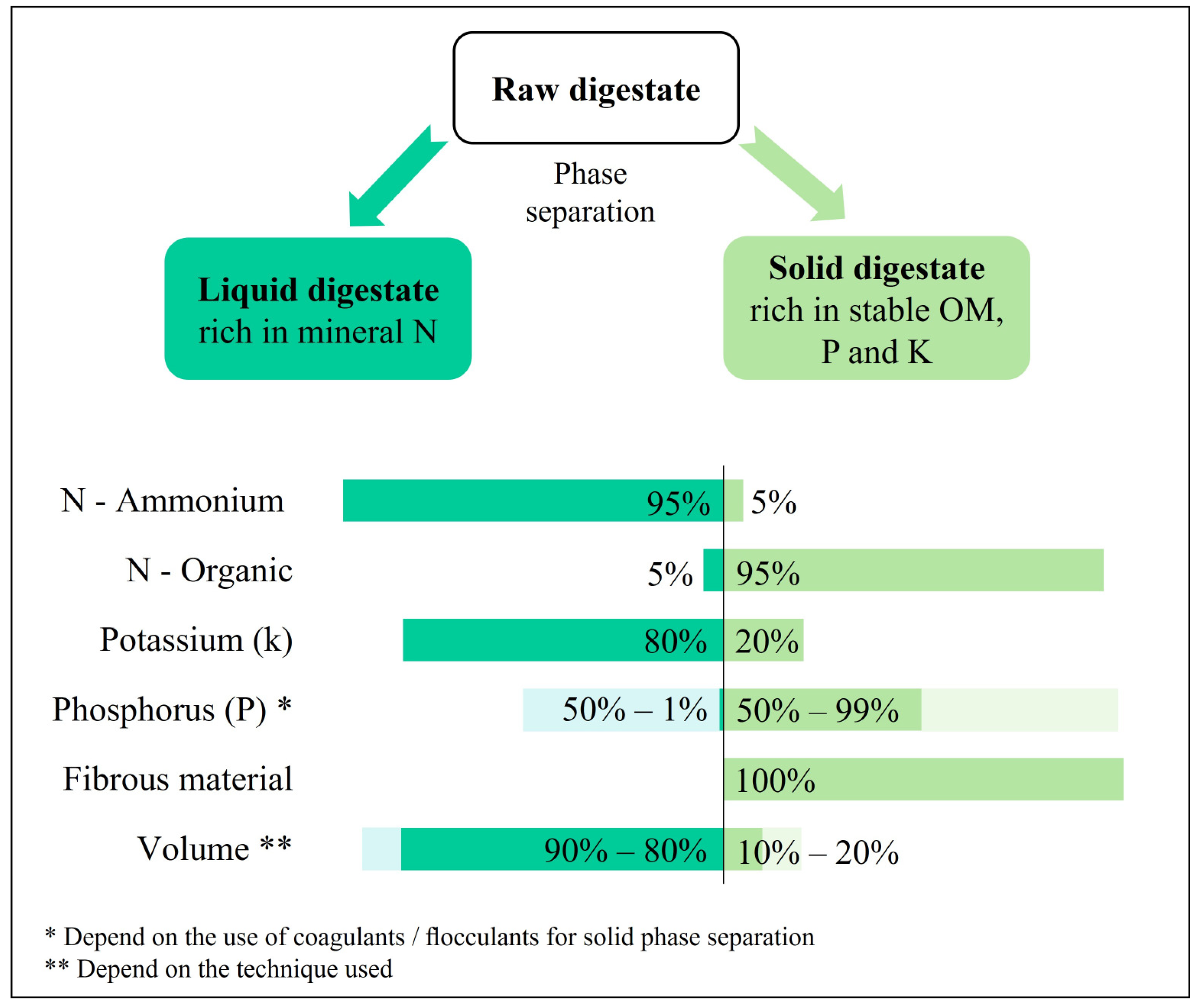
Following separation, the distribution of nutrients between the liquid and solid fractions is uneven (Figure 1). Mineral nitrogen and potassium, which are mainly present as ammonium and potassium ions, respectively, remain predominantly in the liquid fraction. In contrast, the solid fraction is enriched in organic nitrogen, phosphorus, and structural fibres [2,15]. This differentiation enables targeted downstream valorisation, as each fraction can be treated or upgraded to produce value-added products for specific agronomic or industrial applications.
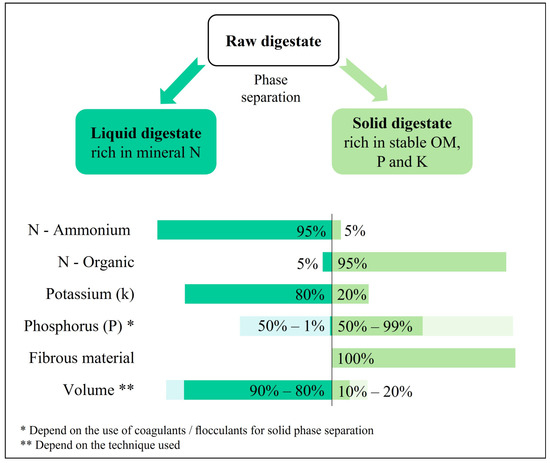
Figure 1.
Distribution of key nutrients and materials between liquid (left, dark green) and solid (right, light green) digestate fractions. Shades indicate ranges depending on separation methods, with darker colors showing minimum and lighter colors maximum values. Percentages for each component sum to 100%. (source: adapted from [3]).
Solid–liquid separation is therefore a key step in digestate management. It improves handling and transport efficiency, as well as treatment flexibility, while generating fractions with distinct physicochemical properties. As previously mentioned, the characteristics of the resulting solid digestate depend on the separation technology and conditioning applied and therefore directly influence its suitability for downstream valorisation. Solids rich in organic matter are more suitable for biological processes, such as solid-state fermentation, whereas drier, and more mineral-rich solids are better suited to thermochemical pathways, including pyrolysis and hydrothermal conversion. Consequently, choosing the right separation strategy is important for enabling targeted solid digestate valorisation.
Solid Digestate Characteristics
Table 2 summarises the physicochemical characterisation of the solid fraction of digestate obtained from different AD feedstocks and solid–liquid separation technologies. The results clearly show that the solid fraction is a highly heterogeneous material whose properties are strongly influenced by the composition of the feedstock and post-digestion processing.
The most frequently reported AD feedstocks are food waste, manure and sewage sludge, reflecting their wide availability and dominant role in full-scale AD plants. Co-digestion with agricultural residues and energy crops is also common. Centrifugation and screw pressing are the most commonly reported separation techniques.
Of the reported parameters, total solids (TS) and volatile matter (VM) are measured most consistently, followed by elemental composition. In contrast, pH, nutrient composition, heavy metals, lignocellulosic fractions, and heating value are reported less systematically, indicating an absence of standardised characterisation across studies.
Mean values highlight clear trends but also large variability: TS = 36.4 ± 26.5%, VM = 70.6 ± 13.2% (dry basis), pH = 8.6 ± 1.0, ash = 18.4 ± 10.0% (dry basis), and C/N = 19.3 ± 9.6. The wide ranges, particularly for TS and ash content, are mainly driven by separation technology and the inorganic load of the feedstock. VM and carbon content remain relatively high across most studies, indicating significant residual organic matter after digestion.
Elemental analysis confirms that the solid fraction is carbon-rich (≈30–52 wt% C), while the nitrogen content varies widely, particularly between plant-based and sludge-derived digestates. Macronutrients (P, K, Ca and Mg) are commonly present, supporting nutrient recovery potential, whereas heavy metals are mainly reported in sewage sludge and mixed urban waste, reflecting environmental and regulatory constraints.
Only a limited number of studies report on the lignocellulosic composition and heating values of the solid fraction, although the available data indicate substantial lignin content and HHV/LHV values (≈12–20 MJ/kg), which are comparable to those of low-grade solid biofuels.
Overall, the table highlights that the solid fraction of digestate is not a uniform residue, but rather a versatile resource with significant potential for valorisation. However, the strong variability and inconsistent reporting emphasise the need for standardised characterisation methods and strategies specific to the feedstock to enable its conversion into high-value bioproducts for uses beyond conventional agriculture.
Currently, large-scale, harmonised compositional data is primarily available for whole digestate and its liquid fraction. Notably, the European Database of the Compositional Properties of Digestate and the Liquid Fraction of Digestate, developed within the Nutri2Cycle project, contains information on over 1800 samples from across Europe. It provides standardised data on pH, nitrogen species, organic carbon and heavy metals [17]. This database is a valuable tool for comparative assessments, nutrient management, and optimisation of digestate use as a biofertiliser. However, a comparable systematic and harmonised database for the solid fraction of digestate is currently lacking, despite its growing relevance for advanced valorisation pathways. As the solid fraction concentrates carbon, lignocellulosic components, nutrients, and potential contaminants, its characterisation is equally critical not only for agronomic reuse, but also for developing high-value bioproducts. Expanding standardised datasets to explicitly include the solid fraction would significantly improve cross-study comparability, support technology selection and accelerate the transition from conventional disposal routes towards circular, resource-efficient digestate valorisation strategies.
Table 2.
Summary of reported physicochemical properties of the solid fraction of digestate obtained from different anaerobic digestion feedstocks and solid–liquid separation technologies.
Table 2.
Summary of reported physicochemical properties of the solid fraction of digestate obtained from different anaerobic digestion feedstocks and solid–liquid separation technologies.
| AD Feedstock | Solid–Liquid Separation | TS (%) | VM (%) * | pH | Ash (%) * | C/N | Elemental Comp. | Macro/Micro Nutrients | Heavy Metals | Lig-Cellulosic Comp. | Heating Value (MJ/kg) | References |
|---|---|---|---|---|---|---|---|---|---|---|---|---|
| Food waste | - | 39.6 | 74.6 | - | 24.3 | 15.7 | C: 50.24; H: 7.60; N: 3.21; S: 1.46; O: 13.19 (wt%) | ✓ | - | [18] | ||
| Food waste | - | - | 66.1 | - | 10.2 | 22.7 | C: 43.52; H: 4.84; N: 1.92; S: 0.11; O: 39.4 (wt%) | ✓ | ✓ | - | - | [19] |
| Food waste | - | - | 59.4 | - | 32.2 | 10.1 | C: 38.26; H: 5.98; N: 3.8; S: 0.76; O: 19.03 (wt%) | - | - | - | ✓ | [20] |
| Food waste | Decanter centrifuge | 28.2 | 73 (LOI) | 8.6 | - | 11.5 | C: 50.1; N: 4.6 (wt% *) | ✓ | - | - | - | [21] |
| Agri-food waste, manure, and slurry | Belt dryer | 85 | - | - | - | - | - | - | - | - | ✓ | [22] |
| Agro-industrial residues and biowaste | Drying | - | - | 7.12 | - | 31.8 | C: 385.78; N: 12.15; S: 2.93 (g/kg) | ✓ | ✓ | - | - | [23] |
| Sewage sludge | Centrifugation | 12.2 | 57.9 | - | 35.7 | 7.3 | C: 31.90; H: 4.15; N: 4.35; S: 1.35; O: 22.59 (wt%) | ✓ | ✓ | - | ✓ | [24] |
| Sewage sludge mixture with T. latifolia plant | Centrifugation | 14.4 | 60.2 | - | 31.1 | 9.7 | C: 34.83; H: 3.73; N: 3.58; S: 1.09; O: 25.69 (wt%) | ✓ | ✓ | - | ✓ | [24] |
| Sewage sludge | Filter press | 19.2 | 45.6 | 10.7 | - | 8.6 | C: 31.77; H: 4.05; N: 3.71; S: 1.34 (wt%) | ✓ | ✓ | - | ✓ | [25] |
| Quinoa residues with wastewater sludge | Wine press | 91.7 | 60.4 | 7.7 | 15.9 | 13.2 | C: 37.0; H: 4.6; N: 2.8; S: 0.6; O: 39.1 (wt%) | ✓ | ✓ | ✓ | - | [26] |
| Pig slurry, olive pomace, maize silage, sorghum silage and onion scraps | Screw press | - | 67.1 | - | 12.4 | 23.8 | C: 42.52; H: 5.94; N: 1.79; O: 49.75 (wt%) | - | - | ✓ | ✓ | [27] |
| Corn silage and flushing wastewater from cattle manure | - | 22.2 | 65.3 | - | 5.9 | 25.9 | C: 50.14; H: 6.54; N: 1.94; O: 41.38 (wt%) | - | - | ✓ | ✓ | [28] |
| Pig slurry and plant materials | Screw press | 28.4 | 88 | 8.1 | - | 40.9 | C: 52.4; N: 1.28 (wt%) | ✓ | - | - | - | [6] |
| Pig slurry and plant materials | Screw press | 26.5 | 87.1 | 8.5 | - | 33.2 | C: 50.1; N: 1.51 (wt%) | ✓ | - | - | - | [6] |
| Corn silage and apple pomace | Mechanical dewatering | 87.8–88.1 | 78.8–89.8 | - | 8.2–11.6 | 29.6–51.0 | C: 44.4–45.9; H: 6.1–6.4; N: 0.9–1.5; S: 0.1–0.2; O: 29.6–32.6 (wt%) | ✓ | ✓ | - | ✓ | [29] |
| Catch crop, bovine manure, beet pulp, cereal dust, whey | Screw press | 20.5 | 75.6 | 9.1 | - | 19.3 | C: 33.2; N: 1.7 (wt% *) | ✓ | - | - | - | [30] |
| Grass silage, chicken litter, and cattle slurry | Centrifugation | 87.7 | 62.0 | - | 19.1 | 15.2 | C: 34.9; H: 5.0; O: 57.5; N: 2.3; S: 0.3 (wt%) | - | - | ✓ | - | [31] |
| Maize silage, triticale silage, and other cereals | Screw press | 31.7 | 88.1 | 9.4 | - | - | TN: 0.8 (wt%) | ✓ | - | - | - | [32] |
| Manure, corn silage, and grass silage | - | 22.1 | 87.0 | 9.2 | 13.0 | - | N: 0.028 (kgN/kgDM) | - | - | - | - | [33] |
| Plant silage, grain meal, and manure | - | 26.4 | 88.9 | 9.0 | 11.1 | - | N: 0.026 (kgN/kgDM) | - | - | - | - | [33] |
| Cattle manure and energy crops | - | 26.2 | - | 7.4 | - | 17.6 | C: 37; N: 2.1 (wt%) | ✓ | - | - | - | [34] |
| Mean value | 36.4 ± 26.5 | 70.6 ± 13.2 | 8.6 ± 1.0 | 18.4 ± 10.0 | 19.3 ± 9.6 |
TS, total solids. VM, volatile matter. * dry basis. (-) data not available. (✓) information reported.
4. Solid Digestate Valorisation
SD could be used directly as a biofertiliser by nearby farms, but some plants often produce more digestate than is required for this purpose. In such cases, the high moisture content of the digestate poses a significant challenge, driving up transportation costs and hindering its practical reuse.
The valorisation of SD presents challenges relating to handling and storage, high treatment costs and the heterogeneity of digestate quality. The handling and storage of SD remain critical operational challenges that have been widely discussed in the literature [2,5,9]. Despite its improved stability compared to whole digestate, SD can still exhibit variable moisture content, particle size and biological activity, which complicates storage and can lead to compaction or odour formation. Several strategies have been investigated to mitigate these issues, including partial drying, composting, aerated storage systems, and pelletisation. These strategies can improve material stability, reduce volume, and facilitate handling. However, these solutions often entail additional energy demands or infrastructure requirements, and their adoption is heavily influenced by local logistics, regulatory constraints, and the intended end use. Nevertheless, digestate has potential for energy production, nutrient recovery, and the production of value-added products [2]. The solid fraction of digestate is stable and rich in carbon and phosphorus. Compared to raw digestate, the solid fraction is more stable and enriched in carbon and phosphorus, and its reduced volume facilitates transport and downstream management. Therefore, beyond its use as a soil conditioner, SD can serve as a versatile feedstock for a wide range of conversion technologies.
Accordingly, this review conducts a systematic bibliographic assessment to identify research trends relating to SD treatment and valorisation pathways over the past decade.
From a process perspective, solid digestate valorisation routes can be broadly classified as either dry or wet, which has important implications for energy demand, logistics and overall system integration. Dry routes, such as pelletisation and conventional thermochemical conversion, require moisture reduction beforehand and therefore involve significant energy input for drying. However, the resulting decrease in mass and volume can substantially reduce transportation and storage costs. In contrast, wet valorisation routes, including hydrothermal processes and wet biological treatments, operate on high-moisture substrates and thus avoid or minimise the need for drying, but they necessitate the transport and handling of larger volumes of material. This can increase logistical costs and limit economic feasibility, particularly over long distances. Therefore, the optimal choice between dry and wet valorisation strategies depends on the context and is influenced by local conditions, such as plant scale, the availability of waste heat, proximity to end users and the degree of integration with existing anaerobic digestion infrastructure.
4.1. Systematic Bibliographic Research
The screening aims to identify current practices and future opportunities for obtaining value-added products from the SD. Firstly, the diversity in the naming of the solid fraction of the digestate should be noted, as this makes it difficult to collect and compare information. The most commonly used term is “solid digestate”, followed by “solid fraction of digestate”. Others use terms such as ‘dewatered digestate’, ‘dewatered digested’, ‘dried digestate’, ‘dry digestate’, ‘dehydrated digestate’, ‘press cake’ and ‘solid phase of digestate’, which can lead to ambiguity. Furthermore, many papers refer to digestate without clarifying whether they are referring to the liquid fraction, the solid fraction, or the whole digestate. ‘Digestate’ is a broad concept; it is therefore important to emphasise the origin (the AD feedstock) and clarify whether we are talking about raw digestate or its solid or liquid fraction. The product’s physicochemical characteristics will differ depending on what is being considered.
Taking all this into account, the search string comprised seven sections, which were combined using Boolean operators in the following order: (solid digestate) OR (solid fraction of digestate) OR (solid phase of digestate) OR (dewatered digestate) OR (dewatered digested) OR (dried digestate) OR (dry digestate) (Table 1). All the research was performed using Scopus and was limited to the last 10 years (2014–2024) (https://www.scopus.com (accessed on July 2024)). Only articles from journals in English at the final publication stage were included, and the term was searched for in the article title, abstract and keywords. Table 3 shows the percentage of articles searched with the specified term. Of all the terms used in the literature, those with less than five papers were discarded from the search.
Table 3.
Percentage of articles searched with the specified term using Scopus (July 2024).
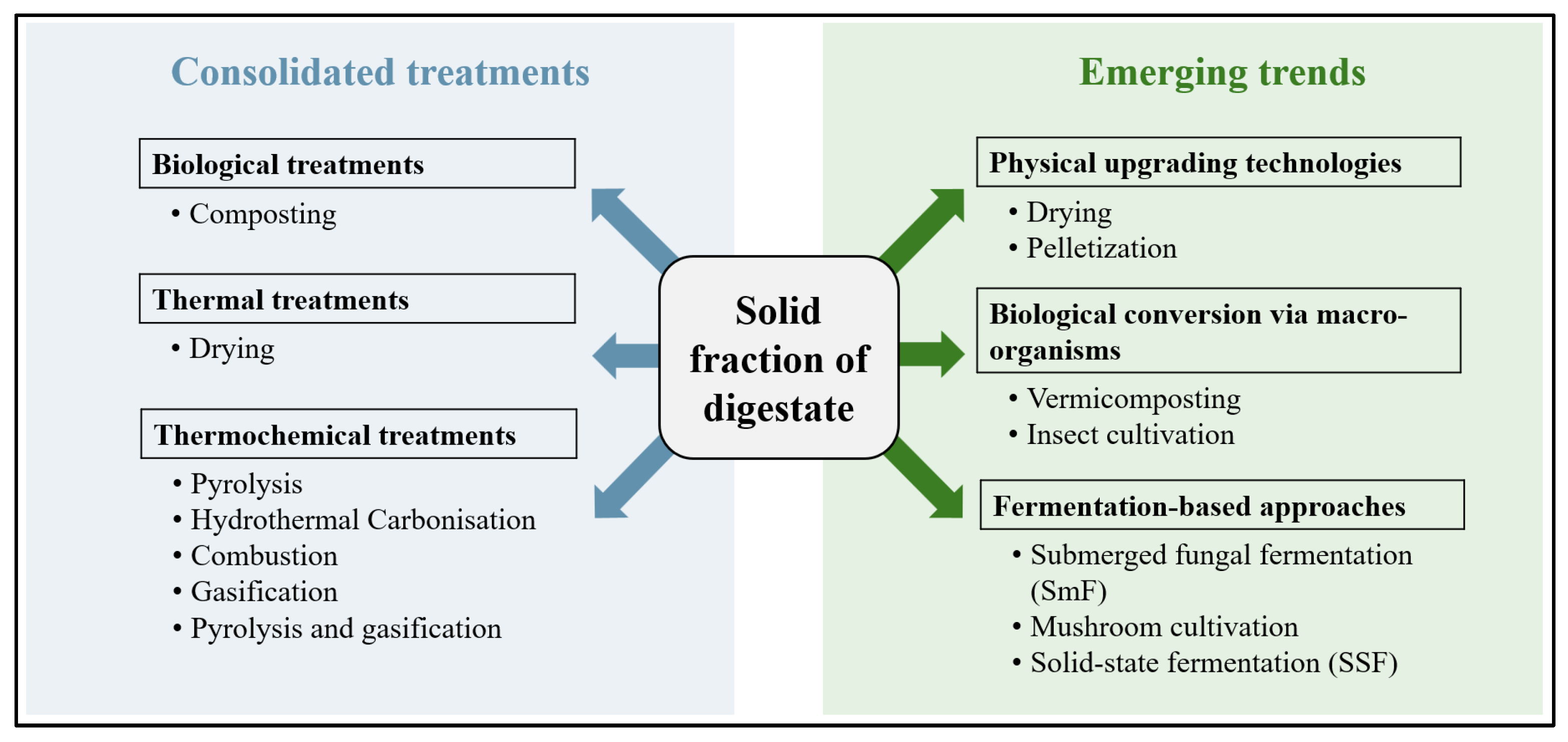
A total of 265 documents were screened, of which 99 discussed a treatment of the solid fraction of digestate. Many of the articles that did not focus on SD treatment—and were therefore not considered in the analysis—focused on the recirculation of SD to improve biogas production. Others studied the presence of organic pollutants or plastics in the solid fraction of digestate, while still others evaluated its direct application to soil or different crops. The authors classified these 99 papers as ‘Consolidated treatments’ (75) or ‘Emerging trends’ (24), and summarised them in Figure 2.
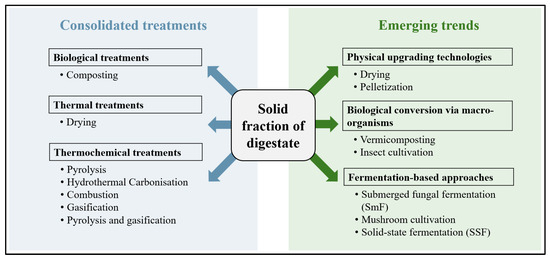
Figure 2.
Summary of consolidated treatments and emerging trends pathways for the valorisation of the solid fraction of digestate.
4.2. Consolidated Treatments
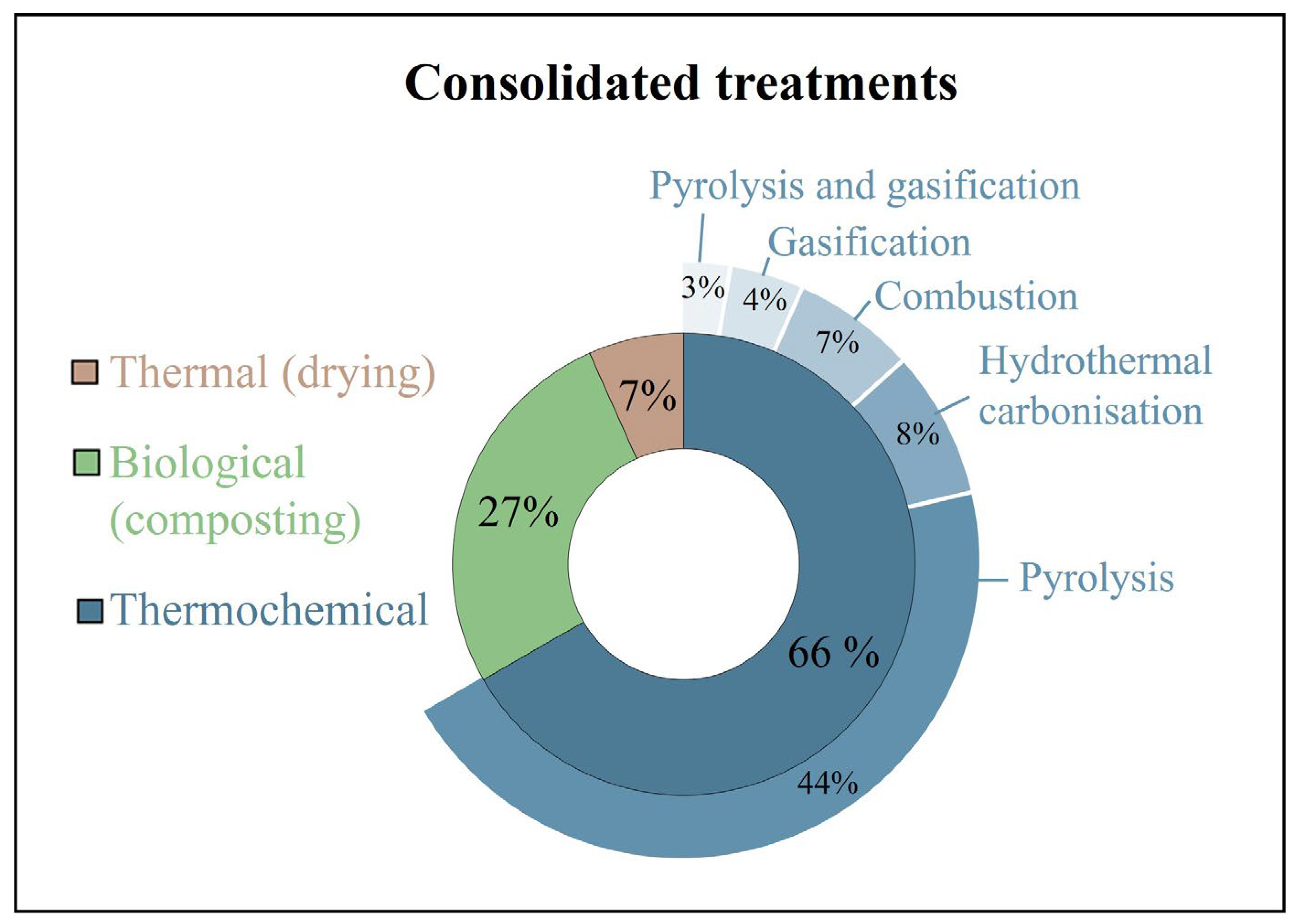
Consolidated treatments were considered, to be those that have been used for years and are widely implemented at an industrial level. The results of this systematic search indicate that the publications focus primarily on thermochemical treatments and composting (Figure 3). Of the thermochemical treatments, pyrolysis is the most widely studied.
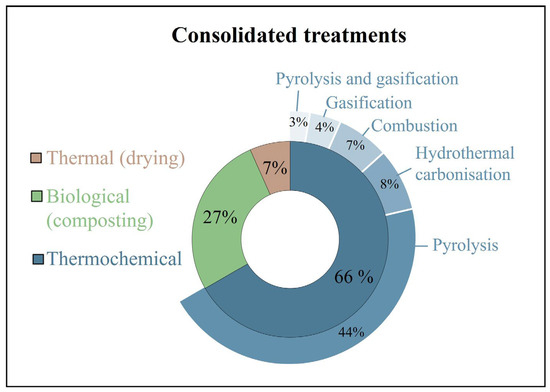
Figure 3.
Percentage of the screened documents addressing consolidated treatments applied to the solid fraction of digestate.
Composting is one of the most well-established strategies for stabilising the solid fraction of digestate. It involves the aerobic biodegradation of organic matter through microbial enzymatic activity [35]. This low-cost process reduces odours by lowering volatile organic compounds and decreasing moisture content and phytotoxicity [36]. It also yields a nutrient-rich organic fertiliser with biostimulant properties and generally low levels of contaminants [2,37]. However, composting still generates greenhouse gases such as NH3, CO2, and volatile sulphur compounds [38,39]. Despite reaching thermophilic temperatures (50–70 °C), an additional sanitation step is required, involving periods of 4–15 days at 55 °C or 1 h at 70 °C [40].
Thermochemical conversion is another major consolidated treatment pathway for SD, utilising its lignocellulosic content to produce heat, gas or biofuels [41]. Conventional processes include pyrolysis, gasification, combustion, and hydrothermal carbonisation (HTC). However, pyrolysis, gasification and combustion require prior drying to reduce the moisture content of SD to around 15% [11]. Once dried, SD can be pelletised, and its calorific value has been found to be similar to that of wood [42].
Although combustion generates heat and ash residues [43], ash accumulation can impair furnace aeration and performance [44,45].
Gasification converts SD into synthesis gas (syngas) and char under high temperatures and a controlled oxygen supply [16]. Due to the high ash content (10–50 wt%) and char yield (5–10 wt%), suitable valorisation routes for these residues are necessary, but detailed operational studies are limited [41].
Pyrolysis, which is often integrated with AD, is the most widely studied thermal valorisation route [16]. When conducted under oxygen-free conditions, it produces biochar, syngas and bio-oil. The distribution of these products is strongly dependent on temperature, heating rate and vapour residence time [46,47]. Biochar can be used as a soil improver, a carbon sink, an adsorbent or a precursor for activated carbon [47]. Bio-oil requires upgrading to improve its quality and heating value [46], while syngas can be combusted to generate heat or converted into biofuels via fermentation [48,49,50].
In contrast, HTC processes wet SD without prior drying. It operates at ≤250 °C under pressure and with short residence times (5–120 min) [11,16]. This process yields hydrochar and process water, with typical production reaching 74% and 21%, respectively [16]. Hydrochar is studied as a soil improver, adsorbent, or energy carrier [11,51,52], while the nutrient-rich process water can be recirculated into the AD process.
Although pyrochar and hydrochar have similar agronomic potential, information on the performance of hydrochar, particularly in agriculture, remains limited [53]. Currently, pyrolysis and gasification are reported at TRL 9, and HTC at TRL 8 [3].
Overall, thermochemical processes such as pyrolysis, gasification and hydrothermal carbonisation are robust in the face of feedstock heterogeneity and are technologically mature, making them suitable for large-scale applications. However, they are energy-intensive and mainly produce products of lower market value. In contrast, biological pathways operate under milder conditions and enable the production of higher-value products, although they involve longer processing times and are more sensitive to substrate variability. Consequently, thermochemical processes are better suited to centralised industrial deployment, whereas biological pathways align more closely with resource-efficient, circular bioeconomy-oriented valorisation strategies.
4.3. Emerging Trends in the Valorisation of the Solid Digestate
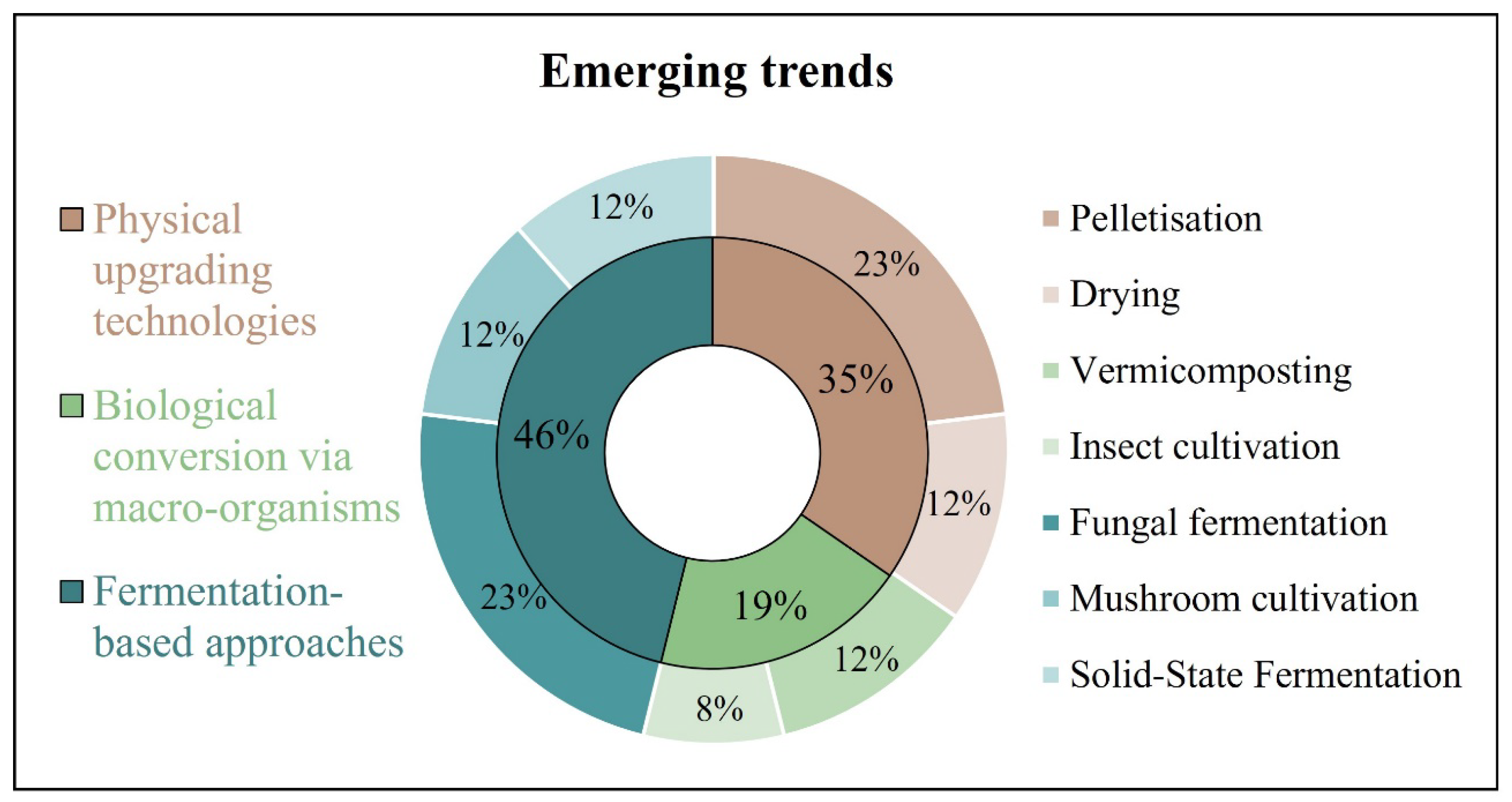
Beyond its conventional use in agriculture, the solid fraction of digestate is increasingly recognised as a versatile feedstock for producing high-value products. A systematic bibliographic review identified 24 publications addressing emerging trends, reflecting growing research interest in expanding the use of SD beyond agronomic purposes. Figure 4 illustrates the distribution of emerging valorisation pathways for the solid fraction of digestate identified in the literature. These approaches can be categorised as follows: physical upgrading technologies; biological conversion via macro-organisms; and fermentation-based processes.
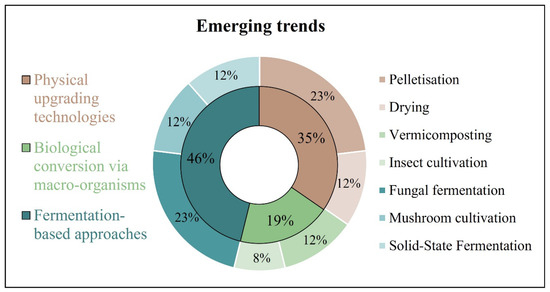
Figure 4.
Percentage of the screened documents addressing emerging trends applied to the solid fraction of digestate.
As shown in Figure 4, fermentation-based approaches account for the largest share (46%), highlighting their increasing importance for generating high-value bioproducts. Physical upgrading technologies account for 35% of the studies, reflecting continued interest in improving SD handling and energy recovery. Biological conversion via macro-organisms is less prevalent (19%), but shows strong potential as a sustainable and multifunctional valorisation route. Overall, the figure confirms the increasing diversification of SD valorisation strategies beyond conventional agricultural applications.
4.3.1. Drying Technologies
Despite being termed ‘solid’, SD often contains only around 21% dry matter, meaning it requires drying for long-term storage, transport and many downstream processes. Drying can serve as a pretreatment for pelletisation, thermal conversion, soil application or animal bedding. Several methods exist for reducing moisture in organic waste: mechanical drying, solar drying and biodrying [15]. Conventional heat drying is widely used due to its simplicity and effectiveness. However, biodrying, in which microbial heat generation drives moisture removal, has emerged as a low-energy alternative to conventional thermal drying [54]. With active aeration, the core mechanism of biodrying is to facilitate evaporation driven by the breakdown of organic matter. Although biodrying was initially developed for sewage sludge, it is now being used increasingly for food waste and digestate [15]. However, information specific to the biodrying of the solid fraction of digestate is still scarce [34]. Dried SD has potential as an organic amendment or bedding material. Jaďuďová et al. [55] evaluated its fire-technical properties, supporting its use as an alternative bedding substrate.
4.3.2. Pelletisation
Pelletisation is a promising technique for improving the handling, storage and transport of SD. Given their nutrient content and calorific properties, SD pellets offer value both as fertilisers and as biofuels [56]. Pelletisation enhances fertiliser storability and facilitates transport, enabling nutrients to be moved more easily over time [57]. SD has also shown potential as a biofuel substrate that is more suitable than sawdust [22]. Producing pellets near biogas plants can optimise energy use by recovering excess process heat for drying [58]. The process involves three main steps: drying, grinding and pressing [22].
4.3.3. Vermicomposting
Although the direct application of SD to agricultural soils is common practice, it poses several environmental and health risks. However, SD contains significant amounts of organic matter and nutrients, making it suitable for bio-oxidative treatments such as composting and vermicomposting. These processes improve the stability and maturity of the material, resulting in safer and more effective soil amendments. Vermicompost enhances soil fertility, stimulates plant and microbial activity, and contributes to carbon sequestration.
Vermicomposting is a biological treatment process in which earthworms and associated microorganisms transform organic matter into a stable, nutrient-rich product. Earthworm activity improves aeration, accelerates the degradation of organic matter, and minimises the development of anaerobic conditions that cause odours. As well as producing high-quality vermicompost, the process generates earthworm biomass that can be used as a protein source in animal feed.
In addition to improving soil quality, vermicompost can act as a bioadsorbent for organic and inorganic pollutants thanks to its micromorphology and reactive surface functional groups. This adsorption capacity reduces the mobility of contaminants and their subsequent uptake by plants. However, standard characterisation methods often overlook this adsorption potential [13]. A comprehensive analysis of microstructure, porosity and surface chemistry is necessary to understand its broader functions. Recent studies have highlighted vermicomposting as a suitable and sustainable technology for digestate management, particularly in small-scale farming systems [59].
4.3.4. Insect Cultivation for Protein and Fertilizer Production
The insect bioconversion of digestate is gaining interest as a novel method of producing sustainable protein [60]. In particular, Black Soldier Fly Larvae (BSFL) thrive on diverse organic substrates (including SD) and can be processed into protein-rich flour for use in livestock, poultry or aquaculture feed [60,61,62]. The residual frass constitutes a high-quality organic fertiliser. BSFL cultivated on digestate have also been investigated for their potential for lipid accumulation and biodiesel production [61]. The EU VALUEWASTE project demonstrated the feasibility of rearing BSFL on SD on a pilot scale in Murcia, Spain. While commercial opportunities are emerging, further development is needed. Companies such as Insectius (Catalonia) are currently conducting large-scale trials, and this technology has been evaluated at TRL 8 [3].
4.3.5. Fermentation-Based Approaches
Fermentation processes provide a versatile way to convert SD into valuable bioproducts. Depending on factors such as moisture content, operational complexity and the desired end products, fermentation can be implemented through submerged fungal fermentation (SmF), low-tech solid-state cultivation (e.g., growing mushrooms) or high-tech solid-state fermentation (SSF).
SmF is a well-established fermentation strategy in which microorganisms grow in a liquid medium containing solubilised SD components. Several studies have demonstrated the potential of SD-derived hydrolysates as substrates for bioethanol and biodiesel production [63,64,65,66]. For instances, Zhong et al. [66] produced lipid-based biofuels using a mixture of manure and corn stover SD, involving six days of aerobic fungal fermentation, followed by lipid extraction and transesterification. The residual fungal biomass (rich in proteins and chitin) can be used as animal feed, providing an additional valorisation pathway.
SmF can also produce chitin-rich fungal biomass. For example, Liu et al. [65] demonstrated this with Rhizopus oryzae, thereby expanding the potential applications of SD-derived products. Because SD is a complex lignocellulosic matrix, pretreatment is essential to increase substrate accessibility. Mechanical fragmentation techniques, such as centrifugal or vibro-ball milling, have been shown to improve the efficiency of enzymatic hydrolysis and subsequently enhance ethanol yields during simultaneous saccharification and fermentation [67,68]. Therefore, effective pretreatment is consistently required to release fermentable sugars and enable efficient conversion.
Overall, SmF can convert SD into valuable bioproducts, but the process is limited in feasibility due to high wastewater generation, low product titres and the requirement for pretreatment. These constraints have led to increased interest in SSF, where SD can be used directly with minimal pre-processing.
Mushroom cultivation is a simple, low-tech form of SSF that can add value to SD. Many edible and white-rot fungal species naturally grow on lignocellulosic substrates, such as straw, making SD a suitable alternative feedstock. White-rot fungi are particularly relevant due to their ability to degrade lignin, which increases the accessibility of structural polysaccharides within the SD matrix. This degradation may also enable the digestate to be recirculated into an anaerobic digester or used in other biorefinery processes, such as the production of bioethanol [69]. Several studies have successfully cultivated edible fungi on SD, reporting effective lignocellulose breakdown and enzyme production [69,70,71]. Santi et al. [69] were the first to evaluate the growth of four white-rot species on SD using Petri dish (DDBIOLAB, Barcelona, Spain) assays, observing positive enzymatic activity after 15–20 days of fermentation. However, mycelium performance varied widely across strains, reflecting the influence of the original anaerobic digestion feedstock on digestate composition. On a larger scale, Fornito et al. [71] cultivated edible fungi in autoclavable polypropylene bags (20 cm × 30 cm), which were incubated for 20–35 days at 22 °C. The bags were then transferred to controlled climate chambers for fruiting. Fruiting bodies were harvested over a period of three months. While the cultivation periods are relatively long, this approach remains promising as a low-tech bioprocess capable of transforming lignocellulosic waste into nutritionally and commercially valuable mushroom biomass.
High-tech SSF provides a more controlled and industrially oriented framework for converting SD into high-value microbial products. In SSF, microorganisms grow in a solid matrix in absence or near absence of free water, using the solid substrate as physical support and a source of nutrients [72]. This process is particularly well-suited to ligno-cellulosic materials such as SD, and can be used to produce enzymes, biosurfactants, aroma compounds, fungal biopesticides and microbial inoculants. Cerda et al. demonstrated the feasibility of using sanitised SD as the sole substrate for SSF, without any pretreatment [73]. Their study evaluated multiple bioproducts of industrial interest, including cellulases, proteases, biosurfactants and Bacillus thuringiensis (Bt)-based biopesticides. Although the yields of enzymes and biosurfactants were low, the production of Bt biopesticides at laboratory scale (0.45 L reactors) showed promising results. Subsequent studies have expanded SSF to larger reactor scales. Molina-Peñate et al. [74] and Mejías et al. [75] successfully cultivated Bt using mixtures of SD with biowaste or biowaste-derived hydrolysates in bench-scale trials (22 L packed-bed reactors). More recently, Font-Pomarol et al. [76] confirmed that different solid fractions of digested sewage sludge can also support Bt production. This underlines the importance of robust feedstock characterisation using advanced analytical techniques such as pyrolysis coupled with gas chromatography–mass spectrometry (Py-GC-MS), which can be used to evaluate substrate suitability for SSF. Pilot-scale demonstrations (290 L reactors) by Mejías et al. [77] further validated the industrial potential of SD-based SSF. By implementing an optimised aeration strategy, the authors produced a fermented solid with biopesticidal properties that is suitable for direct use as an organic amendment. Beyond Bt, SSF supports the diverse fungal and bacterial transformations of SD. Fang et al. [78] used white-rot fungi (Pleurotus sajor-caju and Trametes versicolor) to enhance SD biodegradability and increase VFA production. In agricultural applications, mixtures of digestate and food waste have been used to cultivate Trichoderma reesei and T. atroviride to produce bioactive compounds relevant to plant biostimulants [79]. While these studies used whole digestate, using only the solid fraction could eliminate the need for bulking agents to adjust the moisture content. Digestate containing Trichoderma products obtained by SSF has been shown to exhibit reduced phytotoxicity, greater stability and enhanced agronomic value [80].
Overall, SSF is a versatile and scalable platform for converting SD into high-value microbial bioproducts. As noted by Ref. [81], SSF could even replace SmF in industrial enzyme production thanks to its higher productivity and substantially lower wastewater generation. Although SmF benefits from well-established reactor designs and process control, it generally requires extensive pretreatment to solubilise the SD matrix. This results in high water and energy demand, as well as significant wastewater generation. In contrast, SSF enables the direct use of SD with minimal preprocessing, offering reduced water consumption, greater process robustness and fewer downstream treatment requirements. While SSF faces challenges related to scaling up, such as heat and mass transfer and process monitoring, recent pilot-scale studies suggest that these limitations can be overcome through improved reactor design and aeration strategies [75,77]. Overall, SmF remains more suitable for highly controlled liquid-product applications, whereas SSF appears to be a more resource-efficient approach that is better aligned with the principles of the integrated circular bioeconomy for solid digestate valorisation. Table 4 summarises the advantages and disadvantages of all the emerging solid digestate treatment technologies, their associated challenges, and their TRLs.
4.3.6. Hydrothermal Liquefaction
Although hydrothermal liquefaction (HTL) did not emerge directly from the systematic bibliographic analysis focused on the solid fraction of digestate, it is included here as an increasingly relevant emerging technology. Several recent studies investigate HTL using digestate without explicitly distinguishing between whole digestate and its solid fraction, despite effectively processing solid-rich streams. Given its suitability for high-moisture feedstocks, HTL is discussed briefly as a complementary wet valorisation route.
Among wet energy conversion pathways, HTL has gained attention as a promising option for converting wet biomass, including digestate-derived solids, into energy-dense bio-oil without prior drying. Operating under conditions of 250–370 °C and 10–25 MPa, HTL enables organic matter to be converted into a liquid fuel phase alongside aqueous, gaseous and solid by-products. Recent studies indicate higher energy recovery efficiencies for wet substrates than conventional dry thermochemical routes, although challenges related to high-pressure operation, reactor design, and bio-oil upgrading currently limit large-scale deployment [82,83]. Nevertheless, HTL is a promising emerging technology for recovering energy from solid digestate, especially when integrated into existing anaerobic digestion infrastructures.
Table 4.
Emerging solid digestate treatment technologies, their applications, advantages, challenges, and TRLs.
Table 4.
Emerging solid digestate treatment technologies, their applications, advantages, challenges, and TRLs.
| Emerging Technology | Description/Main Applications | Advantages | Disadvantages/Challenges | TRL | References |
|---|---|---|---|---|---|
| Drying | Mechanical, thermal, solar or biodrying processes to reduce SD moisture for stabilization, storage, transport, or further processing. |
|
| 6–8 | [34,55,84] |
| Pelletisation | Production of SD pellets for biofertilizers or solid biofuels. Requires drying, grinding, pressing. |
|
| 7–8 | [22,56,57,58] |
| Vermicomposting | Earthworm-mediated decomposition of SD to produce vermicompost and worm biomass. |
|
| 5–6 | [13,85,86] |
| Insect cultivation | Black Soldier Fly Larvae convert SD into protein-rich larvae and frass for fertiliser. |
|
| 7–8 | [61,62] |
| Submerged fungal fermentation (SmF) | Fermentation of SD hydrolysates for bioethanol, lipids, enzymes, organic acids, single-cell proteins. |
|
| 4–5 | [63,64,65,66,68] |
| Mushroom cultivation (low-tech SSF) | Edible mushrooms (white-rot fungi) grown directly on SD or SD blends. Also acts as lignocellulose pretreatment. |
|
| 3–4 | [69,70,71] |
| High-tech SSF | Controlled solid-state fermentation on SD for producing enzymes, biosurfactants, biostimulants, biopesticides, aroma compounds. |
|
| 4–6 | [76,78,79,80] |
5. Conclusions
The solid fraction of digestate is a versatile by-product of anaerobic digestion that has significant potential for sustainable resource recovery and applications in the circular bioeconomy. A key first step in digestate management is mechanical solid–liquid separation, which concentrates nutrients and fibres in the solid fraction and enables targeted downstream valorisation. Consolidated treatments such as composting and thermochemical conversion remain widely implemented, providing stable organic fertilisers, biochar and energy products while mitigating the environmental risks associated with raw digestate. Emerging valorisation trends, such as drying, pelletisation, vermicomposting, insect rearing and fermentation-based processes, are promising for transforming solid digestate into valuable products like microbial biopesticides, enzymes, protein-rich biomass and biofuels. The strong variability in digestate characteristics driven by feedstock type and separation method, directly affects the suitability and efficiency of each valorisation route. Key parameters, including total solids, volatile matter, C/N ratio, nutrient composition and especially biodegradability, should be systematically reported to guide technology selection and process optimisation. Harmonized terminology distinguishing solid, liquid, and whole digestate is also essential for comparability across studies. Despite these opportunities, challenges remain, including high moisture content, heterogeneous feedstock, treatment costs and regulatory complexity. Future research should prioritise integrated valorisation strategies that combine multiple technologies within a biorefinery framework, alongside legislative harmonisation, to maximise economic and environmental outcomes. Overall, the valorisation of the solid fraction of digestate is essential to support nutrient recycling, reducing waste, and advancing sustainable circular bioeconomy practices.
Author Contributions
Conceptualization, J.F.-P., E.M.-P., A.A. and A.S.; investigation, J.F.-P.; writing—original draft preparation, J.F.-P.; writing—review and editing, E.M.-P., A.A. and A.S.; visualization, J.F.-P.; supervision, E.M.-P., A.A. and A.S.; funding acquisition, A.S. All authors have read and agreed to the published version of the manuscript.
Funding
This research was funded by the Spanish Ministerio de Ciencia, Innovación y Universidades, grant number PID2023-146978B-I00 (Project Solstice). Jana Font thanks Generalitat de Catalunya for her industrial pre-doctoral grant (AGAUR, 2024 DI 00021).
Data Availability Statement
No new data were created or analyzed in this study.
Conflicts of Interest
Author Jana Font-Pomarol was employed by the Aeris Tecnologías Ambientales S.L. The remaining authors declare that the research was conducted in the absence of any commercial or financial relationships that could be construed as a potential conflict of interest.
Abbreviations
The following abbreviations are used in this manuscript:
| AD | Anaerobic digestion |
| BSFL | Black Soldier Fly Larvae |
| CMC | Component Material Categories |
| EBA | European Biogas Association |
| FPR | Fertilising Products Regulation |
| HHV | High Heating Value |
| HTC | Hydrothermal carbonisation |
| HTL | Hydrothermal liquefaction |
| LHV | Low Heating Value |
| SD | Solid digestate |
| SmF | Submerged fermentation |
| SSF | Solid-state fermentation |
| TS | Total solids |
| VFA | Volatile fatty acids |
| VM | Volatile matter |
| WFD | Waste Framework Directive |
| wt | weight |
References
- The Ellen MacArthur Foundation. Circular Economy Introduction. Available online: https://www.ellenmacarthurfoundation.org/topics/circular-economy-introduction/overview (accessed on 21 January 2026).
- Chojnacka, K.; Moustakas, K. Anaerobic Digestate Management for Carbon Neutrality and Fertilizer Use: A Review of Current Practices and Future Opportunities. Biomass Bioenergy 2024, 180, 106991. [Google Scholar] [CrossRef]
- European Biogas Association. Exploring Digestate’s Contribution to Healthy Soils; European Biogas Association: Brussels, Belgium, 2024; Available online: https://www.europeanbiogas.eu/wp-content/uploads/2024/03/Exploring-digestate-contribution-to-health-soils_EBA-Report.pdf (accessed on 21 January 2026).
- European Commission. REPowerEU Plan. Available online: https://energy.ec.europa.eu/topics/renewable-energy/bioenergy/biomethane_en (accessed on 21 January 2026).
- Carraro, G.; Tonderski, K.; Enrich-Prast, A. Solid-Liquid Separation of Digestate from Biogas Plants: A Systematic Review of the Techniques’ Performance. J. Environ. Manag. 2024, 356, 120585. [Google Scholar] [CrossRef]
- Slepetiene, A.; Ceseviciene, J.; Amaleviciute-Volunge, K.; Mankeviciene, A.; Parasotas, I.; Skersiene, A.; Jurgutis, L.; Volungevicius, J.; Veteikis, D.; Mockeviciene, I. Solid and Liquid Phases of Anaerobic Digestate for Sustainable Use of Agricultural Soil. Sustainability 2023, 15, 1345. [Google Scholar] [CrossRef]
- Zapata-Morales, A.L.; Moreno-Andrade, I. Valorization of Digestates from Organic Solid Waste as Fertilizers, Soil Improvers, and Agricultural Prebiotics: Panorama and Perspectives. 3 Biotech 2025, 15, 333. [Google Scholar] [CrossRef] [PubMed]
- Reuland, G.; Sleutel, S.; Li, H.; Dekker, H.; Sigurnjak, I.; Meers, E. Quantifying CO2 Emissions and Carbon Sequestration from Digestate-Amended Soil Using Natural 13C Abundance as a Tracer. Agronomy 2023, 13, 2501. [Google Scholar] [CrossRef]
- Lamolinara, B.; Pérez-Martínez, A.; Guardado-Yordi, E.; Guillén Fiallos, C.; Diéguez-Santana, K.; Ruiz-Mercado, G.J. Anaerobic Digestate Management, Environmental Impacts, and Techno-Economic Challenges. Waste Manag. 2022, 140, 14–30. [Google Scholar] [CrossRef]
- Dahlin, J.; Herbes, C.; Nelles, M. Biogas Digestate Marketing: Qualitative Insights into the Supply Side. Resour. Conserv. Recycl. 2015, 104, 152–161. [Google Scholar] [CrossRef]
- Monlau, F.; Sambusiti, C.; Ficara, E.; Aboulkas, A.; Barakat, A.; Carrère, H. New Opportunities for Agricultural Digestate Valorization: Current Situation and Perspectives. Energy Environ. Sci. 2015, 8, 2600–2621. [Google Scholar] [CrossRef]
- Nayak, J.K.; Ranade, V.V. Valorisation of Digestate: Characteristics, Products, Processes and Potential. Chem. Eng. J. Adv. 2025, 24, 100887. [Google Scholar] [CrossRef]
- Loffredo, E.; Vona, D.; Porfido, C.; Giangregorio, M.M.; Gelsomino, A. Compositional and Structural Characterization of Bioenergy Digestate and Its Aerobic Derivatives Compost and Vermicompost. J. Sustain. Agric. Environ. 2024, 3, e70002. [Google Scholar] [CrossRef]
- Catalan Water Agency. Sludge Management. Available online: https://aca.gencat.cat/ca/laigua/gestio-del-cicle-de-laigua/gestio-de-fangs/index.html#googtrans(ca|en) (accessed on 21 January 2026).
- Lu, J.; Xu, S. Post-Treatment of Food Waste Digestate towards Land Application: A Review. J. Clean. Prod. 2021, 303, 127033. [Google Scholar] [CrossRef]
- Wang, W.; Chang, J.S.; Lee, D.J. Anaerobic Digestate Valorization beyond Agricultural Application: Current Status and Prospects. Bioresour. Technol. 2023, 373, 128742. [Google Scholar] [CrossRef]
- Reuland, G.; Sigurnjak, I.; Dekker, H.; Michels, E.; Meers, E. The Potential of Digestate and the Liquid Fraction of Digestate as Chemical Fertiliser Substitutes under the RENURE Criteria. Agronomy 2021, 11, 1374. [Google Scholar] [CrossRef]
- Wang, N.; Chen, Q.; Zhang, C.; Dong, Z.; Xu, Q. Improvement in the Physicochemical Characteristics of Biochar Derived from Solid Digestate of Food Waste with Different Moisture Contents. Sci. Total Environ. 2022, 819, 153100. [Google Scholar] [CrossRef]
- Liu, J.; Huang, S.; Chen, K.; Wang, T.; Mei, M.; Li, J. Preparation of Biochar from Food Waste Digestate: Pyrolysis Behavior and Product Properties. Bioresour. Technol. 2020, 302, 122841. [Google Scholar] [CrossRef]
- Zhao, J.; Wang, Z.; Li, J.; Yan, B.; Chen, G. Pyrolysis of Food Waste and Food Waste Solid Digestate: A Comparative Investigation. Bioresour. Technol. 2022, 354, 127191. [Google Scholar] [CrossRef]
- Dietrich, M.; Fongen, M.; Foereid, B. Anaerobic Digestion Affecting Nitrous Oxide and Methane Emissions from the Composting Process. Bioresour. Technol. Rep. 2021, 15, 100752. [Google Scholar] [CrossRef]
- Czekała, W. Solid Fraction of Digestate from Biogas Plant as a Material for Pellets Production. Energies 2021, 14, 5034. [Google Scholar] [CrossRef]
- Calamai, A.; Chiaramonti, D.; Casini, D.; Masoni, A.; Palchetti, E. Short-Term Effects of Organic Amendments on Soil Properties and Maize (Zea maize L.) Growth. Agriculture 2020, 10, 158. [Google Scholar] [CrossRef]
- Petrovič, A.; Vohl, S.; Cenčič Predikaka, T.; Bedoić, R.; Simonič, M.; Ban, I.; Čuček, L. Pyrolysis of Solid Digestate from Sewage Sludge and Lignocellulosic Biomass: Kinetic and Thermodynamic Analysis, Characterization of Biochar. Sustainability 2021, 13, 9642. [Google Scholar] [CrossRef]
- Sakiewicz, P.; Piotrowski, K.; Rajca, M.; Maj, I.; Kalisz, S.; Ober, J.; Karwot, J.; Pagilla, K.R. Innovative Technological Approach for the Cyclic Nutrients Adsorption by Post-Digestion Sewage Sludge-Based Ash Co-Formed with Some Nanostructural Additives under a Circular Economy Framework. Int. J. Environ. Res. Public Health 2022, 19, 11119. [Google Scholar] [CrossRef]
- Tayibi, S.; Monlau, F.; Marias, F.; Thevenin, N.; Jimenez, R.; Oukarroum, A.; Alboulkas, A.; Zeroual, Y.; Barakat, A. Industrial Symbiosis of Anaerobic Digestion and Pyrolysis: Performances and Agricultural Interest of Coupling Biochar and Liquid Digestate. Sci. Total Environ. 2021, 793, 148461. [Google Scholar] [CrossRef] [PubMed]
- Barbanera, M.; Pelosi, C.; Taddei, A.R.; Cotana, F. Optimization of Bio-Oil Production from Solid Digestate by Microwave-Assisted Liquefaction. Energy Convers. Manag. 2018, 171, 1263–1272. [Google Scholar] [CrossRef]
- Guo, X.; Zhang, Y.; Guo, Q.; Zhang, R.; Wang, C.; Yan, B.; Lin, F.; Chen, G.; Hou, L. Evaluation on Energetic and Economic Benefits of the Coupling Anaerobic Digestion and Gasification from Agricultural Wastes. Renew. Energy 2021, 176, 494–503. [Google Scholar] [CrossRef]
- Dziedzic, K.; Łapczyńska-kordon, B.; Jurczyk, M.; Arczewska, M.; Wróbel, M.; Jewiarz, M.; Mudryk, K.; Pająk, T. Solid Digestate—Physicochemical and Thermal Study. Energies 2021, 14, 7224. [Google Scholar] [CrossRef]
- Brémond, U.; Bertrandias, A.; Loisel, D.; Jimenez, J.; Steyer, J.P.; Bernet, N.; Carrere, H. Assessment of Fungal and Thermo-Alkaline Post-Treatments of Solid Digestate in a Recirculation Scheme to Increase Flexibility in Feedstocks Supply Management of Biogas Plants. Renew. Energy 2020, 149, 641–651. [Google Scholar] [CrossRef]
- Akor, C.I.; Osman, A.I.; Farrell, C.; McCallum, C.S.; John Doran, W.; Morgan, K.; Harrison, J.; Walsh, P.J.; Sheldrake, G.N. Thermokinetic Study of Residual Solid Digestate from Anaerobic Digestion. Chem. Eng. J. 2021, 406, 127039. [Google Scholar] [CrossRef]
- Zanellati, A.; Spina, F.; Rollé, L.; Varese, G.C.; Dinuccio, E. Fungal Pretreatments on Non-Sterile Solid Digestate to Enhance Methane Yield and the Sustainability of Anaerobic Digestion. Sustainability 2020, 12, 8549. [Google Scholar] [CrossRef]
- Mellmann, J.; Salamat, R.; Kharaghani, A. Drying Behavior of Solid Digestate and Reaction Kinetics of Ammonium Degradation during Laboratory-Scale Drying. Waste Manag. 2024, 173, 75–86. [Google Scholar] [CrossRef]
- Clagnan, E.; Cucina, M.; De Nisi, P.; Dell’Orto, M.; D’Imporzano, G.; Kron-Morelli, R.; Llenas-Argelaguet, L.; Adani, F. Effects of the Application of Microbiologically Activated Bio-Based Fertilizers Derived from Manures on Tomato Plants and Their Rhizospheric Communities. Sci. Rep. 2023, 13, 22478. [Google Scholar] [CrossRef]
- Vráblová, M.; Smutná, K.; Chamrádová, K.; Vrábl, D.; Koutník, I.; Rusín, J.; Bouchalová, M.; Gavlová, A.; Sezimová, H.; Navrátil, M.; et al. Co-Composting of Sewage Sludge as an Effective Technology for the Production of Substrates with Reduced Content of Pharmaceutical Residues. Sci. Total Environ. 2024, 915, 169818. [Google Scholar] [CrossRef]
- Bustamante, M.A.; Alburquerque, J.A.; Restrepo, A.P.; de la Fuente, C.; Paredes, C.; Moral, R.; Bernal, M.P. Co-Composting of the Solid Fraction of Anaerobic Digestates, to Obtain Added-Value Materials for Use in Agriculture. Biomass Bioenergy 2012, 43, 26–35. [Google Scholar] [CrossRef]
- Bignami, C.; Melegari, F.; Zaccardelli, M.; Pane, C.; Ronga, D. Composted Solid Digestate and Vineyard Winter Prunings Partially Replace Peat in Growing Substrates for Micropropagated Highbush Blueberry in the Nursery. Agronomy 2022, 12, 337. [Google Scholar] [CrossRef]
- Li, M.; Li, S.; Chen, S.; Meng, Q.; Wang, Y.; Yang, W.; Shi, L.; Ding, F.; Zhu, J.; Ma, R.; et al. Measures for Controlling Gaseous Emissions during Composting: A Review. Int. J. Environ. Res. Public Health 2023, 20, 3587. [Google Scholar] [CrossRef] [PubMed]
- González, D.; Guerra, N.; Colón, J.; Gabriel, D.; Ponsá, S.; Sánchez, A. Characterization of the Gaseous and Odour Emissions from the Composting of Conventional Sewage Sludge. Atmosphere 2020, 11, 211. [Google Scholar] [CrossRef]
- Torres, P.; Perez, A.; Escobar, J.C.; Uribe, I.E.; Imery, R. Compostaje de biosólidos de plantas de tratamiento de aguas residuales. Eng. Agric. Jaboticabal 2007, 27, 267–275. [Google Scholar] [CrossRef]
- Chen, G.; Guo, X.; Cheng, Z.; Yan, B.; Dan, Z.; Ma, W. Air Gasification of Biogas-Derived Digestate in a Downdraft Fixed Bed Gasifier. Waste Manag. 2017, 69, 162–169. [Google Scholar] [CrossRef]
- Kratzeisen, M.; Starcevic, N.; Martinov, M.; Maurer, C.; Müller, J. Applicability of Biogas Digestate as Solid Fuel. Fuel 2010, 89, 2544–2548. [Google Scholar] [CrossRef]
- Ferreira, C.I.A.; Calisto, V.; Cuerda-Correa, E.M.; Otero, M.; Nadais, H.; Esteves, V.I. Comparative Valorisation of Agricultural and Industrial Biowastes by Combustion and Pyrolysis. Bioresour. Technol. 2016, 218, 918–925. [Google Scholar] [CrossRef]
- Allesina, G.; Pedrazzi, S.; Allegretti, F.; Tartarini, P. Spent Coffee Grounds as Heat Source for Coffee Roasting Plants: Experimental Validation and Case Study. Appl. Therm. Eng. 2017, 126, 730–736. [Google Scholar] [CrossRef]
- Pedrazzi, S.; Allesina, G.; Belló, T.; Rinaldini, C.A.; Tartarini, P. Digestate as Bio-Fuel in Domestic Furnaces. Fuel Process. Technol. 2015, 130, 172–178. [Google Scholar] [CrossRef]
- Neumann, J.; Meyer, J.; Ouadi, M.; Apfelbacher, A.; Binder, S.; Hornung, A. The Conversion of Anaerobic Digestion Waste into Biofuels via a Novel Thermo-Catalytic Reforming Process. Waste Manag. 2016, 47, 141–148. [Google Scholar] [CrossRef] [PubMed]
- Tayibi, S.; Monlau, F.; Bargaz, A.; Jimenez, R.; Barakat, A. Synergy of Anaerobic Digestion and Pyrolysis Processes for Sustainable Waste Management: A Critical Review and Future Perspectives. Renew. Sustain. Energy Rev. 2021, 152, 111603. [Google Scholar] [CrossRef]
- Daniell, J.; Köpke, M.; Simpson, S.D. Commercial Biomass Syngas Fermentation. Energies 2012, 5, 5372–5417. [Google Scholar] [CrossRef]
- Gao, J.; Atiyeh, H.K.; Phillips, J.R.; Wilkins, M.R.; Huhnke, R.L. Development of Low Cost Medium for Ethanol Production from Syngas by Clostridium Ragsdalei. Bioresour. Technol. 2013, 147, 508–515. [Google Scholar] [CrossRef]
- Latif, H.; Zeidan, A.A.; Nielsen, A.T.; Zengler, K. Trash to Treasure: Production of Biofuels and Commodity Chemicals via Syngas Fermenting Microorganisms. Curr. Opin. Biotechnol. 2014, 27, 79–87. [Google Scholar] [CrossRef]
- Biller, P.; Ross, A.B. Hydrothermal Processing of Algal Biomass for the Production of Biofuels and Chemicals. Biofuels 2012, 3, 603–623. [Google Scholar] [CrossRef]
- Funke, A.; Mumme, J.; Koon, M.; Diakité, M. Cascaded Production of Biogas and Hydrochar from Wheat Straw: Energetic Potential and Recovery of Carbon and Plant Nutrients. Biomass Bioenergy 2013, 58, 229–237. [Google Scholar] [CrossRef]
- Fabbri, D.; Torri, C. Linking Pyrolysis and Anaerobic Digestion (Py-AD) for the Conversion of Lignocellulosic Biomass. Curr. Opin. Biotechnol. 2016, 38, 167–173. [Google Scholar] [CrossRef]
- Choi, H.L.; Richard, T.L.; Ahn, H.K. Composting High Moisture Materials: Biodrying Poultry Manure in a Sequentially Fed Reactor. Compost Sci. Util. 2001, 9, 303–311. [Google Scholar] [CrossRef]
- Jaďuďová, J.; Marková, I.; Šťastná, M.; Giertlová, Z. The Evaluation of the Fire Safety of the Digestate as An Alternative Bedding Material. Processes 2023, 11, 2609. [Google Scholar] [CrossRef]
- Łysiak, G.; Kulig, R.; Al Aridhee, J.K. Toward New Value-Added Products Made from Anaerobic Digestate: Part 1—Study on the Effect of Moisture Content on the Densification of Solid Digestate. Sustainability 2023, 15, 4548. [Google Scholar] [CrossRef]
- Valentinuzzi, F.; Cavani, L.; Porfido, C.; Terzano, R.; Pii, Y.; Cesco, S.; Marzadori, C.; Mimmo, T. The Fertilising Potential of Manure-Based Biogas Fermentation Residues: Pelleted vs. Liquid Digestate. Heliyon 2020, 6, e03325. [Google Scholar] [CrossRef] [PubMed]
- Nagy, D.; Balogh, P.; Gabnai, Z.; Popp, J.; Oláh, J.; Bai, A. Economic Analysis of Pellet Production in Co-Digestion Biogas Plants. Energies 2018, 11, 1135. [Google Scholar] [CrossRef]
- Cucina, M.; Castro, L.; Font-Pomarol, J.; Escalante, H.; Muñoz-Muñoz, A.; Ferrer, I.; Garfí, M. Vermifiltration as a Green Solution to Promote Digestate Reuse in Agriculture in Small-Scale Farms. J. Environ. Manag. 2024, 368, 122164. [Google Scholar] [CrossRef]
- Fu, S.F.; Wang, D.H.; Xie, Z.; Zou, H.; Zheng, Y. Producing Insect Protein from Food Waste Digestate via Black Soldier Fly Larvae Cultivation: A Promising Choice for Digestate Disposal. Sci. Total Environ. 2022, 830, 154654. [Google Scholar] [CrossRef] [PubMed]
- Elsayed, M.; Ran, Y.; Ai, P.; Azab, M.; Mansour, A.; Jin, K.; Zhang, Y.; Abomohra, A.E.F. Innovative Integrated Approach of Biofuel Production from Agricultural Wastes by Anaerobic Digestion and Black Soldier Fly Larvae. J. Clean. Prod. 2020, 263, 121495. [Google Scholar] [CrossRef]
- Pas, C.; Brodeur, D.; Deschamps, M.H.; Lebeuf, Y.; Adjalle, K.; Barnabé, S.; Eeckhout, M.; Vandenberg, G.; Vaneeckhaute, C. Valorization of Pretreated Biogas Digestate with Black Soldier Fly (Hermetia illucens, L.; Diptera: Stratiomyidae) Larvae. J. Environ. Manag. 2022, 319, 115529. [Google Scholar] [CrossRef]
- Musatti, A.; Ficara, E.; Mapelli, C.; Sambusiti, C.; Rollini, M. Use of Solid Digestate for Lignocellulolytic Enzymes Production through Submerged Fungal Fermentation. J. Environ. Manag. 2017, 199, 1–6. [Google Scholar] [CrossRef]
- Wang, D.; Xi, J.; Ai, P.; Yu, L.; Zhai, H.; Yan, S.; Zhang, Y. Enhancing Ethanol Production from Thermophilic and Mesophilic Solid Digestate Using Ozone Combined with Aqueous Ammonia Pretreatment. Bioresour. Technol. 2016, 207, 52–58. [Google Scholar] [CrossRef]
- Liu, Z.; Liao, W.; Liu, Y. A Sustainable Biorefinery to Convert Agricultural Residues into Value-Added Chemicals. Biotechnol. Biofuels 2016, 9, 197. [Google Scholar] [CrossRef]
- Zhong, Y.; Ruan, Z.; Zhong, Y.; Archer, S.; Liu, Y.; Liao, W. A Self-Sustaining Advanced Lignocellulosic Biofuel Production by Integration of Anaerobic Digestion and Aerobic Fungal Fermentation. Bioresour. Technol. 2015, 179, 173–179. [Google Scholar] [CrossRef]
- Monlau, F.; Sambusiti, C.; Barakat, A. Comparison of Dry versus Wet Milling to Improve Bioethanol or Methane Recovery from Solid Anaerobic Digestate. Bioengineering 2019, 6, 80. [Google Scholar] [CrossRef]
- Sambusiti, C.; Monlau, F.; Barakat, A. Bioethanol Fermentation as Alternative Valorization Route of Agricultural Digestate According to a Biorefinery Approach. Bioresour. Technol. 2016, 212, 289–295. [Google Scholar] [CrossRef] [PubMed]
- Santi, G.; Muzzini, V.G.; Galli, E.; Proietti, S.; Moscatello, S.; Battistelli, A. Mycelial Growth and Enzymatic Activities of White-Rot Fungi on Anaerobic Digestates from Industrial Biogas Plants. Environ. Eng. Manag. J. 2015, 14, 1713–1719. [Google Scholar] [CrossRef]
- Schimpf, U.; Schrader, A.; Hübner, A.; Schulz, R.; Neubauer, P. Utilisation of Solid Digestate from Acidification Reactors of Continues Two-Stage Anaerobic Digestion Processes in Lentinula Edodes Cultivation. Bioresour. Technol. Rep. 2019, 8, 100322. [Google Scholar] [CrossRef]
- Fornito, S.; Puliga, F.; Leonardi, P.; Di Foggia, M.; Zambonelli, A.; Francioso, O. Degradative Ability of Mushrooms Cultivated on Corn Silage Digestate. Molecules 2020, 25, 3020. [Google Scholar] [CrossRef]
- Sadh, P.K.; Duhan, S.; Duhan, J.S. Agro-Industrial Wastes and Their Utilization Using Solid State Fermentation: A Review. Bioresour. Bioprocess. 2018, 5, 1. [Google Scholar] [CrossRef]
- Cerda, A.; Mejias, L.; Rodríguez, P.; Rodríguez, A.; Artola, A.; Font, X.; Gea, T.; Sánchez, A. Valorisation of Digestate from Biowaste through Solid-State Fermentation to Obtain Value Added Bioproducts: A First Approach. Bioresour. Technol. 2019, 271, 409–416. [Google Scholar] [CrossRef]
- Molina-Peñate, E.; Arenòs, N.; Sánchez, A.; Artola, A. Bacillus Thuringiensis Production Through Solid-State Fermentation Using Organic Fraction of Municipal Solid Waste (OFMSW) Enzymatic Hydrolysate. Waste Biomass Valorization 2023, 14, 1433–1445. [Google Scholar] [CrossRef]
- Mejias, L.; Estrada, M.; Barrena, R.; Gea, T. A Novel Two-Stage Aeration Strategy for Bacillus Thuringiensis Biopesticide Production from Biowaste Digestate through Solid-State Fermentation. Biochem. Eng. J. 2020, 161, 107644. [Google Scholar] [CrossRef]
- Font-Pomarol, J.; Kaal, J.; Molina-Peñate, E.; Sánchez, A.; Artola, A. Bench-Scale Solid-State Fermentation of Digested Sewage Sludge to Produce Bacillus Thuringiensis: Influence of Digestate Characteristics. J. Environ. Manag. 2025, 394, 127478. [Google Scholar] [CrossRef] [PubMed]
- Mejias, L.; Ruiz, D.; Molina-Peñate, E.; Barrena, R.; Gea, T. Bacillus Thuringiensis Derived Biopesticides from Biowaste Digestate at 290-L Demonstration Scale through Solid-State Fermentation. Environ. Technol. Innov. 2025, 37, 103974. [Google Scholar] [CrossRef]
- Fang, W.; Zhang, P.; Zhang, X.; Zhu, X.; van Lier, J.B.; Spanjers, H. White Rot Fungi Pretreatment to Advance Volatile Fatty Acid Production from Solid-State Fermentation of Solid Digestate: Efficiency and Mechanisms. Energy 2018, 162, 534–541. [Google Scholar] [CrossRef]
- Bulgari, D.; Alias, C.; Peron, G.; Ribaudo, G.; Gianoncelli, A.; Savino, S.; Boureghda, H.; Bouznad, Z.; Monti, E.; Gobbi, E. Solid-State Fermentation of Trichoderma spp.: A New Way to Valorize the Agricultural Digestate and Produce Value-Added Bioproducts. J. Agric. Food Chem. 2023, 71, 3994–4004. [Google Scholar] [CrossRef]
- Alias, C.; Bulgari, D.; Gobbi, E. It Works! Organic-Waste-Assisted Trichoderma spp. Solid-State Fermentation on Agricultural Digestate. Microorganisms 2022, 10, 164. [Google Scholar] [CrossRef] [PubMed]
- Doriya, K.; Jose, N.; Gowda, M.; Kumar, D.S. Solid-State Fermentation vs Submerged Fermentation for the Production of l-Asparaginase. Adv. Food Nutr. Res. 2016, 78, 115–135. [Google Scholar] [CrossRef]
- Tito, E.; Landi, D.; Demichelis, F.; Pipitone, G.; Bensaid, S.; Pirone, R. Hydrothermal Liquefaction of Digestate from the Organic Fraction of Municipal Solid Waste: Optimization of Operating Parameters. Energy Convers. Manag. 2025, 336, 119881. [Google Scholar] [CrossRef]
- Klüpfel, C.; Yuan, B.; Biller, P.; Herklotz, B. Hydrothermal Liquefaction as a Treatment Technology for Anaerobic Digestate: A Review. Renew. Sustain. Energy Rev. 2025, 210, 115156. [Google Scholar] [CrossRef]
- Egene, C.E.; Regelink, I.; Sigurnjak, I.; Adani, F.; Tack, F.M.G.; Meers, E. Greenhouse Gas Emissions from a Sandy Loam Soil Amended with Digestate-Derived Biobased Fertilisers—A Microcosm Study. Appl. Soil Ecol. 2022, 178, 104577. [Google Scholar] [CrossRef]
- Truzzi, E.; Vitti, A.; Di Serio, A.; Jamal, A.; Benvenuti, S.; Nuzzaci, M.; Bertelli, D.; Ronga, D. Effects of Digestate from Biogas on Agronomic Traits, Functional and Health Properties of Hydroponic Cultivation of Rocket (Diplotaxis tenuifolia L.) and Parsley (Petroselinum crispum Mill.). J. Soil Sci. Plant Nutr. 2025, 25, 7036–7060. [Google Scholar] [CrossRef]
- Manyuchi, M.; Mbohwaa, C.; Muzenda, E. Resource Recovery from Municipal Waste and Bio Solids (Digestate) Through Vermicomposting: A Waste Management Initiative. In Proceedings of the 2017 IEEE International Conference on Industrial Engineering and Engineering Management (IEEM), Singapore, 10–13 December 2017. [Google Scholar]
Disclaimer/Publisher’s Note: The statements, opinions and data contained in all publications are solely those of the individual author(s) and contributor(s) and not of MDPI and/or the editor(s). MDPI and/or the editor(s) disclaim responsibility for any injury to people or property resulting from any ideas, methods, instructions or products referred to in the content. |
© 2026 by the authors. Licensee MDPI, Basel, Switzerland. This article is an open access article distributed under the terms and conditions of the Creative Commons Attribution (CC BY) license.