


Structural Transformation and Decoupling Strategies in a Carbon-Intensive Catch-Up Economy


Abstract
1. Introduction
- (1)
- Methodologically, it pioneers the application of the GDIM framework to a single, less-developed province (Jiangxi). This approach captures the interconnected effects of driving factors (e.g., between economic scale, energy structure, and efficiency), overcoming the factor-independence limitation of LMDI and yielding more reliable insights.
- (2)
- Empirically, it provides a comprehensive, long-term (2000–2022) analysis of emission drivers and decoupling states in a typical catch-up region. It moves beyond identifying drivers to critically examine the persistence of “weak decoupling,” highlighting the tension between growth imperatives and emission constraints within a carbon-locked system.
- (3)
- Policy-wise, it translates findings into actionable, context-specific recommendations grounded in Jiangxi’s coal dependence and developmental stage. The proposed roadmap, emphasizing structural over merely efficiency-focused changes, offers a realistic reference for policymakers in analogous regions.
2. Research Methods and Data Sources
2.1. Research Methods
2.1.1. Measurement Methods of Carbon Emissions
2.1.2. GDM Decomposition Model
2.1.3. Decoupling Index Model
2.2. Data Source
3. Empirical Results and Analysis
3.1. Decomposition Analysis of Carbon Emission Change and Carbon Emission Driving Factors
3.2. Analysis of Carbon Emission Decoupling Effect
3.3. Comparative Perspective with Other Regions
4. Conclusions and Recommendations
4.1. Conclusions
4.2. Recommendations
4.3. Limitations and Future Research
Author Contributions
Funding
Informed Consent Statement
Data Availability Statement
Acknowledgments
Conflicts of Interest
References
- Tang, X.; Li, J. Study of the mechanism of digitalization boosting urban low-carbon transformation. Front. Environ. Sci. 2022, 10, 982864. [Google Scholar] [CrossRef] [Scilit]
- Tang, X.; Luo, X. Research on energy policies of Jiangxi province under the dual-carbon constraints. Front. Environ. Sci. 2022, 10, 986385. [Google Scholar] [CrossRef] [Scilit]
- Ang, B.W.; Zhang, F. A survey of index decomposition analysis in energy and environmental studies. Energy 2000, 25, 1149–1176. [Google Scholar] [CrossRef] [Scilit]
- Zheng, Y.; Xu, K.N. Driving factors of China’s declining energy intensity: A study based on the logarithmic mean Dirichlet decomposition (LMDI). Econ. Manag. 2012, 34, 11–21. [Google Scholar] [CrossRef]
- Wang, Z.; Yu, M. Decomposition of influencing factors of carbon dioxide emissions from China’s petrochemical industry—Based on the generalized Dirichlet index decomposition method. Sci. Technol. Manag. Res. 2019, 39, 268–274. [Google Scholar]
- Shao, S.; Cui, X. Responsibility accounting and driving factors of carbon emissions on the energy supply side and consumption side—Based on the perspective of “income responsibility”. J. Shanghai Jiao Tong Univ. (Philos. Soc. Sci.) 2024, 32, 81–100. [Google Scholar] [CrossRef]
- Shao, S.; Zhang, X.; Zhao, X. Empirical decomposition and peak path of carbon emissions from China’s manufacturing industry—Generalized Dirichlet index decomposition and dynamic scenario analysis. China’s Ind. Econ. 2017, 3, 44–63. [Google Scholar] [CrossRef]
- Wang, W.; Xiao, Z.; Kong, N. Analysis of influencing factors of carbon emissions from energy consumption in Jilin Province. Compr. Util. Tire Resour. China 2025, 1, 73–75. [Google Scholar] [CrossRef]
- Wan, Y.; Xu, Y.; Pan, B.; Tang, X. Policy-oriented pathways for decoupling economic growth from carbon emissions in Southwest China: A GDIM analysis of multi-driver dynamics and regional heterogeneity. Front. Environ. Sci. 2025, 13, 1711582. [Google Scholar] [CrossRef] [Scilit]
- Wan, Y.; Pan, B.; Xu, Y.; Yu, Y.; Yang, J.; Tang, X. Decoupling effect of carbon emissions in the Yangtze River Delta region based on GDIM factor decomposition. Front. Environ. Sci. 2025, 13, 1622372. [Google Scholar] [CrossRef] [Scilit]
- Vaninsky, A. Economic Factorial Analysis of CO2 Emissions: The Divisia Index with Interconnected Factors Approach. Int. J. Econ. Manag. Eng. 2013, 7, 2772–2777. [Google Scholar]
- Vaninsky, A. Factorial decomposition of CO2 emissions: A generalized Divisia index approach. Energy Econ. 2014, 45, 389–400. [Google Scholar] [CrossRef] [Scilit]
- Yan, Q.; Yin, J. The decomposition of carbon emission factors in Beijing Tianjin Hebei region based on generalized Dirichlet index decomposition method. Sci. Technol. Manag. Res. 2017, 37, 239–245. [Google Scholar]
- Hao, Y.; Wang, J. Research on the driving factors of carbon emissions in China’s automobile manufacturing industry. J. Environ. Sci. 2024, 43, 1–6, 19. [Google Scholar] [CrossRef]
- Guo, W.Q.; Yu, Z.P.; Lei, M.; Zhang, W.P.; Gao, Y.Q. Research on decomposition of driving factors of carbon emissions and decoupling efforts in China. Environ. Sci. Res. 2025, 38, 209–219. [Google Scholar] [CrossRef]
- Yan, Q.Y.; Li, X.T. Research on decoupling between carbon emissions from energy consumption and economic development in Shandong Province Based on GDIM. Shandong Ind. Technol. 2023, 2, 3–13. [Google Scholar] [CrossRef]
- Dong, L.; Li, H. Research on decoupling status and influencing factors of carbon emissions from energy consumption in Xinjiang under the background of dual carbon. Environ. Prot. Sci. 2025, 51, 32–40. [Google Scholar] [CrossRef]
- Zhou, M.; Yang, J.; Ning, X.; Wu, C.; Zhang, Y. Analysis of the Characteristics and Driving Mechanisms of Carbon Emission Decoupling in the Hu-Bao-O-Yu City Cluster under the “Double Carbon” Target. Sustainability 2024, 16, 7290. [Google Scholar] [CrossRef] [Scilit]
- Ji, J.; Li, C.; Ye, X.; Song, Y.; Lv, J. Analysis of the Spatial and Temporal Evolution of China’s Energy Carbon Emissions, Driving Mechanisms, and Decoupling Levels. Sustainability 2023, 15, 15843. [Google Scholar] [CrossRef] [Scilit]
- Liang, L.; Wang, H.; Huai, H.; Tang, X. Study of the Decoupling Patterns between Agricultural Development and Agricultural Carbon Emissions in Beijing Tianjin Hebei Region from 2000 to 2020. Land 2024, 13, 839. [Google Scholar] [CrossRef] [Scilit]
- Du, M.; Antunes, J.; Wanke, P.; Chen, Z. Ecological efficiency assessment under the construction of low-carbon city: A perspective of green technology innovation. J. Environ. Plan. Manag. 2022, 65, 1727–1752. [Google Scholar] [CrossRef] [Scilit]
- Guan, Q. Decomposing and Decoupling the Energy-Related Carbon Emissions in the Beijing–Tianjin–Hebei Region Using the Extended LMDI and Tapio Index Model. Sustainability 2023, 15, 9681. [Google Scholar] [CrossRef] [Scilit]
- Ding, H.; Wang, Z.; Huang, C.; Liu, L.; Bedra, K.B. Carbon Pressure and Economic Growth in the Urban Agglomeration in the Middle Reaches of the Yangtze River: A Study on Decoupling Effect and Driving Factors. Sustainability 2023, 15, 7862. [Google Scholar] [CrossRef] [Scilit]

| Energy Type | Coal | Crude Oil | Natural Gas | Electric Power |
|---|---|---|---|---|
| carbon emission coefficient/ (t/tce) | 0.7559 | 0.5860 | 0.4483 | 0.2720 |
| Variable | Meaning | Unit |
|---|---|---|
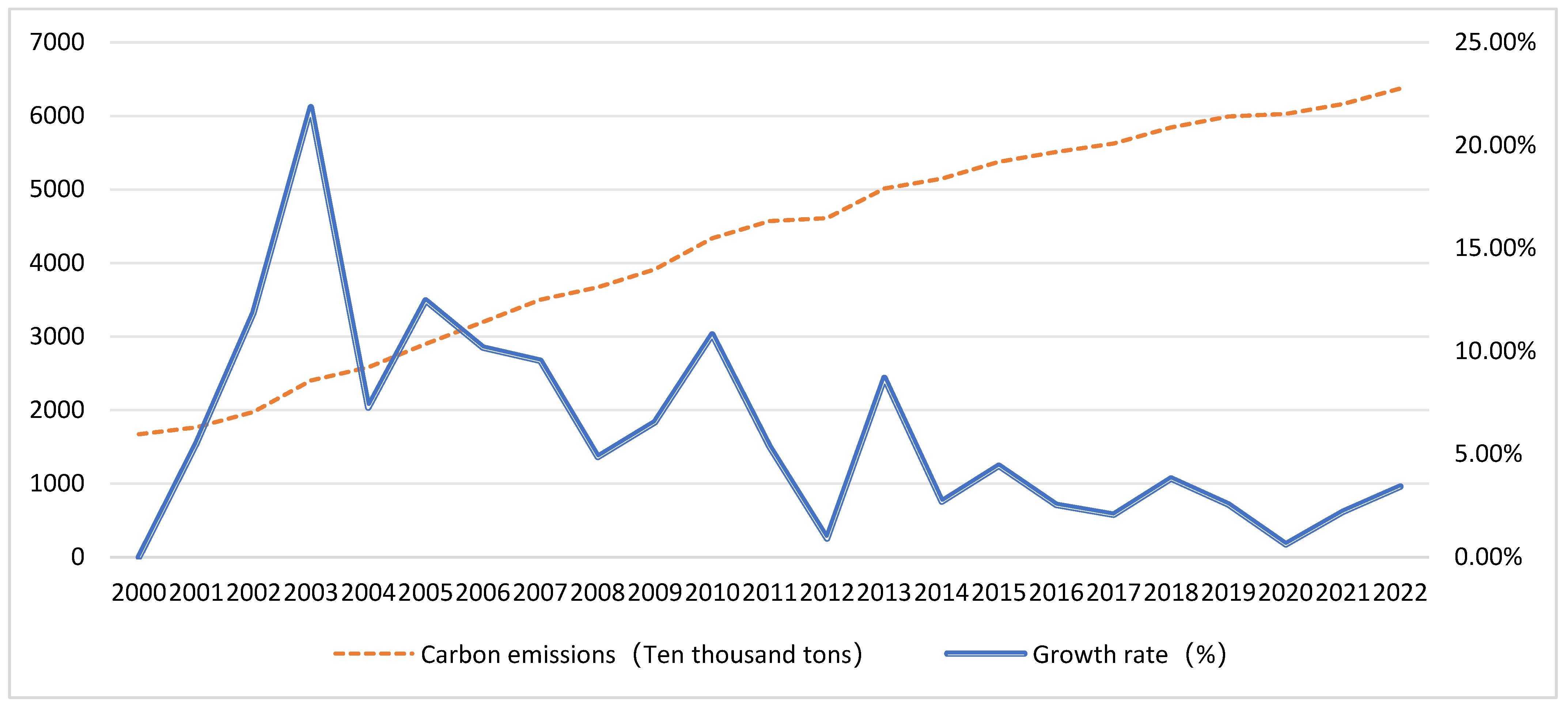
| C | Carbon Emissions from Energy Consumption | Ten thousand tons |
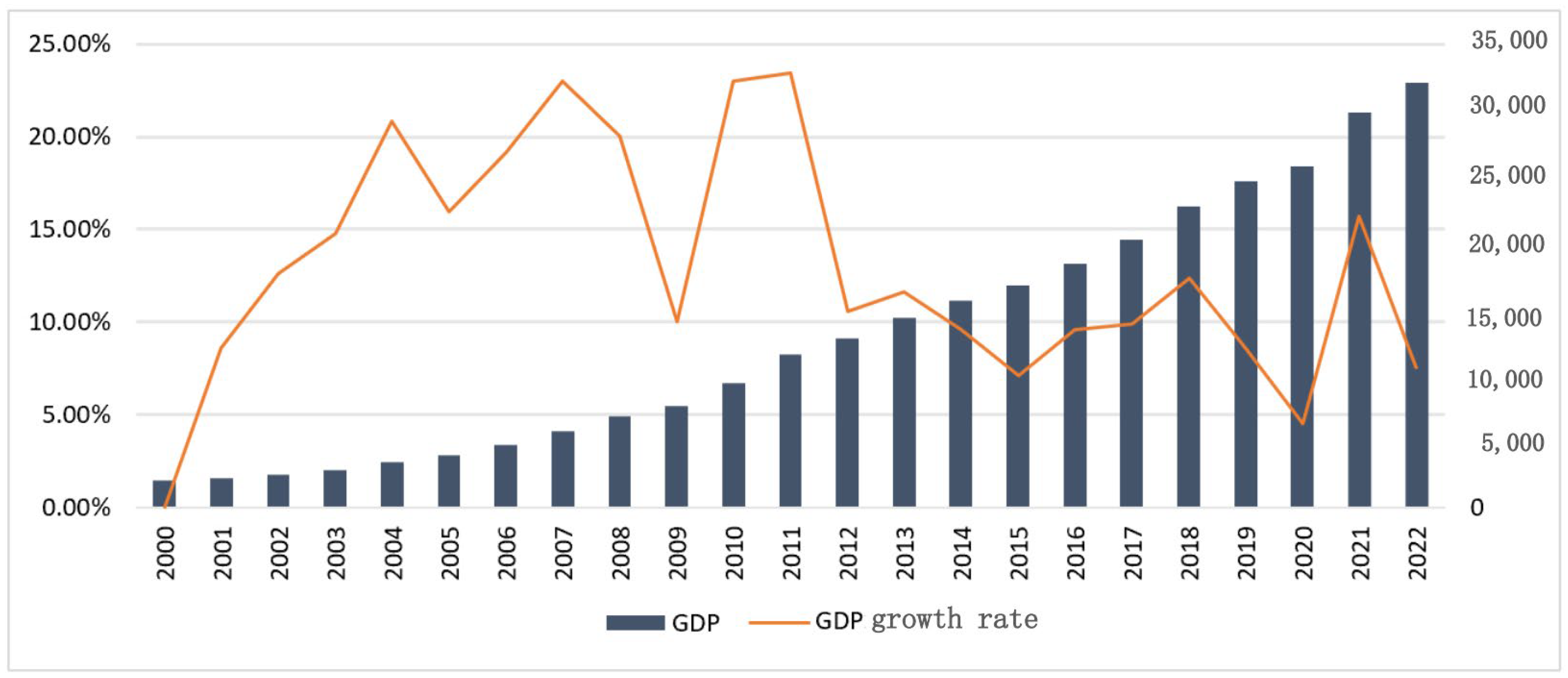
| X1 = GDP | Regional Gross Domestic Product | Hundred million yuan |
| X2 = C/GDP | Carbon Emissions Per Unit of GDP Produced (output carbon intensity) | Ton/ten thousand yuan |
| X3 = E | Energy Consumption | Tons of standard coal |
| X4 = C/E | Carbon Emissions Per Unit of Energy Consumption (carbon intensity of energy consumption) | Tons/tons of standard coal |
| X5 = P | Permanent Population (population size) | Ten thousand people |
| X6 = C/P | Carbon Emissions Per Capita | Tons per person |
| X7 = GDP/P | Real GDP Per Capita | Ten thousand yuan/person |
| X8 = E/GDP | Energy Consumption Per Unit of GDP (energy intensity) | Tons of standard coal/10,000 yuan |
| Decoupling Category | Status | ΔC/C | ΔG/G | t |
|---|---|---|---|---|
| Negative Decoupling | Weak Negative Decoupling | <0 | <0 | [0, 0.8) |
| Strong Negative Decoupling | >0 | <0 | (−∞, 0) | |
| Expansion Negative Decoupling | >0 | >0 | (1.2, +∞) | |
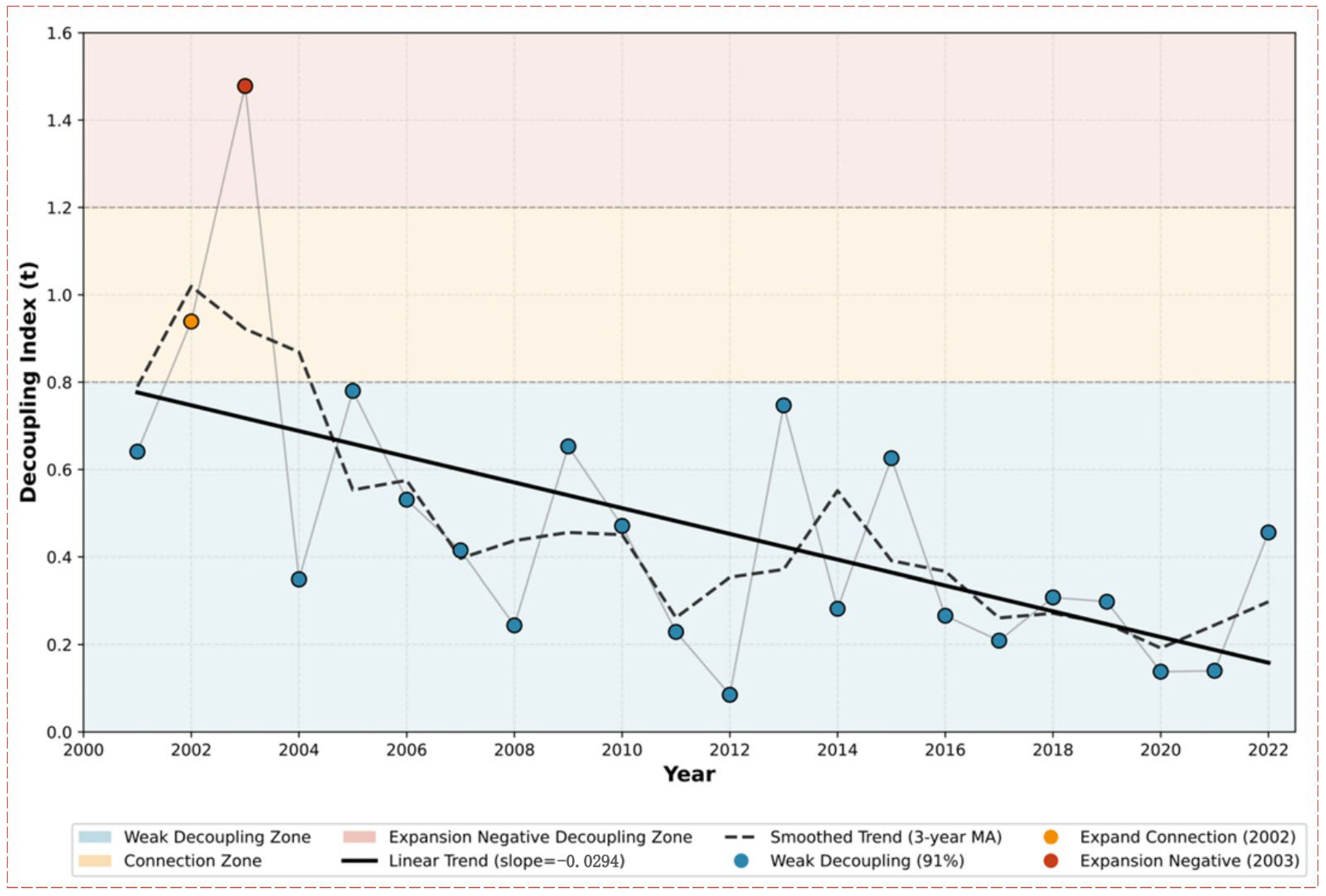
| Decoupling | Weak Decoupling | >0 | >0 | [0, 0.8) |
| Strong Decoupling | <0 | >0 | (−∞, 0) | |
| Recession Decoupling | <0 | <0 | (1.2, +∞) | |
| Connect | Decay Connection | <0 | <0 | [0.8, 1.2] |
| Expand Connection | >0 | >0 | [0.8, 1.2] |
| Year | X1 | X2 | X3 | X4 | X5 | X6 | X8 |
|---|---|---|---|---|---|---|---|
| 2001 | 0.02863 | −0.00977 | 0.01643 | 0.00199 | 0.00302 | 0.01556 | −0.00029 |
| 2002 | 0.04229 | −0.00240 | 0.03950 | 0.00078 | 0.00299 | 0.03755 | −0.00006 |
| 2003 | 0.05105 | 0.02191 | 0.05935 | 0.01504 | 0.00265 | 0.07290 | 0.00007 |
| 2004 | 0.06687 | −0.03959 | 0.03725 | −0.01277 | 0.00230 | 0.02272 | −0.00169 |
| 2005 | 0.05318 | −0.01069 | 0.04200 | 0.00029 | 0.00221 | 0.04066 | −0.00036 |
| 2006 | 0.06308 | −0.02651 | 0.02923 | 0.00467 | 0.00220 | 0.03264 | −0.00199 |
| 2007 | 0.07488 | −0.03859 | 0.02794 | 0.00364 | 0.00229 | 0.03044 | −0.00364 |
| 2008 | 0.06434 | −0.04404 | 0.02137 | −0.00546 | 0.00242 | 0.01418 | −0.00310 |
| 2009 | 0.03319 | −0.01096 | 0.02670 | −0.00454 | 0.00245 | 0.01975 | −0.00013 |
| 2010 | 0.07530 | −0.03485 | 0.02688 | 0.00899 | 0.00232 | 0.03475 | −0.00381 |
| 2011 | 0.07460 | −0.05155 | 0.02934 | −0.01177 | 0.00087 | 0.01767 | −0.00355 |
| 2012 | 0.03417 | −0.02997 | 0.01438 | −0.01145 | 0.00012 | 0.00294 | −0.00073 |
| 2013 | 0.03897 | −0.00913 | 0.02056 | 0.00849 | 0.00001 | 0.02959 | −0.00064 |
| 2014 | 0.03119 | −0.02155 | 0.02055 | −0.01135 | 0.00031 | 0.00886 | −0.00026 |
| 2015 | 0.02359 | −0.00847 | 0.01528 | −0.00039 | 0.00036 | 0.01467 | −0.00015 |
| 2016 | 0.03139 | −0.02197 | 0.01202 | −0.00361 | 0.00083 | 0.00776 | −0.00067 |
| 2017 | 0.03242 | −0.02438 | 0.00912 | −0.00233 | 0.00117 | 0.00579 | −0.00092 |
| 2018 | 0.04063 | −0.02622 | 0.01156 | 0.00107 | 0.00015 | 0.01279 | −0.00143 |
| 2019 | 0.02818 | −0.01898 | 0.01352 | −0.00499 | 0.00018 | 0.00848 | −0.00041 |
| 2020 | 0.01491 | −0.01258 | 0.00491 | −0.00285 | 0.00022 | 0.00188 | −0.00018 |
| 2021 | 0.05021 | −0.04051 | 0.02352 | −0.01622 | −0.00011 | 0.00766 | −0.00135 |
| 2022 | 0.02497 | −0.01296 | 0.00849 | 0.00295 | 0.00079 | 0.01077 | −0.00047 |
| Total | 0.97805 | −0.47375 | 0.50992 | −0.03982 | 0.02974 | 0.45001 | −0.02575 |
| Year | ∆C/C | ∆GDP/GDP | t | Decoupling Status |
|---|---|---|---|---|
| 2001 | 0.055 | 0.086 | 0.641 | Weak Decoupling |
| 2002 | 0.119 | 0.126 | 0.939 | Expand Connection |
| 2003 | 0.219 | 0.148 | 1.478 | Expansion Negative Decoupling |
| 2004 | 0.073 | 0.208 | 0.349 | Weak Decoupling |
| 2005 | 0.125 | 0.160 | 0.780 | Weak Decoupling |
| 2006 | 0.102 | 0.192 | 0.531 | Weak Decoupling |
| 2007 | 0.095 | 0.230 | 0.415 | Weak Decoupling |
| 2008 | 0.049 | 0.200 | 0.244 | Weak Decoupling |
| 2009 | 0.065 | 0.100 | 0.653 | Weak Decoupling |
| 2010 | 0.108 | 0.230 | 0.471 | Weak Decoupling |
| 2011 | 0.054 | 0.235 | 0.229 | Weak Decoupling |
| 2012 | 0.009 | 0.106 | 0.085 | Weak decoupling |
| 2013 | 0.087 | 0.117 | 0.747 | Weak Decoupling |
| 2014 | 0.027 | 0.096 | 0.282 | Weak Decoupling |
| 2015 | 0.044 | 0.071 | 0.626 | Weak Decoupling |
| 2016 | 0.025 | 0.096 | 0.266 | Weak Decoupling |
| 2017 | 0.021 | 0.099 | 0.209 | Weak Decoupling |
| 2018 | 0.038 | 0.124 | 0.308 | Weak Decoupling |
| 2019 | 0.026 | 0.086 | 0.298 | Weak Decoupling |
| 2020 | 0.006 | 0.045 | 0.138 | Weak Decoupling |
| 2021 | 0.022 | 0.157 | 0.140 | Weak Decoupling |
| 2022 | 0.034 | 0.075 | 0.456 | Weak Decoupling |
| Region (Research) | Period | Main Decoupling State | Overall Contribution: Economic Scale (X1) | Overall Contribution: Carbon Intensity (X2) |
|---|---|---|---|---|
| Jiangxi (This study) | 2001–2022 | Weak decoupling (91%) | 97.8% | −47.4% |
| Jianghuai–Baoyu Urban Agglomeration | 2005–2020 | Weak and strong decoupling period | Approximately 85% | Negative value (significant) |
| Beijing–Tianjin–Hebei | 2000–2019 | Various types (weak, strong, expansion) | Approximately 60–80% | Negative value |
| National average value | 2000–2019 | Mainly weak decoupling | High (scale dominant) | Negative value (reducing) |
Disclaimer/Publisher’s Note: The statements, opinions and data contained in all publications are solely those of the individual author(s) and contributor(s) and not of MDPI and/or the editor(s). MDPI and/or the editor(s) disclaim responsibility for any injury to people or property resulting from any ideas, methods, instructions or products referred to in the content. |
© 2026 by the authors. Licensee MDPI, Basel, Switzerland. This article is an open access article distributed under the terms and conditions of the Creative Commons Attribution (CC BY) license.
Share and Cite
Hao, G.; Wang, J.; Tang, X.; Xiao, B.; Nubea, M.D. Structural Transformation and Decoupling Strategies in a Carbon-Intensive Catch-Up Economy. Processes 2026, 14, 367. https://doi.org/10.3390/pr14020367
Hao G, Wang J, Tang X, Xiao B, Nubea MD. Structural Transformation and Decoupling Strategies in a Carbon-Intensive Catch-Up Economy. Processes. 2026; 14(2):367. https://doi.org/10.3390/pr14020367
Chicago/Turabian StyleHao, Guozu, Jingjing Wang, Xinfa Tang, Bin Xiao, and Musa Dirane Nubea. 2026. "Structural Transformation and Decoupling Strategies in a Carbon-Intensive Catch-Up Economy" Processes 14, no. 2: 367. https://doi.org/10.3390/pr14020367
APA StyleHao, G., Wang, J., Tang, X., Xiao, B., & Nubea, M. D. (2026). Structural Transformation and Decoupling Strategies in a Carbon-Intensive Catch-Up Economy. Processes, 14(2), 367. https://doi.org/10.3390/pr14020367

