You are currently on the new version of our website. Access the old version .
ProcessesProcesses
  • Article
  • Open Access

12 January 2026

A Multi-Factor Fracturability Evaluation Model for Supercritical CO2 Fracturing in Tight Reservoirs Considering Dual-Well Configurations


,
,
,
and
1
School of Smart City Engineering, Qingdao Huanghai University, Qingdao 266427, China
2
Department of Engineering, Jining University, Qufu 273100, China
3
College of Agronomy, Northwest A & F University, Yangling 712100, China
*
Author to whom correspondence should be addressed.
This article belongs to the Section Petroleum and Low-Carbon Energy Process Engineering

Abstract

Supercritical CO2 (SC-CO2) fracturing has emerged as a promising technology for the effective stimulation of unconventional tight reservoirs due to its low viscosity, high diffusivity, and environmental advantages. However, existing fracturability evaluation models often oversimplify key parameters and lack validation under realistic dual-well conditions. To address these gaps, we developed a multi-factor coupled evaluation model incorporating well spacing, stress anisotropy, and fluid viscosity and proposed a fracturability index (FI) to quantify the potential for complex fracture development. True triaxial SC-CO2 fracturing experiments using both single- and dual-well setups were conducted, and 3D fracture networks were analyzed via CT imaging and U-Net segmentation. Results show strong agreement between FI and fracture complexity. Optimal fracturing conditions were identified, providing a practical framework for the design and optimization of SC-CO2 fracturing in tight reservoirs.

1. Introduction

Supercritical CO2 (SC-CO2) fracturing technology is a key approach that integrates unconventional hydrocarbon development with geological carbon sequestration [1], playing a strategically significant role in the global energy transition [2]. As conventional oil and gas reserves continue to decline, the efficient exploitation of unconventional resources has become essential for ensuring energy security [3]. Traditional water-based fracturing technologies face numerous technical challenges, including high water consumption [4], clay swelling [5], low flowback efficiency, and potential formation damage [6]. In contrast, SC-CO2, due to its unique physicochemical properties such as low viscosity, high diffusivity, and negligible interfacial tension with the rock matrix under supercritical conditions [7], provides a promising alternative for addressing these challenges [8].
However, single-well fracturing has shown limitations in deep, high-stress, tight formations, primarily due to insufficient fracture network extension and stimulated reservoir volume (SRV), often rendering it economically ineffective in field applications [9]. Dual-well fracturing, by enlarging fracture propagation, enhancing fracture complexity, and increasing SRV, offers a practical solution to overcome these limitations [9,10,11,12]. For instance, in the Daqing Oilfield in China, dual-well hydraulic fracturing has significantly improved production from deep tight gas reservoirs [13]. Dual-well fracturing mainly includes two forms: horizontal dual-well and vertical dual-well fracturing [11]. While horizontal dual-well fracturing has been widely adopted to improve reservoir permeability [14], vertical dual-well fracturing also plays a critical role in shale gas extraction and enhanced geothermal system development [10,11]. Due to differences in in situ stress and stimulation strategies [15], fracture propagation patterns and interactions in vertical wells differ significantly from those observed in horizontal wells [11]. Thus, developing practical reservoir fracturability evaluation models and optimizing fracturing strategies remain urgent tasks [11].
The evaluation of fracturability serves as the foundation for fracturing design and optimization. Especially for dual-well fracturing, establishing a scientific and reasonable quantitative evaluation model of fracturability is of great significance for guiding the selection of field construction parameters, optimizing perforation positions, predicting SRV, and improving the overall fracturing effect. Fracturability is typically evaluated through rock brittleness. Lu et al. [16] proposed a novel evaluation method based on mechanical parameters obtained from physical experiments, incorporating fractal dimensions and fracture angles, using a brittleness index to guide the optimization of perforation cluster locations. Yang et al. [17] conducted uniaxial compression tests and established a quantitative model linking rock brittleness to fracturability using parameters such as fractal dimension and Weibull distribution shape factor, confirming the positive correlation between brittleness and fracturability. However, recent studies indicate that brittleness alone is insufficient to predict the formation of complex fracture networks. Field data and lab results suggest that brittleness indices derived solely from mineral composition often fail to reflect fracture complexity and may even contradict actual observations [18,19,20]. In complex geological settings with natural fractures and strong anisotropy, relying solely on brittleness leads to inaccurate fracturability assessments [20]. In some cases, high brittleness may negatively affect fracture propagation, causing unexpected fracture paths or premature closure, thus reducing fracturing efficiency [21].
Accumulating evidence indicates that the fracturability of unconventional tight reservoirs is governed by multiple interacting factors. Therefore, establishing a quantitative fracturability evaluation model that comprehensively considers these factors is of vital importance. Such models not only contribute to the in-depth understanding of fracturability mechanisms but also significantly enhance the scientific validity of fracturing designs and the operability of field implementations, demonstrating clear engineering application value. Xu et al. [22] proposed defining fracturability as the ease of generating complex fracture networks and achieving large SRV under identical fracturing and reservoir conditions. They introduced indices such as fracture network probability and SRV index for quantitative characterization. Guo et al. [23] related fracturability to gas content and brittleness, classifying reservoirs into three types to guide economically viable operations. Zhai et al. [24] applied the analytic hierarchy process (AHP) and catastrophe theory to minimize subjectivity in weight assignment. Meng et al. [25] used nanoindentation tests on core samples to assess fracturability based on the ratio of fracture to total indentation and elastic modulus anisotropy. Amiri et al. [26] compared multi-well data and rock mechanical properties to define a new fracturability index integrating factors such as rock mechanics, natural fracture geometry, and inter-well spacing, using AHP to establish a total fracturability index model. Zhai et al. [27] developed a model for heterogeneous reservoirs by analyzing brittleness, natural fracture density, fracture toughness, fracture interaction, and stress anisotropy. Shen et al. [28] used well logs, seismic, and fracturing data to identify key factors affecting fracturability—brittleness, in situ stress, porosity, TOC, and perforation cluster distribution—and proposed a comprehensive evaluation model. Ju et al. [29] employed the entropy weight method to establish an evaluation model incorporating both brittleness and toughness to assess fracture propagation under varying reservoir conditions.
Furthermore, current fracturability evaluation methods are sufficient for hydraulic fracturing but lack approaches applicable to SC-CO2 fracturing in reservoirs, especially those considering factors such as temperature, in situ stress, fracturing fluid viscosity, and well spacing [16,22,30]. Collectively, these studies highlight that while multi-parameter fracability models exist, they are predominantly developed and validated for single-well water-based fracturing. Critically missing are: (i) models that explicitly account for dual-well stress interference under SC-CO2 conditions; (ii) experimental validation using 3D fracture complexity metrics; and (iii) integration of SC-CO2-specific parameters such as temperature-dependent viscosity and diffusivity. This study addresses these gaps through a 6-factor FI model validated by true triaxial dual-well SC-CO2 experiments. Therefore, it is necessary to construct a new comprehensive fracturability evaluation model. This model should be developed using a combined weighting method to reasonably balance the relationship between subjective expert opinions and objective data in weight allocation, ultimately providing strong theoretical support for accurately evaluating the reservoir stimulation effect of SC-CO2 fracturing in tight reservoirs.
To address these challenges, this study proposes a novel multi-factor fracturability index (FI) evaluation model specifically for dual-well SC-CO2 fracturing—making three distinct contributions compared to prior studies: integrating critical factors including well spacing, rock brittleness, stress anisotropy, fracturing fluid viscosity (and its temperature sensitivity), and injection energy into a unified framework via a combined weighting method to comprehensively capture the coupled effects of geological and engineering parameters; experimentally validating the model through true triaxial SC-CO2 fracturing tests on artificial dual-well sandstone samples, with fracture networks reconstructed and quantitatively analyzed using computed tomography (CT) and U-net image segmentation—thus bridging the gap between idealized single-well models and realistic multi-well field scenarios; and revealing the unreported non-monotonic influence of well spacing on fracture complexity under SC-CO2 conditions, identifying an optimal dimensionless well spacing range (0.28–0.32) where stress shadow effects maximize network complexity. This work not only verifies the model’s effectiveness and reliability but also provides theoretical basis and technical support for the engineering deployment of field dual-well SC-CO2 fracturing.

2. Experimental

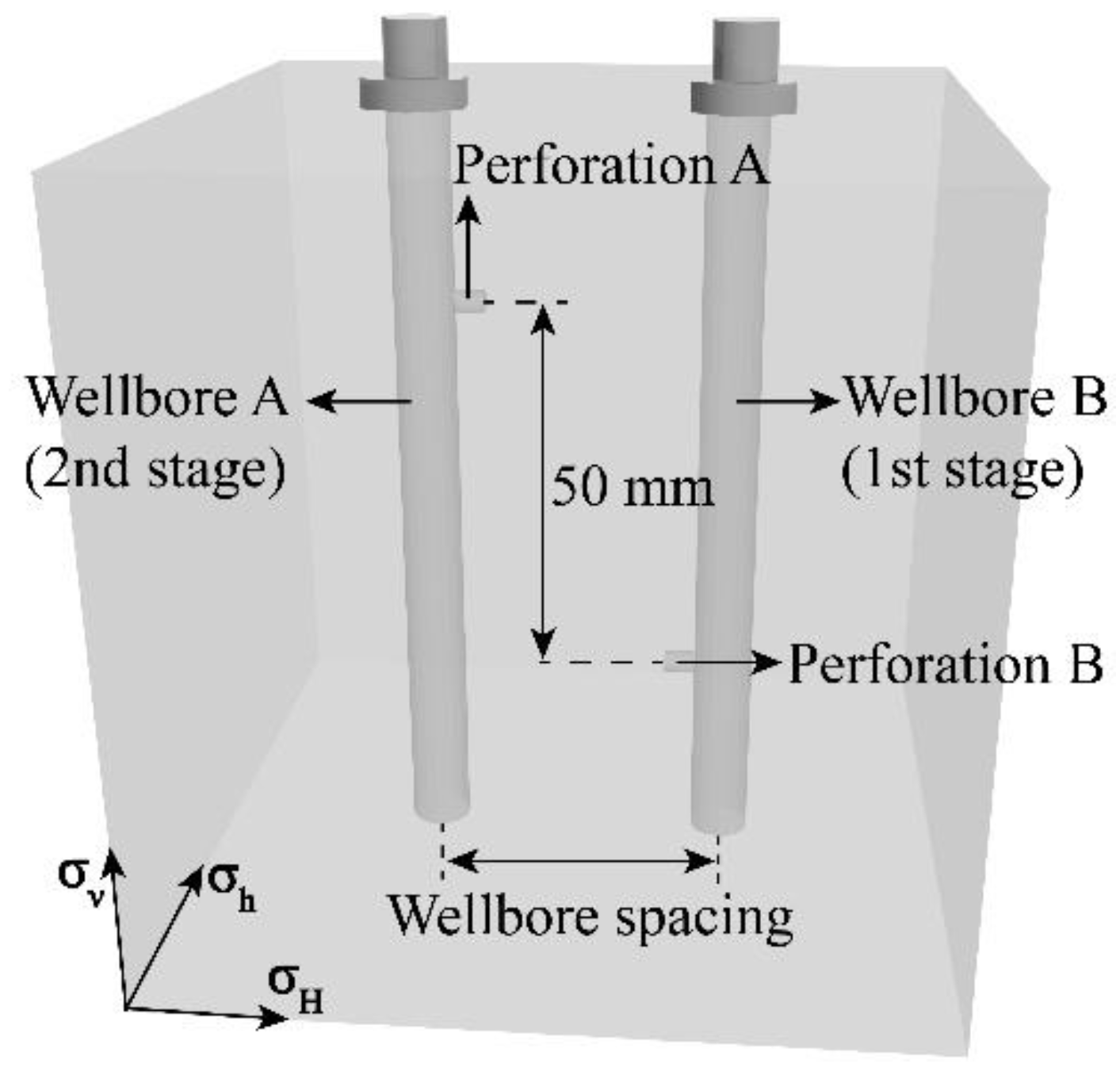
To investigate the influencing parameters of the multi-well SC-CO2 fracturability evaluation model and to investigate the effects of factors such as well spacing and stress anisotropy on fracture propagation, this study specifically focused on the special case of dual-well fracturing within the context of multiple-well fracturing. As shown in Table 1, five different well spacings and three horizontal stress ratios were designed. The experiments were conducted using a sequential fracturing method without flow competition. When the injection pressure in the first stage (Wellbore B) significantly decreased, the second stage (Wellbore A) fracturing operation was initiated. Different tracers were used to distinguish the fractures formed in each of the two stages. The specimen model is illustrated in Figure 1. To simulate the unconventional tight reservoir and ensure that CO2 remains in supercritical state during the experiment, both the specimen and the fracturing fluid were set to a temperature of 60 °C. Following previous studies [31], the specimens were gradually heated before the experiment to ensure uniform internal and external temperatures within 3 h [32]. To evaluate the repeatability of the experiments, all tests were performed in triplicate.
Table 1. Experimental conditions.
Figure 1. Schematic of the artificial tight sandstone specimen.

3. Parameters of Fracturability Index

Based on the results of the dual-well experiments conducted in this study, along with previously completed single-well experiments [8] and findings from prior research [16,33], this section defines the parameters used in the fracturability evaluation model.
Furthermore, it should be noted that the fracturability index proposed herein is an operational fracturability metric, integrating both reservoir properties (brittleness, stress state) and engineering parameters (well spacing, injection energy, fluid choice). This contrasts with ‘intrinsic fracturability’ (e.g., based solely on mineralogy), which is less useful for field design. By including Ei, the model directly links fracturing design intensity to expected complexity—a key advantage for engineers.

3.1. Well Spacing

During multiple-well hydraulic fracturing, closely spaced fractures may propagate either simultaneously or sequentially, leading to significant stress interference between the fractures [34]. When the well spacing is too small, this interference effect is amplified, resulting in mutual suppression of fracture propagation and a reduction in the stimulated reservoir volume [35,36]. Therefore, the appropriate well spacing is crucial in the design of multiple-well fracturing operations. To quantify this impact, the dimensionless well spacing parameter S w has been defined:
S w = l w Δ l
where l w is the well spacing, and Δ l is the length of the parallel borehole arrangement in the fracturing zone; it refers to the length of the specimen in this study, which is 100 mm, as shown in Figure 1.

3.2. Brittleness

Brittleness is the property of reservoir rocks and is also a key parameter for evaluating fracturability. The higher the brittleness of the rock, the more conducive to fracturing. The dimensionless brittleness index B I can be defined using the method proposed by Rickman et al. [19]:
B I = E n + μ n 2
E n = E E min E max E min
μ n = μ max μ μ max μ min
where E and E n are the elastic modulus and normalized elastic modulus, respectively, μ n is the dimensionless Poisson’s ratio.

3.3. Horizontal Principal Stress Anisotropy

The initiation and propagation of hydraulic fractures require the injection pressure of the fluid to overcome the tensile strength of the rock, the induced stresses near the wellbore, and the far-field horizontal in situ stresses [37]. Previous studies believed that there is a preferred fracture propagation direction during the propagation of hydraulic fractures, wherein fractures propagate perpendicular to the direction of the minimum horizontal principal stress [38]. Large horizontal principal stress anisotropy results in fractures propagating predominantly in a single direction, thereby reducing the complexity of the fracture network. In contrast, low horizontal principal stress anisotropy promotes fracture propagation in multiple directions, increasing the number of branching fractures and enhancing the complexity of the fracture network. The influence of stress anisotropy on hydraulic fracturing can be quantitatively characterized using the dimensionless stress anisotropy index K σ :
K σ = σ H σ h σ h
where σ H and σ h are maximum and minimum horizontal principal stress, respectively.

3.4. Fluid Viscosity

The viscosity of the fracturing fluid is one of the key factors influencing the morphology of the fracture network during hydraulic fracturing in reservoirs. Previous research [39] indicates that the use of high-viscosity fracturing fluids typically results in fracture propagation along a single path. In contrast, low-viscosity fracturing fluids can enhance the pore pressure within the rock, thereby reducing the required breakdown pressure and facilitating the complex fracture network with a greater number of branching fractures. Therefore, when establishing the fracturability evaluation model, the viscosity of the fracturing fluid should be considered. The dimensionless fracturing fluid viscosity index λ i has been defined:
λ i = φ max φ i φ max φ min
where φ i is the viscosity of the fracturing fluid, φ max and φ min are the maximum and minimum fracturing fluid viscosity considered within the range, respectively.
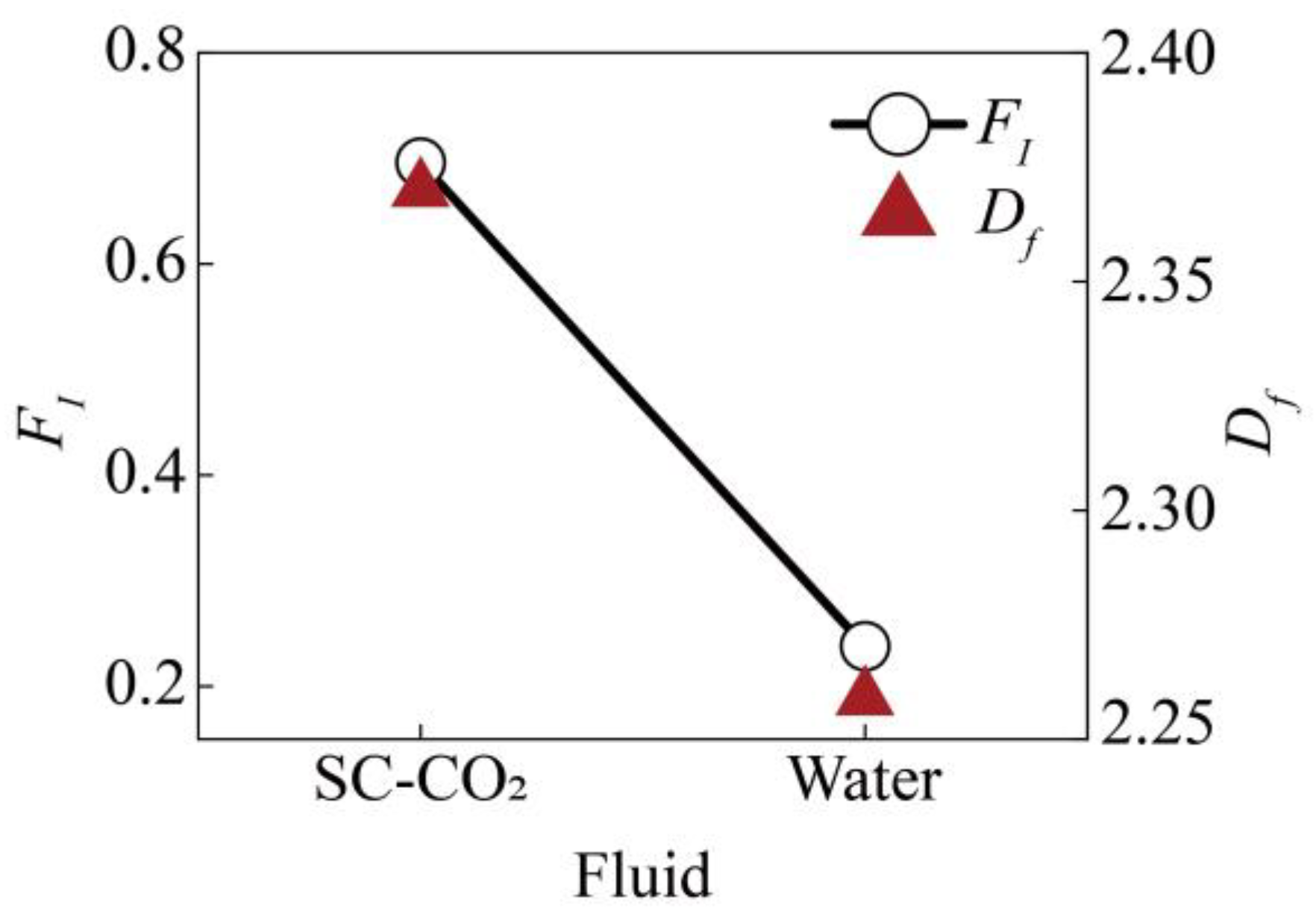
In this study, fluid viscosity is adopted as a representative parameter for SC-CO2’s advantageous properties. Under supercritical conditions (60 °C, >7.38 MPa), SC-CO2 exhibits not only low viscosity (~0.04 mPa·s) but also negligible interfacial tension (<0.1 mN/m) and high molecular diffusivity (~10−7 m2/s) [7,40]. These properties are inherently interlinked through the equation of state, making viscosity a practical and non-redundant proxy. The significant difference in FI between SC-CO2 and water (0.696 vs. 0.238) validates that this single parameter sufficiently captures the net enhancement in fracture complexity.

3.5. Energy Injected

When evaluating the stimulated reservoir volume, considering the energy injected at the macroscopic level is an important approach. According to the research by Goodfellow et al. [40], as shown in Equation (8), the energy injected during the hydraulic fracturing can be estimated by monitoring the injection pressure P ( t ) and the fluid injection rate ν . Based on this principle, the dimensionless injected energy parameter E i has been defined:
E i = E i E min E max E min
E i = t 1 t 2 P ( t ) ν d t
where E i is the total energy injected, E max and E min are the maximum and minimum total energy injected within the range, respectively.

3.6. Reservoir Temperature

According to the results of fracturing experiments under high temperature [41], the viscosity and diffusivity of fracturing fluids are highly sensitive to temperature, especially when SC-CO2 is used as the fracturing fluid. When the reservoir temperature is high, the viscosity of SC-CO2 is low, which is conducive to its flow in the reservoir and the expansion of fractures. Conversely, when the reservoir temperature is low, the viscosity of SC-CO2 is high, which may increase the resistance during the fracturing process and affect the efficiency of fracture formation and expansion. Therefore, when establishing an evaluation model for the fracturability of multi-well tight sandstone reservoirs, the influence of reservoir temperature must be fully considered, and a dimensionless reservoir temperature index T* is defined:
T * = T T min T max T min
where T is the reservoir temperature, T max and T min are the maximum and minimum reservoir temperatures within the range, respectively.

4. Evaluation Model of Fracturability for Multi-Well Tight Sandstone Reservoirs

The combined weighting method follows a two-step philosophy: first, capture expert-informed relative importance via an improved Analytic Hierarchy Process (AHP); second, correct for subjective bias using objective data dispersion via the Entropy Weight Method (EWM).
The improved AHP uses a 0–2 scale to construct pairwise comparisons, then derives initial weights through an optimal transitive matrix to ensure logical consistency. However, as AHP inherently relies on expert judgment, we further apply EWM to adjust these weights based on the actual variation in each parameter across our experimental dataset. Parameters showing greater variation are assigned higher objective weight, while less variable ones receive lower weight. This hybrid approach balances physical intuition with data-driven objectivity, enhancing model robustness.
The key to accurately evaluating the fracturability of multi-well tight sandstone reservoirs lies in how to reasonably determine the weights of the considered parameters. The distribution of weights could significantly affect the reliability and validity of the fracturability evaluation results. Therefore, this study calculates the weights of the parameters proposed in the previous section through a combined weighting method that combines the improved analytic hierarchy process and the entropy weight method and proposes and establishes the fracturability index F I . The larger the value of the fracturability index F I , the more suitable the multi-well tight sandstone reservoir is for fracturing. The fracturability index F I can be expressed as:
F I = i = 1 n ε i δ i               i = 1 , 2 , n
where ε i and δ i are the dimensionless value and weight factor of each parameter, respectively.
To calculate the F I , the following four steps need to be followed: parameter standardization processing, determining the fuzzy weights of each parameter based on the improved analytic hierarchy process, correcting the weights based on the entropy weight method, and weighted calculation of the evaluation parameters.

4.1. Parameter Normalization

The evaluation parameters presented in the previous section have different units and dimensions. Therefore, we should normalize these parameters to maintain consistency. Various methods are employed for the normalization of parameters, including approaches for positive and negative parameters.
For positive parameters:
S = X X min X max X min
For negative parameters:
S = X max X X max X min
where S is the dimensionless value of the parameter, and X is the value of the parameter.

4.2. Weight Calculation

The improved analytic hierarchy process is a robust multi-criteria decision-making method that quantitatively determines the relative weights of multiple factors [42]. By constructing comparison matrices, it assesses the relative importance between each pair of evaluation parameters. Based on these comparisons, a judgment matrix is formulated, and through its solution, precise weights for each evaluation parameter are derived. The scale parameters utilized in the comparison matrices are detailed in Table 2.
Table 2. Scale of comparison matrices.
The binary-like scale (0, 1, 2) was chosen to minimize over-interpretation of expert judgment. The assignment of ‘0’ for stress anisotropy relative to other parameters stems from experimental evidence: across our test matrix (stress ratio 1.0–1.4), changes in Kσ caused only a 6.5% variation in Df, whereas changes in well spacing (20–40 mm) induced a 12.3% variation. This supports its lower relative importance in the studied regime.
The comparison matrices D n × n is:
D n × n = a 1 , 1 , a 1 , 2 , , a 1 , n a n , 1 , a n , 2 , , a n , n
The importance index r i is defined as:
r i = k = 1 n a i , k
Equation (11) computes the importance index as the sum of the i-th row in the judgment matrix. This linear aggregation is a standard step in simplified AHP variants to convert pairwise comparisons into a scalar priority score before eigenvector refinement. It provides an intuitive measure of how ‘frequently’ or ‘strongly’ a parameter is judged as more important than others.
Based on Table 3, we can obtain the judgment matrix A n × n :
A n × n = b i . j n × n
Table 3. Element of the judgment matrix.
The antisymmetric matrix B n × n is represented as follows:
B n × n = lg b i , j n × n
Based on the B n × n , the optimal transitive matrix A n × n is determined as follows:
A n × n = b i , j n × n
b i , j = 10 1 n k = 1 n b i , k b j , k
where b i , j is the element of optimal transitive matrix.
The final weight of each evaluation parameter can be determined by solving the eigenvector of the optimal transitive matrix and normalizing it, expressed as follows:
ξ = ( ξ 1 , ξ 2 , , ξ n )
where ξ is the weight of each parameter.

4.3. Weight Correction Based on the Entropy Weight Method

Although the traditional analytic hierarchy process has been improved by the optimal transfer matrix, the improved analytic hierarchy process still has a certain degree of subjectivity. To further reduce the subjective deviation in the calculation of fuzzy weights, this study introduces the entropy weight method for correction. The entropy weight method is an objective weighting method based on information entropy theory and is widely used in the determination of weights for various evaluation indicators in multi-criteria decision analysis [43]. This method determines the weights of each indicator by calculating its information entropy to reflect its degree of variation. This approach can effectively avoid the influence of subjective factors on weight distribution, ensuring the objectivity and rationality of the weights [44]. When applying the entropy weight method, the first step is to determine and calculate the entropy value Hi (i = 1, 2, …, n) of each influencing parameter:
H i = K j = 1 n f i , j ln f i j
K = ( ln n ) 1
f i , j = r i , j j = 1 n r i , j
Calculate the initial weight Wi of each evaluation parameter through the obtained entropy value:
W i = 1 H i i = 1 n 1 H i
Based on the fuzzy weights calculated by the improved analytic hierarchy process, the initial weights Wi are corrected to obtain the final weights δi:
δ i = ξ i W i i = 1 n ξ i W i

4.4. Establish the New Fracturability Evaluation Model

Table 4 presents the results of the comparison matrices constructed for the evaluation parameters. The importance indices for each evaluation parameter can be calculated according to Equation (11), with the results shown in Table 5. From the results, it is evident that brittleness and energy injected are the primary factors influencing reservoir hydraulic fracturing, followed by well spacing, fracturing fluid viscosity and reservoir temperature, with stress anisotropy being the least significant.
Table 4. Comparison matrices.
Table 5. The importance index.
It should be noted that the weight ranking (brittleness ≈ energy > spacing ≈ viscosity ≈ temperature > stress anisotropy) reflects the parameter variation ranges covered in our experimental program. Within these ranges—particularly the low-to-moderate stress anisotropy (0–0.46) and fixed rock type—the influence of stress anisotropy on fracture complexity was indeed minimal compared to other factors. This ordering is consistent with the observed fractal dimension trends, where FI correlates most strongly with well spacing and fluid type. The ranking may shift in reservoirs with extreme stress ratios (>1.5) or highly ductile rocks, which lie outside our current scope.
According to Equation (12), the judgment matrix is as follows:
A = 1 1 / 5 4 1 1 / 5 1 5 1 9 5 1 5 1 / 4 1 / 9 1 1 / 4 1 / 9 1 / 4 1 1 / 5 4 1 1 / 5 1 5 1 9 5 1 5 1 1 / 5 4 1 1 / 5 1
According to Equation (13), the antisymmetric matrix is as follows:
B = 0 0.699 0.602 0 0.699 0 0.699 0 0.954 0.699 0 0.699 0.602 0.954 0 0.602 0.954 0.602 0 0.699 0.602 0 0.699 0 0.699 0 0.954 0.699 0 0.699 0 0.699 0.602 0 0.699 0
The optimal transitive matrix is as follows:
A = 1 0 . 228 3 . 065 1 0 . 228 1 4 . 377 1 13 . 416 4 . 37 7 1 4 . 37 7 0 . 326 0 . 075 1 0 . 326 0 . 075 0 . 326 1 0 . 228 3 . 065 1 0 . 228 1 4 . 37 7 1 13 . 416 4.377 1 4.377 1 0.228 3.065 1 0.228 1
The eigenvector of the optimal transitive matrix is as follows:
ξ = 0.083 , 0.362 , 0.027 , 0.083 , 0.362 , 0.083
The weight vector is obtained as the normalized principal eigenvector of the optimal transitive matrix. The vector is then normalized, ensuring the weights represent a probability distribution over parameters. This standard normalization guarantees comparability and avoids scale-dependent bias.
Consequently, the weights corresponding to well spacing, brittleness, stress anisotropy, fracturing fluid viscosity, energy injected and reservoir temperature are 0.083, 0.362, 0.027, 0.083, 0.362 and 0.083, respectively. Based on the improved analytic hierarchy process, the entropy weight method is used to correct the fuzzy weights calculated by it. The entropy values Hi and initial weights Wi calculated according to Equations (20) and (23) are shown in Table 6.
Table 6. The results of entropy method.
The corrected weights were calculated based on Equation (24), and the corresponding corrected weights for the well spacing index, brittleness index, horizontal stress difference coefficient, fracturing fluid viscosity index, injection energy index, and reservoir temperature are 7.2%, 38.6%, 1.3%, 7.2%, 38.6%, and 7.2%, respectively. Therefore, the formula for calculating the fracturability index is obtained based on Equation (10):
F I = 7.2 % S w + 38.6 % B I + 1.3 % K σ + 7.2 % λ i + 38.6 % E i + 7.2 % T *
Although brittleness is assigned a high weight (38.6%), this does not imply that it is used in isolation. Rather, within the context of dual-well SC-CO2 fracturing, BI serves as a robust proxy for rock failure resistance and fracture conductivity. Its high weight is justified by both expert judgment (AHP) and its substantial variation across our parameter space (entropy correction). Critically, the model does not treat brittleness as a binary ‘high is good’ metric; instead, it is nonlinearly coupled with well spacing and stress field, such that high brittleness only enhances fracability when stress shadow effects are moderate (e.g., Sw ≈ 0.3). This resolves the apparent contradiction cited in the literature.

5. Results and Discussion

5.1. Fracture Extraction and Reconstruction Based on CT Images

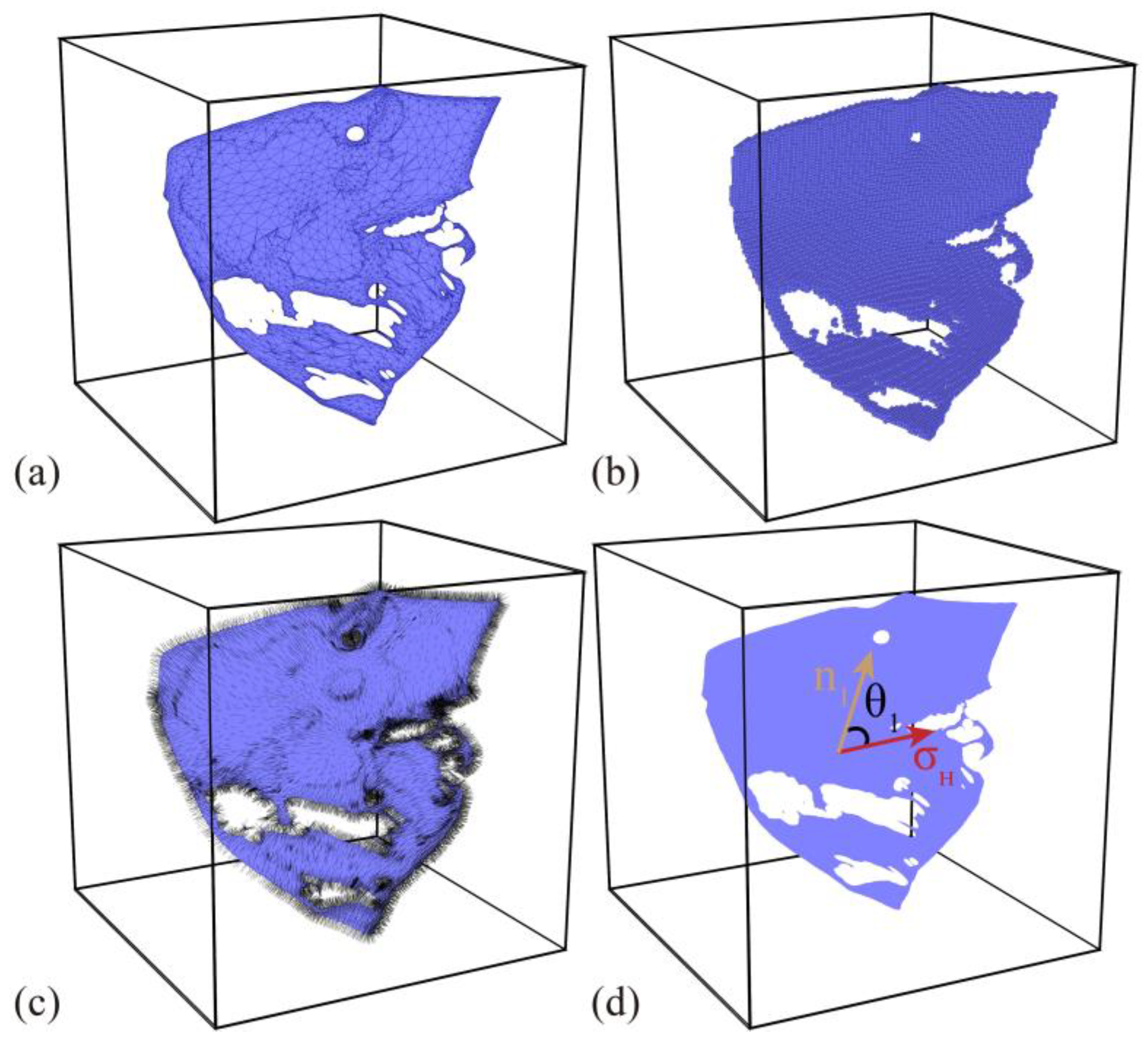
After generating a series of two-dimensional slice images of the rock sample using a CT scanning system, this study employed a U-net image segmentation algorithm to process the slice images [45]. The U-net is an image segmentation algorithm based on a fully convolutional neural network, primarily consisting of an encoding and a decoding pathway. Initially, the encoding pathway extracts image features and captures contextual information, compressing the image into a feature map. Subsequently, the decoding pathway precisely localizes the extracted features, decodes, and segments the fractures from the input images. As shown in Figure 2a, the two-dimensional fracture slice images processed by the U-net algorithm can be reconstructed into a complete 3D fracture network using post-processing 2024.2.0 software. As illustrated in Figure 2b–d, the reconstructed fractures can be quantitatively represented by fractal dimensions D f and voxels [46]. By calculating the number of voxels, further quantitative data, such as the deflection angle and aperture of the fractures, can be obtained, which allows for a more detailed analysis and validation of the model’s accuracy.
Figure 2. Fracture network reconstruction and workflow: (a) Fracture network reconstruction, (b) fracture network voxelization, (c) normal calculation, (d) calculation of the deflection angles.

5.2. The Effect of Well Spacing on Dual-Well SC-CO2 Fracturing

As shown in Table 7, the results of various evaluation parameters and the fracturability index under different well spacing conditions indicate that as the well spacing decreases, the fracturability index initially increases and then decreases.
Table 7. The fracturability index under different well spacings.
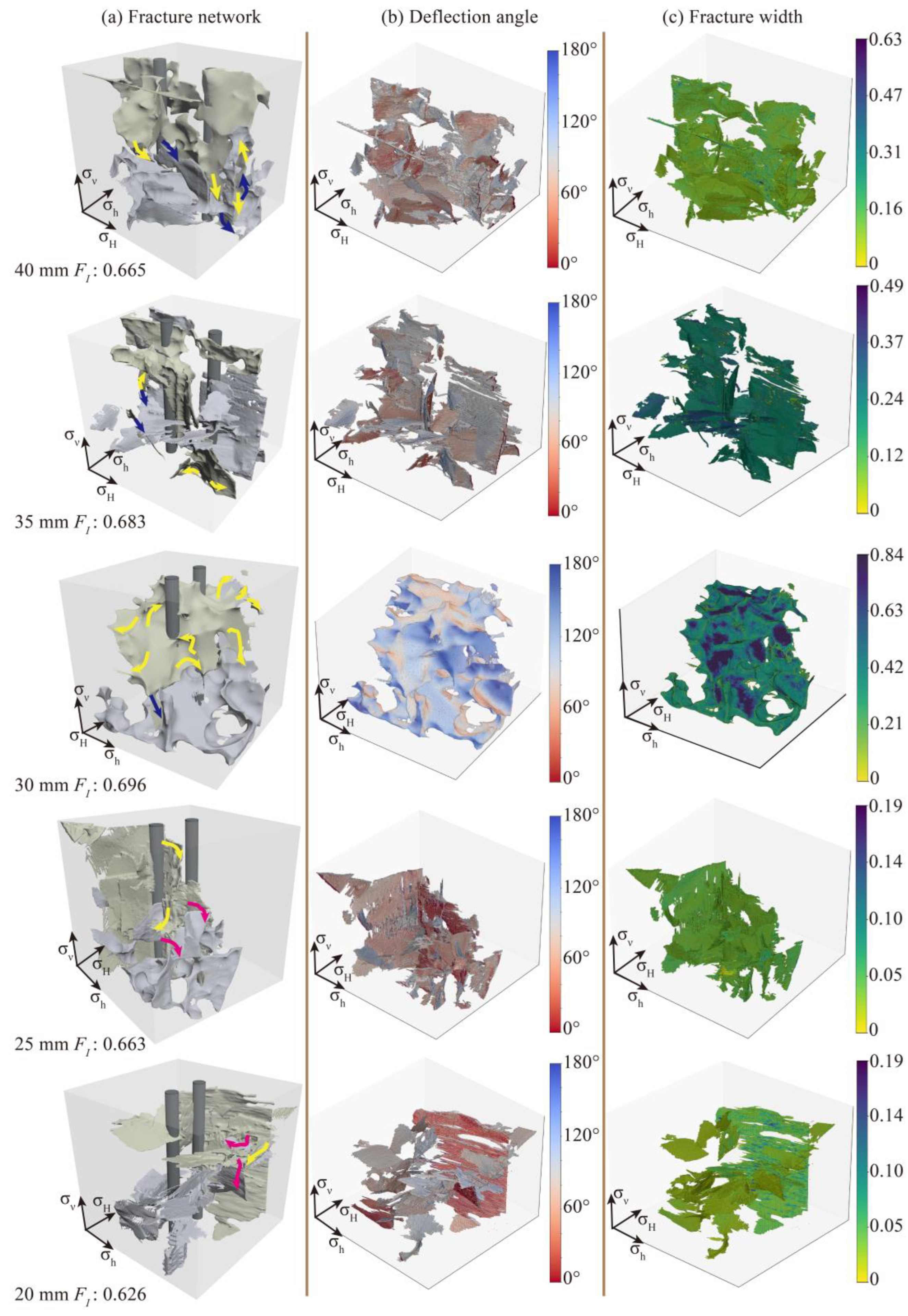
In Figure 3a, the gray fracture network represents fractures formed during the first stage, while the brown network corresponds to those formed during the second stage. The results indicate that as the well spacing decreases, the number of secondary (branched) fractures in the second-stage network first increases and then decreases, whereas the complexity of the first-stage fracture network remains relatively unchanged. However, the second-stage fracture network exhibits significant variations with decreasing well spacing. At the well spacing of 40 mm with horizontal stress ratio of 1:1, the first-stage fractures propagate in relatively dispersed directions. The second-stage fractures are minimally influenced by the first-stage network but are more strongly controlled by the in situ stress field. During propagation, numerous intersections with the first-stage fractures occur, while deflection events are relatively rare. As shown in Figure 3a, yellow arrows denote deflection, and dark blue arrows indicate intersection. When the well spacing is reduced to 35 mm, the stress shadow effect becomes more pronounced compared to the 40 mm. Consequently, deflection occurrences in the second-stage fractures increase, while intersections with the first-stage network slightly decrease. In this study, fracture ‘deflection’ is defined as a change in propagation direction ≥ 30° relative to the initial fracture orientation (perpendicular to σ h ), as derived from 3D normal vector analysis. ‘Intersection’ is identified when Stage-I and Stage-II fracture voxels are within 0.2 mm (2× CT voxel size) in 3D space, indicating physical contact or coalescence. The reported deflection angle and aperture ranges represent the minimum and maximum values observed across the entire reconstructed 3D fracture network, based on voxel-level analysis. At 40 mm spacing, although Stage-II fractures exhibit ‘numerous intersections’ with Stage-I (due to overlapping volumes), their propagation direction remains largely unaltered by stress shadow effects—hence described as ‘minimally influenced’ in terms of trajectory reorientation.
Figure 3. Morphologies of SC-CO2 fracturing fracture network under different well spacings.
At 30 mm, deflection becomes significantly more frequent, and intersections are markedly reduced. Moreover, short, non-extending fractures begin to appear in the second-stage network, indicating that the stress shadow effect is beginning to constrain fracture propagation. Nevertheless, due to the increase in deflection events, the fracture network complexity at 30 mm remains higher than at larger spacings. When the spacing is further reduced to 25 mm and 20 mm, the intensified stress shadow effect leads to the formation of numerous short and non-propagating fractures in the second-stage network. Simultaneously, extensive connectivity between first- and second-stage fractures emerges, as indicated by the purple arrows in Figure 3a. This significantly reduces the overall complexity of the fracture network, resulting in a more regular second-stage network with substantially fewer branched fractures.
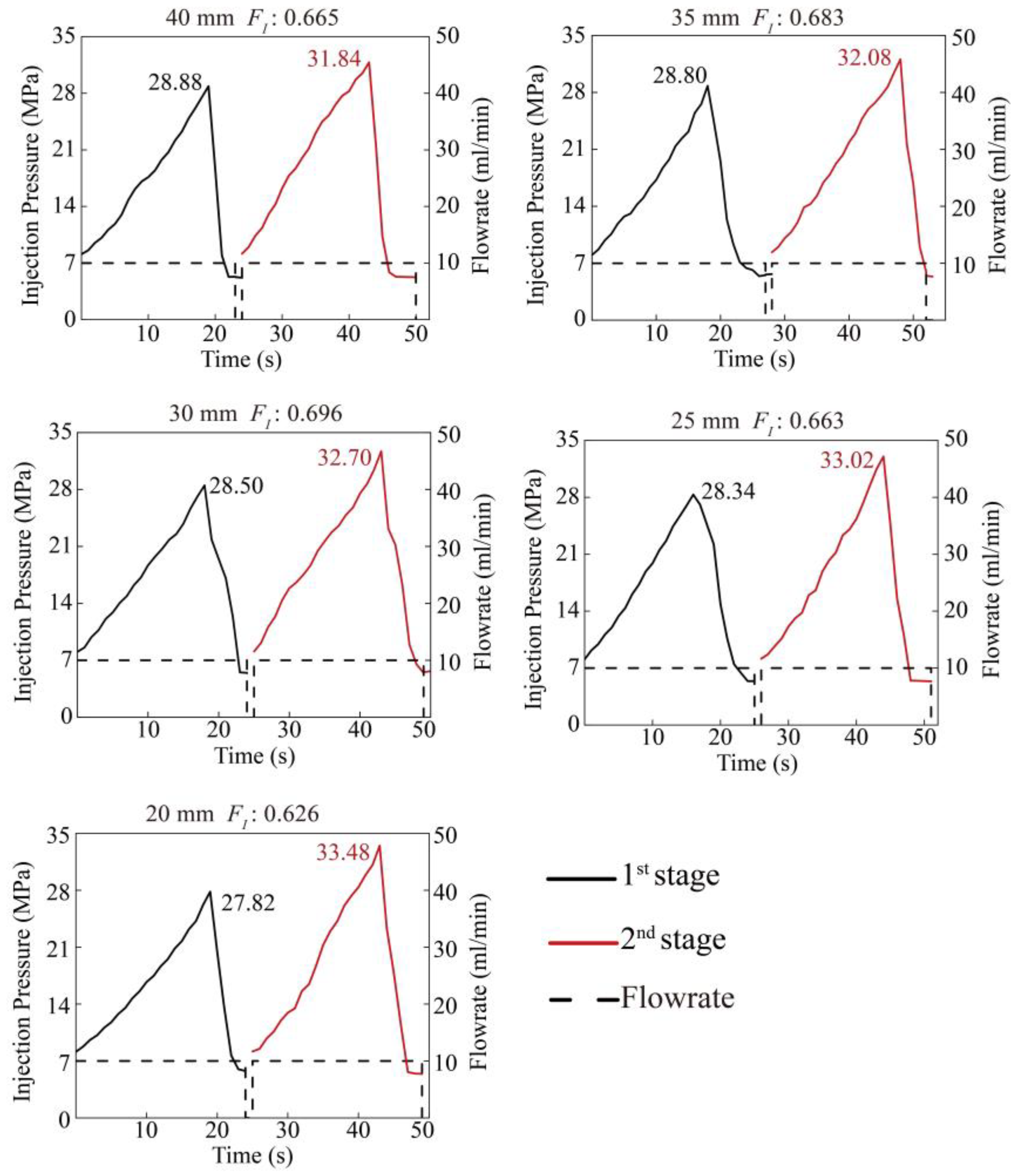
Figure 3b,c present the 3D fracture networks, fracture deflection angle distributions, and fracture aperture distributions under different well spacing conditions. The results show that as the well spacing decreases, the number of secondary fractures in the second-stage network initially increases and then decreases, while the complexity of the first-stage fracture network remains largely unchanged. Notably, the second-stage fracture network undergoes significant changes with decreasing well spacing. When the spacing is reduced to 25 mm and 20 mm, the fracture network becomes more regular, with a substantial reduction in the number of branched fractures. The distribution of fracture deflection angles in the second-stage network varies significantly with well spacing. At 30 mm spacing, the deflection angles exhibit the highest degree of complexity, predominantly ranging from 30° to 140°, indicating high directional variability and extensive branching. In contrast, at 25 mm and 20 mm spacings, the deflection angle ranges narrow markedly, concentrating between 70–100° and 80–100°, respectively. When the spacing increases to 35 mm and 40 mm, the deflection angle distribution broadens again, primarily spanning 90–120° and 60–120°, respectively, suggesting increased directional diversity. Comparison of fracture aperture distributions further supports these trends. At a spacing of 30 mm, the aperture distribution is most complex, primarily concentrated between 0.4 mm and 0.6 mm. As the spacing decreases to 25 mm and 20 mm, the aperture range becomes more constrained, focusing on 0.04–0.10 mm and 0.05–0.11 mm, respectively. At larger spacings, significant variations in aperture distribution are observed. At 40 mm, the distribution becomes more uniform, concentrated between 0.07 mm and 0.18 mm. At 35 mm, a large area of deep green coloration appears, with aperture values mainly ranging from 0.14 mm to 0.27 mm. Figure 4 illustrates the injection pressure for SC-CO2 fracturing under different well spacings. As the well spacing decreases, the breakdown pressure in the first stage decreases by 3.65%, while the breakdown pressure in the second stage increases by 5.16%. Additionally, the difference in breakdown pressures between the two stages is also observed to increase.
Figure 4. Injection pressure of SC-CO2 fracturing under different well spacings.
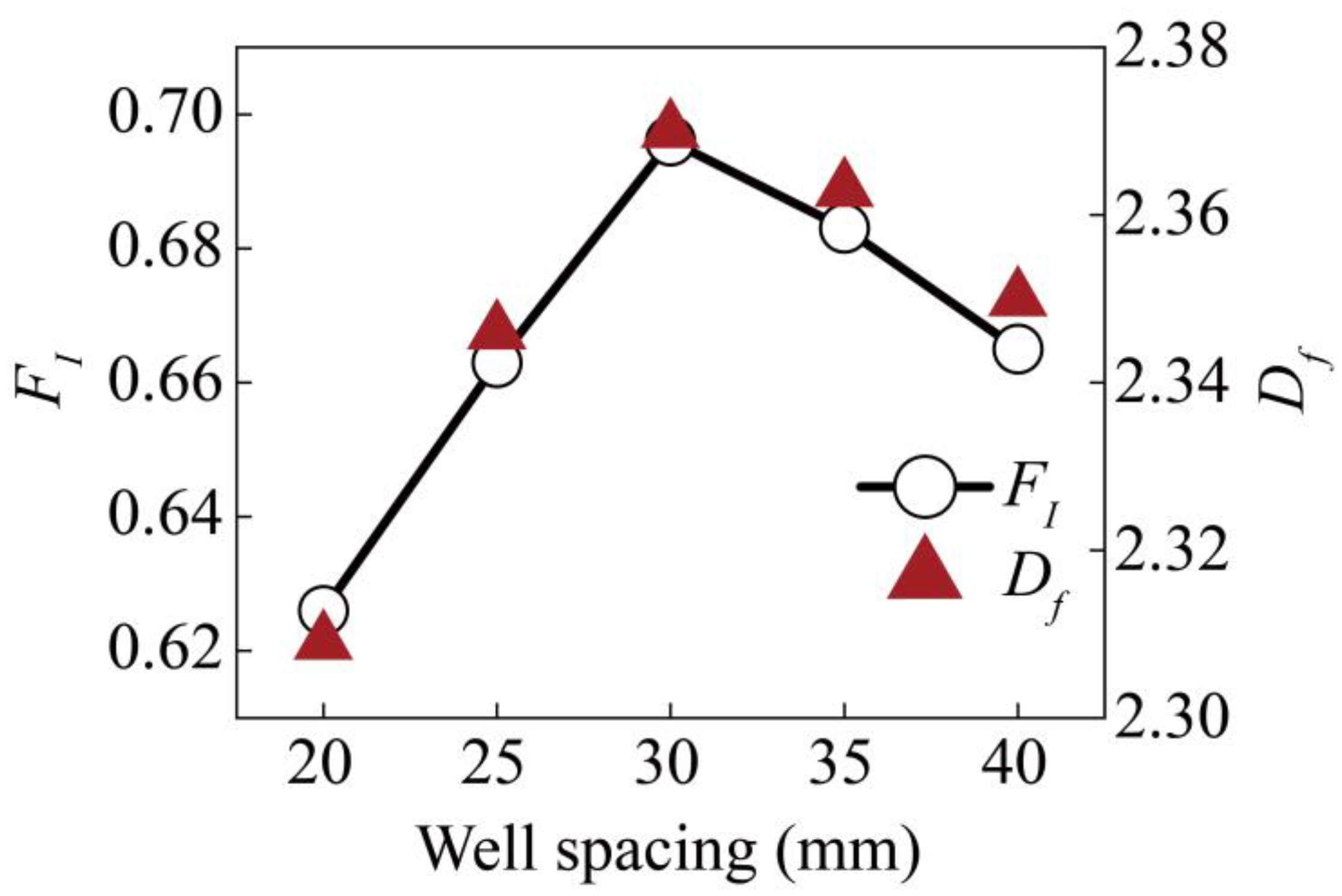
Figure 5 illustrates the relationship between the fractal dimension of the fracture network and the fracturability index under different well spacings. As the well spacing increases, both the fractal dimension and the fracturability index initially increase and then decrease. When the well spacing is 30 mm, both the fractal dimension and the fracturability index reach their maximum values, indicating that the fracture network is most complex under this condition. During fracturing, the propagation of fractures alters the stress field in the surrounding rock, which in turn influences the propagation patterns and morphologies of adjacent fractures [47]. As the well spacing gradually decreases, the stress concentration near the wellbore during the first stage of fracturing becomes more pronounced, leading to a reduction in the breakdown pressure for this stage [48]. The small well spacing enhances the interaction of stresses between fractures [35], making the stress shadow effect more significant, as shown in Figure 3. Consequently, during the second stage of fracturing, the effective stress that needs to be overcome for further fracture propagation is increased. During hydraulic fracturing, the stress redistribution induced by fracture propagation significantly alters the propagation trajectories and morphologies of adjacent fractures [47]. Notably, well spacing, a critical engineering parameter, directly influences the superposition pattern and intensity of stress fields at fracture tips by regulating the spatial configuration relationship of neighboring hydraulic fractures. Based on the multi-fracture interference theoretical model proposed by Li et al. [49], we introduced a stress interference factor that accounts for the mutual perturbation effects between fractures [11,49]. By adopting a dimensionless characterization method, this factor enables quantitative description of the interference effects Df,I,II exerted by first-stage fractures on second-stage fractures [11,49]:
D f , I , I I = K e c h e l o n K s i n g l e
K e c h e l o n = W σ I I ( ξ , η ) + Δ σ I , i n d u c e d + Δ σ I I , i n d u c e d 0 α m ( α , ξ ) d ξ + W P I I + Δ σ I , i n d u c e d + Δ σ I I , i n d u c e d 0 α m ( α , ξ ) d ξ
K s i n g l e = W σ I I ( ξ , η ) + P I I 0 α m ( α , ξ ) d ξ
where Ksingle is the stress intensity factor of second-stage fractures under isolated conditions, Kechelon is the equivalent stress intensity factor of second-stage fractures considering the interference from first-stage fractures, and α and ξ are the dimensionless fracture length and coordinate, respectively, defined as α = a / W , ξ = x / W , η = y / W where a is the fracture length, x is the coordinate, and W is the characteristic fracture length. According to Rice et al. [50], in the weight function theory, m ( α , ξ ) is a weight function that characterizes the mechanical response of a fracture system [50,51], and σ I I ( ξ , η ) is the hypothetical stress at the fracture location induced by loads and displacements acting on the outer boundary of the cracked body, including the internal body forces and stresses (such as interference stresses between fractures). When the fracture spacing increases, the absolute values of the two interference factors exhibit a significant decreasing trend, indicating that the mutual interference intensity between fractures is negatively correlated with the spacing. Shear stress superposition at the fracture tips alters the distribution of the local stress fields, leading to deflections in fracture propagation directions [11]. When Df,I,II > 1, first-stage fractures promoted the propagation of second-stage fractures; conversely, when Df,I,II < 1, an inhibitory effect was observed. According to Li et al. [49], when the fracture spacing is approximately equal to the half-length of the fractures, first-stage fractures exert moderate inhibition on second-stage fractures [11,49]. Under the influence of shear stress superposition at the fracture tips, deflections tend to occur, leading to frequent reorientation during fracture propagation and the promotion of branch fracture development, which are beneficial for forming a more complex fracture network configuration. This spacing can be characterized as the optimal spacing for stress shadow effects between fractures. From a macroscopic perspective, this implies the existence of an optimal well spacing where stress shadow effects are moderate, maximizing the promotional effect of the first-stage fracture network on second-stage fracture propagation, which is consistent with previous studies [35,47,48,52]. Therefore, in engineering applications, the rational selection of well spacing is crucial for promoting fracture reorientation, forming complex fracture networks, and improving reservoir stimulation efficiency.
Figure 5. D f and F I of SC-CO2 fracturing fracture networks under different well spacings ( F I is fracturability index, and D f is fractal dimension).
Based on the stress interference factor Df,I,II (Equation (30)), our calculations show that at Sw = 0.30, Df,I,II ≈ 1.05 (>1), indicating mild promotion of Stage-II fractures. At Sw = 0.25, Df,I,II drops to 0.92 (<1), marking the onset of inhibitive interference. This critical threshold aligns with the peak in FI and Df, providing a physics-based criterion for optimal well spacing.

5.3. The Effect of Stress Anisotropy on Dual-Well SC-CO2 Fracturing

As shown in Table 8, the results of various evaluation parameters and the fracturability index under different stress anisotropies indicate that as the stress ratio increases, the fracturability index exhibits a decreasing trend.
Table 8. The fracturability index under different stress anisotropies.
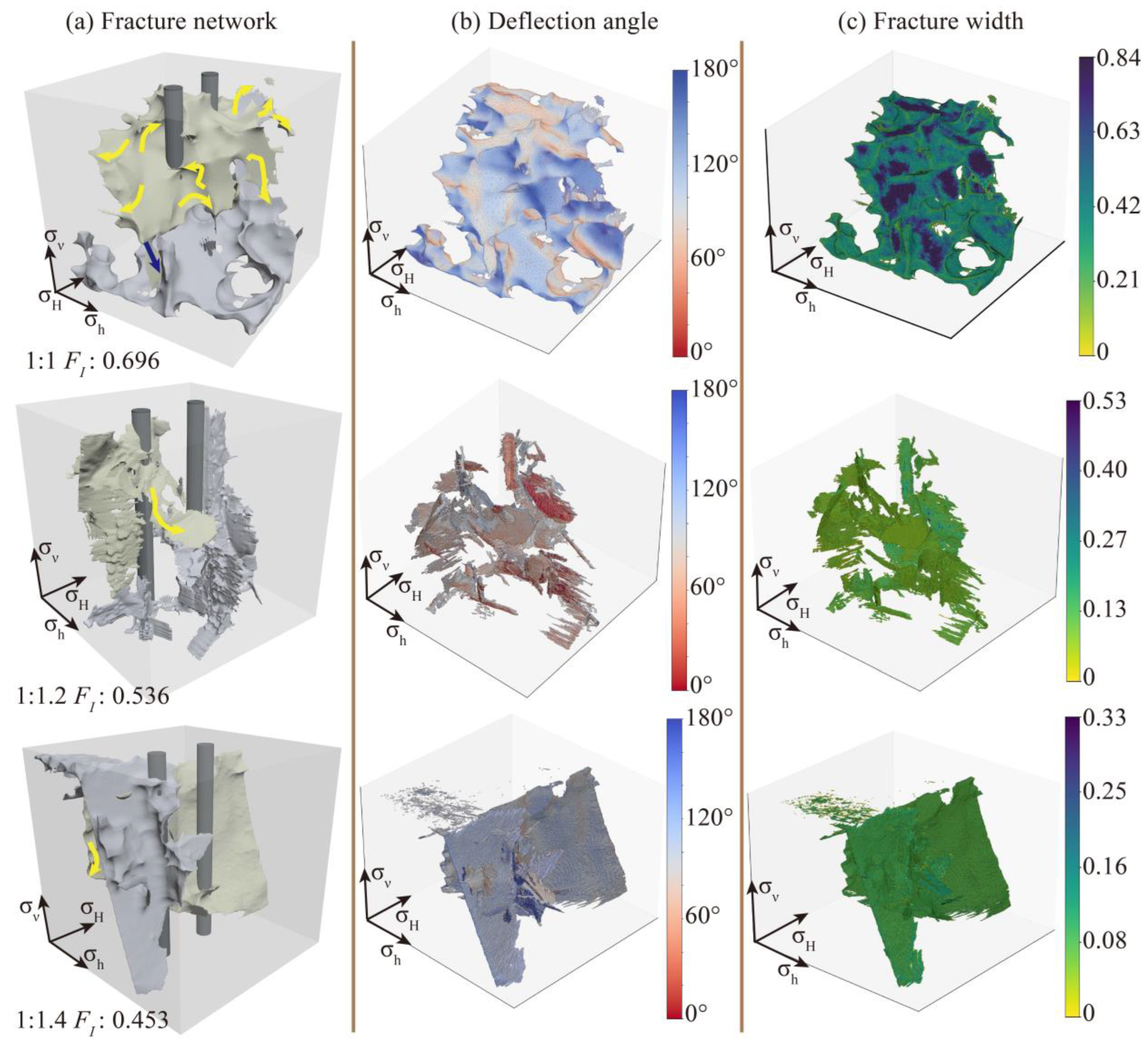
Figure 6a illustrates the influence of stress ratio on the propagation of fracture networks during SC-CO2 fracturing. At a stress ratio of 1:1, the fractures exhibit a complex morphology with a relatively uniform spatial distribution. Under the combined influence of in situ stress and stress shadow effects, numerous fracture deflections occur during the second-stage fracturing, resulting in the formation of many branched fractures. As the stress ratio increases to 1:1.2, fracture complexity decreases and the number of branched fractures is reduced. Although stress shadow effects persist, the second-stage fractures are more strongly influenced by the in situ stress field, tending to propagate parallel to the direction of maximum horizontal principal stress. Nevertheless, several fracture deflections are still observed, as indicated by the yellow arrows. When the stress ratio further increases to 1:1.4, the propagation patterns in both fracturing stages become more concentrated, with fractures predominantly extending in alignment with the maximum horizontal principal stress. The number of branched fractures is significantly reduced, and most branches are short, leading to a notable decline in overall fracture network complexity.
Figure 6. Morphologies of SC-CO2 fracturing fracture network under different stress anisotropies.
Figure 6b,c show the effects of varying stress ratios on fracture deflection angles and apertures during SC-CO2 fracturing. At a horizontal stress ratio of 1:1, the deflection angles exhibit the most complex distribution, ranging from 30° to 140°, indicating significant directional diversity. When the stress ratio increases to 1:1.2, the deflection angles narrow to a range of 60° to 120°, suggesting a tendency for fractures to align more closely with the principal stress direction. With a further increase to 1:1.4, the deflection angle distribution becomes even more concentrated, falling within 70° to 110°, reflecting a continued reduction in fracture network complexity.
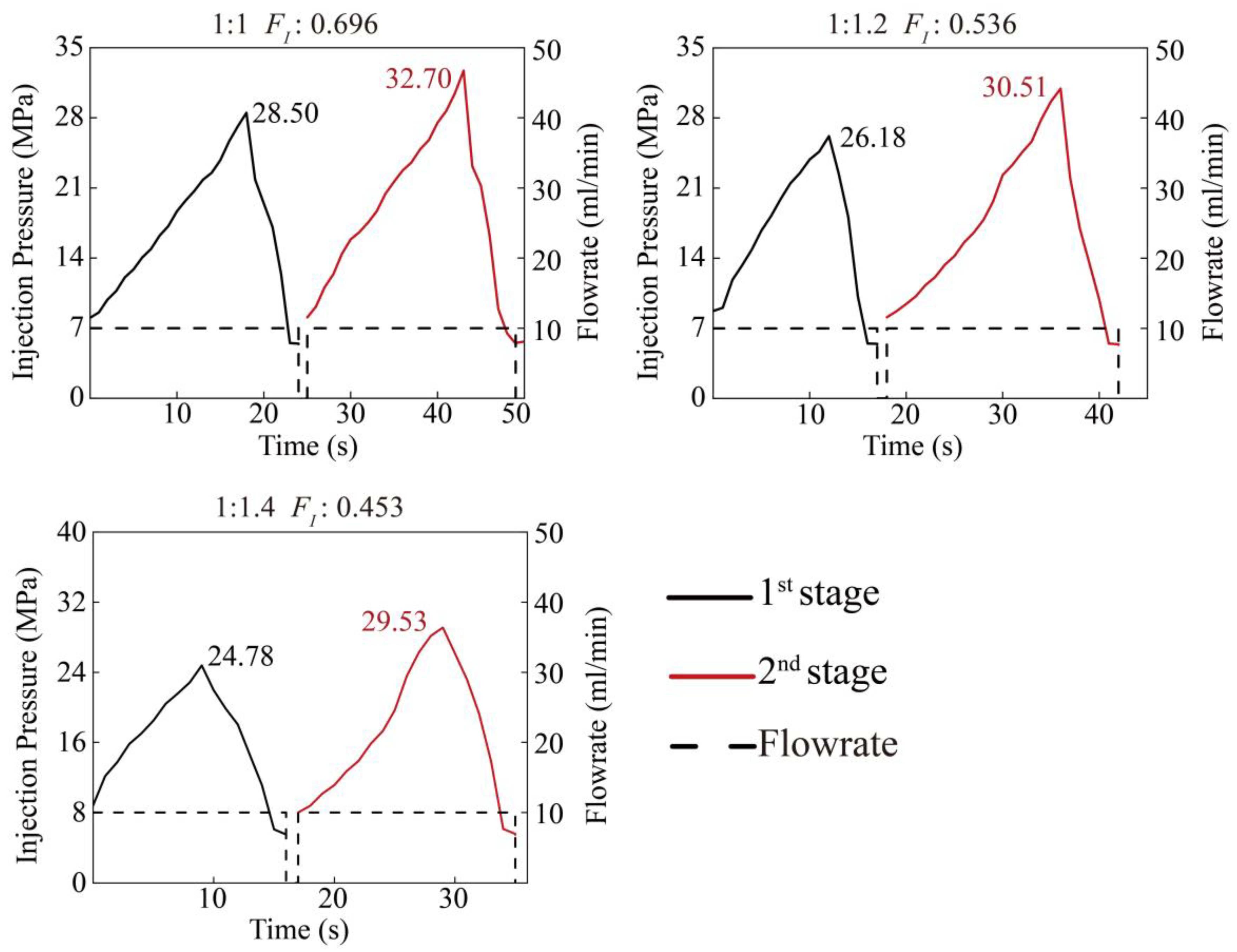
Regarding fracture aperture, the distribution is most complex at a stress ratio of 1:1, predominantly ranging from 0.4 to 0.6 mm. As the stress ratio increases to 1:1.2, the aperture range narrows to 0.15–0.19 mm, accompanied by an increase in light green areas, indicating a more uniform aperture distribution. At a stress ratio of 1:1.4, the overall fracture aperture further decreases and becomes more uniform, primarily concentrated between 0.12 and 0.15 mm. This indicates straighter fracture geometries and narrower apertures under higher stress anisotropy. As shown in Figure 7, the Stage-I breakdown pressure decreases from 28.5 MPa (at stress ratio 1:1) to 24.78 MPa (1:1.4), a reduction of 13.05%; Stage-II pressure drops from 32.7 MPa to 29.53 MPa, a 9.69% decrease. This phenomenon is consistent with findings from previous studies [53].
Figure 7. Injection pressure of SC-CO2 fracturing under different stress ratios.
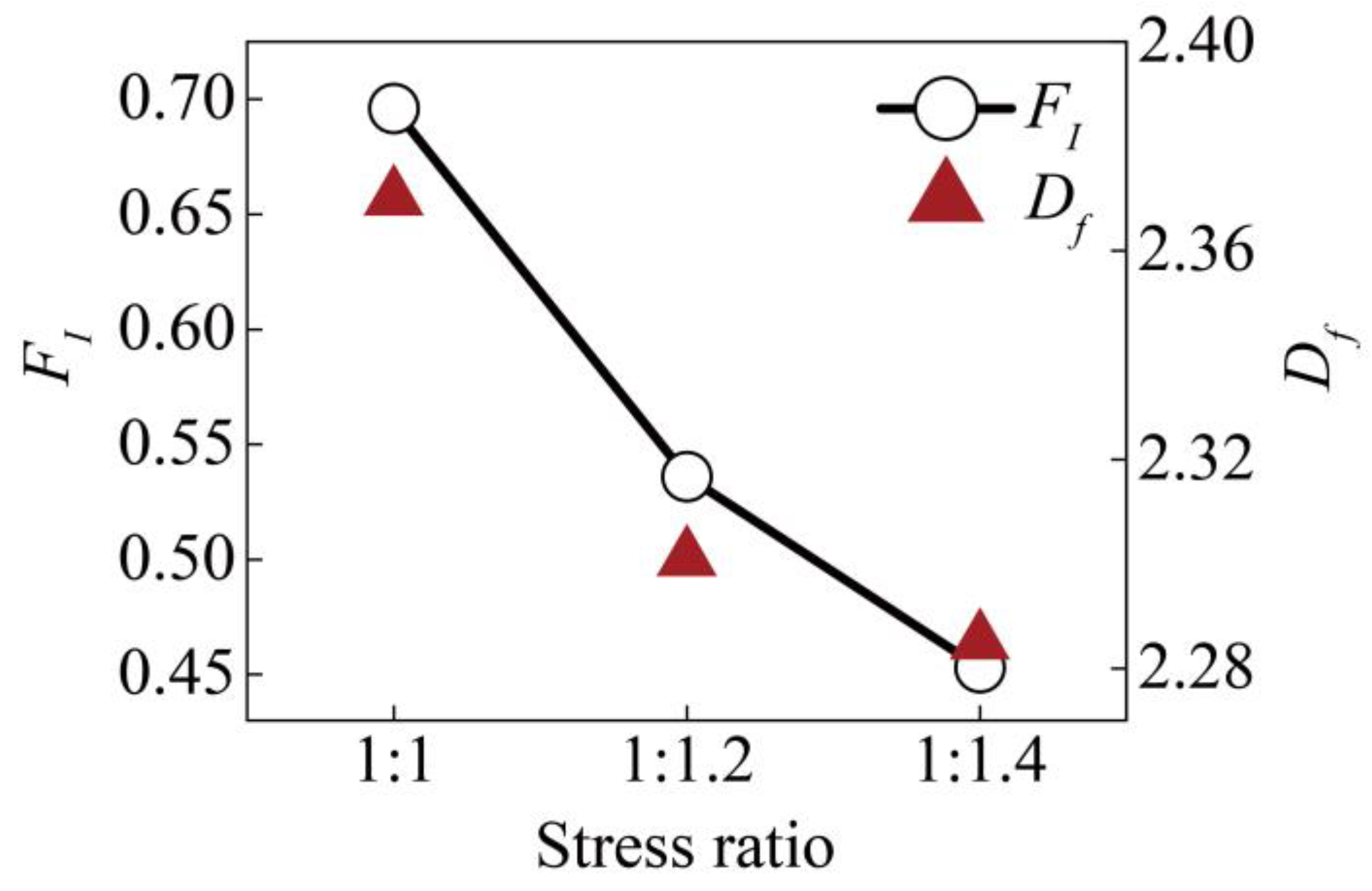
Figure 8 illustrates the relationship between the fractal dimension of the fracture network and the fracturability index under different stress anisotropies. The fractal dimension declines from 2.381 (1:1) to 2.285 (1:1.4), and the fracturability index drops from 0.696 to 0.453—corresponding to reductions of 3.59% and 34.9%, respectively. At a stress ratio of 1:1, both the fractal dimension and the fracturability index reach their maximum values, indicating that the fracture network expansion is the most complex under these conditions. Under higher stress ratios, the complexity of the fracture network gradually decreases, and the fracture distribution tends to adopt simpler geometric forms. This is attributed to the increased anisotropy of the stress field at higher stress ratios, which results in the fracture propagation direction being more controlled by the principal stress, thereby reducing the branching and irregularity of the fractures and leading to an overall decrease in fracture network complexity [38]. Additionally, in the second stage, as shown in Figure 6, the interaction between the two wells significantly intensifies with increasing stress ratios, exacerbating the phenomenon of restricted fracture propagation, which aligns with previous research findings [54].
Figure 8. D f and F I of SC-CO2 fracturing fracture networks under different stress anisotropies ( F I is fracturability index, and D f is fractal dimension).
To assess experimental repeatability, each stress anisotropy case (stress ratios of 1.0, 1.2, and 1.4) was tested in triplicate using samples with identical composition and curing history. The resulting fracturability index (FI) showed a maximum deviation of ±0.025 across repeats (e.g., FI = 0.624 ± 0.018 at stress ratio 1.0; FI = 0.587 ± 0.021 at 1.2; FI = 0.551 ± 0.025 at 1.4). This level of consistency (relative variation < 4.0%) confirms the robustness of the observed decreasing trend in FI with increasing stress ratio. Minor variations are attributed to inherent micro-heterogeneity (<5% in UCS) and slight differences in fracture coalescence patterns during CT reconstruction.

5.4. The Fracturability of Dual-Well SC-CO2 Fracturing and Dual-Well Hydraulic Fracturing

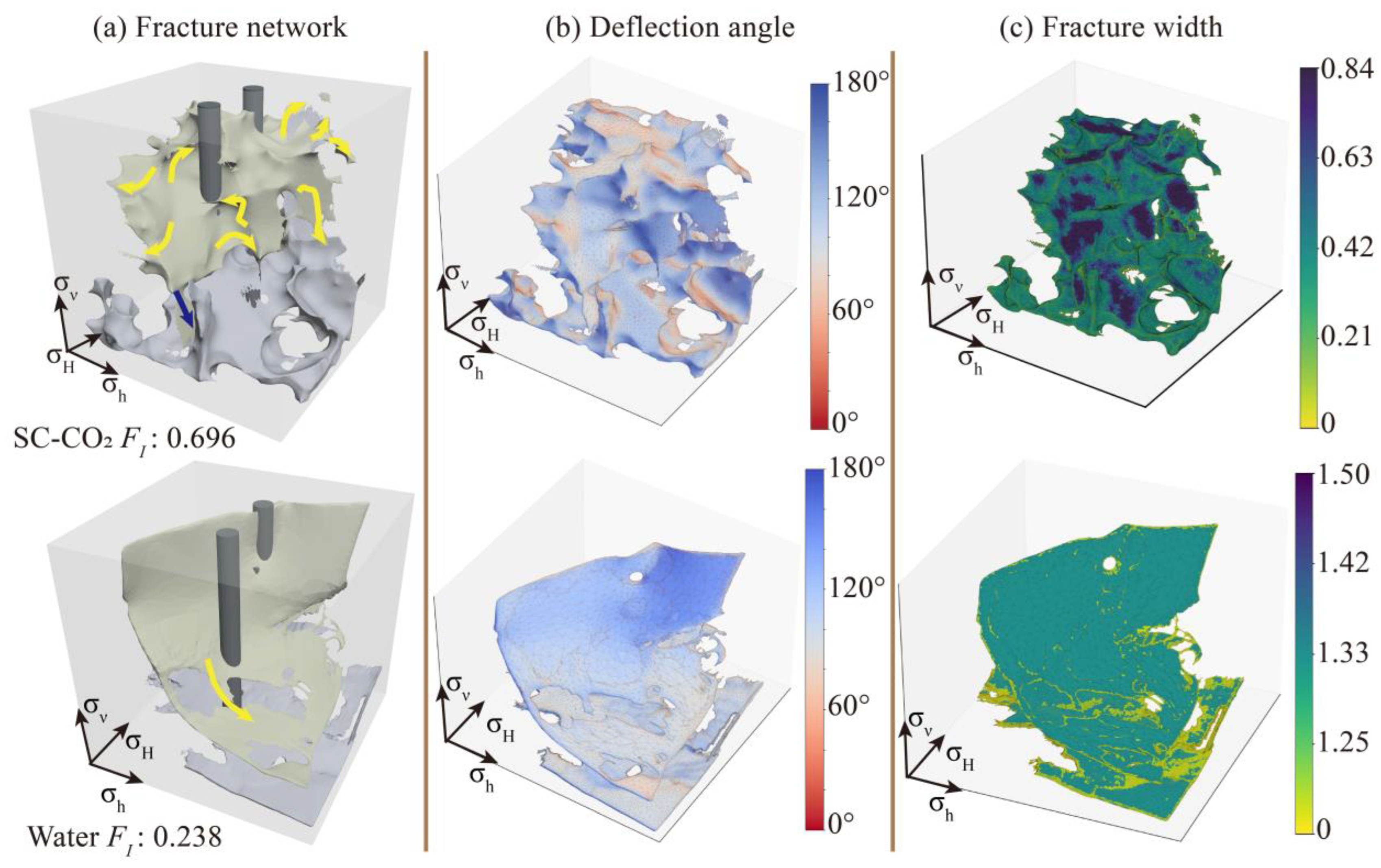
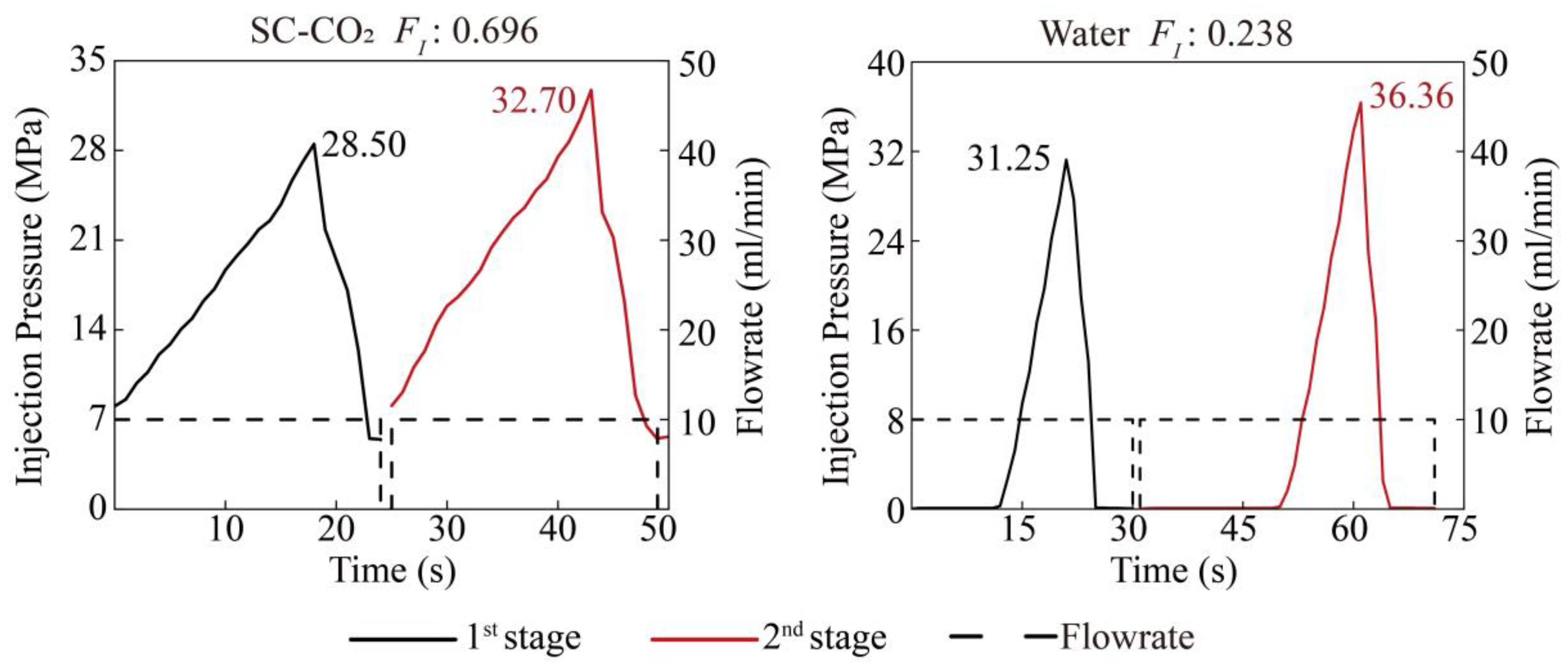
As shown in Table 9, the results of the evaluation parameters and the fracturability index under different fracturing fluids are presented. When water is used as the fracturing fluid, the fracturability index is significantly lower than that in the case of SC-CO2. Figure 9a illustrates the 3D fracture network, deflection angle distributions, and aperture distributions under different fracturing fluids. The results indicate that when water is used as the fracturing fluid, the fractures exhibit a more planar morphology, with a noticeable reduction in the number of branching fractures; the second-stage fractures experience significant deflection near the first stage, but the overall propagation remains relatively uniform. In contrast, fractures induced by SC-CO2 exhibit greater complexity, with an increased number of branching fractures, and the fracture network demonstrates higher non-planarity and diversity. Figure 9b shows that the deflection angle distribution of water-induced fractures was more concentrated, primarily between 60° and 120°, indicating a more directional and less complex propagation. Figure 9c reveals that the aperture distribution of water-induced fractures was more concentrated and consistent, with the second-stage fracture apertures mainly distributed between 1.28 and 1.35 mm, showing a smaller variation and a more uniform aperture characteristic. This contrasts with the aperture distribution of SC-CO2-induced fractures. Figure 10 illustrates the injection pressure curves under different fracturing fluids. In both fracturing stages, the breakdown pressures for SC-CO2 fracturing (28.5 MPa and 32.7 MPa) are lower than those for water-based fracturing (31.25 MPa and 36.36 MPa), with a reduction of approximately 10%. It can be observed that the breakdown pressure in the second stage for both types of fracturing fluids is higher than that in the first stage, with an average increase of about 15%.
Table 9. The fracturability index under different fracturing fluid viscosities.
Figure 9. Morphologies of SC-CO2 and water-based fracturing fracture networks.
Figure 10. Injection pressure of SC-CO2 and water-based fracturing.
Additionally, Figure 11 presents the relationship between the fractal dimension of the fracture network and the fracturability index under different fracturing fluids. As the viscosity increases, both the fractal dimension and the fracturability index show a decreasing trend. This validates that the proposed fracturability evaluation model can effectively evaluate the fracturing performance of different fracturing fluids under dual-well conditions.
Figure 11. D f and F I of SC-CO2 and water-based fracturing fracture networks ( F I is fracturability index, and D f is fractal dimension).
Compared to SC-CO2 fracturing, the overall D f of the fracture network generated by water-based fracturing is reduced by approximately 4.68%, indicating a lower complexity in the fracture network formed by water-based fracturing. Due to the high viscosity and low permeability of water-based fracturing fluids, they tend to accumulate within confined regions near fracture zones, forming localized high-pressure areas. In contrast, SC-CO2, with its lower viscosity and zero surface tension, rapidly infiltrates the rock matrix, generating more extensive high-pressure zones [55]. As fracturing fluid injection continues, the high-pressure zone progressively expands, increasing the pore pressure gradient from the fracture zone toward the matrix. This elevated pore pressure reduces the effective stress between matrix skeletons and alters the dominant fracture propagation mode. The diminished effective stress shifts the fracture propagation mechanism from tension-dominated failure to a hybrid mode incorporating both tensile and shear mechanisms [56]. Consequently, SC-CO2 fracturing generates more complex fracture networks compared to hydraulic fracturing.
Furthermore, during the secondary stage of fracturing, fracture propagation exhibits pronounced multidirectional characteristics, primarily attributed to the enhanced ability of SC-CO2 to propagate along fractures and reorient within distinct stress field domains. The high diffusivity of SC-CO2 enables rapid filling of fracture spaces [46], thereby mitigating localized constraints from stress shadowing effects and facilitating fracture redirection and branching in response to stress field variations. Additionally, the supercritical state of CO2 imparts superior fluidity and reduced interfacial tension, promoting fracture extension and bifurcation in complex stress fields, which amplifies fracture network complexity. The minimal critical invasion pressure of SC-CO2 also results in a near-zero lag zone length, enabling fracture initiation at lower downhole pressures. In comparison, water-based fracturing fluids can only permeate larger-scale fractures, typically exhibiting prolonged lag zones at the pressure-affected front, which impedes microcrack initiation and necessitates higher breakdown pressures than those required for SC-CO2 fracturing.
During multi-well, multi-stage hydraulic fracturing, the stress shadow effect [11] leads to an increase in the effective compressive stress perpendicular to the fracture plane when the second stage of fracturing begins after the completion of the first stage. This increase in stress is equivalent to the net pressure applied during the previous fracturing stage. As a result, the breakdown pressure required for the second stage is higher than that for the first stage. These findings are consistent with previous research [35].

5.5. The Fracturability of Single-Well and Dual-Well Fracturing

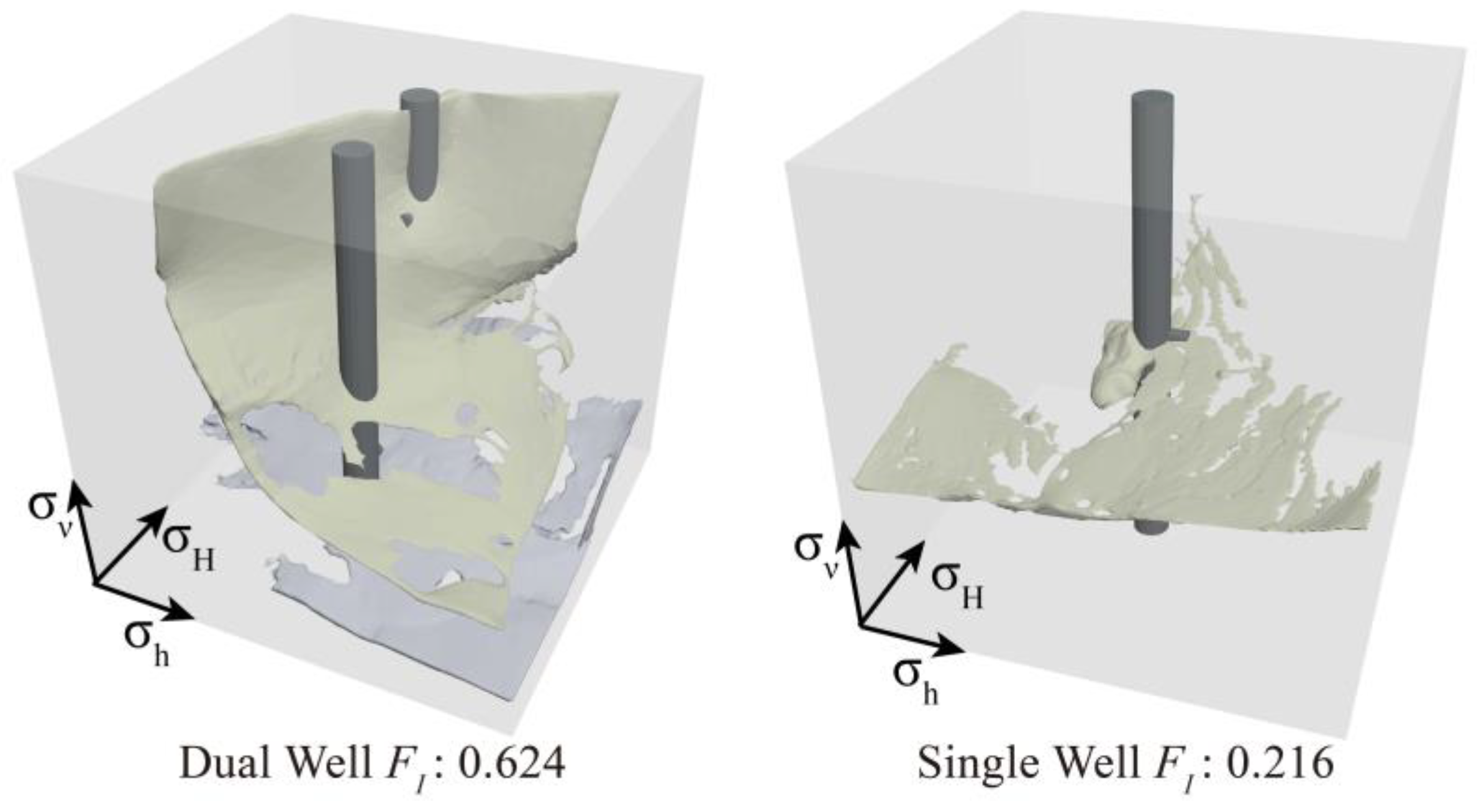
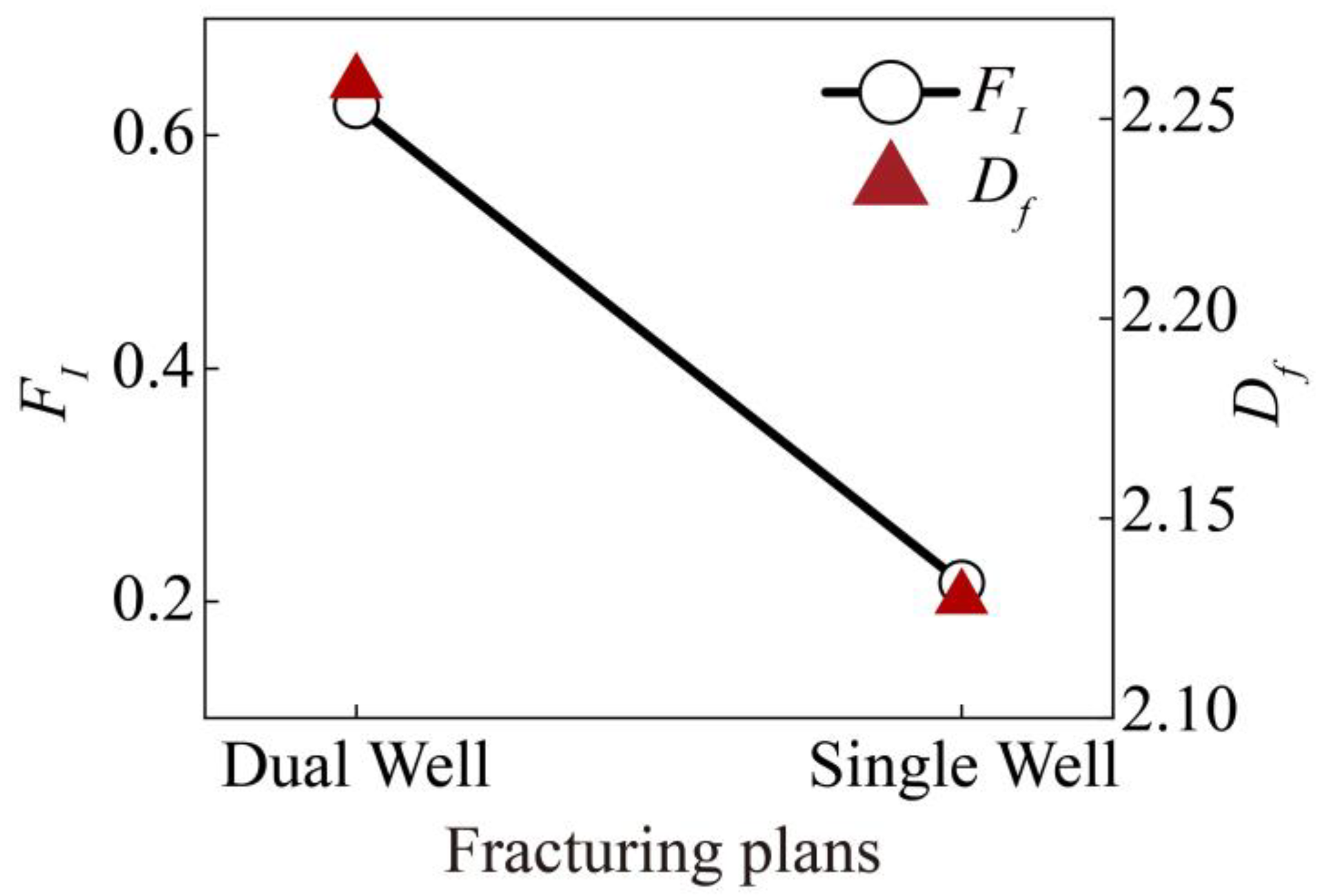
To explore the influence of single-well and dual-well fracturing techniques on the fracturability of the reservoir, we have compared the results of hydraulic fracturing experiments with single and dual wellbores. Based on the above-mentioned reservoir fracturability evaluation model, as shown in Table 10, the results of each evaluation parameter and the fracturability index under different fracturing plans show that when the single-wellbore fracturing scheme is adopted, the fracturability index drops by approximately 65.4% compared to the dual-wellbore fracturing, significantly lower than the dual-wellbore fracturing situation. Figure 12 shows the fracture morphology under different fracturing plans, from which, compared with single-well fracturing, dual-well fracturing can form a more complex fracture network. Additionally, the trend comparison of the fracturability index and different fracturing plans in Figure 13 further proves that dual-well fracturing is conducive to promoting the formation of complex fracture networks.
Table 10. The fracturability index under different fracturing plans.
Figure 12. The correspondence between fracture morphology and fracturability index.
Figure 13. Fractal dimension and fracturability index of fracture networks ( F I is fracturability index, and D f is fractal dimension).

5.6. Assessment of Fracturability Range

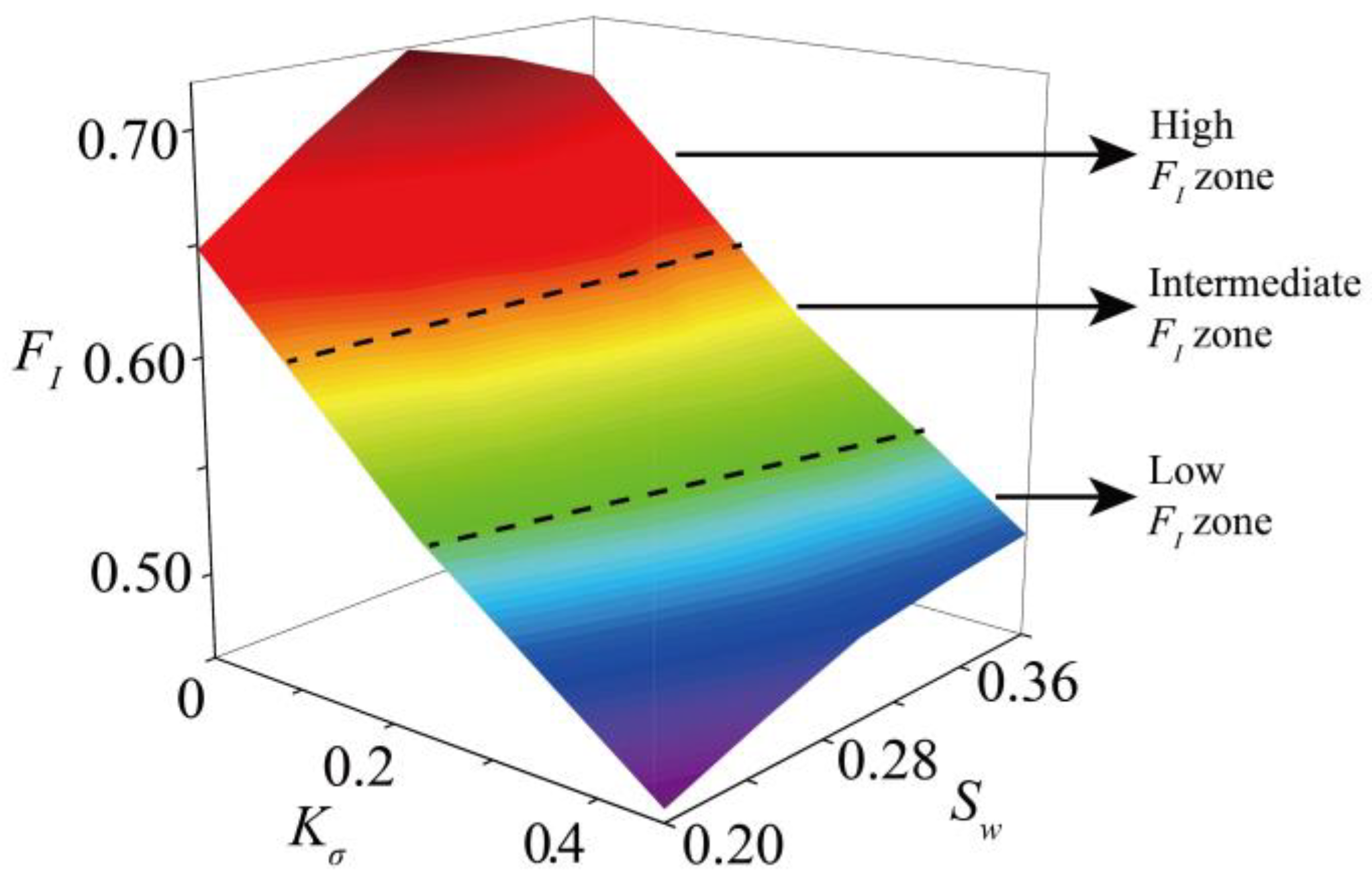
Based on the discussions and analyses in the previous section, the well spacing index S w , stress anisotropy index K σ , and fracturability index F I were gridded and processed using Kriging interpolation. This resulted in an evolutionary diagram of the fracturability index of the dual-well SC-CO2 fracturing reservoir as a function of the well spacing index S w and the stress anisotropy index K σ , as shown in Figure 14.
Figure 14. Fracturability index F I varying with S w and K σ .
As shown in Figure 14, the effectiveness of multiple-well reservoir fracturing can be categorized into three types based on the fracturability of the reservoir. When the well spacing index S w is in the range of 0.2–0.4 and the stress anisotropy index K σ is in the range of 0–0.08, the fracturability index F I exhibits high values, indicating that under these conditions, the dual-well SC-CO2 fracturing reservoir can stimulate a complex fracture network. Specifically, when the well spacing index S w is in the range of 0.28–0.32, the F I reaches its maximum, suggesting that the morphology of the fracture network under this condition is the most complex, resulting in the best fracturing performance. When K σ is in the range of 0.08–0.22, the F I falls into a medium value zone, indicating that although the fracturing network maintains a relatively high level of complexity, it shows a slight decrease in complexity compared to the aforementioned high-value zone, indicating an intermediate level. When K σ exceeds 0.22, the fracturability index F I is in a low-value zone, indicating a significant reduction in the complexity of the fracture network. Particularly, when the S w is in the range of 0.2–0.24, the fracturability index reaches its minimum, indicating that under these conditions, the complexity of the dual-well SC-CO2 fracture network is at its lowest, and the development of the reservoir fracture network is poor.
To rigorously validate the predictive capability of the proposed fracturability index, this study conducted a correlation analysis between the pre-fracturing fracturability index and the post-fracturing fractal dimension measured via CT reconstruction. The results yielded a coefficient of determination (R2 = 0.91) and a Pearson correlation coefficient (r = 0.95). This high correlation confirms that the fracturability index is not merely a descriptive metric but also a robust predictor of 3D fracture network complexity under the conditions of dual-well SC-CO2 fracturing.

6. Conclusions

In this study, we developed a comprehensive evaluation model to determine the fracturability and fracturing performance of unconventional tight reservoirs based on the analysis of five influencing factors. Subsequently, we utilized a true triaxial hydraulic fracturing device to investigate the effects of fracturing fluid viscosity, well spacing, and horizontal stress ratio on fracture complexity during dual-well fracturing. The main conclusions of the study are as follows:
(1)
Quantification of the importance of fracturing parameters: The contributions of six parameters (well spacing, brittleness, stress anisotropy, fracturing fluid viscosity, temperature, and injected energy) to reservoir fracturability were quantified. A comprehensive evaluation model was established based on the combinatorial weighting method. The results indicate that brittleness and injected energy are the most critical factors affecting reservoir fracturability, with both having a weight of 38.6%; temperature, well spacing, and fracturing fluid viscosity each have a weight of 7.2%; and the weight of stress anisotropy is 1.3%. The established fracturability evaluation model can effectively assess the construction effect of dual-well fracturing.
(2)
The effect of fracturing fluid viscosity on fracture network: Compared to using water as a fracturing fluid, the application of SC-CO2 in dual-well fracturing leads to a higher complexity of the fracture network. Due to its low surface tension and viscosity, SC-CO2 fluid is more capable of penetrating the microfractures in the rock, further expanding into a complex fracture network. Experimental results indicate that the fractal dimension of the SC-CO2 fracture network is approximately 4.68% higher than that of the water-based fracture network.
(3)
The effect of well spacing on fracture network: As the well spacing decreases, the stress shadow effect gradually intensifies, leading to a trend where fracture network complexity first increases and then decreases. The reduction in well spacing enhances the superposition effects of the stress fields. However, its influence on the development and complexity of the fracture network is nonlinear. An evaluation of the fracturability index of the dual-well SC-CO2 fracturing reservoir reveals that when the well spacing index S w is in the range of 0.28–0.32 and the stress anisotropy index K σ is between 0 and 0.08, the value is maximized, indicating optimal fracturing performance. For field implementation, these thresholds should be calibrated using local rock mechanics data and microseismic monitoring. The model structure, however, is generalizable.
(4)
The effect of horizontal stress ratio on fracture network: As the stress ratio increases, the stress shadow effect and the superposition of the stress fields are enhanced, leading to a gradual reduction in fracture network complexity. The increasing horizontal stress ratio encourages fractures to propagate along the direction of the maximum stress, inhibiting the development of branching fractures and the redirection of fracture propagation, ultimately resulting in decreased network complexity. Based on the evaluation of the fracturability index F I , when the stress anisotropy index K σ is in the range of 0–0.08 and the well spacing index S w is between 0.2 and 0.4, F I remains at a relatively high level, indicating that under this condition, the fractured reservoir can achieve a more complex fracture network.
This study provides a detailed explanation of how to assess the fracturing effectiveness of dual-well SC-CO2 fracturing in unconventional tight reservoirs through a comprehensive evaluation model and experimental methods, as well as how these factors influence the propagation of fractures. The findings offer significant theoretical support for optimizing multiple-well hydraulic fracturing designs. Furthermore, field-scale dual-well SC-CO2 fracturing and numerical simulation studies are required to further refine the evaluation model proposed in this study for practical applications in reservoir fracturing. For the convenience of laboratory experiments, the current dimensionless well spacing index is defined based on the specimen length. In its generalized form, the characteristic length can be taken as the fracture half-length or stress shadow radius for field applications to ensure physical consistency across scales. Future research will determine the field-applicable characteristic length using fracture geometry data derived from microseismic monitoring. Although the proposed multi-factor fracability model exhibits excellent predictive capability under laboratory conditions, it has three limitations for field application: first, scale dependency—core dimensionless parameters are derived from centimeter-scale specimens, so characteristic length should be replaced with fracture half-length or stress shadow radius according to hydraulic fracturing similarity theory for field use, with subsequent calibration against microseismic data to ensure scale consistency; second, exclusion of natural fractures—a natural fracture index (NFI) based on logging or seismic data can be added as the seventh parameter to an extended model by following relevant frameworks; third, insufficient weight generalizability—current weights are calibrated for specific artificial tight sandstones, and thus need to be recalibrated using core test or well-log data before application to other formations to maintain model accuracy. These limitations will be further investigated and discussed in future research.

Author Contributions

Software, G.Z.; Validation, Q.W. (Quanlin Wu); Investigation, G.Z. and W.H.; Resources, G.Z., Q.W. (Quanlin Wu), Q.W. (Quansen Wu) and W.H.; Writing—original draft, Y.L. and G.Z.; Writing—review and editing, Y.L. and G.Z.; Visualization, W.H.; Supervision, Q.W. (Quanlin Wu) and Q.W. (Quansen Wu); Funding acquisition, Y.L., Q.W. (Quanlin Wu) and Q.W. (Quansen Wu). All authors have read and agreed to the published version of the manuscript.

Funding

This study was supported in part by the Youth Innovation and Entrepreneurship in Higher Education Institutions of Shandong Province (Grant No. 2022KJ101), the Jining University Research and Innovation Team (Grant No. 24KCTD12), and the Qingdao Huanghai University Doctoral Research Foundation Project (Grant No. 2024boshi10).

Data Availability Statement

The data presented in this study are available on request from the corresponding author.

Conflicts of Interest

The authors declare no conflict of interest.

References

  1. Sun, X.; Dai, C.; Sun, Y.; Du, M.; Wang, T.; Zou, C.; He, J. Wettability alteration study of supercritical CO2 fracturing fluid on low permeability oil reservoir. Energy Fuels 2017, 31, 13364–13373. [Google Scholar] [CrossRef]
  2. Wang, C.; Shi, X.; Zhang, W.; Elsworth, D.; Cui, G.; Liu, S.; Wang, H.; Song, W.; Hu, S.; Zheng, P. Dynamic analysis of heat extraction rate by supercritical carbon dioxide in fractured rock mass based on a thermal-hydraulic-mechanics coupled model. Int. J. Min. Sci. Technol. 2022, 32, 225–236. [Google Scholar] [CrossRef]
  3. Wang, M.; Huang, K.; Xie, W.; Dai, X. Current research into the use of supercritical CO2 technology in shale gas exploitation. Int. J. Min. Sci. Technol. 2019, 29, 739–744. [Google Scholar] [CrossRef]
  4. Zhang, J.; Liu, Y.; Lv, J. Investigation of heat extraction performance of supercritical CO2 in 2D self-affine rough intersecting fracture. Geoenergy Sci. Eng. 2024, 243, 213352. [Google Scholar] [CrossRef]
  5. She, C.; Peng, H.; Yang, J.; Peng, J.; Han, H.; Yang, X.; Peng, Y. Experimental study on the true triaxial fracturing of tight sandstone with supercritical CO2 and slickwater. Geoenergy Sci. Eng. 2023, 228, 211977. [Google Scholar] [CrossRef]
  6. Vengosh, A.; Jackson, R.B.; Warner, N.; Darrah, T.H.; Kondash, A. A critical review of the risks to water resources from unconventional shale gas development and hydraulic fracturing in the United States. Environ. Sci. Technol. 2014, 48, 8334–8348. [Google Scholar] [CrossRef]
  7. Brown, D.W. Geothermal Energy Production with Supercritical Fluids. U.S. Patent 6,668,554, 30 December 2003. [Google Scholar]
  8. Ju, Y.; Zhang, G.; Wu, G.; Guo, F.; Zhou, H.; Wang, K.; Peng, S. 3D Fracture Network Morphologies and Breakdown Pressure in Supercritical CO2 Fracturing of Tight Sandstones: Effects of High Temperatures and In Situ Stress Differentials. Energy Fuels 2025, 39, 3820–3833. [Google Scholar] [CrossRef]
  9. Zhang, H. Shale Gas: New Bright Point of the Exploitation of the Global Oil-gas Resources—The Present Status and Key Problems of the Exploitation of Shale Gas. Bull. Chin. Acad. Sci. 2010, 25, 406–410. [Google Scholar]
  10. Guo, W.; Zhu, B.; Liu, Z.; Li, Q. Fracture propagation and evaluation of dual wells, multi-fracturing, and split-time in Fuyu oil shale. Geoenergy Sci. Eng. 2024, 239, 212948. [Google Scholar] [CrossRef]
  11. Ju, Y.; Li, Y.; Wang, Y.; Yang, Y. Stress shadow effects and microseismic events during hydrofracturing of multiple vertical wells in tight reservoirs: A three-dimensional numerical model. J. Nat. Gas Sci. Eng. 2020, 84, 103684. [Google Scholar] [CrossRef]
  12. Ren, L.; Lin, R.; Zhao, J.; Yang, K.; Hu, Y.; Wang, X. Simultaneous hydraulic fracturing of ultra-low permeability sandstone reservoirs in China: Mechanism and its field test. J. Cent. South Univ. 2015, 22, 1427–1436. [Google Scholar] [CrossRef]
  13. Gao, C.; Lan, Z.; Gao, X.; Wang, W.; Zhong, H.; Sui, H.; Xu, C.; Shen, D. First Dual-Lateral Well Fractures in China Land Well Increased Production in Deep Tight Gas Reservoir. In Proceedings of the Spe Asia Pacific Hydraulic Fracturing Conference, Beijing, China, 24–26 August 2016; p. D032S010R058. [Google Scholar]
  14. Ju, Y.; Chen, J.; Wang, Y.; Gao, F.; Xie, H. Numerical Analysis of Hydrofracturing Behaviors and Mechanisms of Heterogeneous Reservoir Glutenite, Using the Continuum-Based Discrete Element Method While Considering Hydromechanical Coupling and Leak-Off Effects. J. Geophys. Res. Solid Earth 2018, 123, 3621–3644. [Google Scholar] [CrossRef]
  15. Abbas, S.; Lecampion, B.; Prioul, R. Competition between transverse and axial hydraulic fractures in horizontal wells. In Proceedings of the SPE Hydraulic Fracturing Technology Conference, Woodlands, TX, USA, 4–6 February 2013; p. D021S004R003. [Google Scholar]
  16. Lu, C.; Ma, L.; Guo, J.; Li, X.; Yang, B. Novel method and case study of a deep shale fracturability evaluation based on the brittleness index. Energy Explor. Exploit. 2021, 40, 442–459. [Google Scholar] [CrossRef]
  17. Yang, B.; Xue, L.; Duan, Y.; Wang, M. Correlation study between fracturability and brittleness of shale-gas reservoir. Geomech. Geophys. Geo-Energy Geo-Resour. 2021, 7, 31. [Google Scholar] [CrossRef]
  18. Mullen, M.J.; Roundtree, R.; Turk, G.A. A Composite Determination of Mechanical Rock Properties for Stimulation Design (What to Do When You Don’t Have a Sonic Log). In Proceedings of the Rocky Mountain Oil & Gas Technology Symposium, Denver, CO, USA, 16–18 April 2007; p. SPE-108139-MS. [Google Scholar]
  19. Rickman, R.; Mullen, M.; Petre, E.; Grieser, B.; Kundert, D. A Practical Use of Shale Petrophysics for Stimulation Design Optimization: All Shale Plays Are Not Clones of the Barnett Shale. In Proceedings of the SPE Annual Technical Conference and Exhibition, Denver, CO, USA, 21–24 September 2008. [Google Scholar]
  20. Sondergeld, C.; Newsham, K.; Comisky, J.; Rice, M.; Rai, C. Petrophysical Considerations in Evaluating and Producing Shale Gas Resources. In Proceedings of the SPE Unconventional Gas Conference, Pittsburgh, PA, USA, 23–25 February 2010; p. SPE-131768-MS. [Google Scholar]
  21. Jin, X.; Shah, S.N.; Roegiers, J.C.; Zhang, B. An Integrated Petrophysics and Geomechanics Approach for Fracturability Evaluation in Shale Reservoirs. SPE J. 2015, 20, 518–526. [Google Scholar] [CrossRef]
  22. Xu, W.; Zhao, J.; Xu, J. Fracturability Evaluation Method for Tight Sandstone Oil Reservoirs. Nat. Resour. Res. 2021, 30, 4277–4295. [Google Scholar] [CrossRef]
  23. Guo, J.; Jia, C.; He, D.; Meng, F. Classification and Evaluation on Shale Gas Reservoir for Wufeng-Longmaxi Formation in Chuannan Area, Sichuan Basin. Lithosphere 2021, 2021, 3364731. [Google Scholar] [CrossRef]
  24. Zhai, W.; Li, J.; Zhou, Y. Application of catastrophe theory to fracturability evaluation of deep shale reservoir. Arab. J. Geosci. 2019, 12, 161. [Google Scholar] [CrossRef]
  25. Meng, S.; Li, D.; Wang, Q.; Tao, J.; Su, J.; Li, H.; Jin, X.; Yang, L. Nanoindentation-Based Three-Parameter Fracturability Evaluation Method for Continental Shales. Front. Earth Sci. 2021, 9, 797405. [Google Scholar] [CrossRef]
  26. Amiri, H.; Ramezanzadeh, A.; Chamanzad, M.; Parhizgar, M. Recognizing the best intervals for hydraulic fracturing using a new fracturability index. J. Pet. Explor. Prod. 2021, 11, 3193–3201. [Google Scholar]
  27. Zhai, M.; Li, L.; Wang, Z.; Zhang, L.; Li, A.; Zhang, Z.; Zheng, B.; Huang, B. Three-Dimensional Numerical Simulation and Analysis of Geomechanical Controls of Hydraulic Fracturing in Heterogeneous Formations. Arab. J. Sci. Eng. 2022, 47, 11533–11552. [Google Scholar] [CrossRef]
  28. Shen, C.; Zhao, J.; Xie, J.; Ren, L. The Main Controlling Factors and Evaluation Method of the Reservoir Stimulation Potential: A Case Study of the Changning Shale Gas Field, Southern Sichuan Basin, SW China. Front. Earth Sci. 2021, 9, 738668. [Google Scholar] [CrossRef]
  29. Ju, Y.; Wu, G.; Wang, Y.; Liu, P.; Yang, Y. 3D Numerical Model for Hydraulic Fracture Propagation in Tight Ductile Reservoirs, Considering Multiple Influencing Factors via the Entropy Weight Method. SPE J. 2021, 26, 2685–2702. [Google Scholar] [CrossRef]
  30. Dou, L.; Zuo, X.; Qu, L.; Xiao, Y.; Bi, G.; Wang, R.; Zhang, M. A New Method of Quantitatively Evaluating Fracturability of Tight Sandstone Reservoirs Using Geomechanics Characteristics and In Situ Stress Field. Processes 2022, 10, 1040. [Google Scholar] [CrossRef]
  31. Tian, H.; Kempka, T.; Yu, S.; Ziegler, M. Mechanical Properties of Sandstones Exposed to High Temperature. Rock Mech. Rock Eng. 2016, 49, 321–327. [Google Scholar] [CrossRef]
  32. Luo, Z.; Bryant, S. Influence of Thermo-Elastic Stress on Fracture Initiation During CO2 Injection and Storage. Energy Procedia 2011, 4, 3714–3721. [Google Scholar] [CrossRef]
  33. Ju, Y.; Wu, G.; Zhang, G. Effects of rock ductility on the fracturability of ductile reservoirs: An experimental evaluation. Geoenergy Sci. Eng. 2023, 227, 211864. [Google Scholar] [CrossRef]
  34. Germanovich, L.; Ring, L.; Astakhov, D.; Shlyapobersky, J.; Mayerhofer, M. Hydraulic fracture with multiple segments II. Eff. Interact. 1997, 34, 98.e1–98.e15. [Google Scholar] [CrossRef]
  35. Fisher, M.K.; Heinze, J.R.; Harris, C.D.; Davidson, B.M.; Wright, C.A.; Dunn, K.P. Optimizing Horizontal Completion Techniques in the Barnett Shale Using Microseismic Fracture Mapping. In Proceedings of the SPE Annual Technical Conference and Exhibition, Houston, TX, USA, 26–29 September 2004; p. SPE-90051-MS. [Google Scholar]
  36. Roussel, N.; Sharma, M. Strategies to Minimize Frac Spacing And Stimulate Natural Fractures in Horizontal Completions. In Proceedings of the SPE Annual Technical Conference and Exhibition, Denver, CO, USA, 30 October–2 November 2011; p. SPE-146104-MS. [Google Scholar]
  37. Liu, X.; Zhang, W.; Qu, Z.; Guo, T.; Cao, Q. Feasibility evaluation of hydraulic fracturing in hydrate-bearing sediments based on analytic hierarchy process-entropy method (AHP-EM). J. Nat. Gas Sci. Eng. 2020, 81, 103434. [Google Scholar] [CrossRef]
  38. Beugelsdijk, L.; Pater, C.; Sato, K. Experimental Hydraulic Fracture Propagation in a Multi-Fractured Medium. In Proceedings of the SPE Asia Pacific Conference on Integrated Modelling for Asset Management, Yokohama, Japan, 25–26 April 2000; p. SPE-59419-MS. [Google Scholar]
  39. Zeng, F.; Yang, B.; Guo, J.; Chen, Z.; Xiang, J. Experimental and Modeling Investigation of Fracture Initiation from Open-Hole Horizontal Wells in Permeable Formations. Rock Mech. Rock Eng. 2019, 52, 1133–1148. [Google Scholar] [CrossRef]
  40. Goodfellow, S.D.; Nasseri, M.H.B.; Maxwell, S.C.; Young, R.P. Hydraulic fracture energy budget: Insights from the laboratory. Geophys. Res. Lett. 2015, 42, 3179–3187. [Google Scholar] [CrossRef]
  41. Badulla, I.; Ranjith, G.; Tharaka, R.; Mandadige, P.; Dornadula, C.; Wanniarachchige, K. An Influence of Thermally-Induced Micro-Cracking under Cooling Treatments: Mechanical Characteristics of Australian Granite. Energies 2018, 11, 1338. [Google Scholar]
  42. Sun, H.; Wang, S.; Hao, X. An Improved Analytic Hierarchy Process Method for the evaluation of agricultural water management in irrigation districts of north China. Agric. Water Manag. 2017, 179, 324–337. [Google Scholar] [CrossRef]
  43. Li, X.; Wang, K.; Liu, L.; Xin, J.; Yang, H.; Gao, C. Application of the Entropy Weight and TOPSIS Method in Safety Evaluation of Coal Mines. Procedia Eng. 2011, 26, 2085–2091. [Google Scholar] [CrossRef]
  44. Li, C.; Zhang, K.; Guo, C.; Xie, J.; Zhao, J.; Li, X.; Maggi, F. Impacts of relative permeability hysteresis on the reservoir performance in CO2 storage in the Ordos Basin. Greenh. Gases Sci. Technol. 2017, 7, 259–272. [Google Scholar] [CrossRef]
  45. Ronneberger, O.; Fischer, P.; Brox, T. U-Net: Convolutional Networks for Biomedical Image Segmentation. In International Conference on Medical Image Computing and Computer-Assisted Intervention; Springer: Berlin/Heidelberg, Germany, 2015; pp. 234–241. [Google Scholar]
  46. Yang, B.; Wang, H.; Wang, B. Digital quantification of fracture in full-scale rock using micro-CT images: A fracturing experiment with N2 and CO2. J. Pet. Sci. Eng. 2021, 196, 107682. [Google Scholar] [CrossRef]
  47. Sobhaniaragh, B.; Mansur, W.J.; Peters, F.C. The role of stress interference in hydraulic fracturing of horizontal wells. Int. J. Rock Mech. Min. Sci. 2018, 106, 153–164. [Google Scholar] [CrossRef]
  48. Li, M.; Zhou, F.; Dong, E. Experimental study on the multiple fracture simultaneous propagation during extremely limited-entry fracturing. J. Pet. Sci. Eng. 2022, 218, 110906. [Google Scholar] [CrossRef]
  49. Li, Y. Theoretical and numerical analysis of stress shadow effect between echelon fractures in hydraulic fracturing of double vertical wells. Eng. Fract. Mech. 2023, 284, 109238. [Google Scholar] [CrossRef]
  50. Rice, J.R. Some remarks on elastic crack-tip stress fields. Int. J. Solids Struct. 1972, 8, 751–758. [Google Scholar] [CrossRef]
  51. Wu, X.R.; Chen, X.G. Wide-range weight function for center cracks. Eng. Fract. Mech. 1989, 33, 877–886. [Google Scholar] [CrossRef]
  52. Sobhaniaragh, B.; Haddad, M.; Mansur, W.J.; Peters, F.C. Computational modelling of multi-stage hydraulic fractures under stress shadowing and intersecting with pre-existing natural fractures. Acta Mech. 2019, 230, 1037–1059. [Google Scholar] [CrossRef]
  53. Li, M.; Zhou, F. Multi-fracture initiation sequence and breakdown pressure in horizontal wells during TDPF: A visualization experimental investigation based on PMMA. J. Pet. Sci. Eng. 2022, 215, 110645. [Google Scholar] [CrossRef]
  54. Guo, T.; Wang, Y.; Chen, M.; Qu, Z.; Tang, S.; Wen, D. Multi-stage and multi-well fracturing and induced stress evaluation: An experiment study. Geoenergy Sci. Eng. 2023, 230, 212271. [Google Scholar] [CrossRef]
  55. Xu, W.; Yu, H.; Zhang, J.; Lyu, C.; Wang, Q.; Micheal, M.; Wu, H. Phase-field method of crack branching during SC-CO2 fracturing: A new energy release rate criterion coupling pore pressure gradient. Comput. Methods Appl. Mech. Eng. 2022, 399, 115366. [Google Scholar] [CrossRef]
  56. Al-Shayea, N.; Khan, K.; Abduljauwad, S. Effects of confining pressure and temperature on mixed-mode (I–II) fracture toughness of a limestone rock. Int. J. Rock Mech. Min. Sci. 2000, 37, 629–643. [Google Scholar] [CrossRef]
Disclaimer/Publisher’s Note: The statements, opinions and data contained in all publications are solely those of the individual author(s) and contributor(s) and not of MDPI and/or the editor(s). MDPI and/or the editor(s) disclaim responsibility for any injury to people or property resulting from any ideas, methods, instructions or products referred to in the content.

Article Metrics

Citations

Article Access Statistics

Article metric data becomes available approximately 24 hours after publication online.