Bioremoval of Heavy Metals by Native Isolates of Trichoderma viride PSGSS01, Purpureocillium lilacinum PSGSS05, and Aspergillus nidulans PSGSS08

 , , , ,
Abstract
1. Introduction
2. Materials and Methods
2.1. Aqueous Solution of Metal Ions
2.2. Isolation of Filamentous Fungi
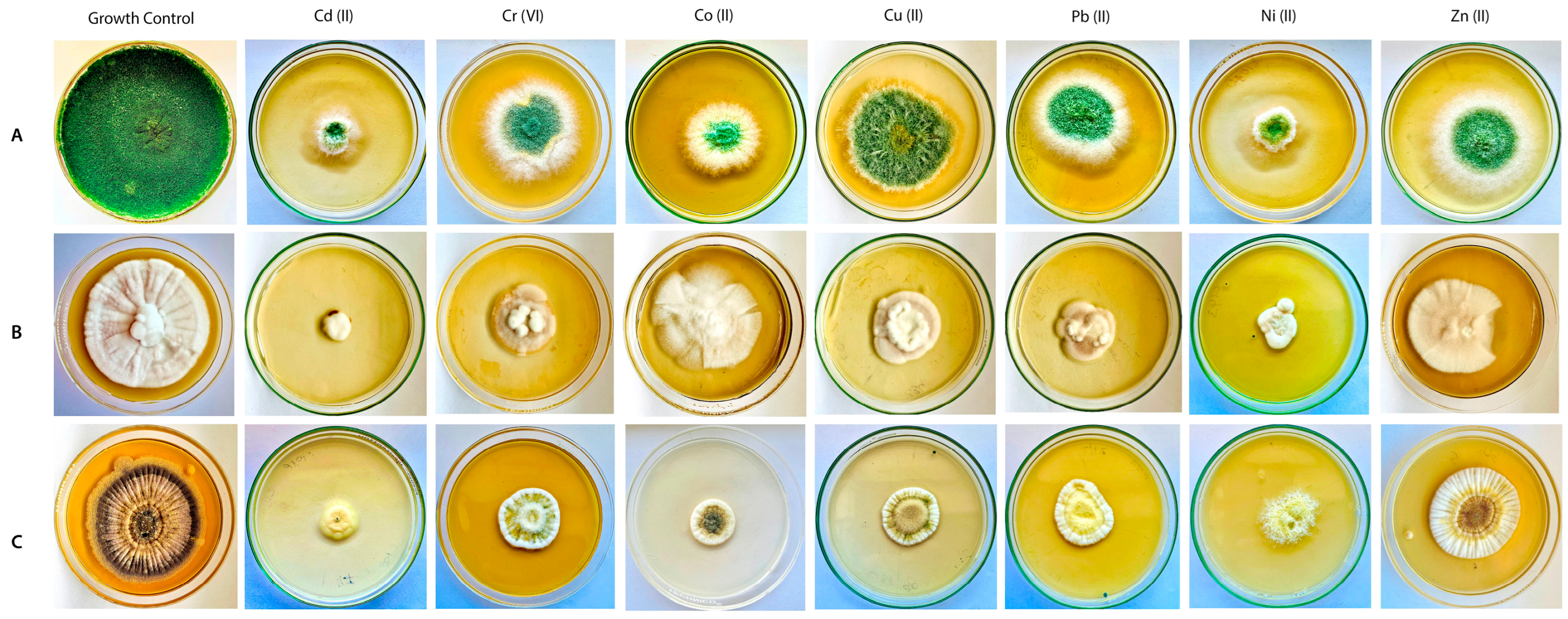
2.3. Screening of Fungi for Heavy Metal Tolerance
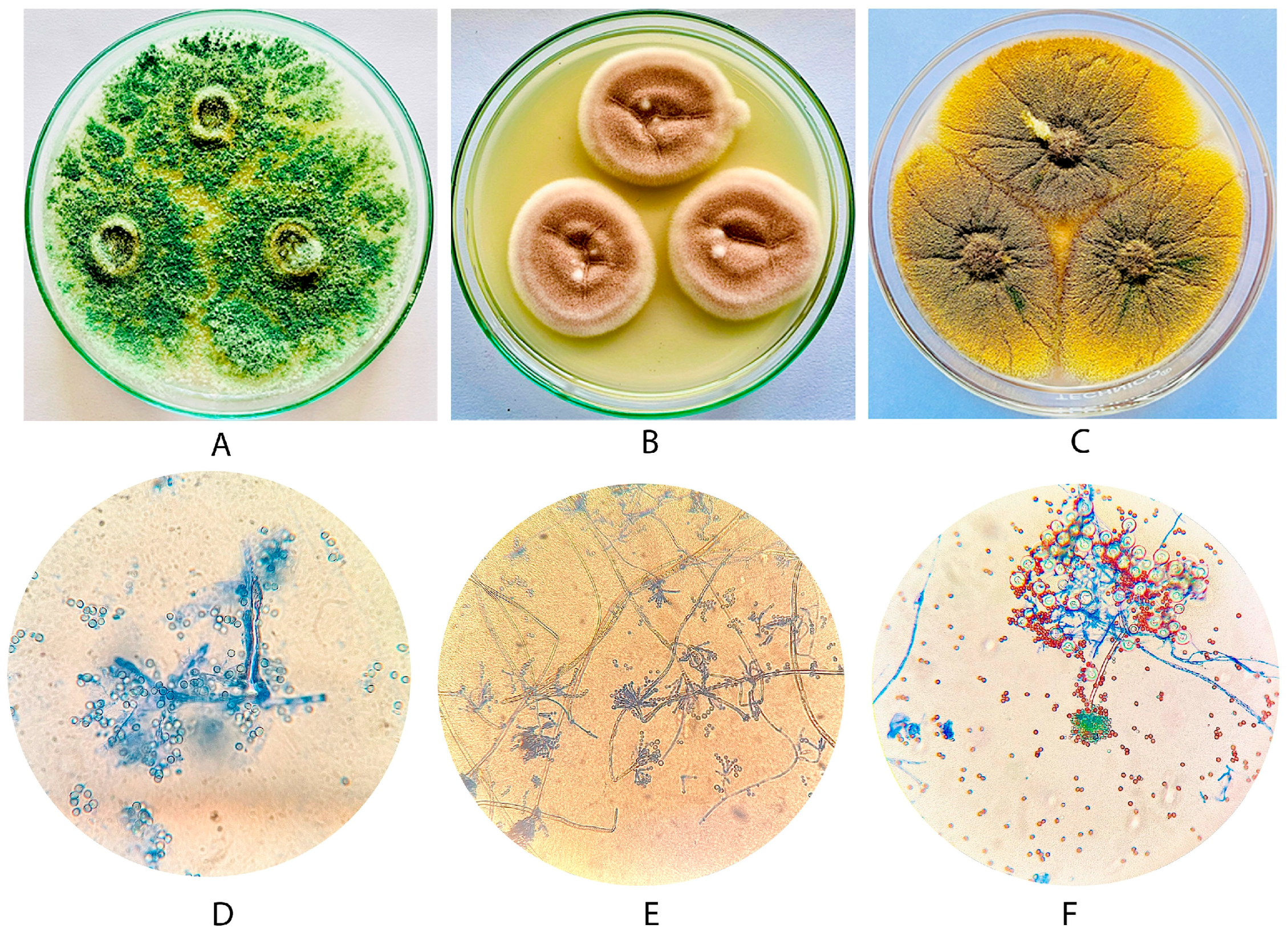
2.4. Characterization of Heavy Metal-Resistant Fungi
2.5. Minimum Inhibitory Concentrations (MICs) of Heavy Metals Against the Fungal Isolates
2.6. Evaluation of Heavy Metal Tolerance Index of the Isolates
2.7. Quantification of Heavy Metal Removal
2.8. Scanning Electron Microscopy (SEM) Analysis
3. Results
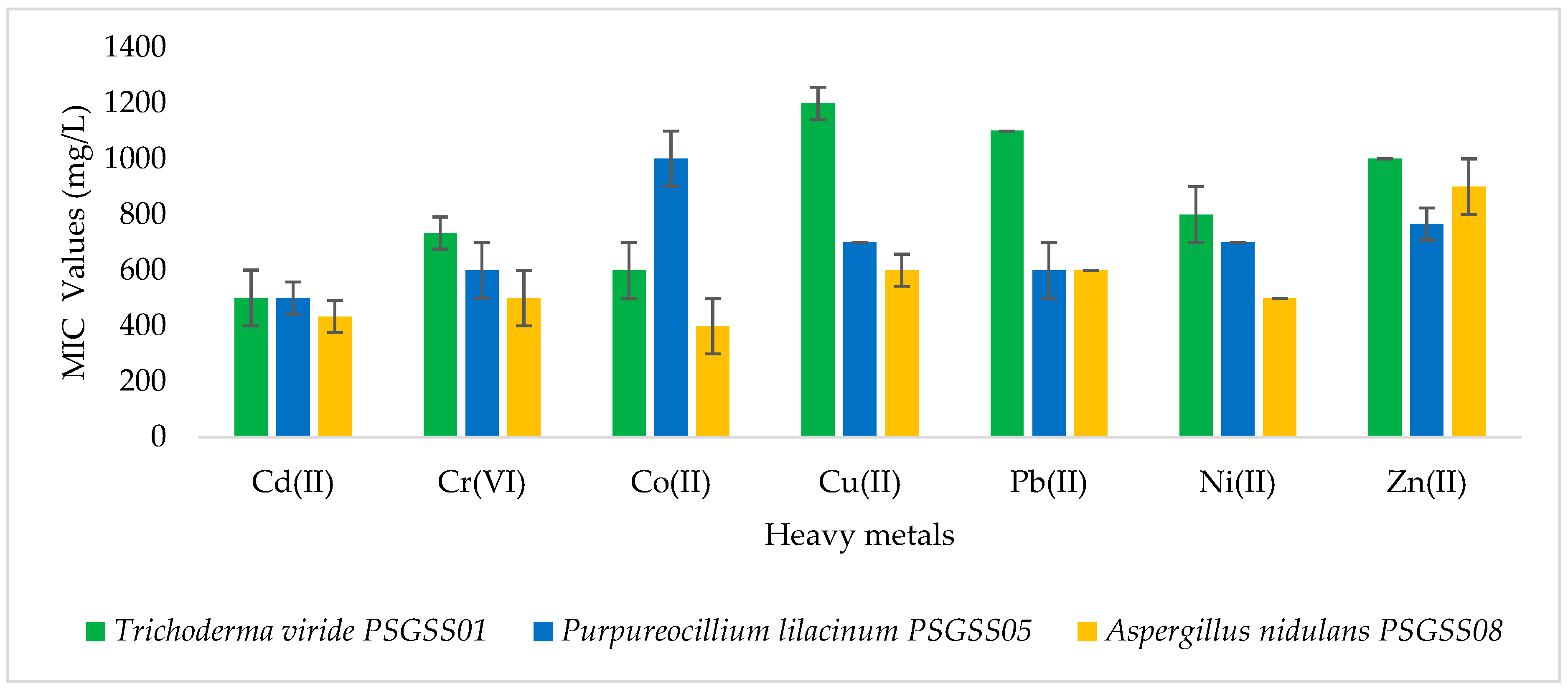
3.1. Minimum Inhibitory Concentration of Fungal Isolates
3.2. Tolerance Index of Test Fungal Isolates
3.3. Bioaccumulation Efficiency
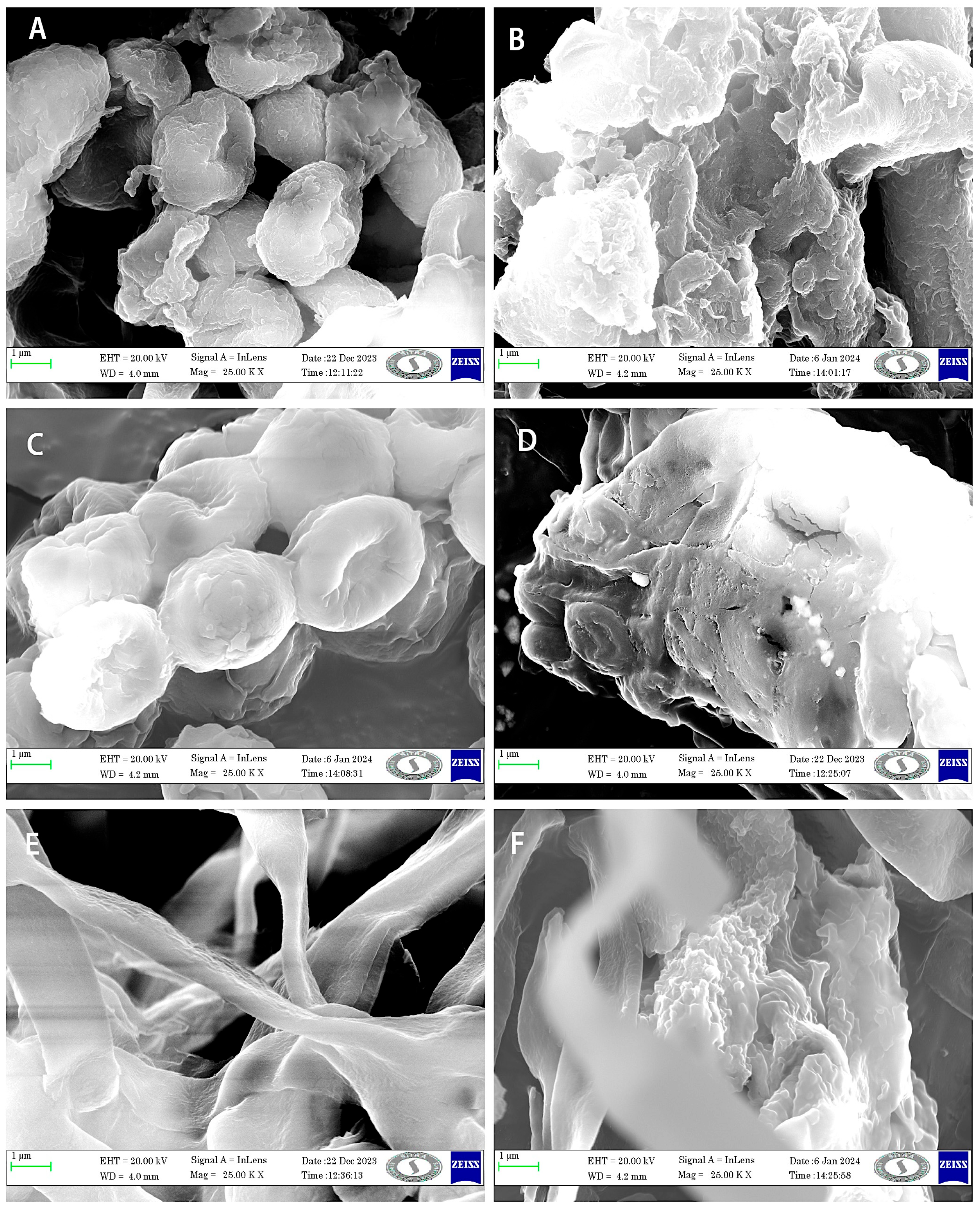
3.4. SEM Analysis
4. Discussion
5. Conclusions
Author Contributions
Funding
Data Availability Statement
Acknowledgments
Conflicts of Interest
References
- Chen, S.H.; Cheow, Y.L.; Ng, S.L.; Ting, A.S.Y. Mechanisms for metal removal established via electron microscopy and spectroscopy: A case study on metal tolerant fungi Penicillium simplicissimum. J. Hazard. Mater. 2019, 362, 394–402. [Google Scholar] [CrossRef] [Scilit]
- Shukla, A.; Srivastava, S.; D’Souza, S.F. An integrative approach toward biosensing and bioremediation of metals and metalloids. Int. J. Environ. Sci. Technol. 2018, 15, 2701–2712. [Google Scholar] [CrossRef] [Scilit]
- Huët, M.A.L.; Puchooa, D. Bioremediation of heavy metals from aquatic environment through microbial processes: A potential role for probiotics. J. Appl. Biol. Biotechnol. 2017, 5, 14–23. [Google Scholar] [CrossRef] [Scilit]
- Rajkumar, M.; Freitas, H. Influence of metal resistant-plant growth-promoting bacteria on the growth of Ricinus communis in soil contaminated with heavy metals. Chemosphere 2008, 71, 834–842. [Google Scholar] [CrossRef] [Scilit] [PubMed]
- Coradduzza, D.; Congiargiu, A.; Azara, E.; Mammani, I.M.A.; De Miglio, M.R.; Zinellu, A.; Carru, C.; Medici, S. Heavy metals in biological samples of cancer patients: A systematic literature review. Biometals 2024, 37, 803–817. [Google Scholar] [CrossRef] [Scilit]
- Rehman, A.; Liu, G.; Yousaf, B.; Ahmed, R.; Rashid, M.S.; Irshad, S.; Shakoor, A.; Farooq, M.R. Morpho-chemical characterization and source apportionment of potentially toxic metal(oid)s from school dust of second largest populous city of Pakistan. Environ. Res. 2021, 196, 110427. [Google Scholar] [CrossRef] [Scilit] [PubMed]
- dos Santos, P.R.S.; Fernandes, G.J.T.; Moraes, E.P.; Moreira, L.F.F. Tropical climate effect on the toxic heavy metal pollutant course of road-deposited sediments. Environ. Pollut. 2019, 251, 766–772. [Google Scholar] [CrossRef] [Scilit] [PubMed]
- Wuana, R.A.; Okieimen, F.E. Heavy metals in contaminated soils: A review of sources, chemistry, risks and best available strategies for remediation. Int. Sch. Res. Not. 2011, 2011, 402647. [Google Scholar] [CrossRef] [Scilit]
- Li, X.; Zeng, G.M.; Huang, J.H.; Zhang, D.M.; Shi, L.J.; He, S.B.; Ruan, M. Simultaneous removal of cadmium ions and phenol with MEUF using SDS and mixed surfactants. Desalination 2011, 276, 136–141. [Google Scholar] [CrossRef] [Scilit]
- Zhou, J.L. Zn biosorption by Rhizopus arrhizus and other fungi. Appl. Microbiol. Biotechnol. 1999, 51, 686–693. [Google Scholar] [CrossRef] [Scilit]
- Hassan, J.; Rajib, M.M.R.; Khan, M.N.E.A.; Khandaker, S.; Zubayer, M.; Ashab, K.R.; Kuba, T.; Marwani, H.M.; Asiri, A.M.; Hasan, M.M.; et al. Assessment of heavy metals accumulation by vegetables irrigated with different stages of textile wastewater for evaluation of food and health risk. J. Environ. Manag. 2024, 353, 120206. [Google Scholar] [CrossRef] [Scilit]
- Abo Alkasem, M.I.; El-Abd, M.A.E.H.; Maany, D.A.; Ibrahim, A.S.S. Hexavalent chromium reduction by a potent novel Haloalkaliphilic Nesterenkonia sp. strain NRC-Y isolated from hypersaline soda lakes. Egypt. J. Chem. 2023, 66, 463–473. [Google Scholar] [CrossRef] [Scilit]
- Vaksmaa, A.; Guerrero-Cruz, S.; Ghosh, P.; Zeghal, E.; Hernando-Morales, V.; Niemann, H. Role of fungi in bioremediation of emerging pollutants. Front. Mar. Sci. 2023, 10, 1070905. [Google Scholar] [CrossRef] [Scilit]
- Kaushik, P.; Malik, A. Process optimization for efficient dye removal by Aspergillus lentulus FJ172995. J. Hazard. Mater. 2011, 185, 837–843. [Google Scholar] [CrossRef] [Scilit]
- Sagar, V.; Singh, D.P. Biodegradation of lindane pesticide by non white-rots soil fungus Fusarium sp. World J. Microbiol. Biotechnol. 2011, 27, 1747–1754. [Google Scholar] [CrossRef] [Scilit]
- Ray, M.K.; Panda, J.; Panda, B.P.; Mohanta, T.K.; Mohanta, Y.K. Mycoremediation of heavy metals and/or metalloids in soil. In Land Remediation and Management: Bioengineering Strategies; Springer Nature: Singapore, 2023; pp. 161–190. [Google Scholar] [CrossRef] [Scilit]
- Ma, J.; Chen, D.; Xu, Y.; Liu, Y.; Liu, L.; Huang, J.; Hou, Q. Effects of different heavy metal stressors on the endophytic community composition and diversity of Symphytum officinale. Microorganisms 2024, 12, 477. [Google Scholar] [CrossRef] [Scilit]
- Pande, V.; Pandey, S.C.; Sati, D.; Bhatt, P.; Samant, M. Microbial interventions in bioremediation of heavy metal contaminants in agroecosystem. Front. Microbiol. 2022, 13, 824084. [Google Scholar] [CrossRef] [Scilit]
- Văcar, C.L.; Covaci, E.; Chakraborty, S.; Li, B.; Weindorf, D.C.; Frențiu, T.; Pârvu, M.; Podar, D. Heavy metal-resistant filamentous fungi as potential mercury bioremediators. J. Fungi 2021, 7, 386. [Google Scholar] [CrossRef] [Scilit]
- Joseph, J.T.; Mahalakshmi, R.; Revathy, K.; Panneerselvam, K.; Manikandan, P.; Shobana, C.S. Effectiveness of application of lignolytic fungal strains, Cladosporium uredinicola GRDBF21 and Bipolaris maydis GRDBF23 in the treatment of tannery effluent. J. Environ. Biol. 2019, 40, 158–164. [Google Scholar] [CrossRef] [Scilit]
- Ko, S.S.; Kunimoto, R.K.; Ko, W.H. A simple technique for purifying fungal cultures contaminated with bacteria and mites. J. Phytopathol. 2001, 149, 509–510. [Google Scholar] [CrossRef] [Scilit]
- Dey, P.; Gola, D.; Mishra, A.; Malik, A.; Kumar, P.; Singh, D.K.; Patel, N.; von Bergen, M.; Jehmlich, N. Comparative performance evaluation of multi-metal resistant fungal strains for simultaneous removal of multiple hazardous metals. J. Hazard. Mater. 2016, 318, 679–685. [Google Scholar] [CrossRef] [Scilit] [PubMed]
- Uddin, A.H.; Khalid, R.S.; Alaama, M.; Abdualkader, A.M.; Kasmuri, A.; Abbas, S.A. Comparative study of three digestion methods for elemental analysis in traditional medicine products using atomic absorption spectrometry. J. Anal. Sci. Technol. 2016, 7, 6. [Google Scholar] [CrossRef] [Scilit]
- Zhang, C.; Ren, H.X.; Zhong, C.Q.; Wu, D. Biosorption of Cr (VI) by immobilized waste biomass from polyglutamic acid production. Sci. Rep. 2020, 10, 3705. [Google Scholar] [CrossRef] [Scilit] [PubMed]
- Kumar, J.N.; Oommen, C. Removal of heavy metals by biosorption using freshwater alga Spirogyra hyalina. J. Environ. Biol. 2012, 33, 27. Available online: http://www.jeb.co.in./journal_issues/201201_jan12/paper_05.pdf (accessed on 20 June 2025). [PubMed]
- Shakya, M.; Sharma, P.; Meryem, S.S.; Mahmood, Q.; Kumar, A. Heavy metal removal from industrial wastewater using fungi: Uptake mechanism and biochemical aspects. J. Environ. Eng. 2016, 142, C6015001. [Google Scholar] [CrossRef] [Scilit]
- Fawzy, E.M.; Abdel-Motaal, F.F.; El-zayat, S.A. Biosorption of heavy metals onto different eco-friendly substrates. J. Toxicol. Environ. Health Sci. 2017, 9, 35–44. Available online: https://academicjournals.org/journal/JTEHS/article-full-text-pdf/36A24FA64028 (accessed on 5 August 2025). [CrossRef]
- Priyanka; Dwivedi, S.K. Fungi mediated detoxification of heavy metals: Insights on mechanisms, influencing factors and recent developments. J. Water Process Eng. 2023, 53, 103800. [Google Scholar] [CrossRef] [Scilit]
- Alvarado-Campo, K.L.; Quintero, M.; Cuadrado-Cano, B.; Montoya-Giraldo, M.; Otero-Tejada, E.L.; Blandón, L.; Gómez-León, J. Heavy metal tolerance of microorganisms isolated from coastal marine sediments and their lead removal potential. Microorganisms 2023, 11, 2708. [Google Scholar] [CrossRef] [Scilit]
- Shalaby, M.A.; Matter, I.A.; Gharieb, M.M.; Darwesh, O.M. Biosorption performance of the multi-metal tolerant fungus Aspergillus sp. for removal of some metallic nanoparticles from aqueous solutions. Heliyon 2023, 9, e16125. [Google Scholar] [CrossRef] [Scilit]
- Konieczna, W.; Turkan, S.; Warchoł, M.; Skrzypek, E.; Dąbrowska, G.B.; Mierek-Adamska, A. The Contribution of Trichoderma viride and Metallothioneins in Enhancing the Seed Quality of Avena sativa L. in Cd-Contaminated Soil. Foods 2024, 13, 2469. [Google Scholar] [CrossRef] [Scilit]
- Manna, M.C.; Sahu, A.; De, N.; Thakur, J.K.; Mandal, A.; Bhattacharjya, S.; Manna, M.C.; Sahu, A.; De, N.; Thakur, J.K.; et al. Novel bio-filtration method for the removal of heavy metals from municipal solid waste. Environ. Technol. Innov. 2020, 17, 100619. [Google Scholar] [CrossRef] [Scilit]
- Siddiquee, S.; Aishah, S.N.; Azad, S.A.; Shafawati, S.N.; Laila Naher, L.N. Tolerance and biosorption capacity of Zn2+, Pb2+, Ni3+ and Cu2+ by filamentous fungi (Trichoderma harzianum, T. aureoviride and T. virens). Adv. Biosci. Biotechnol. 2013, 4, 570–583. [Google Scholar] [CrossRef]
- Zeng, X.; Tang, J.; Yin, H.; Liu, X.; Jiang, P.; Liu, H. Isolation, identification and cadmium adsorption of a high cadmium-resistant Paecilomyces lilacinus. Afr. J. Biotechnol. 2010, 9, 6525–6533. Available online: https://academicjournals.org/journal/AJB/article-abstract/FD2504321500 (accessed on 20 June 2025).
- Xia, L.; Xu, X.; Zhu, W.; Huang, Q.; Chen, W. A comparative study on the biosorption of Cd2+ onto Paecilomyces lilacinus XLA and Mucoromycote sp. XLC. Int. J. Mol. Sci. 2015, 16, 15670–15687. [Google Scholar] [CrossRef] [Scilit] [PubMed]
- Elkhawaga, M.A. Morphological and Metabolic Response of Aspergillus nidulans and F. oxysporum to Heavy Metal Stress. J. Appl. Sci. Res. 2011, 7, 1737–1745. Available online: https://www.aensiweb.com/old/jasr/jasr/2011/1737-1745.pdf (accessed on 21 June 2025).
- Oggerin, M.; Del Moral, C.; Rodriguez, N.; Fernandez-Gonzalez, N.; Martínez, J.M.; Lorca, I.; Amils, R. Metal tolerance of Río Tinto fungi. Front. Fungal Biol. 2024, 5, 1446674. [Google Scholar] [CrossRef] [Scilit]
- Kerga, G.A.; Shibeshi, N.T.; Prabhu, S.V.; Varadharajan, V.; Yeshitla, A. Biosorption potential of Purpureocillium lilacinum biomass for chromium (VI) removal: Isolation, characterization, and significance of growth limiting factors. Appl. Biol. Chem. 2023, 66, 78. [Google Scholar] [CrossRef] [Scilit]
- Zucconi, L.; Ripa, C.; Alianiello, F.; Benedetti, A.; Onofri, S. Lead resistance, sorption and accumulation in a Paecilomyces lilacinus strain. Biol. Fertil. Soils 2003, 37, 17–22. [Google Scholar] [CrossRef] [Scilit]
- Hassan, A.; Pariatamby, A.; Ahmed, A.; Auta, H.S.; Hamid, F.S. Enhanced bioremediation of heavy metal contaminated landfill soil using filamentous fungi consortia: A demonstration of bioaugmentation potential. Water Air Soil Poll. 2019, 230, 215. [Google Scholar] [CrossRef] [Scilit]
- Mohammadian Fazli, M.; Soleimani, N.; Mehrasbi, M.; Darabian, S.; Mohammadi, J.; Ramazani, A. Highly cadmium tolerant fungi: Their tolerance and removal potential. J. Environ. Health Sci. Eng. 2015, 13, 19. [Google Scholar] [CrossRef] [Scilit] [PubMed]
- Prakash, S.; Prasad, R.; Yadav, P.K. Assessing the tolerance impact of fungal isolates against lead and zinc heavy metals under controlled conditions. Environ. Ecol. 2023, 41, 1369–1377. [Google Scholar] [CrossRef] [Scilit]
- De Padua, J.C.; dela Cruz, T.E.E. Isolation and characterization of nickel-tolerant Trichoderma strains from marine and terrestrial environments. J. Fungi 2021, 7, 591. [Google Scholar] [CrossRef] [Scilit] [PubMed]
- Datta, B. Heavy metal tolerance of filamentous fungi isolated from metal-contaminated soil. Asian J. Microbiol. Biotechnol. Environ. Sci. 2015, 17, 965–968. Available online: https://www.envirobiotechjournals.com/issues/article_abstract.php?aid=6604&iid=205&jid=1 (accessed on 6 August 2025).
- Chauhan, J.; Yadav, V.K.; Sahu, A.P.; Jha, R.K.; Kaushik, P. Biosorption potential of alkali pretreated fungal biomass for the removal and detoxification of lead metal ions. J. Sci. Ind. Res. 2020, 79, 636–639. Available online: https://nopr.niscpr.res.in/bitstream/123456789/54984/1/JSIR%2079%287%29%20636-639.pdf (accessed on 6 August 2025). [CrossRef] [Scilit]
- Sule, A.M.; Inuwa, B.; Bello, S.Z.; Gero, M.; Mohammed, H.A.; Muhammad, Z.A. Isolation, characterization and heavy metals tolerance indices of indigenous fungal flora from a tannery located at Challawa Industrial Estate of Kano State, Nigeria. J. Appl. Sci. Environ. Manag. 2022, 26, 1289–1298. [Google Scholar] [CrossRef] [Scilit]
- Ting, A.S.Y.; Choong, C.C. Bioaccumulation and biosorption efficacy of Trichoderma isolate SP2F1 in removing copper (Cu (II)) from aqueous solutions. World J. Microbiol. Biotechnol. 2009, 25, 1431–1437. [Google Scholar] [CrossRef] [Scilit]
- Kumar, R.; Bhatia, D.; Singh, R.; Rani, S.; Bishnoi, N.R. Sorption of heavy metals from electroplating effluent using immobilized biomass Trichoderma viride in a continuous packed-bed column. Int. Biodeterior. Biodegrad. 2011, 65, 1133–1139. [Google Scholar] [CrossRef] [Scilit]
- Ali, E.H.; Hashem, M. Removal efficiency of the heavy metals Zn (II), Pb (II) and Cd (II) by Saprolegnia delica and Trichoderma viride at different pH values and temperature degrees. Mycobiology 2007, 35, 135–144. [Google Scholar] [CrossRef] [Scilit]
- Sujatha, P.; Kalarani, V.; Kumar, B.N. Effective biosorption of nickel (II) from aqueous solutions using Trichoderma viride. J. Chem. 2013, 2013, 716098. [Google Scholar] [CrossRef] [Scilit]
- Ameen, F.; Alsarraf, M.J.; Abalkhail, T.; Stephenson, S.L. Evaluation of resistance patterns and bioremoval efficiency of hydrocarbons and heavy metals by the mycobiome of petroleum refining wastewater in Jazan with assessment of molecular typing and cytotoxicity of Scedosporium apiospermum JAZ-20. Heliyon 2024, 10, e32954. [Google Scholar] [CrossRef] [Scilit]
- Słaba, M.; Długoński, J. Efficient Zn2+ and Pb2+ uptake by filamentous fungus Paecilomyces marquandii with engagement of metal hydrocarbonates precipitation. Int. Biodeterior. Biodegrad. 2011, 65, 954–960. [Google Scholar] [CrossRef] [Scilit]
- Lotlikar, N.P.; Damare, S.R.; Meena, R.M.; Linsy, P.; Mascarenhas, B. Potential of marine-derived fungi to remove hexavalent chromium pollutant from culture broth. Indian J. Microbiol. 2018, 58, 182–192. [Google Scholar] [CrossRef] [Scilit] [PubMed]
- Yang, Y.; Liu, R.; Zhou, Y.; Tang, Y.; Zhang, J.; Wang, Y.; Dai, T.; Zou, P.; Bi, X.; Li, S. Screening and performance optimization of fungi for heavy metal adsorption in electrolytes. Front. Microbiol. 2024, 15, 1371877. [Google Scholar] [CrossRef] [Scilit] [PubMed]
- Barros Júnior, L.M.; Macedo, G.R.; Duarte, M.M.L.; Silva, E.P.; Lobato, A.K.C.L. Biosorption of cadmium using the fungus Aspergillus niger. Braz. J. Chem. Eng. 2003, 20, 229–239. [Google Scholar] [CrossRef] [Scilit]
- Gazem, M.A.; Nazareth, S. Sorption of lead and copper from an aqueous phase system by marine-derived Aspergillus species. Ann. Microbiol. 2013, 63, 503–511. [Google Scholar] [CrossRef] [Scilit]
- Saad, A.M.; Saad, M.M.; Ibrahim, N.A.; El-Hadedy, D.; Ibrahim, E.I.; El-Din, A.Z.K.; Hassan, H.M. Evaluation of Aspergillus tamarii NRC 3 biomass as a biosorbent for removal and recovery of heavy metals from contaminated aqueous solutions. Bull. Natl. Res. Cent. 2019, 43, 10. [Google Scholar] [CrossRef] [Scilit]
- Ahmad, I.; Zafar, S.; Ahmad, F. Heavy metal biosorption potential of Aspergillus and Rhizopus sp. isolated from wastewater treated soil. J. Appl. Sci. Environ. Manag. 2005, 9, 123–126. Available online: http://hdl.handle.net/1807/6431 (accessed on 5 August 2025).




| Isolates | Radial Growth Diameter (mm) * | ||
|---|---|---|---|
| Day 3 | Day 5 | Day 8 | |
| Trichoderma viride PSGSS01 | 19.33 ± 1.154 | 47.67 ± 1.52 | 90 ± 0 |
| Purpureocillium lilacinum PSGSS05 | 15 ± 1 | 36.33 ± 0.57 | 50.33 ± 1.52 |
| Aspergillus nidulans PSGSS08 | 11.67 ± 0.57 | 35.67 ± 1.53 | 49 ± 1 |
| Fungal Isolates | Concentration of Heavy Metals (mg/L) | ||||||||||||||||||||
|---|---|---|---|---|---|---|---|---|---|---|---|---|---|---|---|---|---|---|---|---|---|
| Cd (II) | Cr (VI) | Co (II) | Cu (II) | Pb (II) | Ni (II) | Zn (II) | |||||||||||||||
| 30 | 60 | 100 | 30 | 60 | 100 | 30 | 60 | 100 | 30 | 60 | 100 | 30 | 60 | 100 | 30 | 60 | 100 | 30 | 60 | 100 | |
| T. viride PSGSS01 | 0.57 ± 0.04 | 0.47 ± 0.07 | 0.40 ± 0.03 | 0.69 ± 0.05 | 0.63 ± 0.06 | 0.55 ± 0.01 | 0.67 ± 0.03 | 0.65 ± 0.07 | 0.57 ± 0.03 | 0.95 ± 0.01 | 0.87 ± 0.01 | 0.83 ± 0.01 | 0.90 ± 0.03 | 0.84 ± 0.03 | 0.71 ± 0.06 | 0.60 ± 0.06 | 0.51 ± 0.05 | 0.37 ± 0.05 | 0.88 ± 0.03 | 0.75 ± 0.06 | 0.64 ± 0.04 |
| P. lilacinum PSGSS05 | 0.37 ± 0.05 | 0.33 ± 0.02 | 0.12 ± 0.04 | 0.72 ± 0.03 | 0.52 ± 0.06 | 0.38 ± 0.02 | 0.85 ± 0.03 | 0.72 ± 0.03 | 0.67 ± 0.01 | 0.74 ± 0.02 | 0.58 ± 0.04 | 0.56 ± 0.03 | 0.61 ± 0.03 | 0.59 ± 0.04 | 0.46 ± 0.03 | 0.64 ± 0.03 | 0.45 ± 0.03 | 0.42 ± 0.05 | 0.77 ± 0.02 | 0.66 ± 0.03 | 0.61 ± 0.02 |
| A. nidulans PSGSS08 | 0.43 ± 0.01 | 0.35 ± 0.03 | 0.23 ± 0.01 | 0.72 ± 0.02 | 0.51 ± 0.01 | 0.38 ± 0.04 | 0.57 ± 0.03 | 0.44 ± 0.02 | 0.31 ± 0.02 | 0.71 ± 0.01 | 0.63 ± 0.03 | 0.46 ± 0.03 | 0.80 ± 0.02 | 0.69 ± 0.03 | 0.51 ± 0.08 | 0.54 ± 0.04 | 0.44 ± 0.08 | 0.40 ± 0.07 | 0.86 ± 0.02 | 0.80 ± 0.03 | 0.68 ± 0.03 |
| Heavy Metal | Dried Biomass (g/L) | Metal Removed After 7 d (mg/L) | Metal Ion Uptake per Unit of Dry Biomass (mg/g) | Removal Efficiency (%) | ||||||||
|---|---|---|---|---|---|---|---|---|---|---|---|---|
| T. viride PSGSS01 | P. lilacinum PSGSS05 | A. nidulans PSGSS08 | T. viride PSGSS01 | P. lilacinum PSGSS05 | A. nidulans PSGSS08 | T. viride PSGSS01 | P. lilacinum PSGSS05 | A. nidulans PSGSS08 | T. viride PSGSS01 | P. lilacinum PSGSS05 | A. nidulans PSGSS08 | |
| Cd (II) | 0.22 | 0.73 | 0.95 | 3.03 | 4.24 | 4.23 | 15.50 | 10.79 | 10.81 | 6.06 | 8.48 | 8.47 |
| Cr (VI) | 2.56 | 1.71 | 2.96 | 8.51 | 6.62 | 21.64 | 4.875 | 6.55 | 1.31 | 17.02 | 13.25 | 43.28 |
| Co (II) | 3.10 | 3.91 | 2.08 | 23.05 | 41.35 | 24.54 | 1.17 | 0.21 | 1.04 | 46.01 | 82.70 | 49.08 |
| Cu (II) | 5.32 | 2.92 | 3.56 | 45.64 | 37.87 | 26.37 | 0.09 | 0.32 | 0.89 | 91.28 | 75.74 | 52.75 |
| Pb (II) | 4.06 | 2.76 | 3.21 | 38.79 | 36.88 | 37.74 | 0.29 | 0.35 | 0.32 | 77.59 | 73.76 | 75.48 |
| Ni (II) | 1.27 | 1.48 | 3.50 | 4.77 | 6.44 | 7.34 | 9.47 | 6.76 | 5.81 | 9.55 | 12.88 | 14.68 |
| Zn (II) | 3.28 | 3.13 | 4.98 | 32.71 | 28.69 | 44.66 | 0.53 | 0.74 | 0.12 | 65.43 | 57.39 | 89.32 |
Disclaimer/Publisher’s Note: The statements, opinions and data contained in all publications are solely those of the individual author(s) and contributor(s) and not of MDPI and/or the editor(s). MDPI and/or the editor(s) disclaim responsibility for any injury to people or property resulting from any ideas, methods, instructions or products referred to in the content. |
© 2025 by the authors. Licensee MDPI, Basel, Switzerland. This article is an open access article distributed under the terms and conditions of the Creative Commons Attribution (CC BY) license.
Share and Cite
Poothenchery, S.; Shobana, C.S.; Suresh, S.; Subhashini, M.; Anjali, R.; Jayavarthan, M.; Vijayakumar, R.; Manikandan, P. Bioremoval of Heavy Metals by Native Isolates of Trichoderma viride PSGSS01, Purpureocillium lilacinum PSGSS05, and Aspergillus nidulans PSGSS08. Processes 2026, 14, 86. https://doi.org/10.3390/pr14010086
Poothenchery S, Shobana CS, Suresh S, Subhashini M, Anjali R, Jayavarthan M, Vijayakumar R, Manikandan P. Bioremoval of Heavy Metals by Native Isolates of Trichoderma viride PSGSS01, Purpureocillium lilacinum PSGSS05, and Aspergillus nidulans PSGSS08. Processes. 2026; 14(1):86. https://doi.org/10.3390/pr14010086
Chicago/Turabian StylePoothenchery, Saritha, Coimbatore Subramanian Shobana, Sreeram Suresh, Malaichamy Subhashini, Ravichandran Anjali, Manokaran Jayavarthan, Rajendran Vijayakumar, and Palanisamy Manikandan. 2026. "Bioremoval of Heavy Metals by Native Isolates of Trichoderma viride PSGSS01, Purpureocillium lilacinum PSGSS05, and Aspergillus nidulans PSGSS08" Processes 14, no. 1: 86. https://doi.org/10.3390/pr14010086
APA StylePoothenchery, S., Shobana, C. S., Suresh, S., Subhashini, M., Anjali, R., Jayavarthan, M., Vijayakumar, R., & Manikandan, P. (2026). Bioremoval of Heavy Metals by Native Isolates of Trichoderma viride PSGSS01, Purpureocillium lilacinum PSGSS05, and Aspergillus nidulans PSGSS08. Processes, 14(1), 86. https://doi.org/10.3390/pr14010086