1. Introduction
Coalbed methane (CBM) represents a dual-faceted challenge and opportunity in sustainable coal mining: as a primary hazard triggering gas outbursts and explosions, it severely threatens operational safety [
1]; conversely, it is also recognized as a high-quality clean energy resource [
2]. Therefore, its efficient extraction and utilization are paramount, serving the dual purpose of mitigating mining risks and contributing to energy transition goals. The flow and storage of CBM within coal seams are governed by a typical dual-porosity system, where an extensive, interconnected fracture network provides the dominant pathways for fluid flow [
3]. The permeability of the coal seam and the overall efficiency of any CBM extraction strategy are fundamentally controlled by the geometric configuration and connectivity of this fracture network [
4].
To enhance CBM recovery rates and proactively control gas hazards, various fluid injection technologies have been developed and deployed [
5]. Gas injection methods (e.g., CO
2 or N
2) displace methane through competitive adsorption and pressure drive mechanisms [
6], while coal seam water infusion techniques utilize hydrostatic pressure to displace free gas, a process whose efficiency is closely tied to the microstructural properties of the coal [
7]. These engineering practices inevitably induce complex, transient gas–liquid two-phase flow dynamics within the subsurface fracture network [
8]. The performance and optimization of such interventions hinge on a mechanistic understanding of fluid behavior at the most fundamental structural unit of the network—the fracture intersection. These junctions function as critical nodal points, dictating phase distribution and redirecting flow pathways [
9], thereby exerting a controlling influence on the macroscopic transport behavior of the entire fracture network [
10]. Accurately predicting flow and transport in such networks, for instance using discrete fracture network (DFN) models, relies heavily on the correct representation of junction physics [
11].
Theoretical modeling of fluid flow through fractured media often originates with the analysis of a single fracture, idealized as flow between smooth, parallel plates described by the cubic law [
12]. However, natural fracture surfaces possess inherent roughness, leading to significant deviations from ideal conditions [
13] and the emergence of nonlinear flow behavior as flow velocity increases [
14]. This complexity is compounded when scaling up to fracture networks, where intersections introduce additional flow resistance and redistribution effects. Extensive research has demonstrated that the hydraulic behavior at intersections is highly sensitive to geometric parameters. The intersection angle significantly affects flow partitioning and nonlinearity [
15], while the aperture ratio between intersecting branches determines the flow preference and energy loss at the junction [
16]. Furthermore, surface roughness introduces additional flow heterogeneity and energy dissipation [
17]. Notably, nonlinear flow effects, where the flow rate ceases to be linearly proportional to the pressure gradient, can be initiated at relatively low Reynolds numbers within intersecting fractures [
18]. For single fracture intersections, studies have further quantified the influences of hydraulic gradient, surface roughness, and intersecting angle on nonlinear flow behavior [
19].
The introduction of a second immiscible phase (gas–liquid) transforms the flow physics into a significantly more intricate regime, central to CBM extraction processes. Gas–liquid two-phase flow in fracture channels is characterized by a variety of interfacial structures or flow patterns, such as bubble, slug, and annular flow, which arise from the dynamic competition between inertial, viscous, and capillary forces [
20]. At fracture intersections, this multi-force interplay leads to even more complex phenomena. Droplet or slug breakup and coalescence are common events that can alter phase distribution [
21]. Phase separation can also occur, driven by capillary barrier effects [
22]. Additionally, intricate mixing and flow partitioning behaviors are observed, significantly impacting transport efficiency [
23]. The roughness of fracture surfaces further amplifies this complexity, profoundly affecting interface stability [
24] and phase connectivity at junctions [
25]. Capturing these detailed physics necessitates advanced numerical simulation tools. The Computational Fluid Dynamics (CFD) approach has demonstrated strong capability in resolving the dynamics of multiphase flows in complex geometries [
26]. Particularly, the interface-capturing Volume of Fluid (VOF) method is well-suited for simulating flows with large interface deformations, such as those at fracture intersections [
27]. Numerical simulations have been successfully applied to investigate hydraulic and transport properties in three-dimensional crossed fractures [
28].
Notwithstanding considerable research progress, substantial and critical knowledge gaps persist concerning transient gas–liquid two-phase flow through symmetric, orthogonal fracture intersections—a prevalent and foundational configuration in subsurface fracture networks [
29]. First, while the influence of junction geometry on single-phase flow has been explored [
30], and the effect of surface roughness on flow patterns is acknowledged [
31], a systematic, quantitative framework that maps the evolution of distinct two-phase flow regimes across a broad spectrum of Reynolds numbers in symmetric cross-junctions is conspicuously absent. The critical Reynolds numbers marking regime transitions and the associated morphological evolution of the gas–liquid interface remain poorly quantified [
32]. Second, the intrinsic and quantitative relationship between flow partitioning and the consequent energy dissipation (pressure drop) across these identified regimes has not been established. While models exist for estimating nonlinear flow coefficients in two-dimensional intersections under single-phase conditions [
33], they lack the capability to address the transient, two-phase nature of flows encountered during CBM extraction. Existing models for upscaling flow in fractured media often incorporate oversimplified representations of junction physics [
34], lacking robust, data-driven correlations to predict phase distribution and hydraulic resistance during concurrent gas–liquid transport [
35]—information vital for optimizing injection parameters in field operations. Third, the potential role of hydrodynamic instabilities in triggering asymmetric flow patterns at nominally symmetric junctions under dynamic two-phase conditions is an area requiring deeper investigation [
36]. Furthermore, the interplay between inertial and capillary forces at the junction under transient conditions is not well understood [
37].
To directly address these delineated research gaps, this study undertakes a comprehensive numerical investigation of air–water two-phase flow in a two-dimensional, orthogonal cross-fracture junction using a rigorously validated CFD model based on the VOF method. The primary objectives are threefold: (1) to identify, characterize, and classify the dominant flow regimes emerging under a wide range of inlet velocities (0.2–5.0 m/s), spanning from capillary-viscous to fully inertia-dominated flow conditions; (2) to quantitatively analyze the dependence of flow partitioning at the junction on the inflow hydrodynamic conditions; and (3) to elucidate the corresponding pressure loss characteristics and establish predictive correlations between head loss and key flow parameters. The novelty and significance of this work lie in its systematic, parametric design that directly links the Reynolds number to specific two-phase flow regimes, provides first-of-their-kind quantitative correlations for the deflection flow ratio and junction head loss over the entire studied range, and delivers fundamental, mechanistic insights with direct implications for optimizing fluid injection strategies in CBM extraction and mine gas control engineering.
2. Problem Formulation and Geometric Model
This study investigates the transient dynamics of methane–water two-phase flow at a fundamental unit of fracture networks: a two-dimensional, symmetric, orthogonal intersection. The objective is to quantify how inflow velocity (and thus Reynolds number) governs the flow regime, phase distribution, and associated pressure loss, directly relevant to CBM extraction processes.
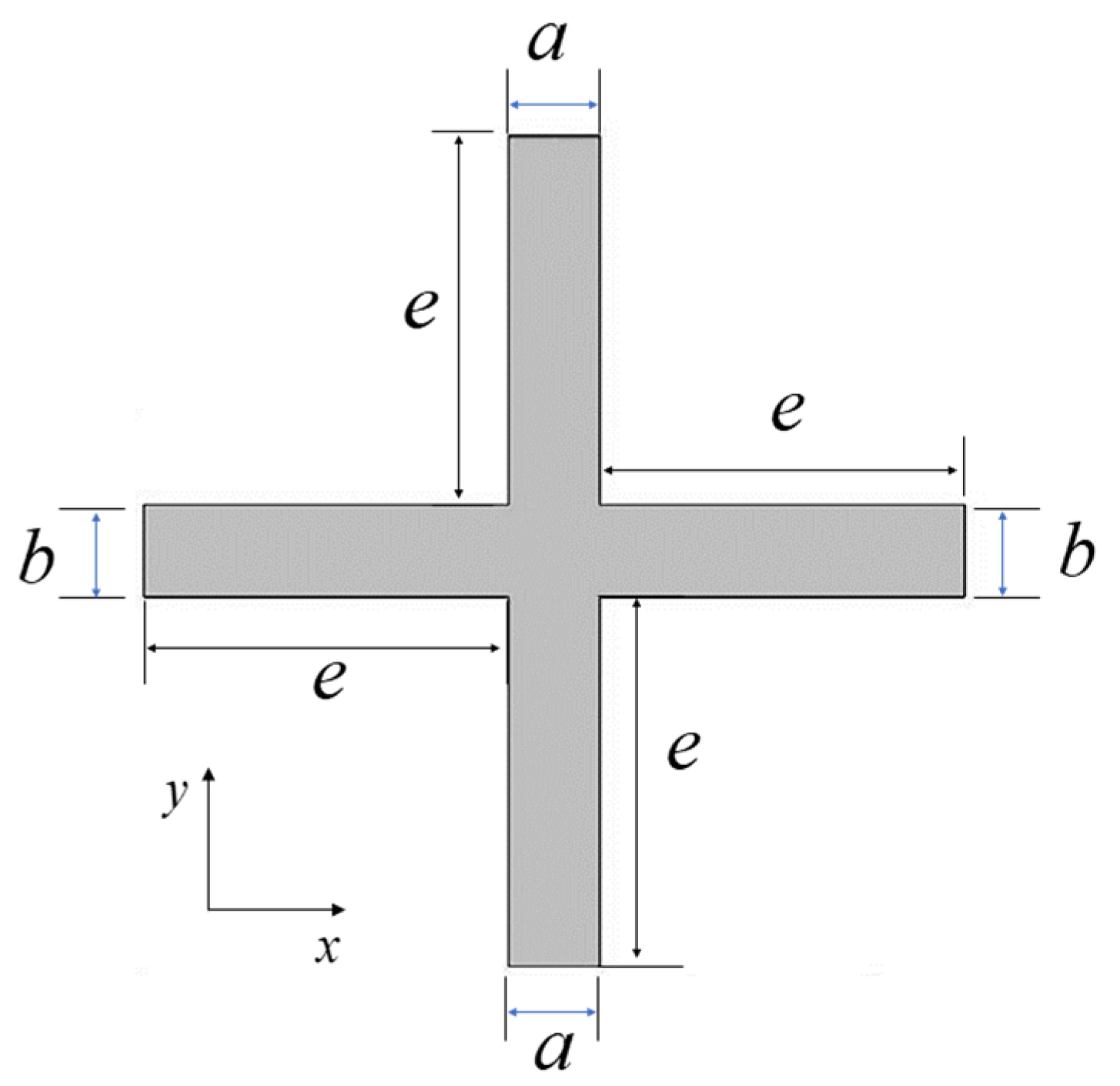
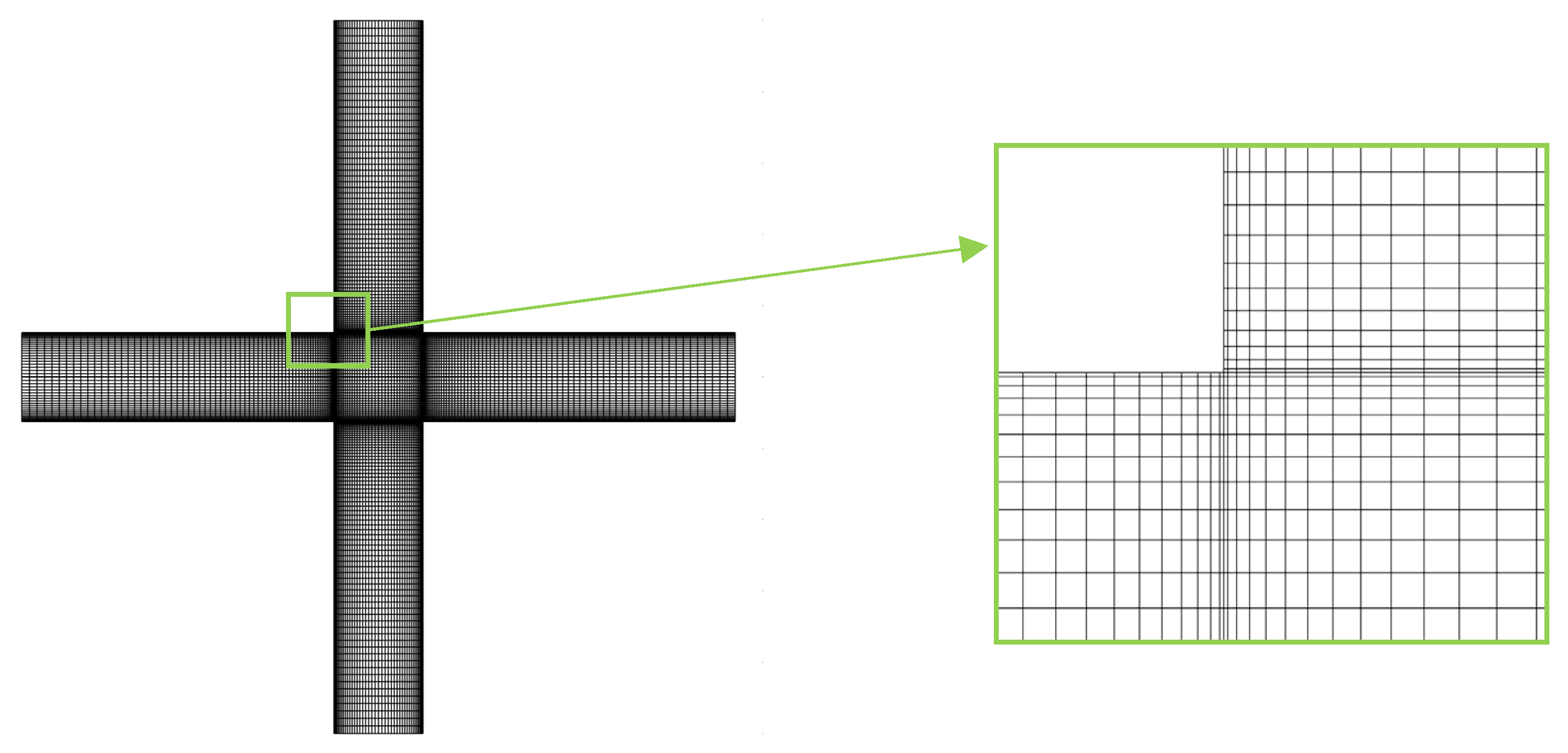
The physical domain is a cross-shaped fracture junction, as depicted in
Figure 1. The geometry is defined by a uniform aperture
a =
b = 2.5 mm and an arm length e = 10 mm, forming a symmetric “+” configuration. The fracture walls are assumed to be smooth and rigid. The geometric parameters (aperture 2.5 mm, arm length 10 mm) are based on coal seam fractures’ typical traits [
3]. The 2.5 mm aperture, the median of field-observed 0.1–5 mm (52% in 1–3 mm), represents primary CBM flow channels. The 10 mm arm length aligns with DFN models and 5–15 mm field fracture segments, balancing physical realism and computational feasibility.
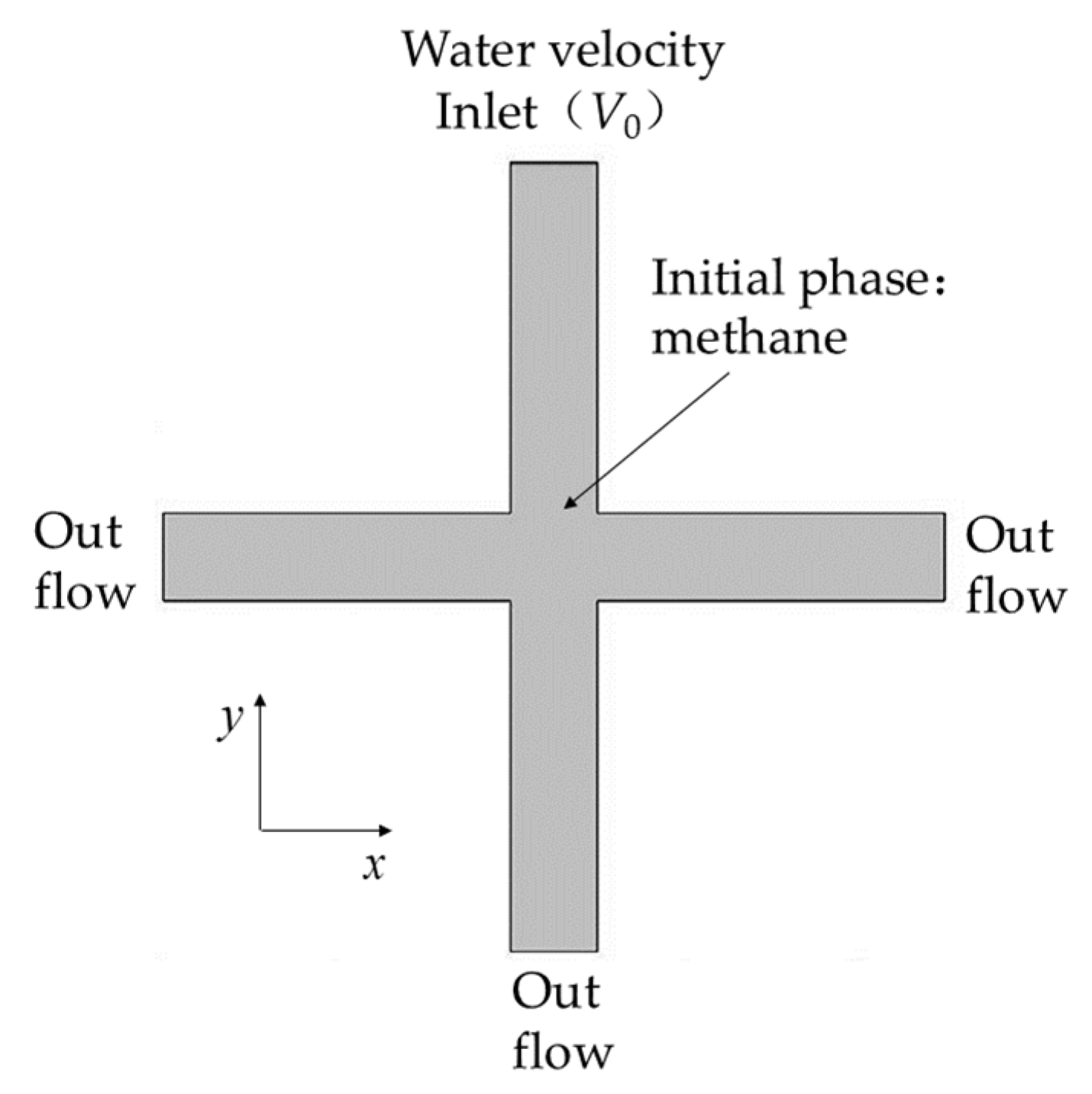
Figure 2 illustrates the applied boundary and initial conditions. Water (the liquid phase) is injected vertically downward from the top inlet with a specified uniform velocity
V0. The entire fracture is initially saturated with stationary methane (CH
4, representing the coalbed gas phase). The left, right, and bottom exits are set as pressure outlets with zero relative (gauge) pressure. A no-slip condition is applied at all fracture walls. To systematically explore the effect of flow inertia, seven inlet velocities ranging from 0.2 m/s to 5.0 m/s were simulated, corresponding to a broad spectrum of Reynolds numbers. The parameter matrix is summarized in
Table 1.
The inlet velocity range (0.2–5.0 m/s) covers common CBM extraction conditions: 0.2–0.5 m/s for conventional water infusion (laminar, fracture-protective [
6]), and 1.0–5.0 m/s for enhanced recovery (CO
2/N
2 displacement, flowback [
5]), aligning with field data and peer simulations [
26].
3. Mathematical Model and Numerical Framework
3.1. Model Assumptions and Simplifications
To make the transient, high-density-ratio two-phase flow problem at the fracture junction computationally tractable while preserving the essential physics, the following key assumptions and simplifications were adopted:
Two-dimensional (2D) Flow: The fracture is modeled as a 2D cross-section, assuming uniformity in the out-of-plane direction. This simplification is commonly used for fundamental studies of junction flow [
26], and it allows for high-resolution capture of interface dynamics at manageable computational cost.
Incompressible, Isothermal Fluids: Both the liquid (water) and gas (methane) phases are treated as incompressible, and the flow is assumed to be isothermal. This is justified as the Mach number is very low, and the focus is on hydrodynamic rather than thermodynamic effects.
Immiscible Phases with Sharp Interface: Phase change and mass transfer between phases are neglected. The interface is treated as sharp, governed by surface tension.
Smooth and Rigid Walls: Fracture walls are assumed to be hydraulically smooth and non-deformable. This isolates the effects of junction geometry and inflow conditions from the complexities of wall roughness and geomechanically coupling, which are important but separate aspects for future study.
Constant Fluid Properties: Density and viscosity for each phase are constant at standard conditions (20 °C, 1 atm).
3.2. Governing Equations and the VOF Method
Two-phase flow involves the simultaneous flow of two immiscible fluid phases (e.g., gas and liquid). A common model is the Two-Fluid Model (Euler–Euler model), where each phase has its own set of independent mass, momentum, and energy conservation equations. These equations [
38], based on classical fluid mechanics, describe the interactions between phases, flow behavior, and energy transfer. The core governing equations include the mass conservation equation (Equation (1)), the momentum conservation equation (Equation (2)), and the energy conservation equation (Equation (3)), as follows:
In the above equations, represents the volume fraction of phase (k), denoting the proportion of phase (k) within a control volume. It is dimensionless (ranging from 0 to 1). is the density of phase (k), representing the mass of phase (k) per unit volume, typically in kg/m3. is the velocity vector of phase (k), indicating the flow velocity of phase (k) in space, typically in m/s. is the mass source term for phase (k), representing the mass generation or disappearance rate due to phase change (e.g., evaporation or condensation), typically in kg/(m3·s). p is the pressure, representing the static pressure in the fluid, assumed to be balanced at the interface between phases, typically in Pa (Pascal). is the stress tensor for phase (k), representing the internal stress due to viscous effects, typically in Pa. is the gravitational acceleration vector, representing the influence of Earth’s gravity on the fluid, typically in m/s2. is the surface tension force vector, representing the body force density due to surface tension, typically in N/m3. It acts near the interface, causing it to contract to a minimum area. is the specific internal energy of phase (k), representing the internal energy per unit mass of phase (k), including molecular kinetic and potential energy, etc., typically in J/kg. is the heat flux vector, representing the heat flow rate due to thermal conduction, power per unit area, typically in W/m2. is the heat source term for phase (k), representing the rate of heat input from external sources to phase (k), power per unit volume, typically in W/m3.
In the three equations above, for each phase (k), the mass conservation equation ensures mass balance during flow, the momentum conservation equation describes the force balance and momentum change, and the energy conservation equation describes the energy balance, including internal energy, heat conduction, and dissipation.
This study also accounted for surface tension. In Equation (2), , where is the surface tension coefficient, representing the force per unit length of the interface, typically in N/m. is the interface curvature, representing the degree of bending of the interface, typically in 1/m. is the gradient of the volume fraction, representing the spatial rate of change of the volume fraction α, typically in 1/m.
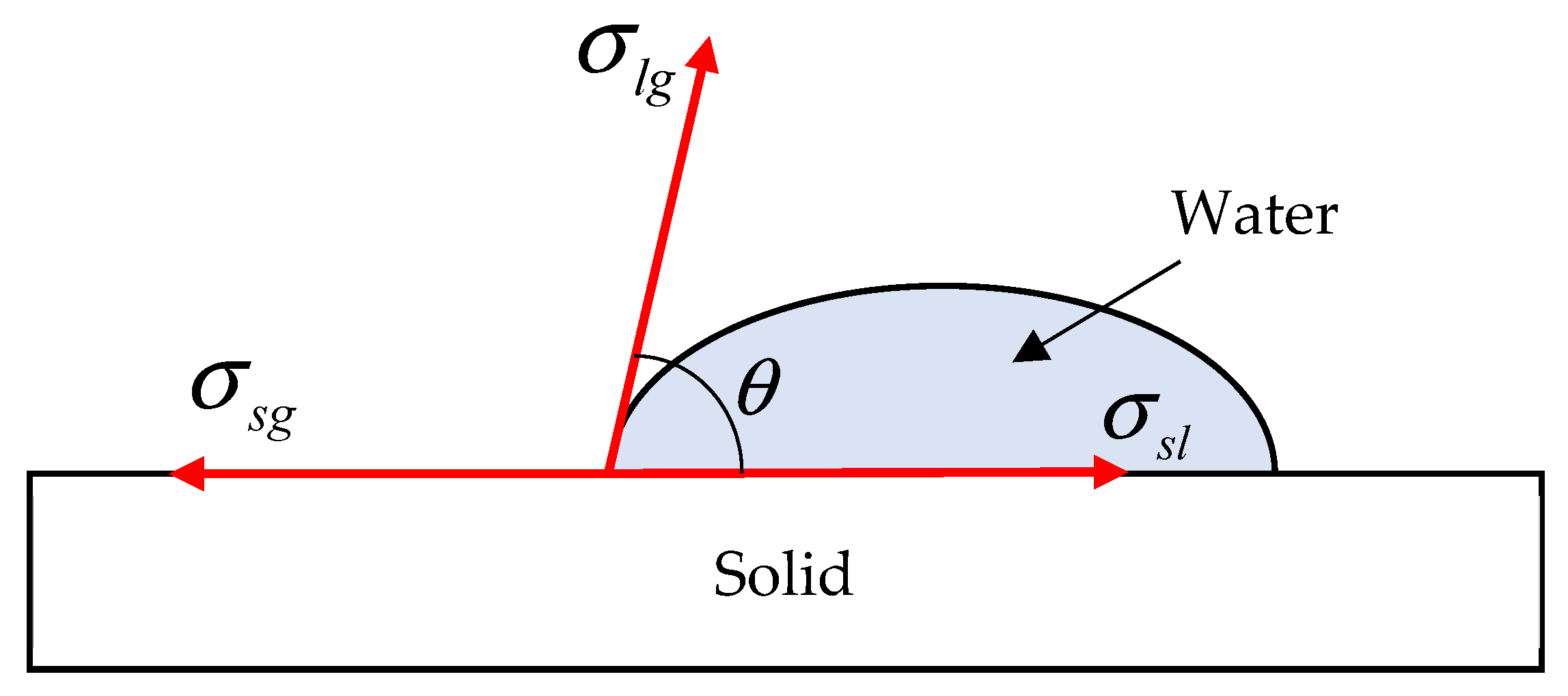
The relationship between the contact angle and the surface tension coefficients is given by Young’s equation [
39] (Equation (4)):
where
is the contact angle, typically in degrees (°) or radians (rad). It represents the angle between the liquid interface and the solid surface.
is the solid–gas interfacial tension, in N/m, representing the tension at the solid–gas interface.
is the solid–liquid interfacial tension, in N/m, representing the tension at the solid–liquid interface.
is the liquid–gas interfacial tension, i.e., the surface tension coefficient σ, in N/m.
Figure 3 provides a schematic diagram of the relationship between the contact angle and the surface tension coefficients. In the present calculations, the surface tension coefficient for water is taken as 0.072 N/m, and the contact angle between water and coal is set to 50° [
40].
As this study focuses on gas–liquid two-phase flow, specifically investigating the unsaturated flow of water in a coal cross-fracture, the Volume of Fluid (VOF) model was adopted to better describe the motion of the fluid interface. The VOF model is an interface-tracking method used to simulate the flow of two or more immiscible fluids (e.g., gas and liquid). It captures the interface between phases by solving a volume fraction equation, without the need for explicit interface tracking. The VOF model is typically coupled with the Navier–Stokes equations and employs interface reconstruction techniques (e.g., geometric reconstruction) to enhance interface resolution [
27]. The VOF method is particularly suited for this study due to its ability to robustly handle large interfacial deformations (e.g., jet impact and droplet formation at the junction) and the high-density ratio between water and methane (~1420:1), while ensuring mass conservation—a critical requirement for accurately quantifying transient flow partitioning.
3.3. Turbulence Modeling: Justification for the SST k-ω Model
The Shear Stress Transport (SST) k-ω turbulence model [
41] was employed to accurately simulate the wide Reynolds number range, spanning laminar to turbulent regimes. This model is particularly suited for the present study due to its well-established capability in handling flows with strong adverse pressure gradients and flow separation—key features at the fracture junction—while maintaining accuracy in near-wall regions. It has been widely validated for similar internal and multiphase flows. For the lower velocity (laminar) cases, the model appropriately reduces its effect, ensuring consistency across all simulated conditions.
3.4. Numerical Solution and Model Parameters
The simulations were performed using the pressure-based, transient solver in ANSYS Fluent 16.0. The Pressure-Implicit with Splitting of Operators (PISO) scheme was used for pressure-velocity coupling due to its superiority for transient multiphase flows. The Geo-Reconstruct scheme was selected for discretizing the VOF equation to achieve a sharp, physically realistic interface.
The fluid properties were water [
42] (ρ
1 = 998.2 kg/m
3, μ
1 = 1.003 × 10
−3 Pa·s) and methane [
43] (air, ρ
2 = 0.707 kg/m
3, μ
2 = 1.09 × 10
−5 Pa·s). A second-order upwind scheme was used for momentum discretization. The simulations were advanced in time with a fixed step size of 1 × 10
−6 s, ensuring a maximum Courant number below 0.5 for interface stability. Each case was run until a quasi-steady flow pattern and stable outflow rates were established.
5. Results and Flow Regime Analysis
A comprehensive post-processing analysis was then conducted to elucidate the fundamental characteristics of the flow field. This analysis systematically examines the temporal and spatial evolution of the flow across the seven investigated inlet velocities (V0 = 0.2 to 5.0 m/s). The primary focus is on several key aspects: firstly, the global flow pattern and the morphological evolution of the water phase; secondly, the distribution and fluctuation of pressure within the fracture; thirdly, the velocity fields in both horizontal and vertical directions; and finally, the streamline patterns. Additionally, the head loss across the intersection is quantified to assess the energy dissipation characteristics. The collective results from these analyses consistently demonstrate a profound dependency of the flow behavior on the inlet velocity, leading to the identification of three distinct flow regimes, as detailed in the following subsections.
5.1. Flow Patterns
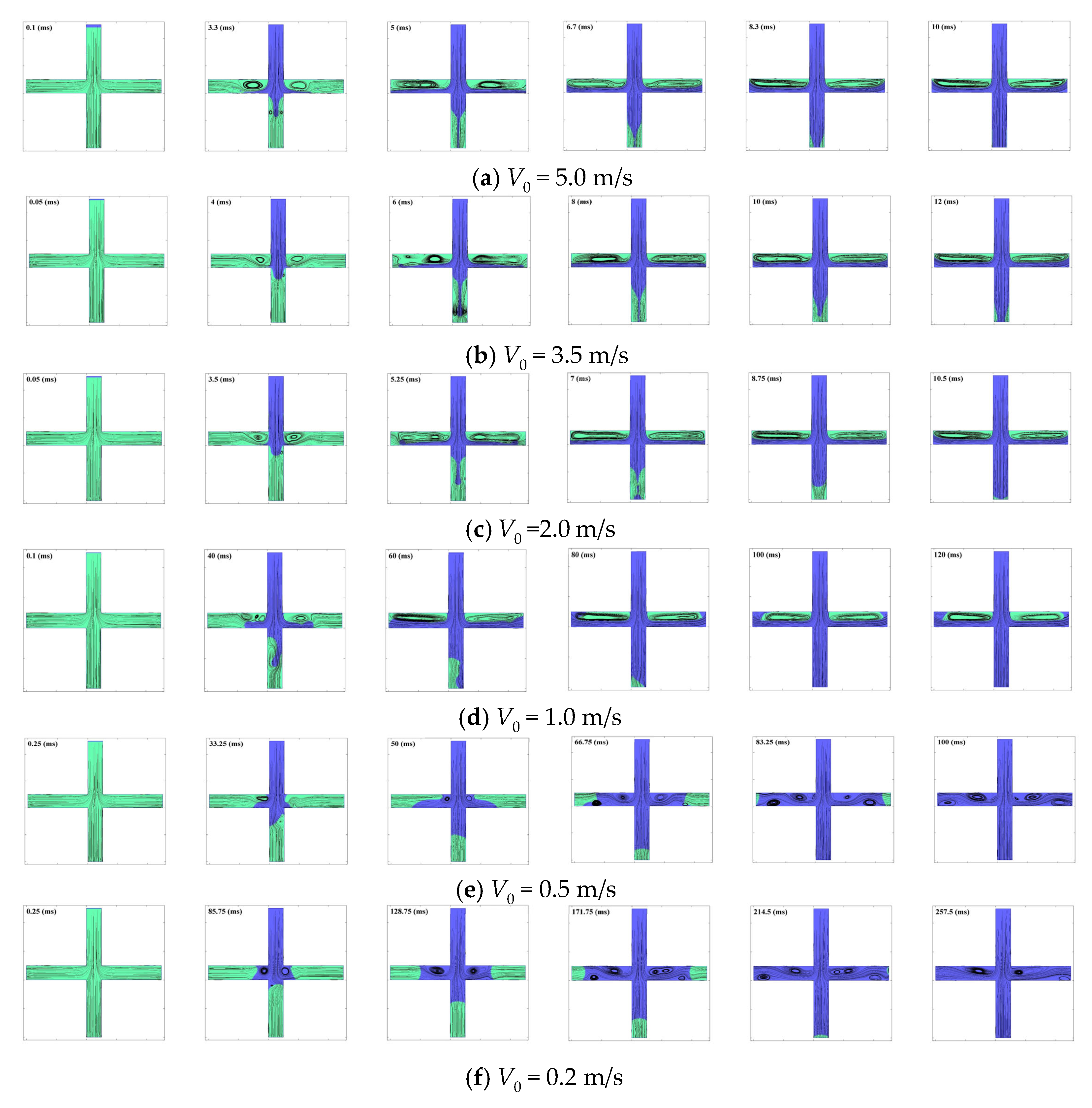
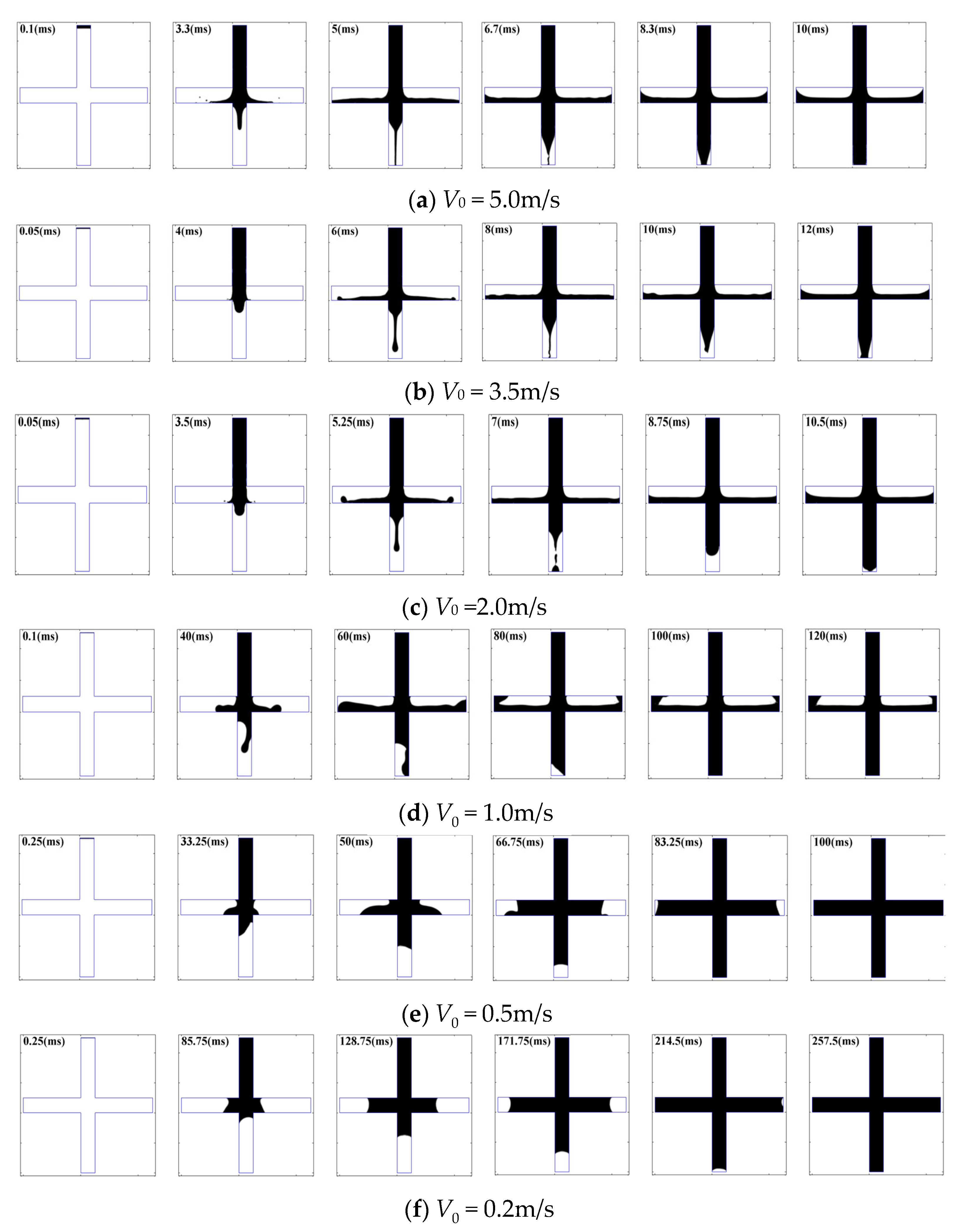
Figure 5 illustrates the evolution of water flow morphology in the cross-fracture under seven different inlet velocities. Based on the observed gas–liquid interface morphology, temporal evolution, and the underlying competition between dominant forces, the flows are systematically categorized into three characteristic regimes: (1) high-speed impinging flow, (2) moderate-speed transitional flow, and (3) low-speed creeping filling flow. This phenomenological classification is central to this study and is primarily defined by the shift in dominance among inertial, viscous, and gravitational forces. It is pertinent to note that while the Reynolds number (Re) ranges of these regimes’ approximate classical hydrodynamic states (laminar, transition, turbulent), the present classification focuses specifically on the distinctive two-phase flow structures and force balances at the junction. The flow characteristics corresponding to all velocities under each pattern are detailed as follows:
- (1)
High-speed Impinging Flow (V0 = 5.0 m/s, 3.5 m/s)
In this pattern, inertial forces dominate absolutely, with the effects of viscous forces and gravity being negligible. The flow is characterized by the core feature of “rapid impact–synchronous diffusion”.
At V0 = 5.0 m/s, after entering from the top inlet, the fluid rapidly impacts the lower section of the vertical fracture under the drive of strong inertia and spreads symmetrically into the horizontal branches on both sides. Obvious fluid accumulation occurs in the initial stage (0.1 ms). At 3.3 ms, a stable fluid blob forms in the lower section of the vertical fracture and extends significantly into the horizontal fractures. The filling of the entire cross-fracture is completed at 10 ms, and the expansion in the horizontal and vertical directions is almost completely synchronous with no obvious time difference. The reason for jet and droplet formation under this condition is the extremely high inertial force causes the fluid to retain momentum after impacting the lower section of the vertical fracture; part of the fluid breaks through the constraint of surface tension and forms high-speed jets along the horizontal branches. During movement, the jets break due to interface instability (dynamic imbalance between inertial force and surface tension), and discrete droplets are finally formed with slight disturbances from the fracture wall.
At V0 = 3.5 m/s, the flow law is consistent with that at 5.0 m/s, but the time scale is slightly longer: rapid accumulation begins at 0.05 ms, a fluid blob extends to the horizontal fractures at 4 ms, and the filling of the entire cross-fracture is completed at 12 ms. Compared with 5.0 m/s, its impact intensity and diffusion rate are slightly reduced, but the synchronous expansion characteristic under inertial dominance is still maintained. The mechanism of jet and droplet formation is consistent with that at 5.0 m/s, but the inertial force is slightly weaker, resulting in lower jet velocity, larger droplet size (about 0.1–0.2 mm), fewer droplets, and longer jet duration (about 3–4 ms), with the constraining effect of surface tension relatively prominent.
- (2)
Moderate-speed Transitional Flow (V0 = 2.0 m/s, 1.0 m/s)
In this pattern, inertial forces weaken, and viscous forces and gravity begin to participate in momentum balance. The flow exhibits a staged characteristic of “vertical accumulation–horizontal expansion”, with a filling speed between high-speed and low-speed.
At V0 = 2.0 m/s, the fluid first accumulates slowly in the lower section of the vertical fracture after entering, forms a certain pressure accumulation at 3.5 ms, and then spreads to the horizontal fractures, showing the typical characteristic of “vertical accumulation–horizontal expansion”. The horizontal expansion range increases significantly at 5.25 ms, and full filling is completed at 10.5 ms. At this time, inertial forces still play a dominant role, but viscous resistance has led to a vertical–horizontal difference in expansion rate, and the staged characteristic initially appears. The reason for jet and droplet formation is that inertial force can still drive the fluid to form local high-speed streams (jets), but the damping effect of viscous forces reduces the jet velocity compared to the high-speed condition. When the jet moves in the horizontal branch, the combined action of viscous shear and surface tension causes interface tearing, forming droplets (size about 0.2–0.3 mm) that move more gently and are less prone to secondary fragmentation.
At V0 = 1.0 m/s, the staged characteristic of “vertical accumulation–horizontal expansion” is more prominent: only partial filling of the lower section of the vertical fracture is completed at 40 ms, slow spreading to the horizontal fractures begins at 60 ms, and full filling is achieved at 120 ms. The damping effect of viscous forces is further enhanced, and the lag of horizontal expansion is more obvious than that at 2.0 m/s, which is consistent with the force balance characteristics of moderate-speed transitional flow.
- (3)
Low-speed Creeping Filling Flow (V0 = 0.5 m/s, 0.2 m/s)
In this pattern, inertial forces are negligible, viscous forces and gravity dominate the flow, the fluid momentum is extremely low, and the core characteristic is creeping filling of “slow accumulation–gradual diffusion”.
At V0 = 0.5 m/s, the fluid accumulates in the lower section of the vertical fracture for a long time after entering, and the horizontal expansion is extremely slow, showing the characteristic of “slow accumulation–gradual diffusion”: only a small range of the lower section of the vertical fracture is filled at 33.25 ms, spreading to the proximal end of the horizontal fractures begins at 50 ms, and full filling is completed at 100 ms. The flow is driven by the combined action of static pressure and viscous diffusion, with no obvious impact effect, which is consistent with the flow law of low-speed creeping flow.
At V0 = 0.2 m/s, the creeping characteristic of “slow accumulation–gradual diffusion” is most significant: only a small area in the lower section of the vertical fracture and the proximal end of the horizontal fractures is filled at 85.75 ms, the horizontal expansion gradually becomes obvious at 128.75 ms, and the filling of the entire fracture is only completed at 257.5 ms. The fluid has almost no momentum, and slow diffusion is completely achieved through static pressure gradient and viscous transfer, which is a typical manifestation of low-speed creeping filling flow.
It should be noted that the phenomenon of “fluid rising from the exit plane in the left and right branches” is observed in all flow regimes. It essentially results from the coupling of zero-gauge pressure at the outflow boundary and multiple forces: at high speeds, inertial impact induces instantaneous pressure feedback, hindering rapid fluid discharge; at moderate-low speeds, viscous drag reduces the discharge rate, combined with capillary action dominated by surface tension, leading to local accumulation. This phenomenon reflects the dynamic balance of momentum, pressure, viscosity, and capillary forces, consistent with basic fluid mechanics principles.
In summary, as the inlet velocity decreases, the flow in the cross-fracture gradually transitions from “inertia-dominated rapid impact” to “viscosity-gravity dominated slow filling”. The flow time scale extends from the millisecond level (10–12 ms) in the high-speed mode to the hundred-millisecond level (100–257.5 ms) in the low-speed mode, the synchronization of spatial expansion gradually disappears, and the dynamic mechanism presents a significant graded change. However, the core characteristics of the three flow patterns (rapid impact–synchronous diffusion, vertical accumulation–horizontal expansion, slow accumulation–gradual diffusion) remain consistent throughout.
5.2. Pressure Distribution
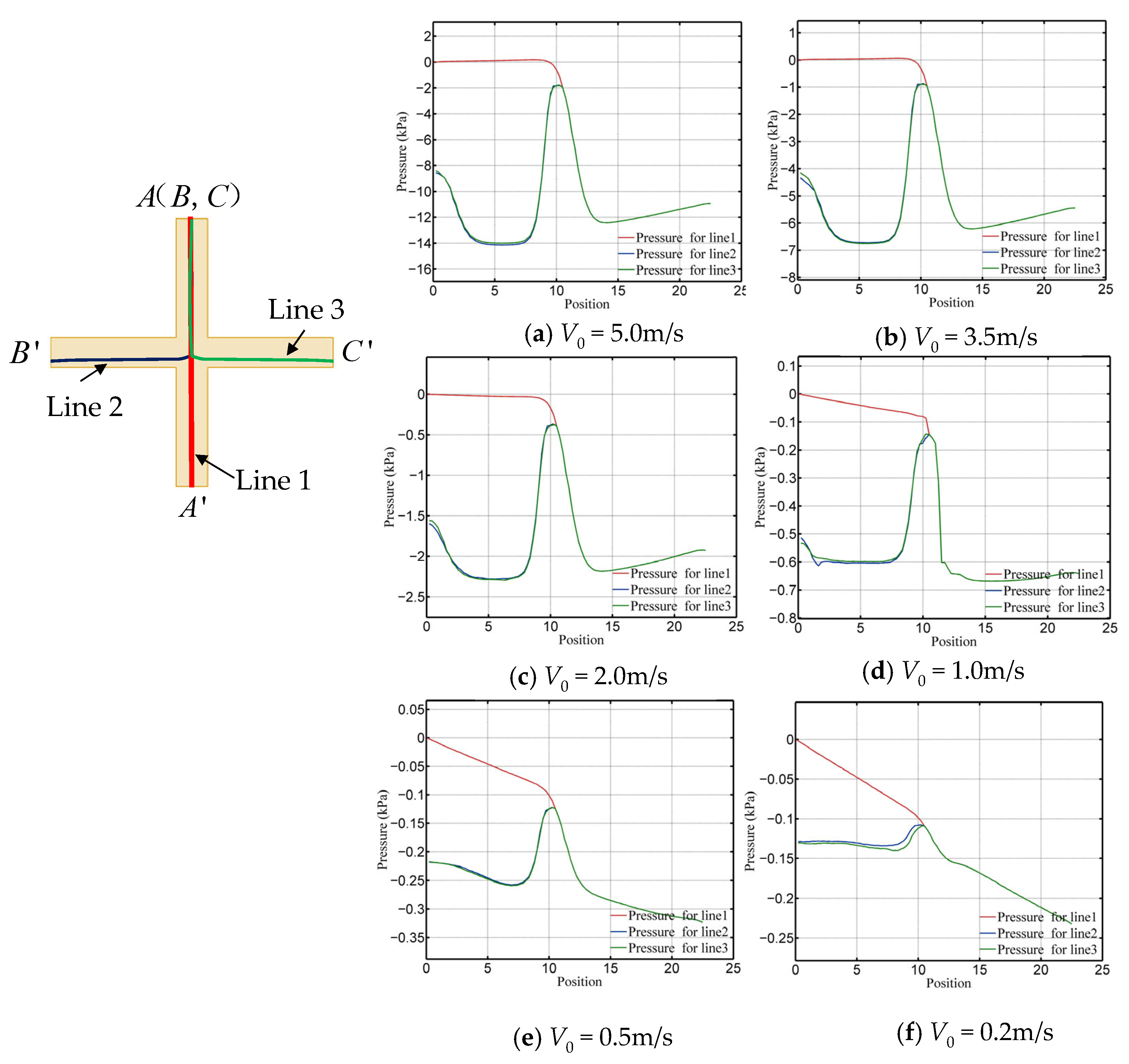
Figure 6 presents the pressure variation curves along the predefined monitoring lines under steady-state flow for seven inlet velocities. The pressure distribution characteristics exhibit a strong dependence on the flow regime, which is governed by the sequential shift in dominant forces (inertial, viscous, and gravitational forces) with decreasing inlet velocity. Detailed analyses of each flow regime and corresponding operating conditions are provided as follows:
- (1)
High-speed Impinging Flow (V0 = 5.0 m/s, 3.5 m/s)
In this regime, inertial forces dominate completely, while the damping effects of viscous and gravitational forces are negligible. The pressure distribution is characterized by intense fluctuations, distinct “deep trough–steep rise” profiles, and significant negative pressure peaks, attributed to the abrupt momentum change induced by high-velocity fluid impact.
At V0 = 5.0 m/s (Re ≈ 12,500), the negative pressure peak on Line 1 (lower segment of the vertical fracture) reaches −14 kPa. This extreme pressure drop arises from the rapid deceleration of the fluid upon impacting the vertical fracture wall, where the inertial momentum cannot be dissipated instantaneously. Lines 2 and 3 (horizontal fracture segments) exhibit significant negative pressure across their entire lengths, echoing the pressure mutation in the vertical fracture and reflecting efficient pressure transmission during rapid fluid diffusion.
At V0 = 3.5 m/s (Re ≈ 8750), the pressure fluctuation amplitude is moderately reduced compared to V0 = 5.0 m/s. The negative pressure peak on Line 1 decreases to ~−10 kPa, and the negative pressure range in the horizontal fractures narrows with a slower attenuation rate. This mitigation trend is consistent with the weakened inertial impact intensity, while the inertia-dominated pressure changes mechanism remains unchanged.
- (2)
Moderate-speed Transitional Flow (V0 = 2.0 m/s, 1.0 m/s)
This regime is marked by a dynamic balance between inertial and viscous forces, leading to attenuated pressure fluctuations, smooth curve transitions, and a gradual flattening of the pressure gradient as the inlet velocity decreases.
At V0 = 2.0 m/s (Re ≈ 5000), the negative pressure peak on Line 1 is ~−2 kPa. The pressure in the horizontal fractures fluctuates gently, with no abrupt mutations, as viscous forces partially buffer the inertial impact. This pressure variation is well-correlated with the staged fluid expansion characteristic of the transitional flow regime.
At V0 = 1.0 m/s (Re ≈ 2500), the negative pressure peak further decreases to −1 kPa. The pressure curves for all monitoring lines show no obvious “trough–rise” features, and the pressure gradients in the vertical and horizontal fractures tend to converge, indicating a near-equilibrium state between inertial and viscous forces.
- (3)
Low-speed Creeping Flow (V0 = 0.5 m/s, 0.2 m/s)
In this regime, viscous and gravitational forces govern the flow, resulting in minimal pressure amplitude, gentle linear pressure profiles, and no local pressure concentration, which is consistent with the laminar flow pressure distribution law.
At V0 = 0.5 m/s (Re ≈ 1250), the absolute pressure magnitude across the entire flow field is less than 0.3 kPa. Lines 2 and 3 exhibit linear pressure drops, with no negative pressure peaks, as the pressure gradient is jointly determined by hydrostatic pressure and viscous resistance.
At V0 = 0.2 m/s (Re ≈ 500), pressure fluctuations are negligible (absolute value < 0.25 kPa), and the pressure is uniformly distributed throughout the fracture network. The pressure loss induced by viscous resistance is extremely small under static pressure dominance, fully conforming to the inherent pressure distribution characteristics of laminar flow.
5.3. Velocity Field
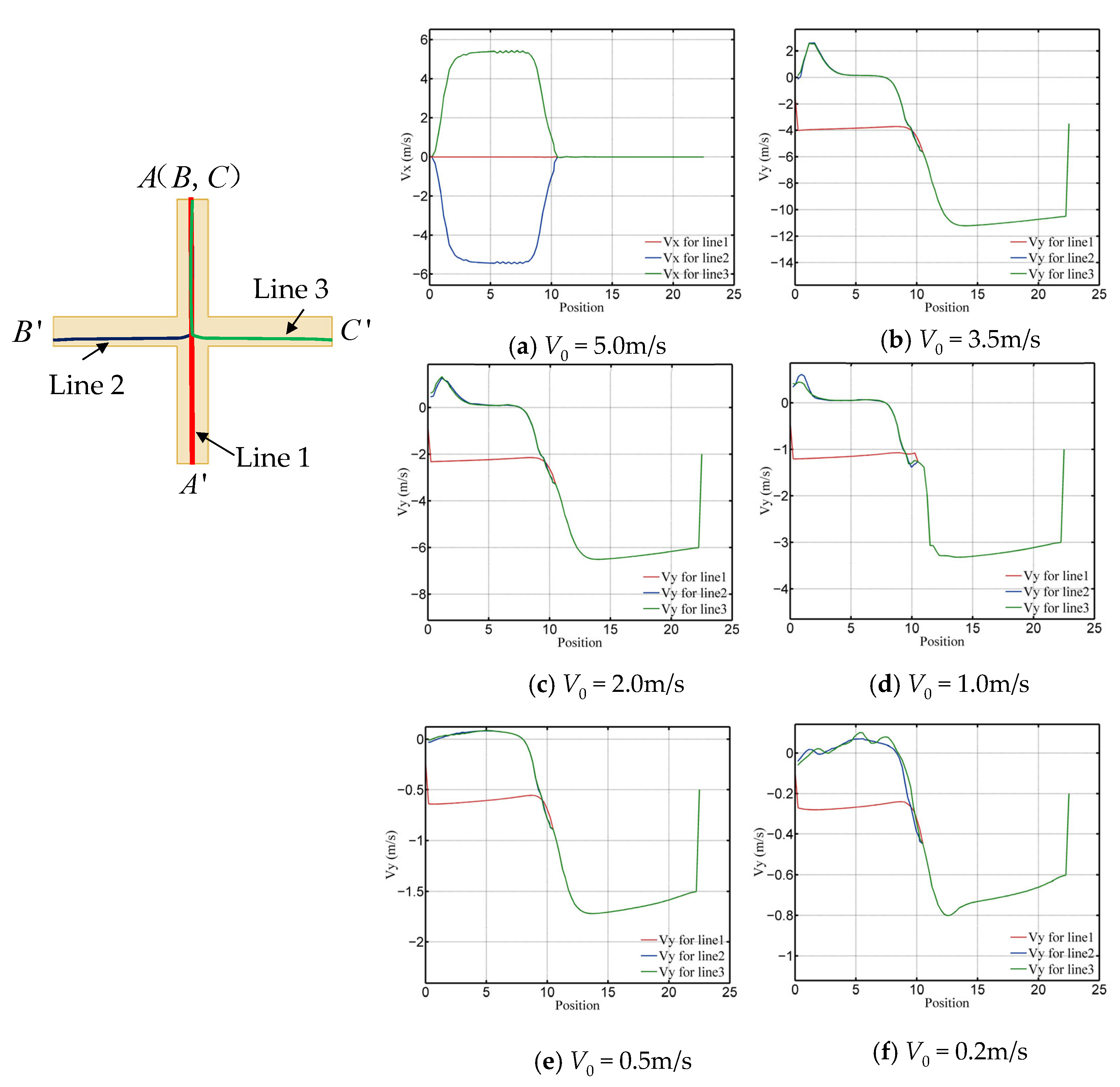
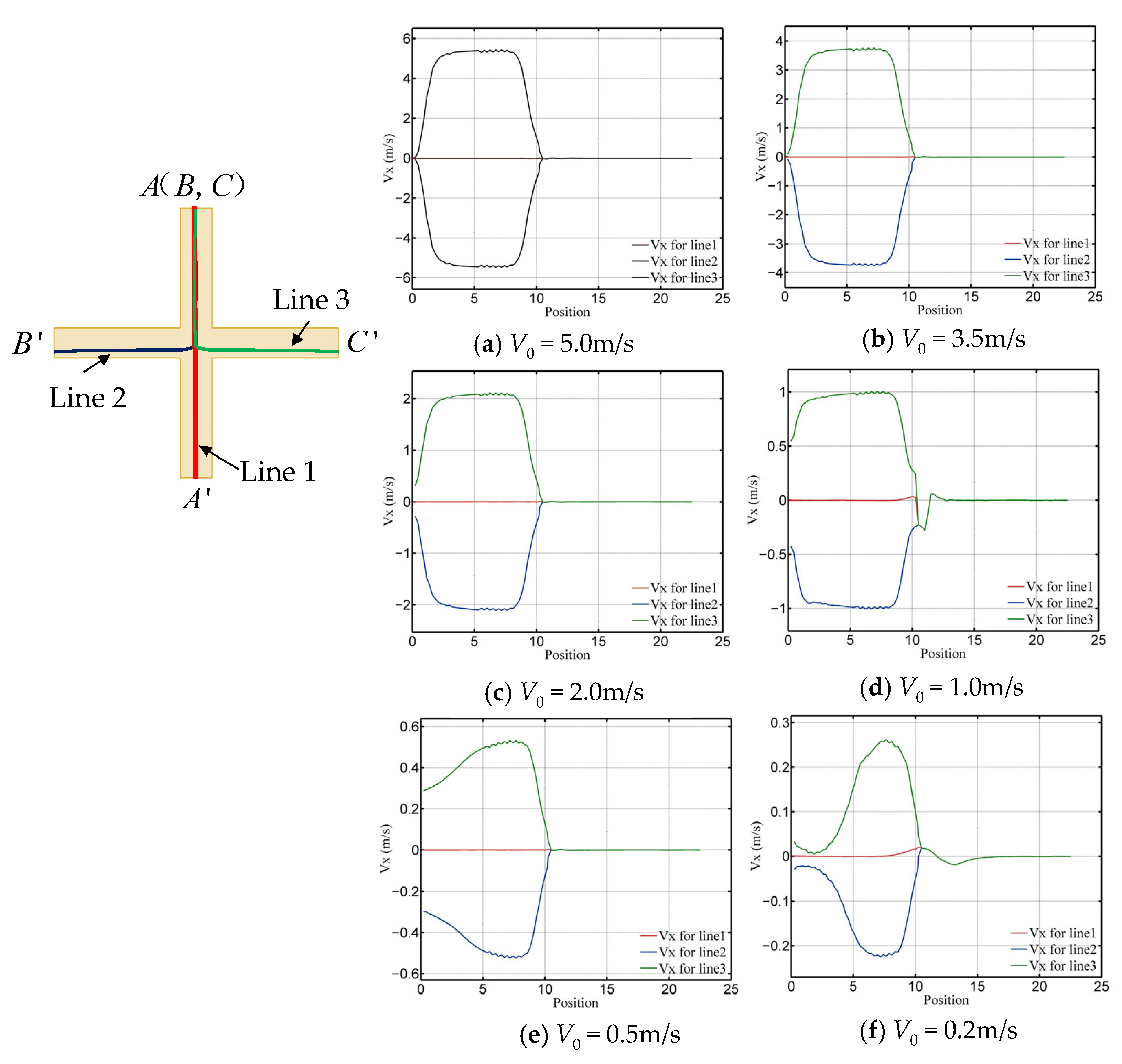
Figure 7 shows the horizontal velocity variation curves along the monitoring lines under steady flow conditions for the seven inlet velocities.
It can be observed that: For the high-speed impinging type (V0 = 5.0 m/s, V0 = 3.5 m/s): Velocity fluctuations are intense, with large amplitudes (negative velocity on Line 1 exceeds −4 m/s, positive velocity on Line 3 exceeds 3 m/s). The curves exhibit an abrupt “deep valley–high peak” characteristic. This is because, at high speeds, inertia dominates, and the rapid turning of fluid within the cross-fracture causes drastic momentum changes. The retarding effects of viscosity and gravity are negligible, leading to large fluctuation in horizontal velocity.
For the medium-speed transitional type (V0 = 2.0 m/s, V0 = 1.0 m/s): The amplitude of velocity fluctuations is reduced compared to the high-speed type. The negative velocity on Line 1 ranges from approximately −2 m/s to −0.6 m/s, and the positive velocity on Line 3 ranges from about 2 m/s to 1.0 m/s. The “valley–peak” transition in the curve is smoother. Here, inertial forces weaken, and viscous forces and gravity begin to participate in the momentum balance. The momentum change during fluid turning is partially buffered, and the velocity gradient is determined by both inertia and viscosity.
For the low-speed creeping type (V0 = 0.5 m/s, V0 = 0.2 m/s): The velocity amplitude is very small, and curve transitions in a near-linear and gradual manner, showing no sharp velocity changes. Due to the dominance of viscous and gravitational forces at low speeds, inertia is negligible. The fluid flow approximates laminar flow, and the velocity distribution is linearly controlled by viscous diffusion and the static pressure gradient, thus exhibiting a smooth velocity variation characteristic.
Figure 8 shows the vertical velocity variation curves along the monitoring lines under steady flow conditions for the seven inlet velocities. It can be observed that for the high-speed impinging type (
V0 = 5.0 m/s,
V0 = 3.5 m/s): velocity fluctuations are intense, with large amplitudes (negative velocity on Line 1 exceeds −10 m/s). The curves exhibit an abrupt “sharp drop–gentle” characteristic. This is because, at high speeds, inertia dominates, and the fluid rapidly impacts and turns within the vertical fracture, causing drastic momentum changes. The retarding effects of viscosity and gravity are negligible, leading to large oscillations in vertical velocity.
For the medium-speed transitional type (V0 = 2.0 m/s, V0 = 1.0 m/s): The amplitude of velocity fluctuations is reduced compared to the high-speed type. The negative velocity on Line 1 ranges from approximately −6 m/s to −2 m/s, and the “sharp drop–gentle” transition is more gradual. Here, inertial forces weaken, and viscous forces and gravity begin to participate in the momentum balance. The momentum change during fluid turning is partially buffered, and the velocity gradient is determined by both inertia and viscosity.
For the low-speed creeping type (V0 = 0.5 m/s, V0 = 0.2 m/s): The velocity amplitude is very small, and the curves are nearly linear and gradual, with no significant velocity change. Due to the dominance of viscous and gravitational forces at low speeds, inertia is negligible. The fluid flow approximates laminar flow, and the velocity distribution is linearly controlled by viscous diffusion and the static pressure gradient, thus exhibiting a smooth velocity variation characteristic.
Comparing the two velocity curves reveals that for the same inlet velocity, the difference in amplitude and fluctuation pattern between the horizontal and vertical velocities gradually diminishes as the inlet velocity decreases. At high speeds, differences arise due to momentum variations in different flow directions, while at low speeds, they tend to converge due to viscosity–gravity dominance. This difference essentially results from the combined effect of flow direction and the dynamic mechanism.
5.4. Streamline Patterns and Vortex Evolution
Figure 9 shows the evolution of streamlines inside the cross-fracture for the seven inlet velocities. It can be observed that the streamline characteristics within the cross-fracture exhibit a clear velocity dependence: at high speeds (
V0 = 5.0 m/s,
V0 = 3.5 m/s), streamlines form intensely distorted vortex structures due to strong inertia, with vigorous momentum transfer during fluid impact and diffusion; at medium speeds (
V0 = 2.0 m/s,
V0 = 1.0 m/s), the streamlines transition to a smoother pattern, with reduced vortex scale and number, indicating a gradual balance between inertial and viscous forces; at low speeds (
V0 = 0.5 m/s,
V0 = 0.2 m/s), the streamlines become nearly parallel, vortices disappear, and the flow ultimately assumes a purely laminar form, where viscous forces and gravity dominate momentum transfer.
The change in streamline characteristics essentially represents a graded transition of the fluid dynamic mechanism from inertia-controlled to viscosity–gravity-controlled. At high speeds, inertial forces far exceed viscous and gravitational forces, and the intense momentum changes in the fluid induce complex vortices. As the velocity decreases, the damping effect of viscous forces on momentum becomes increasingly prominent, and the dominant role of inertial forces is diminished, causing streamlines to transition from an “intense impact type” to a “smooth laminar type”. At very low speeds, inertial forces are negligible, and viscous forces and gravity jointly determine the smooth distribution of streamlines, resulting in a purely laminar flow characteristic. This transition clearly reflects the varying dominance of inertial, viscous, and gravitational forces at different flow velocities.
Notably, despite perfectly symmetric initial and boundary conditions, slight but distinct asymmetry emerges in the streamlines and vortices for high-speed (
V0 = 5.0 m/s, 3.5 m/s) and moderate-speed (
V0 = 2.0 m/s) flows (
Figure 9a–c). This symmetry breaking is attributed to physical hydrodynamic instabilities (e.g., Kelvin–Helmholtz shear instability [
45]), a conclusion corroborated by mesh independence tests and validation studies. The accompanying subtle pressure differences (≈0.8 kPa) between horizontal branches provide further evidence for this mechanism. While minor numerical perturbations may serve as a trigger, the growth of the instability and the resulting asymmetric flow patterns are fundamentally governed by the sensitive dynamic force balance at the junction under these inertial conditions.
5.5. Head Loss Analysis
The head loss calculation in this study is based on the modified Bernoulli equation (mechanical energy conservation law), which is widely applied in branched flow channel analysis. The total mechanical energy (
Et) of the fluid is decomposed into kinetic energy (
), gravitational potential energy (
), and static pressure energy (
). Head loss is defined as the mechanical energy loss per unit weight of fluid, calculated by the following formula [
46]:
where
is the total mechanical energy at the inlet section;
,
,
are temporary designations for data recording and calculation convenience, corresponding to the “Left/Right/Bottom exit” defined in the original geometric model;
is the fluid density (kg/m
3);
g is the gravitational acceleration (9.81 m/s
2).
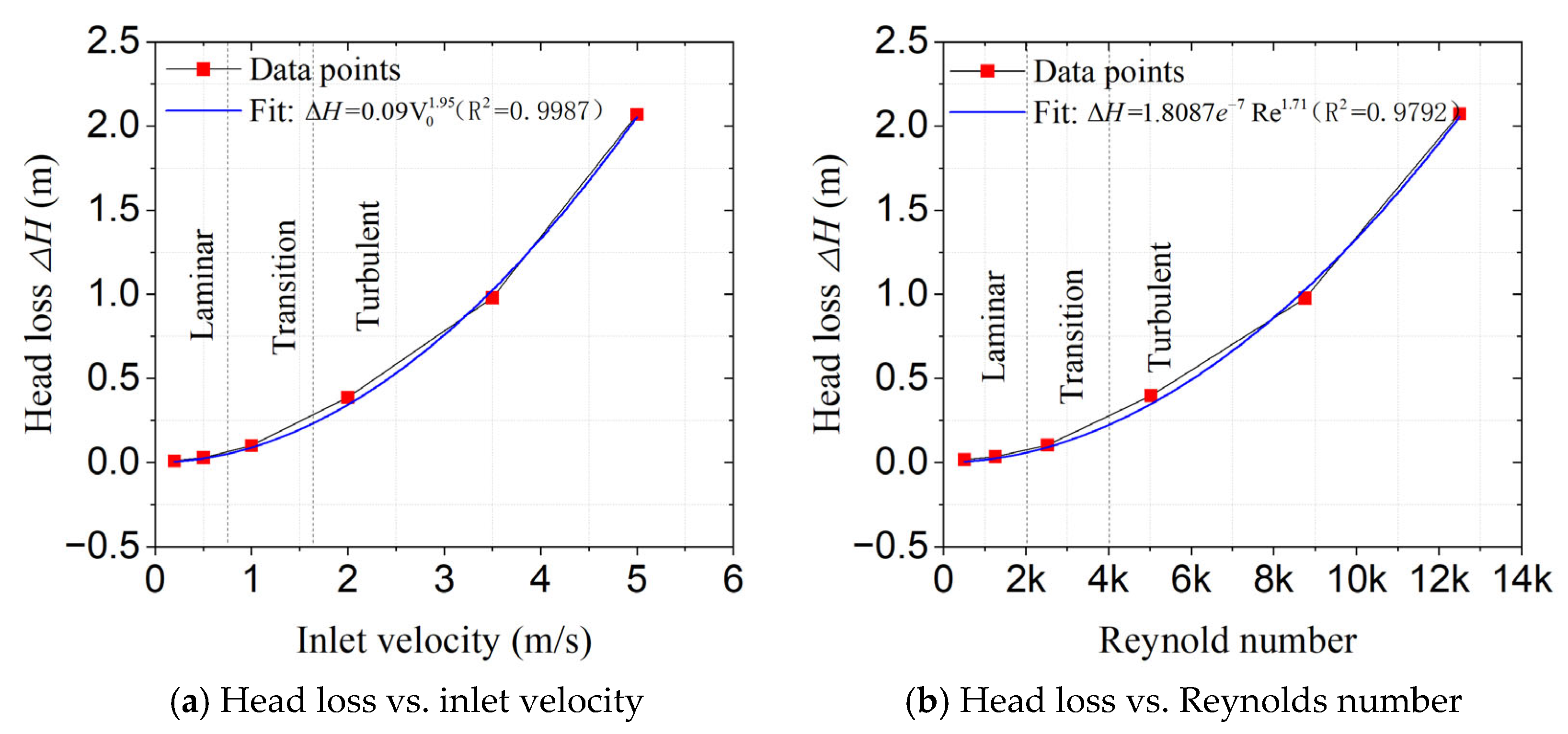
Figure 10 shows the curves of head loss versus inlet velocity and Reynolds number for the flow process in the cross-fracture.
As shown in
Figure 10a, the head loss in the cross-fracture increases monotonically with increasing inlet velocity: when the inlet velocity is very low (approaching 0), the head loss is close to 0; at a velocity of about 2.0 m/s, the head loss is about 0.5 m; at 3.5 m/s, the head loss is about 1.0 m; and at 5.0 m/s, the head loss exceeds 2.0 m, with the growth rate in the high-speed segment being significantly faster than in the low-speed segment.
As shown in
Figure 10b, in conjunction with the Reynolds number (Re), the head loss in the laminar region (Re < 2100), which corresponds to our phenomenologically defined low-speed creeping filling regime, is very small and increases gently; in the transition region (2100 < Re < 4000), encompassing the moderate-speed transitional flow, the growth rate accelerates; in the turbulent region (Re > 4000), characteristic of the high-speed impinging flow, head loss increases sharply.
From a fluid mechanics perspective, viscous resistance dominates in laminar flow, and head loss is linearly related to velocity (or Reynolds number). In turbulent flow, inertial resistance dominates, and head loss is related to a higher power of velocity (or Reynolds number). An increase in inlet velocity raises the Reynolds number, transitioning the flow from laminar to turbulent. This shift in the dominant resistance mechanism causes the rate of head loss increase with velocity and Reynolds number to escalate in a graded manner, with the numerical increase in head loss in the high-speed (high Reynolds number) segment being far greater than in the low-speed (low Reynolds number) segment.
Based on nonlinear fitting of simulation data, two quantitative empirical relationships are established: one between cross-fracture head loss (ΔH) and inlet velocity (
V0), and the other between ΔH and Reynolds number (Re), which are expressed as:
The first formula (Equation (6)) corresponds to the power-law relationship between head loss and inlet velocity in
Figure 10a, with a goodness-of-fit R
2 = 0.9987, indicating a strong correlation between the two. The second formula (Equation (7)) describes the quantitative relationship between head loss and Reynolds number in
Figure 10b, with R
2 = 0.9792 verifying the reliability of the fitting result. Both formulas are fully applicable to the geometric parameters (fracture aperture 2.5 mm, arm length 10 mm) and flow conditions (gas–liquid two-phase flow, Re = 500~12,500) of this study.
The unified trend across the entire range of investigated conditions (Re ≈ 500 to 12,500) is that the head loss increases in a non-linear, power-law fashion with the inlet velocity (approximately proportional to ). This signifies that energy dissipation at the symmetric junction is overwhelmingly dominated by inertial effects (flow impact, redirection, and turbulent dissipation) rather than viscous friction, even at the lower end of the velocity spectrum studied. Therefore, for engineering estimates involving similar gas–liquid flows in symmetric cross-fractures, the head loss can be expected to scale roughly with the square of the inflow velocity.
6. Dynamics and Evolution of Deflection Flow
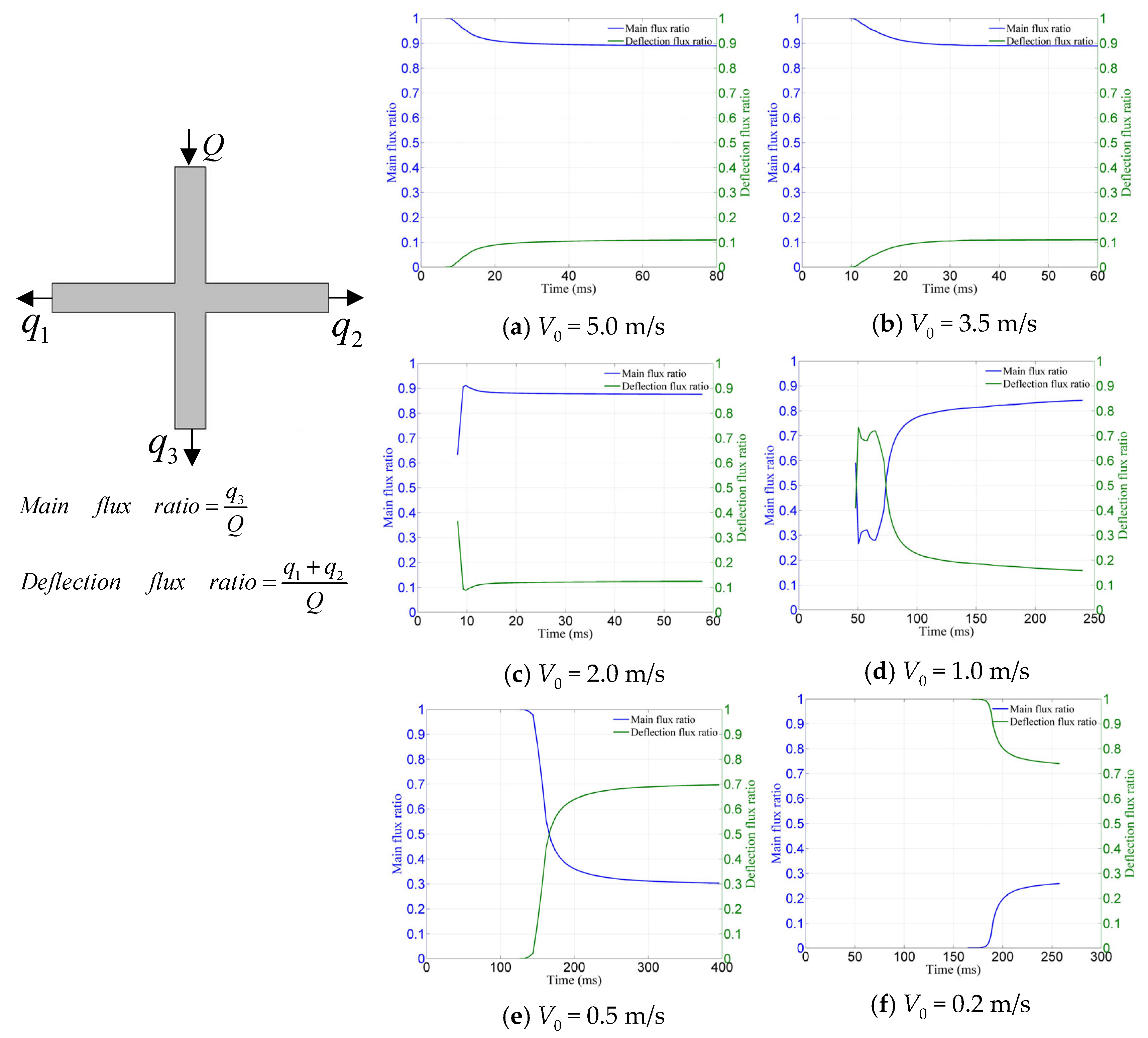
Figure 11 shows the variation curves of the main flow ratio and deflection flow ratio over time for the seven inlet velocity cases. It can be observed that at high speeds (
V0 = 5.0 m/s,
V0 = 3.5 m/s), the main flow ratio is close to 1, and the deflection flow ratio is close to 0, indicating that the flow is predominantly in the main direction with very weak deflection. At medium speeds (
V0 = 2.0 m/s,
V0 = 1.0 m/s), the main flow ratio decreases rapidly, and the deflection flow ratio increases rapidly, showing a clear transition in flow distribution. At low speeds (
V0 = 0.5 m/s,
V0 = 0.2 m/s), the main flow ratio decreases substantially (even below 0.3), and the deflection flow ratio increases significantly (even exceeding 0.7), making deflection flow the dominant form of flow distribution.
The change in deflection flow characteristics essentially stems from the shift in dominance between fluid inertial forces and viscous forces. At high speeds, inertia dominates, concentrating fluid momentum in the main flow direction and suppressing deflection flow. As the velocity decreases, the dispersive effect of viscous forces on momentum enhances, causing the flow distribution within the cross-fracture to transition from “main-flow concentrated” to “deflection-flow dominated”. At low speeds, viscous forces completely dominate momentum transfer, allocating a large portion of the flow to the deflection direction. This transition clearly reflects the controlling effect of inertial and viscous forces on flow distribution at different flow velocities.
Notably, the deflection flow phenomena observed under high-velocity (
V0 ≥ 3.5 m/s) and moderate-velocity (
V0 = 2.0 m/s) conditions (
Figure 11a–d) may be subtly influenced by hydrodynamic instabilities in the statistical outcomes of flow distribution (see
Section 5.4). Specifically, at high speeds, intense inertial impact and abrupt momentum variations can trigger Kelvin–Helmholtz shear instability at the interface, disrupting the ideal symmetric momentum distribution and potentially causing slight skews in instantaneous flow paths, thereby affecting the steady-state deflection flow ratio statistically. For the moderate-speed transitional flow at
V0 = 2.0 m/s, where inertial and viscous forces are in a sensitive dynamic balance, minor pressure fluctuations (as discussed in
Section 5.2) may be amplified, leading to asymmetric vortex structures or flow deviations. This serves as a potential physical mechanism for the rapid changes in deflection flow phenomena under moderate inertial conditions (
Figure 11). In contrast, at low speeds (
V0 ≤ 0.5 m/s), viscous forces dominate absolutely, effectively suppressing instabilities, resulting in highly symmetric and predictable flow distribution. Hence, a comprehensive understanding of deflection flow phenomena necessitates considering both the macro-scale balance of inertial and viscous forces and the micro-scale mechanisms of hydrodynamic instabilities that may operate under high/moderate-speed conditions.
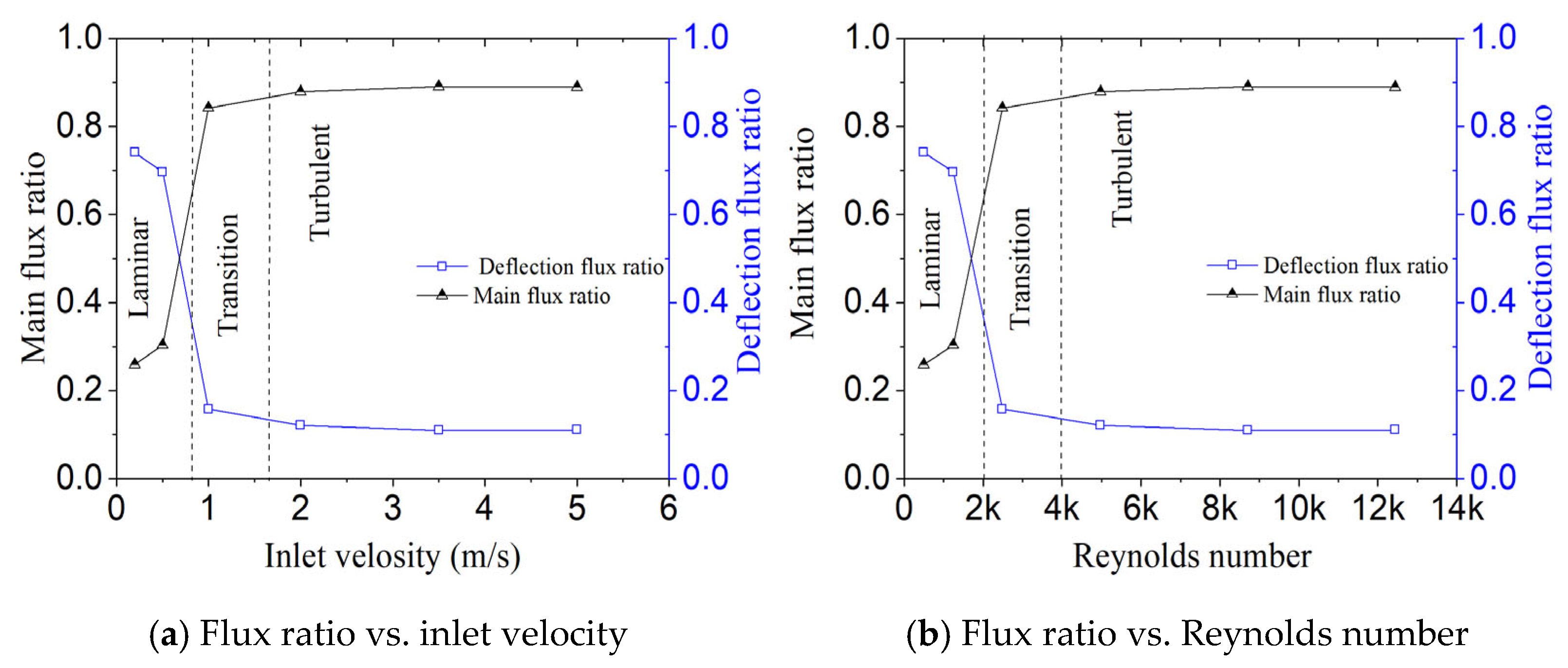
Figure 12 presents the variation curves of the main flow ratio and deflection flow ratio for the seven inlet velocity cases, with two different X-axis parameters (inlet velocity in
Figure 12a and Reynolds number in
Figure 12b) but consistent underlying data. Both subfigures collectively reflect the quantitative relationship between flow partitioning and flow conditions, with Reynolds number (Re) and inlet velocity (
V0) being mutually correlated parameters (Re ∝
V0) that characterize the flow inertia.
In the low flow inertia region (V0 = 0.2–0.5 m/s, Re = 500.0–1250.0, laminar flow), the deflection flow ratio dominates at 0.696–0.741, while the main flow ratio remains low at 0.259–0.304. This is because viscous forces and gravity control the flow, and the fluid spreads slowly to horizontal branches, resulting in a high deflection flow ratio. As flow inertia increases (V0 = 1.0 m/s, Re = 2500.0, transition flow), the deflection flow ratio plummets to 0.158, and the main flow ratio rises sharply to 0.842. This abrupt transition is due to the gradual dominance of inertial forces, which drive the fluid to maintain the main flow direction and suppress lateral spreading. In the high flow inertia region (V0 ≥ 2.0 m/s, Re ≥ 5000.0, turbulent flow), both ratios stabilize: the deflection flow ratio is maintained at 0.109–0.121, and the main flow ratio at 0.879–0.891. At this stage, inertial forces fully dominate, and the flow direction is barely affected by viscous resistance, leading to stable flow partitioning.
To facilitate discussion and connect our findings with established fluid mechanics knowledge,
Figure 12b also annotates the classical laminar (Re < 2100) and transition (2100 < Re < 4000) Reynolds number ranges. A direct comparison reveals a significant insight: the dramatic shift in flow partitioning (e.g., the plunge in deflection flow ratio) is centered within our phenomenologically defined moderate-speed transitional flow regime, which occupies a Reynolds number range (~1000 to ~4000) that starts below and extends through the classical transition zone. This underscores that the flow-splitting behavior at the junction is governed by the evolving force balance (inertial vs. viscous) specific to the two-phase, junctional geometry, and its most sensitive changes precede and are not strictly bound by the classical single-phase stability criteria.
Figure 12b (Flux ratio vs. Reynolds number) clearly reflects three flow regimes: in the laminar region (Re < 2100, laminar region), where the flow is in the low-speed creeping filling regime, the deflection flow ratio dominates (0.67–0.74) with low main flow ratio (<0.33); As inertia increases into the classical transition region (2100 < Re < 4000), the deflection flow ratio plummets (0.158) and the main flow ratio rises sharply (0.842); In the high inertia regime (Re > 4000, turbulent region), which is the domain of high-speed impinging flow, the flow partitioning stabilizes (main flow: 0.879–0.913, deflection flow: 0.097–0.121) with the data points showing a clear and consistent trend.
Overall, the consistent data in
Figure 12a,b confirm that inlet velocity and Reynolds number are core indicators governing flow partitioning at the fracture junction. The flow ratio variation follows a unified law across different X-axis parameters, which strongly supports the reliability of the flow regime classification and force dominance analysis in this study.