Resource Utilization of Sewage Sludge: Heavy Metal Removal and Phosphorus Recovery for Sustainable Bio/Hydro-Char Production



Abstract
1. Introduction
2. Heavy Metal Removal Processes
2.1. Characteristics of Sewage Sludge
2.2. Conventional Technologies
2.2.1. Pyrolysis
2.2.2. Hydrothermal Carbonization
2.2.3. Traditional Processes
2.3. Electrokinetic Treatment
2.3.1. Electrokinetic Technology
2.3.2. Enhanced Electrokinetic Technology
- Effects of electrodes on electrokinetic technology
- Effects of additives on electrokinetic technology
3. P-Enriched Bio/Hydrochar Derived from Sewage Sludge
3.1. Characterization and Characteristics of Sewage Sludge and the Derived Bio/Hydrochar
3.1.1. Methods for P Characterization
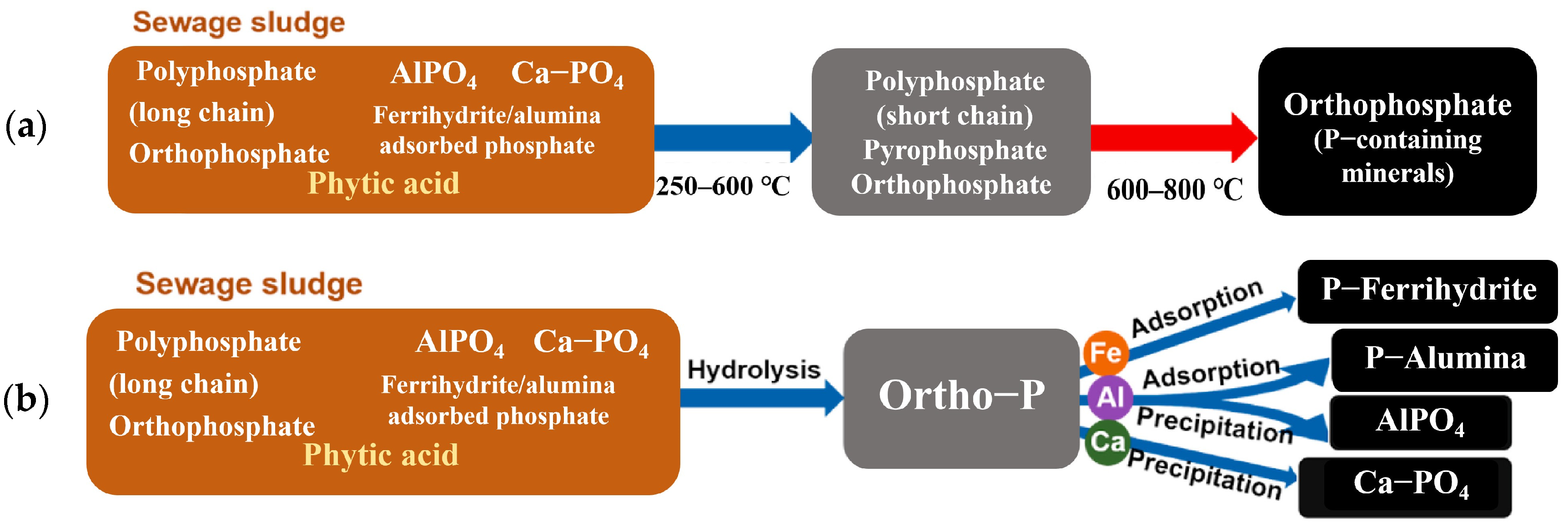
3.1.2. P Speciation in Raw Sewage Sludge
3.2. Migration and Transformation of P During the Bio/Hydrochar Production Processes
3.2.1. Pyrolysis
- Effects of process parameters
3.2.2. Hydrothermal Carbonization
- Effects of process parameters
3.2.3. Comparison of P Migration and Transformation Between Pyrolysis and Hydrothermal Carbonization
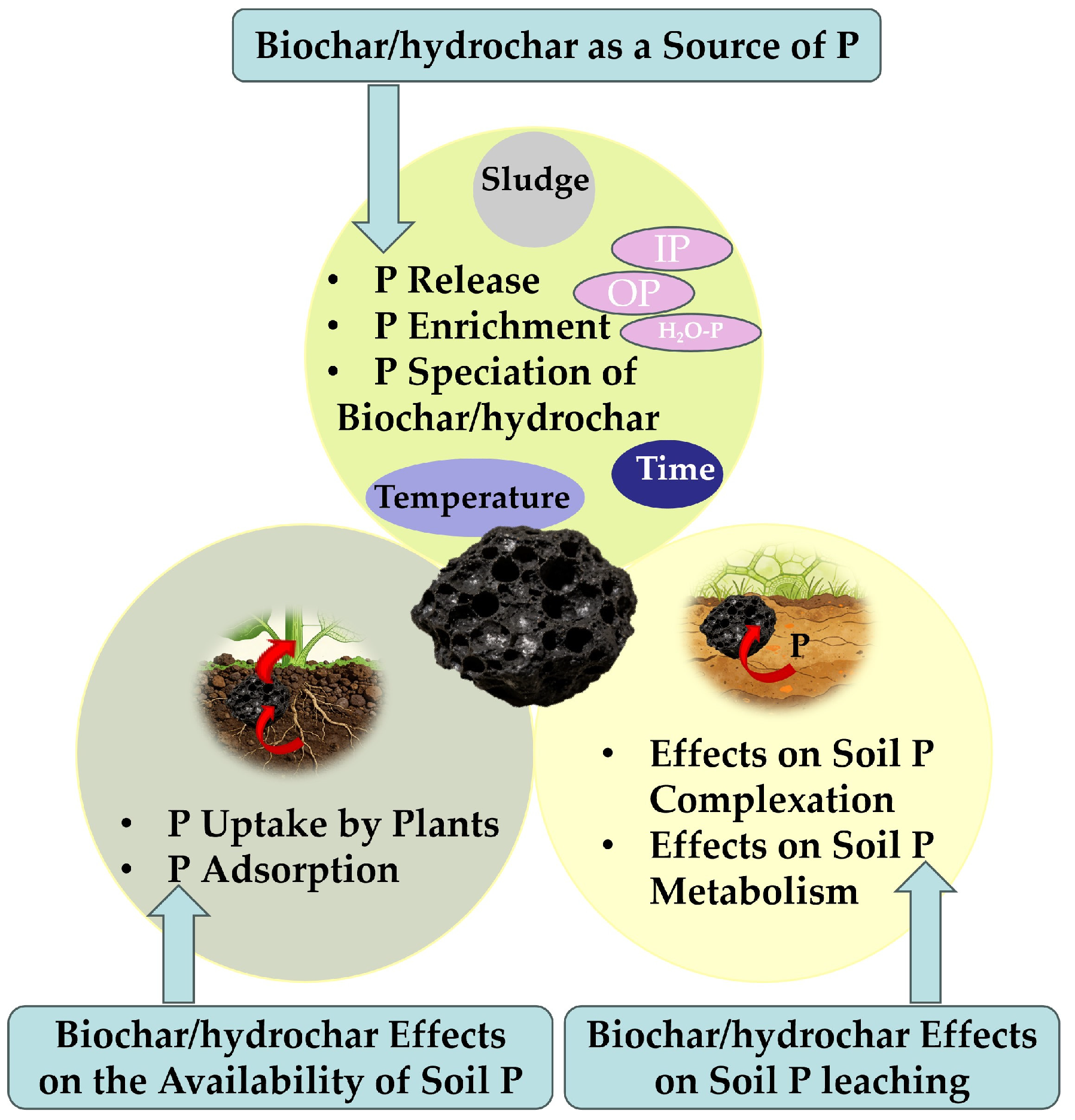
3.3. Applications of Sewage Sludge-Derived Bio/Hydrochar as P Fertilizer in Agricultural Soils
3.3.1. Advantages for Serving as Agricultural P Fertilizer
- Heavy metal mobility and plant uptake
3.3.2. Mechanisms of Soil Quality Enhancement
- Biochar
- Hydrochar
3.3.3. Key Influencing Factors
- Reaction conditions
- Soil Physicochemical Properties
- Application Strategies
4. Perspectives and Challenges
- The potential impact of electrokinetic treatment on the separation and transformation of heavy metals in sludge and the derived bio/hydro-chars remains unexplored. Adopting the BCR (Community Bureau of Reference) sequential extraction for the whole coupling treatment is suggested to enhance the rigor of heavy metal speciation characterization.
- It will be highly beneficial to explore the synergistic effect between electrokinetic treatment and thermochemical conversion treatment on P reclamation and heavy metal removal. This can be achieved by integrating batch experiments and advanced spectroscopic analyses, combined with big data modeling calculations.
- Whether the soil properties, including water holding capacity, pH value, P bioavailability, and heavy metal stability, would alter after applying these bio/hydrochars in soil, long-term (2–10 years) field experiments can be further investigated.
5. Conclusions
Author Contributions
Funding
Data Availability Statement
Conflicts of Interest
Abbreviations
| SS | Sewage sludge |
| P | Phosphorus |
| EDDS | Ethylene diamine disuccinic acid |
| EDTA | Ethylene diamine tetraacetic acid |
| NTA | Nitrilotriacetic acid |
| GLDA | Dicarboxymethyl glutamic acid |
| PASP | Polyaspartic acid |
| Na2EDTA | Ethylenedinitrilotetraacetic acid disodium salt dihydrate |
| 31P NMR | 31P nuclear magnetic resonance |
| P K-edge XANES | P K-edge X-ray absorption spectroscopy |
| AP | Apatite inorganic phosphorus |
| NAIP | Non-apatite inorganic phosphorus |
| SMT | Standard measurement and testing |
| DGT | Diffusive gradients in thin films |
| TCLP | Toxicity characteristic leaching procedure |
References
- Katsoulea, A.; Zafeirakou, A. Sewage sludge pyrolysis and gasification for biochar production in circular economy. Sustain. Futur. 2025, 10, 101067. [Google Scholar] [CrossRef] [Scilit]
- Moussa, O.; Makkawi, Y.; Masek, O.; Mohamed, B. Pyrolysis of anaerobically digested and undigested sewage sludge: Comparative assessment of product quality, emissions, and carbon sequestration. Energy Convers. Manag. X 2025, 27, 101213. [Google Scholar] [CrossRef] [Scilit]
- Wang, Z.; Li, X.; Liu, H.; Mou, J.; Khan, S.J.; Lin, C.S.K.; Wang, Q. Evaluating energy balance and environmental footprint of sludge management in BRICS countries. Water Res. X 2024, 25, 100255. [Google Scholar] [CrossRef] [Scilit] [PubMed]
- China, Ministry of Housing and Urban-Rural Development. Constrution Statistical Yearbook of 2023. Available online: https://www.mohurd.gov.cn/cms_files/filemanager/1150240553/attach/202411/DFCB889EC2BF48242085D2C9460A147F.xls?fileName=2023%E5%B9%B4%E5%9F%8E%E5%B8%82%E5%BB%BA%E8%AE%BE%E7%BB%9F%E8%AE%A1%E5%B9%B4%E9%89%B4 (accessed on 1 November 2025).
- Li, H.; Gao, Y.; Chen, H.; Zhou, H.; Qin, Y.; Niu, S. Acidic Fe(III)-Driven hydrothermal co-transformation of phosphorus and arsenic in sewage sludge: Vivianite crystallization coupled with amorphous ferric arsenate formation for phosphorus-enriched hydrochar. Sep. Purif. Technol. 2025, 373, 133617. [Google Scholar] [CrossRef] [Scilit]
- Zhu, W.; Zhang, L.; Li, P.; Fang, W.; Zhang, P. Mechanisms of heavy metal migration and removal in sewage sludge by Fe2+/Ca(ClO)2/tannic acid conditioning and risk assessment. J. Water Process Eng. 2025, 77, 108584. [Google Scholar] [CrossRef] [Scilit]
- Brandstätter, G.; Fürsatz, K.; Long, A.; Hannl, T.K.; Schubert, T. Exploring the potential of sewage sludge for gasification and resource recovery: A review. Environ. Technol. Innov. 2025, 40, 104346. [Google Scholar] [CrossRef] [Scilit]
- Subbiah, G.; Singh, R.P.; Deepak, K.; Nayak, P.P.; venkadeshwaran, K.; Tiwari, A.; Sahoo, J.; Priya, K.K. Continuous pyrolysis of rice husk for sustainable biochar production and carbon sequestration: Recent advances and techno-economic perspectives. Results Eng. 2025, 27, 106991. [Google Scholar] [CrossRef] [Scilit]
- Khanam, R.; Kumar, A.; Nayak, A.K.; Shahid, M.; Tripathi, R.; Vijayakumar, S.; Bhaduri, D.; Kumar, U.; Mohanty, S.; Panneerselvam, P.; et al. Metal(loid)s (As, Hg, Se, Pb and Cd) in paddy soil: Bioavailability and potential risk to human health. Sci. Total Environ. 2019, 699, 134330. [Google Scholar] [CrossRef] [Scilit]
- Pooja. Concurrent bioleaching of the selected metals and nutrients from dewatered sewage sludge: Addressing post-acidification challenges using nature-based material. J. Environ. Chem. Eng. 2025, 13, 116800. [Google Scholar] [CrossRef] [Scilit]
- Nee Kew, S.Y.; Lau, S.Y. Review of electrochemical reactors for the efficient removal of heavy metals from wastewater. J. Ind. Eng. Chem. 2025, 152, 18–32. [Google Scholar] [CrossRef] [Scilit]
- Azmi, L.S.; Jabit, N.A.; Ismail, S.; Ku Ishak, K.E.H.; Abdullah, T.K. Membrane filtration technologies for sustainable industrial wastewater treatment: A review of heavy metal removal. Desalin. Water Treat. 2025, 323, 101321. [Google Scholar] [CrossRef] [Scilit]
- Geng, H.; Xu, Y.; Zheng, L.; Gong, H.; Dai, L.; Dai, X. An overview of removing heavy metals from sewage sludge: Achievements and perspectives. Environ. Pollut. 2020, 266, 115375. [Google Scholar] [CrossRef] [Scilit] [PubMed]
- Makowska, D.; Pandiyan, M.; Kapusta, K.; Kolarz, K.; Stypka, Z.; Boehman, A.L.; Wooldridge, M.S. Effects of pyrolysis parameters on biochar derived from sewage sludge including environmental risk assessment of heavy metals. J. Environ. Manag. 2025, 395, 127888. [Google Scholar] [CrossRef] [Scilit] [PubMed]
- Czerwińska, K.; Wierońska-Wiśniewska, F.; Bytnar, K.; Mikusińska, J.; Śliz, M.; Wilk, M. The effect of an acidic environment during the hydrothermal carbonization of sewage sludge on solid and liquid products: The fate of heavy metals, phosphorus and other compounds. J. Environ. Manag. 2024, 365, 121637. [Google Scholar] [CrossRef] [Scilit]
- Molaey, R.; Appels, L.; Yesil, H.; Tugtas, A.E.; Calli, B. Sustainable heavy metal removal from sewage sludge: A review of bioleaching and other emerging technologies. Sci. Total Environ. 2024, 955, 177020. [Google Scholar] [CrossRef] [Scilit]
- Beyrami, H. Effect of different treatments on electrokinetic remediation of Zn, Pb and Cd from a contaminated calcareous soil. Chin. J. Chem. Eng. 2021, 38, 255–265. [Google Scholar] [CrossRef] [Scilit]
- Huang, R.; Tang, Y. Speciation Dynamics of Phosphorus during (Hydro)Thermal Treatments of Sewage Sludge. Environ. Sci. Technol. 2015, 49, 14466–14474. [Google Scholar] [CrossRef] [Scilit]
- Chen, G.; Wang, J.; Yu, F.; Wang, X.; Xiao, H.; Yan, B.; Cui, X. A review on the production of P-enriched hydro/bio-char from solid waste: Transformation of P and applications of hydro/bio-char. Chemosphere 2022, 301, 134646. [Google Scholar] [CrossRef] [Scilit]
- Cui, X.; Li, X.; Wang, J.; Wang, X.; Yu, F.; Yang, G.; Xu, S.; Cheng, Z.; Yang, Q.; Yan, B.; et al. A review on the production of nutrient-enriched biochar: Insights from the evolution of nitrogen, phosphorus, and potassium. Crit. Rev. Environ. Sci. Technol. 2025, 55, 885–903. [Google Scholar] [CrossRef] [Scilit]
- Zhang, S.; Du, Q.; Cheng, K.; Antonietti, M.; Yang, F. Efficient phosphorus recycling and heavy metal removal from wastewater sludge by a novel hydrothermal humification-technique. Chem. Eng. J. 2020, 394, 124832. [Google Scholar] [CrossRef] [Scilit]
- Qian, T.; Wang, L.; Le, C.; Zhou, Y. Low-temperature-steam activation of phosphorus in biochar derived from enhanced biological phosphorus removal (EBPR) sludge. Water Res. 2019, 161, 202–210. [Google Scholar] [CrossRef] [Scilit] [PubMed]
- Wu, L.; Zhang, S.; Chen, M.; Liu, J.; Ding, X. A sustainable option: Biochar addition can improve soil phosphorus retention and rice yield in a saline–alkaline soil. Environ. Technol. Innov. 2021, 24, 102070. [Google Scholar] [CrossRef] [Scilit]
- Wang, C.; Zhou, H.; Wu, C.; Sun, W.; Sun, X.; He, C. Phosphorus recovery from sewage sludge-derived hydrochar: Balancing phosphorus recovery, heavy metal concomitant leaching and residual hydrochar utilization. J. Clean. Prod. 2025, 491, 144756. [Google Scholar] [CrossRef] [Scilit]
- Lustosa Filho, J.F.; Viana, R.d.S.R.; Melo, L.C.A.; de Figueiredo, C.C. Changes in phosphorus due to pyrolysis and in the soil-plant system amended with sewage sludge biochar compared to conventional P fertilizers: A global meta-analysis. Chemosphere 2025, 371, 144055. [Google Scholar] [CrossRef] [Scilit]
- Figueiredo, C.C.d.; Reis, A.d.S.P.J.; Araujo, A.S.d.; Blum, L.E.B.; Shah, K.; Paz-Ferreiro, J. Assessing the potential of sewage sludge-derived biochar as a novel phosphorus fertilizer: Influence of extractant solutions and pyrolysis temperatures. Waste Manag. 2021, 124, 144–153. [Google Scholar] [CrossRef] [Scilit]
- McIntosh, S.; Padilla, R.V.; Rose, T.; Rose, A.L.; Boukaka, E.; Erler, D. Crop fertilisation potential of phosphorus in hydrochars produced from sewage sludge. Sci. Total Environ. 2022, 817, 153023. [Google Scholar] [CrossRef] [Scilit]
- Hedayati Marzbali, M.; Hakeem, I.G.; Ngo, T.; Balu, R.; Jena, M.K.; Vuppaladadiyam, A.; Sharma, A.; Choudhury, N.R.; Batstone, D.J.; Shah, K. A critical review on emerging industrial applications of chars from thermal treatment of biosolids. J. Environ. Manag. 2024, 369, 122341. [Google Scholar] [CrossRef] [Scilit]
- Murtaza, G.; Rizwan, M.; Zeeshan, A.; Usman, M.; Khan, I.; Kashif Irshad, M. 17-Effective heavy metals removal from wastewater: Exploring the efficacy of various biochar-based adsorbents. In Composites and Biocomposites for Heavy Metal Adsorption; Birniwa, A.H., Jagaba, A.H., Noor, A., Mohammad, R.E.A., Lawal, I.M., Eds.; Woodhead Publishing: Delhi, India, 2026; pp. 313–334. [Google Scholar]
- Paudel, P.P.; Kafle, S.; Park, S.; Kim, S.J.; Cho, L.; Kim, D.H. Advancements in sustainable thermochemical conversion of agricultural crop residues: A systematic review of technical progress, applications, perspectives, and challenges. Renew. Sustain. Energy Rev. 2024, 202, 114723. [Google Scholar] [CrossRef] [Scilit]
- Nahar, K.; Hakeem, I.G.; Chiang, K.; Ball, A.S.; Shah, K. Catalytic and co-hydrothermal treatment of sewage sludge: Hydrochar properties and fate of heavy metals and per and polyfluoroalkyl substances (PFAS). J. Water Process Eng. 2025, 72, 107605. [Google Scholar] [CrossRef] [Scilit]
- Embaye, T.M.; Zhou, A.; Li, R.; Ahmed, M.B.; Ruan, R.; Wu, D.; Deng, N.; Wang, X. Assessment of heavy metals distribution and environmental risks in biochar from co-pyrolysis of sewage sludge and mixed municipal waste. Process Saf. Environ. Prot. 2025, 193, 1332–1342. [Google Scholar] [CrossRef] [Scilit]
- Naqvi, S.R.; Tariq, R.; Shahbaz, M.; Naqvi, M.; Aslam, M.; Khan, Z.; Mackey, H.; McKay, G.; Al-Ansari, T. Recent developments on sewage sludge pyrolysis and its kinetics: Resources recovery, thermogravimetric platforms, and innovative prospects. Comput. Chem. Eng. 2021, 150, 107325. [Google Scholar] [CrossRef] [Scilit]
- Chen, M.; Oshita, K.; Takaoka, M.; Shiota, K. Co-incineration effect of sewage sludge and municipal solid waste on the behavior of heavy metals by phosphorus. Waste Manag. 2022, 152, 112–117. [Google Scholar] [CrossRef] [Scilit] [PubMed]
- Wang, L.; Chang, Y.; Liu, Q. Fate and distribution of nutrients and heavy metals during hydrothermal carbonization of sewage sludge with implication to land application. J. Clean. Prod. 2019, 225, 972–983. [Google Scholar] [CrossRef] [Scilit]
- Matheri, A.N.; Ntuli, F.; Ngila, J.C. Sludge to energy recovery dosed with selected trace metals additives in anaerobic digestion processes. Biomass Bioenergy 2021, 144, 105869. [Google Scholar] [CrossRef] [Scilit]
- Abdolrezayi, A.; Puricelli, S.; Dolci, G.; Turolla, A.; Canziani, R.; Rigamonti, L. Phosphorus recovery from sewage sludge ash: Life cycle inventory and critical review of LCA case studies. J. Environ. Manag. 2025, 389, 125620. [Google Scholar] [CrossRef] [Scilit]
- Li, D.; Shan, R.; Jiang, L.; Gu, J.; Zhang, Y.; Yuan, H.; Chen, Y. A review on the migration and transformation of heavy metals in the process of sludge pyrolysis. Resour. Conserv. Recycl. 2022, 185, 106452. [Google Scholar] [CrossRef] [Scilit]
- Liu, L.; Wang, Y.; Wang, J.; He, C.; Zhang, J. Recovery of nitrogen and phosphorus in sewage sludge treatment technologies. Chin. Chem. Lett. 2025, 37, 111431. [Google Scholar] [CrossRef] [Scilit]
- Fei, Y.H.; Zhao, D.; Cao, Y.; Huot, H.; Tang, Y.T.; Zhang, H.; Xiao, T. Phosphorous Retention and Release by Sludge-Derived Hydrochar for Potential Use as a Soil Amendment. J. Environ. Qual. 2019, 48, 502–509. [Google Scholar] [CrossRef] [Scilit]
- Kwapinski, W.; Kolinovic, I.; Leahy, J.J. Sewage Sludge Thermal Treatment Technologies with a Focus on Phosphorus Recovery: A Review. Waste Biomass Valorization 2021, 12, 5837–5852. [Google Scholar] [CrossRef] [Scilit]
- Yu, B.; Luo, J.; Xie, H.; Yang, H.; Chen, S.; Liu, J.; Zhang, R.; Li, Y.Y. Species, fractions, and characterization of phosphorus in sewage sludge: A critical review from the perspective of recovery. Sci. Total Environ. 2021, 786, 147437. [Google Scholar] [CrossRef] [Scilit]
- Zeng, Q.; Huang, H.; Tan, Y.; Chen, G.; Hao, T. Emerging electrochemistry-based process for sludge treatment and resources recovery: A review. Water Res. 2021, 209, 117939. [Google Scholar] [CrossRef] [Scilit]
- Jin, L.; Zhang, G.; Tian, H. Current state of sewage treatment in China. Water Res. 2014, 66, 85–98. [Google Scholar] [CrossRef] [Scilit] [PubMed]
- Yi, L.; Feng, J.; Qin, Y.-H.; Li, W.-Y. Prediction of elemental composition of coal using proximate analysis. Fuel 2017, 193, 315–321. [Google Scholar] [CrossRef] [Scilit]
- Li, J.; Zhang, M.; Ye, Z.; Yang, C. Effect of manganese oxide-modified biochar addition on methane production and heavy metal speciation during the anaerobic digestion of sewage sludge. J. Environ. Sci. 2019, 76, 267–277. [Google Scholar] [CrossRef] [Scilit] [PubMed]
- Chen, G.; Zhang, R.; Guo, X.; Wu, W.; Guo, Q.; Zhang, Y.; Yan, B. Comparative evaluation on municipal sewage sludge utilization processes for sustainable management in Tibet. Sci. Total Environ. 2021, 765, 142676. [Google Scholar] [CrossRef] [Scilit]
- Chen, G.; Yang, R.; Cheng, Z.; Yan, B.; Ma, W. Nitric oxide formation during corn straw/sewage sludge co-pyrolysis/gasification. J. Clean. Prod. 2018, 197, 97–105. [Google Scholar] [CrossRef] [Scilit]
- Kavehei, E.; Jenkins, G.A.; Adame, M.F.; Lemckert, C. Carbon sequestration potential for mitigating the carbon footprint of green stormwater infrastructure. Renew. Sustain. Energy Rev. 2018, 94, 1179–1191. [Google Scholar] [CrossRef] [Scilit]
- Gao, N.; Li, J.; Qi, B.; Li, A.; Duan, Y.; Wang, Z. Thermal analysis and products distribution of dried sewage sludge pyrolysis. J. Anal. Appl. Pyrolysis 2014, 105, 43–48. [Google Scholar] [CrossRef] [Scilit]
- Sun, S.; Huang, X.; Lin, J.; Ma, R.; Fang, L.; Zhang, P.; Qu, J.; Zhang, X.; Liu, Y. Study on the effects of catalysts on the immobilization efficiency and mechanism of heavy metals during the microwave pyrolysis of sludge. Waste Manag. 2018, 77, 131–139. [Google Scholar] [CrossRef] [Scilit]
- Wang, X.; Cui, X.; Fang, C.; Yu, F.; Zhi, J.A.; Mašek, O.; Yan, B.; Chen, G.; Dan, Z. Agent-assisted Electrokinetic treatment of Sewage Sludge: Heavy Metal Removal Effectiveness and Nutrient Content Characteristics. Water Res. 2022, 224, 119016. [Google Scholar] [CrossRef] [Scilit]
- Yang, T.; Huang, H.-J.; Lai, F.-Y. Pollution hazards of heavy metals in sewage sludge from four wastewater treatment plants in Nanchang, China. Trans. Nonferrous Met. Soc. China 2017, 27, 2249–2259. [Google Scholar] [CrossRef] [Scilit]
- GB 4284-2018; Control Standards of Pollutants in Sludge for Agricultural Use. Standardization Administration of the People’s Republic of China: Beijing, China, 2018.
- GB 15618-2018; Soil Environmental Quality-Risk Control Standard for Soil Contamination of Agricultural Land. Ministry of Ecology and Environment: Beijing, China, 2018.
- Sirés, I.; Brillas, E.; Oturan, M.A.; Rodrigo, M.A.; Panizza, M. Electrochemical advanced oxidation processes: Today and tomorrow. A review. Environ. Sci. Pollut. Res. 2014, 21, 8336–8367. [Google Scholar] [CrossRef] [Scilit] [PubMed]
- Yesil, H.; Tugtas, A.E. Removal of heavy metals from leaching effluents of sewage sludge via supported liquid membranes. Sci. Total Environ. 2019, 693, 133608. [Google Scholar] [CrossRef] [Scilit] [PubMed]
- Hossain, M.K.; Strezov, V.; Chan, K.Y.; Ziolkowski, A.; Nelson, P.F. Influence of pyrolysis temperature on production and nutrient properties of wastewater sludge biochar. J. Environ. Manag. 2011, 92, 223–228. [Google Scholar] [CrossRef] [Scilit]
- Gong, H.; Zhao, L.; Rui, X.; Hu, J.; Zhu, N. A review of pristine and modified biochar immobilizing typical heavy metals in soil: Applications and challenges. J. Hazard. Mater. 2022, 432, 128668. [Google Scholar] [CrossRef] [Scilit]
- Jin, J.; Li, Y.; Zhang, J.; Wu, S.; Cao, Y.; Liang, P.; Zhang, J.; Wong, M.H.; Wang, M.; Shan, S.; et al. Influence of pyrolysis temperature on properties and environmental safety of heavy metals in biochars derived from municipal sewage sludge. J. Hazard. Mater. 2016, 320, 417–426. [Google Scholar] [CrossRef] [Scilit]
- Zhu, Y.; Zhai, Y.; Li, S.; Liu, X.; Wang, B.; Liu, X.; Fan, Y.; Shi, H.; Li, C.; Zhu, Y. Thermal treatment of sewage sludge: A comparative review of the conversion principle, recovery methods and bioavailability-predicting of phosphorus. Chemosphere 2022, 291, 133053. [Google Scholar] [CrossRef] [Scilit]
- Hoekman, S.K.; Broch, A.; Robbins, C.; Zielinska, B.; Felix, L. Hydrothermal carbonization (HTC) of selected woody and herbaceous biomass feedstocks. Biomass Convers. Biorefinery 2013, 3, 113–126. [Google Scholar] [CrossRef] [Scilit]
- Prasannamedha, G.; Kumar, P.S.; Balasubramani, S.R.; Parthasarathy, V.; Deehen, A.D.; Jananie, E.; Lokesh, V.; Shivani, S.; Keerthana, S.; Shivani, I.; et al. Engineering properties of hydrochar fabricated from hydrothermal carbonization of lignocellulosic biomass: Practice as adsorbent and catalyst in water treatment. J. Water Process Eng. 2025, 74, 107739. [Google Scholar] [CrossRef] [Scilit]
- Zhang, C.; Wang, Q.; Sun, G.; Wang, K.; Yang, Y.-P.; Chen, J.; Chen, G.; Zheng, R. Valorization of dual waste: Heavy metal mitigation and carbon/nutrient regulation in hydrochar via co-hydrothermal carbonization of sewage sludge and sawdust. Bioresour. Technol. 2025, 436, 133038. [Google Scholar] [CrossRef] [Scilit]
- Liu, H.; Basar, I.A.; Nzihou, A.; Eskicioglu, C. Hydrochar derived from municipal sludge through hydrothermal processing: A critical review on its formation, characterization, and valorization. Water Res. 2021, 199, 117186. [Google Scholar] [CrossRef] [Scilit] [PubMed]
- Shi, W.; Liu, C.; Ding, D.; Lei, Z.; Yang, Y.; Feng, C.; Zhang, Z. Immobilization of heavy metals in sewage sludge by using subcritical water technology. Bioresour. Technol. 2013, 137, 18–24. [Google Scholar] [CrossRef] [Scilit] [PubMed]
- Wang, T.; Zhai, Y.; Zhu, Y.; Li, C.; Zeng, G. A review of the hydrothermal carbonization of biomass waste for hydrochar formation: Process conditions, fundamentals, and physicochemical properties. Renew. Sustain. Energy Rev. 2018, 90, 223–247. [Google Scholar] [CrossRef] [Scilit]
- Huang, H.J.; Yuan, X.Z. The migration and transformation behaviors of heavy metals during the hydrothermal treatment of sewage sludge. Bioresour. Technol. 2016, 200, 991–998. [Google Scholar] [CrossRef] [Scilit]
- Yusuf, B.O.; Aliyu, M.; Azeez, M.O.; Taialla, O.A.; Lateef, S.; Sulaimon, R.; Akinpelu, A.A.; Ganiyu, S.A. Comprehensive technologies for heavy metal remediation: Adsorption, membrane processes, photocatalysis, and AI-driven design. Desalination 2025, 615, 119261. [Google Scholar] [CrossRef] [Scilit]
- Shrestha, R.; Ban, S.; Devkota, S.; Sharma, S.; Joshi, R.; Tiwari, A.P.; Kim, H.Y.; Joshi, M.K. Technological trends in heavy metals removal from industrial wastewater: A review. J. Environ. Chem. Eng. 2021, 9, 105688. [Google Scholar] [CrossRef] [Scilit]
- Pathak, A.; Dastidar, M.G.; Sreekrishnan, T.R. Bioleaching of heavy metals from sewage sludge: A review. J. Environ. Manag. 2009, 90, 2343–2353. [Google Scholar] [CrossRef] [Scilit]
- Gao, J.; Luo, Q.S.; Zhu, J.; Zhang, C.B.; Li, B.Z. Effects of electrokinetic treatment of contaminated sludge on migration and transformation of Cd, Ni and Zn in various bonding states. Chemosphere 2013, 93, 2869–2876. [Google Scholar] [CrossRef] [Scilit]
- Peng, G.; Tian, G. Using electrode electrolytes to enhance electrokinetic removal of heavy metals from electroplating sludge. Chem. Eng. J. 2010, 165, 388–394. [Google Scholar] [CrossRef] [Scilit]
- Fu, R.; Wen, D.; Xia, X.; Zhang, W.; Gu, Y. Electrokinetic remediation of chromium (Cr)-contaminated soil with citric acid (CA) and polyaspartic acid (PASP) as electrolytes. Chem. Eng. J. 2017, 316, 601–608. [Google Scholar] [CrossRef] [Scilit]
- Liu, Y.; Chen, J.; Cai, Z.; Chen, R.; Sun, Q.; Sun, M. Removal of copper and nickel from municipal sludge using an improved electrokinetic process. Chem. Eng. J. 2017, 307, 1008–1016. [Google Scholar] [CrossRef] [Scilit]
- Vocciante, M.; Dovì, V.; Ferro, S. Sustainability in ElectroKinetic Remediation Processes: A Critical Analysis. Sustainability 2021, 13, 770. [Google Scholar] [CrossRef] [Scilit]
- Vocciante, M.; Caretta, A.; Bua, L.; Bagatin, R.; Ferro, S. Enhancements in ElectroKinetic Remediation Technology: Environmental assessment in comparison with other configurations and consolidated solutions. Chem. Eng. J. 2016, 289, 123–134. [Google Scholar] [CrossRef] [Scilit]
- Ryu, B.-G.; Park, G.-Y.; Yang, J.-W.; Baek, K. Electrolyte conditioning for electrokinetic remediation of As, Cu, and Pb-contaminated soil. Sep. Purif. Technol. 2011, 79, 170–176. [Google Scholar] [CrossRef] [Scilit]
- Jensen, P.E.; Kirkelund, G.M.; Fritt-Rasmussen, J.; Ottosen, L.M. Electrodialytic Remediation of Toxic Elements and P Recovery from Sediments of Eutrophic Fresh-Waters in 3-Compartment Batch and Stack Setup. Waste Biomass Valorization 2022, 13, 4085–4098. [Google Scholar] [CrossRef] [Scilit]
- Gao, J.; Luo, Q.; Zhang, C.; Li, B.; Meng, L. Enhanced electrokinetic removal of cadmium from sludge using a coupled catholyte circulation system with multilayer of anion exchange resin. Chem. Eng. J. 2013, 234, 1–8. [Google Scholar] [CrossRef] [Scilit]
- Xu, Y.; Zhang, C.; Zhao, M.; Rong, H.; Zhang, K.; Chen, Q. Comparison of bioleaching and electrokinetic remediation processes for removal of heavy metals from wastewater treatment sludge. Chemosphere 2017, 168, 1152–1157. [Google Scholar] [CrossRef] [Scilit]
- Tang, J.; He, J.; Tang, H.; Wang, H.; Sima, W.; Liang, C.; Qiu, Z. Heavy metal removal effectiveness, flow direction and speciation variations in the sludge during the biosurfactant-enhanced electrokinetic remediation. Sep. Purif. Technol. 2020, 246, 116918. [Google Scholar] [CrossRef] [Scilit]
- Acar, Y.B.; Alshawabkeh, A.N. Principles of electrokinetic remediation. Environ. Sci. Technol. 2002, 27, 2638–2647. [Google Scholar] [CrossRef] [Scilit]
- Adhikary, A.; Nath, A.; Das, S.; Pal, S.; Ghosh, S. A novel hybrid constructed Wetland–Electrokinetic system for simultaneous removal of aqueous lead and naphthalene with in-situ bed rejuvenation. J. Environ. Manag. 2026, 397, 128234. [Google Scholar] [CrossRef] [Scilit]
- Barkhordari, M.S.; Zhou, N.; Li, K.; Qi, C. Interpretable machine learning for predicting heavy metal removal efficiency in electrokinetic soil remediation. J. Environ. Chem. Eng. 2024, 12, 114330. [Google Scholar] [CrossRef] [Scilit]
- Suanon, F.; Tomètin, L.A.S.; Zveushe, O.K.; de Dios, V.R.; Han, Y.; Ifon, B.E.; Atakpa, E.O.; Yete, P.; Sesu, F.; Li, J.; et al. Electrokinetic remediation of chromium-contaminated soils: The potential for advanced materials in three-dimensional EKR approaches. J. Environ. Chem. Eng. 2025, 13, 116774. [Google Scholar] [CrossRef] [Scilit]
- Abou-Shady, A. Explore the potential for improving phosphorus availability in calcareous soil through electrokinetic methods. Soil Tillage Res. 2025, 250, 106525. [Google Scholar] [CrossRef] [Scilit]
- Fardin, A.B.; Jamshidi-Zanjani, A.; Saeedi, M. A comprehensive review of soil remediation contaminated by persistent organic pollutants using electrokinetic: Challenging enhancement techniques. J. Environ. Manag. 2025, 373, 123587. [Google Scholar] [CrossRef] [Scilit]
- Almeira, O.J.; Peng, C.-S.; Abou-Shady, A. Simultaneous removal of cadmium from kaolin and catholyte during soil electrokinetic remediation. Desalination 2012, 300, 1–11. [Google Scholar] [CrossRef] [Scilit]
- Wu, J.; Zhang, J.; Xiao, C. Focus on factors affecting pH, flow of Cr and transformation between Cr(VI) and Cr(III) in the soil with different electrolytes. Electrochim. Acta 2016, 211, 652–662. [Google Scholar] [CrossRef] [Scilit]
- Chen, B.; Li, H.; Qu, G.; Yang, J.; Jin, C.; Wu, F.; Ren, Y.; Liu, Y.; Liu, X.; Qin, J.; et al. Aluminium sulfate synergistic electrokinetic separation of soluble components from phosphorus slag and simultaneous stabilization of fluoride. J. Environ. Manag. 2023, 328, 116942. [Google Scholar] [CrossRef] [Scilit]
- Tang, J.; Qiu, Z.; Tang, H.; Wang, H.; Sima, W.; Liang, C.; Liao, Y.; Li, Z.; Wan, S.; Dong, J. Coupled with EDDS and approaching anode technique enhanced electrokinetic remediation removal heavy metal from sludge. Environ. Pollut. 2021, 272, 115975. [Google Scholar] [CrossRef] [Scilit]
- Wang, J.-Y.; Zhang, D.-S.; Stabnikova, O.; Tay, J.-H. Evaluation of electrokinetic removal of heavy metals from sewage sludge. J. Hazard. Mater. 2005, 124, 139–146. [Google Scholar] [CrossRef] [Scilit]
- Yuan, C.; Weng, C.-H. Electrokinetic enhancement removal of heavy metals from industrial wastewater sludge. Chemosphere 2006, 65, 88–96. [Google Scholar] [CrossRef] [Scilit]
- Ge, X.; Song, X.; Xie, J.; Huang, W.; Wang, Y.; Xu, Z.; Wang, Y.; Hou, X.; Cao, X. Comparison of the influence of EDTA, nitrilotriacetic acid, diethylenetriamine pentaacetic acid, chitosan, fulvic acid and pine needle extract on the removal of multiple heavy metal by electrokinetic remediation. Int. J. Electrochem. Sci. 2022, 17, 221012. [Google Scholar] [CrossRef] [Scilit]
- Salom, D.; Fernández-Verdejo, D.; Isidro, J.; Vicent, T.; Blánquez, P. Coupling electrokinetic soil flushing with bioremediation for the removal of chlorinated benzenes and hexachlorocyclohexane. J. Hazard. Mater. 2025, 496, 139397. [Google Scholar] [CrossRef] [Scilit] [PubMed]
- Chen, G.; Han, K.; Liu, C.; Yan, B. Quantitative research on heavy metal removal of flue gas desulfurization-derived wastewater sludge by electrokinetic treatment. J. Hazard. Mater. 2021, 414, 125561. [Google Scholar] [CrossRef] [Scilit] [PubMed]
- Tang, J.; He, J.; Liu, T.; Xin, X.; Hu, H. Removal of heavy metal from sludge by the combined application of a biodegradable biosurfactant and complexing agent in enhanced electrokinetic treatment. Chemosphere 2017, 189, 599–608. [Google Scholar] [CrossRef] [Scilit]
- Abou-Shady, A.; Ismail, S.; Yossif, T.M.H.; Yassin, S.A.; Ali, M.E.A.; Habib, A.A.M.; Khalil, A.K.A.; Tag-Elden, M.A.; Emam, T.M.; Mahmoud, A.A.; et al. Comprehensive review of progress made in soil electrokinetic research during 1993–2020, part II. No.1: Materials additives for enhancing the intensification process during 2017–2020. S. Afr. J. Chem. Eng. 2023, 45, 182–200. [Google Scholar] [CrossRef] [Scilit]
- Tang, J.; He, J.; Xin, X.; Hu, H.; Liu, T. Biosurfactants enhanced heavy metals removal from sludge in the electrokinetic treatment. Chem. Eng. J. 2018, 334, 2579–2592. [Google Scholar] [CrossRef] [Scilit]
- Ebbers, B.; Ottosen, L.M.; Jensen, P.E. Electrodialytic treatment of municipal wastewater and sludge for the removal of heavy metals and recovery of phosphorus. Electrochim. Acta 2015, 181, 90–99. [Google Scholar] [CrossRef] [Scilit]
- Mahmoud, A.; Olivier, J.; Vaxelaire, J.; Hoadley, A.F. Electrical field: A historical review of its application and contributions in wastewater sludge dewatering. Water Res. 2010, 44, 2381–2407. [Google Scholar] [CrossRef] [Scilit]
- Babel, S.; del Mundo Dacera, D. Heavy metal removal from contaminated sludge for land application: A review. Waste Manag. 2006, 26, 988–1004. [Google Scholar] [CrossRef] [Scilit]
- Kou, Y.; Zhao, Q.; Cheng, Y.; Wu, Y.; Dou, W.; Ren, X. Removal of heavy metals in sludge via joint EDTA-acid treatment: Effects on seed germination. Sci. Total Environ. 2020, 707, 135866. [Google Scholar] [CrossRef] [Scilit]
- Wang, Y.; Li, A.; Cui, C. Remediation of heavy metal-contaminated soils by electrokinetic technology: Mechanisms and applicability. Chemosphere 2021, 265, 129071. [Google Scholar] [CrossRef] [Scilit]
- Moon, D.H.; Chang, Y.Y.; Lee, M.; Koutsospyros, A.; Koh, I.H.; Ji, W.H.; Park, J.H. Assessment of soil washing for heavy metal contaminated paddy soil using FeCl3 washing solutions. Environ. Geochem. Health 2021, 43, 3343–3350. [Google Scholar] [CrossRef] [Scilit] [PubMed]
- Huang, R.; Tang, Y. Evolution of phosphorus complexation and mineralogy during (hydro)thermal treatments of activated and anaerobically digested sludge: Insights from sequential extraction and P K-edge XANES. Water Res. 2016, 100, 439–447. [Google Scholar] [CrossRef] [Scilit] [PubMed]
- Dou, Y.; Du, Y.; Xu, Y.; Li, Y.; Wu, X.; Wang, D. Phosphorus recovery from sewage sludge: Progress, challenges, policies, and future directions. Chem. Eng. J. 2025, 520, 165735. [Google Scholar] [CrossRef] [Scilit]
- Han, X.; Wang, F.; Zhou, B.; Chen, H.; Yuan, R.; Liu, S.; Zhou, X.; Gao, L.; Lu, Y.; Zhang, R. Phosphorus complexation of sewage sludge during thermal hydrolysis with different reaction temperature and reaction time by P K-edge XANES and 31P NMR. Sci. Total Environ. 2019, 688, 1–9. [Google Scholar] [CrossRef] [Scilit]
- Wei, Y.; Wang, J.; Chang, R.; Zhan, Y.; Wei, D.; Zhang, L.; Chen, Q. Composting with biochar or woody peat addition reduces phosphorus bioavailability. Sci. Total Environ. 2021, 764, 142841. [Google Scholar] [CrossRef] [Scilit]
- Frišták, V.; Pipíška, M.; Soja, G. Pyrolysis treatment of sewage sludge: A promising way to produce phosphorus fertilizer. J. Clean. Prod. 2018, 172, 1772–1778. [Google Scholar] [CrossRef] [Scilit]
- Feng, H.; Zhou, S.; Guan, W.; Zhu, L.; Li, R.; Wang, S. Enhancement of apatite-phosphorus-rich biochar production from sewage sludge pyrolysis assisted by carbide slag. Process Saf. Environ. Prot. 2024, 192, 26–35. [Google Scholar] [CrossRef] [Scilit]
- Liu, Q.; Fang, Z.; Liu, Y.; Liu, Y.; Xu, Y.; Ruan, X.; Zhang, X.; Cao, W. Phosphorus speciation and bioavailability of sewage sludge derived biochar amended with CaO. Waste Manag. 2019, 87, 71–77. [Google Scholar] [CrossRef] [Scilit]
- Werner, F.; Prietzel, J. Standard Protocol and Quality Assessment of Soil Phosphorus Speciation by P K-Edge XANES Spectroscopy. Environ. Sci. Technol. 2015, 49, 10521–10528. [Google Scholar] [CrossRef] [Scilit]
- Menezes-Blackburn, D.; Zhang, H.; Stutter, M.; Giles, C.D.; Darch, T.; George, T.S.; Shand, C.; Lumsdon, D.; Blackwell, M.; Wearing, C.; et al. A Holistic Approach to Understanding the Desorption of Phosphorus in Soils. Environ. Sci. Technol. 2016, 50, 3371–3381. [Google Scholar] [CrossRef] [Scilit]
- Atkinson, C.J.; Fitzgerald, J.D.; Hipps, N.A. Potential mechanisms for achieving agricultural benefits from biochar application to temperate soils: A review. Plant Soil 2010, 337, 1–18. [Google Scholar] [CrossRef] [Scilit]
- Sun, H.; Luo, L.; Wang, J.; Wang, D.; Huang, R.; Ma, C.; Zhu, Y.G.; Liu, Z. Speciation Evolution of Phosphorus and Sulfur Derived from Sewage Sludge Biochar in Soil: Ageing Effects. Environ. Sci. Technol. 2022, 56, 6639–6646. [Google Scholar] [CrossRef] [Scilit] [PubMed]
- Jin, M.; Liu, H.; He, Z.; Yao, H. Intensified Enrichment and Leaching Strategy of Phosphorus in Sewage Sludge via Species-Targeted Conversion. Environ. Sci. Technol. 2025, 59, 9285–9297. [Google Scholar] [CrossRef] [Scilit] [PubMed]
- Petzet, S.; Peplinski, B.; Cornel, P. On wet chemical phosphorus recovery from sewage sludge ash by acidic or alkaline leaching and an optimized combination of both. Water Res. 2012, 46, 3769–3780. [Google Scholar] [CrossRef] [Scilit]
- Huang, R.; Fang, C.; Lu, X.; Jiang, R.; Tang, Y. Transformation of Phosphorus during (Hydro)thermal Treatments of Solid Biowastes: Reaction Mechanisms and Implications for P Reclamation and Recycling. Environ. Sci. Technol. 2017, 51, 10284–10298. [Google Scholar] [CrossRef] [Scilit]
- Mackay, J.E.; Cavagnaro, T.R.; Jakobsen, I.; Macdonald, L.M.; Grønlund, M.; Thomsen, T.P.; Müller-Stöver, D.S. Evaluation of phosphorus in thermally converted sewage sludge: P pools and availability to wheat. Plant Soil 2017, 418, 307–317. [Google Scholar] [CrossRef] [Scilit]
- Vogel, C.; Sekine, R.; Steckenmesser, D.; Lombi, E.; Herzel, H.; Zuin, L.; Wang, D.; Félix, R.; Adam, C. Combining diffusive gradients in thin films (DGT) and spectroscopic techniques for the determination of phosphorus species in soils. Anal. Chim. Acta 2019, 1057, 80–87. [Google Scholar] [CrossRef] [Scilit]
- Six, L.; Smolders, E.; Merckx, R. The performance of DGT versus conventional soil phosphorus tests in tropical soils—Maize and rice responses to P application. Plant Soil 2013, 366, 49–66. [Google Scholar] [CrossRef] [Scilit]
- Ren, M.; Ding, S.; Shi, D.; Zhong, Z.; Cao, J.; Yang, L.; Tsang, D.C.W.; Wang, D.; Zhao, D.; Wang, Y. A new DGT technique comprised in a hybrid sensor for the simultaneous measurement of ammonium, nitrate, phosphorus and dissolved oxygen. Sci. Total Environ. 2020, 725, 138447. [Google Scholar] [CrossRef] [Scilit]
- Zheng, X.; Jiang, Z.; Ying, Z.; Ye, Y.; Chen, W.; Wang, B.; Dou, B. Migration and Transformation of Phosphorus During Hydrothermal Carbonization of Sewage Sludge: Focusing on the Role of pH and Calcium Additive and the Transformation Mechanism. ACS Sustain. Chem. Eng. 2020, 8, 7806–7814. [Google Scholar] [CrossRef] [Scilit]
- Xu, G.; Zhang, Y.; Shao, H.; Sun, J. Pyrolysis temperature affects phosphorus transformation in biochar: Chemical fractionation and 31P NMR analysis. Sci. Total Environ. 2016, 569-570, 65–72. [Google Scholar] [CrossRef] [Scilit]
- Li, S.; Zeng, W.; Jia, Z.; Wu, G.; Xu, H.; Peng, Y. Phosphorus species transformation and recovery without apatite in FeCl3-assisted sewage sludge hydrothermal treatment. Chem. Eng. J. 2020, 399, 125735. [Google Scholar] [CrossRef] [Scilit]
- Garcia Jimenez, D.; Ermondi, G.; Jandova, Z.; Vallaro, M.; Caron, G.; Arnhof, H. Linker Methylation as a Strategy to Enhance PROTAC Oral Bioavailability: Insights from Molecular Properties and Conformational Analysis. J. Med. Chem. 2025, 68, 16666–16677. [Google Scholar] [CrossRef] [Scilit] [PubMed]
- Zhao, Z.; Wang, B.; Zhang, X.; Xu, H.; Cheng, N.; Feng, Q.; Zhao, R.; Gao, Y.; Wei, M. Release characteristics of phosphate from ball-milled biochar and its potential effects on plant growth. Sci. Total Environ. 2022, 821, 153256. [Google Scholar] [CrossRef] [Scilit] [PubMed]
- Shober, A.L.; Hesterberg, D.L.; Sims, J.T.; Gardner, S. Characterization of phosphorus species in biosolids and manures using XANES spectroscopy. J. Environ. Qual. 2006, 35, 1983–1993. [Google Scholar] [CrossRef] [Scilit] [PubMed]
- Montazerharzand, M.; Paya, H.; Taghizadeh, A.; Hosseinkhani, A.; Ramin, M. Effects of walnut shell biochar feed additive on rumen fermentation, nutrient utilization, and performance in fattening lambs. Vet. Anim. Sci. 2025, 30, 100515. [Google Scholar] [CrossRef] [Scilit]
- Abioye, K.J.; Falua, K.J.; Rezaee, M.; Zamiri, M.A.; Zou, F.; Acharya, B. Global insights into biomass pyrolysis mechanisms: A scientometric and mechanistic approach. Results Eng. 2025, 28, 107123. [Google Scholar] [CrossRef] [Scilit]
- Knijnenburg, J.T.N.; Suwanree, S.; Macquarrie, D.; Kasemsiri, P.; Jetsrisuparb, K. Phosphorus recovery from animal manures through pyrolysis: Phosphorus transformations, release mechanisms, and applications of manure biochars in agriculture. RSC Sustain. 2024, 3, 1084–1101. [Google Scholar] [CrossRef] [Scilit]
- Michalska, J.; Turek-Szytow, J.; Dudło, A.; Surmacz-Górska, J. Characterization of humic substances recovered from the sewage sludge and validity of their removal from this waste. EFB Bioeconomy J. 2022, 2, 100026. [Google Scholar] [CrossRef] [Scilit]
- Adhikari, S.; Gasco, G.; Mendez, A.; Surapaneni, A.; Jegatheesan, V.; Shah, K.; Paz-Ferreiro, J. Influence of pyrolysis parameters on phosphorus fractions of biosolids derived biochar. Sci. Total Environ. 2019, 695, 133846. [Google Scholar] [CrossRef] [Scilit] [PubMed]
- Cheremisina, O.V.; Gorbacheva, A.A.; Balandinsky, D.A.; Adhikari, M.K.; Ojha, A.M.; Bhattarai, A.; Chakraborty, G. Physicochemical criteria for selection of reagents on phosphate flotation: Recent advances and future approaches. Miner. Eng. 2026, 235, 109863. [Google Scholar] [CrossRef] [Scilit]
- Luo, X.; Ding, W.; Sheng, Y.; Ma, Z.; Tan, L.; Wu, Z.; Gao, X.; Wang, N.; Luo, Z.; Zhou, Y.; et al. Different phosphorus reclamation strategies of solid biowastes after thermal treatment: Insights into phosphorus bioavailability and metal species. Chem. Eng. J. 2025, 524, 169417. [Google Scholar] [CrossRef] [Scilit]
- Gupta, A.; Ramachandran, S.; Mayilswamy, N.; Nighojkar, A.; Kandasubramanian, B. Dye-laden sludge-derived biochar for wastewater remediation: A review on pyrolytic engineering, adsorptive interactions, and environmental prospects. Sustain. Chem. Environ. 2025, 11, 100271. [Google Scholar] [CrossRef] [Scilit]
- Tiwari, S.B.; Chan, W.P.; Veksha, A.; Lisak, G.; Lim, T.-T. Advancing insights into phosphorus transformation during thermochemical treatment of sewage sludge. J. Environ. Manag. 2025, 391, 126505. [Google Scholar] [CrossRef] [Scilit]
- Meng, X.; Huang, Q.; Gao, H.; Tay, K.; Yan, J. Improved utilization of phosphorous from sewage sludge (as Fertilizer) after treatment by Low-Temperature combustion. Waste Manag. 2018, 80, 349–358. [Google Scholar] [CrossRef] [Scilit]
- Ponnusamy, P.; Loganathan, M.; Krishnasamy, S. Sewage sludge pyrolysis: Aspen plus simulation and AI-assisted optimization for biochar yield and properties. Sustain. Chem. Pharm. 2025, 48, 102241. [Google Scholar] [CrossRef] [Scilit]
- Kamesh, M.R.; Kumar, P.S.; Vijayalakshmi, A.; Dubey, S.; Madhu, P.; Sowmya Dhanalakshmi, C.; Vadivel, A.; Yadav, A.S.; Subramani, N. Interaction between sewage sludge and biomass components for enhanced biofuel production via pyrolysis based on studies of the mild acid pre-treatment process. J. Energy Inst. 2025, 121, 102167. [Google Scholar] [CrossRef] [Scilit]
- Mustapha, S.I.; Isa, Y.M. Catalytic co-pyrolysis of sewage sludge and softwood using CuO/CoO/CeO2/HZSM-5 hybrid catalysts: Influence of catalyst synthesis techniques on bio-oil product yields and quality. J. Environ. Chem. Eng. 2025, 13, 119621. [Google Scholar] [CrossRef] [Scilit]
- Mutsvene, B.; Chetty, M.; Bux, F.; Kumari, S. Waste to wealth transformation: Maximising resource and energy recovery through hydrothermal treatment of sewage sludge—A technoeconomic evaluation. Case Stud. Chem. Environ. Eng. 2025, 11, 101182. [Google Scholar] [CrossRef] [Scilit]
- Mbasabire, P.; Murindangabo, Y.T.; Frouz, J.; Brom, J. Characterization, fractionation and untapped potential of phosphate-amended sewage sludge biochar in soil-plant systems. Chemosphere 2024, 367, 143565. [Google Scholar] [CrossRef] [Scilit] [PubMed]
- Naciri, R.; Chtouki, M.; El Maalam, L.; Hirt, H.; Belkachach, D.; Oukarroum, A. Phosphate-modified biochar attenuates cadmium availability in contaminated soil and reduces its transfer to tomato fruits. Environ. Res. 2025, 279, 121775. [Google Scholar] [CrossRef] [Scilit] [PubMed]
- Yang, L.; Wu, Y.; Wang, Y.; An, W.; Jin, J.; Sun, K.; Wang, X. Effects of biochar addition on the abundance, speciation, availability, and leaching loss of soil phosphorus. Sci. Total Environ. 2021, 758, 143657. [Google Scholar] [CrossRef] [Scilit] [PubMed]
- Zeb, A.; Shi, R.; Liu, W.; Khan, S.; Baig, A.M.; Iqbal, H.; Tariq, H.; Zhao, Y.; Sun, Y. A critical review of tire wear particles aging and ecotoxicological consequences in terrestrial environments: Insights into environmentally persistent free radicals. J. Hazard. Mater. 2026, 501, 140641. [Google Scholar] [CrossRef] [Scilit]
- Lv, M.; Zhao, T.; Chen, J.; Tong, L.; Ni, Z.; Lin, Q.; Ruan, Z.; Qiu, R. Distribution and transformation behavior of heavy metals and phosphorus during sewage sludge pyrolysis. Environ. Technol. Innov. 2025, 37, 104049. [Google Scholar] [CrossRef] [Scilit]
- Li, J.; Li, Y.; Liu, F.; Zhang, X.; Song, M.; Li, R. Pyrolysis of sewage sludge to biochar: Transformation mechanism of phosphorus. J. Anal. Appl. Pyrolysis 2023, 173, 106065. [Google Scholar] [CrossRef] [Scilit]
- Xiao, Y.; Yan, T.; Yao, P.; Xiang, W.; Wu, Y.; Li, J. Co-pyrolysis of sewage sludge and phosphate tailings: Synergistically enhancing heavy metal immobilization and phosphorus availability. Waste Manag. 2024, 181, 44–56. [Google Scholar] [CrossRef] [Scilit]
- Irewale, A.T.; Elemike, E.E.; Aikpokpodion, P.E.; Thangavelu, R.M.; Dimkpa, C.O.; Oguzie, E.E. Morphological and chemical profiling of biochar derived from invasive aquatic weed towards bio-nanofertilizer development. RSC Sustain. 2025, 3, 3947–3963. [Google Scholar] [CrossRef] [Scilit]
- Mainali, K.; Sarker, M.I.; Mullen, C.A.; Sharma, B.K.; Yadav, M.P.; Ngo, H.; Garcia-Perez, M. Thermal decomposition kinetics of dairy manure hydrochars. J. Energy Inst. 2025, 120, 102088. [Google Scholar] [CrossRef] [Scilit]
- Zhao, C.; Liang, S.; Wu, Z.; Huang, Y.; Peng, D.; Huang, T. Mechanically activated steel slag induces Ca-P crystallization to recover phosphates from phosphogypsum leachate: Adsorption and crystallization coupled processes. Colloids Surf. A Physicochem. Eng. Asp. 2025, 713, 136535. [Google Scholar] [CrossRef] [Scilit]
- Yang, W.; Hu, W.; Liu, H.; Wang, P.; Li, P.; Li, H.; Wang, Z.; Yang, S.; Li, Z.; Zhu, Y. Exploring the effects of calcium bicarbonate on endogenous phosphorus conversion and pyrolysis product distributions of oil crop residues. J. Anal. Appl. Pyrolysis 2025, 192, 107287. [Google Scholar] [CrossRef] [Scilit]
- Dahiru, U.H.; Saleem, F.; Rehman, A.; Zhang, K.; Harvey, A.P. A comprehensive review of non-catalytic plasma-assisted decomposition of volatile organic compounds. Total Environ. Eng. 2025, 5, 100050. [Google Scholar] [CrossRef] [Scilit]
- Feng, Y.; Ma, K.; Yu, T.; Bai, S.; Pei, D.; Bai, T.; Zhang, Q.; Yin, L.; Hu, Y.; Chen, D. Phosphorus Transformation in Hydrothermal Pretreatment and Steam Gasification of Sewage Sludge. Energy Fuels 2018, 32, 8545–8551. [Google Scholar] [CrossRef] [Scilit]
- Meng, W.; Zheng, L.; Cheng, S.; Li, Z. Unlocking sustainable opportunities for sludge-derived aqueous phase via hydrothermal carbonization. Renew. Sustain. Energy Rev. 2025, 224, 116084. [Google Scholar] [CrossRef] [Scilit]
- Shi, Y.; Luo, G.; Rao, Y.; Chen, H.; Zhang, S. Hydrothermal conversion of dewatered sewage sludge: Focusing on the transformation mechanism and recovery of phosphorus. Chemosphere 2019, 228, 619–628. [Google Scholar] [CrossRef] [Scilit]
- Aragón-Briceño, C.I.; Pozarlik, A.K.; Bramer, E.A.; Niedzwiecki, L.; Pawlak-Kruczek, H.; Brem, G. Hydrothermal carbonization of wet biomass from nitrogen and phosphorus approach: A review. Renew. Energy 2021, 171, 401–415. [Google Scholar] [CrossRef] [Scilit]
- Sangué Djandja, O.; Duan, B.; Yin, L.-X.; Cao, C.; Shan, Y.; Duo, J.; Yao, G.; Duan, P.-G. Ammonia-assisted thermal hydrolysis of sewage sludge: Solid and liquid phases characterization. Sustain. Energy Technol. Assess. 2022, 53, 102693. [Google Scholar] [CrossRef] [Scilit]
- Huang, W.; Cai, W.; Huang, H.; Lei, Z.; Zhang, Z.; Tay, J.H.; Lee, D.J. Identification of inorganic and organic species of phosphorus and its bio-availability in nitrifying aerobic granular sludge. Water Res. 2015, 68, 423–431. [Google Scholar] [CrossRef] [Scilit]
- Khiar, H.; Barka, N.; Puga, A. Metal phosphates for the design of advanced heterogeneous photocatalysts. Coord. Chem. Rev. 2024, 510, 215814. [Google Scholar] [CrossRef] [Scilit]
- Fang, Z.; Liu, F.; Li, Y.; Li, B.; Yang, T.; Li, R. Influence of microwave-assisted pyrolysis parameters and additives on phosphorus speciation and transformation in phosphorus-enriched biochar derived from municipal sewage sludge. J. Clean. Prod. 2021, 287, 125550. [Google Scholar] [CrossRef] [Scilit]
- Zheng, X.; Shen, M.; Ying, Z.; Feng, Y.; Wang, B.; Dou, B. Correlating phosphorus transformation with process water during hydrothermal carbonization of sewage sludge via experimental study and mathematical modelling. Sci. Total Environ. 2022, 807, 150750. [Google Scholar] [CrossRef] [Scilit] [PubMed]
- Yang, J.; Zhang, Z.; Wang, J.; Zhao, X.; Zhao, Y.; Qian, J.; Wang, T. Pyrolysis and hydrothermal carbonization of biowaste: A comparative review on the conversion pathways and potential applications of char product. Sustain. Chem. Pharm. 2023, 33, 101106. [Google Scholar] [CrossRef] [Scilit]
- Manya, J.J. Pyrolysis for biochar purposes: A review to establish current knowledge gaps and research needs. Environ. Sci. Technol. 2012, 46, 7939–7954. [Google Scholar] [CrossRef] [Scilit] [PubMed]
- Lu, B.; Xu, Z.; Li, J.; Chai, X. Removal of water nutrients by different aquatic plant species: An alternative way to remediate polluted rural rivers. Ecol. Eng. 2018, 110, 18–26. [Google Scholar] [CrossRef] [Scilit]
- Shahbeig, H.; Nosrati, M. Pyrolysis of municipal sewage sludge for bioenergy production: Thermo-kinetic studies, evolved gas analysis, and techno-socio-economic assessment. Renew. Sustain. Energy Rev. 2020, 119, 109567. [Google Scholar] [CrossRef] [Scilit]
- Liu, C.; Wang, H.; Tang, X.; Guan, Z.; Reid, B.J.; Rajapaksha, A.U.; Ok, Y.S.; Sun, H. Biochar increased water holding capacity but accelerated organic carbon leaching from a sloping farmland soil in China. Environ. Sci. Pollut. Res. 2016, 23, 995–1006. [Google Scholar] [CrossRef] [Scilit]
- Mašek, O.; Brownsort, P.; Cross, A.; Sohi, S. Influence of production conditions on the yield and environmental stability of biochar. Fuel 2013, 103, 151–155. [Google Scholar] [CrossRef] [Scilit]
- Fei, Y.H.; Zhao, D.; Liu, Y.; Zhang, W.; Tang, Y.Y.; Huang, X.; Wu, Q.; Wang, Y.X.; Xiao, T.; Liu, C. Feasibility of sewage sludge derived hydrochars for agricultural application: Nutrients (N, P, K) and potentially toxic elements (Zn, Cu, Pb, Ni, Cd). Chemosphere 2019, 236, 124841. [Google Scholar] [CrossRef] [Scilit]
- Wang, X.; Li, H.; Wang, J.; Buss, W.; Bogush, A.; Masek, O.; Zhang, Y.; Yu, F.; Yan, B.; Cheng, Z.; et al. Reclamation of available phosphorus and separation of heavy metals from sewage sludge via FeCl3-assisted electrokinetic treatment and pyrolysis. J. Environ. Manag. 2025, 387, 125882. [Google Scholar] [CrossRef] [Scilit]
- Wang, X.; Mašek, O.; Li, H.; Yu, F.; Wurzer, C.; Wang, J.; Yan, B.; Cui, X.; Chen, G.; Hou, L.a. Coupling electrokinetic technique with hydrothermal carbonization for phosphorus-enriched hydrochar production and heavy metal separation from sewage sludge. Chem. Eng. J. 2024, 481, 148144. [Google Scholar] [CrossRef] [Scilit]
- Rojas, M.; Manrique, R.; Hornung, U.; Funke, A.; Mullen, C.A.; Chejne, F.; Maya, J.C. Advances and challenges on hydrothermal processes for biomass conversion: Feedstock flexibility, products, and modeling approaches. Biomass Bioenergy 2025, 194, 107621. [Google Scholar] [CrossRef] [Scilit]
- Brar, G.S.; Malhotra, K.; Kumar, R.; Lamba, J.; Way, T.R.; Prasad, R.; Adhikari, S. Elucidating the impact of broiler litter and pinewood biochar application method on metal retention and leaching in undisturbed soil columns using simulated rainfall. J. Hazard. Mater. Adv. 2025, 20, 100860. [Google Scholar] [CrossRef] [Scilit]
- Wang, Y.; Lin, Y.; Chiu, P.C.; Imhoff, P.T.; Guo, M. Phosphorus release behaviors of poultry litter biochar as a soil amendment. Sci. Total Environ. 2015, 512–513, 454–463. [Google Scholar] [CrossRef] [Scilit] [PubMed]
- Peng, Y.; Chen, Q.; Guan, C.-Y.; Yang, X.; Jiang, X.; Wei, M.; Tan, J.; Li, X. Metal oxide modified biochars for fertile soil management: Effects on soil phosphorus transformation, enzyme activity, microbe community, and plant growth. Environ. Res. 2023, 231, 116258. [Google Scholar] [CrossRef] [Scilit]
- Cheng, Y.; Ma, D.; Zhao, J.; Zhang, Q.; Li, X.; Zhao, Y.; Zheng, W.; Zhang, B.; Liu, Z. Biochar application does not improve crop growth and yield in a semi-humid region in the HuangHuaiHai Plain of China: A 7-year consecutive field experiment. Soil Tillage Res. 2025, 247, 106367. [Google Scholar] [CrossRef] [Scilit]
- Zhang, Q.; Song, Y.; Wu, Z.; Yan, X.; Gunina, A.; Kuzyakov, Y.; Xiong, Z. Effects of six-year biochar amendment on soil aggregation, crop growth, and nitrogen and phosphorus use efficiencies in a rice-wheat rotation. J. Clean. Prod. 2020, 242, 118435. [Google Scholar] [CrossRef] [Scilit]
- Taran, J.; Bhar, R.; Jha, H.; Kuila, S.K.; Samal, B.; Pradhan, R.; Dubey, B.K. Synthetic coalification of microalgae through hydrothermal carbonization: Strategies for enhanced hydrochar characteristics and technological advancements. Bioresour. Technol. 2025, 429, 132542. [Google Scholar] [CrossRef] [Scilit]
- Martinez-Sanchez, L.; Maestro-Gaitán, I.; de la Rubia, M.A.; Reguera, M.; Mohedano, A.F.; Tobajas, M. Hydrothermal carbonization and pyrolysis of sewage sludge: Plant growth effects of hydrochar and biochar. Biomass Bioenergy 2026, 204, 108424. [Google Scholar] [CrossRef] [Scilit]
- Kumar Mishra, R.; Jaya Prasanna Kumar, D.; Narula, A.; Minnat Chistie, S.; Ullhas Naik, S. Production and beneficial impact of biochar for environmental application: A review on types of feedstocks, chemical compositions, operating parameters, techno-economic study, and life cycle assessment. Fuel 2023, 343, 127968. [Google Scholar] [CrossRef] [Scilit]
- Lu, H.; Li, K.; Shi, Y.; Nkoh, J.N.; Hong, Z.; Xu, R.; Jiang, J. Combining biochar and lime amendments for remediation of Cd-contaminated paddy soil around e-waste dismantling site: A study from laboratory to field. J. Environ. Manag. 2025, 394, 127490. [Google Scholar] [CrossRef] [Scilit]
- Gao, Y.; Tong, H.; Zhao, Z.; Cheng, N.; Wu, P. Effects of Fe oxides and their redox cycling on Cd activity in paddy soils: A review. J. Hazard. Mater. 2023, 456, 131665. [Google Scholar] [CrossRef] [Scilit] [PubMed]
- Roy, A.R.; Jahan, I.; Mou, S.J.; Hasin, M.F.; Angon, P.B.; Sultana, R.; Mazumder, B.; Sakil, M.A. Function of Biochar: Alleviation of Heat Stress in Plants and Improvement of Soil Microbial Communities. Phyton-Int. J. Exp. Bot. 2025, 94, 1177–1210. [Google Scholar] [CrossRef] [Scilit]
- Shaheen, S.M.; Antoniadis, V.; Shahid, M.; Yang, Y.; Abdelrahman, H.; Zhang, T.; Hassan, N.E.E.; Bibi, I.; Niazi, N.K.; Younis, S.A.; et al. Sustainable applications of rice feedstock in agro-environmental and construction sectors: A global perspective. Renew. Sustain. Energy Rev. 2022, 153, 111791. [Google Scholar] [CrossRef] [Scilit]
- Acevedo-De-los-Ríos, A.; Dyson, A.; Claeys, D.; Cardenas-Mamani, U. Environmental performance of urban agriculture in the global south: A comprehensive literature review and life cycle analysis approach. Environ. Impact Assess. Rev. 2025, 115, 108040. [Google Scholar] [CrossRef] [Scilit]
- Tabakh, M.; Attarzadeh, R.; Yarahmadi, R.; Amanati, M.; Momeny, M.; Maleki, H.; Najafi, A.M.; Zandifar, A.; Mukhitdinov, O.; Jumanazarov, D. From waste to functional materials: A review on innovations in waste Management for Environmental Remediation Applications. Coord. Chem. Rev. 2026, 549, 217379. [Google Scholar] [CrossRef] [Scilit]
- Ghodszad, L.; Reyhanitabar, A.; Maghsoodi, M.R.; Asgari Lajayer, B.; Chang, S.X. Biochar affects the fate of phosphorus in soil and water: A critical review. Chemosphere 2021, 283, 131176. [Google Scholar] [CrossRef] [Scilit]
- Chen, Y.; Yang, W.; Liu, H.; Mao, W.; Zhang, J.; Wang, B.; Yang, L.; Wang, S.; Zhou, H.; Zeng, P.; et al. Phosphorus-loaded magnetic biochar for remediation of cadmium contaminated paddy soil: Efficacy and identification of limiting factors. J. Hazard. Mater. 2025, 492, 138162. [Google Scholar] [CrossRef] [Scilit]
- Yuan, X.; Li, S.; Yang, F.; Wang, S.; Bie, S.; Wang, Z.; Zhang, H.; Liu, J.; Zhou, J.; Wang, X.; et al. A review on As-contaminated soil remediation using waste biomass feedstock-based biochar and metal-modified biochar. Ecotoxicol. Environ. Saf. 2025, 292, 117927. [Google Scholar] [CrossRef] [Scilit]
- Ma, P.; Rosen, C. Land application of sewage sludge incinerator ash for phosphorus recovery: A review. Chemosphere 2021, 274, 129609. [Google Scholar] [CrossRef] [Scilit]
- Chu, Q.N.; Lyu, T.; Xue, L.H.; Yang, L.Z.; Feng, Y.F.; Sha, Z.M.; Yue, B.; Mortimer, R.J.G.; Cooper, M.; Pan, G. Hydrothermal carbonization of microalgae for phosphorus recycling from wastewater to crop-soil systems as slow-release fertilizers. J. Clean. Prod. 2021, 283, 124627. [Google Scholar] [CrossRef] [Scilit]
- Chen, Y.; Shi, C.; Zhao, B.; Di, D.; Xiao, J.; Chen, G. One-pot synthesis of high-efficiency hydroxyapatite-hydrochar composites derived from phytoremediation biomass and bone meal: Heavy metal stabilization, adsorption performance and mechanism. J. Alloys Compd. 2025, 1022, 179859. [Google Scholar] [CrossRef] [Scilit]
- Xu, X.; Zou, Z.; Guo, X.; Liang, S.; Yang, F.; Chen, S.; Yu, W.; Duan, H.; Yuan, S.; Yang, J. Comprehensive evaluation of bioavailable phosphorus in biochar synthesized by co-pyrolysis of sewage sludge and straw ash. Sci. Total Environ. 2024, 954, 176679. [Google Scholar] [CrossRef] [Scilit] [PubMed]
- Gao, S.; DeLuca, T.H.; Cleveland, C.C. Biochar additions alter phosphorus and nitrogen availability in agricultural ecosystems: A meta-analysis. Sci. Total Environ. 2019, 654, 463–472. [Google Scholar] [CrossRef] [Scilit] [PubMed]
- Li, W.T.; Liu, M.; Jiang, C.Y.; Wu, M.; Chen, X.F.; Ma, X.Y.; Li, Z.P. Changes in soil aggregate-associated enzyme activities and nutrients under long-term chemical fertilizer applications in a phosphorus-limited paddy soil. Soil Use Manag. 2017, 33, 25–33. [Google Scholar] [CrossRef] [Scilit]
- Cognigni, P.; Leonelli, C.; Berrettoni, M. A bibliographic study of biochar and hydrochar: Differences and similarities. J. Anal. Appl. Pyrolysis 2025, 187, 106985. [Google Scholar] [CrossRef] [Scilit]
- Kwapińska, M.; Burke, N.; Leahy, J.J. Hydrothermal carbonization and pyrolysis of dairy processing sludge for improved nutrient management in agriculture: Current state-of-the-art. Chem. Eng. J. Adv. 2025, 24, 100888. [Google Scholar] [CrossRef] [Scilit]
- Figueiredo, C.C.; Pinheiro, T.D.; de Oliveira, L.E.Z.; de Araujo, A.S.; Coser, T.R.; Paz-Ferreiro, J. Direct and residual effect of biochar derived from biosolids on soil phosphorus pools: A four-year field assessment. Sci. Total Environ. 2020, 739, 140013. [Google Scholar] [CrossRef] [Scilit]
- Ge, Q.; Dong, C.; Wang, G.; Zhang, J.; Hou, R. Production, characterization and environmental remediation application of emerging phosphorus-rich biochar/hydrochar: A comprehensive review. RSC Adv. 2024, 14, 33649–33665. [Google Scholar] [CrossRef] [Scilit]
- Leghari, A.; Xiao, Y.; Ding, L.; Raheem, A.; Ryzhkov, A.; Yu, G. Research advancements in nutrients and heavy metals, its speciation and behavior during hydrothermal carbonization of sludge—A critical review. Fuel 2023, 352, 129082. [Google Scholar] [CrossRef] [Scilit]
- Dou, R.; Gao, F.; Tan, Y.; Xiong, H.-R.; Xu, Z.-X.; Osman, S.M.; Zheng, L.-J.; Luque, R. Phosphorus species transformation and recovery in deep eutectic solvent-assisted hydrothermal carbonization of sewage sludge. Sustain. Chem. Pharm. 2024, 37, 101408. [Google Scholar] [CrossRef] [Scilit]
- Gou, L.; Ping, Z.; Dai, L.; Wang, Y. Influence of organic acids with varying chain lengths on the physicochemical properties and combustion performance of hydrochar from sewage sludge. J. Environ. Chem. Eng. 2025, 13, 118983. [Google Scholar] [CrossRef] [Scilit]
- Kooij, J.; Yang, P.-T.; Bruun, S.; Magid, J.; Gro Nielsen, U.; Theil Kuhn, L.; Müller-Stöver, D. Phosphorus speciation in different sewage sludges and their biochars and its implications for movement of labile phosphate in two soils. J. Environ. Manag. 2024, 370, 122565. [Google Scholar] [CrossRef] [Scilit]
- Emamverdian, A.; Khalofah, A.; Pehlivan, N.; Ghorbani, A. Utilizing nano-biochar and biochar for sustainable heavy metal remediation and enhanced crop tolerance: Innovative approaches in nano-biosensing and environmental health. Ind. Crop. Prod. 2025, 234, 121462. [Google Scholar] [CrossRef] [Scilit]
- Abdo, A.I.; Li, Y.; Shi, Z.; El-Saadony, M.T.; Alkahtani, A.M.; Chen, Y.; Wang, X.; Zhang, J.; Wei, H. Biochar of invasive plants alleviated impact of acid rain on soil microbial community structure and functionality better than liming. Ecotoxicol. Environ. Saf. 2024, 282, 116726. [Google Scholar] [CrossRef] [Scilit]
- Wang, K.; Xu, J.; Chen, P.; Liao, L.; Fan, J.; Wang, H.; Sleutel, S. Balancing energy inputs and carbon outcomes in hydrochar applications: Temperature-Dependent effects on soil carbon sequestration. Biomass Bioenergy 2026, 204, 108382. [Google Scholar] [CrossRef] [Scilit]
- Djandja, O.S.; Liew, R.K.; Liu, C.; Liang, J.; Yuan, H.; He, W.; Feng, Y.; Lougou, B.G.; Duan, P.-G.; Lu, X.; et al. Catalytic hydrothermal carbonization of wet organic solid waste: A review. Sci. Total Environ. 2023, 873, 162119. [Google Scholar] [CrossRef] [Scilit]
- Isakovski, M.K.; Jevrosimov, I.; Tamindžija, D.; Apostolović, T.; Knicker, H.; de la Rosa, J.M.; Rončević, S.; Maletić, S. Enhanced retention of hydrophobic pesticides in subsurface soils using organic amendments. J. Hazard. Mater. 2024, 480, 135738. [Google Scholar] [CrossRef] [Scilit]
- Khosravi, A.; Zheng, H.; Liu, Q.; Hashemi, M.; Tang, Y.; Xing, B. Production and characterization of hydrochars and their application in soil improvement and environmental remediation. Chem. Eng. J. 2022, 430, 133142. [Google Scholar] [CrossRef] [Scilit]
- Yan, S.; Zhang, S.; Yan, P.; Wei, Z.; Wang, H.; Zhang, H.; Niu, X.; Aurangzeib, M.; Tao, G. Biochar application strategies mediating the soil temperature, moisture and salinity during the crop seedling stage in Mollisols. Sci. Total Environ. 2025, 958, 178098. [Google Scholar] [CrossRef] [Scilit]
- Jin, Z.; Chen, C.; Chen, X.; Jiang, F.; Hopkins, I.; Zhang, X.; Han, Z.; Billy, G.; Benavides, J. Soil acidity, available phosphorus content, and optimal biochar and nitrogen fertilizer application rates: A five-year field trial in upland red soil, China. Field Crop. Res. 2019, 232, 77–87. [Google Scholar] [CrossRef] [Scilit]
- Höyhtyä, I.; Ronkanen, A.-K.; Liimatainen, M.; Hyvärinen, M.; Kløve, B.; Marttila, H. Soil chemical properties to retain phosphorus in managed boreal peatlands in northern Finland. Soil Tillage Res. 2025, 248, 106452. [Google Scholar] [CrossRef] [Scilit]
- Ighalo, J.O.; Ohoro, C.R.; Ojukwu, V.E.; Oniye, M.; Shaikh, W.A.; Biswas, J.K.; Seth, C.S.; Mohan, G.B.M.; Chandran, S.A.; Rangabhashiyam, S. Biochar for ameliorating soil fertility and microbial diversity: From production to action of the black gold. iScience 2025, 28, 111524. [Google Scholar] [CrossRef] [Scilit] [PubMed]
- Wang, Y.; Qi, M.; Yang, C.; Sun, R.; Li, H.; Zhao, Y.; Wang, L. Biochar and Phosphogypsum in agricultural soils: Individual roles, combined potentials, and future prospects. Pedosphere 2025. [Google Scholar] [CrossRef] [Scilit]
- Zhang, E.; Meng, C.; Qu, J.; Zhu, Z.; Niu, J.; Wang, L.; Song, N.; Yin, Z. Dual effects of Caragana korshinskii introduction on herbaceous vegetation in Chinese desert areas: Short-term degradation and long-term recovery. Plant Soil 2025. [Google Scholar] [CrossRef] [Scilit]
- Yin, X.; Xi, M.; Li, Y.; Kong, F.; Jiang, Z. Improvements in physicochemical and nutrient properties of sewage sludge biochar by the co-pyrolysis with organic additives. Sci. Total Environ. 2021, 779, 146565. [Google Scholar] [CrossRef] [Scilit]
- Singh, R.P.; Agrawal, M. Effects of sewage sludge amendment on heavy metal accumulation and consequent responses of Beta vulgaris plants. Chemosphere 2007, 67, 2229–2240. [Google Scholar] [CrossRef] [Scilit]
- Wang, L.; Zhang, J.G.; Sha, H.Y.; Wang, Y.R.; Wang, H.Y.; Zhu, G.C.; Lu, Y.Z. Lanthanum-quaternized chitosan-modified zeolite for long-lasting operation of constructed wetland: A bifunctional strategy for simultaneous phosphorus removal and microbial clogging mitigation. Water Res. 2026, 288, 124688. [Google Scholar] [CrossRef] [Scilit]
- Yu, N.; Zeng, X.; Ma, X.; Sun, Y.; Wang, Y.; Chen, B.; Luo, Z.; Dong, C.; Shen, K.; Wu, J. Preparation of Ce-Fe2O3/Al2O3 catalyst for simultaneous degradation of benzodiacetone and reduction of Cr(VI) by electro-Fenton process: Performance, mechanism, degradation pathways. J. Alloys Compd. 2025, 1045, 184745. [Google Scholar] [CrossRef] [Scilit]
- Xi, W.; Ping, Y.; Tao, J.; Ye, X.; Fu, M.; Zhang, Y.; Xie, M. Enhanced prediction of copper-polymetallic deposits in the Kalatag mining district using integrated SVM and GIS technology. Earth Sci. Inform. 2024, 18, 11. [Google Scholar] [CrossRef] [Scilit]


| As | Cr | Cd | Cu | Hg | Ni | Pb | Zn | Reference | |
|---|---|---|---|---|---|---|---|---|---|
| Shanghai | - | 226.89 | 2.93 | 186.89 | - | 163.12 | - | 2011.52 | [46] |
| Xi’an | 34.29 | 154.29 | <2.5 | 240.0 | 80.48 | 30.95 | 113.33 | 1005.71 | [47] |
| Tianjin | 38.12 | 952.54 | <2.5 | 455.57 | <2.5 | 328.53 | 22.22 | 909.54 | [48] |
| Chengdu | 3.13 | 275.40 | <2.5 | 178.40 | 8.09 | 3.23 | 56.80 | 8330 | [49] |
| Dalian | 51.30 | 935.00 | 3.00 | 5248.20 | - | 342.50 | 86.40 | 2277.30 | [50] |
| Shenzhen | - | 126.20 | 33.4 | 591.40 | - | 301.20 | 291.0 | 3884.00 | [51] |
| Tibet | 38.09 | 209.67 | 0.63 | 121.15 | 2.68 | 29.88 | 58.33 | 412.23 | [52] |
| Nanchang | - | 112.50 | 11.72 | 383.47 | - | 692.94 | 113.19 | 609.44 | [53] |
| Class A a | 30 | 500 | 5 | 500 | 3 | 100 | 300 | 1200 | [54] |
| Class B b | 75 | 1000 | 15 | 1500 | 15 | 200 | 1000 | 3000 | [55] |
| Heavy Metal | Chemical Extraction | Bioleaching | Membrane Separation | Enhanced Electrokinetic |
|---|---|---|---|---|
| Cd | 10–100 | 28–84 | ~90 | 24–89 |
| Cr | 5–100 | 9–27 | ~85 | 49–95 |
| Cu | 5–100 | 8–85 | ~99 | 33–84 |
| Hg | 42 | Not applicable | ~99 | 28–63 |
| Ni | 8–100 | 12–99 | ~85 | 66–82 |
| Pb | 11–90 | 15–69 | ~90 | 44–87 |
| Zn | 8–100 | 8–87 | ~98 | 42–90 |
| Process | Influence Factors | Advantages | Disadvantages | Applicable Scope | Reference |
|---|---|---|---|---|---|
| Chemical extraction | Types of chemicals, properties, and forms of heavy metals | Various types of agents, suitable for different types of SS | Cause secondary pollution | SS with a high concentration of heavy metals | [11] |
| Bioleaching | Microbial species, sewage sludge properties, temperature, pH | Low operating cost, high removal efficiency | Strict operation and conditions limit, long duration | SS that is suitable for the growth of specific bacteria | [10] |
| Membrane separation | Membrane type, solution type | Less space requirement, separation selectivity | High operational cost, high energy consumption | Organic and inorganic wastes | [12] |
| Electrokinetic | Heavy metal forms and content, pH, type of SS | High removal efficiency, low impact on properties of SS | High cost | SS with high ion-exchangeable fractions | [16] |
| Feedstock Source | Chemical | Mechanism | Conditions | Removal Rate | Energy Consumption (kW·h) |
|---|---|---|---|---|---|
| Anaerobically digested dewatered | HNO3 | Adjusting sludge pH to 2.0 | 1.25 V·cm−1; Graphite plate electrode | Cu: 96%, Zn: 95%, Pb: 19%Ni: 90%, Cr: 68%, As: 31% | – |
| Dewatered sewage sludge | Ammonia | Increased the exchangeable content of heavy metals | VAmmonia:Vwater:VSS = 0.4:1:4, Electrolyte: 0.05 mol L−1 NaCl | Cu: 66%, Zn: 81%, Pb: 41% | 1.10 |
| Ethylenediamine | Adding ethylenediamine does not affect the acidification and current density | VAmmonia:Vwater:VSS = 0.2:1:4, Electrolyte: 0.05 mol L−1 NaCl | Cu: 65%, Zn: 82%, Pb: 53% | 1.20 | |
| 0–20 cm topsoil | Deionize water | Electrolyte: deionized water, 2 V cm−1, 150 h | Cu:1%, Pb: 2% | 0.40 | |
| PASP | Corrosion inhibition effect on the electrode | Catholyte: 4 g L−1 PASP, Anolyte: deionized water, 2 V cm−1, 150 h | Cu: 46%, Pb: 33% | 0.83 | |
| Citric Acid | Strengthen the removal efficiency of Pb and Cu | Catholyte: 0.1 mol L−1 CA, Anolyte: Deionized water, 2 V cm−1, 150 h | Cu: 16%, Pb: 22% | 0.82 | |
| PASP+ Citric Acid | PASP + Citric acid enhances the chelation effect | Catholyte: 4 g L−1 PASP + 0.1 M CA, Anolyte: 4 g L−1 PASP, 2 V cm−1, 150 h | Cu: 18%, Pb: 29% | 1.35 | |
| Tungsten mine tailings in Spain | Citric Acid | Electrochemical extraction | 0.8 mol L−1, liquid–solid ratio = 1:10, 800 mA, 6 h | As: 70%, Fe: 20%, Mn: 50% | 0.48 |
| Soil in the mining area of Spain | Na2EDTA | Two sludge chambers | Catholyte: 0.2 mol L−1 Na2EDTA, Anolyte: 0.4 mol L−1 NaOH, current density 2 mA cm−2 | Pb: 59%, Ca: 1%, Mg: 9% |
| Aspect | Pyrolysis | Hydrothermal Carbonization |
|---|---|---|
| P Retention in Solid | High (70–95%), low volatilization loss | Medium (40–70%), high solid–liquid migration |
| P Speciation in Product | Dominated by HCl–P (high temperature) or NaOH–P (low temperature); low bioavailability | Dominated by NaOH–P and NaHCO3–P; high bioavailability |
| Volatile P Loss | Significant (>5%) at high temperature (>700 °C) | Negligible (<1%), no P volatilization |
| Organic P Mineralization | High (>90%) | Medium (50–80%) |
| Application Oriented | Suitable for long-term P supply in acidic soils (high HCl–P) | Suitable for short-term P supply in neutral/alkaline soils (high NaHCO3–P) |
| Sample | Total P (mg·g−1) | P Recovery Rate (%) | Ni (%) | Cu (%) | Zn (%) |
|---|---|---|---|---|---|
| SS | 16.17 ± 0.23 | Not applicable | 30.74 ± 2.14 | 17.28 ± 1.30 | 40.48 ± 0.03 |
| ESS | 17.87 ± 0.06 | 27.73 ± 0.55 | 15.30 ± 0.03 | 23.77 ± 0.37 | |
| SB300 | 22.85 ± 3.55 | 97.15 | 2.83 ± 0.29 | 1.21 ± 0.03 | 13.72 ± 0.06 |
| ESB300 | 26.53 ± 0.12 | ~100 | 2.26 ± 0.10 | 1.06 ± 0.07 | 11.59 ± 0.19 |
| SB500 | 32.79 ± 0.60 | ~100 | 6.93 ± 0.16 | 1.71 ± 0.01 | 6.22 ± 0.10 |
| ESB500 | 34.56 ± 0.36 | ~100 | 0.78 ± 0.03 | 1.82 ± 0.09 | 3.33 ± 0.34 |
| SB700 | 35.04 ± 0.94 | ~100 | 5.77 ± 0.12 | 1.18 ± 0.11 | 1.92 ± 0.03 |
| ESB700 | 35.76 ± 0.71 | ~100 | 1.19 ± 0.15 | 1.14 ± 0.06 | 1.79 ± 0.06 |
| SH180 | 22.85 ± 3.55 | 82.09 | 13.25 ± 0.01 | 3.23 ± 0.00 | 21.27 ± 0.00 |
| ESH180 | 26.53 ± 0.12 | 82.40 | 5.66 ± 0.01 | 1.57 ± 0.00 | 6.06 ± 0.00 |
| SH220 | 32.79 ± 0.60 | 96.12 | 8.06 ± 0.05 | 1.71 ± 0.00 | 9.49 ± 0.00 |
| ESH220 | 34.56 ± 0.36 | 94.76 | 6.84 ± 0.02 | 1.27 ± 0.00 | 4.00 ± 0.00 |
| SH260 | 35.04 ± 0.94 | 94.48 | 7.20 ± 0.05 | 0.97 ± 0.00 | 17.02 ± 0.00 |
| ESH260 | 35.76 ± 0.71 | 86.05 | 8.71 ± 0.01 | 0.53 ± 0.00 | 11.97 ± 0.00 |
| Application Scenario | Sewage Sludge-Derived Hydrochar | Sewage Sludge-Derived Biochar |
|---|---|---|
| Suitable soil types | Alkaline soils (pH > 7.5), neutral soils (6.5 < pH < 7.5). | Acidic soils (pH < 6.5), neutral soils (6.5 < pH < 7.5). |
| Short-term P availability (1–3 months) | High (available P release rate: 40–60%). | Medium (available P release rate: 25–45%; slightly higher at low pyrolysis temperatures). |
| Long-term P supply (6–12 months) | Medium (sustained release but decelerated in later stages). | High (stable P slowly converts, maintaining supply in later stages). |
| Soil amendment focus | pH regulation, synergistic N supply, microbial activity promotion. | Water/nutrient retention enhancement, carbon sequestration, heavy metal immobilization. |
| Crop yield increase (wheat/rice) | 10–18% (significant advantage in alkaline soils). | 10–20% (significant advantage in acidic soils). |
Disclaimer/Publisher’s Note: The statements, opinions and data contained in all publications are solely those of the individual author(s) and contributor(s) and not of MDPI and/or the editor(s). MDPI and/or the editor(s) disclaim responsibility for any injury to people or property resulting from any ideas, methods, instructions or products referred to in the content. |
© 2025 by the authors. Licensee MDPI, Basel, Switzerland. This article is an open access article distributed under the terms and conditions of the Creative Commons Attribution (CC BY) license.
Share and Cite
Wang, X.; Li, H.; Wang, J.; Yu, F.; Chen, G.; Yan, B.; Du, G.; Cui, X. Resource Utilization of Sewage Sludge: Heavy Metal Removal and Phosphorus Recovery for Sustainable Bio/Hydro-Char Production. Processes 2026, 14, 136. https://doi.org/10.3390/pr14010136
Wang X, Li H, Wang J, Yu F, Chen G, Yan B, Du G, Cui X. Resource Utilization of Sewage Sludge: Heavy Metal Removal and Phosphorus Recovery for Sustainable Bio/Hydro-Char Production. Processes. 2026; 14(1):136. https://doi.org/10.3390/pr14010136
Chicago/Turabian StyleWang, Xutong, Huwei Li, Junxia Wang, Fan Yu, Guanyi Chen, Beibei Yan, Guiyue Du, and Xiaoqiang Cui. 2026. "Resource Utilization of Sewage Sludge: Heavy Metal Removal and Phosphorus Recovery for Sustainable Bio/Hydro-Char Production" Processes 14, no. 1: 136. https://doi.org/10.3390/pr14010136
APA StyleWang, X., Li, H., Wang, J., Yu, F., Chen, G., Yan, B., Du, G., & Cui, X. (2026). Resource Utilization of Sewage Sludge: Heavy Metal Removal and Phosphorus Recovery for Sustainable Bio/Hydro-Char Production. Processes, 14(1), 136. https://doi.org/10.3390/pr14010136