Sustainable Use of Tomato Powder Derived from Food Waste in Yogurt Formulation



Abstract
1. Introduction
2. Materials and Methods
2.1. Materials
2.2. Tomato Powder (TP) Preparation
2.3. Yogurt Preparation
2.4. Physicochemical Analyses
2.4.1. Determination of Acidification Kinetics Parameters
2.4.2. Determination of Titratable Acidity
2.4.3. Determination of Water Holding Capacity and Syneresis
2.4.4. Viscosity Measurement
2.4.5. Texture Profile Analysis (TPA)
2.4.6. Color Measurement
2.4.7. Lycopene Determination
2.5. Microbiological Analysis
2.6. Statistical Analysis
3. Results and Discussion
3.1. Acidification Kinetics and Titratable Acidity
3.2. Microbiological Characteristics
3.3. Susceptibility to Syneresis, Water Holding Capacity and Texture Profile Analysis
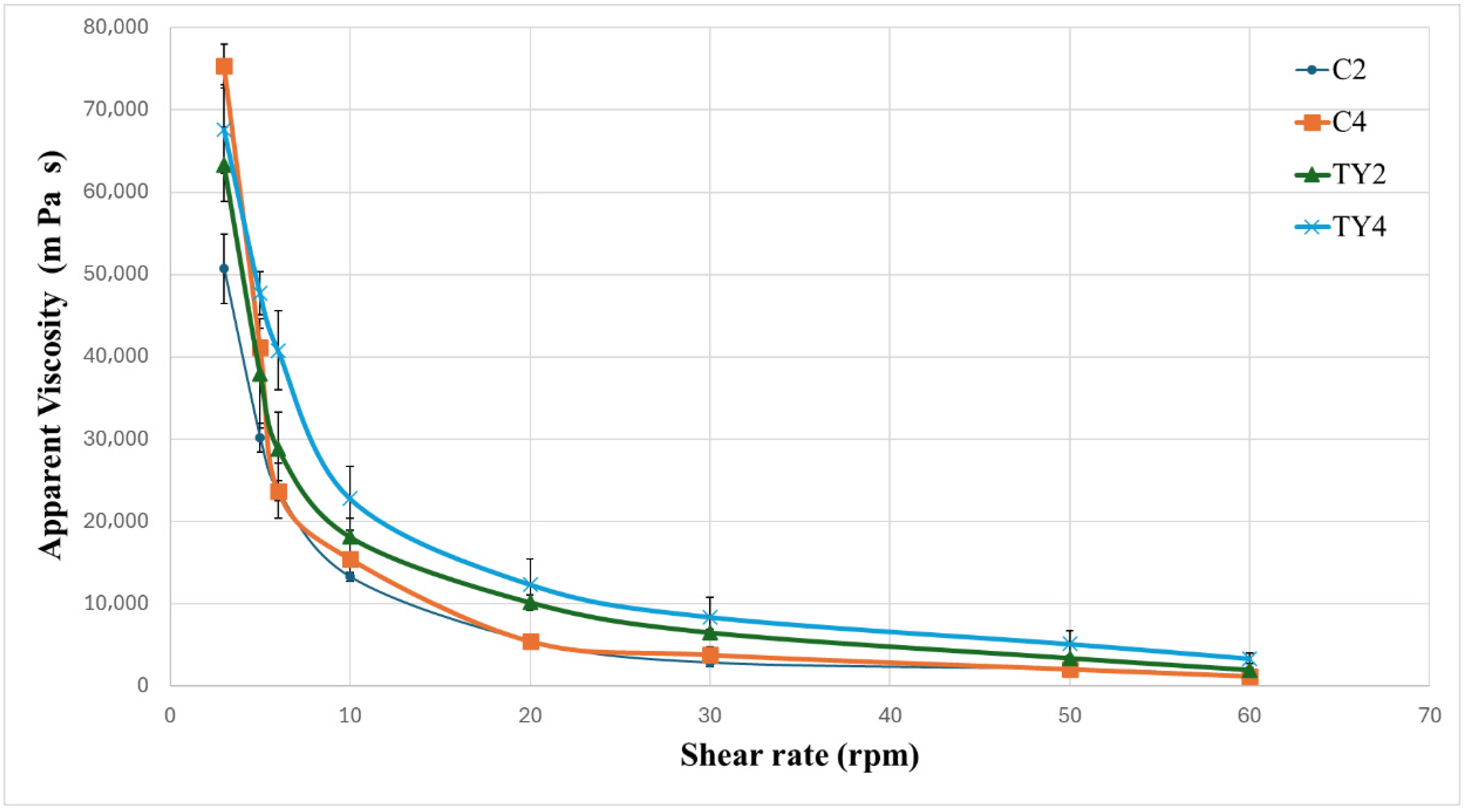
3.4. Viscosity Measurements
3.5. Color Parameters and Lycopene Content
4. Conclusions
Supplementary Materials
Author Contributions
Funding
Data Availability Statement
Acknowledgments
Conflicts of Interest
Abbreviations
| SMP | skim milk powder |
| TP | tomato powder |
| TA | titratable acidity |
| WHC | water holding capacity |
References
- Market.us. Fermented Milk Market Size, Share, Forecast. Available online: https://market.us/report/fermented-milk-market/ (accessed on 24 December 2025).
- Bintsis, T.; Papademas, P. The Evolution of Fermented Milks, from Artisanal to Industrial Products: A Critical Review. Fermentation 2022, 8, 679. [Google Scholar] [CrossRef] [Scilit]
- Ahmad, I.; Hao, M.; Li, Y.; Zhang, J.; Ding, Y.; Lyu, F. Fortification of Yogurt with Bioactive Functional Foods and Ingredients and Associated Challenges A Review. Trends Food Sci. Technol. 2022, 129, 558–580. [Google Scholar] [CrossRef] [Scilit]
- Munteanu-Ichim, R.-A.; Canja, C.-M.; Lupu, M.; Bădărău, C.-L.; Matei, F. Tradition and Innovation in Yoghurt from a Functional Perspective A Review. Fermentation 2024, 10, 357. [Google Scholar] [CrossRef] [Scilit]
- Aryana, K.J.; Olson, D.W. A 100-Year Review: Yogurt and other cultured dairy products. J. Dairy Sci. 2017, 100, 9987–10013. [Google Scholar] [CrossRef] [Scilit]
- Bruzantin, F.P.; Daniel, J.L.P.; da Silva, P.P.M.; Spoto, M.H.F. Physicochemical and Sensory Characteristics of Fat-Free Goat Milk Yogurt with Added Stabilizers and Skim Milk Powder Fortification. J. Dairy Sci. 2016, 99, 3316–3324. [Google Scholar] [CrossRef] [Scilit]
- de Souza, W.F.C.A.; do Amaral, C.R.S.; Bernardino, P.D.L.D. The Addition of Skim Milk Powder and Dairy Cream Influences the Physicochemical Properties and the Sensory Acceptance of Concentrated Greek-Style Yogurt. Int. J. Gastron. Food Sci. 2021, 24, 100349. [Google Scholar] [CrossRef] [Scilit]
- Karam, M.C.; Gaiani, C.; Hosri, C.; Burgain, J.; Scher, J. Effect of Dairy Powders Fortification on Yogurt Textural and Sensorial Properties: A Review. J. Dairy Res. 2013, 80, 400–409. [Google Scholar] [CrossRef] [Scilit]
- Hasani, M.; Sari, A.A.; Heshmati, A.; Karami, M. Physicochemical and sensory attributes assessment of functional low-fat yogurt produced by incorporation of barley bran and Lactobacillus acidophilus. Food Sci. Nutr. 2017, 5, 875–880. [Google Scholar] [CrossRef] [Scilit]
- Ahmad, I.; Khalique, A.; Shahid, M.Q.; Ahid Rashid, A.; Faiz, F.; Ikram, M.A.; Ahmed, S.; Imran, M.; Khan, M.A.; Nadeem, M.; et al. Studying the Influence of Apple Peel Polyphenol Extract Fortification on the Characteristics of Probiotic Yogurt. Plants 2020, 9, 77. [Google Scholar] [CrossRef] [Scilit]
- Kowaleski, J.; Quast, L.B.; Steffens, J.; Lovato, F.; Rodrigues dos Santos, L.; Zambiazi da Silva, S.; Maschio de Souza, D.; Felicetti, M.A. Functional yogurt with strawberries and chia seeds. Food Biosci. 2020, 37, 100726. [Google Scholar] [CrossRef] [Scilit]
- Almasi, K.; Esnaashari, S.S.; Khosravani, M.; Adabi, M. Yogurt fortified with omega-3 using nanoemulsion containing flaxseed oil: Investigation of physicochemical properties. Food Sci. Nutr. 2021, 9, 6186–6193. [Google Scholar] [CrossRef] [Scilit]
- Hamed, A.M.; Awad, A.A.; Abdel-Mobdy, A.E.; Alzahrani, A.; Salamatullah, A.M. Buffalo Yogurt Fortified with Eucalyptus (Eucalyptus camaldulensis) and Myrrh (Commiphora myrrha) Essential Oils: New Insights into the Functional Properties and Extended Shelf Life. Molecules 2021, 26, 6853. [Google Scholar] [CrossRef] [Scilit]
- Ahmed, M.; Ali, A.; Sarfraz, A.; Hong, Q.; Boran, H. Effect of Freeze-Drying on Apple Pomace and Pomegranate Peel Powders Used as a Source of Bioactive Ingredients for the Development of Functional Yogurt. J. Food Qual. 2022, 2022, 3327401. [Google Scholar] [CrossRef] [Scilit]
- Madududu, P.; Jourdain, D.; Tran, D.; Degieter, M.; Karuaiehe, S.; Ntuli, H.; De Steur, H. Consumers’ Willingness-to-Pay for Dairy and Plant-Based Milk Alternatives towards Sustainable Dairy: A Scoping Review. Sustain. Prod. Consum. 2024, 51, 261–277. [Google Scholar] [CrossRef] [Scilit]
- Su, W.; Zhang, Y.Y.; Li, S.; Sheng, J. Consumers’ Preferences and Attitudes towards Plant-Based Milk. Foods 2024, 13, 2. [Google Scholar] [CrossRef] [Scilit]
- Varziri, A.; Zhao, S.; Woods, T.A.; Esene, F. Consumer Preferences Toward Local Versus Carbon: A Study of Value-Added Dairy Products. Agric. Econ. 2025, 56, 961–975. [Google Scholar] [CrossRef] [Scilit]
- Fan, X.; Li, X.; Du, L.; Li, J.; Xu, J.; Shi, Z.; Li, C.; Tu, M.; Zeng, X.; Wu, Z.; et al. The Effect of Natural Plant-Based Homogenates as Additives on the Quality of Yogurt: A Review. Food Biosci. 2022, 49, 101953. [Google Scholar] [CrossRef] [Scilit]
- Berenguer, C.V.; Andrade, C.; Pereira, J.A.M.; Perestrelo, R.; Câmara, J.S. Current Challenges in the Sustainable Valorisation of Agri-Food Wastes: A Review. Processes 2023, 11, 20. [Google Scholar] [CrossRef] [Scilit]
- Gage, E.; Wang, X.; Xu, B.; Foster, A.; Evans, J.; Terry, L.A.; Falagán, N. Reducing Food Loss and Waste Contributes to Energy, Economic and Environmental Sustainability. J. Clean. Prod. 2024, 451, 142068. [Google Scholar] [CrossRef] [Scilit]
- Subedi, S.; Dent, B.; Adhikari, R. The Carbon Footprint of Fruits: A Systematic Review from a Life Cycle Perspective. Sustain. Prod. Consum. 2024, 52, 12–28. [Google Scholar] [CrossRef] [Scilit]
- Food and Agriculture Organization of the United Nations (FAO). The State of Food and Agriculture 2019: Moving Forward on Food Loss and Waste Reduction; FAO: Rome, Italy, 2019; Available online: https://openknowledge.fao.org/server/api/core/bitstreams/11f9288f-dc78-4171-8d02-92235b8d7dc7/content (accessed on 5 September 2025).
- Szabo, K.; Varvara, R.-A.; Ciont, C.; Macri, A.M.; Vodnar, D.C. An Updated Overview on the Revalorization of Bioactive Compounds Derived from Tomato Production and Processing By-Products. J. Clean. Prod. 2025, 497, 145151. [Google Scholar] [CrossRef] [Scilit]
- Sagar, N.A.; Pareek, S.; Sharma, S.; Yahia, E.M.; Lobo, M.G. Fruit and Vegetable Waste: Bioactive Compounds, Their Extraction, and Possible Utilization. Compr. Rev. Food Sci. Food Saf. 2018, 17, 512–531. [Google Scholar] [CrossRef] [Scilit]
- Gebeyaw, M.; Tsegay, S. Review on: Effect of Pre and Post Harvest Treatment on the Quality of Tomato (Lycopersicon esculentum L.). Int. J. Curr. Res. Acad. Rev. 2020, 8, 75–82. [Google Scholar] [CrossRef]
- Løvdal, T.; Van Droogenbroeck, B.; Eroglu, E.C.; Kaniszewski, S.; Agati, G.; Verheul, M.; Skipnes, D. Valorization of Tomato Surplus and Waste Fractions: A Case Study Using Norway, Belgium, Poland, and Turkey as Examples. Foods 2019, 8, 229. [Google Scholar] [CrossRef] [Scilit] [PubMed]
- Cardoso, C.E.d.F.; Silva, S.T.; Trindade, M.E.F.; Campos, M.d.B.E.; Cruz, A.G.; Fonseca Lobo, F.A.T.; Teodoro, A.J. Flavors of the Earth: Bioprospecting and Potential of Agricultural Ingredients in Yogurt Production with a Focus on Sustainability, Quality, and Technological Innovation. Foods 2025, 14, 1497. [Google Scholar] [CrossRef] [Scilit] [PubMed]
- Stoica, F.; Rațu, R.N.; Motrescu, I.; Cara, I.G.; Filip, M.; Țopa, D.; Jităreanu, G. Application of Pomace Powder of Black Carrot as a Natural Food Ingredient in Yoghurt. Foods 2024, 13, 1130. [Google Scholar] [CrossRef] [Scilit]
- Vénica, C.I.; Spotti, M.J.; Pavón, Y.L.; Molli, J.S.; Perotti, M.C. Influence of Carrot Fibre Powder Addition on Rheological, Microstructure and Sensory Characteristics of Stirred-Type Yogurt. Int. J. Food Sci. Technol. 2020, 55, 1916–1923. [Google Scholar] [CrossRef] [Scilit]
- Taha, S.H.; Elshaghabee, F.M.F.; Ameen, M.A. Quality Attributes and Antioxidant Activity of Stirred Yoghurt Fortified with Some Nano-Fruit Waste Powders. Discov. Food 2024, 4, 125. [Google Scholar] [CrossRef] [Scilit]
- Espírito-Santo, A.P.; Lagazzo, A.; Sousa, A.L.O.P.; Perego, P.; Converti, A.; Oliveira, M.N. Rheology, Spontaneous Whey Separation, Microstructure and Sensorial Characteristics of Probiotic Yoghurts Enriched with Passion Fruit Fiber. Food Res. Int. 2013, 50, 224–231. [Google Scholar] [CrossRef] [Scilit]
- Darwish, O.H.; Sulieman, A.E.-R.M.; Shalaby, H.S.; Alkhudhayri, D.A.; Dahran, N.; Hashim, M.A.; Hafiz, A.A.; Elmahallawy, E.K. Assessing the Physicochemical and Sensory Attributes of Yogurt Enriched with Mango and Potato Peel Powders and Their Hypolipidemic Effects on Rats Consuming a High-Fat Diet. Ital. J. Food Sci. 2025, 37, 60–77. [Google Scholar] [CrossRef] [Scilit]
- Lastra-Ripoll, S.E.; Quintana, S.E.; García-Zapateiro, L.A. Yogurt Enriched with Mango Peel Extracts (Mangifera indica) in Chitosan–Xanthan Gum Dispersions: Physicochemical, Rheological, Stability, and Antioxidant Activity. Fluids 2023, 8, 259. [Google Scholar] [CrossRef] [Scilit]
- Dong, R.; Liao, W.; Xie, J.; Chen, Y.; Peng, G.; Xie, J.; Sun, N.; Liu, S.; Yu, C.; Yu, Q. Enrichment of Yogurt with Carrot Soluble Dietary Fiber Prepared by Three Physical Modified Treatments: Microstructure, Rheology and Storage Stability. Innov. Food Sci. Emerg. Technol. 2022, 75, 102901. [Google Scholar] [CrossRef] [Scilit]
- Popescu, L.; Ceșco, T.; Gurev, A.; Ghendov-Mosanu, A.; Sturza, R.; Tarna, R. Impact of Apple Pomace Powder on the Bioactivity, and the Sensory and Textural Characteristics of Yogurt. Foods 2022, 11, 3565. [Google Scholar] [CrossRef] [Scilit]
- Kusio, K.; Szafrańska, J.O.; Radzki, W.; Sołowiej, B.G. Effect of Different Dried Vegetable Powders on Physicochemical, Organoleptic, and Antioxidative Properties of Fat-Free Dairy Desserts. Appl. Sci. 2022, 12, 11503. [Google Scholar] [CrossRef] [Scilit]
- Raiola, A.; Rigano, M.M.; Calafiore, R.; Frusciante, L.; Barone, A. Enhancing the Health-Promoting Effects of Tomato Fruit for Biofortified Food. Mediat. Inflamm. 2014, 2014, 139873. [Google Scholar] [CrossRef] [Scilit] [PubMed]
- Ademosun, O.T.; Ajanaku, K.O.; Adebayo, A.H.; Oloyede, M.O.; Okere, D.U.; Akinsiku, A.A.; Ajayi, S.O.; Ajanaku, C.O.; Dokunmu, T.M.; Owolabi, A.O. Physico-Chemical, Microbial and Organoleptic Properties of Yoghurt Fortified with Tomato Juice. J. Food Nutr. Res. 2019, 7, 810–814. [Google Scholar] [CrossRef] [Scilit]
- Simanjuntak, P.L.; Sitohang, A.; Sihombing, D.R.; Pandiangan, M.; Tampubolon, S.D.R.; Panjaitan, D.; Sibuea, P.; Zega, A.V.; Harefa, K.S.E. Quality Improvement of Yogurt through the Addition of Corn and Tomato Juice. IOP Conf. Ser. Earth Environ. Sci. 2018, 205, 012047. [Google Scholar] [CrossRef] [Scilit]
- Alqahtani, N.K.; Helal, A.; Alnemr, T.M.; Marquez, O. Influence of Tomato Pomace Inclusion on the Chemical, Physical and Microbiological Properties of Stirred Yoghurt. Int. J. Dairy Sci. 2020, 15, 152–160. [Google Scholar] [CrossRef] [Scilit]
- Jefrin, A.; Kamaleshraj, R.S.; Prem Kumar, A.; Rajalakshmi, G. Development of Yogurt Enriched with Freeze Dried Tomato Peel Powder. Int. J. Eng. Appl. Sci. Technol. 2022, 7, 199–206. [Google Scholar]
- Demirci, T.; Sert, D.; Aktaş, K.; Sözeri Atik, D.; Öztürk Negiş, H.İ.; Akın, N. Influence of Hot and Cold Break Tomato Powders on Survival of Probiotic Lactobacillus paracasei subsp. paracasei F19, Texture Profile and Antioxidative Activity in Set-Type Yoghurts. LWT—Food Sci. Technol. 2020, 118, 108855. [Google Scholar] [CrossRef] [Scilit]
- Fish, W.W.; Perkins-Veazie, P.; Collins, J.K. A Quantitative Assay for Lycopene That Utilizes Reduced Volumes of Organic Solvents. J. Food Compos. Anal. 2002, 15, 309–317. [Google Scholar] [CrossRef] [Scilit]
- AOAC. Official Methods of Analysis of AOAC International, 17th ed.; Horwitz, W., Ed.; AOAC International: Gaithersburg, MD, USA, 2000. [Google Scholar]
- Mantzouridou, F.T.; Naziri, E.; Kyriakidou, A.; Paraskevopoulou, A.; Tsimidou, M.Z.; Kiosseoglou, V. Oil Bodies from Dry Maize Germ as an Effective Replacer of Cow Milk Fat Globules in Yogurt-Like Product Formulation. LWT—Food Sci. Technol. 2019, 105, 48–56. [Google Scholar] [CrossRef] [Scilit]
- Wu, H.; Hulbert, G.J.; Mount, J.R. Effects of Ultrasound on Milk Homogenization and Fermentation with Yogurt Starter. Innov. Food Sci. Emerg. Technol. 2001, 1, 211–218. [Google Scholar] [CrossRef] [Scilit]
- Salaün, F.; Mietton, B.; Gaucheron, F. Buffering Capacity of Dairy Products. Int. Dairy J. 2005, 15, 95–109. [Google Scholar] [CrossRef] [Scilit]
- Gaucheron, F. The Minerals of Milk. Reprod. Nutr. Dev. 2005, 45, 473–483. [Google Scholar] [CrossRef] [Scilit]
- Corredig, M.; Sharafbafi, N.; Kristo, E. Polysaccharide–Protein Interactions in Dairy Matrices: Control and Design of Structures. Food Hydrocoll. 2011, 25, 1833–1841. [Google Scholar] [CrossRef] [Scilit]
- Wilbanks, D.J.; Yazdi, S.R.; Lucey, J.A. Effects of Varying Casein and Pectin Concentrations on the Rheology of High-Protein Cultured Milk Beverages Stored at Ambient Temperature. J. Dairy Sci. 2022, 105, 72–82. [Google Scholar] [CrossRef] [Scilit]
- Ricci, A.; Marrella, M.; Hadj Saadoun, J.; Bernini, V.; Godani, F.; Dameno, F.; Neviani, E.; Lazzi, C. Development of Lactic Acid-Fermented Tomato Products. Microorganisms 2020, 8, 1192. [Google Scholar] [CrossRef] [Scilit] [PubMed]
- Arab, M.; Yousefi, M.; Khanniri, E.; Azari, M.; Ghasemzadeh-Mohammadi, V.; Mollakhalili-Meybodi, N. A Comprehensive Review on Yogurt Syneresis: Effect of Processing Conditions and Added Additives. J. Food Sci. Technol. 2023, 60, 1656–1665. [Google Scholar] [CrossRef] [Scilit]
- Jia, X.; Li, X.; Shao, Y.; Xiao, M.; Li, X.; Sun, Y.; Liu, Y.; Guo, Q.; Goff, H.D. Structural and Rheological Properties of Four Pectins and Their Application in Yogurt. Food Hydrocoll. 2026, 172, 112079. [Google Scholar] [CrossRef] [Scilit]
- Rao, A.V.; Waseem, Z.; Agarwal, S. Lycopene Content of Tomatoes and Tomato Products and Their Contribution to Dietary Lycopene. Food Res. Int. 1998, 31, 737–753. [Google Scholar] [CrossRef] [Scilit]


| Sample 1 | Vmax 2 (pH Units/min) | Tm 2 (min) | pHTm 2 | pHe 2 | pHt24 2 | Titratable Acidity (%Lactic Acid) t0 2 | Titratable Acidity (%Lactic Acid) t24 2 |
|---|---|---|---|---|---|---|---|
| C-2 | 0.017 ± 0.002 a | 130 ± 17 a | 5.43 ± 0.09 a | 4.68 ± 0.03 c | 4.50 ± 0.14 a | 0.89 ± 0.02 a | 1.04 ± 0.04 a |
| C-4 | 0.019 ± 0.002 a | 120 ± 0 a | 5.52 ± 0.03 a | 4.69 ± 0.02 bc | 4.52 ± 0.14 a | 0.76 ± 0.04 b | 0.95 ± 0.04 a |
| TΥ-2 | 0.019 ± 0.005 ab | 120 ± 0 a | 4.98 ± 0.03 b | 4.65 ± 0.04 a | 4.55 ± 0.05 a | 0.89 ± 0.02 a | 1.03 ± 0.15 a |
| TΥ-4 | 0.009 ± 0.001 b | 80 ± 35 a | 5.20 ± 0.28 ab | 4.62 ± 0.03 ab | 4.52 ± 0.01 a | 0.89 ± 0.04 a | 0.95 ± 0.04 a |
| Samples | L. delbrueckii subsp. bulgaricus | S. thermophilus | ||
|---|---|---|---|---|
| Storage Time 1 | ||||
| T0 | T24 | T0 | T24 | |
| Log CFU/g | ||||
| C-2 | 5.32 ± 0.01 b,c | 6.45 ± 0.24 a,b | 3.5 ± 0.13 a | 4.9 ± 0.39 a |
| C-4 | 4.81 ± 0.42 c | 6.85 ± 0.13 a | 3.17 ± 0.20 a,b | 4.75 ± 0.42 a |
| TΥ-2 | 6.69 ± 0.01 a | 6.61 ± 0.13 a,b | 3.11 ± 0.48 a,b | 4.56 ± 0.22 a |
| TΥ-4 | 5.94 ± 0.34 b | 6.21 ± 0.19 b | 2.61 ± 0.44 b | 4.32 ± 0.28 a |
| Samples 1 | Syneresis (%) 2 | WHC (%) 2 |
|---|---|---|
| C-2 | 37 ± 1.73 a | 92 ± 1.22 b |
| C-4 | 41 ± 4.36 a | 83 ± 3.46 a |
| TΥ-2 | 40 ± 2.55 a | 89 ± 1.00 b |
| TΥ-4 | 41 ± 1.00 a | 98 ± 0.00 c |
| Samples 1 | Hardness (g) | Adhesiveness | Springiness | Cohesiveness | Gumminess |
|---|---|---|---|---|---|
| C-2 | 30.22 ± 2.64 a | −74.20 ± 3.35 c | 3.50 ± 0.56 b | 0.33 ± 0.01 a | 9.97 ± 0.66 a |
| C-4 | 47.10 ± 7.63 b | −156.43 ± 60.75 bc | 2.87 ± 0.74 ab | 0.33 ± 0.01 a | 15.57 ± 1.84 b |
| TΥ-2 | 72.10 ± 7.10 c | −430.57 ± 61.71 a | 1.53 ± 0.07 a | 0.33 ± 0.01 a | 25.10 ± 2.92 c |
| TΥ-4 | 87.03 ± 3.67 d | −302.97 ± 139.56 ab | 1.90 ± 0.70 a | 0.43 ± 0.07 a | 28.70 ± 1.00 c |
| Samples 1 | L* | a* | b* | c | h |
|---|---|---|---|---|---|
| C-2 | 91.93 ± 3.44 a | −0.33 ± 0.84 c | 5.43 ± 1.62 c | 5.53 ± 1.62 c | 93.55 ± 9.76 a |
| C-4 | 95.40 ± 1.42 a | −1.03 ± 1.13 c | 5.03 ± 1.08 c | 5.25 ± 0.82 c | 102.98 ± 14.94 a |
| TY-2 | 82.95 ± 1.00 b | 8.15 ± 0.70 b | 16.03 ± 0.90 b | 18.00 ± 1.00 b | 63.08 ± 1.24 b |
| TY-4 | 66.48 ± 3.33 c | 18.38 ± 0.47 a | 23.10 ± 1.25 a | 29.53 ± 1.26 a | 51.53 ± 0.96 b |
Disclaimer/Publisher’s Note: The statements, opinions and data contained in all publications are solely those of the individual author(s) and contributor(s) and not of MDPI and/or the editor(s). MDPI and/or the editor(s) disclaim responsibility for any injury to people or property resulting from any ideas, methods, instructions or products referred to in the content. |
© 2025 by the authors. Licensee MDPI, Basel, Switzerland. This article is an open access article distributed under the terms and conditions of the Creative Commons Attribution (CC BY) license.
Share and Cite
Grillia, E.; Naziri, E. Sustainable Use of Tomato Powder Derived from Food Waste in Yogurt Formulation. Processes 2026, 14, 107. https://doi.org/10.3390/pr14010107
Grillia E, Naziri E. Sustainable Use of Tomato Powder Derived from Food Waste in Yogurt Formulation. Processes. 2026; 14(1):107. https://doi.org/10.3390/pr14010107
Chicago/Turabian StyleGrillia, Eftychia, and Eleni Naziri. 2026. "Sustainable Use of Tomato Powder Derived from Food Waste in Yogurt Formulation" Processes 14, no. 1: 107. https://doi.org/10.3390/pr14010107
APA StyleGrillia, E., & Naziri, E. (2026). Sustainable Use of Tomato Powder Derived from Food Waste in Yogurt Formulation. Processes, 14(1), 107. https://doi.org/10.3390/pr14010107