Review and Evaluation of Agricultural Biomass Ashes as Supplementary Cementitious Materials for Sustainable Concrete


Abstract
1. Introduction
2. Methodology
3. Results and Discussion
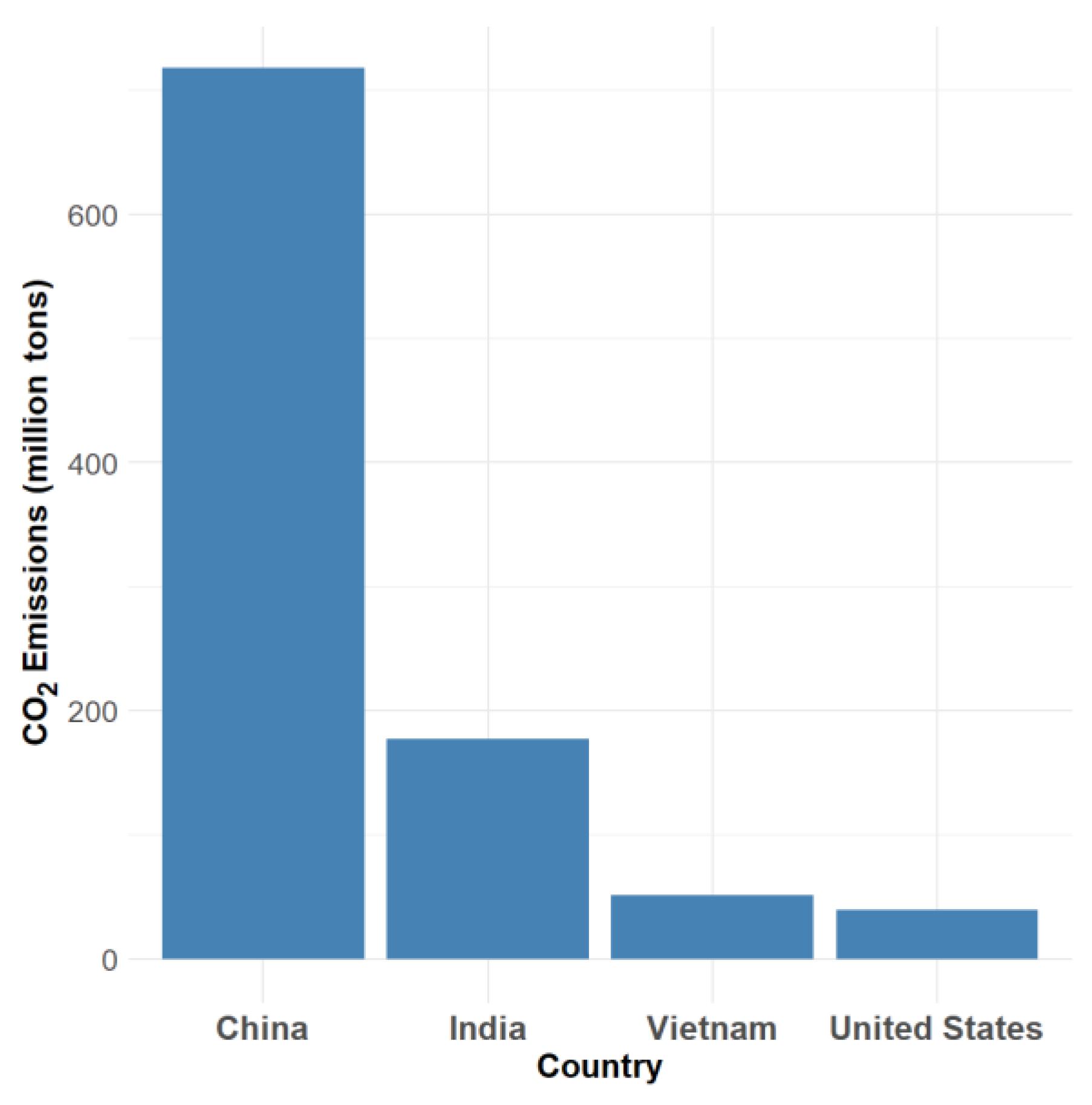
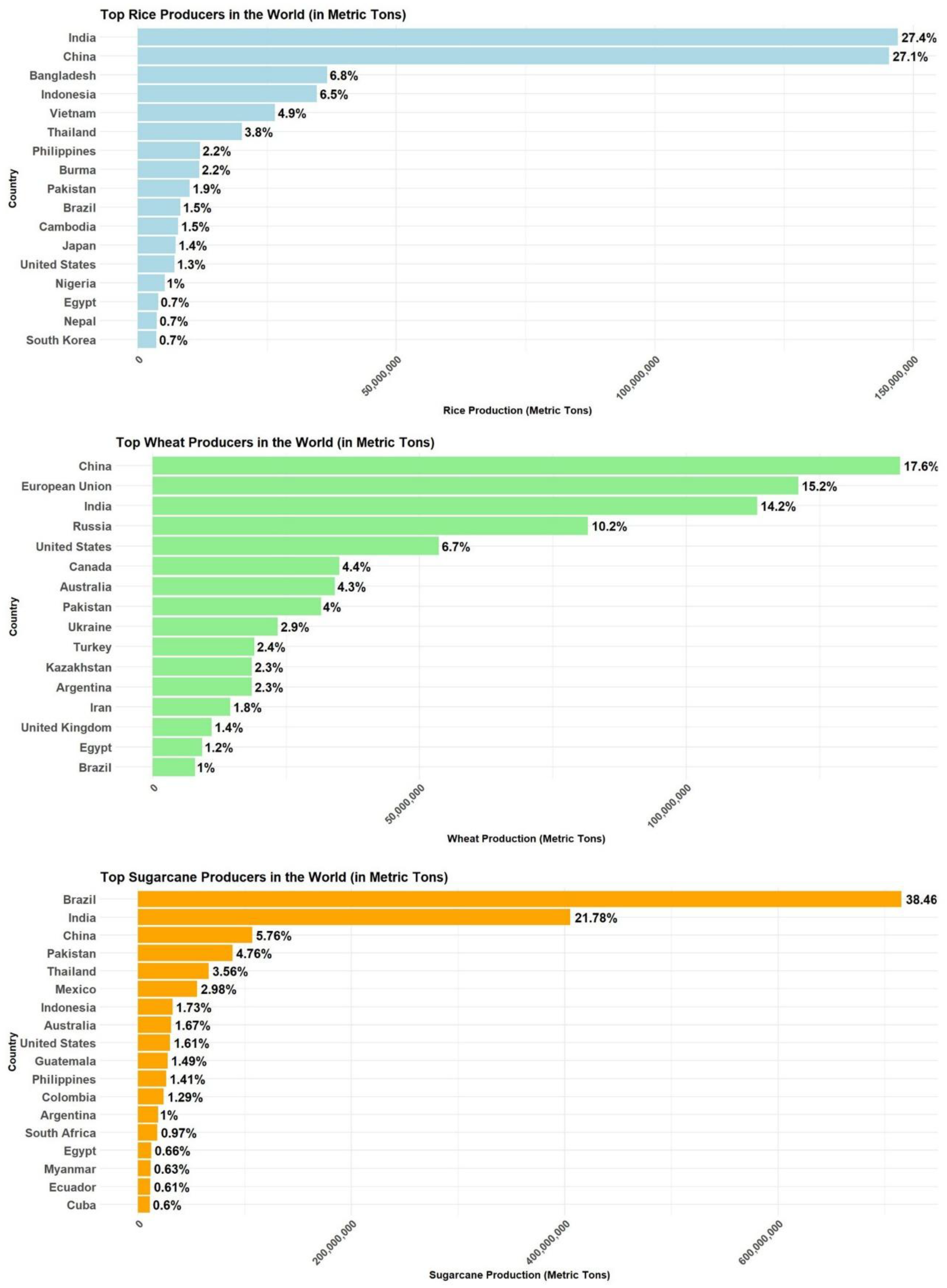
3.1. Global Agricultural (Rice, Wheat, Sugarcane) Production
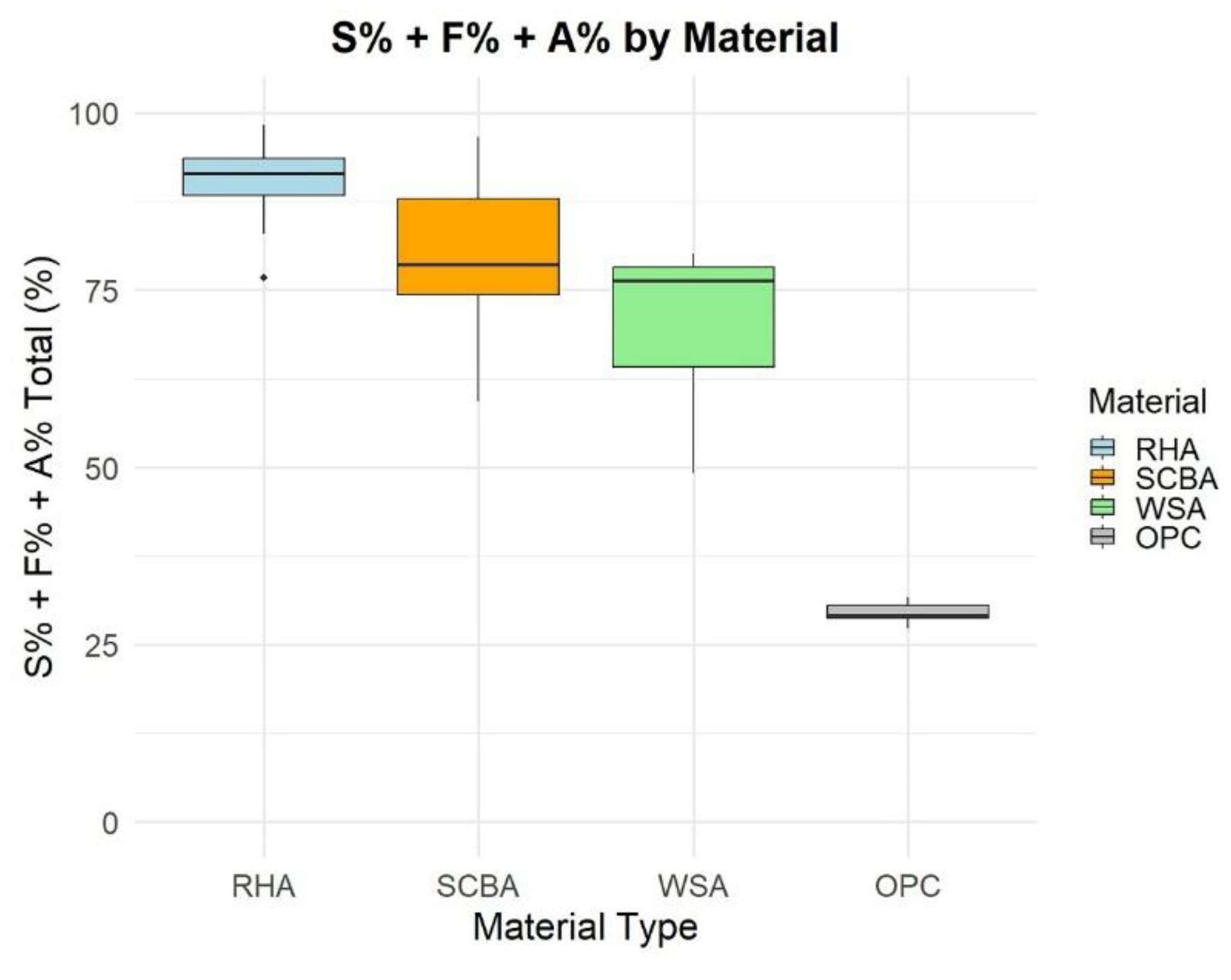
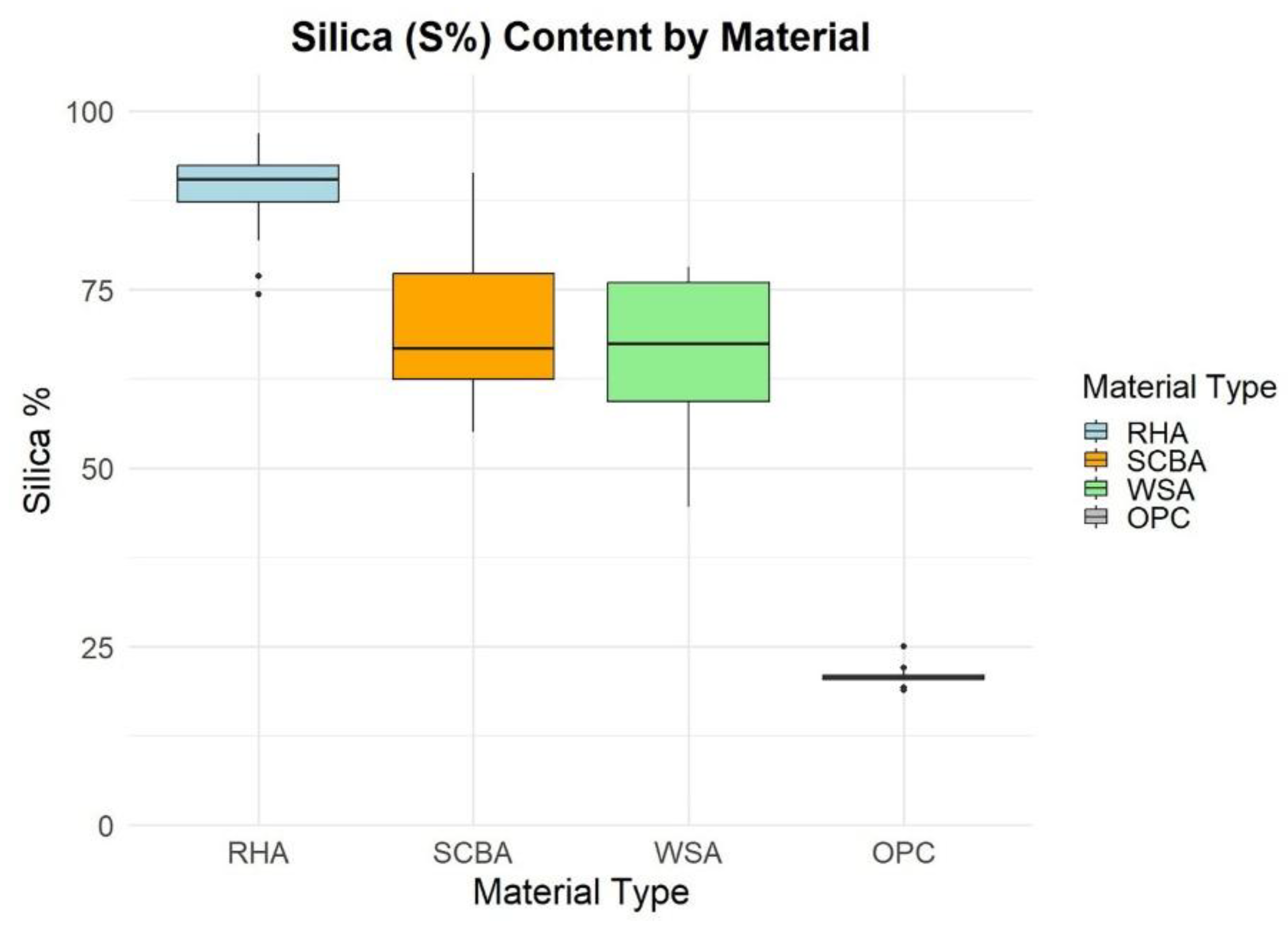
3.2. Chemical and Physical Characteristics of the Selected ABAs
3.3. Performance of the Selected ABA-Blended Cement Concrete
3.3.1. Fresh Properties of the Selected ABA-Blended Cement Concrete
Workability
Improving Workability
Initial and Final Setting Times
3.3.2. Compressive Strength (CS) of the Selected ABA-Blended Cement Concrete
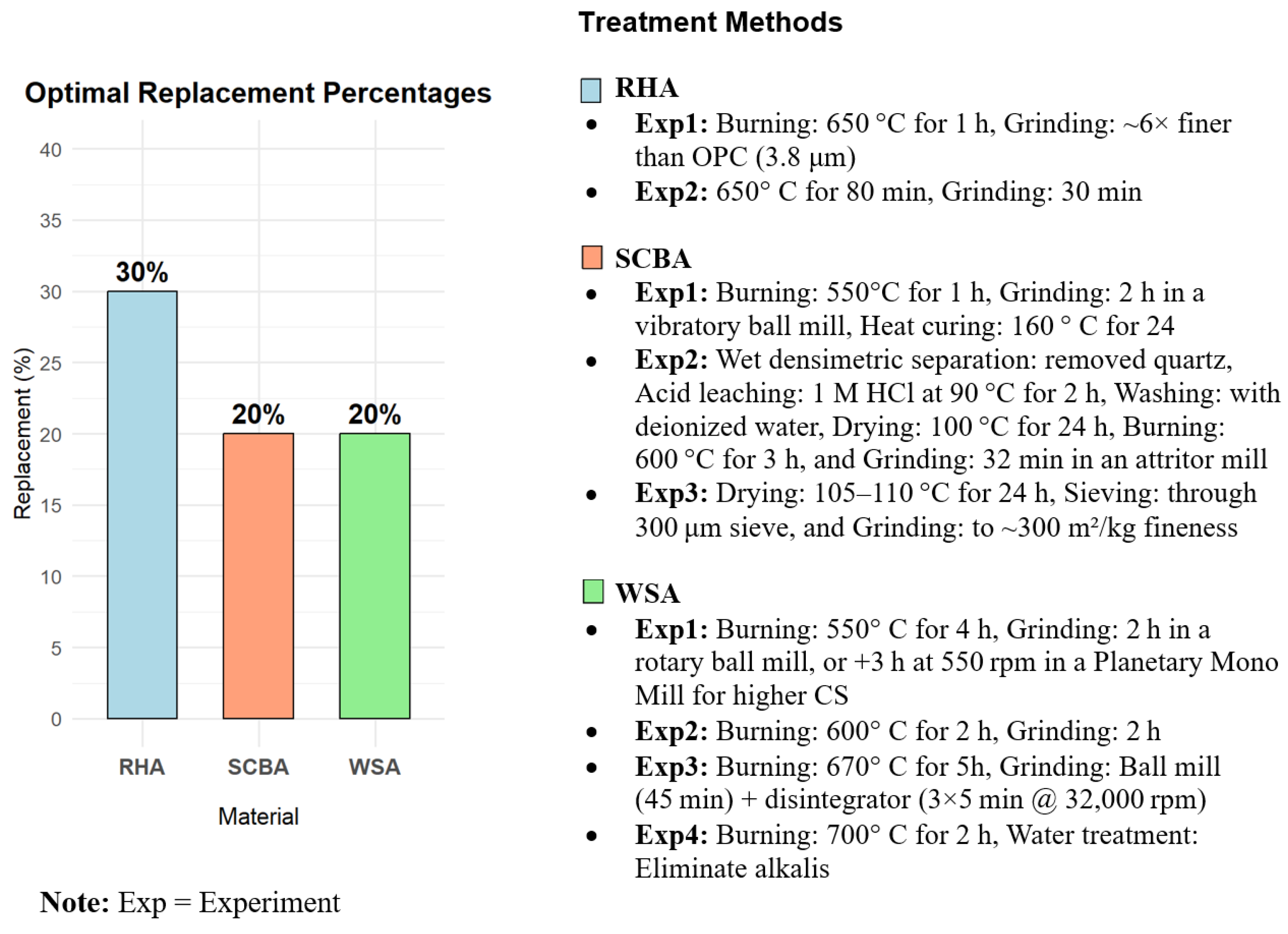
Treatment Methods to Improve CS of ABA-Blended Cement Concrete
- Sieving: Sieving removes oversized particles and separates particles by size (ranging from 75 to 2000 μm). This process improves the quality of ABAs by eliminating impurities and reducing carbon content and LOI. Additionally, sieving increases the concentration of pozzolanic oxides, thereby enhancing reactivity and potentially improving the compressive strength of concrete [142].
- Burning: Controlled burning conditions not only reduce carbon content and LOI but also increase the concentration of pozzolanic oxides [142], particularly amorphous silica [11]. Achieving a higher proportion of amorphous silica depends critically on the optimal temperature range and duration, as outlined below:
- ○
- ○
- ○
- SCBA: Burning in the range of 450–650 °C for 1–3 h, with 550 °C for 1 h, results in the highest amount of silica in amorphous form [166].
- Water or Chemical Treatment: If necessary, water or chemical treatment is recommended. Water washing is particularly effective for the removal of soluble salts, including chlorides, sulfates, and alkalis (e.g., Na and K). For heavy metal removal, more advanced methods—such as chemical washing (using hydrochloric acid, sulfuric acid, or phosphoric acid), electro-dialytic remediation (with citric acid, ammonium citrate, or ammonia), and ammonium acetate extraction—have also been shown to be effective [181].
- Grinding: The reduction in particle size of ABAs through grinding significantly enhances their pozzolanic reactivity by increasing the surface area of the finer particles, thereby providing more active sites for chemical reactions [9]. In the case of RHA, although grinding reduces its average particle size, the surface area is largely governed by its intrinsic multilayered, angular, and microporous structure rather than particle size alone. This complex morphology contributes to its high reactivity [125].
Optimizing ABA Replacement Percentage Based on Concrete CS
3.3.3. Durability Properties of the Selected ABA-Blended Cement Concrete
3.4. Environmental Impact of the Selected ABA-Blended Cement Concrete
4. Conclusions
Author Contributions
Funding
Data Availability Statement
Conflicts of Interest
References
- Bigger Climate Action Emerging in Cement Industry. Available online: https://unfccc.int/news/bigger-climate-action-emerging-in-cement-industry (accessed on 20 December 2024).
- Endale, S.A.; Taffese, W.Z.; Vo, D.-H.; Yehualaw, M.D. Rice husk ash in concrete. Sustainability 2022, 15, 137. [Google Scholar] [CrossRef]
- Cement. Available online: https://sciencebasedtargets.org/sectors/cement (accessed on 20 December 2024).
- Lavagna, L.; Nisticò, R. An insight into the chemistry of cement—A review. Appl. Sci. 2022, 13, 203. [Google Scholar] [CrossRef]
- Telschow, S.; Frandsen, F.; Theisen, K.; Dam-Johansen, K. Cement Formation A Success Story in a Black Box: High Temperature Phase Formation of Portland Cement Clinker. Ind. Eng. Chem. Res. 2012, 51, 10983–11004. [Google Scholar] [CrossRef]
- Dunuweera, S.; Rajapakse, R. Cement types, composition, uses and advantages of nanocement, environmental impact on cement production, and possible solutions. Adv. Mater. Sci. Eng. 2018, 2018, 4158682. [Google Scholar] [CrossRef]
- Annual CO2 Emissions from Cement. Available online: https://ourworldindata.org/grapher/annual-co2-cement (accessed on 20 December 2024).
- Juenger, M.C.; Snellings, R.; Bernal, S.A. Supplementary cementitious materials: New sources, characterization, and performance insights. Cem. Concr. Res. 2019, 122, 257–273. [Google Scholar] [CrossRef]
- Charitha, V.; Athira, V.; Jittin, V.; Bahurudeen, A.; Nanthagopalan, P. Use of different agro-waste ashes in concrete for effective upcycling of locally available resources. Constr. Build. Mater. 2021, 285, 122851. [Google Scholar] [CrossRef]
- Chao-Lung, H.; Le Anh-Tuan, B.; Chun-Tsun, C. Effect of rice husk ash on the strength and durability characteristics of concrete. Constr. Build. Mater. 2011, 25, 3768–3772. [Google Scholar] [CrossRef]
- Ganesan, K.; Rajagopal, K.; Thangavel, K. Rice husk ash blended cement: Assessment of optimal level of replacement for strength and permeability properties of concrete. Constr. Build. Mater. 2008, 22, 1675–1683. [Google Scholar] [CrossRef]
- Bheel, N.; Ali, M.O.A.; Kirgiz, M.S.; de Sousa Galdino, A.G.; Kumar, A. Fresh and mechanical properties of concrete made of binary substitution of millet husk ash and wheat straw ash for cement and fine aggregate. J. Mater. Res. Technol. 2021, 13, 872–893. [Google Scholar] [CrossRef]
- Mohammed, A.; Aboshio, A.; Aliyu, M. Performance of millet husk ash in self compacting concrete. Niger. J. Technol. 2021, 40, 1010–1017. [Google Scholar] [CrossRef]
- Amin, M.N.; Murtaza, T.; Shahzada, K.; Khan, K.; Adil, M. Pozzolanic potential and mechanical performance of wheat straw ash incorporated sustainable concrete. Sustainability 2019, 11, 519. [Google Scholar] [CrossRef]
- Cao, F.; Qiao, H.; Li, Y.; Shu, X.; Cui, L. Effect of highland barley straw ash admixture on properties and microstructure of concrete. Constr. Build. Mater. 2022, 315, 125802. [Google Scholar] [CrossRef]
- Ruviaro, A.S.; dos Santos Lima, G.T.; Silvestro, L.; Barraza, M.T.; Rocha, J.C.; de Brito, J.; Gleize, P.J.P.; Pelisser, F. Characterization and investigation of the use of oat husk ash as supplementary cementitious material as partial replacement of Portland cement: Analysis of fresh and hardened properties and environmental assessment. Constr. Build. Mater. 2023, 363, 129762. [Google Scholar] [CrossRef]
- Alogla, S.M.; Almusayrie, A.I. Compressive strength evaluation of concrete with palm tree ash. Civ. Eng. Archit. 2022, 10, 725–733. [Google Scholar] [CrossRef]
- Munshi, S.; Sharma, R.P. Experimental investigation on strength and water permeability of mortar incorporate with rice straw ash. Adv. Mater. Sci. Eng. 2016, 2016, 9696505. [Google Scholar] [CrossRef]
- Singh, R.; Patel, M. Strength and durability performance of rice straw ash-based concrete: An approach for the valorization of agriculture waste. Int. J. Environ. Sci. Technol. 2023, 20, 9995–10012. [Google Scholar] [CrossRef]
- Sobuz, M.H.R.; Datta, S.D.; Jabin, J.A.; Aditto, F.S.; Hasan, N.M.S.; Hasan, M.; Zaman, A.A.U. Assessing the influence of sugarcane bagasse ash for the production of eco-friendly concrete: Experimental and machine learning approaches. Case Stud. Constr. Mater. 2024, 20, e02839. [Google Scholar] [CrossRef]
- Bahurudeen, A.; Kanraj, D.; Dev, V.G.; Santhanam, M. Performance evaluation of sugarcane bagasse ash blended cement in concrete. Cem. Concr. Compos. 2015, 59, 77–88. [Google Scholar] [CrossRef]
- Khalil, M.J.; Aslam, M.; Ahmad, S. Utilization of sugarcane bagasse ash as cement replacement for the production of sustainable concrete–A review. Constr. Build. Mater. 2021, 270, 121371. [Google Scholar] [CrossRef]
- Tijani, M.A.; Ajagbe, W.O.; Agbede, O.A. Combined reusing of sorghum husk ash and recycled concrete aggregate for sustainable pervious concrete production. J. Clean. Prod. 2022, 343, 131015. [Google Scholar] [CrossRef]
- Tijani, M.; Ajagbe, W.; Ganiyu, A.; Agbede, O. Sustainable pervious concrete incorporating sorghum husk ash as cement replacement. IOP Conf. Ser. Mater. Sci. Eng. 2019, 640, 012051. [Google Scholar] [CrossRef]
- Oyebisi, S.; Igba, T.; Oniyide, D. Performance evaluation of cashew nutshell ash as a binder in concrete production. Case Stud. Constr. Mater. 2019, 11, e00293. [Google Scholar] [CrossRef]
- Memon, S.A.; Javed, U.; Khushnood, R.A. Eco-friendly utilization of corncob ash as partial replacement of sand in concrete. Constr. Build. Mater. 2019, 195, 165–177. [Google Scholar] [CrossRef]
- Akindahunsi, A.; Ogune, C.; Ayodele, A.; Fajobi, A.; Olajumoke, A. Evaluation of the performance of corncob ash in cement mortars. J. Build. Pathol. Rehabil. 2022, 7, 72. [Google Scholar] [CrossRef]
- Marthong, C. Sawdust ash (SDA) as partial replacement of cement. Int. J. Eng. Res. Appl. 2012, 2, 1980–1985. [Google Scholar]
- Raheem, A.; Olasunkanmi, B.; Folorunso, C. Saw dust ash as partial replacement for cement in concrete. Organ. Technol. Manag. Constr. Int. J. 2012, 4, 474–480. [Google Scholar] [CrossRef]
- Darweesh, H.; El-Suoud, M.A. Saw dust ash substitution for cement pastes—Part I. Am. J. Appl. Sci. Res. 2017, 13, 63–71. [Google Scholar] [CrossRef]
- Malik, M.I.; Jan, S.R.; Peer, J.A.; Nazir, S.A.; Mohammad, K.F. Partial replacement of cement by saw Dust Ash in concrete a sustainable Approach. Int. J. Eng. Res. Dev. 2015, 11, 48–53. [Google Scholar]
- Utsev, J.; Taku, J. Coconut shell ash as partial replacement of ordinary Portland cement in concrete production. Int. J. Sci. Technol. Res. 2012, 1, 86–89. [Google Scholar]
- Kanojia, A.; Jain, S.K. Performance of coconut shell as coarse aggregate in concrete. Constr. Build. Mater. 2017, 140, 150–156. [Google Scholar] [CrossRef]
- Ranatunga, K.S.; del Rey Castillo, E.; Toma, C.L. Evaluation of the optimal concrete mix design with coconut shell ash as a partial cement replacement. Constr. Build. Mater. 2023, 401, 132978. [Google Scholar] [CrossRef]
- Abebaw, G.; Bewket, B.; Getahun, S. Experimental investigation on effect of partial replacement of cement with bamboo leaf ash on concrete property. Adv. Civ. Eng. 2021, 2021, 6468444. [Google Scholar] [CrossRef]
- Dacuan, C.N.; Abellana, V.Y.; Canseco, H.A.R. Assessment and evaluation of blended cement using bamboo leaf ash BLASH against corrosion. Civ. Eng. J. 2021, 7, 1015–1035. [Google Scholar] [CrossRef]
- Sell, F.K., Jr.; Wally, G.B.; Magalhães, F.C.; de Pires, M.M.; Kulakowski, M.P.; do Nascimento, C.D.; Flores, W.H.; Avellaneda, C.A.O. Effects of bamboo leaf ashes on concrete compressive strength, water absorption, and chloride penetration. J. Build. Eng. 2024, 97, 110986. [Google Scholar] [CrossRef]
- Bhutto, S.; Ali, M.; Buller, A.S.; Bheel, N.; Gamil, Y.; Najeh, T.; Deifalla, A.F.; Ragab, A.E.; Almujibah, H.R. Effect of banana tree leaves ash as cementitious material on the durability of concrete against sulphate and acid attacks. Heliyon 2024, 10, e29236. [Google Scholar] [CrossRef] [PubMed]
- Tavares, J.C.; Lucena, L.F.; Henriques, G.F.; Ferreira, R.L.; dos Anjos, M.A. Use of banana leaf ash as partial replacement of Portland cement in eco-friendly concretes. Constr. Build. Mater. 2022, 346, 128467. [Google Scholar] [CrossRef]
- Kanning, R.C.; Portella, K.F.; Bragança, M.O.; Bonato, M.M.; dos Santos, J.C. Banana leaves ashes as pozzolan for concrete and mortar of Portland cement. Constr. Build. Mater. 2014, 54, 460–465. [Google Scholar] [CrossRef]
- Islam, M.H.; Law, D.W.; Gunasekara, C.; Sobuz, M.H.R.; Rahman, M.N.; Habib, M.A.; Sabbir, A.K. Assessing the Influence of Banana Leaf Ash as Pozzolanic Material for the Production of Green Concrete: A Mechanical and Microstructural Evaluation. Materials 2024, 17, 720. [Google Scholar] [CrossRef]
- ASTM C618–22; Standard Specification for Coal Fly Ash and Raw or Calcined Natural Pozzolan for Use in Concrete. ASTM International: West Conshohocken, PA, USA, 2022.
- Sandhu, R.K.; Siddique, R. Influence of rice husk ash (RHA) on the properties of self-compacting concrete: A review. Constr. Build. Mater. 2017, 153, 751–764. [Google Scholar] [CrossRef]
- Alsaed, M.M.; Al Mufti, R.L. The Effects of Rice Husk Ash as Bio-Cementitious Material in Concrete. Constr. Mater. 2024, 4, 629–639. [Google Scholar] [CrossRef]
- Bheel, N.; Memon, F.A.; Meghwar, S.L. Study of fresh and hardened properties of concrete using cement with modified blend of millet husk ash as secondary cementitious material. Silicon 2021, 13, 4641–4652. [Google Scholar] [CrossRef]
- Sadoon, A.; Bassuoni, M.; Ghazy, A. Assessment of Oat Husk Ash from Cold Climates as a Supplementary Cementitious Material. J. Mater. Civ. Eng. 2025, 37, 04025371. [Google Scholar] [CrossRef]
- Kumari, S.; Walia, R. Life cycle assessment of sustainable concrete by utilizing groundnut husk ash in concrete. Mater. Today Proc. 2022, 49, 1910–1915. [Google Scholar] [CrossRef]
- Ogork, E.N.N.; Uche, O.A.; Elinwa, A. Characterization of Groundnut husk ash (Gha) admixed with Rice husk ash (Rha) in cement paste and concrete. Adv. Mater. Res. 2015, 1119, 662–671. [Google Scholar] [CrossRef]
- Gedefaw, A.; Worku Yifru, B.; Endale, S.A.; Habtegebreal, B.T.; Yehualaw, M.D. Experimental investigation on the effects of coffee husk ash as partial replacement of cement on concrete properties. Adv. Mater. Sci. Eng. 2022, 2022, 4175460. [Google Scholar] [CrossRef]
- Hareru, W.K.; Asfaw, F.B.; Ghebrab, T. Physical and chemical characterization of coffee husk ash effect on partial replacement of cement in concrete production. Int. J. Sustain. Constr. Eng. Technol. 2022, 13, 167–184. [Google Scholar] [CrossRef]
- Audu Vincent, E.; Mamman Yakubu, W. Use of Cocoa Pod Husk Ash as Admixture in Concrete. Int. J. Eng. Res. Technol. (IJERT) 2013, 2, 3781–3793. [Google Scholar]
- Jankovský, O.; Pavlikova, M.; Sedmidubský, D.; Bouša, D.; Lojka, M.; Pokorný, J.; Záleská, M.; Pavlík, Z. Study on pozzolana activity of wheat straw ash as potential admixture for blended cements. Ceram. Silik 2017, 61, 327–339. [Google Scholar] [CrossRef]
- Rahim, M.; Douzane, O.; Le, A.T.; Promis, G.; Langlet, T. Characterization and comparison of hygric properties of rape straw concrete and hemp concrete. Constr. Build. Mater. 2016, 102, 679–687. [Google Scholar] [CrossRef]
- Cao, F.; Qiao, H.; Li, Y.; Shu, X.; Li, W. Correlation evaluation between water resistance and pore structure of magnesium oxychloride cement mixed with highland barley straw ash. J. Mater. Civ. Eng. 2022, 34, 04022259. [Google Scholar] [CrossRef]
- Cao, F.; Qiao, H.; Zhang, Y.; Li, S.; Cui, L. Early-age performance and mechanism of magnesium oxychloride cement mortar mixed with highland barley straw ash. Constr. Build. Mater. 2023, 401, 132979. [Google Scholar] [CrossRef]
- Šupić, S.; Malešev, M.; Radonjanin, V.; Bulatović, V.; Milović, T. Reactivity and pozzolanic properties of biomass ashes generated by wheat and soybean straw combustion. Materials 2021, 14, 1004. [Google Scholar] [CrossRef]
- Wen, L.; Yan, C.; Shi, Y.; Wang, Z.; Liu, G.; Shi, W. Utilization of straw ash as a partial substitute for ordinary Portland cement in concrete. BioResources 2024, 19, 4250. [Google Scholar] [CrossRef]
- Hakeem, I.Y.; Amin, M.; Zeyad, A.M.; Tayeh, B.A.; Maglad, A.M.; Agwa, I.S. Effects of nano sized sesame stalk and rice straw ashes on high-strength concrete properties. J. Clean. Prod. 2022, 370, 133542. [Google Scholar] [CrossRef]
- Aksoğan, O.; Binici, H.; Ortlek, E. Durability of concrete made by partial replacement of fine aggregate by colemanite and barite and cement by ashes of corn stalk, wheat straw and sunflower stalk ashes. Constr. Build. Mater. 2016, 106, 253–263. [Google Scholar] [CrossRef]
- Șerbănoiu, A.A.; Grădinaru, C.M.; Cimpoeșu, N.; Filipeanu, D.; Șerbănoiu, B.V.; Cherecheș, N.C. Study of an ecological cement-based composite with a sustainable raw material, sunflower stalk ash. Materials 2021, 14, 7177. [Google Scholar] [CrossRef] [PubMed]
- Memon, S.A.; Khan, S.; Wahid, I.; Shestakova, Y.; Ashraf, M. Evaluating the Effect of Calcination and Grinding of Corn Stalk Ash on Pozzolanic Potential for Sustainable Cement-Based Materials. Adv. Mater. Sci. Eng. 2020, 2020, 1619480. [Google Scholar] [CrossRef]
- Salem, S.; Hamdy, Y.; Abdelraouf, E.-S.; Shazly, M. Towards sustainable concrete: Cement replacement using Egyptian cornstalk ash. Case Stud. Constr. Mater. 2022, 17, e01193. [Google Scholar] [CrossRef]
- Agwa, I.S.; Omar, O.M.; Tayeh, B.A.; Abdelsalam, B.A. Effects of using rice straw and cotton stalk ashes on the properties of lightweight self-compacting concrete. Constr. Build. Mater. 2020, 235, 117541. [Google Scholar] [CrossRef]
- Amin, M.; Zeyad, A.M.; Tayeh, B.A.; Agwa, I.S. Effects of nano cotton stalk and palm leaf ashes on ultrahigh-performance concrete properties incorporating recycled concrete aggregates. Constr. Build. Mater. 2021, 302, 124196. [Google Scholar] [CrossRef]
- Bheel, N.; Mahro, S.K.; Adesina, A. Influence of coconut shell ash on workability, mechanical properties, and embodied carbon of concrete. Environ. Sci. Pollut. Res. 2021, 28, 5682–5692. [Google Scholar] [CrossRef]
- Adajar, M.A.; Galupino, J.; Frianeza, C.; Aguilon, J.F.; Sy, J.B.; Tan, P.A. Compressive strength and durability of concrete with coconut shell ash as cement replacement. Geomate J. 2020, 18, 183–190. [Google Scholar] [CrossRef]
- Yurt, Ü.; Bekar, F. Comparative study of hazelnut-shell biomass ash and metakaolin to improve the performance of alkali-activated concrete: A sustainable greener alternative. Constr. Build. Mater. 2022, 320, 126230. [Google Scholar] [CrossRef]
- Baran, Y.; Gökçe, H.; Durmaz, M. Physical and mechanical properties of cement containing regional hazelnut shell ash wastes. J. Clean. Prod. 2020, 259, 120965. [Google Scholar] [CrossRef]
- Soriano Martínez, L.; Font, A.; Mitsuuchi Tashima, M.; Monzó Balbuena, J.M.; Borrachero Rosado, M.V.; Bonifacio, T.; Paya Bernabeu, J.J. Almond-shell biomass ash (ABA): A greener alternative to the use of commercial alkaline reagents in alkali-activated cement. Constr. Build. Mater. 2021, 290, 1–14. [Google Scholar]
- Fan, J.; Yeo, B.-L.; Markandeya, A.; Martínez, A.; Harvey, J.; Miller, S.A.; Nassiri, S. Transforming almond shell waste into high-value activators for low-carbon concrete: Life cycle assessment and technoeconomic analysis. J. Build. Eng. 2025, 105, 112547. [Google Scholar] [CrossRef]
- Oyebisi, S.; Olutoge, F.; Oyaotuderekumor, I.; Bankole, F.; Owamah, H.; Mazino, U. Effects of cashew nutshell ash on the thermal and sustainability properties of cement concrete. Heliyon 2022, 8, e11593. [Google Scholar] [CrossRef]
- Tekin, I.; Dirikolu, İ.; Gökçe, H. A regional supplementary cementitious material for the cement industry: Pistachio shell ash. J. Clean. Prod. 2021, 285, 124810. [Google Scholar] [CrossRef]
- Durmaz, M.; Doğruyol, M. Pistachio Shell Ash in Agro-Waste Cement Composites: A Pathway to Low-Carbon Binders. Sustainability 2025, 17, 4003. [Google Scholar] [CrossRef]
- Chen, H.; Yang, J. A new supplementary cementitious material: Walnut shell ash. Constr. Build. Mater. 2023, 408, 133852. [Google Scholar] [CrossRef]
- Beskopylny, A.N.; Stel’makh, S.A.; Shcherban’, E.M.; Mailyan, L.R.; Meskhi, B.; Shilov, A.A.; Chernil’nik, A.; El’shaeva, D. Effect of walnut-shell additive on the structure and characteristics of concrete. Materials 2023, 16, 1752. [Google Scholar] [CrossRef] [PubMed]
- Zerihun, B.; Yehualaw, M.D.; Vo, D.-H. Effect of agricultural crop wastes as partial replacement of cement in concrete production. Adv. Civ. Eng. 2022, 2022, 5648187. [Google Scholar] [CrossRef]
- Adhikary, S.K.; Ashish, D.K.; Rudžionis, Ž. A review on sustainable use of agricultural straw and husk biomass ashes: Transitioning towards low carbon economy. Sci. Total Environ. 2022, 838, 156407. [Google Scholar] [CrossRef] [PubMed]
- Udoeyo, F.F.; Dashibil, P.U. Sawdust ash as concrete material. J. Mater. Civ. Eng. 2002, 14, 173–176. [Google Scholar] [CrossRef]
- Teker Ercan, E.E.; Andreas, L.; Cwirzen, A.; Habermehl-Cwirzen, K. Wood ash as sustainable alternative raw material for the production of concrete—A review. Materials 2023, 16, 2557. [Google Scholar] [CrossRef]
- Siddique, R. Utilization of wood ash in concrete manufacturing. Resources, conservation and Recycling 2012, 67, 27–33. [Google Scholar] [CrossRef]
- Amah, V.E.; Ugwoha, E.; Chukwuemeka, E. Effect of palm tree Leaf ash on the compressive strength of concrete and its workability. Int. J. Eng. Sci. (IJES) 2020, 9, 37–45. [Google Scholar]
- Asha, P.; Salman, A.; Kumar, R.A. Experimental study on concrete with bamboo leaf ash. Int. J. Eng. Adv. Technol. 2014, 3, 46–51. [Google Scholar]
- Dhinakaran, G.; Chandana, G.H. Compressive Strength and Durability of Bamboo Leaf Ash Concrete. Jordan J. Civ. Eng. 2016, 10, 279–289. [Google Scholar] [CrossRef]
- Silva, L.H.P.; Tamashiro, J.R.; de Paiva, F.F.G.; dos Santos, L.F.; Teixeira, S.R.; Kinoshita, A.; Antunes, P.A. Bamboo leaf ash for use as mineral addition with Portland cement. J. Build. Eng. 2021, 42, 102769. [Google Scholar] [CrossRef]
- Cordeiro, G.C.; Sales, C.P. Influence of calcining temperature on the pozzolanic characteristics of elephant grass ash. Cem. Concr. Compos. 2016, 73, 98–104. [Google Scholar] [CrossRef]
- Cordeiro, G.C.; Sales, C.P. Pozzolanic activity of elephant grass ash and its influence on the mechanical properties of concrete. Cem. Concr. Compos. 2015, 55, 331–336. [Google Scholar] [CrossRef]
- Nakanishi, E.Y.; Frías, M.; Santos, S.F.; Rodrigues, M.S.; de la Villa, R.V.; Rodriguez, O.; Junior, H.S. Investigating the possible usage of elephant grass ash to manufacture the eco-friendly binary cements. J. Clean. Prod. 2016, 116, 236–243. [Google Scholar] [CrossRef]
- Lv, Y.; Ye, G.; De Schutter, G. Utilization of miscanthus combustion ash as internal curing agent in cement-based materials: Effect on autogenous shrinkage. Constr. Build. Mater. 2019, 207, 585–591. [Google Scholar] [CrossRef]
- Chen, Y.; Yu, Q.; Brouwers, H. Acoustic performance and microstructural analysis of bio-based lightweight concrete containing miscanthus. Constr. Build. Mater. 2017, 157, 839–851. [Google Scholar] [CrossRef]
- Hussein, A.A.E.; Shafiq, N.; Nuruddin, M.F.; Memon, F.A. Compressive strength and microstructure of sugar cane bagasse ash concrete. Res. J. Appl. Sci. Eng. Technol. 2014, 7, 2569–2577. [Google Scholar] [CrossRef]
- Ahmad, J.; Arbili, M.M.; Alabduljabbar, H.; Deifalla, A.F. Concrete made with partially substitution corn cob ash: A review. Case Stud. Constr. Mater. 2023, 18, e02100. [Google Scholar] [CrossRef]
- Adesanya, D.; Raheem, A. A study of the workability and compressive strength characteristics of corn cob ash blended cement concrete. Constr. Build. Mater. 2009, 23, 311–317. [Google Scholar] [CrossRef]
- Hakeem, I.Y.; Agwa, I.S.; Tayeh, B.A.; Abd-Elrahman, M.H. Effect of using a combination of rice husk and olive waste ashes on high-strength concrete properties. Case Stud. Constr. Mater. 2022, 17, e01486. [Google Scholar] [CrossRef]
- Tayeh, B.A.; Hadzima-Nyarko, M.; Zeyad, A.M.; Al-Harazin, S.Z. Properties and durability of concrete with olive waste ash as a partial cement replacement. Adv. Concr. Constr. 2021, 11, 59–71. [Google Scholar]
- Raheem, S.; Arubike, E.; Awogboro, O. Effects of cassava peel ash (CPA) as alternative binder in concrete. Int. J. Constr. Res. Civ. Eng. 2020, 1, 27–32. [Google Scholar]
- Salau, M.A.; Ikponmwosa, E.E.; Olonode, K.A. Structural strength characteristics of cement-cassava peel ash blended concrete. Civ. Environ. Res. 2012, 2, 68–77. [Google Scholar]
- Olatokunbo, O.; Anthony, E.; Rotimi, O.; Solomon, O.; Tolulope, A.; John, O.; Adeoye, O. Assessment of strength properties of cassava peel ash-concrete. Int. J. Civ. Eng. Technol. 2018, 9, 965–974. [Google Scholar]
- Nerusu, V.S.R.; Padavala, S.S.A.B.; Krishna, G.S.; Loya, G.B. Experimental investigation on tobacco waste ash for sustainable development. IOP Conf. Ser. Earth Environ. Sci. 2022, 1086, 012057. [Google Scholar] [CrossRef]
- Moreno, P.; Fragozo, R.; Vesga, S.; Gonzalez, M.; Hernandez, L.; Gamboa, I.D.; Delgado, J. Tobacco waste ash: A promising supplementary cementitious material. Int. J. Energy Environ. Eng. 2018, 9, 499–504. [Google Scholar] [CrossRef]
- Bheel, N.; Ali, M.O.A.; Shafiq, N.; Almujibah, H.R.; Awoyera, P.; Benjeddou, O.; Shittu, A.; Olalusi, O.B. Utilization of millet husk ash as a supplementary cementitious material in eco-friendly concrete: RSM modelling and optimization. Structures 2023, 49, 826–841. [Google Scholar] [CrossRef]
- Onogwu, C.; Bukar, A.; Magaji, A. Influence of sulphate attack on compressive strength of millet husk ash as an alternative to silica fume in internally cured high performance concrete. Environ. Technol. Sci. J. 2024, 15, 37–44. [Google Scholar] [CrossRef]
- Mohammed, A.; Aboshio, A. Durability characteristics of millet hush ash: A study on self-compacting concrete. Tek. J. Sains Dan Teknol. 2021, 17, 106–112. [Google Scholar] [CrossRef]
- Bheel, N.; Ali, M.O.A.; Tafsirojjaman; Khahro, S.H.; Keerio, M.A. Experimental study on fresh, mechanical properties and embodied carbon of concrete blended with sugarcane bagasse ash, metakaolin, and millet husk ash as ternary cementitious material. Environ. Sci. Pollut. Res. 2022, 29, 5224–5239. [Google Scholar] [CrossRef]
- Katman, H.Y.B.; Khai, W.J.; Bheel, N.; Kırgız, M.S.; Kumar, A.; Khatib, J.; Benjeddou, O. Workability, strength, modulus of elasticity, and permeability feature of wheat straw ash-incorporated hydraulic cement concrete. Buildings 2022, 12, 1363. [Google Scholar] [CrossRef]
- Biricik, H.; Aköz, F.; Türker, F.; Berktay, I. Resistance to magnesium sulfate and sodium sulfate attack of mortars containing wheat straw ash. Cem. Concr. Res. 2000, 30, 1189–1197. [Google Scholar] [CrossRef]
- Ahmad, J.; Arbili, M.M.; Alqurashi, M.; Althoey, F.; Deifalla, A.F. Concrete made with partial substitutions of wheat straw ash: A review. Int. J. Concr. Struct. Mater. 2023, 17, 61. [Google Scholar] [CrossRef]
- Al-Akhras, N.M. Durability of wheat straw ash concrete to alkali-silica reaction. Proc. Inst. Civ. Eng. Constr. Mater. 2013, 166, 65–70. [Google Scholar] [CrossRef]
- Amin, M.N.; Siffat, M.A.; Shahzada, K.; Khan, K. Influence of fineness of wheat straw ash on autogenous shrinkage and mechanical properties of green concrete. Crystals 2022, 12, 588. [Google Scholar] [CrossRef]
- Memon, S.A.; Javed, U.; Haris, M.; Khushnood, R.A.; Kim, J. Incorporation of wheat straw ash as partial sand replacement for production of eco-friendly concrete. Materials 2021, 14, 2078. [Google Scholar] [CrossRef]
- Al-Akhras, N.M. Durability of wheat straw ash concrete exposed to freeze–thaw damage. Proc. Inst. Civ. Eng. Constr. Mater. 2011, 164, 79–86. [Google Scholar] [CrossRef]
- Bheel, N.; Ibrahim, M.H.W.; Adesina, A.; Kennedy, C.; Shar, I.A. Mechanical performance of concrete incorporating wheat straw ash as partial replacement of cement. J. Build. Pathol. Rehabil. 2021, 6, 1–7. [Google Scholar] [CrossRef]
- Memon, S.A.; Wahid, I.; Khan, M.K.; Tanoli, M.A.; Bimaganbetova, M. Environmentally friendly utilization of wheat straw ash in cement-based composites. Sustainability 2018, 10, 1322. [Google Scholar] [CrossRef]
- Yao, W.; Bai, M.; Pang, J.; Liu, T. Performance degradation and damage model of rice husk ash concrete under dry–wet cycles of sulfate environment. Environ. Sci. Pollut. Res. 2022, 29, 59173–59189. [Google Scholar] [CrossRef]
- Ahmed, A.; Kamau, J. Performance of rice husk ash concrete in sulfate solutions. Res. Dev. Mater. Sci. 2017, 2, 1. [Google Scholar] [CrossRef]
- Chatveera, B.; Lertwattanaruk, P. Evaluation of nitric and acetic acid resistance of cement mortars containing high-volume black rice husk ash. J. Environ. Manag. 2014, 133, 365–373. [Google Scholar] [CrossRef] [PubMed]
- Hashem, F.; Amin, M.; El-Gamal, S. Improvement of acid resistance of Portland cement pastes using rice husk ash and cement kiln dust as additives. J. Therm. Anal. Calorim. 2013, 111, 1391–1398. [Google Scholar] [CrossRef]
- Saraswathy, V.; Song, H.-W. Corrosion performance of rice husk ash blended concrete. Constr. Build. Mater. 2007, 21, 1779–1784. [Google Scholar] [CrossRef]
- Munir, M.J.; Kazmi, S.M.S.; Khitab, A.; Hassan, M. Utilization of rice husk ash to mitigate alkali silica reaction in concrete. In Proceedings of the 2nd International Multi-Disciplinary Conference, Gujrat, India, 19–20 December 2016; p. 20. [Google Scholar]
- Abbas, S.; Kazmi, S.M.; Munir, M.J. Potential of rice husk ash for mitigating the alkali-silica reaction in mortar bars incorporating reactive aggregates. Constr. Build. Mater. 2017, 132, 61–70. [Google Scholar] [CrossRef]
- Gastaldini, A.; Da Silva, M.; Zamberlan, F.; Neto, C.M. Total shrinkage, chloride penetration, and compressive strength of concretes that contain clear-colored rice husk ash. Constr. Build. Mater. 2014, 54, 369–377. [Google Scholar] [CrossRef]
- Li, C.; Jiang, D.; Li, X.; Lv, Y.; Wu, K. Autogenous shrinkage and hydration property of cement pastes containing rice husk ash. Case Stud. Constr. Mater. 2023, 18, e01943. [Google Scholar] [CrossRef]
- Ma, W.; Lv, B.; Wang, Y.; Huang, L.; Yan, L.; Kasal, B. Freeze-thaw, chloride penetration and carbonation resistance of natural and recycled aggregate concrete containing rice husk ash as replacement of cement. J. Build. Eng. 2024, 86, 108889. [Google Scholar] [CrossRef]
- Zhang, W.; Duan, Z.; Liu, H.; Yao, Y.; Zhang, Z.; Liu, C. Salt freezing-thawing damage evolution model based on the time-dependent hydration reaction incorporating rice husk ash and recycled coarse aggregate. Constr. Build. Mater. 2024, 440, 137179. [Google Scholar] [CrossRef]
- Zhang, W.; Duan, Z.; Liu, C.; Yao, Y.; Liu, H.; Nasr, A.; Zhu, Z.; Zhang, Z. Performance optimisation and predictive modelling of rice husk ash recycled concrete under the coupled action of freeze-thaw cycles and chloride erosion: Experimental study and machine learning. Constr. Build. Mater. 2025, 481, 141467. [Google Scholar] [CrossRef]
- Habeeb, G.A.; Mahmud, H.B. Study on properties of rice husk ash and its use as cement replacement material. Mater. Res. 2010, 13, 185–190. [Google Scholar] [CrossRef]
- Tian, E.; Frank Chen, Y.; Zhuang, Y.; Zeng, W. Effects of rice husk ash on itself activity and concrete behavior at different preparation temperatures. Mater. Test. 2021, 63, 1070–1076. [Google Scholar] [CrossRef]
- Adesanya, D.; Raheem, A. A study of the permeability and acid attack of corn cob ash blended cements. Constr. Build. Mater. 2010, 24, 403–409. [Google Scholar] [CrossRef]
- Abubakar, A.; Mohammed, A.; Samson, D. Mechanical properties of concrete containing corn cob ash. Int. J. Sci. Res. Eng. Stud. 2016, 3, 41–47. [Google Scholar]
- Tumba, M.; Ofuyatan, O.; Uwadiale, O.; Oluwafemi, J.; Oyebisi, S. Effect of sulphate and acid on self-compacting concrete containing corn cob ash. IOP Conf. Ser. Mater. Sci. Eng. 2018, 413, 012040. [Google Scholar] [CrossRef]
- Șerbănoiu, A.A.; Grădinaru, C.M.; Muntean, R.; Cimpoeșu, N.; Șerbănoiu, B.V. Corn cob ash versus sunflower stalk ash, two sustainable raw materials in an analysis of their effects on the concrete properties. Materials 2022, 15, 868. [Google Scholar] [CrossRef]
- Ayuba, S.; Uche, O.; Haruna, S.; Mohammed, A. Durability properties of cement–saw dust ash (SDA) blended self compacting concrete (SCC). Niger. J. Technol. 2022, 41, 212–221. [Google Scholar] [CrossRef]
- Ogork, E.; Ayuba, S. Influence of sawdust ash (SDA) as admixture in cement paste and concrete. IJISET–Int. J. Innov. Sci. Eng. Technol. 2014, 1, 736–743. [Google Scholar]
- Gwarah, L.; Akatah, B.; Onungwe, I.; Akpan, P. Partial replacement of ordinary portland cement with sawdust ash in concrete. Curr. J. Appl. Sci. Technol. 2019, 32, 43352. [Google Scholar] [CrossRef]
- Rao, K.V.; Swaroop, A.; Rao, P.K.R.; Bharath, C.N. Study on strength properties of coconut shell concrete. Int. J. Civ. Eng. Technol. (IJCIET) 2015, 6, 42–61. [Google Scholar]
- Nagarajan, V.K.; Devi, S.A.; Manohari, S.; Santha, M.M. Experimental study on partial replacement of cement with coconut shell ash in concrete. Int. J. Sci. Res. 2014, 3, 651–661. [Google Scholar]
- Terungwa, K.; Emmanuel, M. Effect of coconut shell ash on the sulhate resisting capabilities of concrete. Int J Adv Eng Res Technol (IJAERT) 2018, 6, 393–399. [Google Scholar]
- Jerlin Regin, J.; Vincent, P.; Ganapathy, C. Effect of mineral admixtures on mechanical properties and chemical resistance of lightweight coconut shell concrete. Arab. J. Sci. Eng. 2017, 42, 957–971. [Google Scholar] [CrossRef]
- Gunasekaran, K.; Annadurai, R.; Kumar, P. A study on some durability properties of coconut shell aggregate concrete. Mater. Struct. 2015, 48, 1253–1264. [Google Scholar] [CrossRef]
- Aziz, W.; Aslam, M.; Ejaz, M.F.; Ali, M.J.; Ahmad, R.; Raza, M.W.-u.-H.; Khan, A. Mechanical properties, drying shrinkage and structural performance of coconut shell lightweight concrete. Structures 2022, 35, 26–35. [Google Scholar] [CrossRef]
- Thomas, B.S.; Yang, J.; Bahurudeen, A.; Abdalla, J.; Hawileh, R.A.; Hamada, H.M.; Nazar, S.; Jittin, V.; Ashish, D.K. Sugarcane bagasse ash as supplementary cementitious material in concrete–a review. Mater. Today Sustain. 2021, 15, 100086. [Google Scholar] [CrossRef]
- Rambabu, P.; Gupta, K.D.; Ramarao, G. Effect of sulphates (Na2So4) on concrete with sugarcane bagasse ash as a pozzolana. Int. J. Eng. Appl. Sci. 2016, 3, 257749. [Google Scholar]
- Li, Y.; Chai, J.; Wang, R.; Zhang, X.; Si, Z. Utilization of sugarcane bagasse ash (SCBA) in construction technology: A state-of-the-art review. J. Build. Eng. 2022, 56, 104774. [Google Scholar] [CrossRef]
- de Siqueira, A.A.; Cordeiro, G.C. Sustainable cements containing sugarcane bagasse ash and limestone: Effects on compressive strength and acid attack of mortar. Sustainability 2022, 14, 5683. [Google Scholar] [CrossRef]
- Kazmi, S.M.S.; Munir, M.J.; Patnaikuni, I.; Wu, Y.-F. Pozzolanic reaction of sugarcane bagasse ash and its role in controlling alkali silica reaction. Constr. Build. Mater. 2017, 148, 231–240. [Google Scholar] [CrossRef]
- Barbosa, F.L.; Cordeiro, G.C. Partial cement replacement by different sugar cane bagasse ashes: Hydration-related properties, compressive strength and autogenous shrinkage. Constr. Build. Mater. 2021, 272, 121625. [Google Scholar] [CrossRef]
- Priya, K.L.; Ragupathy, R. Effect of sugarcane bagasse ash on strength properties of concrete. Int. J. Res. Eng. Technol 2016, 5, 159–164. [Google Scholar]
- Cao, F.; Qiao, H.; Shu, X.; Cui, L.; Li, S.; Zhang, T. Potential application of highland barley straw ash as a new active admixture in magnesium oxychloride cement. J. Build. Eng. 2022, 59, 105108. [Google Scholar] [CrossRef]
- Cao, F.; Qiao, H.; Wang, P.; Li, W.; Li, Y. Frost resistance of magnesium oxychloride cement mortar added with highland barley straw ash. J. Wuhan Univ. Technol. Mater. Sci. Ed. 2022, 37, 912–921. [Google Scholar] [CrossRef]
- Farhat, M.; Abdullah, T.; Fenniche, F.; Kouider, H.H. The Effect of Adding Barley and Oats Husks Ashes on the Properties of Ordinary Portland cement. Bani Walid Univ. J. Humanit. Appl. Sci. 2023, 8, 271–282. [Google Scholar]
- Dwivedi, V.; Singh, N.; Das, S.; Singh, N. A new pozzolanic material for cement industry: Bamboo leaf ash. Int. J. Phys. Sci. 2006, 1, 106–111. [Google Scholar]
- Nduka, D.O.; Olawuyi, B.J.; Ajao, A.M.; Okoye, V.C.; Okigbo, O.M. Mechanical and durability property dimensions of sustainable bamboo leaf ash in high-performance concrete. Clean. Eng. Technol. 2022, 11, 100583. [Google Scholar] [CrossRef]
- Mujedu, K.; Lamidi, I.; Olomo, R.; Alao, M. Evaluation of physical and mechanical properties of partially replaced bamboo ash cement mortar. Int. J. Eng. Sci. 2018, 7, 35–41. [Google Scholar]
- Ikumapayı, C.M.; Jegede, O. Effects of bamboo leaf ash on alkali-silica reaction in concrete. J. Sustain. Constr. Mater. Technol. 2023, 8, 78–88. [Google Scholar] [CrossRef]
- Ikumapayi, C.; Akingbonmire, S.; Oni, O. The Influence of Partial Replacement of Some Selected Pozzolans on the Drying Shrinkage of Concrete. Sci. Rev. 2019, 5, 189–197. [Google Scholar] [CrossRef]
- Darweesh, H. Effect of banana leaf ash as a sustainable material on the hydration of Portland cement pastes. Int. J. Mater. Sci. 2023, 4, 1–11. [Google Scholar]
- Abdulwahab, M.; Uche, O. Durability properties of self-compacting concrete (SCC) incorporating cassava peel ash (CPA). Niger. J. Technol. 2021, 40, 584–590. [Google Scholar] [CrossRef]
- Ajayi, J.A.; Gana, A.J.; Ayinnuola, G.; Adanikin, A.; Faleye, E.; Popoola, O. Suppression of Alkali-Silica Reactions in Concrete by Partially Replacing Cement with Cassava Peel Ash. In Proceedings of the 2023 International Conference on Science, Engineering and Business for Sustainable Development Goals (SEB-SDG), Omu-Aran, Nigeria, 5–7 April 2023; pp. 1–4. [Google Scholar]
- Mildawati, R.; Puri, A.; Handayani, M.Z. Effects of Corn Stalks Ash as A Substitution Material of Cement Due to the Concrete Strength of Rigid Pavement. J. Geosci. Eng. Environ. Technol. 2022, 7, 21–26. [Google Scholar] [CrossRef]
- Li, Q.; Zhao, Y.; Chen, H.; Hou, P.; Cheng, X. Effect of cornstalk ash on the microstructure of cement-based material under sulfate attack. IOP Conf. Ser. Earth Environ. Sci. 2019, 358, 052010. [Google Scholar] [CrossRef]
- Shakouri, M.; Exstrom, C.L.; Piccini, G.D. Chloride binding and desorption properties of the concrete containing corn stover ash. J. Sustain. Cem. Based Mater. 2022, 11, 43–56. [Google Scholar] [CrossRef]
- Chowdhury, S.; Mishra, M.; Suganya, O. The incorporation of wood waste ash as a partial cement replacement material for making structural grade concrete: An overview. Ain Shams Eng. J. 2015, 6, 429–437. [Google Scholar] [CrossRef]
- Production—Rice. Available online: https://www.fas.usda.gov/data/production/commodity/0422110 (accessed on 16 April 2025).
- Production—Wheat. Available online: https://www.fas.usda.gov/data/production/commodity/0410000 (accessed on 16 April 2025).
- World Sugarcane Production by Country. Available online: https://www.atlasbig.com/countries-sugarcane-production (accessed on 16 April 2025).
- Tural, H.; Ozarisoy, B.; Derogar, S.; Ince, C. Investigating the governing factors influencing the pozzolanic activity through a database approach for the development of sustainable cementitious materials. Constr. Build. Mater. 2024, 411, 134253. [Google Scholar] [CrossRef]
- Rajasekar, A.; Arunachalam, K.; Kottaisamy, M.; Saraswathy, V. Durability characteristics of Ultra High Strength Concrete with treated sugarcane bagasse ash. Constr. Build. Mater. 2018, 171, 350–356. [Google Scholar] [CrossRef]
- Neto, J.S.A.; de França, M.J.S.; de Amorim Júnior, N.S.; Ribeiro, D.V. Effects of adding sugarcane bagasse ash on the properties and durability of concrete. Constr. Build. Mater. 2021, 266, 120959. [Google Scholar] [CrossRef]
- Khan, K.; Ishfaq, M.; Amin, M.N.; Shahzada, K.; Wahab, N.; Faraz, M.I. Evaluation of mechanical and microstructural properties and global warming potential of green concrete with wheat straw ash and silica fume. Materials 2022, 15, 3177. [Google Scholar] [CrossRef]
- Qudoos, A.; Kakar, E.; Rehman, A.U.; Jeon, I.K.; Kim, H.G. Influence of milling techniques on the performance of wheat straw ash in cement composites. Appl. Sci. 2020, 10, 3511. [Google Scholar] [CrossRef]
- Cordeiro, G.C.; Toledo Filho, R.D.; Tavares, L.M.; Fairbairn, E.d.M.R.; Hempel, S. Influence of particle size and specific surface area on the pozzolanic activity of residual rice husk ash. Cem. Concr. Compos. 2011, 33, 529–534. [Google Scholar] [CrossRef]
- Jiménez-Quero, V.; León-Martínez, F.; Montes-García, P.; Gaona-Tiburcio, C.; Chacón-Nava, J. Influence of sugar-cane bagasse ash and fly ash on the rheological behavior of cement pastes and mortars. Constr. Build. Mater. 2013, 40, 691–701. [Google Scholar] [CrossRef]
- ASTM C150/C150M-22; Standard Specification for Portland Cement. ASTM International: West Conshohocken, PA, USA, 2022.
- Givi, A.N.; Rashid, S.A.; Aziz, F.N.A.; Salleh, M.A.M. Assessment of the effects of rice husk ash particle size on strength, water permeability and workability of binary blended concrete. Constr. Build. Mater. 2010, 24, 2145–2150. [Google Scholar] [CrossRef]
- Cordeiro, G.C.; Toledo Filho, R.D.; de Moraes Rego Fairbairn, E. Use of ultrafine rice husk ash with high-carbon content as pozzolan in high performance concrete. Mater. Struct. 2009, 42, 983–992. [Google Scholar] [CrossRef]
- Cordeiro, G.; Toledo Filho, R.; Tavares, L.; Fairbairn, E. Pozzolanic activity and filler effect of sugar cane bagasse ash in Portland cement and lime mortars. Cem. Concr. Compos. 2008, 30, 410–418. [Google Scholar] [CrossRef]
- Liu, C.; Huang, R.; Zhang, Y.; Liu, Z.; Zhang, M. Modelling of irregular-shaped cement particles and microstructural development of Portland cement. Constr. Build. Mater. 2018, 168, 362–378. [Google Scholar] [CrossRef]
- Barbhuiya, S.; Das, B.B.; Adak, D. Insights into cementitious materials: Exploring atomic structures and interactions. Discov. Concr. Cem. 2025, 1, 6. [Google Scholar] [CrossRef]
- Pushpan, S.; Ziga-Carbarín, J.; Rodríguez-Barboza, L.I.; Sanal, K.; Acevedo-Dávila, J.L.; Balonis, M.; Gómez-Zamorano, L.Y. Strength and microstructure assessment of partially replaced ordinary portland cement and calcium sulfoaluminate cement with Pozzolans and spent coffee grounds. Materials 2023, 16, 5006. [Google Scholar] [CrossRef]
- Sudeep, Y.; Ujwal, M.; Mahesh, R.; Shiva Kumar, G.; Vinay, A.; Ramaraju, H. Optimization of wheat straw ash for cement replacement in concrete using response surface methodology for enhanced sustainability. Low-Carbon Mater. Green Constr. 2024, 2, 29. [Google Scholar] [CrossRef]
- Ojedokun, O.; Mangat, P. Characterization and pore structure of rice husk ash cementitious material. In ACI SP-326: Durability and Sustainability of Concrete Structures (DSCS-2018); Sheffield Hallam University: Sheffield, UK, 2018; Volume 326, pp. 97–106. [Google Scholar]
- Bülbül, F.; Courard, L. Turning Waste into Greener Cementitious Building Material: Treatment Methods for Biomass Ashes—A Review. Materials 2025, 18, 834. [Google Scholar] [CrossRef]
- Khanna, M.; Senthil, K. Approach towards net-zero carbon emission: Rice husk ash cementitious material on the fibrous reinforced concrete beams under mechanical loading through the experiment and simulations. Biomass Convers. Biorefinery 2025, 1–26. [Google Scholar] [CrossRef]



| Raw Material | Chemical Role | Reaction | Temperature | Product |
|---|---|---|---|---|
| Limestone (CaCO3) | Provides calcium oxide (CaO) | CaCO3 → CaO + CO2 | 800–900 °C | Calcium oxide (CaO) |
| Silicon Dioxide (SiO2) | Combines with CaO to form two important silicate phases | 2CaO + SiO2 | 900–1250 °C | C2S (Belite) |
| 3CaO + SiO2 | 1250–1450 °C | C3S (Alite) | ||
| Aluminum Oxide (Al2O3) | Reacts with CaO to form aluminate phase | 3CaO + Al2O3 | 950–1250 °C | C3A (Tricalcium Aluminate) |
| Iron Oxide (Fe2O3) | Reacts with CaO and Al2O3 to form ferrite phase | CaO + Al2O3 + Fe2O3 | 950–1250 °C | C4AF (Brownmillerite) |
| No. | Category | Type of Biomass Ash | Abbreviated Name | References |
|---|---|---|---|---|
| 1 | Husk Ashes | Rice Husk Ash | RHA | [10,11,43,44] |
| Millet Husk Ash | MHA | [12,13,45] | ||
| Sorghum Husk Ash | SHA | [23,24] | ||
| Oat Husk Ash | OHA | [16,46] | ||
| Groundnut Husk Ash | GHA | [47,48] | ||
| Coffee Husk Ash | CHA | [49,50] | ||
| Cocoa Pod Husk Ash | CPHA | [51] | ||
| 2 | Straw Ashes | Wheat Straw Ash | WSA | [14,52] |
| Rape Straw Ash | RpSA | [53] | ||
| Highland Barley Straw Ash | HBSA | [15,54,55] | ||
| Rice Straw Ash | RSA | [18,19] | ||
| Soybean Straw Ash | SbSA | [56,57] | ||
| 3 | Stalks Ashes | Sesame Stalks Ash | SSA | [58] |
| Sunflower Stalks Ash | SfSA | [59,60] | ||
| Corn Stalks Ash | CSA | [61,62] | ||
| Cotton Stalks Ash | CtSA | [63,64] | ||
| 4 | Shell Ashes | Crushed Coconut Shell Ash | CCSA | [32,65,66] |
| Hazelnut Shell Ash | HSA | [67,68] | ||
| Almond Shell Ash | ASA | [69,70] | ||
| Cashew Nutshell Ash | CNSA | [25,71] | ||
| Pistachio Shell Ash | PSA | [72,73] | ||
| Walnut Shell Ash | WShA | [74,75] | ||
| Groundnut Shell Ash | GSA | [76,77] | ||
| 5 | Wood-Based Ashes | Sawdust Ash | SDA | [28,31,78] |
| Wood Ash | WA | [79,80] | ||
| 6 | Leaf Ashes | Palm Leaf Ash | PLA | [17,64,81] |
| Banna Leaf Ash | BnLA | [38,39,40,41] | ||
| Bamboo Leaf Ash | BmLA | [36,82,83,84] | ||
| 7 | Grass-Derived Ashes | Elephant Grass Ash | EGA | [85,86,87] |
| Miscanthus Ash | MA | [88,89] | ||
| 8 | Agricultural Processing Residues | Sugarcane Bagasse Ash | SCBA | [20,21,22,90] |
| Corn Cob Ash | CCA | [27,91,92] | ||
| 9 | Fruit/Root Processing Residues | Olive Waste Ash | OWA | [93,94] |
| Cassava Peel Ash | CPA | [95,96,97] | ||
| Tobacco Waste Ash | TWA | [98,99] |
| BMA Type | Strength | Durability | Optimal Replacement (%) | ||||||||||||||||||
|---|---|---|---|---|---|---|---|---|---|---|---|---|---|---|---|---|---|---|---|---|---|
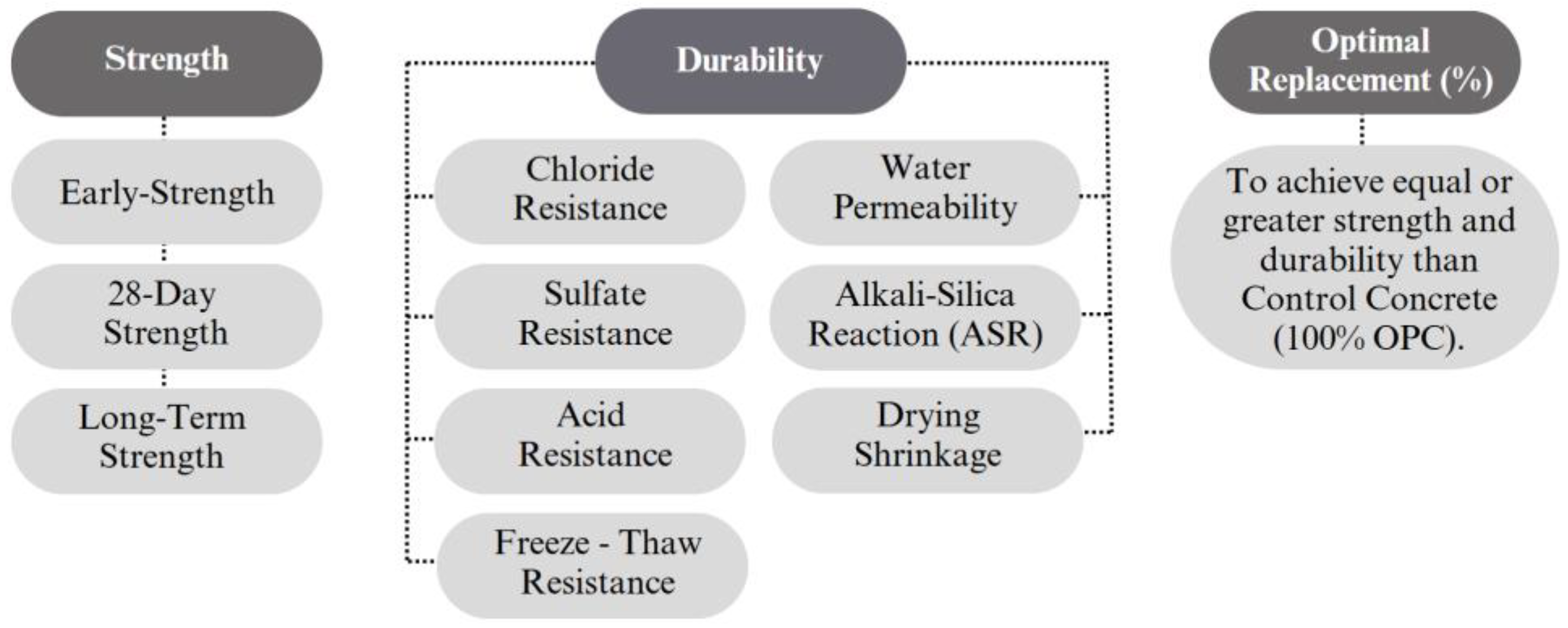
| Early-Strength | Standard Strength (28 D) | Long-Term Strength (Beyond 28 D) | Water Permeability | Sulfate Resistance | Acid Resistance | Chloride Resistance | Alkali–Silica Reaction (ASR) | Drying Shrinkage | Freeze–Thaw Resistance | ||||||||||||
| Elephant Grass |  | [85,86] | | [85,86] |  | [85] | N/A * | N/A | N/A | N/A | N/A | N/A | N/A | 20% [85,86,87] | |||||||
 | [87] |
| [87] | ||||||||||||||||
| Millet Husk | | [13,45] |
| [12,13,45] | | [12,13] |
| [12,100] | | [101,102] |
| [102] | | [12] | N/A |
| [100] | N/A | 5–10% [12,13,45,100,103] | ||
| Wheat Straw |
| [14] |
| [14] |
| [14] |
| [104] |
| [105] | N/A |
| [106] |
| [106,107] |
| [108,109] |
| [110] | 10–20% [14,52,104,108,111,112] | |
| Rice Husk |
| [11] |
| [11] |
| [10,11] |
| [11,43] |
| [113,114] |
| [115,116] |
| [11,117] |
| [118,119] |
| [120,121] |
| [122,123,124] | 10–30% [10,11,43,44,117,125,126] |
| Corn Cob |
| [27,91,92] |
| [91,92] |
| [91] |
| [127,128] |
| [91] |
| [127,129] |
| [27] | N/A |
| [26] |
| [130] | 8%–10% [27,91,92] | |
|
| [27] |
| [27] |
| [129] | ||||||||||||||||
| Saw Dust |
| [28,29,78] | | [28,29,78] |
| [28,29] | | [28,131] |
| [28] | | [132] | N/A | N/A |
| [28] | | [133] | 5–15% [28,29,30,31,78] | ||
|
| [30,31] | ||||||||||||||||||||
|
| [30,31] |
| [30,31] |
| [78] | ||||||||||||||||
| Crushed Coconut Shell |
| [32,33,66] | | [32,33,66] |
| [32,66] | | [134,135] |
| [66] [136] |
| [137] | | [138] | N/A | | [139] | N/A | 10–15% [32,34,65,66] | ||
|
| [34] | | [34,65] |
| [34] | ||||||||||||||||
| Sugarcane Bagasse |
| [20,21,90] |
| [20,21,22,90] |
| [20,21,22,90] |
| [20,21,22] |
| [140,141,142] |
| [140,142,143] |
| [21,22,142] | | [142,144] | | [21] [145] | N/A | 10–20% [20,21,22,90,142,146] | |
| Highland Barly Straw | N/A |
| [15] |
| [15] | N/A | N/A | N/A |
| [147] | N/A | N/A |
| [148] | 15% [15] | ||||||
| Oat Husk |
| [16] |
| [16] |
| [16] | N/A | N/A | N/A | N/A | N/A | N/A | N/A | 15–20% [16,149] | |||||||
| Palm Leaf |
| [17] |
| [17] |
| [17] |
| [81] | N/A | N/A | N/A | N/A | N/A | N/A | 5% [17,81] | ||||||
| Sorghum Husk |
| [23] |
| [23,24] |
| [23,24] |
| [24] | N/A | N/A | N/A | N/A | N/A | N/A | 5% [23,24] | ||||||
| Miscanthus | N/A | N/A | N/A | N/A | N/A | N/A | N/A | N/A | | [88] | N/A | 20% [88] | |||||||||
| Bambo Leaf | | [35,36,150] |
| [36,82,83] | | [35,37] |
| [151,152] | | [35,82] |
| [36,151] | | [37,82,151] |
| [153] | | [152,154] | N/A | 10–30% [35,36,37,82,83,84,150] | |
|
| [35,84,150] | | [36] | ||||||||||||||||||
| Banana Leaf |
| [38,39,40] |
| [38,39,40] |
| [38,39,40] |
| [38,39] |
| [38] |
| [38] |
| [39,155] |
| [39,40] | N/A | N/A | 10% [39,40] | ||
|
| [41] |
| [41] | ||||||||||||||||||
| Cashew Nutshell |
| [25] |
| [25,71] |
| [25] | N/A |
| [25] | N/A | N/A | N/A | N/A | N/A | 15% [25,71] | ||||||
| Cassava Peel |
| [95,96,97] |
| [95,96,97] |
| [95,96,97] |
| [97] |
| [156] |
| [97] |
| [97] |
| [157] |
| [97] | N/A | 5–10% [96,97] | |
| Rice Straw |
| [18] |
| [18,19] |
| [18,19] |
| [18,19] | N/A | N/A |
| [19] | N/A | N/A | N/A | 8–10% [18,19] | |||||
| Corn Stalk |
| [61,62] | | [61,158] |
| [62] | | [62] |
| [159] | N/A | | [160] | N/A | N/A |
| [59] | 7–10% [61,62,158] | |||
|
| [62] | ||||||||||||||||||||
| Wood |
| [80] | | [79] |
| [79] | | [80] | N/A |
| [161] | | [79] |
| [79] | | [79] |
| [80] | 10% [79] | |
|
| [80] |
| [80] | ||||||||||||||||||
indicates an increase, a decrease, and same (no change). * Entries marked as N/A indicate that data for the corresponding criterion were not available in the literature.| Criteria | Scoring Scale | Evaluation Basis | Score Description | Point Value |
|---|---|---|---|---|
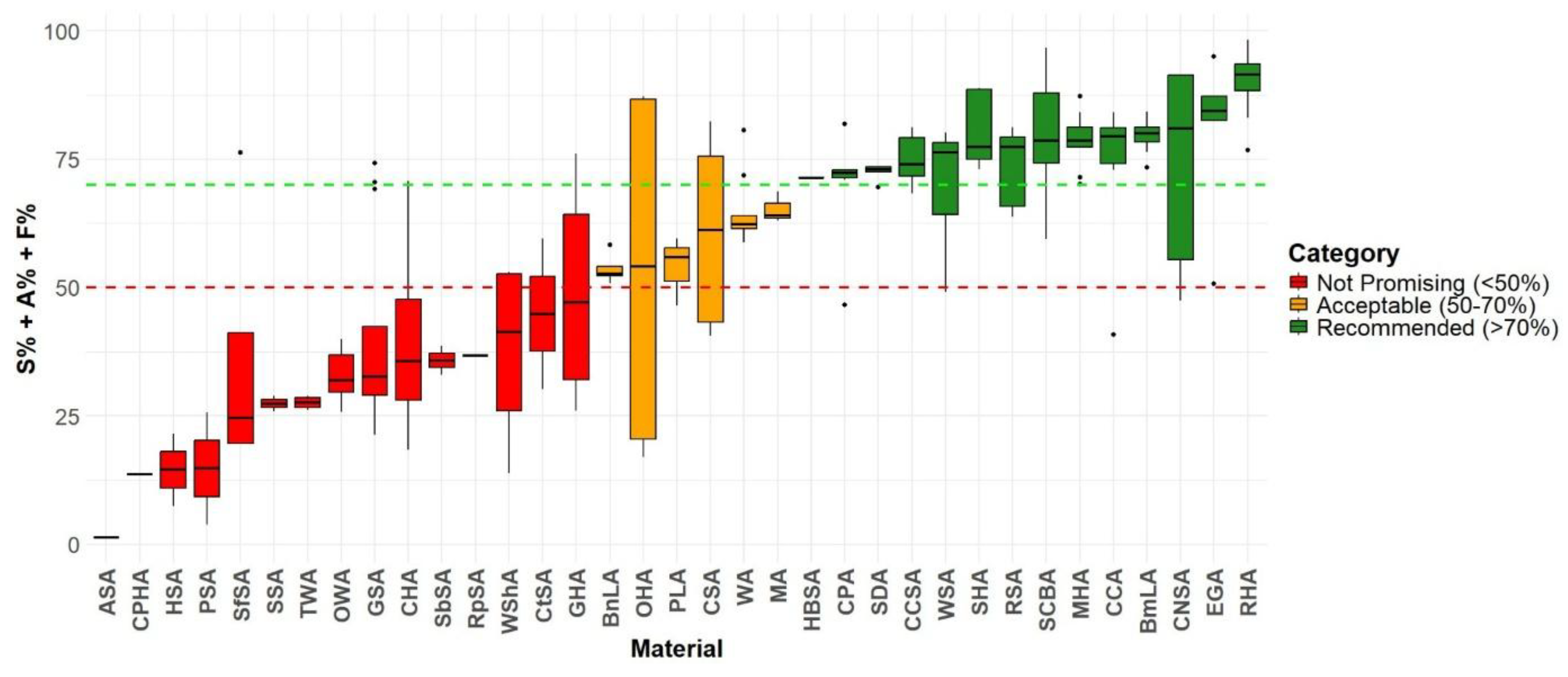
| Strength | −1, 0, 1 | Observed change compared to control concrete (100% OPC) | ↑ = increase ↓ = decrease - = same ↑ or ↓ = positive effective change - = neutral ↑ or ↓ = negative ineffective change | +1 0 −1 |
| Durability | ||||
| Optimal Replacement Percentage | 1, 2, 3 | Percentage-based performance outcome | >20% | 3 |
| 10–20% | 2 | |||
| <10% | 1 |
| Chemical Components | OPC | RHA | WSA | SCBA |
|---|---|---|---|---|
| SiO2 (%) | 19.00–25.00 [52,166] | 76.81–96.84 [2,119] | 44.54–77.36 [14,112] | 56.40–91.30 [140] |
| Al2O3 (%) | 4.00–6.19 [125,166] | 0.22–6.17 [11,119] | 1.50–9.10 [52,104,111] | 1.07–14.95 [22] |
| Fe2O3 (%) | 0.60–5.44 [21,166] | 0.20–4.19 [119,120] | 0.50–4.36 [52,104,111] | 0.42–12.25 [22] |
| CaO (%) | 60.22–65.96 [104,111,125] | 0.48–2.12 [2,11] | 3.05–12.54 [105,109] | 1.00–12.60 [22] |
| MgO (%) | 0.83–4.56 [11,21] | 0.28–1.41 [11,119] | 1.10–2.7 [52,108] | 0.30–6.42 [22,146] |
| Na2O (%) | 0.08–0.46 [11,119] | 0.03–1.83 [44,120] | 0.10–2.70 [52,109] | 0.12–3.4 [21,146] |
| K2O (%) | 0.27–1.30 [21,166] | 1.12–3.51 [2] | 1.30–11.10 [52,121] | 0.36–9.59 [21,144] |
| SO3 (%) | 2.03–3.40 [10,167] | 0.05–1.21 [10,120] | 1.13–2.35 [168,169] | 0.11–4.33 [20,22] |
| P2O5 (%) | 0.05 [10] | 0.80–0.98 [10,170] | 1.24–3.80 [12,107] | 0.59–2.13 [20,167] |
| Cl (%) | - | - | 0.2–0.30 [52] | - |
| TiO2 (%) | 0.28 [52] | - | 0.04–0.97 [109,112] | 0.30–1.30 [140] |
| LOI (%) | 0.51–4.10 [10,167] | 1.30–11.90 [121,170] | 4.03–11.20 [107,168] | 0.35–10.53 [171] |
| Physical Characteristics | OPC | RHA | WSA | SCBA |
|---|---|---|---|---|
| Particle Size (µm) | 4.0–86.56 [14] | 1–50 [2] | 3.56–134.3 [14] | 4.7–107.90 [140] |
| Fineness Passing 45 µm | 93% [22] | 70–99% [22] | - | 95–97% [22] |
| Blaine’s Fineness m2/kg | 308–373 [52,170] | 314–1620 [22,173] | 367–552 [105,112] | 453–1250 [22,144] |
| BET Specific Surface Area m2/g | 1.14–11.69 [108,120] | 18.89–65.60 [120,121] | 2.75–68.01 [52,112] | 6.1–60.50 [140] |
| Bulk Density kg/m3 | 3170 [170] | 2290 [170] | 1845 [104] | 1200–2500 [20] |
| Specific Gravity g/cm3 | 2.9–3.15 [22,107] | 2–2.7 [2,22] | 1.97–2.41 [105,107] | 1.36–2.88 [22] |
| Pozzolanic Activity Index (PAI) at 28 Days (PAI ≥ 75%) | - | 80–110% up to 20% RHA replacement [174] | 85.20–107.69% up to 20% WSA replacement [112] | 81–103% up to 20% SCBA replacement [175] |
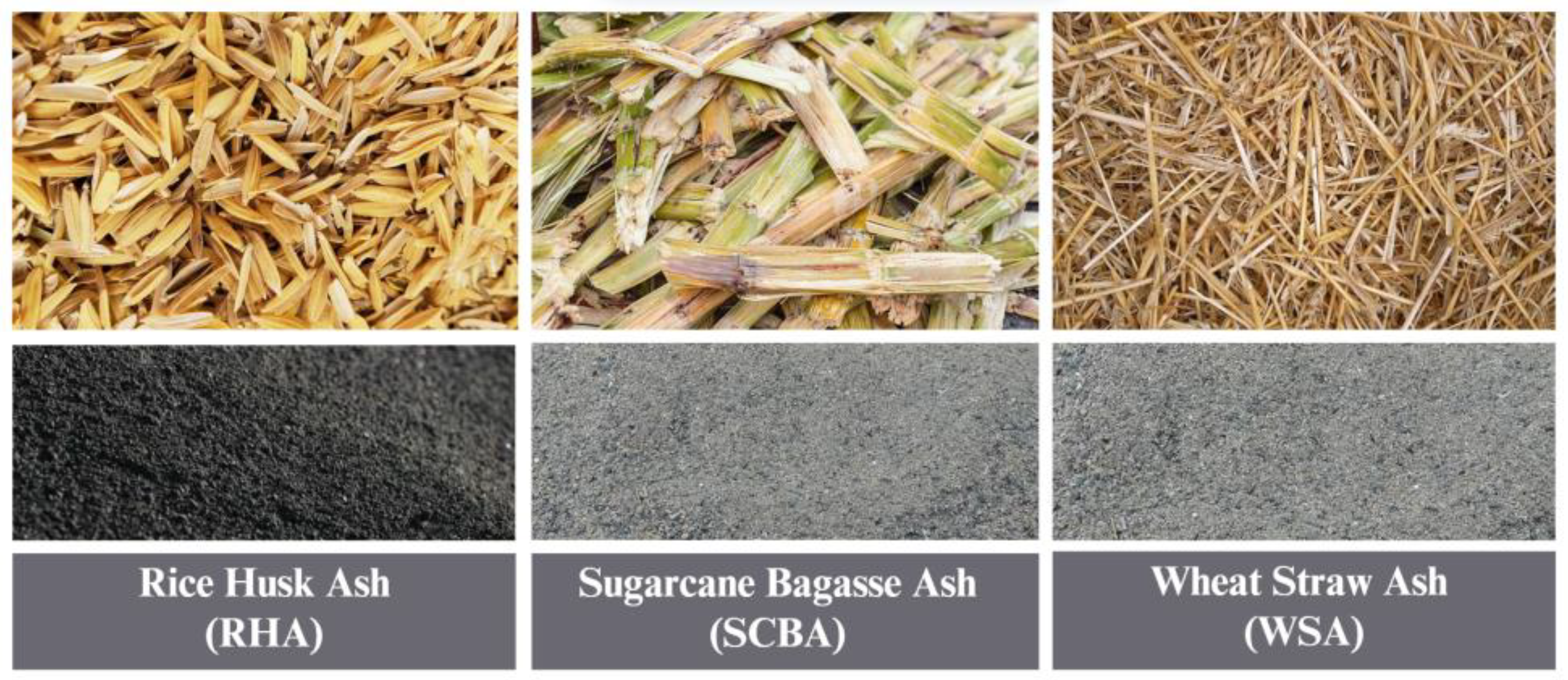
| Color | The color of ashes varies from black to whitish-gray, with lighter colors indicating a lower amount of unburnt carbon content in the ABAs [112]; however, SCBA also includes reddish tones [22]. | |||
| Durability Properties | RHA | WSA | SCBA |
|---|---|---|---|
| Water Permeability | Up to 35% replacement resulted in a reduction in water permeability. | Up to 20% replacement resulted in a reduction in water permeability. | Up to 25% replacement resulted in a reduction in water permeability. |
| Sulfate Resistance | Up to 30% replacement demonstrated improved sulfate resistance in sodium sulfate (Na2SO4) and mixed sulfate environments. | Up to 24% replacement showed the highest CS at the lower sodium sulfate concentration (10,000 mg/L), while 16% replacement performed best at the higher concentration (40,000 mg/L). | Up to 20% replacement resulted in improved sulfate resistance. |
| The use of ABA-blended cement concrete reduces the content of C3A and Ca(OH)2, limiting the availability of these reactive compounds and decreasing the formation of harmful products like gypsum and ettringite that contribute to sulfate-induced deterioration [109]. | |||
| Chloride Resistance | Up to 35% replacement resulted in increased chloride resistance. | Up to 40% replacement resulted in improved chloride resistance. | Up to 25% replacement enhanced chloride resistance. At 28 days, 5% showed moderate corrosion risk, while 15% and 25% showed low risk, further reduced to very low by 56 days. |
| Acid Resistance | Up to 30% replacement resulted in increased resistance to nitric and acetic acids. | - | Up to 20% replacement resulted in increased resistance to sulfuric acid. |
| Freeze–Thaw Resistance | Up to 20% | Up to 15% | - |
| Alkali–Silica Reaction (ASR) | Up to 40% replacement resulted in a reduction in ASR expansion. | Up to 15% replacement enhanced ASR resistance. | Up to 40% mitigated the ASR. |
| ASR, known as the cancer of concrete, causes expansion and cracking due to the reaction between reactive silica in aggregates, hydroxyl ions (OH−), alkali ions (Na+, K+), and moisture, forming an expansive gel. Alkalis in cement (Na2O and K2O) raise the pore solution pH, accelerating ASR and leading to structural damage [144]. To reduce risk, the total alkali content must meet ASTM C150. SCMs with higher alumina content help mitigate ASR by forming calcium aluminosilicate hydrate (C-A-S-H) gel, which binds alkalis and reduces their availability in the pore solution [119]. | |||
| Drying Shrinkage | Up to 30% replacement resulted in a reduction in drying shrinkage. | Up to 20% replacement resulted in a reduction in drying shrinkage, due to WSA’s fineness and porous structure that absorbs water and acts as an internal curing agent. | Up to 25% replacement reduced drying shrinkage or showed similar values to CC. |
| Low Heat of Hydration | ABA-blended cement concrete has a lower heat of hydration than CC, reducing the risk of early-age thermal cracking [21]. This is due to fewer heat-releasing components (C3A, C3S, gypsum) [21,142] and a higher amount of pozzolanic oxides in ABAs. | ||
Disclaimer/Publisher’s Note: The statements, opinions and data contained in all publications are solely those of the individual author(s) and contributor(s) and not of MDPI and/or the editor(s). MDPI and/or the editor(s) disclaim responsibility for any injury to people or property resulting from any ideas, methods, instructions or products referred to in the content. |
© 2025 by the authors. Licensee MDPI, Basel, Switzerland. This article is an open access article distributed under the terms and conditions of the Creative Commons Attribution (CC BY) license (https://creativecommons.org/licenses/by/4.0/).
Share and Cite
Mirzaei, L.; Ghebrab, T.; Fedler, C.B. Review and Evaluation of Agricultural Biomass Ashes as Supplementary Cementitious Materials for Sustainable Concrete. Processes 2025, 13, 3571. https://doi.org/10.3390/pr13113571
Mirzaei L, Ghebrab T, Fedler CB. Review and Evaluation of Agricultural Biomass Ashes as Supplementary Cementitious Materials for Sustainable Concrete. Processes. 2025; 13(11):3571. https://doi.org/10.3390/pr13113571
Chicago/Turabian StyleMirzaei, Leila, Tewodros Ghebrab, and Clifford B. Fedler. 2025. "Review and Evaluation of Agricultural Biomass Ashes as Supplementary Cementitious Materials for Sustainable Concrete" Processes 13, no. 11: 3571. https://doi.org/10.3390/pr13113571
APA StyleMirzaei, L., Ghebrab, T., & Fedler, C. B. (2025). Review and Evaluation of Agricultural Biomass Ashes as Supplementary Cementitious Materials for Sustainable Concrete. Processes, 13(11), 3571. https://doi.org/10.3390/pr13113571