1. Introduction
Reliability analysis has always depended on specific data and parameters, making it essential for evaluating lifetime data. Nevertheless, real-world situations frequently result in inaccurate and partial information, which raises questions about the precision of these evaluations. This requires the development of approaches that can reliably interpret ambiguous data and maintain the integrity of reliability assessments in the context of incomplete data. In order to meet the obstacles presented by uncertain circumstances, a customized approach to reliability evaluation is required, particularly when dealing with ambiguous lifetime data. In response to the need for a more flexible framework, Zadeh [
1] pioneered the development of fuzzy set theory. This theory offers a framework for a sophisticated and flexible reliability analysis in circumstances that are uncertain and complex. Fuzzy set theory is a pragmatic method for handling uncertain data, which utilizes a membership degree to express the probability of an event. This degree quantifies the level of association between an element and a fuzzy set. Through successful research efforts, the concept of fuzzy sets has evolved significantly, leading to the development of different expansions. Type 1, type 2, and intuitionistic fuzzy sets (IFSs) are examples of extensions that increase the utility of fuzzy set theory. Each extension corresponds to a specific situation, providing a versatile framework for collecting and expressing various aspects of uncertainty in many different kinds of situations. Atanassov’s fundamental work [
2] pioneered the definition of intuitionistic fuzzy sets, while his recent work [
3] provided novel operations and bridged conceptual gaps between intuitionistic and type 1 fuzzy sets theories. After that, Zeng et al. [
4] presented a new multi-attribute decision-making method using intuitionistic fuzzy values and a modified VIKOR method. In a different case, experienced specialists were limited to provide options within the scope of IFS. To address this problem, Yager [
5,
6,
7] proposed Pythagorean and generalized orthopair fuzzy sets. The concept of IFSs has been utilized to address various decision-making [
8,
9,
10] and reliability evaluation issues [
11,
12,
13].
Several influential research articles have significantly contributed to the advancement of system reliability analysis through the application of fuzzy set theory. One notable approach involves employing fuzzy probability for reliability analysis, by utilizing fuzzy random numbers to represent uncertain probabilities of system events [
14]. To enhance the system reliability engineering, fuzzy set theory is also expanded to address numerous multi-objective system reliability optimization scenarios [
15,
16,
17]. These techniques optimize system reliability under conflicting objectives, considering both probabilistic and imprecise reliability measures [
18]. Furthermore, Refs. [
19,
20,
21] employed intuitionistic fuzzy sets to construct and systematically evaluate the reliability of both time-dependent and blended systems, meticulously accounting for the inherent uncertainties associated with lifetime data. Moreover, the authors also presented the studies (Refs. [
22,
23,
24]) that apply simulation-based techniques to analyze complex systems, highlighting how these methods enhance understanding and reliability assessments across various contexts. Recently, q-rung orthopair fuzzy sets have been utilized in system reliability analysis to sophisticatedly handle and model the inherent uncertainties in system performance predictions [
25,
26,
27,
28].
The Burr XII distribution is one of the twelve distributions in the Burr family. It is defined by two positive shape parameters, referred to as
η and
γ. This distribution is critical in survival analysis, especially when studying heavy-tailed survival time data [
29]. Burr XII’s probability density function can have a declining or unimodal structure, giving it versatility in representing many events. The curve of hazard rate function of the Burr distribution is flexible, as it can exhibit either diminishing trends or an upside-down bathtub shape. Its versatility enables it to accurately simulate diverse risk patterns [
30]. The application of fuzzy approaches has improved the reliability study of the Burr family distribution. One study presents a compound class of the unit Burr XII model, analyzing parameters and fuzzy reliability using both nonfuzzy and fuzzy estimators [
31]. In another study, the Burr XII distribution is utilized to apply sophisticated statistical techniques for modeling two competing failure modes [
32]. Furthermore, a comparison of classical and Bayesian estimates of a Burr type XII distribution using fuzzy technique is explored in Ref. [
33]. Moreover, Burr XII is used in several excellent works pertaining to lifetime and fuzzy analysis [
34,
35,
36,
37,
38,
39].
Jamkhaneh and Shabani [
40,
41] presented a new type of generalized intuitionistic fuzzy numbers (GenIFNs) based on Mondal’s [
42] fundamental generalized intuitionistic fuzzy sets (GenIFSs) for the reliability study of life distribution. They investigated several reliability measures and derived different system reliability for life distribution using this new fuzzy set [
43,
44,
45]. In a recent work, Kalam, A. et al. [
46] also used this new fuzzy set to study the reliability characteristics for Lomax life distribution. The existing literature clearly emphasizes the utmost importance of comprehending fuzzy reliability in the context of fuzzy life distribution, both in theoretical and practical domains.
To achieve this, we used the Burr XII distribution to study the dynamics of life distribution, concentrating on the uncertainty in one of its shape parameters, γ. By fixing the first shape parameter η and fuzzifying the other into a GenIFN, we developed a fuzzy probability framework for the Burr XII distribution. Extending our exploration, we provided generalized intuitionistic fuzzy probability and reliability for this life distribution by applying new -cut sets. This approach effectively unraveled the inherent fuzziness in the form of reliability characteristic bands. Our study also involved a comprehensive analysis of the nature of these reliability characteristics over time, shedding light on their temporal evolution and dynamics. This new methodology aims to significantly improve the precision and comprehension of reliability evaluations in the domain of system reliability engineering. Its emphasis point is the intricate analysis of complex systems where the inherent challenges of uncertainty and imprecision play a critical role. By addressing these critical variables, the approach attempts to raise the standard for reliability evaluation, contributing to a finer understanding necessary for the construction and maintenance of highly reliable and resilient systems.
The subsequent parts of the paper are methodically arranged as follows:
Section 2 provides a thorough examination of the fundamental ideas of generalized intuitionistic fuzzy set theory.
Section 3 and
Section 4 elaborate on the methodological framework used to derive GIFSs probability, illuminating the intricate process underlying the development of key reliability features, namely, reliability, conditional reliability, and hazard functions modified for the Burr XII life distribution. The subsequent
Section 5 systematically gives a numerical example, complemented by a graphical representation, deliberately utilized to support and strengthen the theoretical constructions presented in the preceding sections.
2. Definitions
2.1. Generalized Intuitionistic Fuzzy Set (GenIFS)
A GenIFS [
40] within a non-empty universal set
X is defined as
where
,
are the extent of membership and non-membership functions of
in
, respectively. Also,
, for each
and
,
.
2.2. Generalized Intuitionistic Fuzzy Number (GenIFN)
A new type of GenIFN,
[
41], can be given as
where
,
are the membership and non-membership functions of
, respectively. The GenIFN
is represented as
if
and
.
The above expression indicates that a generalized intuitionistic fuzzy number (GenIFN) has an equal distribution in its membership and non-membership functions, centered around a main value and showing symmetry in its left and right sides.
2.3. GenIFN Based on -Cut Sets
A generalized intuitionistic fuzzy number (GenIFN) based on the
α-cut and
β-cut sets can be defined by
Suppose that the fixed numbers
such that
,
and
; then the
-cut sets are derived as
Note that the above expression contains two cut-sets, the
-cut set of GenIFN,
where
and the
-cut set of GenIFN,
where
The
-cut sets of a GenIFN are the intersection of these two cut-sets,
which can be simplified as
2.4. Several Relations and Operations on GenIFNs
Let us consider two GenIFNs, and , then.
3. Generalized Intuitionistic Fuzzy Probability
Lifetime data uncertainty often arises from random variables or imprecise model parameters. In this context, we specifically address parameters represented as fuzzy numbers, enhancing our approach by employing generalized intuitionistic fuzzy numbers (GenIFNs). This leads to the introduction of a refined concept, fuzzy probability, which accommodates and quantifies the inherent uncertainty in model parameters.
Let us consider a lifetime variable
X characterized by a density function
, where
are represented as generalized intuitionistic fuzzy parameters. So, we can define the
cut for membership and
cut for the non-membership function within the provided fuzzy probability framework for a constant point
c as
for
, where
is the crisp probability defined as
and
Consequently, the generalized intuitionistic fuzzy probability (GenIFP) can be given by
and the
-cut sets of GenIFP for
c are
with
and
for empty set
and universal set
.
To be more specific, we considered a lifetime variable
X from the Burr XII distribution with two shape parameters,
η and
γ, having the cumulative distribution function
and the probability density function
Moreover, changing the values of γ leads to different shapes in the probability density function graph while η remains constant, and vice versa. Fuzzification with generalized intuitionistic fuzzy sets (GenIFSs) enhances the modeling of Burr XII distribution’s shape parameters, offering a more flexible uncertainty representation by considering membership, non-membership, and hesitancy levels. This might be flexibly applied to one or both shape parameters, accommodating the specific needs of diverse datasets.
Consider the lifetime variable X from the Burr XII distribution with fuzzification to the one shape parameter, γ, into a GenIFN as , while the other shape parameter, , remains constant.
Since
is the monotonically decreasing function of
γ, the cut-sets of the generalized intuitionistic fuzzy distribution function is given by
which leads to the cut-sets for the specific point
x =
c:
Corollary 1. Let us consider the GenIFP , then.
- (I)
- (II)
Proof.
(I) From the definition of GenIFP, for
,
which is substantiated by relation 2.4 (V).
(II) Since
it is
and based on the relation 2.4 (IV), the proof is completed. □
4. Generalized Intuitionistic Fuzzy Reliability Characteristics
The generalized intuitionistic fuzzy sets method enhances the analysis of reliability parameters by considering membership, non-membership, and hesitancy levels, effectively addressing subjective, uncertain, and vague aspects of information. This sophisticated technique goes beyond the limits of conventional binary logic, adapting to the inherent unpredictability found in intricate systems and thereby improving the accuracy of their representations.
Let a lifetime variable X from the density function , where the parameter is vectorized by a generalized intuitionistic fuzzy number (GenIFN) and the generalized intuitionistic fuzzy reliability characteristics (GenIFRCs) is denoted by .
Then, the
-cut sets for GenIFRC for
can be given by the following equation:
where
with the following restrictions:
,
,
and
. The function
may be considered reliability measures, including hazard rate, reversed hazard rate, or cumulative risk functions.
Finally, the GenIFRC is shown as
and the
-cut sets of GenIFRC are given by
where
is a two-variate function of
k and time
t. For every special time,
is a generalized intuitionistic fuzzy number. In this method, for every special value of
and
, curves of
and
behave as bands with lower and upper limits.
These reliability measures possess some important properties, which can be remarked as follows:
Remark 1. If and , then ,
Remark 2. If, then .
4.1. Generalized Intuitionistic Fuzzy Reliability
Using the developed notion of reliability characteristics, the cut-sets for one of the measures of GenIFR are
where
with constraint
.
The GenIFR is shown as
and the cut-sets of GenIFR are given by the following equation:
For the Burr XII distribution,
Since
is a monotonically decreasing function of
, the
α and
β cut-sets for GenIFR can be modified as
Moreover, for the Burr XII life distribution,
Note that for every set of , the reliability bands hold the given relations:
,
,
.
Since
is a two-variate function of
k and time
t. For every special time
, the membership
and non-membership
functions of GenIFR based on Equation (2) can be derived as
4.2. Generalized Intuitionistic Fuzzy Conditional Reliability
The concept of conditional reliability focuses on the probability that an object will continue to function at a given time (
t), provided it has remained operational up to that point (
T). This concept is particularly crucial in reliability engineering and risk assessment. To accommodate uncertainty and imprecision often found in real-world scenarios, this traditional notion of conditional reliability is explored through the application of fuzzy sets. The cut-sets of GenIFCR are
where
for all
. Hence, GenIFCR can be given as
and the cut-sets of the GenIFCR function is described as
Considering the Burr XII distribution, the cut-sets of GenIFCR can be given as
The function
exhibits a monotonic decrease in relation to its parameter
, leading to the subsequent formulation for GenIFCR bands.
4.3. Generalized Intuitionistic Fuzzy Hazard
The hazard function, also commonly referred to as the instantaneous failure rate, is a critical component of life distribution analysis. It essentially provides an estimate of the likelihood that a component will fail at a given point in time, given that it has survived up to that moment. This function is instrumental in predicting the time-dependent failure rates of components or systems in service. For the generalized intuitionistic fuzzy hazard GenIFH functions, the cut-sets play a significant role. These cut-sets provide a means to evaluate the hazard function under varying degrees of uncertainty and fuzziness, allowing for a more comprehensive and elaborated understanding of the failure dynamics of the system. The cut-sets of GenIFH are
where
and
for
.
The GenIFH can be given as
and the
-cut sets of GenIFH are
For the Burr XII distribution, the above equations will be adjusted as follows:
Given that the function
is characterized by a monotonic increase with respect to its parameter
, the hazard bands can be described as follows:
Corollary 2. Consider the two lifetime random variables and , from two different GenIF density functions and , respectively. If the condition and hold, then for each .
Theorem 1. The function must be increasing, which is a necessary and sufficient condition on for to belong to a class of distribution with a decreasing failure rate.
Proof. As stated, for every
,
and
so, it can be observed that
or
Equating lower and upper bands to
, then
Hence,
are increasing functions, and by using the definition of the GenIFCR, we have
Since is increasing, and
or
hence proving that
.□
5. Numerical Illustration
The application of a generalized intuitionistic fuzzy Burr XII distribution in traffic control systems offers a sophisticated approach to managing complex traffic dynamics. This distribution, characterized by its ability to represent asymmetric behaviors and adapt to varying data scenarios, can be integrated with intuitionistic fuzzy logic to handle the inherent uncertainties and ambiguities in traffic patterns. This integration allows for better interpretation of traffic data, more efficient traffic flow management, and improved adaptive signal system performance, leading to reduced congestion and enhanced road safety.
Let us consider that a traffic control system is modelled by the generalized intuitionistic fuzzy Burr XII distribution with a fixed shape parameter
, fuzzified shape parameter
, and special values of
. The
-cut sets for GenIFP for
are
The concept here pertains to the idea of generalized intuitionistic fuzzy probability (GenIFP) functions acting as bands. These bands, referred to as the lower and upper bands, define the range or scope of reliable functioning in a system. The bandwidth, which is the measure of this range, varies depending on specific values set
. This variability implies that the extent of reliable performance, denoted by the bandwidth, can expand or contract based on certain conditions or values. The GenIFP bands for different sets of
and
are calculated in
Table 1.
Since the GenIFP bands are function of
and
, then for a special set of
,
and
, the membership and non-membership curves are
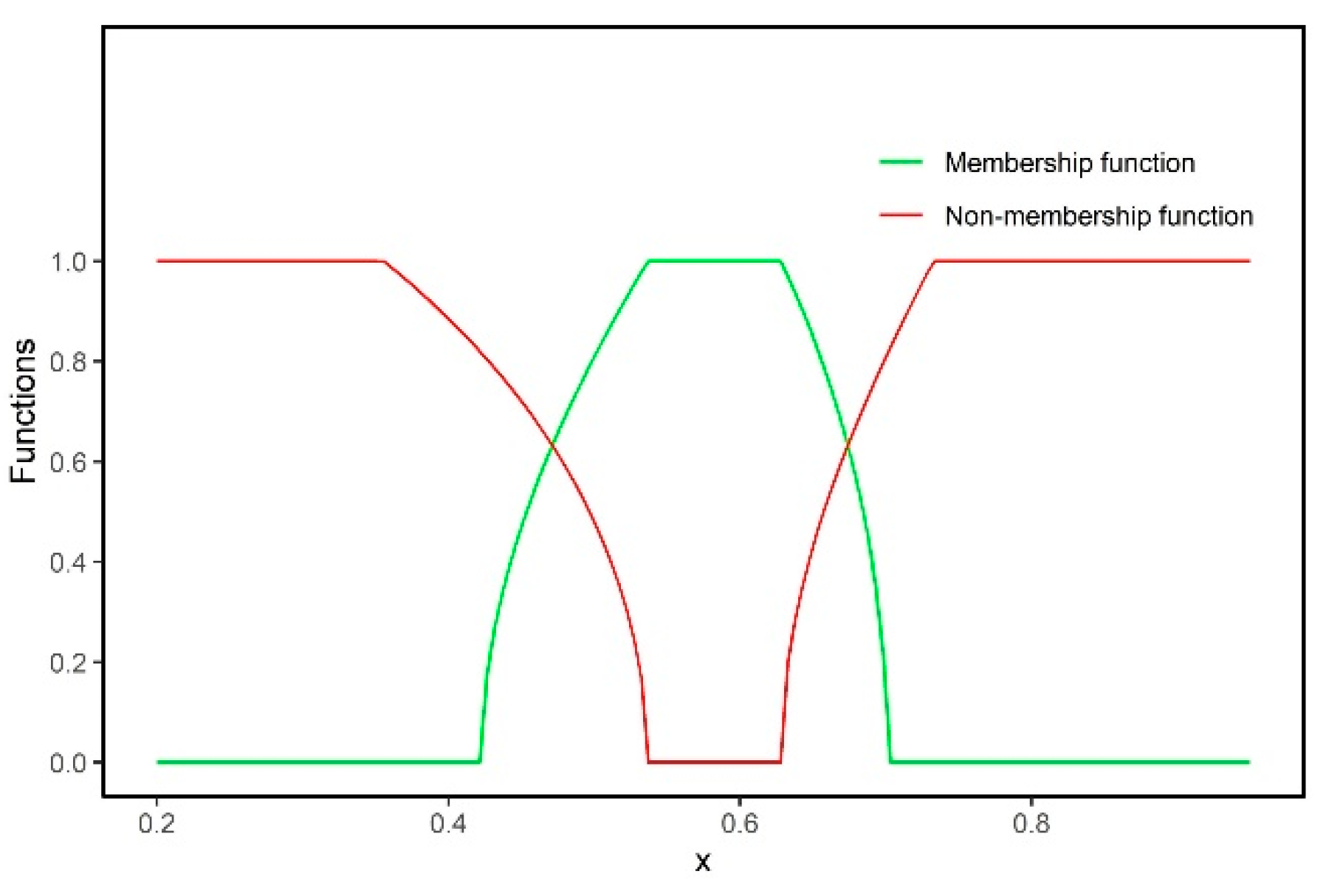
Hence, the functions of membership
and non-membership
curve of the GenIFP bands are described by the above expressions and graphically shown in
Figure 1.
In the same way, the GenIFR bands for different sets of
at fixed time
are calculated in
Table 2 using the following expressions:
The functions for membership and non-membership curves of GenIFR bands at special time
,
and fixed set
are given as
It can be observed that
Table 2 shows the reliability bands for various cut-sets but for a fixed time point
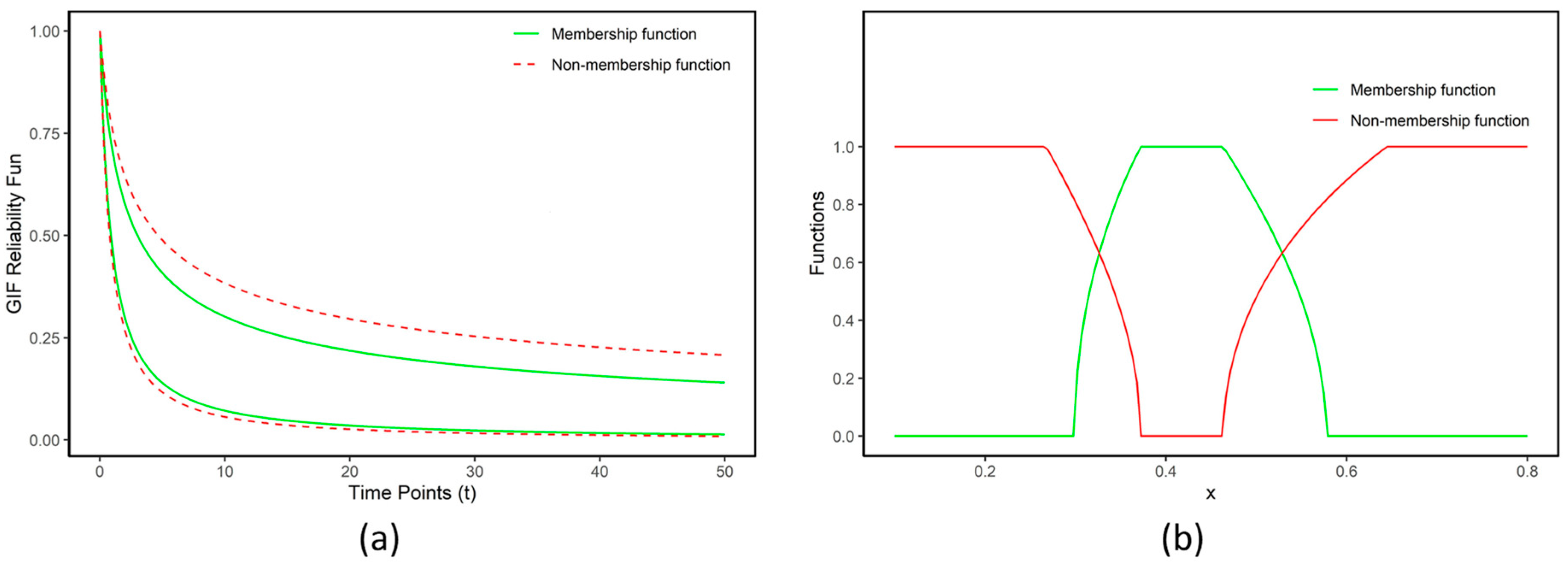
. It is necessary to observe the reliability bands for various time points. So, we fixed a cut-set value at
and observed the reliability bands over time
t, as shown in
Figure 2a.
Similarly, the membership (green solid line) and non-membership (red solid line) functions for GenIFR bands for special time
and cut-set
are shown in
Figure 2b.
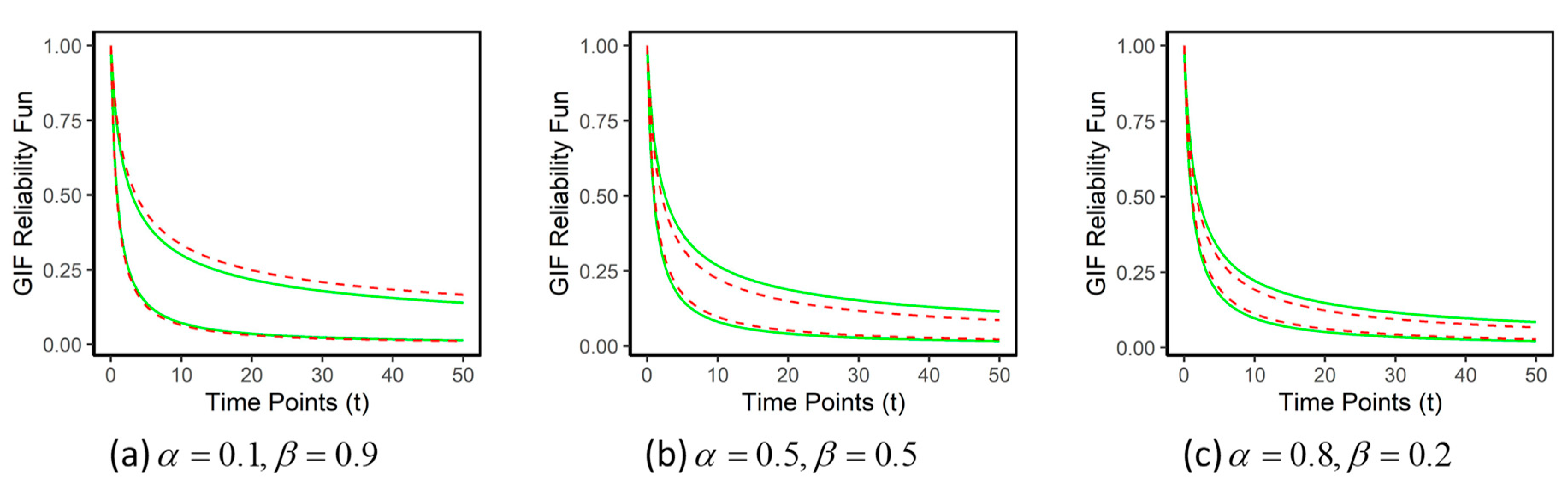
Figure 3 provides a detailed perspective by presenting additional sets of
values with respect to time
t. These values demonstrate that fuzziness in GenIFR can be reduced by simultaneously increasing
and decreasing
.
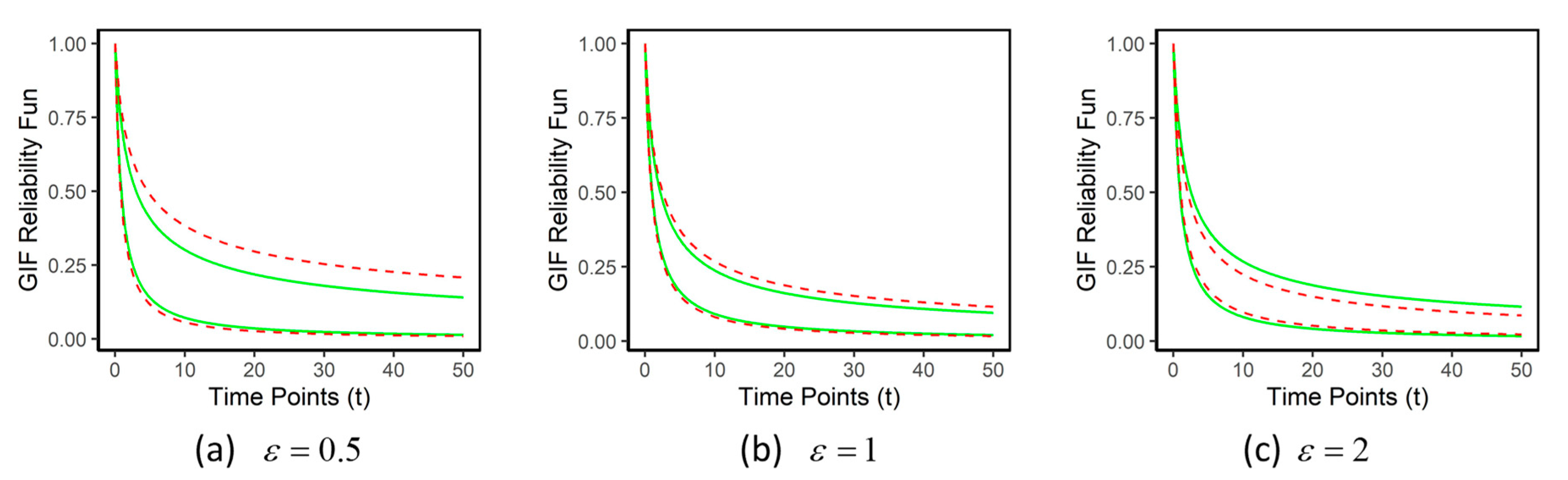
The reliability features of generalized intuitionistic fuzzy characteristics (GenIFRC) are influenced by parameter
. This is illustrated in
Figure 4, where the reliability bands for varying
values are presented with parameters
and
set equal to 0.5. This illustration suggests that as
increases, the reliability of the system becomes more precise or accurate.
The cut-sets of GenIFCR bands for various values of
and time
are obtained using the following relations and presented in
Table 3.
Also, the functions of membership and non-membership curves for GenIFCR at
,
are
The generalized intuitionistic fuzzy conditional reliability (GenIFCR) bands varying with time
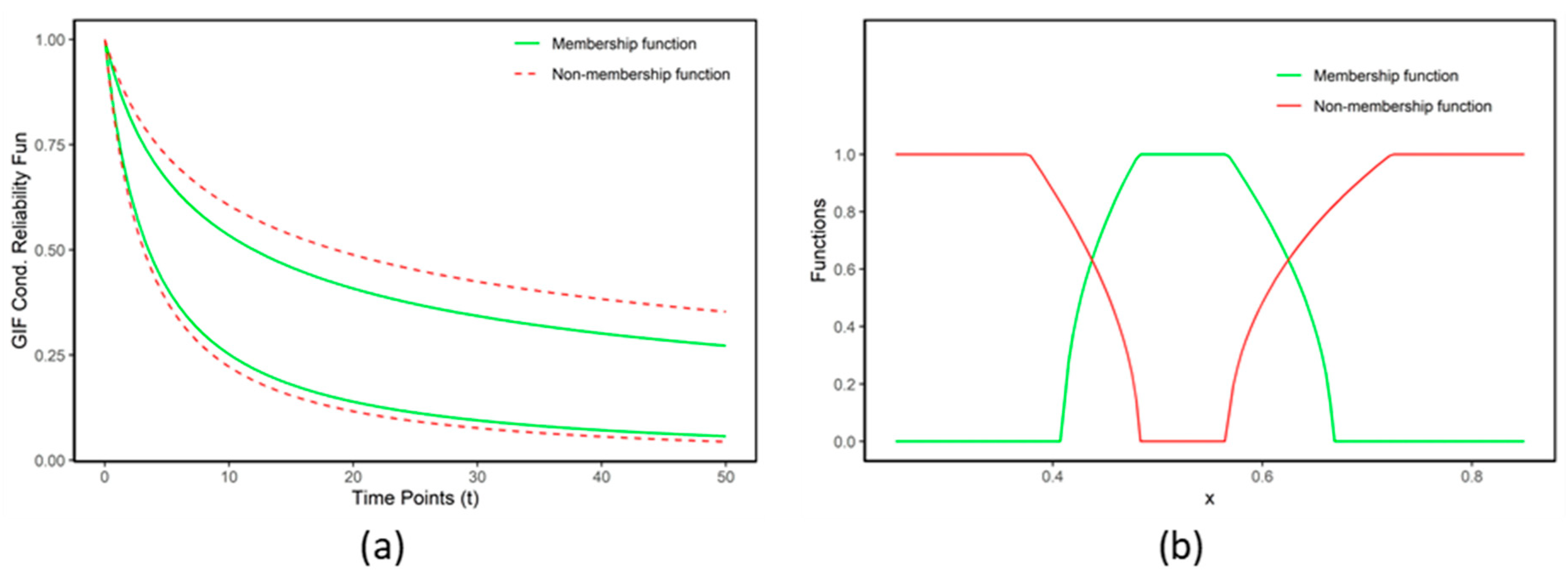
t are shown in
Figure 5a. Also, their membership and non-memberships curves are presented in
Figure 5b.
Finally, the cut-sets of generalized intuitionistic fuzzy hazard (GenIFH) bands based on the following expressions are given in
Table 4.
Analogously, the functions of membership and non-membership curves for GenIFH are given as
In the same way,
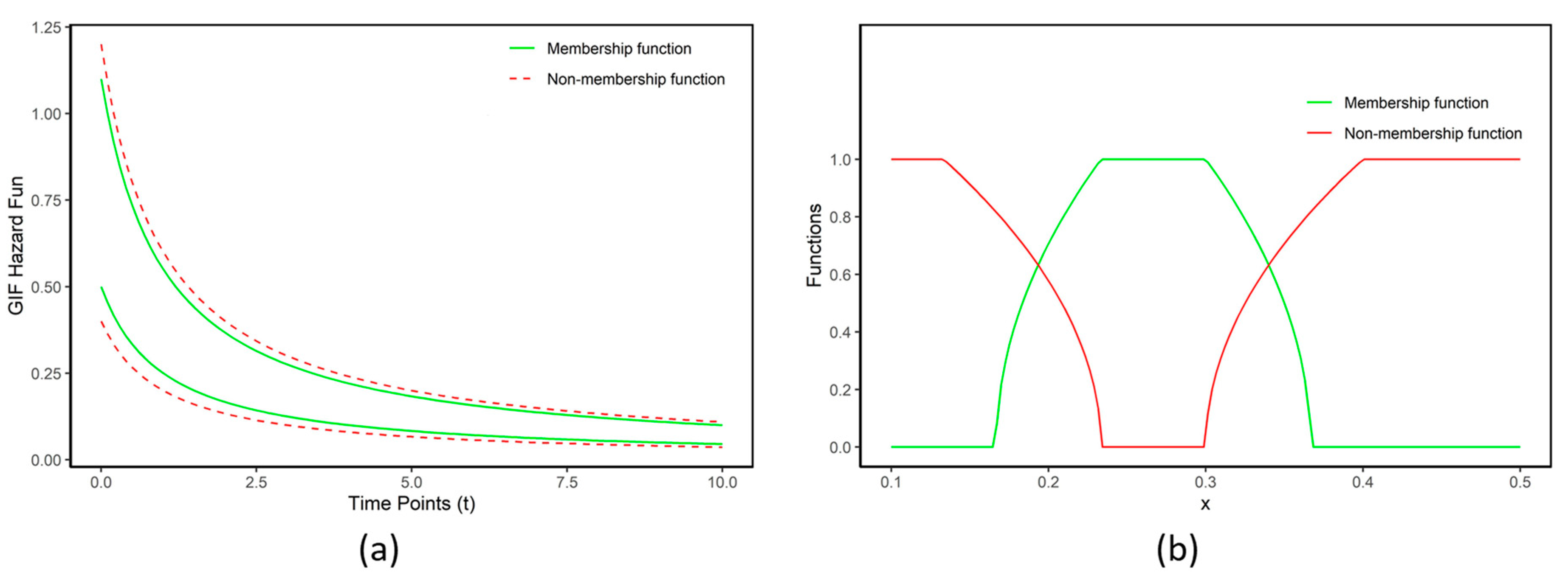
Figure 6a shows the decreasing GenIFH bands with time
t for the case of least vagueness, which is attended for the greatest and lowest values of
and
, respectively. Also, the curves for membership and non-membership functions of hazard bands are graphically shown in
Figure 6b.
6. Results and Discussion
This study employs a generalized intuitionistic fuzzy approach to examine the Burr XII lifetime distribution, introducing a novel methodological paradigm. The main goal is to evaluate uncertainty in many aspects of reliability measures in a comprehensive manner. The study achieves this goal by precisely quantifying the inherent fuzziness in one of the essential shape parameters of the Burr XII distribution, indicated as . Concerning the fuzzy method, we concentrated on a particular case of the generalized intuitionistic fuzzy framework containing predetermined values for . In this study, the parameter ε is set to a value of 2, and the cut-set approach is used to precisely determine the bands of various reliability measures.
The cut-set bands of the generalized intuitionistic fuzzy probability (GenIFP) bands for various sets are presented in
Table 1, which indicates that for
, the most reliable band can be found at the highest cut-set of the membership function and the lowest cut-set of the non-membership function. Furthermore, the
-cut of membership and
-cut of non-membership function for generalized intuitionistic fuzzy reliability (GenIFR) bands at time
have been shown in
Table 2. It indicates that most precise bands are attended at the greatest
and lowest values of
for fixed time. Since the reliability bands change over time, we have also included the GenIFR bands for
over time
t in
Figure 2a and a few more sets in
Figure 3. Based on
Figure 2a and
Figure 3, we conclude that the reliability bands lead to a great reduction in the level of uncertainty over time
t. Additionally, the membership and non-membership curves for
and
have been graphically shown in
Figure 2b. It is important to discuss the significance of parameter ε as it has a substantial impact on the uncertainty in both reliability and probability characteristics.
Figure 4 shows that the best reliable bands are obtained at the maximum value of parameter
.
Another characteristic discussed here is the generalized intuitionistic fuzzy conditional reliability (GenIFCR) bands, which are presented in
Table 3 for
t = 2 and for varying
t in
Figure 5a. They exhibit the same trend as the GenIFCR bands. Eventually, we also studied the generalized intuitionistic fuzzy hazard (GenIFH) bands, evaluating them in
Table 4 for a fixed time parameter
t and displaying results in
Figure 6a for varying
t. Notably,
Table 4 shows improved precision in hazard bands, particularly for the greatest cut-set value for the membership function and the lowest cut-set value for the non-membership function at a fixed time. Also,
Figure 6a shows an obvious reduction in bandwidth over time.
In conjunction with the above outcomes, our study encompasses a thorough examination detailing the computation of membership and non-membership functions for each reliability measure. This comprehensive analysis is visually presented in
Figure 2b,
Figure 5b and
Figure 6b, employing a graphical representation with the green line symbolizing the membership function and the red line depicting the non-membership function.
In summary, the findings from
Table 1,
Table 2,
Table 3 and
Table 4 underscore the significance of optimizing the cut-sets for membership and non-membership, revealing improved precision in probability and diverse reliability measures. Furthermore, the observed trend across all reliability measures indicates a systematic decrease in the value of uncertainty or fuzziness corresponding to increasing time
t.
7. Conclusions
This study assesses the fuzzy reliability of the Burr XII lifetime distribution using the notion of generalized intuitionistic fuzzy sets. In the Burr type XII distribution with two parameters, one of the shape parameters remains fixed while the other is treated as a generalized intuitionistic fuzzy number (GenIFN) so as to calculate probability and various reliability measures. The fuzziness or uncertainty of parameters can be assessed using bands formed by the various reliability measures, with each individual pair of cut-set values related to a distinct band width. The results demonstrate that optimal bandwidth precision is reached when the cut-set of membership functions is large, paired by a small cut-set of non-membership functions. In addition, all measures exhibit a declining trend as time progresses. Remarkably, this approach surpasses alternative fuzzy sets by effectively exposing greater levels of ambiguity.
The current study focuses on enhancing the field of system reliability engineering. The presented technique provides a way to evaluate the reliability of different systems, including those organized in series and parallel configurations. In addition, the combination of extended intuitionistic fuzzy approaches with the Hausdorff distance also has the potential to greatly improve models used for spatial and image data analysis for further research and practical use.
Acknowledging certain limitations inherent in applying the generalized intuitionistic fuzzy technique in reliability analysis is imperative. A notable constraint arises in the heightened complexity of modeling and computational processes. This increased complexity poses potential challenges in real-world applications, necessitating careful consideration. The identified difficulties underscore the significance of further research endeavors aimed at overcoming these challenges in the practical domain of reliability analysis.