1. Introduction
In recent decades, T–S systems have become popular due to their ability to model nonlinear systems with a high accuracy and efficiency [
1,
2]. T–S fuzzy systems use a set of fuzzy if–then rules to represent the system, and each rule corresponds to a local linear model that approximates the behavior of the system. Therefore, we can extend many linear control methods to the constructed system. In addition, T–S fuzzy systems can handle uncertainties in the system by associating different local models with different fuzzy rules. In recent years, T–S fuzzy systems have been successfully used in various fields, such as robotics, power systems, and finance [
3,
4,
5]. Furthermore, T–S systems can be extended to T–S interconnected systems (ISs) [
6,
7], where each subsystem is described by a T–S model and the entire system is represented by a set of interconnected subsystems. However, the design of the T–S IS controllers needs to address the challenges related to local controller coordination to achieve the required global performance. To solve this problem, decentralized control is a method of distributing control actions among multiple local controllers, which can be designed using available local information [
8,
9,
10]. This increases the computational efficiency of the entire system and improves the fault tolerance, as each local controller can operate independently and adapt to the changes in local conditions. Furthermore, the design of decentralized controllers for T–S ISs poses challenges, such as selecting appropriate local models and coordinating local controllers to achieve the desired global performance. Nonetheless, the potential advantages of the T–S IS and its applications in various fields demonstrate its importance as a framework for the modeling and control of complex systems.
Based on the T–S IS system concept, the T–S IS can be expressed in the form of descriptors. Descriptor systems provide a general mathematical framework for the modeling and analysis of complex dynamic systems. Unlike ordinary differential equations, descriptor systems combine differential equations with algebraic constraints, making them well-suited for representing a variety of physical phenomena in mathematics, engineering, and physics. Therefore, the T–S IDS is a mathematical model used to represent complex system dynamics in control theory [
11,
12,
13]. It is widely used for the accurate modeling of systems with nonlinear and time-varying behavior, making it a powerful tool for analyzing and simulating complex systems in diverse fields, such as engineering, science, and industry. The versatility and applicability of the T–S IDS make it an important tool for researchers and practitioners. However, to effectively control the T–S IDS, it is very important to keep the T–S IDS impulse-free [
14,
15,
16], which involves avoiding sudden or abrupt changes in the control actions. Impulse-free action can lead to unstable behavior or even damage the system, making it difficult to control complex systems with high precision. In addition to the impulse-free problem, regularity is another key requirement for descriptor systems [
17,
18,
19]. Regularity ensures that the system is well-posed and that the solution to the system equations is unique and stable. Therefore, designing a controller that guarantees impulse-free and regularity is a challenging problem in control theory.
From the above, we can see that designing a controller for the T–S IDS is challenging because of the additional complexity introduced by impulse-free and regularity constraints. Constraints must be considered when designing the controller to ensure that the system remains stable and meets the required performance specifications. Through the PDFC method [
20,
21], the T–S IDS is usually converted into a conventional system through derivative signals. The PDFC is an effective technology to improve the stability and performance of the T–S IDS [
22,
23]. To design the PDFC method, it is crucial to access the state signals and state-derivative signals within the system. This ensures that the fuzzy controller can be designed and implemented efficiently. However, it should be noted that not all signals in the system are directly measurable, which poses a significant challenge to the controller design. To overcome this challenge, observer-based methods can be used to estimate the derivative signals in the system [
24,
25,
26]. This enables the PDFC strategy to be effectively implemented in real-world applications, even if some signals cannot be measured directly. Based on the above reasons, the main motivation of this article is to increase the possibility of designing PDFC methods through observer control technology and solve the problem of unmeasured system signals. Furthermore, the design procedure of the fuzzy controller considers the decay rate performance to enhance the transient response of the system.
Inspired by the above discussion, this paper uses the T–S fuzzy model to divide the nonlinear ID into a series of interconnected linear subsystems. The contributions of this article are summarized as follows: 1. Decentralized control technology is used in the design process of the controller. Each subsystem is controlled by the local controller, allowing the controller to operate independently. 2. Compared with the previous literature [
20,
27], this article uses the observer method to estimate system signals that cannot be directly measured, which can effectively increase the possibility of designing a PDFC method. 3. The proposed controller will be implemented through mathematical tools, such as the FWLF, LMIs, and the Schur complement. In addition, in the design process of the fuzzy controller, the focus will be on improving the transient response of the system by considering the decay-rate performance. 4. The effectiveness of the proposed controller will be evaluated through different simulation case studies.
The remainder of the paper is organized as follows:
Section 2 reviews the overall state of the unmeasured T–S IDS and its nonlinear dynamics, and some remarks and lemma are also given. Our research method, a decentralized fuzzy control of the T–S IDS, is shown in
Section 3, with the observer-based-feedback approach and the PDFC method. Simulation results of realistic case studies are provided in
Section 4. Finally,
Section 5 deals with the conclusions and future perspectives.
2. Problem Descriptions
In this section, let us consider the nonlinear-state-unmeasured IDS composed of nonlinear subsystems. The nonlinear IDS is transformed into the T–S IDS with interconnections and perturbations, as follows:
Model Rule
: IF
is
,
, and
is
,
for
,
and
;
are fuzzy sets and
denotes the premise variable. For the
i-th nonlinear subsystem,
is the number of rules;
denotes the vector of state;
denotes the vector of the control input;
denotes the vector of the output. The matrices
,
, and
are the appropriate dimensions. The matrices
may be singular.
is the interconnection term.
By using the central average defuzzifier and fuzzy inference, the fuzzy system (1) can be deduced as follows:
Define and ; is the fuzzy membership grade of in .
The objective of this study is to propose a decentralized fuzzy controller state-unmeasured T–S IDS. To achieve this, the following fuzzy observer is proposed, which can effectively estimate the unmeasurable states and increase the possibility of designing decentralized fuzzy controllers:
where
is the estimate of
and
is the estimate of
. The matrices
and
are the observer gains. According to [
23], the estimation error can be defined as
. The overall representation of the fuzzy observer can be obtained by differentiating the estimation error.
With some simplifications (4) can be written as:
where
Observers are designed to estimate the unmeasured or unobservable states of the system using the available input and output information. Observer-based control is particularly useful when the direct measurement of all state variables is not feasible. It enhances the system’s robustness, stability, and performance by utilizing the observer’s estimates. The decentralized fuzzy controller with the observer-based-feedback method and the PDFC method is proposed as:
where
and
are the controller gains.
Remark 1 ([
23])
. In the IDS, the states of the system may not be uniquely identifiable from the available measurements or outputs. This can occur due to the presence of degeneracy or redundancy in the system dynamics near the singularity. As a result, designing an observer that can accurately reconstruct the states of the system from its outputs becomes challenging. Moreover, in an observer-based control system, the estimated states are integrated into the control law. This allows the controller to utilize the estimated states to generate the control signals, thus compensating for the absence of the direct measurements of all states. The author presents assumptions in [23], which ensure the system’s observability and similar assumptions. By incorporating controller (7) into system (1), we can establish the resulting closed-loop system:
From (8), we can obtain
where
Remark 2 ([
27])
. The description matrix in a descriptor system may cause system impulse or irregularities. First, irregular systems can cause simulation and control design difficulties because they can lead to singular problems. Second, the impulse may cause transient changes in the state variables. Therefore, we must ensure that the system is regular and impulse-free before we can conduct the stability analysis. The constraints and definitions regarding the T–S IDS have been discussed in detail in [27]. Through differential terms, we can convert the descriptor system into a standard state-space system. In addition, when matrix is a full-rank matrix, it can be ensured that the system is not singular-satisfied impulse-free and regular. Remark 3 ([
20,
27])
. Findings are from earlier investigations in [20,27]. The PDFC approach generally relies on the direct measurement of the system’s current state for the efficient control-signal generation. However, in cases where the direct measurement of the signal is not feasible, it significantly impacts the control performance and diminishes the viability of the PD control method. As a solution, this paper introduces an observer-based control technology. The observer is capable of estimating the system’s state based on the input and output information, enabling the utilization of these estimated signals in the controller design to enhance the implementation feasibility. Next, an important lemma is given for following derivations.
Lemma 1 ([
27])
. According to [27], the following inequality holds:orwhere is the free-weighting matrices and is the interconnection matrix. Definition 1. The decay-rate performance refers to the rate at which the system’s transient response diminishes over time. For all trajectories of system (10), if there exists a decay rate that satisfies the following inequality, then the T–S IDS is said to be quadratically stable with the decay rate.
3. Main Results
This paper is devoted to the development of a decentralized fuzzy controller for stabilizing system (9). To accomplish this objective, the stability conditions for system (9) can be summarized as follows:
Theorem 1. The state-unmeasured T–S IDS (9) can be stabilized asymptotically by the decentralized fuzzy controller if the existence of controller gains, observer gains, and positive definite matrices meet the following requirements:where , , , Proof. Based on [
28], we consider the FWLF as
where
and
For any matrices
,
,
, and
of proper dimensions, it follows from (5) and (9) that
and
Substituting (19) into (17), then
Based on (11) from Lemma 1, one has
where
On the other hand, (18) can be rewritten as the following with (12) and (20):
where
According to (16), if the inequalities (14) and (15) are held, which also means . If is held, then system (9) is asymptotically stable. The proof of Theorem 1 has been concluded. However, the stability conditions presented in Theorem 1 are bilinear matrix inequalities (BMIs), which cannot be directly computed using the LMI toolbox. Consequently, it is essential to convert the stability condition into a computationally tractable form. □
Theorem 2. The state-unmeasured T–S IDS (9) can be stabilized asymptotically by the decentralized fuzzy controller if the existence of controller gains, observer gains, and positive definite matrices meet the following requirements:where , , , Proof. Pre- and postmultiplying
by
and its transpose, we have
where
,
,
,
,
,
Substituting (10) into (26), and expanding the membership function, then
where
Furthermore, defining the matrices
,
,
, and
, we have the following equations:
where
Similar to (27), substituting (6) into
, we have the following equation:
where
Defining the matrices
,
,
,
, and
, we obtain
where
By adding (28) to (30), it follows that
By using the Shur complement, we obtain
where
Theorem 2 presents sufficient conditions to ensure the stability of the state-unmeasured T–S IDS based on the decentralized fuzzy control with the observer-based feedback and the PDFC method. It is easy to see that the new sufficient conditions developed in Theorem 2 are in the LMI form, which can be solved by the Matlab LMI toolbox directly. Furthermore, if (24) and (25) are satisfied, then from (31). In addition, the closed-loop system (9) is asymptotically stable because from (16). Therefore, the proof is completed. In the following, the decay-rate performance has been chosen to enhance the system’s transient response. □
Theorem 3. Given the performance scalar , the state-unmeasured T–S IDS (9) can be stabilized asymptotically by the decentralized fuzzy controller if the existence of controller gains, observer gains, and positive definite matrices meet the following requirements:where , , , Proof. By using the Schur complement, the inequality (34) can be referred as follows with (31):
Multiplying
and transporting on both sides of (36), one can obtain
Following the same method, the condition (35) can be written as:
Based on the characteristics of the membership function
and
, one can know
If the inequality (39) is satisfied, then the state-unmeasured T–S IDS is quadratically stable with a decay rate constraint. The proof of Theorem 3 is complete. In the following, some examples are given to show the application of the proposed fuzzy control method. □
Remark 4. Due to the complexity of the system, the conditions obtained when conducting system-stability analysis are usually in the form of BMIs. Therefore, we cannot use the Matlab LMI toolbox for conditional solving during the simulation. However, through the free-weighing matrices method, we can increase the possibility of converting the BMIs to LMIs. In addition, the LMI toolbox provides various solvers to handle different types of LMI problems. However, the toolbox may not be able to solve the problem due to poor conditions or being too complex. The LMI conditions (Theorems 2 and 3) proposed in this paper are complex conditions. In order to increase the feasibility of the solution, we increase the flexibility of the optimization problem through the free-weighing matrices. This additional flexibility may help in finding solutions.
Theorem 1 uses the Lyapunov function and free-weight matrix to prove the stability condition of the system. However, this article uses the Matlab LMI toolbox to solve the conditions, and Theorem 1 cannot be solved. In this regard, Theorem 2 introduces a conversion process to convert Theorem 1 into an LMI form. By solving Theorem 2, a fuzzy controller for the state-unmeasured T–S IDS can be derived. Furthermore, we know the importance of performance for control systems, so we propose the decay-rate performance in Theorem 3, and then combine it with the conditions in Theorem 2 to pursue enhanced overall system performance. Obviously, the conditions proposed in Theorem 2 and Theorem 3 belong to LMI problems, and this problem can be easily solved by using the MATLAB LMI toolbox to search for feasible solutions.
However, considering the decay rate, Theorem 3 may cause: 1. over-damping, resulting in a longer system settling time; 2. a potential increase in the possibility of oscillation or overshooting; 3. an excessively strong recession rate, which may make the system unstable. Based on the above reasons, users can choose the required stability conditions according to the needs of the system. In order to determine the feedback gain conveniently and clearly, we propose the following design method, and use Theorem 2 or Theorem 3 to calculate the feedback gains and observer gains.
Controller Design Procedure:
Step 1: Check the satisfactions of the definitions and remarks for the system.
Step 2: Users can choose theorem according to the system requirements (Theorem 2 or Theorem 3) to obtain the variables , , , , , , , , , , , and by using the MATLAB LMI toolbox.
Step 3: According to , , , , , , , and , one can find the feedback gains , , , and , and the observer gains , , , and .
Step 4: Using the gains acquired in Step 3, one can design the corresponding controller.
Before giving the example, the following steps are given to determine the stability of the systems.
- (1)
Identify the Equilibrium Points: Determine the equilibrium points of the interconnected system by finding the values of the state variables at which the system remains unchanged. These points are obtained by setting the time derivatives of all state variables to zero.
- (2)
Simulate the System: Use mathematical modeling or simulation techniques to obtain the state trajectories of the interconnected system. This involves solving the system’s equations of motion or employing numerical methods to simulate its behavior.
- (3)
Plot the State Trajectories: Plot the state trajectories on a graph, with each state variable represented on a separate axis. Ensure that the graph captures the dynamics of the system over time.
- (4)
Evaluate the Convergence: Examine the behavior of the state trajectories over time. If the trajectories converge to the equilibrium points identified in Step 1, it suggests stability. Specifically, if the trajectories approach the equilibrium points and remain within a certain range, it indicates stable behavior.
It is important to note that the stability analysis can be complex and may require advanced mathematical techniques and system-specific considerations. The steps provided here provide a general approach that can help the user determine the system stability and whether the observer is functioning.
4. Numerical Examples
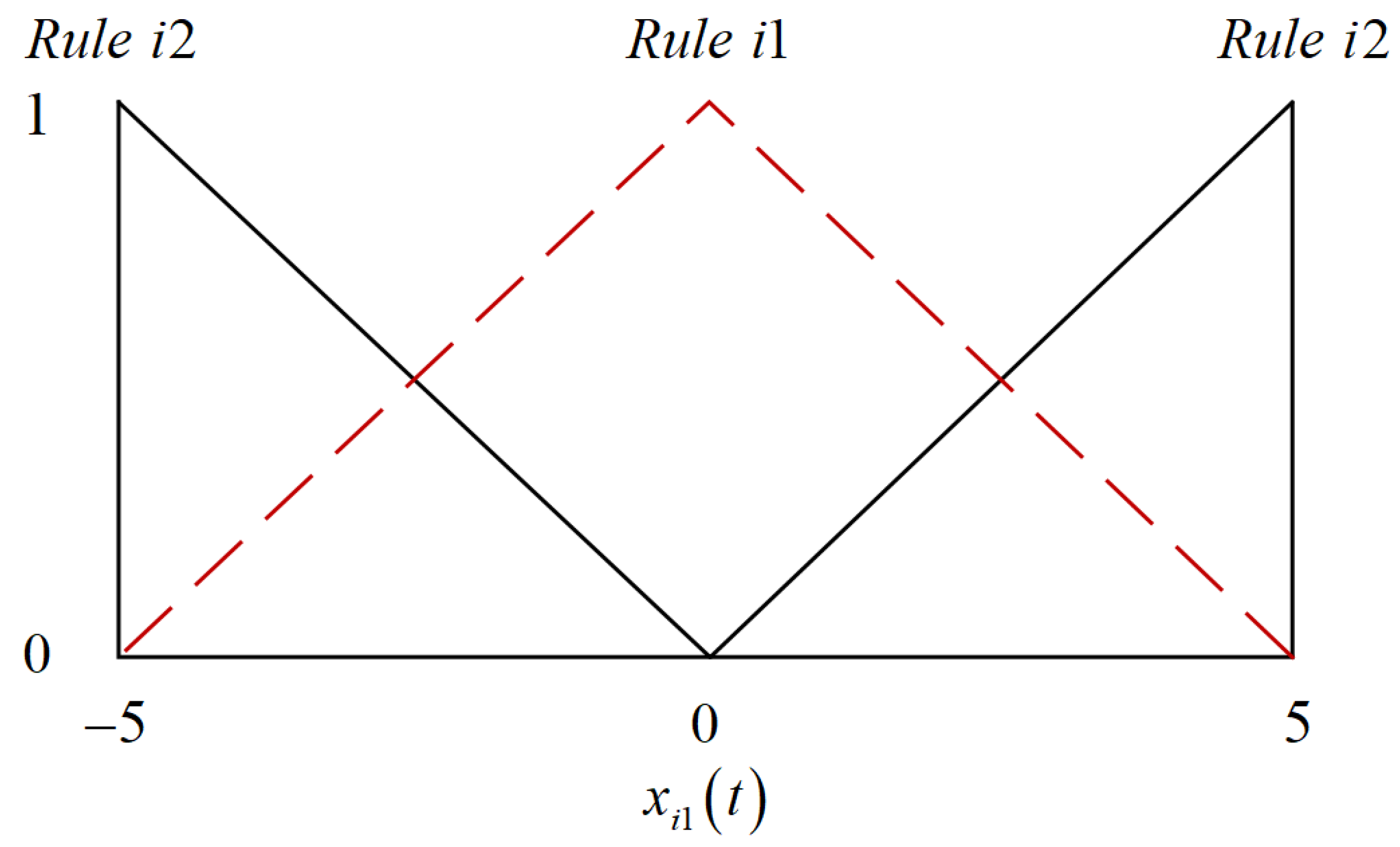
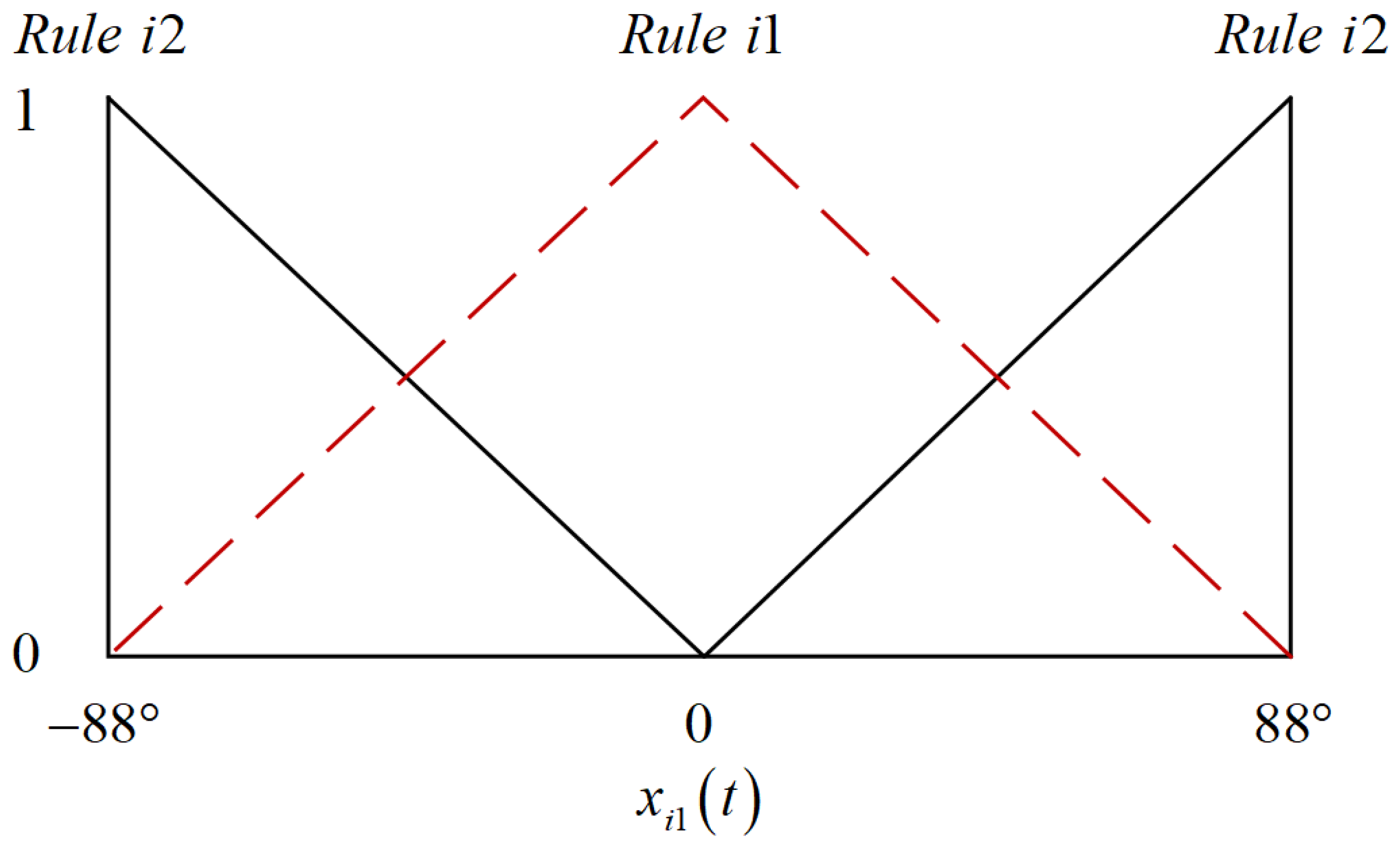
Example 1. To showcase the aforementioned findings, we will consider a numerical-state-unmeasured T–S IDS (9) that consists of two subsystems with singular matrices. Based on the membership function from Figure 1, the system parameters are given as follows for subsystem 1 and 2: By leveraging the capabilities of the MATLAB LMI toolbox, the feedback gains can be determined by solving the conditions stated in Theorem 2.
In order to illustrate the decay-rate performance given by Theorem 3, we solve Theorem 3 and obtain the following control gains.
Let us consider the system with the following initial conditions
,
, and
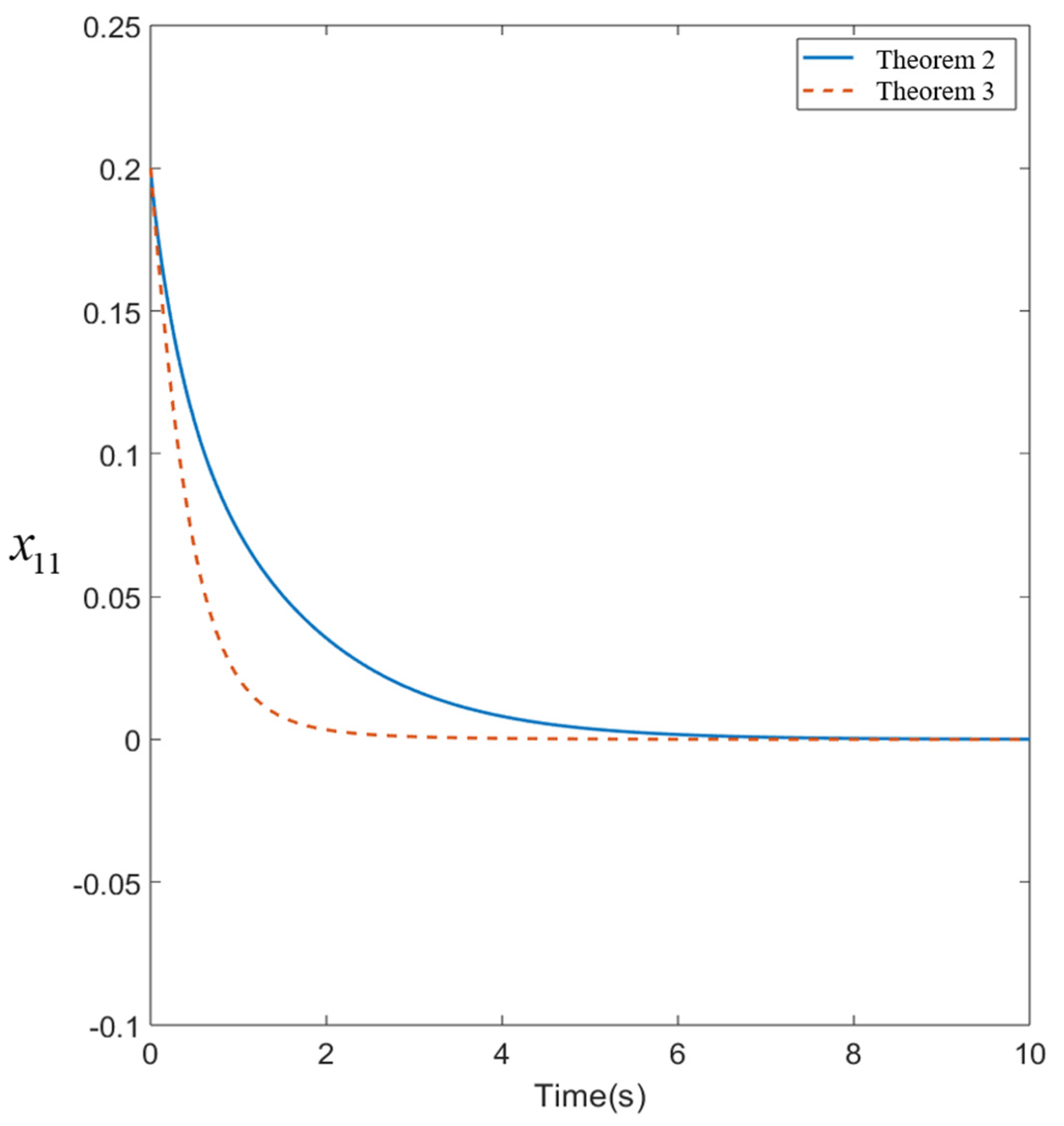
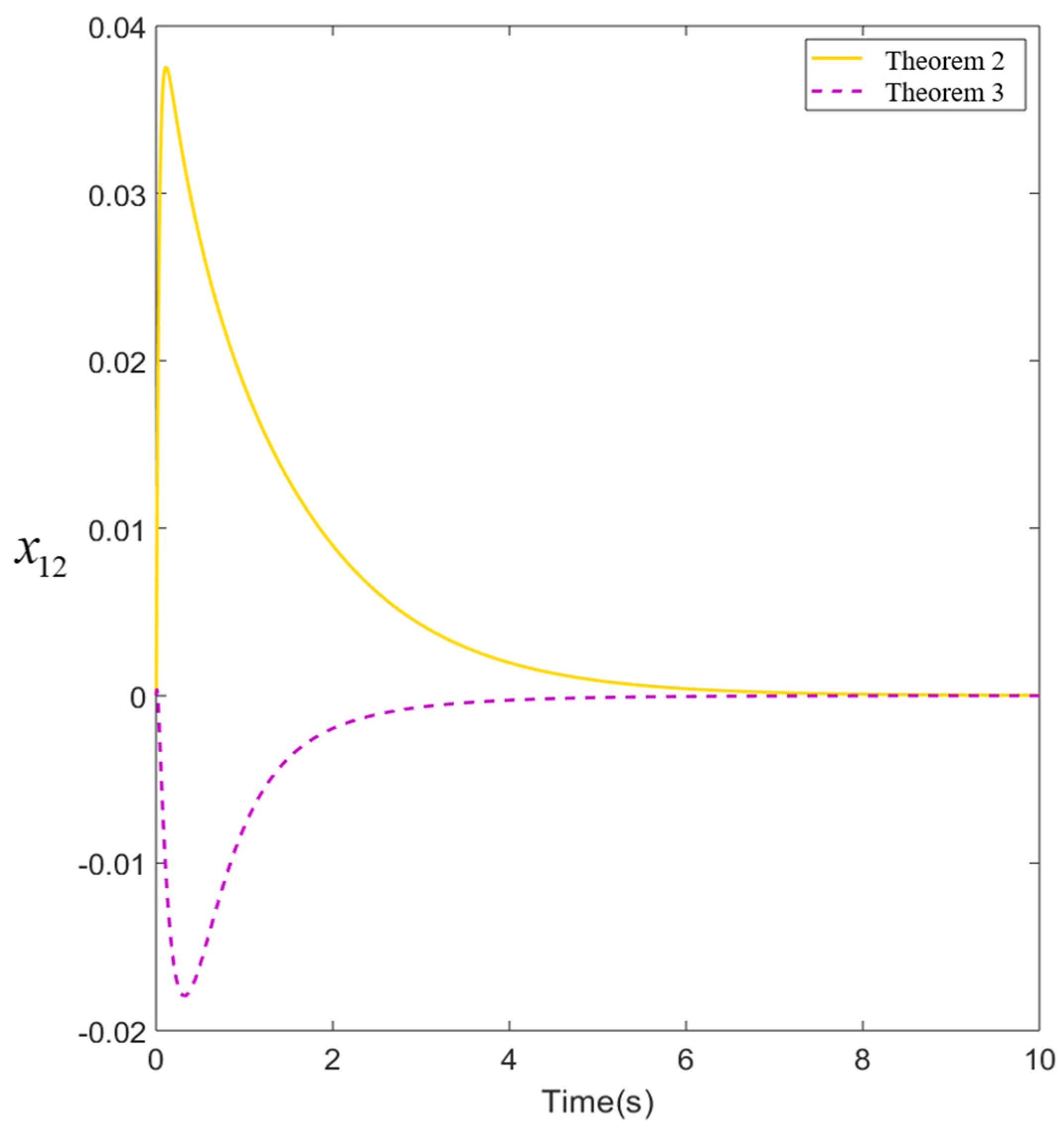
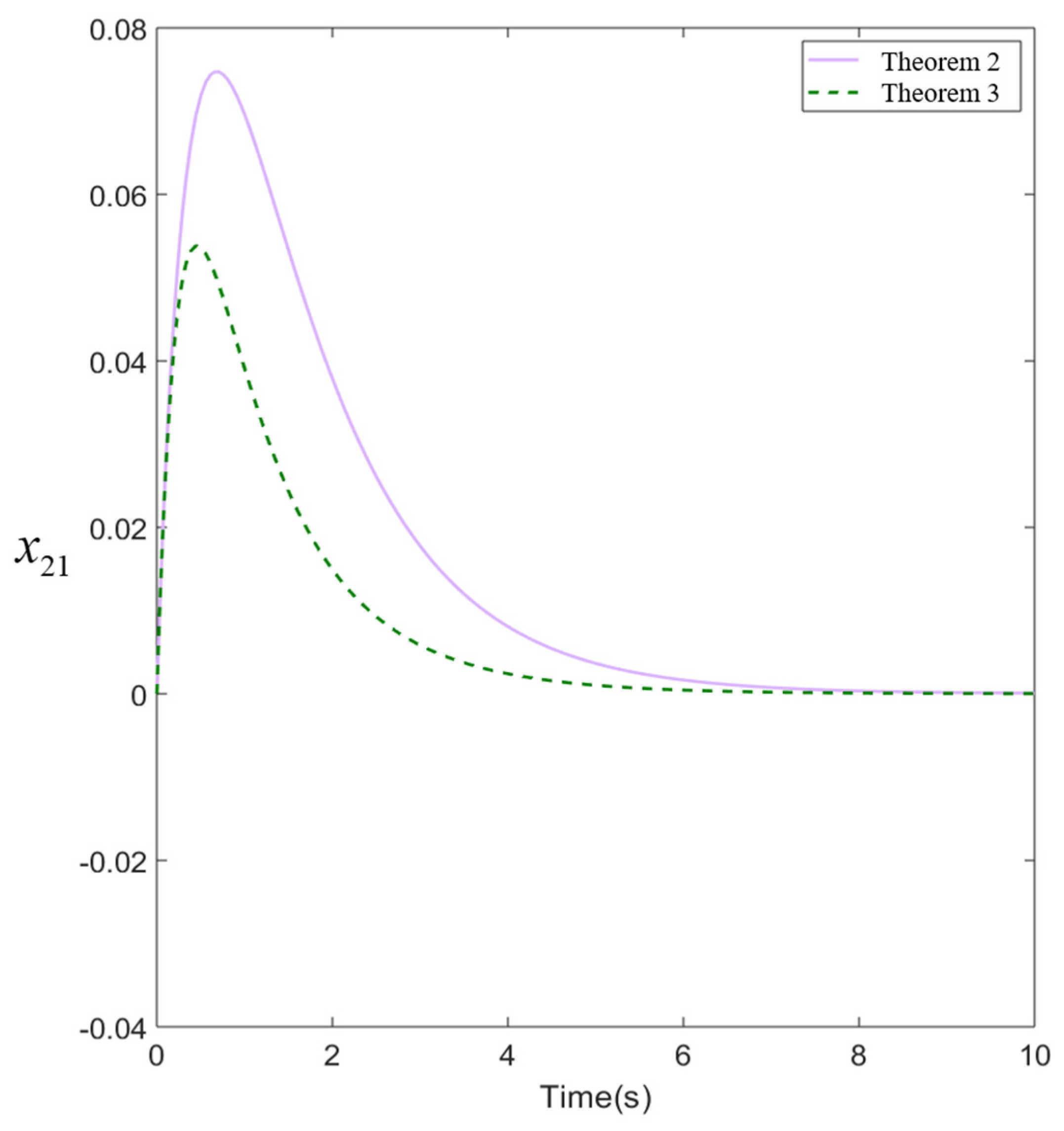
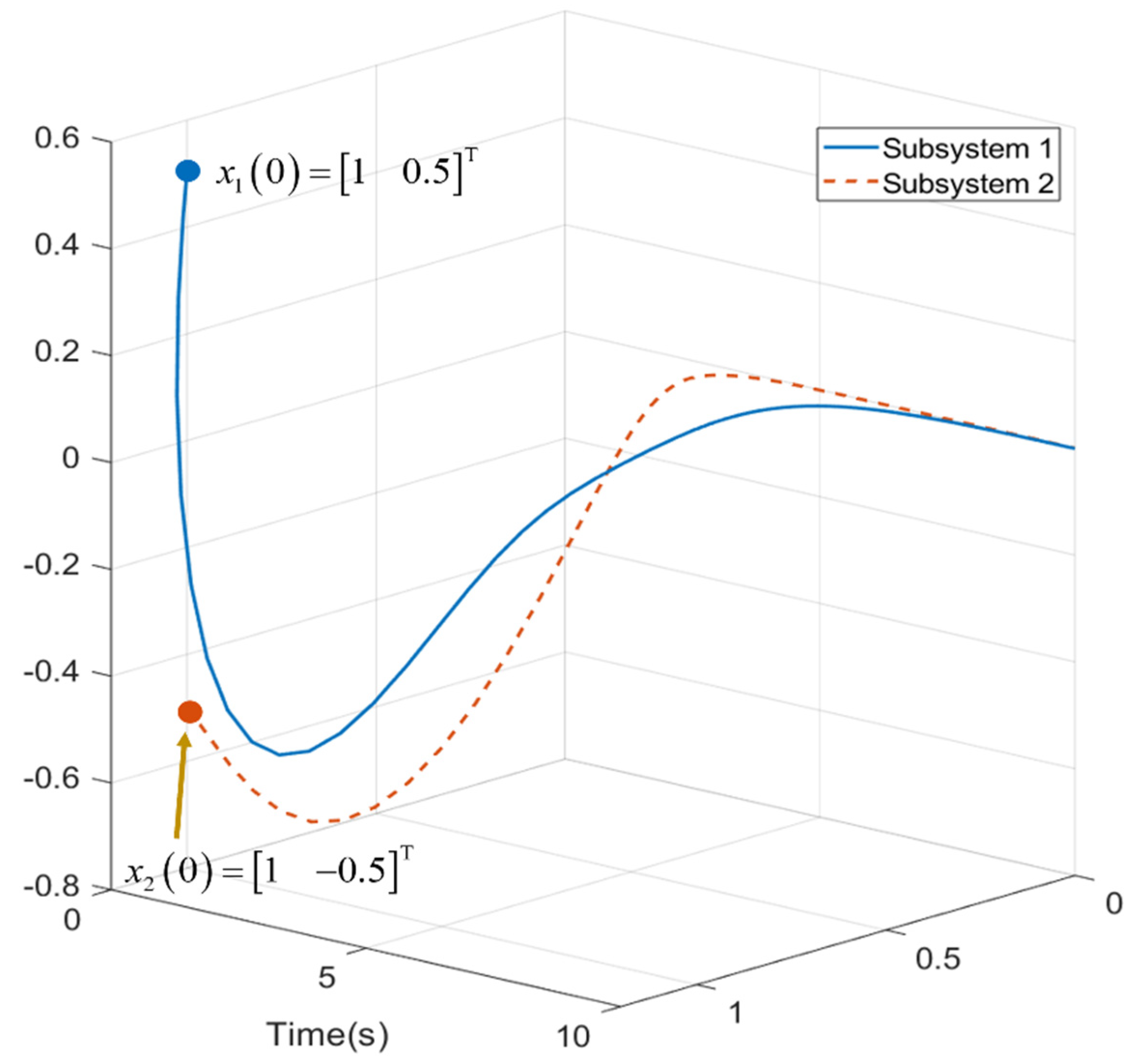
. The state trajectory of the system is plotted using the above gains, as shown in
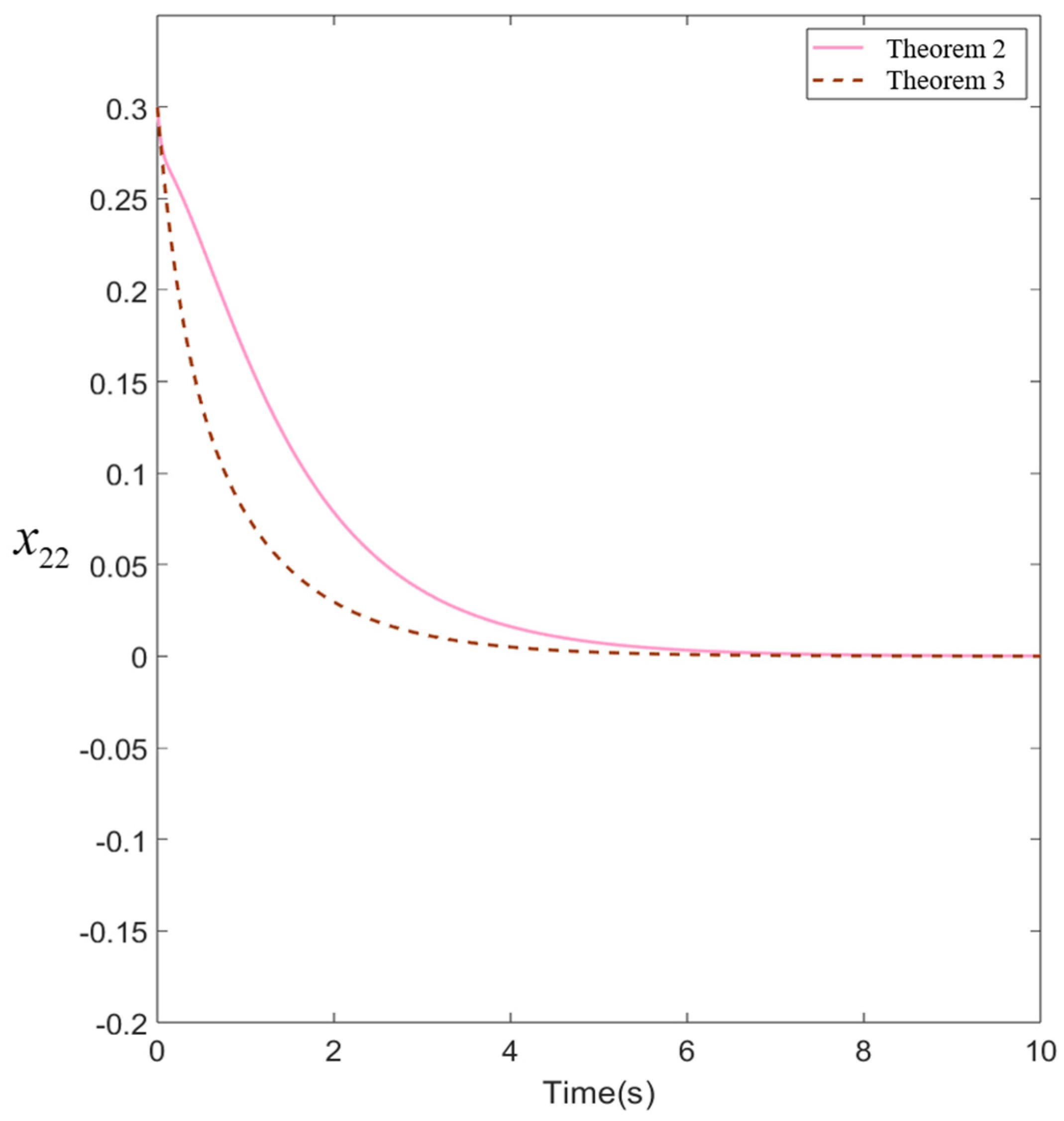
Figure 1,
Figure 2,
Figure 3,
Figure 4 and
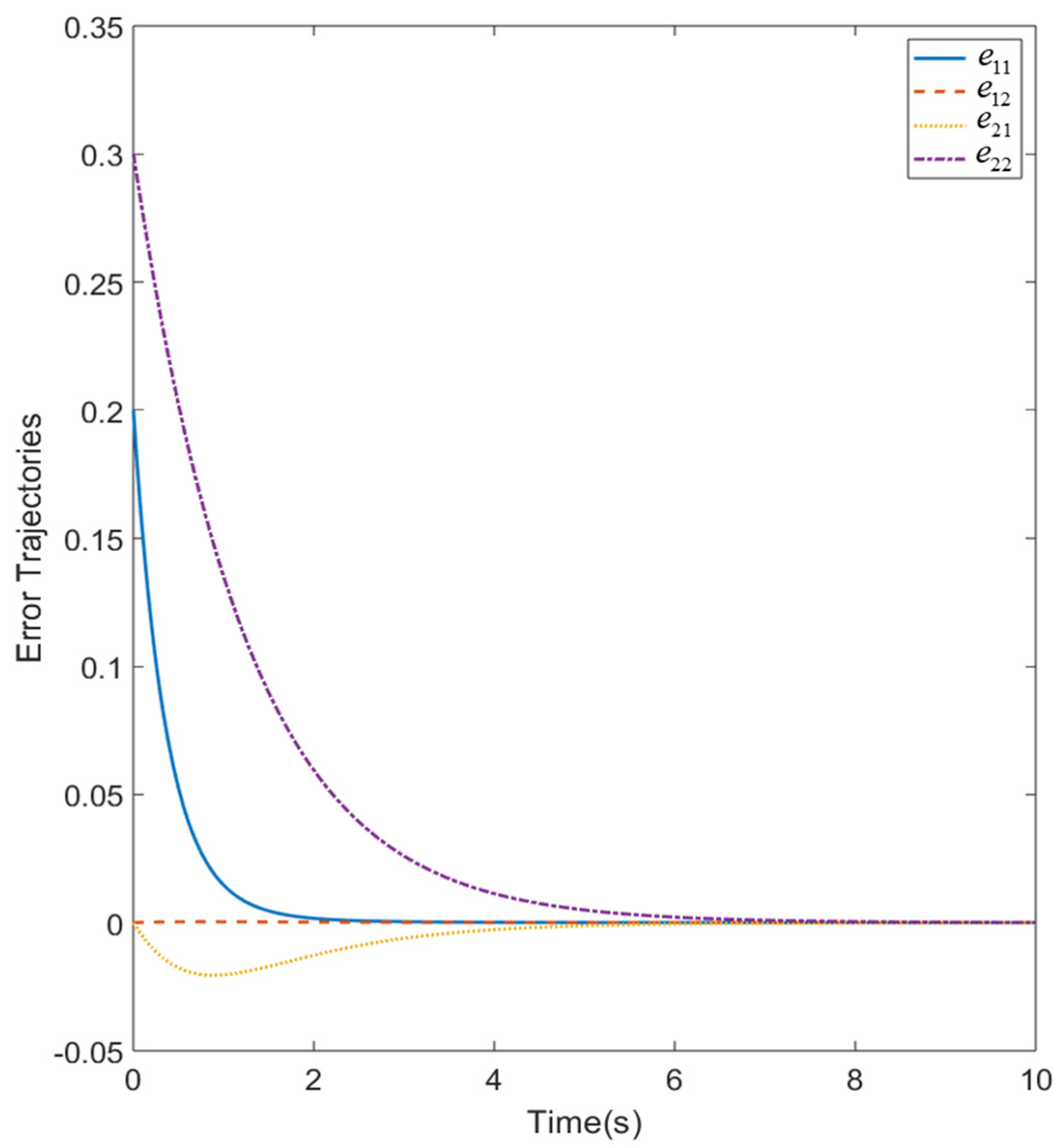
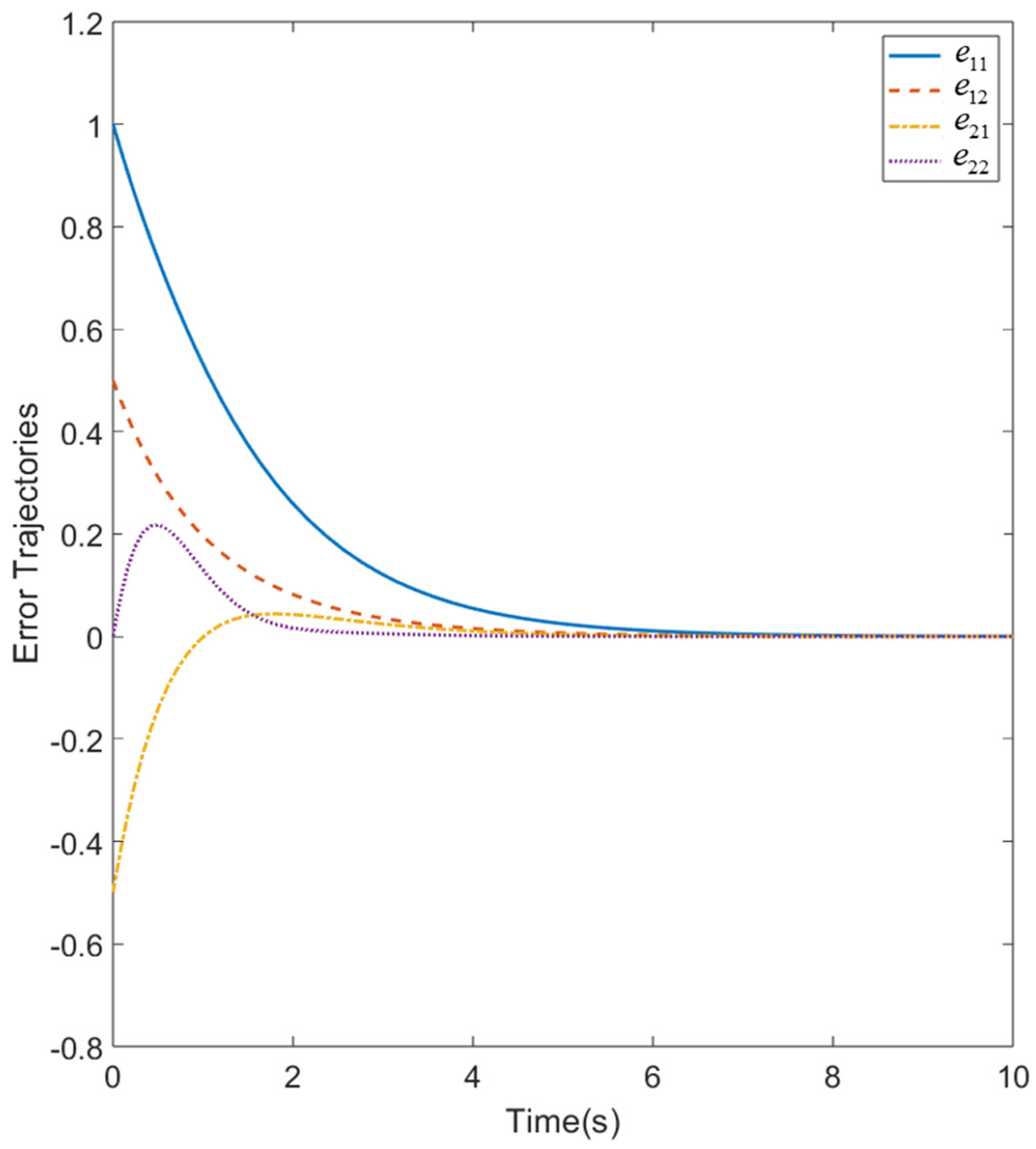
Figure 5. It can be seen from the simulation results that the controller designed based on Theorem 2 and Theorem 3 can effectively control the system. In addition, compared with Theorem 2, Theorem 3 shortens the stabilization time of the system because it considers the decay-rate performance. The error trajectory is shown in
Figure 6. When the error converges to 0, it means that the designed observer successfully estimates the system state, and it also means that the observer can effectively observe the system state. Therefore, we know that, through the observer-based control method, we can effectively use the PDFC method to develop a decentralized fuzzy controller for Example 1.
This paper chooses the mean square error (MSE), integrated absolute error (IAE), and integral time absolute error methods (ITAE) [
29,
30] to judge the controller performance.
According to [
29], we can define the following MSE performance indicator:
where
is real output value,
is predicted output value, and
is number of data points.
The IAE is the integral of the absolute value of the error, and its mathematical expression is:
where
is the output error.
The ITAE is defined as the integral of the absolute error multiplied by the time differential, and its mathematical expression is:
According to
Table 1, we can know that the MSE, IAE, and ITAE obtained by Theorem 3 are smaller than Theorem 2, which means that the decay-rate performance considered in Theorem 3 can reduce the average squared difference between the actual value and the expected value. In addition, Theorem 3 can also reduce the system output error value. Furthermore, we give the overshoot, settling time, and rise time for Example 1.
From the comparison results in
Table 2, it can be seen that the fuzzy controller with decay-rate performance proposed in Theorem 3 can effectively stabilize the system quickly and reduce the settling time and rise time. Therefore, through Example 1, it can be proved that the controller with the decay rate can provide better performance.
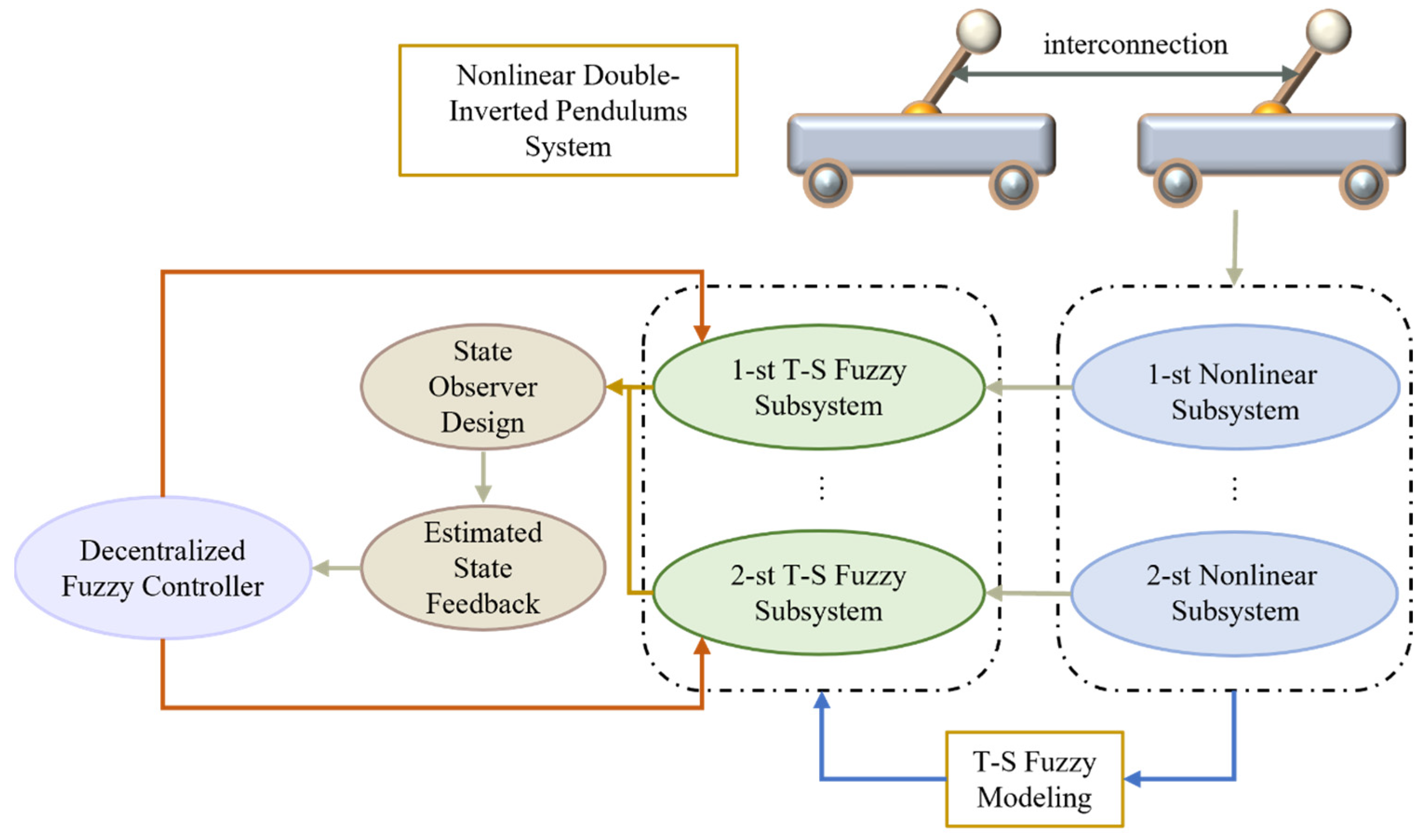
Example 2. In Example 2, we demonstrate the effectiveness of the proposed control method by analyzing a nonlinear double-inverted pendulum system (Figure 7). The nonlinear double-inverted pendulum system is a widely recognized and frequently used example by many experts [27,31,32]. The nonlinear system is described as follows. where
is the angle from the vertical reference and
denotes the angular velocity. The system parameters are: masses of pendulums:
and
; gravity constant:
; length of the pendulum:
; constant of the connecting torsional spring:
; moments of inertia:
and
.
The double-inverted pendulum system can be described by the T–S IDS form (9) with two rules (
Figure 8) and the following system matrices:
The control and observer gains can be obtained by harnessing the computational prowess of the MATLAB LMI toolbox with Theorem 3 and
.
Figure 9 and
Figure 10 present the simulation results with the initial conditions
,
, and
. We additionally give state-space trajectories (
Figure 9) to demonstrate that the respective interconnected subsystems can be effectively controlled through a decentralized control approach. The system response parameters for Example 2 are given in
Table 3. This comprehensive examination not only confirms the feasibility of the decentralized control but also highlights its ability to ensure the stability of all systems. Therefore, the proposed decentralized fuzzy control scheme can effectively stabilize Example 1 and Example 2 with decay rate constraints. Furthermore, observers can perfectly estimate the state of the system even when it cannot be measured.