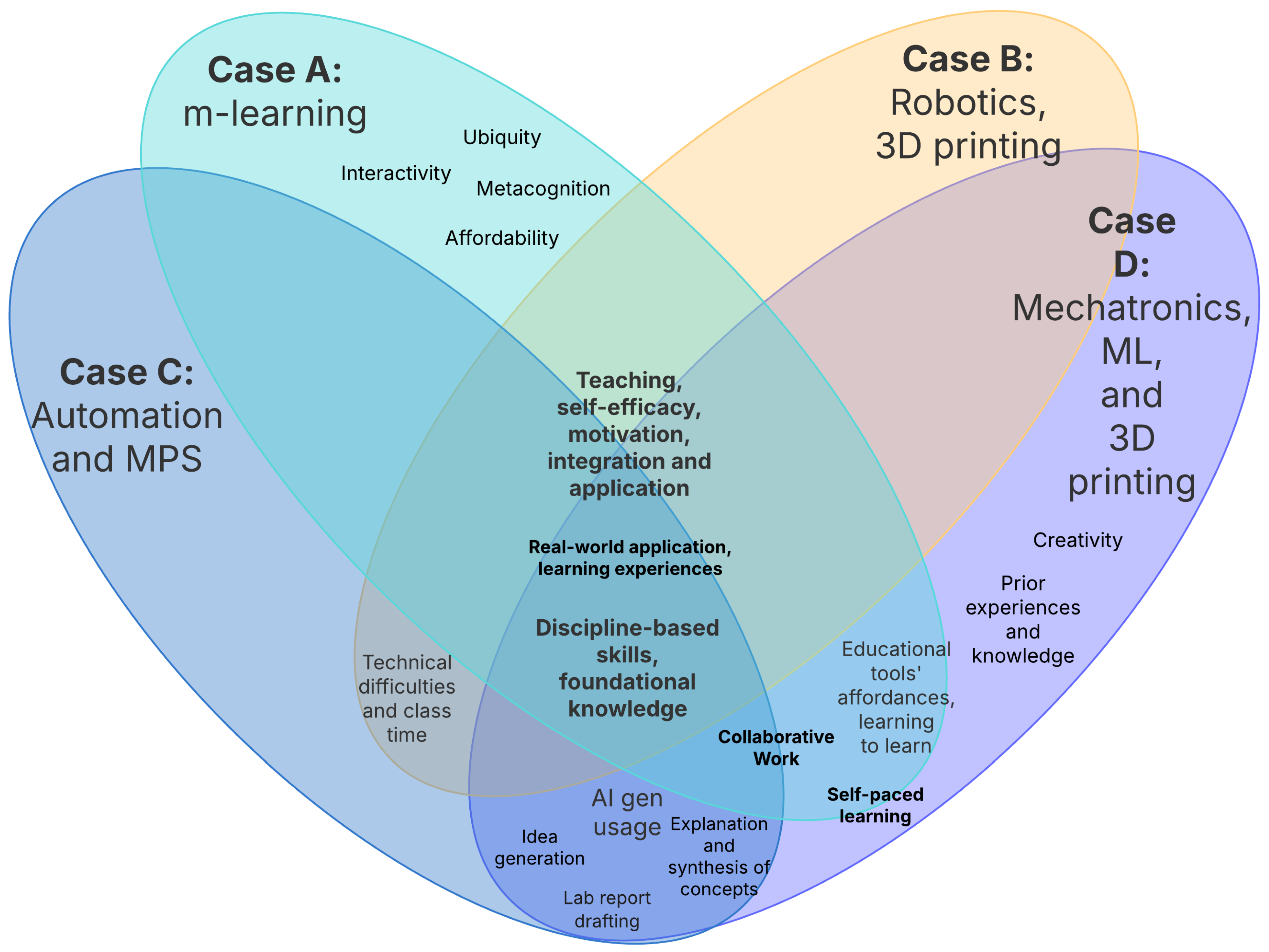

Investigating the Impact of Education 4.0 and Digital Learning on Students’ Learning Outcomes in Engineering: A Four-Year Multiple-Case Study



Abstract
1. Introduction
- RQ1. To what extent did the methodology with Education 4.0 principles develop cognitive learning outcomes among the students?
- RQ2. To what extent did the methodology with Education 4.0 principles promote affective learning outcomes among the students?
2. Background
2.1. Related Works
2.2. Education 4.0, Digital Learning, and Study Motivation
3. Method
3.1. Multiple-Case-Study Research Design
- 1.
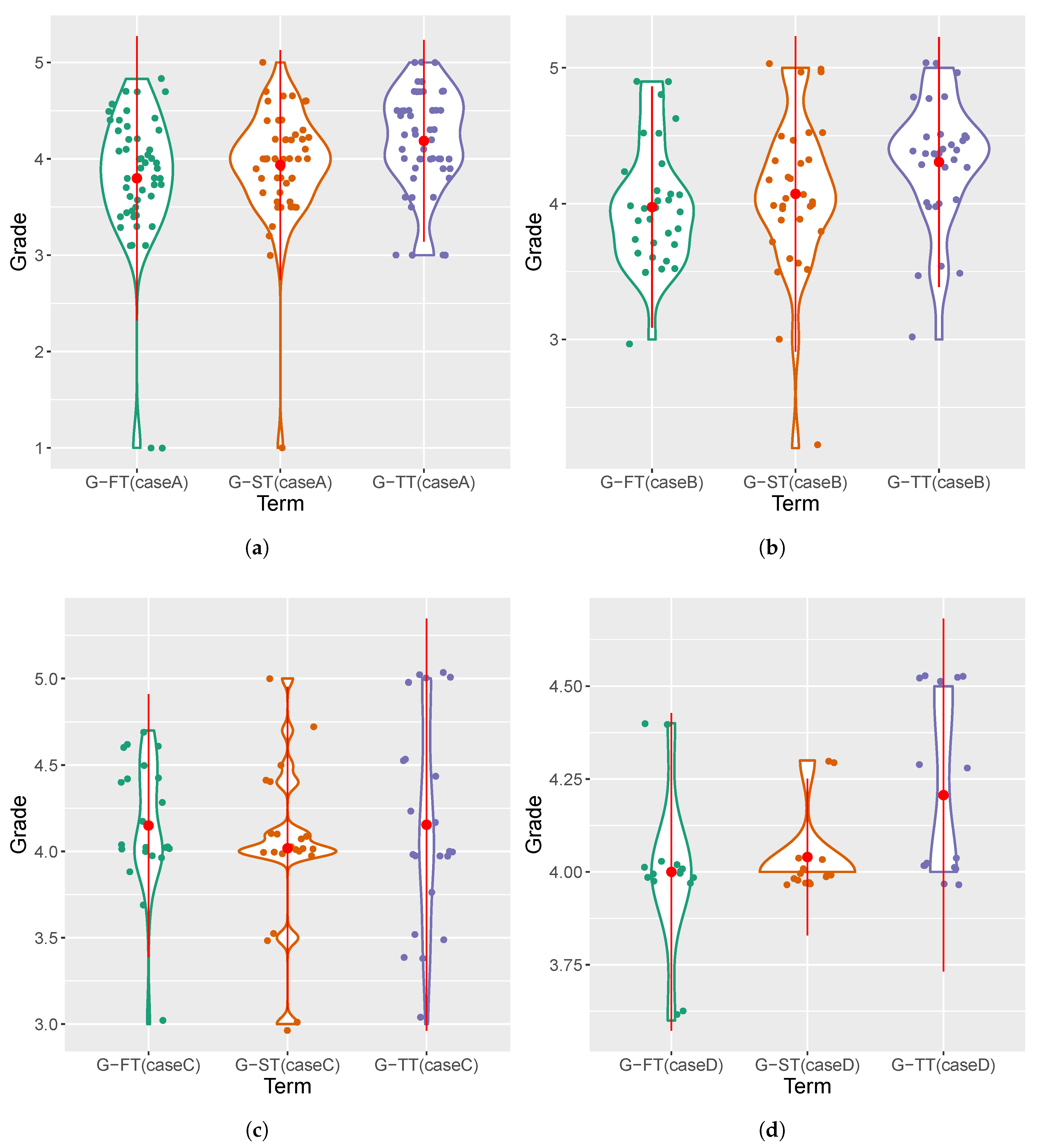
- The academic performance was measured through students’ grades in each selected case study. A student’s grade per term was composed of an exam (50%), a laboratory (35%), and a workshop (15%). For the final term in each semester, the exam was replaced with a final project or challenge. The workshops and the final project/challenge were evaluated using a rubric, described below.
- 2.
- Knowledge and discipline-based skills were identified through the observation of the artifacts and projects created by the students, surveys with closed and open-ended questions administered to students with some minor changes, and semi-structured interviews across the selected case studies.
- 3.
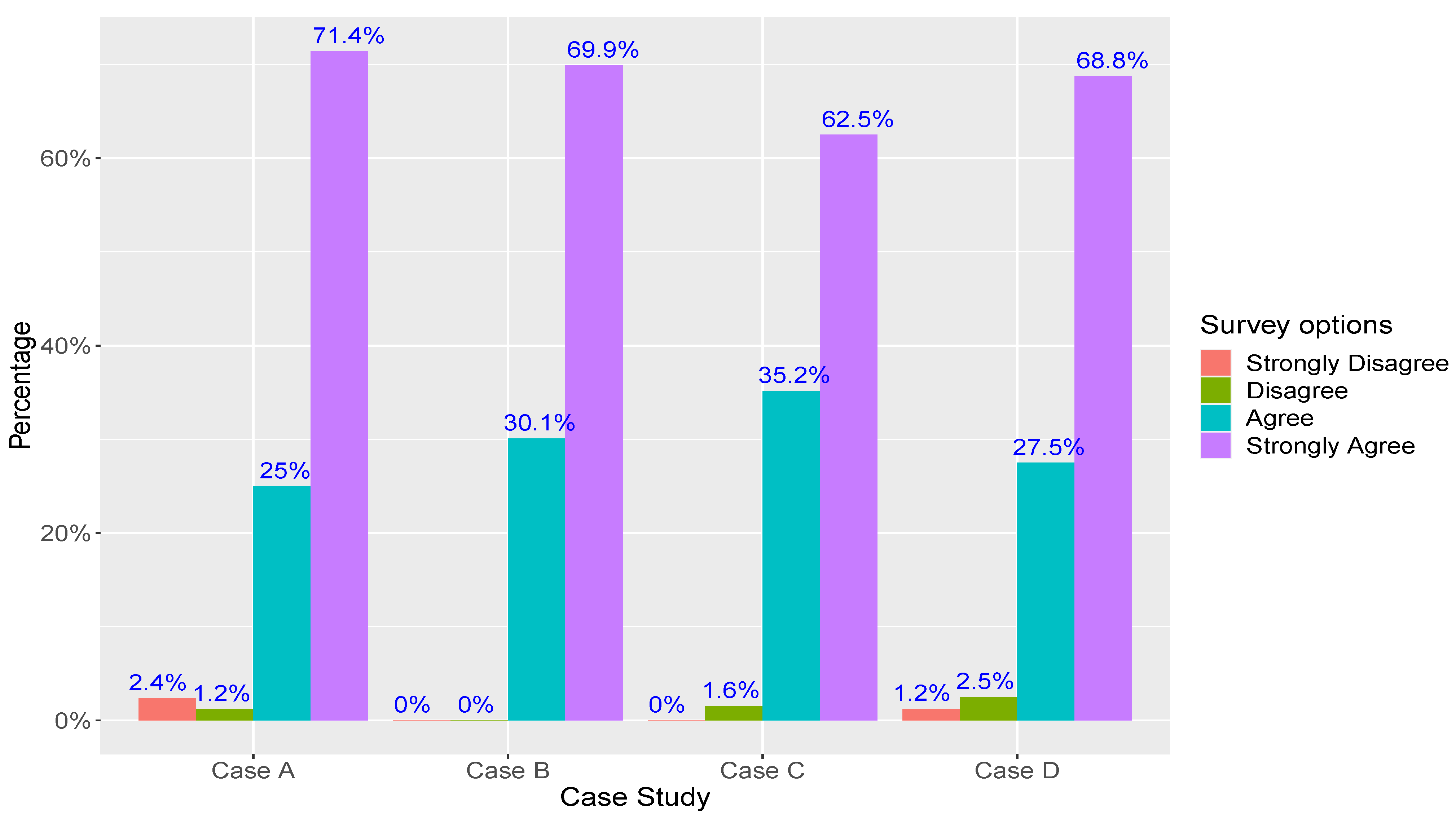
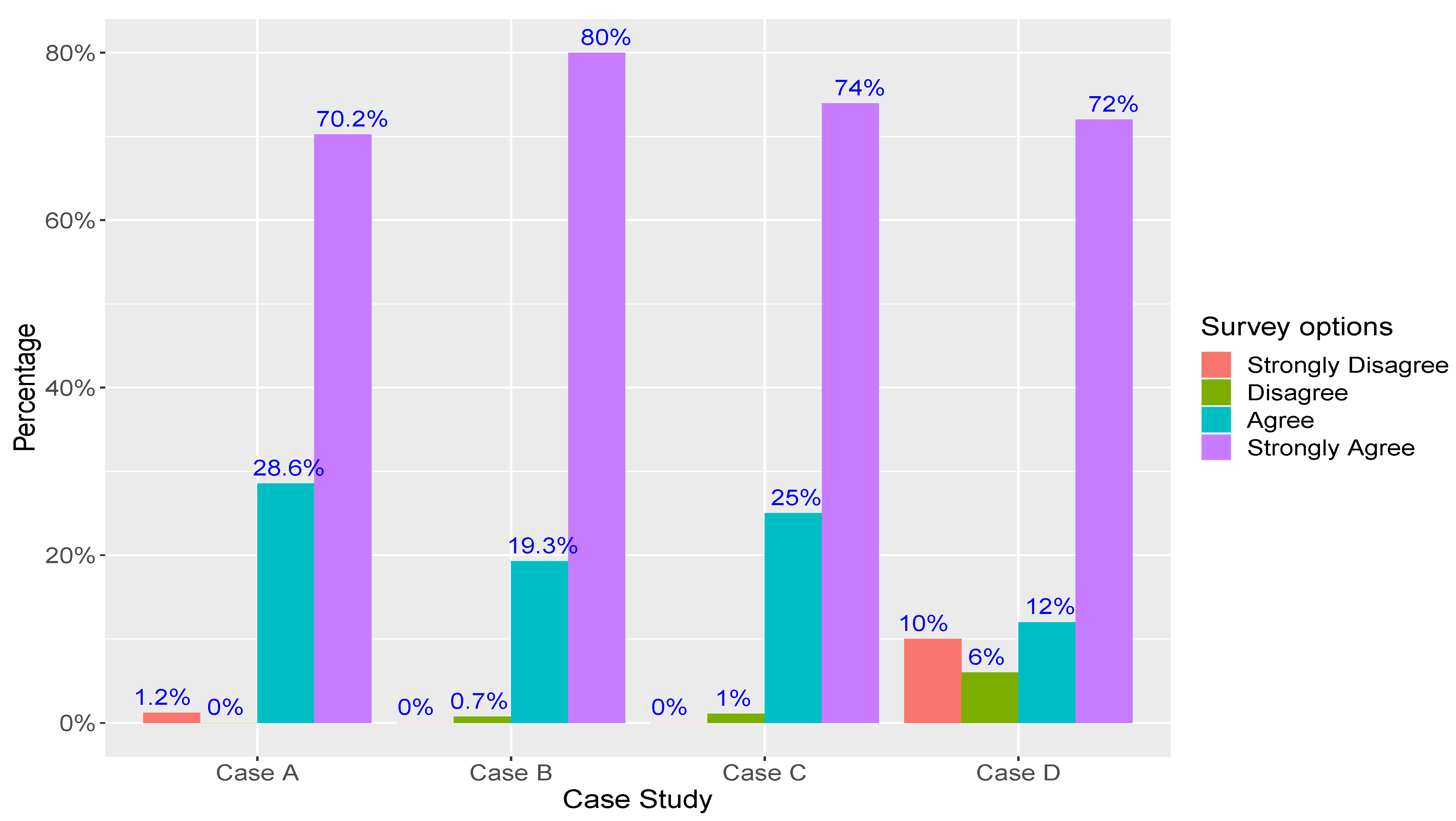
- Affective learning outcomes were analyzed using surveys with closed and open-ended questions that were administered to students with some minor changes and semi-structured interviews across the selected case studies.
3.2. Case Study Overview
3.3. Case Studies Description
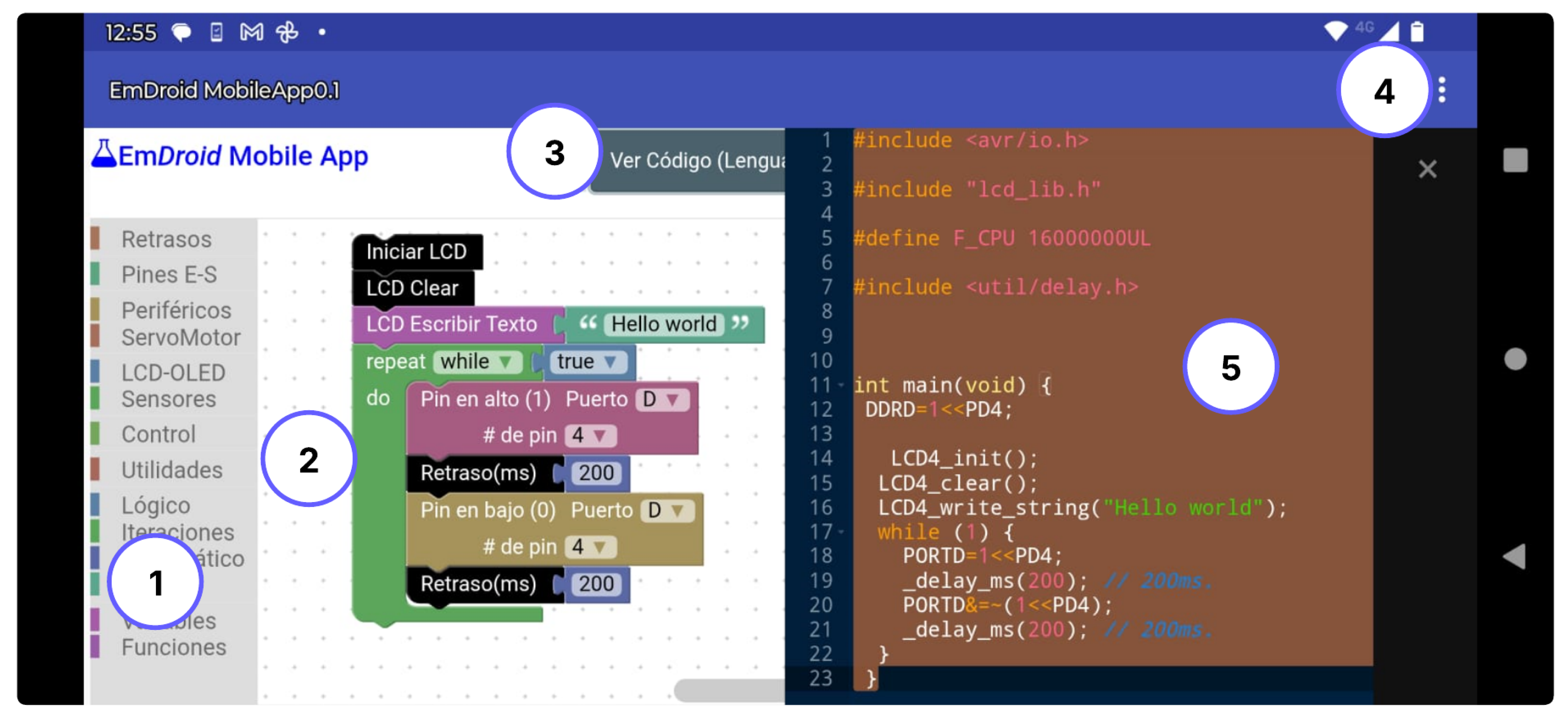
3.3.1. Case Study A: Mobile Learning to Foster Discipline-Based Skills in Introduction to Electronics
3.3.2. Case Study B: Robotics and Low-Cost 3D Printing in Digital Electronics
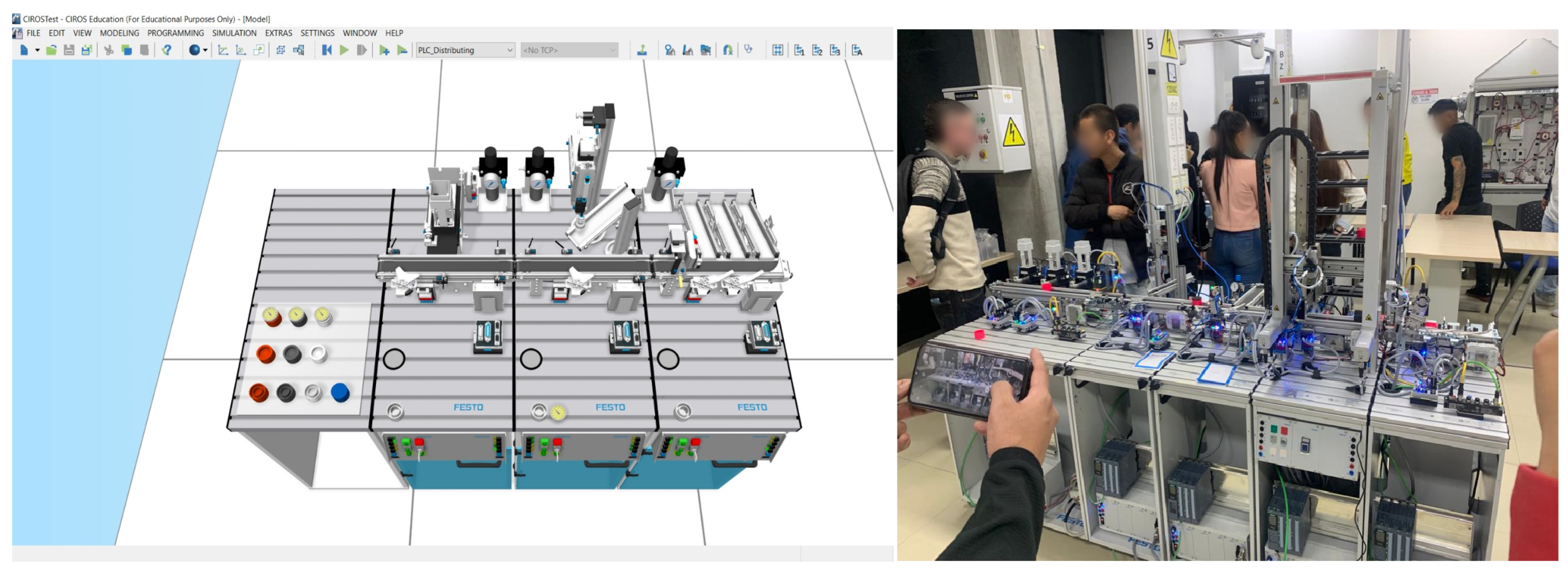
3.3.3. Case Study C: Digital Twins and Modular Production System (MPS) in Automation
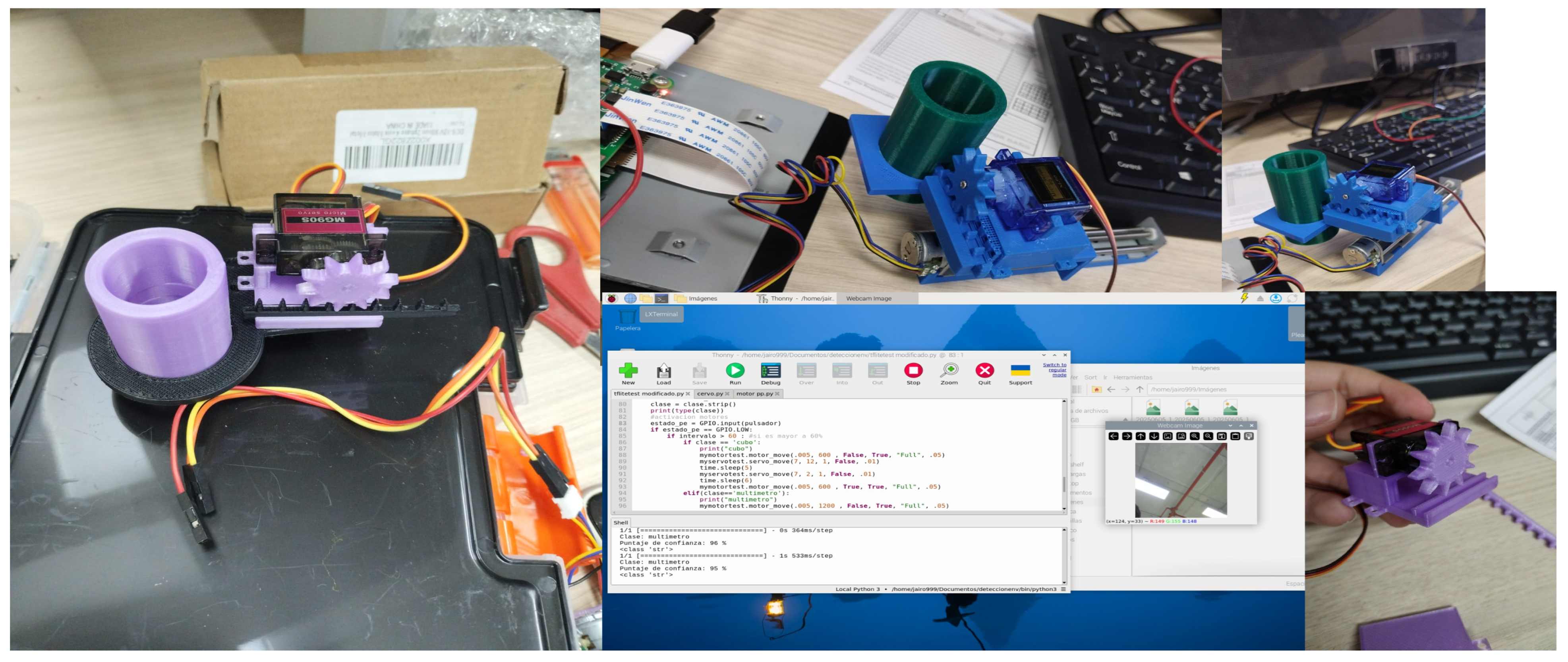
3.3.4. Case Study D: Low-Cost 3D Printing and Machine Learning in Mechatronics
3.4. Participants
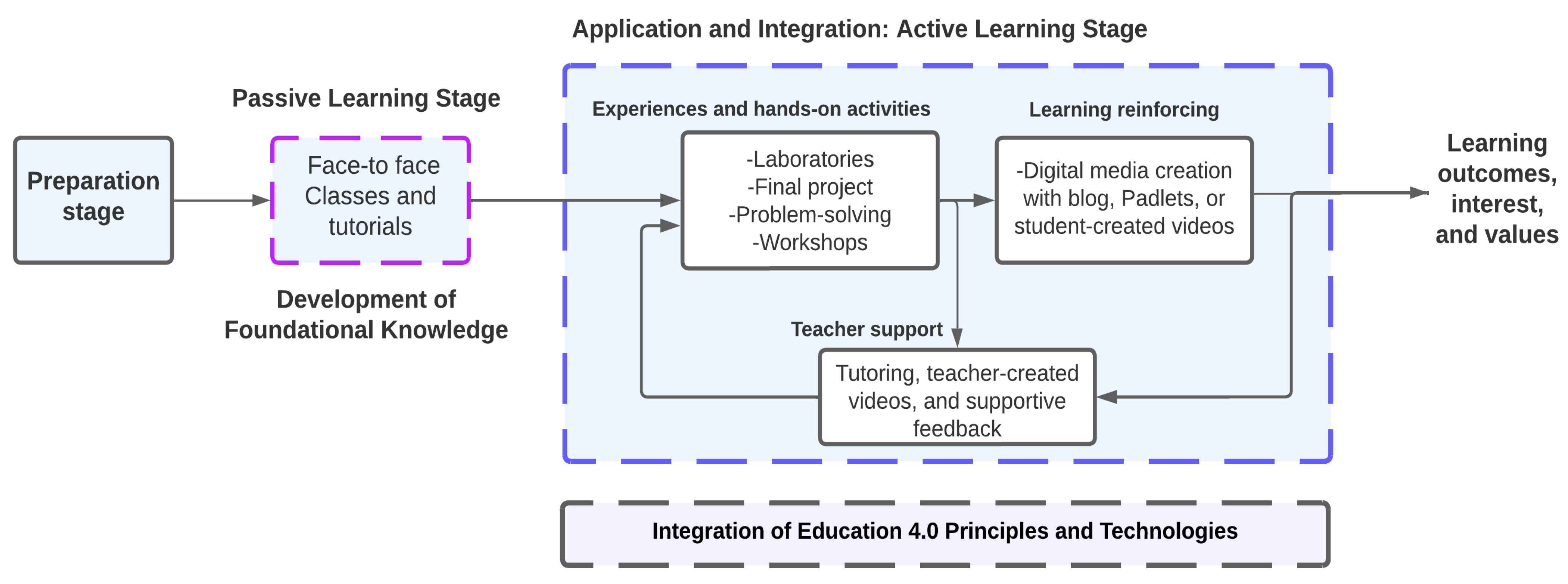
3.5. Educational Methodology
3.6. Research Methodology
4. Results
4.1. RQ1. To What Extent Did the Methodology with Education 4.0 Principles Develop Cognitive Learning Outcomes Among the Students?
4.1.1. Academic Performance
4.1.2. Development of Foundational Knowledge
4.1.3. Experimentation and Debugging
4.1.4. Learning to Learn, Self-Directed Learning, and Metacognition
4.1.5. Generative AI Usages and Preferences
4.2. RQ2. To What Extent Did the Methodology with Education 4.0 Principles Promote Affective Learning Outcomes Among the Students?
5. Discussion
6. Conclusions, Limitations, and Implications for Practice
Supplementary Materials
Author Contributions
Funding
Institutional Review Board Statement
Informed Consent Statement
Data Availability Statement
Conflicts of Interest
References
- Miranda, J.; Navarrete, C.; Noguez, J.; Molina-Espinosa, J.M.; Ramírez-Montoya, M.S.; Navarro-Tuch, S.A.; Bustamante-Bello, M.R.; Rosas-Fernández, J.B.; Molina, A. The Core Components of Education 4.0 in Higher Education: Three Case Studies in Engineering Education. Comput. Electr. Eng. 2021, 93, 107278. [Google Scholar] [CrossRef] [Scilit]
- Espinosa-Izquierdo, J.; Quijije-Acosta, K.; Villamar-Bravo, J.E.; Mesa-Vázquez, J. Digital ecosystems of learning and education 4.0 an approach to emerging pedagogies. Polo Del Conoc. 2023, 8, 134–158. [Google Scholar]
- De Oliveira, L.C.; Guerino, G.C.; De Oliveira, L.C.; Pimentel, A.R. Information and Communication Technologies in Education 4.0 Paradigm: A Systematic Mapping Study. Inform. Educ. 2022, 22, 71–98. [Google Scholar] [CrossRef] [Scilit]
- Lin, M.H.; Chen, H.C.; Liu, K.S. A Study of the Effects of Digital Learning on Learning Motivation and Learning Outcome. Eurasia J. Math. Sci. Technol. Educ. 2017, 13, 3553–3564. [Google Scholar] [CrossRef] [Scilit]
- Oztemel, E.; Gursev, S. Literature Review of Industry 4.0 and Related Technologies. J. Intell. Manuf. 2020, 31, 127–182. [Google Scholar] [CrossRef] [Scilit]
- Görmüş, A. Future of Work with the Industry 4.0. In Proceedings of the International Congress on Social Sciences (INCSOS 2019); Proceeding Book; Atlantis Press: Dordrecht, The Netherlands, 2019; Volume 1, pp. 317–323. [Google Scholar]
- Guiu, A.G.; Agüera, L.G. La Industria 4.0 en la Sociedad Digital; Alfaomega Grupo Editor: Mexico City, Mexico, 2020. [Google Scholar]
- Forum, W.E. The Future of Jobs Report 2025. Available online: https://www.weforum.org/publications/the-future-of-jobs-report-2025/ (accessed on 19 January 2026).
- Quy, V.K.; Thanh, B.T.; Chehri, A.; Linh, D.M.; Tuan, D.A. AI and Digital Transformation in Higher Education: Vision and Approach of a Specific University in Vietnam. Sustainability 2023, 15, 11093. [Google Scholar] [CrossRef] [Scilit]
- Alenezi, M. Digital Learning and Digital Institution in Higher Education. Educ. Sci. 2023, 13, 88. [Google Scholar] [CrossRef] [Scilit]
- Mei Kin, T.; Omar, A.K.; Musa, K.; Ghouri, A.M. Leading Teaching and Learning in the Era of Education 4.0: The Relationship between Perceived Teacher Competencies and Teacher Attitudes toward Change. Asian J. Univ. Educ. 2022, 18, 65. [Google Scholar] [CrossRef] [Scilit]
- Coelho, P.A.; Casanello, F.; Leal, N.; Brintrup, K.; Angulo, L.; Sanhueza, I.; Flores, F.; Reyes, J.; Forcael, E. Challenge-Based Learning and Scrum as Enablers of 4.0 Technologies in Engineering Education. Appl. Sci. 2024, 14, 9746. [Google Scholar] [CrossRef] [Scilit]
- Pérez-Rodríguez, R.; Lorenzo-Martin, R.; Trinchet-Varela, C.A.; Simeón-Monet, R.E.; Miranda, J.; Cortés, D.; Molina, A. Integrating Challenge-Based-Learning, Project-Based-Learning, and Computer-Aided Technologies into Industrial Engineering Teaching: Towards a Sustainable Development Framework. Integr. Educ. 2022, 26, 198–215. [Google Scholar] [CrossRef] [Scilit]
- Srivani, V.; Hariharasudan, A.; Nawaz, N.; Ratajczak, S. Impact of Education 4.0 among Engineering Students for Learning English Language. PLoS ONE 2022, 17, e0261717. [Google Scholar] [CrossRef] [Scilit]
- Coşkun, S.; Kayıkcı, Y.; Gençay, E. Adapting Engineering Education to Industry 4.0 Vision. Technologies 2019, 7, 10. [Google Scholar] [CrossRef] [Scilit]
- Kirkwood, A.; Price, L. Technology-Enhanced Learning and Teaching in Higher Education: What Is ‘Enhanced’ and How Do We Know? A Critical Literature Review. Learn. Media Technol. 2014, 39, 6–36. [Google Scholar] [CrossRef] [Scilit]
- Fink, L.D. Creating Significant Learning Experiences: An Integrated Approach to Designing College Courses; John Wiley & Sons: Hoboken, NJ, USA, 2013. [Google Scholar]
- Gutiérrez-Martínez, Y.; Bustamante-Bello, R.; Navarro-Tuch, S.A.; López-Aguilar, A.A.; Molina, A.; Álvarez-Icaza Longoria, I. A Challenge-Based Learning Experience in Industrial Engineering in the Framework of Education 4.0. Sustainability 2021, 13, 9867. [Google Scholar] [CrossRef] [Scilit]
- Boltsi, A.; Kalovrektis, K.; Xenakis, A.; Chatzimisios, P.; Chaikalis, C. Digital Tools, Technologies, and Learning Methodologies for Education 4.0 Frameworks: A STEM Oriented Survey. IEEE Access 2024, 12, 12883–12901. [Google Scholar] [CrossRef] [Scilit]
- Ramirez-Mendoza, R.A.; Morales-Menendez, R.; Iqbal, H.; Parra-Saldivar, R. Engineering Education 4.0: —Proposal for a New Curricula. In 2018 IEEE Global Engineering Education Conference (EDUCON); IEEE: New York, NY, USA, 2018; pp. 1273–1282. [Google Scholar] [CrossRef] [Scilit]
- González-Pérez, L.I.; Ramírez-Montoya, M.S. Components of Education 4.0 in 21st Century Skills Frameworks: Systematic Review. Sustainability 2022, 14, 1493. [Google Scholar] [CrossRef] [Scilit]
- Souza, A.S.C.D.; Debs, L. Concepts, Innovative Technologies, Learning Approaches and Trend Topics in Education 4.0: A Scoping Literature Review. Soc. Sci. Humanit. Open 2024, 9, 100902. [Google Scholar] [CrossRef] [Scilit]
- Bizami, N.A.; Tasir, Z.; Kew, S.N. Innovative Pedagogical Principles and Technological Tools Capabilities for Immersive Blended Learning: A Systematic Literature Review. Educ. Inf. Technol. 2023, 28, 1373–1425. [Google Scholar] [CrossRef] [Scilit]
- Hernandez-de-Menendez, M.; Escobar Díaz, C.A.; Morales-Menendez, R. Engineering Education for Smart 4.0 Technology: A Review. Int. J. Interact. Des. Manuf. (IJIDeM) 2020, 14, 789–803. [Google Scholar] [CrossRef] [Scilit]
- Arias, J.; Salas, J.I.; Chiappe, A.; Sáez Delgado, F. The Extended Education 4.0: Lifelong Learning in Times of Artificial Intelligence. Appl. Sci. 2025, 15, 9352. [Google Scholar] [CrossRef] [Scilit]
- Jaya Saragih, M.; Mas Rizky Yohannes Cristanto, R.; Effendi, Y.; Zamzami, E.M. Application of Blended Learning Supporting Digital Education 4.0. J. Phys. Conf. Ser. 2020, 1566, 012044. [Google Scholar] [CrossRef] [Scilit]
- Sailer, M.; Murböck, J.; Fischer, F. Digital Learning in Schools: What Does It Take beyond Digital Technology? Teach. Teach. Educ. 2021, 103, 103346. [Google Scholar] [CrossRef] [Scilit]
- Fraillon, J. An International Perspective on Digital Literacy: Results from ICILS 2023; International Association for the Evaluation of Educational Achievement: Amsterdam, The Netherlands, 2024. [Google Scholar]
- Yin, R.K. Case Study Research and Applications: Design and Methods, 6th ed.; SAGE: Los Angeles, CA, USA, 2018. [Google Scholar]
- Creswell, J.W.; Clark, V.L.P. Designing and Conducting Mixed Methods Research; Sage Publications: Los Angeles, CA, USA, 2017. [Google Scholar]
- O’Sullivan, D.; Igoe, T. Physical Computing: Sensing and Controlling the Physical World with Computers; Course Technology Press: Boston, MA, USA, 2004. [Google Scholar]
- Ariza, J.Á. Bringing Active Learning, Experimentation, and Student-Created Videos in Engineering: A Study about Teaching Electronics and Physical Computing Integrating Online and Mobile Learning. Comput. Appl. Eng. Educ. 2023, 31, 1723–1749. [Google Scholar] [CrossRef] [Scilit]
- Ariza, J.Á.; Mercado, H.R.N. ControlDroid: A m-Learning Platform to Learn and Teach Control Systems in Technology and Engineering. In 2020 IEEE International Symposium on Accreditation of Engineering and Computing Education (ICACIT); IEEE: New York, NY, USA, 2020; pp. 1–4. [Google Scholar]
- Ariza, J.Á.; Hernández, C.H. Physical Computing and Computational Thinking Supported by Mobile Devices in an Introductory Electronics Course: An Active Learning Approach. IEEE Trans. Educ. 2025, 68, 528–542. [Google Scholar] [CrossRef] [Scilit]
- Rubio, M.A.; Romero-Zaliz, R.; Mañoso, C.; Angel, P. Closing the Gender Gap in an Introductory Programming Course. Comput. Educ. 2015, 82, 409–420. [Google Scholar] [CrossRef] [Scilit]
- Gyebi, E.B.; Hanheide, M.; Cielniak, G. The Effectiveness of Integrating Educational Robotic Activities into Higher Education Computer Science Curricula: A Case Study in a Developing Country. In Educational Robotics in the Makers Era; Springer: Berlin/Heidelberg, Germany, 2017; pp. 73–87. [Google Scholar]
- Digilent Inc. Basys2 Overview. 2016. Available online: https://digilent.com/reference/_media/basys2:basys2_rm.pdf (accessed on 19 January 2026).
- FESTO. Festo Didactic InfoPortal-MPS Stations. Available online: https://ip.festo-didactic.com/Infoportal/MPS/Hardware/EN/Stations.html (accessed on 19 January 2026).
- FESTO. MPS: Fábricas Para La Enseñanza de Mecatrónica | Festo CO. Available online: https://www.festo.com/co/es/e/educacion/conceptos-educativos/aspectos-mas-destacados/fabricas-para-la-ensenanza/mps-fabricas-para-la-ensenanza-de-mecatronica-id_31963/ (accessed on 19 January 2026).
- FESTO. Comprar CIROS 7, Sistema de Simulación 3D Universal PROD_DID_8140772 Online | Festo CO. Available online: https://www.festo.com/co/es/p/ciros-7-sistema-de-simulacion-3d-universal-id_PROD_DID_8140772/?page=0 (accessed on 19 January 2026).
- Batty, M. Digital Twins. Environ. Plan. B Urban Anal. City Sci. 2018, 45, 817–820. [Google Scholar] [CrossRef] [Scilit]
- Upton, E.; Halfacree, G. Raspberry Pi User Guide; John Wiley & Sons: Hoboken, NJ, USA, 2016. [Google Scholar]
- Ariza, J.Á.; Baez, H. Understanding the Role of Single-board Computers in Engineering and Computer Science Education: A Systematic Literature Review. In Computer Applications in Engineering Education; Wiley: Hoboken, NJ, USA, 2021; p. cae.22439. [Google Scholar] [CrossRef] [Scilit]
- OpenCV. OpenCV Webpage. Available online: https://opencv.org/ (accessed on 19 January 2026).
- Google Inc. Teachable Machine. Available online: https://teachablemachine.withgoogle.com/ (accessed on 19 January 2026).
- Tech & Learning. What Is Padlet and How Does It Work? 2024. Available online: https://www.techlearning.com/how-to/what-is-padlet-and-how-does-it-work-for-teachers-and-students (accessed on 19 January 2026).
- Rienties, B.; Ferguson, R.; Gonda, D.; Hajdin, G.; Herodotou, C.; Iniesto, F.; Llorens Garcia, A.; Muccini, H.; Sargent, J.; Virkus, S.; et al. Education 4.0 in Higher Education and Computer Science: A Systematic Review. Comput. Appl. Eng. Educ. 2023, 31, 1339–1357. [Google Scholar] [CrossRef] [Scilit]
- Eager, B.; Brunton, R. Prompting Higher Education towards AI-augmented Teaching and Learning Practice. J. Univ. Teach. Learn. Pract. 2023, 20, 1–21. [Google Scholar] [CrossRef] [Scilit]
- Patton, M.Q. Qualitative Research & Evaluation Methods: Integrating Theory and Practice; Sage Publications: Los Angeles, CA, USA, 2014. [Google Scholar]
- Brookhart, S.M. How to Create and Use Rubrics for Formative Assessment and Grading; ASCD: Arlington, VA, USA, 2013. [Google Scholar]
- Mamaril, N.A.; Usher, E.L.; Li, C.R.; Economy, D.R.; Kennedy, M.S. Measuring Undergraduate Students’ Engineering Self-efficacy: A Validation Study. J. Eng. Educ. 2016, 105, 366–395. [Google Scholar] [CrossRef] [Scilit]
- Guay, F.; Vallerand, R.J.; Blanchard, C. On the Assessment of Situational Intrinsic and Extrinsic Motivation: The Situational Motivation Scale (SIMS). Motiv. Emot. 2000, 24, 175–213. [Google Scholar] [CrossRef] [Scilit]
- Bandura, A. Self-Efficacy: The Exercise of Control; Macmillan: New York, NY, USA, 1997. [Google Scholar]
- Ariza, J.Á. Can In-Home Laboratories Foster Learning, Self-Efficacy, and Motivation during the COVID-19 Pandemic?—A Case Study in Two Engineering Programs. arXiv 2022, arXiv:2203.16465. [Google Scholar] [CrossRef] [Scilit]
- Hayes, A.F.; Coutts, J.J. Use Omega Rather than Cronbach’s Alpha for Estimating Reliability. But…. Commun. Methods Meas. 2020, 14, 1–24. [Google Scholar] [CrossRef] [Scilit]
- MAXQDA. Software para Análisis de Datos Cualitativos. 2024. Available online: https://www.maxqda.com/es/software-analisis-datos-cualitativos (accessed on 19 January 2026).
- Guest, G.; MacQueen, K.M.; Namey, E.E. Applied Thematic Analysis; Sage Publications: Los Angeles, CA, USA, 2011. [Google Scholar]
- Sheppard, S.; Colby, A.; Macatangay, K.; Sullivan, W. What Is Engineering Practice? Wiley: Hoboken, NJ, USA, 2008. [Google Scholar]
- Herschbach, D.R. Technology as Knowledge: Implications for Instruction. J. Technol. Educ. 1995, 7. [Google Scholar] [CrossRef] [Scilit]
- Vieira, M.; Kennedy, J.; Leonard, S.N.; Cropley, D. Creative Self-Efficacy: Why It Matters for the Future of STEM Education. Creat. Res. J. 2025, 37, 472–488. [Google Scholar] [CrossRef] [Scilit]
- Kaufman, J.C. Self-Reported Differences in Creativity by Ethnicity and Gender. Appl. Cogn. Psychol. 2006, 20, 1065–1082. [Google Scholar] [CrossRef] [Scilit]
- Pan, X. Technology Acceptance, Technological Self-Efficacy, and Attitude Toward Technology-Based Self-Directed Learning: Learning Motivation as a Mediator. Front. Psychol. 2020, 11, 564294. [Google Scholar] [CrossRef] [Scilit] [PubMed]
- Hennessy Elliott, C.; Nixon, J.; Gendrau Chakarov, A.; Bush, J.B.; Schneider, M.J.; Recker, M. Characterizing Teacher Support of Debugging with Physical Computing: Debugging Pedagogies in Practice. ACM Trans. Comput. Educ. 2024, 24, 1–28. [Google Scholar] [CrossRef] [Scilit]
- Kapur, M. Learning from Productive Failure. Learn. Res. Pract. 2015, 1, 51–65. [Google Scholar] [CrossRef] [Scilit]
- Shabani, K.; Khatib, M.; Ebadi, S. Vygotsky’s Zone of Proximal Development: Instructional Implications and Teachers’ Professional Development. Engl. Lang. Teach. 2010, 3, 237–248. [Google Scholar]
- Sutherland, R.; Robertson, S.; John, P. Improving Classroom Learning with ICT, 1st ed.; Routledge: London, UK, 2008. [Google Scholar] [CrossRef] [Scilit]
- Traxler, J. Defining, Discussing and Evaluating Mobile Learning. Int. Rev. Res. Open Distance Learn. 2007, 8, 1–12. [Google Scholar]
- Traxler, J. Learning in a Mobile Age. Int. J. Mob. Blended Learn. (IJMBL) 2009, 1, 1. [Google Scholar]
- Crompton, H.; Burke, D. The Use of Mobile Learning in Higher Education: A Systematic Review. Comput. Educ. 2018, 123, 53–64. [Google Scholar] [CrossRef] [Scilit]
- Trust, T.; Maloy, R.W. Why 3D Print? The 21st-Century Skills Students Develop While Engaging in 3D Printing Projects. Comput. Sch. 2017, 34, 253–266. [Google Scholar] [CrossRef] [Scilit]
- Robertson, B.; Radcliffe, D. Impact of CAD Tools on Creative Problem Solving in Engineering Design. Comput.-Aided Des. 2009, 41, 136–146. [Google Scholar] [CrossRef] [Scilit]
- Ariza, J.Á.; Restrepo, M.B.; Hernández, C.H. Generative AI in Engineering and Computing Education: A Scoping Review of Empirical Studies and Educational Practices. IEEE Access 2025, 13, 30789–30810. [Google Scholar] [CrossRef] [Scilit]
- Sheard, J.; Denny, P.; Hellas, A.; Leinonen, J.; Malmi, L.; Simon. Instructor Perceptions of AI Code Generation Tools—A Multi-Institutional Interview Study. In Proceedings of the 55th ACM Technical Symposium on Computer Science Education V. 1, Portland, OR, USA, 20–23 March 2024; pp. 1223–1229. [Google Scholar] [CrossRef] [Scilit]
- Chan, M.M.; Amado-Salvatierra, H.R.; Hernandez-Rizzardini, R.; De La Roca, M. The Potential Role of AI-based Chatbots in Engineering Education. Experiences from a Teaching Perspective. In 2023 IEEE Frontiers in Education Conference (FIE); IEEE: New York, NY, USA, 2023; pp. 1–5. [Google Scholar]
- Lu, J.; Schmidt, M.; Lee, M.; Huang, R. Usability Research in Educational Technology: A State-of-the-Art Systematic Review. Educ. Technol. Res. Dev. 2022, 70, 1951–1992. [Google Scholar] [CrossRef] [Scilit]
- Noordin, N.H. Exploring the Impact of Arduino Robotics Instruction on Physical Computing and Programming Skills. In Proceedings of the 2024 22nd International Conference on Research and Education in Mechatronics (REM), Amman, Jordan, 24–26 September 2024; pp. 75–79. [Google Scholar] [CrossRef] [Scilit]





| Case Study | Course | Main Course Objective | Electronics, Industry 4.0, or ICT Fields |
|---|---|---|---|
| 1. Case A: Mobile learning to foster discipline-based skills in introduction to electronics | Introduction to Electronics | Learn electronics principles such as voltage, current, resistance, Ohm’s law, circuits, and sensors while handling instruments such as a multimeter and power supply. | Mobile learning, basic electronics, Virtual System Modeling (VSM), and sensor conditioning. |
| 2. Case B: Robotics and low-cost 3D printing in digital electronics | Digital Electronics | Introduce students to combinational and sequential digital systems for understanding complex data-processing architectures. | Three-dimensional printing, robotics, and VHDL programming. |
| 3. Case C: Digital twins and Modular Production System (MPS) in automation | Automation | Design and implement automation routines using Programmable Logic Controllers (PLCs), combining them with pneumatic and electromechanical systems. | MPS, CPS, and digital twins. |
| 4. Case D: Low-cost 3D printing and machine learning in mechatronics | Mechatronic Design | Understand how electromechanical systems work and how these systems can be controlled through electronics techniques. | Three-dimensional printing, machine learning, and Computer-Aided Design (CAD). |
| Case Study | Participants-Gender Ratio | M | SD |
|---|---|---|---|
| Case Study A | 50 students; 26% female, 74% male | 21.04 | 3.05 |
| Case Study B | 32 students; 37.5% female, 62.5% male | 20.57 | 2.49 |
| Case Study C | 22 students; 27.28% female, 72.72% male | 23.31 | 3.74 |
| Case Study D | 15 students; 20% female, 80% male | 22.9 | 4.9 |
| Survey Category-N° Questions | Description | Question Example |
|---|---|---|
| Experimentation and Debugging (4 to 5) | Seeks to identify the students’ perceptions regarding experimentation, hands-on activities, and the debugging process. | Through the methodology used in the course, was I able to experiment with and apply the concepts learned using, for example, …? |
| Development of Foundational Knowledge (4 to 6) | Covers the students’ perceptions concerning the acquisition and development of disciplinary knowledge according to the purpose of each course. | Did the methodology developed in the course enable me to understand the concepts taught by the teacher? |
| Motivation, self-efficacy, and Collaboration (4 to 8) | Entails the students’ perceptions about interest, motivation, self-efficacy development, and collaboration in the courses. | Comparing my skills at the beginning and at the end of the course, do I think they improved with the course methodology? |
| Survey Category | ||||
|---|---|---|---|---|
| Experimentation and Debugging | 0.93 | 0.7 | 0.813 | - |
| Development of Foundational Knowledge | 0.771 | 0.883 | 0.794 | - |
| Motivation, Self-Efficacy, and Collaboration | 0.901 | 0.834 | 0.844 | - |
| Code | f | Description | Themes |
|---|---|---|---|
| 1. Teaching | 80 | Describes the didactic strategies, learning resources, and teacher’s characteristics elicited by students in the case studies. | Teaching Compromise, Openness and Willingness; Didactic; Learning resources. |
| 2. Education 4.0 Technology Features | 54 | Exposes technologies’ features that foster learning, interactivity, and concept application in the case studies. | Facilitation of Learning; Ease of Use; Versatility and Interactivity; Ubiquity. |
| 3. Concept application and Experimentation | 50 | Describes how students applied concepts and experimented through the deployed methodology. Also explores how the methodology fostered creativity. | Practice and Experimentation; Creativity. |
| 4. Development of Foundational Knowledge | 33 | Evinces the development of foundational knowledge in the cases analyzed, including prior experiences with this knowledge among students. | Evidence of Foundational Knowledge; Prior Experiences in Foundational Knowledge. |
| 5. Affective Learning | 31 | Gathers skills and attitudes through emotional engagement with students in the case studies. This engagement includes self-efficacy, motivation, and interest, encouraged in the case studies. | Self-Efficacy; Motivation; Interest. |
| 6. Learning to Learn | 15 | Synthesizes reflections that students experienced with their learning process (metacognition traits). | Metacognition; Learning Reinforcing; Self-Directed Learning. |
| 7. Teamwork | 5 | Identifies the teamwork and collaboration that students experienced in the case studies. | Collaboration; Teamwork. |
| 8. Help-Seeking Preferences | 46 | Describes the help-seeking preferences, including GenAI when students experienced doubt or an inquiry in the case studies. | Teacher Support; AI Support. |
| 9. Positive Aspects of GenAI | 45 | Identifies positive aspects of GenAI elicited among students in the cases. | Quick Access to Information; Personalized Learning; Doubt Clarification and Feedback; Learning Reinforcement. |
| 10. Negative aspects and concerns about GenAI | 37 | Identifies negative aspects or concerns about GenAI elicited among students in the cases. | Over-Reliance; Hallucination; Lack of Trustworthiness; Diminish Critical Thinking. |
| Case Study | M (FT) | M (ST) | M (TT) | Z | r | p |
|---|---|---|---|---|---|---|
| Case A | 3.8 | 3.94 | 4.19 | −4.25 | 0.6 | <0.001 |
| Case B | 3.97 | 4.07 | 4.31 | −3.937 | 0.696 | <0.001 |
| Case C | 4.15 | 4.02 | 4.15 | −0.048 | 0.01 | 0.962 |
| Case D | 4.0 | 4.0 | 4.21 | −2.682 | 0.692 | 0.007 |
Disclaimer/Publisher’s Note: The statements, opinions and data contained in all publications are solely those of the individual author(s) and contributor(s) and not of MDPI and/or the editor(s). MDPI and/or the editor(s) disclaim responsibility for any injury to people or property resulting from any ideas, methods, instructions or products referred to in the content. |
© 2026 by the authors. Licensee MDPI, Basel, Switzerland. This article is an open access article distributed under the terms and conditions of the Creative Commons Attribution (CC BY) license.
Share and Cite
Álvarez Ariza, J.; Hernández Hernández, C. Investigating the Impact of Education 4.0 and Digital Learning on Students’ Learning Outcomes in Engineering: A Four-Year Multiple-Case Study. Informatics 2026, 13, 18. https://doi.org/10.3390/informatics13020018
Álvarez Ariza J, Hernández Hernández C. Investigating the Impact of Education 4.0 and Digital Learning on Students’ Learning Outcomes in Engineering: A Four-Year Multiple-Case Study. Informatics. 2026; 13(2):18. https://doi.org/10.3390/informatics13020018
Chicago/Turabian StyleÁlvarez Ariza, Jonathan, and Carola Hernández Hernández. 2026. "Investigating the Impact of Education 4.0 and Digital Learning on Students’ Learning Outcomes in Engineering: A Four-Year Multiple-Case Study" Informatics 13, no. 2: 18. https://doi.org/10.3390/informatics13020018
APA StyleÁlvarez Ariza, J., & Hernández Hernández, C. (2026). Investigating the Impact of Education 4.0 and Digital Learning on Students’ Learning Outcomes in Engineering: A Four-Year Multiple-Case Study. Informatics, 13(2), 18. https://doi.org/10.3390/informatics13020018